EP1561503A1 - Herstellung von Filterelementen unter Verwendung von radiofrequenz-sensitiven Klebemitteln - Google Patents
Herstellung von Filterelementen unter Verwendung von radiofrequenz-sensitiven Klebemitteln Download PDFInfo
- Publication number
- EP1561503A1 EP1561503A1 EP05250601A EP05250601A EP1561503A1 EP 1561503 A1 EP1561503 A1 EP 1561503A1 EP 05250601 A EP05250601 A EP 05250601A EP 05250601 A EP05250601 A EP 05250601A EP 1561503 A1 EP1561503 A1 EP 1561503A1
- Authority
- EP
- European Patent Office
- Prior art keywords
- adhesive
- filter media
- filter
- end disc
- radio frequency
- Prior art date
- Legal status (The legal status is an assumption and is not a legal conclusion. Google has not performed a legal analysis and makes no representation as to the accuracy of the status listed.)
- Withdrawn
Links
- 239000000853 adhesive Substances 0.000 title claims abstract description 58
- 230000001070 adhesive effect Effects 0.000 title claims abstract description 58
- 239000000463 material Substances 0.000 claims abstract description 24
- 238000004519 manufacturing process Methods 0.000 claims abstract description 11
- 229920001944 Plastisol Polymers 0.000 claims abstract description 5
- 239000004999 plastisol Substances 0.000 claims abstract description 5
- 238000000034 method Methods 0.000 claims description 14
- 239000012530 fluid Substances 0.000 claims description 8
- 125000000391 vinyl group Chemical group [H]C([*])=C([H])[H] 0.000 abstract description 2
- 229920002554 vinyl polymer Polymers 0.000 abstract description 2
- 238000010438 heat treatment Methods 0.000 description 4
- 239000003086 colorant Substances 0.000 description 1
- 230000000593 degrading effect Effects 0.000 description 1
- 230000005669 field effect Effects 0.000 description 1
- 238000001914 filtration Methods 0.000 description 1
- 239000002184 metal Substances 0.000 description 1
- 238000012986 modification Methods 0.000 description 1
- 230000004048 modification Effects 0.000 description 1
- 239000000126 substance Substances 0.000 description 1
- 230000000007 visual effect Effects 0.000 description 1
Images
Classifications
-
- B—PERFORMING OPERATIONS; TRANSPORTING
- B01—PHYSICAL OR CHEMICAL PROCESSES OR APPARATUS IN GENERAL
- B01D—SEPARATION
- B01D29/00—Filters with filtering elements stationary during filtration, e.g. pressure or suction filters, not covered by groups B01D24/00 - B01D27/00; Filtering elements therefor
- B01D29/11—Filters with filtering elements stationary during filtration, e.g. pressure or suction filters, not covered by groups B01D24/00 - B01D27/00; Filtering elements therefor with bag, cage, hose, tube, sleeve or like filtering elements
- B01D29/111—Making filtering elements
-
- B—PERFORMING OPERATIONS; TRANSPORTING
- B01—PHYSICAL OR CHEMICAL PROCESSES OR APPARATUS IN GENERAL
- B01D—SEPARATION
- B01D29/00—Filters with filtering elements stationary during filtration, e.g. pressure or suction filters, not covered by groups B01D24/00 - B01D27/00; Filtering elements therefor
- B01D29/11—Filters with filtering elements stationary during filtration, e.g. pressure or suction filters, not covered by groups B01D24/00 - B01D27/00; Filtering elements therefor with bag, cage, hose, tube, sleeve or like filtering elements
- B01D29/13—Supported filter elements
- B01D29/15—Supported filter elements arranged for inward flow filtration
- B01D29/21—Supported filter elements arranged for inward flow filtration with corrugated, folded or wound sheets
Definitions
- the present invention relates to a filter manufacturing process using a radio frequency (RF) receptive filter adhesive.
- This invention also relates to a filter assembly that uses RF receptive adhesive and which is suitable for oil filter and other applications.
- RF radio frequency
- Fluid filters incorporate a filter assembly for filtering debris from fluid flowing through the filter.
- One typical arrangement for oil filter applications includes a filter assembly having a paper pleated filter media captured between a pair of opposing end discs.
- a center tube may be arranged between the end discs and the filter media to provide further structural rigidity to the filter assembly.
- a roll of filter media is fed into a pleating machine to create folds in the media.
- the filter media contains a material that provides stiffness to the filter media when exposed to heat.
- the pleated filter media enters an oven where it is preheated to partially cure the material and the filter media.
- the partially pleated filter media enters a station where it is cut to length and the ends are secured to form a cylindrical shape. A center tube may be inserted at this time.
- An adhesive that provides desirable chemical and temperature resistance such as plastisol, is dispensed onto end discs, which is installed onto the ends of the filter media to form an assembly.
- the filter media and end disc enter an oven where the adhesive is heated and cured or partially cured.
- the material in the filter media also finishes curing at this time.
- the oven where the assembly is finally cured may be of a considerable length, and the assembly may require exposure of several minutes in the oven.
- the inventive filter manufacturing process includes the steps of dispensing an adhesive including an RF receptive material, and arranging the adhesive between an end disc and a filter media.
- the adhesive is exposed to RF waves to excite the RF receptive material, which generates heat to cure the adhesive.
- the adhesive need only be exposed to the RF waves for several seconds to generate sufficient heat to fully cure the adhesive.
- the RF receptive material and the adhesive generates heat of a desired level only in a localized area.
- the filter media may be fully cured during the early processing stages without becoming damaged by subsequent heating.
- the adhesive is a vinyl adhesive plastisol.
- the end discs may be arranged into the filter media and cured one at a time or simultaneously.
- the filter assembly is passed through a curing tunnel in which an RF transmitter is arranged proximate to the adhesive.
- the strength of the RF waves diminishes in proportion to the square of the distance from the RF transmitter to the RF receptive material. As a result, the RF waves do not generate a significant amount of heat in portions of the filter media away from the adhesive.
- the above invention provides a filter manufacturing process that reduces the cost and space associated with the long assembly line and numerous ovens while enabling use of non-metallic end disc materials.
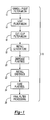
- FIG. 1 A flow chart depicting the inventive filter manufacturing process 10 is shown in Figure 1.
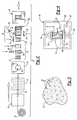
- the flow chart of Figure 1 may be read in connection with the filter assembly line 27 shown in Figure 2.
- the inventive process will be first described generally relative to Figure 1 and then described in greater detail relative to Figures 2-4.
- the filter media is unrolled and pleated, as indicated at 12.
- the filter media is heated, as indicated at 14.
- the filter media may be heated to the extent that the material in the filter media is fully cured.
- the filter media is cut to size and the free ends are joined together to form a cylindrical shaped filter, as indicated at 16.
- a center tube may be installed into the filter media, if desired, as indicated at 18.
- An adhesive having a radio frequency (RF) receptive material is dispensed, for securing end discs to the filter media as indicated at 20.
- End discs are installed onto the filter media, as indicated at 22.
- the adhesive is cured, as indicated at 24, by briefly exposing the adhesive to RF waves.
- the filter assembly comprising the filter media and end discs is ready for final filter processing, as indicated at 26, immediately following the curing of the adhesive.
- a roll of paper filter media 28 is fed into a pleater 29 that makes folds in the filter media to produce a pleated paper filter media 30.
- the pleated paper filter media 30 is fed into an oven 32 where the material in the filter media is exposed to heat sufficient to fully cure the material in the filter media.
- a sacrificial dye in the filter media colors the filter media tan when the material in the filter media has been fully cured providing a visual indication that the media has cured as desired.
- the prior art filter manufacturing processes did not enable the filter media to be fully cured since the filter media was exposed to a significant amount of heat during the adhesive curing process, which would destroy or significantly degrade the filter media. However, some heat was required to stiffen the media better enabling processing.
- the cured filter media is fed through a machine 34 that cuts the filter media into desired lengths and forms the filter media into a cylindrical-shaped filter element 35.
- the free ends of the filter element 35 are joined together, for example, by clips 36, which forms a central opening 38.
- a center tube 44 may be inserted into the central opening 38 at station 42 to provide additional structural support for the filter element 38 during filter operation, however, a center tube 44 need not be used.
- a dispenser 50 deposits an adhesive 52 onto first 56 and second 58 end discs at a station 46. While metal end discs are typically used, paper or other non-metallic end discs may now be used with the inventive manufacturing process due to the reduced temperatures and exposure as compared to the prior art process.
- the adhesive 52 includes an RF receptive material 54 dispersed throughout. The RF receptive material 54 becomes excited in response to exposure to RF waves, which produces heat.
- One end disc 56 and 58 may arranged onto the filter element 35 and cured one at a time. Alternatively, both of the end discs 56 and 58 may be arranged onto the filter element 35 and the adhesive on the end discs 56 and 58 simultaneously cured.
- An adhesive 52 having a greater viscosity enables the end discs 56 and 58 to be installed onto the filter element 35 and cured simultaneously since the adhesive will run more slowly.
- a lower viscosity adhesive may also be used, however, the end disc 56 and 58 may have to be cured and installed onto the filter element 35 one at a time to avoid the adhesive 52 from running or wicking into the filter media.
- adhesive plastisol may be inserted into a mold and an end of the filter element 35 inserted into the adhesive. The adhesive end disc then may be cured upon exposure to RF waves.
- the filter element 35, discs 56 and 58, and adhesive 52 together comprise the filter assembly 59.
- the filter assembly 59 is fed through a curing tunnel 60 to heat and cure the adhesive 52.
- the curing tunnel 60 of the inventive filter manufacturing process 10 is shown in more detail in Figure 4.
- the filter assembly 59 is fed through the curing tunnel 60 on a conveyor 62.
- the curing tunnel 60 includes RF emitters 64 arranged proximate to the adhesive 52. RF waves create a near field effect in which the strength of the waves decrease the farther the waves are from the RF emitters 64 at a relationship that is the square of the distance from the RF emitter 64.
- localized heating of the adhesive 52 may be achieved without heating other portions of the filter media, which would otherwise destroy or degrade the filter media.
- the RF emitters 64 are positioned at a distance, away from the adhesive 52 that is selected to sufficiently excite the RF receptive material 54 thereby generating an adequate amount of heat to cure the adhesive 52 without degrading the filter media and other areas of the filter assembly 59.
- the curing tunnel 60 may include a shield 66 to contain the RF waves.
Landscapes
- Chemical & Material Sciences (AREA)
- Chemical Kinetics & Catalysis (AREA)
- Filtering Materials (AREA)
- Filtering Of Dispersed Particles In Gases (AREA)
- Filtration Of Liquid (AREA)
Applications Claiming Priority (2)
| Application Number | Priority Date | Filing Date | Title |
|---|---|---|---|
| US10/771,915 US20050167356A1 (en) | 2004-02-04 | 2004-02-04 | RF receptive filter adhesive |
| US771915 | 2004-02-04 |
Publications (1)
| Publication Number | Publication Date |
|---|---|
| EP1561503A1 true EP1561503A1 (de) | 2005-08-10 |
Family
ID=34679373
Family Applications (1)
| Application Number | Title | Priority Date | Filing Date |
|---|---|---|---|
| EP05250601A Withdrawn EP1561503A1 (de) | 2004-02-04 | 2005-02-03 | Herstellung von Filterelementen unter Verwendung von radiofrequenz-sensitiven Klebemitteln |
Country Status (5)
| Country | Link |
|---|---|
| US (1) | US20050167356A1 (de) |
| EP (1) | EP1561503A1 (de) |
| JP (1) | JP2005246373A (de) |
| CN (1) | CN1310697C (de) |
| CA (1) | CA2491822A1 (de) |
Families Citing this family (2)
| Publication number | Priority date | Publication date | Assignee | Title |
|---|---|---|---|---|
| DE102007013178A1 (de) * | 2007-03-20 | 2008-09-25 | Hydac Filtertechnik Gmbh | Verfahren zum Herstellen eines Filterelementes und nach dem Verfahren hergestelltes Filterelement |
| CN114605748B (zh) * | 2022-04-13 | 2023-12-01 | 南通顺驰橡胶制品有限公司 | 一种环保型丁基胶内胎料制备工艺及滤胶机 |
Citations (7)
| Publication number | Priority date | Publication date | Assignee | Title |
|---|---|---|---|---|
| US2966469A (en) * | 1955-04-12 | 1960-12-27 | Union Carbide Corporated | Method of curing plasticized polyvinylchloride using radio frequency electrical energy |
| US3164506A (en) * | 1961-05-04 | 1965-01-05 | Gen Motors Corp | Method of bonding end closures to paper filter elements |
| DE2758208A1 (de) * | 1977-01-28 | 1978-08-03 | Continental Group | Verfahren zum herstellen von dichtungen in behaelterverschluessen |
| US4561979A (en) * | 1983-01-03 | 1985-12-31 | Harmsco, Inc. | Single cartridge filter |
| US5288469A (en) * | 1992-03-16 | 1994-02-22 | Envirosurgical, Inc. | Surgery plume filter device |
| EP0635295A2 (de) * | 1993-07-06 | 1995-01-25 | Baldwin Filters, Inc. | Ölfilterpatrone |
| US5714030A (en) * | 1992-12-07 | 1998-02-03 | Tsuchiya Mfg. Co., Ltd. | Plastisol type adhesive composition used in filter for alcohol-containing fuel |
Family Cites Families (1)
| Publication number | Priority date | Publication date | Assignee | Title |
|---|---|---|---|---|
| US4675139A (en) * | 1985-10-21 | 1987-06-23 | Continental Can Company, Inc. | Method of forming plastisol gaskets in container closures fabricated from synthetic plastic resins |
-
2004
- 2004-02-04 US US10/771,915 patent/US20050167356A1/en not_active Abandoned
-
2005
- 2005-01-10 CA CA002491822A patent/CA2491822A1/en not_active Abandoned
- 2005-02-03 CN CNB2005100016585A patent/CN1310697C/zh not_active Expired - Fee Related
- 2005-02-03 JP JP2005027280A patent/JP2005246373A/ja active Pending
- 2005-02-03 EP EP05250601A patent/EP1561503A1/de not_active Withdrawn
Patent Citations (7)
| Publication number | Priority date | Publication date | Assignee | Title |
|---|---|---|---|---|
| US2966469A (en) * | 1955-04-12 | 1960-12-27 | Union Carbide Corporated | Method of curing plasticized polyvinylchloride using radio frequency electrical energy |
| US3164506A (en) * | 1961-05-04 | 1965-01-05 | Gen Motors Corp | Method of bonding end closures to paper filter elements |
| DE2758208A1 (de) * | 1977-01-28 | 1978-08-03 | Continental Group | Verfahren zum herstellen von dichtungen in behaelterverschluessen |
| US4561979A (en) * | 1983-01-03 | 1985-12-31 | Harmsco, Inc. | Single cartridge filter |
| US5288469A (en) * | 1992-03-16 | 1994-02-22 | Envirosurgical, Inc. | Surgery plume filter device |
| US5714030A (en) * | 1992-12-07 | 1998-02-03 | Tsuchiya Mfg. Co., Ltd. | Plastisol type adhesive composition used in filter for alcohol-containing fuel |
| EP0635295A2 (de) * | 1993-07-06 | 1995-01-25 | Baldwin Filters, Inc. | Ölfilterpatrone |
Also Published As
| Publication number | Publication date |
|---|---|
| US20050167356A1 (en) | 2005-08-04 |
| JP2005246373A (ja) | 2005-09-15 |
| CA2491822A1 (en) | 2005-08-04 |
| CN1310697C (zh) | 2007-04-18 |
| CN1651537A (zh) | 2005-08-10 |
Similar Documents
| Publication | Publication Date | Title |
|---|---|---|
| US2749265A (en) | Method of making pleated paper filter elements | |
| CA2695916C (en) | Brace bar with tabbed apertures for brazing to a flow tube | |
| KR100356089B1 (ko) | 필터장치 | |
| US7458468B2 (en) | Fuel filter diverter | |
| WO1996033001A1 (en) | Pleated filter and a method for making the same | |
| EA038919B1 (ru) | Пресс-фитинг для соединения труб и способ его изготовления | |
| EP3957380A1 (de) | Filterelement und verfahren zum herstellen eines filterelements | |
| CA2597909A1 (en) | Radial expansion of a wellbore casing against a formation | |
| US20050167356A1 (en) | RF receptive filter adhesive | |
| WO1997033674A1 (en) | Color coded side seam label for filter element | |
| DE60012430D1 (de) | Verfahren und Einrichtung zur industriellen Herstellung von Produkten durch Alkoxylationsreaktionen | |
| DE60027001T2 (de) | Zusammensetzung eines coriolisdurchflussmessers mit einem geradrohr | |
| US8640884B2 (en) | Fluid treatment elements and fluid treatment arrangements with spaces between fluid treatment elements and methods for making and using them | |
| US7481862B2 (en) | Filter assembly using adhesive center tube | |
| US6293410B1 (en) | No-cure fuel filter and method for making same | |
| US4474661A (en) | Filter dryer | |
| WO2003069284A1 (de) | Strömungsgleichrichter für einen luftmassensensor | |
| TW450829B (en) | Filter element and method of assembling an air filter | |
| GB2328888A (en) | Conical pleated filter cartridges | |
| US20090026129A1 (en) | Filter element with sealing and method of producing the filter element | |
| DE19610414C2 (de) | Ölfilter und Verfahren zu seiner Herstellung | |
| US4071453A (en) | Diaphragm filtration system | |
| US20080283132A1 (en) | Gasket with internal screen and method of manufacturing the same | |
| US7473355B2 (en) | Chemical additive carrier for filter | |
| US4188836A (en) | Repair part and method for repairing transmission detent cable |
Legal Events
| Date | Code | Title | Description |
|---|---|---|---|
| PUAI | Public reference made under article 153(3) epc to a published international application that has entered the european phase |
Free format text: ORIGINAL CODE: 0009012 |
|
| AK | Designated contracting states |
Kind code of ref document: A1 Designated state(s): AT BE BG CH CY CZ DE DK EE ES FI FR GB GR HU IE IS IT LI LT LU MC NL PL PT RO SE SI SK TR |
|
| AX | Request for extension of the european patent |
Extension state: AL BA HR LV MK YU |
|
| 17P | Request for examination filed |
Effective date: 20060120 |
|
| AKX | Designation fees paid |
Designated state(s): AT BE BG CH CY LI |
|
| REG | Reference to a national code |
Ref country code: DE Ref legal event code: 8566 |
|
| RBV | Designated contracting states (corrected) |
Designated state(s): DE ES FR GB IT |
|
| 17Q | First examination report despatched |
Effective date: 20060821 |
|
| RAP1 | Party data changed (applicant data changed or rights of an application transferred) |
Owner name: PUROLATOR FILTERS NA LLC |
|
| STAA | Information on the status of an ep patent application or granted ep patent |
Free format text: STATUS: THE APPLICATION IS DEEMED TO BE WITHDRAWN |
|
| 18D | Application deemed to be withdrawn |
Effective date: 20070829 |