EP1564161A2 - Gewebeverstärktes Band zur Beförderung von Nahrungsmitteln - Google Patents
Gewebeverstärktes Band zur Beförderung von Nahrungsmitteln Download PDFInfo
- Publication number
- EP1564161A2 EP1564161A2 EP04019575A EP04019575A EP1564161A2 EP 1564161 A2 EP1564161 A2 EP 1564161A2 EP 04019575 A EP04019575 A EP 04019575A EP 04019575 A EP04019575 A EP 04019575A EP 1564161 A2 EP1564161 A2 EP 1564161A2
- Authority
- EP
- European Patent Office
- Prior art keywords
- web
- composite web
- threads
- warp
- extending
- Prior art date
- Legal status (The legal status is an assumption and is not a legal conclusion. Google has not performed a legal analysis and makes no representation as to the accuracy of the status listed.)
- Granted
Links
Images



Classifications
-
- D—TEXTILES; PAPER
- D03—WEAVING
- D03D—WOVEN FABRICS; METHODS OF WEAVING; LOOMS
- D03D1/00—Woven fabrics designed to make specified articles
- D03D1/0094—Belts
-
- B—PERFORMING OPERATIONS; TRANSPORTING
- B65—CONVEYING; PACKING; STORING; HANDLING THIN OR FILAMENTARY MATERIAL
- B65G—TRANSPORT OR STORAGE DEVICES, e.g. CONVEYORS FOR LOADING OR TIPPING, SHOP CONVEYOR SYSTEMS OR PNEUMATIC TUBE CONVEYORS
- B65G15/00—Conveyors having endless load-conveying surfaces, i.e. belts and like continuous members, to which tractive effort is transmitted by means other than endless driving elements of similar configuration
- B65G15/30—Belts or like endless load-carriers
- B65G15/32—Belts or like endless load-carriers made of rubber or plastics
- B65G15/34—Belts or like endless load-carriers made of rubber or plastics with reinforcing layers, e.g. of fabric
-
- B—PERFORMING OPERATIONS; TRANSPORTING
- B65—CONVEYING; PACKING; STORING; HANDLING THIN OR FILAMENTARY MATERIAL
- B65G—TRANSPORT OR STORAGE DEVICES, e.g. CONVEYORS FOR LOADING OR TIPPING, SHOP CONVEYOR SYSTEMS OR PNEUMATIC TUBE CONVEYORS
- B65G15/00—Conveyors having endless load-conveying surfaces, i.e. belts and like continuous members, to which tractive effort is transmitted by means other than endless driving elements of similar configuration
- B65G15/30—Belts or like endless load-carriers
- B65G15/56—Belts or like endless load-carriers with edge-protecting or reinforcing means
-
- D—TEXTILES; PAPER
- D03—WEAVING
- D03D—WOVEN FABRICS; METHODS OF WEAVING; LOOMS
- D03D1/00—Woven fabrics designed to make specified articles
-
- D—TEXTILES; PAPER
- D03—WEAVING
- D03D—WOVEN FABRICS; METHODS OF WEAVING; LOOMS
- D03D19/00—Gauze or leno-woven fabrics
-
- B—PERFORMING OPERATIONS; TRANSPORTING
- B65—CONVEYING; PACKING; STORING; HANDLING THIN OR FILAMENTARY MATERIAL
- B65G—TRANSPORT OR STORAGE DEVICES, e.g. CONVEYORS FOR LOADING OR TIPPING, SHOP CONVEYOR SYSTEMS OR PNEUMATIC TUBE CONVEYORS
- B65G2207/00—Indexing codes relating to constructional details, configuration and additional features of a handling device, e.g. Conveyors
- B65G2207/26—Hygienic features, e.g. easy to sanitize
-
- Y—GENERAL TAGGING OF NEW TECHNOLOGICAL DEVELOPMENTS; GENERAL TAGGING OF CROSS-SECTIONAL TECHNOLOGIES SPANNING OVER SEVERAL SECTIONS OF THE IPC; TECHNICAL SUBJECTS COVERED BY FORMER USPC CROSS-REFERENCE ART COLLECTIONS [XRACs] AND DIGESTS
- Y10—TECHNICAL SUBJECTS COVERED BY FORMER USPC
- Y10T—TECHNICAL SUBJECTS COVERED BY FORMER US CLASSIFICATION
- Y10T442/00—Fabric [woven, knitted, or nonwoven textile or cloth, etc.]
- Y10T442/10—Scrim [e.g., open net or mesh, gauze, loose or open weave or knit, etc.]
- Y10T442/102—Woven scrim
- Y10T442/172—Coated or impregnated
-
- Y—GENERAL TAGGING OF NEW TECHNOLOGICAL DEVELOPMENTS; GENERAL TAGGING OF CROSS-SECTIONAL TECHNOLOGIES SPANNING OVER SEVERAL SECTIONS OF THE IPC; TECHNICAL SUBJECTS COVERED BY FORMER USPC CROSS-REFERENCE ART COLLECTIONS [XRACs] AND DIGESTS
- Y10—TECHNICAL SUBJECTS COVERED BY FORMER USPC
- Y10T—TECHNICAL SUBJECTS COVERED BY FORMER US CLASSIFICATION
- Y10T442/00—Fabric [woven, knitted, or nonwoven textile or cloth, etc.]
- Y10T442/10—Scrim [e.g., open net or mesh, gauze, loose or open weave or knit, etc.]
- Y10T442/102—Woven scrim
- Y10T442/172—Coated or impregnated
- Y10T442/178—Synthetic polymeric fiber
-
- Y—GENERAL TAGGING OF NEW TECHNOLOGICAL DEVELOPMENTS; GENERAL TAGGING OF CROSS-SECTIONAL TECHNOLOGIES SPANNING OVER SEVERAL SECTIONS OF THE IPC; TECHNICAL SUBJECTS COVERED BY FORMER USPC CROSS-REFERENCE ART COLLECTIONS [XRACs] AND DIGESTS
- Y10—TECHNICAL SUBJECTS COVERED BY FORMER USPC
- Y10T—TECHNICAL SUBJECTS COVERED BY FORMER US CLASSIFICATION
- Y10T442/00—Fabric [woven, knitted, or nonwoven textile or cloth, etc.]
- Y10T442/20—Coated or impregnated woven, knit, or nonwoven fabric which is not [a] associated with another preformed layer or fiber layer or, [b] with respect to woven and knit, characterized, respectively, by a particular or differential weave or knit, wherein the coating or impregnation is neither a foamed material nor a free metal or alloy layer
- Y10T442/2549—Coating or impregnation is chemically inert or of stated nonreactance
-
- Y—GENERAL TAGGING OF NEW TECHNOLOGICAL DEVELOPMENTS; GENERAL TAGGING OF CROSS-SECTIONAL TECHNOLOGIES SPANNING OVER SEVERAL SECTIONS OF THE IPC; TECHNICAL SUBJECTS COVERED BY FORMER USPC CROSS-REFERENCE ART COLLECTIONS [XRACs] AND DIGESTS
- Y10—TECHNICAL SUBJECTS COVERED BY FORMER USPC
- Y10T—TECHNICAL SUBJECTS COVERED BY FORMER US CLASSIFICATION
- Y10T442/00—Fabric [woven, knitted, or nonwoven textile or cloth, etc.]
- Y10T442/20—Coated or impregnated woven, knit, or nonwoven fabric which is not [a] associated with another preformed layer or fiber layer or, [b] with respect to woven and knit, characterized, respectively, by a particular or differential weave or knit, wherein the coating or impregnation is neither a foamed material nor a free metal or alloy layer
- Y10T442/273—Coating or impregnation provides wear or abrasion resistance
-
- Y—GENERAL TAGGING OF NEW TECHNOLOGICAL DEVELOPMENTS; GENERAL TAGGING OF CROSS-SECTIONAL TECHNOLOGIES SPANNING OVER SEVERAL SECTIONS OF THE IPC; TECHNICAL SUBJECTS COVERED BY FORMER USPC CROSS-REFERENCE ART COLLECTIONS [XRACs] AND DIGESTS
- Y10—TECHNICAL SUBJECTS COVERED BY FORMER USPC
- Y10T—TECHNICAL SUBJECTS COVERED BY FORMER US CLASSIFICATION
- Y10T442/00—Fabric [woven, knitted, or nonwoven textile or cloth, etc.]
- Y10T442/20—Coated or impregnated woven, knit, or nonwoven fabric which is not [a] associated with another preformed layer or fiber layer or, [b] with respect to woven and knit, characterized, respectively, by a particular or differential weave or knit, wherein the coating or impregnation is neither a foamed material nor a free metal or alloy layer
- Y10T442/2861—Coated or impregnated synthetic organic fiber fabric
-
- Y—GENERAL TAGGING OF NEW TECHNOLOGICAL DEVELOPMENTS; GENERAL TAGGING OF CROSS-SECTIONAL TECHNOLOGIES SPANNING OVER SEVERAL SECTIONS OF THE IPC; TECHNICAL SUBJECTS COVERED BY FORMER USPC CROSS-REFERENCE ART COLLECTIONS [XRACs] AND DIGESTS
- Y10—TECHNICAL SUBJECTS COVERED BY FORMER USPC
- Y10T—TECHNICAL SUBJECTS COVERED BY FORMER US CLASSIFICATION
- Y10T442/00—Fabric [woven, knitted, or nonwoven textile or cloth, etc.]
- Y10T442/30—Woven fabric [i.e., woven strand or strip material]
- Y10T442/3179—Woven fabric is characterized by a particular or differential weave other than fabric in which the strand denier or warp/weft pick count is specified
-
- Y—GENERAL TAGGING OF NEW TECHNOLOGICAL DEVELOPMENTS; GENERAL TAGGING OF CROSS-SECTIONAL TECHNOLOGIES SPANNING OVER SEVERAL SECTIONS OF THE IPC; TECHNICAL SUBJECTS COVERED BY FORMER USPC CROSS-REFERENCE ART COLLECTIONS [XRACs] AND DIGESTS
- Y10—TECHNICAL SUBJECTS COVERED BY FORMER USPC
- Y10T—TECHNICAL SUBJECTS COVERED BY FORMER US CLASSIFICATION
- Y10T442/00—Fabric [woven, knitted, or nonwoven textile or cloth, etc.]
- Y10T442/30—Woven fabric [i.e., woven strand or strip material]
- Y10T442/3179—Woven fabric is characterized by a particular or differential weave other than fabric in which the strand denier or warp/weft pick count is specified
- Y10T442/3301—Coated, impregnated, or autogenous bonded
Definitions
- the present invention relates to composite webs and more particularly to fabric reinforced webs Belts for transporting processed foodstuffs.
- the conveyor belts are made of woven fabrics that are in line with the polymeric material coated or laminated.
- the Conveyor belts made of solid sheets of polymeric material that are not woven are reinforced.
- One aspect of the present invention is to provide an improved Composite web cut to a suitable width and then used as a conveyor belt for a food processing machine or the like can be used can, preferably without sealing the cut side edge or edges must, and preferably without excessive stretching of the tape.
- a composite web includes Tissue that is at least partially embedded in a polymeric web.
- the Fabric advantageously restricts the elongation of the composite web.
- the fabric contains longitudinally extending warp threads and laterally extending weft yarns, wherein one or more pairs of substantially spaced, but still adjacent warp threads are present. At each Couple, the two warp threads are away from each other with sufficient distance, so that the composite web slotted in the longitudinal direction or at a position between the Warp threads can be slit or cut away from these to make one or to provide multiple longitudinal sections of the composite web as conveyor belts can be used.
- the warp threads lie on the cut Side edges or the upper and lower surfaces of the sections of the Composite track not free. Therefore, the sections of the composite web in an advantageous Way of conveying food in a food processing Machine or the like can be used without the cut (s) To seal side edge (s).
- the weft threads are located on the cut side edges of the sections of the composite web free.
- the weft threads are preferably and advantageously polyester monofilament yarns and the composite web is preferably substantially free of unfilled voids. Therefore, the cut side edges preferably preferentially absorb no liquids and do not need to be sealed.
- the warp threads are on or a plurality of longitudinally extending portions of warp yarns of the composite web limited, and each cutting of the composite web takes place in the longitudinal direction preferably in one or more longitudinally extending areas without warp threads of the composite web.
- the areas without warp threads contain no Warp threads of the composite web. It is preferable that several of the areas without Warp yarns and warp yarns of the composite web in a laterally extending series are arranged so that multiple digits for a possible longitudinal section are provided.
- the areas without warp threads preferably each have one lateral width, which is sufficiently large, so that long sections of the Composite material can be longitudinally cut / slotted without being in cut one of the warp threads and thus expose this.
- each warp only area contains only a warp thread and in other versions each area with warp threads contains two, three or more warp threads. It is preferable that the distance between adjacent Warp threads located in the same area with warp threads smaller than that lateral width of the areas without warp threads is.
- all or some of the Weft threads, or at least parts of some or all of the weft threads, with the polymeric web are reinforced.
- the cut side edges essentially impermeable to liquid and / or to the cut Side edges do not appear weft threads and / or the cut side edges are essentially homogeneous.
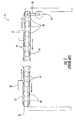
- FIG. 1 is a schematic side elevational view of parts of a conveyor system 20 according to FIG Prior art and Figure 1 shows some of the features of an exemplary Embodiment of the present invention.
- the conveyor system 20 includes a Endless conveyor belt 22 which runs around a plurality of rollers 24 which carry the conveyor belt and are rotatably mounted on a frame 26.
- the conveyor belt 22 is endless because opposite ends of the band are connected at a junction, the preferably has the form of a splice.
- the Conveyor belt 22 is driven by one of the rollers 24 is driven.
- One or several of the rollers 24 are, for example by a drive belt 28, from a motor 30 which is fixed to the frame 26.
- the upper run carries / transports of the tape food 32 or the like.
- the conveyor system 20 is preferably part of a food processing machine for processing of the food 32 serves.
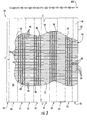
- each such longitudinal section of the composite web 34 within the longitudinally extending regions without warp yarns 40 extends and not in the longitudinal direction extending areas with warp threads 42 (e.g., in areas containing warp threads).
- FIG Figure 2 schematically represented by phantom lines.
- the phantom lines are imaginary lines passing through alternately two short dashes and a longer dash are formed.
- the composite web 34 is shown broken in the middle in Figure 2 to show that they can have different lengths and that they too may have different widths, preferably the length a multiple is greater than the width.
- the Compound 34 is made in lengths of many feet, such as a hundred Foot or more or a thousand feet or more, without being limited to it.
- the width of the Compound 34 which is the distance between side edges 52 of Composite web / polymeric web 46 is to be seven feet or a little less, though numerous other latitudes are also acceptable.
- the composite web contains 34 a fabric 44, and preferably consists essentially of this, the preferably at least substantially embedded in a polymeric web 46.
- the fabric 44 can be characterized as having the areas without warp threads and defined with warp threads 40, 42.
- FIG. 3 is a partial top plan view of FIG Composite web 34, wherein an upper part of the polymeric web 46 is removed to a Expose part of the tissue 44. Phantom lines also show schematically and partly the areas without warp threads and with warp threads 40, 42 in FIGS. 3 and 5.
- the fabric 44 preferably includes warp threads 48 which extending in the longitudinal direction, and weft threads 50, extending in the lateral direction extend, which is at least approximately perpendicular to the longitudinal direction.
- warp threads 48 which extending in the longitudinal direction
- weft threads 50 extending in the lateral direction extend, which is at least approximately perpendicular to the longitudinal direction.
- the exemplary embodiments of the present invention include the ranges without warp threads 40, preferably no warp threads 48, and each of the areas with Warp yarns 42 preferably includes one or more of the warp yarns 48.
- weft threads 50 in each of the areas without warp threads and with warp threads 40, 42 and Preferably, all of the weft threads extend completely over each of the areas without warp threads and with warp threads, especially after original ones, in Longitudinally extending side edges of the composite web 34 are cut off, such as will be discussed in more detail later.
- the fabric 44 advantageously provides for a sufficient strength in the warp direction to an undesirable longitudinal expansion the composite web 34 to prevent, wherein the tissue advantageously a adequate space between the areas with warp threads 42 for an optimal Slitting / cutting to the width provides, and the tissue enough space between leaves the weft threads 50 so that the polymeric material of the polymeric web 46 originally around each of the weft threads 50 can flow.
- the polymeric web 46 includes preferably: longitudinally extending side edges 52, laterally spaced apart from each other; laterally extending end edges 54 which are in Longitudinally spaced from each other; and outer, broad, upper and lower Surfaces 56, 58, each longitudinally and laterally between and in Continuation to the edges 52, 54 extend.
- the exemplary Embodiment of the present invention are all warp and weft threads 48, 50th the fabric 44 between the upper and lower surfaces 56, 58 and arranged none of the warp and weft threads are on one of the upper and lower surfaces free.
- Figure 2 shows that none of the threads 56, 58 of the fabric 44 on the upper and lower surfaces 56, 58 is exposed, since Figure 2 is a plan view of both above and below the composite web 34 shows.
- Figure 4 lies Preferably, none of the warp threads 48 on one of the side edges 52 free, while the Weft threads 50 are preferably exposed on the side edges 52.
- the warp threads 48 are preferably at the end edges 54 free.
- the Weft threads 50 not necessarily on the original side edges of the composite web 34 free, but the original side edges (not shown) are preferred cut to provide the illustrated side edges 52 to which the Weft threads are exposed. That is, according to the exemplary embodiment of the present invention, the original side edges of the composite web 34 be jagged so that they are cut off, whereby the side edges 52 are obtained become. Therefore, there are a variety of constructions of the original side edges the composite web 34 within the scope of the present invention since these are original Side edges are preferably cut away. Likewise, the illustrated End edges 54 preferably formed by cutting. As an alternative and if desired, special care can be taken in the original edges in a way that they do not have to be cut off.
- the polymeric web 46 / composite web 34 defines preferably a thickness T that is between and substantially perpendicular to the upper and lower surfaces 56, 58 is defined.
- the thickness T is less than about 0.4 inches, In particular, the thickness is about 0.04 inches to about 0.4 inches, and more particularly the Thickness about 0.1 inch.
- each of the warp yarn areas 42 has preferably a laterally extending width W1 and containing the entire thickness the polymeric web 46, which is within the width W1.
- each width W1 at least about the diameter of a single one of the warp threads 48, in particular each width W1 is about the diameter of a single one of the warp threads 48 up to about one foot, and more particularly each width W1 is about 0.5 inches.
- each of the inner regions has no warp threads 40 preferably a laterally extending width W2 and containing the entire thickness T of the polymeric web 46, which is within the width W2, and each of the outer regions without warp threads 40 preferably has a laterally extending Width W3 and contains the entire thickness T of the polymeric web 46, which is within the width W3 is located.
- Invention is any width W2 greater than or at least about 0.5 cm, in particular each width W2 greater than or at least about 0.5 cm to about 1.5 inches, and all in particular, each width W2 is about 0.6 inches.
- each width W3 is greater than or at least about 0.15 inches to about 0.75 inches, and more particularly each width is W3 about 0.5 cm.
- the widths W3 is equal to or about equal to widths W2.
- variations of the outer regions without warps 40, the width W3 extending laterally and located in Contained longitudinally extending side edges 52, since, for example, in some Slitting in the longitudinal direction (e.g., as hereinafter described with reference to Figs FIG. 8) near the longitudinally extending side edges of FIGS Composite web 34 is not necessary.
- broad composite webs only one or very few areas without warp threads 40 at one or more predetermined Contain positions that are only where longitudinal slotting is desired.
- the desired longitudinal slits may be spaced apart in the longitudinal direction extending side edges, as along the center line of the composite web.
- FIG. 6 is an isolated, schematic, substantially enlarged view of one Part of the fabric 44 according to the exemplary embodiment of the present invention Invention.
- the lateral width W2 ( Figures 2, 3 and 5) and each inner area without Warp threads 40 (FIGS. 2, 3 and 5) preferably correspond to a separation distance D1 ( Figure 6) between substantially spaced, yet adjacent warp threads 48, which belong to adjacent areas with warp threads 42 ( Figure 2, 3 and 5). Therefore, each separation distance D1 is greater than or at least about 0.5 cm, In particular, each separation distance D1 is greater than or at least about 0.5 cm to about 1.5 inches, and more particularly, each separation distance D1 is about 0.6 inches.
- the separation distance D2 ( Figure 6) between the warp threads of each pair clearly less than the separation distance D1 between the substantially spaced, but still adjacent warp threads, each with adjacent areas Warp threads 42 belong.
- the warp and weft threads 48, 50 provide a relatively open weave in the areas Warp threads 42 form.
- the binding prevents unwanted Slipping and shifting of the threads 48, 50, and in particular the bond is the Leno weave.
- the leno weave is a conventional bond that the A person of ordinary skill in the art should be aware.
- the warp yarns arranged in pairs and the bullet (i.e., the weft threads) just above the Tissue is fired, as in a plain weave, with the exception that the Warp threads are alternately turned to the right and to the left, crossing them before each weft thread is used.
- the leno weave provides strength and strength in an open-weave fabric, causing unwanted slippage and shifting the threads is reduced. That is, according to the exemplary Embodiment of the present invention, the warp threads 48 are preferably in order the weft threads 50 are woven in a leno weave, so that in each of the areas with warp threads 42 four pairs of closely adjacent warp threads are present, where each pair is approximately equidistant from the adjacent pair. According to the exemplary embodiment of the present invention provides the leno weave a clear locking of the warp and weft threads 48, 50 ready, and this Locking ensures that the tissue 44 during the procedure for in the Substantially embedding the tissue in the polymeric web 46 is sufficiently stable.
- the Warp threads 48 be any kind of thread suitable for Provides tensile strength properties to preferably undesirably stretch the Composite web 34 to prevent, and are preferably multifilament polyester threads.
- the warp threads 48 can be threads with a denier of about 500 to Threads with a denier of about 2000, and are preferred Multifilament polyester yarns having a denier of about 1000 arranged so are that each area with warp threads 42 contains eight of the warp threads.
- the weft threads 50 are a type of thread that is not intended to absorb liquid (e.g., solid polyester monofilament strands).
- the Weft threads 50 preferably polyester monofilament threads having a denier of about 560, which are uniformly spaced far enough apart so that the polymers Railway essentially encapsulates the weft threads.
- the fabric 44 is as Style No. 930202 available from Milliken & Company, Spartanburg, South Carolina; the However, fabric 44 may be any other type of fabric that the composite web 34 gives the desired effect.
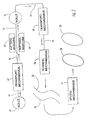
- FIG. 7 shows schematically methods and devices for forming the composite web 34, for cutting the sections 36 from the composite web and for the production of Endless belts 38 from the sections according to the exemplary embodiment of present invention.
- the fabric 44 is preferably of a roll 60 handled and transported by one or more transport mechanisms 62, the along the path of movement of the fabric 44 and / or the composite web 34 are arranged.
- the fabric 44 is passed through a coater or between Coating machines 64 transported. It can be any kind of suitable coater used in the art for coating a wide web or a web wide textile is known.
- the fabric 44 is preferably at least substantially embedded in the polymeric web 46 to form the composite web 34.
- the coater 64 may extrude the film or Extrusion calenders on both sides of the fabric 44 apply to the fabric at least substantially embed in the polymeric web 46.
- the applicators 64 may each have preformed polymeric webs on the sides Laminate the fabric, with sufficient heat is used to the Softening webs so that the webs flow around the threads 48, 50 of the fabric, and the webs at the edges of the fabric and through the spaces between them Stick threads of tissue together.
- the polymeric web 46 is an elastomeric material, and in particular polyurethane or the like.
- the composite web 34 between calender cylinders or the like can be passed to one or both of the upper and lower ones Surface 56, 58 of the composite web to provide a surface texture, and / or The composite web can be used for cooling between cooled rolls be passed through.
- the composite web 34 then preferably becomes a roll 66 formed.
- the Composite web of roll 66 through one or more transport mechanisms 68 unwound, which are arranged along the path of movement of the composite web. at a cutting mechanism 70 become portions 36 of the composite web 34 cut off.
- the sections 36 are cut both laterally and longitudinally.
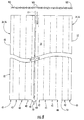
- the sections 36 become with a slot machine / knife 72 preferably in the longitudinal direction of the Composite web 34 preferably along the centerline of one of the areas without Warp threads 40 cut so that the warp threads 48 at the cut side edges 52 of the obtained sections are not exposed, as shown in Figure 4.
- the relative longitudinal movement between the knife 72 and the composite web 34 facilitates cutting in the longitudinal direction with the knife.
- This relative Longitudinal movement is shown schematically in Figure 8 by means of the knife 72, the represented by both full and dashed lines.
- the representation in Dashed line of the knife 72 shows the position before cutting and the Illustration in full line of the knife 72 shows the position after cutting.
- the Compound 34 / sections 36 are shown broken in the middle in Figure 8 in order to show that they can have different lengths and they may also have different different widths, with the lengths preferably a multiple greater than the widths.
- the cutting in the longitudinal direction with the knife 72 is continuous, wherein the Section extends over at least several feet, and extends in many situations the continuous cut is about ten feet to fifteen feet, twenty feet, thirty Foot or more, or even longer lengths, such as over a hundred feet or more, without being limited thereto.
- the slot machine 72 a Knik with a sharp cutting edge
- the slot machine 72 a Ultrasonic cutting device or another type of cutting device, the heated the cut side edges 52 in an advantageous manner.
- the parts of the weft threads 50, which are close to the cut Side edges 52 are located, and the parts of the polymeric sheet 46, the near the cut side edges lie, merge in an advantageous manner, as discussed in more detail below.
- each of the sections 36 preferably attaches connected to the ends at a splicing mechanism 74 to an endless belt 38 to form.
- an endless belt 38 is made by the two Ends of the section brought together and the polymeric web 46 at the ends is fused to form a thermoplastic splice.
- the warp threads 48 near the splice site are more advantageous Do not release freely so that they can not absorb any liquid. That is, according to All of the warp threads 48 are in the exemplary embodiment of the present invention each endless belt 38 completely in the polymeric web 46 of the endless belt 38th encapsulated.
- the endless belts 38 can thereby and advantageously instead of the conveyor belt 22 of Figure 1 for transporting food 32nd used during the processing of food, preferably without ever a sealing material on the side edges 52 of the endless belts 38th to have to attach.
- the invention may provide some sealant on the side edges 52 and / or others Surfaces of the bands 38 are applied.
- the exemplary embodiment of the present invention is the Example preferred that none of the warp threads 48 of the endless belts 38 is exposed, and that each of the areas without warp threads and with warp threads 40, 42 of an endless belt 38 contains all the weft threads 50 of the endless belt.
- Example is acceptable according to an embodiment of the present invention that one or more of the warp threads 48 of an endless belt 38 at one Outer surface of the endless belt are exposed and / or one or more of the Weft threads 50 of the endless belt are not in one or more of the areas without Warp threads and with warp threads 40, 42 of the endless belt extends.
- the Fabric 44 woven by a non-leno weave.
- a non-leno weave As an example will Assume that another type of bond in the areas with warp threads 42 could be used, such as a plain weave, but without it to be limited. In such situations, it may be beneficial to the Coater (s) 64 immediately downstream and close to the weaving machine too Positioning, which produces the tissue, so that the polymeric web 46 at the Tissue is attached while the tissue exits the loom without this Tissue between the steps of making the tissue and the formation of the tissue To wind composite web to a roll 60. In this alternative embodiment Assuming that the polymeric web 46 has a relative movement between the Threads of the tissue can limit sufficiently, so that it is not necessary, the Leno binding to use.
- each of the Areas with warp threads 42 only one warp thread, so that each of the areas with Warp threads has a width of about the diameter of the warp threads; and in this Embodiment would be preferred that each of the areas with warp threads all Containing weft threads, and that the warp and weft threads each with each other are entwined, so that the fabric is ground-bound or in another is bound in a suitable manner.
- each of the sections with warp threads contain two, three or more warp threads and Preferably, for each pair of adjacent warp threads that would be in the same area with warp threads, the distance between the warp threads of the pair is less than that Distance between adjacent areas with warp threads; each of the areas with Warp threads contain all the weft threads, and the warp and weft threads are respectively entwined with each other so that the fabric is ground bound or in another is bound in a suitable manner.
- the threads of the Tissue are intertwined with each other so that the tissue is bound, can use other types of tissues instead of the bound tissues become.
- Polyester elastomer or a polyester urethane elastomer), or the materials of the Fabric 44 and polymeric web 46 are selected in other ways, so that the weft threads 50 or at least some or parts of the weft threads 50 in the polymeric web 46 are melted when the polymeric web on the fabric 44 is applied or at another time, and the molten Weft threads or melted parts of the weft threads become part of the polymeric Web, so that the composite web 34 no weft threads or a reduced number and / or parts of the weft threads.
- the Coater (s) 64 ( Figure 7) are operated so that during the previous described coating method, the temperature of the polymeric web 46 via its melting point and the melting point of the weft threads 50 is located.
- the cut side edges 52 are substantially impermeable to liquid, Such impermeability can be achieved by melting the weft threads 50 in the polymeric web 46 are reinforced. That is, according to the present alternatives Embodiments are the cut side edges 52 substantially for Liquid impermeable and / or there are no weft threads 50 to the cut side edges 52 recognizable and / or the cut side edges 52nd are essentially homogeneous. According to another embodiment of the present invention, each appearance of the weft threads 50 to the cut side edges 52 minimized by the weft threads 50 the same color as the polymeric web 46 have.
- a hot iron (not shown) is placed along / next to cut side edges 52 of the composite web 34 with the target moves, all bubbles in the polymeric web 46 exposed by cutting the edges has been.
- this can be done before discussed merging can also be achieved by the composite web 34 is passed through a heated nip, or by other means to the to get the desired result.
Landscapes
- Engineering & Computer Science (AREA)
- Textile Engineering (AREA)
- Mechanical Engineering (AREA)
- Woven Fabrics (AREA)
- Belt Conveyors (AREA)
- Packages (AREA)
Abstract
Description
Claims (41)
ein Gewebe, das zumindest teilweise in einer polymeren Bahn eingebettet ist,
wobei das Gewebe Kettfäden enthält, die sich in Längsrichtung erstrecken, und Schussfäden, die sich in seitlicher Richtung erstrecken, die zumindest annähernd senkrecht zu der Längsrichtung liegt, wobei:
wobei die mehreren Kettfäden mindestens ein erstes Paar benachbarter Kettfäden enthalten und die Kettfäden des ersten Paares von benachbarten Kettfäden mindestens 0,5 cm voneinander beabstandet sind.
Applications Claiming Priority (2)
| Application Number | Priority Date | Filing Date | Title |
|---|---|---|---|
| US780483 | 1977-03-23 | ||
| US10/780,483 US7074729B2 (en) | 2003-02-18 | 2004-02-17 | Fabric-reinforced belt for conveying food |
Publications (3)
| Publication Number | Publication Date |
|---|---|
| EP1564161A2 true EP1564161A2 (de) | 2005-08-17 |
| EP1564161A3 EP1564161A3 (de) | 2006-10-18 |
| EP1564161B1 EP1564161B1 (de) | 2008-10-22 |
Family
ID=34701455
Family Applications (1)
| Application Number | Title | Priority Date | Filing Date |
|---|---|---|---|
| EP20040019575 Expired - Lifetime EP1564161B1 (de) | 2004-02-17 | 2004-08-18 | Gewebeverstärktes Band zur Beförderung von Nahrungsmitteln |
Country Status (4)
| Country | Link |
|---|---|
| US (1) | US7074729B2 (de) |
| EP (1) | EP1564161B1 (de) |
| AT (1) | ATE411957T1 (de) |
| DE (1) | DE502004008313D1 (de) |
Families Citing this family (13)
| Publication number | Priority date | Publication date | Assignee | Title |
|---|---|---|---|---|
| DE102005061971A1 (de) * | 2005-12-23 | 2007-07-05 | Transnorm System Gmbh | Förderband |
| US7341076B2 (en) * | 2006-04-10 | 2008-03-11 | Nv Bekaert Sa | Woven fabric comprising leno weave bound metal |
| US20080164127A1 (en) * | 2007-01-10 | 2008-07-10 | J.H. Fenner & Co. Ltd | Needled felt and monofilament fabric conveyor belt |
| KR100995510B1 (ko) * | 2007-01-16 | 2010-11-19 | 주식회사 엘지화학 | 가소제를 포함하는 아크릴계 점착제 조성물 |
| US20090130376A1 (en) * | 2007-11-20 | 2009-05-21 | The Boeing Company | Unidirectional fiber material and fabrication method |
| US20090136734A1 (en) * | 2007-11-26 | 2009-05-28 | The Boeing Company | Unidirectional resin infused panels for material characterization testing |
| CN102418188A (zh) * | 2010-09-27 | 2012-04-18 | 江苏澳盛复合材料科技有限公司 | 碳纤维布 |
| EP3356261B1 (de) | 2015-09-29 | 2020-07-01 | ContiTech Transportbandsysteme GmbH | Förderband |
| DE102019100268A1 (de) | 2019-01-08 | 2020-07-09 | Voith Patent Gmbh | Kantenschutz für eine Papiermaschinenbespannung |
| EP3835617A1 (de) * | 2019-12-10 | 2021-06-16 | Habasit AG | Förderband, insbesondere spindelband, mit lateralen ultraschall- oder laserschnittseiten |
| US12234097B2 (en) * | 2020-03-20 | 2025-02-25 | Gates Corporation | Reinforced food grade belts and manufacturing method |
| US12024819B2 (en) | 2021-03-31 | 2024-07-02 | Cooley Group Holdings, Inc. | Composite structures and methods of preparation |
| CN117966331A (zh) * | 2024-03-15 | 2024-05-03 | 澳帕曼织带(昆山)有限公司 | 一种集蛋输送织带 |
Family Cites Families (17)
| Publication number | Priority date | Publication date | Assignee | Title |
|---|---|---|---|---|
| US2356249A (en) * | 1941-04-12 | 1944-08-22 | Dayton Rubber Mfg Co | Method of making belts |
| GB1013081A (en) * | 1963-08-08 | 1965-12-15 | Turner Brothers Asbest | Improvements in conveyer belting |
| GB1547773A (en) | 1975-06-05 | 1979-06-27 | Bekaert Sa Nv | Reinforcement of resilient articles |
| BE804133A (nl) * | 1973-08-29 | 1974-02-28 | Bekaert Sa Nv | Versterkingsweefsel voor rubber- en kunststofprodukten |
| US3941162A (en) * | 1974-03-28 | 1976-03-02 | Uniroyal Inc. | Reinforcing fabric for belts |
| DE2425465B1 (de) * | 1974-05-27 | 1975-03-27 | Clouth Gummiwerke Ag | Foerdergurt |
| US4168340A (en) | 1976-05-24 | 1979-09-18 | N. V. Bekaert S.A. | Reinforcement of resilient articles |
| US4770290A (en) | 1985-08-26 | 1988-09-13 | The B. F. Goodrich Company | Conveyor belt |
| US4769202A (en) | 1985-11-29 | 1988-09-06 | The B. F. Goodrich Company | Process of making a conveyor belt |
| US4820143A (en) | 1985-11-29 | 1989-04-11 | The Bfgoodrich Company | Apparatus for making a cord reinforced polyurethane conveyor belt |
| DE4121572C1 (de) | 1991-06-29 | 1992-12-03 | Fa. Ernst Siegling, 3000 Hannover, De | |
| US5558207A (en) | 1995-04-12 | 1996-09-24 | Globe International, Inc. | Belting having sealed edge and method of manufacture |
| ZA963715B (en) * | 1995-05-12 | 1996-11-20 | Tensar Corp | Bonded composite open mesh structural textiles |
| US5595284A (en) | 1995-05-26 | 1997-01-21 | The Yokohama Rubber Co. Ltd. | Conveyor belt |
| US6174825B1 (en) * | 1997-12-09 | 2001-01-16 | Albany International Corp. | Resin-impregnated belt for application on papermaking machines and in similar industrial application |
| US6540069B2 (en) | 2000-04-12 | 2003-04-01 | Imperial Technologies, Inc | Foldable belt with internal cables |
| US20040180591A1 (en) * | 2003-03-13 | 2004-09-16 | Haneburger Jules A. | Sealed edge food belt |
-
2004
- 2004-02-17 US US10/780,483 patent/US7074729B2/en not_active Expired - Lifetime
- 2004-08-18 DE DE200450008313 patent/DE502004008313D1/de not_active Expired - Lifetime
- 2004-08-18 EP EP20040019575 patent/EP1564161B1/de not_active Expired - Lifetime
- 2004-08-18 AT AT04019575T patent/ATE411957T1/de not_active IP Right Cessation
Also Published As
| Publication number | Publication date |
|---|---|
| ATE411957T1 (de) | 2008-11-15 |
| EP1564161B1 (de) | 2008-10-22 |
| US20040161990A1 (en) | 2004-08-19 |
| US7074729B2 (en) | 2006-07-11 |
| DE502004008313D1 (de) | 2008-12-04 |
| EP1564161A3 (de) | 2006-10-18 |
Similar Documents
| Publication | Publication Date | Title |
|---|---|---|
| DE69815680T2 (de) | Multiaxiales Pressgewebe mit Kettelnaht | |
| DE3801739C2 (de) | ||
| DE69822299T2 (de) | Vorgeformte Gewebenaht | |
| DE3607613A1 (de) | Saumverbindung zum endlosmachen von papiermaschinen-bespannungen | |
| DE69407365T2 (de) | Naht mit hoher schlingendichte | |
| DE69621129T2 (de) | Schraubenförmige Naht aus Polyamid für Geweben mit Stecknaht | |
| EP1564161B1 (de) | Gewebeverstärktes Band zur Beförderung von Nahrungsmitteln | |
| EP0080713B1 (de) | Spiralgliederband und Verfahren zu dessen Herstellung | |
| DE69907995T2 (de) | Zusatz von strömungsverringerndem Material zur Doppelnahtverbindung von Gewebene | |
| DE60203833T2 (de) | Nahtkonstruktion eines Papiermachergewebes | |
| DE69929767T2 (de) | Multiaxiales Pressgewebe mit geformten Fäden | |
| DE69727706T2 (de) | Geflochtenes grundgewebe für eines schuhpressband | |
| EP3587664A1 (de) | Bespannung für papiermaschinen oder zellstoffentwässerungsmaschinen, verwendung einer solchen und verwendung von monofilamenten mit oder aus teilaromatischem polyamid zur herstellung von bespannungen für papiermaschinen oder zellstoffentwässerungsmaschinen | |
| DE69908697T2 (de) | Wellpappenmaschine mit einem mit polymeren Harzmaterial beschichtetem Gurt | |
| DE60220132T2 (de) | Verbesserte Naht für Papiermachergewebe mit Naht | |
| DE60104523T2 (de) | Technisches gewebe mit stecknaht | |
| EP0472072A1 (de) | Drahtgliederband | |
| DE60311664T2 (de) | Technisches gewebe mit auf der maschine herstellbaren nähten und nahtverstärkungsringen | |
| EP1897980B1 (de) | Band für eine Maschine zur Herstellung von Bahnmaterial, insbesondere Papier oder Karton, und Verfahren zur Herstellung eines derartigen Bandes | |
| DE2455185A1 (de) | Gewebe zur herstellung von papier | |
| EP1452639A1 (de) | Papiermaschinenbespannung | |
| DE69805532T2 (de) | Verbesserungen beim pressband für breit-nip-pressen | |
| EP2236666B1 (de) | Nahtbares Pressfilz mit flach hergestellter und nicht gewobener Trägerstruktur | |
| DE102014223972A1 (de) | Doppelschlaufennaht in Bespannung | |
| DE69929465T2 (de) | Verwobenes riemengewebe |
Legal Events
| Date | Code | Title | Description |
|---|---|---|---|
| PUAI | Public reference made under article 153(3) epc to a published international application that has entered the european phase |
Free format text: ORIGINAL CODE: 0009012 |
|
| AK | Designated contracting states |
Kind code of ref document: A2 Designated state(s): AT BE BG CH CY CZ DE DK EE ES FI FR GB GR HU IE IT LI LU MC NL PL PT RO SE SI SK TR |
|
| AX | Request for extension of the european patent |
Extension state: AL HR LT LV MK |
|
| REG | Reference to a national code |
Ref country code: HK Ref legal event code: DE Ref document number: 1081505 Country of ref document: HK |
|
| PUAL | Search report despatched |
Free format text: ORIGINAL CODE: 0009013 |
|
| AK | Designated contracting states |
Kind code of ref document: A3 Designated state(s): AT BE BG CH CY CZ DE DK EE ES FI FR GB GR HU IE IT LI LU MC NL PL PT RO SE SI SK TR |
|
| AX | Request for extension of the european patent |
Extension state: AL HR LT LV MK |
|
| RIC1 | Information provided on ipc code assigned before grant |
Ipc: B65G 15/56 20060101ALI20060911BHEP Ipc: B65G 15/34 20060101AFI20050617BHEP |
|
| 17P | Request for examination filed |
Effective date: 20070418 |
|
| AKX | Designation fees paid |
Designated state(s): AT BE BG CH CY CZ DE DK EE ES FI FR GB GR HU IE IT LI LU MC NL PL PT RO SE SI SK TR |
|
| 17Q | First examination report despatched |
Effective date: 20070625 |
|
| GRAP | Despatch of communication of intention to grant a patent |
Free format text: ORIGINAL CODE: EPIDOSNIGR1 |
|
| RIN1 | Information on inventor provided before grant (corrected) |
Inventor name: LEIGHTON, JAY PHILIP Inventor name: DEAL, NATALIE B. |
|
| GRAS | Grant fee paid |
Free format text: ORIGINAL CODE: EPIDOSNIGR3 |
|
| GRAA | (expected) grant |
Free format text: ORIGINAL CODE: 0009210 |
|
| AK | Designated contracting states |
Kind code of ref document: B1 Designated state(s): AT BE BG CH CY CZ DE DK EE ES FI FR GB GR HU IE IT LI LU MC NL PL PT RO SE SI SK TR |
|
| REG | Reference to a national code |
Ref country code: GB Ref legal event code: FG4D Free format text: NOT ENGLISH |
|
| REG | Reference to a national code |
Ref country code: CH Ref legal event code: EP |
|
| REG | Reference to a national code |
Ref country code: IE Ref legal event code: FG4D Free format text: LANGUAGE OF EP DOCUMENT: GERMAN |
|
| REF | Corresponds to: |
Ref document number: 502004008313 Country of ref document: DE Date of ref document: 20081204 Kind code of ref document: P |
|
| NLV1 | Nl: lapsed or annulled due to failure to fulfill the requirements of art. 29p and 29m of the patents act | ||
| PG25 | Lapsed in a contracting state [announced via postgrant information from national office to epo] |
Ref country code: BG Free format text: LAPSE BECAUSE OF FAILURE TO SUBMIT A TRANSLATION OF THE DESCRIPTION OR TO PAY THE FEE WITHIN THE PRESCRIBED TIME-LIMIT Effective date: 20090122 Ref country code: ES Free format text: LAPSE BECAUSE OF FAILURE TO SUBMIT A TRANSLATION OF THE DESCRIPTION OR TO PAY THE FEE WITHIN THE PRESCRIBED TIME-LIMIT Effective date: 20090202 |
|
| PG25 | Lapsed in a contracting state [announced via postgrant information from national office to epo] |
Ref country code: PT Free format text: LAPSE BECAUSE OF FAILURE TO SUBMIT A TRANSLATION OF THE DESCRIPTION OR TO PAY THE FEE WITHIN THE PRESCRIBED TIME-LIMIT Effective date: 20090323 Ref country code: PL Free format text: LAPSE BECAUSE OF FAILURE TO SUBMIT A TRANSLATION OF THE DESCRIPTION OR TO PAY THE FEE WITHIN THE PRESCRIBED TIME-LIMIT Effective date: 20081022 Ref country code: NL Free format text: LAPSE BECAUSE OF FAILURE TO SUBMIT A TRANSLATION OF THE DESCRIPTION OR TO PAY THE FEE WITHIN THE PRESCRIBED TIME-LIMIT Effective date: 20081022 Ref country code: FI Free format text: LAPSE BECAUSE OF FAILURE TO SUBMIT A TRANSLATION OF THE DESCRIPTION OR TO PAY THE FEE WITHIN THE PRESCRIBED TIME-LIMIT Effective date: 20081022 Ref country code: SI Free format text: LAPSE BECAUSE OF FAILURE TO SUBMIT A TRANSLATION OF THE DESCRIPTION OR TO PAY THE FEE WITHIN THE PRESCRIBED TIME-LIMIT Effective date: 20081022 |
|
| REG | Reference to a national code |
Ref country code: IE Ref legal event code: FD4D |
|
| PG25 | Lapsed in a contracting state [announced via postgrant information from national office to epo] |
Ref country code: DK Free format text: LAPSE BECAUSE OF FAILURE TO SUBMIT A TRANSLATION OF THE DESCRIPTION OR TO PAY THE FEE WITHIN THE PRESCRIBED TIME-LIMIT Effective date: 20081022 Ref country code: EE Free format text: LAPSE BECAUSE OF FAILURE TO SUBMIT A TRANSLATION OF THE DESCRIPTION OR TO PAY THE FEE WITHIN THE PRESCRIBED TIME-LIMIT Effective date: 20081022 Ref country code: RO Free format text: LAPSE BECAUSE OF FAILURE TO SUBMIT A TRANSLATION OF THE DESCRIPTION OR TO PAY THE FEE WITHIN THE PRESCRIBED TIME-LIMIT Effective date: 20081022 Ref country code: IE Free format text: LAPSE BECAUSE OF FAILURE TO SUBMIT A TRANSLATION OF THE DESCRIPTION OR TO PAY THE FEE WITHIN THE PRESCRIBED TIME-LIMIT Effective date: 20081022 |
|
| PLBE | No opposition filed within time limit |
Free format text: ORIGINAL CODE: 0009261 |
|
| STAA | Information on the status of an ep patent application or granted ep patent |
Free format text: STATUS: NO OPPOSITION FILED WITHIN TIME LIMIT |
|
| PG25 | Lapsed in a contracting state [announced via postgrant information from national office to epo] |
Ref country code: SE Free format text: LAPSE BECAUSE OF FAILURE TO SUBMIT A TRANSLATION OF THE DESCRIPTION OR TO PAY THE FEE WITHIN THE PRESCRIBED TIME-LIMIT Effective date: 20090122 Ref country code: IT Free format text: LAPSE BECAUSE OF FAILURE TO SUBMIT A TRANSLATION OF THE DESCRIPTION OR TO PAY THE FEE WITHIN THE PRESCRIBED TIME-LIMIT Effective date: 20081022 Ref country code: CZ Free format text: LAPSE BECAUSE OF FAILURE TO SUBMIT A TRANSLATION OF THE DESCRIPTION OR TO PAY THE FEE WITHIN THE PRESCRIBED TIME-LIMIT Effective date: 20081022 |
|
| 26N | No opposition filed |
Effective date: 20090723 |
|
| PG25 | Lapsed in a contracting state [announced via postgrant information from national office to epo] |
Ref country code: SK Free format text: LAPSE BECAUSE OF FAILURE TO SUBMIT A TRANSLATION OF THE DESCRIPTION OR TO PAY THE FEE WITHIN THE PRESCRIBED TIME-LIMIT Effective date: 20081022 |
|
| BERE | Be: lapsed |
Owner name: FORBO INTERNATIONAL S.A. Effective date: 20090831 |
|
| PG25 | Lapsed in a contracting state [announced via postgrant information from national office to epo] |
Ref country code: MC Free format text: LAPSE BECAUSE OF NON-PAYMENT OF DUE FEES Effective date: 20090831 |
|
| REG | Reference to a national code |
Ref country code: CH Ref legal event code: PL |
|
| GBPC | Gb: european patent ceased through non-payment of renewal fee |
Effective date: 20090818 |
|
| PG25 | Lapsed in a contracting state [announced via postgrant information from national office to epo] |
Ref country code: CH Free format text: LAPSE BECAUSE OF NON-PAYMENT OF DUE FEES Effective date: 20090831 Ref country code: LI Free format text: LAPSE BECAUSE OF NON-PAYMENT OF DUE FEES Effective date: 20090831 |
|
| REG | Reference to a national code |
Ref country code: FR Ref legal event code: ST Effective date: 20100430 |
|
| PG25 | Lapsed in a contracting state [announced via postgrant information from national office to epo] |
Ref country code: BE Free format text: LAPSE BECAUSE OF NON-PAYMENT OF DUE FEES Effective date: 20090831 |
|
| PG25 | Lapsed in a contracting state [announced via postgrant information from national office to epo] |
Ref country code: FR Free format text: LAPSE BECAUSE OF NON-PAYMENT OF DUE FEES Effective date: 20090831 |
|
| PG25 | Lapsed in a contracting state [announced via postgrant information from national office to epo] |
Ref country code: GR Free format text: LAPSE BECAUSE OF FAILURE TO SUBMIT A TRANSLATION OF THE DESCRIPTION OR TO PAY THE FEE WITHIN THE PRESCRIBED TIME-LIMIT Effective date: 20090123 |
|
| PG25 | Lapsed in a contracting state [announced via postgrant information from national office to epo] |
Ref country code: AT Free format text: LAPSE BECAUSE OF NON-PAYMENT OF DUE FEES Effective date: 20090818 Ref country code: GB Free format text: LAPSE BECAUSE OF NON-PAYMENT OF DUE FEES Effective date: 20090818 |
|
| PG25 | Lapsed in a contracting state [announced via postgrant information from national office to epo] |
Ref country code: LU Free format text: LAPSE BECAUSE OF NON-PAYMENT OF DUE FEES Effective date: 20090818 |
|
| PG25 | Lapsed in a contracting state [announced via postgrant information from national office to epo] |
Ref country code: HU Free format text: LAPSE BECAUSE OF FAILURE TO SUBMIT A TRANSLATION OF THE DESCRIPTION OR TO PAY THE FEE WITHIN THE PRESCRIBED TIME-LIMIT Effective date: 20090423 |
|
| PG25 | Lapsed in a contracting state [announced via postgrant information from national office to epo] |
Ref country code: TR Free format text: LAPSE BECAUSE OF FAILURE TO SUBMIT A TRANSLATION OF THE DESCRIPTION OR TO PAY THE FEE WITHIN THE PRESCRIBED TIME-LIMIT Effective date: 20081022 |
|
| PG25 | Lapsed in a contracting state [announced via postgrant information from national office to epo] |
Ref country code: CY Free format text: LAPSE BECAUSE OF FAILURE TO SUBMIT A TRANSLATION OF THE DESCRIPTION OR TO PAY THE FEE WITHIN THE PRESCRIBED TIME-LIMIT Effective date: 20081022 |
|
| REG | Reference to a national code |
Ref country code: HK Ref legal event code: WD Ref document number: 1081505 Country of ref document: HK |
|
| PGFP | Annual fee paid to national office [announced via postgrant information from national office to epo] |
Ref country code: DE Payment date: 20230831 Year of fee payment: 20 |
|
| REG | Reference to a national code |
Ref country code: DE Ref legal event code: R082 Ref document number: 502004008313 Country of ref document: DE Representative=s name: CREUTZBURG, TOM, DIPL.-ING., DE |
|
| P01 | Opt-out of the competence of the unified patent court (upc) registered |
Effective date: 20240116 |
|
| REG | Reference to a national code |
Ref country code: DE Ref legal event code: R071 Ref document number: 502004008313 Country of ref document: DE |