EP1564547B1 - Vorrichtung und Verfahren zur Bildverarbeitung - Google Patents
Vorrichtung und Verfahren zur Bildverarbeitung Download PDFInfo
- Publication number
- EP1564547B1 EP1564547B1 EP05003046A EP05003046A EP1564547B1 EP 1564547 B1 EP1564547 B1 EP 1564547B1 EP 05003046 A EP05003046 A EP 05003046A EP 05003046 A EP05003046 A EP 05003046A EP 1564547 B1 EP1564547 B1 EP 1564547B1
- Authority
- EP
- European Patent Office
- Prior art keywords
- image
- processing device
- image processing
- imaging range
- solid
- Prior art date
- Legal status (The legal status is an assumption and is not a legal conclusion. Google has not performed a legal analysis and makes no representation as to the accuracy of the status listed.)
- Expired - Lifetime
Links
- 238000012545 processing Methods 0.000 title claims description 139
- 238000003672 processing method Methods 0.000 title claims description 11
- 238000003384 imaging method Methods 0.000 claims description 201
- 238000000034 method Methods 0.000 claims description 64
- 238000007689 inspection Methods 0.000 claims description 61
- 230000008569 process Effects 0.000 claims description 55
- 238000005259 measurement Methods 0.000 claims description 18
- 238000005286 illumination Methods 0.000 claims description 5
- 230000003321 amplification Effects 0.000 claims description 2
- 238000003199 nucleic acid amplification method Methods 0.000 claims description 2
- 238000012937 correction Methods 0.000 description 10
- 239000000126 substance Substances 0.000 description 10
- 238000010586 diagram Methods 0.000 description 7
- 230000008859 change Effects 0.000 description 5
- 230000007547 defect Effects 0.000 description 4
- 230000004048 modification Effects 0.000 description 3
- 238000012986 modification Methods 0.000 description 3
- 230000005540 biological transmission Effects 0.000 description 2
- 230000000593 degrading effect Effects 0.000 description 2
- 238000003708 edge detection Methods 0.000 description 2
- 238000004519 manufacturing process Methods 0.000 description 2
- 239000002184 metal Substances 0.000 description 2
- 238000012544 monitoring process Methods 0.000 description 2
- 239000011347 resin Substances 0.000 description 2
- 229920005989 resin Polymers 0.000 description 2
- 230000008878 coupling Effects 0.000 description 1
- 238000010168 coupling process Methods 0.000 description 1
- 238000005859 coupling reaction Methods 0.000 description 1
- 230000001419 dependent effect Effects 0.000 description 1
- 239000000463 material Substances 0.000 description 1
- 230000002093 peripheral effect Effects 0.000 description 1
- 230000004044 response Effects 0.000 description 1
Images




Classifications
-
- G—PHYSICS
- G01—MEASURING; TESTING
- G01N—INVESTIGATING OR ANALYSING MATERIALS BY DETERMINING THEIR CHEMICAL OR PHYSICAL PROPERTIES
- G01N21/00—Investigating or analysing materials by the use of optical means, i.e. using sub-millimetre waves, infrared, visible or ultraviolet light
- G01N21/84—Systems specially adapted for particular applications
- G01N21/88—Investigating the presence of flaws or contamination
- G01N21/95—Investigating the presence of flaws or contamination characterised by the material or shape of the object to be examined
- G01N21/9501—Semiconductor wafers
-
- G—PHYSICS
- G01—MEASURING; TESTING
- G01N—INVESTIGATING OR ANALYSING MATERIALS BY DETERMINING THEIR CHEMICAL OR PHYSICAL PROPERTIES
- G01N21/00—Investigating or analysing materials by the use of optical means, i.e. using sub-millimetre waves, infrared, visible or ultraviolet light
- G01N21/84—Systems specially adapted for particular applications
- G01N21/88—Investigating the presence of flaws or contamination
- G01N21/95—Investigating the presence of flaws or contamination characterised by the material or shape of the object to be examined
- G01N21/956—Inspecting patterns on the surface of objects
Definitions
- the present invention relates to an image processing device and an image processing method.
- document US 6,137,531 relates to a detecting device for road monitoring which detects traveling states of vehicles on a road or fallen objects on a road, comprising: a color image pick-up camera for picking up images of a road; luminance change detecting means for detecting, in image data fed from said color image pick-up camera, image portions where the image data is different in luminance from background image data which is prepared by taking a time average of luminance for each picture element; hue change detecting means for detecting, in image data fed from said color image pick-up camera, image portions where the image data is different in hue from background image data which is prepared by taking a time average of hue for each picture element; and overlapping portion extracting and judging means for extracting overlapping portions between image portions detected by said luminance change detecting means when it is in the daytime and illuminance is larger than a predetermined value and image portions detected by said hue change detecting means at the same point of time, and judging the extracted overlapping portions to represent objects existing on the road and to be detected.
- Another document EP 0 837 323 relates a web surveillance video system for monitoring a continuous web of material moving along a path of travel through a papermaking machine, comprising: a plurality of video cameras, each for addressing a different location of interest of the web along its path of travel through the papermaking machine and for producing a video output signal; a plurality of video recorders, each for receiving at an input thereto and recording on a video tape, and for playing back and producing as an output signal, the video output signal from an associated one of said video cameras; means for time base correcting said video recorder output signals; a video monitor; means for coupling said time base corrected video recorder output signals to said video monitor and for selectively displaying on said video monitor either an image from a single one of said video cameras or a sequence of images from more than one of said video cameras; and means for receiving and responding to an independent alerting signal indicating the occurrence of a web event to be reviewed, said means for receiving and responding causing said video recorders to cease recording upon occurrence of the alerting signal, so
- An image processing device is used for the inspection of various substances such as IC (Integrated Circuit) electronic components during the manufacturing process or after manufacture, for example, the inspection such as the measurement of the size of the substance, or the existence of defects or stains (for example, Japanese Patent Laid-Open No. 2000-329536 ).
- such an image processing device 1 has a camera 2 having a solid-state image element such as a CCD (charge coupled device), an image processing device main body 3, a monitor 4 for displaying the result of the inspection or measurement by the image processing device main body 3, and cables 5 and 6 for detachably connecting the camera 2 and the image processing device main body 3, and the image processing device main body 3 and the monitor 4, respectively.
- a solid-state image element such as a CCD (charge coupled device)
- an image processing device main body 3 for displaying the result of the inspection or measurement by the image processing device main body 3, and cables 5 and 6 for detachably connecting the camera 2 and the image processing device main body 3, and the image processing device main body 3 and the monitor 4, respectively.
- an entire view field region 7 of the solid-state image element (CCD effective pixel region) or a central region other than a peripheral region of the entire view field region 7 is fixed as an imaging range 8 ( FIG. 10 ).
- An image (captured image) of the imaging region 8 is transmitted from the camera 2 to
- the entire view field region (CCD effective pixel region) 7 of the solid-state image element of the camera 2 or the central region is fixed as the imaging range 8 and the captured image is transmitted to the image processing device main body 3.
- the central region is fixed as the imaging range 8. This is generally because the memory space of the image processing device main body 3 or the display of the monitor 4 is limited.
- the entire view field region (CCD effective pixel region) 7 of the solid-state image element of the camera 2 cannot be effectively utilized. Even if the substance, that is, an inspection object enters the entire view field region 7, when it deviates from the imaging range 8, the inspection or measurement is needed to be performed again after relatively moving the inspection object or the camera 2.
- the substance may not enter the imaging range 8.
- the inspection or measurement is also needed to be performed again after relatively moving the inspection object or the camera 2.
- the camera 2 tends to adapt the solid-state image element having high pixel density such as 2 mega pixels, 4 mega pixels, or 7 mega pixels.
- the entire view field region 7 is enlarged with the replacement of the camera.
- the imaging range 8 to be actually processed is still fixed, and thus there is a problem in that the newest camera introduced is of no value.
- the image processing device main body 3 capable of utilizing the entire view field region 7 of the newest camera having high pixel density is tentatively manufactured, the image processing device main body 3 is needed to have an expanded memory space, and it takes a long time to transmit the captured image from the camera 2 to the image processing device main body 3. As a result, there is a problem in that the image cannot be processed at high speed.
- an object of the present invention to provide an image processing device and an image processing method that can effectively utilize an entire view field region of a solid-state image element of a camera without degrading the transmission rate of a captured image from the camera to an image processing device main body.
- an image processing device having a solid-state image element camera that captures a raw image of an inspection object corresponding to an entire view field region of the solid-state image element camera having an imaging range of the solid-state image element camera, wherein the imaging range is a portion of the entire view field region and is adapted to be arbitrarily set within the entire view field region, an image processing device main body that receives and processes the captured image from the camera, and a monitor that displays an inspection or measurement result by the image processing device main body, wherein the image processing device main body includes a storing section, a transmitting section, an assigning section and a receiving section; wherein the assigning section assigns the imaging range on behalf of a user, wherein the storing section is adapted to store the imaging range assigned by the user, wherein the transmitting section is adapted for reading the imaging range stored in the storing section and transmitting a signal about the read imaging range from the image processing device main body to the solid-state image element camera; and wherein the
- the user can arbitrarily set the imaging range, unlike the related art in which the imaging range is fixed.
- the image processing device is provided with the camera having high pixel density
- the entire view field region of the solid-state image element of the camera can be effectively utilize to set the imaging range, without degrading the transmission rate of the captured image from the camera to the image processing device main body.
- precision of the inspection or measurement can be increased without relatively moving the camera and the inspection object. Therefore, even if the image is captured with the camera having high pixel density, the entire view field region of the solid-state image element of the camera can be effectively utilized with the practically satisfactory process rate, and thus precision of the inspection or measurement can be increased.
- the camera and the image processing device main body may be connected to each other via a cable. According to an alternative example, the camera and the image processing device main body may be incorporated. Further, the imaging range may be set with an external apparatus connected to the image processing device main body. Alternatively, the imaging range may be set with the image processing device main body. When the imaging range is set by the external apparatus, the imaging range can be set during the image process by the image processing device main body.
- the image processing device main body can be switchable between a setup mode in which an imaging range is set and an operation mode in which an image process is performed.
- a setup mode an imaging range assigned by a user is transmitted to the solid-state image element camera, the captured image transmitted from the solid-state image element camera is displayed on the monitor, and the imaging range determined by the user is stored in a storing section.
- a signal about the imaging range stored in the storing section is transmitted from the image processing device main body to the solid-state image element camera such that the imaging range of the solid-state image element camera is set, and the image processing device main body receives and processes a captured image of the imaging range in an image captured by the solid-state image element camera.
- the image processing device main body has an assigning section that assigns the imaging range on behalf of the user, a transmitting section that transmits the imaging range assigned by the assigning section to the solid-state image element camera, a receiving section that receives the signal about the captured image of the assigned imaging range from the solid-state image element camera, a monitor display control section that transmits the captured image received from the camera to the monitor and causes the monitor to display the captured image of the imaging range, and a storing section that stores the imaging range determined by the user.
- the imaging range assigned by the user is transmitted to the solid-state image element camera, the captured image transmitted from the solid-state state image element camera is displayed en the monitor, and the imaging range determined by the user is stored in the storing section. Therefore, the user can set the imagine range while viewing the monitor.
- the present invention can also be applied to an inspection of a substance in which a first region is made of black resin and a second region is made of a metal, a portion surrounding the first region is registered as a first imaging range, and a portion surrounding the second region is registered as a second imaging range.
- a relatively slow shutter speed is registered such that an image does not become dark.
- a relatively fast shutter speed is registered such that an image does not have unduly high white levels.
- FIGS. 1 to 8 a preferred embodiment of the present invention will be described with reference to FIGS. 1 to 8 .
- an image processing device 10 of the embodiment has general elements as described in the related art, that is, a CCD camera 11, an image processing device main body 12, a monitor 13, and cables 14 and 15 that connect them to each other.
- the CCD camera 11, the image processing device main body 12, and the monitor 13 are separatable from each other by removing the cables 14 and 15.
- the CCD camera 11 is fixedly arranged on an inspection station 17 of an inspection line 16.
- An inspection object (substance) w flowing on the inspection line 16 at a predetermined tact temporarily stops in a defined location on the inspection station 17. In this state, an image of the inspection object W is captured by the camera 11.
- a memory 13 of the image processing device main body 12 stores an imaging mode arbitrarily set by a user, specifically, an imaging range and an imaging condition. Whenever the image of the same inspection object is captured by the camera 11, the imaging mode of the CCD camera 11 can be changed according to the imaging mode stored in the memory 18.
- a setup screen of the imaging mode exemplarily shown in FIG. 2 will be described.
- the user can register the imaging modes of first to fourth groups Gr1 to Gr4 and can arbitrarily set the imaging range and the imaging condition of the camera for each group.
- the user may perform the setup work with the image processing device main body 12 or with an external apparatus connected to the image processing device main body 12, for example, a personal computer, while viewing the monitor 13.
- the setup work may be performed during an image process by the image processing device main body 12.
- the imaging range and the imaging condition set in such a manner are stored in the memory 18.
- the image processing device main body 12 When the image processing device main body 12 is provided with a section that sets the imaging range and the imaging condition, the image processing device main body 12 is preferably switchable between a setup mode that sets the imaging range and the imaging condition and an operation mode that captures an image through the camera and processes the captured image.
- the imaging mode registered by the user in the setup mode, that is, the imaging range and the imaging condition are stored in the memory 18.
- the imaging mode stored in the memory 18 is read and signals about the imaging range and the imaging condition read are supplied from the image processing device main body 12 to the CCD camera 11, such that the setup of the CCD camera 11 is performed.
- the user assigns the imaging range and/or imaging condition through an assigning section (not shown) of the image processing device main body 12, and the imaging range and/or imaging condition assigned by the user is transmitted to the CCD camera 11.
- a monitor display control section (not shown) of the image processing device main body 12 transmits the captured image of the assigned imaging range and/or imaging condition received from the CCD camera 11 to the monitor 13 and causes the monitor 13 to display the captured image of the assigned imaging range and/or imaging condition.
- the user can determine the imaging range and/or imaging condition while viewing the monitor 13 and the imaging range and/or imaging condition determined by the user is stored in the memory 18.
- the imaging range 'UPPER LEFT' in the group Gr1 means that an upper left portion with respect to a CCD effective pixel region 20 of the CCD camera 11 is registered as a first imaging range 21a.
- the imaging range 'UPPER RIGHT' in the group Gr2 means that an upper right portion with respect to the CCD effective pixel region 20 is registered as a second imaging range 21b.
- the range is preferably displayed on the monitor 13. Further, after confirming the range on the monitor , the user may allow the range to be stored in the memory 18. In such a registration method of the imaging range, preferably, the user may previously set the size of the imaging range.
- a location where the imaging range 21 is set is indicated and determined by selecting 'UPPER LEFT' or the like, such that the determined imaging range is stored in the memory 18.
- 'SHUTTER 1/500' represents a shutter speed.
- 'GAIN 5' or 'GAIN 6' represents the amplification factor of a CCD output signal.
- a coordinate X(+), Y(+) with an upper left corner as an origin may be indicated and registered.
- the shutter speed of the imaging condition changes brightness (exposure time).
- registerable parameters as the imaging condition that is, as the registerable imaging conditions, zoom (magnification), scanning modes, diaphragms, illumination or the like may be included.
- the number of the groups Gr1 to Gr4 is not limited, and this is just an example.
- the first to fourth groups Gr1 to Gr4 correspond to the number of shutter times of (trigger number) with respect to one inspection object.
- the first group Gr1 substantially means a first trigger, that is, a first shutter with respect to the same inspection object
- the second group Gr2 substantially means a second trigger
- the third group Gr3 substantially means a third trigger
- the fourth group Gr4 substantially means a fourth trigger.
- the image processing device main body 12 synchronously receives a process start signal that is supplied from an exterior, such that the process is started.
- the imaging range and the imaging condition registered as the first group Gr1 are read from the memory 18, and the signals about the imaging range and the imaging condition of the first group Gr1 are supplied from the image processing device main body 12 to the CCD camera 11, such that the setup of the CCD camera 11 is performed.
- the CCD camera 11 captures an image according to the imaging condition of the first group Gr1 (step S2).
- a next step S3 in the raw image captured by the CCD camera 11 (image of the entire view field region 20), the image (captured image) of the imaging range of the first group Gr1 is transmitted from the CCD camera 11 to the image processing device main body 12.
- the image processing device main body 12 receives the image (captured image) and performs the same image process as that in the related art.
- the image process in the step S4 includes a position correction (x, y, ⁇ ) of an image about an x axis, a y axis, and a rotation ⁇ , and further it means a process required for a desired inspection or measurement (for example, the size, the existence of defects, the number, the edge detection).
- the image process including the position correction is well-known, and thus the detailed description thereon will be omitted.
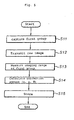
- the position correction the procedure thereof will be described with reference to FIG. 5 .
- the raw image is transmitted from the camera 11 to the image processing device main body 12 (step S12), and the measurement of the imaging range set on the first group is performed by the image processing device main body 12 (step S13). Then, the correction amount (x, y, ⁇ ) is calculated based on the measurement.
- the correction amount (x, y, ⁇ ) is stored in the memory of the image processing device main body 12.
- the correction amount (x, y, ⁇ ) is used for the pre-process (position correction) that is included in the image process of the second, third, or fourth group.
- the process returns to the step S1.
- the imaging range and the imaging condition registered as the second group Gr2 are read from the memory 18, and the signals about the imaging range and the imaging condition of the second group Gr2 are supplied from the image processing device main body 12 to the CCD camera 11, such that the setup of the CCD camera 11 is performed.
- the CCD camera 11 captures an image according to the imaging condition of the second group Gr2 (the step S2).
- the step S3 in the raw image captured by the CCD camera 11 (image of the entire view field region 20), the image (captured image) of the imaging range of the second group Gr2 is transmitted from the CCD camera 11 to the image processing device main body 12.
- the image processing device main body 12 receives the captured image and performs the same image process as that in the related art.
- the process returns to the step S1.
- the imaging range and the imaging condition registered as the third group Gr3 are read from the memory 18, and the signals about the imaging range and the imaging condition of the third group Gr3 are supplied from the image processing device main body 12 to the CCD camera 11, such that the setup of the CCD camera 11 is performed.
- the CCD camera 11 captures an image according to the imaging condition of the third group Gr3 (the step S2).
- the step S3 in the raw image captured by the CCD camera 11 (image of the entire view field region 20), the image (captured image) of the imaging range of the third group Gr3 is transmitted from the CCD camera 11 to the image processing device main body 12.
- the image processing device main body 12 receives the captured image and performs the same image process as that in the related art.
- the process returns to the step S1.
- the imaging range and the imaging condition registered as the fourth group Gr4 are read from the memory 18, and the signals about the imaging range and the imaging condition of the fourth group Gr4 are supplied from the image processing device main body 12 to the CCD camera 11, such that the setup of the CCD camera 11 is performed.
- the CCD camera 11 captures an image according to the imaging condition of the fourth group Gr4 (the step S2).
- the step S3 in the raw image captured by the CCD camera 11 (image of the entire view field region 20), the image (captured image) of the imaging range of the fourth group Gr4 is transmitted from the CCD camera 11 to the image processing device main body 12.
- the image processing device main body 12 receives the captured image and performs the same image process as that in the related art.
- step S5 If the image of the fourth group Gr4 is captured and processed, in a step S5, it is judged that all groups are processed, and the inspection or measurement of the same inspection object is completed. Then, the image processing device 10 waits until a next inspection object enters the inspection station 17.
- the overlap portion 21c when images captured several times are processed as one image, the overlap portion 21c is needed to be processed.
- the overlap portion 21c may be averaged to be processed.
- the captured images may be respectively prioritized and the image process may be performed according to the priority.
- the captured images may be weighted and the image process may be performed according to the weight.
- the imaging range and the imaging condition in the current image process may be selectively changed according to the result of the previous image process. For example, when a tolerance inspection is performed with the image process of the first group Gr1, if the result falls within the tolerance (OK), the setup signals of the imaging range and the imaging condition are transmitted such that an area inspection of an additional location is performed, and the image is captured according to the setup signals of the imaging range and the imaging condition.
- the setup signal for the change of the gain in the imaging range of the first group Gr1 is transmitted to the camera 11, and the image is captured according to the setup signals of the imaging range and the imaging condition, such that the imaging range of the first group Gr1 may be inspected again.
- a shape matching inspection is performed with the image process of the captured image under the first imaging range and imaging condition
- the tolerance inspection is subsequently performed with the same imaging range.
- a line defect inspection is subsequently performed with the same imaging range. If the shape does not match with the first or second template, a subsequent inspection may be changed according to the result of the image process such that the subsequent inspection may be not performed.
- the inspection object stops at a predetermined position
- the image processing device main body 12 synchronously receives the process start signal that is supplied from the exterior, such that the process is started.
- the imaging range and the imaging condition registered as the first group Gr1 are read from the memory 18, and the signals about the imaging range and the imaging condition of the first group Gr1 are supplied from the image processing device main body 12 to the CCD camera 11, such that the setup of the CCD camera 11 is performed.
- the CCD camera 11 captures an image according to the imaging condition of the first group Gr1 (step S22).
- a next step S23 in the raw image captured by the CCD camera 11 (image of the entire view field 20), the image (captured image) of the imaging range 21a of the first group Gr1 is supplied to the image processing device main body 12. The captured image is received by the image processing device main body 12.
- the process returns to the step S21.
- the imaging range and the imaging condition registered as the second group Gr2 are set on the CCD camera 11.
- the CCD camera 11 captures an image according to the imaging range and the imaging condition of the second group Gr2 (the step S22).
- the image (captured image) of the imaging range 21b of the second group Gr2 is supplied from the CCD camera 11 to the image processing device main body 12 (the step S23).
- the process returns to the step S21.
- the imaging range and the imaging condition registered as the third group Gr3 are set on the CCD camera 11.
- the CCD camera 11 captures an image according to the imaging condition of the third group Gr3 (the step S22).
- the image (captured image) of the imaging range 21c of the third group Gr3 is supplied from the CCD camera 11 to the image processing device main body 12 (the step S23).
- the process returns to the step S21.
- the imaging range and the imaging condition registered as the fourth group Gr4 are set on the CCD camera 11.
- the CCD camera 11 captures an image according to the imaging condition of the fourth group Gr4 (the step S22).
- the image (captured image) of the imaging range 21d of the fourth group Gr4 is supplied from the CCD camera 11 to the image processing device main body 12 (the step S23).
- the image processing device main body 12 processes the images of the respective groups.
- the image process includes the position correction (x, y, ⁇ ) of the image about the x axis, the y axis, and the rotation ⁇ , and further it means the process required for the desired inspection or measurement (for example, the size, the existence of defects, the number, the edge detection).
- the image process including the position correction is well-known, and thus the detailed description thereon will be omitted.
- the captured images of the respective groups are received by and stored in the image processing device main body 12 and the image processing device main body 12 performs the image process after receiving the captured images of all groups.
- the images can be synthesized while preventing blurring from being caused by the movement of the inspection object.
- the image processing device main body 12 requires the large memory space.
- the image processing device 10 of the embodiment for example, as shown in FIG. 7 , for a substance 32 (inspection object) that has regions 30 and 31 having different gray levels, two groups, that is, imaging ranges 21a and 21b for the respective regions 30 and 31 and imaging conditions suitable for the respective regions 30 and 31 are set and registered. Accordingly, proper images for the respective regions 30 and 31 can be received by the image processing device main body 12.
- the first region 30 is made of black resin and the second region 31 is made of a metal
- a first portion surrounding the first region 30 is registered as the imaging range of the first group Gr1 and a portion surrounding the second region 31 is registered as the imaging range of the second group Gr2.
- a relatively slow shutter speed may be registered such that the image does not become dark.
- a relatively fast shutter speed may be registered such that the image does not have unduly high white levels.
- the illumination when a proper image about the first region 30 is captured, the illumination may become bright, and, when a proper image about the second region 31 is captured, the illumination may become dark, such that the reflection may be prevented. In this case, however, a sufficient response speed cannot be ensured due to the brightness control of the illumination.
- a substance 36 having a positioning mark 35 has the size to an extent that, if not reduced, it cannot be received by the image processing device main body 12.
- a portion including the positioning mark 35 that requires inspection precision is registered as a first imaging range 21a
- a proper magnification is set for capturing the image of the portion including the mark 35
- the captured image of the first imaging range 21a is received by the image processing device main body 12.
- a portion including an inspection object 37 in which inspection precision can be ensured with reduced scale is set to a second imaging range 21b and a properly reduced magnification is set for the portion in which inspection precision can be ensured with reduced scale.
- the captured image of the second imaging range 21b may be received by the image processing device main body 12.
- the image processing device in which the CCD camera 11 and the image processing device main body 12 are connected to each other via the cable 14 is described.
- the present invention can be properly applied to an image processing device in which the CCD camera 11 and the image processing device main body 12 are incorporated.
- the present invention can be properly applied to an image processing device in which the image processing device main body 12 and the monitor 13 are incorporated.
- the present invention can be properly applied to an image processing device in which the CCD camera 11, the image processing device 12, and the monitor 13 are incorporated.
- the setup of the imaging range and/or imaging condition of the CCD camera 11 may be performed by the signal from the external apparatus.
- the setup by the signal from the external apparatus may be performed during the image process by the image processing device main body 12.
- CMOS image sensor instead of the CCD, a CMOS image sensor may be adapted. In the case of the CMOS image sensor, the advantages according to the present invention can be obtained.
Landscapes
- General Health & Medical Sciences (AREA)
- General Physics & Mathematics (AREA)
- Life Sciences & Earth Sciences (AREA)
- Chemical & Material Sciences (AREA)
- Analytical Chemistry (AREA)
- Biochemistry (AREA)
- Health & Medical Sciences (AREA)
- Immunology (AREA)
- Physics & Mathematics (AREA)
- Pathology (AREA)
- Studio Devices (AREA)
- Investigating Materials By The Use Of Optical Means Adapted For Particular Applications (AREA)
- Image Processing (AREA)
- Image Analysis (AREA)
- Closed-Circuit Television Systems (AREA)
Claims (11)
- Ein Bildverarbeitungsgerät (10), umfassend:eine Festkörperbildelementkamera (11), die ein Rohbild eines Inspektionsobjekts aufnimmt, welches einem gesamten Sichtfeldbereich der Festkörperbildelementkamera entspricht, die einen Bildbereich der Festkörperbildelementkamera aufweist, wobei der Bildbereich (21a, 21b) ein Teil des gesamten Sichtfeldbereichs (20) ist und eingerichtet ist, beliebig innerhalb des gesamten Sichtfeldbereichs (20) gesetzt zu werden;ein Bildverarbeitungsgeräthauptkörper (12), der das aufgenommene Bild von der Kamera empfängt und verarbeitet; undeinen Monitor (13), der ein Inspektions- oder Messergebnis durch den Bildverarbeitungsgeräthauptkörper anzeigt,wobei der Bildverarbeitungsgeräthauptkörper (12) einen Speicherabschnitt, einen Übertragungsabschnitt einen Zuweisungsabschnitt und einen Empfangsabschnitt umfasst, wobei der Zuweisungsabschnitt den Bildbereich im Auftrag eines Nutzers zuweist, wobei der Speicherbereich (18) eingerichtet ist, den vom Nutzer zugewiesenen Bildbereich (2 1 a, 21b) zu speichern; wobei der Übertragungsabschnitt eingerichtet ist zum Lesen des Bildbereichs, der in dem Speicherabschnitt gespeichert ist, und zum Übertragen eines Signals über den gelesenen Bildbereich von dem Bildverarbeitungsgeräthauptkörper zu der Festkörperbildelementkamera; und wobei der Empfangsteil des Bildverarbeitungsgeräthauptkörpers (12) eingerichtet ist, ein dem Bildbereich entsprechendes aufgenommenes Bildsignal von der Festkörperbildelementkamera zu empfangen;wobei das Bildverarbeitungsgerät eine Bildverarbeitung basierend auf dem aufgenommenen Signal ausführt, das durch den Empfangsabschnitt empfangen ist.
- Das Bildverarbeitungsgerät nach Anspruch 1,
wobei der Bildbereich (21 a, 21b, 21 c) der Festkörperbildelementkamera (11) durch einen externen Apparat gesetzt ist, der mit dem Bildverarbeitungsgeräthauptkörper verbunden ist. - Das Bildverarbeitungsgerät nach Anspruch 1 oder 2,
wobei der Bildbereich (21 a, 2 1 b, 21 c) der Festkörperbildelementkamera (11) durch den externen Apparat gesetzt ist während der Bildverarbeitung durch den Bildverarbeitungsgeräthauptkörper. - Bildverarbeitungsgerät nach einem der Ansprüche 1 bis 3,
wobei der Speicherabschnitt (18) weiter eine Abbildungsbedingung speichert, die durch den Nutzer gesetzt ist, und
der Bildverarbeitungsgeräthauptkörper (12) die Abbildungsbedingung aus dem Speicherabschnitt zusammen mit dem Bildbereich liest, Signale über den Bildbereich und die Abbildungsbedingung an die Festkörperbildelementkamera überträgt und die Abbildungsbedingung auf der Festkörperbildelementkamera setzt, um ein Bild aufzunehmen. - Das Bildverarbeitungsgerät nach Anspruch 4,
wobei die Abbildungsbedingung mindestens eine ist ausgewählt aus der Gruppe von Vergrößerungs- und Scan-Modi der Festkörperbildelementkamera, einem Verstärkungsfaktor eines Ausgabesignals der Festkörperbildelementkamera und einer Verschlussgeschwindigkeit, Blenden und Belichtung der Festkörperbildelementkamera. - Das Bildverarbeitungsgerät nach einem der Ansprüche 1 bis 5,
wobei die Festkörperbildelementkamera (11) und der Bildverarbeitungsgeräthauptkörper (12) miteinander durch ein Kabel (14) verbunden sind. - Das Bildverarbeitungsgerät nach einem der Ansprüche 1 bis 6,
wobei der Bildverarbeitungsgeräthauptkörper (12) aufweist:einen Zuweisungsabschnitt, der den Bildbereich im Auftrag des Nutzers zuweist;den Übertragungsabschnitt, der den durch den Zuweisungsabschnitt zugewiesenen Bildbereich an die Festkörperbildelementkamera überträgt;den Empfangsabschnitt, der das Signal über das aufgenommene Bild des zugewiesenen Bildbereichs von der Festkörperbildelementkamera empfängt;einen Monitoranzeigekontrollabschnitt, der das von der Festkörperbildelementkamera empfangene, aufgenommene Bild an den Monitor überträgt und den Monitor veranlasst, das aufgenommene Bild anzuzeigen; undden Speicherbereich, der den durch den Nutzer bestimmten Bildbereich speichert. - Das Bildverarbeitungsgerät nach einem der Ansprüche 1 bis 7,
wobei der Bildverarbeitungsgeräthauptkörper (12) aufweist: einen Zuweisungsabschnitt, der den Bildbereich und die Abbildungsbedingung im Auftrag des Nutzers zuweist;
den Übertragungsabschnitt, der den Bildbereich und die Abbildungsbedingung, die durch den Zuweisungsabschnitt zugewiesen sind, an die Festkörperbildelementkamera überträgt;
den Empfangsabschnitt, der das Signal über das unter der zugewiesenen Abbildungsbedingung aufgenommene Bild des zugewiesenen Bildbereichs von der Festkörperbildelementkamera empfängt;
einen Monitoranzeigekontrollabschnitt, der das von der Festkörperbildelementkamera empfangene, aufgenommene Bild an den Monitor überträgt und den Monitor veranlasst, das aufgenommene Bild anzuzeigen; und
den Speicherbereich, der den Bildbereich und die Abbildungsbedingung speichert, die durch den Nutzer bestimmt sind. - Ein Bildverarbeitungsverfahren ausgeführt in einem Bildverarbeitungsgerät, umfassend:Zuweisen eines Bildbereichs einer Festkörperbildelementkamera im Auftrag eines Nutzers,Speichern des durch den Nutzer zugewiesenen Bildbereichs, wobei der Bildbereich (21a, 21b) ein Teil des gesamten Sichtfeldbereichs (20) ist und eingerichtet ist, beliebig innerhalb des gesamten Sichtfeldbereichs (20) gesetzt zu werden;Aufnehmen eines Rohbildes eines Inspektionsobjekts durch die Festkörperbildelementkamera, das dem gesamten Sichtfeldbereich entspricht, und Erzeugen eines aufgenommenen Bildsignals, das dem gespeicherten Bildbereich in dem von der Festkörperbildelementkamera aufgenommenen Bild entspricht;Empfangen des aufgenommenen Bildsignals von der Festkörperbildelementkamera (11) in dem Bildverarbeitungsgeräthauptkörper (12); undAusführen einer Bildverarbeitung basierend auf dem erzeugten aufgenommenen Bildsignal.
- Das Bildverarbeitungsverfahren nach Anspruch 9, weiter umfassend:Zuweisen des Bildbereichs im Auftrag des Nutzers;Aufnehmen eines Bilds eines Inspektionsobjekts durch die Festkörperbildelementkamera und Erzeugen eines aufgenommenen Bilds des zugewiesenen Bildbereichs in dem Bild, das durch die Festkörperbildelementkamera aufgenommen wird; undAnzeigen des aufgenommenen Bilds des zugewiesenen Bildbereichs, das von der Festkörperbildelementkamera empfangen wird; undSpeichern des durch den Nutzer bestimmten Bildbereichs als gesetzten Bildbereich der Festkörperbildelementkamera.
- Das Bildverarbeitungsverfahren nach Anspruch 9, weiter umfassend:Setzen des Bildbereichs der Festkörperbildelementkamera durch einen externen Apparat, der mit dem Bildverarbeitungsgerät verbunden ist.
Applications Claiming Priority (2)
| Application Number | Priority Date | Filing Date | Title |
|---|---|---|---|
| JP2004034514A JP4521858B2 (ja) | 2004-02-12 | 2004-02-12 | 画像処理装置 |
| JP2004034514 | 2004-02-12 |
Publications (3)
| Publication Number | Publication Date |
|---|---|
| EP1564547A2 EP1564547A2 (de) | 2005-08-17 |
| EP1564547A3 EP1564547A3 (de) | 2005-09-14 |
| EP1564547B1 true EP1564547B1 (de) | 2010-10-27 |
Family
ID=34697897
Family Applications (1)
| Application Number | Title | Priority Date | Filing Date |
|---|---|---|---|
| EP05003046A Expired - Lifetime EP1564547B1 (de) | 2004-02-12 | 2005-02-14 | Vorrichtung und Verfahren zur Bildverarbeitung |
Country Status (5)
| Country | Link |
|---|---|
| US (1) | US7982779B2 (de) |
| EP (1) | EP1564547B1 (de) |
| JP (1) | JP4521858B2 (de) |
| CN (1) | CN100593104C (de) |
| DE (1) | DE602005024330D1 (de) |
Families Citing this family (9)
| Publication number | Priority date | Publication date | Assignee | Title |
|---|---|---|---|---|
| US7999861B2 (en) * | 2008-03-14 | 2011-08-16 | Omron Corporation | Image processing apparatus for generating composite image with luminance range optimized for a designated area |
| JP2010278510A (ja) * | 2009-05-26 | 2010-12-09 | Elmo Co Ltd | 資料提示装置 |
| CN101929837B (zh) * | 2009-06-22 | 2012-06-27 | 牧德科技股份有限公司 | 可连续输送待测量物件的二次元光学测量装置 |
| JP5841427B2 (ja) | 2011-12-28 | 2016-01-13 | 株式会社キーエンス | 画像処理装置及び画像処理方法 |
| JP5890692B2 (ja) * | 2012-01-13 | 2016-03-22 | キヤノン株式会社 | 撮像装置、制御方法及びプログラム |
| JP6474334B2 (ja) * | 2015-07-30 | 2019-02-27 | 株式会社キーエンス | 画像検査装置、画像検査方法および画像検査プログラム |
| JP6333871B2 (ja) * | 2016-02-25 | 2018-05-30 | ファナック株式会社 | 入力画像から検出した対象物を表示する画像処理装置 |
| JP6917762B2 (ja) * | 2017-05-09 | 2021-08-11 | 株式会社キーエンス | 画像検査装置 |
| CN109613001B (zh) * | 2018-11-07 | 2021-02-19 | 常州信息职业技术学院 | 一种基于视觉传达的信号接收处理装置 |
Family Cites Families (25)
| Publication number | Priority date | Publication date | Assignee | Title |
|---|---|---|---|---|
| JPS60236592A (ja) * | 1984-05-10 | 1985-11-25 | Toppan Printing Co Ltd | 印刷物の脱刷検査装置 |
| US5262871A (en) * | 1989-11-13 | 1993-11-16 | Rutgers, The State University | Multiple resolution image sensor |
| JP3007392B2 (ja) * | 1990-08-16 | 2000-02-07 | ニチデン機械株式会社 | パターン認識方法及びその装置 |
| CA2218563A1 (en) * | 1996-10-18 | 1998-04-18 | Consolidated Papers, Inc. | Method of and system for video surveillance of a fast moving web |
| JP3759280B2 (ja) * | 1997-04-15 | 2006-03-22 | 富士通株式会社 | 道路監視用事象検知装置 |
| JPH117392A (ja) | 1997-06-17 | 1999-01-12 | Tec Corp | 補助記憶装置を二重化してなるデータ処理装置及びこのデータ処理装置のシステム立下げ方法 |
| JPH11133292A (ja) * | 1997-10-28 | 1999-05-21 | Canon Inc | 撮像システムおよびその制御方法およびその処理を実行させるプログラムを記憶した記憶媒体 |
| US6670991B1 (en) * | 1997-09-26 | 2003-12-30 | Canon Kabushiki Kaisha | Image sensing system, control method, and recording medium for controlling a camera apparatus utilizing a client device connected thereto |
| JPH11103410A (ja) * | 1997-09-26 | 1999-04-13 | Canon Inc | カメラ制御システムおよびその制御方法およびその処理を実行するプログラムを記憶した記憶媒体 |
| JPH11122540A (ja) | 1997-10-17 | 1999-04-30 | Hamamatsu Photonics Kk | Ccdカメラ及びccdカメラ制御装置並びにccdカメラの感度調整方法 |
| US6047042A (en) * | 1998-03-25 | 2000-04-04 | Continental X-Ray Corporation | Automatic exposure and brightness control for fluoroscopic and radio-graphic imaging |
| US7161619B1 (en) * | 1998-07-28 | 2007-01-09 | Canon Kabushiki Kaisha | Data communication system, data communication control method and electronic apparatus |
| JP4124866B2 (ja) * | 1998-07-28 | 2008-07-23 | キヤノン株式会社 | 画像通信システム及び制御装置 |
| JP2000138870A (ja) * | 1998-10-30 | 2000-05-16 | Canon Inc | データ通信システム、端末装置及びシステム制御方法並びに記憶媒体 |
| JP4227238B2 (ja) | 1999-02-19 | 2009-02-18 | 株式会社キーエンス | 画像表示方法、画像処理装置、及び記録媒体 |
| JP2000329536A (ja) * | 1999-05-19 | 2000-11-30 | Nec Corp | 外観検査装置および外観検査方法 |
| KR100374046B1 (ko) * | 1999-09-30 | 2003-03-03 | 오므론 가부시키가이샤 | 화상처리장치, 화상처리방법 및 시각검사 시스템 |
| US6920241B1 (en) * | 2000-09-29 | 2005-07-19 | Cognex Corporation | System and method for bundled location and regional inspection |
| JP2002230546A (ja) | 2001-01-30 | 2002-08-16 | Fujitsu Ltd | 画像処理プログラム、画像処理プログラムを記録したコンピュータ読取可能な記録媒体、画像処理方法及び画像処理装置 |
| JP4014379B2 (ja) * | 2001-02-21 | 2007-11-28 | 株式会社日立製作所 | 欠陥レビュー装置及び方法 |
| JP2003098112A (ja) * | 2001-09-25 | 2003-04-03 | Hitachi Ltd | 薄膜デバイスの表面画像の検出・出力方法及びその装置並びにそれを用いた薄膜デバイスの製造方法及びその製造装置 |
| JP4726367B2 (ja) | 2001-09-28 | 2011-07-20 | 株式会社キーエンス | 画像処理領域の指定回路、画像処理領域の指定方法、画像処理領域の指定プログラムおよびコンピュータで読み取り可能な記録媒体 |
| US20030185432A1 (en) * | 2002-03-29 | 2003-10-02 | Hong Dezhong | Method and system for image registration based on hierarchical object modeling |
| JP4275378B2 (ja) | 2002-09-27 | 2009-06-10 | 富士重工業株式会社 | ステレオ画像処理装置およびステレオ画像処理方法 |
| US20050117017A1 (en) * | 2003-12-01 | 2005-06-02 | Baer Richard L. | System and method for imaging regions of interest |
-
2004
- 2004-02-12 JP JP2004034514A patent/JP4521858B2/ja not_active Expired - Fee Related
-
2005
- 2005-02-10 US US11/055,270 patent/US7982779B2/en not_active Expired - Fee Related
- 2005-02-14 EP EP05003046A patent/EP1564547B1/de not_active Expired - Lifetime
- 2005-02-14 DE DE602005024330T patent/DE602005024330D1/de not_active Expired - Lifetime
- 2005-02-16 CN CN200510069768A patent/CN100593104C/zh not_active Expired - Fee Related
Also Published As
| Publication number | Publication date |
|---|---|
| US20050178949A1 (en) | 2005-08-18 |
| CN100593104C (zh) | 2010-03-03 |
| EP1564547A3 (de) | 2005-09-14 |
| DE602005024330D1 (de) | 2010-12-09 |
| JP4521858B2 (ja) | 2010-08-11 |
| CN1755321A (zh) | 2006-04-05 |
| US7982779B2 (en) | 2011-07-19 |
| EP1564547A2 (de) | 2005-08-17 |
| JP2005227931A (ja) | 2005-08-25 |
Similar Documents
| Publication | Publication Date | Title |
|---|---|---|
| JP3984936B2 (ja) | 撮像装置および撮像方法 | |
| US7286171B2 (en) | Apparatus and method for concealing defective pixels in image sensors having test mode | |
| CN103139492B (zh) | 摄像装置、摄像方法以及监视系统 | |
| CN102469258B (zh) | 图像处理器及其控制方法 | |
| JPWO2011055468A1 (ja) | 撮像装置、調整装置、および撮像装置の光軸調整システム | |
| EP1564547B1 (de) | Vorrichtung und Verfahren zur Bildverarbeitung | |
| JP2009017475A (ja) | 欠陥画素検出装置、撮像装置、および、欠陥画素の検出方法 | |
| US7936948B2 (en) | System and method for merging differently focused images | |
| JP2011077825A (ja) | 表示装置、表示システム、表示方法及びプログラム | |
| JPH08254499A (ja) | 表示・外観検査装置 | |
| US20090033774A1 (en) | Imaging device | |
| JPH0686114A (ja) | 撮像装置 | |
| JP2005210164A5 (de) | ||
| JP2003051990A (ja) | 画素欠陥補正装置および画素欠陥補正方法 | |
| CN101267502A (zh) | 成像装置以及图像数据记录方法 | |
| JP2001045359A (ja) | 固体撮像装置の手ぶれ補正方法および固体撮像装置 | |
| JP2014007599A (ja) | 撮像装置、欠陥処理方法、欠陥処理プログラムおよび電子情報機器 | |
| JP2005175719A (ja) | 撮像装置及び撮像システム | |
| JP3615463B2 (ja) | ディジタルカメラおよび検査装置 | |
| JPH02264561A (ja) | 撮像素子光学ユニットの調整方法 | |
| JPH0548977A (ja) | テレビジヨンカメラ装置 | |
| KR100278670B1 (ko) | 텔레비전화면검사방법및그검사장치 | |
| JP2008131109A (ja) | 撮像装置及び撮像装置の制御方法 | |
| JP2002051261A (ja) | 画像読み取り装置および画像読み取り方法 | |
| US20100026861A1 (en) | Image capture device and image processing method for the same |
Legal Events
| Date | Code | Title | Description |
|---|---|---|---|
| PUAI | Public reference made under article 153(3) epc to a published international application that has entered the european phase |
Free format text: ORIGINAL CODE: 0009012 |
|
| PUAL | Search report despatched |
Free format text: ORIGINAL CODE: 0009013 |
|
| AK | Designated contracting states |
Kind code of ref document: A2 Designated state(s): AT BE BG CH CY CZ DE DK EE ES FI FR GB GR HU IE IS IT LI LT LU MC NL PL PT RO SE SI SK TR |
|
| AX | Request for extension of the european patent |
Extension state: AL BA HR LV MK YU |
|
| AK | Designated contracting states |
Kind code of ref document: A3 Designated state(s): AT BE BG CH CY CZ DE DK EE ES FI FR GB GR HU IE IS IT LI LT LU MC NL PL PT RO SE SI SK TR |
|
| AX | Request for extension of the european patent |
Extension state: AL BA HR LV MK YU |
|
| 17P | Request for examination filed |
Effective date: 20060207 |
|
| AKX | Designation fees paid |
Designated state(s): DE GB |
|
| 17Q | First examination report despatched |
Effective date: 20070212 |
|
| GRAP | Despatch of communication of intention to grant a patent |
Free format text: ORIGINAL CODE: EPIDOSNIGR1 |
|
| RTI1 | Title (correction) |
Free format text: IMAGE PROCESSING DEVICE AND IMAGE PROCESSING METHOD |
|
| GRAS | Grant fee paid |
Free format text: ORIGINAL CODE: EPIDOSNIGR3 |
|
| GRAA | (expected) grant |
Free format text: ORIGINAL CODE: 0009210 |
|
| AK | Designated contracting states |
Kind code of ref document: B1 Designated state(s): DE GB |
|
| REG | Reference to a national code |
Ref country code: GB Ref legal event code: FG4D |
|
| REF | Corresponds to: |
Ref document number: 602005024330 Country of ref document: DE Date of ref document: 20101209 Kind code of ref document: P |
|
| PLBE | No opposition filed within time limit |
Free format text: ORIGINAL CODE: 0009261 |
|
| STAA | Information on the status of an ep patent application or granted ep patent |
Free format text: STATUS: NO OPPOSITION FILED WITHIN TIME LIMIT |
|
| 26N | No opposition filed |
Effective date: 20110728 |
|
| REG | Reference to a national code |
Ref country code: DE Ref legal event code: R097 Ref document number: 602005024330 Country of ref document: DE Effective date: 20110728 |
|
| PGFP | Annual fee paid to national office [announced via postgrant information from national office to epo] |
Ref country code: DE Payment date: 20120208 Year of fee payment: 8 |
|
| PGFP | Annual fee paid to national office [announced via postgrant information from national office to epo] |
Ref country code: GB Payment date: 20120208 Year of fee payment: 8 |
|
| GBPC | Gb: european patent ceased through non-payment of renewal fee |
Effective date: 20130214 |
|
| REG | Reference to a national code |
Ref country code: DE Ref legal event code: R119 Ref document number: 602005024330 Country of ref document: DE Effective date: 20130903 |
|
| PG25 | Lapsed in a contracting state [announced via postgrant information from national office to epo] |
Ref country code: GB Free format text: LAPSE BECAUSE OF NON-PAYMENT OF DUE FEES Effective date: 20130214 Ref country code: DE Free format text: LAPSE BECAUSE OF NON-PAYMENT OF DUE FEES Effective date: 20130903 |