EP1564921A2 - Procédé d'adaptation entre ressources requises et ressources allouées dans un système de radiocommunications mobiles - Google Patents
Procédé d'adaptation entre ressources requises et ressources allouées dans un système de radiocommunications mobiles Download PDFInfo
- Publication number
- EP1564921A2 EP1564921A2 EP05076078A EP05076078A EP1564921A2 EP 1564921 A2 EP1564921 A2 EP 1564921A2 EP 05076078 A EP05076078 A EP 05076078A EP 05076078 A EP05076078 A EP 05076078A EP 1564921 A2 EP1564921 A2 EP 1564921A2
- Authority
- EP
- European Patent Office
- Prior art keywords
- resources
- resources required
- spreading codes
- spreading
- allocated
- Prior art date
- Legal status (The legal status is an assumption and is not a legal conclusion. Google has not performed a legal analysis and makes no representation as to the accuracy of the status listed.)
- Ceased
Links
Images

Classifications
-
- H—ELECTRICITY
- H04—ELECTRIC COMMUNICATION TECHNIQUE
- H04B—TRANSMISSION
- H04B7/00—Radio transmission systems, i.e. using radiation field
- H04B7/24—Radio transmission systems, i.e. using radiation field for communication between two or more posts
- H04B7/26—Radio transmission systems, i.e. using radiation field for communication between two or more posts at least one of which is mobile
- H04B7/2628—Radio transmission systems, i.e. using radiation field for communication between two or more posts at least one of which is mobile using code-division multiple access [CDMA] or spread spectrum multiple access [SSMA]
- H04B7/264—Radio transmission systems, i.e. using radiation field for communication between two or more posts at least one of which is mobile using code-division multiple access [CDMA] or spread spectrum multiple access [SSMA] for data rate control
-
- H—ELECTRICITY
- H04—ELECTRIC COMMUNICATION TECHNIQUE
- H04J—MULTIPLEX COMMUNICATION
- H04J13/00—Code division multiplex systems
- H04J13/16—Code allocation
-
- H—ELECTRICITY
- H04—ELECTRIC COMMUNICATION TECHNIQUE
- H04W—WIRELESS COMMUNICATION NETWORKS
- H04W28/00—Network traffic management; Network resource management
- H04W28/02—Traffic management, e.g. flow control or congestion control
- H04W28/06—Optimizing the usage of the radio link, e.g. header compression, information sizing, discarding information
-
- H—ELECTRICITY
- H04—ELECTRIC COMMUNICATION TECHNIQUE
- H04W—WIRELESS COMMUNICATION NETWORKS
- H04W72/00—Local resource management
- H04W72/04—Wireless resource allocation
- H04W72/044—Wireless resource allocation based on the type of the allocated resource
- H04W72/0466—Wireless resource allocation based on the type of the allocated resource the resource being a scrambling code
Definitions
- the present invention is generally concerned with multiple access mobile radio systems.
- radio resources are allocated dynamically to users in accordance with their requirements.
- resources allocated to a user do not exactly match resources required, with the result that matching is necessary for transmission to the radio interface.
- CDMA Code Division Multiple Access
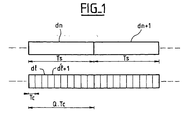
- An alternative representation of the spread sequence of length Q.N is (d1.c Q , d2.c Q , ... dN.c Q ) where d1.c Q represents the product of the symbol d1 by the spreading code c Q .
- dn and dn+1 correspond to two successive symbols of a non-spread incoming sequence and d'l and d'l+1 correspond to two successive basic symbols (or "chips") of the same spread symbol.
- resources allocated may not exactly match resources required, in particular because a code having the required length is not available (either because none is provided or because it has already been allocated).
- the problem is more serious in systems in which the bit rates to be transmitted can be different (corresponding in particular to speech, data, pictures, etc.) or vary (corresponding in particular to speech encoded with variable codes).
- Using the discontinuous transmission technique also has the drawback of reducing transmission efficiency.
- a particular aim of the present invention is to avoid the above drawbacks.
- the present invention consists in a method of matching resources required and resources allocated in a spreading code division multiple access mobile radio system, characterized in that it includes allocation of one or more spreading codes, the number and the length of said spreading codes, and in the case of a plurality of allocated spreading codes, the mode of distribution of the various symbols of a sequence to be spread, respectively despread, between said spreading codes being determined so that resources allocated are matched optimally to resources required.
- the present invention consists in a new matching technique that exploits the possibilities offered by the code division multiple access technique itself, no longer matching resources required to resources allocated, but instead matching resources allocated to resources required (nevertheless without excluding the possibility of matching resources required to resources allocated).
- the present invention achieves such matching in a relatively refined manner since resources allocated are matched to resources required in terms of the symbols constituting sequences of symbols instead of in terms of the sequences themselves.
- the present invention offers an additional degree of freedom compared to prior art techniques so that such matching is more efficient, better optimized and more flexible than using the prior art techniques referred to above.
- the number of spreading codes allocated is chosen to be as high as possible and/or the length of said spreading codes is chosen to be as low as possible, so as additionally to optimize transmission performance. This is of course effected within the limits of what is possible without allocating too great a proportion of the resources to a given user so as not to penalize other users.
- the distribution mode is defined by the fraction of symbols of a sequence of symbols to be spread, respectively despread, applied to each of said spreading codes.
- the distribution mode is further defined, for given fractions of symbols, by the mode of application of the various symbols of said sequence to said spreading codes, to obtain said fractions of symbols.
- the mode of application is chosen so as additionally to optimize transmission performance.
- the parameters for fixing resources required are also determined so that resources required are matched optimally to resources allocated.
- said parameters include:
- the present invention also consists in a transmitter device for a spreading code division multiple access mobile radio system, for implementing a method of the above kind, the transmitter device being essentially characterized in that it includes spreading means using a plurality of spreading codes and means for distributing symbols from a sequence of symbols to be spread between said spreading codes in accordance with a given distribution mode, the number and the length of said spreading codes and said distribution mode being determined so that resources allocated are matched optimally to resources required.
- the present invention further consists in a mobile station for spreading code division multiple access mobile radio systems including a transmitter device of the above kind.
- the present invention further consists in an entity, in particular base transceiver station, for spreading code division multiple access mobile radio systems including at least one transmitter device of the above kind.
- the present invention further consists in a receiver device for a spreading code division multiple access mobile radio system for implementing a method of the above kind, the receiver device being essentially characterized in that it includes despreading means using a plurality of spreading codes and means for distributing symbols from a sequence of symbols to be despread between said spreading codes, in accordance with a given distribution mode, the number and the length of said spreading codes and said distribution mode being determined so that resources allocated are matched optimally to resources required.
- the present invention further consists in a mobile station for spreading code division multiple access mobile radio systems including a receiver device of the above kind.
- the present invention further consists in an entity, in particular base transceiver station, for spreading code division multiple access mobile radio systems including at least one receiver device of the above kind.
- a transmitter device for a spreading code division multiple access mobile radio system includes:
- the receiver device shown in Figure 3 generally comprises means executing functions which are the converse of those shown in Figure 2, namely:
- the method of matching required resources and allocated resources includes the allocation of one or more spreading codes, the number and the length of those spreading codes, and in the case of a plurality of spreading codes, the mode of distribution of the various symbols of a sequence of symbols to be spread, respectively despread, between the spreading codes being determined so that resources allocated are matched optimally to resources required.
- Figures 2 and 3 correspond to the case in which the method in accordance with the invention of matching required resources and allocated resources includes the allocation of a plurality of spreading codes.
- the mode of distributing the various symbols of a sequence of symbols to be spread, respectively despread, between these spreading codes depends on various factors, such as:
- Each symbol transmitted is therefore spread, respectively despread, by a single allocated code, possibly allocated at the same time as other symbols. This implies in particular that at any time between 0 and J codes can be used simultaneously (the number 0 corresponding to when the discontinuous transmission technique previously referred to is to be used).
- the parameter a therefore takes into account the fact that at any time a plurality of symbols can be spread and transmitted simultaneously or, to the contrary, transmission can be stopped temporarily (if the discontinuous transmission technique is to be used).
- the spreading means 5 include means such as the means 5 1 , ...5 j , ...5 J to perform spreading by means of respective spreading codes of length Q (1) , ...Q (j) , ...Q (J) , and distributor means 52 receiving the sequence to be spread and distributing it, in accordance with said mode of distribution, between different means such as the means 5 1 , ...5 j , ...5 J .
- despreading means 5' include means 5 1 ', ...5 j ', ...5 J ' and 52' executing functions which are the converse of those executed by means 5 1 , ...5 j , ...5 J and 52.
- resources allocated are expressed in the form: as a function of the parameters J, Q (j) , of the distribution mode (in this instance the parameters p j and
- the parameters J, Q (j) and the distribution mode are determined so that resources allocated are matched optimally to resources required.
- transmission performance can be improved by choosing the highest possible value of the parameter a and/or the shortest possible length Q (j) of the codes, i.e. more generally by reducing the sum (of course within the limits of what can be done without penalizing other users).
- a sufficiently short code length is chosen (within the same limits) to authorize an optimum error correction encoding rate for a given payload bit rate.
- codes can be allocated at the beginning of a call or at any time during a call (the codes allocated can, for example, be shared in the time domain between a plurality of users).
- the distribution mode can change during a call.
- the parameters for fixing resources required can also be determined so that resources required are matched optimally to resources allocated. In the example shown in Figures 2 and 3, such matching can be obtained by operating on one or more of the parameters R, ⁇ c , ⁇ r and m.
- the means 1 to 4 and 1' to 4' can be conventional means and therefore do not need to be described in detail here.
- the means as 5 1 , ...5 j , ...5 J and 5 1 ', ...5 j ', ...5 J ' can equally be conventional means and do not need to be described in detail here.
- the means 6 and 6' can be conventional means, except that the means 6 may have to be adapted to receive the symbols delivered to the outputs of the means 5 1 , ...5 j , ...5 J (i.e. possibly to include as many modulator and transmitter subsystems as necessary), and similarly the means 6' may have to be adapted to deliver symbols to the means as 5 1 , ...5 j , ...5 J (i.e. possibly to include as many receiver and demodulator subsystems as necessary).
- Transmitter or receiver devices like those shown in Figures 2 and 3 can be used in mobile stations and in base transceiver stations of mobile radio systems.
Landscapes
- Engineering & Computer Science (AREA)
- Computer Networks & Wireless Communication (AREA)
- Signal Processing (AREA)
- Mobile Radio Communication Systems (AREA)
- Radio Relay Systems (AREA)
Applications Claiming Priority (3)
| Application Number | Priority Date | Filing Date | Title |
|---|---|---|---|
| FR9815620A FR2787279B1 (fr) | 1998-12-10 | 1998-12-10 | Procede d'adaptation entre ressources requises et ressources allouees dans un systeme de radiocommunications mobiles |
| FR9815620 | 1998-12-10 | ||
| EP99400903A EP1009117A1 (fr) | 1998-12-10 | 1999-04-13 | Procédé d'adaptation entre ressources requises et ressources allouées dans un système de radiocommunications mobiles |
Related Parent Applications (2)
| Application Number | Title | Priority Date | Filing Date |
|---|---|---|---|
| EP99400903.3 Division | 1999-04-13 | ||
| EP99400903A Division EP1009117A1 (fr) | 1998-12-10 | 1999-04-13 | Procédé d'adaptation entre ressources requises et ressources allouées dans un système de radiocommunications mobiles |
Publications (2)
| Publication Number | Publication Date |
|---|---|
| EP1564921A2 true EP1564921A2 (fr) | 2005-08-17 |
| EP1564921A3 EP1564921A3 (fr) | 2006-03-15 |
Family
ID=9533834
Family Applications (2)
| Application Number | Title | Priority Date | Filing Date |
|---|---|---|---|
| EP05076078A Ceased EP1564921A3 (fr) | 1998-12-10 | 1999-04-13 | Procédé d'adaptation entre ressources requises et ressources allouées dans un système de radiocommunications mobiles |
| EP99400903A Ceased EP1009117A1 (fr) | 1998-12-10 | 1999-04-13 | Procédé d'adaptation entre ressources requises et ressources allouées dans un système de radiocommunications mobiles |
Family Applications After (1)
| Application Number | Title | Priority Date | Filing Date |
|---|---|---|---|
| EP99400903A Ceased EP1009117A1 (fr) | 1998-12-10 | 1999-04-13 | Procédé d'adaptation entre ressources requises et ressources allouées dans un système de radiocommunications mobiles |
Country Status (6)
| Country | Link |
|---|---|
| EP (2) | EP1564921A3 (fr) |
| JP (1) | JP3693540B2 (fr) |
| KR (1) | KR100676338B1 (fr) |
| CN (1) | CN1256601A (fr) |
| AU (1) | AU6435999A (fr) |
| FR (1) | FR2787279B1 (fr) |
Families Citing this family (1)
| Publication number | Priority date | Publication date | Assignee | Title |
|---|---|---|---|---|
| JP4270126B2 (ja) * | 2004-12-20 | 2009-05-27 | 沖電気工業株式会社 | 符号分割多重通信システム |
Family Cites Families (3)
| Publication number | Priority date | Publication date | Assignee | Title |
|---|---|---|---|---|
| US5442625A (en) * | 1994-05-13 | 1995-08-15 | At&T Ipm Corp | Code division multiple access system providing variable data rate access to a user |
| US5896368A (en) * | 1995-05-01 | 1999-04-20 | Telefonaktiebolaget Lm Ericsson | Multi-code compressed mode DS-CDMA systems and methods |
| US6389000B1 (en) * | 1997-09-16 | 2002-05-14 | Qualcomm Incorporated | Method and apparatus for transmitting and receiving high speed data in a CDMA communication system using multiple carriers |
-
1998
- 1998-12-10 FR FR9815620A patent/FR2787279B1/fr not_active Expired - Fee Related
-
1999
- 1999-04-13 EP EP05076078A patent/EP1564921A3/fr not_active Ceased
- 1999-04-13 EP EP99400903A patent/EP1009117A1/fr not_active Ceased
- 1999-12-07 AU AU64359/99A patent/AU6435999A/en not_active Abandoned
- 1999-12-08 JP JP34839499A patent/JP3693540B2/ja not_active Expired - Fee Related
- 1999-12-10 CN CN99126110A patent/CN1256601A/zh active Pending
- 1999-12-10 KR KR1019990056401A patent/KR100676338B1/ko not_active Expired - Fee Related
Also Published As
| Publication number | Publication date |
|---|---|
| EP1009117A1 (fr) | 2000-06-14 |
| KR100676338B1 (ko) | 2007-02-01 |
| JP2000201133A (ja) | 2000-07-18 |
| FR2787279B1 (fr) | 2002-05-31 |
| JP3693540B2 (ja) | 2005-09-07 |
| FR2787279A1 (fr) | 2000-06-16 |
| CN1256601A (zh) | 2000-06-14 |
| EP1564921A3 (fr) | 2006-03-15 |
| KR20000057048A (ko) | 2000-09-15 |
| AU6435999A (en) | 2000-06-15 |
Similar Documents
| Publication | Publication Date | Title |
|---|---|---|
| JP3442787B2 (ja) | 統計的合波を利用した、通信システムの中で可変レートデータを提供するための方法と装置 | |
| US5777990A (en) | Method and apparatus for providing variable rate data in a communications system using non-orthogonal overflow channels | |
| US7502424B2 (en) | Maximizing data rate by adjusting codes and code rates | |
| RU2313193C2 (ru) | Способ и устройство для генерирования управляющей информации для пакетных данных | |
| JP2003506913A (ja) | 適応変調無線通信システム用改良フレーム構造 | |
| CN100568768C (zh) | 最小化用信号发送码和时隙分配所需数据量的方法和装置 | |
| US20090213904A1 (en) | Method and apparatus for orthogonally overlaying variable chip rate spread spectrum signals | |
| MXPA97008267A (es) | Metodo y aparato para proporcionar datos de velocidad de transmision variable en un sistema de comunicacion que utiliza multiplexado estadistico | |
| US7751371B2 (en) | Method and apparatus for providing variable rate data in a communications system using non-orthogonal overflow channels | |
| US7167502B1 (en) | Zero-overhead symbol rate adaptation system for OVSF code | |
| US20030086364A1 (en) | Dynamically-scalable system and method for multiple user access utilzing multi-bit and multi-code orthogonal multiplexing | |
| US7298718B2 (en) | Channel allocations in a communications system | |
| RU2221344C2 (ru) | Устройство передачи и приема дискретной информации с использованием широкополосных шумоподобных сигналов при кодовом разделении каналов | |
| US5835480A (en) | Circuitry and method for simultaneously transmitting voice and data information | |
| EP1564921A2 (fr) | Procédé d'adaptation entre ressources requises et ressources allouées dans un système de radiocommunications mobiles | |
| US6556558B1 (en) | Transmission method for use in a multiple access radiocommunication system | |
| AU2008202102A1 (en) | Method of matching resources required and resources allocated in a mobile radio system | |
| AU2004203108A1 (en) | Method of matching resources required and resources allocated in a mobile radio system | |
| EP1135864B1 (fr) | Appareil et procede permettant d'augmenter le nombre de voies dans un systeme amcr | |
| WO2006044422A2 (fr) | Systeme et procede permettant d’optimiser des attributions de codes de walsh | |
| CN1130105C (zh) | 一种终端发送到同一站的异步传输方式电信方法 | |
| MXPA00002096A (en) | A method for assigning spreading codes | |
| HK1065902B (en) | The method and device for minimizing the amount of data necessary to signal code and timeslot assignments |
Legal Events
| Date | Code | Title | Description |
|---|---|---|---|
| PUAI | Public reference made under article 153(3) epc to a published international application that has entered the european phase |
Free format text: ORIGINAL CODE: 0009012 |
|
| AC | Divisional application: reference to earlier application |
Ref document number: 1009117 Country of ref document: EP Kind code of ref document: P |
|
| AK | Designated contracting states |
Kind code of ref document: A2 Designated state(s): DE ES FI FR GB IT SE |
|
| RIN1 | Information on inventor provided before grant (corrected) |
Inventor name: ROOSEN, FABIENNE Inventor name: AGIN, PASCAL Inventor name: VISBECQ, OLIVIER Inventor name: GOURGUE, FREDERIC |
|
| PUAL | Search report despatched |
Free format text: ORIGINAL CODE: 0009013 |
|
| AK | Designated contracting states |
Kind code of ref document: A3 Designated state(s): DE ES FI FR GB IT SE |
|
| 17P | Request for examination filed |
Effective date: 20060915 |
|
| AKX | Designation fees paid |
Designated state(s): DE ES FI FR GB IT SE |
|
| 17Q | First examination report despatched |
Effective date: 20061026 |
|
| RAP1 | Party data changed (applicant data changed or rights of an application transferred) |
Owner name: ALCATEL LUCENT |
|
| STAA | Information on the status of an ep patent application or granted ep patent |
Free format text: STATUS: THE APPLICATION HAS BEEN REFUSED |
|
| 18R | Application refused |
Effective date: 20080512 |