EP1566512A2 - Portail avec dispositif de verrouillage et système d'entraínement - Google Patents
Portail avec dispositif de verrouillage et système d'entraínement Download PDFInfo
- Publication number
- EP1566512A2 EP1566512A2 EP05000738A EP05000738A EP1566512A2 EP 1566512 A2 EP1566512 A2 EP 1566512A2 EP 05000738 A EP05000738 A EP 05000738A EP 05000738 A EP05000738 A EP 05000738A EP 1566512 A2 EP1566512 A2 EP 1566512A2
- Authority
- EP
- European Patent Office
- Prior art keywords
- locking
- gate according
- door leaf
- door
- locking device
- Prior art date
- Legal status (The legal status is an assumption and is not a legal conclusion. Google has not performed a legal analysis and makes no representation as to the accuracy of the status listed.)
- Withdrawn
Links
Images







Classifications
-
- E—FIXED CONSTRUCTIONS
- E05—LOCKS; KEYS; WINDOW OR DOOR FITTINGS; SAFES
- E05B—LOCKS; ACCESSORIES THEREFOR; HANDCUFFS
- E05B65/00—Locks or fastenings for special use
- E05B65/0021—Locks or fastenings for special use for overhead or roll-up doors, e.g. garage doors
-
- E—FIXED CONSTRUCTIONS
- E05—LOCKS; KEYS; WINDOW OR DOOR FITTINGS; SAFES
- E05C—BOLTS OR FASTENING DEVICES FOR WINGS, SPECIALLY FOR DOORS OR WINDOWS
- E05C9/00—Arrangements of simultaneously actuated bolts or other securing devices at well-separated positions on the same wing
- E05C9/10—Actuating mechanisms for bars
- E05C9/14—Actuating mechanisms for bars with pins engaging slots
-
- E—FIXED CONSTRUCTIONS
- E05—LOCKS; KEYS; WINDOW OR DOOR FITTINGS; SAFES
- E05C—BOLTS OR FASTENING DEVICES FOR WINGS, SPECIALLY FOR DOORS OR WINDOWS
- E05C9/00—Arrangements of simultaneously actuated bolts or other securing devices at well-separated positions on the same wing
- E05C9/10—Actuating mechanisms for bars
- E05C9/16—Actuating mechanisms for bars with crank pins and connecting rods
-
- E—FIXED CONSTRUCTIONS
- E05—LOCKS; KEYS; WINDOW OR DOOR FITTINGS; SAFES
- E05F—DEVICES FOR MOVING WINGS INTO OPEN OR CLOSED POSITION; CHECKS FOR WINGS; WING FITTINGS NOT OTHERWISE PROVIDED FOR, CONCERNED WITH THE FUNCTIONING OF THE WING
- E05F15/00—Power-operated mechanisms for wings
- E05F15/60—Power-operated mechanisms for wings using electrical actuators
- E05F15/603—Power-operated mechanisms for wings using electrical actuators using rotary electromotors
- E05F15/665—Power-operated mechanisms for wings using electrical actuators using rotary electromotors for vertically-sliding wings
- E05F15/668—Power-operated mechanisms for wings using electrical actuators using rotary electromotors for vertically-sliding wings for overhead wings
-
- E—FIXED CONSTRUCTIONS
- E05—LOCKS; KEYS; WINDOW OR DOOR FITTINGS; SAFES
- E05B—LOCKS; ACCESSORIES THEREFOR; HANDCUFFS
- E05B47/00—Operating or controlling locks or other fastening devices by electric or magnetic means
-
- E—FIXED CONSTRUCTIONS
- E05—LOCKS; KEYS; WINDOW OR DOOR FITTINGS; SAFES
- E05C—BOLTS OR FASTENING DEVICES FOR WINGS, SPECIALLY FOR DOORS OR WINDOWS
- E05C9/00—Arrangements of simultaneously actuated bolts or other securing devices at well-separated positions on the same wing
- E05C9/06—Arrangements of simultaneously actuated bolts or other securing devices at well-separated positions on the same wing with three or more sliding bars
-
- E—FIXED CONSTRUCTIONS
- E05—LOCKS; KEYS; WINDOW OR DOOR FITTINGS; SAFES
- E05Y—INDEXING SCHEME ASSOCIATED WITH SUBCLASSES E05D AND E05F, RELATING TO CONSTRUCTION ELEMENTS, ELECTRIC CONTROL, POWER SUPPLY, POWER SIGNAL OR TRANSMISSION, USER INTERFACES, MOUNTING OR COUPLING, DETAILS, ACCESSORIES, AUXILIARY OPERATIONS NOT OTHERWISE PROVIDED FOR, APPLICATION THEREOF
- E05Y2201/00—Constructional elements; Accessories therefor
- E05Y2201/20—Brakes; Disengaging means; Holders; Stops; Valves; Accessories therefor
- E05Y2201/218—Holders
- E05Y2201/22—Locks
-
- E—FIXED CONSTRUCTIONS
- E05—LOCKS; KEYS; WINDOW OR DOOR FITTINGS; SAFES
- E05Y—INDEXING SCHEME ASSOCIATED WITH SUBCLASSES E05D AND E05F, RELATING TO CONSTRUCTION ELEMENTS, ELECTRIC CONTROL, POWER SUPPLY, POWER SIGNAL OR TRANSMISSION, USER INTERFACES, MOUNTING OR COUPLING, DETAILS, ACCESSORIES, AUXILIARY OPERATIONS NOT OTHERWISE PROVIDED FOR, APPLICATION THEREOF
- E05Y2201/00—Constructional elements; Accessories therefor
- E05Y2201/60—Suspension or transmission members; Accessories therefor
- E05Y2201/622—Suspension or transmission members elements
- E05Y2201/686—Rods, links
-
- E—FIXED CONSTRUCTIONS
- E05—LOCKS; KEYS; WINDOW OR DOOR FITTINGS; SAFES
- E05Y—INDEXING SCHEME ASSOCIATED WITH SUBCLASSES E05D AND E05F, RELATING TO CONSTRUCTION ELEMENTS, ELECTRIC CONTROL, POWER SUPPLY, POWER SIGNAL OR TRANSMISSION, USER INTERFACES, MOUNTING OR COUPLING, DETAILS, ACCESSORIES, AUXILIARY OPERATIONS NOT OTHERWISE PROVIDED FOR, APPLICATION THEREOF
- E05Y2900/00—Application of doors, windows, wings or fittings thereof
- E05Y2900/10—Application of doors, windows, wings or fittings thereof for buildings or parts thereof
- E05Y2900/106—Application of doors, windows, wings or fittings thereof for buildings or parts thereof for garages
Definitions
- the invention relates to a gate according to the preamble of the appended claim 1, as it is known from DE 199 19 554 A1.
- This known gate has a gate locking device, which is particularly safe against Burglary attempts makes.
- the locking rods can also with different Radius distributed on the circumference of the drive element be connected, so that in Principle any number of locking rods can be connected. To be favoured at least three locking rods connected, two of which are in the lower Lock corners and one at the top in the middle. All locking rods are by turning the traction sheave associated with a handle movable. It is in DE 199 19 554 A1 also described an automatic operation of the gate. This is a small adapter provided between a handle shaft and the traction sheave.
- the intermediate piece has a central cylindrical portion and radially spaced therefrom small pen.
- the traction sheave either turns freely; or the pin of the non-rotatable on the handle shaft fitting adapter engages in an opening on the traction sheave a, so that this is rotatable with the handle.
- the object of the invention is a gate according to the preamble of the attached claim 1 form such that it can be easily connected to a door drive and yet a reliable and burglar-proof automatic in every situation Gate is created.
- the gate according to the invention comprises a door leaf and a locking device for locking the door leaf in the closed position. It is further a coupling device for coupling the door leaf to the driver of a door drive intended.
- This coupling device has a first connection element for Connecting to the driver, which in the following called “drive connection element” becomes.
- the coupling device further has a second connection element - in the following "Torblatt-AnMedicelement” called - to connect the door leaf.
- To get an automatic Lock the gate by the door drive in a simple manner to accomplish these connection elements are movable relative to each other. It is still on Gear for transmitting this relative movement provided on the locking device.
- the relative movement is driven in particular by the drive when moves the door leaf in the closed position, there strikes and therefore not further in Can move closing movement direction. Conversely, the relative movement takes place first before the door leaf is moved in the opening movement direction from the open position.
- the transmission for transmitting the relative movement and / or the locking device formed by a detachable movement unit Locking device can be fixed.
- the latching device is detachable, so that They can be solved for example when retracting the door leaf in the shooting position and then the relative movement of the two connecting elements for the purpose of locking the Torblattes can be done.
- the locking device transmits in its reverse direction and larger driving forces on the gate. Will the Locking device then solved, the entire force of the drive to move the Serve locking device. On the other hand, the latching device can be in the other Easy to engage direction, leaving a mechanism in only one of the two directions needs to be provided for releasing the locking device.
- Such a mechanism is in particular formed by a release device which the latching device during driven retraction of the door leaf in the closed position solves.
- the release device preferably has a fixedly arranged ramp element, when retracting the door leaf in the closed position, a latching tongue of the latching device on their detection with a counter bearing triggers.
- This release device is preferred on a guide device of the door drive, in which the driver is driven is reciprocated by a motor drive unit, fixed.
- the ramp element can be screwed laterally to a guide rail protrude and project down the side so that it passes through the coupling device provided latching device is detected.
- the relative movement of the two connection elements is preferably made possible by in that the coupling device is a telescopic part with two towards and away from one another has displaceable telescopic sub-elements. A first of these telescope subelements is then connected to the drive connector or is itself as such formed. The second telescopic subelement is with the Torblattan gleichelement connected or even trained as this.
- the latching device is then preferred arranged on the telescopic part and preferably locks the two telescopic sub-elements in an exploded position. This can be at train the Coupling cause the locking, which then push together the coupling device opposes pressure force and so pushing together the telescopic sub-elements when closing the gate until the release of the locking device prevented by detecting the release device.
- the gate locking device and the door leaf and the frame is preferably as in the DE 199 19 554 A1 described, to which expressly for further details Reference is made. Accordingly, a plurality of bars and a rotatable driving element provided for operating the same.
- this driving element must not necessarily a circular disk element, it's just about a To provide rotary member which is rotatable about an axis of rotation and in the radial direction spaced from the axis of rotation has a plurality of articulation points for the locking rods.
- the transmission preferably has a traction means for transmitting the relative movement to the Locking device, since such traction means are flexible and, for example can easily initiate differently directed movements over deflectors.
- this traction means acts in the closing direction, so that the locking device after retraction of the door leaf in the closed position due to the drive taking place relative movement of the two connection elements in the locking direction is pulled.
- Gate drives offered today are usually self-locking, to gates without their own locking device at standstill of the door drive in the Keep closed position. There are also door operators, which have their own door drive locking device have to drive the driver in the closed position at his leadership facility to lock.
- the unlocking can be done in one embodiment via a second traction means, the the reverse relative movement of the connecting elements, as occurs when opening, on the locking device transmits and then unlocking the locking device initiates.
- connection elements, in the transmission and the locking device formed movement unit a direction of movement is biased. Then only one of the two directions of movement be transmitted actively, for example by the mentioned traction means. In the other direction of movement, the biasing device can act.
- the biasing device has a plurality of spring elements, for example a spring element is arranged on the connection elements in order to move them in a direction of relative movement pretension.
- Another spring element is preferably the locking device assigned.
- the closing movement is active via traction means on the locking device is transmitted.
- the two spring elements tension the movement unit in the opening movement direction or unlocking direction.
- the function of the coupling device can be stabilized.
- the spring element on the locking device biases this in the opening direction, which is an unlocking relieved in emergencies.
- An emergency unlocking device on the door drive which is used to decouple door leaf and Motor drive unit in major accidents, such as power outages, serves, is in further preferred embodiment connected to the locking device. So that can you can do the emergency opening of the gate with less effort, by the anyway necessary step of unlocking the locking device with the operation the decoupling of door drive and door leaf coupled.
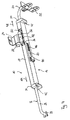
- a coupling device 10 for Coupling a door leaf 132 with locking device 136, as described in DE 199 19 554 A1 can be removed, explained in detail to a door drive 126.
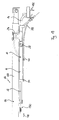
- a coupling device 10 for Coupling a door leaf 132 with locking device 136 as described in DE 199 19 554 A1 can be removed, explained in detail to a door drive 126.
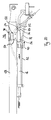
- a coupling device 10 for Coupling a door leaf 132 with locking device 136 as described in DE 199 19 554 A1 can be removed, explained in detail to a door drive 126.
- DE 199 19 554 A1 for more details of the door is expressly made to DE 199 19 554 A1.
- the total designated 10 coupling device is used as a push rod between the door leaf 132 and a driver 130 of a garage door drive 126 used as this will be explained in more detail below with reference to the illustration of FIG. 19.
- the coupling device 10 has a to be connected to the driver 130 drive connection element 12 and a door leaf 132 to be connected Torblatt connecting element 14 and a telescopic part 16 in between.
- the telescopic part 16 By the telescopic part 16, the two connection elements 12, 14 movable relative to each other.
- the telescopic part 16 has a housing 18 and a slidably guided therein slider 20.
- the slider 20 is as first telescopic part element connected to the drive connection element 12.
- the Housing 18 is connected as a second telescopic part element to the door leaf connecting element 14.
- a latching device 22 sets when pulling the two telescopic sub-elements 18, 20 fixed their relative mobility. When attacking a release device 24, the locking device 22 is released again.
- the two connection elements 12, 14 each have rigid push rods 26, 27.
- the Drive-side push rod 26 is angled at its free end by 90 ° and can thus used in a connection opening on the driver 130 pivotally and with a Secured clip or a split pin 28.
- the door leaf side Push rod 27 is in contrast to the straight push rod 26 with a curved Provided area 30 and at its free end similar to the push rod 26 at right angles bent.
- the door leaf connecting element 14 further has a gate fitting 32 on, which is attachable to the door leaf 132 and in which the right angled End of the door leaf-side push rod 27 is pivotally inserted and with the securing clip 28 is secured.
- the housing 18 is at its ends with end pieces in the form of thrust guides 34 for the push rods 26, 27 provided.
- the straight drive side Push rod 26 is slidably guided in a push guide 34 and firmly connected to the slider 20.
- the door leaf-side push rod 27 is in the other Push guide 34 introduced and firmly connected thereto and to the housing 18.
- the Push guides 34 also act as end terminations of the housing 18.
- the latching device 22 has an elastically resilient latching tongue 36 made of spring steel, whose one end is received firmly in a curved receptacle 38 in the carriage 20.
- the carriage 20 has its underside also a Bowden cable attachment 40.
- the identically designed push guides 34 have Bowden cable connections 42.
- the locking device 22 as an abutment for the latching tongue 36 has a lateral opening 44 in the housing 18.
- a slot guide 46 for the Bowden cable attachment 40 At the bottom is the case 18 a slot guide 46 for the Bowden cable attachment 40. From the first Opening 44 is spaced apart as seen in the closing direction 48 is a second, elongated opening 50 is provided in the side wall of the housing 18.
- the release device 24 has a sheet-metal shaped part 52 with a fastening section 54 and a ramp element 56, in the opening and closing direction is provided with bent ends 58, which as an inclined plane for releasing the detection the latching tongue 36 serve from the boundary of the first opening 44.
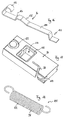
- Fig. 6 shows the Bowden cable attachment 40, which has a mounting plate 60 for fastening on the carriage 20, a larger bag opening 62 whose bottom with a small opening 64 is provided, and has a smaller passage opening 66. All openings 62, 64, 66 are slotted open to the side with smaller cross-section, leaving the strand of a Bowden cable can be guided laterally.
- the bag opening 62 serves to receive an end piece a shell 80 of a Bowden cable 78; as shown in Fig. 10.
- Fig. 7 shows the housing 18 with its various openings 44, 46, 50, wherein it can be seen that the slot guide 46 has a widened end 68 through which passes the thicker head portion 70 shown in FIG. 6 can be passed while the narrow slot guide 46 engages in waistings 72 on the Bowden cable 40. Opposite the larger opening 68 is at the top of the housing 18 an opening 74 through which the mounting plate 60 of the Bowden cable attachment 40 can be passed.
- the housing 18 is made of a square tube and to his open ends.
- Fig. 9 shows a further element 88 for determining the course of the Bowden cable.
- Fig. 10 is a gear 76 for transmitting the relative movement of the telescopic sub-elements 18, 20 on the locking device of the door leaf in the form of a Bowden cable 78 with sheath 80 and inner wire rope 82 shown.
- One end of the shell 80 with Screws 84 is secured in the sack opening 62.
- the other end of the shell 80 is by means of a plate-shaped gate fitting 86 shown in Fig. 8 in the vicinity of the castle of the Torblatt attached to this.
- Fig. 11 shows a sheet metal part 90, by means of which the release device 24 at a C-shaped Guide rail 128 of the door drive 126 can be fastened, as shown in more detail in FIG. 20 is shown.
- Fig. 12 shows the gate fitting 32 in detail and Figs. 13 and 14 show the two Push rods 26, 27.
- Push guide 34 has been designated.
- This push guide 34 has a passage opening 92 for the push rods 26, 27, the Bowdenzugan gleich 42 for fixing optional one end of the wire rope 82 of the first Bowden cable 78 or one end of the Case 80 of another Bowden cable, not shown here, in another embodiment instead of a hereinafter explained in more detail biasing device 100th acts.
- An engagement portion 94 is from its outer diameter to the inner diameter the housing 18 adapted.
- This engagement portion 94 further has an annular Recess 96, which serves to connect one end of a tension spring 98.
- This tension spring 98 is part of a biasing device 100, which from the telescopic part 16, Bowden cable 78 and locking device formed locomotor in the opening direction or Pretent release direction.
- the latching tongue 36 is shown in detail in FIG. 16. She has a kink at one end 102, with which it is receivable in the corresponding receptacle 38 of the slider 20. Then follows a straight portion 104, which acts like a leaf spring for biasing. Then is the latching tongue 36 for forming a latching step 106 with an inclined plane forming Start shoulder 108 bent. At the free end 110, the latching tongue 36 is a rounded Projection 112 further bent out. This projection 112 serves for Detecting the ramp element 56 of the release device 24.
- the carriage 20 is shown in detail in FIG. 17. He has recording 38 on one side a corresponding recess 114 for the straight portion 104 of the latching tongue 36th center the carriage 20 is provided with a rectangular passage opening 116, in FIG the Bowdenzugbefest Trent 40 is receivable.
- This passage opening 116 has a page also a step-shaped receptacle 118 for the mounting plate 60 and on the receptacle 38 opposite end is also the slider 20 with an annular Recess 120 provided for securing the other end of the tension spring 98.
- the tension spring 98 is shown in Fig. 18 in detail and indicated in Fig. 3 in use.
- in the Insert is her turn area 122 led around the push rod 26.
- the one end is connected to the drive-side slide guide 34 and the other end to the Slider 20.
- the tension spring 98 thus biases the slider 20 in the opening direction 124.
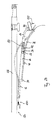
- a door leaf 132 As shown in Fig. 19, there is a door leaf 132, as known from DE 199 19 554 A1 is connected to a door drive 126.
- the door drive 126 has a C-shaped profile Guide rail 128, in which a driver 130 driven by a motor drive unit (not shown) is guided back and forth movable.
- the driver 130 is connected to the drive connection element 12 of the coupling device 10.
- the Door leaf 132 is connected to the door leaf connecting element 14.
- the other end of the Bowden cable 78 is, as is apparent from Fig. 21, to the driving element, here in the form of a one-piece disk element 134 of the locking device 136th connected.
- the disk element 134 drives three locking rods 138, on whose Ends (not shown) bolt tips are formed.
- the locking rods 138 engage with their long tips on three sides, two left and right below and one above in the middle.
- the locking rods 138 are hinged over the disc element 134. So they can be operated together by turning the handle 140 in manual mode become.
- the handle 140 sits on a square, by a lock 144 against rotation is lockable. On the outside sits an unillustrated outside handle on the square.
- the disc member 134 By the disc member 134, a large stroke can be accomplished.
- the disc element 134 is articulated via the first Bowden cable 78 to the telescopic part 16.
- the latching device 22 prevents in the course of the door drive Telescoping the telescopic sub-elements 18, 20.
- the release device 24 on the guide rail 28 attached. Due to the mounting plate 90, the location of the release device slidably adjusted to the operation explained in more detail below ensure properly.
- the detent tongue 36 is thus pressed from its detection at the opening 44. It is located the door leaf 132 already in the closed position (see Fig. 19).
- Fig. 20 shows the further movement of the driver 130.
- the slider 20 In the further movement the slider 20 is pushed further in the closing direction 48 in the housing 18.
- the latching tongue passes over its rounded projection 112 through the elongated opening 50 and thus creates space for pushing together. At the same time, this will be on the drive side Bowden cable connection 42 connected wire 82 due to the shift the attached to the Bowden cable attachment 40 shell 80 tightened.
- These Pull movement is, as is apparent from Fig. 21, transmitted to the disc member 134.
- This is pulled in the locking direction 148 and pushes the locking rods 138 in the locking position.
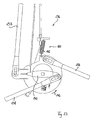
- the locking device As seen in Fig. 21, the locking device is also 136 biased in the open position.
- a second tension spring 142 is provided which is identical to the tension spring 98 is constructed and at one end to the gate fitting 86 and the other end to the disc element 134 attacks.
- Figs. 22 and 23 show the unlocking movement.
- the driver 130 in the opening direction 124 pulls the tension spring 98, the two telescopic sub-elements 20, 18th apart.
- the rounded protrusion 112 enters the opening via the ramp element 56 50 pushed in.
- the Bowden cable 78 is relieved.
- the power of Biasing device 100 with the two springs 98, 142 is the disc element 134th pulled in unlocking 146 and thus also the locking rods 138th unlocked.
- the latching step 106 in the opening 44 so that the coupling device 10 is locked again is. In this state, then the entire door running, of which a middle position in Fig. 24 is shown.
- the biasing means 100 of the above-mentioned second Bowden cable instead of or in addition to the biasing means 100 of the above-mentioned second Bowden cable used. Its shell is on attached to the Bowdenzugan gleich 42 of the drive-side slide guide 34, and be Wire rope 82 is attached to the Bowden cable attachment 40. When pushing apart of the telescopic part 16 thus this second Bowden cable is tightened. With his other End is the second Bowden cable on the first Bowden cable 78 opposite Side of the disc member 134 connected so that he like the tension spring 142 pulls in unlocked position.
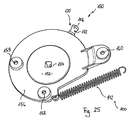
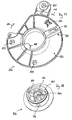
- Figs. 25 - 31 is yet another embodiment of the as a disk element formed driving element of the locking device shown.
- the disc element 150 has two concentrically arranged parts 152, 153.
- a radially inner Part 152 is provided with a square opening 154 for placement on the handle shaft of a handle Mistake.
- On the periphery of the inner part 152 is rotatably seated an outer part 156, the first, second and third connection means 158, 159, 160 for connection the locking rods 138 has.
- the third connection device 160 is radially further outside as the other two terminal devices 158, 159 are formed to the above attacking locking rod 138 to be provided with a larger stroke.
- the inner part 152 has a extending over a peripheral region Recess 166 and the outer part 156 a reaching into this recess Projection 168.
- the peripheral end walls of the recess 166 act as stops 162, 164 for the projection 168.
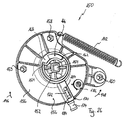
- This relative movement of the two parts 152, 154 is preferably in an end position by means of a locking device 170 here in the end position in the locking direction, lockable.
- the outer part 156 a radial guide for a radially movable locking pin 172 (see FIG. 29), at one end a gripping member 174 and at the other end a rounded tip 176 for retraction into a radial opening 178 on the inner part 152 has. Between the two Parts 152, 156 is still a bearing element 180 (see FIG. 30) used.
- this embodiment also applies again the tension spring 142 is provided.
- a handle here is not the handle 140 according to DE 199 19 554 A1, but the Handle, as it is known from the German patent application 102 44 652.0 of the applicant of 25.09.2002 (not prepublished, attached in copy) described and shown.
- the connecting device shown there on the handle is the end another Bowden cable 182 (see Fig. 19) connected, the other end engages on an emergency release device on the driver 130 so that the driver 130 by train on the wire of the Bowden cable 182 of the motor drive unit can be decoupled.
- the square opening 154 sits on the handle shaft of the handle, wherein inside the handle from DE 102 44 652 and outside the outer handle from DE 199 19 554 A1 is used.
- the handle shaft (square) can through the lock 144 - by means of slide from the inside or Keys from the outside - either fixed or released for rotation.
- Locking pin 172 can be pulled out and pushed in via the gripping part 174.
- the gate (without connection of the door drive 126) normally open and closed by manual operation become. Rotation of the handle rotates the inner part 152 and the locking device 170 the outer parts 156. This allows all three bars on the locking rods 138 are operated simultaneously.
- the Lock 144 locked. This locks the square and the handles. Locked is also locked the inner part 152, so yes on the square opening 154 against rotation on the square sitting. The locking device 170 is released by pulling out the locking pin 172.
- the locking pin 172 has this purpose a locking device 184, which in its open position holds. Rotatable is now only there outer part 156; the function of locking and unlocking is then the same as previously described in the embodiment.
- the outer part 156 of the disc member 150 is also by the tension spring 142 in the unlocked position spring-loaded.
- the outer part 156 When driving the door drive 126, the outer part 156 is connected via the Bowden cable 78.
- the tension spring 142 engages on one side of the outer part 156, the Bowden cable 78 on the other side in Bowdenzugan gleich 186. So you can over Pull on the Bowden cable 78 the outer part 156 (also called traction sheave) in the Locking direction 148 move and the tension spring 142 pulls the outer part 156 in the unlocking 146th
- the locking by the locking device 22 is effective. Due to this, the Bowden cable 78 remains unloaded during the entire journey. Therefore, the locking rods 138 and their locking tips are not after moved outside. Only when retracting the door leaf 132 in the closed position moves the Locking device 22 via the release device 24. About the inclined plane of the ramp element 56, the projection 112 and thereby the latching step 106 is pressed inwards. As a result, the telescopic part 16 can be pushed together, and the locking rods 138 are again moved accordingly in the locked position.
- the door drive can not be used as usual, for example via a hand transmitter from the outside, you can with the key the Lock 144 also open from the outside.
- the outer handle can be turned.
- On the inside handle this is the star-shaped handle according to the earlier application 102 44 652.0, is a separate rope or similar traction means, here the third Bowden cable 182nd attached. This is guided for emergency release on the driver 130.
- the rotation on the outer handle turns over the square only the inner part 152 and the inner handle, but not the locking rods 138 and the bolt, because of the relative rotation of the inner part 152 and the outer part 156 of the disc member 150.
- the driver 130 is released from his drive.
- the bias of the biasing device 100 in particular, the tension spring 98, pushes the driver 130 in the opening direction.
- the first Bowden cable 78 is relieved. When relieved Bowden cable 78 pulls the tension spring 142 the outer part 156 of the disc member 150 in the unlocked position. In this unlocked position, the locking rods 138 and their latch are again pulled inside.
- the gate can be opened by hand.
- the disk element 150 is preferably made of plastic.
Landscapes
- Engineering & Computer Science (AREA)
- Mechanical Engineering (AREA)
- Power-Operated Mechanisms For Wings (AREA)
- Gates (AREA)
Applications Claiming Priority (2)
| Application Number | Priority Date | Filing Date | Title |
|---|---|---|---|
| DE102004007940A DE102004007940B4 (de) | 2004-02-18 | 2004-02-18 | Tor mit Verriegelungsvorrichtung und Antrieb |
| DE102004007940 | 2004-02-18 |
Publications (2)
| Publication Number | Publication Date |
|---|---|
| EP1566512A2 true EP1566512A2 (fr) | 2005-08-24 |
| EP1566512A3 EP1566512A3 (fr) | 2008-02-27 |
Family
ID=34706838
Family Applications (1)
| Application Number | Title | Priority Date | Filing Date |
|---|---|---|---|
| EP05000738A Withdrawn EP1566512A3 (fr) | 2004-02-18 | 2005-01-14 | Portail avec dispositif de verrouillage et système d'entraînement |
Country Status (2)
| Country | Link |
|---|---|
| EP (1) | EP1566512A3 (fr) |
| DE (1) | DE102004007940B4 (fr) |
Cited By (2)
| Publication number | Priority date | Publication date | Assignee | Title |
|---|---|---|---|---|
| WO2020136184A1 (fr) * | 2018-12-28 | 2020-07-02 | Hörmann KG Antriebstechnik | Dispositif pour le verrouillage de portes à charnières ainsi que porte à charnières comprenant un tel dispositif |
| WO2020237356A1 (fr) * | 2019-05-28 | 2020-12-03 | Magna Closures Inc. | Ensemble poulie de porte coulissante de puissance avec tendeur et élément de blocage |
Families Citing this family (1)
| Publication number | Priority date | Publication date | Assignee | Title |
|---|---|---|---|---|
| DE202011102492U1 (de) | 2011-06-27 | 2011-12-13 | Novoferm Tormatic Gmbh | Handentriegelung |
Family Cites Families (5)
| Publication number | Priority date | Publication date | Assignee | Title |
|---|---|---|---|---|
| DE6921692U (de) * | 1969-05-30 | 1969-11-27 | Hanning Elektro Werke | Motorisch angetriebenes garagen-kipptor mit notloesevorrichtung |
| US4739584A (en) * | 1986-10-23 | 1988-04-26 | Peter Zellman | Garage door locking mechanism |
| DE4415279A1 (de) * | 1994-04-30 | 1995-11-02 | Siebau | Garagentor mit einem Kopfkipptorblatt und einer Sicherheitsverriegelung |
| GB2317201B (en) * | 1996-09-13 | 2001-05-16 | Amourelle Products Ltd | Door locking apparatus |
| DE19919554C2 (de) * | 1999-03-31 | 2002-09-05 | Hoermann Kg | Torverriegelungsvorrichtung |
-
2004
- 2004-02-18 DE DE102004007940A patent/DE102004007940B4/de not_active Expired - Fee Related
-
2005
- 2005-01-14 EP EP05000738A patent/EP1566512A3/fr not_active Withdrawn
Cited By (2)
| Publication number | Priority date | Publication date | Assignee | Title |
|---|---|---|---|---|
| WO2020136184A1 (fr) * | 2018-12-28 | 2020-07-02 | Hörmann KG Antriebstechnik | Dispositif pour le verrouillage de portes à charnières ainsi que porte à charnières comprenant un tel dispositif |
| WO2020237356A1 (fr) * | 2019-05-28 | 2020-12-03 | Magna Closures Inc. | Ensemble poulie de porte coulissante de puissance avec tendeur et élément de blocage |
Also Published As
| Publication number | Publication date |
|---|---|
| DE102004007940A1 (de) | 2005-09-08 |
| DE102004007940B4 (de) | 2006-05-04 |
| EP1566512A3 (fr) | 2008-02-27 |
Similar Documents
| Publication | Publication Date | Title |
|---|---|---|
| DE3135401C2 (de) | Verriegelungseinrichtung für ein Tor mit einem ein- oder mehrteiligen Torblatt | |
| DE112021000048B4 (de) | Elektrisches Schloss für eine Fahrzeugtür | |
| DE112016006079T5 (de) | Fahrzeug-türverriegelungssystem | |
| EP3502386B1 (fr) | Fermeture pour une fenêtre, une porte ou analogue | |
| EP2058461B1 (fr) | Crémone | |
| DE69408741T2 (de) | Türverriegelungssystem für Fahrzeuge | |
| EP2146032B1 (fr) | Dispositif destiné à ouvrir et/ou fermer ainsi qu'à verrouiller un état fermé d'un dispositif de fermeture destiné à fermer une ouverture de salle ainsi que dispositif de fermeture doté d'un tel dispositif | |
| DE4321099A1 (de) | Belüftungseinrichtung für Fenster oder Türen | |
| EP0111790B1 (fr) | Compas pour fenêtre | |
| DE60009812T2 (de) | Türschlossvorrichtung mit abnehmbarem Betätigungsgriff | |
| WO2011018223A2 (fr) | Mécanisme de transmission | |
| EP1566512A2 (fr) | Portail avec dispositif de verrouillage et système d'entraínement | |
| DE102007025723B3 (de) | Kupplungseinheit für ein Garagentor, insbesondere Kipp-, Schwenk- oder Sektionaltor | |
| DE69629759T2 (de) | Betätigungsvorrichtung für ein Tor oder andere Verschlussplatte | |
| DE69702008T2 (de) | Fenster mit einem Treibstangenschloss und einer Auftriebsvorrichtung | |
| DE102004007939B4 (de) | Torverriegelungsvorrichtung mit Treibelement | |
| DE202007014548U1 (de) | Mitnehmerschlitten für eine Torantriebsvorrichtung, eine solche Torantriebsvorrichtung und ein Tor | |
| WO2001057350A1 (fr) | Dispositif d'actionnement | |
| EP1340872A2 (fr) | Dispositif de verrouillage | |
| EP3070236B1 (fr) | Dispositif de verrouillage d'urgence | |
| DE3246396C2 (de) | Ausstellvorrichtung, insbesondere für Klappfenster von Kraftfahrzeugen, für Autohebedächer od. dgl. | |
| DE2518318A1 (de) | Verriegelungsvorrichtung | |
| EP1683938B1 (fr) | Pêne de verrouillage pour une crémone | |
| DE10015095C2 (de) | Verriegelungsvorrichtung für einen Türflügel | |
| DE10320923B4 (de) | Torantrieb mit Sicherheitsentriegelung |
Legal Events
| Date | Code | Title | Description |
|---|---|---|---|
| PUAI | Public reference made under article 153(3) epc to a published international application that has entered the european phase |
Free format text: ORIGINAL CODE: 0009012 |
|
| AK | Designated contracting states |
Kind code of ref document: A2 Designated state(s): AT BE BG CH CY CZ DE DK EE ES FI FR GB GR HU IE IS IT LI LT LU MC NL PL PT RO SE SI SK TR |
|
| AX | Request for extension of the european patent |
Extension state: AL BA HR LV MK YU |
|
| PUAL | Search report despatched |
Free format text: ORIGINAL CODE: 0009013 |
|
| AK | Designated contracting states |
Kind code of ref document: A3 Designated state(s): AT BE BG CH CY CZ DE DK EE ES FI FR GB GR HU IE IS IT LI LT LU MC NL PL PT RO SE SI SK TR |
|
| AX | Request for extension of the european patent |
Extension state: AL BA HR LV MK YU |
|
| AKX | Designation fees paid | ||
| STAA | Information on the status of an ep patent application or granted ep patent |
Free format text: STATUS: THE APPLICATION IS DEEMED TO BE WITHDRAWN |
|
| 18D | Application deemed to be withdrawn |
Effective date: 20080828 |
|
| REG | Reference to a national code |
Ref country code: DE Ref legal event code: 8566 |