EP1566638A1 - Verfahren zur anbringung eines biomolekülsan einen metallträger - Google Patents
Verfahren zur anbringung eines biomolekülsan einen metallträger Download PDFInfo
- Publication number
- EP1566638A1 EP1566638A1 EP03774208A EP03774208A EP1566638A1 EP 1566638 A1 EP1566638 A1 EP 1566638A1 EP 03774208 A EP03774208 A EP 03774208A EP 03774208 A EP03774208 A EP 03774208A EP 1566638 A1 EP1566638 A1 EP 1566638A1
- Authority
- EP
- European Patent Office
- Prior art keywords
- immobilized
- nucleic acid
- solution
- hybridization
- component
- Prior art date
- Legal status (The legal status is an assumption and is not a legal conclusion. Google has not performed a legal analysis and makes no representation as to the accuracy of the status listed.)
- Withdrawn
Links
Images
Classifications
-
- G—PHYSICS
- G01—MEASURING; TESTING
- G01N—INVESTIGATING OR ANALYSING MATERIALS BY DETERMINING THEIR CHEMICAL OR PHYSICAL PROPERTIES
- G01N33/00—Investigating or analysing materials by specific methods not covered by groups G01N1/00 - G01N31/00
- G01N33/48—Biological material, e.g. blood, urine; Haemocytometers
- G01N33/50—Chemical analysis of biological material, e.g. blood, urine; Testing involving biospecific ligand binding methods; Immunological testing
- G01N33/53—Immunoassay; Biospecific binding assay; Materials therefor
- G01N33/543—Immunoassay; Biospecific binding assay; Materials therefor with an insoluble carrier for immobilising immunochemicals
- G01N33/551—Immunoassay; Biospecific binding assay; Materials therefor with an insoluble carrier for immobilising immunochemicals the carrier being inorganic
- G01N33/553—Metal or metal coated
-
- B—PERFORMING OPERATIONS; TRANSPORTING
- B01—PHYSICAL OR CHEMICAL PROCESSES OR APPARATUS IN GENERAL
- B01J—CHEMICAL OR PHYSICAL PROCESSES, e.g. CATALYSIS OR COLLOID CHEMISTRY; THEIR RELEVANT APPARATUS
- B01J19/00—Chemical, physical or physico-chemical processes in general; Their relevant apparatus
- B01J19/0046—Sequential or parallel reactions, e.g. for the synthesis of polypeptides or polynucleotides; Apparatus and devices for combinatorial chemistry or for making molecular arrays
-
- B—PERFORMING OPERATIONS; TRANSPORTING
- B82—NANOTECHNOLOGY
- B82Y—SPECIFIC USES OR APPLICATIONS OF NANOSTRUCTURES; MEASUREMENT OR ANALYSIS OF NANOSTRUCTURES; MANUFACTURE OR TREATMENT OF NANOSTRUCTURES
- B82Y30/00—Nanotechnology for materials or surface science, e.g. nanocomposites
-
- B—PERFORMING OPERATIONS; TRANSPORTING
- B01—PHYSICAL OR CHEMICAL PROCESSES OR APPARATUS IN GENERAL
- B01J—CHEMICAL OR PHYSICAL PROCESSES, e.g. CATALYSIS OR COLLOID CHEMISTRY; THEIR RELEVANT APPARATUS
- B01J2219/00—Chemical, physical or physico-chemical processes in general; Their relevant apparatus
- B01J2219/00274—Sequential or parallel reactions; Apparatus and devices for combinatorial chemistry or for making arrays; Chemical library technology
- B01J2219/00277—Apparatus
- B01J2219/00279—Features relating to reactor vessels
- B01J2219/00306—Reactor vessels in a multiple arrangement
- B01J2219/00313—Reactor vessels in a multiple arrangement the reactor vessels being formed by arrays of wells in blocks
- B01J2219/00315—Microtiter plates
-
- B—PERFORMING OPERATIONS; TRANSPORTING
- B01—PHYSICAL OR CHEMICAL PROCESSES OR APPARATUS IN GENERAL
- B01J—CHEMICAL OR PHYSICAL PROCESSES, e.g. CATALYSIS OR COLLOID CHEMISTRY; THEIR RELEVANT APPARATUS
- B01J2219/00—Chemical, physical or physico-chemical processes in general; Their relevant apparatus
- B01J2219/00274—Sequential or parallel reactions; Apparatus and devices for combinatorial chemistry or for making arrays; Chemical library technology
- B01J2219/00277—Apparatus
- B01J2219/00351—Means for dispensing and evacuation of reagents
- B01J2219/00364—Pipettes
-
- B—PERFORMING OPERATIONS; TRANSPORTING
- B01—PHYSICAL OR CHEMICAL PROCESSES OR APPARATUS IN GENERAL
- B01J—CHEMICAL OR PHYSICAL PROCESSES, e.g. CATALYSIS OR COLLOID CHEMISTRY; THEIR RELEVANT APPARATUS
- B01J2219/00—Chemical, physical or physico-chemical processes in general; Their relevant apparatus
- B01J2219/00274—Sequential or parallel reactions; Apparatus and devices for combinatorial chemistry or for making arrays; Chemical library technology
- B01J2219/00277—Apparatus
- B01J2219/00351—Means for dispensing and evacuation of reagents
- B01J2219/00387—Applications using probes
-
- B—PERFORMING OPERATIONS; TRANSPORTING
- B01—PHYSICAL OR CHEMICAL PROCESSES OR APPARATUS IN GENERAL
- B01J—CHEMICAL OR PHYSICAL PROCESSES, e.g. CATALYSIS OR COLLOID CHEMISTRY; THEIR RELEVANT APPARATUS
- B01J2219/00—Chemical, physical or physico-chemical processes in general; Their relevant apparatus
- B01J2219/00274—Sequential or parallel reactions; Apparatus and devices for combinatorial chemistry or for making arrays; Chemical library technology
- B01J2219/00277—Apparatus
- B01J2219/00497—Features relating to the solid phase supports
- B01J2219/005—Beads
-
- B—PERFORMING OPERATIONS; TRANSPORTING
- B01—PHYSICAL OR CHEMICAL PROCESSES OR APPARATUS IN GENERAL
- B01J—CHEMICAL OR PHYSICAL PROCESSES, e.g. CATALYSIS OR COLLOID CHEMISTRY; THEIR RELEVANT APPARATUS
- B01J2219/00—Chemical, physical or physico-chemical processes in general; Their relevant apparatus
- B01J2219/00274—Sequential or parallel reactions; Apparatus and devices for combinatorial chemistry or for making arrays; Chemical library technology
- B01J2219/00277—Apparatus
- B01J2219/00497—Features relating to the solid phase supports
- B01J2219/00527—Sheets
-
- B—PERFORMING OPERATIONS; TRANSPORTING
- B01—PHYSICAL OR CHEMICAL PROCESSES OR APPARATUS IN GENERAL
- B01J—CHEMICAL OR PHYSICAL PROCESSES, e.g. CATALYSIS OR COLLOID CHEMISTRY; THEIR RELEVANT APPARATUS
- B01J2219/00—Chemical, physical or physico-chemical processes in general; Their relevant apparatus
- B01J2219/00274—Sequential or parallel reactions; Apparatus and devices for combinatorial chemistry or for making arrays; Chemical library technology
- B01J2219/00583—Features relative to the processes being carried out
- B01J2219/00585—Parallel processes
-
- B—PERFORMING OPERATIONS; TRANSPORTING
- B01—PHYSICAL OR CHEMICAL PROCESSES OR APPARATUS IN GENERAL
- B01J—CHEMICAL OR PHYSICAL PROCESSES, e.g. CATALYSIS OR COLLOID CHEMISTRY; THEIR RELEVANT APPARATUS
- B01J2219/00—Chemical, physical or physico-chemical processes in general; Their relevant apparatus
- B01J2219/00274—Sequential or parallel reactions; Apparatus and devices for combinatorial chemistry or for making arrays; Chemical library technology
- B01J2219/00583—Features relative to the processes being carried out
- B01J2219/00596—Solid-phase processes
-
- B—PERFORMING OPERATIONS; TRANSPORTING
- B01—PHYSICAL OR CHEMICAL PROCESSES OR APPARATUS IN GENERAL
- B01J—CHEMICAL OR PHYSICAL PROCESSES, e.g. CATALYSIS OR COLLOID CHEMISTRY; THEIR RELEVANT APPARATUS
- B01J2219/00—Chemical, physical or physico-chemical processes in general; Their relevant apparatus
- B01J2219/00274—Sequential or parallel reactions; Apparatus and devices for combinatorial chemistry or for making arrays; Chemical library technology
- B01J2219/00583—Features relative to the processes being carried out
- B01J2219/00603—Making arrays on substantially continuous surfaces
- B01J2219/00657—One-dimensional arrays
-
- B—PERFORMING OPERATIONS; TRANSPORTING
- B01—PHYSICAL OR CHEMICAL PROCESSES OR APPARATUS IN GENERAL
- B01J—CHEMICAL OR PHYSICAL PROCESSES, e.g. CATALYSIS OR COLLOID CHEMISTRY; THEIR RELEVANT APPARATUS
- B01J2219/00—Chemical, physical or physico-chemical processes in general; Their relevant apparatus
- B01J2219/00274—Sequential or parallel reactions; Apparatus and devices for combinatorial chemistry or for making arrays; Chemical library technology
- B01J2219/00583—Features relative to the processes being carried out
- B01J2219/00603—Making arrays on substantially continuous surfaces
- B01J2219/00659—Two-dimensional arrays
-
- B—PERFORMING OPERATIONS; TRANSPORTING
- B01—PHYSICAL OR CHEMICAL PROCESSES OR APPARATUS IN GENERAL
- B01J—CHEMICAL OR PHYSICAL PROCESSES, e.g. CATALYSIS OR COLLOID CHEMISTRY; THEIR RELEVANT APPARATUS
- B01J2219/00—Chemical, physical or physico-chemical processes in general; Their relevant apparatus
- B01J2219/00274—Sequential or parallel reactions; Apparatus and devices for combinatorial chemistry or for making arrays; Chemical library technology
- B01J2219/00583—Features relative to the processes being carried out
- B01J2219/00603—Making arrays on substantially continuous surfaces
- B01J2219/00677—Ex-situ synthesis followed by deposition on the substrate
-
- B—PERFORMING OPERATIONS; TRANSPORTING
- B01—PHYSICAL OR CHEMICAL PROCESSES OR APPARATUS IN GENERAL
- B01J—CHEMICAL OR PHYSICAL PROCESSES, e.g. CATALYSIS OR COLLOID CHEMISTRY; THEIR RELEVANT APPARATUS
- B01J2219/00—Chemical, physical or physico-chemical processes in general; Their relevant apparatus
- B01J2219/00274—Sequential or parallel reactions; Apparatus and devices for combinatorial chemistry or for making arrays; Chemical library technology
- B01J2219/00709—Type of synthesis
- B01J2219/00711—Light-directed synthesis
-
- B—PERFORMING OPERATIONS; TRANSPORTING
- B01—PHYSICAL OR CHEMICAL PROCESSES OR APPARATUS IN GENERAL
- B01J—CHEMICAL OR PHYSICAL PROCESSES, e.g. CATALYSIS OR COLLOID CHEMISTRY; THEIR RELEVANT APPARATUS
- B01J2219/00—Chemical, physical or physico-chemical processes in general; Their relevant apparatus
- B01J2219/00274—Sequential or parallel reactions; Apparatus and devices for combinatorial chemistry or for making arrays; Chemical library technology
- B01J2219/00718—Type of compounds synthesised
- B01J2219/0072—Organic compounds
- B01J2219/00722—Nucleotides
-
- B—PERFORMING OPERATIONS; TRANSPORTING
- B01—PHYSICAL OR CHEMICAL PROCESSES OR APPARATUS IN GENERAL
- B01J—CHEMICAL OR PHYSICAL PROCESSES, e.g. CATALYSIS OR COLLOID CHEMISTRY; THEIR RELEVANT APPARATUS
- B01J2219/00—Chemical, physical or physico-chemical processes in general; Their relevant apparatus
- B01J2219/00274—Sequential or parallel reactions; Apparatus and devices for combinatorial chemistry or for making arrays; Chemical library technology
- B01J2219/00718—Type of compounds synthesised
- B01J2219/0072—Organic compounds
- B01J2219/00725—Peptides
-
- B—PERFORMING OPERATIONS; TRANSPORTING
- B01—PHYSICAL OR CHEMICAL PROCESSES OR APPARATUS IN GENERAL
- B01J—CHEMICAL OR PHYSICAL PROCESSES, e.g. CATALYSIS OR COLLOID CHEMISTRY; THEIR RELEVANT APPARATUS
- B01J2219/00—Chemical, physical or physico-chemical processes in general; Their relevant apparatus
- B01J2219/00274—Sequential or parallel reactions; Apparatus and devices for combinatorial chemistry or for making arrays; Chemical library technology
- B01J2219/00718—Type of compounds synthesised
- B01J2219/0072—Organic compounds
- B01J2219/00731—Saccharides
-
- C—CHEMISTRY; METALLURGY
- C12—BIOCHEMISTRY; BEER; SPIRITS; WINE; VINEGAR; MICROBIOLOGY; ENZYMOLOGY; MUTATION OR GENETIC ENGINEERING
- C12Q—MEASURING OR TESTING PROCESSES INVOLVING ENZYMES, NUCLEIC ACIDS OR MICROORGANISMS; COMPOSITIONS OR TEST PAPERS THEREFOR; PROCESSES OF PREPARING SUCH COMPOSITIONS; CONDITION-RESPONSIVE CONTROL IN MICROBIOLOGICAL OR ENZYMOLOGICAL PROCESSES
- C12Q1/00—Measuring or testing processes involving enzymes, nucleic acids or microorganisms; Compositions therefor; Processes of preparing such compositions
- C12Q1/68—Measuring or testing processes involving enzymes, nucleic acids or microorganisms; Compositions therefor; Processes of preparing such compositions involving nucleic acids
- C12Q1/6813—Hybridisation assays
- C12Q1/6834—Enzymatic or biochemical coupling of nucleic acids to a solid phase
Definitions
- the present invention relates to a method of immobilizing a biomolecule such as a nucleic acid on a carrier.
- the method of the present invention is useful for operations of analysis of nucleic acids based on hybridization and so forth.
- nucleic acids In analyses of nucleic acids based on hybridization, immunoassays and so forth, techniques of immobilizing nucleic acids or proteins on carriers such as membranes and plates have conventionally been utilized. As such methods of immobilizing biomolecules, the following methods are known for nucleic acids:
- the method of (1) requires an extremely special apparatus and regents. Furthermore, in the methods of (2) and (3), nucleic acids are dropped off from the carriers during the hybridization, in particular, in operation processes, and thus detection sensitivity may be reduced, or reproducibility cannot be obtained. Furthermore, those methods suffer from further drawback, that is, although a long nucleic acid can be immobilized, a short nucleic acid of about 50-mer or shorter such as oligomers cannot be efficiently immobilized. In those methods, the UV dose is about several tens mJ/cm 2 . Furthermore, the method of (4) also requires an extremely special apparatus and regents for synthesizing DNA on a base material, and the nucleic acid that can be synthesized is limited to about 25-mer or shorter. Moreover, in the method of (5), the material of the base material is limited, and a surface coating step is required.
- an object of the present invention is to provide a method of conveniently and efficiently immobilizing a biomolecule such as a nucleic acid, in particular, a nucleic acid of a short chain length, on a carrier.
- the inventors of the present invention have conducted various researches in order to achieve the aforementioned object. As a result, they have found that a nucleic acid can be efficiently immobilized on a carrier by spotting a solution of the nucleic acid on a metallic carrier and then irradiating the carrier with an ultraviolet ray, and have accomplished the present invention.
- the present invention provides the following.
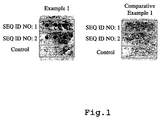
- Fig. 1 shows the result of hybridization using the oligonucleotide-immobilized plate produced in the example.
- the dotted line represents the regions on which the oligonucleotides were immobilized, and the regions on which 1 ⁇ TE buffer solution was spotted as a control in Example 1 and Comparative Example 1.
- a carrier used in the present invention is intended to immobilize a biomolecule, and is made of a metal.
- the metal is not particularly limited as long as it can immobilize a biomolecule by ultraviolet ray irradiation.
- Preferable examples thereof include a metal selected from Groups I, II, III, IV, V, VI, and VII of second to seventh periods and transition elements in a periodic table, and an alloy containing each of these metal.
- Particularly preferable examples of the metal selected from Groups I, II, III, IV, V, VI, and VII of second to seventh periods and transition elements in the periodic table include aluminum, titanium, platinum, tungsten, molybdenum, gold, copper, and nickel.
- the alloy examples include nickel silver (component: Cu, Ni, Zn), brass (component: Cu, Zn), bronze (component: Cu, Be), Monel (component: Cu, Ni, Fe, Mn), a nickel-cobalt alloy (component: Ni, Co), a nickel-chromium alloy (component: Ni, Cr), a cobalt alloy (component: Co, Ni, Cr), stainless steel (component: Ni, Cr, Fe), silver tungsten (component: Ag, W), ⁇ titanium (component: Ti, V, Al), ⁇ titanium (component: Ti, V, Al), an NT alloy (component: Ti, Ni), an aluminum alloy (component: Al, Cu, Mg, Si, Mn, Zn), duralumin (component: Al, Cu, Si, Fe, Mn, Mg, Zn), a magnesium alloy (component: Mg, Al, Zn), K24 (component: Au), K18 (component: Au, Ag, Cu), beryllium copper (component:
- the metal may also be deposited or plated with another metal. Further the metal may have different kinds of metals laminated thereon, or may be a single metal to retain its shape.
- a carrier according to the present invention consists essentially of the metal.
- the carrier may consist of the metal only, or may have the metal laminated on a non-metal material by adhesion, deposition, plating, or the like.
- the shape of the aforementioned carrier is not particularly limited, and examples of the shape include those of foil, plate, wafer, filter, and bead. Furthermore, it may be the shape of microtiter plate. In order to facilitate preservation of the obtained result, a back surface of plate or the like may be, for example, applied or coated with a material usable as a seal or the like (adhesives etc.) so that the material can be used as a seal.
- a material usable as a seal or the like adheresives etc.
- a solution of a biomolecule is spotted on predetermined positions of the aforementioned carrier.
- the biomolecule include nucleic acids, proteins, saccharides, antigens, antibodies, peptides, and enzymes.
- nucleic acid as the biomolecule.
- methods and conditions conventionally used for immobilization can be used also for other substances except that an ultraviolet ray is applied for the immobilization.
- the nucleic acid is not particularly different from a usual solid phase-immobilized nucleic acid used for hybridization of nucleic acids using a solid phase-immobilized nucleic acid, and it is not particularly limited so long as it is a nucleic acid that allows hybridization.
- it may be a naturally occurring or synthesized DNA (including oligonucleotides) or RNA (including oligonucleotides).
- the nucleic acid may be single-stranded or double-stranded.
- the chain length of the nucleic acid is not also particularly limited so long as it allows hybridization. However, it is usually about 5 to 50,000 nucleotides, preferably 20 to 10,000 nucleotides.
- the nucleic acid may have a polymer of oligonucleotides having a group that becomes reactive upon ultraviolet ray irradiation such as those of thymidine or the like at the 5' end or 3' end.
- the solvent for dissolving the nucleic acid is not particularly limited, and examples thereof include: distilled water; buffers usually used for preparing a nucleic acid solution, for example, a Tris buffer such as TE buffer (10 mM Tris/hydrochloric acid, pH 8.0, 1 mM EDTA); an aqueous solution containing sodium chloride; an aqueous solution containing a carboxylic acid salt (sodium citrate, ammonium citrate, sodium acetate etc.); an aqueous solution containing a sulfonic acid salt (sodium dodecylsulfate, ammonium dodecylsulfate etc.); and an aqueous solution containing a phosphonic acid salt (sodium phosphate, ammonium phosphate etc.).
- a Tris buffer such as TE buffer (10 mM Tris/hydrochloric acid, pH 8.0, 1 mM EDTA
- an aqueous solution containing sodium chloride an
- concentration of the nucleic acid solution is not particularly limited either, it is usually a concentration of 1 mmol/ml to 1 fmol/ml, preferably 100 pmol/ml to 100 fmol/ml.
- Examples of the method of spotting of the nucleic acid solution on the carrier include a method involving dropping the nucleic acid solution onto the carrier with a pipette and a method involving using a commercially available spotter.
- the shape of spot and amount of the solution to be spotted are not particularly limited so long as the position at which the nucleic acid solution has been spotted can be confirmed, the shape is preferably a dot shape or circular shape.
- the amount of the solution to be spotted is preferably 10 nl to 10 ml.
- the nucleic acid solution is spotted on one place or two or more places on the carrier.
- One kind of nucleic acid solution or two or more kinds of nucleic acid solutions may be spotted.
- a labeled nucleic acid may be immobilized as a positive control indicating immobilization of the nucleic acid on the carrier.
- an ultraviolet ray containing a component having a wavelength of 280 nm is applied after the nucleic acid solution is spotted on the carrier.
- An ultraviolet ray containing a component having a wavelength of 220 to 300 nm can be given as the ultraviolet ray.
- the nucleic acid solution can be dried after the spotting and before the ultraviolet ray irradiation.
- the nucleic acid solution may be spontaneously dried, or dried by heating. When it is heated, the heating temperature is usually 30 to 100°C, and preferably 35 to 45°C.
- an ultraviolet ray containing a component having a wavelength of 280 nm is applied at least on the position or positions of the carrier at which the nucleic acid has been immobilized.
- the ultraviolet ray may be monochromatic light having a wavelength of 280 nm, or an ultraviolet ray having a broad waveform and containing a component having a wavelength of 280 nm.
- Examples of the ultraviolet ray having a broad waveform and containing a component having a wavelength of 280 nm include an ultraviolet ray containing a component having a wavelength of 220 to 300 nm.
- Examples of the ultraviolet ray containing a component having a wavelength of 220 to 300 nm include an ultraviolet ray having a maximum value at near 280 nm.
- the irradiation dose is usually 100 mJ/cm 2 or more, preferably 200 mJ/cm 2 or more, as cumulative irradiation dose.
- a nucleic acid-immobilized carrier By immobilizing a nucleic acid on a carrier as described above, a nucleic acid-immobilized carrier is produced.
- the nucleic acid-immobilized carrier obtained by the method of the present invention can be used for, for example, analysis of nucleic acids based on hybridization. Because a nucleic acid immobilized on a carrier by the method of the present invention hardly detaches from the carrier under the conditions of usual hybridization, more favorable detection sensitivity and reproducibility can be obtained than those in the case where the irradiation with an ultraviolet ray is not performed.
- the hybridization and detection thereof can be performed in the same manner as hybridization utilizing a usual solid phase-immobilized nucleic acid.
- the cost can be reduced.
- the metallic material can be easily formed, it becomes easy to produce DNA microarrays of various shapes. Further, the metallic material can be stored for a long period of time, and has superior storage stability.
- the method of the present invention does not require a step of coating a surface of carrier, and thus it becomes possible to immobilize nucleic acid directly on a metal used as an electrode or the like.
- Hybridization of a complementary nucleic acid in the solution and an immobilized nucleic acid can be performed efficiently by immobilizing a nucleic acid on an electrode. Hybridization is presumably performed efficiently because a nucleic acid, which has negative charge, is attracted to a positive electrode and then the concentration of the nucleic acid near the positive electrode becomes high.
- Oligonucleotides having the nucleotide sequences of SEQ ID NOS: 1 and 2 respectively were synthesized in a conventional manner by using an oligonucleotide synthesizer (Perkin-elmer Applied Biosystems). Furthermore, DNA having the nucleotide sequence of SEQ ID NO: 3 (262bp) was also prepared as a probe.
- the oligonucleotide having the nucleotide sequence of SEQ ID NO: 1 and the probe were biotinylated at the 5' ends.
- the oligonucleotide having the nucleotide sequence of SEQ ID NO: 2 was complementary to the biotinylated probe.
- Those oligonucleotides were dissolved in 1 ⁇ TE buffer (10 mM Tris-HCl, pH 8/ 1 mM EDTA) at a concentration of 1 pmol/ ⁇ l.
- Each of the aforementioned oligonucleotide solutions was spotted on a commercially available aluminum foil (Mitsubishi Aluminum Co., Ltd.) as three spots at predetermined positions (Fig. 1).
- the amount of the solutions used for each spotting was 0.5 ⁇ l, and the size of each of the spots was about 1 mm in diameter.
- This aluminum foil was put into a drier and dried at 37°C for 20 minutes. Then, the foil was irradiated with an ultraviolet ray containing a component having a wavelength of 280 nm for 250 mJ/cm 2 by using Uvstratalinker 2400 (STRATAGENE) at a distance of 16 cm. The irradiation time was 100 seconds. Then, the aluminum foil was washed by shaking in water for 30 minutes, and dried.
- the aluminum foil was irradiated beforehand with an ultraviolet ray containing a component having a wavelength of 280 nm for 250 mJ/cm 2 by using Uvstratalinker 2400 (STRATAGENE) at a distance of 16 cm.
- Each of the oligonucleotide solutions described in Example 1 was spotted on the aluminum foil as three spots at predetermined positions.
- the amount of the solutions used for each spotting was 0.5 ⁇ l, and the size of each of the spots was about 1 mm in diameter.
- the irradiation time was 100 seconds.
- This aluminum foil was put into a drier and dried at 37°C for 20 minutes. Then, the aluminum foil was washed by shaking in water for 30 minutes, and dried.
- Example 1 On the nucleic acid-immobilized portions of the oligonucleotide-immobilized aluminum foil of Example 1 and Comparative Example 1, 60 ⁇ l of a hybridization solution (Arrayit UniHyb, (TeleCHem International, Inc.) containing 3 pmol of the biotinylated probe (262bp) was placed, and the aluminum foil was put into a case shielded from water (HybriCassette), immersed in a water bath with the case, and heated at 45°C for 2 hours.
- a hybridization solution Arrayit UniHyb, (TeleCHem International, Inc.) containing 3 pmol of the biotinylated probe (262bp) was placed, and the aluminum foil was put into a case shielded from water (HybriCassette), immersed in a water bath with the case, and heated at 45°C for 2 hours.
- post-hybridization washing was performed under the following conditions to remove the probe non-specifically adsorbed on the oligonucleotide-immobilized aluminum foil.
- a blocking solution containing milk proteins (BlockAce, Snow Brand Milk Products) was placed to perform blocking at room temperature for 30 minutes. After the blocking solution was removed, 1.5 ml of streptavidin-alkaline phosphatase conjugate solution (VECTOR) was placed and reacted at room temperature for 30 minutes. Then, the aluminum foil was immersed in TBST solution (50 mM Tris-HCl (pH 7.5), 0.15 M NaCl, 0.05% Tween 20) and shaken for 5 minutes to remove the conjugate that did not react. Finally, 1.5 ml of a substrate solution (TMB) was placed on the portions of the aluminum foil on which the hybridization solution was placed and left for 30 minutes to perform a coloring reaction.
- TTBST solution 50 mM Tris-HCl (pH 7.5), 0.15 M NaCl, 0.05% Tween 20
- the oligonucleotides were more surely immobilized on the oligonucleotide-immobilized aluminum foil of Example 1 than on the oligonucleotide-immobilized aluminum foil of Comparative Example 1. Moreover, on the oligonucleotide-immobilized aluminum foil of Example 1, the hybridization signals appeared clearly. In addition, on the positions of control (positions at which a solution not containing any nucleic acid was spotted), no signal appeared at all.
- Oligonucleotides having the nucleotide sequences of SEQ ID NOS: 4, 5, and 6 respectively were synthesized in a conventional manner by using an oligonucleotide synthesizer (Perkin-elmer Applied Biosystems).
- the oligonucleotide having the nucleotide sequence of SEQ ID NO: 4 was biotinylated at the 5' end.
- the oligonucleotides having the nucleotide sequences of SEQ ID NOS: 4 and 5 corresponded to the oligonucleotides having the nucleotide sequences of SEQ ID NOS: 1 and 2 described in Example 1 with ten thymidine residues at the 5' ends, respectively.
- the oligonucleotide of SEQ ID NO: 5 was complementary to the aforementioned biotinylated probe, and the oligonucleotide of SEQ ID NO: 6 did not have complementarity because it was different from the oligonucleotide of SEQ ID NO: 5 by one nucleotide. Those oligonucleotides were dissolved in 5 ⁇ SSC at a concentration of 100 pmol/ml.
- Each of the aforementioned oligonucleotide solutions was spotted on a commercially available stainless plate (Special Kinzoku Kogyo Co., Ltd.) as three spots at predetermined positions by using a spotter (Pyxsis 5500, CARTESIAN). The size of each of the spots was about 0.3 mm in diameter.
- This plate was put into a drier and dried at 42°C for 20 minutes. Then, the plate was irradiated with an ultraviolet ray containing a component having a wavelength of 280 nm for 300 mJ/cm 2 by using Uvstratalinker 2400 (STRATAGENE) at a distance of 16 cm. The irradiation time was 120 seconds. Then, the plate was washed by shaking in water for 30 minutes, and dried.
- the stainless plate was irradiated beforehand with an ultraviolet ray containing a component having a wavelength of 280 nm for 300 mJ/cm 2 by using Uvstratalinker 2400 (STRATAGENE) at a distance of 16 cm.
- Uvstratalinker 2400 STRATAGENE
- Each of the oligonucleotide solutions described in Example 3 was spotted on the stainless plate as three spots at predetermined positions by using a spotter (Pyxsis 5500, CARTESIAN).
- the irradiation time was 120 seconds. This plate was put into a drier and dried at 42°C for 20 minutes. Then, the plate was washed by shaking in water for 30 minutes, and dried.
- Example 3 On the nucleic acid-immobilized portions of the oligonucleotide-immobilized plates of Example 3 and Comparative Example 2, 60 ml of a hybridization solution (Arrayit UniHyb, (TeleCHem International, Inc.) containing 3 pmol of the biotinylated probe (262bp) was placed, and the plates were put into a case shielded from water (HybriCassette), immersed in a water bath with the case, and heated at 45°C for 2 hours.
- a hybridization solution Arrayit UniHyb, (TeleCHem International, Inc.) containing 3 pmol of the biotinylated probe (262bp) was placed, and the plates were put into a case shielded from water (HybriCassette), immersed in a water bath with the case, and heated at 45°C for 2 hours.
- the oligonucleotides were more surely immobilized on the oligonucleotide-immobilized plate of Example 3 than on the oligonucleotide-immobilized plate of Comparative Example 2. Moreover, on the oligonucleotide-immobilized plate of Example 3, the hybridization signals also appeared clearly. In addition, on the positions of control (positions at which a solution not containing any nucleic acid was spotted) and SEQ ID NO: 6, no signal appeared at all.
- Each of the oligonucleotide solutions prepared in example 3 was spotted on a silver tungsten plate (Eastern Technics Corp.) as three spots at predetermined positions by using a spotter. The size of each of the spots was about 0.3 mm in diameter.
- This plate was put into a drier and dried at 42°C for 20 minutes. Then, the plate was irradiated with an ultraviolet ray containing a component having a wavelength of 280 nm for 400 mJ/cm 2 by using Uvstratalinker 2400 (STRATAGENE) at a distance of 16 cm. The irradiation time was 160 seconds. Then, the plate was washed by shaking in water for 30 minutes, and dried.
- the silver tungsten plate was irradiated beforehand with an ultraviolet ray containing a component having a wavelength of 280 nm for 400 mJ/cm 2 by using Uvstratalinker 2400 (STRATAGENE) at a distance of 16 cm.
- Uvstratalinker 2400 STRATAGENE
- Each of the oligonucleotide solutions described in Example 3 was spotted on the silver tungsten plate as three spots at predetermined positions by using a spotter (Pyxsis 5500, CARTESIAN).
- the irradiation time was 160 seconds. This plate was put into a drier and dried at 42°C for 20 minutes. Then, the plate was washed by shaking in water for 30 minutes, and dried.
- Example 5 On the nucleic acid-immobilized portions of the oligonucleotide-immobilized plates of Example 5 and Comparative Example 3, 60 ml of a hybridization solution (Arrayit UniHyb, (TeleCHem International, Inc.) containing 3 pmol of the biotinylated probe (262bp) was placed, and the plates were put into a case shielded from water (HybriCassette), immersed in a water bath with the case, and heated at 45°C for 2 hours.
- a hybridization solution Arrayit UniHyb, (TeleCHem International, Inc.) containing 3 pmol of the biotinylated probe (262bp) was placed, and the plates were put into a case shielded from water (HybriCassette), immersed in a water bath with the case, and heated at 45°C for 2 hours.
- the oligonucleotides were more surely immobilized on the oligonucleotide-immobilized plate of Example 5 than on the oligonucleotide-immobilized plate of Comparative Example 3. Moreover, on the oligonucleotide-immobilized plate of Example 5, the hybridization signals also appeared clearly. In addition, on the positions of control (positions at which a solution not containing any nucleic acid was spotted) and SEQ ID NO: 6, no signal appeared at all.
- a ⁇ DNA fragment (A) was amplified in a conventional manner by using oligonucleotides having the nucleotide sequences shown in SEQ ID NOS: 7 and 8 as primers. The obtained fragment was subjected to agarose electrophoresis and detected by ethidium bromide staining. As a result, it was found that the fragment had a length of about 300b.
- a ⁇ DNA fragment (B) (about 300b) that was not complementary to the aforementioned ⁇ DNA was also amplified in a similar manner.
- a solution of each of the aforementioned ⁇ DNAs was spotted on a commercially available aluminum foil (Mitsubishi Aluminum Co., Ltd.) as three spots at predetermined positions by using a spotter (Pyxsis 5500, CARTESIAN). The size of each of the spots was about 0.3 mm in diameter.
- This aluminum foil was put into a drier and dried at 42°C for 20 minutes. Then, the foil was irradiated with an ultraviolet ray containing a component having a wavelength of 280 nm for 600 mJ/cm 2 by using Uvstratalinker 2400 (STRATAGENE) at a distance of 16 cm. The irradiation time was 240 seconds. Then, the aluminum foil was washed by shaking in water for 30 minutes, and dried.
- Example 7 Each of the ⁇ DNA solutions described in Example 7 (concentration: 1 pmol/ ⁇ l) was spotted on the aluminum foil as three spots at predetermined positions by using a spotter (Pyxsis 5500, CARTESIAN). This aluminum foil was put into a drier and dried at 42°C for 20 minutes. Then, the aluminum foil was washed by shaking in water for 30 minutes, and dried.
- a ⁇ DNA fragment (C) was amplified by using an oligonucleotide having the nucleotide sequence shown in SEQ ID NO: 7 labeled with biotin at the 5' end and an oligonucleotide having the nucleotide sequence shown in SEQ ID NO: 8 as primers.
- the sequence of this ⁇ DNA fragment (C) was the same as that of ⁇ DNA fragment (A) prepared in Example 7.
- the ⁇ DNA-immobilized aluminum foil of each of Example 7 and Comparative Example 4 was immersed in water heated to 95°C for 5 minutes, and immersed in water cooled to 4°C for 5 minutes. Subsequently, on the nucleic acid-immobilized portions of the ⁇ DNA-immobilized aluminum foil, 60 ml of a hybridization solution (Arrayit UniHyb, (TeleCHem International, Inc.) containing 0.5 pmol of the aforementioned biotinylated ⁇ DNA fragment (C) was placed, and the aluminum foil was put into a case shielded from water (HybriCassette), immersed in a water bath with the case, and heated at 55°C for 2 hours.
- a hybridization solution Arrayit UniHyb, (TeleCHem International, Inc.) containing 0.5 pmol of the aforementioned biotinylated ⁇ DNA fragment (C)
- post-hybridization washing was performed under the following conditions to remove the probe non-specifically adsorbed on the ⁇ DNA-immobilized aluminum foil.
- a blocking solution containing milk proteins (BlockAce, Snow Brand Milk Products) was placed to perform blocking at room temperature for 30 minutes. After the blocking solution was removed, 1.5 ml of streptavidin-alkaline phosphatase conjugate solution (VECTOR) was placed and reacted at room temperature for 30 minutes. Then, the aluminum foil was immersed in TBST solution (50 mM Tris-HCl (pH 7.5), 0.15 M NaCl, 0.05% Tween 20) and shaken for 5 minutes to remove the conjugate that did not react. Finally, 1.5 ml of a substrate (TMB) solution was placed on the portions of the aluminum foil on which the hybridization solution was placed and left for 30 minutes to perform a coloring reaction.
- TTBST solution 50 mM Tris-HCl (pH 7.5), 0.15 M NaCl, 0.05% Tween 20
- Example 7 Each of the ⁇ DNA solutions described in Example 7 was spotted on a commercially available stainless plate (Special Kinzoku Kogyo Co., Ltd.) as three spots at predetermined positions by using a spotter (Pyxsis 5500, CARTESIAN). The size of each of the spots was about 0.3 mm in diameter.
- This plate was put into a drier and dried at 42°C for 20 minutes. Then, the plate was irradiated with an ultraviolet ray containing a component having a wavelength of 280 nm for 1,200 mJ/cm 2 by using Uvstratalinker 2400 (STRATAGENE) at a distance of 16 cm. The irradiation time was 480 seconds. Then, the plate was washed by shaking in water for 30 minutes, and dried.
- Example 7 Each of the ⁇ DNA solutions described in Example 7 was spotted on the stainless plate as three spots at predetermined positions by using a spotter (Pyxsis 5500, CARTESIAN). This plate was put into a drier and dried at 42°C for 20 minutes. Then, the plate was washed by shaking in water for 30 minutes, and dried.
- Example 9 and Comparative Example 5 were immersed in water heated to 95°C for 10 minutes, and immersed in water cooled to 4°C for 5 minutes. Subsequently, on the nucleic acid-immobilized portions of the ⁇ DNA-immobilized plates, 60 ml of a hybridization solution (Arrayit UniHyb, (TeleCHem International, Inc.) containing 1 pmol of the biotinylated ⁇ DNA (C) described in Example 8 was placed, and the plates were put into a case shielded from water (HybriCassette), immersed in a water bath with the case, and heated at 60°C for 2 hours.
- a hybridization solution Arrayit UniHyb, (TeleCHem International, Inc.) containing 1 pmol of the biotinylated ⁇ DNA (C) described in Example 8 was placed, and the plates were put into a case shielded from water (HybriCassette), immersed in a water bath with the case, and
- Each of the ⁇ DNA solutions described in Example 7 was spotted on a commercially available silicon wafer (Mitsubishi Sumitomo Silicon Corp.) as three spots at predetermined positions by using a spotter (Pyxsis 5500, CARTESIAN). The size of each of the spots was about 0.3 mm in diameter.
- This silicon wafer was put into a drier and dried at 42°C for 20 minutes. Then, the silicon wafer was irradiated with an ultraviolet ray containing a component having a wavelength of 280 nm for 1,200 mJ/cm 2 by using Uvstratalinker 2400 (STRATAGENE) at a distance of 16 cm. The irradiation time was 480 seconds. Then, the silicon wafer was washed by shaking in water for 30 minutes, and dried.
- Each of the ⁇ DNA solutions (concentration: 1 pmol/ ⁇ l) described in Example 7 was spotted on the silicon wafer as three spots at predetermined positions by using a spotter (Pyxsis 5500, CARTESIAN). This silicon wafer was put into a drier and dried at 42°C for 20 minutes. Then, the silicon wafer was washed by shaking in water for 30 minutes, and dried.
- the ⁇ DNA-immobilized silicon wafer of each of Example 11 and Comparative Example 6 was immersed in water heated to 95°C for 10 minutes, and immersed in water cooled to 4°C for 5 minutes. Subsequently, on the nucleic acid-immobilized portions of the ⁇ DNA-immobilized silicon wafer, 60 ml of a hybridization solution (Arrayit UniHyb, (TeleCHem International, Inc.) containing 1 pmol of the biotinylated ⁇ DNA (C) described in Example 8 was placed, and the silicon wafer was put into a case shielded from water (HybriCassette), immersed in a water bath with the case, and heated at 60°C for 2 hours.
- a hybridization solution Arrayit UniHyb, (TeleCHem International, Inc.
- Each of the ⁇ DNA solutions described in Example 7 was spotted on a substrate obtained by subjecting a glass plate to gold evaporation as three spots at predetermined positions by using a spotter (Pyxsis 5500, CARTESIAN). The size of each of the spots was about 0.3 mm in diameter.
- This gold-evaporated glass substrate was put into a drier and dried at 42°C for 20 minutes. Then, the substrate was irradiated with an ultraviolet ray containing a component having a wavelength of 280 nm for 1,200 mJ/cm 2 by using Uvstratalinker 2400 (STRATAGENE) at a distance of 16 cm. The irradiation time was 480 seconds. Then, the gold-evaporated glass substrate was washed by shaking in water for 30 minutes, and dried.
- Example 7 Each of the ⁇ DNA solutions (concentration: 1 pmol/ ⁇ l) described in Example 7 was spotted on the gold-evaporated glass substrate as three spots at predetermined positions by using a spotter (Pyxsis 5500, CARTESIAN). This plate was put into a drier and dried at 42°C for 20 minutes. Then, the gold-evaporated glass substrate was washed by shaking in water for 30 minutes, and dried.
- a spotter Pyxsis 5500, CARTESIAN
- the ⁇ DNA-immobilized gold-evaporated glass substrate of each of Example 13 and Comparative Example 7 was immersed in water heated to 95°C for 10 minutes, and immersed in water cooled to 4°C for 5 minutes. Subsequently, on the nucleic acid-immobilized portions of the ⁇ DNA-immobilized gold-evaporated glass substrate, 60 ml of a hybridization solution (Arrayit UniHyb, (TeleCHem International, Inc.) containing 1 pmol of the biotinylated ⁇ DNA (C) described in Example 8 was placed, and the gold-evaporated glass substrate was put into a case shielded from water (HybriCassette), immersed in a water bath with the case, and heated at 60°C for 2 hours.
- a hybridization solution Arrayit UniHyb, (TeleCHem International, Inc.
- Example 7 Each of the ⁇ DNA solutions described in Example 7 was spotted on a commercially available copper foil (Nikko Metal Manufacturing Co., Ltd) as three spots at predetermined positions by using a spotter (Pyxsis 5500, CARTESIAN). The size of each of the spots was about 0.3 mm in diameter.
- This copper foil was put into a drier and dried at 42°C for 20 minutes. Then, the foil was irradiated with an ultraviolet ray containing a component having a wavelength of 254 nm for 1,200 mJ/cm 2 by using Uvstratalinker 2400 (STRATAGENE) at a distance of 16 cm. The irradiation time was 480 seconds. Then, the copper foil was washed by shaking in water for 30 minutes, and dried.
- STRATAGENE Uvstratalinker 2400
- Example 7 Each of the ⁇ DNA solutions (concentration: 1 pmol/ ⁇ l) described in Example 7 was spotted on the copper foil as three spots at predetermined positions by using a spotter (Pyxsis 5500, CARTESIAN). This copper foil was put into a drier and dried at 42°C for 20 minutes. Then, the copper foil was washed by shaking in water for 30 minutes, and dried.
- the ⁇ DNA-immobilized copper foil of each of Example 15 and Comparative Example 8 was immersed in water heated to 95°C for 10 minutes, and immersed in water cooled to 4°C for 5 minutes. Subsequently, on the nucleic acid-immobilized portions of the ⁇ DNA-immobilized copper foil, 60 ml of a hybridization solution (Arrayit UniHyb, (TeleCHem International, Inc.) containing 1 pmol of the biotinylated ⁇ DNA (C) described in Example 8 was placed, and the copper foil was put into a case shielded from water (HybriCassette), immersed in a water bath with the case, and heated at 60°C for 2 hours.
- a hybridization solution Arrayit UniHyb, (TeleCHem International, Inc.
- Example 7 Each of the ⁇ DNA solutions described in Example 7 was spotted on a commercially available pure nickel foil (Nikko Metal Manufacturing Co., Ltd) as three spots at predetermined positions by using a spotter (Pyxsis 5500, CARTESIAN). The size of each of the spots was about 0.3 mm in diameter.
- This pure nickel foil was put into a drier and dried at 42°C for 20 minutes. Then, the foil was irradiated with an ultraviolet ray containing a component having a wavelength of 280 nm for 1,200 mJ/cm 2 by using Uvstratalinker 2400 (STRATAGENE) at a distance of 16 cm. The irradiation time was 480 seconds. Then, the pure nickel foil was washed by shaking in water for 30 minutes, and dried.
- Example 7 Each of the ⁇ DNA solutions (concentration: 1 pmol/ ⁇ l) described in Example 7 was spotted on the pure nickel foil as three spots at predetermined positions by using a spotter (Pyxsis 5500, CARTESIAN). This pure nickel foil was put into a drier and dried at 42°C for 20 minutes. Then, the pure nickel foil was washed by shaking in water for 30 minutes, and dried.
- the ⁇ DNA-immobilized pure nickel foil of each of Example 17 and Comparative Example 9 was immersed in water heated to 95°C for 10 minutes, and immersed in water cooled to 4°C for 5 minutes. Subsequently, on the nucleic acid-immobilized portions of the ⁇ DNA-immobilized pure nickel foil, 60 ml of a hybridization solution (Arrayit UniHyb, (TeleCHem International, Inc.) containing 1 pmol of the biotinylated ⁇ DNA (C) described in Example 8 was placed, and the pure nickel foil was put into a case shielded from water (HybriCassette), immersed in a water bath with the case, and heated at 60°C for 2 hours.
- a hybridization solution Arrayit UniHyb, (TeleCHem International, Inc.) containing 1 pmol of the biotinylated ⁇ DNA (C) described in Example 8 was placed, and the pure nickel foil was put into a case shielded from water (H
- Oligonucleotides having the nucleotide sequences of SEQ ID NOS: 9, 10, and 11 respectively were synthesized in a conventional manner by using an oligonucleotide synthesizer (Perkin-elmer Applied Biosystems).
- the oligonucleotide having the nucleotide sequence of SEQ ID NO: 9 was biotinylated at the 5' end.
- the oligonucleotides having the nucleotide sequences of SEQ ID NOS: 9 and 10 corresponded to the oligonucleotides having the nucleotide sequences of SEQ ID NO: 1 and 2 described in Example 1 with five thymidine residues at the 5' ends, respectively.
- oligonucleotide of SEQ ID NO: 11 did not have complementarity because it was different from the oligonucleotide of SEQ ID NO: 5 by one nucleotide.
- those oligonucleotides are the oligonucleotide sequences of SEQ ID NOS: 4, 5, and 6 as described in Example 3 with the number of the thymidine residues at the 5' end reduced to five.
- Example 2 The above oligonucleotides were immobilized in the same manner as in Example 3 using a commercially available stainless plate (Special Kinzoku Kogyo Co., Ltd.). Thereafter, post-hybridization, and detection of the oligonucleotides immobilized on the plates and hybridization were performed in the same manner as that of Example 2.
- Each oligonucleotide was immobilized on a stainless plate in the same manner as in Comparative Example 2, except that oligonucleotide solutions described in Example 19 were used.
- Example 19 On the nucleic acid-immobilized portions of the oligonucleotide-immobilized plates of Example 19 and Comparative Example 10, 60 ml of a hybridization solution (Arrayit UniHyb, (TeleCHem International, Inc.) containing 3 pmol of the biotinylated probe (262bp) was placed, and the plates were put into a case shielded from water (HybriCassette), immersed in a water bath with the case, and heated at 45°C for 2 hours.
- a hybridization solution Arrayit UniHyb, (TeleCHem International, Inc.) containing 3 pmol of the biotinylated probe (262bp) was placed, and the plates were put into a case shielded from water (HybriCassette), immersed in a water bath with the case, and heated at 45°C for 2 hours.
- a biomolecule for example, a nucleic acid, especially a short chain length nucleic acid, can be conveniently and efficiently immobilized on a metallic carrier. Further, as coating of the carrier surface is unnecessary, a biomolecule may be directly fixed onto a metallic electrode or the like.
Landscapes
- Chemical & Material Sciences (AREA)
- Health & Medical Sciences (AREA)
- Engineering & Computer Science (AREA)
- Life Sciences & Earth Sciences (AREA)
- Immunology (AREA)
- Urology & Nephrology (AREA)
- Hematology (AREA)
- Physics & Mathematics (AREA)
- Nanotechnology (AREA)
- Organic Chemistry (AREA)
- Molecular Biology (AREA)
- Biomedical Technology (AREA)
- General Physics & Mathematics (AREA)
- Crystallography & Structural Chemistry (AREA)
- Food Science & Technology (AREA)
- Inorganic Chemistry (AREA)
- Biotechnology (AREA)
- Cell Biology (AREA)
- Materials Engineering (AREA)
- Microbiology (AREA)
- Chemical Kinetics & Catalysis (AREA)
- Composite Materials (AREA)
- Medicinal Chemistry (AREA)
- Condensed Matter Physics & Semiconductors (AREA)
- Analytical Chemistry (AREA)
- Biochemistry (AREA)
- General Health & Medical Sciences (AREA)
- Pathology (AREA)
- Measuring Or Testing Involving Enzymes Or Micro-Organisms (AREA)
- Apparatus Associated With Microorganisms And Enzymes (AREA)
Applications Claiming Priority (3)
| Application Number | Priority Date | Filing Date | Title |
|---|---|---|---|
| JP2002340464 | 2002-11-25 | ||
| JP2002340464 | 2002-11-25 | ||
| PCT/JP2003/015010 WO2004048973A1 (ja) | 2002-11-25 | 2003-11-25 | 生体分子の金属担体への固定法 |
Publications (2)
| Publication Number | Publication Date |
|---|---|
| EP1566638A1 true EP1566638A1 (de) | 2005-08-24 |
| EP1566638A4 EP1566638A4 (de) | 2007-06-13 |
Family
ID=32375822
Family Applications (1)
| Application Number | Title | Priority Date | Filing Date |
|---|---|---|---|
| EP03774208A Withdrawn EP1566638A4 (de) | 2002-11-25 | 2003-11-25 | Verfahren zur anbringung eines biomolekülsan einen metallträger |
Country Status (6)
| Country | Link |
|---|---|
| US (1) | US20060068392A1 (de) |
| EP (1) | EP1566638A4 (de) |
| JP (1) | JPWO2004048973A1 (de) |
| AU (1) | AU2003284679A1 (de) |
| CA (1) | CA2506260A1 (de) |
| WO (1) | WO2004048973A1 (de) |
Families Citing this family (8)
| Publication number | Priority date | Publication date | Assignee | Title |
|---|---|---|---|---|
| DE102006024058B8 (de) * | 2006-05-16 | 2010-10-14 | Technische Universität Dresden | Modulares System mit immobilisierten Nukleinsäuren und/oder Nukleinsäurederivaten an metallischen Oberflächen und Verfahren zu dessen Herstellung |
| DE102011051692A1 (de) * | 2011-07-08 | 2013-01-10 | Peter Brehm Chirurgie-Mechanik e.K. | Verfahren zur Sterilisation von funktionalisierten, Nukleotide und/oder Nukleotidderivate enthaltenden, beschichteten Oberflächen |
| US9506890B2 (en) | 2014-12-16 | 2016-11-29 | Eastman Chemical Company | Physical vapor deposited biosensor components |
| KR102451440B1 (ko) | 2016-06-15 | 2022-10-05 | 이스트만 케미칼 컴파니 | 물리적 증착된 바이오센서 컴포넌트 |
| WO2018052711A1 (en) | 2016-09-16 | 2018-03-22 | Eastman Chemical Company | Biosensor electrodes prepared by physical vapor deposition |
| US11630075B2 (en) | 2016-09-16 | 2023-04-18 | Eastman Chemical Company | Biosensor electrodes prepared by physical vapor deposition |
| KR102646492B1 (ko) | 2017-06-22 | 2024-03-12 | 이스트만 케미칼 컴파니 | 물리적으로 증착된 전기화학 센서용 전극 |
| CN114538600B (zh) * | 2022-03-28 | 2023-12-26 | 中化学朗正环保科技有限公司 | 铁碳耦合微生物膜载体材料及其反应装置和脱氮除磷系统 |
Family Cites Families (6)
| Publication number | Priority date | Publication date | Assignee | Title |
|---|---|---|---|---|
| JP2001136968A (ja) * | 1999-11-11 | 2001-05-22 | Mitsubishi Rayon Co Ltd | 生体高分子固定化フィルム積層体及びその薄片並びにそれらの製造方法 |
| JP2001281246A (ja) * | 2000-01-26 | 2001-10-10 | Nisshinbo Ind Inc | 固定化核酸及び核酸の検出法 |
| EP1130121A3 (de) * | 2000-01-26 | 2003-04-16 | Nisshinbo Industries Inc. | Immobilisierte Nukleinsäuren und Methoden zum Nchhweis von Nukleinsäuren |
| JP2002250726A (ja) * | 2000-12-08 | 2002-09-06 | Toray Ind Inc | ポリマー配列固定化ディスクおよび固定化ポリマー配列による検出方法 |
| JP2003144172A (ja) * | 2001-11-16 | 2003-05-20 | Nisshinbo Ind Inc | メチル化検出用オリゴヌクレオチド固定化基板 |
| JP2003207505A (ja) * | 2002-01-11 | 2003-07-25 | Nisshinbo Ind Inc | 生体分子の分析方法 |
-
2003
- 2003-11-25 EP EP03774208A patent/EP1566638A4/de not_active Withdrawn
- 2003-11-25 CA CA002506260A patent/CA2506260A1/en not_active Abandoned
- 2003-11-25 WO PCT/JP2003/015010 patent/WO2004048973A1/ja not_active Ceased
- 2003-11-25 AU AU2003284679A patent/AU2003284679A1/en not_active Abandoned
- 2003-11-25 JP JP2004555033A patent/JPWO2004048973A1/ja not_active Withdrawn
- 2003-11-25 US US10/535,582 patent/US20060068392A1/en not_active Abandoned
Also Published As
| Publication number | Publication date |
|---|---|
| CA2506260A1 (en) | 2004-06-10 |
| WO2004048973A1 (ja) | 2004-06-10 |
| WO2004048973A8 (ja) | 2004-11-11 |
| US20060068392A1 (en) | 2006-03-30 |
| EP1566638A4 (de) | 2007-06-13 |
| JPWO2004048973A1 (ja) | 2006-03-23 |
| AU2003284679A1 (en) | 2004-06-18 |
Similar Documents
| Publication | Publication Date | Title |
|---|---|---|
| US6489160B2 (en) | Method for producing nucleic acid strand immobilized carrier | |
| US5556752A (en) | Surface-bound, unimolecular, double-stranded DNA | |
| US6670131B2 (en) | Nucleic acid detection method and apparatus, and vessel for detecting nucleic acid | |
| EP1729136A1 (de) | Verfahren zum schütteln einer lösung | |
| US20030044799A1 (en) | Analysis using a distributed sample | |
| WO1999051773A9 (en) | Addressable protein arrays | |
| US20040106121A1 (en) | Static micro-array of biological or chemical probes immobilised on a support by magnetic attraction | |
| JP2000502886A (ja) | トランスポンダーを有する固相粒子を用いた、核酸配列の決定方法 | |
| JP2000106876A (ja) | 特異的結合のアッセイにおける検出可能なシグナルを増強するための方法および組成物 | |
| JP2000502887A (ja) | 生体分子の電子的固相アッセイ | |
| US7645574B2 (en) | Methods of metallizing nucleic acid molecules and methods of attaching nucleic acid molecules to conductive surfaces | |
| EP1412518B1 (de) | Sortierungs und immobilisationssystem für nukleinsäuren mittels synthetischer bindungssysteme | |
| JP2000249706A (ja) | 新規の生物学的チップ及び分析方法 | |
| US20060068392A1 (en) | Method of fixing biomolecule on metal support | |
| JP2004506922A (ja) | バイオチップマイクロアレイを構築するための固体支持体の表面活性化を得る方法 | |
| US9266726B2 (en) | Method for making biochips | |
| WO2004096986A2 (en) | Method for quantitative detection of nucleic acid molecules | |
| WO1998059243A1 (en) | High density streptavidin supports | |
| JP2004020386A (ja) | 選択結合性物質のハイブリダイゼーション方法とハイブリダイゼーション装置および選択結合性物質固定用基材 | |
| JP4261077B2 (ja) | 核酸鎖固定化担体の製造方法 | |
| DE60208946T2 (de) | Reaktiver Träger zur Bestimmung von DNA Fragmenten | |
| EP1471355A1 (de) | Verfahren zum anheften eines biomoleküls an einen träger | |
| JP3677237B2 (ja) | 核酸検出方法及び装置並びに核酸検出用容器 | |
| JP2005520568A (ja) | 基質に結合した特異的核酸結合剤のハイブリダイゼーション速度の向上 | |
| JP2005291952A (ja) | 生体関連物質固定用粒子およびマイクロアレイ |
Legal Events
| Date | Code | Title | Description |
|---|---|---|---|
| PUAI | Public reference made under article 153(3) epc to a published international application that has entered the european phase |
Free format text: ORIGINAL CODE: 0009012 |
|
| 17P | Request for examination filed |
Effective date: 20050523 |
|
| AK | Designated contracting states |
Kind code of ref document: A1 Designated state(s): AT BE BG CH CY CZ DE DK EE ES FI FR GB GR HU IE IT LI LU MC NL PT RO SE SI SK TR |
|
| AX | Request for extension of the european patent |
Extension state: AL LT LV MK |
|
| DAX | Request for extension of the european patent (deleted) | ||
| RBV | Designated contracting states (corrected) |
Designated state(s): DE FR GB |
|
| A4 | Supplementary search report drawn up and despatched |
Effective date: 20070511 |
|
| RIC1 | Information provided on ipc code assigned before grant |
Ipc: B01J 19/00 20060101ALI20070507BHEP Ipc: G01N 33/553 20060101ALI20070507BHEP Ipc: G01N 33/543 20060101AFI20040617BHEP |
|
| STAA | Information on the status of an ep patent application or granted ep patent |
Free format text: STATUS: THE APPLICATION HAS BEEN WITHDRAWN |
|
| 18W | Application withdrawn |
Effective date: 20071008 |