EP1566703A2 - Toner - Google Patents
Toner Download PDFInfo
- Publication number
- EP1566703A2 EP1566703A2 EP04030460A EP04030460A EP1566703A2 EP 1566703 A2 EP1566703 A2 EP 1566703A2 EP 04030460 A EP04030460 A EP 04030460A EP 04030460 A EP04030460 A EP 04030460A EP 1566703 A2 EP1566703 A2 EP 1566703A2
- Authority
- EP
- European Patent Office
- Prior art keywords
- toner
- weight
- resin
- temperature
- molecular weight
- Prior art date
- Legal status (The legal status is an assumption and is not a legal conclusion. Google has not performed a legal analysis and makes no representation as to the accuracy of the status listed.)
- Granted
Links
Images


Classifications
-
- G—PHYSICS
- G03—PHOTOGRAPHY; CINEMATOGRAPHY; ANALOGOUS TECHNIQUES USING WAVES OTHER THAN OPTICAL WAVES; ELECTROGRAPHY; HOLOGRAPHY
- G03G—ELECTROGRAPHY; ELECTROPHOTOGRAPHY; MAGNETOGRAPHY
- G03G9/00—Developers
- G03G9/08—Developers with toner particles
- G03G9/087—Binders for toner particles
- G03G9/08784—Macromolecular material not specially provided for in a single one of groups G03G9/08702 - G03G9/08775
- G03G9/08797—Macromolecular material not specially provided for in a single one of groups G03G9/08702 - G03G9/08775 characterised by their physical properties, e.g. viscosity, solubility, melting temperature, softening temperature, glass transition temperature
-
- G—PHYSICS
- G03—PHOTOGRAPHY; CINEMATOGRAPHY; ANALOGOUS TECHNIQUES USING WAVES OTHER THAN OPTICAL WAVES; ELECTROGRAPHY; HOLOGRAPHY
- G03G—ELECTROGRAPHY; ELECTROPHOTOGRAPHY; MAGNETOGRAPHY
- G03G9/00—Developers
- G03G9/08—Developers with toner particles
- G03G9/087—Binders for toner particles
- G03G9/08702—Binders for toner particles comprising macromolecular compounds obtained by reactions only involving carbon-to-carbon unsaturated bonds
- G03G9/08704—Polyalkenes
-
- G—PHYSICS
- G03—PHOTOGRAPHY; CINEMATOGRAPHY; ANALOGOUS TECHNIQUES USING WAVES OTHER THAN OPTICAL WAVES; ELECTROGRAPHY; HOLOGRAPHY
- G03G—ELECTROGRAPHY; ELECTROPHOTOGRAPHY; MAGNETOGRAPHY
- G03G9/00—Developers
- G03G9/08—Developers with toner particles
- G03G9/087—Binders for toner particles
- G03G9/08702—Binders for toner particles comprising macromolecular compounds obtained by reactions only involving carbon-to-carbon unsaturated bonds
- G03G9/08706—Polymers of alkenyl-aromatic compounds
-
- G—PHYSICS
- G03—PHOTOGRAPHY; CINEMATOGRAPHY; ANALOGOUS TECHNIQUES USING WAVES OTHER THAN OPTICAL WAVES; ELECTROGRAPHY; HOLOGRAPHY
- G03G—ELECTROGRAPHY; ELECTROPHOTOGRAPHY; MAGNETOGRAPHY
- G03G9/00—Developers
- G03G9/08—Developers with toner particles
- G03G9/087—Binders for toner particles
- G03G9/08702—Binders for toner particles comprising macromolecular compounds obtained by reactions only involving carbon-to-carbon unsaturated bonds
- G03G9/08706—Polymers of alkenyl-aromatic compounds
- G03G9/08708—Copolymers of styrene
-
- G—PHYSICS
- G03—PHOTOGRAPHY; CINEMATOGRAPHY; ANALOGOUS TECHNIQUES USING WAVES OTHER THAN OPTICAL WAVES; ELECTROGRAPHY; HOLOGRAPHY
- G03G—ELECTROGRAPHY; ELECTROPHOTOGRAPHY; MAGNETOGRAPHY
- G03G9/00—Developers
- G03G9/08—Developers with toner particles
- G03G9/087—Binders for toner particles
- G03G9/08702—Binders for toner particles comprising macromolecular compounds obtained by reactions only involving carbon-to-carbon unsaturated bonds
- G03G9/08706—Polymers of alkenyl-aromatic compounds
- G03G9/08708—Copolymers of styrene
- G03G9/08711—Copolymers of styrene with esters of acrylic or methacrylic acid
-
- G—PHYSICS
- G03—PHOTOGRAPHY; CINEMATOGRAPHY; ANALOGOUS TECHNIQUES USING WAVES OTHER THAN OPTICAL WAVES; ELECTROGRAPHY; HOLOGRAPHY
- G03G—ELECTROGRAPHY; ELECTROPHOTOGRAPHY; MAGNETOGRAPHY
- G03G9/00—Developers
- G03G9/08—Developers with toner particles
- G03G9/087—Binders for toner particles
- G03G9/08775—Natural macromolecular compounds or derivatives thereof
- G03G9/08782—Waxes
-
- G—PHYSICS
- G03—PHOTOGRAPHY; CINEMATOGRAPHY; ANALOGOUS TECHNIQUES USING WAVES OTHER THAN OPTICAL WAVES; ELECTROGRAPHY; HOLOGRAPHY
- G03G—ELECTROGRAPHY; ELECTROPHOTOGRAPHY; MAGNETOGRAPHY
- G03G9/00—Developers
- G03G9/08—Developers with toner particles
- G03G9/087—Binders for toner particles
- G03G9/08784—Macromolecular material not specially provided for in a single one of groups G03G9/08702 - G03G9/08775
- G03G9/08793—Crosslinked polymers
-
- G—PHYSICS
- G03—PHOTOGRAPHY; CINEMATOGRAPHY; ANALOGOUS TECHNIQUES USING WAVES OTHER THAN OPTICAL WAVES; ELECTROGRAPHY; HOLOGRAPHY
- G03G—ELECTROGRAPHY; ELECTROPHOTOGRAPHY; MAGNETOGRAPHY
- G03G9/00—Developers
- G03G9/08—Developers with toner particles
- G03G9/087—Binders for toner particles
- G03G9/08784—Macromolecular material not specially provided for in a single one of groups G03G9/08702 - G03G9/08775
- G03G9/08795—Macromolecular material not specially provided for in a single one of groups G03G9/08702 - G03G9/08775 characterised by their chemical properties, e.g. acidity, molecular weight, sensitivity to reactants
Definitions
- an electrostatic latent image is formed on a photosensitive member by various means, subsequently developed by the use of a toner to form a toner image, and the toner image is transferred to a transfer material such as paper as needed, followed by fixing by the action of heat, pressure, heat-and-pressure or solvent vapor to form a fixed image.
- the most commonly available method at present is a pressure-and-heating system making use of a heat roller.
- the surface of the heat roller and the toner image on the fixing-receiving sheet come into contact with each other under application of pressure, and hence the thermal efficiency in fusing the toner image onto the fixing-medium sheet is so good that the toner image can rapidly be fixed.
- Japanese Patent Application Laid-open No. S57-208559 discloses a toner containing a polyester resin as a binder resin.
- a polyester resin is difficult to pulverize in a process involving the pulverization step and is disadvantageous in respect of productivity.
- Toners containing the vinyl polymer or gel matter obtained by such cross-linking reaction may be improved in anti-offset performance.
- the vinyl polymer obtained by such cross-linking reaction is used as a toner raw material, the polymer undergoes larger shear force depending on the height of viscoelasticity at the time of melt kneading in producing toner particles, and so, the cutting of polymer molecular chains is accelerated to lower the melt viscosity of the binder resin, so that the anti-offset performance of the toner at the time of fixing deteriorates.
- toners are proposed in which molecular weight distribution controlled to have peaks separated into two regions of low molecular weight and high molecular weight is formed and which have as a binder resin a resin composition constituted of a carboxyl-group-containing vinyl resin, using as a cross-linking agent a glycidyl-group-containing vinyl resin.
- an object of the present invention is to provide a toner having superior development durability, low-temperature fixing performance and high-temperature anti-offset properties even in a high-speed development system.
- Styrene resins though promising superior development durability, have relatively high melt starting temperature, and hence have made toners have inferior low-temperature fixing performance especially in a high-speed development system.
- a method has been employed in which the molecular weight distribution of a binder resin is brought to the lower molecular weight side to lower the temperature at which the melt viscosity begins to lower, or a method in which a release agent is used in a styrene resin having low-molecular weight.
- the resin has so high viscosity that it has been difficult to obtain the necessary release effect.
- the toner includes toner particles containing at least a styrene resin and a colorant, wherein o-dichlorobenzene-soluble matter (hereinafter referred to also as "ODCB") of the toner has a weight-average molecular weight (Mw) of from 1.0 ⁇ 10 3 to 1 ⁇ 10 5 of absolute molecular weights measured with a viscosity detector in a high-temperature GPC-RALLS-viscometer analysis of the o-dichlorobenzene-soluble matter; in the o-dichlorobenzene-soluble matter, a component having the absolute molecular weight of 10,000 or less is in a proportion of from 40 to 90% by weight, and a component having the absolute molecular weight
- Mw weight-average molecular weight
- the molecular weight distribution as measured by GPC using a THF (tetrahydrofuran) solvent, having conventionally been measured, is equivalent to conversion molecular weight based on molecular size, and does not exactly represent the molecular weight the monomer actually has. Accordingly, there have been disadvantages such that it is difficult to sufficiently correlate molecular weight with toner performance and also no information on solvent-insoluble matter is obtained.
- the molecular weight measured with a viscosity detector in a high-temperature GPC-RALLS-viscometer analysis of the o-dichlorobenzene(ODCB)-soluble matter is the absolute molecular weight of a polymer.
- the ODCB-soluble matter which is extracted with o-dichlorobenzene at high temperature (135°C) also contains gel components present as ODCB-insoluble matter at normal temperature and dissolving in part, and can be said to have molecular weight distribution close to that of the whole resin inclusive of gel content.
- the temperature 135°C is close to fixing temperature, and hence the state of a polymer in the temperature range at the time of fixing can be measured from the viewpoints of molecular weight and viscosity. Hence, the performance of toner at the time of fixing can be directly inspected, and the present invention defines these.
- the ODCB-soluble matter contained in the toner of the present invention may be grouped into a component (1) which dissolves even at normal temperature and a component (2) which does not dissolve at normal temperature, but serves as a soluble component in high-temperature ODCB.
- the o-dichlorobenzene-soluble matter of the toner of the present invention has the weight-average molecular weight (Mw) of from 1.0 ⁇ 10 3 to 1 ⁇ 10 5 , preferably from 5.0 ⁇ 10 3 to 5.0 ⁇ 10 4 , and more preferably from 8.0 ⁇ 10 3 to 3.0 ⁇ 10 4 , of the absolute molecular weights measured with a viscosity detector in a high-temperature GPC-RALLS-viscometer analysis of the o-dichlorobenzene-soluble matter.
- Mw weight-average molecular weight
- the weight-average molecular weight (Mw) of the absolute molecular weights is less than 1.0 ⁇ 10 3 , the resin has so low viscosity that the toner may have poor anti-offset properties. If on the other hand the weight-average molecular weight (Mw) of the absolute molecular weights is more than 1.0 ⁇ 10 5 , the toner may have poor fixing performance.
- the component with the absolute molecular weight of 10,000 or less is in a proportion of from 40 to 90% by weight, preferably from 45 to 80% by weight, and more preferably from 50 to 70% by weight, and the component with the absolute molecular weight of 1,000,000 or more is less than 10% by weight, preferably in a proportion of from 0 to 5% by weight, and more preferably from 0 to 2% by weight. If the component with the absolute molecular weight of 10,000 or less is in a proportion of less than 40% by weight, the quantity of the low-molecular weight component is so small that the toner may have a poor fixing performance.
- the toner may have low fixing performance.
- the toner of the present invention has an intrinsic viscosity of from 0.10 ml/g to 0.80 ml/g, preferably from 0.20 ml/g to 0.60 ml/g, and more preferably from 0.30 ml/g to 0.50 ml/g, as measured with the viscosity detector. If its intrinsic viscosity is less than 0.10 ml/g, the toner may have low anti-offset properties and low fluidity, making it difficult to obtain high-quality images, especially in a high-temperature and high-humidity environment. If it is more than 0.80 ml/g, the toner may be so hard as to tend to scratch the developing sleeve.
- the toner may preferably have a molecular size Rw (radius of inertia) of from 1 nm or more to less than 20 nm, and more preferably from 3 nm or more to less than 15 nm, as measured with the viscosity detector in the high-temperature GPC-RALLS-viscometer analysis of the toner.
- Rw radius of inertia
- the molecular size Rw (radius of inertia) indicates the spatiality of a molecule in question, and is greatly concerned with its entanglement and mixing properties with other molecular-weight components, i.e., the high-temperature anti-offset properties and developing performance required for the toner.
- the molecular size Rw (radius of inertia) is less than 1 nm while the absolute molecular weight is in the range of from 1.0 ⁇ 10 3 to 1.0 ⁇ 10 5 , it means that the high polymer has dense random coils and is high in cross-link density. Thus, entanglement with other molecular components and mixing with components other than the resin may be difficult to bring about, and hence the high-temperature anti-offset properties and developing performance required for the toner may lower. Also, such a component is strong in brittleness, resulting in poor pulverizability and inferior toner production stability.
- the molecular size Rw (radius of inertia) is more than 20 nm while the absolute molecular weight is in the range of from 1.0 ⁇ 10 3 to 1.0 ⁇ 10 5 , it means that the molecule is close to straight-chain.
- Rw radius of inertia
- the toner of the present invention may preferably contain ODCB-insoluble matter in an amount of from 0.1 to 20% by weight, more preferably from 0.3 to 15% by weight, and still more preferably from 0.5 to 10% by weight, based on the weight of the binder resin.
- This component is a cross-linked component having strong brittleness, and hence has good thermal stability. Accordingly, the presence of the ODCB-soluble matter in toner particles in a small quantity enables high-quality images to be formed over a long period of time even in a severe environment such as a high-temperature and high-humidity environment.
- the ODCB-insoluble matter is in an amount of more than 20% by weight, it may affect the low-temperature fixing performance of the toner, and may be difficult to mix with a low-molecular weight resin, resulting in an inferior pulverizability and tending to result in an increase in liberated resin powder, which is undesirable. If on the other hand it is in an amount of less than 0.1% by weight, a harmful effect may be brought such that image density tends to decrease in a high-temperature and high-humidity environment.
- its tetrahydrofuran(THF)-soluble component may preferably have an acid value of from 0.5 to 50 mg ⁇ KOH/g, more preferably from 1.0 to 40 mg ⁇ KOH/g, and still more preferably from 2.0 to 35 mg ⁇ KOH/g. This is preferable in order to achieve better charge characteristics. If the acid value is not suitable, the toner may have poor chargeability to tend to cause toner scatter and ghost.
- the toner of the present invention may preferably have a glass transition temperature (Tg) of from 40°C to 70°C. If it has a Tg of less than 40°C, the toner tends to have poor anti-blocking properties. If it has the Tg of more than 70°C, the toner tends to have low fixing performance.
- Tg glass transition temperature
- the "vinyl resin having as partial structure a linkage formed by the reaction of a carboxyl group with an epoxy group" used as the binder resin may preferably be one in which the carboxyl group of a vinyl resin having a carboxyl group and the epoxy group of a vinyl resin having an epoxy group are bonded, or one in which the carboxyl group and epoxy group in a vinyl resin having a carboxyl group and an epoxy group are bonded.
- the former is more preferred.
- the acid value is less than 1.0 mg ⁇ KOH/g, the sites at which the carboxyl group and the epoxy group such as a glycidyl group undergo cross-linking reaction are so few that the cross-linking structure may not sufficiently be formed, making it difficult to satisfactorily achieve the improvement of the running (extensive operation) performance of the toner.
- a vinyl resin having a glycidyl group with a high epoxy value may be used to enhance crosslink density to a certain extent.
- residual epoxy groups may affect developing performance or make it difficult to control the cross-linked structure.
- the acid value is more than 60 mg ⁇ KOH/g, the toner may have so strong moisture absorption as to result in a decrease in image density and an increase in fog.
- its THF-soluble matter may preferably have a number-average molecular weight of from 10,000 to 40,000 in order to achieve good fixing performance and developing performance, and have weight-average molecular weight of from 10,000 to 10,000,000 in order to achieve good anti-offset properties, anti-blocking properties and running performance.
- the "vinyl resin having a carboxyl group” used for obtaining the "vinyl resin having as partial structure a linkage formed by the reaction of a carboxyl group with an epoxy group” according to the present invention may preferably contain a low-molecular weight component and a high-molecular weight component.
- the low-molecular weight component may preferably have a peak molecular weight of from 4,000 to 30,000, and more preferably from 5,000 to 25,000, in order to achieve good fixing performance.
- the high-molecular weight component may preferably have a peak molecular weight of from 100,000 to 1,000,000, and more preferably from 100,000 to 500,000, in order to achieve good anti-offset properties, anti-blocking properties and running performance.
- the low-molecular weight component and the high-molecular weight component may be used in a weight ratio of low-molecular weight component: high-molecular weight component of from 95:5 to 50:50, and preferably from 90:10 to 55:45. This is preferable in view of fixing performance, and dispersibility of other additives such as wax.
- Synthesis methods for producing the high-molecular weight component of the "vinyl resin having a carboxyl group” may include bulk polymerization, solution polymerization, emulsion polymerization and suspension polymerization.
- the polymerization process is relatively simple and the polymerization product is in the form of fine particles, the colorant, charge control agent and other additives can be mixed with ease when the toner particles are produced, which is advantage to the production of binder resins for toners.
- the reaction may preferably be carried out using the polymerizable monomer in an amount of not more than 100 parts by weight, and preferably from 10 to 90 parts by weight, based on 100 parts by weight of an aqueous medium.
- Usable dispersants include polyvinyl alcohol, partially saponified polyvinyl alcohol, and calcium phosphate, any of which may commonly be used in an amount of from 0.05 to 1 part by weight based on 100 parts by weight of the aqueous medium.
- Polymerization temperature may be from 50°C to 95°C as a suitable range, and may appropriately be selected depending on initiators used and intended polymers.
- a polyfunctional polymerization initiator as exemplified below may be used as a polymerization initiator in order to achieve the object of the present invention.
- polyfunctional polymerization initiator having polyfunctional structure the following may be cited: polyfunctional polymerization initiators having in one molecule two or more functional groups such as peroxide groups, having a polymerization initiating function, as exemplified by 1,1-di-t-butylperoxy-3,3,5-trimethylcyclohexane, 1,3-bis(t-butylperoxyisopropyl)benzene, 2,5-dimethyl-2,5-(t-butylperoxy)hexane, 2,5-dimethyl-2,5-di-(t-butylperoxy)hexane, tris-(t-butylperoxy)triazine, 1,1-di-t-butylperoxycyclohexane, 2,2-di-t-butylperoxybutane, 4,4-di-t-butylperoxyvaleric acid-n-butyl ester, di-t-butyl peroxyhex
- more preferred ones are 1,1-di-t-butylperoxy-3,3,5-trimethylcyclohexane, 1,1-di-t-butylperoxycyclohexane, di-t-butyl peroxyhexahydroterephthalate, di-t-butyl peroxyazelate, 2,2-bis(4,4-di-t-butylperoxycyclohexyl)propane, and t-butyl peroxyallylcarbonate.
- Such a monofunctional polymerization initiator may specifically include organic peroxides such as benzoyl peroxide, 1,1-di(t-butylperoxy)-3,3,5-trimethylcyclohexane, n-butyl-4,4-di(t-butylperoxy)valerate, dicumyl peroxide, 2,2-bis(t-butylperoxydiisopropyl)benzene, t-butylperoxycumene, and di-t-butyl peroxide; and azo or diazo compounds such as azobisisobutylonitrile and diazoaminoazobenzene.
- organic peroxides such as benzoyl peroxide, 1,1-di(t-butylperoxy)-3,3,5-trimethylcyclohexane, n-butyl-4,4-di(t-butylperoxy)valerate, dicumyl peroxide, 2,2-bis(t-butylperoxy
- the low-molecular weight component can be obtained with ease under mild conditions by utilizing a difference in radical chain transfer due to solvents or adjusting the quantity of an initiator and the reaction temperature, and thus, the solution polymerization is preferred for obtaining the low-molecular weight component in the vinyl resin having a carboxyl group.
- xylene, toluene, cumene, cellosolve acetate, isopropyl alcohol or benzene may be cited.
- styrene monomers are used as polymerizable monomers
- xylene, toluene or cumene is preferred.
- the solvent may appropriately be selected depending on monomers to be polymerized or polymers to be obtained.
- the reaction may normally be carried out at the reaction temperature of 70°C to 230°C, which may differ depending on solvents and polymerization initiators to be used and polymers to be produced.
- the "vinyl resin having an epoxy group” used for obtaining "vinyl resin having as partial structure a linkage formed by the reaction of a carboxyl group with an epoxy group” is described below.
- the epoxy group referred to in the present invention is meant to be a functional group in which an oxygen atom is bonded with different carbon atoms in the same molecule, and has a cyclic ether structure.
- Such a monomer having an epoxy group may be polymerized alone or in a mixture of a plurality of types, or may be copolymerized with other vinyl monomer by known polymerization methods to obtain the vinyl resin having an epoxy group.
- the "vinyl resin having an epoxy group” according to the present invention may preferably be used in a mixing proportion in which the epoxy group is in an equivalent weight of from 0.01 to 5.0, and more preferably in an equivalent weight of from 0.03 to 1.0, based on 1 equivalent weight of the total carboxyl groups in the "vinyl resin having a carboxyl group” and a "vinyl resin having a carboxyl group contained in others" which are used when obtaining the "vinyl resin having as partial structure a linkage formed by the reaction of a carboxyl group with an epoxy group”.
- the "vinyl resin having as partial structure a linkage formed by the reaction of a carboxyl group with an epoxy group” may preferably be incorporated with from 0.1 to 60% by weight of THF-insoluble matter.
- the resin itself can have appropriate melt viscosity in the kneading step of the production process, and hence a uniform dispersion of materials can be achieved. If the THF-insoluble matter is more than 60% by weight, the resin itself may have so high melt viscosity as to lower the dispersibility of materials.
- the viscosity of the hydrocarbon wax is determined according to JIS K 6862-7.2.
- Hydrocarbons serving as a matrix may include those synthesized by reacting carbon monoxide with hydrogen in the presence of a metal oxide type catalyst (in general, a catalyst of a two or more multiple system), as exemplified by hydrocarbons having several hundred carbon atoms, obtained by the Synthol process, the Hydrocol process (making use of a fluidized catalyst bed) or the Arge process (making use of a fixed catalyst bed) which can produce waxy hydrocarbons in large quantity; and hydrocarbons obtained by polymerization of alkylenes such as ethylene in the presence of a Ziegler catalyst; all of which are preferable as having less and small branches and being saturated long straight chain hydrocarbons.
- hydrocarbon waxes synthesized by a method not relying on the polymerization of alkylenes are preferred in view of their structure and their molecular weight distribution which allows easy fractionation.
- the hydrocarbon wax (b) used in the present invention suitably has hydroxyl groups in the molecule, the hydrocarbon wax (b) can be dispersed in the binder resin in the form of fine particles. Hence, an appropriate plasticizing effect can be obtained, and the toner is improved in fixing performance. If the hydrocarbon wax (b) has a hydroxyl value of less than 5 mg ⁇ KOH, the hydrocarbon wax (b) can not sufficiently finely be dispersed in the binder resin, so that the toner may have low fixing performance. If on the other hand the component has a hydroxyl value of more than 150 mg ⁇ KOH, the hydrocarbon wax (b) is so large in plasticizing effect that the toner may have low anti-blocking properties.
- the toner may have insufficient fixing performance, and besides, the hydrocarbon wax (b) may be poorly mixed with the resin and hydrocarbon wax (a) according to the toner of the present invention, and hence is difficult to disperse in toner particles, so that image density may decrease due to faulty charging.
- both of the above hydrocarbon waxes (a) and (b) may be preferably used in combination in order to improve the performance of the toner.
- the reasons therefor are as follows: in the present invention, the hydrocarbon wax (b) is appropriately finely dispersed in the toner particles, and the hydrocarbon wax (b) has so high an affinity with the hydrocarbon wax (a) that, in regard to the hydrocarbon wax (a) as well, finer dispersion can be achieved as compared with a case in which the hydrocarbon wax (a) is used alone, so that the hydrocarbon wax (a) can quickly exude on the toner particle surfaces at the time of fixing, and can provide the toner with good anti-offset properties.
- the hydrocarbon wax (b) also has a good affinity with the binder resin and is high in plasticity, and hence, may accelerate the deterioration of the toner, and the toner is accelerated to deteriorate due to the stress applied to the toner in a developing assembly during long-term use especially in a high-temperature and high-humidity environment.
- the excessive plasticizing action of the hydrocarbon wax (b) can be restrained in virtue of the release action the hydrocarbon wax (a) has on the binder resin, and the good developing performance of the toner can be maintained over a long period of time.
- viscosity ( ⁇ a) of the hydrocarbon wax (a) at 120°C and viscosity ( ⁇ b) of the hydrocarbon wax (b) at 120°C satisfy the following relationship: ⁇ a > ⁇ b
- the hydrocarbon wax (a) and hydrocarbon wax (b) can be restrained from agglomerating, and can be finely dispersed in toner particles.
- the hydrocarbon wax (a) and hydrocarbon wax (b) in the present invention may be contained in such a proportion that the content of the hydrocarbon wax (b) is from 0.05 to 20, preferably from 0.07 to 15, and more preferably from 0.1 to 10, regarding the content of the hydrocarbon wax (a) as 1. If the proportion of content of the hydrocarbon wax (b) to the hydrocarbon wax (a) is outside the above range, the toner may have insufficient fixing performance and anti-offset properties.
- the central metal Fe or Cr is particularly preferred.
- a halogen atom, an alkyl group or an anilide group is preferred.
- a hydrogen ion, an alkali metal ammonium ion or an aliphatic ammonium ion is preferred.
- a mixture of complexes having different counter ions may also preferably be used.
- a charge control agent capable of controlling the toner to be positively chargeable may include, e.g., Nigrosine, and its products modified with a fatty acid metal salt; quaternary ammonium salts such as tributylbenzylammonium 1-hydroxy-4-naphthosulfonate and tetrabutylammonium teterafluoroborate, and analogues of these, i.e., onium salts such as phosphonium salts, and lake pigments of these, triphenylmethane dyes and lake pigments of these (lake-forming agents include tungstophosphoric acid, molybdophosphoric acid, tungstomolybdophosphoric acid, tannic acid, lauric acid, gallic acid, ferricyanides and ferrocyanides); metal salts of higher fatty acids; diorganotin oxides such as dibutyltin oxide, dioctyltin oxide and dicyclohexyltin oxide;
- R 1 , R 2 , R 3 , R 4 , R 5 and R 6 may be the same or different from one another and each represent one or two or more selected from a hydrogen atom, a substituted or unsubstituted alkyl group and a substituted or unsubstituted aryl group;
- R 7 , R 8 and R 9 may be the same or different from one another and each represent one or two or more selected from a hydrogen atom, a halogen atom, an alkyl group and an alkoxyl group;
- a - represents a negative ion selected from a sulfate ion, a borate ion, a phosphate ion, a carboxylate ion, an organoborate ion and a tetrafluorborate ion.
- agents for negative charging may be exemplified by Spilon Black TRH, T-77, T-95 (available from Hodogaya Chemical Co., Ltd.); BONTRON (registered trademark) S-34, S-44, S-54, E-84, E-88, E-89 (available from Orient Chemical Industries Ltd.).
- agents for positive charging may include, e.g., TP-302, TP-415 (available from Hodogaya Chemical Co., Ltd.); BONTRON (registered trademark) N-01, N-04, N-07, P-51 (available from Orient Chemical Industries Ltd.), and Copy Blue PR (Klariant GmbH).
- the silane compound used in the hydrophobic treatment may include hexamethyldisilazane, trimethylsilane, trimethylchlorosilane, trimethylethoxysilane, dimethyldichlorosilane, methyltrichlorosilane, allyldimethylchlorosilane, allylphenyldichlorosilane, benzyldimethylchlorosilane, bromomethyldimethylchlorosilane, ⁇ -chloroethyltrichlorosilane, ⁇ -chloroethyltrichlorosilane, chloromethyldimethylchlorosilane, triorganosilane mercaptan, trimethylsilyl mercaptan, triorganosilyl acrylate, vinyldimethylacetoxysilane, dimethylethoxysilane, dimethyldimethoxysilane, diphenyldiethoxysilane, hexamethyldis
- they are fine resin particles or inorganic fine particles that function as a charge auxiliary agent, a conductivity-providing agent, a fluidity-providing agent, an anti-caking agent, a release agent at the time of heat roll fixing, a lubricant and an abrasive.
- a polymerizable monomer making up that resin may include such monomers as exemplified by styrene; styrene derivatives such as o-methylstyrene, m-methylstyrene, p-methylstyrene, p-methoxystyrene and p-ethylstyrene; acrylic acid; methacrylic acid; acrylic esters such as methyl acrylate, ethyl acrylate, n-butyl acrylate, isobutyl acrylate, n-propyl acrylate, n-octyl acrylate, dodecyl acrylate, 2-ethylhexyl acrylate, stearyl acrylate, 2-chloroethyl acrylate and phenyl acrylate; methacrylic esters such as methyl methacrylate;
- a polymerization process it may include suspension polymerization, emulsion polymerization and soap-free polymerization. More preferably, resin particles obtained by soap-free polymerization are favorable.
- the weight-average particle diameter (D4) and particle size distribution of the toner are measured by a Coulter Counter method.
- Coulter Multisizer manufactured by Coulter Electronics, Inc.
- an electrolytic solution a 1% NaCl aqueous solution is prepared using first-grade sodium chloride.
- ISOTON R-II available from Coulter Scientific Japan Co.
- a dispersant 0.1 to 5 ml of a surface active agent (preferably an alkylbenzenesulfonate) is added to 100 to 150 ml of the above aqueous electrolytic solution, and 2 to 20 mg of a sample for measurement is further added.
- a surface active agent preferably an alkylbenzenesulfonate
- 13 channels are used, which are of 2.00 to less than 2.52 ⁇ m, 2.52 to less than 3.17 ⁇ m, 3.17 to less than 4.00 ⁇ m, 4.00 to less than 5.04 ⁇ m, 5.04 to less than 6.35 ⁇ m, 6.35 to less than 8.00 ⁇ m, 8.00 to less than 10.08 ⁇ m, 10.08 to less than 12.70 ⁇ m, 12.70 to less than 16.00 ⁇ m, 16.00 to less than 20.20 ⁇ m, 20.20 to less than 25.40 ⁇ m, 25.40 to less than 32.00 ⁇ m, and 32.00 to less than 40.30 ⁇ m.
- the toner of the present invention may be used in combination with a carrier so as to be used as a two-component developer.
- a carrier used in two-component development a conventionally known carrier may be used.
- usable as the carrier are particles which have an average particle diameter of from 20 ⁇ m to 300 ⁇ m and are formed of a metal such as iron, nickel, cobalt, manganese, chromium or a rare earth element, or an alloy or an oxide thereof, having been surface-oxidized or non-oxidized.
- a material such as a styrene resin, an acrylic resin, a silicone resin, a fluorine resin or a polyester resin has been deposited or coated.
- toner constituent materials as described above may be thoroughly mixed by means of a ball mill or any other mixing machine, followed by sufficient kneading using a heat kneading machine such as a heat roll, a kneader or an extruder.
- the kneaded product obtained is cooled to solidify, followed by crushing, thereafter fine grinding and then classification.
- the toner particles obtained may be subjected to surface modification by means of a surface modifying apparatus (e.g., FACULTY F-600, manufactured by Hosokawa Micron Corporation). Any desired additives may further optionally be.mixed by means of a mixing machine such as Henschel mixer.
- a mixing machine such as Henschel mixer.
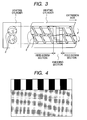
- a first kneading section on the side close to the feed opening 4 is set at a high temperature and a second kneading section on the side close to the extrusion opening 5 is set at a low temperature.
- the difference in temperature between both the kneading sections is 10°C or more.
- the kneading machine may include KRC Kneader (manufactured by Kurimoto, Ltd.); Buss-Kneader (manufactured by Coperion Buss Ag.); TEM-type Extruder (manufactured by Toshiba Machine Co., Ltd.); TEX Twin-screw Extruder (manufactured by The Japan Steel Works, Ltd.); PCM Kneader (manufactured by Ikegai Corp.); Three-Roll Mill, Mixing Roll Mill, and Kneader (manufactured by Inoue Manufacturing Co., Ltd.); Kneadex (manufactured by Mitsui Mining & Smelting Co., Ltd.); MS-type Pressure Kneader, and Kneader-Ruder (manufactured by Moriyama Manufacturing Co., Ltd.); and Banbury Mixer (manufactured by Kobe Steel, Ltd.).
- KRC Kneader manufactured by Kurimoto, Ltd.
- Buss-Kneader
- the molecular weight distribution of the sample is calculated from the relationship between the logarithmic value on a calibration curve prepared using several kinds of monodisperse polystyrene standard samples and the count number.
- the standard polystyrene samples used for the preparation of the calibration curve it is suitable to use samples with molecular weights of 600, 2,100, 4,000, 17,500, 51,000, 110,000, 390,000, 860,000, 2,000,000 and 4,480,000, which are available from Pressure Chemical Co. or Tosoh Corporation, and using at least about 10 standard polystyrene samples.
- An RI (refractive index) detector is used as a detector.
- the molecular weight distribution of the wax is measured by gel permeation chromatography (GPC) under the following conditions.
- the wax In measuring the acid value, hydroxyl value, ester value and saponification value of the wax contained in the toner in the present invention, the wax may be separated from the toner and thereafter the measurement may be made according to the above measuring methods.
- Waxes (a) and (b) used in Examples and Comparative Example are shown in Tables 1 and 2. Resin production processes are shown below. The results of measurement by DSC of the wax (a) are shown in Fig. 1.
- Binder Resins 2 to 9 were obtained in the same manner as in Binder Resin Production Example 1 except that the resins and reaction conditions were changed as shown in Table 6.
- Reaction Conditions ii and iii refer to the following conditions.
- Toners 4 to 6 were prepared in the same manner as in Toner 1 except that the binder resin and the wax were changed as shown in Table 7, and the kneading was carried out without the main-shaft cooling and at a heating temperature of 130°C for both the first kneading section and the second kneading section and at the revolution of 200 rpm for the paddles (Kneading Conditions 3).
- the physical properties of Toners 4 to 6 were measured in the same manner as in Example 1. Results obtained are shown in Table 7.
Landscapes
- Physics & Mathematics (AREA)
- Spectroscopy & Molecular Physics (AREA)
- General Physics & Mathematics (AREA)
- Chemical & Material Sciences (AREA)
- Chemical Kinetics & Catalysis (AREA)
- Developing Agents For Electrophotography (AREA)
Applications Claiming Priority (2)
| Application Number | Priority Date | Filing Date | Title |
|---|---|---|---|
| JP2004043956 | 2004-02-20 | ||
| JP2004043956 | 2004-02-20 |
Publications (3)
| Publication Number | Publication Date |
|---|---|
| EP1566703A2 true EP1566703A2 (fr) | 2005-08-24 |
| EP1566703A3 EP1566703A3 (fr) | 2006-09-06 |
| EP1566703B1 EP1566703B1 (fr) | 2009-02-11 |
Family
ID=34709132
Family Applications (1)
| Application Number | Title | Priority Date | Filing Date |
|---|---|---|---|
| EP04030460A Ceased EP1566703B1 (fr) | 2004-02-20 | 2004-12-22 | Toner |
Country Status (5)
| Country | Link |
|---|---|
| US (1) | US7351509B2 (fr) |
| EP (1) | EP1566703B1 (fr) |
| JP (1) | JP4756874B2 (fr) |
| CN (2) | CN101246322B (fr) |
| DE (1) | DE602004019389D1 (fr) |
Cited By (4)
| Publication number | Priority date | Publication date | Assignee | Title |
|---|---|---|---|---|
| EP1995638A4 (fr) * | 2006-03-03 | 2011-12-21 | Canon Kk | Toner |
| US8445170B2 (en) | 2007-08-30 | 2013-05-21 | Mitsui Chemicals, Inc. | Binder resin for color toners and color toner using the same |
| US8450039B2 (en) | 2007-08-30 | 2013-05-28 | Mitsui Chemicals, Inc. | Binder resin for color toners and color toner using the same |
| EP2625568A4 (fr) * | 2010-10-04 | 2016-05-25 | Canon Kk | Toner |
Families Citing this family (39)
| Publication number | Priority date | Publication date | Assignee | Title |
|---|---|---|---|---|
| US8026030B2 (en) * | 2005-11-07 | 2011-09-27 | Canon Kabushiki Kaisha | Toner |
| EP2063322B1 (fr) * | 2006-10-11 | 2015-12-30 | Canon Kabushiki Kaisha | Toner |
| US7927776B2 (en) * | 2006-12-08 | 2011-04-19 | Samsung Electronics Co., Ltd. | Toner for electrophotography |
| JP4537496B2 (ja) * | 2007-12-27 | 2010-09-01 | キヤノン株式会社 | トナー |
| JP2010072240A (ja) * | 2008-09-17 | 2010-04-02 | Ricoh Co Ltd | 電子写真用トナー、画像形成方法、画像形成装置及びプロセスカートリッジ |
| JP5300401B2 (ja) * | 2008-10-08 | 2013-09-25 | キヤノン株式会社 | トナー |
| US8614044B2 (en) * | 2010-06-16 | 2013-12-24 | Canon Kabushiki Kaisha | Toner |
| BR112013013153A2 (pt) | 2010-12-28 | 2016-08-23 | Canon Kk | toner |
| KR20130113507A (ko) | 2010-12-28 | 2013-10-15 | 캐논 가부시끼가이샤 | 토너 |
| US8512925B2 (en) | 2011-01-27 | 2013-08-20 | Canon Kabushiki Kaisha | Magnetic toner |
| US8501377B2 (en) | 2011-01-27 | 2013-08-06 | Canon Kabushiki Kaisha | Magnetic toner |
| KR20130073817A (ko) * | 2011-12-23 | 2013-07-03 | 주식회사 엘지화학 | 중합 토너 및 이의 제조 방법 |
| US9116448B2 (en) | 2012-06-22 | 2015-08-25 | Canon Kabushiki Kaisha | Toner |
| EP2869126A4 (fr) | 2012-06-22 | 2016-01-20 | Canon Kk | Toner |
| CN103676518A (zh) * | 2012-09-21 | 2014-03-26 | 刘同波 | 一种彩色磁性激光打印机碳粉及其制备方法 |
| US9715188B2 (en) | 2013-07-31 | 2017-07-25 | Canon Kabushiki Kaisha | Toner |
| WO2015016384A1 (fr) | 2013-07-31 | 2015-02-05 | Canon Kabushiki Kaisha | Toner magnétique |
| US9829818B2 (en) | 2014-09-30 | 2017-11-28 | Canon Kabushiki Kaisha | Toner |
| US10101683B2 (en) | 2015-01-08 | 2018-10-16 | Canon Kabushiki Kaisha | Toner and external additive for toner |
| US9971263B2 (en) | 2016-01-08 | 2018-05-15 | Canon Kabushiki Kaisha | Toner |
| US10289016B2 (en) | 2016-12-21 | 2019-05-14 | Canon Kabushiki Kaisha | Toner |
| US10295921B2 (en) | 2016-12-21 | 2019-05-21 | Canon Kabushiki Kaisha | Toner |
| US10295920B2 (en) | 2017-02-28 | 2019-05-21 | Canon Kabushiki Kaisha | Toner |
| US10303075B2 (en) | 2017-02-28 | 2019-05-28 | Canon Kabushiki Kaisha | Toner |
| US10241430B2 (en) | 2017-05-10 | 2019-03-26 | Canon Kabushiki Kaisha | Toner, and external additive for toner |
| JP7066439B2 (ja) | 2018-02-14 | 2022-05-13 | キヤノン株式会社 | トナー用外添剤、トナー用外添剤の製造方法及びトナー |
| US10768540B2 (en) | 2018-02-14 | 2020-09-08 | Canon Kabushiki Kaisha | External additive, method for manufacturing external additive, and toner |
| JP7224885B2 (ja) | 2018-12-10 | 2023-02-20 | キヤノン株式会社 | トナー |
| JP7207981B2 (ja) | 2018-12-10 | 2023-01-18 | キヤノン株式会社 | トナー及びトナーの製造方法 |
| JP2020095083A (ja) | 2018-12-10 | 2020-06-18 | キヤノン株式会社 | トナー |
| JP7443048B2 (ja) | 2018-12-28 | 2024-03-05 | キヤノン株式会社 | トナー |
| JP7504583B2 (ja) | 2018-12-28 | 2024-06-24 | キヤノン株式会社 | トナーの製造方法 |
| JP7433872B2 (ja) | 2018-12-28 | 2024-02-20 | キヤノン株式会社 | トナー |
| JP7391640B2 (ja) | 2018-12-28 | 2023-12-05 | キヤノン株式会社 | トナー |
| JP7301560B2 (ja) | 2019-03-08 | 2023-07-03 | キヤノン株式会社 | トナー |
| JP7483428B2 (ja) | 2020-03-16 | 2024-05-15 | キヤノン株式会社 | トナー |
| JP7475907B2 (ja) | 2020-03-16 | 2024-04-30 | キヤノン株式会社 | トナー |
| JP2021148843A (ja) | 2020-03-16 | 2021-09-27 | キヤノン株式会社 | トナー |
| CN111474258B (zh) * | 2020-04-17 | 2022-09-06 | 湖北航天化学技术研究所 | 叠氮缩水甘油聚醚支化程度的测定方法 |
Family Cites Families (39)
| Publication number | Priority date | Publication date | Assignee | Title |
|---|---|---|---|---|
| JPS57208559A (en) | 1981-06-19 | 1982-12-21 | Konishiroku Photo Ind Co Ltd | Toner for electrostatic charged image development |
| JP2962809B2 (ja) | 1990-11-14 | 1999-10-12 | 三菱レイヨン株式会社 | トナー用樹脂組成物およびその製造方法 |
| KR970001393B1 (ko) * | 1991-09-11 | 1997-02-06 | 캐논 가부시기가이샤 | 정전하상 현상용 토너 및 가열정착방법 |
| CA2088093C (fr) * | 1992-01-31 | 1999-06-29 | Masaaki Shin | Toner electrophotographique et sa methode de production |
| JP3118341B2 (ja) | 1992-01-31 | 2000-12-18 | 三井化学株式会社 | 電子写真用トナー及びその製造法 |
| JP3131754B2 (ja) * | 1993-01-20 | 2001-02-05 | キヤノン株式会社 | 静電荷像現像用トナー及び該トナー用樹脂組成物の製造方法 |
| JP3213776B2 (ja) * | 1993-02-26 | 2001-10-02 | キヤノン株式会社 | 加熱定着方法 |
| DE69407643T2 (de) * | 1993-03-31 | 1998-05-20 | Canon Kk | Toner zur Entwicklung elektrostatischer Bilder und Bilderzeugungsverfahren |
| US5753397A (en) * | 1995-01-30 | 1998-05-19 | Tomoegawa Paper Co., Ltd. | Electrophotographic toner |
| JP3261559B2 (ja) * | 1995-03-29 | 2002-03-04 | キヤノン株式会社 | トナー及び画像形成方法 |
| US5605778A (en) * | 1995-04-07 | 1997-02-25 | Canon Kabushiki Kaisha | Toner with wax component for developing electrostatic image |
| JP3342229B2 (ja) * | 1995-04-07 | 2002-11-05 | キヤノン株式会社 | 静電荷像現像用トナーに用いられるワックス組成物、その製造方法及び該ワックス組成物を含有する静電荷像現像用トナー |
| JP3347533B2 (ja) | 1995-06-15 | 2002-11-20 | キヤノン株式会社 | 静電荷像現像用トナー、画像形成方法及び、該トナー用樹脂組成物とその製造方法 |
| JP3570019B2 (ja) * | 1995-07-21 | 2004-09-29 | 三菱化学株式会社 | 静電荷像現像用トナー |
| JP3169543B2 (ja) * | 1995-12-05 | 2001-05-28 | 積水化学工業株式会社 | トナー用樹脂組成物及びトナー |
| JP3794762B2 (ja) | 1996-09-11 | 2006-07-12 | 三井化学株式会社 | 電子写真用トナー |
| JP3450634B2 (ja) * | 1997-03-17 | 2003-09-29 | キヤノン株式会社 | 静電荷像現像用トナー |
| WO1999000429A1 (fr) * | 1997-06-27 | 1999-01-07 | Tomoegawa Paper Co., Ltd. | Resine olefinique et toner pour impression electrophotographique preparee a partir d'une telle resine |
| JP3825922B2 (ja) * | 1997-08-29 | 2006-09-27 | キヤノン株式会社 | 静電荷像現像用トナー及び画像形成方法 |
| SG70143A1 (en) * | 1997-12-25 | 2000-01-25 | Canon Kk | Toner and image forming method |
| JP3327829B2 (ja) * | 1998-02-27 | 2002-09-24 | キヤノン株式会社 | 静電荷像現像用トナー |
| JP3200414B2 (ja) * | 1999-02-01 | 2001-08-20 | キヤノン株式会社 | 静電荷像現像用トナー及び加熱定着方法 |
| EP1096325B1 (fr) * | 1999-10-29 | 2006-11-29 | Canon Kabushiki Kaisha | Toner |
| JP4227268B2 (ja) * | 1999-12-28 | 2009-02-18 | キヤノン株式会社 | 乾式トナー |
| EP1160631B1 (fr) * | 2000-06-02 | 2004-04-21 | Canon Kabushiki Kaisha | Révélateur |
| JP4095260B2 (ja) * | 2000-06-02 | 2008-06-04 | キヤノン株式会社 | トナー |
| JP2001350293A (ja) * | 2000-06-05 | 2001-12-21 | Sharp Corp | 静電荷像現像用トナー、静電荷像現像用現像剤、画像形成装置および画像形成方法 |
| JP4385517B2 (ja) * | 2000-11-24 | 2009-12-16 | コニカミノルタビジネステクノロジーズ株式会社 | 静電荷像現像用トナー |
| JP3817432B2 (ja) * | 2001-03-15 | 2006-09-06 | キヤノン株式会社 | トナー及び画像形成方法 |
| JP2003057877A (ja) * | 2001-08-20 | 2003-02-28 | Canon Inc | トナー、トナー用樹脂組成物及びその製造方法 |
| US6808852B2 (en) * | 2001-09-06 | 2004-10-26 | Canon Kabushiki Kaisha | Toner and heat-fixing method |
| JP2003122044A (ja) * | 2001-10-18 | 2003-04-25 | Canon Inc | トナー |
| JP4365567B2 (ja) * | 2002-01-11 | 2009-11-18 | 株式会社リコー | 静電荷像現像用トナー及び画像作製方法 |
| JP3977084B2 (ja) * | 2002-01-16 | 2007-09-19 | キヤノン株式会社 | カラートナーキット及び画像形成方法 |
| JP2003270851A (ja) * | 2002-03-14 | 2003-09-25 | Mitsubishi Rayon Co Ltd | トナー用スチレン系バインダー樹脂及びそれを用いたトナー |
| US6881527B2 (en) * | 2002-03-26 | 2005-04-19 | Canon Kabushiki Kaisha | Toner, and process cartridge |
| JP4332367B2 (ja) * | 2002-04-10 | 2009-09-16 | キヤノン株式会社 | トナー |
| KR100487048B1 (ko) * | 2002-04-10 | 2005-05-03 | 캐논 가부시끼가이샤 | 토너 |
| JP2003302784A (ja) * | 2002-04-11 | 2003-10-24 | Canon Inc | 磁性トナー |
-
2004
- 2004-12-17 US US11/013,534 patent/US7351509B2/en not_active Expired - Lifetime
- 2004-12-22 DE DE602004019389T patent/DE602004019389D1/de not_active Expired - Lifetime
- 2004-12-22 EP EP04030460A patent/EP1566703B1/fr not_active Ceased
-
2005
- 2005-02-16 JP JP2005039295A patent/JP4756874B2/ja not_active Expired - Fee Related
- 2005-02-21 CN CN200810006573XA patent/CN101246322B/zh not_active Expired - Fee Related
- 2005-02-21 CN CN200510008445.5A patent/CN1658078A/zh active Pending
Cited By (5)
| Publication number | Priority date | Publication date | Assignee | Title |
|---|---|---|---|---|
| EP1995638A4 (fr) * | 2006-03-03 | 2011-12-21 | Canon Kk | Toner |
| US8247147B2 (en) | 2006-03-03 | 2012-08-21 | Canon Kabushiki Kaisha | Toner |
| US8445170B2 (en) | 2007-08-30 | 2013-05-21 | Mitsui Chemicals, Inc. | Binder resin for color toners and color toner using the same |
| US8450039B2 (en) | 2007-08-30 | 2013-05-28 | Mitsui Chemicals, Inc. | Binder resin for color toners and color toner using the same |
| EP2625568A4 (fr) * | 2010-10-04 | 2016-05-25 | Canon Kk | Toner |
Also Published As
| Publication number | Publication date |
|---|---|
| DE602004019389D1 (de) | 2009-03-26 |
| CN1658078A (zh) | 2005-08-24 |
| CN101246322B (zh) | 2011-03-16 |
| JP2005266789A (ja) | 2005-09-29 |
| US7351509B2 (en) | 2008-04-01 |
| CN101246322A (zh) | 2008-08-20 |
| JP4756874B2 (ja) | 2011-08-24 |
| EP1566703B1 (fr) | 2009-02-11 |
| US20050186497A1 (en) | 2005-08-25 |
| EP1566703A3 (fr) | 2006-09-06 |
Similar Documents
| Publication | Publication Date | Title |
|---|---|---|
| EP1566703B1 (fr) | Toner | |
| US7288354B2 (en) | Toner | |
| US7745089B2 (en) | Process for producing toner, and toner | |
| US7638251B2 (en) | Toner | |
| KR101259863B1 (ko) | 토너 | |
| US7935467B2 (en) | Magnetic toner | |
| US20090197192A1 (en) | Magnetic toner | |
| EP1353236B1 (fr) | Toner | |
| JP2008102396A (ja) | トナー | |
| JP4208784B2 (ja) | トナー | |
| JP4125199B2 (ja) | 画像形成方法 | |
| US20060141380A1 (en) | Toner | |
| JP2005266788A (ja) | トナーの製造方法及びトナー | |
| JP4262160B2 (ja) | トナー | |
| JP4164476B2 (ja) | トナー | |
| JP4208785B2 (ja) | トナー | |
| JP2008096624A (ja) | トナー | |
| JP4136791B2 (ja) | トナー | |
| HK1059651A (en) | Toner |
Legal Events
| Date | Code | Title | Description |
|---|---|---|---|
| PUAI | Public reference made under article 153(3) epc to a published international application that has entered the european phase |
Free format text: ORIGINAL CODE: 0009012 |
|
| AK | Designated contracting states |
Kind code of ref document: A2 Designated state(s): AT BE BG CH CY CZ DE DK EE ES FI FR GB GR HU IE IS IT LI LT LU MC NL PL PT RO SE SI SK TR |
|
| AX | Request for extension of the european patent |
Extension state: AL BA HR LV MK YU |
|
| PUAL | Search report despatched |
Free format text: ORIGINAL CODE: 0009013 |
|
| AK | Designated contracting states |
Kind code of ref document: A3 Designated state(s): AT BE BG CH CY CZ DE DK EE ES FI FR GB GR HU IE IS IT LI LT LU MC NL PL PT RO SE SI SK TR |
|
| AX | Request for extension of the european patent |
Extension state: AL BA HR LV MK YU |
|
| 17P | Request for examination filed |
Effective date: 20070306 |
|
| 17Q | First examination report despatched |
Effective date: 20070410 |
|
| AKX | Designation fees paid |
Designated state(s): DE FR GB IT |
|
| GRAP | Despatch of communication of intention to grant a patent |
Free format text: ORIGINAL CODE: EPIDOSNIGR1 |
|
| GRAS | Grant fee paid |
Free format text: ORIGINAL CODE: EPIDOSNIGR3 |
|
| GRAA | (expected) grant |
Free format text: ORIGINAL CODE: 0009210 |
|
| AK | Designated contracting states |
Kind code of ref document: B1 Designated state(s): DE FR GB IT |
|
| REG | Reference to a national code |
Ref country code: GB Ref legal event code: FG4D |
|
| REF | Corresponds to: |
Ref document number: 602004019389 Country of ref document: DE Date of ref document: 20090326 Kind code of ref document: P |
|
| PLBE | No opposition filed within time limit |
Free format text: ORIGINAL CODE: 0009261 |
|
| STAA | Information on the status of an ep patent application or granted ep patent |
Free format text: STATUS: NO OPPOSITION FILED WITHIN TIME LIMIT |
|
| 26N | No opposition filed |
Effective date: 20091112 |
|
| PGFP | Annual fee paid to national office [announced via postgrant information from national office to epo] |
Ref country code: GB Payment date: 20131217 Year of fee payment: 10 |
|
| PGFP | Annual fee paid to national office [announced via postgrant information from national office to epo] |
Ref country code: IT Payment date: 20131203 Year of fee payment: 10 |
|
| GBPC | Gb: european patent ceased through non-payment of renewal fee |
Effective date: 20141222 |
|
| PG25 | Lapsed in a contracting state [announced via postgrant information from national office to epo] |
Ref country code: GB Free format text: LAPSE BECAUSE OF NON-PAYMENT OF DUE FEES Effective date: 20141222 |
|
| REG | Reference to a national code |
Ref country code: FR Ref legal event code: PLFP Year of fee payment: 12 |
|
| PG25 | Lapsed in a contracting state [announced via postgrant information from national office to epo] |
Ref country code: IT Free format text: LAPSE BECAUSE OF NON-PAYMENT OF DUE FEES Effective date: 20141222 |
|
| REG | Reference to a national code |
Ref country code: FR Ref legal event code: PLFP Year of fee payment: 13 |
|
| REG | Reference to a national code |
Ref country code: FR Ref legal event code: PLFP Year of fee payment: 14 |
|
| PGFP | Annual fee paid to national office [announced via postgrant information from national office to epo] |
Ref country code: FR Payment date: 20171229 Year of fee payment: 14 |
|
| PG25 | Lapsed in a contracting state [announced via postgrant information from national office to epo] |
Ref country code: FR Free format text: LAPSE BECAUSE OF NON-PAYMENT OF DUE FEES Effective date: 20181231 |
|
| PGFP | Annual fee paid to national office [announced via postgrant information from national office to epo] |
Ref country code: DE Payment date: 20201020 Year of fee payment: 17 |
|
| REG | Reference to a national code |
Ref country code: DE Ref legal event code: R119 Ref document number: 602004019389 Country of ref document: DE |
|
| PG25 | Lapsed in a contracting state [announced via postgrant information from national office to epo] |
Ref country code: DE Free format text: LAPSE BECAUSE OF NON-PAYMENT OF DUE FEES Effective date: 20220701 |