EP1566923B1 - Verfahren zur Kommunikation zwischen Hausgeräten und Geräte zur Durchführung des Verfahrens - Google Patents
Verfahren zur Kommunikation zwischen Hausgeräten und Geräte zur Durchführung des Verfahrens Download PDFInfo
- Publication number
- EP1566923B1 EP1566923B1 EP05101094A EP05101094A EP1566923B1 EP 1566923 B1 EP1566923 B1 EP 1566923B1 EP 05101094 A EP05101094 A EP 05101094A EP 05101094 A EP05101094 A EP 05101094A EP 1566923 B1 EP1566923 B1 EP 1566923B1
- Authority
- EP
- European Patent Office
- Prior art keywords
- appliance
- threshold
- power level
- zone
- registration request
- Prior art date
- Legal status (The legal status is an assumption and is not a legal conclusion. Google has not performed a legal analysis and makes no representation as to the accuracy of the status listed.)
- Ceased
Links
Images


Classifications
-
- H—ELECTRICITY
- H04—ELECTRIC COMMUNICATION TECHNIQUE
- H04L—TRANSMISSION OF DIGITAL INFORMATION, e.g. TELEGRAPHIC COMMUNICATION
- H04L12/00—Data switching networks
- H04L12/28—Data switching networks characterised by path configuration, e.g. LAN [Local Area Networks] or WAN [Wide Area Networks]
- H04L12/2801—Broadband local area networks
-
- G—PHYSICS
- G02—OPTICS
- G02C—SPECTACLES; SUNGLASSES OR GOGGLES INSOFAR AS THEY HAVE THE SAME FEATURES AS SPECTACLES; CONTACT LENSES
- G02C7/00—Optical parts
- G02C7/02—Lenses; Lens systems ; Methods of designing lenses
-
- G—PHYSICS
- G02—OPTICS
- G02C—SPECTACLES; SUNGLASSES OR GOGGLES INSOFAR AS THEY HAVE THE SAME FEATURES AS SPECTACLES; CONTACT LENSES
- G02C1/00—Assemblies of lenses with bridges or browbars
- G02C1/02—Bridge or browbar secured to lenses without the use of rims
-
- G—PHYSICS
- G02—OPTICS
- G02C—SPECTACLES; SUNGLASSES OR GOGGLES INSOFAR AS THEY HAVE THE SAME FEATURES AS SPECTACLES; CONTACT LENSES
- G02C11/00—Non-optical adjuncts; Attachment thereof
- G02C11/02—Ornaments, e.g. exchangeable
-
- H—ELECTRICITY
- H04—ELECTRIC COMMUNICATION TECHNIQUE
- H04H—BROADCAST COMMUNICATION
- H04H60/00—Arrangements for broadcast applications with a direct linking to broadcast information or broadcast space-time; Broadcast-related systems
- H04H60/09—Arrangements for device control with a direct linkage to broadcast information or to broadcast space-time; Arrangements for control of broadcast-related services
- H04H60/14—Arrangements for conditional access to broadcast information or to broadcast-related services
- H04H60/16—Arrangements for conditional access to broadcast information or to broadcast-related services on playing information
-
- H—ELECTRICITY
- H04—ELECTRIC COMMUNICATION TECHNIQUE
- H04H—BROADCAST COMMUNICATION
- H04H60/00—Arrangements for broadcast applications with a direct linking to broadcast information or broadcast space-time; Broadcast-related systems
- H04H60/76—Arrangements characterised by transmission systems other than for broadcast, e.g. the Internet
- H04H60/78—Arrangements characterised by transmission systems other than for broadcast, e.g. the Internet characterised by source locations or destination locations
- H04H60/80—Arrangements characterised by transmission systems other than for broadcast, e.g. the Internet characterised by source locations or destination locations characterised by transmission among terminal devices
-
- H—ELECTRICITY
- H04—ELECTRIC COMMUNICATION TECHNIQUE
- H04L—TRANSMISSION OF DIGITAL INFORMATION, e.g. TELEGRAPHIC COMMUNICATION
- H04L12/00—Data switching networks
- H04L12/28—Data switching networks characterised by path configuration, e.g. LAN [Local Area Networks] or WAN [Wide Area Networks]
- H04L12/2803—Home automation networks
-
- H—ELECTRICITY
- H04—ELECTRIC COMMUNICATION TECHNIQUE
- H04L—TRANSMISSION OF DIGITAL INFORMATION, e.g. TELEGRAPHIC COMMUNICATION
- H04L12/00—Data switching networks
- H04L12/28—Data switching networks characterised by path configuration, e.g. LAN [Local Area Networks] or WAN [Wide Area Networks]
- H04L12/2803—Home automation networks
- H04L12/2838—Distribution of signals within a home automation network, e.g. involving splitting/multiplexing signals to/from different paths
-
- H—ELECTRICITY
- H04—ELECTRIC COMMUNICATION TECHNIQUE
- H04N—PICTORIAL COMMUNICATION, e.g. TELEVISION
- H04N21/00—Selective content distribution, e.g. interactive television or video on demand [VOD]
- H04N21/40—Client devices specifically adapted for the reception of or interaction with content, e.g. set-top-box [STB]; Operations thereof
- H04N21/43—Processing of content or additional data, e.g. demultiplexing additional data from a digital video stream; Elementary client operations, e.g. monitoring of home network or synchronising decoder's clock; Client middleware
- H04N21/436—Interfacing a local distribution network, e.g. communicating with another STB or one or more peripheral devices inside the home
- H04N21/4367—Establishing a secure communication between the client and a peripheral device or smart card
-
- H—ELECTRICITY
- H04—ELECTRIC COMMUNICATION TECHNIQUE
- H04N—PICTORIAL COMMUNICATION, e.g. TELEVISION
- H04N21/00—Selective content distribution, e.g. interactive television or video on demand [VOD]
- H04N21/40—Client devices specifically adapted for the reception of or interaction with content, e.g. set-top-box [STB]; Operations thereof
- H04N21/45—Management operations performed by the client for facilitating the reception of or the interaction with the content or administrating data related to the end-user or to the client device itself, e.g. learning user preferences for recommending movies, resolving scheduling conflicts
- H04N21/462—Content or additional data management e.g. creating a master electronic programme guide from data received from the Internet and a Head-end or controlling the complexity of a video stream by scaling the resolution or bit-rate based on the client capabilities
- H04N21/4623—Processing of entitlement messages, e.g. ECM [Entitlement Control Message] or EMM [Entitlement Management Message]
-
- H—ELECTRICITY
- H04—ELECTRIC COMMUNICATION TECHNIQUE
- H04N—PICTORIAL COMMUNICATION, e.g. TELEVISION
- H04N7/00—Television systems
- H04N7/16—Analogue secrecy systems; Analogue subscription systems
- H04N7/162—Authorising the user terminal, e.g. by paying; Registering the use of a subscription channel, e.g. billing
- H04N7/163—Authorising the user terminal, e.g. by paying; Registering the use of a subscription channel, e.g. billing by receiver means only
-
- H—ELECTRICITY
- H04—ELECTRIC COMMUNICATION TECHNIQUE
- H04H—BROADCAST COMMUNICATION
- H04H60/00—Arrangements for broadcast applications with a direct linking to broadcast information or broadcast space-time; Broadcast-related systems
- H04H60/09—Arrangements for device control with a direct linkage to broadcast information or to broadcast space-time; Arrangements for control of broadcast-related services
- H04H60/14—Arrangements for conditional access to broadcast information or to broadcast-related services
- H04H60/23—Arrangements for conditional access to broadcast information or to broadcast-related services using cryptography, e.g. encryption, authentication, key distribution
-
- H—ELECTRICITY
- H04—ELECTRIC COMMUNICATION TECHNIQUE
- H04N—PICTORIAL COMMUNICATION, e.g. TELEVISION
- H04N7/00—Television systems
- H04N7/01—Conversion of standards, e.g. involving analogue television standards or digital television standards processed at pixel level
- H04N7/0125—Conversion of standards, e.g. involving analogue television standards or digital television standards processed at pixel level one of the standards being a high definition standard
Definitions
- the present invention relates to the field of digital decoders and more precisely to the use of several decoders in the home using the same subscription.
- Multimedia service operators distribute their services according to several transmission networks.
- These networks may be cited satellite, cable and digital terrestrial distribution networks.
- These various distribution networks share the common feature of conveying transport streams up to an appliance, the network entry point, in the home.
- the services are thereafter distributed within the home on a cable to the various places where the subscriber wishes to be able to receive the services to which he has signed up.
- Reception proper is performed by means of an appliance called a digital decoder whose function is to verify the subscriber's access entitlements to the services and to decode those for which the subscriber possesses entitlements.
- the subscriber In his home, the subscriber often possesses several receivers with which he can view the services distributed. The problem then arises of allowing the subscriber to decode the services to which he has subscribed at several places in his home. Distribution downstream of the decoder of the service decoded is one solution but only makes it possible to transmit a single service into the home, the one which is decoded at a given moment by the single decoder. This implies that everybody in the home is viewing the same service.
- each decoder is able to decode any one of the services distributed independently of the services decoded by the other decoders in the home. Accordingly, it is therefore possible to use in a home several decoders using the particulars of a single subscription. However, if decoders able to reuse the particulars of one and the same subscription are distributed in this way, it becomes easy to reuse such a second decoder, not now in the subscriber's home, but in another home by somebody who has not signed up to the service.
- WO 01/80030A discloses a system and method for communication between subscriber's devices over cable infrastructure designed to carry video signals.
- the invention sets out to make it possible to distribute multiple decoders usable in the home of a subscriber.
- the decoders using one and the same subscription will have to communicate with one another to operate. This communication is facilitated by the cable allowing the transmission of services into the home.
- the emission and reception power of the signals implementing this communication is managed in such a way as to preclude this communication between two neighbouring homes by the service distribution equipment, in the case of a communal distribution of these services.
- the exemplary embodiment which follows explains the manner in which decoders will be paired within a home in such a way as to allow them to converse with one another.
- the standpoint of the exemplary embodiment is that of digital decoders, the invention is not limited to appliances of this type and can be used regardless of the type of domestic appliance.
- a protocol is defined so as to effectively facilitate this communication.
- the communication is conducted according to a master/slave mode.
- a decoder of the home will play the role of master and the other decoders of slaves.
- a slave decoder will be able to operate only on condition that it exchanges information regularly with its master. This information will typically be encrypted authentication information.
- the invention offers the means of communication between the decoders. The manner in which this communication is restricted to the home of the subscriber by management of the emission and reception power of the signals will be described.
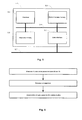
- FIG. 1 represents the diagram of a typical installation for communal distribution of services which will help us to describe the exemplary embodiment.
- the services are distributed by a distribution network 1.1 which may be a cable network, a satellite network, a digital terrestrial network or the like.
- a cable network facilitates the distribution of services between several homes. This case occurs naturally in cable-based service distribution networks and in communal distribution networks for satellite and digital terrestrial.
- a reception dish or antenna will allow the reception of the services which will be distributed by a communal distribution cable network 1.2 within a property or a residential district.
- This communal distribution cable network arrives via cables 1.12 at the homes 1.3, 1.4 of the subscribers.
- decoders 1.8, 1.9, 1.10 allow the decoding of these services for viewing by the subscribers.
- a subscriber wants to receive the services in several rooms this being the case of the home 1 of the diagram, he will utilize two decoders 1.8 and 1.9. These two decoders will establish a communication by way of the cables 1.11 distributing the services around the home. This communication will allow the pairing of the decoders one playing the role of master and the others of slaves. The choice of the decoder playing the role of master may be made in various ways.
- the simplest manner consists in offering the user a configuration option for the appliance indicating to him whether it is playing this role of master or that of slave. This pairing is symbolized by the arrow 1.13 in the figure.
- the communication protocol will use the despatching and the receiving of digital frames on the cable by using a low-frequency channel, typically 250 Khz or 1 Mhz, but any frequency that does not disturb the distribution of the services is conceivable.
- the problem then arises of allowing the pairing of the decoders 1.8 and 1.9 in the home 1.3 without disturbing and above all without allowing the decoder 1.10 to pair up via the cable distribution network 1.2 and the cables 1.12.
- a signal emitted on a cable undergoes attenuation as a function of the length of the cable and of the appliances traversed.
- a signal emitted under a certain emission power threshold S1 typically 83 dB ⁇ V
- S4 typically 41 dB ⁇ V
- S2 typically 70 dB ⁇ v
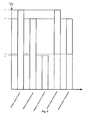
- Figure 2 describes these various thresholds. As may be seen therein, first column, a signal emitted with a power of less than S1 is received, second column, at a level of less than S2 in the home and less than S4, third column, in a neighbouring home. From this one therefore deduces that if the emission power is limited between S3 and S1 and the reception power is limited between S3 and S2, only the decoders located in the same home will be able to communicate.
- the communication protocol makes provision, firstly, for an initialization phase during which all the slaves present in the home will register with the master.
- This phase also serves to determine the power level necessary for the communication.
- the idea is to establish the communication between the master and the slaves by using the minimum power level required out of a certain number of preset levels. We saw that the power level of emission had to lie between a level S3 and a level S1 in order to facilitate communication in the home while preventing communication between two homes. It goes without saying that the lower the emission power level of the messages, the less it will be possible for this communication in the home to be perceived outside the home.
- the initialization phase comprises the emission by the master of a so-called registration request packet.
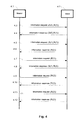
- This registration request will be despatched a first time at a first emission level of typically around S3, reference 3.3 in the drawings.
- an emission level slightly greater than S3 is the minimum emission level whereby it is possible to contemplate reception at a level greater than S3.
- Any decoder receiving this request will respond thereto via a so-called registration response request.
- This response will be despatched at the same power level as the registration request. It will contain an identifier of the slave decoder responding to the request. This identifier may be an MAC address, a serial number or else a chip card number. The master will allocate an address to this decoder corresponding to this identifier.
- the risks of collision on the cable can be minimized by applying a random delay to the response, this delay being kept within a response window fixed by the master in his registration request.
- the despatching of this connection request at a power level close to the minimum threshold S3 provides us with no guarantee that it was understood by all the decoders present in the home.
- To facilitate the registration of all of the decoders we shall repeat this registration request 3.4, 3.5 and 3.7 at progressively increasing power levels without ever exceeding the maximum level S1.
- the emission power level of the connection request is coded in the connection request itself, thereby allowing the slave decoder to emit its registration response 3.6 at the same power level.
- the response likewise will comprise this power level coded in the response itself.
- a slave decoder In the case where a slave decoder receives several registration requests at different powers, it will only despatch a response with the emission power level corresponding to the emission power level of the request having the lowest level.
- all the decoders present in the home will be known, will have an address allocated by the master and the minimum emission level, P3 in Figure 3 , will be known from among the levels used during initialization, at which the communication must be established so as to communicate with all the decoders of the home.
- This minimum emission level will thereafter be used for all the messages exchanged between the master and the slaves. It is also conceivable to store in the master the minimum level required to communicate with each slave and to use this level in the communication with this slave. This initialization phase will be automatically repeated regularly over time so as to permit the connection of new decoders that might appear in the home.
- connection phase will make it possible to actually open the communication link between the master and the slave.
- This phase is covered by three types of messages: the connection request 3.8, the connection response 3.9 and the connection confirmation 3.10.
- the connection request will be despatched by the master to the slave that has just registered.
- This message will be despatched in broadcast mode and contains the address allocated to the decoder as well as the identifier under which the decoder has made itself known.
- the decoder which will recognize its identifier will therefore be able to know the address that has been allocated to it. This knowledge allows it, thereafter, to recognize the messages which are intended for it. It responds, with a message, called the connection response, unicast to this connection request.
- a data exchange process will thereafter be able to be set up between the master and the slaves.
- the content of the data transmitted, their coding, the transmission frequency are not detailed here.
- the master having the initiative for any exchange of messages between it and the slaves in this protocol, it will be able to despatch data to the slaves. In the case where it has no data to despatch, it will regularly despatch requests to the slaves to ask them whether they do have data to despatch to it. This is done by despatching an information request 3.11 to a slave, to which the slave will respond with an information response 3.12. Each of these messages may or may not contain useful information. In all cases, the protocol demands an exchange of such packets, if need be empty of useful data, regularly.
- a stream control system is also implemented during these exchanges of packets.
- This system is composed of two registers in the packets, called S and R.
- the register S is a register with 3 bits defining the number of the packet despatched, while the register R, likewise 3 bits, indicates the number of the next packet expected. Only packets containing useful data contain a significant register S. On the other hand all the packets contain a register R.
- An exemplary communication portraying the registers in question is shown in Figure 4 . This depicts a first packet 4.3, this packet transports information and is numbered 0 via the register S. Since no message has yet been received on the part of the peer, the register R indicates that the message numbered 0 is awaited.
- the message 4.4 numbered 0 is received in response, awaiting a next message numbered 1.
- the message 4.5 is numbered 1 and indicates that the master is waiting for a message numbered 1 from the slave.
- the message 4.6 contains no information and therefore no significant register S. On the other hand, it nevertheless signals that the next message expected by the slave is the message numbered 2.
- the message 4.7 has the same significance, nothing is transmitted and message 1 is awaited. This message arrives in the form of the message 4.8, numbered 1 and indicating that the slave is awaiting a message numbered 2.
- the subsequent messages contain no information and therefore merely indicate the number of the next message that the master or the slave are waiting for.
- the end of the connection is managed by the master. It may arrive for four distinct reasons. It may arrive because it is requested by the application or on expiry of time counters (timeout) while waiting for a connection response or an information response. A fourth case consisting of unexpected errors is also envisaged.
- a message called a release request is despatched by the master to the slave. This request may be despatched either to a given slave or in broadcast mode to all the slaves.
- the slaves involved in the request must respond with a message called the release response.
- Such a phase giving rise to ends of connections must necessarily be followed by an initial ization phase allowing the slaves to reconnect. Specifically, a valid connection must be maintained between the master and the slaves.
- this type of protocol may be implemented in any type of domestic appliance provided that several appliances can be linked by a cable making it possible to establish a communication.
Landscapes
- Engineering & Computer Science (AREA)
- Signal Processing (AREA)
- Multimedia (AREA)
- Physics & Mathematics (AREA)
- Computer Networks & Wireless Communication (AREA)
- Databases & Information Systems (AREA)
- Automation & Control Theory (AREA)
- Ophthalmology & Optometry (AREA)
- Health & Medical Sciences (AREA)
- Optics & Photonics (AREA)
- General Physics & Mathematics (AREA)
- Computer Security & Cryptography (AREA)
- General Health & Medical Sciences (AREA)
- Small-Scale Networks (AREA)
- Cable Transmission Systems, Equalization Of Radio And Reduction Of Echo (AREA)
- Two-Way Televisions, Distribution Of Moving Picture Or The Like (AREA)
Claims (10)
- Verfahren zum Herstellen einer Kommunikation zwischen einem ersten Gerät (1.8) und mindestens einem zweiten Gerät (1.9), wobei das erste Gerät und das mindestens eine zweite Gerät durch ein Kabelnetz (1.12) innerhalb einer ersten Zone (1.3) verknüpft sind, wobei dieses Kabelnetz mit einer zweiten Zone (1.4) verbunden ist, sodass durch ein Gerät innerhalb der ersten Zone emittierte Signale in der zweiten Zone erfasst werden können, wobei durch Modulieren eines Signals, das eine digitale Nachricht repräsentiert, auf dem Kabel eine Kommunikation hergestellt wird, dadurch gekennzeichnet, dass das Verfahren die folgenden durch das erste Gerät implementierten Schritte umfasst:- Aussenden mindestens einer Registrierungsanforderung (3.3, 3.4, 3.5, 3.7), die in Übereinstimmung mit einer Sendebetriebsart auf dem Kabel abgesendet wird, wobei mindestens ein Emissionsleistungspegel höher als ein zweiter Schwellenwert (S3) und niedriger als ein erster Schwellenwert (S1) ist, wobei der Emissionsleistungspegel in der Anforderung angegeben ist;- Empfangen mindestens einer Registrierungsantwort (3.6), die durch das mindestens eine zweite Gerät (1.9) innerhalb der ersten Zone in Reaktion auf die mindestens eine Registrierungsanforderung abgesendet wird;- sodass irgendeine Nachricht, die mit einem Leistungspegel gleich dem ersten Schwellenwert (S1) durch das erste Gerät (1.8) abgesendet wird, den maximalen Leistungspegel, mit dem sie durch ein Gerät, das sich in der zweiten Zone (1.4) befindet, empfangen werden kann, als kleiner als einen dritten Schwellenwert (S4), der kleiner als der zweite Schwellenwert (S3) ist, sieht.
- Verfahren nach Anspruch 1, dadurch gekennzeichnet, dass die mindestens eine Registrierungsanforderung mit zunehmenden Leistungspegeln gesendet wird.
- Verfahren nach Anspruch 1 und 2, dadurch gekennzeichnet, dass es einen Schritt des Wählens der Emissionsleistung der mindestens einen zu dem mindestens einen zweiten registrierten Gerät abgesendeten Registrierungsanforderung als eine Funktion der Emissionsleistungspegel der empfangenen Registrierungsantworten umfasst.
- Verfahren nach einem der Ansprüche 1 bis 3, dadurch gekennzeichnet, dass für die Kommunikation mit dem mindestens einen zweiten Gerät ein minimaler Sendepegel verwendet wird, wobei der minimale Sendepegel dem Leistungspegel entspricht, der einer durch das mindestens eine zweite Gerät gesendeten Registrierungsantwort zugeordnet ist.
- Verfahren nach einem der Ansprüche 1 bis 3, dadurch gekennzeichnet, dass für die Kommunikation mit dem mindestens einen zweiten Gerät ein minimaler Sendepegel verwendet wird, wobei der minimale Sendepegel dem minimalen Leistungspegel entspricht, der einer durch das mindestens eine zweite Gerät gesendeten Registrierungsantwort zugeordnet ist, um mit allen der mindestens einen zweiten Geräte zu kommunizieren.
- Verfahren nach einem der Ansprüche 1 bis 5, dadurch gekennzeichnet, dass die mindestens eine Registrierungsantwort einen Emissionsleistungspegel der entsprechenden Verbindungsanforderung umfasst.
- Verfahren nach einem der Ansprüche 1 bis 6, dadurch gekennzeichnet, dass es eine ausschließliche Betrachtung der mindestens einen mit einem höheren Leistungspegel als dem zweiten Schwellenwert (S3) empfangenen Registrierungsanforderung durch das mindestens eine zweite Gerät umfasst, sodass irgendeine Registrierungsanforderung, die mit einem Leistungspegel gleich dem ersten Schwellenwert (S1) durch ein Gerät, das sich in der ersten Zone befindet, abgesendet wird, durch ein Gerät, das sich in der zweiten Zone befindet, mit einem maximalen Leistungspegel, der kleiner als der dritte Schwellenwert (S4) ist, der kleiner als der zweite Schwellenwert (S3) ist, empfangen wird.
- Verfahren zum Herstellen einer Kommunikation zwischen einem ersten Gerät (1.8) und mindestens einem zweiten Gerät (1.9), wobei das erste Gerät und das mindestens eine zweite Gerät durch ein Kabelnetz (1.12) innerhalb einer ersten Zone (1.3) verknüpft sind, wobei dieses Kabelnetz mit einer zweiten Zone (1.4) verbunden ist, sodass durch ein Gerät innerhalb der ersten Zone emittierte Signale in der zweiten Zone erfasst werden können, wobei durch Modulieren eines Signals, das eine digitale Nachricht repräsentiert, auf dem Kabel eine Kommunikation hergestellt wird, dadurch gekennzeichnet, dass das Verfahren die folgenden durch das mindestens eine zweite Gerät implementierten Schritte umfasst:- Empfangen mindestens einer Registrierungsanforderung (3.3, 3.4, 3.5, 3.7), die durch das erste Gerät in Übereinstimmung mit einer Sendebetriebsart auf dem Kabel abgesendet wird, wobei mindestens ein Emissionsleistungspegel höher als ein zweiter Schwellenwert (S3) und niedriger als ein erster Schwellenwert (S1) ist, wobei der Emissionsleistungspegel in der Anforderung angegeben ist;- Betrachten der mindestens einen Registrierungsanforderung (3.3, 3.4, 3.5, 3.7) aufgrund dessen, dass die mindestens eine Registrierungsanforderung (3.3, 3.4, 3.5, 3.7) mit einem höheren Leistungspegel als dem zweiten Schwellenwert (S3) empfangen wird, durch das mindestens eine zweites Gerät (1.9), sodass irgendeine Nachricht, die mit einem Leistungspegel gleich dem ersten Schwellenwert (S1) durch ein Gerät, das sich in der ersten Zone (1.3) befindet, abgesendet wird, einen maximalen Leistungspegel, mit dem sie durch ein Gerät, das sich in der zweiten Zone (1.4) befindet, empfangen werden kann, als kleiner als einen dritten Schwellenwert (S4), der kleiner als der zweite Schwellenwert (S3) ist, sieht;- Absenden mindestens einer Registrierungsantwort (3.6) in Reaktion auf die mindestens eine Registrierungsanforderung.
- Verfahren nach Anspruch 8, dadurch gekennzeichnet, dass die mindestens eine Registrierungsantwort einen Emissionsleistungspegel der entsprechenden Verbindungsanforderung umfasst.
- Verfahren nach einem der Ansprüche 8 und 9, dadurch gekennzeichnet, dass es eine ausschließliche Betrachtung der mindestens einen Registrierungsanforderung, die mit einem höheren Leistungspegel als dem zweiten Schwellenwert (S3) empfangen wird, durch das mindestens eine zweite Gerät umfasst, sodass irgendeine Registrierungsanforderung, die mit einem Leistungspegel gleich dem ersten Schwellenwert (S1) durch ein Gerät, das sich in der ersten Zone befindet, abgesendet wird, durch ein Gerät, das sich in der zweiten Zone befindet, mit einem maximalen Leistungspegel, der kleiner als der dritte Schwellenwert (S4) ist, der kleiner als der zweite Schwellenwert (S3) ist, empfangen wird.
Applications Claiming Priority (2)
| Application Number | Priority Date | Filing Date | Title |
|---|---|---|---|
| FR0401780 | 2004-02-23 | ||
| FR0401780A FR2866767A1 (fr) | 2004-02-23 | 2004-02-23 | Methode de communication entre appareils domestiques et appareils implementant la methode |
Publications (2)
| Publication Number | Publication Date |
|---|---|
| EP1566923A1 EP1566923A1 (de) | 2005-08-24 |
| EP1566923B1 true EP1566923B1 (de) | 2012-04-11 |
Family
ID=34708014
Family Applications (1)
| Application Number | Title | Priority Date | Filing Date |
|---|---|---|---|
| EP05101094A Ceased EP1566923B1 (de) | 2004-02-23 | 2005-02-14 | Verfahren zur Kommunikation zwischen Hausgeräten und Geräte zur Durchführung des Verfahrens |
Country Status (7)
| Country | Link |
|---|---|
| US (1) | US20050264395A1 (de) |
| EP (1) | EP1566923B1 (de) |
| JP (1) | JP4785390B2 (de) |
| KR (1) | KR101127216B1 (de) |
| CN (1) | CN1661978A (de) |
| FR (1) | FR2866767A1 (de) |
| MX (1) | MXPA05001987A (de) |
Families Citing this family (22)
| Publication number | Priority date | Publication date | Assignee | Title |
|---|---|---|---|---|
| US7954127B2 (en) | 2002-09-25 | 2011-05-31 | The Directv Group, Inc. | Direct broadcast signal distribution methods |
| US7907910B2 (en) * | 2004-08-02 | 2011-03-15 | Intel Corporation | Method and apparatus to vary power level of training signal |
| US7958531B2 (en) * | 2005-04-01 | 2011-06-07 | The Directv Group, Inc. | Automatic level control for incoming signals of different signal strengths |
| US7950038B2 (en) | 2005-04-01 | 2011-05-24 | The Directv Group, Inc. | Transponder tuning and mapping |
| US7900230B2 (en) | 2005-04-01 | 2011-03-01 | The Directv Group, Inc. | Intelligent two-way switching network |
| US7945932B2 (en) | 2005-04-01 | 2011-05-17 | The Directv Group, Inc. | Narrow bandwidth signal delivery system |
| US7987486B2 (en) | 2005-04-01 | 2011-07-26 | The Directv Group, Inc. | System architecture for control and signal distribution on coaxial cable |
| US8024759B2 (en) | 2005-04-01 | 2011-09-20 | The Directv Group, Inc. | Backwards-compatible frequency translation module for satellite video delivery |
| US8621525B2 (en) | 2005-04-01 | 2013-12-31 | The Directv Group, Inc. | Signal injection via power supply |
| US8549565B2 (en) | 2005-04-01 | 2013-10-01 | The Directv Group, Inc. | Power balancing signal combiner |
| US8789115B2 (en) | 2005-09-02 | 2014-07-22 | The Directv Group, Inc. | Frequency translation module discovery and configuration |
| US7937732B2 (en) | 2005-09-02 | 2011-05-03 | The Directv Group, Inc. | Network fraud prevention via registration and verification |
| US8019275B2 (en) | 2005-10-12 | 2011-09-13 | The Directv Group, Inc. | Band upconverter approach to KA/KU signal distribution |
| US7991348B2 (en) * | 2005-10-12 | 2011-08-02 | The Directv Group, Inc. | Triple band combining approach to satellite signal distribution |
| DE102006001292B4 (de) * | 2006-01-10 | 2021-06-17 | BSH Hausgeräte GmbH | Vorrichtung und Verfahren zur Abstimmung von Haushaltsgeräten |
| US8719875B2 (en) | 2006-11-06 | 2014-05-06 | The Directv Group, Inc. | Satellite television IP bitstream generator receiving unit |
| US8712318B2 (en) | 2007-05-29 | 2014-04-29 | The Directv Group, Inc. | Integrated multi-sat LNB and frequency translation module |
| US8238813B1 (en) | 2007-08-20 | 2012-08-07 | The Directv Group, Inc. | Computationally efficient design for broadcast satellite single wire and/or direct demod interface |
| US9942618B2 (en) | 2007-10-31 | 2018-04-10 | The Directv Group, Inc. | SMATV headend using IP transport stream input and method for operating the same |
| BRPI1006912A2 (pt) | 2009-01-06 | 2016-02-16 | Directv Group Inc | estimação de deriva de frequência para unidade externa de baixo custo |
| EP2493147B1 (de) * | 2011-02-23 | 2014-05-21 | Zerogroup Holding OÜ | Steuersystem und Paarungsverfahren für ein Steuersystem |
| CN102957757B (zh) * | 2011-08-23 | 2015-05-13 | 珠海格力电器股份有限公司 | 空调系统及其通信地址匹配方法和装置 |
Family Cites Families (16)
| Publication number | Priority date | Publication date | Assignee | Title |
|---|---|---|---|---|
| JPS63173424A (ja) * | 1987-01-13 | 1988-07-18 | Toshiba Corp | 電灯線搬送装置 |
| US5909549A (en) * | 1996-11-12 | 1999-06-01 | International Business Machines Corporation | Network management system wherein the managed device reestablishes a connection to a management station after detecting a broken connection |
| JP3425864B2 (ja) * | 1998-06-19 | 2003-07-14 | 富士通株式会社 | 信号伝送装置およびその方法 |
| CA2277264A1 (en) * | 1999-07-09 | 2001-01-09 | Telecommunications Research Laboratories | A self-configuring radio network |
| WO2001080030A1 (en) * | 2000-04-12 | 2001-10-25 | Texas Instruments Incorporated | System and methods for home network communications |
| US20020161454A1 (en) * | 2001-04-26 | 2002-10-31 | Masaki Mukai | Information processing system, information processing apparatus, information terminal, and method for control thereof |
| US20030028886A1 (en) * | 2001-08-02 | 2003-02-06 | Chein-Hsun Wang | Single subscriber multiple set top boxes linkage device |
| US7072582B2 (en) * | 2001-10-19 | 2006-07-04 | Lockheed Martin Corporation | Optical transmitter power setting using feedback |
| US8068610B2 (en) * | 2001-11-21 | 2011-11-29 | General Instrument Corporation | Method and system for providing security within multiple set-top boxes assigned for a single customer |
| ES2550821T3 (es) * | 2002-01-24 | 2015-11-12 | Panasonic Corporation | Método de y sistema para comunicaciones de portadora por línea eléctrica |
| JP2003264485A (ja) * | 2002-03-07 | 2003-09-19 | Matsushita Electric Ind Co Ltd | 電力線通信装置および電力線通信システム |
| US6782082B2 (en) * | 2002-02-15 | 2004-08-24 | Broadcom Corporation | Method and system for reducing cross-talk and avoiding bridged taps |
| EP1481548B1 (de) * | 2002-03-06 | 2009-03-25 | Advanced Digital Broadcast Polska Sp. zo.o. | Rundfunknetzwerkzugangsverwaltungssystem und verwaltungsmethode für empfänger in einem solchen netzwerk |
| GB2387090A (en) * | 2002-03-28 | 2003-10-01 | Nokia Corp | A dvb receiver with at least two separate receivers, one of which decrypts encrypted keys which it sends to the others to use them to decrypt programmes |
| JP2004056593A (ja) * | 2002-07-22 | 2004-02-19 | Canon Inc | 無線通信システム |
| US7515924B2 (en) * | 2003-10-30 | 2009-04-07 | Qualcomm Incorporated | Method and module for operating independently of a remote terminal if an incoming pilot signal is not detected within a time period and enabling a pilot signal transmission |
-
2004
- 2004-02-23 FR FR0401780A patent/FR2866767A1/fr active Pending
-
2005
- 2005-02-14 EP EP05101094A patent/EP1566923B1/de not_active Ceased
- 2005-02-18 MX MXPA05001987A patent/MXPA05001987A/es not_active Application Discontinuation
- 2005-02-21 JP JP2005044328A patent/JP4785390B2/ja not_active Expired - Fee Related
- 2005-02-21 CN CN2005100093806A patent/CN1661978A/zh active Pending
- 2005-02-22 KR KR1020050014477A patent/KR101127216B1/ko not_active Expired - Fee Related
- 2005-02-22 US US11/068,652 patent/US20050264395A1/en not_active Abandoned
Also Published As
| Publication number | Publication date |
|---|---|
| KR101127216B1 (ko) | 2012-03-30 |
| JP4785390B2 (ja) | 2011-10-05 |
| JP2005244976A (ja) | 2005-09-08 |
| CN1661978A (zh) | 2005-08-31 |
| EP1566923A1 (de) | 2005-08-24 |
| US20050264395A1 (en) | 2005-12-01 |
| MXPA05001987A (es) | 2005-09-08 |
| FR2866767A1 (fr) | 2005-08-26 |
| KR20060043060A (ko) | 2006-05-15 |
Similar Documents
| Publication | Publication Date | Title |
|---|---|---|
| EP1566923B1 (de) | Verfahren zur Kommunikation zwischen Hausgeräten und Geräte zur Durchführung des Verfahrens | |
| US8891544B1 (en) | Multimedia over coaxial cable access protocol | |
| US8498294B1 (en) | Multimedia over coaxial cable access protocol | |
| US6854059B2 (en) | Method and apparatus for medium access control in powerline communication network systems | |
| US6467090B1 (en) | Method and system for provisioning a single physical broadband drop to accommodate multiple devices | |
| US7251231B2 (en) | Method and apparatus for controlling communication within a computer network | |
| US7093015B2 (en) | Method and apparatus for accessing a wireless computer network communication channel by accessing quiet intervals in network frames | |
| US7668195B2 (en) | Method and apparatus for transmitting and receiving data over a shared access carrier network | |
| CA2698055C (en) | Selection of a proxy device for a network | |
| US20020034179A1 (en) | IP tunneling service without a return connection | |
| US20020133589A1 (en) | Dynamic bandwidth negotiation scheme for wireless computer networks | |
| US6742186B1 (en) | Method and apparatus for enhancing periodic ranging for cable modems | |
| CN101073213A (zh) | 频率转译设备 | |
| KR100670786B1 (ko) | 가입자 프로파일을 이용하여 ip 방송 서비스를선택적으로 제공하는 장치 및 그 방법 | |
| CN1351798A (zh) | 有线网络上行连接的建立 | |
| US7512137B2 (en) | Multimedia residential gateway | |
| US7346164B1 (en) | Communication installation for collective data reception | |
| US7724647B2 (en) | Method and system for fast channel change in a DOCSIS set top gateway device | |
| JP4451091B2 (ja) | 通信ネットワークシステムおよびケーブルモデム装置 | |
| KR20080069102A (ko) | 광 동축 혼합망에서 복수의 클라이언트 노드 사이의 통신을제공하는 시스템 및 방법 | |
| Hahn et al. | A new method of Internet access within a DBS environment | |
| EP1112643A1 (de) | Schutzverfahren für ein steuerbares nicht einrastendes halbleiter-schaltelement und hierzu korrespondierende schutzschaltung |
Legal Events
| Date | Code | Title | Description |
|---|---|---|---|
| PUAI | Public reference made under article 153(3) epc to a published international application that has entered the european phase |
Free format text: ORIGINAL CODE: 0009012 |
|
| AK | Designated contracting states |
Kind code of ref document: A1 Designated state(s): AT BE BG CH CY CZ DE DK EE ES FI FR GB GR HU IE IS IT LI LT LU MC NL PL PT RO SE SI SK TR |
|
| AX | Request for extension of the european patent |
Extension state: AL BA HR LV MK YU |
|
| RAP1 | Party data changed (applicant data changed or rights of an application transferred) |
Owner name: THOMSON LICENSING |
|
| 17P | Request for examination filed |
Effective date: 20060201 |
|
| AKX | Designation fees paid |
Designated state(s): DE ES FR GB IT TR |
|
| 17Q | First examination report despatched |
Effective date: 20070509 |
|
| RAP1 | Party data changed (applicant data changed or rights of an application transferred) |
Owner name: THOMSON LICENSING |
|
| GRAP | Despatch of communication of intention to grant a patent |
Free format text: ORIGINAL CODE: EPIDOSNIGR1 |
|
| RIC1 | Information provided on ipc code assigned before grant |
Ipc: H04L 12/28 20060101AFI20111021BHEP |
|
| GRAS | Grant fee paid |
Free format text: ORIGINAL CODE: EPIDOSNIGR3 |
|
| GRAA | (expected) grant |
Free format text: ORIGINAL CODE: 0009210 |
|
| AK | Designated contracting states |
Kind code of ref document: B1 Designated state(s): DE ES FR GB IT TR |
|
| REG | Reference to a national code |
Ref country code: GB Ref legal event code: FG4D |
|
| REG | Reference to a national code |
Ref country code: DE Ref legal event code: R096 Ref document number: 602005033566 Country of ref document: DE Effective date: 20120606 |
|
| PLBE | No opposition filed within time limit |
Free format text: ORIGINAL CODE: 0009261 |
|
| STAA | Information on the status of an ep patent application or granted ep patent |
Free format text: STATUS: NO OPPOSITION FILED WITHIN TIME LIMIT |
|
| PG25 | Lapsed in a contracting state [announced via postgrant information from national office to epo] |
Ref country code: IT Free format text: LAPSE BECAUSE OF FAILURE TO SUBMIT A TRANSLATION OF THE DESCRIPTION OR TO PAY THE FEE WITHIN THE PRESCRIBED TIME-LIMIT Effective date: 20120411 |
|
| 26N | No opposition filed |
Effective date: 20130114 |
|
| PG25 | Lapsed in a contracting state [announced via postgrant information from national office to epo] |
Ref country code: ES Free format text: LAPSE BECAUSE OF FAILURE TO SUBMIT A TRANSLATION OF THE DESCRIPTION OR TO PAY THE FEE WITHIN THE PRESCRIBED TIME-LIMIT Effective date: 20120722 |
|
| REG | Reference to a national code |
Ref country code: DE Ref legal event code: R097 Ref document number: 602005033566 Country of ref document: DE Effective date: 20130114 |
|
| GBPC | Gb: european patent ceased through non-payment of renewal fee |
Effective date: 20130214 |
|
| PG25 | Lapsed in a contracting state [announced via postgrant information from national office to epo] |
Ref country code: GB Free format text: LAPSE BECAUSE OF NON-PAYMENT OF DUE FEES Effective date: 20130214 |
|
| PG25 | Lapsed in a contracting state [announced via postgrant information from national office to epo] |
Ref country code: TR Free format text: LAPSE BECAUSE OF FAILURE TO SUBMIT A TRANSLATION OF THE DESCRIPTION OR TO PAY THE FEE WITHIN THE PRESCRIBED TIME-LIMIT Effective date: 20120411 |
|
| REG | Reference to a national code |
Ref country code: FR Ref legal event code: PLFP Year of fee payment: 12 |
|
| REG | Reference to a national code |
Ref country code: FR Ref legal event code: PLFP Year of fee payment: 13 |
|
| REG | Reference to a national code |
Ref country code: DE Ref legal event code: R082 Ref document number: 602005033566 Country of ref document: DE Representative=s name: HOFSTETTER, SCHURACK & PARTNER PATENT- UND REC, DE |
|
| REG | Reference to a national code |
Ref country code: FR Ref legal event code: PLFP Year of fee payment: 14 |
|
| PGFP | Annual fee paid to national office [announced via postgrant information from national office to epo] |
Ref country code: DE Payment date: 20180223 Year of fee payment: 14 |
|
| PGFP | Annual fee paid to national office [announced via postgrant information from national office to epo] |
Ref country code: FR Payment date: 20180216 Year of fee payment: 14 |
|
| REG | Reference to a national code |
Ref country code: DE Ref legal event code: R119 Ref document number: 602005033566 Country of ref document: DE |
|
| PG25 | Lapsed in a contracting state [announced via postgrant information from national office to epo] |
Ref country code: DE Free format text: LAPSE BECAUSE OF NON-PAYMENT OF DUE FEES Effective date: 20190903 |
|
| PG25 | Lapsed in a contracting state [announced via postgrant information from national office to epo] |
Ref country code: FR Free format text: LAPSE BECAUSE OF NON-PAYMENT OF DUE FEES Effective date: 20190228 |
|
| P01 | Opt-out of the competence of the unified patent court (upc) registered |
Effective date: 20230527 |