EP1568672A2 - Traitement de munitions par digestion acide - Google Patents
Traitement de munitions par digestion acide Download PDFInfo
- Publication number
- EP1568672A2 EP1568672A2 EP05076100A EP05076100A EP1568672A2 EP 1568672 A2 EP1568672 A2 EP 1568672A2 EP 05076100 A EP05076100 A EP 05076100A EP 05076100 A EP05076100 A EP 05076100A EP 1568672 A2 EP1568672 A2 EP 1568672A2
- Authority
- EP
- European Patent Office
- Prior art keywords
- casing
- munition
- corrosive fluid
- liquor
- container
- Prior art date
- Legal status (The legal status is an assumption and is not a legal conclusion. Google has not performed a legal analysis and makes no representation as to the accuracy of the status listed.)
- Withdrawn
Links
Images
Classifications
-
- A—HUMAN NECESSITIES
- A62—LIFE-SAVING; FIRE-FIGHTING
- A62D—CHEMICAL MEANS FOR EXTINGUISHING FIRES OR FOR COMBATING OR PROTECTING AGAINST HARMFUL CHEMICAL AGENTS; CHEMICAL MATERIALS FOR USE IN BREATHING APPARATUS
- A62D3/00—Processes for making harmful chemical substances harmless or less harmful, by effecting a chemical change in the substances
- A62D3/30—Processes for making harmful chemical substances harmless or less harmful, by effecting a chemical change in the substances by reacting with chemical agents
- A62D3/36—Detoxification by using acid or alkaline reagents
-
- A—HUMAN NECESSITIES
- A62—LIFE-SAVING; FIRE-FIGHTING
- A62D—CHEMICAL MEANS FOR EXTINGUISHING FIRES OR FOR COMBATING OR PROTECTING AGAINST HARMFUL CHEMICAL AGENTS; CHEMICAL MATERIALS FOR USE IN BREATHING APPARATUS
- A62D3/00—Processes for making harmful chemical substances harmless or less harmful, by effecting a chemical change in the substances
- A62D3/10—Processes for making harmful chemical substances harmless or less harmful, by effecting a chemical change in the substances by subjecting to electric or wave energy or particle or ionizing radiation
- A62D3/11—Electrochemical processes, e.g. electrodialysis
-
- C—CHEMISTRY; METALLURGY
- C06—EXPLOSIVES; MATCHES
- C06B—EXPLOSIVES OR THERMIC COMPOSITIONS; MANUFACTURE THEREOF; USE OF SINGLE SUBSTANCES AS EXPLOSIVES
- C06B21/00—Apparatus or methods for working-up explosives, e.g. forming, cutting, drying
- C06B21/0091—Elimination of undesirable or temporary components of an intermediate or finished product, e.g. making porous or low density products, purifying, stabilising, drying; Deactivating; Reclaiming
-
- F—MECHANICAL ENGINEERING; LIGHTING; HEATING; WEAPONS; BLASTING
- F42—AMMUNITION; BLASTING
- F42B—EXPLOSIVE CHARGES, e.g. FOR BLASTING, FIREWORKS, AMMUNITION
- F42B33/00—Manufacture of ammunition; Dismantling of ammunition; Apparatus therefor
- F42B33/06—Dismantling fuzes, cartridges, projectiles, missiles, rockets or bombs
-
- A—HUMAN NECESSITIES
- A62—LIFE-SAVING; FIRE-FIGHTING
- A62D—CHEMICAL MEANS FOR EXTINGUISHING FIRES OR FOR COMBATING OR PROTECTING AGAINST HARMFUL CHEMICAL AGENTS; CHEMICAL MATERIALS FOR USE IN BREATHING APPARATUS
- A62D2101/00—Harmful chemical substances made harmless, or less harmful, by effecting chemical change
- A62D2101/02—Chemical warfare substances, e.g. cholinesterase inhibitors
-
- A—HUMAN NECESSITIES
- A62—LIFE-SAVING; FIRE-FIGHTING
- A62D—CHEMICAL MEANS FOR EXTINGUISHING FIRES OR FOR COMBATING OR PROTECTING AGAINST HARMFUL CHEMICAL AGENTS; CHEMICAL MATERIALS FOR USE IN BREATHING APPARATUS
- A62D2101/00—Harmful chemical substances made harmless, or less harmful, by effecting chemical change
- A62D2101/06—Explosives, propellants or pyrotechnics, e.g. rocket fuel or napalm
Definitions
- EOD explosive ordnance disposal
- U.S. Patent 4,854,982 involves the comminution and removal of propellant ingredients from rocket motors, and extraction/recovery of ammonium perchlorate oxidizer or other soluble ingredients with high pressure anhydrous liquid ammonia. Internal gas pressure within the rocket motor must be greater than that of the vapor pressure of ammonia at the demilitarization temperature to maintain ammonia in liquid state throughout the propellant removal process.
- an inert solvent such as near-critical or supercritical CO 2 , is used to extract plasticizers and stabilizers from propellant, explosive or pyrotechnic compositions.
- Acid trepanning has been considered in the neutralization of various explosives, including trinitrotoluene (TNT), dynamite (nitroglycerine), pentaerythritol tetranitrate (PETN), cyclotrimethylenetrinitramine (RDX), and ammonium nitrate (AN)--however the interaction between the acid and explosive has been of considerable concern.
- TNT trinitrotoluene
- dynamite nitrogen
- PETN pentaerythritol tetranitrate
- RDX cyclotrimethylenetrinitramine
- AN ammonium nitrate
- test rounds In addition to disposal of munitions actually having chemical or other hazardous materials therein, the disposal of a large number of "test rounds" is a matter of increasing concern. Such rounds are typically filled with a liquid (such as ethylene glycol) simulating the liquid chemical agent. Such rounds are considered by some to be hazardous in their own right, because they are susceptible to being refilled and reused. Additionally, when stored with munitions actually containing chemical agents, it is often impossible to distinguish the test rounds from the live rounds, and it is easier to treat the test rounds as hazardous rather than attempt a determination of their actual state of readiness.
- a liquid such as ethylene glycol
- the process of the present invention (hereinafter referred to as the MTAD process) has three distinct advantages: 1) minimal mechanical shock to the device, 2) capability of remote operation, and 3) elimination of the container to an inoperative condition.
- the present invention comprises a process for treating containers of hazardous materials (such as assembled munitions containing chemicals used in chemical warfare) to render the containers susceptible to disposal, using highly corrosive fluids, including the steps of:
- the process set forth above may require the removal of explosive or trigger devices, or exterior coatings from the weapon.
- the trigger devices found in many projectiles may be easily removed and treated for disposal. Care must be taken to ensure that the digestion of the casing in the highly corrosive fluid does not produce by-products which may react with the explosive components. In such cases, the explosives must be removed prior to processing of the munition.
- the highly corrosive fluid may contain additives to minimize emissions, enhance dissolution, or enhance recovery and disposal of the byproducts.
- the process may be practiced in the environment of a fixed installation, or as a transportable or mobile system.
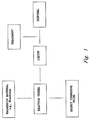
- Fig. 1 is a schematic representation of the process of the present invention.
- the present invention in its broadest embodiment, comprises a method having the following steps:
- the process of the present invention may be useful for the dissolution of a broad range of containers with hazardous materials therein, it is especially adapted to the digestion of munitions containing chemical weapon components.
- the munitions are typically projectile shells having a metallic outer casing, and containing a fuse, explosive and a chemical agent.
- the munitions may be of different configurations, such as missiles or rockets.
- the word "munitions" will refer to simulated (test) and actual weapons, since it may not be possible to determine the actual form of the munition from a physical observation.
- the primary use environment of the present invention will be the treatment of munitions having metallic casings to render them unusable and susceptible to destruction.
- metallic casings For example, brass, carbon or mild steel projectiles can be treated using acidic fluids, while aluminum casings may be treated with either acid or alkaline fluids.
- the process of the present invention may be used to completely dissolve the munition body, or it may be used to partially dissolve the casing so as to render the shell or projectile militarily unusable. If the munition is not totally dissolved, the remaining metals may be recovered and recycled. During the process of the present invention, products within the munition may be recovered for reuse. Explosives such as RDX are insoluble in many acids and can be recovered from the liquor by filtration.
- the method of the present invention may be utilized with chemical or conventional weapons classified as explosively or non-explosively configured, or with test or simulated rounds of these weapons.
- the invention is particularly adapted, but not limited to, use with metallic-encased munitions such as projectiles, bombs, cartridges, and rockets, and to metallic bulk containers used to store or transport the chemicals utilized in such munitions.
- a concentrated nitric acid solution is the preferred acid for digestion of steel munitions.
- the initial acid concentration may range from three to eight molar (3M to 8M) depending on the desired rate of dissolution. While generally not optimal, under other circumstances the concentrated acid may be selected from the group of concentrated hydrochloric acid , sulfuric acid, hydrofluoric acid, and the like, including mixtures of these acids.
- the process of the present invention is preferably carried out in a reaction vessel impervious to the corrosive effects of the corrosive fluid.
- the reaction vessel may be heated to a temperature of up to or exceeding about 50°C.
- the process is exothermic, and the digestion rate of the munitions is sufficient at ambient temperatures so that application of external heat may be unnecessary.
- Sparging the reaction vessel with ambient air or oxygen will, in some cases, increase the conversion of ferrous ions to ferric ions, thus increasing the rate of digestion of the metallic casing.
- impressing an electrical current into the reaction vessel will induce anodic dissolution of the metallic casing, also increasing the digestion rate.
- Chemical agents include mustard agents (HD, HT, HN, HL, CX, PD, ED, MD), nerve agents (tabun, sarin, soman, VX, GF), blood agents (AC, CK, SA), choking agents (CG, DP), vomiting agents (DA, DM, DC), and incapacitating agents (BZ).
- mustard agents HD, HT, HN, HL, CX, PD, ED, MD
- nerve agents tabun, sarin, soman, VX, GF
- blood agents AC, CK, SA
- choking agents CG, DP
- vomiting agents DA, DM, DC
- incapacitating agents BZ
- organic chemical explosives will be insoluble in the acid and therefore not dissolved in the liquor.
- the organic constituents can be filtered out and recovered for disposal separately, or for reuse. Following treatment, various disposal methods are available including discharge to solidification/stabilization, hydrothermal oxidation, or incineration.
- One of the beneficial aspects of the present invention is that after the casing has been completely breached, the dissolving liquid will enter the container, flush out the components therein, and "cleanse" the inner surface of the container.
- the acid will infiltrate the inner casing, either dissolving or flushing the contents therein into the surrounding acid bath.
- the nitric acid will begin digesting the inner surface of the projectile, thereby removing all traces of hazardous chemicals therefrom. Therefore, it may not be required to take the process of the present invention to complete digestion of the casing-breaching the casing and cleansing the interior may be sufficient to render the munition both inoperative and environmentally benign.
- the method of the present invention will require a distribution system to store and supply the corrosive fluid to the reaction vessel, as well as a ventilation system to handle off-gases.
- a distribution system to store and supply the corrosive fluid to the reaction vessel, as well as a ventilation system to handle off-gases.
- Applicants have observed that the dissolution of steel casings in nitric acid will release NO x and hydrogen as off-gas. Acid recovery apparatus will recover any acid entrained in the off-gas stream.
- the digestion rate of the present process is greatly enhanced if the coating or paint is at least partially removed. The removal of only a small portion of the coating will permit more rapid point dissolution at that location, and once the casing is breached, the dissolution liquid enters the casing and begins digesting the casing from the inside.
- test rounds may proceed in the same manner as treatment of rounds containing actual chemical agents.
- Test rounds are generally filled with an ethylene glycol fluid to simulate the physical characteristics of chemical agents.
- nitric acid When immersed in, or treated with, nitric acid, upon breaching the shell casing, the reaction of the nitric acid and the ethylene glycol to form oxalic acid is as follows: C 2 H 6 O 2 + HNO 3 ⁇ C 2 H 2 O 4 •2H 2 O Disposal of oxalic acid is by conventional means, such as by neutralization.
Landscapes
- Chemical & Material Sciences (AREA)
- General Chemical & Material Sciences (AREA)
- Health & Medical Sciences (AREA)
- General Health & Medical Sciences (AREA)
- Toxicology (AREA)
- Chemical Kinetics & Catalysis (AREA)
- Business, Economics & Management (AREA)
- Emergency Management (AREA)
- Engineering & Computer Science (AREA)
- Electrochemistry (AREA)
- Manufacturing & Machinery (AREA)
- General Engineering & Computer Science (AREA)
- Organic Chemistry (AREA)
- Processing Of Solid Wastes (AREA)
Applications Claiming Priority (3)
| Application Number | Priority Date | Filing Date | Title |
|---|---|---|---|
| US08/879,539 US6011193A (en) | 1997-06-20 | 1997-06-20 | Munitions treatment by acid digestion |
| US879539 | 1997-06-20 | ||
| EP98930269A EP0991612A1 (fr) | 1997-06-20 | 1998-06-16 | Traitement de munitions par digestion acide |
Related Parent Applications (1)
| Application Number | Title | Priority Date | Filing Date |
|---|---|---|---|
| EP98930269A Division EP0991612A1 (fr) | 1997-06-20 | 1998-06-16 | Traitement de munitions par digestion acide |
Publications (2)
| Publication Number | Publication Date |
|---|---|
| EP1568672A2 true EP1568672A2 (fr) | 2005-08-31 |
| EP1568672A3 EP1568672A3 (fr) | 2009-05-13 |
Family
ID=25374353
Family Applications (2)
| Application Number | Title | Priority Date | Filing Date |
|---|---|---|---|
| EP98930269A Ceased EP0991612A1 (fr) | 1997-06-20 | 1998-06-16 | Traitement de munitions par digestion acide |
| EP05076100A Withdrawn EP1568672A3 (fr) | 1997-06-20 | 1998-06-16 | Traitement de munitions par digestion acide |
Family Applications Before (1)
| Application Number | Title | Priority Date | Filing Date |
|---|---|---|---|
| EP98930269A Ceased EP0991612A1 (fr) | 1997-06-20 | 1998-06-16 | Traitement de munitions par digestion acide |
Country Status (4)
| Country | Link |
|---|---|
| US (1) | US6011193A (fr) |
| EP (2) | EP0991612A1 (fr) |
| AU (1) | AU7969698A (fr) |
| WO (1) | WO1998058890A1 (fr) |
Families Citing this family (18)
| Publication number | Priority date | Publication date | Assignee | Title |
|---|---|---|---|---|
| US6414143B1 (en) * | 1999-02-24 | 2002-07-02 | Alliant Techsystems Inc. | Extraction and recovery of nitramines from propellants, explosives, and pyrotechnics |
| US6416601B1 (en) | 2000-03-10 | 2002-07-09 | Alliant Techsystems Inc. | Method of recovery for nitramines from aluminized energetic materials |
| US6610156B2 (en) * | 2000-03-10 | 2003-08-26 | Alliant Techsystems Inc. | Method for recovery of nitramines from aluminized energetic materials |
| US7225716B1 (en) * | 2000-05-12 | 2007-06-05 | Gradient Technology | Process for removing the fuze from explosive projectiles using fluid jet technology |
| FR2824901B1 (fr) * | 2001-05-21 | 2003-09-12 | Poudres & Explosifs Ste Nale | Procede et installation de destruction de fusee montee sur une munition |
| ATE334729T1 (de) * | 2002-04-24 | 2006-08-15 | Steris Inc | Behandlungssystem und verfahren unter verwendung von aktiviertem oxydierendem dampf |
| DE602004026852D1 (de) * | 2003-04-24 | 2010-06-10 | Steris Inc | Neutralizationbehandlung von kampstoffen mit aktiviertem dampf |
| US7102052B2 (en) * | 2003-04-24 | 2006-09-05 | Steris Inc | Activated vapor treatment for neutralizing warfare agents |
| US6945175B1 (en) | 2003-06-18 | 2005-09-20 | The United States Of America As Represented By The Secretary Of The Navy | Biological and chemical agent defeat system |
| US7883676B2 (en) * | 2006-09-27 | 2011-02-08 | General Atomics | Hydrolysis system and process for devices containing energetic material |
| US10427192B2 (en) | 2015-05-15 | 2019-10-01 | Ronald G. Presswood, Jr. | Method to recycle plastics, electronics, munitions or propellants using a metal reactant alloy composition |
| NZ736827A (en) * | 2015-05-15 | 2022-07-01 | Presswood Ronald G Jr | Method to recycle plastics, electronics, munitions or propellants using a metal reactant alloy composition |
| US10514242B1 (en) * | 2015-10-14 | 2019-12-24 | The University Of Massachusetts | Method and apparatus for electrochemical ammunition disposal and material recovery |
| US10626482B2 (en) | 2016-06-08 | 2020-04-21 | Battelle Memorial Institute | Acid digestion processes for recovery of rare earth elements from coal and coal byproducts |
| US11592274B2 (en) | 2017-06-28 | 2023-02-28 | Dynasafe US LLC | Device and process for the destruction of chemical warfare agents |
| US10968500B1 (en) | 2017-08-31 | 2021-04-06 | Gregory Rudolph Verderber | Methods and systems for extracting materials from fly ash |
| US11087898B2 (en) * | 2019-08-19 | 2021-08-10 | Henry Crichlow | Disassembly and disposal of munition components |
| GR1010256B (el) * | 2020-11-03 | 2022-06-27 | Soukos Robotics E.E., | Φορητο συστημα εξουδετερωσης χημικων και βιολογικων παραγοντων |
Family Cites Families (15)
| Publication number | Priority date | Publication date | Assignee | Title |
|---|---|---|---|---|
| DE342265C (fr) * | 1921-05-03 | |||
| FR828449A (fr) * | 1937-01-27 | 1938-05-18 | Procédé de récupération des amorces de fulminate | |
| US3108918A (en) * | 1944-01-12 | 1963-10-29 | Harold J Plumley | Trepanning of cased explosives by etching |
| EP0013822B1 (fr) * | 1978-12-29 | 1981-09-02 | Stablex A.G. | Améliorations dans le traitement de déchets dangereux |
| DE4123225C1 (fr) * | 1991-07-11 | 1992-11-05 | Mechanische Werkstaetten Koenigswartha Gmbh, O-8613 Koenigswartha, De | |
| US5430228A (en) * | 1993-02-24 | 1995-07-04 | Hughes Aircraft Company | Ozone methods for the destruction of chemical weapons |
| US5714128A (en) * | 1993-03-30 | 1998-02-03 | Ritter; Robert A. | Sequential batch chemical apparatus for destruction of toxic organic compounds |
| FR2704640B1 (fr) * | 1993-04-26 | 1995-06-09 | Snpe Ingenierie Sa | Procede et installation de destruction de munitions contenant des agents toxiques. |
| US5554096A (en) * | 1993-07-01 | 1996-09-10 | Symphonix | Implantable electromagnetic hearing transducer |
| FR2714048B1 (fr) * | 1993-12-16 | 1996-02-16 | Everite Sa | Article, notamment plaque de revêtement de bâtiments, et procédé de fabrication d'un tel article. |
| US5516971A (en) * | 1994-05-05 | 1996-05-14 | Hercules Incorporated | Process for disposal of waste propellants and explosives |
| GB9414812D0 (en) * | 1994-07-22 | 1994-09-14 | Atomic Energy Authority Uk | The disposal of organic materials encased in metal |
| AU4604196A (en) * | 1994-12-29 | 1996-07-31 | Alliant Techsystems Inc. | High pressure washout of chemical agents |
| EP0823855A1 (fr) * | 1995-05-05 | 1998-02-18 | Krupp Uhde GmbH | Procede d'elimination catalytique-hydrothermique de matieres chimiques militaires |
| FR2734048B1 (fr) * | 1995-05-11 | 1997-06-06 | Electricite De France | Procede et machine de neutralisation de munitions ou de recipients emplis de produits dangereux |
-
1997
- 1997-06-20 US US08/879,539 patent/US6011193A/en not_active Expired - Lifetime
-
1998
- 1998-06-16 EP EP98930269A patent/EP0991612A1/fr not_active Ceased
- 1998-06-16 AU AU79696/98A patent/AU7969698A/en not_active Abandoned
- 1998-06-16 EP EP05076100A patent/EP1568672A3/fr not_active Withdrawn
- 1998-06-16 WO PCT/US1998/012484 patent/WO1998058890A1/fr not_active Ceased
Also Published As
| Publication number | Publication date |
|---|---|
| EP0991612A1 (fr) | 2000-04-12 |
| AU7969698A (en) | 1999-01-04 |
| EP1568672A3 (fr) | 2009-05-13 |
| WO1998058890A1 (fr) | 1998-12-30 |
| US6011193A (en) | 2000-01-04 |
Similar Documents
| Publication | Publication Date | Title |
|---|---|---|
| US6011193A (en) | Munitions treatment by acid digestion | |
| RU2195987C2 (ru) | Способ разрушения энергетических материалов | |
| Pearson et al. | Critical evaluation of proven chemical weapon destruction technologies (IUPAC Technical Report) | |
| US5709800A (en) | Environmentally acceptable waste disposal by hydrothermal decomposition of labile compounds with nitrite | |
| EA000631B1 (ru) | Способ и устройство для уничтожения химических боевых веществ | |
| EA001667B1 (ru) | Способ расснаряжения путём разрезания струёй жидкого аммиака с использованием сольватированных электронов | |
| US6118039A (en) | Method for digesting a nitro-bearing explosive compound | |
| Borcherding | An alternative to open burning treatment of solid propellant manufacturing wastes | |
| CN117776825B (zh) | 一种含能材料处理方法 | |
| Upadhye et al. | Molten salt destruction of energetic material wastes as an alternative to open burning | |
| US20040073077A1 (en) | Decomposition of nitrogen-based energetic material | |
| Soilleux | The Silver II Process for the Destruction of CW Munitions | |
| Poulin | Literature Review on Demilitarization of Munitions: Document Prepared for the RIGHTTRAC Technology Demonstration Project | |
| Krotovich | DEVELOPMENT OF CW DESTRUCTION TECHNOLOGIES IN THE RUSSIAN FEDERATION | |
| JPH08297000A (ja) | 不要弾薬類の処理方法 | |
| Upadhye et al. | Molten salt destruction as an alternative to open burning of energetic material wastes | |
| RU2712875C1 (ru) | Способ разделки корпуса боеприпаса из коррозионностойкой стали | |
| van Ham | Investigations of risks connected to sea-dumped munitions | |
| Froment | Destruction of Chemical Weapons | |
| US7186877B1 (en) | Chemical detoxification of vesicants and related chemicals in mobile disposal systems | |
| RU2302891C2 (ru) | Способ обеззараживания внутренней поверхности химических боеприпасов от остатков фосфорорганических отравляющих веществ | |
| Parkinson | The Big Thaw | |
| Stratta et al. | Alternatives to open burning/open detonation of energetic materials | |
| Upadhye et al. | Energetic materials destruction using molten salt | |
| Batey et al. | The Application of the Silver II Electrochemical Oxidation Process for the Demilitarization of Non-Stockpile Material |
Legal Events
| Date | Code | Title | Description |
|---|---|---|---|
| PUAI | Public reference made under article 153(3) epc to a published international application that has entered the european phase |
Free format text: ORIGINAL CODE: 0009012 |
|
| 17P | Request for examination filed |
Effective date: 20050511 |
|
| AC | Divisional application: reference to earlier application |
Ref document number: 0991612 Country of ref document: EP Kind code of ref document: P |
|
| AK | Designated contracting states |
Kind code of ref document: A2 Designated state(s): AT BE CH CY DE DK ES FI FR GB GR IE IT LI LU MC NL PT SE |
|
| RIN1 | Information on inventor provided before grant (corrected) |
Inventor name: ZACHER, ALAN H. Inventor name: ELMORE, MONTE R. Inventor name: JONES, EVAN O. Inventor name: MYLER, CRAIG A. Inventor name: TOOJMAJIAN, MARTIN E. |
|
| PUAL | Search report despatched |
Free format text: ORIGINAL CODE: 0009013 |
|
| AK | Designated contracting states |
Kind code of ref document: A3 Designated state(s): AT BE CH CY DE DK ES FI FR GB GR IE IT LI LU MC NL PT SE |
|
| AKX | Designation fees paid |
Designated state(s): AT BE CH CY DE DK ES FI FR GB GR IE IT LI LU MC NL PT SE |
|
| 17Q | First examination report despatched |
Effective date: 20110222 |
|
| STAA | Information on the status of an ep patent application or granted ep patent |
Free format text: STATUS: THE APPLICATION IS DEEMED TO BE WITHDRAWN |
|
| 18D | Application deemed to be withdrawn |
Effective date: 20130101 |