EP1569867B1 - Méthode de fabrication de nanoparticules et structures nanoscopiques métalisées - Google Patents
Méthode de fabrication de nanoparticules et structures nanoscopiques métalisées Download PDFInfo
- Publication number
- EP1569867B1 EP1569867B1 EP03813538A EP03813538A EP1569867B1 EP 1569867 B1 EP1569867 B1 EP 1569867B1 EP 03813538 A EP03813538 A EP 03813538A EP 03813538 A EP03813538 A EP 03813538A EP 1569867 B1 EP1569867 B1 EP 1569867B1
- Authority
- EP
- European Patent Office
- Prior art keywords
- nanoparticles
- nanoscopic
- nano
- structures according
- manufacturing nanoparticles
- Prior art date
- Legal status (The legal status is an assumption and is not a legal conclusion. Google has not performed a legal analysis and makes no representation as to the accuracy of the status listed.)
- Expired - Lifetime
Links
Images

Classifications
-
- B—PERFORMING OPERATIONS; TRANSPORTING
- B82—NANOTECHNOLOGY
- B82Y—SPECIFIC USES OR APPLICATIONS OF NANOSTRUCTURES; MEASUREMENT OR ANALYSIS OF NANOSTRUCTURES; MANUFACTURE OR TREATMENT OF NANOSTRUCTURES
- B82Y30/00—Nanotechnology for materials or surface science, e.g. nanocomposites
-
- D—TEXTILES; PAPER
- D01—NATURAL OR MAN-MADE THREADS OR FIBRES; SPINNING
- D01F—CHEMICAL FEATURES IN THE MANUFACTURE OF ARTIFICIAL FILAMENTS, THREADS, FIBRES, BRISTLES OR RIBBONS; APPARATUS SPECIALLY ADAPTED FOR THE MANUFACTURE OF CARBON FILAMENTS
- D01F6/00—Monocomponent artificial filaments or the like of synthetic polymers; Manufacture thereof
- D01F6/02—Monocomponent artificial filaments or the like of synthetic polymers; Manufacture thereof from homopolymers obtained by reactions only involving carbon-to-carbon unsaturated bonds
- D01F6/20—Monocomponent artificial filaments or the like of synthetic polymers; Manufacture thereof from homopolymers obtained by reactions only involving carbon-to-carbon unsaturated bonds from polymers of cyclic compounds with one carbon-to-carbon double bond in the side chain
-
- D—TEXTILES; PAPER
- D01—NATURAL OR MAN-MADE THREADS OR FIBRES; SPINNING
- D01F—CHEMICAL FEATURES IN THE MANUFACTURE OF ARTIFICIAL FILAMENTS, THREADS, FIBRES, BRISTLES OR RIBBONS; APPARATUS SPECIALLY ADAPTED FOR THE MANUFACTURE OF CARBON FILAMENTS
- D01F6/00—Monocomponent artificial filaments or the like of synthetic polymers; Manufacture thereof
- D01F6/02—Monocomponent artificial filaments or the like of synthetic polymers; Manufacture thereof from homopolymers obtained by reactions only involving carbon-to-carbon unsaturated bonds
- D01F6/20—Monocomponent artificial filaments or the like of synthetic polymers; Manufacture thereof from homopolymers obtained by reactions only involving carbon-to-carbon unsaturated bonds from polymers of cyclic compounds with one carbon-to-carbon double bond in the side chain
- D01F6/22—Monocomponent artificial filaments or the like of synthetic polymers; Manufacture thereof from homopolymers obtained by reactions only involving carbon-to-carbon unsaturated bonds from polymers of cyclic compounds with one carbon-to-carbon double bond in the side chain from polystyrene
-
- D—TEXTILES; PAPER
- D01—NATURAL OR MAN-MADE THREADS OR FIBRES; SPINNING
- D01F—CHEMICAL FEATURES IN THE MANUFACTURE OF ARTIFICIAL FILAMENTS, THREADS, FIBRES, BRISTLES OR RIBBONS; APPARATUS SPECIALLY ADAPTED FOR THE MANUFACTURE OF CARBON FILAMENTS
- D01F6/00—Monocomponent artificial filaments or the like of synthetic polymers; Manufacture thereof
- D01F6/28—Monocomponent artificial filaments or the like of synthetic polymers; Manufacture thereof from copolymers obtained by reactions only involving carbon-to-carbon unsaturated bonds
- D01F6/42—Monocomponent artificial filaments or the like of synthetic polymers; Manufacture thereof from copolymers obtained by reactions only involving carbon-to-carbon unsaturated bonds comprising cyclic compounds containing one carbon-to-carbon double bond in the side chain as major constituent
Definitions
- the invention relates to nanoparticles and nanoscopic structures and processes for their preparation.
- Nanoparticles and nanostructured materials are used for a variety of applications in the field of electronics, microtechnology, biotechnology, catalysis, photonics and medical technology, as well as in construction technology. Such materials find particular application for electronic, magnetic, optical, optoelectronic and micromechanical devices and sensors.
- nanoparticles and nanostructured materials are the subject of nanotechnology or nanostructure technology, a modern field of physical and semiconductor research that allows the manipulation of matter on an atomic scale.
- the aim of nanotechnology is precise structuring on the order of nanometers for the production of extremely small components or structures with given properties.
- Nanotechnology has opened up new fields of application and possibilities for polymer materials.
- Polymer materials can be used to form nanoparticles and nanoscopic structures.
- One of the main areas of nanotechnology is the production of composites.
- the size of the nanoparticles and the properties of the polymers give rise to very interesting properties of the nanocomposite materials formed.
- Nanocomposites are composites that consist of a matrix material with embedded, often fibrous nanoparticles that have different properties from the matrix material.
- Nanostructures are regular arrangements of nanoparticles, which are mostly produced in semiconductor technology by means of lithographic processes with light, X-ray or electron beams, but increasingly by self-organized growth on suitable substrates.
- Nanoparticles are particles with a size of approx. 0.1 to 200 nanometers (nm). Cylindrical nanoparticles and nanowires, as well as nano-well structures and methods for their preparation are known in the art.
- nanoscopic structures and nanoparticles can be produced by admixing and separating out low molecular weight components into copolymers.
- cylindrical holes can be formed in a structure by leaching a low-molecular-weight component. It is also possible to produce short nanocylinders by dissolving out a low molecular weight component.
- WO 00/02090 discloses periodically ordered nanostructured materials and methods of using and altering these materials.
- the polymeric substances comprising one or more regions include, for example, an inorganic substance capable of forming an inorganic oxide ceramic.
- a method for the modification of the polymeric constituents by oxidation and / or irradiation is presented in order to form periodically structured porous and holey materials, which, for. B. contain a ceramic oxide in their structure.
- nanofilters which are cylindrical particles with diameters in the area of the nanoparticles, wherein the length of the nanofilaments can go beyond the nanoparticle range, has hitherto been carried out via a solution synthesis or the stepwise construction of the particles from the ends (step-edge decoration).
- nanofilters or even nanotubes contain metallic components and if they are electrically conductive over a certain range, these particles are also referred to as nanowires and are of great interest for a large number of applications.
- the object is achieved by a manufacturing method according to claim 1, so that by this treatment nanoscopic structures, in particular nanoscopic holes or nanoparticles in the size of one to two hundred nanometers, arise.
- the nanoparticles and nanoscopic structures can be modified in particular by adding further polymers to the mixture, which preferably dissolve in one of the components.
- further polymers are in the application described polystyrene, polyvinylpyridine or poly-para-methylstyrene.
- polystyrene block poly (4-vinylpyridine) [PS-b-P4VP] is used as the block copolymer.
- the low molecular weight component used is preferably 3-n-pentadecylphenol [PDP].
- the nanoparticles obtained in accordance with the invention have cylindrical shapes, disc leaf shapes or ellipsoidal shapes or are also available as irregularly shaped particles.
- nanoscopic holes are preferably obtained in a structure, which may also have cylindrical, lamellar or ellipsoidal shapes.
- the functionalization of the surface consists in a metallization of the same.
- Metallization can be accomplished by adsorbing metal ions from a salt solution followed by chemical reduction to a pure metal layer. Subsequently, the metallic surface is improved by vapor deposition, sputtering or electrochemical or chemical deposition.
- the nanoparticles and nanoscopic structures receive an electrically conductive layer or at least arrange isolated metallic nanoparticles on the surface.
- the metallization of the surface of the nanoparticles and nanoscopic structures is carried out with palladium, nickel, cobalt, cadmium selenide, silver or gold.
- palladium, nickel, cobalt, cadmium selenide, silver or gold Other metals, semimetals or compounds or mixtures thereof are possible.
- nanofilaments can be produced particularly advantageously by self-assembly of nanostructured materials.
- the structure of block copolymers is selectively altered and subsequently used to produce nanostructures.
- Copolymers are plastics in which at least two different structural units (monomers) are involved in the construction of the polymer chain. After the arrangement of the monomers A and B, a distinction is made between alternating copolymers (regular change, ABAB) and random copolymers (irregular distribution, for example AABABBB).
- alternating copolymers regular change, ABAB
- random copolymers irregular distribution, for example AABABBB
- block copolymers are each constructed with long sequences of the structural units A and B or else further components C, D and the like.
- different architectures are possible. Mention may be made of linear chains, graft polymers, star-shaped arrangements and similar structures.
- the various components are covalently bonded together and normally immiscible with each other. It is possible to mix one or more components, low molecular weight or polymeric, which in each case mix with or interact with the components A, B. Due to these properties, they form areas with a nano-scale microstructure. These areas are suitable as templates for nanostructures.
- the concept of the invention achieves the creation of a functional polymer complex based on the self-assembly of block copolymers and the admixed components into supramolecular structures.
- the physical bonds within the supramolecular structures allow controlled selectivity of the essential components of the copolymer.
- an oscillating shear stress leads to a Improvement of the orientation or orientation of the microstructures.
- Orientation or alignment may also take place by selective interaction of one or more components with a solid, liquid or gaseous surface.
- Hydrogen bonds preferably play a fundamental role in the formation of the supramolecular polymer structures in the self-assembly process because of the relatively low binding energy, which allows high flexibility of the structuring compounding and dissolution processes.
- ampholytic hydrogen bonds rather than bonds of conventional block copolymers results in obtaining a defined volume fraction having the desired morphology. Thereafter, the ampholytic and optionally other components are selectively extracted or removed with solvents by tearing off the hydrogen bonds.
- these vacant sites become useful for substrates. After evaporation of the solvent, these areas can serve as templates for the buildup or settlement of nanoparticles.
- the build-up of inorganic material to organic copolymers is highly selective and of high density and can be made from the solution by non-electrochemical means over a wide range of process conditions to block copolymers by selective aggregation of metals.
- the ratio of the concentration between the metal ions and the nanofilaments plays a fundamental role in connection with the high surface energy of the metal, which exceeds that of the block copolymers by orders of magnitude.
- metal-to-metal bonds thus overlay the metal-polymer bonds, but at a very small metal concentration, it becomes possible to form metal-polymer bonds up to a certain concentration on the polymer surface.
- Partly isolated metallic nanoparticles form first. Then, the nanoparticles begin to combine into clusters and finally form a nanowire, possibly with multiple repetition of the method according to the invention.
- the nanofilaments are obtained from a diblock copolymer.
- the diblock copolymer used is preferably polystyrene poly (4-vinylpyridine) [PS-b-P4VP].
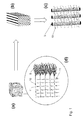
- the complex is shown schematically in Fig. 1 (a).
- the individual components are illustrated diagrammatically in FIG. 1 (d) in the enlargement.
- ampholitic 3-n-pentadecylphenol (PDP) 11 is used to form a supramolecular polymer complex PS-b-P4VP (PDP) according to FIG. 1 (a) with the diblock copolymer.
- both components are dissolved in chloroform at 60 ° C over 24 hours and the solvent was then removed.
- the polymer complex is then heated to 125 ° C and held under vacuum in a 7.9 mm diameter, one millimeter thick mold between teflon plates for one hour. Subsequently, the temperature is gradually lowered to 115 ° C before the material is pressed into a tablet form of 5 kN and then cooled to 30 ° C.
- the sample preferably has a slight orientation.
- Fig. 1 (b) It is followed by an oscillating shear treatment, the result is shown in Fig. 1 (b).
- the related converter works in the range from 0,2 to 200 g * cm.
- the strain amplitude is 50%
- the frequency is 0.5 Hz
- the temperature at the shear treatment is kept constant at 115 ° C for 12 hours.
- hexagonal packed polystyrene cylinders are formed in a matrix of PS-b-P4VP (PDP).
- the polystyrene nanofilaments have a diameter of about 25 nm and are oriented parallel to each other in a P4VP (PDP) matrix.
- the nanofilter of PS-b-P4VP after removal of the matrix has a diameter of about 35 nm. For example, with a metallic layer of palladium, the nanowire has a diameter of about 60 nm.
- a nanowire is shown schematically.
- the polystyrene thread 9 is surrounded by a matrix polyvinylpyridine 10, on which according to the invention the metal layer 12 is arranged.
- Polystyrene 2 and polyvinylpyridine 10 are covalently linked together.
- metals such as palladium, nickel, cobalt, gold or silver are now deposited on the surface of the nanofilaments with a redox reaction from an aqueous solution at room temperature.
- metallic nanoparticles such as cadmium selenide (CdSe)
- CdSe cadmium selenide
- the nanofilaments of the PS-b-P4VP block copolymer serve as a negative template. This is made possible by a lone pair of electrons in the nitrogen of the pyridine ring of P4VP.
- the difficulty in the metallization of organic nanofilaments lies in the generation of organic-inorganic bonds on the surface of the nanofilaments.
- the complexation of the metal with the pyridine ring serves as an organic-inorganic bond.
- the diameter of the metallic nanoparticles or nanowires not only depends on the size of the template, but can be influenced by the reaction conditions, such as the concentration of the coating solution and the reaction time.
- the polystyrene core palladium nanowire has a diameter of 60 nm and a length of several ⁇ m and has been successfully synthesized by the reduction of palladium acetate Pd (CH 3 COO) 2 from aqueous solution with dimethylamine borane (CH 3 ) 2 NBH 2 .
- semiconductor nanowires metallized by cadmium selenide nanoparticles have a diameter of approximately 80 nm.
- a 0.506 M ethanolic solution of sodium hydrogen selenide (NaHSe) is recovered from the reaction of selenium and sodium borohydride (NaBH) in ethanol.
- NaHSe sodium hydrogen selenide
- NaBH sodium borohydride
- 10 ml of the 1 mmol cadmium precursor are evaporated under reduced pressure. The residue is dissolved in 100 ml of N, N-dimethylformamide (DMF) and 2.5 mmol of 4-mercaptobenzoic acid.
- DMF N, N-dimethylformamide
- the colorless solution reacts with 1.0 ml of the ethanolic solution of sodium hydrogenselenide (NaHSe) under a nitrogen atmosphere. After stirring for 30 minutes, a yellow suspension of cadmium selenide (CdSe) is formed. One ml of this solution of cadmium selenide is then mixed with five ml of ethanol.
- NaHSe sodium hydrogenselenide
- nano threads are then brought into contact with the cadmium selenide solution for 5 minutes for the coating and finally washed twice with ethanol.
- the advantage of the embodiment according to the invention lies in the production of metallic nanoparticles or nanowires with uniform metal nano layers on a nanotemplate by a simple non-electrolytic method and / or by deposition from the solution / suspension of metallic / semi-metallic nanoparticles on the polymer core.
- the nanotemplate is formed by self-assembly of the diblock copolymer PS-b-P4VP (PDP) via hydrogen bonds with ampholytic PDP, after which oscillating shear stress with large amplitudes is used to align the polystyrene cylinders with P4VP (PDP).
- PDP diblock copolymer PS-b-P4VP
- a nanofilter consisting of a polystyrene core and a thin layer of poly (4-vinylpyridine) (P4VP).
- the polymer complex PS-b-P4VP (PDP) is dried in vacuo for 24 hours before the extrusion at 60 ° C and then heated to a temperature of 120 ° C. Thereafter, the material is present as a melt.
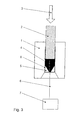
- the device for extrusion is shown in FIG. It consists essentially of a heating device 1, which surrounds a pressure cylinder 8 is tempered and a nozzle 5, which forms the tapered lower portion of the pressure cylinder 8.
- the nozzle 5 is formed at its exit as a capillary with a diameter of 0.3 mm and a length of 0.6 mm.
- the polymer melt 4 is introduced into the printing cylinder 8 for melt extrusion.
- a thrust force 3 acts on the piston 2.
- the pressure generated in the interior of the pressure cylinder, the tempered polymer melt 4 is pressed through the nozzle 5 to a filament 6, whereby the polymer structure aligns partially macroscopic.
- the resulting filament 6 is taken up by a winding machine 7 arranged at a distance of 0.2 m from the nozzle 5 at a speed of 4 m / min.
- the volume flow rate of the polymer melt 4 during melt extrusion is about 0.156 cm 3 / min.
- Melt extrusion can produce a very long oriented filament containing the nanostructured block copolymers. This process can also be carried out continuously in a modified form.
Landscapes
- Chemical & Material Sciences (AREA)
- Engineering & Computer Science (AREA)
- Textile Engineering (AREA)
- General Chemical & Material Sciences (AREA)
- Chemical Kinetics & Catalysis (AREA)
- Nanotechnology (AREA)
- Condensed Matter Physics & Semiconductors (AREA)
- Crystallography & Structural Chemistry (AREA)
- Materials Engineering (AREA)
- General Physics & Mathematics (AREA)
- Physics & Mathematics (AREA)
- Composite Materials (AREA)
- Manufacture Of Metal Powder And Suspensions Thereof (AREA)
- Powder Metallurgy (AREA)
- Processes Of Treating Macromolecular Substances (AREA)
- Physical Or Chemical Processes And Apparatus (AREA)
Claims (10)
- Procédé de fabrication de nanoparticules et de structures nanoscopiques, comprenant les étapes suivantes :a) mélanger un copolymère bloc avec au moins un composant de faible masse moléculaire, etb) séparer les phases du mélange pour produire une nanostructure,c) soumettre la nanostructure ainsi créée à un traitement ultérieur pour améliorer son orientation macroscopique,d) enlever par dissolution au moins ledit composant de faible masse moléculaire pour ainsi créer soit des cavités nanoscopiques soit des nanoparticules d'une taille comprise entre un et deux cent nm,caractérisé en ce que
la surface est rendue fonctionnelle par métallisation,- les agrégats métalliques, les nanoparticules métalliques ou une couche métallique continue (12) étant disposés sur ladite surface, et- ladite métallisation de la surface étant réalisée par adsorption d'ions métalliques issus d'une solution de sel, lesdits ions subissant ensuite une réduction chimique pour former une couche métallique continue (12), des agrégats métalliques ou des nanoparticules métalliques. - Procédé de fabrication de nanoparticules et de structures nanoscopiques selon la revendication 1, caractérisé en ce que d'autres polymères tels que le polystyrène (9), le polyvinylpyridine (10) ou le poly-para-méthylstyrène sont ajoutés au mélange selon l'étape a).
- Procédé de fabrication de nanoparticules et de structures nanoscopiques selon les revendications 1 ou 2, caractérisé en ce que le polystyrène à blocs de poly(4-vinylpyridine) [PS-b-P4VP] est utilisé en tant que copolymère bloc.
- Procédé de fabrication de nanoparticules et de structures nanoscopiques selon une des revendications 1 à 3, caractérisé en ce que le 3-n-pentadecylphénol [PDP] (11) est utilisé en tant que composant de faible masse moléculaire.
- Procédé de fabrication de nanoparticules et de structures nanoscopiques selon une des revendications 1 à 4, caractérisé en ce que le traitement ultérieur pour améliorer l'orientation des structures selon l'étape c) consiste à soumettre lesdites structures à une contrainte de cisaillement ou à un procédé d'extrusion ou de filature au fondu, ou que l'orientation est effectuée par interaction sélective d'un ou de plusieurs composants du complexe de polymères avec une surface solide, liquide ou gazeuse.
- Procédé de fabrication de nanoparticules et de structures nanoscopiques selon une des revendications 1 à 5, caractérisé en ce que les nanoparticules créées se présentent sous forme de disques, de feuilles, d'ellipsoïdes ou qu'elles sont de forme irrégulière.
- Procédé de fabrication de nanoparticules et de structures nanoscopiques selon une des revendications 1 à 6, caractérisé en ce que les structures nanoscopiques créées se présentent sous forme de cavités au sein de la structure, les structures nanoscopiques étant au moins dans une dimension de taille nanoscopique.
- Procédé de fabrication de nanoparticules et de structures nanoscopiques selon une des revendications 1 à 7, caractérisé en ce que l'amélioration ultérieure de la couche métallique (12) de la surface est réalisée par dépôt en phase vapeur, par pulvérisation cathodique, par électrodéposition ou par dépôt chimique.
- Procédé de fabrication de nanoparticules et de structures nanoscopiques selon une des revendications 1 à 8, caractérisé en ce qu'une couche électriquement conductrice est créée par la métallisation.
- Procédé de fabrication de nanoparticules et de structures nanoscopiques selon une des revendications 1 à 9, caractérisé en ce qu'une métallisation de la surface est réalisée avec du palladium, du nickel, du cobalt, du séléniure de cadmium, de l'argent ou de l'or, d'autres métaux, semi-métaux ou leurs alliages pouvant être mis en oeuvre.
Applications Claiming Priority (3)
| Application Number | Priority Date | Filing Date | Title |
|---|---|---|---|
| DE10261885A DE10261885A1 (de) | 2002-12-20 | 2002-12-20 | Nanopartikel und nanoskopische Strukturen und Verfahren zu deren Herstellung |
| DE10261885 | 2002-12-20 | ||
| PCT/DE2003/004227 WO2004056699A2 (fr) | 2002-12-20 | 2003-12-11 | Nanoparticules, structures nanoscopiques et procede pour leur production |
Publications (2)
| Publication Number | Publication Date |
|---|---|
| EP1569867A2 EP1569867A2 (fr) | 2005-09-07 |
| EP1569867B1 true EP1569867B1 (fr) | 2007-03-28 |
Family
ID=32519572
Family Applications (1)
| Application Number | Title | Priority Date | Filing Date |
|---|---|---|---|
| EP03813538A Expired - Lifetime EP1569867B1 (fr) | 2002-12-20 | 2003-12-11 | Méthode de fabrication de nanoparticules et structures nanoscopiques métalisées |
Country Status (5)
| Country | Link |
|---|---|
| EP (1) | EP1569867B1 (fr) |
| AT (1) | ATE358332T1 (fr) |
| AU (1) | AU2003296542A1 (fr) |
| DE (2) | DE10261885A1 (fr) |
| WO (1) | WO2004056699A2 (fr) |
Families Citing this family (8)
| Publication number | Priority date | Publication date | Assignee | Title |
|---|---|---|---|---|
| GB0708695D0 (en) * | 2007-05-04 | 2007-06-13 | Univ Nottingham | Fabrication of nanoparticles |
| DE102009052986A1 (de) | 2008-11-12 | 2010-05-27 | Rodenstock Gmbh | Photochromer Kunststoffgegenstand mit sphärischen Nanopartikeln zur Verbesserung der Photochromie-Eigenschaften |
| DE102013202544B4 (de) | 2013-02-18 | 2020-08-13 | Leibniz-Institut Für Festkörper- Und Werkstoffforschung Dresden E.V. | Dispergatoren und verfahren zur abwasseraufbereitung |
| WO2016135257A2 (fr) | 2015-02-25 | 2016-09-01 | Universität Bayreuth | Mousses à alvéoles ouvertes et substrats fibreux métallisés |
| WO2019147895A1 (fr) * | 2018-01-25 | 2019-08-01 | Ut-Battelle, Llc | Polymères à base de lignine présentant une capacité d'extrusion à l'état fondu améliorée |
| US11161983B2 (en) | 2018-01-25 | 2021-11-02 | Ut-Battelle, Llc | Lignin-based polymers with enhanced melt extrusion ability |
| CN112358643B (zh) * | 2020-11-10 | 2022-09-30 | 浙江工业大学 | 一种基于嵌段共聚物本体聚合的均孔膜制备方法 |
| CN118480208B (zh) * | 2024-07-12 | 2024-11-05 | 富优特(山东)新材料科技有限公司 | 两亲性聚合物调控的聚酰亚胺纳米多孔薄膜的制备方法 |
Family Cites Families (4)
| Publication number | Priority date | Publication date | Assignee | Title |
|---|---|---|---|---|
| DE19738913B4 (de) * | 1997-09-05 | 2004-03-18 | MAX-PLANCK-Gesellschaft zur Förderung der Wissenschaften e.V. | Blockcopolymerphasen als Template für strukturierte organisch-anorganische Hybridmaterialien |
| AU4967499A (en) * | 1998-07-02 | 2000-01-24 | Massachusetts Institute Of Technology | Periodic porous and relief nanostructured articles |
| JP2980899B1 (ja) * | 1998-09-01 | 1999-11-22 | 科学技術振興事業団 | 列状に配置された金属超微粒子を含有する金属・有機ポリマー複合構造体とその製造方法 |
| KR100878281B1 (ko) * | 2001-03-14 | 2009-01-12 | 유니버시티 오브 매사츄세츠 | 나노 제조 |
-
2002
- 2002-12-20 DE DE10261885A patent/DE10261885A1/de not_active Withdrawn
-
2003
- 2003-12-11 DE DE50306930T patent/DE50306930D1/de not_active Expired - Lifetime
- 2003-12-11 AT AT03813538T patent/ATE358332T1/de not_active IP Right Cessation
- 2003-12-11 WO PCT/DE2003/004227 patent/WO2004056699A2/fr not_active Ceased
- 2003-12-11 AU AU2003296542A patent/AU2003296542A1/en not_active Abandoned
- 2003-12-11 EP EP03813538A patent/EP1569867B1/fr not_active Expired - Lifetime
Non-Patent Citations (1)
| Title |
|---|
| None * |
Also Published As
| Publication number | Publication date |
|---|---|
| WO2004056699A2 (fr) | 2004-07-08 |
| AU2003296542A1 (en) | 2004-07-14 |
| DE10261885A1 (de) | 2004-07-15 |
| EP1569867A2 (fr) | 2005-09-07 |
| ATE358332T1 (de) | 2007-04-15 |
| DE50306930D1 (de) | 2007-05-10 |
| WO2004056699A3 (fr) | 2005-11-24 |
Similar Documents
| Publication | Publication Date | Title |
|---|---|---|
| Prasad et al. | Engineered nanomaterials: nanofabrication and surface functionalization | |
| EP2134886B1 (fr) | Procédé de production de variations de tailles et de distances plates de motifs de nanostructures sur des surfaces | |
| Moffitt et al. | Spherical assemblies of semiconductor nanoparticles in water-soluble block copolymer aggregates | |
| EP1027157B1 (fr) | Nanostructures | |
| KR100379248B1 (ko) | 덴드리머를 이용한 나노 입자가 표면에 부착된무기-고분자 복합 소재 및 그 제조 방법 | |
| DE60212628T2 (de) | Nanopartikel-strukturen | |
| WO2016070869A2 (fr) | Dispositif pour la mise en oeuvre d'un procédé de nanoimpression capillaire, procédé de réalisation d'une nanoimpression capillaire faisant appel audit dispositif, produits pouvant être obtenus par ledit procédé et utilisation dudit dispositif | |
| DE10116232A1 (de) | Verfahren zur Herstellung von Formkörpern mit innenbeschichteten Hohlräumen | |
| Li et al. | Water-dispersible tetrablock copolymer synthesis, aggregation, nanotube preparation, and impregnation | |
| EP2391657A1 (fr) | Procédé de production de nanoparticules contenant du métal, enrobées de polymères et articles pouvant être obtenus à partir desdites nanoparticules | |
| WO2004056699A2 (fr) | Nanoparticules, structures nanoscopiques et procede pour leur production | |
| DE19952018C1 (de) | Verfahren zur Herstellung von im Nanometerbereich oberflächendekorierten Substraten | |
| Geng et al. | Fabrication of composite polymer foam films at the liquid/liquid interface through emulsion-directed assembly and adsorption processes | |
| RU2364472C2 (ru) | Органико-неорганические наноструктуры и материалы, содержащие наночастицы благородных металлов, и способы их получения | |
| DE19747815A1 (de) | Nanostrukturierung von Oberflächen | |
| WO2011131979A2 (fr) | Procédé de formation d'une nanostructure monodimensionnelle et nanostructure formée par le procédé | |
| DE102010040826B4 (de) | Verfahren zur Immobilisierung von Nanopartikeln auf thermoplastischen Kunststoffoberflächen sowie immobilisierte Nanopartikel | |
| DE69931341T2 (de) | Verfahren zur herstellung einer verbundstruktur aus metall/organisches polymer enthaltend ultrafeine metallteilchen die in einer reihe angeordnet sind | |
| Shang et al. | Unique self-assembly behavior of a triblock copolymer and fabrication of catalytically active gold nanoparticle/polymer thin films at the liquid/liquid interface | |
| DE10159192B4 (de) | Nanodrähte und Verfahren zu ihrer Herstellung | |
| DE19747816A1 (de) | Nanostrukturierung von Oberflächen | |
| EP1557396B1 (fr) | Méthode de fabrication de microtubes de materiau polymerique | |
| DE102005060407B3 (de) | Verfahren zur Herstellung von Nanostrukturen auf einem Substrat | |
| DE19747813A1 (de) | Nanostrukturierung von Oberflächen | |
| EP1899499B1 (fr) | Procede pour produire sur un substrat une couche presentant des nanoparticules |
Legal Events
| Date | Code | Title | Description |
|---|---|---|---|
| PUAI | Public reference made under article 153(3) epc to a published international application that has entered the european phase |
Free format text: ORIGINAL CODE: 0009012 |
|
| 17P | Request for examination filed |
Effective date: 20050601 |
|
| AK | Designated contracting states |
Kind code of ref document: A2 Designated state(s): AT BE BG CH CY CZ DE DK EE ES FI FR GB GR HU IE IT LI LU MC NL PT RO SE SI SK TR |
|
| AX | Request for extension of the european patent |
Extension state: AL LT LV MK |
|
| RAP1 | Party data changed (applicant data changed or rights of an application transferred) |
Owner name: LEIBNIZ-INSTITUT FUER POLYMERFORSCHUNG DRESDEN E.V |
|
| PUAK | Availability of information related to the publication of the international search report |
Free format text: ORIGINAL CODE: 0009015 |
|
| RIC1 | Information provided on ipc code assigned before grant |
Ipc: C08F 293/00 19740701ALI20051130BHEP Ipc: B01D 71/80 19900101ALI20051130BHEP Ipc: H01L 21/768 19950101AFI20051130BHEP |
|
| DAX | Request for extension of the european patent (deleted) | ||
| GRAP | Despatch of communication of intention to grant a patent |
Free format text: ORIGINAL CODE: EPIDOSNIGR1 |
|
| RTI1 | Title (correction) |
Free format text: METHOD OF MANUFACTURING METALLISED NANOPARTICLES AND NANOSCOPIC STRUCTURES |
|
| GRAS | Grant fee paid |
Free format text: ORIGINAL CODE: EPIDOSNIGR3 |
|
| GRAA | (expected) grant |
Free format text: ORIGINAL CODE: 0009210 |
|
| AK | Designated contracting states |
Kind code of ref document: B1 Designated state(s): AT BE BG CH CY CZ DE DK EE ES FI FR GB GR HU IE IT LI LU MC NL PT RO SE SI SK TR |
|
| PG25 | Lapsed in a contracting state [announced via postgrant information from national office to epo] |
Ref country code: FI Free format text: LAPSE BECAUSE OF FAILURE TO SUBMIT A TRANSLATION OF THE DESCRIPTION OR TO PAY THE FEE WITHIN THE PRESCRIBED TIME-LIMIT Effective date: 20070328 Ref country code: NL Free format text: LAPSE BECAUSE OF FAILURE TO SUBMIT A TRANSLATION OF THE DESCRIPTION OR TO PAY THE FEE WITHIN THE PRESCRIBED TIME-LIMIT Effective date: 20070328 Ref country code: SI Free format text: LAPSE BECAUSE OF FAILURE TO SUBMIT A TRANSLATION OF THE DESCRIPTION OR TO PAY THE FEE WITHIN THE PRESCRIBED TIME-LIMIT Effective date: 20070328 |
|
| REG | Reference to a national code |
Ref country code: GB Ref legal event code: FG4D Free format text: NOT ENGLISH |
|
| REG | Reference to a national code |
Ref country code: CH Ref legal event code: EP |
|
| REF | Corresponds to: |
Ref document number: 50306930 Country of ref document: DE Date of ref document: 20070510 Kind code of ref document: P |
|
| REG | Reference to a national code |
Ref country code: IE Ref legal event code: FG4D Free format text: LANGUAGE OF EP DOCUMENT: GERMAN |
|
| PG25 | Lapsed in a contracting state [announced via postgrant information from national office to epo] |
Ref country code: SE Free format text: LAPSE BECAUSE OF FAILURE TO SUBMIT A TRANSLATION OF THE DESCRIPTION OR TO PAY THE FEE WITHIN THE PRESCRIBED TIME-LIMIT Effective date: 20070628 |
|
| PG25 | Lapsed in a contracting state [announced via postgrant information from national office to epo] |
Ref country code: ES Free format text: LAPSE BECAUSE OF FAILURE TO SUBMIT A TRANSLATION OF THE DESCRIPTION OR TO PAY THE FEE WITHIN THE PRESCRIBED TIME-LIMIT Effective date: 20070709 |
|
| GBT | Gb: translation of ep patent filed (gb section 77(6)(a)/1977) |
Effective date: 20070627 |
|
| PG25 | Lapsed in a contracting state [announced via postgrant information from national office to epo] |
Ref country code: PT Free format text: LAPSE BECAUSE OF FAILURE TO SUBMIT A TRANSLATION OF THE DESCRIPTION OR TO PAY THE FEE WITHIN THE PRESCRIBED TIME-LIMIT Effective date: 20070828 |
|
| ET | Fr: translation filed | ||
| NLV1 | Nl: lapsed or annulled due to failure to fulfill the requirements of art. 29p and 29m of the patents act | ||
| PG25 | Lapsed in a contracting state [announced via postgrant information from national office to epo] |
Ref country code: SK Free format text: LAPSE BECAUSE OF FAILURE TO SUBMIT A TRANSLATION OF THE DESCRIPTION OR TO PAY THE FEE WITHIN THE PRESCRIBED TIME-LIMIT Effective date: 20070328 |
|
| REG | Reference to a national code |
Ref country code: IE Ref legal event code: FD4D |
|
| PG25 | Lapsed in a contracting state [announced via postgrant information from national office to epo] |
Ref country code: RO Free format text: LAPSE BECAUSE OF FAILURE TO SUBMIT A TRANSLATION OF THE DESCRIPTION OR TO PAY THE FEE WITHIN THE PRESCRIBED TIME-LIMIT Effective date: 20070328 Ref country code: CZ Free format text: LAPSE BECAUSE OF FAILURE TO SUBMIT A TRANSLATION OF THE DESCRIPTION OR TO PAY THE FEE WITHIN THE PRESCRIBED TIME-LIMIT Effective date: 20070328 |
|
| PG25 | Lapsed in a contracting state [announced via postgrant information from national office to epo] |
Ref country code: IE Free format text: LAPSE BECAUSE OF FAILURE TO SUBMIT A TRANSLATION OF THE DESCRIPTION OR TO PAY THE FEE WITHIN THE PRESCRIBED TIME-LIMIT Effective date: 20070328 Ref country code: DK Free format text: LAPSE BECAUSE OF FAILURE TO SUBMIT A TRANSLATION OF THE DESCRIPTION OR TO PAY THE FEE WITHIN THE PRESCRIBED TIME-LIMIT Effective date: 20070328 |
|
| PLBE | No opposition filed within time limit |
Free format text: ORIGINAL CODE: 0009261 |
|
| STAA | Information on the status of an ep patent application or granted ep patent |
Free format text: STATUS: NO OPPOSITION FILED WITHIN TIME LIMIT |
|
| 26N | No opposition filed |
Effective date: 20080102 |
|
| PG25 | Lapsed in a contracting state [announced via postgrant information from national office to epo] |
Ref country code: GR Free format text: LAPSE BECAUSE OF FAILURE TO SUBMIT A TRANSLATION OF THE DESCRIPTION OR TO PAY THE FEE WITHIN THE PRESCRIBED TIME-LIMIT Effective date: 20070629 Ref country code: IT Free format text: LAPSE BECAUSE OF FAILURE TO SUBMIT A TRANSLATION OF THE DESCRIPTION OR TO PAY THE FEE WITHIN THE PRESCRIBED TIME-LIMIT Effective date: 20070328 |
|
| BERE | Be: lapsed |
Owner name: LEIBNIZ-INSTITUT FUR POLYMERFORSCHUNG DRESDEN E.V. Effective date: 20071231 |
|
| PG25 | Lapsed in a contracting state [announced via postgrant information from national office to epo] |
Ref country code: MC Free format text: LAPSE BECAUSE OF NON-PAYMENT OF DUE FEES Effective date: 20071231 |
|
| REG | Reference to a national code |
Ref country code: CH Ref legal event code: PL |
|
| PG25 | Lapsed in a contracting state [announced via postgrant information from national office to epo] |
Ref country code: BE Free format text: LAPSE BECAUSE OF NON-PAYMENT OF DUE FEES Effective date: 20071231 |
|
| PG25 | Lapsed in a contracting state [announced via postgrant information from national office to epo] |
Ref country code: LI Free format text: LAPSE BECAUSE OF NON-PAYMENT OF DUE FEES Effective date: 20071231 Ref country code: CH Free format text: LAPSE BECAUSE OF NON-PAYMENT OF DUE FEES Effective date: 20071231 |
|
| PG25 | Lapsed in a contracting state [announced via postgrant information from national office to epo] |
Ref country code: EE Free format text: LAPSE BECAUSE OF FAILURE TO SUBMIT A TRANSLATION OF THE DESCRIPTION OR TO PAY THE FEE WITHIN THE PRESCRIBED TIME-LIMIT Effective date: 20070328 |
|
| PG25 | Lapsed in a contracting state [announced via postgrant information from national office to epo] |
Ref country code: AT Free format text: LAPSE BECAUSE OF NON-PAYMENT OF DUE FEES Effective date: 20071211 |
|
| PG25 | Lapsed in a contracting state [announced via postgrant information from national office to epo] |
Ref country code: CY Free format text: LAPSE BECAUSE OF FAILURE TO SUBMIT A TRANSLATION OF THE DESCRIPTION OR TO PAY THE FEE WITHIN THE PRESCRIBED TIME-LIMIT Effective date: 20070328 |
|
| PG25 | Lapsed in a contracting state [announced via postgrant information from national office to epo] |
Ref country code: LU Free format text: LAPSE BECAUSE OF NON-PAYMENT OF DUE FEES Effective date: 20071211 Ref country code: BG Free format text: LAPSE BECAUSE OF FAILURE TO SUBMIT A TRANSLATION OF THE DESCRIPTION OR TO PAY THE FEE WITHIN THE PRESCRIBED TIME-LIMIT Effective date: 20070628 |
|
| PG25 | Lapsed in a contracting state [announced via postgrant information from national office to epo] |
Ref country code: HU Free format text: LAPSE BECAUSE OF FAILURE TO SUBMIT A TRANSLATION OF THE DESCRIPTION OR TO PAY THE FEE WITHIN THE PRESCRIBED TIME-LIMIT Effective date: 20070929 Ref country code: TR Free format text: LAPSE BECAUSE OF FAILURE TO SUBMIT A TRANSLATION OF THE DESCRIPTION OR TO PAY THE FEE WITHIN THE PRESCRIBED TIME-LIMIT Effective date: 20070328 |
|
| PGFP | Annual fee paid to national office [announced via postgrant information from national office to epo] |
Ref country code: FR Payment date: 20100105 Year of fee payment: 7 Ref country code: GB Payment date: 20091221 Year of fee payment: 7 |
|
| PGFP | Annual fee paid to national office [announced via postgrant information from national office to epo] |
Ref country code: DE Payment date: 20091222 Year of fee payment: 7 |
|
| GBPC | Gb: european patent ceased through non-payment of renewal fee |
Effective date: 20101211 |
|
| REG | Reference to a national code |
Ref country code: FR Ref legal event code: ST Effective date: 20110831 |
|
| PG25 | Lapsed in a contracting state [announced via postgrant information from national office to epo] |
Ref country code: FR Free format text: LAPSE BECAUSE OF NON-PAYMENT OF DUE FEES Effective date: 20110103 |
|
| PG25 | Lapsed in a contracting state [announced via postgrant information from national office to epo] |
Ref country code: GB Free format text: LAPSE BECAUSE OF NON-PAYMENT OF DUE FEES Effective date: 20101211 Ref country code: DE Free format text: LAPSE BECAUSE OF NON-PAYMENT OF DUE FEES Effective date: 20110701 |
|
| REG | Reference to a national code |
Ref country code: DE Ref legal event code: R119 Ref document number: 50306930 Country of ref document: DE Effective date: 20110701 |