EP1570883B1 - Raquette pour des jeux de balle et procédés de fabrication - Google Patents
Raquette pour des jeux de balle et procédés de fabrication Download PDFInfo
- Publication number
- EP1570883B1 EP1570883B1 EP05004225A EP05004225A EP1570883B1 EP 1570883 B1 EP1570883 B1 EP 1570883B1 EP 05004225 A EP05004225 A EP 05004225A EP 05004225 A EP05004225 A EP 05004225A EP 1570883 B1 EP1570883 B1 EP 1570883B1
- Authority
- EP
- European Patent Office
- Prior art keywords
- racket
- clock
- dampening
- layers
- layer
- Prior art date
- Legal status (The legal status is an assumption and is not a legal conclusion. Google has not performed a legal analysis and makes no representation as to the accuracy of the status listed.)
- Expired - Lifetime
Links
- 238000004519 manufacturing process Methods 0.000 title description 6
- 238000000034 method Methods 0.000 claims abstract description 7
- 239000000463 material Substances 0.000 claims description 60
- 238000004804 winding Methods 0.000 claims description 21
- 230000035939 shock Effects 0.000 claims description 8
- 238000000465 moulding Methods 0.000 claims description 4
- 229920003051 synthetic elastomer Polymers 0.000 claims description 3
- 239000005061 synthetic rubber Substances 0.000 claims description 3
- 229920006311 Urethane elastomer Polymers 0.000 claims description 2
- 239000011358 absorbing material Substances 0.000 claims description 2
- 229920001084 poly(chloroprene) Polymers 0.000 claims description 2
- 229920001195 polyisoprene Polymers 0.000 claims description 2
- 229920003048 styrene butadiene rubber Polymers 0.000 claims description 2
- 244000043261 Hevea brasiliensis Species 0.000 claims 1
- 241000219470 Mirabilis Species 0.000 claims 1
- 240000005860 Portulaca grandiflora Species 0.000 claims 1
- 239000000203 mixture Substances 0.000 claims 1
- 229920003052 natural elastomer Polymers 0.000 claims 1
- 229920001194 natural rubber Polymers 0.000 claims 1
- 238000013016 damping Methods 0.000 description 87
- OKTJSMMVPCPJKN-UHFFFAOYSA-N Carbon Chemical compound [C] OKTJSMMVPCPJKN-UHFFFAOYSA-N 0.000 description 4
- 208000027418 Wounds and injury Diseases 0.000 description 4
- 229910052799 carbon Inorganic materials 0.000 description 4
- 238000010586 diagram Methods 0.000 description 4
- 230000005540 biological transmission Effects 0.000 description 3
- 230000001419 dependent effect Effects 0.000 description 2
- 229920001971 elastomer Polymers 0.000 description 2
- 239000005060 rubber Substances 0.000 description 2
- 229920000049 Carbon (fiber) Polymers 0.000 description 1
- 235000009854 Cucurbita moschata Nutrition 0.000 description 1
- 240000001980 Cucurbita pepo Species 0.000 description 1
- 235000009852 Cucurbita pepo Nutrition 0.000 description 1
- JOYRKODLDBILNP-UHFFFAOYSA-N Ethyl urethane Chemical compound CCOC(N)=O JOYRKODLDBILNP-UHFFFAOYSA-N 0.000 description 1
- 208000002240 Tennis Elbow Diseases 0.000 description 1
- 239000004917 carbon fiber Substances 0.000 description 1
- 239000004918 carbon fiber reinforced polymer Substances 0.000 description 1
- 230000000694 effects Effects 0.000 description 1
- VNWKTOKETHGBQD-UHFFFAOYSA-N methane Chemical compound C VNWKTOKETHGBQD-UHFFFAOYSA-N 0.000 description 1
- 239000011359 shock absorbing material Substances 0.000 description 1
- 235000020354 squash Nutrition 0.000 description 1
- 230000007704 transition Effects 0.000 description 1
Images
Classifications
-
- A—HUMAN NECESSITIES
- A63—SPORTS; GAMES; AMUSEMENTS
- A63B—APPARATUS FOR PHYSICAL TRAINING, GYMNASTICS, SWIMMING, CLIMBING, OR FENCING; BALL GAMES; TRAINING EQUIPMENT
- A63B59/00—Bats, rackets, or the like, not covered by groups A63B49/00 - A63B57/00
-
- A—HUMAN NECESSITIES
- A63—SPORTS; GAMES; AMUSEMENTS
- A63B—APPARATUS FOR PHYSICAL TRAINING, GYMNASTICS, SWIMMING, CLIMBING, OR FENCING; BALL GAMES; TRAINING EQUIPMENT
- A63B60/00—Details or accessories of golf clubs, bats, rackets or the like
-
- A—HUMAN NECESSITIES
- A63—SPORTS; GAMES; AMUSEMENTS
- A63B—APPARATUS FOR PHYSICAL TRAINING, GYMNASTICS, SWIMMING, CLIMBING, OR FENCING; BALL GAMES; TRAINING EQUIPMENT
- A63B2102/00—Application of clubs, bats, rackets or the like to the sporting activity ; particular sports involving the use of balls and clubs, bats, rackets, or the like
- A63B2102/02—Tennis
-
- A—HUMAN NECESSITIES
- A63—SPORTS; GAMES; AMUSEMENTS
- A63B—APPARATUS FOR PHYSICAL TRAINING, GYMNASTICS, SWIMMING, CLIMBING, OR FENCING; BALL GAMES; TRAINING EQUIPMENT
- A63B49/00—Stringed rackets, e.g. for tennis
- A63B49/02—Frames
-
- A—HUMAN NECESSITIES
- A63—SPORTS; GAMES; AMUSEMENTS
- A63B—APPARATUS FOR PHYSICAL TRAINING, GYMNASTICS, SWIMMING, CLIMBING, OR FENCING; BALL GAMES; TRAINING EQUIPMENT
- A63B60/00—Details or accessories of golf clubs, bats, rackets or the like
- A63B60/54—Details or accessories of golf clubs, bats, rackets or the like with means for damping vibrations
Definitions
- the present invention relates to a racket for ball games, in particular a tennis, squash, badminton, racquetball or Paddletennistrainr, with excellent handling characteristics, and a manufacturing method for such a racket.
- Such clubs typically include a frame that forms a club head and a handle portion connected thereto.
- a so-called heart region is formed in the transition region between the club head and the grip section.
- the frame is formed of a frame profile or hollow profile, which is made of a carbon fiber reinforced plastic material in a molding press.
- the club head of the racket defines a clothing plane in which the clothing of the racket is placed. To accommodate the strings of the covering lying through holes are provided on the frame in the stringing level for the performance of stringed strings.
- both the "impact” generated during the ball impact and vibrations are transmitted from the head portion of the racket via the grip portion to the player's arm. This can be uncomfortable and may lead to physical problems (such as tennis elbow).
- this racket is based on the idea of not providing a direct connection between the head area and the gripping area of the racket, over which shocks and vibrations can be transmitted.
- this racket is divided into three parts, namely a head area, a connection area and a grip section.
- the EP 0 441 971 B2 discloses a racket having a frame portion, a neck portion and a handle portion.
- a vibration reducing material is used as part of the material forming the grip portion or forming the neck portion and the grip portion or forming the frame portion, the neck portion and the grip portion.
- the main body of the racket may be formed by so-called prepregs, for example, by winding a plurality of prepreg layers around a core while winding a sheet of the vibration-reducing material over it.
- additional layers of the prepreg may be wound over it.
- the present invention has for its object to provide an improved racket for ball games, which has excellent damping properties against shocks and vibrations. This object is achieved with a racket having the features of independent claim 1.
- a racket having the features of independent claim 1.
- Independent claim 17 relates to a production process for the racket according to the invention. Preferred embodiments of the manufacturing method are laid down in the dependent claims.
- the racquet for ball games according to the invention has a frame which has a club head and a handle portion connected thereto via a heart area.
- the frame is formed by winding a plurality of layers of sheet material as a hollow profile.
- a plurality of damping layers are provided in pairs substantially symmetrically to the longitudinal axis of the racket, which are wrapped between the layers forming the hollow profile.
- damping layer is to be understood to mean that it is preferably a shock and / or vibration absorbing material, such as rubber or synthetic rubbers.
- Preferred materials are polyisoprenes, styrene-butadiene rubbers, polychloroprenes or urethane rubbers.
- the hardness of the damping material forming the damping layers is preferably greater than 30 Shore A, more preferably the hardness is approximately in the range between 65 and 75 Shore A, in particular at about 70 Shore A.
- a dial of a conventional watch is usually used, with the twelve o'clock position (XII) at the outermost free end of the racket, ie at the end opposite the handle portion.
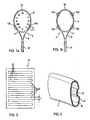
- the three o'clock position or nine o'clock position is usually provided in the middle of the longitudinal extent of the clubhead (see Fig. 1a).
- a damping position is in the range between 4 o'clock and 6 o'clock, in particular at about 5 o'clock, and a further damping position is substantially symmetrical thereto between 6 o'clock and 8 o'clock, in particular at about 7 o'clock.
- the cushioning layers are preferably made of a sheet or sheet material of suitable dimensions in length, width and thickness, the cushioning material preferably being a rectangular piece of sheet material.
- the damping material in particular the damping material forming the damping layers between 4 o'clock and 6 o'clock or between 6 o'clock and 8 o'clock, preferably has a thickness in the range between 0.05 mm and 0.3 mm, more preferably between 0.15 mm and 0.25 mm, and most preferably about 0.2 mm.
- the width of the damping material i. the extent in the winding direction, is preferably such that the damping material in the wound state over at least one, preferably two or more windings in the cross section of the frame profile extends to form the damping layers.
- the damping material in particular the damping layers forming the damping layers between 4 o'clock and 6 o'clock or between 6 o'clock and 8 o'clock, preferably a width in the range between 30 mm and 150 mm, more preferably between 70 mm and 140 mm, strongest preferably between 80 mm and 130 mm, on.
- the width and thickness of the damping material are preferably selected so that the sum of the thicknesses of the individual layers of the damping material per wall of the frame profile in the finished frame preferably in the range of about 0.1 mm to 0.6 mm, preferably 0.3 mm to 0th , 5 mm.
- the length of the damping layers, in particular the damping layers provided between 4 o'clock and 6 o'clock or 6 o'clock and 8 o'clock, along the frame profile is preferably in the range between 20 mm and 150 mm, more preferably between 40 mm and 110 mm.
- the dimensions of the damping material are selected as a function of the size of the striking surface and / or the circumference of the frame profile in the region of the damping layers.
- the damping material for example a length along the frame of 90 mm to 130 mm, preferably 105 mm to 115 mm, more preferably about 110 mm.
- the width of the damping material in the winding direction is approximately in the range between 110 mm and 150 mm, preferably between 125 mm and 135 mm, more preferably approximately 130 mm.
- At least one, preferably two to three, windings can be realized with the damping material having the above dimensions.
- the cushioning material has a length along the frame of 60 mm to 100 mm, preferably 75 mm to 85 mm, more preferably about 80 mm.
- the width of the damping material in the winding direction is approximately in the range between 60 mm and 100 mm, preferably between 75 mm and 85 mm, more preferably at about 80 mm.
- a frame height of about 21 mm to 25 mm and a circumference of the frame profile in the region of the damping layer (at 4 o'clock) of about 69 mm at least one, preferably one to two, windings can be realized with the damping material having the above dimensions.
- the cushioning material has a length along the frame of 20 mm to 60 mm, preferably 35 mm to 45 mm, more preferably about 40 mm.
- the width of the damping material in the winding direction is approximately in the range between 60 mm and 100 mm, preferably between 75 mm and 85 mm, more preferably at about 80 mm.
- a frame height of about 19 mm and a circumference of the frame profile in the region of the damping position (at 4 o'clock) of about 50 mm at least one, preferably two, windings can be realized with the damping material having the above dimensions.
- damping layers Another advantageous possibility of forming the damping layers is to provide a plurality of strips of damping material, which are advantageously aligned parallel to each other.
- the strips may be wound to partially overlap one another, at least in the marginal areas, with the material forming the frame (eg, carbon fiber layers) therebetween.
- the width of the strips is typically in the range between 3 mm and 10 mm, more preferably between 5 mm and 7 mm. These streaks can also effectively absorb the shock or vibration energy To ensure excellent damping properties, while weight can be saved.
- the invention further relates to a process for the production of a racket, to which first a windable sheet material, e.g. Carbon or carbon webs are provided, on which a web-shaped damping material is placed. Subsequently, the layer material with the damping material positioned thereon at least in sections is wound into a tube, which is then formed into a frame profile forming the frame.
- a molding press is used, in which the tube is inserted and is formed under the action of pressure and temperature.
- the frame formed in this way has a club head and a grip section connected therewith over a heart area, wherein at least one damping layer wrapped between the layers forming the hollow profile is provided on the club head and / or in the heart area.
- the racket according to the invention has the particular advantage that it has excellent damping properties. At the same time, the production of the racket is relatively simple and therefore inexpensive.
- the racket 2 is formed from a frame 4 and has a club head 6 and a grip section 10 connected thereto via a heart area 8.
- the frame 4 is formed of a hollow profile, which is made by winding a plurality of layers. These are usually first flexible web-like Materials such as carbon or carbon sheets used, which are usually superimposed at an angle of ⁇ 45 ° to the frame direction. The superimposed materials are rolled into a "tube", so that there are several superimposed windings of the web material. This tube is then formed in a molding press under the action of pressure and temperature to form a frame hollow profile.
- the racket 2 has at least one damping material wrapped between the layers forming the hollow profile and, as shown in FIG. 2, forms a damping layer 12 in the finished racket.
- the damping layer 12 is disposed between two adjacent layers 14 and 16 of the sheet forming the frame.
- the racket 2 on a pair of damping layers 12a, 12b which are arranged substantially symmetrically to the longitudinal axis of the racket 2.
- the damping layer 12a is approximately in the range between 4 o'clock and 6 o'clock. It is particularly preferred to form the damping layer 12a at about 5 o'clock.
- the symmetrically arranged damping layer 12b is approximately in the range between 6 o'clock and 8 o'clock. It is particularly advantageous to provide the damping layer 12b at about 7 o'clock on the club head.
- the first pair of damping layers 12a, 12b is arranged as in the embodiment according to FIG. 1a.
- the second pair of damping layers 12 c, 12 d is provided closer to a free end 18 of the club head 6.
- the damping layer 12c is approximately in the range between 9 o'clock and 11 o'clock, wherein a position at about 10 o'clock is particularly preferred.
- the damping layer 12d is preferably between 1 o'clock and 3 o'clock, more preferably at about 2 o'clock.
- the damping material preferably has a thickness in the range between 0.05 mm and 0.3 mm, more preferably between 0.15 mm and 0.25 mm, and particularly preferably about 0.2 mm.
- the width of the damping material in the winding direction is preferably such that the damping layer 12 extends at least once around the circumference of the frame 4 forming the hollow profile, ie, having at least one winding. However, it is more preferred to dimension the width such that the damping material extends over at least two windings.
- the damping material preferably a width in the range between 30 mm and 150 mm, more preferably between 70 mm and 140 mm, and most preferably between 80 mm and 130 mm.
- the length L of the damping layer 12 in the direction of the frame extension is preferably in the range between 20 mm and 150 mm, more preferably between 40 mm and 110 mm.
- Das damping material may be formed in the form of a plurality of strips 20 according to the embodiment shown schematically in Figure 3.
- the strips 20 are preferably arranged parallel to each other and together form a damping layer 12, which are preferably in their dimensions in the range of the above-described continuous damping layer.
- the strips 20 of the damping layer 12 are preferably formed by cutting out a plurality of parallel recesses 22 from an approximately rectangular piece of the damping material. This results in mutually parallel and along the circumference of the rectangle interconnected strip 20. This damping material 12 can thus also be handled as an integral element.
- the individual strips 20 preferably have a length 1 in the range between 3 mm and 10 mm, more preferably between 5 mm and 7 mm.
- the inventive effect of the improved damping is ensured even with this strip-shaped design of the damping layer 12, since the individual strips 20 also reduce the shear stresses occurring between adjacent layers 14, 16.
- the individual strips 20 may be provided perpendicular to the extension of the frame at the relevant point. But it may also be advantageous to provide the strips 20 at an angle relative to the winding direction, so that adjacent strips can at least partially overlap in the wound state. Suitable angles for winding the damping material are preferably in the range between 0 ° and 45 °, preferably between 5 ° and 15 ° to the frame longitudinal direction. In this arrangement as well, shear stresses between adjacent layers 14, 16 of the layer material forming the frame 4 are effectively reduced.
- the racket 2 according to the invention has essentially the advantage that it has excellent damping properties despite its integral or one-piece design, while being easy to produce at the same time.
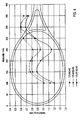
- Figure 4 is an illustration showing how the position and size of cushioning layers on the clubhead affect the deformation of the racket under load.
- the diagram shows the deformation in millimeters of the racket at a specific measuring point.
- the measuring point is shown on the x-axis of the diagram, wherein the respective measuring point is defined as the distance from the extreme head end of the racket.
- On the y-axis the deformation is shown in millimeters.
- three different clubs were tested, namely a first one with the designation "175-R0-H0" (dark gray curve), a second one with the designation "175-R55-H0" (light gray curve) and a third one with the designation "175-R110-H0" (white curve).
- the term “175" is a name of the racket.
- the term “Rx” provides information about the length L of the damping layer in the direction of the frame extension. That is, “R0” refers to a racket without a cushioning layer, “R55” refers to a racket having a cushioning layer having a length of 55 mm, and “R110” refers to a racket having a cushioning layer having a length of 110 mm.
- the damping positions are each provided at about 5 o'clock or 7 o'clock, ie in the range between 4 o'clock and 6 o'clock or 6 o'clock and 8 o'clock.
- the racket according to the invention is thus clearly superior to rackets without damping layer in terms of its handling properties. Furthermore, the racket according to the invention is also significantly improved with respect to racquets with provided in the grip portion damping layers in terms of its handling, since in rackets with damping layers in the handle portion is a relatively soft racket in the region of the handle. While this may result in an effective way of damping, it is also accompanied by a loss of clout.
Landscapes
- Health & Medical Sciences (AREA)
- General Health & Medical Sciences (AREA)
- Physical Education & Sports Medicine (AREA)
- Laminated Bodies (AREA)
- Golf Clubs (AREA)
- Shaping By String And By Release Of Stress In Plastics And The Like (AREA)
- Moulds For Moulding Plastics Or The Like (AREA)
- Blow-Moulding Or Thermoforming Of Plastics Or The Like (AREA)
Claims (21)
- Raquette pour jeux de balle avec un cadre (4) présentant une partie supérieure (6) et une partie de manche (10) reliée à cette dernière par une zone centrale (8), à base d'un profilé creux, qui est formé par l'enroulement de plusieurs couches, le cadre (4) présentant sur la partie supérieure (6) plusieurs couches d'amortissement (12) enroulées par paires de façon sensiblement symétrique par rapport à l'axe longitudinal de la raquette (2) entre les couches formant le profilé creux, une couche d'amortissement (12a) étant prévue dans la zone entre 4 heures et 6 heures et une autre couche d'amortissement (12b) entre 6 heures et 8 heures sur la partie supérieure (6), l'axe longitudinal étant défini par la position de 6 heures et la position de 12 heures.
- Raquette selon la revendication 1, une couche d'amortissement (12a) étant prévue aux environs de 5 heures et une autre couche d'amortissement (12b) aux environs de 7 heures sur la partie supérieure de la raquette (6).
- Raquette selon la revendication 1 ou 2, une autre couche d'amortissement (12d) étant prévue dans la zone entre 1 heure et 3 heures et, de façon symétrique par rapport à la première, une autre couche d'amortissement (12c) étant prévue entre 9 heures et 11 heures sur la partie supérieure de la raquette (6).
- Raquette selon l'une quelconque des revendications 1 à 3, l'autre couche d'amortissement (12d) étant prévue aux environs de 2 heures et la couche d'amortissement (12c) disposée de façon symétrique par rapport à la première étant prévue aux environs de 10 heures sur la partie supérieure de la raquette (6).
- Raquette selon l'une quelconque des revendications 1 à 4, les couches d'amortissement (12) étant formées à base de matériau absorbant les chocs et/ou les vibrations.
- Raquette selon l'une quelconque des revendications 1 à 5, le matériau pour les couches d'amortissement (12) étant du caoutchouc synthétique, en particulier des polyisoprènes, des caoutchoucs au styrène-butadiène, des polychloroprènes ou des caoutchoucs à uréthane, ou bien un mélange constitué de caoutchouc naturel et de caoutchouc synthétique.
- Raquette selon l'une quelconque des revendications 1 à 6, le matériau pour les couches d'amortissement (12) présentant une épaisseur située entre 0,05 mm et 0,3 mm, de préférence entre 0,15 mm et 0,25 mm, avec une préférence particulière d'environ 0,2 mm.
- Raquette selon l'une quelconque des revendications 1 à 7, le matériau des couches d'amortissement (12) présentant une largeur dimensionnée de telle sorte que les couches d'amortissement s'étendent sur au moins une, de préférence deux ou plus de deux enroulements dans le profilé creux.
- Raquette selon l'une quelconque des revendications 1 à 8, le matériau formant les couches d'amortissement (12) présentant une largeur située entre 30 mm et 150 mm, de préférence entre 70 mm et 140 mm, avec une préférence plus forte entre 80 mm et 130 mm.
- Raquette selon l'une quelconque des revendications 1 à 9, les couches d'amortissement (12) présentant une longueur (L) située entre 20 mm et 150 mm, de préférence entre 40 mm et 110 mm.
- Raquette selon l'une quelconque des revendications 1 à 10, les couches d'amortissement (12) étant réalisées sous la forme de plusieurs bandes (20).
- Raquette selon la revendication 11, les bandes (20) étant agencées sensiblement parallèlement entre elles.
- Raquette selon la revendication 11 ou 12, chaque bande (20) présentant une longueur (1) située entre 3 mm et 10 mm, de préférence entre 5 mm et 7 mm.
- Raquette selon l'une quelconque des revendications 1 à 13, le matériau d'amortissement présentant une dureté Shore A supérieure à 30, de préférence entre 65 et 75.
- Raquette selon l'une quelconque des revendications 1 à 14, les couches d'amortissement étant prévues sous un angle compris entre 0° et 45°, de préférence entre 5° et 15°, par rapport à la direction longitudinale du cadre.
- Raquette selon l'une quelconque des revendications 1 à 15, au moins une couche d'amortissement étant prévue dans la zone centrale de la raquette.
- Procédé pour fabriquer une raquette (2) selon l'une quelconque des revendications 1 à 16, comprenant les étapes suivantes:a) mise à disposition d'un matériau de couche enroulable;b) placement d'un matériau d'amortissement en forme de bande sur le matériau de couche;c) enroulement du matériau de couche et d'amortissement se superposant au moins par endroits pour former un flexible; etd) réalisation d'un cadre (4) formé à partir du flexible en un profilé de cadre, qui présente une partie supérieure de raquette (6) et une partie manche (10) reliée à la première par une zone centrale (8).
- Procédé selon la revendication 17, plusieurs bandes (20) du matériau d'amortissement formant ensemble une couché d'amortissement (12).
- Procédé selon la revendication 18, les bandes (20) étant disposées sensiblement parallèlement entre elles.
- Procédé selon l'une quelconque des revendications 17 à 19, le matériau d'amortissement étant enroulé dans un angle situé entre 0° et 45°, de préférence entre 5° et 15°, par rapport à la direction longitudinale du cadre.
- Procédé selon l'une quelconque des revendications 17 à 20, la réalisation du cadre (4) s'effectuant dans une presse à mouler sous l'effet de la pression et de la température.
Applications Claiming Priority (2)
| Application Number | Priority Date | Filing Date | Title |
|---|---|---|---|
| DE102004010349 | 2004-03-03 | ||
| DE102004010349A DE102004010349B4 (de) | 2004-03-03 | 2004-03-03 | Schläger für Ballspiele und Herstellungsverfahren |
Publications (2)
| Publication Number | Publication Date |
|---|---|
| EP1570883A1 EP1570883A1 (fr) | 2005-09-07 |
| EP1570883B1 true EP1570883B1 (fr) | 2007-07-11 |
Family
ID=34745360
Family Applications (1)
| Application Number | Title | Priority Date | Filing Date |
|---|---|---|---|
| EP05004225A Expired - Lifetime EP1570883B1 (fr) | 2004-03-03 | 2005-02-25 | Raquette pour des jeux de balle et procédés de fabrication |
Country Status (6)
| Country | Link |
|---|---|
| US (1) | US7077767B2 (fr) |
| EP (1) | EP1570883B1 (fr) |
| CN (1) | CN100488586C (fr) |
| AT (1) | ATE366608T1 (fr) |
| DE (2) | DE102004010349B4 (fr) |
| TW (1) | TWI337883B (fr) |
Cited By (2)
| Publication number | Priority date | Publication date | Assignee | Title |
|---|---|---|---|---|
| US8105184B2 (en) | 2007-10-24 | 2012-01-31 | Head Technology Gmbh | System and method of using shear thickening materials in sports products |
| EP3922327A1 (fr) | 2020-06-11 | 2021-12-15 | Sumitomo Rubber Industries, Ltd. | Raquette |
Families Citing this family (6)
| Publication number | Priority date | Publication date | Assignee | Title |
|---|---|---|---|---|
| DE10308532B3 (de) * | 2003-02-27 | 2004-10-21 | Head Technology Ges.M.B.H. | Schläger für Ballspiele |
| EP1981600A2 (fr) * | 2006-02-02 | 2008-10-22 | Head Technology GmbH | Raquette |
| US8342989B2 (en) | 2008-11-14 | 2013-01-01 | Head Technology Gmbh | Sporting goods with graphene material |
| CN103272374B (zh) * | 2013-06-07 | 2015-10-07 | 南京胜利体育用品实业有限公司 | 羽毛球拍制造方法 |
| CA3147894A1 (fr) * | 2019-07-22 | 2021-01-28 | Vt Advantec, Llc | Amortisseurs pour equipement sportif et equipement sportif comprenant ceux-ci |
| TWI814038B (zh) * | 2021-07-22 | 2023-09-01 | 陳威融 | 減震裝置 |
Family Cites Families (19)
| Publication number | Priority date | Publication date | Assignee | Title |
|---|---|---|---|---|
| US4609198A (en) * | 1983-11-08 | 1986-09-02 | Tarr Robert G | Racket handle assembly having vibration dampening characteristics |
| US5314180A (en) * | 1989-08-28 | 1994-05-24 | Toray Industries, Inc. | Sports instrument and impact-absorbing element to be attached to sports equipment |
| WO1991003284A1 (fr) | 1989-08-28 | 1991-03-21 | Toray Industries, Inc. | Articles de sport et materiau amortissant les chocs applique sur les articles de sport |
| EP0550121B1 (fr) * | 1992-01-08 | 1995-12-20 | Chin-San You | Cadre de raquette |
| CN2147017Y (zh) * | 1993-01-30 | 1993-11-24 | 罗光男 | 球拍的三九点吸震构造 |
| US6422958B1 (en) * | 1994-02-24 | 2002-07-23 | David W. Repetto | Frame for a game racquet formed by filament winding |
| JP2798002B2 (ja) * | 1995-04-20 | 1998-09-17 | ヤマハ株式会社 | ラケットフレームおよびその製法 |
| US5982090A (en) * | 1997-07-11 | 1999-11-09 | Kaiser Aerospace And Electronics Coporation | Integrated dual mode flat backlight |
| US5928090A (en) | 1997-09-09 | 1999-07-27 | Cabales; Raymund S. | Golf shaft for controlling passive vibrations |
| US6524692B1 (en) * | 2000-05-02 | 2003-02-25 | Structured Composites, Lp | Energy absorbing structural laminate |
| JP3416634B2 (ja) * | 2000-09-21 | 2003-06-16 | 住友ゴム工業株式会社 | ダイナミックダンパー |
| US6500080B2 (en) * | 2001-05-04 | 2002-12-31 | Wilson Sporting Goods Co. | Game racquet with separate head and handle portions for reducing vibration |
| US20030073523A1 (en) * | 2001-10-16 | 2003-04-17 | Hsu Young-Chen | Method for manufacturing rackets with shock absorbing members with single heating process |
| US20030073522A1 (en) * | 2001-10-16 | 2003-04-17 | Hsu Young-Chen | Method for manufacturing rackets with shock absorbing members |
| DE20209723U1 (de) * | 2001-10-16 | 2002-12-19 | Hsu, Young-Chen, Taichung, Nan-Tun | Schläger |
| DE10200745A1 (de) | 2002-01-10 | 2003-11-13 | Ignatius Georg | Racket zur Beaufschlagung von Tennisbällen und ähnlichen Spielkörpern |
| US6663515B1 (en) * | 2002-08-15 | 2003-12-16 | Chin-Dong Pai | Racket with a head and a handle both made of different materials |
| JP4041031B2 (ja) * | 2003-07-04 | 2008-01-30 | Sriスポーツ株式会社 | ラケットフレーム |
| JP3970865B2 (ja) * | 2003-11-27 | 2007-09-05 | Sriスポーツ株式会社 | ラケットフレーム |
-
2004
- 2004-03-03 DE DE102004010349A patent/DE102004010349B4/de not_active Expired - Fee Related
- 2004-03-30 US US10/812,059 patent/US7077767B2/en not_active Expired - Lifetime
-
2005
- 2005-02-25 EP EP05004225A patent/EP1570883B1/fr not_active Expired - Lifetime
- 2005-02-25 DE DE502005000990T patent/DE502005000990D1/de not_active Expired - Lifetime
- 2005-02-25 AT AT05004225T patent/ATE366608T1/de active
- 2005-03-01 TW TW094106059A patent/TWI337883B/zh not_active IP Right Cessation
- 2005-03-03 CN CNB2005100518844A patent/CN100488586C/zh not_active Expired - Fee Related
Cited By (2)
| Publication number | Priority date | Publication date | Assignee | Title |
|---|---|---|---|---|
| US8105184B2 (en) | 2007-10-24 | 2012-01-31 | Head Technology Gmbh | System and method of using shear thickening materials in sports products |
| EP3922327A1 (fr) | 2020-06-11 | 2021-12-15 | Sumitomo Rubber Industries, Ltd. | Raquette |
Also Published As
| Publication number | Publication date |
|---|---|
| DE102004010349A1 (de) | 2005-09-29 |
| DE102004010349B4 (de) | 2006-03-09 |
| EP1570883A1 (fr) | 2005-09-07 |
| ATE366608T1 (de) | 2007-08-15 |
| DE502005000990D1 (de) | 2007-08-23 |
| CN1663641A (zh) | 2005-09-07 |
| CN100488586C (zh) | 2009-05-20 |
| US7077767B2 (en) | 2006-07-18 |
| TW200534897A (en) | 2005-11-01 |
| US20050197218A1 (en) | 2005-09-08 |
| TWI337883B (en) | 2011-03-01 |
Similar Documents
| Publication | Publication Date | Title |
|---|---|---|
| DE4433717A1 (de) | Stoßabsorbierender Griff für Tennisschläger und ähnliches | |
| DE3434956A1 (de) | Schlaeger fuer spiele mit begrenzt elastischem ball | |
| DE4009590A1 (de) | Golfschlaegerschaft mit selektiver verstaerkung | |
| DE69320739T2 (de) | Schläger mit Dämpfungselementen | |
| EP1570883B1 (fr) | Raquette pour des jeux de balle et procédés de fabrication | |
| DE69517619T2 (de) | Schläger mit unebenem Rahmen | |
| DE3312834A1 (de) | Ballschlaeger, insbesondere tennisschlaeger | |
| EP2823866B1 (fr) | Batteurs de jeux à balle avec son amélioré | |
| EP1815891B1 (fr) | Bande antidérapante et poignée pour un raquette de sport | |
| EP1557203B1 (fr) | Raquette pour jeux de balle et méthode de fabrication | |
| DE69201986T2 (de) | Schläger mit länglicher Asymmetrie. | |
| EP1452207A1 (fr) | Raquette pour jeux de balle | |
| DE4037568A1 (de) | Tennisschlaeger | |
| DE102004003526B3 (de) | Schläger für Ballspiele und Herstellungsverfahren | |
| EP0487963B1 (fr) | Raquette de tennis | |
| DE2804569C3 (de) | Rahmen für einen Ballschläger | |
| DE202004003583U1 (de) | Schläger für Ballspiele | |
| EP1097730B1 (fr) | Raquette pour jeux de balles | |
| EP1452209B1 (fr) | Raquette pour jeux de balle | |
| EP2138207B1 (fr) | Batteur de jeux de balle | |
| DE102008064385B4 (de) | Ballspielschläger | |
| DE3910871A1 (de) | Schlaeger fuer ballspiele, insbes. tennisschlaeger | |
| EP0310169B2 (fr) | Raquettes pour jeux de balles, en particulier raquettes de tennis | |
| DE102006004860B3 (de) | Griffband für Ballspielschläger | |
| DE102006004862B3 (de) | Griff für Ballspielschläger |
Legal Events
| Date | Code | Title | Description |
|---|---|---|---|
| PUAI | Public reference made under article 153(3) epc to a published international application that has entered the european phase |
Free format text: ORIGINAL CODE: 0009012 |
|
| AK | Designated contracting states |
Kind code of ref document: A1 Designated state(s): AT BE BG CH CY CZ DE DK EE ES FI FR GB GR HU IE IS IT LI LT LU MC NL PL PT RO SE SI SK TR |
|
| AX | Request for extension of the european patent |
Extension state: AL BA HR LV MK YU |
|
| 17P | Request for examination filed |
Effective date: 20051107 |
|
| AKX | Designation fees paid |
Designated state(s): AT BE BG CH CY CZ DE DK EE ES FI FR GB GR HU IE IS IT LI LT LU MC NL PL PT RO SE SI SK TR |
|
| GRAJ | Information related to disapproval of communication of intention to grant by the applicant or resumption of examination proceedings by the epo deleted |
Free format text: ORIGINAL CODE: EPIDOSDIGR1 |
|
| GRAP | Despatch of communication of intention to grant a patent |
Free format text: ORIGINAL CODE: EPIDOSNIGR1 |
|
| GRAP | Despatch of communication of intention to grant a patent |
Free format text: ORIGINAL CODE: EPIDOSNIGR1 |
|
| GRAS | Grant fee paid |
Free format text: ORIGINAL CODE: EPIDOSNIGR3 |
|
| GRAA | (expected) grant |
Free format text: ORIGINAL CODE: 0009210 |
|
| AK | Designated contracting states |
Kind code of ref document: B1 Designated state(s): AT BE BG CH CY CZ DE DK EE ES FI FR GB GR HU IE IS IT LI LT LU MC NL PL PT RO SE SI SK TR |
|
| REG | Reference to a national code |
Ref country code: GB Ref legal event code: FG4D Free format text: NOT ENGLISH |
|
| REG | Reference to a national code |
Ref country code: CH Ref legal event code: EP |
|
| GBT | Gb: translation of ep patent filed (gb section 77(6)(a)/1977) |
Effective date: 20070723 |
|
| REF | Corresponds to: |
Ref document number: 502005000990 Country of ref document: DE Date of ref document: 20070823 Kind code of ref document: P |
|
| REG | Reference to a national code |
Ref country code: CH Ref legal event code: NV Representative=s name: VOSSIUS & PARTNER |
|
| REG | Reference to a national code |
Ref country code: IE Ref legal event code: FG4D Free format text: LANGUAGE OF EP DOCUMENT: GERMAN |
|
| ET | Fr: translation filed | ||
| PG25 | Lapsed in a contracting state [announced via postgrant information from national office to epo] |
Ref country code: PT Free format text: LAPSE BECAUSE OF FAILURE TO SUBMIT A TRANSLATION OF THE DESCRIPTION OR TO PAY THE FEE WITHIN THE PRESCRIBED TIME-LIMIT Effective date: 20071211 Ref country code: ES Free format text: LAPSE BECAUSE OF FAILURE TO SUBMIT A TRANSLATION OF THE DESCRIPTION OR TO PAY THE FEE WITHIN THE PRESCRIBED TIME-LIMIT Effective date: 20071022 Ref country code: LT Free format text: LAPSE BECAUSE OF FAILURE TO SUBMIT A TRANSLATION OF THE DESCRIPTION OR TO PAY THE FEE WITHIN THE PRESCRIBED TIME-LIMIT Effective date: 20070711 Ref country code: NL Free format text: LAPSE BECAUSE OF FAILURE TO SUBMIT A TRANSLATION OF THE DESCRIPTION OR TO PAY THE FEE WITHIN THE PRESCRIBED TIME-LIMIT Effective date: 20070711 Ref country code: IS Free format text: LAPSE BECAUSE OF FAILURE TO SUBMIT A TRANSLATION OF THE DESCRIPTION OR TO PAY THE FEE WITHIN THE PRESCRIBED TIME-LIMIT Effective date: 20071111 Ref country code: FI Free format text: LAPSE BECAUSE OF FAILURE TO SUBMIT A TRANSLATION OF THE DESCRIPTION OR TO PAY THE FEE WITHIN THE PRESCRIBED TIME-LIMIT Effective date: 20070711 Ref country code: BG Free format text: LAPSE BECAUSE OF FAILURE TO SUBMIT A TRANSLATION OF THE DESCRIPTION OR TO PAY THE FEE WITHIN THE PRESCRIBED TIME-LIMIT Effective date: 20071011 |
|
| REG | Reference to a national code |
Ref country code: CH Ref legal event code: PCAR Free format text: VOSSIUS & PARTNER;NADELBERG 3;4051 BASEL (CH) |
|
| NLV1 | Nl: lapsed or annulled due to failure to fulfill the requirements of art. 29p and 29m of the patents act | ||
| PG25 | Lapsed in a contracting state [announced via postgrant information from national office to epo] |
Ref country code: PL Free format text: LAPSE BECAUSE OF FAILURE TO SUBMIT A TRANSLATION OF THE DESCRIPTION OR TO PAY THE FEE WITHIN THE PRESCRIBED TIME-LIMIT Effective date: 20070711 |
|
| REG | Reference to a national code |
Ref country code: IE Ref legal event code: FD4D |
|
| PG25 | Lapsed in a contracting state [announced via postgrant information from national office to epo] |
Ref country code: GR Free format text: LAPSE BECAUSE OF FAILURE TO SUBMIT A TRANSLATION OF THE DESCRIPTION OR TO PAY THE FEE WITHIN THE PRESCRIBED TIME-LIMIT Effective date: 20071012 Ref country code: DK Free format text: LAPSE BECAUSE OF FAILURE TO SUBMIT A TRANSLATION OF THE DESCRIPTION OR TO PAY THE FEE WITHIN THE PRESCRIBED TIME-LIMIT Effective date: 20070711 |
|
| PLBE | No opposition filed within time limit |
Free format text: ORIGINAL CODE: 0009261 |
|
| STAA | Information on the status of an ep patent application or granted ep patent |
Free format text: STATUS: NO OPPOSITION FILED WITHIN TIME LIMIT |
|
| PG25 | Lapsed in a contracting state [announced via postgrant information from national office to epo] |
Ref country code: SK Free format text: LAPSE BECAUSE OF FAILURE TO SUBMIT A TRANSLATION OF THE DESCRIPTION OR TO PAY THE FEE WITHIN THE PRESCRIBED TIME-LIMIT Effective date: 20070711 Ref country code: IE Free format text: LAPSE BECAUSE OF FAILURE TO SUBMIT A TRANSLATION OF THE DESCRIPTION OR TO PAY THE FEE WITHIN THE PRESCRIBED TIME-LIMIT Effective date: 20070711 Ref country code: CZ Free format text: LAPSE BECAUSE OF FAILURE TO SUBMIT A TRANSLATION OF THE DESCRIPTION OR TO PAY THE FEE WITHIN THE PRESCRIBED TIME-LIMIT Effective date: 20070711 |
|
| 26N | No opposition filed |
Effective date: 20080414 |
|
| PG25 | Lapsed in a contracting state [announced via postgrant information from national office to epo] |
Ref country code: SE Free format text: LAPSE BECAUSE OF FAILURE TO SUBMIT A TRANSLATION OF THE DESCRIPTION OR TO PAY THE FEE WITHIN THE PRESCRIBED TIME-LIMIT Effective date: 20071011 Ref country code: RO Free format text: LAPSE BECAUSE OF FAILURE TO SUBMIT A TRANSLATION OF THE DESCRIPTION OR TO PAY THE FEE WITHIN THE PRESCRIBED TIME-LIMIT Effective date: 20070711 |
|
| BERE | Be: lapsed |
Owner name: HEAD TECHNOLOGY GMBH Effective date: 20080228 |
|
| PG25 | Lapsed in a contracting state [announced via postgrant information from national office to epo] |
Ref country code: MC Free format text: LAPSE BECAUSE OF NON-PAYMENT OF DUE FEES Effective date: 20080228 |
|
| PG25 | Lapsed in a contracting state [announced via postgrant information from national office to epo] |
Ref country code: EE Free format text: LAPSE BECAUSE OF FAILURE TO SUBMIT A TRANSLATION OF THE DESCRIPTION OR TO PAY THE FEE WITHIN THE PRESCRIBED TIME-LIMIT Effective date: 20070711 |
|
| PG25 | Lapsed in a contracting state [announced via postgrant information from national office to epo] |
Ref country code: BE Free format text: LAPSE BECAUSE OF NON-PAYMENT OF DUE FEES Effective date: 20080228 |
|
| PG25 | Lapsed in a contracting state [announced via postgrant information from national office to epo] |
Ref country code: SI Free format text: LAPSE BECAUSE OF FAILURE TO SUBMIT A TRANSLATION OF THE DESCRIPTION OR TO PAY THE FEE WITHIN THE PRESCRIBED TIME-LIMIT Effective date: 20070711 |
|
| PG25 | Lapsed in a contracting state [announced via postgrant information from national office to epo] |
Ref country code: CY Free format text: LAPSE BECAUSE OF FAILURE TO SUBMIT A TRANSLATION OF THE DESCRIPTION OR TO PAY THE FEE WITHIN THE PRESCRIBED TIME-LIMIT Effective date: 20070711 |
|
| PG25 | Lapsed in a contracting state [announced via postgrant information from national office to epo] |
Ref country code: HU Free format text: LAPSE BECAUSE OF FAILURE TO SUBMIT A TRANSLATION OF THE DESCRIPTION OR TO PAY THE FEE WITHIN THE PRESCRIBED TIME-LIMIT Effective date: 20080112 Ref country code: LU Free format text: LAPSE BECAUSE OF NON-PAYMENT OF DUE FEES Effective date: 20080225 |
|
| PG25 | Lapsed in a contracting state [announced via postgrant information from national office to epo] |
Ref country code: TR Free format text: LAPSE BECAUSE OF FAILURE TO SUBMIT A TRANSLATION OF THE DESCRIPTION OR TO PAY THE FEE WITHIN THE PRESCRIBED TIME-LIMIT Effective date: 20070711 |
|
| PGFP | Annual fee paid to national office [announced via postgrant information from national office to epo] |
Ref country code: IT Payment date: 20131205 Year of fee payment: 10 Ref country code: AT Payment date: 20140219 Year of fee payment: 10 |
|
| REG | Reference to a national code |
Ref country code: AT Ref legal event code: MM01 Ref document number: 366608 Country of ref document: AT Kind code of ref document: T Effective date: 20150225 |
|
| PG25 | Lapsed in a contracting state [announced via postgrant information from national office to epo] |
Ref country code: AT Free format text: LAPSE BECAUSE OF NON-PAYMENT OF DUE FEES Effective date: 20150225 |
|
| PG25 | Lapsed in a contracting state [announced via postgrant information from national office to epo] |
Ref country code: IT Free format text: LAPSE BECAUSE OF NON-PAYMENT OF DUE FEES Effective date: 20150225 |
|
| REG | Reference to a national code |
Ref country code: FR Ref legal event code: PLFP Year of fee payment: 12 |
|
| REG | Reference to a national code |
Ref country code: CH Ref legal event code: PFA Owner name: HEAD TECHNOLOGY GMBH, AT Free format text: FORMER OWNER: HEAD TECHNOLOGY GMBH, AT |
|
| REG | Reference to a national code |
Ref country code: FR Ref legal event code: PLFP Year of fee payment: 13 |
|
| PGFP | Annual fee paid to national office [announced via postgrant information from national office to epo] |
Ref country code: CH Payment date: 20170207 Year of fee payment: 13 |
|
| REG | Reference to a national code |
Ref country code: FR Ref legal event code: PLFP Year of fee payment: 14 |
|
| REG | Reference to a national code |
Ref country code: CH Ref legal event code: PL |
|
| PG25 | Lapsed in a contracting state [announced via postgrant information from national office to epo] |
Ref country code: CH Free format text: LAPSE BECAUSE OF NON-PAYMENT OF DUE FEES Effective date: 20180228 Ref country code: LI Free format text: LAPSE BECAUSE OF NON-PAYMENT OF DUE FEES Effective date: 20180228 |
|
| PGFP | Annual fee paid to national office [announced via postgrant information from national office to epo] |
Ref country code: FR Payment date: 20181123 Year of fee payment: 15 Ref country code: GB Payment date: 20181203 Year of fee payment: 15 |
|
| GBPC | Gb: european patent ceased through non-payment of renewal fee |
Effective date: 20200225 |
|
| PG25 | Lapsed in a contracting state [announced via postgrant information from national office to epo] |
Ref country code: GB Free format text: LAPSE BECAUSE OF NON-PAYMENT OF DUE FEES Effective date: 20200225 Ref country code: FR Free format text: LAPSE BECAUSE OF NON-PAYMENT OF DUE FEES Effective date: 20200229 |
|
| PGFP | Annual fee paid to national office [announced via postgrant information from national office to epo] |
Ref country code: DE Payment date: 20240112 Year of fee payment: 20 |
|
| REG | Reference to a national code |
Ref country code: DE Ref legal event code: R071 Ref document number: 502005000990 Country of ref document: DE |