EP1570933B1 - Vorrichtung mit einer Löseeinheit zum Betätigen einer Spannvorrichtung für Werkzeuge - Google Patents
Vorrichtung mit einer Löseeinheit zum Betätigen einer Spannvorrichtung für Werkzeuge Download PDFInfo
- Publication number
- EP1570933B1 EP1570933B1 EP05003751A EP05003751A EP1570933B1 EP 1570933 B1 EP1570933 B1 EP 1570933B1 EP 05003751 A EP05003751 A EP 05003751A EP 05003751 A EP05003751 A EP 05003751A EP 1570933 B1 EP1570933 B1 EP 1570933B1
- Authority
- EP
- European Patent Office
- Prior art keywords
- releasing
- housing
- motor
- spindle
- releasing unit
- Prior art date
- Legal status (The legal status is an assumption and is not a legal conclusion. Google has not performed a legal analysis and makes no representation as to the accuracy of the status listed.)
- Expired - Lifetime
Links
- 230000008878 coupling Effects 0.000 claims description 51
- 238000010168 coupling process Methods 0.000 claims description 51
- 238000005859 coupling reaction Methods 0.000 claims description 51
- 238000006073 displacement reaction Methods 0.000 claims description 5
- 238000006243 chemical reaction Methods 0.000 claims 2
- 230000001419 dependent effect Effects 0.000 claims 2
- 238000005259 measurement Methods 0.000 claims 1
- 238000000034 method Methods 0.000 description 3
- 230000008569 process Effects 0.000 description 3
- 238000001514 detection method Methods 0.000 description 2
- 238000011109 contamination Methods 0.000 description 1
- 238000010586 diagram Methods 0.000 description 1
- 239000000428 dust Substances 0.000 description 1
- 230000001050 lubricating effect Effects 0.000 description 1
- 238000005461 lubrication Methods 0.000 description 1
- 230000007257 malfunction Effects 0.000 description 1
- 238000012544 monitoring process Methods 0.000 description 1
- 238000000465 moulding Methods 0.000 description 1
- 210000002445 nipple Anatomy 0.000 description 1
- 230000004044 response Effects 0.000 description 1
- 230000000284 resting effect Effects 0.000 description 1
- 230000007704 transition Effects 0.000 description 1
- 230000001960 triggered effect Effects 0.000 description 1
Images


Classifications
-
- B—PERFORMING OPERATIONS; TRANSPORTING
- B23—MACHINE TOOLS; METAL-WORKING NOT OTHERWISE PROVIDED FOR
- B23B—TURNING; BORING
- B23B31/00—Chucks; Expansion mandrels; Adaptations thereof for remote control
- B23B31/02—Chucks
- B23B31/24—Chucks characterised by features relating primarily to remote control of the gripping means
- B23B31/26—Chucks characterised by features relating primarily to remote control of the gripping means using mechanical transmission through the working-spindle
- B23B31/261—Chucks characterised by features relating primarily to remote control of the gripping means using mechanical transmission through the working-spindle clamping the end of the toolholder shank
- B23B31/265—Chucks characterised by features relating primarily to remote control of the gripping means using mechanical transmission through the working-spindle clamping the end of the toolholder shank by means of collets
-
- B—PERFORMING OPERATIONS; TRANSPORTING
- B23—MACHINE TOOLS; METAL-WORKING NOT OTHERWISE PROVIDED FOR
- B23B—TURNING; BORING
- B23B31/00—Chucks; Expansion mandrels; Adaptations thereof for remote control
- B23B31/02—Chucks
- B23B31/24—Chucks characterised by features relating primarily to remote control of the gripping means
- B23B31/28—Chucks characterised by features relating primarily to remote control of the gripping means using electric or magnetic means in the chuck
-
- B—PERFORMING OPERATIONS; TRANSPORTING
- B23—MACHINE TOOLS; METAL-WORKING NOT OTHERWISE PROVIDED FOR
- B23B—TURNING; BORING
- B23B2260/00—Details of constructional elements
- B23B2260/062—Electric motors
-
- B—PERFORMING OPERATIONS; TRANSPORTING
- B23—MACHINE TOOLS; METAL-WORKING NOT OTHERWISE PROVIDED FOR
- B23B—TURNING; BORING
- B23B2270/00—Details of turning, boring or drilling machines, processes or tools not otherwise provided for
- B23B2270/09—Details relating to unclamping
-
- Y—GENERAL TAGGING OF NEW TECHNOLOGICAL DEVELOPMENTS; GENERAL TAGGING OF CROSS-SECTIONAL TECHNOLOGIES SPANNING OVER SEVERAL SECTIONS OF THE IPC; TECHNICAL SUBJECTS COVERED BY FORMER USPC CROSS-REFERENCE ART COLLECTIONS [XRACs] AND DIGESTS
- Y10—TECHNICAL SUBJECTS COVERED BY FORMER USPC
- Y10T—TECHNICAL SUBJECTS COVERED BY FORMER US CLASSIFICATION
- Y10T408/00—Cutting by use of rotating axially moving tool
- Y10T408/94—Tool-support
- Y10T408/95—Tool-support with tool-retaining means
-
- Y—GENERAL TAGGING OF NEW TECHNOLOGICAL DEVELOPMENTS; GENERAL TAGGING OF CROSS-SECTIONAL TECHNOLOGIES SPANNING OVER SEVERAL SECTIONS OF THE IPC; TECHNICAL SUBJECTS COVERED BY FORMER USPC CROSS-REFERENCE ART COLLECTIONS [XRACs] AND DIGESTS
- Y10—TECHNICAL SUBJECTS COVERED BY FORMER USPC
- Y10T—TECHNICAL SUBJECTS COVERED BY FORMER US CLASSIFICATION
- Y10T409/00—Gear cutting, milling, or planing
- Y10T409/30—Milling
- Y10T409/309352—Cutter spindle or spindle support
- Y10T409/309408—Cutter spindle or spindle support with cutter holder
- Y10T409/309464—Cutter spindle or spindle support with cutter holder and draw bar
Definitions
- the invention relates to a device with a release unit for operating a clamping device for tools according to the preamble of claim 1.
- a device is known from US-A-4,750,850 known.
- the tool spindle usually has a HSK holder for the tools, which are drawn into the spindle via a collet and clamped with a high axial pull-in force. Due to the axial movement of the tension rod collet segments are pressed by means of a seated on the tension rod cone piece to the outside. The collet elements engage behind a clamping surface on the tool, which is drawn through the tension rod into the spindle and tensioned. The axial movement of the tension rod is carried out in the tensioning direction by a spring assembly, for example by a cup spring package, mechanically and thus very securely and reliably.
- the tension rod must be adjusted against the spring force to the front.
- the collet segments are released so that they can pivot inwards.
- the tool is then ejected on the last remainder of the travel by the tie rod from the tool holder.
- the release unit is provided, which is formed by a hydraulically actuated release unit in the manner of a hydraulic cylinder.
- a part of the release unit is arranged axially displaceably in a receptacle and is supported axially with a coupling ring on a seated in the tool spindle coupling screw.
- the hydraulic solution is complicated and expensive due to the need for a hydraulic unit with pump, oil reservoir, valve block and the necessary piping. In addition, leaks can lead to malfunction. If the tool spindle is driven by belts, the hydraulic lines must be disconnected when changing the belt, which is difficult even when using hydraulic quick-release couplings and sometimes results in contamination by oil.
- the pneumatic solution does not work with the medium oil, but otherwise has the same disadvantages as the hydraulic solution.
- the pneumatically operating release unit due to the relatively low pressures at the high forces required either very large builds or expensive special solutions, such as tandem cylinder or pressure booster, are necessary.
- the invention has the object of providing the generic device in such a way that it is simple, inexpensive and compact.
- the drive is formed by an electric motor, which can be simple, inexpensive and compact and only requires an electrical supply line for operation.
- the effort for hydraulic units and piping is eliminated.
- the dissolving unit according to the invention is preferably used in molding machines.
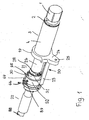
- the stationary motorized release unit described below can be solved tools 1, which are clamped in an interface 2 of a tool spindle 3 in a known manner.
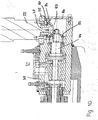
- the tool spindle 3 has a spindle sleeve 4 (FIG. Fig. 1 ), in which a spindle shaft 5 is rotatably mounted.
- a tension rod 6 is housed in a known manner, which is surrounded over part of its length in a known manner by a spring assembly 7.
- the spring assembly 7 is advantageously made of disc springs.
- the spring assembly is supported at one end via a guide plate 8 at a radially inwardly projecting shoulder 9 in the inner wall of the spindle shaft 5 off.
- the spring assembly 7 is supported via a disc 10 on the end face of a pressure piece 11, which is designed as a sleeve and projects through a coupling screw 12 which is screwed into the end facing away from the interface 2 of the tool spindle 3 end of the spindle shaft 5.
- the over the coupling screw 12 outwardly projecting end of the pressure member 11 has a radially outwardly directed flange 13 acts on him the release unit when the clamped in the interface 2 tool 1 is to be solved.
- the interface 2 is advantageously designed as an HSK interface and has a cone-shaped tool holder 14, in which the tool 1 engages with a corresponding conical shaft 15.
- collets 16 are mounted in the spindle shaft 5 in a known manner, which engage behind the tool shank 15 in the clamping position and pull the tool 1 into the tool holder 14 and tighten.
- the clamping force is applied by the spring assembly 7.
- the tool 1 is pulled so far into the spindle shaft 5 until it rests against a flat end face 17 of the spindle shaft 5 with great force.
- the collets 16 are by a cone piece 18 in the in Fig. 9 pivoted clamping position shown pivoted.
- the cone piece 18 is firmly seated on the tension rod 6.
- the cone piece 18 is screwed onto the tension rod 6. If the tension rod 6 under the force of the spring assembly 7 in Fig. 9 shifted to the right in the spindle shaft 5, it spreads the tie rods 16 radially outward, which engage behind the tool shank 15. Will the tension rod 6 in a manner to be described by the release unit against the force of the spring assembly 7 in Fig. 9 shifted to the left, the cone piece 18 releases so much space that the collets 16 pivot inward and can release the tool shank 15.
- the cone piece 18 At the end of the displacement movement, the tool 1 comes out of the spindle shaft 5 which, with its shaft 15, sits self-lockingly in the cone seat 14 of the interface 2.
- a holder 19 On the spindle sleeve 4 is a holder 19 ( Fig. 1 ), which is part of a holding device 20. With her a release unit 21 is held, with the voltage of the tools 1 can be solved in a manner to be described later.
- the tool spindle 3 and the release unit 21 are axially behind each other ( Fig. 1 ) and coaxial with each other.
- a drive 22 for the release unit 21 is connected.
- the holding device 20 has a support 23, on which the release unit 21 is mounted resting and which protrudes perpendicularly from the holder 19.
- the holder 19 has a radially projecting eye 24 with a threaded bore 25, through which a (not shown) Axialverstellspindel protrudes, with which the unit of the tool spindle 3, holding device 20 and release unit 21 on a carrier (not shown) can be adjusted axially.
- the spindle sleeve 4 surrounds the spindle shaft 5 at its front region.
- the spindle shaft 5 has greater wall thickness than in the adjoining area ( Fig. 9 ), rotatably on a pulley 26 ( Fig. 1 ) sits.
- a pulley 26 For rotationally fixed connection with the pulley 26 of the wall thickness thinner part of the spindle shaft 5 with at least one positive locking element 27 (FIG. Fig. 9 ), which establishes the rotationally fixed connection to the pulley 26.
- the pulley 26 With a pulley nut 28, the pulley 26 is axially secured on the spindle shaft 5 ( Fig. 4 ).
- the pulley nut 28 is screwed onto the end of the spindle shaft 5 facing the release unit 21.
- the pulley 26 With its other end, the pulley 26 is located at the interposition of bearings (not shown) on a radially outwardly directed collar 29 (FIG. Fig. 9 ), which at the transition from thinner is provided in the thicker wall portion of the spindle shaft 5.
- FIG. 4 and 5 show the coupling screw 12 and the pressure member 11 axially over the spindle shaft 5 in the release unit 21.
- the pressure member 11 is compared to the coupling screw 12 so far moved towards the release unit 21 that the flange 13 of the pressure member 11 in the normal position ( Fig. 4 and 5 ) Distance from the coupling screw 12 has.
- the release unit 21 is mounted on the holding device 20 so that the coupling screw 12 and the pressure piece 11 protrude into a housing 30 of the release unit 21.
- a coupling ring 31 which with fastening screws 32 (FIG. Fig. 5 ) is attached to the housing front.
- the coupling ring 31 has threaded holes 33 into which the fastening screws 32 are screwed with their free end. So that the coupling ring 31 can be dismantled when the release unit 21 is mounted, the fastening screws 32 can be actuated from the opposite side of the housing 30.
- the housing has 30 recesses 34 which receive the screw heads 35 which rest against the bottom of the recesses 34.
- the coupling screw 12 is surrounded by the coupling ring 31 with little play.
- the coupling screw 12 is provided at the free, outside the tool spindle 3 lying end with a radially outwardly directed flange 36. He lies in the in the Fig. 4 and 5 shown basic position of the release unit 21 with axial distance an axially projecting collar 37 of the coupling ring 31 opposite.
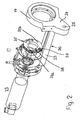
- the coupling ring 31 can be removed after loosening the fastening screws 32, it is designed to be split and has two ring parts 31a, 31b ( Fig. 2 ), which are each mounted with an axial pivot axis 38, 39 on the end face of the housing 30 pivotally.
- the pivot axes 38, 39 may be formed for example by fitting screws, which are inserted into corresponding openings in the end face of the housing 30. After loosening the fastening screws 32, the approximately semicircular ring parts 31a, 31b on the pivot axes 38, 39 are moved so far that the collar 37 emerges from the housing 30. Then, the ring members 31a, 31b can be pivoted about the pivot axes 38, 39 to the outside, so that the release unit 21 can be removed.
- the ring members 31a, 31b of the coupling ring 31 are not pivotally provided, but can be screwed only to the housing 30 and unscrew from it.
- the two ring members 31a, 31b are held together as a unit, the coupling ring 31 is provided in its outer surface with an annular groove 40 into which an elastic ring, preferably an O-ring, can be inserted, which holds the two ring parts 31a, 31b together.
- a discharge nut 41 is housed, which rests against the inner wall 42 of the housing 30.
- the ejection nut 41 has a central threaded through hole 43 into which a threaded spindle 44 engages. It is supported by thrust bearings 45, 46 in the housing 30.
- the threaded spindle 44 is coupled to a drive shaft 47 of the drive 22.
- the ejection nut 41 is displaced axially in the direction of the pressure piece 11 or away from it in the housing 30.
- the ejection nut 41 has a radially projecting torque arm 48 (FIG. Fig. 4 ), with their radially outer end in an in Axially extending slot 49 of the housing 30 engages.
- the width of this slot 49 corresponds to the cross-sectional width of the torque arm 48 in the engagement region.
- the torque arm 48 has a bolt 50 mounted in the ejection nut 41 and projecting radially above it, which may be screwed or pressed into the ejection nut 41.
- On the bolt 50 is seated a bushing 51, which is guided almost free of play in the slot 49 of the housing 30.
- the length of the axially extending slot 49 corresponds at least to the maximum displacement of the ejection nut 41 in the housing 30th
- the housing 30 of the release unit 21 is seated in a receiving flange 52, which is fastened to the holding device 20.
- the housing 30 is axially displaceable relative to the receiving flange 52 to a limited extent when the tool 1 clamped in the tool spindle 3 is to be released.
- the housing 30 is loaded by at least one spring 53, preferably a plate spring, in the direction of the drive 22 to the right.
- the spring 53 is supported on the receiving flange 52 and a securing ring 54, which sits on the outside of the housing 30.
- the drive 22 is attached. It rests with a motor flange plate 55 on the front side of the housing 30 and is fastened with screws 56 on the housing 30.
- the flange plate 55 itself is screwed with screws 57 on the front side of a motor housing 58.
- the flange plate 55 has in the amount of the fastening screws 32 lying axial through holes 59 ( Fig. 5 ), so that the mounting screws 32 are accessible even when mounted flange 55 from the outside.
- the passage openings 59 are located in a radially projecting beyond the motor housing 58 area.
- the threaded spindle 44 has a lying in the area outside of the ejection nut 41 collar 60, on which a thrust bearing 45 is axially supported. On the opposite side, the thrust bearing 45 is supported on a radially inwardly projecting shoulder surface 61 of the housing 30.
- the axially adjacent thrust bearing 46 is supported axially on a further radially inwardly projecting shoulder surface 62 of the housing 30 and on a nut 64 screwed onto the threaded spindle 44.
- the release unit 21 is provided with two sensors 65 and 66 ( Fig. 4 ) projecting radially from the release unit 21.
- the sensor 65 protrudes in the height of the pressure piece 11 in the housing 30 and is held by a sensor plate 67 which is fixed by at least one screw 68 on the housing 30 adjacent to the coupling ring 31.
- the other sensor 66 is seated in a sensor plate 69, which is fastened with at least one screw 70 on the receiving flange 52. Both sensors 65, 66 are advantageously inductively operating sensors.
- the sensor 65 has two functions. When the tool 1 is properly clamped in the tool spindle 3, the flange 13 of the pressure member 11 is in the in the Fig. 4 and 5 shown position in which the sensor 65 detects a button 71 of the Druck thoroughlyflansches 13. The button 71 is formed by the lateral surface of the Druck Anlagenflansches 13.
- the sensor 65 also has the task of monitoring the ejection process of the tool 1 from the tool spindle 3.
- the sensor 66 serves to turn off the drive 22 when the housing 30 is in its normal position according to the Fig. 4 and 5 located.
- the switch-off process is triggered by a button 74, which connects to an outside recess 75 in the housing 30 in the direction of the drive 22.
- the sensors 65, 66 can be advantageously limited in the axial direction of the housing 30 and the receiving flange 52, so that a simple positionally accurate positioning of the sensors 65, 66 is ensured relative to the buttons 71 and 74.
- the Fig. 4 and 5 show the initial position of the release unit 21 when the tool 1 is properly clamped in the tool spindle 3.
- the motor 22 is turned off, so that the threaded spindle 44 does not rotate.
- the flange 36 of the coupling screw 12 has axial distance from the collar 37 of the coupling ring 31.
- the opposing support surfaces 76, 77 of collar 37 and flange 36 touch each other in this position Not.
- the coupling screw 12, which is rotatably connected to the spindle shaft 5 freely rotate about its axis when the spindle shaft 5 rotates.
- the coupling ring 31 surrounds the coupling screw 12 with little radial clearance, the rotational movement of the coupling screw 12 is also not hindered by the coupling ring 31.
- the low clearance leads to a good seal of the interior of the release unit 21 and thus prevents the entry of dirt, dust, chips and the like.
- the drive of the spindle shaft 5 is first turned off, so that they and thus also the coupling screw 12 and the pressure piece 11 stand still. Subsequently, the motor 22 is turned on, so that the drive shaft 47 and the rotatably connected to it threaded spindle 44 are rotatably driven. The threaded spindle 44 is rotated so that the ejection nut 41 is displaced in the direction of the pressure piece 11 in the housing 30.
- the torque arm 48 ensures that the ejection nut 41 reliably displaced axially and not turned around its axis.
- the ejection nut 41 is further displaced in the direction of the tool spindle 3 until the drive motor 22 is automatically switched off when an adjustable maximum current is exceeded.
- This maximum current occurs when the pressure piece 11 with its flange 13 at the bottom 78 of a front-side recess 79 (FIG. Fig. 5 ) of the coupling screw 12 comes to rest.
- the coupling screw 12 thus forms a stop for the axial displacement of the pressure piece 11 and the ejection nut 41 and thereby ensures a defined position of the tension rod 6 with the cone piece 18 for ejecting and inserting the tool 1.
- This release position is in Fig. 6 shown.
- the housing 30 is displaced relative to the receiving flange 52.
- the cone piece 18 on the tension rod 6 releases the collets 16, so that they can be pivoted into the position releasing the tool 1.
- the tool 1 is ejected on the last piece of travel of the tension rod 6 from the tool holder 14 of the spindle shaft 5.
- the drive motor 22 is switched off when a maximum current is exceeded. But it is also possible to use the sensor 65 to switch off the motor during the release process. He then gives a shutdown signal to the motor 22, if a button 80 provided on the ejection nut 41 (FIG. Fig. 6 ) enters the detection range of the sensor 65.
- the tool 1 After the tool 1 has been ejected from the tool holder 14, it can be removed from the tool spindle 3. In the tool holder 14, a new tool 1 can then be used.
- the motor 20 is then switched in the reverse direction, so that the threaded spindle 44 rotates so that the ejection nut 41 back into the in the Fig. 4 and 5 shown release position is moved.
- the spring assembly 7 moves the tension rod 6 and thus the pressure piece 11 in the direction toward the release unit 21, as the ejection nut 41 moves back in the housing 30. In this way, the new tool 1 is clamped in the tool holder 14. Once the torque arm 48 with the head 72 of the bolt 50 at the in Fig.
- the button 80 of the ejection nut 41 comes out of the measuring range of the sensor 65, while the button 71 of the pressure piece 12 enters the detection range of the sensor 65 when the tool 1 is properly tensioned. Now the basic position according to the Fig. 4 and 5 reached. The sensor 65 then outputs an enable signal for switching on the tool spindle 3.
- the sensor 66 is fixedly arranged on the receiving flange 52 in the exemplary embodiment. But it is also possible to form the sensor 66 with the ejection nut 41 ride.
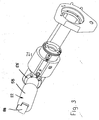
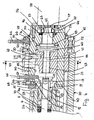
- the Fig. 3 and 10 show an embodiment that differs from the embodiment described above in that the motor 22 is not connected in the longitudinal direction of the release unit 21, but is at right angles to her. For this reason, the motor shaft 47 ( Fig. 10 ) via a bevel gear 83 with the threaded spindle 44 drivingly connected. On the motor shaft 47 sits a bevel gear 84 which meshes with a rotationally fixed on the threaded spindle 44 bevel gear 85.
- the flange plate 55 is in contrast to the previous embodiment not flanged to the end face of the housing 30, but on its lateral surface having a corresponding flattening.
- the front side of the housing 30 of the release unit 21 is closed by a cover 86.
- the rotatably seated on the motor shaft 47 bevel gear 84 is axially supported by a needle bearing 87.
- a connector 88 is provided at the free end of the motor housing 58.
- the embodiment according to the Fig. 3 and 10 is characterized by a short length. It can be used, for example, for vertical spindles on moulders.
- the release unit 21 is the same design as the previous embodiment.
- a lubricating nipple 89 is provided on the receiving flange 52, connect to the lubrication holes 90 to 92. They pass through the receiving flange 52, the housing 30 and the ejection nut 41. In this way, the ejection nut 41 and the threaded spindle 44 can be lubricated.
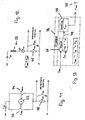
- FIGS. 11, 12 and 13 show a part of the preferred control for the release unit.
- the drive 22 ( FIGS. 11 and 12 ) is operated with a motor current I mot .
- the motor consists in the replacement diagram of an inductance L mot and a resistor R mot , which is variable depending on the engine temperature. In series with the motor, a measuring resistor R mess 95 is connected. This is much smaller dimensioned than the motor resistance R mot , whereby the engine is not significantly affected in its performance.
- a voltage U mess which is a controller 96 is supplied. It contains a comparator 97, in which the voltage U mess is compared with a reference voltage U ref . As soon as the voltage U mess ⁇ the reference voltage U ref , the comparator 97 supplies a signal 98 to a shutdown module 99. It generates a shutdown signal with which the switching element 93 is actuated and shuts off the motor.
- the voltage U mess is proportional to the motor current I mot , which in turn is proportional to the engine torque M mot .
- the maximum possible voltage U mess can be set and thus the switch-off current of the motor. This ensures that the motor is loaded only up to its permissible motor current and motor torque.
- the measuring resistor R mess 95 is substantially smaller than the motor resistance R mot , so that the drive 22 is also protected against overloading.
Landscapes
- Engineering & Computer Science (AREA)
- Mechanical Engineering (AREA)
- Gripping On Spindles (AREA)
- Details Of Spanners, Wrenches, And Screw Drivers And Accessories (AREA)
- Gear Transmission (AREA)
- Milling, Drilling, And Turning Of Wood (AREA)
- Finish Polishing, Edge Sharpening, And Grinding By Specific Grinding Devices (AREA)
Applications Claiming Priority (2)
| Application Number | Priority Date | Filing Date | Title |
|---|---|---|---|
| DE102004011738 | 2004-03-03 | ||
| DE102004011738A DE102004011738B4 (de) | 2004-03-03 | 2004-03-03 | Vorrichtung mit einer Löseeinheit zum Betätigen einer Spannvorrichtung für Werkzeuge |
Publications (3)
| Publication Number | Publication Date |
|---|---|
| EP1570933A2 EP1570933A2 (de) | 2005-09-07 |
| EP1570933A3 EP1570933A3 (de) | 2008-01-23 |
| EP1570933B1 true EP1570933B1 (de) | 2010-03-31 |
Family
ID=34745444
Family Applications (1)
| Application Number | Title | Priority Date | Filing Date |
|---|---|---|---|
| EP05003751A Expired - Lifetime EP1570933B1 (de) | 2004-03-03 | 2005-02-22 | Vorrichtung mit einer Löseeinheit zum Betätigen einer Spannvorrichtung für Werkzeuge |
Country Status (8)
| Country | Link |
|---|---|
| US (1) | US7249919B2 (pt) |
| EP (1) | EP1570933B1 (pt) |
| CN (1) | CN1663741B (pt) |
| AR (1) | AR048156A1 (pt) |
| AT (1) | ATE462520T1 (pt) |
| BR (1) | BRPI0500720A (pt) |
| DE (2) | DE102004011738B4 (pt) |
| TW (1) | TWI275434B (pt) |
Families Citing this family (16)
| Publication number | Priority date | Publication date | Assignee | Title |
|---|---|---|---|---|
| DE10160705A1 (de) * | 2001-12-11 | 2003-06-26 | Paul Mueller Gmbh & Co Kg | Vorrichtung zur Befestigung eines Werkzeugs an einer Welle sowie Maschinenspindel mit einer derartigen Vorrichtung |
| DE102004051031B3 (de) | 2004-10-20 | 2006-04-27 | Ott-Jakob Gmbh & Co. Spanntechnik Kg | Spannvorrichtung |
| JP4846410B2 (ja) * | 2006-03-30 | 2011-12-28 | シチズンホールディングス株式会社 | 主軸頭装置及び工作機械 |
| CN101310902B (zh) * | 2007-05-24 | 2011-01-26 | 鸿准精密模具(昆山)有限公司 | 夹持装置及其使用方法 |
| US8769786B1 (en) * | 2009-03-24 | 2014-07-08 | Honda Motor Co., Ltd. | Trim and flame robot end effector with optional automatic blade change feature |
| KR101157324B1 (ko) * | 2009-12-18 | 2012-06-18 | 한화테크엠주식회사 | 서보모터를 이용한 척킹력 조정방법 |
| DE102010021010A1 (de) * | 2010-03-02 | 2011-09-08 | Grob-Werke Gmbh & Co. Kg | Bearbeitungsmaschine |
| DE102010044783A1 (de) * | 2010-03-02 | 2011-09-08 | Grob-Werke Gmbh & Co. Kg | Bearbeitungsmaschine |
| EP2495059B1 (de) * | 2011-03-01 | 2017-07-19 | Siemens Aktiengesellschaft | Werkzeuglösevorrichtung, Inbetriebnahmeverfahren und Betriebsverfahren |
| DE102011082828A1 (de) * | 2011-09-16 | 2013-03-21 | Zf Friedrichshafen Ag | Schalteinheit mit Spindeltrieb für ein Werkzeugmaschinengetriebe |
| DE102012105759A1 (de) * | 2012-06-29 | 2014-01-02 | Röhm Gmbh | Spannkopf |
| DE102014104285A1 (de) * | 2014-03-27 | 2015-10-01 | Röhm Gmbh | Spannfutter |
| DE102016009431A1 (de) | 2016-07-29 | 2018-02-01 | Michael Weinig Ag | Spanneinrichtung für Werkzeuge |
| KR102360161B1 (ko) * | 2017-05-29 | 2022-02-09 | 현대자동차주식회사 | 스핀들 장치 및 그의 작동방법 |
| CN107234279B (zh) * | 2017-07-28 | 2024-02-02 | 昆山众异特机械工业有限公司 | 一种模具划线装置 |
| CN113001470B (zh) * | 2021-02-14 | 2022-08-30 | 株洲大众机械制造有限责任公司 | 一种便于单人使用的机械加工刀具更换用辅助装置 |
Family Cites Families (14)
| Publication number | Priority date | Publication date | Assignee | Title |
|---|---|---|---|---|
| DE1099309B (de) * | 1955-05-28 | 1961-02-09 | Karl Schmidt Ges Mit Beschraen | Vorrichtung zum Spannen von Werkstuecken, insbesondere bei Mehrspindelautomaten |
| DE1281783B (de) * | 1965-12-02 | 1968-10-31 | Froriep Gmbh Maschf | Verstellvorrichtung fuer die Spannbacken einer Planscheibe od. dgl. |
| US4913605A (en) * | 1984-07-30 | 1990-04-03 | Schwartzman Everett H | Integral spring flexure for use with high speed rotating shafts |
| DE3508231A1 (de) * | 1985-03-08 | 1986-09-11 | Karl Hertel GmbH, 8510 Fürth | Antriebseinheit fuer rotierende werkzeuge |
| FR2588492B1 (fr) * | 1985-10-14 | 1989-05-26 | Aerospatiale | Porte-outil de securite pour machine-outil |
| DE3629453A1 (de) * | 1986-08-29 | 1988-03-10 | Forkardt Paul Gmbh | Elektromechanische vorrichtung zum erzeugen einer axialkraft fuer die betaetigung von spannzeugen |
| US4750850A (en) * | 1987-05-01 | 1988-06-14 | Husted Royce Hill | Collet release mechanism for milling machine |
| US4804301A (en) * | 1988-02-24 | 1989-02-14 | Gte Valenite Corporation | Central drawbar coupling actuating mechanism |
| JP3475401B2 (ja) * | 1999-02-25 | 2003-12-08 | 東芝機械株式会社 | アングルヘッドの工具着脱装置 |
| JP4344442B2 (ja) * | 1999-12-17 | 2009-10-14 | 富士機械製造株式会社 | チャック装置 |
| US6700231B2 (en) * | 2000-01-12 | 2004-03-02 | Mitsubishi Denki Kabushiki Kaisha | Thrust converter, method of controlling the same, and controller for controlling the same |
| DE10101093B4 (de) * | 2001-01-12 | 2009-10-22 | Ortlieb Präzisions-Spannzeuge GmbH + Co. | Spanneinrichtung für Werkzeuge, Werkzeughalter oder dergleichen |
| DE10101095A1 (de) * | 2001-01-12 | 2002-07-25 | Ortlieb Praez S Spannzeuge Gmb | Spanneinrichtung für Werkzeuge, Werkzeughalter oder dergleichen |
| DE10160705A1 (de) * | 2001-12-11 | 2003-06-26 | Paul Mueller Gmbh & Co Kg | Vorrichtung zur Befestigung eines Werkzeugs an einer Welle sowie Maschinenspindel mit einer derartigen Vorrichtung |
-
2004
- 2004-03-03 DE DE102004011738A patent/DE102004011738B4/de not_active Expired - Fee Related
-
2005
- 2005-02-04 TW TW094103511A patent/TWI275434B/zh not_active IP Right Cessation
- 2005-02-16 AR ARP050100548A patent/AR048156A1/es unknown
- 2005-02-22 EP EP05003751A patent/EP1570933B1/de not_active Expired - Lifetime
- 2005-02-22 AT AT05003751T patent/ATE462520T1/de active
- 2005-02-22 DE DE502005009295T patent/DE502005009295D1/de not_active Expired - Lifetime
- 2005-03-02 BR BR0500720-8A patent/BRPI0500720A/pt not_active IP Right Cessation
- 2005-03-02 CN CN2005100528899A patent/CN1663741B/zh not_active Expired - Fee Related
- 2005-03-03 US US10/906,713 patent/US7249919B2/en not_active Expired - Lifetime
Also Published As
| Publication number | Publication date |
|---|---|
| DE102004011738B4 (de) | 2010-01-07 |
| DE102004011738A1 (de) | 2005-09-22 |
| CN1663741B (zh) | 2010-05-05 |
| US7249919B2 (en) | 2007-07-31 |
| DE502005009295D1 (de) | 2010-05-12 |
| TW200536640A (en) | 2005-11-16 |
| US20050196247A1 (en) | 2005-09-08 |
| ATE462520T1 (de) | 2010-04-15 |
| TWI275434B (en) | 2007-03-11 |
| AR048156A1 (es) | 2006-04-05 |
| EP1570933A2 (de) | 2005-09-07 |
| CN1663741A (zh) | 2005-09-07 |
| EP1570933A3 (de) | 2008-01-23 |
| BRPI0500720A (pt) | 2005-11-08 |
Similar Documents
| Publication | Publication Date | Title |
|---|---|---|
| EP1570933B1 (de) | Vorrichtung mit einer Löseeinheit zum Betätigen einer Spannvorrichtung für Werkzeuge | |
| DE4234115A1 (de) | Dosenverschliessmaschine | |
| EP2598271B1 (de) | Hydrodehnspannfutter | |
| CH619629A5 (pt) | ||
| EP0368023A2 (de) | Werkzeugsystem | |
| EP1776202B1 (de) | Fördereinrichtung eines schweissdrahts | |
| DE9016415U1 (de) | Handgeführte Elektrowerkzeugmaschine mit einer Einrichtung zum Einstellen des Drehmoments | |
| EP3403749A1 (de) | Gegenlager für bearbeitungsspindeln von bearbeitungsmaschinen und verfahren zum spannen von gegenlagern und werkzeugen | |
| DE2316605C2 (de) | Vorrichtung zum Spannen und Lösen von einen konischen Schaft aufweisenden, in eine Spindelaufnahme einsetzbaren Werkzeugen | |
| EP0302187A1 (de) | Spanneinrichtung an Drehmaschinen mit einem Spannfutter | |
| EP2616212A2 (de) | Sicherungs-spannvorrichtung | |
| DE2518626A1 (de) | Hydraulische lenkung | |
| EP3658318B1 (de) | Zerspanungswerkzeug mit einer justiereinrichtung | |
| EP4135929B1 (de) | Vorrichtung und verfahren zum anschluss einer kühldüse an eine kühlschmiermittelzuführung | |
| DE8518206U1 (de) | Antriebseinheit für rotierende Schaftwerkzeuge | |
| EP3658321A1 (de) | Zerspanungswerkzeug | |
| EP0798064B1 (de) | Spannvorrichtung für scheibenförmige Werkzeuge | |
| DE2329564B2 (de) | Umsteuereinrichtung für die Umkehr der Drehrichtung eines mit Druckmittel beaufschlagten Antriebsmotors für ein Werkzeug | |
| DE2112016A1 (de) | Hydraulische Vorschubeinrichtung fuer Werkzeugmaschinen | |
| EP3403766A1 (de) | Klemmeinrichtung für wenigstens ein zu klemmendes bauteil | |
| EP2550461A1 (de) | Vorrichtung zum verriegeln eines axial verschiebbaren bauteils einer hydraulischen anlage | |
| DE4445611A1 (de) | Werkzeughalter, insbesondere Schnellwechselfutter | |
| DE3411542C2 (de) | Bearbeitungseinrichtung | |
| EP1153709A2 (de) | Zusatzwerkzeug für eine Fräsmaschine | |
| DE2412850A1 (de) | Einrichtung zum wechselweisen spannen und loesen des werkzeugschaftes an werkzeugmaschinen, insbesondere an bohr- und fraesmaschinen |
Legal Events
| Date | Code | Title | Description |
|---|---|---|---|
| PUAI | Public reference made under article 153(3) epc to a published international application that has entered the european phase |
Free format text: ORIGINAL CODE: 0009012 |
|
| AK | Designated contracting states |
Kind code of ref document: A2 Designated state(s): AT BE BG CH CY CZ DE DK EE ES FI FR GB GR HU IE IS IT LI LT LU MC NL PL PT RO SE SI SK TR |
|
| AX | Request for extension of the european patent |
Extension state: AL BA HR LV MK YU |
|
| PUAL | Search report despatched |
Free format text: ORIGINAL CODE: 0009013 |
|
| AK | Designated contracting states |
Kind code of ref document: A3 Designated state(s): AT BE BG CH CY CZ DE DK EE ES FI FR GB GR HU IE IS IT LI LT LU MC NL PL PT RO SE SI SK TR |
|
| AX | Request for extension of the european patent |
Extension state: AL BA HR LV MK YU |
|
| 17P | Request for examination filed |
Effective date: 20080529 |
|
| 17Q | First examination report despatched |
Effective date: 20080710 |
|
| R17C | First examination report despatched (corrected) |
Effective date: 20080728 |
|
| AKX | Designation fees paid |
Designated state(s): AT BE BG CH CY CZ DE DK EE ES FI FR GB GR HU IE IS IT LI LT LU MC NL PL PT RO SE SI SK TR |
|
| RTI1 | Title (correction) |
Free format text: APPARATUS WITH A RELEASING UNIT FOR THE ACTUATION OF A CLAMPING DEVICE FOR TOOLS |
|
| GRAP | Despatch of communication of intention to grant a patent |
Free format text: ORIGINAL CODE: EPIDOSNIGR1 |
|
| GRAS | Grant fee paid |
Free format text: ORIGINAL CODE: EPIDOSNIGR3 |
|
| GRAA | (expected) grant |
Free format text: ORIGINAL CODE: 0009210 |
|
| AK | Designated contracting states |
Kind code of ref document: B1 Designated state(s): AT BE BG CH CY CZ DE DK EE ES FI FR GB GR HU IE IS IT LI LT LU MC NL PL PT RO SE SI SK TR |
|
| REG | Reference to a national code |
Ref country code: CH Ref legal event code: EP Ref country code: GB Ref legal event code: FG4D Free format text: NOT ENGLISH |
|
| REG | Reference to a national code |
Ref country code: IE Ref legal event code: FG4D |
|
| REF | Corresponds to: |
Ref document number: 502005009295 Country of ref document: DE Date of ref document: 20100512 Kind code of ref document: P |
|
| REG | Reference to a national code |
Ref country code: NL Ref legal event code: VDEP Effective date: 20100331 |
|
| PG25 | Lapsed in a contracting state [announced via postgrant information from national office to epo] |
Ref country code: LT Free format text: LAPSE BECAUSE OF FAILURE TO SUBMIT A TRANSLATION OF THE DESCRIPTION OR TO PAY THE FEE WITHIN THE PRESCRIBED TIME-LIMIT Effective date: 20100331 |
|
| LTIE | Lt: invalidation of european patent or patent extension |
Effective date: 20100331 |
|
| PG25 | Lapsed in a contracting state [announced via postgrant information from national office to epo] |
Ref country code: FI Free format text: LAPSE BECAUSE OF FAILURE TO SUBMIT A TRANSLATION OF THE DESCRIPTION OR TO PAY THE FEE WITHIN THE PRESCRIBED TIME-LIMIT Effective date: 20100331 Ref country code: SI Free format text: LAPSE BECAUSE OF FAILURE TO SUBMIT A TRANSLATION OF THE DESCRIPTION OR TO PAY THE FEE WITHIN THE PRESCRIBED TIME-LIMIT Effective date: 20100331 Ref country code: PL Free format text: LAPSE BECAUSE OF FAILURE TO SUBMIT A TRANSLATION OF THE DESCRIPTION OR TO PAY THE FEE WITHIN THE PRESCRIBED TIME-LIMIT Effective date: 20100331 |
|
| REG | Reference to a national code |
Ref country code: IE Ref legal event code: FD4D |
|
| PG25 | Lapsed in a contracting state [announced via postgrant information from national office to epo] |
Ref country code: ES Free format text: LAPSE BECAUSE OF FAILURE TO SUBMIT A TRANSLATION OF THE DESCRIPTION OR TO PAY THE FEE WITHIN THE PRESCRIBED TIME-LIMIT Effective date: 20100712 Ref country code: EE Free format text: LAPSE BECAUSE OF FAILURE TO SUBMIT A TRANSLATION OF THE DESCRIPTION OR TO PAY THE FEE WITHIN THE PRESCRIBED TIME-LIMIT Effective date: 20100331 Ref country code: CY Free format text: LAPSE BECAUSE OF FAILURE TO SUBMIT A TRANSLATION OF THE DESCRIPTION OR TO PAY THE FEE WITHIN THE PRESCRIBED TIME-LIMIT Effective date: 20100331 Ref country code: SE Free format text: LAPSE BECAUSE OF FAILURE TO SUBMIT A TRANSLATION OF THE DESCRIPTION OR TO PAY THE FEE WITHIN THE PRESCRIBED TIME-LIMIT Effective date: 20100331 Ref country code: NL Free format text: LAPSE BECAUSE OF FAILURE TO SUBMIT A TRANSLATION OF THE DESCRIPTION OR TO PAY THE FEE WITHIN THE PRESCRIBED TIME-LIMIT Effective date: 20100331 Ref country code: RO Free format text: LAPSE BECAUSE OF FAILURE TO SUBMIT A TRANSLATION OF THE DESCRIPTION OR TO PAY THE FEE WITHIN THE PRESCRIBED TIME-LIMIT Effective date: 20100331 |
|
| PG25 | Lapsed in a contracting state [announced via postgrant information from national office to epo] |
Ref country code: SK Free format text: LAPSE BECAUSE OF FAILURE TO SUBMIT A TRANSLATION OF THE DESCRIPTION OR TO PAY THE FEE WITHIN THE PRESCRIBED TIME-LIMIT Effective date: 20100331 Ref country code: CZ Free format text: LAPSE BECAUSE OF FAILURE TO SUBMIT A TRANSLATION OF THE DESCRIPTION OR TO PAY THE FEE WITHIN THE PRESCRIBED TIME-LIMIT Effective date: 20100331 Ref country code: IS Free format text: LAPSE BECAUSE OF FAILURE TO SUBMIT A TRANSLATION OF THE DESCRIPTION OR TO PAY THE FEE WITHIN THE PRESCRIBED TIME-LIMIT Effective date: 20100731 |
|
| PG25 | Lapsed in a contracting state [announced via postgrant information from national office to epo] |
Ref country code: PT Free format text: LAPSE BECAUSE OF FAILURE TO SUBMIT A TRANSLATION OF THE DESCRIPTION OR TO PAY THE FEE WITHIN THE PRESCRIBED TIME-LIMIT Effective date: 20100802 Ref country code: DK Free format text: LAPSE BECAUSE OF FAILURE TO SUBMIT A TRANSLATION OF THE DESCRIPTION OR TO PAY THE FEE WITHIN THE PRESCRIBED TIME-LIMIT Effective date: 20100331 Ref country code: IE Free format text: LAPSE BECAUSE OF FAILURE TO SUBMIT A TRANSLATION OF THE DESCRIPTION OR TO PAY THE FEE WITHIN THE PRESCRIBED TIME-LIMIT Effective date: 20100331 |
|
| PLBE | No opposition filed within time limit |
Free format text: ORIGINAL CODE: 0009261 |
|
| STAA | Information on the status of an ep patent application or granted ep patent |
Free format text: STATUS: NO OPPOSITION FILED WITHIN TIME LIMIT |
|
| 26N | No opposition filed |
Effective date: 20110104 |
|
| BERE | Be: lapsed |
Owner name: MICHAEL WEINIG A.G. Effective date: 20110228 |
|
| PG25 | Lapsed in a contracting state [announced via postgrant information from national office to epo] |
Ref country code: MC Free format text: LAPSE BECAUSE OF NON-PAYMENT OF DUE FEES Effective date: 20110228 |
|
| REG | Reference to a national code |
Ref country code: CH Ref legal event code: PL |
|
| PG25 | Lapsed in a contracting state [announced via postgrant information from national office to epo] |
Ref country code: CH Free format text: LAPSE BECAUSE OF NON-PAYMENT OF DUE FEES Effective date: 20110228 Ref country code: LI Free format text: LAPSE BECAUSE OF NON-PAYMENT OF DUE FEES Effective date: 20110228 |
|
| PG25 | Lapsed in a contracting state [announced via postgrant information from national office to epo] |
Ref country code: BE Free format text: LAPSE BECAUSE OF NON-PAYMENT OF DUE FEES Effective date: 20110228 |
|
| REG | Reference to a national code |
Ref country code: AT Ref legal event code: MM01 Ref document number: 462520 Country of ref document: AT Kind code of ref document: T Effective date: 20110222 |
|
| PG25 | Lapsed in a contracting state [announced via postgrant information from national office to epo] |
Ref country code: AT Free format text: LAPSE BECAUSE OF NON-PAYMENT OF DUE FEES Effective date: 20110222 |
|
| PG25 | Lapsed in a contracting state [announced via postgrant information from national office to epo] |
Ref country code: LU Free format text: LAPSE BECAUSE OF NON-PAYMENT OF DUE FEES Effective date: 20110222 |
|
| PG25 | Lapsed in a contracting state [announced via postgrant information from national office to epo] |
Ref country code: BG Free format text: LAPSE BECAUSE OF FAILURE TO SUBMIT A TRANSLATION OF THE DESCRIPTION OR TO PAY THE FEE WITHIN THE PRESCRIBED TIME-LIMIT Effective date: 20100630 Ref country code: TR Free format text: LAPSE BECAUSE OF FAILURE TO SUBMIT A TRANSLATION OF THE DESCRIPTION OR TO PAY THE FEE WITHIN THE PRESCRIBED TIME-LIMIT Effective date: 20100331 |
|
| PG25 | Lapsed in a contracting state [announced via postgrant information from national office to epo] |
Ref country code: HU Free format text: LAPSE BECAUSE OF FAILURE TO SUBMIT A TRANSLATION OF THE DESCRIPTION OR TO PAY THE FEE WITHIN THE PRESCRIBED TIME-LIMIT Effective date: 20100331 |
|
| PG25 | Lapsed in a contracting state [announced via postgrant information from national office to epo] |
Ref country code: GR Free format text: LAPSE BECAUSE OF FAILURE TO SUBMIT A TRANSLATION OF THE DESCRIPTION OR TO PAY THE FEE WITHIN THE PRESCRIBED TIME-LIMIT Effective date: 20100331 |
|
| REG | Reference to a national code |
Ref country code: FR Ref legal event code: PLFP Year of fee payment: 12 |
|
| REG | Reference to a national code |
Ref country code: FR Ref legal event code: PLFP Year of fee payment: 13 |
|
| REG | Reference to a national code |
Ref country code: FR Ref legal event code: PLFP Year of fee payment: 14 |
|
| PGFP | Annual fee paid to national office [announced via postgrant information from national office to epo] |
Ref country code: IT Payment date: 20200226 Year of fee payment: 16 Ref country code: GB Payment date: 20200212 Year of fee payment: 16 |
|
| PGFP | Annual fee paid to national office [announced via postgrant information from national office to epo] |
Ref country code: FR Payment date: 20200128 Year of fee payment: 16 |
|
| GBPC | Gb: european patent ceased through non-payment of renewal fee |
Effective date: 20210222 |
|
| PG25 | Lapsed in a contracting state [announced via postgrant information from national office to epo] |
Ref country code: GB Free format text: LAPSE BECAUSE OF NON-PAYMENT OF DUE FEES Effective date: 20210222 Ref country code: FR Free format text: LAPSE BECAUSE OF NON-PAYMENT OF DUE FEES Effective date: 20210228 |
|
| PG25 | Lapsed in a contracting state [announced via postgrant information from national office to epo] |
Ref country code: IT Free format text: LAPSE BECAUSE OF NON-PAYMENT OF DUE FEES Effective date: 20210222 |
|
| PGFP | Annual fee paid to national office [announced via postgrant information from national office to epo] |
Ref country code: DE Payment date: 20240426 Year of fee payment: 20 |
|
| REG | Reference to a national code |
Ref country code: DE Ref legal event code: R071 Ref document number: 502005009295 Country of ref document: DE |