EP1571861A2 - Transmission de données concernant l'utilisation du spectre en fonction de la position géographique - Google Patents
Transmission de données concernant l'utilisation du spectre en fonction de la position géographique Download PDFInfo
- Publication number
- EP1571861A2 EP1571861A2 EP05101520A EP05101520A EP1571861A2 EP 1571861 A2 EP1571861 A2 EP 1571861A2 EP 05101520 A EP05101520 A EP 05101520A EP 05101520 A EP05101520 A EP 05101520A EP 1571861 A2 EP1571861 A2 EP 1571861A2
- Authority
- EP
- European Patent Office
- Prior art keywords
- information
- wireless
- geographic location
- accordance
- location
- Prior art date
- Legal status (The legal status is an assumption and is not a legal conclusion. Google has not performed a legal analysis and makes no representation as to the accuracy of the status listed.)
- Withdrawn
Links
Images


Classifications
-
- H—ELECTRICITY
- H04—ELECTRIC COMMUNICATION TECHNIQUE
- H04W—WIRELESS COMMUNICATION NETWORKS
- H04W48/00—Access restriction; Network selection; Access point selection
- H04W48/08—Access restriction or access information delivery, e.g. discovery data delivery
- H04W48/14—Access restriction or access information delivery, e.g. discovery data delivery using user query or user detection
-
- H—ELECTRICITY
- H04—ELECTRIC COMMUNICATION TECHNIQUE
- H04W—WIRELESS COMMUNICATION NETWORKS
- H04W4/00—Services specially adapted for wireless communication networks; Facilities therefor
- H04W4/02—Services making use of location information
- H04W4/029—Location-based management or tracking services
-
- H—ELECTRICITY
- H04—ELECTRIC COMMUNICATION TECHNIQUE
- H04W—WIRELESS COMMUNICATION NETWORKS
- H04W16/00—Network planning, e.g. coverage or traffic planning tools; Network deployment, e.g. resource partitioning or cells structures
- H04W16/02—Resource partitioning among network components, e.g. reuse partitioning
- H04W16/10—Dynamic resource partitioning
-
- H—ELECTRICITY
- H04—ELECTRIC COMMUNICATION TECHNIQUE
- H04W—WIRELESS COMMUNICATION NETWORKS
- H04W16/00—Network planning, e.g. coverage or traffic planning tools; Network deployment, e.g. resource partitioning or cells structures
- H04W16/14—Spectrum sharing arrangements between different networks
-
- H—ELECTRICITY
- H04—ELECTRIC COMMUNICATION TECHNIQUE
- H04W—WIRELESS COMMUNICATION NETWORKS
- H04W4/00—Services specially adapted for wireless communication networks; Facilities therefor
- H04W4/02—Services making use of location information
-
- H—ELECTRICITY
- H04—ELECTRIC COMMUNICATION TECHNIQUE
- H04W—WIRELESS COMMUNICATION NETWORKS
- H04W48/00—Access restriction; Network selection; Access point selection
- H04W48/16—Discovering, processing access restriction or access information
-
- H—ELECTRICITY
- H04—ELECTRIC COMMUNICATION TECHNIQUE
- H04W—WIRELESS COMMUNICATION NETWORKS
- H04W8/00—Network data management
- H04W8/22—Processing or transfer of terminal data, e.g. status or physical capabilities
- H04W8/24—Transfer of terminal data
- H04W8/245—Transfer of terminal data from a network towards a terminal
-
- H—ELECTRICITY
- H04—ELECTRIC COMMUNICATION TECHNIQUE
- H04W—WIRELESS COMMUNICATION NETWORKS
- H04W88/00—Devices specially adapted for wireless communication networks, e.g. terminals, base stations or access point devices
- H04W88/18—Service support devices; Network management devices
Definitions
- This invention relates to methods and systems for disseminating control information to a wireless communications device, for example to coordinate use of limited wireless spectrum resources by a plurality of such devices.
- One approach to exploiting spectrum holes is to use adaptive techniques (e.g. "The exploitation of "spectrum holes” to enhance spectrum efficiency” submitted to the FCC by Motorola in October 2002).
- a device wishing to make 802.11 transmissions listens for signals in a particular frequency band; if no traffic is heard over some period of time, or the device detects the band is already being used for 802.11 communication, then it takes this as implicit permission to use this band itself.
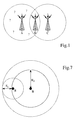
- Such techniques have the advantage of being very distributed, but they also have some obvious disadvantages. For example, consider the situation illustrated in Figure 1, where device A is trying to detect potential spectrum holes. It is outside the range of device C and so will be unaware that this device is transmitting data to device B on a particular frequency band. If A (erroneously) concludes that this frequency is unused and starts transmitting on it, then communications between device B and device A may be disrupted. This is the well-known hidden device or hidden node problem.
- Peer to peer networking techniques can go some way towards alleviating such problems. If adjacent devices exchange their knowledge of potential spectrum holes then a device may be able to build a better picture of the geographic extent of such a hole. If the extent is substantially larger than the transmission range of the devices wishing to use the hole then this would give more confidence that there are no hidden device problems associated with its use. Of course it still gives no guarantee, and bands that are used intermittently may still be misdiagnosed as holes. Furthermore, when an official user does start transmitting on the band there is no easy way to distinguish this use from other, unlicensed users with no more right or priority to use the band than the WiFi devices. Under what circumstances should these devices therefore stop using such a band when other transmissions are detected?
- a method of disseminating control information to a wireless communications device to coordinate use of a wireless spectrum resource in accordance with geographic location of the device comprising:
- the invention makes possible an automatic mechanism for choosing channels based on geographic location.
- automatic constraint of channel usage to within relatively fine-grained geographic areas, use is facilitated of otherwise problematic techniques such as WiFi transmission within buildings in bands normally reserved for other services.
- the invention can be used to ensure that devices only use an appropriate set of frequencies, power levels and modulation standards appropriate to their current location.
- a wireless communications device receives the information selected from the database passively from a communications station that broadcasts the information to devices in its vicinity, the information being selected from the database in accordance with the geographic location of the communications station.
- a frequency server for disseminating control information to coordinate use of a wireless spectrum resource in accordance with geographic location of wireless communications devices comprising:
- communications station for disseminating control information to a wireless communications device to coordinate use of a wireless spectrum resource in accordance with geographic location of the device, comprising:
- a method of controlling operation of a wireless communications device to coordinate use of a wireless spectrum resource in accordance with geographic location of the device comprising:
- a device for providing authenticated location information comprising:
- the invention provides a framework, in one embodiment, for automatically controlling the frequencies, power levels and modulation schemes used by wireless communications devices such as 802.11 access points, laptop computers and personal digitial assistants.
- Some aspects of its operation are comparable to the Internet's Domain Name Service (DNS), described in Request for Comments (RFC) 1034 and RFC 1035 of the Internet Engineering Task Force (IETF), and to the Dynamic Host Configuration Protocol (DHCP) described in RFC 2131, but the invention provides services not contemplated by either of those systems and to that end further includes additional functionality.
- DNS Domain Name Service
- RFC Request for Comments
- IETF Internet Engineering Task Force
- DHCP Dynamic Host Configuration Protocol
- Implementation of the invention involves the establishment by regulatory or similar authorities of "frequency servers", analogous to root domain name servers, providing the following service: given the coordinates of any geographic location within the region for which it holds information, the server determines and supplies details on the frequency bands, power levels, and/or modulation schemes a particular service such as WiFi is permitted to use at the specified location.
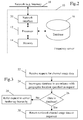
- Figure 2 shows the principal components of a frequency server 10:
- the frequency server 10 may treat the whole region it serves in a uniform way, supplying details of the existing 802.11b channel(s) already authorised for use by the WiFi service for example. But over time the data in the database 16 can be extended with more options for specific areas, down to any desired level of granularity such as individual office blocks. It is envisaged that these extensions would be added on the basis of user demand. Corporate and other large users would be able apply to have their sites surveyed, for a fee, to identify additional channels that may safely be used at their premises. In return they would be able to use a wider range of channels, and hence bandwidth, within the geographic constraints of their site. A hierarchy of frequency servers can be constructed, with root servers containing default settings for the whole region, and local servers providing more specialised extensions and constraints based on local knowledge.
- a request for details of channel usage data for a geographic location may be sent to the frequency server 10 via the Internet, for example in a TCP or UDP message specifying that location.
- the server interrogates the database 16 at step 24 using the specified location as a search key.
- the server determines whether or not the database 16 contains the requested data. If not, for example because the location is outside that server's coverage area, the server refers the request to another frequency server higher up the hierarchy, at step 28. Otherwise, at step 30 the server returns the requested information to the requestor, again via its Internet connection.
- a wireless device wishing to operate within the region needs to be able to determine which channels can be used prior to establishing contact with other wireless devices in its proximity.
- Wireless devices typically obtain a temporary Internet Protocol (IP) address from a DHCP server when they attempt their first communication. Therefore one possibility in principle would be to use an extension to DHCP to distribute channel usage information. If a DHCP server knows its location it can obtain channel usage information pertinent to that location from the frequency server.
- An extension to DHCP could define an option that provides this information to a wireless device when the device is provided with an IP address by a DHCP server.
- one implementation of the invention additionally involves the use of stations for disseminating channel usage information, referred to herein as frequency "beacons”.
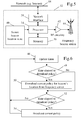
- a beacon in the context of this description, is a transmitter that has a known, reliable geographic location and that can communicate with a frequency server 10, for example via the Internet, as illustrated schematically (and not to scale) in Figure 4.
- Figure 5 shows the major components of a beacon 32.
- the beacon's operation is coordinated by a processor 34 operating in accordance with software program instructions stored in a memory 36, to communicate over the network 18, via a network interface 38, with the frequency server 10.
- the beacon 32 sends the server 10 periodic requests for channel usage data for the beacon's location as specified in a secure store 40 within the beacon.
- the usage data received in response is held in the memory 36 and periodically broadcast via an RF amplifier 42 and antenna 44.
- a beacon may have a Global Positioning System (GPS) receiver built into the secure store 40, to determine its position.
- GPS Global Positioning System
- beacons may be sited where GPS signals are not available, such as inside buildings.
- An alternative approach in such situations is to hardwire the position information into the beacon, in the secure store 40.
- cryptographic signing is used to ensure that any unauthorised attempt to alter the position information can be detected.
- an inspector can certify that the position recorded in the secure store 40 is accurate, and download a digital certificate into the store to authenticate this fact; the store includes a tamperproof mechanism that invalidates the digital certificate if the beacon is moved.
- Figure 6 outlines the procedure implemented by each beacon 32.
- the beacon updates a timer (possibly implemented in software) at step 46 and at step 48 checks whether the time has elapsed to interrogate the associated frequency server 10, at step 50, to determine the current frequency band policy for the beacon's vicinity. Such information is provided with a limited period of validity, just as with DHCP leases, ensuring that beacons cannot cache this information indefmitely.
- the beacon and the frequency server authenticate each other using known authentication protocols to ensure that the information returned by the server is genuine.
- the beacon further checks whether the time has elapsed for a periodic transmission of this information to all wireless devices under its control, at step 54. Thereafter the procedure returns to step 46. All access points and mobile devices within range of the beacon 32 are permitted to use any of the channels identified by the beacon.
- beacons There is a trade-off to be made between number of beacons and the size of the "cell" within which a beacon provides service to wireless devices. If a beacon transmits channel usage information at high power, i.e. its cell size covers a wide area, then there is a high risk of devices within this cell conflicting with other authorised users.
- the number of channels that can be used in this area therefore has to be restricted to the "standard" set, e.g. the basic set of channels authorised for use throughout the relevant regulatory area.
- a small cell size covers a smaller geographic area, and so could permit a wider choice of channels without causing interference to others. But in this case more beacons would need to be deployed.
- the information stored in the frequency server 10 is therefore selected to take account of a beacon's cell size, as well as its location, when determining an appropriate set of channels and other policy data for the beacon to broadcast.
- the area served by a beacon will be a complicated, irregular shape, governed by many factors.
- the range of a beacon, for a given power level is desirably overestimated, and the coverage area is assumed to be circular, with a radius determined by this range.
- a beacon can transmit at varying power levels then logically it can be viewed as a set of beacons, each with its own power level and resulting cell size.
- the beacon may interrogate the server once for each cell size, and then broadcast the respective channel use policy for each power level.
- a device close to the beacon will receive multiple broadcasts, with differing policies. However, there will be a natural ordering between these, and the device can be arranged base its channel use decision on the most liberal policy received.
- Beacon cell size requires more precise definition.
- the "contract" between beacon and frequency server has the following form: any device within the boundary of the beacon's cell, e.g. within a specified distance from the beacon, may be permitted by the beacon to use the specified wireless resources, as long as any signal escaping outside the boundary is guaranteed to be below a specified signal strength threshold.
- the relationship between this boundary, the maximum range of the beacon's signal and the maximum range of a wireless device's signal is shown in Figure 7.
- the beacon B is considered always to transmit at maximum power, and the maximum distance at which this signal can be received is B d .
- a device S at this distance from the beacon B is using one of the channels permitted by the beacon, also at maximum power.
- the maximum distance at which this signal is above the signal strength threshold is S d . Therefore the maximum distance at which a device controlled by the beacon could potentially disrupt other users is B d +S d . This distance is therefore the cell size that must be reported to the frequency server when the beacon B is requesting the current frequency
- the beacon B first advertises the availability of a specific channel at low power, reach those devices within region R 1 . This advertisement allows the channel to be used at power P 1 , with a respective maximal range D 1 . The same channel is then advertised at maximum power (with a range R 2 ), but with permission to use the channel at a power setting P 2 ⁇ P 1 and associated shorter range D 2 . A device receiving multiple transmissions from the beacon B is allowed to use the highest power setting that is specified in the broadcasts it receives. This technique reduces the size of the excess S d of the reported cell size over the beacon range R 2 , whilst allowing devices closer to the beacon B to still operate at full power.
- Client devices such as 802.11 access points and devices are arranged to use the transmissions from the nearest or strongest received signal-strength beacon to determine which band(s) and channel(s) are currently available for use.
- the devices are arranged to use a default set of channels, e.g. the currently specified set of 802.11b channels.
- the information transmitted by a beacon may be digitally signed to authenticate it, to avoid the possibility of a bogus beacon being introduced into the system.
- the communication mechanism and protocol between client device and beacon is such that a relay device cannot be used to extend the service range of the beacon without being detected.
- One strategy is to have a challenge/response exchange that has to be completed within a limited time window that would be exceeded by signal propagation delays if the service range were being artificially extended. This approach does not completely prevent a relay being constructed, but likely could prevent this being accomplished without specialised hardware that is expensive and/or difficult to procure.
- a beacon's digital certificate gives a guarantee of the beacon's location. If the client device can be known with reasonable certainty to be within a specified distance from the beacon then the location service can have other uses such as increased access control on connections to a corporate network.
- the existing process used in 802.11 protocols for establishing communication between an access point and a user mobile device needs changing to make use of the frequency server and beacon facilities.
- Access points can still broadcast beacon frames on the standard 802.11 channels, and this mechanism can be used to establish initial contact between an access point and a mobile device.
- both devices will have received from the frequency beacon advertisement(s) a set of channels and power levels they are permitted to use. This information may not be identical for both devices for a variety of reasons. If the devices S and AP are at different distances from a beacon B 1 , as illustrated in Figure 9, then the device further away may have not received some of the advertisements. The two devices may even be serviced by different beacons B 1 and B 2 , for example where cells overlap ( Figure 10).
- a negotiation phase (similar to that proposed for adjacent access points for example) needs to take place to determine an appropriate channel and associated power level that conform to the permissions received by each device.
- a device S near the edge of the cell may only be able to use a channel at low power (as described above with reference to Figure 7), whereas the access point AP may be allowed to use the channel at a higher power level if it is nearer the beacon. This might result in the access point AP being able to contact the device S on this channel, but the reverse direction might fail owing to the lower transmission power allowed for the device S.
- Different channels may have different power constraints, depending on what else uses the band, and so in such a case another channel would be chosen, for one or both directions.
- beacons The situation where WiFi devices are used outside the range of a beacon also needs to be addressed.
- the standard channels can be considered for use in such cases, but as discussed above these channels depend on the country or region in which the device is being used.
- Another approach is to use a hierarchy of beacons.
- One beacon covers the whole region (e.g. a country), broadcasting the standard channels for that region.
- More localised beacons then broadcast the more location-specific constraints for those areas where there are enough expected users to justify the associated complexity and cost.
- the data rates required for the beacon transmissions are fairly minimal, and the access points and mobile devices only need to be able to receive (not transmit) on these bands. It is therefore envisaged to be relatively straightforward to identify a small set of bands to use for such transmissions that can cover the entire world.
- Wireless devices sometimes incorporate mechanisms to vary their transmitter power depending on the estimated range to the receiver, or the observed error rate. Such mechanisms are applied for increased spectrum usage efficiency and longer battery life. These mechanisms would be unaffected by implementation of the invention other than incorporation of the requirement to observe the power limits advertised by the beacons.
- the wireless device's power control mechanism may suggest using a power level that is prohibited by the channel usage policy for the device's current geographic location. In such a case the device's control functionality should change operation to a different channel for which the power usage policy is consistent with the power control requirement.
- Mobility is always an issue in wireless networks.
- the device should cease using channels identified by that beacon. If the interval between beacon broadcasts is too long relative to the speed of the mobile device, the device may not cease using affected channels quickly enough.
- the boundary between cells includes a "guard band", providing a no man's land between beacons with potentially conflicting channel use. If beacons transmit channel usage information at a rate of the order of once a second, then a user on foot will not travel far between transmissions and the guard band can be quite small.
- a handover between access points is more complex than in existing systems, in order to negotiate an appropriate channel for the mobile device to use with the new access point. But this complexity will be encountered anyway when access points using multiple channels are implemented, so the additional overhead is minor.
- the invention as described above would work reliably for a "high-velocity" mobile device such as a car.
- beacons may be contemplated of simply advertising wide ranges of spectrum for use. However this raises a number of complex usage issues so it is safer to arrange the beacons to advertise specific channels rather than large bands.
- Signal bandwidth and adjacent channel power (ACP) considerations can be taken into account when additional channels are nominated for use.
- the invention does require more infrastructure than an autonomous system that just listens for unused frequency bands. However, it offsets this by providing a number of advantages. Depending on the range of beacons, and the sophistication of the frequency servers, the invention allows a very fine-grained control over frequency usage as a function both of geography and time. For example, frequencies allocated for fire brigade use within a building could be made available to other users in normal circumstances, but this availability would be disabled when a fire alarm is activated.
- beacons being able to download new firmware to a mobile wireless device, e.g. if a particular country uses a modulation scheme not initially installed in that device, assuming the use of a software-defined radio such as that being developed by SiRiFIC Wireless Corporation.
- Commissioning a beacon need not be a time-consuming process.
- standard wireless channel profiles can be predefined for common situations, such as an internet café in a high street setting. In many cases this avoids the need for an expensive site survey and may be sufficient if all that is required is access to a small set of additional channels at low power.
Landscapes
- Engineering & Computer Science (AREA)
- Computer Networks & Wireless Communication (AREA)
- Signal Processing (AREA)
- Computer Security & Cryptography (AREA)
- Mobile Radio Communication Systems (AREA)
Applications Claiming Priority (2)
| Application Number | Priority Date | Filing Date | Title |
|---|---|---|---|
| GB0404625A GB2411793A (en) | 2004-03-02 | 2004-03-02 | Disseminating control information to a wireless communications device |
| GB0404625 | 2004-03-02 |
Publications (2)
| Publication Number | Publication Date |
|---|---|
| EP1571861A2 true EP1571861A2 (fr) | 2005-09-07 |
| EP1571861A3 EP1571861A3 (fr) | 2008-09-03 |
Family
ID=32088537
Family Applications (1)
| Application Number | Title | Priority Date | Filing Date |
|---|---|---|---|
| EP05101520A Withdrawn EP1571861A3 (fr) | 2004-03-02 | 2005-02-28 | Transmission de données concernant l'utilisation du spectre en fonction de la position géographique |
Country Status (4)
| Country | Link |
|---|---|
| US (1) | US20050197118A1 (fr) |
| EP (1) | EP1571861A3 (fr) |
| CN (1) | CN1665333A (fr) |
| GB (1) | GB2411793A (fr) |
Cited By (11)
| Publication number | Priority date | Publication date | Assignee | Title |
|---|---|---|---|---|
| WO2007056080A1 (fr) * | 2005-11-04 | 2007-05-18 | Thomson Licensing | Appareil et procede permettant de detecter un signal atsc dans un rapport signal sur bruit bas |
| WO2008140471A1 (fr) | 2006-12-29 | 2008-11-20 | Shared Spectrum Company | Procédé et dispositif de commande de radio selon une politique |
| WO2010008409A1 (fr) * | 2008-07-15 | 2010-01-21 | Sony Ericsson Mobile Communications Ab | Procédés et appareil de fourniture d'informations de services à l'aide d'une station de base sans fil femtocellulaire |
| CN101902285A (zh) * | 2009-05-29 | 2010-12-01 | 索尼公司 | 通信设备、通信控制方法和程序 |
| FR2947690A1 (fr) * | 2009-07-02 | 2011-01-07 | Frederic Jean Pujol | Systeme de gestion d'autorisations geographiques pour terminaux sans licence operant dans les bandes vhf et uhf |
| EP2291047A1 (fr) * | 2009-07-28 | 2011-03-02 | Fujitsu Limited | Appareil de communication mobile, procédé de communication et système de communication |
| WO2011089305A1 (fr) * | 2010-01-19 | 2011-07-28 | Nokia Corporation | Identification d'appareil dans un réseautage de coexistence |
| EP2327245A4 (fr) * | 2008-08-22 | 2017-05-17 | Telecom Ventures, LLC | Procédé et système permettant l utilisation de spectre radio blanc à l aide d un canal de signalisation hors bande |
| EP2534771A4 (fr) * | 2010-02-10 | 2017-08-23 | Microsoft Technology Licensing, LLC | Accès à une base de données distribuée pour accès au spectre |
| US9882995B2 (en) | 2012-06-25 | 2018-01-30 | Sonos, Inc. | Systems, methods, apparatus, and articles of manufacture to provide automatic wireless configuration |
| US10104555B2 (en) | 2007-08-15 | 2018-10-16 | Shared Spectrum Company | Systems and methods for a cognitive radio having adaptable characteristics |
Families Citing this family (28)
| Publication number | Priority date | Publication date | Assignee | Title |
|---|---|---|---|---|
| US8700902B2 (en) * | 2006-02-13 | 2014-04-15 | At&T Intellectual Property I, L.P. | Methods and apparatus to certify digital signatures |
| JP2009538025A (ja) | 2006-05-18 | 2009-10-29 | コーニンクレッカ フィリップス エレクトロニクス エヌ ヴィ | Rfスペクトルにおける一時的に未使用の帯域幅を検出するシステム及び方法 |
| US8019018B2 (en) | 2006-10-12 | 2011-09-13 | Powerwave Cognition, Inc. | Determining a mode to transmit data |
| US8155127B2 (en) * | 2006-11-10 | 2012-04-10 | Powerwave Cognition, Inc. | Autonomous dynamic spectrum access |
| US8718555B2 (en) * | 2006-11-10 | 2014-05-06 | Powerwave Cognition, Inc. | Method and system for using selected bearer channels |
| US8208873B2 (en) * | 2006-11-10 | 2012-06-26 | Powerwave Cognition, Inc. | Method and apparatus for adjusting waveform parameters for an adaptive air interface waveform |
| US20080112428A1 (en) * | 2006-11-10 | 2008-05-15 | Seidel Scott Y | Scheduling for autonomous dynamic spectrum access systems |
| US8014783B2 (en) * | 2006-11-10 | 2011-09-06 | Powerwave Cognition, Inc. | Bearer selection and negotiation in autonomous dynamic spectrum access systems |
| US7787426B2 (en) * | 2006-11-10 | 2010-08-31 | Powerwave Cognition, Inc. | Adaptive control channel initialization operations for autonomous dynamic spectrum access systems |
| US20090061885A1 (en) * | 2007-08-27 | 2009-03-05 | Motorola, Inc. | System and method for contagious virtual carrier sense |
| JP2009253565A (ja) * | 2008-04-04 | 2009-10-29 | Hitachi Ltd | 携帯端末装置および携帯端末装置における無線通信方式の管理方法 |
| JP4666048B2 (ja) * | 2008-10-10 | 2011-04-06 | ソニー株式会社 | 無線通信装置、無線通信方法およびプログラム |
| JP5338682B2 (ja) * | 2009-01-20 | 2013-11-13 | ソニー株式会社 | 通信装置、プログラム、及び通信制御方法 |
| US9602971B2 (en) * | 2010-04-14 | 2017-03-21 | Nokia Technologies Oy | Controlling dynamically-changing traffic load of whitespace devices for database access |
| US9408187B2 (en) * | 2010-08-18 | 2016-08-02 | Nokia Technologies Oy | Method and apparatus for wireless networks |
| US8379528B1 (en) | 2010-10-15 | 2013-02-19 | Sprint Communications Company L.P. | Transfer of messages to user devices of a wireless local area network access point |
| US8619674B1 (en) | 2010-11-30 | 2013-12-31 | Sprint Spectrum L.P. | Delivery of wireless access point information |
| US8472952B1 (en) * | 2010-11-30 | 2013-06-25 | Sprint Spectrum L.P. | Discovering a frequency of a wireless access point |
| US8687616B1 (en) | 2011-07-14 | 2014-04-01 | Sprint Communications Company L.P. | Wireless wide area network characteristics indicated over a wireless local area network |
| US9241330B2 (en) | 2012-04-26 | 2016-01-19 | Industrial Technology Research Institute | Resource management method and apparatuses for device to device communications |
| US20140105037A1 (en) * | 2012-10-15 | 2014-04-17 | Natarajan Manthiramoorthy | Determining Transmission Parameters for Transmitting Beacon Framers |
| US20140323086A1 (en) * | 2013-04-29 | 2014-10-30 | Hewlett-Packard Development Company, L.P. | Management of wireless channel use |
| US9959106B2 (en) | 2013-11-14 | 2018-05-01 | International Business Machines Corporation | Sharing of portable initialized objects between computing platforms |
| JP6297722B2 (ja) * | 2014-06-13 | 2018-03-20 | フィリップス ライティング ホールディング ビー ヴィ | 無線ノードのネットワークに基づく位置特定 |
| US12554686B2 (en) * | 2015-03-26 | 2026-02-17 | Invisible Holdings, Llc | Social identity of objects |
| US10621598B1 (en) * | 2015-04-22 | 2020-04-14 | Richard Greenwald | Methods and systems for facilitating interactions |
| WO2017044826A1 (fr) * | 2015-09-11 | 2017-03-16 | Spectrum Bridge, Inc. | Système et procédé pour une gestion de partage de spectre à l'aide d'une exécution de politique de spectre dynamique |
| CN113661479B (zh) * | 2019-04-17 | 2024-09-17 | 索尼集团公司 | 移动边缘计算服务器、控制方法和处理电力状态的方法 |
Family Cites Families (17)
| Publication number | Priority date | Publication date | Assignee | Title |
|---|---|---|---|---|
| KR880700603A (ko) * | 1985-08-08 | 1988-03-15 | 원본미기재 | 전국 무선 페이징 시스템의 주사용 수신기 |
| IL93444A (en) * | 1989-04-27 | 1994-05-30 | Motorola Inc | Method and unit for communication with communication systems with different operating modes |
| US6484029B2 (en) * | 1998-10-13 | 2002-11-19 | Symbol Technologies, Inc. | Apparatus and methods for adapting mobile unit to wireless LAN |
| US5548809A (en) * | 1992-07-15 | 1996-08-20 | Southwestern Bell Technology Resources, Inc. | Spectrum sharing communications system and system for monitoring available spectrum |
| US5761621A (en) * | 1993-12-15 | 1998-06-02 | Spectrum Information Technologies, Inc. | Apparatus and methods for networking omni-modal radio devices |
| USRE38787E1 (en) * | 1993-12-15 | 2005-08-30 | Mlr, Llc | Apparatus and methods for networking omni-modal radio devices |
| JPH09190236A (ja) * | 1996-01-10 | 1997-07-22 | Canon Inc | 情報処理方法及び装置及びシステム |
| JP2000197118A (ja) * | 1998-12-24 | 2000-07-14 | Toshiba Corp | 無線通信装置及び無線通信装置の仕様設定方法 |
| US6184829B1 (en) * | 1999-01-08 | 2001-02-06 | Trueposition, Inc. | Calibration for wireless location system |
| US6516195B1 (en) * | 1999-05-14 | 2003-02-04 | Ericsson Inc. | Method and system for optimizing a telecommunications utilizing positioning information in network recording programs |
| FR2803162B1 (fr) * | 1999-12-22 | 2004-07-16 | Sagem | Telephone mobile a comportement geographique variable |
| CA2327160A1 (fr) * | 2000-01-12 | 2001-07-12 | Lucent Technologies Inc. | Acheminement dynamique de communications sans fil |
| JP2002152803A (ja) * | 2000-11-10 | 2002-05-24 | Ntt Docomo Inc | 移動通信システム、移動通信システムにおける移動局の位置登録方法およびリソース制御方法、並びに記録媒体 |
| US6885860B2 (en) * | 2001-01-19 | 2005-04-26 | Microsoft Corporation | Information management and processing in a wireless network |
| SE0104159L (sv) * | 2001-12-11 | 2002-10-29 | Telia Ab | Metod och system för positionsbaserat kopieringsskydd |
| US20030118015A1 (en) * | 2001-12-20 | 2003-06-26 | Magnus Gunnarsson | Location based notification of wlan availability via wireless communication network |
| JP4161028B2 (ja) * | 2002-03-06 | 2008-10-08 | 株式会社日立国際電気 | マルチサービス無線通信システム |
-
2004
- 2004-03-02 GB GB0404625A patent/GB2411793A/en not_active Withdrawn
-
2005
- 2005-02-03 US US11/049,804 patent/US20050197118A1/en not_active Abandoned
- 2005-02-28 EP EP05101520A patent/EP1571861A3/fr not_active Withdrawn
- 2005-03-02 CN CN2005100514186A patent/CN1665333A/zh active Pending
Cited By (22)
| Publication number | Priority date | Publication date | Assignee | Title |
|---|---|---|---|---|
| WO2007056080A1 (fr) * | 2005-11-04 | 2007-05-18 | Thomson Licensing | Appareil et procede permettant de detecter un signal atsc dans un rapport signal sur bruit bas |
| KR101375571B1 (ko) * | 2005-11-04 | 2014-03-18 | 톰슨 라이센싱 | 낮은 신호대 잡음비의 atsc 신호를 감지하기 위한 장치및 방법 |
| EP2115918A4 (fr) * | 2006-12-29 | 2013-11-27 | Shared Spectrum Co | Procédé et dispositif de commande de radio selon une politique |
| WO2008140471A1 (fr) | 2006-12-29 | 2008-11-20 | Shared Spectrum Company | Procédé et dispositif de commande de radio selon une politique |
| US10484927B2 (en) | 2006-12-29 | 2019-11-19 | Shared Spectrum Company | Method and device for policy-based control of radio |
| US8997170B2 (en) | 2006-12-29 | 2015-03-31 | Shared Spectrum Company | Method and device for policy-based control of radio |
| US10104555B2 (en) | 2007-08-15 | 2018-10-16 | Shared Spectrum Company | Systems and methods for a cognitive radio having adaptable characteristics |
| WO2010008409A1 (fr) * | 2008-07-15 | 2010-01-21 | Sony Ericsson Mobile Communications Ab | Procédés et appareil de fourniture d'informations de services à l'aide d'une station de base sans fil femtocellulaire |
| EP2327245A4 (fr) * | 2008-08-22 | 2017-05-17 | Telecom Ventures, LLC | Procédé et système permettant l utilisation de spectre radio blanc à l aide d un canal de signalisation hors bande |
| EP2259615A1 (fr) * | 2009-05-29 | 2010-12-08 | Sony Corporation | Dispositif de communication, procédé de commande communication et programme |
| CN101902285B (zh) * | 2009-05-29 | 2013-11-27 | 索尼公司 | 通信设备和通信控制方法 |
| US8447861B2 (en) | 2009-05-29 | 2013-05-21 | Sony Corporation | Communication device, communication control method and program |
| EP3154289A1 (fr) * | 2009-05-29 | 2017-04-12 | Sony Corporation | Dispositif de communication, procédé de commande de communication et programme |
| CN101902285A (zh) * | 2009-05-29 | 2010-12-01 | 索尼公司 | 通信设备、通信控制方法和程序 |
| FR2947690A1 (fr) * | 2009-07-02 | 2011-01-07 | Frederic Jean Pujol | Systeme de gestion d'autorisations geographiques pour terminaux sans licence operant dans les bandes vhf et uhf |
| US8428078B2 (en) | 2009-07-28 | 2013-04-23 | Fujitsu Limited | Communication system including correlation information correlating area and transmission resource |
| EP2291047A1 (fr) * | 2009-07-28 | 2011-03-02 | Fujitsu Limited | Appareil de communication mobile, procédé de communication et système de communication |
| WO2011089305A1 (fr) * | 2010-01-19 | 2011-07-28 | Nokia Corporation | Identification d'appareil dans un réseautage de coexistence |
| EP2534771A4 (fr) * | 2010-02-10 | 2017-08-23 | Microsoft Technology Licensing, LLC | Accès à une base de données distribuée pour accès au spectre |
| EP2865204B1 (fr) * | 2012-06-25 | 2018-03-07 | Sonos, Inc. | Systèmes, procédés, appareil et produits manufacturés destinés à la configuration sans fil automatique |
| US9882995B2 (en) | 2012-06-25 | 2018-01-30 | Sonos, Inc. | Systems, methods, apparatus, and articles of manufacture to provide automatic wireless configuration |
| US10862981B2 (en) | 2012-06-25 | 2020-12-08 | Sonos, Inc. | Systems, methods, apparatus, and articles of manufacture to provide automatic wireless configuration |
Also Published As
| Publication number | Publication date |
|---|---|
| GB2411793A (en) | 2005-09-07 |
| EP1571861A3 (fr) | 2008-09-03 |
| CN1665333A (zh) | 2005-09-07 |
| GB0404625D0 (en) | 2004-04-07 |
| US20050197118A1 (en) | 2005-09-08 |
Similar Documents
| Publication | Publication Date | Title |
|---|---|---|
| EP1571861A2 (fr) | Transmission de données concernant l'utilisation du spectre en fonction de la position géographique | |
| US11051350B2 (en) | Wireless internet system and method | |
| US20220329979A1 (en) | Automated frequency coordination and device location awareness | |
| JP5450588B2 (ja) | 電力効果的小型基地局走査及び取得 | |
| US8792414B2 (en) | Coverage enhancement using dynamic antennas | |
| US9204376B2 (en) | Profile based passive network switching | |
| US8165577B2 (en) | Pilot signal transmission management | |
| US20140031028A1 (en) | Proximity service discovery using a licensed frequency spectrum | |
| US9445353B2 (en) | Presence platform for passive radio access network-to-radio access network device transition | |
| US9374683B2 (en) | Method and apparatus for device to device multicast communication in cellular mobile systems | |
| KR102123469B1 (ko) | 무선통신 시스템에서 어플리케이션 인지 QoS 차별화된 단말 대 단말 간 디스커버리 방법 및 장치 | |
| US20120008604A1 (en) | Enablement for reallocated bandwidth environments | |
| CA2779832A1 (fr) | Procede de fonctionnement de station et appareil dans un blanc televisuel | |
| CN103327571A (zh) | 在共存无线通信系统中对移动设备的高效频率分配 | |
| EP2850883B1 (fr) | Procédé et dispositif concernant la connexion à un point d'accès sans fil | |
| EP2918112B1 (fr) | Distribution de contenu dans une sous-cellule dans un système de télécommunications | |
| GB2443865A (en) | Interference control between local and network base stations | |
| MITCHELL | Frequency Servers | |
| US20250008580A1 (en) | Wireless Internet System and Method | |
| CA3137833C (fr) | Coordination de frequences automatisee et connaissance d'emplacement de dispositif | |
| WO2025176588A1 (fr) | Procédé, appareil et système de gestion d'une connexion de communication dans un réseau sans fil | |
| CN121420596A (zh) | 用于无线网络中频谱共享的装置和方法 | |
| CN119522622A (zh) | 无线通信的方法、终端设备及网络设备 | |
| EP1921879A1 (fr) | Fonctionnement de station de base | |
| HK1153603A (en) | Efficient frequency assignment for mobile devices in coexisting wireless communication systems |
Legal Events
| Date | Code | Title | Description |
|---|---|---|---|
| PUAI | Public reference made under article 153(3) epc to a published international application that has entered the european phase |
Free format text: ORIGINAL CODE: 0009012 |
|
| AK | Designated contracting states |
Kind code of ref document: A2 Designated state(s): AT BE BG CH CY CZ DE DK EE ES FI FR GB GR HU IE IS IT LI LT LU MC NL PL PT RO SE SI SK TR |
|
| AX | Request for extension of the european patent |
Extension state: AL BA HR LV MK YU |
|
| RAP1 | Party data changed (applicant data changed or rights of an application transferred) |
Owner name: AGILENT TECHNOLOGIES, INC. |
|
| PUAL | Search report despatched |
Free format text: ORIGINAL CODE: 0009013 |
|
| AK | Designated contracting states |
Kind code of ref document: A3 Designated state(s): AT BE BG CH CY CZ DE DK EE ES FI FR GB GR HU IE IS IT LI LT LU MC NL PL PT RO SE SI SK TR |
|
| AX | Request for extension of the european patent |
Extension state: AL BA HR LV MK YU |
|
| STAA | Information on the status of an ep patent application or granted ep patent |
Free format text: STATUS: THE APPLICATION IS DEEMED TO BE WITHDRAWN |
|
| 18D | Application deemed to be withdrawn |
Effective date: 20080902 |