EP1572025B1 - Dispositif implantable a mobilite libre dans une cavite corporelle - Google Patents
Dispositif implantable a mobilite libre dans une cavite corporelle Download PDFInfo
- Publication number
- EP1572025B1 EP1572025B1 EP03758644A EP03758644A EP1572025B1 EP 1572025 B1 EP1572025 B1 EP 1572025B1 EP 03758644 A EP03758644 A EP 03758644A EP 03758644 A EP03758644 A EP 03758644A EP 1572025 B1 EP1572025 B1 EP 1572025B1
- Authority
- EP
- European Patent Office
- Prior art keywords
- body cavity
- balloon
- insert
- bladder
- receiver
- Prior art date
- Legal status (The legal status is an assumption and is not a legal conclusion. Google has not performed a legal analysis and makes no representation as to the accuracy of the status listed.)
- Expired - Lifetime
Links
Images




Classifications
-
- A—HUMAN NECESSITIES
- A61—MEDICAL OR VETERINARY SCIENCE; HYGIENE
- A61B—DIAGNOSIS; SURGERY; IDENTIFICATION
- A61B5/00—Measuring for diagnostic purposes; Identification of persons
- A61B5/41—Detecting, measuring or recording for evaluating the immune or lymphatic systems
- A61B5/412—Detecting or monitoring sepsis
-
- A—HUMAN NECESSITIES
- A61—MEDICAL OR VETERINARY SCIENCE; HYGIENE
- A61B—DIAGNOSIS; SURGERY; IDENTIFICATION
- A61B1/00—Instruments for performing medical examinations of the interior of cavities or tubes of the body by visual or photographical inspection, e.g. endoscopes; Illuminating arrangements therefor
- A61B1/00147—Holding or positioning arrangements
- A61B1/00148—Holding or positioning arrangements using anchoring means
-
- A—HUMAN NECESSITIES
- A61—MEDICAL OR VETERINARY SCIENCE; HYGIENE
- A61B—DIAGNOSIS; SURGERY; IDENTIFICATION
- A61B5/00—Measuring for diagnostic purposes; Identification of persons
- A61B5/20—Measuring for diagnostic purposes; Identification of persons for measuring urological functions restricted to the evaluation of the urinary system
- A61B5/202—Assessing bladder functions, e.g. incontinence assessment
- A61B5/205—Determining bladder or urethral pressure
-
- A—HUMAN NECESSITIES
- A61—MEDICAL OR VETERINARY SCIENCE; HYGIENE
- A61B—DIAGNOSIS; SURGERY; IDENTIFICATION
- A61B5/00—Measuring for diagnostic purposes; Identification of persons
- A61B5/48—Other medical applications
- A61B5/4836—Diagnosis combined with treatment in closed-loop systems or methods
- A61B5/4839—Diagnosis combined with treatment in closed-loop systems or methods combined with drug delivery
-
- A—HUMAN NECESSITIES
- A61—MEDICAL OR VETERINARY SCIENCE; HYGIENE
- A61F—FILTERS IMPLANTABLE INTO BLOOD VESSELS; PROSTHESES; DEVICES PROVIDING PATENCY TO, OR PREVENTING COLLAPSING OF, TUBULAR STRUCTURES OF THE BODY, e.g. STENTS; ORTHOPAEDIC, NURSING OR CONTRACEPTIVE DEVICES; FOMENTATION; TREATMENT OR PROTECTION OF EYES OR EARS; BANDAGES, DRESSINGS OR ABSORBENT PADS; FIRST-AID KITS
- A61F2/00—Filters implantable into blood vessels; Prostheses, i.e. artificial substitutes or replacements for parts of the body; Appliances for connecting them with the body; Devices providing patency to, or preventing collapsing of, tubular structures of the body, e.g. stents
- A61F2/0004—Closure means for urethra or rectum, i.e. anti-incontinence devices or support slings against pelvic prolapse
- A61F2/0022—Closure means for urethra or rectum, i.e. anti-incontinence devices or support slings against pelvic prolapse placed deep in the body opening
- A61F2/0027—Closure means for urethra or rectum, i.e. anti-incontinence devices or support slings against pelvic prolapse placed deep in the body opening inflatable
-
- A—HUMAN NECESSITIES
- A61—MEDICAL OR VETERINARY SCIENCE; HYGIENE
- A61M—DEVICES FOR INTRODUCING MEDIA INTO, OR ONTO, THE BODY; DEVICES FOR TRANSDUCING BODY MEDIA OR FOR TAKING MEDIA FROM THE BODY; DEVICES FOR PRODUCING OR ENDING SLEEP OR STUPOR
- A61M29/00—Dilators with or without means for introducing media, e.g. remedies
- A61M29/02—Dilators made of swellable material
-
- A—HUMAN NECESSITIES
- A61—MEDICAL OR VETERINARY SCIENCE; HYGIENE
- A61M—DEVICES FOR INTRODUCING MEDIA INTO, OR ONTO, THE BODY; DEVICES FOR TRANSDUCING BODY MEDIA OR FOR TAKING MEDIA FROM THE BODY; DEVICES FOR PRODUCING OR ENDING SLEEP OR STUPOR
- A61M31/00—Devices for introducing or retaining media, e.g. remedies, in cavities of the body
-
- A—HUMAN NECESSITIES
- A61—MEDICAL OR VETERINARY SCIENCE; HYGIENE
- A61B—DIAGNOSIS; SURGERY; IDENTIFICATION
- A61B1/00—Instruments for performing medical examinations of the interior of cavities or tubes of the body by visual or photographical inspection, e.g. endoscopes; Illuminating arrangements therefor
- A61B1/04—Instruments for performing medical examinations of the interior of cavities or tubes of the body by visual or photographical inspection, e.g. endoscopes; Illuminating arrangements therefor combined with photographic or television appliances
- A61B1/041—Capsule endoscopes for imaging
-
- A—HUMAN NECESSITIES
- A61—MEDICAL OR VETERINARY SCIENCE; HYGIENE
- A61B—DIAGNOSIS; SURGERY; IDENTIFICATION
- A61B5/00—Measuring for diagnostic purposes; Identification of persons
- A61B5/03—Measuring fluid pressure within the body other than blood pressure, e.g. cerebral pressure ; Measuring pressure in body tissues or organs
- A61B5/036—Measuring fluid pressure within the body other than blood pressure, e.g. cerebral pressure ; Measuring pressure in body tissues or organs by means introduced into body tracts
-
- A—HUMAN NECESSITIES
- A61—MEDICAL OR VETERINARY SCIENCE; HYGIENE
- A61F—FILTERS IMPLANTABLE INTO BLOOD VESSELS; PROSTHESES; DEVICES PROVIDING PATENCY TO, OR PREVENTING COLLAPSING OF, TUBULAR STRUCTURES OF THE BODY, e.g. STENTS; ORTHOPAEDIC, NURSING OR CONTRACEPTIVE DEVICES; FOMENTATION; TREATMENT OR PROTECTION OF EYES OR EARS; BANDAGES, DRESSINGS OR ABSORBENT PADS; FIRST-AID KITS
- A61F2210/00—Particular material properties of prostheses classified in groups A61F2/00 - A61F2/26 or A61F2/82 or A61F9/00 or A61F11/00 or subgroups thereof
- A61F2210/009—Particular material properties of prostheses classified in groups A61F2/00 - A61F2/26 or A61F2/82 or A61F9/00 or A61F11/00 or subgroups thereof magnetic
Definitions
- the invention is in the field of implantable medical devices.
- Urinary incontinence mostly affects women (approximately 10 million in the U.S.A. alone) primarily after childbirth or due to old age. In men, urinary incontinence often occurs as a complication of surgery or old age (approximately 3 million in the U.S.A.).
- Incontinence has serious economic, health, social and psychological consequences. Its estimated cost to the health system in the United States in 1993 was US $16 billion. It leads to chronic and severe skin irritation in the genital area, an increase in urinary infections and urosepsis. Fear of incontinence and odors in public cause incontinent people to severely restrict their social activities. The impact on the mental health of the affected people may be even more devastating than the social and health consequences. They suffer severe embarrassment, loss of self-esteem, depression and anxiety.
- Urinary incontinence can be divided into 4 groups:
- treatment of incontinence should provide permanent dryness and is easy to perform.
- Surgical treatments are based on restoring the anatomical changes causing the incontinence. Although in the short-term most surgical procedures restore continence, the long-term prognosis is usually unsatisfactory. Moreover, surgery entails morbidity and high expenses.
- Conservative/behavioral treatments are based on pelvic floor muscle exercises, bladder training, biofeedback, vaginal cones, low-frequency electrostimulation of pelvic floor muscles, intravaginal bladder neck support pessaries, urethral meatus suction cups and intraurethral devices. Conservative treatments are time consuming and require the patients' understanding, cooperation and persistence.
- a flexible rod having a 14 Ch. (approximately 4.5 mm) diameter and a length adjusted to fit the length of the patient's urethra.
- the rod has an inflatable balloon on its bladder end and a flange at other end. After insertion of the device, the balloon is inflated in the bladder. The balloon and the flange maintain the device in its proper position within the urethra. The balloon and rod form a mechanical barrier to retain the urine within the bladder. The balloon must be deflated and the device removed and discarded prior to voiding.
- Such inserts are known in the art, for example, the device known as RELIANCETM produced by UroMed Corp., U.S.A.
- the tube typically has a balloon or flanges for retaining the device in place and a flange at the other end to prevent migration into the bladder.
- the valve is opened for voiding through the lumen of the catheter with the help of an external magnet.
- the tube typically has a 18 Ch. (6 mm.) to 20 Ch. (approximately 7 mm) diameter and a length adjusted to fit the patient's urethra.
- an active intraurethral Foley-type catheter is used for male incontinence.
- This device has a retaining balloon at its bladder end and another smaller balloon under the prostate for fixing the device in place.
- the magnet activated valve is situated at the end of the device near the distal end of the urethra. Active inserts are typically left indwelling up to 4 weeks and are then replaced. Examples of such catheters are disclosed in U.S. Patent Nos. 5,030,199 and 5,234,409 .
- Valve catheters are more convenient for the patient than the inserts. However, in females they cause ascending infection because they connect the bladder with the vulva which is rich in pathogenic bacteria, expecially Escherichia Coli . Even with continuous use of antibiotics, infection is unpreventable in the majority of cases.
- valve catheters and inserts are unavailable in increasing diameters.
- a significant disadvantage of both the inserts and the valve catheters is the discomfort felt by the patient especially when sitting and during sexual intercourse (felt by the patient and the partner).
- the present invention therefore provides a device for the treatment of urinary incontinence in which the disadvantages of the prior art devices are substantially reduced or eliminated.
- UTI urinary tract infection
- UTI urinary levels of antimicrobial drugs that are several hundred times greater than those allowable in the blood. Many antibacterials cannot be used in UTI because, when taken orally or intravenously, they do not attain the required concentration in the urine, without exceeding the allowable limit in the blood. It would therefore be desirable to be able to continuously introduce antimicrobial drugs continuously and directly into the bladder.
- bladder tumors may not only recur but may also invade deeper in the bladder wall. Due to the heterogenity of these tumors (from low-grade tumors showing a benign course to highly malignant high-grade tumors), there does not exist a single approach to the surveillance and treatment of these tumors.
- Intravesical drug therapies are often used for reducing tumor recurrence.
- an immunotherapeutic or chemotherapeutic agent is inserted into the bladder through a catheter. This treatment is typically repeated once a week for 6 weeks and then once a month for a period of 6-12 months.
- periodic treatment has not been established as being effective in altering the progression of the tumor.
- Continuous local treatment with chemotherapeutic or radioactive materials may treat or prevent not only superficial tumors but also deep tumors as well. It would therefore be desirable to be able to introduce antitumoral drugs continuously and directly into the bladder.
- the bladder muscle relaxes for keeping the intravesical pressure low while it contracts for voiding.
- Certain diseases such as spinal cord injuries, diabetes, multiple sclerosis, or hormonal changes after menopause or old age in both sexes may cause a hypo contractility or, paradoxically, hyper contractility of the muscle.
- atonic bladder pharmacological treatment is not very effective.
- hyperreflexic bladder drugs for relaxing the bladder cause constipation and mouth dryness and are therefore not tolerated well by the patients.
- Diagnosis of bladder dysfunction requires continuously monitoring various bladder parameters during filling and/or voiding. These measurements usually are made by inserting a catheter connected to a measuring device into the bladder. This is done, for example, in uroflowmetry (measurement of urinary flow rate) which is non-invasive, simple and inexpensive. However, its sensitivity and specificity are low. Cystometry is an invasive technique for measuring bladder capacity, compliance and muscle tonus. Pressure-flow study is an invasive and costly test for distinguishing patients with low urinary flow due to obstruction or bladder antonia, from those with high intravesical pressure and high urinary flow. It is therefore a need in the art for a simple and inexpensive technique for intravesicular monitoring.
- urodynamics In the diagnostic procedure known as "urodynamics", the bladder is filled through a catheter, and the response of the bladder is monitored.
- Available 24 hour urodynamic monitors have catheters or wires passing through the urethra, connecting sensors inserted into the bladder to a recorder.
- the connecting wires and catheters inadvertently introduce pathogenic bacteria from the genital areas into the bladder. It is therefore desirable to be able to monitor bladder function over several cycles of filling and voiding without the need for such wires or catheters.
- Diagnosis of some intravesical pathological conditions often involves inserting an endoscope into the bladder and optically scanning the bladder walls.
- the observation of blood coming through the ureteral orifices allows determination of the origin of the bleeding.
- endoscopy is of little value in reaching a diagnosis. In such cases more invasive procedures are performed in order to enter the upper urinary tract. It is therefore desirable to be able to monitor the bladder over long periods of time.
- Bladder shape during filling and its contraction during voiding is important for the diagnosis of certain bladder pathologies. These functions can be followed in fluoroscopy and by sonography These techniques however are not accurate and cannot be used for monitoring changes in bladder shape over long periods of time. It would therefore be desirable to be able to continuously image the bladder interior over long periods of time.
- US Patent 6,293,923 to Yachia et al. discloses a balloon for insertion in the urinary bladder for treatment in order to treat or monitor the bladder.
- US Patent 4,925,446 discloses a balloon for insertion into the stomach.
- US-A-4 925 446 discloses a removable inflatable beneficial agent delivery device that is adapted to reside in the stomach for a prolonged time period.
- the device comprises an inflatable member which in its deflated state can be inserted into the stomach via a naso-gastric tube and which in its inflated state resides comfortably in the stomach but cannot pass through the pyloric sphincter, an inflation tube connected to the inflatable member by which the inflatable member can be inflated from outside the body and which is dropped into the stomach after inflation, and one or more agent-containing cartridges that are carried exteriorly on the inflatable member or the inflation tube and are capable of delivering agent to the gastrointestinal tract over a prolonged time period.
- an implantable medical device as specified in claim 1.
- a system for treating a body cavity of an individual as specified in Claim 19.
- the present invention provides a medical device for implanting in a body cavity such as a urinary bladder or a digestive tract organ.
- the device comprises a torroidal shaped balloon defiling a central hole.
- the device further includes an insert configured to be received and retained in the hole.
- the balloon may be filled and compressed prior to insertion of the device into the body cavity and then allowed to expand after insertion in the bladder. Alternatively, the balloon may be filled after insertion so as to expand in the bladder.
- the invention may be used for the intermittent sealing of the urinary bladder outlet and the prevention of involuntary urine leakage. Sealing the urinary bladder outlet involves lodging the device in the outlet so as to seal it. Unsealing the outlet to allow voiding of the bladder involves dislodging the device from the outlet.
- the invention may also be used for such purposes as for example, delivery of drugs to the body cavity, imaging the body cavity, and measuring parameters of the cavity such as the pressure of the fluid in the cavity.
- the device When used for such purposes, the device may be, for example, immobilized in a specific location in the cavity freely floating in the urine in the cavity fluid, etc.
- the invention is entirely confined to the cavity and has no parts extending out of the cavity. As will become apparent in the description below, the device is easily inserted and removed. It may be left in the body for prolonged periods of time without encrusting or causing infections and may be displaced within the body at will using a hand held magnet.
- the invention is comfortable for the patient and does not interfere with the daily activities of the patient including sitting, jogging, riding, or sexual intercourse.
- the invention provides an implantable medical device for insertion into a body cavity, comprising an expandable balloon having a wall and a lumen and having a torroidal shape defining a hole, and an insert configured to be received and secured in the hole.
- the invention provides a system for treating a body cavity of an individual, the system comprising:
- An exemplary method for treating urinary incontinence in an individual comprising:
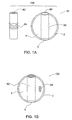
- Fig. 1 shows a medical device 100 for implantation in a body cavity, in accordance with the invention.
- the device includes a balloon 1 having a wall 2 made of an elastic biocompatible material enclosing a lumen 4.
- the balloon after inflation, has a torroidal shape defming a central hole 80 that is generally cylindrical in shape.
- the device 100 also includes a generally cylindrically shaped insert 82.
- the insert 82 is dimensioned to be received in the hole 80, as shown in Fig. 1b .
- the insert 82 is configured to perform any desired function after implantation of the device in the body cavity such as, releasing a substance or substances into the cavity, imaging the cavity, monitoring the cavity, or irradiating the cavity. Also as described in detail below, the device may be used to control release of fluids from the cavity.
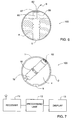
- the balloon 1 or the insert 82 may further comprise a magnetable portion which may consist for example, of one or more metal particles which may be free in the lumen 3a of the balloon 1 (as in Fig. 1b ), attached to the inner surface 3b of the balloon 100 (as in Fig. 1c ), embedded in the wall 3c of the balloon 1 (as in Fig. 1d ), or attached to the insert 82 (3e) as shown in Fig. 1e . .
- the lumen 4 of balloon 1 may be filled with a biocompatible fluid which may be presterilized such as air, water, saline or an oil such as liquid paraffin.
- a self-sealing valve 5 in the wall of the balloon is used to fill the balloon.
- the valve 5 may be for example a duck-bill type valve as shown in Fig. 2 or a ball valve as shown in Fig. 3 in which a ball 8 may be in a sealing position ( Fig. 3a ) or an unsealing position (Fig. 3c).
- the canula 6 of a syringe 7 is inserted through the valve 5 into the lumen 4 of the balloon.
- the fluid injected into the lumen 4 causes the balloon to expand.
- the syringe needle 6 is withdrawn, and the valve 5 seals itself.
- the balloon may adopt a predetermined shape, for example, a sphere, ellipsoid, or an irregular shape.
- the inflated inflated balloon may float or sink in the liquid contents of the body cavity.
- the insert 82 may be inserted into the hole 80 either before the balloon is inflated or afterwards. As shown in Fig. 4 , the insert may be inserted into the hole 80 with the balloon 1 deflated, and the device inserted into the cavity by means of an applicator 20 to be described in detail below ( Fig. 4a ). Following release of the device from the applicator into the body cavity, the balloon 1 then filled with fluid 24 from a syringe 7 ( Fig. 4b ). Alternatively, as shown in Fig. 5a , the balloon 1 may be filled outside the body and the insert 82 inserted into the hole 80. The balloon 1 is then compressed before being inserted into the cavity by means of applicator 20.
- the device 100 comprising the pre-filled balloon 1 and the insert 82, is clutched by the flanges 23 which are initially kept closed by constraining sleeve 26 ( Fig. 5a ).
- ring 25 is pulled as indicated by arrow 21 in Fig. 5b to urge the constraining sleeve 26 away from the flanges 23, allowing flanges 23 to open and release the device 100 into the bladder.
- Fig. 6 shows the insert 82 constructed so as to have a lumen 82 configured to contain one or more diffusible substances 85 .
- a porous membrane 87 separates the substances 85 from the liquid in the body cavity. The properties of the membrane are selected in order to achieve a desired release rate of the substances 85 into the body cavity, as is known in the art.
- the substances 85 could be, for example, drugs, antibiotics immunoglobulins, or radioactive substances, etc.
- the substances diffuse from the insert 82 into the cavity (farrows 9) in order to achieve a desired effect.
- Fig. 7 shows the insert 82 constructed so as to comprise a micro-video camera 19 for imaging the interior of the body cavity.
- the video camera 19 may have associated with it a transmitter 10 for transmitting images to a remote receiver 11.
- Such micro-video cameras and transmitters are known in the art, for example, as disclosed in U.S. Patents 5,604,531 , 5,579781 and 5,188,109 .
- the receiver 11 may be connected to a processing unit 12 for processing the images, or a display 13 for displaying images.
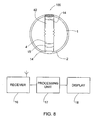
- Fig: 8 shows an insert 82 constructed so as to comprise one or more measuring devices 14 for measuring one or more parameters associated with the body cavity, for example, fluid pressure in the cavity, fluid temperature, fluid density, fluid conductivity or fluid composition.
- the measuring devices 14 may have an associated transmitter 15 for transmitting measurements to a remote receiver 16.
- the receiver may be connected to a processing unit 17 for processing the measurements or to a display 18 for displaying results.
- Such measuring devices are known in the art, for example as disclosed in U.S. Patents 5,579,781 and 5,188,109 .
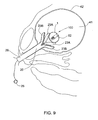
- Fig. 9 shows use of an applicator 20 for inserting the device 100 into the lumen 41 of the urinary bladder 42 of a female individual
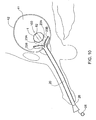
- Fig. 10 shows use of the applicator 20 inserting the device into the lumen of the urinary bladder 42 of a male individual.
- the device 100 is initially grasped by the closed flanges 23a at the distal end of the applicator 20 (Figs. 9a and 10a).
- the distal end of the applicator-device combination is inserted into the urethra until it reaches the lumen 41 of the bladder 42.
- the device 100 is then released from the applicator by opening the flanges 23b by pulling on ring 25 while holding the constraining sleeve 26.
- the applicator 20 is then removed from the body, leaving the device 100 in the bladder lumen 41.
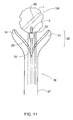
- Fig. 11 shows a retrieval device generally designated as 30 for removing the device 100 from the bladder.
- a catheter 27 has at its distal end 28 a magnetizable portion 29 so as to hold the device 100 at the distal tip 28 by means of the magnetizable particles 3 associated with the device 100.
- the retrieval device is inserted into the body cavity. After opening the flanges 31 of the retrieval device, the engaging probe 32, with magnetizable portion 29 in its tip, is inserted into the body cavity so as to engage the magnetizable particle 3 and push the balloon into the lumen of the cavity. The probe 32 is then pulled so as to bring the device into the grip of flanges 31 of the retrieval device. A piercer 33 is inserted into the balloon 1 to drain the fluid contained in its lumen 4 into an attached syringe (not shown) or into the body cavity. The applicator 20 is then withdrawn from the patient together with the device including the deflated balloon 1 and the insert 82.
- Figs. 12 and 13 show use of a displacing member 51 to position the device 100 at a desired location within the lumen 41 of a body cavity.
- the displacing member 51 is located outside the individual's body and comprises a magnetizable portion 52.
- the displacing member 51 is placed at a location on the surface of the individual's body so as to draw the device 100 from its initial location to the desired location.
- Fig. 12 shows use of the device 100 for sealing the urinary bladder outlet in a female subject.
- Displacing member 51 is placed over the urethral meatus 63 such that, due to the magnetizable portion 52 associated with the displacing member 51 and the magnetizable portion 3 associated with the device 100, the device is drawn into the bladder outlet 64. The device thus becomes lodged in the outlet and seals it. As the amount of urine in the bladder increases, a hydrostatic pressure is exerted on the device further lodging it in the outlet and reinforcing the seal.
- the invention is used similarly for sealing the urinary bladder outlet in male subjects.
- the magnetic displacing member 51 is placed over the upper edge of the pubic bone 65. Due to the magnetizable portion 3 of the device 100, the device 100 is raised and dislodged from the bladder outlet 64 so as to allow voiding of urine as indicated by arrow 66. After voiding the device 100 is redrawn into the bladder outlet 64 by the displacing member 51 so as to seal the outlet again as shown if Fig. 12 .
- Fig. 14 shows use of an immobilizing member 71 comprising a magnetizable portion 72 affixed to the surface 73 of the individual's body so as to maintain the device at a desired location in the lumen 41 of the body cavity 42, which may be for example, a urinary bladder.
- the magnetizable portion 72 of immobilizing member 71 may be enclosed in a coating 75 so as to form, for example, a hygienic pad.
- the immobilizing member 71 may be affixed to the surface 73 by means of tape, or by pressure applied to it by the individual's clothing, or may fit in a specially designed pocket in the individual's clothing. .
Landscapes
- Health & Medical Sciences (AREA)
- Life Sciences & Earth Sciences (AREA)
- Engineering & Computer Science (AREA)
- Biomedical Technology (AREA)
- Veterinary Medicine (AREA)
- Public Health (AREA)
- General Health & Medical Sciences (AREA)
- Animal Behavior & Ethology (AREA)
- Heart & Thoracic Surgery (AREA)
- Surgery (AREA)
- Medical Informatics (AREA)
- Molecular Biology (AREA)
- Pathology (AREA)
- Biophysics (AREA)
- Physics & Mathematics (AREA)
- Vascular Medicine (AREA)
- Anesthesiology (AREA)
- Hematology (AREA)
- Urology & Nephrology (AREA)
- Chemical & Material Sciences (AREA)
- Transplantation (AREA)
- Pharmacology & Pharmacy (AREA)
- Bioinformatics & Cheminformatics (AREA)
- Radiology & Medical Imaging (AREA)
- Optics & Photonics (AREA)
- Nuclear Medicine, Radiotherapy & Molecular Imaging (AREA)
- Cardiology (AREA)
- Oral & Maxillofacial Surgery (AREA)
- Medicinal Chemistry (AREA)
- Immunology (AREA)
- Physiology (AREA)
- Measuring And Recording Apparatus For Diagnosis (AREA)
- Prostheses (AREA)
- Media Introduction/Drainage Providing Device (AREA)
- Measurement Of The Respiration, Hearing Ability, Form, And Blood Characteristics Of Living Organisms (AREA)
- Medical Preparation Storing Or Oral Administration Devices (AREA)
- Infusion, Injection, And Reservoir Apparatuses (AREA)
- Electrotherapy Devices (AREA)
- Seal Device For Vehicle (AREA)
Claims (32)
- Dispositif médical implantable (100) à insérer dans une cavité corporelle, comprenant un ballonnet extensible (10) muni d'une paroi (2) et d'une lumière (80) et doté d'une forme torique délimitant un trou, caractérisé par le fait qu'il comporte en outre un insert configuré pour être reçu et retenu dans le trou par des rainures et des arêtes sur une surface extérieure de l'insert qui sont reçues dans des rainures et arêtes correspondantes sur une surface extérieure d'une paroi du trou.
- Dispositif (100) conforme à la revendication 1, formé avec une partie magnétisable (3).
- Dispositif (100) conforme à la revendication 2, où la partie magnétisable (3) comprend une ou plusieurs particules magnétisables dans la lumière (80) du ballonnet (10), attachées à la paroi du ballonnet (10), ou encastrées dans la paroi du ballonnet (10).
- Dispositif (100) conforme à la revendication 2, où la partie magnétisable (3) du ballonnet (10) comprend une ou plusieurs particules magnétisables dans une lumière de l'insert, attachées à une paroi de l'insert, ou encastrées dans une paroi de l'insert.
- Dispositif (100) conforme à une quelconque des revendications précédentes, où la cavité corporelle est une vessie urinaire ou un organe du tube digestif.
- Dispositif (100) conforme à une quelconque des revendications précédentes, où le ballonnet (10) comporte en outre une valve auto-obturante (5).
- Dispositif (100) conforme à une quelconque des revendications précédentes, où le dispositif (100), à l'extension du ballonnet, est apte à flotter dans la cavité corporelle.
- Dispositif (100) conforme à une quelconque des revendications 1 à 6, où le dispositif (100), à l'extension du ballonnet, est apte à s'enfoncer dans la cavité corporelle.
- Dispositif (100) conforme à une quelconque des revendications précédentes, où l'insert est apte à stocker un ou plusieurs composés et les libérer dans la cavité corporelle.
- Dispositif (100) conforme à la revendication 9, où la une ou les plusieurs substances sont stockées dans une lumière de l'insert.
- Dispositif (100) conforme à la revendication 9, où la une ou les plusieurs substances sont stockées dans une paroi de l'insert.
- Dispositif (100) conforme à une quelconque des revendications 9 à 11, où une ou plusieurs de la une ou des plusieurs substances sont des médicaments ou des antibiotiques.
- Dispositif (100) conforme à une quelconque des revendications 9 à 11, où une ou plusieurs de la une ou des plusieurs substances sont des substances radioactives.
- Dispositif (100) conforme à une quelconque des revendications précédentes, où l'insert comporte un dispositif (14) imageur de la cavité corporelle.
- Dispositif (100) conforme à une quelconque des revendications précédentes, où l'insert comporte un ou plusieurs dispositifs (14) de surveillance d'un ou plusieurs paramètres de la cavité corporelle ou son contenu.
- Dispositif (100) conforme à la revendication 15, où un ou plusieurs des un ou plusieurs dispositifs sont aptes à surveiller un paramètre du corps sélectionné dans la liste comprenant :a. pression du fluide ;b. température du fluide ;c. densité du fluide ; etd. composition du fluide.
- Dispositif (100) conforme à la revendication 14, où l'insert comprend un émetteur d' imageur (10) pour émettre des signaux venant du dispositif imageur vers un récepteur.
- Dispositif (100) conforme à la revendication 15 ou 16, où l'insert comprend en outre un émetteur (15) émettant des signaux venant du dispositif de surveillance vers un récepteur.
- Système destiné à traiter une cavité corporelle d'une personne, ce système comportant :a. un dispositif (100) conforme à une quelconque des revendications précédentes ;b. un applicateur (20) destiné à insérer le dispositif dans le corps d'une personne ou pour retirer le dispositif de la vessie urinaire d'une personne, l'applicateur étant fourni, à une de ses extrémités, d'un dispositif de préhension pour retenir le ballonnet (10) de manière libérable ;c. un dispositif extensible pour mettre le ballonnet (10) en extension dans la cavité corporelle ; etd. un organe de déplacement magnétisable (51) pour déplacer le dispositif à l'intérieur de la cavité corporelle.
- Système conforme à la revendication 19, comprenant en outre un organe d'immobilisation (71) comprenant une partie magnétisable (3), ledit organe d'immobilisation étant fixé sur le corps de la personne pour immobiliser le dispositif (100) à un emplacement désiré dans la cavité corporelle.
- Système conforme à la revendication 20, où l'organe d'immobilisation (71) est en forme de tampon hygiénique à placer dans les vêtements de la personne.
- Système conforme à une quelconque des revendications 19 à 21, où le dispositif de préhension comporte des ailettes (23).
- Système conforme à une quelconque des revendications 19 à 21, où le dispositif de préhension comporte une partie magnétisable (10).
- Système conforme à une quelconque des revendications 14 à 23, où le dispositif extensible comporte un injecteur (7) pour injecter un fluide dans le ballonnet afin de mettre le ballonnet (10) en extension.
- Système conforme à une quelconque des revendications 19 à 23, où le dispositif extensible comporte un décompresseur pour décompresser un ballonnet (10) préalablement comprimé afin de mettre le ballonnet (10) en extension.
- Système conforme à une quelconque des revendications 19 à 25, pour usage dans le traitement d'un trouble sélectionné dans la liste comprenant :a. incontinence urinaire ;b. infections dans la cavité corporelle ;c. tumeurs dans la cavité corporelle ; etd. dysfonctionnement de la cavité corporelle.
- Système conforme à la revendication 19, où l'insert comprend un ou plusieurs dispositifs pour surveiller un ou plusieurs paramètres de la cavité corporelle ou son contenu, un émetteur émettant des signaux venant du dispositif de surveillance vers un récepteur, et un récepteur recevant des signaux venant dudit émetteur.
- Système conforme à la revendication 27, comprenant en outre un ou plusieurs composants sélectionnés dans la liste comportant :a. une unité de traitement traitant des signaux reçus du récepteur ;b. un affichage pour afficher des signaux reçus par le récepteur ;c. un affichage pour afficher une sortie produite par une unité de traitement.
- Système conforme à une quelconque des revendications 27 ou 28, servant à la surveillance d'un ou plusieurs paramètres de la cavité corporelle sélectionnés dans la liste comprenant :a. température du fluide ;b. pression du fluide ;c. densité du fluide ;d. conductivité du fluide ete. composition du fluide.
- Système conforme à une quelconque des revendications 19 à 25, comportant un ballonnet conforme à la revendication 17, comportant de plus un récepteur recevant des signaux venant dudit émetteur.
- Système conforme à la revendication 30, comprenant en outre un ou plusieurs composants sélectionnés dans la liste comportant :a. une unité de traitement traitant des signaux reçus du récepteur ;b. un affichage pour afficher des signaux reçus par le récepteur ;c. un affichage pour afficher une sortie produite par une unité de traitement.
- Système conforme à une quelconque des revendications 30 ou 31, servant à imager la cavité corporelle.
Applications Claiming Priority (3)
| Application Number | Priority Date | Filing Date | Title |
|---|---|---|---|
| IL152630A IL152630A (en) | 2002-11-04 | 2002-11-04 | The device is implanted |
| IL15263002 | 2002-11-04 | ||
| PCT/IL2003/000915 WO2004041124A1 (fr) | 2002-11-04 | 2003-11-04 | Dispositif implantable a mobilite libre dans une cavite corporelle |
Publications (2)
| Publication Number | Publication Date |
|---|---|
| EP1572025A1 EP1572025A1 (fr) | 2005-09-14 |
| EP1572025B1 true EP1572025B1 (fr) | 2009-03-04 |
Family
ID=30011885
Family Applications (1)
| Application Number | Title | Priority Date | Filing Date |
|---|---|---|---|
| EP03758644A Expired - Lifetime EP1572025B1 (fr) | 2002-11-04 | 2003-11-04 | Dispositif implantable a mobilite libre dans une cavite corporelle |
Country Status (10)
| Country | Link |
|---|---|
| US (1) | US7654950B2 (fr) |
| EP (1) | EP1572025B1 (fr) |
| JP (1) | JP4444837B2 (fr) |
| AT (1) | ATE424157T1 (fr) |
| AU (1) | AU2003274675B2 (fr) |
| CA (1) | CA2532996C (fr) |
| DE (1) | DE60326486D1 (fr) |
| ES (1) | ES2323307T3 (fr) |
| IL (1) | IL152630A (fr) |
| WO (1) | WO2004041124A1 (fr) |
Families Citing this family (28)
| Publication number | Priority date | Publication date | Assignee | Title |
|---|---|---|---|---|
| US9974680B2 (en) | 2004-12-27 | 2018-05-22 | Spatz Fgia, Inc. | System and methods for internalization of external components of adjustable intragastric balloon |
| WO2014082044A1 (fr) | 2012-11-26 | 2014-05-30 | Spatz Fgia, Inc. | Système et procédés d'internalisation de composants d'un ballonnet intragastrique réglable |
| US20060142731A1 (en) * | 2004-12-27 | 2006-06-29 | Jeffrey Brooks | Floating gastro-intestinal anchor |
| WO2007025191A1 (fr) | 2005-08-23 | 2007-03-01 | Smith & Nephew, Inc. | Implant orthopedique telemetrique |
| JP4755890B2 (ja) * | 2005-12-09 | 2011-08-24 | 佳彦 平尾 | 測定装置、および測定システム |
| US8430894B2 (en) * | 2006-03-28 | 2013-04-30 | Spatz-Fgia, Inc. | Floating gastrointestinal anchor |
| JP5330222B2 (ja) * | 2007-03-01 | 2013-10-30 | オリンパスメディカルシステムズ株式会社 | 管腔通過確認装置、管腔通過確認方法、および管腔通過確認装置の製造方法 |
| US20100121371A1 (en) * | 2007-04-30 | 2010-05-13 | Spatz Fgia, Inc. | Non-endoscopic insertion and removal of a device |
| US8180438B2 (en) | 2008-01-30 | 2012-05-15 | Greatbatch Ltd. | Minimally invasive physiologic parameter recorder and introducer system |
| US10039907B2 (en) | 2008-04-14 | 2018-08-07 | Innoventions Ltd. | Device, system, and method for releasing substances in a body cavity |
| WO2010116363A1 (fr) * | 2009-04-06 | 2010-10-14 | Realview Medical Limited | Système implantable, dispositif d'introduction du système implantable et procédé correspondant |
| US8277426B2 (en) | 2009-09-30 | 2012-10-02 | Wilcox Heather J | Male urinary incontinence device |
| US9161775B1 (en) | 2012-05-08 | 2015-10-20 | Greatbatch Ltd. | Tunneling tool for deliberate placement of an ILR |
| EP2861145B1 (fr) * | 2012-06-14 | 2019-07-24 | Autonomix Medical, Inc. | Dispositifs et systèmes pour le diagnostic et le traitement de la vessie hyperactive |
| GB2517211B (en) * | 2013-08-16 | 2016-05-25 | Oxtex Ltd | Conformable tissue expander |
| GB2517210B (en) * | 2013-08-16 | 2016-05-25 | Oxtex Ltd | Coated Tissue Expander |
| US9155527B2 (en) | 2013-08-22 | 2015-10-13 | Transmed7, Llc | Soft tissue coring biopsy devices and methods |
| WO2015038770A2 (fr) | 2013-09-12 | 2015-03-19 | Transmed7, Llc | Dispositifs et procédés de biopsie par prélèvement de tissu |
| EP3049019A1 (fr) * | 2013-09-25 | 2016-08-03 | Medtronic, Inc. | Valvule de voie urinaire implantable |
| GB2523991B (en) * | 2014-02-19 | 2018-07-18 | Papirov Eduard | Device, system and method for ambulatory urodynamic analysis |
| US9999758B2 (en) | 2014-09-19 | 2018-06-19 | Transmed7, Llc | In-situ material delivery devices and methods |
| US10052489B2 (en) | 2015-03-23 | 2018-08-21 | Greatbatch Ltd. | Apparatus and method for implanting an implantable device |
| JP2019510607A (ja) * | 2016-04-04 | 2019-04-18 | イノベンションズ リミテッド | 薬物送達装置及び方法 |
| WO2018146547A1 (fr) | 2017-02-09 | 2018-08-16 | Spatz FGIA Ltd | Clapet anti-retour à station d'accueil pour ballonnet gastro-intestinal |
| MX2021007298A (es) | 2018-12-21 | 2021-07-15 | Spatz FGIA Ltd | Valvula con estacion de acoplamiento para globo gastrointestinal. |
| EP3902501A4 (fr) * | 2018-12-24 | 2022-11-30 | Innoventions Ltd | Dispositif intravésiculaire pour le contrôle de l'incontinence urinaire |
| US11089946B2 (en) | 2019-10-07 | 2021-08-17 | Anx Robotica Corp. | Inflatable in-vivo capsule endoscope with magnetic guide |
| CN117615814A (zh) * | 2021-07-09 | 2024-02-27 | 诺和诺德股份有限公司 | 胶囊施用组件 |
Family Cites Families (11)
| Publication number | Priority date | Publication date | Assignee | Title |
|---|---|---|---|---|
| US4928446A (en) * | 1987-11-23 | 1990-05-29 | Alexander Sr Walter A | Break-away sign post and post ground anchor |
| US4925446A (en) * | 1988-07-06 | 1990-05-15 | Transpharm Group Inc. | Removable inflatable intragastrointestinal device for delivering beneficial agents |
| US5234409A (en) * | 1989-07-07 | 1993-08-10 | Cabot Technology Corporation | Female incontinence control device and method |
| US5030199A (en) * | 1989-12-11 | 1991-07-09 | Medical Engineering Corporation | Female incontinence control device with magnetically operable valve and method |
| JPH0433647A (ja) * | 1990-05-30 | 1992-02-05 | Shigeru Saito | 人工歯根 |
| IL108352A (en) * | 1994-01-17 | 2000-02-29 | Given Imaging Ltd | In vivo video camera system |
| US5579781A (en) * | 1994-10-13 | 1996-12-03 | Cooke; Thomas H. | Wireless transmitter for needle electrodes as used in electromyography |
| US6293923B1 (en) * | 1999-03-15 | 2001-09-25 | Innoventions, Inc. | Intravesicular balloon |
| US20020165427A1 (en) | 1999-03-15 | 2002-11-07 | Daniel Yachia | Intravesicular device |
| US6398718B1 (en) * | 2000-06-15 | 2002-06-04 | Innoventions, Inc. | Intravesicular device |
| US6589228B2 (en) * | 2001-04-13 | 2003-07-08 | Asher Holzer | Device for aiding urination and method of use thereof |
-
2002
- 2002-11-04 IL IL152630A patent/IL152630A/en not_active IP Right Cessation
-
2003
- 2003-11-04 AT AT03758644T patent/ATE424157T1/de active
- 2003-11-04 WO PCT/IL2003/000915 patent/WO2004041124A1/fr not_active Ceased
- 2003-11-04 AU AU2003274675A patent/AU2003274675B2/en not_active Ceased
- 2003-11-04 US US10/533,640 patent/US7654950B2/en not_active Expired - Fee Related
- 2003-11-04 EP EP03758644A patent/EP1572025B1/fr not_active Expired - Lifetime
- 2003-11-04 DE DE60326486T patent/DE60326486D1/de not_active Expired - Lifetime
- 2003-11-04 CA CA2532996A patent/CA2532996C/fr not_active Expired - Fee Related
- 2003-11-04 JP JP2004549521A patent/JP4444837B2/ja not_active Expired - Fee Related
- 2003-11-04 ES ES03758644T patent/ES2323307T3/es not_active Expired - Lifetime
Also Published As
| Publication number | Publication date |
|---|---|
| AU2003274675A1 (en) | 2004-06-07 |
| EP1572025A1 (fr) | 2005-09-14 |
| AU2003274675B2 (en) | 2009-04-23 |
| DE60326486D1 (de) | 2009-04-16 |
| US7654950B2 (en) | 2010-02-02 |
| CA2532996C (fr) | 2012-07-10 |
| WO2004041124A1 (fr) | 2004-05-21 |
| ATE424157T1 (de) | 2009-03-15 |
| JP2006505322A (ja) | 2006-02-16 |
| JP4444837B2 (ja) | 2010-03-31 |
| IL152630A (en) | 2010-11-30 |
| IL152630A0 (en) | 2003-06-24 |
| US20060155163A1 (en) | 2006-07-13 |
| ES2323307T3 (es) | 2009-07-13 |
| CA2532996A1 (fr) | 2004-05-21 |
Similar Documents
| Publication | Publication Date | Title |
|---|---|---|
| US6293923B1 (en) | Intravesicular balloon | |
| AU2003274675B2 (en) | Implantable device which is freely movable in a body cavity | |
| US6398718B1 (en) | Intravesicular device | |
| US20020165427A1 (en) | Intravesicular device | |
| US7141038B2 (en) | Endourethral device and method | |
| JP4027600B2 (ja) | 尿うっ滞の処置 | |
| US20060287570A1 (en) | Endourethral device & method | |
| CA2679454C (fr) | Systeme de gestion de fonction intestinale | |
| JP7586822B2 (ja) | 尿失禁を制御するための内部小胞デバイス | |
| CN102123758A (zh) | 使用者控制液体从膀胱排出的导尿管装置 | |
| AU2004206975B2 (en) | Intravesicular balloon | |
| IL145371A (en) | Intravesicular balloon |
Legal Events
| Date | Code | Title | Description |
|---|---|---|---|
| PUAI | Public reference made under article 153(3) epc to a published international application that has entered the european phase |
Free format text: ORIGINAL CODE: 0009012 |
|
| 17P | Request for examination filed |
Effective date: 20050606 |
|
| AK | Designated contracting states |
Kind code of ref document: A1 Designated state(s): AT BE BG CH CY CZ DE DK EE ES FI FR GB GR HU IE IT LI LU MC NL PT RO SE SI SK TR |
|
| AX | Request for extension of the european patent |
Extension state: AL LT LV MK |
|
| RAP1 | Party data changed (applicant data changed or rights of an application transferred) |
Owner name: INNOVENTIONS (ISRAEL) LTD. |
|
| DAX | Request for extension of the european patent (deleted) | ||
| 17Q | First examination report despatched |
Effective date: 20070122 |
|
| GRAP | Despatch of communication of intention to grant a patent |
Free format text: ORIGINAL CODE: EPIDOSNIGR1 |
|
| GRAS | Grant fee paid |
Free format text: ORIGINAL CODE: EPIDOSNIGR3 |
|
| GRAA | (expected) grant |
Free format text: ORIGINAL CODE: 0009210 |
|
| AK | Designated contracting states |
Kind code of ref document: B1 Designated state(s): AT BE BG CH CY CZ DE DK EE ES FI FR GB GR HU IE IT LI LU MC NL PT RO SE SI SK TR |
|
| REG | Reference to a national code |
Ref country code: GB Ref legal event code: FG4D |
|
| REG | Reference to a national code |
Ref country code: CH Ref legal event code: EP |
|
| REG | Reference to a national code |
Ref country code: IE Ref legal event code: FG4D |
|
| REF | Corresponds to: |
Ref document number: 60326486 Country of ref document: DE Date of ref document: 20090416 Kind code of ref document: P |
|
| REG | Reference to a national code |
Ref country code: ES Ref legal event code: FG2A Ref document number: 2323307 Country of ref document: ES Kind code of ref document: T3 |
|
| PG25 | Lapsed in a contracting state [announced via postgrant information from national office to epo] |
Ref country code: NL Free format text: LAPSE BECAUSE OF FAILURE TO SUBMIT A TRANSLATION OF THE DESCRIPTION OR TO PAY THE FEE WITHIN THE PRESCRIBED TIME-LIMIT Effective date: 20090304 Ref country code: SI Free format text: LAPSE BECAUSE OF FAILURE TO SUBMIT A TRANSLATION OF THE DESCRIPTION OR TO PAY THE FEE WITHIN THE PRESCRIBED TIME-LIMIT Effective date: 20090304 Ref country code: FI Free format text: LAPSE BECAUSE OF FAILURE TO SUBMIT A TRANSLATION OF THE DESCRIPTION OR TO PAY THE FEE WITHIN THE PRESCRIBED TIME-LIMIT Effective date: 20090304 |
|
| NLV1 | Nl: lapsed or annulled due to failure to fulfill the requirements of art. 29p and 29m of the patents act | ||
| PG25 | Lapsed in a contracting state [announced via postgrant information from national office to epo] |
Ref country code: SE Free format text: LAPSE BECAUSE OF FAILURE TO SUBMIT A TRANSLATION OF THE DESCRIPTION OR TO PAY THE FEE WITHIN THE PRESCRIBED TIME-LIMIT Effective date: 20090604 |
|
| PG25 | Lapsed in a contracting state [announced via postgrant information from national office to epo] |
Ref country code: BE Free format text: LAPSE BECAUSE OF FAILURE TO SUBMIT A TRANSLATION OF THE DESCRIPTION OR TO PAY THE FEE WITHIN THE PRESCRIBED TIME-LIMIT Effective date: 20090304 |
|
| PG25 | Lapsed in a contracting state [announced via postgrant information from national office to epo] |
Ref country code: CZ Free format text: LAPSE BECAUSE OF FAILURE TO SUBMIT A TRANSLATION OF THE DESCRIPTION OR TO PAY THE FEE WITHIN THE PRESCRIBED TIME-LIMIT Effective date: 20090304 Ref country code: PT Free format text: LAPSE BECAUSE OF FAILURE TO SUBMIT A TRANSLATION OF THE DESCRIPTION OR TO PAY THE FEE WITHIN THE PRESCRIBED TIME-LIMIT Effective date: 20090819 Ref country code: EE Free format text: LAPSE BECAUSE OF FAILURE TO SUBMIT A TRANSLATION OF THE DESCRIPTION OR TO PAY THE FEE WITHIN THE PRESCRIBED TIME-LIMIT Effective date: 20090304 |
|
| PG25 | Lapsed in a contracting state [announced via postgrant information from national office to epo] |
Ref country code: RO Free format text: LAPSE BECAUSE OF FAILURE TO SUBMIT A TRANSLATION OF THE DESCRIPTION OR TO PAY THE FEE WITHIN THE PRESCRIBED TIME-LIMIT Effective date: 20090304 Ref country code: SK Free format text: LAPSE BECAUSE OF FAILURE TO SUBMIT A TRANSLATION OF THE DESCRIPTION OR TO PAY THE FEE WITHIN THE PRESCRIBED TIME-LIMIT Effective date: 20090304 |
|
| PLBE | No opposition filed within time limit |
Free format text: ORIGINAL CODE: 0009261 |
|
| STAA | Information on the status of an ep patent application or granted ep patent |
Free format text: STATUS: NO OPPOSITION FILED WITHIN TIME LIMIT |
|
| PG25 | Lapsed in a contracting state [announced via postgrant information from national office to epo] |
Ref country code: DK Free format text: LAPSE BECAUSE OF FAILURE TO SUBMIT A TRANSLATION OF THE DESCRIPTION OR TO PAY THE FEE WITHIN THE PRESCRIBED TIME-LIMIT Effective date: 20090304 Ref country code: BG Free format text: LAPSE BECAUSE OF FAILURE TO SUBMIT A TRANSLATION OF THE DESCRIPTION OR TO PAY THE FEE WITHIN THE PRESCRIBED TIME-LIMIT Effective date: 20090604 |
|
| 26N | No opposition filed |
Effective date: 20091207 |
|
| PG25 | Lapsed in a contracting state [announced via postgrant information from national office to epo] |
Ref country code: MC Free format text: LAPSE BECAUSE OF NON-PAYMENT OF DUE FEES Effective date: 20091130 |
|
| REG | Reference to a national code |
Ref country code: CH Ref legal event code: PL |
|
| PG25 | Lapsed in a contracting state [announced via postgrant information from national office to epo] |
Ref country code: IE Free format text: LAPSE BECAUSE OF NON-PAYMENT OF DUE FEES Effective date: 20091104 Ref country code: LI Free format text: LAPSE BECAUSE OF NON-PAYMENT OF DUE FEES Effective date: 20091130 Ref country code: GR Free format text: LAPSE BECAUSE OF FAILURE TO SUBMIT A TRANSLATION OF THE DESCRIPTION OR TO PAY THE FEE WITHIN THE PRESCRIBED TIME-LIMIT Effective date: 20090605 Ref country code: CH Free format text: LAPSE BECAUSE OF NON-PAYMENT OF DUE FEES Effective date: 20091130 |
|
| PGFP | Annual fee paid to national office [announced via postgrant information from national office to epo] |
Ref country code: AT Payment date: 20101125 Year of fee payment: 8 |
|
| PG25 | Lapsed in a contracting state [announced via postgrant information from national office to epo] |
Ref country code: IT Free format text: LAPSE BECAUSE OF FAILURE TO SUBMIT A TRANSLATION OF THE DESCRIPTION OR TO PAY THE FEE WITHIN THE PRESCRIBED TIME-LIMIT Effective date: 20090304 |
|
| PG25 | Lapsed in a contracting state [announced via postgrant information from national office to epo] |
Ref country code: LU Free format text: LAPSE BECAUSE OF NON-PAYMENT OF DUE FEES Effective date: 20091104 |
|
| PG25 | Lapsed in a contracting state [announced via postgrant information from national office to epo] |
Ref country code: HU Free format text: LAPSE BECAUSE OF FAILURE TO SUBMIT A TRANSLATION OF THE DESCRIPTION OR TO PAY THE FEE WITHIN THE PRESCRIBED TIME-LIMIT Effective date: 20090905 |
|
| PG25 | Lapsed in a contracting state [announced via postgrant information from national office to epo] |
Ref country code: TR Free format text: LAPSE BECAUSE OF FAILURE TO SUBMIT A TRANSLATION OF THE DESCRIPTION OR TO PAY THE FEE WITHIN THE PRESCRIBED TIME-LIMIT Effective date: 20090304 |
|
| PG25 | Lapsed in a contracting state [announced via postgrant information from national office to epo] |
Ref country code: CY Free format text: LAPSE BECAUSE OF FAILURE TO SUBMIT A TRANSLATION OF THE DESCRIPTION OR TO PAY THE FEE WITHIN THE PRESCRIBED TIME-LIMIT Effective date: 20090304 |
|
| PGFP | Annual fee paid to national office [announced via postgrant information from national office to epo] |
Ref country code: ES Payment date: 20111115 Year of fee payment: 9 |
|
| REG | Reference to a national code |
Ref country code: AT Ref legal event code: MM01 Ref document number: 424157 Country of ref document: AT Kind code of ref document: T Effective date: 20121104 |
|
| PG25 | Lapsed in a contracting state [announced via postgrant information from national office to epo] |
Ref country code: AT Free format text: LAPSE BECAUSE OF NON-PAYMENT OF DUE FEES Effective date: 20121104 |
|
| REG | Reference to a national code |
Ref country code: ES Ref legal event code: FD2A Effective date: 20140304 |
|
| PG25 | Lapsed in a contracting state [announced via postgrant information from national office to epo] |
Ref country code: ES Free format text: LAPSE BECAUSE OF NON-PAYMENT OF DUE FEES Effective date: 20121105 |
|
| REG | Reference to a national code |
Ref country code: FR Ref legal event code: PLFP Year of fee payment: 13 |
|
| REG | Reference to a national code |
Ref country code: FR Ref legal event code: PLFP Year of fee payment: 14 |
|
| PGFP | Annual fee paid to national office [announced via postgrant information from national office to epo] |
Ref country code: DE Payment date: 20161121 Year of fee payment: 14 Ref country code: FR Payment date: 20161118 Year of fee payment: 14 Ref country code: GB Payment date: 20161122 Year of fee payment: 14 |
|
| REG | Reference to a national code |
Ref country code: DE Ref legal event code: R119 Ref document number: 60326486 Country of ref document: DE |
|
| GBPC | Gb: european patent ceased through non-payment of renewal fee |
Effective date: 20171104 |
|
| REG | Reference to a national code |
Ref country code: FR Ref legal event code: ST Effective date: 20180731 |
|
| PG25 | Lapsed in a contracting state [announced via postgrant information from national office to epo] |
Ref country code: FR Free format text: LAPSE BECAUSE OF NON-PAYMENT OF DUE FEES Effective date: 20171130 Ref country code: DE Free format text: LAPSE BECAUSE OF NON-PAYMENT OF DUE FEES Effective date: 20180602 |
|
| PG25 | Lapsed in a contracting state [announced via postgrant information from national office to epo] |
Ref country code: GB Free format text: LAPSE BECAUSE OF NON-PAYMENT OF DUE FEES Effective date: 20171104 |