EP1573532B1 - Architecture permettant de prendre en charge de multiples contextes d'execution en simultanee sur un processeur - Google Patents
Architecture permettant de prendre en charge de multiples contextes d'execution en simultanee sur un processeur Download PDFInfo
- Publication number
- EP1573532B1 EP1573532B1 EP03731480.4A EP03731480A EP1573532B1 EP 1573532 B1 EP1573532 B1 EP 1573532B1 EP 03731480 A EP03731480 A EP 03731480A EP 1573532 B1 EP1573532 B1 EP 1573532B1
- Authority
- EP
- European Patent Office
- Prior art keywords
- thread
- processing
- register
- processor
- threads
- Prior art date
- Legal status (The legal status is an assumption and is not a legal conclusion. Google has not performed a legal analysis and makes no representation as to the accuracy of the status listed.)
- Expired - Lifetime
Links
Images


Classifications
-
- G—PHYSICS
- G06—COMPUTING OR CALCULATING; COUNTING
- G06F—ELECTRIC DIGITAL DATA PROCESSING
- G06F9/00—Arrangements for program control, e.g. control units
- G06F9/06—Arrangements for program control, e.g. control units using stored programs, i.e. using an internal store of processing equipment to receive or retain programs
- G06F9/46—Multiprogramming arrangements
- G06F9/48—Program initiating; Program switching, e.g. by interrupt
- G06F9/4806—Task transfer initiation or dispatching
- G06F9/4843—Task transfer initiation or dispatching by program, e.g. task dispatcher, supervisor, operating system
-
- G—PHYSICS
- G06—COMPUTING OR CALCULATING; COUNTING
- G06F—ELECTRIC DIGITAL DATA PROCESSING
- G06F9/00—Arrangements for program control, e.g. control units
- G06F9/06—Arrangements for program control, e.g. control units using stored programs, i.e. using an internal store of processing equipment to receive or retain programs
- G06F9/30—Arrangements for executing machine instructions, e.g. instruction decode
- G06F9/38—Concurrent instruction execution, e.g. pipeline or look ahead
- G06F9/3836—Instruction issuing, e.g. dynamic instruction scheduling or out of order instruction execution
- G06F9/3851—Instruction issuing, e.g. dynamic instruction scheduling or out of order instruction execution from multiple instruction streams, e.g. multistreaming
-
- G—PHYSICS
- G06—COMPUTING OR CALCULATING; COUNTING
- G06F—ELECTRIC DIGITAL DATA PROCESSING
- G06F9/00—Arrangements for program control, e.g. control units
- G06F9/06—Arrangements for program control, e.g. control units using stored programs, i.e. using an internal store of processing equipment to receive or retain programs
- G06F9/30—Arrangements for executing machine instructions, e.g. instruction decode
- G06F9/38—Concurrent instruction execution, e.g. pipeline or look ahead
- G06F9/3877—Concurrent instruction execution, e.g. pipeline or look ahead using a secondary processor, e.g. coprocessor
-
- G—PHYSICS
- G06—COMPUTING OR CALCULATING; COUNTING
- G06F—ELECTRIC DIGITAL DATA PROCESSING
- G06F9/00—Arrangements for program control, e.g. control units
- G06F9/06—Arrangements for program control, e.g. control units using stored programs, i.e. using an internal store of processing equipment to receive or retain programs
- G06F9/46—Multiprogramming arrangements
- G06F9/48—Program initiating; Program switching, e.g. by interrupt
- G06F9/4806—Task transfer initiation or dispatching
- G06F9/4843—Task transfer initiation or dispatching by program, e.g. task dispatcher, supervisor, operating system
- G06F9/485—Task life-cycle, e.g. stopping, restarting, resuming execution
-
- Y—GENERAL TAGGING OF NEW TECHNOLOGICAL DEVELOPMENTS; GENERAL TAGGING OF CROSS-SECTIONAL TECHNOLOGIES SPANNING OVER SEVERAL SECTIONS OF THE IPC; TECHNICAL SUBJECTS COVERED BY FORMER USPC CROSS-REFERENCE ART COLLECTIONS [XRACs] AND DIGESTS
- Y02—TECHNOLOGIES OR APPLICATIONS FOR MITIGATION OR ADAPTATION AGAINST CLIMATE CHANGE
- Y02D—CLIMATE CHANGE MITIGATION TECHNOLOGIES IN INFORMATION AND COMMUNICATION TECHNOLOGIES [ICT], I.E. INFORMATION AND COMMUNICATION TECHNOLOGIES AIMING AT THE REDUCTION OF THEIR OWN ENERGY USE
- Y02D10/00—Energy efficient computing, e.g. low power processors, power management or thermal management
Definitions
- the behavioral representation of a computer to software running on that computer is called the instruction set architecture.
- the instruction set architecture includes both that part of the state of the computer that is visible to programs executing on the computer, known as the architecturally-visible state, and the operations that change that state, the latter being primarily the instructions that the computer executes.
- the architecturally-visible state is roughly divisible into two sets: the state that is primarily used to configure the computer and is normally only of concern to operating systems, and the state used by application software executing on the computer. Further, within this latter state there is a subset, referred to as a context, that each application running on the computer can assume is dedicated to exclusive use by the application.
- the context includes an indication, referred to as the program counter, of which instruction is to be issued next.
- the central processing unit (CPU) of a computer typically implements one context. Accordingly, on a typical computer, only one program is able to issue instructions at a time.
- an operating system typically runs each program for a short period of time called a time slice (usually a few milliseconds), halts the execution of that program, saves the context of that program to a storage location outside the CPU, loads the context of another program into the CPU, begins running the new program until the time slice for the new program expires, and then repeats the process. This is known as multi-tasking.
- More than one context may be implemented within the CPU of a computer. This allows the hardware to issue instructions from more than one program without intervention by the operating system, and without saving and restoring program contexts in storage locations outside the CPU. Execution of the instructions associated with each context is essentially independent and has no direct effect on the execution of instructions from any other context, except through shared resources. This capability of a single CPU to hold and execute from multiple contexts without operating system intervention has become known as hardware multi-threading. The name is based on referring to each context implemented by the CPU as a thread.
- Hardware multi-threading may be used to make use of very short times of inactivity in the CPU, to mitigate the effects of operations that take a long time to complete (i.e., that have a long latency), or to increase the number of instructions issued in a single clock cycle. Hardware multi-threading also may be used when an application being run on a computer maps more naturally into several tasks executing essentially simultaneously than into a single task or set of tasks executing sequentially.
- One family of computers is based on a series of instruction set architectures developed by ARM Ltd. of Cambridge/ England. This instruction set architecture family is known as the ARM ISA and has several versions and 5 variants.
- One feature of the ARM ISA is the use of coprocessors that execute instructions included in the normal instruction stream. Some standard coprocessors are defined for controlling and configuring the computer. A facility also exists for custom coprocessors that extend the capabilities of the architectures.
- a coprocessor has both its own state and its own instruction set. All or some of the state of a coprocessor might be part of the context dedicated to exclusive use by an executing program. Coprocessors are architecturally distinct in the ARM ISA, but may be implemented as part of the processor. Typically, one or more standard coprocessors used to configure and control the computer are implemented as part of the processor.
- WO 99/21089 describes a system and method for performing computer processing operations in a data processing system including a multithreaded processor and thread switch logic.
- the multithreaded processor is capable of switching between two or more threads of instructions which can be independently executed. Each thread has a corresponding state in a thread state register depending on its execution status.
- the thread switch logic contains a thread switch control register to store the conditions upon which a thread switch will occur.
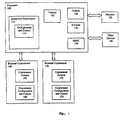
- the processor 200 differs from the processor 100 by having two execution contexts: a Thread 0 context 202 and a Thread 1 context 204. Also, processor 200 adds thread configuration and control state and logic 216 to the integrated coprocessor 210, and permits configuration and control state 214 to have per-thread duplicates of some portions of the configuration and control state 114 of processor 100. Likewise, coprocessor 260 incorporates two coprocessor-specific contexts: Thread 0 coprocessor context 262 and Thread 1 coprocessor context 264. In addition, the configuration and control state 266 of coprocessor 260 may have per-thread duplicates of some portions of the configuration and control state 166 of coprocessor 160.
- Fig. 2 shows an implementation with two contexts, the described techniques are not limited in this respect. Implementations may support any number of contexts.
- coprocessor 260 may be implemented as an integrated coprocessor. The described techniques may be applied to hardware using any scheme for issuing instructions from multiple contexts.
- thread configuration and control state 216 may be in a different architectural coprocessor than the rest of the configuration and control state 214, regardless of whether the state and logic associated with states 214 and 216 are implemented in the same block of circuitry.
- the main processor architecture can be left unaltered from the point of view of executing programs, with the exception of the software that manages the threads.
- the functionality provided through thread configuration and control 216 may include, for example, starting, stopping and resuming all or individual threads; assigning priorities to individual threads; and allocating resources among the threads.
- configuration and control state 114 incorporated into the configuration and control state 214 may need to be duplicated for each thread when each thread needs to have independent control of that functionality.
- the relevant independent states for each thread may all be mapped into the same locations and same registers as in processor 100, and the implementation may determine which thread's state is read or written by a particular instruction by determining which thread issued that instruction.
- Examples of aspects of the configuration and control state 114 that an implementation may duplicate on a per-thread basis and access via the mechanism described above include base pointers for memory mapping tables, software process identifiers, memory translation enable, and debugging feature enables.
- Thread 0 context 202 and Thread 1 context 204 can each contain all of the context needed by the modes supported by the ARM architecture (e.g., User/Supervisor, FIQ, and IRQ), including the program counter, CPSR and SPSR.
- Thread 1 context 204 might only contain the context needed to support the user mode of the ARM architecture. In such an alternate implementation, only one thread could be executing in any mode other than user mode at any particular time, and all user mode threads would be halted whenever any thread entered any mode other than user mode.
- the Icache 220 contains instructions for both Thread 0 and Thread 1.
- the Dcache 230 contains data for both Thread 0 and Thread 1
- the MMU 240 contains translation and permission information for both Thread 0 and Thread 1.
- the control logic of processor 200 maintains an association between each instruction fetched from the Icache 220 and the thread from which the instruction issued so that each instruction uses the appropriate context of context 202 or context 204, is granted the appropriate permissions and uses the proper address translations from MMU 240, and accesses and manipulates the appropriate data in Dcache 220, memory 280 and other devices 290.
- an address space identifier is provided for each thread to indicate which address translations and permissions apply to each thread, with threads that are given the same ASID sharing the same set of address translations and permissions.
- processor 200 and external coprocessor 260 ensure that instructions issued to coprocessor 260 use the proper contexts in coprocessor 260: either context 262 for instructions issued out of thread 0 or context 264 for instructions issued out of thread 1. Errors that result from the execution of a thread anywhere in the process of executing an instruction from that thread are reported to the thread that caused the error.
- Coprocessor 270 has only one coprocessor-specific context 272 and may not have any state or logic designed to support hardware multi-threading. Accordingly, the threads must share coprocessor 270. In one approach to sharing, coprocessor 270 may be permanently allocated to one of the threads such that the other thread receives an error signal when it tries to use coprocessor 270. In another approach, coprocessor 270 may be dynamically assigned to one thread or the other by the operating system or real-time executive, with whichever thread not currently having permission to use the coprocessor 270 receiving an error signal when attempting to use the coprocessor.
- coprocessor 270 may be used simultaneously by both threads, with the software being responsible for making sure that each thread does not interfere with the other thread's use of coprocessor 270, either by per-thread allocation of resources within coprocessor 270 or by software protocols that coordinate which thread can use which resource of coprocessor 270, and when they can use them. Implementations may support any or all of these mechanisms.
- a particular implementation manages access to coprocessors through a per-thread register that has a bit for each coprocessor in the system. Each thread accesses this register through the same address or as the same coprocessor register in the thread configuration and control state 216. The implementation ensures that each thread reads or writes only its own register. Software running on all the threads coordinates which thread has access to which coprocessors. For a coprocessor that supports as many contexts as the processor 200, every thread can set the bit indicating that it has access to that coprocessor. For a coprocessor that only has one context, only one thread should set the bit for that coprocessor, unless software protocols allow the coprocessor to be shared. When a thread attempts to use or access a coprocessor for which the relevant bit is not set in the thread's copy of the register, an error is signaled.
- a thread may query its identity by reading one of the registers in the thread configuration and control state 216.
- the coprocessor 210 responds to the read by returning the thread ID of the requesting thread.
- a thread may also read one of the registers in the thread configuration and control state 216 to determine the number of hardware threads supported by the system.
- a thread may halt or pause its own execution by writing to a register in the thread configuration and control state 216, with a thread that has halted its own execution being referred to as a frozen thread.
- a thread may also force another thread out of the frozen state by writing to a register in the thread configuration and control state 216.
- a frozen thread may also be configured to exit the frozen state and resume execution on the occurrence of an event external to the thread, such as a timer or an I/O device interrupt.
- control of the n threads may be provided through bits in a writable register that typically resides in thread configuration and control state 216.
- the bits are identified as F n-1... F 0 and R n-1... R 0 .
- Bit F x when written '1', freezes thread x.
- Bit R x when written '1', transitions thread x to the running state. It is important to note that the writing of '1' to the appropriate bit of the register, rather than the content of that bit, controls whether the thread is running or frozen: Accordingly, writing a 0 to a bit of the register has no effect. This means multiple threads may use the register simultaneously or nearly simultaneously without concern for what other threads are doing.
- the only mechanism provided for transitioning a thread into the frozen state is having the thread itself write to a coprocessor or memory-mapped register. All threads may do so by writing the same bit in the same register, and the implementation places the thread doing the writing, and no other thread, into the frozen state.
- the thread is transitioned out of the frozen state by an interrupt.
- a thread is placed in the frozen state by sending the thread a reset signal.
- processor 200 only has one thread T 0 executing after processor 200 has been reset, and all other threads are frozen.
- Software running on this thread determines that it is the first thread and executes an initialization routine to bring the system to a state in which having multiple active threads is allowed.
- the software then unfreezes the other threads.
- the software on each other thread checks the thread's Thread ID and from it determines that the thread was not the first thread to run, and, accordingly, does not reexecute the initialization routine.
- each thread begins execution at the same address when it first executes after reset, and, if the initialization software (the "boot code") is not aware that the processor 200 supports hardware multi-threading, the initialization software still executes correctly.
- processor 200 starts all threads executing immediately upon coming out of reset, and the software running on each thread determines from the thread's Thread ID what portion of system initialization, if any, the thread should be carrying out.
- the initialization code must be aware that the processor 200 supports hardware multi-threading in order to execute correctly.
- the processor 200 has only one thread T 0 executing after being reset, with all other threads frozen.
- only the initialization code run by the first thread needs to be aware of the hardware multi-threaded nature of the processor.
- Implementation may selectively route external or internal interrupts to particular threads. This routing may be fixed by the implementation or may be programmable. In addition, one interrupt may be steered to more than one thread or to all threads. In an implementation of the ARM architecture in which each hardware context contains the complete state for all the ARM modes, multiple threads may handle independent interrupts simultaneously. In any case, if an interrupt is routed to a thread that is frozen and the sensing of that interrupt is enabled in that thread, that thread will be unfrozen.
- a mechanism may be provided for a thread to generate an interrupt and for that interrupt to be routed to a particular thread. This allows threads to communicate with each other through interrupts. A thread may be allowed to send interrupts to itself. In addition, a mechanism may be provided to permit a thread to send an interrupt to all threads simultaneously.
- a mechanism also may be provided for threads to reset other threads. This mechanism can either reset a thread and leave the thread frozen, reset a thread and allow the thread to start executing immediately, or allow the thread sending the reset command to choose which of these occurs.
- a mechanism may be provided to allow a thread to detect whether the last reset the thread received was a system-wide reset as might occur when the system was first turned on, or an individual reset sent to that thread by itself or some other thread.
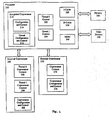
- Fig. 3 shows an alternative implementation in which separate instruction caches and data caches are provided for each thread.
- the processor 300 includes an instruction cache (Icache) 320, 322, a data cache (Dcache) 330, 332, and a context 302, 304 for each of threads Thread0 and Thread1; a memory management unit (MMU) 340; and an integrated coprocessor 310 that has a configuration and controlstate 314 and a thread configuration and control state 316.
- processor 300 is connected to memory 380 and other devices 390.
- processor 300 is connected to a coprocessor 260 and a coprocessor 270. As pointed out above, processor 300 differs from processor 200 by having separate Icaches and Dcaches for each thread (e.g., Thread 0 Icache 320, Thread 1 Icache 322, Thread 0 Dcache 330, and Thread 1 Dcache 332).
- the thread-specific state may be expanded beyond that needed by the processor 200 to include state information that independently configures and controls the per-thread instruction caches 320 and 322.
- the additional state information may be part of the configuration and control state 314, and may be made architecturally invisible through the per-thread register overloading technique previously described.
- the additional state information also may be part of the thread configuration and control state 316, in which case no effort needs to be made to make the information architecturally invisible.
- Elements of the configuration and control of the per-thread instruction and data caches also may be present in both the configuration and control state 314 and the thread configuration and control state 316.
- the described techniques support implementations with many more contexts than just two.
- the techniques support implementations with fewer or more coprocessors than shown in Figs. 2 and 3 .
- the techniques also support implementations with more complex memory hierarchies.
- the processor is augmented to include logic that waits for all threads, or a set of threads, to be in the frozen state, before a particular thread, or a set of threads, is transitioned to the running state.
- the set of threads may be specified in a variety of ways. For example, they may be specified through use of a register that contains a 1 bit for each thread in a set.
- the serial thread T 0 is running and the parallel threads T 1 , T 2 , T 3 are frozen by having appropriate values written to their bits of the register.
- the running serial thread T 0 executes tasks.
- the serial thread T 0 freezes (either by freezing itself or by one of the parallel threads freezing T 0 ) and the parallel threads T 1 , T 2 , T 3 are activated (again, either by activating themselves or by being activated by T 0 ).
- the parallel threads T 1 , T 2 , T 3 then execute their assigned tasks and, upon completion of those tasks, the parallel threads T 1 , T 2 , T 3 return to a frozen state.
- the serial thread T 0 is again activated.
- Table 1 An example of the psuedocode to implement the barrier synchronization example is shown in Table 1: Table 1
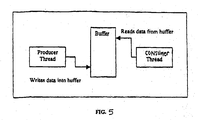
- Fig. 5 shows another implementation that is an example of a producer-consumer scenario in which one or more threads produce data into a buffer and one or more other threads consume the data.
- the producer thread executes tasks that generate data that are stored in the buffer.
- the consumer thread executes tasks that use (consume) the data generated by the producer thread.
- the concern in the relationship of the two threads is preventing over-running or under-running of the shared data buffer by over-production or insufficient use. Thus, the two threads concurrently execute their respective tasks.
- the consumer thread is frozen (e.g., by writing an appropriate value to the appropriate bits of the register) and the producer thread remains in an active state (appropriate bits may be written to the register bits for the producer thread to ensure that the producer thread is in an active state).
- the buffer data location from which the consumer thread is to read data is the next buffer data location in the buffer, the producer thread is frozen (e.g., by writing appropriate values to the appropriate bits of the register). Appropriate values may be written to the register bits for the consumer thread to ensure that the consumer thread is in an active state.
- Table 2 An example of the psuedocode to implement the producer-consumer scenario is shown in Table 2: Table 2
- one or more threads may be dedicated to a particular task, or one or more threads may only wake on interrupt and only process an interrupt, and the memory block may be unified so that all tasks are part of a unified queue.
Landscapes
- Engineering & Computer Science (AREA)
- Software Systems (AREA)
- Theoretical Computer Science (AREA)
- Physics & Mathematics (AREA)
- General Engineering & Computer Science (AREA)
- General Physics & Mathematics (AREA)
- Multimedia (AREA)
- Advance Control (AREA)
- Executing Machine-Instructions (AREA)
- Power Sources (AREA)
- Microcomputers (AREA)
Claims (19)
- Procédé pour assurer un traitement informatique en multithread, le procédé comprenant les étapes consistant à :dédier un registre à la commande de l'exécution et du blocage de threads de traitement multiples, le registre étant inscriptible par chacun des threads de traitement ;faire s'exécuter un thread de traitement par écriture, par un autre thread, d'une première valeur dans un ou plusieurs bits particuliers du registre ; etbloquer le thread de traitement par écriture, par ledit thread ou un autre thread, d'une deuxième valeur dans un ou plusieurs autres bits particuliers du registre.
- Procédé selon la revendication 1, dans lequel le registre est un registre de coprocesseur.
- Procédé selon la revendication 1, dans lequel la première valeur est un "1".
- Procédé selon la revendication 3, dans lequel la deuxième valeur est un "1".
- Procédé selon la revendication 4, dans lequel, si la première valeur ou la deuxième valeur est un "0", le thread de traitement continue de s'exécuter ou reste bloqué.
- Procédé selon la revendication 1, dans lequel l'écriture d'une valeur autre que la deuxième valeur dans le ou les autres bits particuliers du registre n'a aucun effet sur le fait que le thread de traitement soit bloqué ou s'exécute.
- Procédé selon la revendication 1, le procédé comprenant en outre les étapes consistant à :initialiser un processeur ;initialiser n threads de traitement ;faire s'exécuter un premier thread de traitement ;bloquer n-1 threads de traitement ;recevoir une tâche à exécuter ;exécuter la tâche sur le premier thread de traitement ; ets'il existe une tâche supplémentaire, recevoir la tâche supplémentaire et exécuter en simultané la tâche supplémentaire.
- Procédé selon la revendication 7, comprenant, si la tâche supplémentaire exige l'exécution d'un autre thread, l'étape consistant à faire s'exécuter un deuxième thread de traitement et exécuter en simultané la tâche supplémentaire sur le deuxième thread de traitement.
- Procédé selon la revendication 7, dans lequel le processeur comporte au moins une ressource accessible par chacun des n threads de traitement.
- Procédé selon la revendication 9, dans lequel le processeur comporte au moins une ressource accessible par un seul des n threads de traitement.
- Procédé selon la revendication 1, comprenant en outre l'étape consistant à bloquer le thread de traitement et faire s'exécuter un deuxième thread de traitement en réponse à une interruption.
- Système agencé et conçu pour assurer un traitement informatique en multithread, le système comprenant :un registre dédié à la commande de l'exécution et du blocage de threads de traitement multiples, le registre étant inscriptible par chacun des threads de traitement ; etun processeur (200, 300) conçu pour faire s'exécuter un thread de traitement en réponse à l'écriture, par un autre thread, d'une première valeur dans un ou plusieurs bits particuliers du registre, et pour bloquer le thread de traitement en réponse à l'écriture, par ledit thread ou un autre thread, d'une deuxième valeur dans un ou plusieurs autres bits particuliers du registre.
- Système selon la revendication 12, comprenant en outre un coprocesseur (210, 310), dans lequel le registre comprend un registre du coprocesseur.
- Système selon la revendication 12, dans lequel le processeur (200, 300) est conçu de telle sorte que l'écriture d'une valeur autre que la deuxième valeur dans le ou les autres bits particuliers du registre n'a aucun effet sur le fait que le thread de traitement soit bloqué ou s'exécute.
- Système selon la revendication 12, dans lequel le processeur (200, 300) est conçu pour :initialiser n threads de traitement ;faire s'exécuter un premier thread de traitement ;bloquer n-1 threads de traitement ;recevoir une tâche à exécuter ;exécuter la tâche sur le premier thread de traitement ; ets'il existe une tâche supplémentaire, recevoir la tâche supplémentaire et exécuter en simultané la tâche supplémentaire.
- Système selon la revendication 15, dans lequel le processeur (200, 300) est conçu pour faire s'exécuter un deuxième thread de traitement et exécuter en simultané la tâche supplémentaire sur le deuxième thread de traitement si la tâche supplémentaire exige l'exécution d'un autre thread.
- Système selon la revendication 15, dans lequel le processeur (200, 300) comporte au moins une ressource accessible par chacun des n threads de traitement.
- Système selon la revendication 15, dans lequel le processeur (200, 300) comporte au moins une ressource accessible par un seul des n threads de traitement.
- Système selon la revendication 12, dans lequel le processeur (200, 300) est conçu pour bloquer le thread de traitement et faire s'exécuter un deuxième thread de traitement en réponse à une interruption.
Applications Claiming Priority (3)
| Application Number | Priority Date | Filing Date | Title |
|---|---|---|---|
| US162428 | 1988-03-01 | ||
| US10/162,428 US20030225816A1 (en) | 2002-06-03 | 2002-06-03 | Architecture to support multiple concurrent threads of execution on an arm-compatible processor |
| PCT/US2003/017221 WO2003102773A2 (fr) | 2002-06-03 | 2003-05-30 | Architecture permettant de prendre en charge de multiples contextes d'execution en simultanee sur un processeur |
Publications (2)
| Publication Number | Publication Date |
|---|---|
| EP1573532A2 EP1573532A2 (fr) | 2005-09-14 |
| EP1573532B1 true EP1573532B1 (fr) | 2015-06-24 |
Family
ID=29583601
Family Applications (1)
| Application Number | Title | Priority Date | Filing Date |
|---|---|---|---|
| EP03731480.4A Expired - Lifetime EP1573532B1 (fr) | 2002-06-03 | 2003-05-30 | Architecture permettant de prendre en charge de multiples contextes d'execution en simultanee sur un processeur |
Country Status (7)
| Country | Link |
|---|---|
| US (1) | US20030225816A1 (fr) |
| EP (1) | EP1573532B1 (fr) |
| CN (1) | CN100347673C (fr) |
| AU (1) | AU2003240975A1 (fr) |
| MY (1) | MY160949A (fr) |
| TW (1) | TWI243333B (fr) |
| WO (1) | WO2003102773A2 (fr) |
Families Citing this family (30)
| Publication number | Priority date | Publication date | Assignee | Title |
|---|---|---|---|---|
| US20040225840A1 (en) * | 2003-05-09 | 2004-11-11 | O'connor Dennis M. | Apparatus and method to provide multithreaded computer processing |
| US9032404B2 (en) | 2003-08-28 | 2015-05-12 | Mips Technologies, Inc. | Preemptive multitasking employing software emulation of directed exceptions in a multithreading processor |
| EP1658563B1 (fr) * | 2003-08-28 | 2013-06-05 | MIPS Technologies, Inc. | Appareil et méthode pour declenchement de flux d'instructions concurrents dans un microprocesseur a traitement multifiliere |
| US7870553B2 (en) | 2003-08-28 | 2011-01-11 | Mips Technologies, Inc. | Symmetric multiprocessor operating system for execution on non-independent lightweight thread contexts |
| US7594089B2 (en) * | 2003-08-28 | 2009-09-22 | Mips Technologies, Inc. | Smart memory based synchronization controller for a multi-threaded multiprocessor SoC |
| US7836450B2 (en) | 2003-08-28 | 2010-11-16 | Mips Technologies, Inc. | Symmetric multiprocessor operating system for execution on non-independent lightweight thread contexts |
| US7849297B2 (en) | 2003-08-28 | 2010-12-07 | Mips Technologies, Inc. | Software emulation of directed exceptions in a multithreading processor |
| US7418585B2 (en) | 2003-08-28 | 2008-08-26 | Mips Technologies, Inc. | Symmetric multiprocessor operating system for execution on non-independent lightweight thread contexts |
| US7711931B2 (en) * | 2003-08-28 | 2010-05-04 | Mips Technologies, Inc. | Synchronized storage providing multiple synchronization semantics |
| US7475296B2 (en) * | 2004-05-20 | 2009-01-06 | International Business Machines Corporation | Serviceability and test infrastructure for distributed systems |
| US7937709B2 (en) | 2004-12-29 | 2011-05-03 | Intel Corporation | Synchronizing multiple threads efficiently |
| US8079031B2 (en) | 2005-10-21 | 2011-12-13 | Intel Corporation | Method, apparatus, and a system for dynamically configuring a prefetcher based on a thread specific latency metric |
| US8201179B2 (en) * | 2006-05-04 | 2012-06-12 | Oracle America, Inc. | Multi-threaded shared state variable control |
| US7721148B2 (en) * | 2006-06-29 | 2010-05-18 | Intel Corporation | Method and apparatus for redirection of machine check interrupts in multithreaded systems |
| US8056087B2 (en) * | 2006-09-25 | 2011-11-08 | International Business Machines Corporation | Effective use of a hardware barrier synchronization register for protocol synchronization |
| DE102006048379B4 (de) * | 2006-10-12 | 2008-11-06 | Infineon Technologies Ag | Verfahren zur Durchsatzsteuerung einer elektronischen Schaltung sowie entsprechende Durchsatzsteuerung und zugehörige Halbleiterschaltung |
| US8898438B2 (en) * | 2007-03-14 | 2014-11-25 | XMOS Ltd. | Processor architecture for use in scheduling threads in response to communication activity |
| US7853950B2 (en) * | 2007-04-05 | 2010-12-14 | International Business Machines Corporarion | Executing multiple threads in a processor |
| US8181185B2 (en) * | 2007-05-31 | 2012-05-15 | Intel Corporation | Filtering of performance monitoring information |
| CN102067088A (zh) * | 2008-06-19 | 2011-05-18 | 松下电器产业株式会社 | 多处理器 |
| US7930519B2 (en) * | 2008-12-17 | 2011-04-19 | Advanced Micro Devices, Inc. | Processor with coprocessor interfacing functional unit for forwarding result from coprocessor to retirement unit |
| CN101923382B (zh) * | 2009-06-16 | 2013-01-16 | 联想(北京)有限公司 | 一种计算机系统的节能方法及计算机系统 |
| US8832712B2 (en) * | 2009-09-09 | 2014-09-09 | Ati Technologies Ulc | System and method for synchronizing threads using shared memory having different buffer portions for local and remote cores in a multi-processor system |
| US10169072B2 (en) * | 2009-09-23 | 2019-01-01 | Nvidia Corporation | Hardware for parallel command list generation |
| CN102629192A (zh) * | 2012-04-20 | 2012-08-08 | 西安电子科技大学 | 用于片上多核并发多线程处理器的指令包及其操作方法 |
| US9465618B2 (en) | 2014-01-08 | 2016-10-11 | Oracle International Corporation | Methods and systems for optimally selecting an assist unit |
| CN105843592A (zh) * | 2015-01-12 | 2016-08-10 | 芋头科技(杭州)有限公司 | 一种在预设嵌入式系统中实现脚本操作的系统 |
| CN104899039B (zh) * | 2015-06-12 | 2018-12-25 | 百度在线网络技术(北京)有限公司 | 用于在终端设备上提供截屏服务的方法和装置 |
| US11023233B2 (en) * | 2016-02-09 | 2021-06-01 | Intel Corporation | Methods, apparatus, and instructions for user level thread suspension |
| US10503541B2 (en) * | 2017-12-04 | 2019-12-10 | Beijing Panyi Technology Co., Ltd. | System and method for handling dependencies in dynamic thread spawning for a multi-threading processor |
Family Cites Families (6)
| Publication number | Priority date | Publication date | Assignee | Title |
|---|---|---|---|---|
| US5669002A (en) * | 1990-06-28 | 1997-09-16 | Digital Equipment Corp. | Multi-processor resource locking mechanism with a lock register corresponding to each resource stored in common memory |
| US5968157A (en) * | 1997-01-23 | 1999-10-19 | Sun Microsystems, Inc. | Locking of computer resources |
| US6212544B1 (en) | 1997-10-23 | 2001-04-03 | International Business Machines Corporation | Altering thread priorities in a multithreaded processor |
| CN1228557A (zh) * | 1998-03-06 | 1999-09-15 | 刘殷 | 计算机处理器多线程指令级并行技术 |
| US6507862B1 (en) * | 1999-05-11 | 2003-01-14 | Sun Microsystems, Inc. | Switching method in a multi-threaded processor |
| US7120783B2 (en) * | 1999-12-22 | 2006-10-10 | Ubicom, Inc. | System and method for reading and writing a thread state in a multithreaded central processing unit |
-
2002
- 2002-06-03 US US10/162,428 patent/US20030225816A1/en not_active Abandoned
-
2003
- 2003-05-30 AU AU2003240975A patent/AU2003240975A1/en not_active Abandoned
- 2003-05-30 WO PCT/US2003/017221 patent/WO2003102773A2/fr not_active Ceased
- 2003-05-30 EP EP03731480.4A patent/EP1573532B1/fr not_active Expired - Lifetime
- 2003-05-30 CN CNB038186217A patent/CN100347673C/zh not_active Expired - Fee Related
- 2003-06-02 TW TW092114904A patent/TWI243333B/zh not_active IP Right Cessation
- 2003-06-03 MY MYPI20032055A patent/MY160949A/en unknown
Also Published As
| Publication number | Publication date |
|---|---|
| EP1573532A2 (fr) | 2005-09-14 |
| TWI243333B (en) | 2005-11-11 |
| TW200405204A (en) | 2004-04-01 |
| WO2003102773A3 (fr) | 2005-06-30 |
| AU2003240975A1 (en) | 2003-12-19 |
| CN1685315A (zh) | 2005-10-19 |
| HK1078144A1 (en) | 2006-03-03 |
| CN100347673C (zh) | 2007-11-07 |
| WO2003102773A2 (fr) | 2003-12-11 |
| US20030225816A1 (en) | 2003-12-04 |
| MY160949A (en) | 2017-03-31 |
Similar Documents
| Publication | Publication Date | Title |
|---|---|---|
| EP1573532B1 (fr) | Architecture permettant de prendre en charge de multiples contextes d'execution en simultanee sur un processeur | |
| US9069605B2 (en) | Mechanism to schedule threads on OS-sequestered sequencers without operating system intervention | |
| US6587937B1 (en) | Multiple virtual machine system with efficient cache memory design | |
| US8689215B2 (en) | Structured exception handling for application-managed thread units | |
| US6671827B2 (en) | Journaling for parallel hardware threads in multithreaded processor | |
| US5596759A (en) | Method for initializing a multiple processor computer system using a common ROM | |
| CN100383740C (zh) | 挂起线程执行直到发生指定的存储器访问的方法和设备 | |
| US9003421B2 (en) | Acceleration threads on idle OS-visible thread execution units | |
| US20060294326A1 (en) | Primitives to enhance thread-level speculation | |
| US8079035B2 (en) | Data structure and management techniques for local user-level thread data | |
| US7590774B2 (en) | Method and system for efficient context swapping | |
| JP2004326749A (ja) | マルチスレッド・プロセッサを単一スレッド・モード及び同時マルチスレッド・モードの間で動的に切り替える装置及び方法 | |
| IL134823A (en) | Method and device for selecting an event in a multi-process processor | |
| US8516483B2 (en) | Transparent support for operating system services for a sequestered sequencer | |
| Keckler et al. | Concurrent event handling through multithreading | |
| US20070226740A1 (en) | Method and apparatus for global breakpoint for parallel debugging on multiprocessor systems | |
| JP3598282B2 (ja) | コンピュータ、その制御方法及びその制御方法を記録した記録媒体 | |
| Schaelicke et al. | ML-RSIM reference manual | |
| US7516311B2 (en) | Deterministic microcontroller context arrangement | |
| HK1078144B (en) | Architecture to support multiple concurrent execution contexts on a processor | |
| US7562207B2 (en) | Deterministic microcontroller with context manager | |
| WO2006081094A2 (fr) | Microcontroleur deterministe | |
| US20060168420A1 (en) | Microcontroller cache memory | |
| US20060168421A1 (en) | Method of providing microcontroller cache memory | |
| Kinter | The MIPS32® 34K processor: Ultimate design flexibility for embedded applications |
Legal Events
| Date | Code | Title | Description |
|---|---|---|---|
| PUAI | Public reference made under article 153(3) epc to a published international application that has entered the european phase |
Free format text: ORIGINAL CODE: 0009012 |
|
| 17P | Request for examination filed |
Effective date: 20041215 |
|
| AK | Designated contracting states |
Kind code of ref document: A2 Designated state(s): AT BE BG CH CY CZ DE DK EE ES FI FR GB GR HU IE IT LI LU MC NL PT RO SE SI SK TR |
|
| AX | Request for extension of the european patent |
Extension state: AL LT LV MK |
|
| DAX | Request for extension of the european patent (deleted) | ||
| REG | Reference to a national code |
Ref country code: HK Ref legal event code: DE Ref document number: 1078144 Country of ref document: HK |
|
| 17Q | First examination report despatched |
Effective date: 20080214 |
|
| REG | Reference to a national code |
Ref country code: DE Ref legal event code: R079 Ref document number: 60347738 Country of ref document: DE Free format text: PREVIOUS MAIN CLASS: G06F0009460000 Ipc: G06F0009480000 |
|
| RIC1 | Information provided on ipc code assigned before grant |
Ipc: G06F 9/48 20060101AFI20111213BHEP Ipc: G06F 9/38 20060101ALI20111213BHEP |
|
| GRAP | Despatch of communication of intention to grant a patent |
Free format text: ORIGINAL CODE: EPIDOSNIGR1 |
|
| RAP1 | Party data changed (applicant data changed or rights of an application transferred) |
Owner name: INTEL CORPORATION |
|
| INTG | Intention to grant announced |
Effective date: 20150209 |
|
| GRAS | Grant fee paid |
Free format text: ORIGINAL CODE: EPIDOSNIGR3 |
|
| GRAA | (expected) grant |
Free format text: ORIGINAL CODE: 0009210 |
|
| AK | Designated contracting states |
Kind code of ref document: B1 Designated state(s): AT BE BG CH CY CZ DE DK EE ES FI FR GB GR HU IE IT LI LU MC NL PT RO SE SI SK TR |
|
| REG | Reference to a national code |
Ref country code: GB Ref legal event code: FG4D |
|
| REG | Reference to a national code |
Ref country code: CH Ref legal event code: EP |
|
| REG | Reference to a national code |
Ref country code: AT Ref legal event code: REF Ref document number: 733187 Country of ref document: AT Kind code of ref document: T Effective date: 20150715 |
|
| REG | Reference to a national code |
Ref country code: IE Ref legal event code: FG4D |
|
| REG | Reference to a national code |
Ref country code: DE Ref legal event code: R096 Ref document number: 60347738 Country of ref document: DE |
|
| PG25 | Lapsed in a contracting state [announced via postgrant information from national office to epo] |
Ref country code: FI Free format text: LAPSE BECAUSE OF FAILURE TO SUBMIT A TRANSLATION OF THE DESCRIPTION OR TO PAY THE FEE WITHIN THE PRESCRIBED TIME-LIMIT Effective date: 20150624 |
|
| REG | Reference to a national code |
Ref country code: AT Ref legal event code: MK05 Ref document number: 733187 Country of ref document: AT Kind code of ref document: T Effective date: 20150624 |
|
| PG25 | Lapsed in a contracting state [announced via postgrant information from national office to epo] |
Ref country code: GR Free format text: LAPSE BECAUSE OF FAILURE TO SUBMIT A TRANSLATION OF THE DESCRIPTION OR TO PAY THE FEE WITHIN THE PRESCRIBED TIME-LIMIT Effective date: 20150925 Ref country code: BG Free format text: LAPSE BECAUSE OF FAILURE TO SUBMIT A TRANSLATION OF THE DESCRIPTION OR TO PAY THE FEE WITHIN THE PRESCRIBED TIME-LIMIT Effective date: 20150924 |
|
| REG | Reference to a national code |
Ref country code: NL Ref legal event code: MP Effective date: 20150624 |
|
| PG25 | Lapsed in a contracting state [announced via postgrant information from national office to epo] |
Ref country code: EE Free format text: LAPSE BECAUSE OF FAILURE TO SUBMIT A TRANSLATION OF THE DESCRIPTION OR TO PAY THE FEE WITHIN THE PRESCRIBED TIME-LIMIT Effective date: 20150624 |
|
| PG25 | Lapsed in a contracting state [announced via postgrant information from national office to epo] |
Ref country code: CZ Free format text: LAPSE BECAUSE OF FAILURE TO SUBMIT A TRANSLATION OF THE DESCRIPTION OR TO PAY THE FEE WITHIN THE PRESCRIBED TIME-LIMIT Effective date: 20150624 Ref country code: PT Free format text: LAPSE BECAUSE OF FAILURE TO SUBMIT A TRANSLATION OF THE DESCRIPTION OR TO PAY THE FEE WITHIN THE PRESCRIBED TIME-LIMIT Effective date: 20151026 Ref country code: RO Free format text: LAPSE BECAUSE OF NON-PAYMENT OF DUE FEES Effective date: 20150624 Ref country code: ES Free format text: LAPSE BECAUSE OF FAILURE TO SUBMIT A TRANSLATION OF THE DESCRIPTION OR TO PAY THE FEE WITHIN THE PRESCRIBED TIME-LIMIT Effective date: 20150624 Ref country code: AT Free format text: LAPSE BECAUSE OF FAILURE TO SUBMIT A TRANSLATION OF THE DESCRIPTION OR TO PAY THE FEE WITHIN THE PRESCRIBED TIME-LIMIT Effective date: 20150624 Ref country code: SK Free format text: LAPSE BECAUSE OF FAILURE TO SUBMIT A TRANSLATION OF THE DESCRIPTION OR TO PAY THE FEE WITHIN THE PRESCRIBED TIME-LIMIT Effective date: 20150624 |
|
| REG | Reference to a national code |
Ref country code: DE Ref legal event code: R097 Ref document number: 60347738 Country of ref document: DE |
|
| PG25 | Lapsed in a contracting state [announced via postgrant information from national office to epo] |
Ref country code: DK Free format text: LAPSE BECAUSE OF FAILURE TO SUBMIT A TRANSLATION OF THE DESCRIPTION OR TO PAY THE FEE WITHIN THE PRESCRIBED TIME-LIMIT Effective date: 20150624 Ref country code: IT Free format text: LAPSE BECAUSE OF FAILURE TO SUBMIT A TRANSLATION OF THE DESCRIPTION OR TO PAY THE FEE WITHIN THE PRESCRIBED TIME-LIMIT Effective date: 20150624 |
|
| PLBE | No opposition filed within time limit |
Free format text: ORIGINAL CODE: 0009261 |
|
| STAA | Information on the status of an ep patent application or granted ep patent |
Free format text: STATUS: NO OPPOSITION FILED WITHIN TIME LIMIT |
|
| 26N | No opposition filed |
Effective date: 20160329 |
|
| PG25 | Lapsed in a contracting state [announced via postgrant information from national office to epo] |
Ref country code: BE Free format text: LAPSE BECAUSE OF NON-PAYMENT OF DUE FEES Effective date: 20160531 Ref country code: SI Free format text: LAPSE BECAUSE OF FAILURE TO SUBMIT A TRANSLATION OF THE DESCRIPTION OR TO PAY THE FEE WITHIN THE PRESCRIBED TIME-LIMIT Effective date: 20150624 |
|
| PG25 | Lapsed in a contracting state [announced via postgrant information from national office to epo] |
Ref country code: LU Free format text: LAPSE BECAUSE OF FAILURE TO SUBMIT A TRANSLATION OF THE DESCRIPTION OR TO PAY THE FEE WITHIN THE PRESCRIBED TIME-LIMIT Effective date: 20160530 Ref country code: BE Free format text: LAPSE BECAUSE OF FAILURE TO SUBMIT A TRANSLATION OF THE DESCRIPTION OR TO PAY THE FEE WITHIN THE PRESCRIBED TIME-LIMIT Effective date: 20150624 |
|
| REG | Reference to a national code |
Ref country code: CH Ref legal event code: PL |
|
| PG25 | Lapsed in a contracting state [announced via postgrant information from national office to epo] |
Ref country code: CH Free format text: LAPSE BECAUSE OF NON-PAYMENT OF DUE FEES Effective date: 20160531 Ref country code: LI Free format text: LAPSE BECAUSE OF NON-PAYMENT OF DUE FEES Effective date: 20160531 |
|
| REG | Reference to a national code |
Ref country code: IE Ref legal event code: MM4A |
|
| REG | Reference to a national code |
Ref country code: FR Ref legal event code: ST Effective date: 20170131 |
|
| PG25 | Lapsed in a contracting state [announced via postgrant information from national office to epo] |
Ref country code: FR Free format text: LAPSE BECAUSE OF NON-PAYMENT OF DUE FEES Effective date: 20160531 |
|
| PG25 | Lapsed in a contracting state [announced via postgrant information from national office to epo] |
Ref country code: IE Free format text: LAPSE BECAUSE OF NON-PAYMENT OF DUE FEES Effective date: 20160530 |
|
| PG25 | Lapsed in a contracting state [announced via postgrant information from national office to epo] |
Ref country code: SE Free format text: LAPSE BECAUSE OF FAILURE TO SUBMIT A TRANSLATION OF THE DESCRIPTION OR TO PAY THE FEE WITHIN THE PRESCRIBED TIME-LIMIT Effective date: 20150624 Ref country code: NL Free format text: LAPSE BECAUSE OF FAILURE TO SUBMIT A TRANSLATION OF THE DESCRIPTION OR TO PAY THE FEE WITHIN THE PRESCRIBED TIME-LIMIT Effective date: 20150624 |
|
| PGFP | Annual fee paid to national office [announced via postgrant information from national office to epo] |
Ref country code: DE Payment date: 20170523 Year of fee payment: 15 Ref country code: GB Payment date: 20170524 Year of fee payment: 15 |
|
| PG25 | Lapsed in a contracting state [announced via postgrant information from national office to epo] |
Ref country code: CY Free format text: LAPSE BECAUSE OF FAILURE TO SUBMIT A TRANSLATION OF THE DESCRIPTION OR TO PAY THE FEE WITHIN THE PRESCRIBED TIME-LIMIT Effective date: 20150624 Ref country code: HU Free format text: LAPSE BECAUSE OF FAILURE TO SUBMIT A TRANSLATION OF THE DESCRIPTION OR TO PAY THE FEE WITHIN THE PRESCRIBED TIME-LIMIT; INVALID AB INITIO Effective date: 20030530 |
|
| PG25 | Lapsed in a contracting state [announced via postgrant information from national office to epo] |
Ref country code: TR Free format text: LAPSE BECAUSE OF FAILURE TO SUBMIT A TRANSLATION OF THE DESCRIPTION OR TO PAY THE FEE WITHIN THE PRESCRIBED TIME-LIMIT Effective date: 20150624 Ref country code: MC Free format text: LAPSE BECAUSE OF FAILURE TO SUBMIT A TRANSLATION OF THE DESCRIPTION OR TO PAY THE FEE WITHIN THE PRESCRIBED TIME-LIMIT Effective date: 20150624 |
|
| REG | Reference to a national code |
Ref country code: DE Ref legal event code: R119 Ref document number: 60347738 Country of ref document: DE |
|
| GBPC | Gb: european patent ceased through non-payment of renewal fee |
Effective date: 20180530 |
|
| PG25 | Lapsed in a contracting state [announced via postgrant information from national office to epo] |
Ref country code: DE Free format text: LAPSE BECAUSE OF NON-PAYMENT OF DUE FEES Effective date: 20181201 Ref country code: GB Free format text: LAPSE BECAUSE OF NON-PAYMENT OF DUE FEES Effective date: 20180530 |