EP1574095B1 - Zuweisung von zeitschlitzen während der sendepausen einer kommunikation nach einem ersten protokoll zu einer kommunikation nach einem zweiten protokoll - Google Patents
Zuweisung von zeitschlitzen während der sendepausen einer kommunikation nach einem ersten protokoll zu einer kommunikation nach einem zweiten protokoll Download PDFInfo
- Publication number
- EP1574095B1 EP1574095B1 EP02798352A EP02798352A EP1574095B1 EP 1574095 B1 EP1574095 B1 EP 1574095B1 EP 02798352 A EP02798352 A EP 02798352A EP 02798352 A EP02798352 A EP 02798352A EP 1574095 B1 EP1574095 B1 EP 1574095B1
- Authority
- EP
- European Patent Office
- Prior art keywords
- communications
- frame structure
- environment
- communications environment
- transmission gap
- Prior art date
- Legal status (The legal status is an assumption and is not a legal conclusion. Google has not performed a legal analysis and makes no representation as to the accuracy of the status listed.)
- Expired - Lifetime
Links
- 238000004891 communication Methods 0.000 title claims abstract description 577
- 230000005540 biological transmission Effects 0.000 title claims description 220
- 238000000034 method Methods 0.000 claims abstract description 46
- 230000001360 synchronised effect Effects 0.000 claims description 14
- 238000004590 computer program Methods 0.000 claims description 4
- 238000013507 mapping Methods 0.000 description 19
- 238000001228 spectrum Methods 0.000 description 11
- 201000001718 Roberts syndrome Diseases 0.000 description 10
- 208000012474 Roberts-SC phocomelia syndrome Diseases 0.000 description 10
- 238000012986 modification Methods 0.000 description 3
- 230000004048 modification Effects 0.000 description 3
- 238000000926 separation method Methods 0.000 description 3
- 239000002131 composite material Substances 0.000 description 2
- 230000001934 delay Effects 0.000 description 2
- 238000005001 rutherford backscattering spectroscopy Methods 0.000 description 2
- 230000008054 signal transmission Effects 0.000 description 2
- 230000006978 adaptation Effects 0.000 description 1
- 238000013459 approach Methods 0.000 description 1
- 238000004364 calculation method Methods 0.000 description 1
- 239000000969 carrier Substances 0.000 description 1
- 230000006835 compression Effects 0.000 description 1
- 238000007906 compression Methods 0.000 description 1
- 238000001514 detection method Methods 0.000 description 1
- 238000011161 development Methods 0.000 description 1
- 230000018109 developmental process Effects 0.000 description 1
- 230000009977 dual effect Effects 0.000 description 1
- 230000001747 exhibiting effect Effects 0.000 description 1
- 230000002452 interceptive effect Effects 0.000 description 1
- 238000005259 measurement Methods 0.000 description 1
- 238000010295 mobile communication Methods 0.000 description 1
- 230000002123 temporal effect Effects 0.000 description 1
Images






Classifications
-
- H—ELECTRICITY
- H04—ELECTRIC COMMUNICATION TECHNIQUE
- H04B—TRANSMISSION
- H04B7/00—Radio transmission systems, i.e. using radiation field
- H04B7/24—Radio transmission systems, i.e. using radiation field for communication between two or more posts
- H04B7/26—Radio transmission systems, i.e. using radiation field for communication between two or more posts at least one of which is mobile
- H04B7/2618—Radio transmission systems, i.e. using radiation field for communication between two or more posts at least one of which is mobile using hybrid code-time division multiple access [CDMA-TDMA]
-
- H—ELECTRICITY
- H04—ELECTRIC COMMUNICATION TECHNIQUE
- H04B—TRANSMISSION
- H04B7/00—Radio transmission systems, i.e. using radiation field
- H04B7/24—Radio transmission systems, i.e. using radiation field for communication between two or more posts
- H04B7/26—Radio transmission systems, i.e. using radiation field for communication between two or more posts at least one of which is mobile
- H04B7/2643—Radio transmission systems, i.e. using radiation field for communication between two or more posts at least one of which is mobile using time-division multiple access [TDMA]
- H04B7/2656—Radio transmission systems, i.e. using radiation field for communication between two or more posts at least one of which is mobile using time-division multiple access [TDMA] for structure of frame, burst
-
- H—ELECTRICITY
- H04—ELECTRIC COMMUNICATION TECHNIQUE
- H04W—WIRELESS COMMUNICATION NETWORKS
- H04W16/00—Network planning, e.g. coverage or traffic planning tools; Network deployment, e.g. resource partitioning or cells structures
- H04W16/14—Spectrum sharing arrangements between different networks
-
- H—ELECTRICITY
- H04—ELECTRIC COMMUNICATION TECHNIQUE
- H04W—WIRELESS COMMUNICATION NETWORKS
- H04W72/00—Local resource management
- H04W72/12—Wireless traffic scheduling
- H04W72/1215—Wireless traffic scheduling for collaboration of different radio technologies
-
- H—ELECTRICITY
- H04—ELECTRIC COMMUNICATION TECHNIQUE
- H04W—WIRELESS COMMUNICATION NETWORKS
- H04W56/00—Synchronisation arrangements
-
- H—ELECTRICITY
- H04—ELECTRIC COMMUNICATION TECHNIQUE
- H04W—WIRELESS COMMUNICATION NETWORKS
- H04W84/00—Network topologies
- H04W84/02—Hierarchically pre-organised networks, e.g. paging networks, cellular networks, WLAN [Wireless Local Area Network] or WLL [Wireless Local Loop]
- H04W84/04—Large scale networks; Deep hierarchical networks
-
- H—ELECTRICITY
- H04—ELECTRIC COMMUNICATION TECHNIQUE
- H04W—WIRELESS COMMUNICATION NETWORKS
- H04W88/00—Devices specially adapted for wireless communication networks, e.g. terminals, base stations or access point devices
- H04W88/08—Access point devices
- H04W88/10—Access point devices adapted for operation in multiple networks, e.g. multi-mode access points
Definitions
- the present invention relates, in general, to an operation of a communications environment wherein communications resources provided for a first communications standard are utilized for communications according to a second communications standard.
- the present invention particularly relates an operation of different communications environments in a common frequency range and, in particular, to TDMA based communications such as used in a GSM/GPRS communications environment in a W-CDMA based communications environment like UMTS.
- the present invention relates to allocating frequencies used for communications according to a first communications standard of a communications environment for communications according to a second communications standard of the same communications environment like an UMTS communications environment.
- new frequency spectra have been allocated for so-called 3G (third generation) mobile communication systems (for example the W-CDMA based UMTS Terrestrial Radio Access Network UTRAN).
- 3G third generation
- the new frequency spectra have been allocated such that frequency spectra already allocated for 2G (second generation) communications environments, such as GSM networks, are not cooperatively used and affected.
- specific frequencies are associated to each communications environment possibly leading to transmission capacity problems in a communications environment in case the allocated frequencies are not sufficient.
- frequencies can be commonly used by different communications environments.
- 3G communications environments will share the same frequency spectrum with 2G communications environments, such as the 1.900 MHz PCS frequency bands.
- 2G communications environments such as the 1.900 MHz PCS frequency bands.
- a frequency spectrum presently used for 2G communications environments namely the 1.800 MHz frequency band, could be also allocated to 3G communications environments.
- a frequency spectrum allocated to a 3G communications environment is desired to be used for transmissions in a 2G communications environment.
- an adaptation of the frequency planning of at least one of the communications environments will be necessary due to the different standards defined for example with respect to the allocation of physical channels and mapping of transport channels onto physical channels.
- HSDPA High Speed PacketDownlink Access
- An indoor CDMA network is operated within a coverage area of an outdoor CDMA network.
- the document suggests a synchronization procedure for a mobile station.
- the mobile station detects a phase or a spreading code of an interfering signal from the outdoor network.
- the mobile station further detects a phase or a spreading code of a signal from the indoor network. Based on these detections, the mobile station calculates a phase error or a spreading code shift and adjusts a timing of transmitted signals in order to reduce the phase error or the spreading code shift.
- An object of the present invention is to provide for solutions to overcome the above named problems concerning transmission capacities and transmission rates.
- the present invention should allow communications within different communications environments or in a single communications environment which are based on different standards in a common frequency range, preferably avoiding the above named problem of radio signal interferences and drawbacks resulting there from.
- the present invention should allow communications of a TDMA based communications environment (e.g. GSM/GPRS communications environment) to be accomplished in the same frequency range used by a W-CDMA based communications environment (e. g. UMTS) and communications based on FDD in a communications environment to be performed in the same frequency range used for communications based on TDD in the same communications environment.
- a TDMA based communications environment e.g. GSM/GPRS communications environment
- W-CDMA based communications environment e. g. UMTS
- the above-stated object is achieved with a method according to claim 1.
- the above-stated object is achieved with a communications environment according to claim 14.
- the above-stated object is achieved with a user equipment according to claim 22.
- radio base station according to claim 24.
- the expression "communications environment” will refer to environments which provide for communications by means of communications systems, communications networks, communications units, communications devices and the like as well as to methods used therein for communications.
- the expression "communications standard” will refer to standards, specifications, definitions and the like according to which communications is performed in a communications environment.
- the method for operating the first communications environment is also for operating a second communications environment.
- the first communications standard is defined for communications in the first communications environment
- the second communications standard is defined for communications in the second communications environment. Then it might be necessary to operate the second communications environment such that its communications are at least partially performed in the first communications environment in line with the first communications standard.
- Communications in the first and second communications environment can be performed in a common frequency range, which is an example for a communications resource.
- frequency range as used herein also refers to single frequencies, frequency bands, multiple separated frequencies, multiple separated frequency band etc.
- a first frame structure is transmitted in the common frequency range, wherein the first frame structure includes at least one transmission gap, i.e. a portion or duration with no transmissions for communications in the first communications environment.
- Communicating in the second communications environment is performed by transmitting a second frame structure in the common frequency range, wherein at least a part of the second frame structure is transmitted during the at least one transmission gap.
- frame structure will refer, in general, to a predefined arrangement (e.g. frame sequences, frame assignment for content data, control data etc. transmissions, etc.) of frames predefined for a communications environment.
- frame structure will refer to multiframes defined for frames used in GSM/(E)GPRS and UMTS communications environments (TDMA and W-CDMA frames).
- superiorframe refers to frame structures which utilize frames predefined for a communications environment but in a different arrangement (e.g. idle, data and control frames is a different sequence).
- a superiorframe will refer to modified/varied multiframes using respective frames of these communications environments.
- superiorframes for the first and second communications environments can be defined in relation to each other.
- a superiorframe for the first frame structure and a superiorframe for the second frame structure can have the same duration.
- one or both superiorframes can include more than one of the respective frame structure.
- the second frame structure or at least a part thereof can be transmitted during two, three or more transmission gaps.
- a plurality of subsequent ones of first frames is transmitted, at least one of the first frames including a transmission gap.
- the second frame structure or at least a part of the second frame structure is transmitted during at least one transmission gap of subsequently transmitted first frames.
- communications in the second communications environment can be based on a transmission of subsequent second frames.
- Superiorframes defined in relation to each other can also be based on the first and second frames.
- a superiorframe for the first frame structure and a superiorframe for the second frame structure can be defined such that both the number of first frames and the number of the second frames forming a respective superiorframe are integers.
- the first frame structure comprises W-CDMA frames, preferably a predefined number thereof, while the second frame structure is formed by TDMA frames, also preferably a predefined number thereof.
- the first frame of a number of first slots wherein the at least one transmission gap is defined on slot basis by a first predefined number of first slots.
- the second frame includes a number of second slots.
- the at least one transmission gap includes slots of only one of the first frames or that the at least one transmission gap includes slots of two consecutive ones of first frames. While the first alternative provides for transmission gaps within first frames, the second alternative provides for transmission gaps bridging two consecutive first frames. This can be compared to the so-called single-frame and double-frame methods defined for UMTS communications environments. For executing communications with respect to the second communications environment, it is possible that a second predefined number of second slots or a second predefined number of second frames employed for the second communication environment is transmitted during the at least one transmission gap.
- the communicating in the first and second communications environments can be synchronized such that a frame timing for the first frame structure is synchronized with the frame timing for the second frame structure or vice versa.
- the first and second frame structures are synchronized in time for mapping to each other.
- the first frame structure By defining the first frame structure such that the transmission gap has a predefined position therein and/or such that the transmission gap has a predefined length data, traffic control and scheduling demands for communicating in the first and second communications environments are reduced.
- timing information For synchronizing purposes, it is contemplated to transmit timing information between the first and second communications environments.
- the first communications environment is an UMTS environment while the second communications environment is a GSM/GPRS environment.
- the method is used for operating the first communications environment only.
- both the first and the second communications standard are defined for the first communications environment.
- a first frequency range is defined for communications according to a first communications standard
- a second frequency range is defined for communications according to the second communications standard.
- Such definitions of frequencies allow for communications according to the first and second communications standard in separate frequency ranges if such communications are to be performed.
- the frequency range defined for that communication standard could be utilized - at least partially - for communications according to the other communications standard. In particular, this accomplished by allocating at least a part of the second frequency band for communications according to the first communication standard.
- the second frequency band originally intended for communications according to the first communications standard is at least partially available for communications according to the first communications standard.
- communications according to the first communications standard are based on a frequency division multiplex (FDD) method and a respectively defined first communications standard.
- FDD frequency division multiplex
- second communications standard employ a time division duplex (TDD) method and a respectively define second communication standard.
- a duplex distance for frequency ranges or parts thereof of the first communications standard In view of communications according to the first communication standard on the basis of a frequency division duplex method, it is preferred to vary a duplex distance for frequency ranges or parts thereof of the first communications standard. Such a duplex distance variation can be obtained by means of allocating the second frequency range or parts thereof for communications according to the first communication standard. Further, it is preferred that the variation of the duplex distance is performed in view of uplink and downlink frequency ranges provided for communications according to the first communication standard.
- the first communications environment is W-CDMA based communications environment like an UMTS communications environment.
- the present invention also teaches a communications environment wherein communications resources for communications according to a first communications standard are used for communications according to a second communications standard. Preferred embodiments which illustrate the present invention in a more vivid manner are described in the following.
- the communications environment comprises first and second communications environments and a common frequency range for communications therein.
- the communications environment comprises at least one first communications unit for transmitting a first frame structure in the common frequency range.
- the first frame structure includes at least one transmission gap during which no transmissions occur with respect to the first communications environment.
- at least one second communications unit thereof is provided which transmits a second frame structure in the common frequency range.
- the at least one communications unit for the second communications environment is adapted to transmit at least a part of the second frame structure during the at least one transmission gap.
- the at least one first communications unit receives and/or transmits the first frame structure via the common frequency range.
- the at least one second communications unit receives and/or transmits the at least part of the second frame structure during the at least one transmission gap in the common frequency range.
- a common timing unit is used for the at least one first and second communication units.
- the first timing unit is used for the at least one first communications unit, while a second timing unit will be employed for the at least one second communications unit.
- the first and second timing units are synchronized to obtain synchronized communications in the first and second communications environments.
- the at least one first and second communications unit form a part of an integrated communications unit which services communication in both the first and the second communications environments.
- examples for the first and second communication units comprises radio network controllers and notes (UMTS) and base station controllers and base transceiver stations (GSM/GPRS).
- UMTS radio network controllers and notes
- GSM/GPRS base station controllers and base transceiver stations
- the communication environment in view of the first aspect of the present invention further comprises at least one first user equipment for communications in the first communications environment.
- at least one second user equipment is provided for communications in the second communications environment.
- the first user equipment can communicate mainly on the basis of the first frame structure.
- the second user equipment allows communications by means of the at least a part of the second frame structure which is transmitted (sent/received) during the at least one transmission gap. Further, it is possible that the second user equipment also allows for communications on the basis of the second frame structure within the first communications environment.
- Preferred examples of the first and second communications environments include UMTS environments and GSM/GPRS environments, respectively.
- the communications environment comprises the first communications environment only.
- both the first and the second communications standards are defined for the first communications environment.
- this communications environment comprises at least one communications unit for communications according to the first and the second communications standard.
- a communications environment can comprise a first frequency range and a second frequency range for communications according to the first communications standard and the second communications standard, respectively.
- the at least one communications unit comprises means or units to allocate the second frequency range or at least parts thereof to be available for first communications standard communications.
- the at least one communications unit is adapted to communicate in line with the first communications standard on the basis of communications executed via the allocated (parts of the) second frequency range.
- a preferred example for the at least one communications unit is a communications unit being operated on the basis of a frequency division duplex (FDD) method for first communications standard communications and on the basis of time division duplex (TDD) methods for second communications standard communications.
- FDD frequency division duplex
- TDD time division duplex
- the at least one communications unit is adapted to vary a duplex distance between frequency ranges provided for the first communications standard. This can be accomplished by means of the allocation of the second frequency range or parts thereof as described above. Further, it is preferred, that the at least one communication unit varies the duplex distance with respect to uplink and downlink frequency ranges for the first communications standard.
- Such communications units include nodes, radio network controllers, mobile end user equipment and the like for and UMTS communications environment.
- the first communications is an UMTS environment.
- W-CDMA based communications environments are contemplated.
- the present invention provides a user equipment, radio base stations and computer program products as defined in the claims.
- TDMA and W-CDMA communications environments examples include GSM/GPRS communications environments and UMTS communications environments.
- the principles and embodiments of the present invention given with respect to these specific communications environments also apply for other scenarios where different communications environments, i.e. communications environments according to different standards, or a different single communications environment share a same frequency spectrum or frequency band for its communications.
- the present invention will allow for a co-existence and integral cooperation of different communications environments and of different communications standards in single communications environment.
- the first and second communications standards are defined for different communications environment, namely an UMTS communications environment and a GSM/GPRS communications environment.
- a so-called compressed mode has been defined by the third generation partnership project 3GPP.
- the compressed mode which is applicable for both uplink and downlink communications so-called transmission gaps are introduced in frame structures during which no data are transmitted. That means that during some periods in a frame structure no usable data will be communicated between user equipment UE (such as a mobile telephone) and an associated radio base station (i. e. so-called nodes according to the UMTS specifications functionally corresponding to a base transceiver station BTS in a GSM communications environment).
- Usable data refers to data which are usable by a user of a user equipment, such as voice messages, fax, e-mail, alphanumerical and/or graphical data, video and/or audio data and the like. Compressed mode operation is described, for example, in 3GPP TS 25.212 V3.5.0, wherein the transmission gaps are used for measurement purposes.
- such transmissions gaps of one communications environment can be used for communications in another communications environment.
- GSM/GPRS communications transmissions can be executed during transmissions gaps of an UMTS communications environment.
- One of the basic ideas employed in the preferred embodiments is to utilize transmission gaps which occur in the compressed mode specified for UMTS to execute GSM/GPRS communications when UMTS and GSM/GPRS communications environments are operated in the same frequency range. As a result, the common frequency resources are shared between both communications environments by time multiplexing.
- Downlink communications are performed on the basis of time multiplexing, while uplink communications employ I/Q multiplexing.
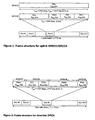
- a frame used for uplink communications comprises several slots which are structured in dependence of data (e. g. speech or content data) and control signals.
- slots of a frame for uplink communications comprises the upper structure shown in fig.1.
- each slot comprises a plurality of data bits which are transmitted in a respective frame via a dedicated physical data channel DPDCH.
- the slots of a frame comprise the structure shown in the middle of fig. 1.
- each slot comprises several pilot bits, a transport format combination indicator TFCI, feedback information FBI data and transmit power control TPC data.
- Frames comprising such slots are communicated via a dedicated physical control channel DPCCH.
- DPDCH and DPCCH are I/Q multiplexed within each frame.
- downlink communications in a UMTS communications environment for DPDCH and DPCCH are multiplexed in the time domain.
- downlink DPCH can be seen as time multiplex of uplink DPDCH and uplink DPCCH.
- a frame used in downlink communications comprises several slots having the structure shown in this figure. Each slot comprises first data (data 1), transmit power control TPC data, transport format combination indicator TFCI data, second data (data 2) and pilot data.
- GPRS has been defined for GSM communications environment and uses a packet-mode technique to communicate packets of data (e.g. content data) by means of radio signals in the GSM communications environment, for example to/from a user equipment UE or mobile station MS.
- packet-mode technique to communicate packets of data (e.g. content data) by means of radio signals in the GSM communications environment, for example to/from a user equipment UE or mobile station MS.
- data e.g. content data
- GPRS which has to be understood to include EGPRS (enhanced GPRS)
- new physical channels or logical channels are defined, wherein uplink and downlink channels are allocated separately.
- packet data channels PDCHs are used for uplink and downlink communications.
- the multiframe structure for a PDCH consists of 52 TDMA frames including 12 radio blocks B0, ..., B11 each thereof including 4 frames, 2 idle frames X and 2 frames T used for the so-called packet timing advance control channel PTCCH for timing control purposes.
- the length of the multiframe structure, i.e. of 52 TDMA frames, is 240 ms.
- mapping of packet data is also possible for any other channel used in a GSM communications environment, such as PBCCH, PCCCH, PACCH, PDTCH, CFCCH, CSCH, CPBCCH, CPCCCH, PACCH, CTSCCH and CTS which also use a multiframe structure of 52 TDMA frames. Further, mapping can be contemplated for other channels of a GSM communications environment which are based on different multiframe structures including 26 TDMA frames (e.g. TCH, FACCH) or 51 TDMA frames (e.g.
- BCCH, CCCH, SDCCH, PBCCH and PCCCH BCCH, CCCH, SDCCH, PBCCH and PCCCH.
- data packet based transmissions will require some modifications of transmission standards and specifications of today's GSM based communications environments, this is important to notice since the use of data packet transmissions will allow utilizing idle periods in one communications environment (e.g. transmission gaps TGs in an UMTS communications environment) for communications in another communications environment.
- employing a broader range of data packet based transmissions in a communications environment will allow for performing a higher amount of transmissions of that communications environment in another communications environment during its idle periods.
- a so-called compressed mode is defined wherein slots having a transmission gap length TGL are not used for transmissions of data.
- transmission gap length TGL defines the number of consecutive empty slots (i.e. slots without usable data) which can be obtained with a transmission time reduction method.
- UMTS employs W-CDMA frames each having a duration of 10 ms and including 15 slots each with a duration of 0.666 ms.
- a number of 12 W-CDMA frames forms a W-CDMA frame structure having a duration of 120 ms.
- information e.g. speech data, content data, control signals and the like
- the maximum idle length i.e. the maximal transmission gap length TGL
- TGL the maximal transmission gap length
- a transmission gap can be located within a W-CDMA frame such that at least on slot of that W-CDMA frame is arranged before and after the transmission gap.
- transmission gaps of consecutive W-CDMA frames will be separated by at least one slot.
- a transmission gap can be located within two consecutive W-CDMA frames such that the respective two W-CDMA frames are bridged.
- no W-CDMA slot will be arranged between the parts of transmission gap of the two consecutive W-CDMA frames.
- TGL 7 slots per W-CDMA frame
- Uplink communications according UMTS employ a slot structure as illustrated in fig. 1.
- the upper slot structure in fig. 1 designated by the term "data” forms consecutive uplink UMTS slots (two slots shown) which can be separated by transmission gaps TGs (one transmission gap TG shown) when operated for uplink compressed transmission.
- data slots are communicated via an associated physical channel such that for a compressed mode operation this physical channel is not used during transmission gaps between single data frames.
- control slots are used which have the lower structure illustrated in fig. 1 .
- each control slot comprises pilot data Pilot, a transmit format combination indicator TFCI, a final block indicator FBI and transmit power control TPC data.
- the control slots form consecutive uplink UMTS slots (two control slots shown) which can be separated by transmission gaps TGs (one transmission gap TG shown) for uplink compressed transmission. Comparable to data slots control slots are transmitted via an associated physical channel. As a result, during transmission gaps with respect to control slots this physical channel is not utilized.
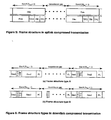
- UMTS downlink communications utilize a different frame structure compared to uplink communications, as shown in fig. 2.
- a frame structure type A uses slots with data data 1 (e.g. speech data or content data), transmit power control TPC data, a transmit format combination indicator TFCI, further data data 2 (e.g. speech or content data) and pilot data PL.
- data data 1 e.g. speech data or content data
- TPC data transmit power control
- TFCI transmit format combination indicator
- further data data 2 e.g. speech or content data
- pilot data PL For downlink compressed transmissions consecutive slots are separated by a transmission gap TG wherein pilot data PL of the last slot in the transmission gap TG is transmitted while transmission is turned off during the rest of the transmission gap TG.
- pilot data PL of the last slot of the transmission gap TG precedes the first data of the subsequently transmitted slot.
- the frame structure type A maximizes the transmission gap length TGL, while the frame structure type B (shown in fig. 6(b)) is optimized for power control.
- the structure of slots for frame structure type B corresponds to the structure for slots of frame structure type A.
- the transmit power control TPC data of a respective slot in the transmission gap TG and the pilot data PL of the last slot in the transmission gap TG are transmitted. For the remaining part of the transmission gap TG, transmission is turned off.
- a transmission gap TG is located within a W-CDMA frame, while according to the so-called double-frame method (shown in fig. 7(2)) a transmission gap TG is positioned between two consecutively transmitted W-CDMA frames.
- Illustrative examples for transmission gap positions for the single-frame method and the double-frame method are shown in fig. 8.
- transmission gaps TGs existing for the compressed mode in UMTS are used for GSM/GPRS transmissions. This is possible since during transmission gaps TGs no transmissions are executed with respect to the UMTS communications environments and due to the fact that GSM/GPRS communications are performed on data packet basis.
- the transmission gaps provide for transmission resources available for GSM/GPRS communications, while data packet based communications allow for a transmission of single TDMA frames and/or slots without affecting data to be transmitted.
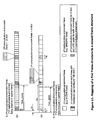
- the multiframe structure defined for GSM/GPRS communications results in TDMA frame structure having a duration of 240 ms. This corresponds with the duration of two consecutive W-CDMA frame structures each having a length of 120 ms. Therefore, a mapping of TDMA frame structure to W-CDMA frame structure is chosen in a relation of 1:2, i.e. one TDMA frame structure will be mapped to two consecutive W-CDMA frame structures. Since not all slots of a W-CDMA frame will be idle slots and only W-CDMA slots of transmission gaps are used for transmissions of GSM/GPRS data, the mapping will be further performed on W-CDMA slot basis.
- a TDMA frame structure (52 TDMA fames) is "synchronized" with respect to two W-CDMA frame structures and that single TDMA frames and/or single slots of a TDMA frame of the TDMA frame structure will be mapped to transmission gap slots of two W-CDMA frame structures.
- TDMA frames or slots of TDMA frames for mapping to transmission gaps depends, inter alia, from used transmission gap lengths, time periods between consecutive transmission gaps, data to be transmitted in the GSM/GPRS communications environment, properties of data packets employed in TDMA frame structures and the like. For example, during a transmission gap having a length of one W-CDMA slot (i.e. 0.666 ms), a TDMA slot (i.e. 0.576 ms) can be transmitted. As further examples, for a transmission gap length of 4.666 ms (single-frame method) a TDMA frame (i.e. 8 TDMA slots; 4.615 ms) can be transmitted, while for a transmission gap length of 9.333 ms (double-frame method) two TDMA frames (i.e. 16 TDMA slots; 9.231 ms) can be transmitted.
- the same transmission capacities for GSM/GPRS communications via an UMTS communications environment can be realized. It can be expected that the latter example will require more synchronization efforts to map each of the 24 TDMA frame to a transmission gap, in contrast to the previous example wherein 12 pairs of TDMA frames are mapped to 12 transmission gaps.
- Such frame structures will also be referred to as 6-superiorframe as they rely on TDMA and W-CDMA frames for GSM/GPRS and UMTS communications, respectively, but are different compared to the "original" GSM/GPRS and UMTS frame structures as least with respect to the use of frames for communications.
- TDMA frames can be transmitted.
- TDMA frames T used for PTCCH see fig. 3 are not contemplated for transmission in an UMTS communications environment, while the "synchronization" of the TDMA and W-CDMA frame structures is performed such that TDMA idle frames X (see fig. 3) occur a time where no transmission gap is existing.
- synchronized refers to a transmission of TDMA frame structures in a fixed time relation to W-CDMA frame structures, which also includes a temporal offset between the beginning of a TDMA frame structure and the beginning of the first one of two W-CDMA frame structures associated thereto.
- a time offset between the GSM/GPRS and UMTS frame structures can be implemented. This will allow for an aligning of a first of the TDMA frames or slots with a first W-CDMA slot of a first of the transmission gaps TGs intended for GSM/GPRS transmissions. Further, as described above, transmission gap lengths TGLs and positions of transmission gaps TGs in the W-CDMA frame structure can be specified within certain limits which is indicated by arrow t per in fig. 9.
- a mapping of a frame structure including 51 TDMA frames to a W-CDMA frame structure is performed independently of the overall duration of the TDMA frame structure and the W-CDMA frame structure. Then, the mapping can be performed on W-CDMA slot basis only.
- GSM/GPRS communications environments this allows to use standard equipment (e.g. radio base stations, user equipment) and transmission standards (e.g. frame structures) specified for these communications environments.
- standard equipment e.g. radio base stations, user equipment
- transmission standards e.g. frame structures
- a new TDMA frame structure or TDMA superiorframe as illustrated in Fig. 10 can be used.
- This modified TDMA frame structure i.e. a superiorframe, which also includes 52 TDMA frames is in particular suitable for the scenario illustrated in Fig. 9.
- the TDMA superiorframe structure shown in Fig. 10 provides 2 radio blocks useable for (E)GPRS communications.
- One of these radio blocks comprises two structures Ba and Bb (half a radio block) each including two bursts.
- Ba and Bb are separated by 11 TDMA frames which are not utilized for GSM/GPRS communications.
- the other of these radio blocks comprises structures Bc and Bd each thereof also including two bursts.
- the separation by 11 idle TDMA frames applies to all of the structures Ba, Bb, Bc and Bd.
- Fig. 10 illustrates a 13-superiorframe.
- the TDMA superiorframe shown in Fig. 10 includes no TDMA frames for PTCCH.
- corresponding packet data channels can only be used as "secondary channels" in order to increase the transmission capacity. That means, that packet data channels being communicated by means of TDMA superiorframe of Fig. 10 during transmission gaps of W-CDMA frames will be used in addition to a "standard" packet data channel which provides PTCCH and are linked thereto.
- an another or an additional transmission gap pattern can be configured.
- Fig. 11 illustrates, in a general manner, mapping of frame structures of a communications environment to frame structures of another communications environment.
- a first communications environment is used for transmissions of communication in a second communications environment.
- the first communication environment uses first frames each thereof consisting of a number of s1 slots.
- the second communications environment utilizes second frames each thereof comprising a number of s2 slots.
- a first frame has a duration of t1, while second frames have a duration of t2.
- a number of f1 first frames forms a specific first frame structure referred to as f1-superiorframe with f1 being set to an actual value.
- a number f2 of second frames forms a specific second frame structure referred to as f2-superframe with f2 being set to an actual value.
- transmission gaps are defined such that for a period, also referred to as transmission gap length, no transmissions of communications to be performed in the first communications environment occur. Those transmissions gaps which are configured on slot basis can be used for transmissions of communications of the second communications environment.
- t per transmission gaps or idle periods in the first communications environment can be specified within limits determined, for example by a defined maximum transmission gap length and/or a defined minimum number of first frames or slots thereof to be used for transmissions.
- the first and second communications environments are synchronized such that transmissions gaps in the first communications environment occur substantially at the same time second frames or slots thereof to be transmitted in the first communications environment occur or are available in the second communications environment.
- Such synchronization is generally recommended on frame structure or superiorframe basis. If, for example, a second frame structure or superiorframe is defined that match better to more than one second frame structure or superiorframe than to a single one thereof, synchronization can also be performed on the basis of multiples of frame structures or superiorframes.
- frame structures or superiorframes for the first and second communications environment are defined as follows.
- the duration (f1 x t1) of the first superiorframe and the duration (f2 x t2) of the second superiorframe are the same and define a superiorframe duration Tmin_comm which is indicated in Fig. 11.
- the first superiorframe will comprise one first frame
- the second superiorframe will comprise one second frame.
- the number f1 for the first superiorframe will be 6, while the number f2 for the second superiorframe will be 13.
- a so-called 6-superiorframe will be obtained as first superiorframe, i.e. superiorframe comprising 6 W-CDMA frames
- a so-called 13-superiorframe will be obtained as second superiorframe, i.e. a superiorframe comprising 13 TDMA of frames.
- Both the first and the second superiorframes have a superiorframe duration Tmin_comm of 60 ms.
- a time of set between the first and second superiorframes can be implemented. This will allow for aligning a first one of second frames in the second superiorframe with a first one of first frames of a transmission gap in the first superiorframe. Comparable thereto, such an alignment can also be based on slot basis.
- the GSM/GPRS transmission capacity can be selected within certain limits. For example, W-CDMA frame transmission gaps TGs should be positioned such that simultaneous transmissions in both the GSM/GPRS and UMTS communications environments are avoided. Further, the scheduling of GSM/GPRS communications and actual transmissions should be controlled accordingly.
- GSM/GPRS and UMTS communications environments exhibit some differences with respect to their network structure, from a functional point of view, the network structures of these communications environments are similar.
- the function of a base transceiver station BTS in a GSM/GPRS communications environment essentially corresponds with a node in an UMTS communications environment.
- a base station controller BSC for GSM/GPRS and a radio network controller RNC for UMTS In principle, such network components of these communications environments serve as units to and from which communications links are established and maintained from and to user equipment like mobile devices (such as mobile telephones).
- radio base station RBS will be used to designate such network structures and/or components of the different communications environments.
- radio base stations RBSs for these communications environments are synchronized.
- basically two different scenarios can be considered:
- each single-mode radio base station includes its own timing unit.
- the TDMA radio base station and the W-CDMA radio base station may thus be synchronized to achieve a common frame timing for example by means of respective timing signals communicated between the radio base stations and, in particular, its timing units.
- a single radio base station is utilized for communications with respect to both GSM/GPRS and UMTS communications environments.
- a dual mode radio base station RBS comprises TDMA base station equipment for GSM/GPRS and W-CDMA base station equipment for UMTS.
- a common timing unit is included which provides for timing and synchronization information to the different base station equipments inside the dual-mode radio base station RBS. As a result, synchronization and, in particular, common frame timing is implicitly achieved.
- GSM/GPRS transmissions should be controlled such that transmission collisions of GSM/GPRS and UMTS transmissions are avoided. This means that for GSM/GPRS transmissions only transmission gaps TGs which are due to the compressed mode of UMTS should be utilized.
- TGs transmission gaps which are due to the compressed mode of UMTS should be utilized.
- other types of GSM communications are not executed on data packet basis such that a distribution of other standard GSM communications to different transmission gaps cannot be obtained in general. Therefore, in the following it is assumed that GSM communications being no GSM/GPRS communications are performed in a frequency range outside the frequency range to be shared by GSM/GPRS and UMTS communications.
- the resulting demands on control and scheduling can be subdivided in a configuration of transmission gaps TGs in the UMTS communications environment and a scheduling of GSM/GPRS communications in view of a transmission gap configuration.
- some control and scheduling functionalities are implemented for the GSM/GPRS and UMTS communications environments.
- the packet control unit PCU schedules downlink GSM/GPRS transmissions for usable radio blocks only. Further, the packet control unit PCU only assigns usable radio blocks for uplink GSM/GPRS transmissions to for example GSM/GPRS mobile equipment.
- radio base station RBS equipment (see fig. 12 and 13) servicing the GSM/GPRS communications environment does not transmit usable data outside usable radio blocks and packet timing advance control channel PTCCH frames in the shared frequency band.
- the respective radio base station RBS equipment (see fig. 12 and 13) is configured to utilize the compressed mode for W-CDMA frame transmissions when radio resources are allocated and used within the frequency range shared with GSM/GPRS communications. Also, equipment of the UMTS communications environment is configured to use the compressed mode when such radio resources are allocated and used.
- new communications channel combinations can be used to indicate a mixed communications mode (i.e. shared frequency ranges for both GSM/GPRS and UMPS communications).
- PTCCH packet timing advance control channel
- Information about a mixed communications mode can be for example broadcasted over a broadcast control channel BCCH for a GSM/GPRS communications environment.
- the first and second communications standards are defined for a common communications environment.
- frequency division duplex (FDD) and time division duplex (TDD) based communications are employed as first and second communications standards, respectively, in an UMTS communications environment as common communications environment.
- FDD frequency division duplex
- TDD time division duplex
- HSDPA High Speed Packet downlink access
- HSDPA High Speed Packet Downlink Access
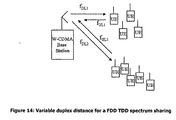
- HSDPA channel usually several end user devices such as user equipment UE shown in Fig. 14, share one HSDPA channel.
- An allocation of this channel to different user equipment UE depends, inter alia, from implemented algorithms, the desired quality of the radio link and the required data through put.
- An allocation of the HSDPA channel to different user equipment UE is accomplished via time multiplexing.
- communications via a HSDPA channel are performed on the basis of W-CDMA frames each including 15 slots.
- each W-CDMA frame is divided in 5 HS (high speed) sub frames each including 3 slots.
- Such frame structures are employed both for frequency division duplex (FDD) and time division duplex (TDD) based communications.
- W-CDMA frame structures are comparable for time division duplex (TDD) and frequency division duplex (FDD) communications
- W-CDMA frames or HS subframes thereof which are originally intended for TDD communications as frames or subframes for FDD communications.
- TDD time division duplex
- FDD frequency division duplex
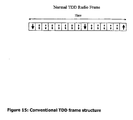
- a conventional TDD (W-CDMA) frame comprises 15 slots and has an overall length of 10 ms. Further, each TDD (W-CDMA) frame includes at least two slots allocated to TDD downlink and at least one slot allocated to TDD uplink. Thus, the TDD W-CDMA frame could be subdivided into five subframes each including 3 slots. For the example illustrated in Fig. 15, the first slot of the first subframe, the last slot of the third subframe and the last slot of the fifth subframe are used for TDD communications.
- the orientations of the large arrows in Fig. 15 indicate downlink (arrows directed to the bottom of Fig. 15) and uplink (arrow directed to the top of Fig. 15) communications. Double headed arrows in Fig. 15 indicate slots available for uplink or downlink communications in principle although not utilized for communications in the illustrated example. In line therewith, the second and forth subframes are not utilized for TDD communications and, thus, are available for different communications as will be described below.
- FDD frequency division duplex
- two carrier frequency ranges are used, one frequency range for uplink communications and another frequency range for downlink communications.
- a duplex distance representing the frequency distance between uplink and downlink frequency ranges is chosen.
- variable duplex distance further allows employing further frequency ranges for uplink and/or downlink communications in addition to uplink and downlink frequency ranges originally indented FDD communications (see Fig. 14).
- a further frequency range for FDD communications capacity limitations for FDD communications due to uplink and/or downlink constraints can be avoided.
- FDD communications are limited by its downlink properties.
- a further downlink frequency range will provide for the required transmission capacity.
- frequency ranges originally intended for TDD communications can be used for that purpose during time periods wherein the TDD frequency range is actually not used for TDD communications.
- the frequency range for the shown TDD W-CDMA frame during the time of the second and forth subframes can be allocated for FDD communications (the use of parts of a TDD frame, i.e. subframes, is, as explained above, possible due to the comparable subdivision of the W-CDMA frames for both TDD and FDD communications).
- the "shared" TDD W-CDMA frame shown in Fig. 16 illustrates the allocation of the second and forth subframes not utilized for TDD communications for FDD downlink communications in the TDD frequency range.
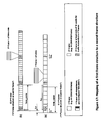
- Fig. 17 illustrates, in a general manner, mapping of frame structures of a communications environment to other frame structures of the same communications environment.
- a communications environment uses first frames each thereof consisting of a number of s1 slots and second frames each thereof comprising a number of s2 slots.
- a first frame has a duration of t1
- second frames have a duration of t2.
- a number of f1 first frames forms a specific first frame structure referred to as f1-superiorframe with f1 being set to an actual value and a number f2 of second frames forms a specific second frame structure referred to as f2-superiorframe with f2 being set to an actual value.
- transmission gaps are defined such that for a period, also referred to as transmission gap length, no transmissions of communications to be performed in the communications environment occur.
- Those transmissions gaps which are configured on slot basis can be used for transmissions of communications by means of the frames or at least slots thereof of second frame structure.
- t per transmission gaps or idle periods in the communications environment can be specified within limits determined, for example by a defined maximum transmission gap length and/or a defined minimum number of first frames or slots thereof to be used for transmissions.
- the first and second frame structures are synchronized such that transmissions gaps of the first frame structure occur substantially at the same time second frames or slots thereof to be transmitted in transmission gaps occur or are available.
- Such synchronization is generally recommended on frame structure or superiorframe basis. If, for example, a second frame structure or superiorframe is defined that match better to more than one second frame structure or superiorframe than to a single one thereof, synchronization can also be performed on the basis of multiples of frame structures or superiorframes.
- frame structures or superiorframes are defined as follows.
- the duration (f1 x t1) of the first superiorframe and the duration (f2 x t2) of the second superiorframe are the same and define a superiorframe duration Tmin_comm which is indicated in Fig. 11.
- the first superiorframe will comprise one first frame
- the second superiorframe will comprise one second frame.
- first superiorframe will be 6 and the number f2 for the second superiorframe will also be 6.
- a so-called 6-superiorframe will be obtained as first superiorframe and second superiorframe, i.e. superiorframes comprising 6 W-CDMA frames.
- a time of set between the first and second superiorframes can be implemented. This will allow for aligning a first one of second frames in the second superiorframe with a first one of first frames of a transmission gap in the first superiorframe. Comparable thereto, such an alignment can also be based on slot basis.
- New GSM/(E)GPRS standards are in discussion wherein it is contemplated to allow TDD frame based communications. Therefore, the observations given with respect to TDD communications via FDD frequencies in an UMTS communications environment correspondingly apply to TDD communications of a GSM/(E)GPRS communications environment to be communicated by means of a "shared" FDD W-CDMA frame of an UMTS communications environment.
- the invention can be implemented for any comparable interface of a communications environment, which can be accessed by units of another communications environment.
- communications environments which include air interfaces between radio base stations
- the use of one communications environment for communications of another communications environment can performed for the communications interface between base stations. Then, modification can be limited to base stations if necessary at all.
- mixed communications are not limited to the examples given with respect to GSM/(E)GPRS communications and W-CDMA communications. Rather, mixed communications as described herein are possible for any communications environments such as mobile telephone systems according to the second generation (e.g. GSM including EDGE, IS95, etc.), the third generation (UMTS: W-CDMA, TDD and CDMA2000) und the planned fourth generation (e.g. OFDM based). Further, an implementation is not limited to combinations of specific frequencies.
- band pairing options for paired and unpaired frequency arrangements for IMT-2000 systems in bands identified by WARC-92 and WRC-2000 are possible.
- the following table provides a selection of these options and additionally proposes some further opportunities based on VDT as examples for planned frequency combinations: Gap (MHz) UE Tx (MHz) Duplex Centre separation (MHz) BS Tx (MHz) Band I 1920 - 1980 130 2110 - 2170 190 Band II 1850 - 1910 20 1930 - 1990 80 Band III 1710 - 1785 20 1805 - 1880 95 (*) 1710 - 1755 50 1805 - 1850 95 (*) 1755 - 1805 305 2110 - 2160 355 (*) 1710 - 1770 240 2110 - 2170 400 (*) 1920 - 1980 520 2500 - 2690 Variable (*) 1850 - 1910 590 2500 - 2690 Variable (*) 1710 - 1785 715 2500 - 2690 Variable (*) 1710 - 1770 730
- bands (*) and Bands (**) are considered for future communications environments.
- ITU-R Resolution 225 from the World Radio Communication Conference 2000 (WRC-2000) states that bands 2500 - 2520 MHz and 2670 - 2690 MHz (as identified for IMT-2000 and allocated to the mobile-satellite service (MSS)) may be used for the satellite component of IMT-2000.
- MSS mobile-satellite service
- bands 2500 - 2520 MHz and 2670 - 2690 MHz may be used by the terrestrial component of IMT-2000.
Landscapes
- Engineering & Computer Science (AREA)
- Computer Networks & Wireless Communication (AREA)
- Signal Processing (AREA)
- Mobile Radio Communication Systems (AREA)
Claims (27)
- Verfahren für Operation einer ersten Kommunikationsumgebung, die einen ersten Kommunikationsstandard hat, und einer zweiten Kommunikationsumgebung, die einen zweiten Kommunikationsstandard hat, wobei Kommunikationsressourcen (TG) für Kommunikationen nach einem ersten Kommunikationsstandard für Kommunikationen nach dem zweiten Kommunikationsstandard in einem gemeinsamen Frequenzbereich verwendet werden,
das Verfahren die folgenden Schritte umfassend:- Kommunikation in der ersten Kommunikationsumgebung durch Übertragung einer ersten Rahmenstruktur in dem gemeinsamen Frequenzbereich, und- Kommunikation in der zweiten Kommunikationsumgebung durch Übertragung einer zweiten Rahmenstruktur in dem gemeinsamen Frequenzbereich,
dadurch gekennzeichnet, dass- die erste Rahmenstruktur mindestens eine Übertragungslücke enthält, und- mindestens ein Teil der zweiten Rahmenstruktur während der mindestens einen Übertragungslücke (TG) übertragen wird. - Verfahren nach Anspruch 1, wobei die mindestens eine Übertragungslücke mit einem Übertragungszeit-Reduktionsverfahren erhalten wird.
- Verfahren nach Anspruch 1 oder 2, die folgenden Schritte umfassend:- Kommunikation in der ersten Kommunikationsumgebung durch Übertragung einer Pluralität von nachfolgenden ersten Rahmen, von denen mindestens einer davon die mindestens eine Übertragungslücke enthält, und/oder- Kommunikation in der zweiten Kommunikationsumgebung durch Übertragung einer Pluralität von nachfolgenden zweiten Rahmen.
- Verfahren nach einem der vorangegangenen Ansprüche, die folgenden Schritte umfassend:- Kommunikation in der ersten Kommunikationsumgebung durch Übertragung von W-CDMA-Rahmen, die die erste Rahmenstruktur bilden, und- Kommunikation in der zweiten Kommunikationsumgebung durch Übertragung von TDMA-Rahmen, die die zweite Rahmenstruktur bilden.
- Verfahren von Anspruch 3 oder 4, wobei- jeder der ersten Rahmen eine Zahl von ersten Schlitzen enthält und die mindestens eine Übertragungslücke auf Schlitzbasis durch eine erste vordefinierte Zahl von ersten Schlitzen defmiert ist, und/oder- jeder der zweiten Rahmen eine Zahl von zweiten Schlitzen enthält.
- Verfahren von einem der Ansprüche 3 bis 5, wobei- die mindestens eine Übertragungslücke Schlitze von einem der ersten Rahmen enthält, und/oder- die mindestens eine Übertragungslücke Schlitze von zwei aufeinander folgenden der ersten Rahmen enthält.
- Verfahren von einem der Ansprüche 3 bis 6, wobei- während der mindestens einen Übertragungslücke (TG) eine zweite vordefinierte Zahl der zweiten Schlitze oder eine zweite vordefinierte Zahl der zweiten Rahmen übertragen wird.
- Verfahren nach einem der vorangegangenen Ansprüche, den folgenden Schritt umfassend:Synchronisieren der Kommunikation in den ersten und zweiten Kommunikationsumgebungen derart, dass eine Rahmentaktung für die erste Rahmenstruktur mit einer Rahmentaktung für die zweite Rahmenstruktur oder umgekehrt synchronisiert ist.
- Verfahren nach einem der vorangegangenen Ansprüche, die folgenden Schritte umfassend:- Definieren der ersten Rahmenstruktur derart, dass die mindestens eine Übertragungslücke (TG) darin eine vordefinierte Position hat, und/oder- Definieren der ersten Rahmenstruktur derart, dass die mindestens eine Übertragungslücke (TG) eine vordefinierte Länge hat.
- Verfahren nach einem der vorangegangenen Ansprüche, wobei
nur der mindestens eine Teil der zweiten Rahmenstruktur, die während der Übertragungslücke (TG) übertragen wird, für Kommunikation in der zweiten Kommunikationsumgebung verwendet wird. - Verfahren nach einem der vorangegangenen Ansprüche, wobei
das Zeitintervall zwischen dem Beginn einer Übertragungslücke (TG) und dem Beginn einer nachfolgenden Übertragungslücke (TG) mit dem Zeitintervall zwischen dem Beginn eines Teils der zweiten Rahmenstruktur, die während Übertragungslücken (TG) zu übertragen ist, und dem Beginn eines nachfolgenden Teils der zweiten Rahmenstruktur, die während Übertragungslücken (TG) zu übertragen ist, korrespondiert. - Verfahren nach einem der vorangegangenen Ansprüche, die folgenden Schritte umfassend:- Übertragen von Taktinformationen zwischen den ersten und zweiten Kommunikationsumgebungen zur Synchronisierung der Kommunikationen darin, und/oder- Übertragen von Informationen zu der zweiten Kommunikationsumgebung, die anzeigen, dass Kommunikation darin durch Übertragungen in dem gemeinsamen Frequenzbereich ausgeführt werden.
- Verfahren nach einem der vorangegangenen Ansprüche, wobei
die erste Kommunikationsumgebung eine UMTS-Kommunikationsumgebung ist, und- die zweite Kommunikationsumgebung eines GSM/GPRS-Kommunikationsumgebung ist. - Kommunikationsumgebung, die einen zweiten Kommunikationsstandard hat, umfassend- eine erste Kommunikationsumgebung, die einen ersten Kommunikationsstandard hat,- eine zweite Kommunikationsumgebung, die einen zweiten Kommunikationsstandard hat, und- einen gemeinsamen Frequenzbereich für Kommunikationen in den ersten und zweiten Kommunikationsumgebungen,
wobei die Kommunikationsumgebung angepasst ist zur Nutzung, für Kommunikationen in dem gemeinsamen Frequenzbereich, von Kommunikationsressourcen für Kommunikationen nach dem ersten Kommunikationsstandard für Kommunikationen nach dem zweiten Kommunikationsstandard,- die erste Kommunikationsumgebung mindestens eine erste Kommunikationseinheit für Übertragung einer ersten Rahmenstruktur in dem gemeinsamen Frequenzbereich umfassend, und- die zweite Kommunikationsumgebung mindestens eine zweite Kommunikationseinheit für Übertragung einer zweiten Rahmenstruktur in dem gemeinsamen Frequenzbereich umfassend,
gekennzeichnet durch- die erste Rahmenstruktur mindestens eine Übertragungslücke (TG) enthaltend, und- die mindestens eine zweite Kommunikationseinheit zur Übertragung der zweiten Rahmenstruktur in dem gemeinsamen Frequenzbereich derart, dass mindestens ein Teil der zweiten Rahmenstruktur während der mindestens einen Übertragungslücke (TG) übertragen wird. - Kommunikationsumgebung nach Anspruch 14, gekennzeichnet durch:- die mindestens eine erste Kommunikationseinheit für mindestens eine von Empfang und Übertragung der ersten Rahmenstruktur über den gemeinsamen Frequenzbereich, und/oder- die mindestens eine zweite Kommunikationseinheit für mindestens eine von Empfang und Übertragung des mindestens einen Teils der zweiten Rahmenstruktur während der mindestens einen Übertragungslücke über den gemeinsamen Frequenzbereich.
- Kommunikationsumgebung nach Anspruch 14 oder 15, gekennzeichnet durch:- eine gemeinsame Taktungseinheit für die mindestens eine ersten und zweiten Kommunikationseinheiten der ersten und zweiten Kommunikationsumgebungen für Synchronisierung der Rahmenstruktur-Übertragungen davon, oder- eine erste Taktungseinheit für die mindestens eine erste Kommunikationseinheit und eine zweite Taktungseinheit für die mindestens eine zweite Kommunikationseinheit, wobei die ersten und zweiten Taktungseinheiten synchronisiert sind, um die Rahmenstruktur-Übertragungen zu synchronisieren.
- Kommunikationsumgebung nach einem der Ansprüche 14 bis 16, gekennzeichnet durch:die mindestens eine ersten und zweiten Kommunikationseinheiten eine integrierte Kommunikationseinheit bildend, die Kommunikationen in der ersten und zweiten Kommunikationsumgebung abwickelt.
- Kommunikationsumgebung nach einem der Ansprüche 14 bis 17, gekennzeichnet durch:- mindestens eine erste Benutzerausrüstung für Kommunikationen in der ersten Kommunikationsumgebung mittels der ersten Rahmenstruktur, und/oder- mindestens eine zweite Benutzerausrüstung für Kommunikationen in der zweiten Kommunikationsumgebung mindestens mittels des mindestens eines Teils der zweiten Rahmenstruktur, die während der mindestens einen Übertragungslücke übertragen wird.
- Kommunikationsumgebung nach einem der Ansprüche 14 bis 18, gekennzeichnet durch:- die erste Kommunikationsumgebung eine UMTS-Umgebung seiend, und- die zweite Kommunikationsumgebung eine GSM/GPRS-Umgebung seiend.
- Kommunikationsumgebung nach einem der Ansprüche 14 bis 19,
angepasst zur Operation gemäß den Schritten, die in einem der Ansprüche 1 bis 13 definiert sind. - Kommunikationsumgebung nach einem der Ansprüche 14 bis 20, gekennzeichnet durch:mindestens eine Kommunikationseinheit für Kommunikation nach dem ersten und dem zweiten Kommunikationsstandard.
- Benutzerausrüstung, umfassend:Mittel für Kommunikation in einer zweiten Kommunikationsumgebung, die einen zweiten Kommunikationsstandard hat, durch Übertragung einer zweiten Rahmenstruktur in einem gemeinsamen Frequenzbereich, wobei der gemeinsame Frequenzbereich geteilt wird mit einer ersten Kommunikationsumgebung, die einen ersten Kommunikationsstandard hat, in der eine erste Rahmenstruktur, die mindestens eine Übertragungslücke enthält, übertragen wird, die Benutzerausrüstung dadurch gekennzeichnet, dassdie Mittel für Kommunikation angepasst sind zur Übertragung von mindestens einem Teil der zweiten Rahmenstruktur während der mindestens einen Übertragungslücke.
- Benutzerausrüstung nach Anspruch 22, wobei die Benutzerausrüstung ein Mobiltelefon ist.
- Funkbasisstation, umfassend
Mittel für Kommunikation in einer zweiten Kommunikationsumgebung, die einen zweiten Kommunikationsstandard hat, durch Übertragung einer zweiten Rahmenstruktur in einem gemeinsamen Frequenzbereich, wobei der gemeinsame Frequenzbereich geteilt wird mit einer ersten Kommunikationsumgebung, die einen ersten Kommunikationsstandard hat, in der eine erste Rahmenstruktur, die mindestens eine Übertragungslücke enthält, übertragen wird, die Funkbasisstation dadurch gekennzeichnet, dass
die Mittel für Kommunikation angepasst sind zur Übertragung von mindestens einem Teil der zweiten Rahmenstruktur während der mindestens einen Übertragungslücke. - Funkbasisstation nach Anspruch 24, die Funkbasisstation weiter umfassend
Mittel für Kommunikation in der ersten Kommunikationsumgebung durch Übertragung der ersten Rahmenstruktur. - Computerprogrammprodukt, umfassend Programmcode-Anteile zum Ausführen der Schritte nach einem der Ansprüche 1 bis 13.
- Computerprogrammprodukt nach Anspruch 26, gespeichert in einem Computer-lesbaren Speichermedium oder in einer Computer-lesbaren Speichervorrichtung.
Priority Applications (1)
| Application Number | Priority Date | Filing Date | Title |
|---|---|---|---|
| AT02798352T ATE342642T1 (de) | 2002-12-19 | 2002-12-19 | Zuweisung von zeitschlitzen während der sendepausen einer kommunikation nach einem ersten protokoll zu einer kommunikation nach einem zweiten protokoll |
Applications Claiming Priority (1)
| Application Number | Priority Date | Filing Date | Title |
|---|---|---|---|
| PCT/EP2002/014602 WO2004057893A1 (en) | 2002-12-19 | 2002-12-19 | Assigning time slots during transmission gaps of a first protocol communicaton to a second protocol communication |
Publications (2)
| Publication Number | Publication Date |
|---|---|
| EP1574095A1 EP1574095A1 (de) | 2005-09-14 |
| EP1574095B1 true EP1574095B1 (de) | 2006-10-11 |
Family
ID=32668672
Family Applications (1)
| Application Number | Title | Priority Date | Filing Date |
|---|---|---|---|
| EP02798352A Expired - Lifetime EP1574095B1 (de) | 2002-12-19 | 2002-12-19 | Zuweisung von zeitschlitzen während der sendepausen einer kommunikation nach einem ersten protokoll zu einer kommunikation nach einem zweiten protokoll |
Country Status (6)
| Country | Link |
|---|---|
| US (1) | US20060002323A1 (de) |
| EP (1) | EP1574095B1 (de) |
| CN (1) | CN100469168C (de) |
| AU (1) | AU2002363888A1 (de) |
| DE (1) | DE60215397T2 (de) |
| WO (1) | WO2004057893A1 (de) |
Cited By (1)
| Publication number | Priority date | Publication date | Assignee | Title |
|---|---|---|---|---|
| US8885577B2 (en) | 2009-06-23 | 2014-11-11 | Motorola Mobility Llc | Method of assigning and managing gaps for reading system information of neighboring cells |
Families Citing this family (35)
| Publication number | Priority date | Publication date | Assignee | Title |
|---|---|---|---|---|
| WO2004107606A1 (en) * | 2003-05-28 | 2004-12-09 | Ipwireless, Inc. | Method, base station and mobile station for tdd operation in a communication system |
| KR100663520B1 (ko) * | 2004-02-10 | 2007-01-02 | 삼성전자주식회사 | 협대역 시분할 이중화 시스템에서 순방향 전용물리채널의 공유 방법 및 장치 |
| KR20070024589A (ko) * | 2004-06-15 | 2007-03-02 | 코닌클리케 필립스 일렉트로닉스 엔.브이. | 무선 통신 시스템에서의 집중된 tdma mac과 제 2mac 사이의 공존을 이루기 위한 방법 |
| CN1977556B (zh) * | 2004-07-02 | 2011-09-07 | 飞思卡尔半导体公司 | 通信系统终端中双模操作的装置和电路 |
| US20060217082A1 (en) * | 2005-03-22 | 2006-09-28 | Georg Fischer | Shaping noise in power amplifiers of duplex communication systems |
| CN100421516C (zh) * | 2005-06-24 | 2008-09-24 | 华为技术有限公司 | 异频测量的测量时间确定方法、异频测量方法及通信终端 |
| US8509158B2 (en) * | 2005-09-26 | 2013-08-13 | The Directv Group, Inc. | Reconfigurable notched spectrum for wireless data transmission |
| US7751823B2 (en) * | 2006-04-13 | 2010-07-06 | Atc Technologies, Llc | Systems and methods for controlling a level of interference to a wireless receiver responsive to an activity factor associated with a wireless transmitter |
| CN101056137B (zh) * | 2006-05-17 | 2010-05-12 | 华为技术有限公司 | 信道传输限制的方法及用户终端 |
| WO2008125905A2 (en) * | 2006-08-08 | 2008-10-23 | Nortel Networks Limited | Method and system for wireless communication in multiple operating environments |
| US8009597B2 (en) | 2006-08-17 | 2011-08-30 | Broadcom Corporation | Using a single logical base transceiver to serve multiple physical locations |
| US8094554B2 (en) | 2006-10-26 | 2012-01-10 | Qualcomm Incorporated | Compressed mode operation and power control with discontinuous transmission and/or reception |
| US9635680B2 (en) * | 2006-12-28 | 2017-04-25 | Google Technology Holdings LLC | Method and apparatus for multiplexing signals having different protocols |
| CN101325786B (zh) * | 2007-06-14 | 2011-09-21 | 中兴通讯股份有限公司 | 通用移动通信系统中900MHz和2000MHz频段共同组网方法 |
| CN101345544B (zh) * | 2007-07-09 | 2012-10-10 | 电信科学技术研究院 | 一种采用支持Relay的帧结构进行无线传输的方法和系统 |
| EP2034628A1 (de) * | 2007-09-04 | 2009-03-11 | Nokia Siemens Networks Oy | Verfahren und Vorrichtung zum Betreiben mindestens zweier Funkzugangstechnologien und Kommunikationssystem mit einer derartigen Vorrichtung |
| GB0721763D0 (en) * | 2007-11-06 | 2007-12-19 | Fujitsu Ltd | Frame structure for a wireless communication system |
| US7860521B2 (en) * | 2007-12-26 | 2010-12-28 | Motorola, Inc. | System and method for minimizing inter-communications system mobile station-to-mobile station interference |
| JP4909914B2 (ja) | 2008-01-15 | 2012-04-04 | 株式会社日立製作所 | 無線端末 |
| CN101631316B (zh) * | 2008-07-16 | 2011-07-06 | 中国移动通信集团公司 | 在tdd系统中提高频谱利用率的方法和设备 |
| EP2242318B1 (de) * | 2009-04-15 | 2015-06-03 | Telefonaktiebolaget L M Ericsson (publ) | OFDMA Ablaufplanungsverfahren zur Verhinderung vom Übersprechen bei mobilen Stationen |
| US8130790B2 (en) * | 2010-02-08 | 2012-03-06 | Apple Inc. | Digital communications system with variable-bandwidth traffic channels |
| EP2624639B1 (de) * | 2010-11-10 | 2014-08-27 | Panasonic Corporation | Drahtloses kommunikationssystem und drahtlose kommunikationsvorrichtung |
| CN102761877B (zh) * | 2011-04-25 | 2015-08-12 | 中兴通讯股份有限公司 | 多网共模方法与系统 |
| CN102843736B (zh) * | 2011-06-23 | 2018-02-13 | 中兴通讯股份有限公司 | 小区切换方法及装置 |
| US9445425B2 (en) | 2011-10-24 | 2016-09-13 | Nokia Solutions And Networks Oy | Method of transmission in a communications network |
| US9622127B2 (en) * | 2012-11-30 | 2017-04-11 | Tejas Networks Limited | Method and system for wireless communication |
| US9954595B2 (en) * | 2014-11-25 | 2018-04-24 | Qualcomm Incorporated | Frame format for low latency channel bonding |
| WO2016095078A1 (en) * | 2014-12-15 | 2016-06-23 | Qualcomm Incorporated | Dual active connections over single radio user equipment |
| CN106301527B (zh) * | 2015-06-09 | 2020-02-14 | 北京信威通信技术股份有限公司 | 卫星通信方法及装置 |
| US10416094B2 (en) | 2016-03-31 | 2019-09-17 | Northeastern University | Characterization of dielectric slabs attached to the body using focused millimeter waves |
| CN108029157A (zh) * | 2016-04-01 | 2018-05-11 | 华为技术有限公司 | 一种通信方法、终端及网络设备 |
| CN109845139B (zh) * | 2016-10-18 | 2022-12-27 | 光子系统股份有限公司 | 全双工通信系统 |
| US10917264B2 (en) * | 2018-11-09 | 2021-02-09 | Telefonaktiebolaget Lm Ericsson (Publ) | NR-LTE coexisting operation for uplink |
| EP3986716B1 (de) | 2019-06-21 | 2025-10-01 | Esko Software BV | Druckerzeugnisverwaltungssystem |
Family Cites Families (14)
| Publication number | Priority date | Publication date | Assignee | Title |
|---|---|---|---|---|
| US5793759A (en) * | 1995-08-25 | 1998-08-11 | Terayon Corporation | Apparatus and method for digital data transmission over video cable using orthogonal cyclic codes |
| US5732076A (en) * | 1995-10-26 | 1998-03-24 | Omnipoint Corporation | Coexisting communication systems |
| CN1102325C (zh) * | 1995-12-04 | 2003-02-26 | 摩托罗拉公司 | 混合系统环境中动态改变选择呼叫接收设备控制帧的方法 |
| US6101176A (en) * | 1996-07-24 | 2000-08-08 | Nokia Mobile Phones | Method and apparatus for operating an indoor CDMA telecommunications system |
| CN1223761A (zh) * | 1996-07-25 | 1999-07-21 | 西门子公司 | 用于tdma无线通信系统运行的方法和装置 |
| CN1298580A (zh) * | 1998-02-27 | 2001-06-06 | 西门子公司 | 具有无线的基于码分多址和时分多址通信的归属通信系统的空气接口 |
| DE69938979D1 (de) * | 1998-04-23 | 2008-08-07 | Mitsubishi Electric Corp | System und Sender verwendet in einem Mobilfunkkommunikationssystem zur Beobachtung von Frequenzen in einem anderen System |
| GB9808716D0 (en) * | 1998-04-25 | 1998-06-24 | Philips Electronics Nv | A method of controlling a communication system and the system employing the method |
| FR2778055B1 (fr) * | 1998-04-28 | 2000-05-26 | Alsthom Cge Alcatel | Procede de transmission dans un reseau radiotelephonique umts,permettant de preparer un saut vers une cellule gsm pendant une communication dans une cellule umts |
| FI112562B (fi) * | 2000-02-29 | 2003-12-15 | Nokia Corp | Mittausaukkojen määrittäminen keskinäistaajuksien mittauksessa |
| GB2360674A (en) * | 2000-03-21 | 2001-09-26 | Inmarsat Ltd | Concurrent use of multiple TDMA Protocols |
| FR2826825B1 (fr) * | 2001-06-28 | 2003-09-26 | Cit Alcatel | Procede de basculement d'un premier mode de radiocommunication vers un second mode de radiocommunication et terminal mobile multi-mode associe |
| US6774857B2 (en) * | 2002-09-12 | 2004-08-10 | Agilent Technologies, Inc. | Method facilitating inter-mode handoff |
| US7050828B2 (en) * | 2002-09-23 | 2006-05-23 | Telefonaktiebolaget Lm Ericsson (Publ) | Inter-system monitor function |
-
2002
- 2002-12-19 EP EP02798352A patent/EP1574095B1/de not_active Expired - Lifetime
- 2002-12-19 CN CNB028300521A patent/CN100469168C/zh not_active Expired - Fee Related
- 2002-12-19 US US10/536,253 patent/US20060002323A1/en not_active Abandoned
- 2002-12-19 AU AU2002363888A patent/AU2002363888A1/en not_active Abandoned
- 2002-12-19 WO PCT/EP2002/014602 patent/WO2004057893A1/en not_active Ceased
- 2002-12-19 DE DE60215397T patent/DE60215397T2/de not_active Expired - Lifetime
Cited By (1)
| Publication number | Priority date | Publication date | Assignee | Title |
|---|---|---|---|---|
| US8885577B2 (en) | 2009-06-23 | 2014-11-11 | Motorola Mobility Llc | Method of assigning and managing gaps for reading system information of neighboring cells |
Also Published As
| Publication number | Publication date |
|---|---|
| DE60215397D1 (de) | 2006-11-23 |
| CN1714587A (zh) | 2005-12-28 |
| WO2004057893A1 (en) | 2004-07-08 |
| US20060002323A1 (en) | 2006-01-05 |
| AU2002363888A1 (en) | 2004-07-14 |
| CN100469168C (zh) | 2009-03-11 |
| EP1574095A1 (de) | 2005-09-14 |
| DE60215397T2 (de) | 2007-08-23 |
Similar Documents
| Publication | Publication Date | Title |
|---|---|---|
| US20060002323A1 (en) | Assigning time slots during transmission gaps of a first protocol communication to a second protocol communication | |
| EP1574096B1 (de) | Adaptive steuerung für den betrieb von kommunikationsumgebungen | |
| KR101515843B1 (ko) | 다중 시분할 복신 시스템의 공존 방법 | |
| US7502596B2 (en) | Mobile communication systems | |
| JP5542225B2 (ja) | 時間分割復信システムの無線フレーム構造の確定方法及び装置 | |
| US9635680B2 (en) | Method and apparatus for multiplexing signals having different protocols | |
| CN1120650C (zh) | 通用移动电话系统无线电话网中的传输方法 | |
| US20050124362A1 (en) | Method and apparatus for compressed mode communication | |
| US20140036739A1 (en) | Method, base station and mobile station for tdd operation in a communication system | |
| RU2216127C2 (ru) | Перемещение соединения связи в системе беспроводной связи, основанной на кодовом и временном уплотнении | |
| EP3541134B1 (de) | Rückkopplungssteuerung in einem fdd-system | |
| AU711875B2 (en) | Dynamic channel allocation | |
| KR19990067090A (ko) | 공존하는 통신 시스템들 | |
| JP4843692B2 (ja) | 移動無線通信システム用の電力制御装置 | |
| WO2008117202A2 (en) | Method for resource unit allocation for wireless communication, subscriber station and base station | |
| US20020164986A1 (en) | Wireless telecommunications apparatus in particular of UMTS or other third generation type and a method of wireless telecommunication | |
| KR20050080570A (ko) | 협대역 시분할 이중화 시스템에서 순방향 전용물리채널의공유 방법 | |
| EP1080551B1 (de) | VERFAHREN ZUR DATENüBERTRAGUNG IN EINEM ZELLULAREN üBERTRAGUNGSSYSTEM | |
| GB2376602A (en) | A method for providing a communications channel in Time Division Duplexing (TDD) mode between a TDD mobile and a TDD base station | |
| US20110058492A1 (en) | Managing resources in a wireless communication system comprising at least one scheduling channel | |
| US12634004B2 (en) | Communications in a wireless network | |
| EP4573770A1 (de) | Verfahren zur verringerung oder beseitigung von interferenzen zwischen zwei gegenseitig nicht kompatiblen kommunikationssystemen, die auf eine zumindest teilweise gemeinsame ressource zugreifen | |
| HK1153866A (en) | Method, base station and mobile station for tdd operation in a communication system | |
| HK1153865B (en) | Method, base station and mobile station for tdd operation in a communication system |
Legal Events
| Date | Code | Title | Description |
|---|---|---|---|
| PUAI | Public reference made under article 153(3) epc to a published international application that has entered the european phase |
Free format text: ORIGINAL CODE: 0009012 |
|
| 17P | Request for examination filed |
Effective date: 20050513 |
|
| AK | Designated contracting states |
Kind code of ref document: A1 Designated state(s): AT BE BG CH CY CZ DE DK EE ES FI FR GB GR IE IT LI LU MC NL PT SE SI SK TR |
|
| AX | Request for extension of the european patent |
Extension state: AL LT LV MK RO |
|
| GRAP | Despatch of communication of intention to grant a patent |
Free format text: ORIGINAL CODE: EPIDOSNIGR1 |
|
| DAX | Request for extension of the european patent (deleted) | ||
| RIN1 | Information on inventor provided before grant (corrected) |
Inventor name: JECK, MICHAEL Inventor name: HILDEBRAND, UWE |
|
| GRAS | Grant fee paid |
Free format text: ORIGINAL CODE: EPIDOSNIGR3 |
|
| GRAA | (expected) grant |
Free format text: ORIGINAL CODE: 0009210 |
|
| AK | Designated contracting states |
Kind code of ref document: B1 Designated state(s): AT BE BG CH CY CZ DE DK EE ES FI FR GB GR IE IT LI LU MC NL PT SE SI SK TR |
|
| PG25 | Lapsed in a contracting state [announced via postgrant information from national office to epo] |
Ref country code: IT Free format text: LAPSE BECAUSE OF FAILURE TO SUBMIT A TRANSLATION OF THE DESCRIPTION OR TO PAY THE FEE WITHIN THE PRESCRIBED TIME-LIMIT;WARNING: LAPSES OF ITALIAN PATENTS WITH EFFECTIVE DATE BEFORE 2007 MAY HAVE OCCURRED AT ANY TIME BEFORE 2007. THE CORRECT EFFECTIVE DATE MAY BE DIFFERENT FROM THE ONE RECORDED. Effective date: 20061011 Ref country code: CZ Free format text: LAPSE BECAUSE OF FAILURE TO SUBMIT A TRANSLATION OF THE DESCRIPTION OR TO PAY THE FEE WITHIN THE PRESCRIBED TIME-LIMIT Effective date: 20061011 Ref country code: NL Free format text: LAPSE BECAUSE OF FAILURE TO SUBMIT A TRANSLATION OF THE DESCRIPTION OR TO PAY THE FEE WITHIN THE PRESCRIBED TIME-LIMIT Effective date: 20061011 Ref country code: FI Free format text: LAPSE BECAUSE OF FAILURE TO SUBMIT A TRANSLATION OF THE DESCRIPTION OR TO PAY THE FEE WITHIN THE PRESCRIBED TIME-LIMIT Effective date: 20061011 Ref country code: BE Free format text: LAPSE BECAUSE OF FAILURE TO SUBMIT A TRANSLATION OF THE DESCRIPTION OR TO PAY THE FEE WITHIN THE PRESCRIBED TIME-LIMIT Effective date: 20061011 Ref country code: AT Free format text: LAPSE BECAUSE OF FAILURE TO SUBMIT A TRANSLATION OF THE DESCRIPTION OR TO PAY THE FEE WITHIN THE PRESCRIBED TIME-LIMIT Effective date: 20061011 Ref country code: SK Free format text: LAPSE BECAUSE OF FAILURE TO SUBMIT A TRANSLATION OF THE DESCRIPTION OR TO PAY THE FEE WITHIN THE PRESCRIBED TIME-LIMIT Effective date: 20061011 Ref country code: SI Free format text: LAPSE BECAUSE OF FAILURE TO SUBMIT A TRANSLATION OF THE DESCRIPTION OR TO PAY THE FEE WITHIN THE PRESCRIBED TIME-LIMIT Effective date: 20061011 Ref country code: CH Free format text: LAPSE BECAUSE OF FAILURE TO SUBMIT A TRANSLATION OF THE DESCRIPTION OR TO PAY THE FEE WITHIN THE PRESCRIBED TIME-LIMIT Effective date: 20061011 Ref country code: LI Free format text: LAPSE BECAUSE OF FAILURE TO SUBMIT A TRANSLATION OF THE DESCRIPTION OR TO PAY THE FEE WITHIN THE PRESCRIBED TIME-LIMIT Effective date: 20061011 |
|
| REG | Reference to a national code |
Ref country code: GB Ref legal event code: FG4D |
|
| REG | Reference to a national code |
Ref country code: CH Ref legal event code: EP |
|
| REG | Reference to a national code |
Ref country code: IE Ref legal event code: FG4D |
|
| REF | Corresponds to: |
Ref document number: 60215397 Country of ref document: DE Date of ref document: 20061123 Kind code of ref document: P |
|
| PG25 | Lapsed in a contracting state [announced via postgrant information from national office to epo] |
Ref country code: IE Free format text: LAPSE BECAUSE OF NON-PAYMENT OF DUE FEES Effective date: 20061219 |
|
| PG25 | Lapsed in a contracting state [announced via postgrant information from national office to epo] |
Ref country code: MC Free format text: LAPSE BECAUSE OF NON-PAYMENT OF DUE FEES Effective date: 20061231 |
|
| PG25 | Lapsed in a contracting state [announced via postgrant information from national office to epo] |
Ref country code: BG Free format text: LAPSE BECAUSE OF FAILURE TO SUBMIT A TRANSLATION OF THE DESCRIPTION OR TO PAY THE FEE WITHIN THE PRESCRIBED TIME-LIMIT Effective date: 20070111 Ref country code: SE Free format text: LAPSE BECAUSE OF FAILURE TO SUBMIT A TRANSLATION OF THE DESCRIPTION OR TO PAY THE FEE WITHIN THE PRESCRIBED TIME-LIMIT Effective date: 20070111 Ref country code: DK Free format text: LAPSE BECAUSE OF FAILURE TO SUBMIT A TRANSLATION OF THE DESCRIPTION OR TO PAY THE FEE WITHIN THE PRESCRIBED TIME-LIMIT Effective date: 20070111 |
|
| PG25 | Lapsed in a contracting state [announced via postgrant information from national office to epo] |
Ref country code: ES Free format text: LAPSE BECAUSE OF FAILURE TO SUBMIT A TRANSLATION OF THE DESCRIPTION OR TO PAY THE FEE WITHIN THE PRESCRIBED TIME-LIMIT Effective date: 20070122 |
|
| PG25 | Lapsed in a contracting state [announced via postgrant information from national office to epo] |
Ref country code: PT Free format text: LAPSE BECAUSE OF FAILURE TO SUBMIT A TRANSLATION OF THE DESCRIPTION OR TO PAY THE FEE WITHIN THE PRESCRIBED TIME-LIMIT Effective date: 20070319 |
|
| NLV1 | Nl: lapsed or annulled due to failure to fulfill the requirements of art. 29p and 29m of the patents act | ||
| ET | Fr: translation filed | ||
| REG | Reference to a national code |
Ref country code: CH Ref legal event code: PL |
|
| PLBE | No opposition filed within time limit |
Free format text: ORIGINAL CODE: 0009261 |
|
| STAA | Information on the status of an ep patent application or granted ep patent |
Free format text: STATUS: NO OPPOSITION FILED WITHIN TIME LIMIT |
|
| 26N | No opposition filed |
Effective date: 20070712 |
|
| GBPC | Gb: european patent ceased through non-payment of renewal fee |
Effective date: 20070111 |
|
| PG25 | Lapsed in a contracting state [announced via postgrant information from national office to epo] |
Ref country code: GB Free format text: LAPSE BECAUSE OF NON-PAYMENT OF DUE FEES Effective date: 20070111 |
|
| PG25 | Lapsed in a contracting state [announced via postgrant information from national office to epo] |
Ref country code: GR Free format text: LAPSE BECAUSE OF FAILURE TO SUBMIT A TRANSLATION OF THE DESCRIPTION OR TO PAY THE FEE WITHIN THE PRESCRIBED TIME-LIMIT Effective date: 20070112 |
|
| PG25 | Lapsed in a contracting state [announced via postgrant information from national office to epo] |
Ref country code: EE Free format text: LAPSE BECAUSE OF FAILURE TO SUBMIT A TRANSLATION OF THE DESCRIPTION OR TO PAY THE FEE WITHIN THE PRESCRIBED TIME-LIMIT Effective date: 20061011 |
|
| PG25 | Lapsed in a contracting state [announced via postgrant information from national office to epo] |
Ref country code: LU Free format text: LAPSE BECAUSE OF NON-PAYMENT OF DUE FEES Effective date: 20061219 Ref country code: TR Free format text: LAPSE BECAUSE OF FAILURE TO SUBMIT A TRANSLATION OF THE DESCRIPTION OR TO PAY THE FEE WITHIN THE PRESCRIBED TIME-LIMIT Effective date: 20061011 |
|
| PG25 | Lapsed in a contracting state [announced via postgrant information from national office to epo] |
Ref country code: CY Free format text: LAPSE BECAUSE OF FAILURE TO SUBMIT A TRANSLATION OF THE DESCRIPTION OR TO PAY THE FEE WITHIN THE PRESCRIBED TIME-LIMIT Effective date: 20061011 |
|
| REG | Reference to a national code |
Ref country code: DE Ref legal event code: R079 Ref document number: 60215397 Country of ref document: DE Free format text: PREVIOUS MAIN CLASS: H04Q0007360000 Ipc: H04W0016000000 |
|
| REG | Reference to a national code |
Ref country code: DE Ref legal event code: R081 Ref document number: 60215397 Country of ref document: DE Owner name: OPTIS CELLULAR TECHNOLOGY, LLC (N. D. GES. D. , US Free format text: FORMER OWNER: TELEFONAKTIEBOLAGET LM ERICSSON (PUBL), STOCKHOLM, SE Effective date: 20150119 Ref country code: DE Ref legal event code: R079 Ref document number: 60215397 Country of ref document: DE Free format text: PREVIOUS MAIN CLASS: H04Q0007360000 Ipc: H04W0016000000 Effective date: 20150119 |
|
| REG | Reference to a national code |
Ref country code: FR Ref legal event code: PLFP Year of fee payment: 14 |
|
| REG | Reference to a national code |
Ref country code: FR Ref legal event code: TP Owner name: OPTIS CELLULAR TECHNOLOGY, LLC, US Effective date: 20151223 |
|
| REG | Reference to a national code |
Ref country code: FR Ref legal event code: PLFP Year of fee payment: 15 |
|
| PGFP | Annual fee paid to national office [announced via postgrant information from national office to epo] |
Ref country code: FR Payment date: 20161121 Year of fee payment: 15 Ref country code: DE Payment date: 20161121 Year of fee payment: 15 |
|
| REG | Reference to a national code |
Ref country code: DE Ref legal event code: R119 Ref document number: 60215397 Country of ref document: DE |
|
| REG | Reference to a national code |
Ref country code: FR Ref legal event code: ST Effective date: 20180831 |
|
| PG25 | Lapsed in a contracting state [announced via postgrant information from national office to epo] |
Ref country code: DE Free format text: LAPSE BECAUSE OF NON-PAYMENT OF DUE FEES Effective date: 20180703 Ref country code: FR Free format text: LAPSE BECAUSE OF NON-PAYMENT OF DUE FEES Effective date: 20180102 |