EP1574206A2 - Composition comprenant un colorant mixte à base d'au moins un chromophore de type nitre (hétéro)aromatique ou azine cyclique - Google Patents
Composition comprenant un colorant mixte à base d'au moins un chromophore de type nitre (hétéro)aromatique ou azine cyclique Download PDFInfo
- Publication number
- EP1574206A2 EP1574206A2 EP05290442A EP05290442A EP1574206A2 EP 1574206 A2 EP1574206 A2 EP 1574206A2 EP 05290442 A EP05290442 A EP 05290442A EP 05290442 A EP05290442 A EP 05290442A EP 1574206 A2 EP1574206 A2 EP 1574206A2
- Authority
- EP
- European Patent Office
- Prior art keywords
- radical
- linear
- branched
- alkyl
- optionally substituted
- Prior art date
- Legal status (The legal status is an assumption and is not a legal conclusion. Google has not performed a legal analysis and makes no representation as to the accuracy of the status listed.)
- Withdrawn
Links
- 0 CNc1nc(Cl)nc(S**)n1 Chemical compound CNc1nc(Cl)nc(S**)n1 0.000 description 3
Classifications
-
- A—HUMAN NECESSITIES
- A61—MEDICAL OR VETERINARY SCIENCE; HYGIENE
- A61K—PREPARATIONS FOR MEDICAL, DENTAL OR TOILETRY PURPOSES
- A61K8/00—Cosmetics or similar toiletry preparations
- A61K8/18—Cosmetics or similar toiletry preparations characterised by the composition
- A61K8/30—Cosmetics or similar toiletry preparations characterised by the composition containing organic compounds
- A61K8/49—Cosmetics or similar toiletry preparations characterised by the composition containing organic compounds containing heterocyclic compounds
- A61K8/4906—Cosmetics or similar toiletry preparations characterised by the composition containing organic compounds containing heterocyclic compounds with one nitrogen as the only hetero atom
- A61K8/4926—Cosmetics or similar toiletry preparations characterised by the composition containing organic compounds containing heterocyclic compounds with one nitrogen as the only hetero atom having six membered rings
-
- A—HUMAN NECESSITIES
- A61—MEDICAL OR VETERINARY SCIENCE; HYGIENE
- A61K—PREPARATIONS FOR MEDICAL, DENTAL OR TOILETRY PURPOSES
- A61K8/00—Cosmetics or similar toiletry preparations
- A61K8/18—Cosmetics or similar toiletry preparations characterised by the composition
- A61K8/30—Cosmetics or similar toiletry preparations characterised by the composition containing organic compounds
- A61K8/49—Cosmetics or similar toiletry preparations characterised by the composition containing organic compounds containing heterocyclic compounds
- A61K8/494—Cosmetics or similar toiletry preparations characterised by the composition containing organic compounds containing heterocyclic compounds with more than one nitrogen as the only hetero atom
-
- A—HUMAN NECESSITIES
- A61—MEDICAL OR VETERINARY SCIENCE; HYGIENE
- A61K—PREPARATIONS FOR MEDICAL, DENTAL OR TOILETRY PURPOSES
- A61K8/00—Cosmetics or similar toiletry preparations
- A61K8/18—Cosmetics or similar toiletry preparations characterised by the composition
- A61K8/30—Cosmetics or similar toiletry preparations characterised by the composition containing organic compounds
- A61K8/49—Cosmetics or similar toiletry preparations characterised by the composition containing organic compounds containing heterocyclic compounds
- A61K8/494—Cosmetics or similar toiletry preparations characterised by the composition containing organic compounds containing heterocyclic compounds with more than one nitrogen as the only hetero atom
- A61K8/4946—Imidazoles or their condensed derivatives, e.g. benzimidazoles
-
- A—HUMAN NECESSITIES
- A61—MEDICAL OR VETERINARY SCIENCE; HYGIENE
- A61Q—SPECIFIC USE OF COSMETICS OR SIMILAR TOILETRY PREPARATIONS
- A61Q5/00—Preparations for care of the hair
- A61Q5/06—Preparations for styling the hair, e.g. by temporary shaping or colouring
- A61Q5/065—Preparations for temporary colouring the hair, e.g. direct dyes
-
- A—HUMAN NECESSITIES
- A61—MEDICAL OR VETERINARY SCIENCE; HYGIENE
- A61Q—SPECIFIC USE OF COSMETICS OR SIMILAR TOILETRY PREPARATIONS
- A61Q5/00—Preparations for care of the hair
- A61Q5/10—Preparations for permanently dyeing the hair
Definitions
- the subject of the present invention is a dye composition
- a dye composition comprising one or a plurality of mixed dyes comprising at least one cyclic azine chromophore and / or of nitro (hetero) aromatic type, as well as a method of staining fibers keratinic, especially human, involving said composition. She likewise purpose of mixed dyes as such.
- these dyes are applied to the fibers, possibly in presence of an oxidizing agent, if it is desired to obtain a simultaneous lightening effect fibers. Once the exposure time has elapsed, the fibers are rinsed, possibly washed and dried.
- the colorations that result from the use of direct dyes are colorations temporary or semi-permanent because the nature of the interactions that bind the dyes directly to the keratin fiber, and their desorption from the surface and / or the core of the fiber are responsible for their low dye power and their relative poor performance in washing or perspiration.
- the object of the present invention is to provide direct dyes which do not have not the disadvantages of existing direct dyes.
- a dye composition comprising in a medium suitable for dyeing keratinous fibers, especially human fibers, at least one mixed dye comprising at least two different chromophores; at least one of the chromophores being chosen from chromophores of the family of cyclic and / or nitro (hetero) aromatic azine compounds, optionally combined with at least one chromophore of the methine and / or carbonyl family; the chromophores being linked to one another via at least one linking arm which stops the delocalization of the electrons of each of the chromophores; with the exception of a composition comprising a mixed dye with two chromophores, one of which is a nitro benzene compound, the other a nitro benzene or anthraquinone compound; the two chromophores being connected by means of a nitrogen atom via a linking arm consisting of an alkyl radical optionally interrupted by a
- the dual chromophore mixed dyes one of which is a nitro benzene compound, the other a nitro benzene or anthraquinone compound, are not covered by the invention; the two chromophores being connected via a linker consisting of an alkyl radical optionally interrupted by a nitrogen atom bearing one or two radicals chosen from hydrogen, a C 1 -C alkyl radical; 4 , a C 1 -C 4 hydroxyalkyl radical.
- a linker consisting of an alkyl radical optionally interrupted by a nitrogen atom bearing one or two radicals chosen from hydrogen, a C 1 -C alkyl radical; 4 , a C 1 -C 4 hydroxyalkyl radical.
- a mixed dye comprising at least two different chromophores; at least one of the chromophores being chosen from chromophores of the family of cyclic and / or nitro (hetero) aromatic azine compounds, optionally combined with at least one chromophore of the methine and / or carbonyl family; the chromophores being linked to one another via at least one linking arm which stops the delocalization of the electrons of each of the chromophores; with the exception of a mixed dye with two chromophores, one of which is a nitro benzene compound, the other a nitro benzene or anthraquinone compound; the two chromophores being connected by means of a nitrogen atom via a linking arm consisting of an alkyl radical optionally interrupted by a nitrogen atom carrying one or two radicals chosen from hydrogen , alkyl C 1 -C 4 hydroxyalkyl C 1 -C 4 alkyl and with the
- the dyeing composition according to the invention makes it possible to obtain powerful, light-stable, weather-resistant, washable and to perspiration, and stubborn in time.
- substituted, substituted aryl (or aromatic) or substituted heteroaryl (or heteroaromatic) radical is understood to mean an alkyl, aryl or heteroaryl radical carrying one or more radicals selected from a radical hydroxyl; a halogen atom, and preferably chlorine, fluorine; a linear or branched, substituted or unsubstituted C 1 -C 8 alkoxy radical, preferably C 1 -C 4 ; a monohydroxy alkoxy radical whose alkyl part is C 1 -C 8 , preferably C 1 -C 4 , linear or branched, substituted or unsubstituted; a polyhydroxyalkoxy radical, C 2 -C 8 , preferably C 2 -C 4 , linear or branched, substituted or unsubstituted; an amino radical optionally substituted with one or more identical or different C 1 -C 8 , preferably C 1 -C 6 , alkyl radicals, linear or
- heteroaromatic radical corresponds to a radical in which at least one of the carbon atoms is replaced by a heteroatom, and more particularly, nitrogen, oxygen or sulfur.
- alkyl or aryl radical or the alkyl or aryl part of a radical which is substituted for another radical comprises one or more substituents chosen from hydroxyl groups. ; amino; amino substituted by one or more identical or non-linear, linear or branched C 1 -C 4 alkyl radicals, optionally bearing at least one hydroxyl group; alkoxy radicals, linear or branched C 1 -C 4 , optionally bearing at least one or more hydroxyl groups.
- alkyl radicals can also form with the nitrogen atom to which they are linked, a 5- or 6-membered ring of which at least one of the carbon atoms may be replaced by one or more atoms nitrogen, oxygen or sulfur.
- the mixed dyes according to the invention being cationic, their counter-ion (s) are chosen from cosmetically acceptable anions, of a mineral nature or oragnique.
- anions of a mineral nature mention may in particular be made of halides, such as chlorides, bromides; hydroxides; sulphates; the hydrogen sulphates; carbonates, hydrogenocarbonates.
- anions such as acetate are suitable; citrate; tartrate; the alkyl sulphates for which the linear or branched alkyl part is C 1 -C 6 , such as the methosulphate or ethosulphate ion; alkylsulphonates for which the linear or branched alkyl part is C 1 -C 6 ; arylsulfonates for which the aryl part, preferably phenyl, is optionally substituted with one or more C 1 -C 4 alkyl radicals.
- the mixed dyes present in the composition according to the invention are all first be described.
- the mixed dyes comprise at least two different chromophores; at least one of the chromophores is selected from chromophores of the family of cyclic and / or nitro (hetero) aromatic compounds optionally associated with at least one chromophore of the methine family and / or carbonyls; the chromophores being linked to one another via at least one arm linkage stopping the delocalization of electrons from each of the chromophores.
- At least one of the chromophores of the mixed dye has one or several cationic charges.
- chromophore is meant a radical derived from a dye, that is to say a radical of an absorbing molecule in the visible range between 400 and 800 nm. It should be noted more than this absorbance of the dye does not require any prior oxidation thereof, nor association with other chemical species.
- the chromophores are different, it means that at least two of them, preferably all, differ in their chemical structure.
- Such chromophores may be chromophores from different families or from same family on the condition of presenting different chemical structures.
- the chromophores can be chosen from the same family of dyes but differ by the chemical structure of the radicals constituting them.
- the mixed dye comprises two to four chromophores, preferably two to three chromophores.
- the dye comprises more than two chromophores, at least one of these chromophores is different from the other or the others.
- the mixed dye includes two chromophores.
- the chromophore (s) cationic are chromophores comprising at least one quaternized nitrogen atom.
- the cationic charge (s) may or may not be engaged in a cycle.
- At least one of the chromophores of the dye mixture has at least one cationic charge, and more particularly a single charge cationic.
- each of the chromophores comprises at least a cationic charge, and very advantageously, a single cationic charge.
- the mixed dye has an overall cationic charge, under the conditions of use of this dye mixed.
- the mixed dye of the present invention can include at least one chromophore of the family of cyclic azines.
- the chromophore of the family of cyclic azines is chosen among the radicals derived from the dyes chosen from azine, xanthene, thioxanthene, fluorindine, acridine, (di) oxazine, (di) thiazine, pyronine.
- the chromophore is more particularly connected to the linker via one of the radicals R 1 , R 2 , R 3 , R 4 , R 5 , or via a ring.
- the radical carried by the ring represents a single bond between the chromophore and the linker.
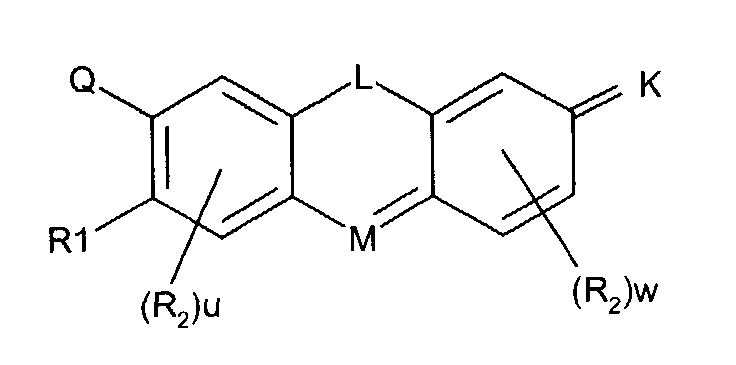
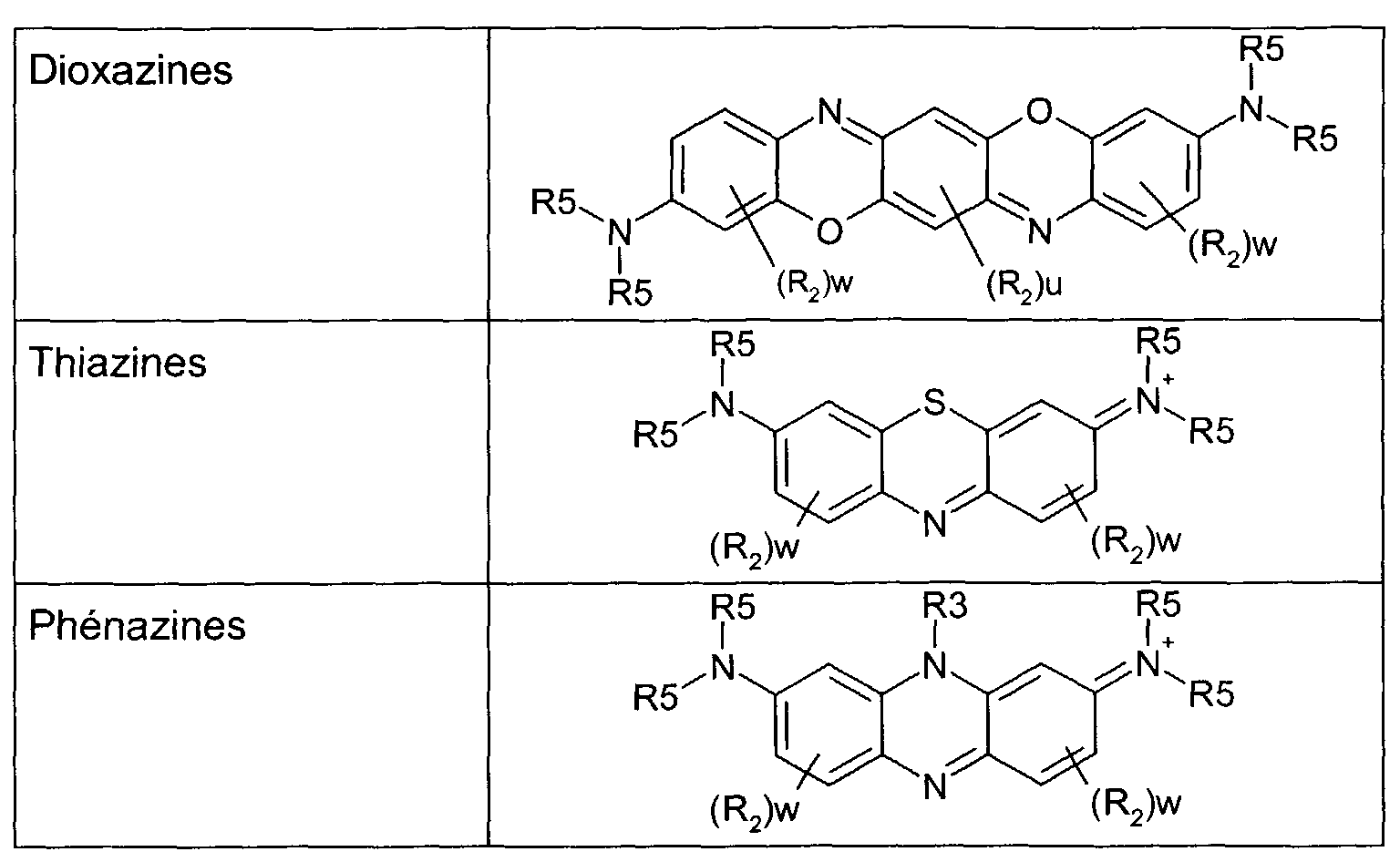
- the chromophore of the family of cyclic azines is represented by the formulas below, as well as, where appropriate, their tautomeric forms: Formulas in which the radicals and the coefficients u and w have been defined previously.
- the chromophore is further connected to the linker via one of the radicals R 2 , R 3 , R 4 , R 5 or via a ring.
- the radical carried by the ring represents a single bond between the chromophore and the linker.
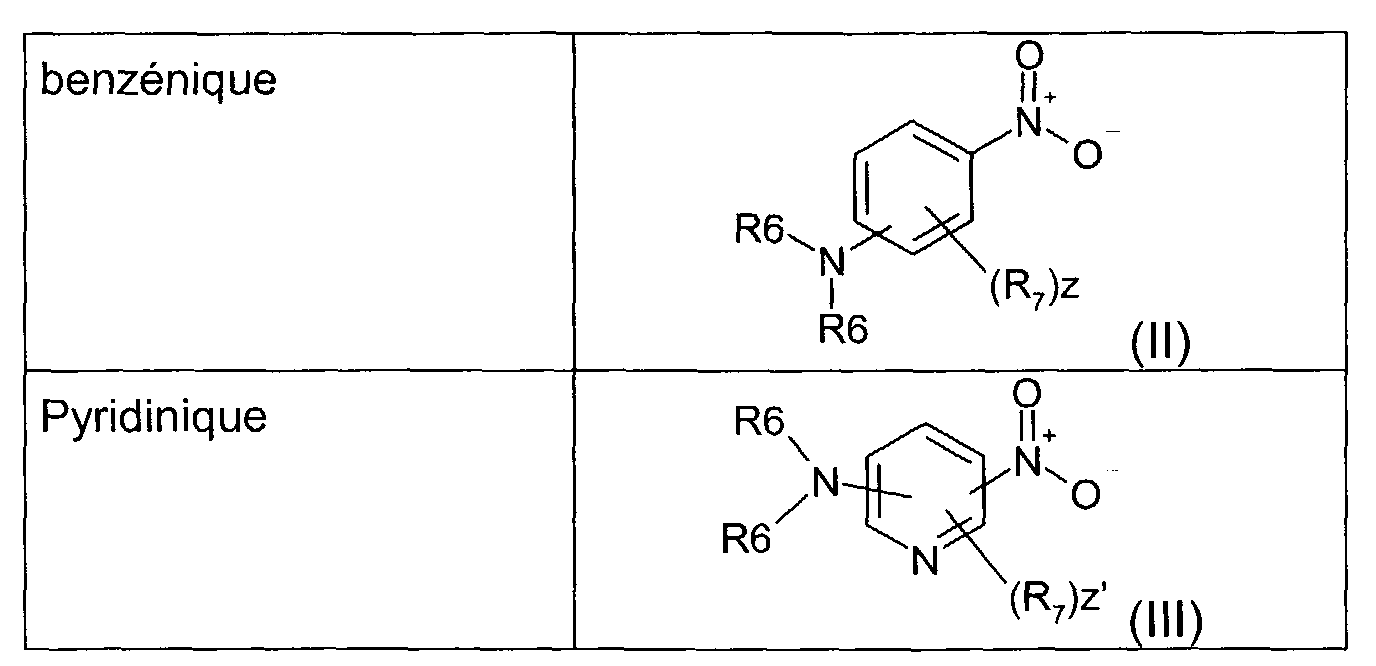
- the mixed dye may comprise at least one chromophore of the family of nitro (hetero) aromatic compounds.
- the chromophore is connected to the linker via R 6 , R 7 or through the ring.
- the radical carried by the ring represents a single bond between the chromophore and the linker.
- the mixed dye according to the present invention can include at least one chromophore of the methine family.
- the chromophores of this family come from chromophores of methine, azomethine, mono- and di-arylmethane, indamines (or diphénylamines), indophenols, indoanilines, carbocyanines, azacabocyanines and their isomers, diazacarbocyanines and their isomers, tetraazacarbocyanines, hemicyanins.
- the chromophore is connected to the linker via the group A 1 or one of the radicals R 8 , R 9 , R 10 and R 11 or directly on the ring (s) (hetero) aromatic.
- the radical R 10 in question then represents a single bond between the chromophore and the linker.
- R 8 or R 9 represents a C 6 aryl radical
- the latter may optionally be substituted, preferably by at least one hydroxyl group, with at least one amino group; at least one amino group substituted by one or more linear or branched C 1 -C 8 alkyl radicals, identical or different, optionally bearing at least one hydroxyl group; one or more halogen atoms; at least one linear or branched C 1 -C 12 alkylsulfonamido radical (alkyl-SO 2 -NH-); at least one linear or branched C 1 -C 12 alkylsulfamoyl radical (alkyl-NH-SO 2 -) at least one acyloxy radical, the linear or branched alkyl part of which is in C 1 -C 12 ; alkoxycarbonyl, the linear or branched alkyl part of which is C 1 -C 12 ; at least one carboxyl radical.
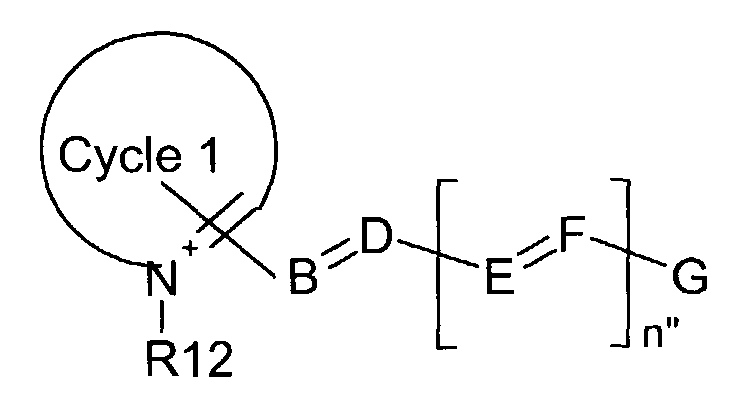
- the chromophore is connected to the linking arm via one of the radicals R 12 , R 13 , R 14 , R 15 , and R 16 or rings.
- the radical carried by the ring represents a single bond between the chromophore and the linker.
- the formula (V) comprises the position isomers corresponding to the different possibilities of implantation of the bond of B on ring 1 with respect to the nitrogen atom quaternized).
- the chromophore can be connected to the linker via one of the groups R 10 , R 11 , R 12 , R 13 , R 14 , R 15 and R 16 or via a ring aromatic or heteroaromatic.
- the radical carried on said ring represents a single bond between the chromophore and the linker.
- the chromophore and the linker are connected via the radical R 12 .
- chromophores described above can be prepared according to teaching of the following patents and patent applications GB 822846; DE 1254118; GB 1047796; US 3652556; US 3423427; BE 702239; GB 702240; US 3995088; US 4054718; US 4670385; US 5094688; US 5097034.
- the mixed dye may likewise comprise at least one chromophore of the family of carbonyls.
- chromophores of this type mention may for example be made of chromophores from the dyes chosen from acridone, benzoquinone, anthraquinone, naphthoquinone, benzanthrone, anthranthrone, pyranthrone, pyrazolanthrone, pyrimidinoanthrone, flavanthrone, idanthrone, flavone, (iso) violanthrone, isoindolinone, benzimidazolone, isoquinolinone, anthrapyridone, pyrazoloquinazolone, perinone, quinacridone, quinophthalone, indigo, thioindigo, naphthalimide, anthrapyrimidine, diketopyrrolopyrrole, coumarin.
- dyes chosen from acridone, benzoquinone, anthraquinone, naphthoquinone, benzanthrone
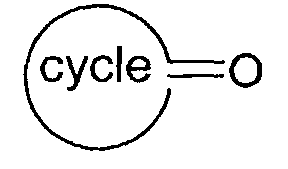
- the chromophore of the carbonyl family is represented by the following formula (VI):
- the ring represents a 5- or 6-membered ring, of which optionally at least one of them is replaced by a heteroatom selected from oxygen, nitrogen, sulfur, or by an additional carbonyl function; said ring being optionally substituted by one or more radicals selected from linear or branched, optionally substituted C 1 -C 8 alkyl radicals; by one or more hydroxyl radicals; halogen atoms such as chlorine; nitro, cyano, amino, alkylamino groups; said ring being optionally condensed with one or more C 6 aromatic rings, this or these rings which can themselves be condensed with one or more aromatic rings, of which optionally at least one of the carbon atoms is replaced by one or more selected heteroatoms among oxygen, nitrogen or sulfur.
- formula (VI) Formula in which the ring represents a 5- or 6-membered ring, of which optionally at least one of them is replaced by a heteroatom selected
- the chromophore is connected to the link arm via the one radicals which substitute rings or via a ring.
- the radical carried by the cycle represents a simple bond between the chromophore and the arm link.
- the chromophore may be connected to the linker via one of the radicals R 18 , R 19 , R 20 , R 21 , R 22 or through one of the aromatic or heteroaromatic rings.
- the radical carried by the ring represents a single bond between the chromophore and the linker.
- the chromophores of the mixed dye are connected between them by means of at least one link arm halting the delocalization of the electrons of each of the chromophores.
- the linker includes an atom or a group of atoms that isolates each of the chromophores of the mixed dye.
- the bond between the radical and the linker is carried out by via a nitrogen atom or oxygen.
- linker may be cationic or non-cationic.
- linker may be divalent, trivalent or tetravalent.
- the linker is chosen from a linear or branched C 1 -C 20 , preferably C 1 -C 12 , hydrocarbon chain, preferably an alkyl chain, one or more carbon atoms of said chain may each be replaced by a heteroatom such as sulfur, nitrogen, oxygen, provided that the chain does not include two adjacent hetero atoms; by a heterocycle comprising 5 or 6 members, saturated or unsaturated, preferably comprising at least two nitrogen atoms; said hydrocarbon chain being unsaturated or containing an arylene radical; from an arylene radical; from a divalent terephthalamide radical; among a divalent or trivalent radical, for example of the triazine type.
- the linking arm corresponds to a C 1 -C 20 , preferably C 1 -C 12 , linear or branched chain, of which at least one of the carbon atoms may be replaced by a heterocycle comprising or 6 chains, saturated or not, preferably comprising at least two nitrogen atoms.
- the mixed dyes of the invention can be prepared according to reactions known per se, from functional chromophores capable of reacting with the chosen link arm.
- the linker is a triazine group
- the chromophore comprises an amino, OH or SH reactive group
- a first chromophore is mixed with the compound likely to form the connecting arm, for example trichlorotriazine.
- a second chromophore is added to the reaction medium. This sequence can be repeated as many times as there are reactive groups on the compound likely to form the link arm.
- the molar ratio of binding arm with respect to the dye 1 is generally between 10: 1 and 0.5: 1, preferably equal to 1: 1. This ratio can be changed when using more than one arm bond or multiple chromophores.
- the reaction temperature is in general between -100 ° C. and + 130 ° C., preferably between -5 ° C and 100 ° C.
- the reaction time depends on the reactivity of the species present and the reaction temperature. In general, the reaction time is between 10 minutes and 8 hours, preferably between 30 minutes and 4 hours.
- the pH of the reaction mixture is between 2 and 12.
- the reaction may further be conducted in water and / or in one or more organic solvents.
- the mixed dye can be obtained by following the following reaction scheme:
- a first chromophore is mixed with the compound capable of forming the connecting arm, for example dibromopropane.
- a second chromophore is added to the reaction medium. This sequence can be repeated as many times as there are reactive groups on the compound likely to form the link arm.
- the molar ratio of the linking arm with respect to the dye 1 is generally between 10: 1 and 0.1: 1, preferably equal to 0.5: 1. This ratio can be changed when using more than one arm bond or multiple chromophores.
- the reaction temperature is in general between -100.degree. C. and + 130.degree. preferably between -5 ° C and 100 ° C.
- the reaction time depends on the reactivity of the species present and the reaction temperature. In general, the reaction time is between 10 minutes and 24 hours, preferably between 30 minutes and 4 hours.
- the reaction can be carried out in water and / or in one or more solvents organic.
- the pH of the reaction mixture is between 2 and 12.
- the composition according to the invention usually comprises a dye content mixture ranging from 0.001 to 20% by weight, more preferably from 0.005 to 10% by weight, and preferably from 0.01 to 5% by weight, relative to the total weight of the composition.
- the dye composition according to the invention may contain one or more dyes additional direct feeds different from the mixed dyes described above.
- Direct dyes conventionally used in the field can be used the coloring of keratinous fibers, and in particular human keratinous fibers.
- the azo direct additional dyes methine direct dyes.
- These dyes direct can be nonionic, anionic or cationic in nature.
- these Additional direct dyes are cationic in nature.
- the dye composition comprises a content of each of the direct dyes ranging from 0.001 to 10% by weight relative to the total weight of the dye composition.
- the dye composition of the invention may also contain one or more bases oxidation and / or one or more couplers, conventionally used for dyeing keratinous fibers, and in particular human keratinous fibers, such as especially the hair.
- oxidation bases there may be mentioned para-phenylenediamines, bis-phenylalkylenediamines, para-aminophenols, bis-para-aminophenols, ortho-aminophenols, heterocyclic bases and their addition salts.
- the oxidation base (s) present in the composition of the invention are in each used in an amount ranging from 0.001 to 10% by weight relative to total weight of the dyeing composition, preferably ranging from 0.005 to 6% by weight.
- couplers that may be used, there may be mentioned meta-phenylenediamines, meta-aminophenols, meta-diphenols, couplers naphthalenic compounds, heterocyclic couplers and their addition salts.
- the coupler (s) are each generally present in an amount ranging from 0.001 to 10% by weight relative to the weight total of the dyeing composition, preferably ranging from 0.005 to 6% by weight.
- addition salts in particular oxidation bases and couplers that can be used in the context of the invention are, for example, chosen from among the salts added with an acid such as hydrochlorides, hydrobromides, sulphates, citrates, succinates, tartrates, lactates, tosylates, benzenesulfonates, phosphates and acetates and addition salts with a base such as soda, potash, ammonia, amines or alkanolamines.
- an acid such as hydrochlorides, hydrobromides, sulphates, citrates, succinates, tartrates, lactates, tosylates, benzenesulfonates, phosphates and acetates
- a base such as soda, potash, ammonia, amines or alkanolamines.
- the appropriate medium for dyeing is a medium cosmetic composition generally consisting of water or a mixture of water and at least an organic solvent to solubilize the compounds that would not be sufficiently soluble in water.
- organic solvent there may be mentioned for example linear or branched monoalcohols, preferably saturated, comprising 2 to 10 carbon atoms, such as ethyl alcohol, isopropyl alcohol; aromatic alcohols such as benzyl alcohol, phenylethyl alcohol; polyols or polyol ethers such as, for example, ethylene glycol monomethyl, monoethyl and monobutyl ethers, propylene glycol or its ethers such as, for example, propylene glycol monomethyl ether, butylene glycol, dipropylene glycol, hexylene glycol (2 methyl 2,4-pentanediol), neopentyl glycol and 3-methyl-1,5-pentanediol; as well as the alkyl ethers of diethylene glycol, especially of C 1 -C 4 , such as, for example, diethylene glycol monoethyl ether or monobutyl ether, alone or as a mixture.
- the solvents are preferably present in proportions ranging from 1 to 40% by weight relative to the total weight of the dyeing composition, and even more preferably from 5 to 30% by weight approximately.
- the dye composition according to the invention may also contain various adjuvants conventionally used in compositions for dyeing fibers keratin, especially human and in particular the hair, such as agents anionic, cationic, nonionic, amphoteric, zwitterionic surfactants or their mixtures; anionic, cationic, nonionic, amphoteric polymers, zwitterionic or mixtures thereof; inorganic or organic thickeners, and in particular anionic polymeric, cationic, nonionic polymeric thickeners ionic and amphoteric; antioxidants; penetrants; of the sequestering agents; perfumes ; buffers; dispersants; agents such as, for example, volatile or non-volatile silicones, modified or unmodified; film-forming agents; ceramides or pseudoceramides ; preservatives; opacifying agents, etc.
- adjuvants conventionally used in compositions for dyeing fibers keratin, especially human and in particular the hair, such as agents anionic, cati
- the adjuvants above are generally present in varying amounts, for each from them, from 0.01 to 20% by weight relative to the weight of the composition.
- composition of the invention may further contain at least one oxidizing agent.
- Oxidizing agents conventionally used for fiber oxidation dyeing keratinous agents, especially human are, for example, hydrogen peroxide, urea peroxide, alkali metal bromates or ferricyanides, persalts such as perborates and persulphates of alkali or alkaline earth metals, such as sodium, potassium, magnesium, alone or in mixtures, peracids and enzymes oxidases, among which mention may be made of peroxidases, 2-oxido reductases, electrons such as uricases and 4-electron oxygenases such as laccases.
- the hydrogen peroxide is particularly preferred.
- composition of the invention may further comprise at least one alkaline agent which can be chosen from those conventionally used in the cosmetic field.
- alkaline agents mention may be made, for example, of ammonia, alkali carbonates, alkanolamines such as mono-, di- and triethanolamines and their derivatives, sodium or potassium hydroxides and compounds of formula (A) below: wherein W is a propylene residue optionally substituted by a hydroxyl group or a C 1 -C 4 alkyl radical; R a, R b, R c and R d, identical or different, represent a hydrogen atom, an alkyl radical in C 1 -C 4 hydroxyalkyl or C 1 -C 4.
- the pH of the dyeing composition of the invention is preferably between and 11.
- the dyeing composition according to the invention may be in forms various, such as in the form of liquids, creams, gels, or in any other form suitable for dyeing keratin fibers, especially human fibers, and more particularly hair.
- the process of the present invention is a process in which fibers, dry or not, the composition according to the present invention as defined previously.
- the composition applied to the keratinous fibers does not include an oxidizing agent.
- This variant is particularly appropriate when the dyeing composition comprises at least one mixed dye according to the invention and optionally at least one additional direct dye.
- the method is implemented with less an oxidizing agent.
- This second variant is appropriate whatever the nature dyes present (mixed dye, additional direct dye, oxidation bases and / or couplers). Such a method also makes it possible to obtain a lightening of the treated fiber.
- the oxidizing agent can be added to the composition at the moment of use or it can still be implemented from a oxidizing composition comprising it, applied simultaneously or sequentially to the dye composition comprising the mixed dye.
- the oxidizing agent is present in a composition different from that comprising the mixed dye.
- the composition comprising the dye mixture is mixed, preferably at the time of use, with a composition containing, in a medium suitable for dyeing, at least one oxidizing agent, this oxidizing agent being present in an amount sufficient to obtain the desired lightening.
- the mixture obtained is then applied to the keratinous fibers.
- the fibers keratin are preferably rinsed, then washed with shampoo, rinsed again then dried or allowed to dry.
- the composition is applied and left to act on a temperature ranging from 15 to 80 ° C, preferably from 15 to 40 ° C.
- the oxidizing composition may also contain various adjuvants used typically in compositions for dyeing keratinous fibers, in particular human and as defined above.
- the pH of the oxidizing composition containing the oxidizing agent is such that after mixture with the dyeing composition, the pH of the resulting composition applied to keratinous fibers (in other words the ready-to-use composition) varies from preferably from 7 to about 12, and even more preferably from 8 to 11. It can be adjusted to the desired value by means of acidifying or basifying agent (s).
- acidifying agents mention may be made, by way of examples, of mineral acids or organic such as hydrochloric acid, orthophosphoric acid, sulfuric acid, acetic acid.
- alkalinizing compounds As regards the alkalinizing compounds, it will be possible to refer to the list previously indicated.
- the ready-to-use composition in other words the composition which is finally applied to keratinous fibers, can take the form of various, such as in the form of liquids, creams, gels or in any other form suitable for dyeing keratin fibers, especially fibers human keratin, such as hair.
- the subject of the invention is also a device with several compartments in which least a first compartment comprises a dye composition comprising at least minus a mixed dye as described previously, and optionally at least one dye different from the mixed dye, possibly at least one oxidation base, possibly at least one coupler, and another compartment comprises an agent oxidant.
- a first compartment comprises a dye composition comprising at least minus a mixed dye as described previously, and optionally at least one dye different from the mixed dye, possibly at least one oxidation base, possibly at least one coupler, and another compartment comprises an agent oxidant.
- the mixed dye optionally the additional direct dye, the or the bases of oxidation, the coupler or couplers, can be in the same compartment or in several; the same compartment may include only one type of dye (mixed, additional direct, oxidation) or a combination of several of them.
- This device can be equipped with a means for delivering on the fibers to treat, the desired mixture, such as the devices described in FR 2 586 913.
- a final subject of the present invention consists of mixed dyes as such, as well as their addition salts, as just described, with the exception of mixed dyes with two chromophores, one of which is a nitro benzene compound, the other a nitro benzene or anthraquinone compound; the two chromophores being connected by means of a nitrogen atom via a linking arm consisting of an alkyl radical optionally interrupted by a nitrogen atom carrying one or two radicals chosen from hydrogen , alkyl C 1 -C 4 alkyl, a hydroxyalkyl radical in C 1 -C 4.
- the dual chromophore mixed dyes one of which is a nitro benzene compound, the other a nitro benzene or anthraquinone compound, are not covered by the invention; the two chromophores being connected via a linker consisting of an alkyl radical optionally interrupted by a nitrogen atom bearing one or two radicals chosen from hydrogen, a C 1 -C alkyl radical; 4 , a C 1 -C 4 hydroxyalkyl radical.
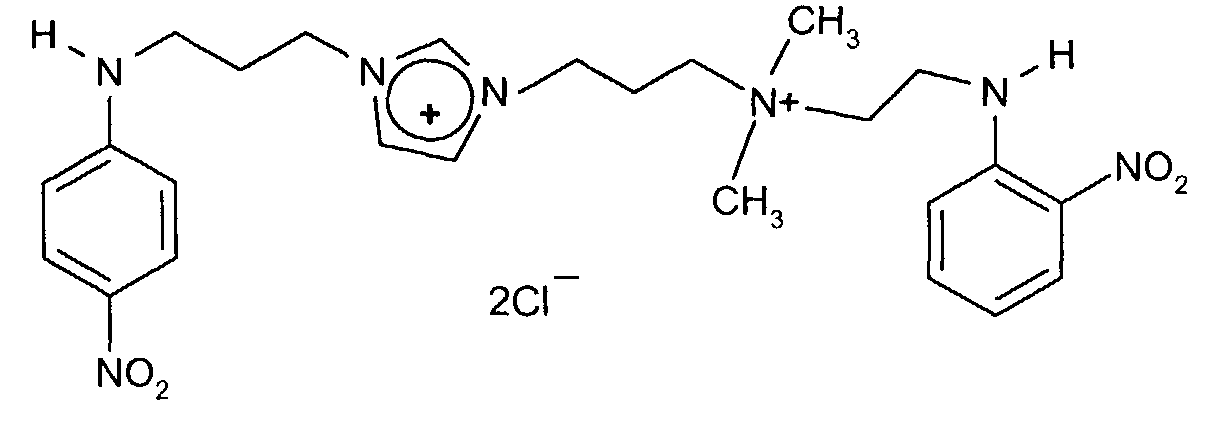
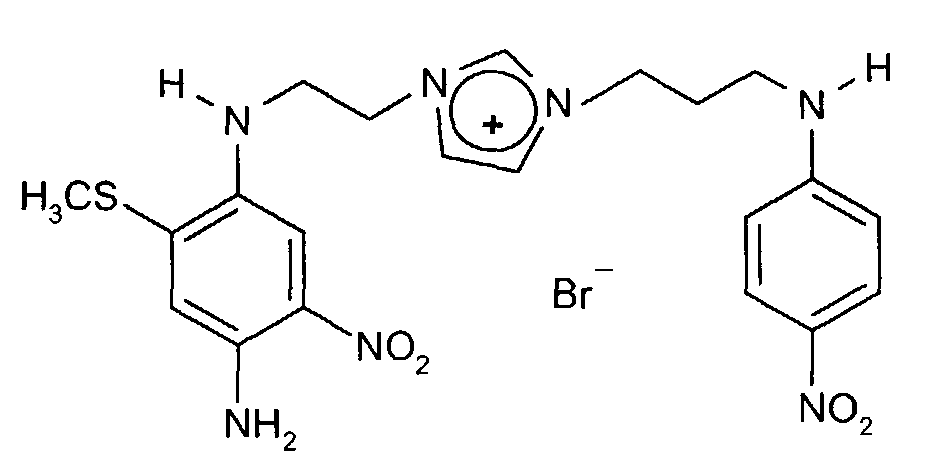
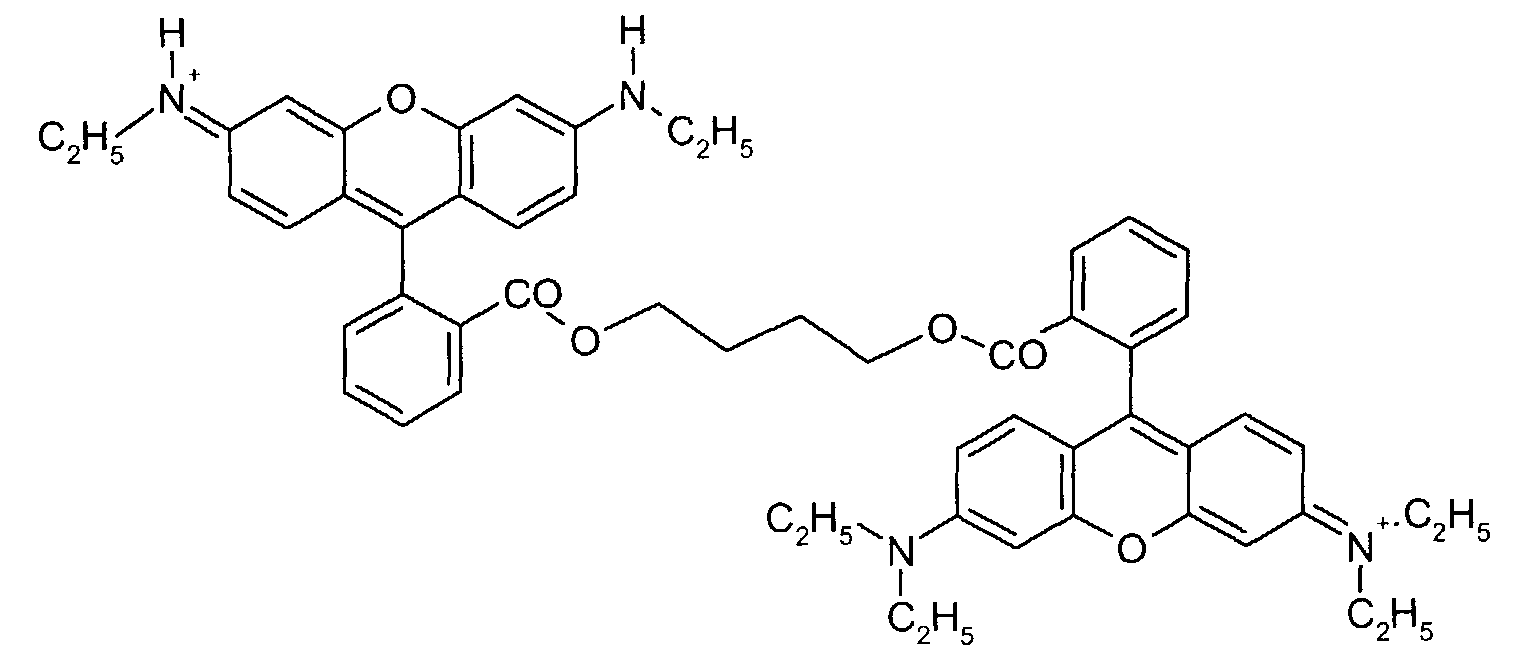
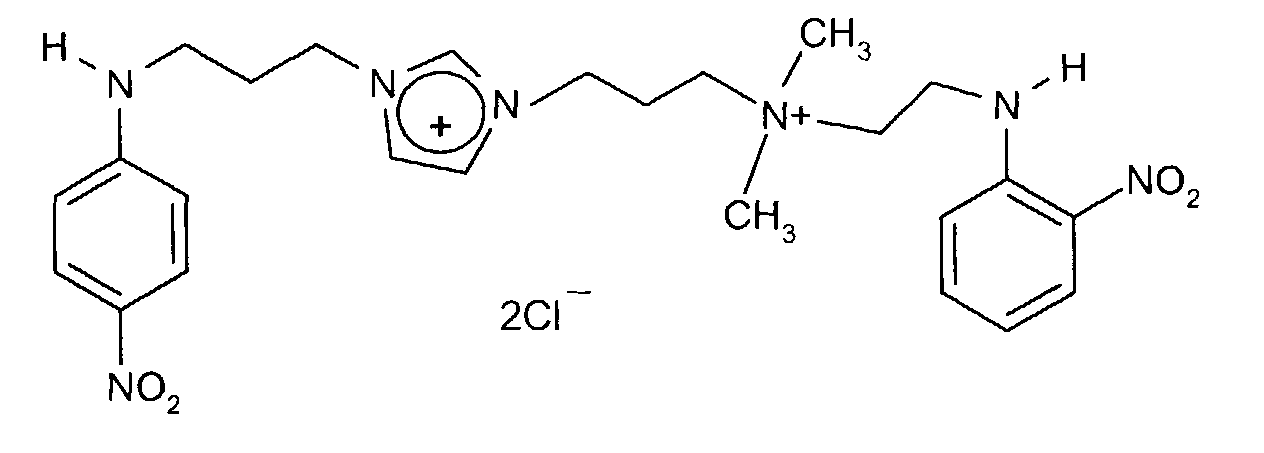
- the compounds of the following formulas are not included in the invention:
- the dyeing composition according to the invention does not comprise preferably not the above compounds.
- the mixed dye according to the invention does not correspond to a dichromophore comprising two nitrobenzene compounds, or a nitro compound benzene and an anthraquinone compound.
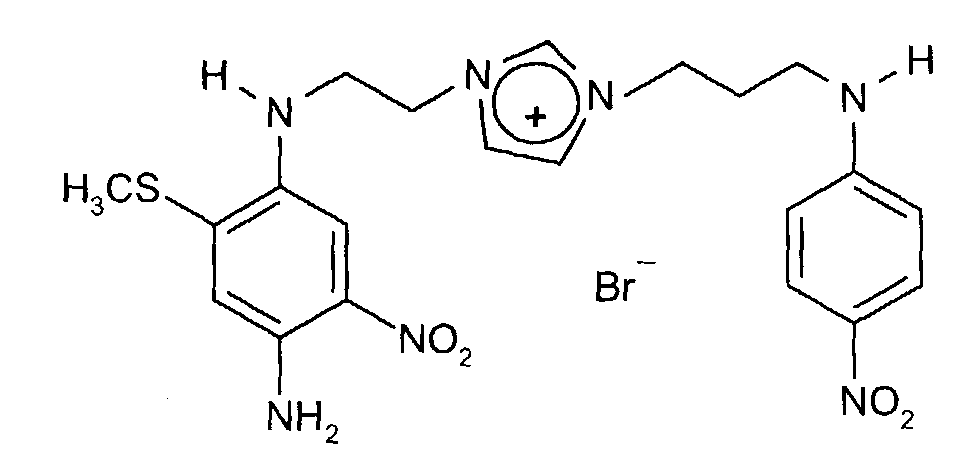
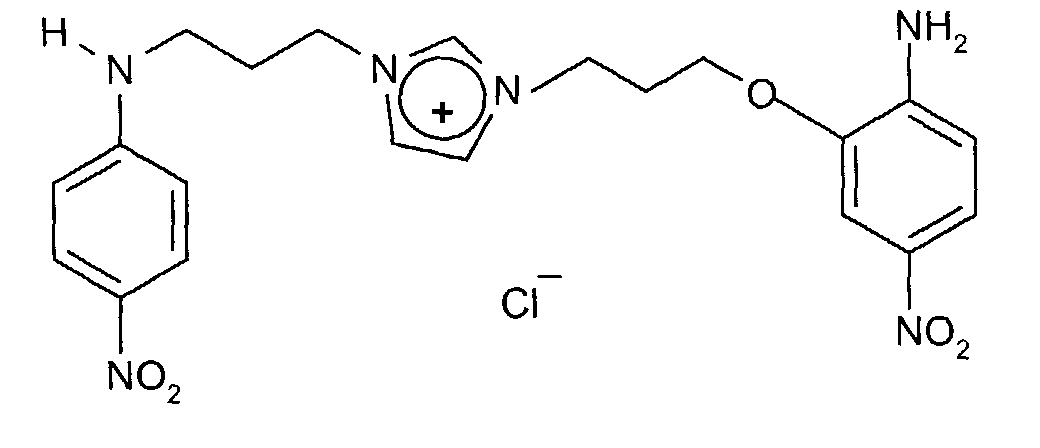
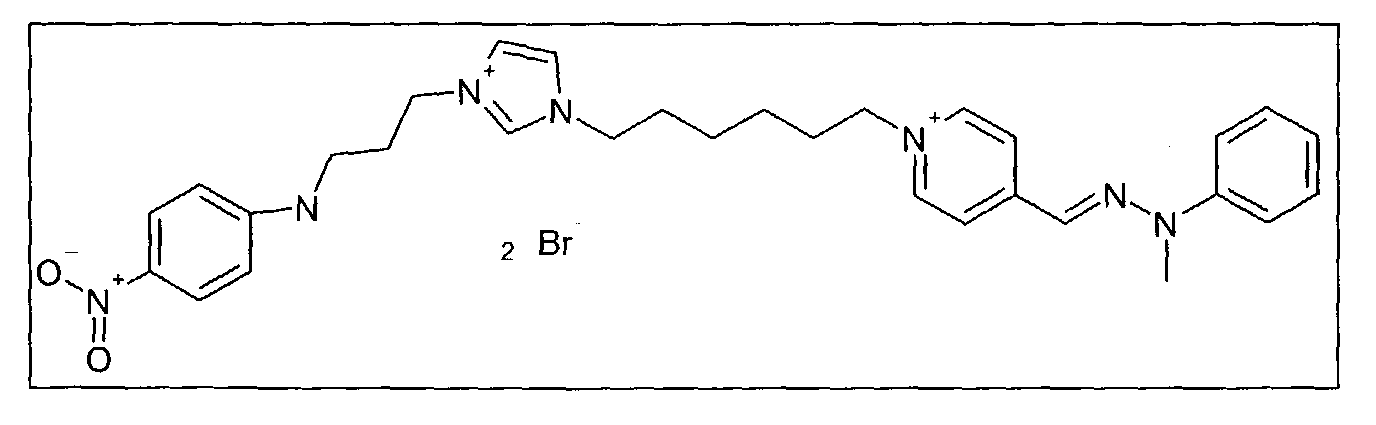
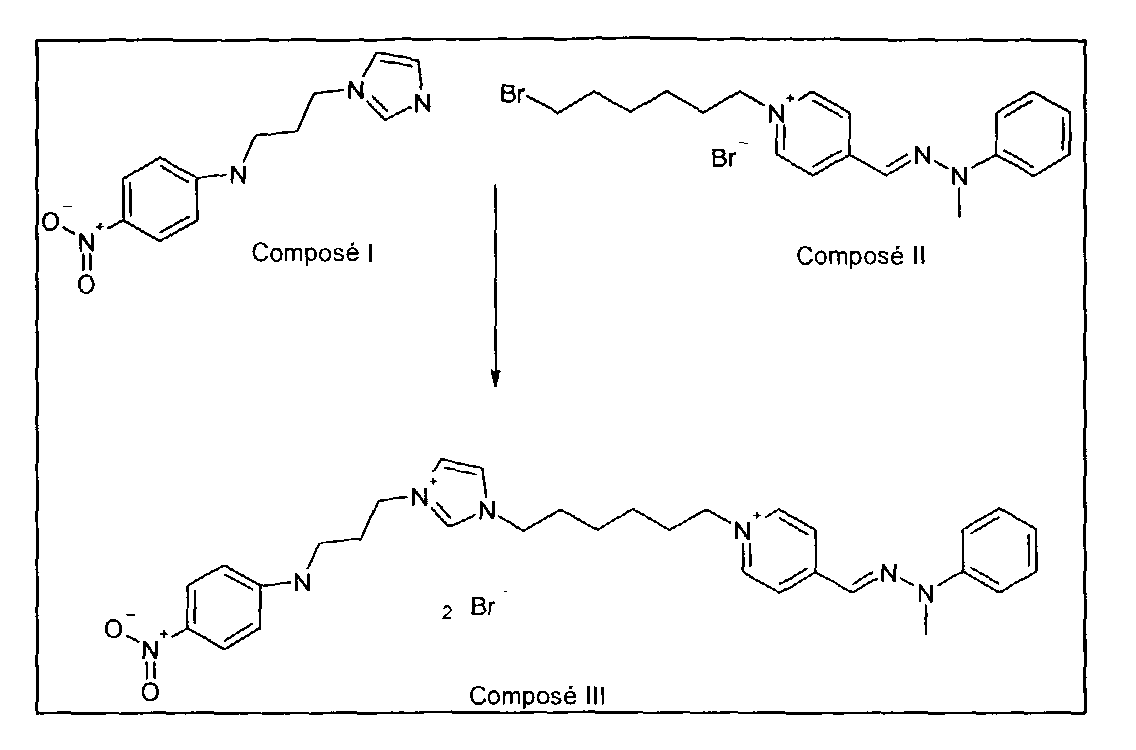
- the mixed dye obtained in the preceding example is formulated at 5.7 ⁇ 10 -4 mol% in the coloring composition A.
- Composition A Alkyl (C 8 / C 10 50/50) polyglucoside in aqueous 60% buffered solution 10 g Benzyl alcohol 10 g Polyethylene glycol 400 with 8 ethylene oxide units 12 g Mixed dye example 1 5.7 ⁇ 10 -4 mol Ammonia at 20.5% 10 g Demineralized Water qsp 100 g
- the pH of the dyeing composition after mixing is between 9.5 and 10.
- the break time on wicks is 20 min at room temperature.
- the colored locks undergo six shampoos, with intermediate drying between two shampoos.
- the color after the six shampoos is compared to the initial color of the lock colored, visually and by colorimetric measurement (CM2002 Minolta colorimeter, illuminant D65-10 ° CSI).
- the shampoo resistance is measured according to the formula of ⁇ E below from the values of L * a * b * measured before (L 0 * a 0 * b 0 *) and after the 6 shampoos (L 1 * a 1 * b 1 *).
- ⁇ E (L 1 * -L 0 *) 2 + (A 1 *-at 0 *) 2 + (B 1 * -b 0 *) 2
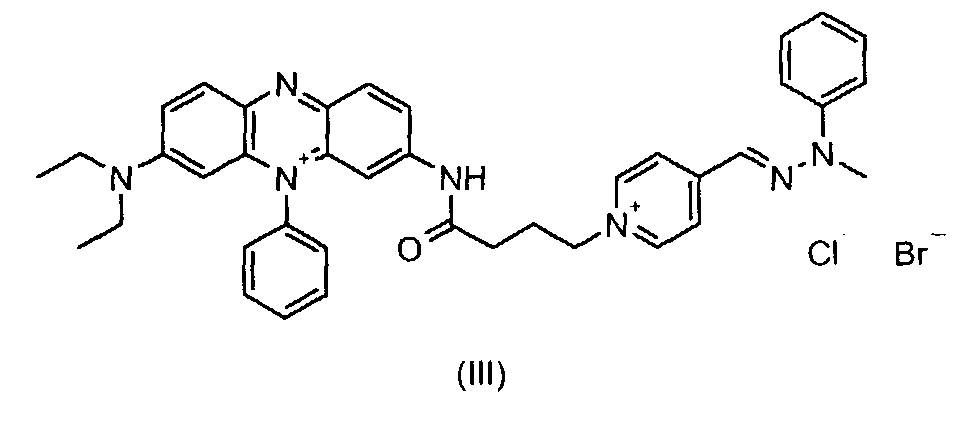
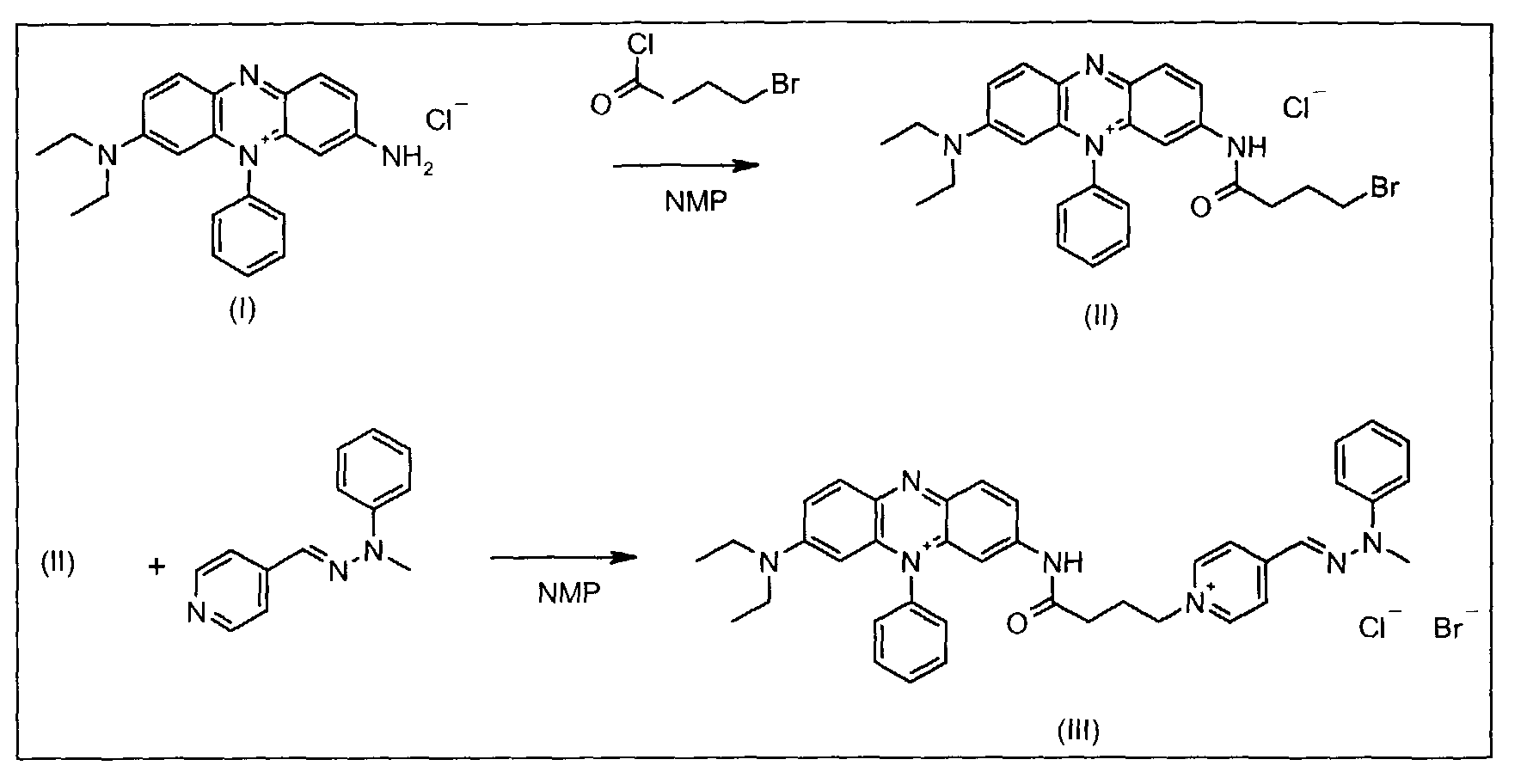
- reaction mixture is stirred at ambient temperature for 16 hours. hours, then it is poured into 200 mL of acetone.
- the mixture is heated at 80 ° C for 24 hours.
- Compound (III) is obtained pure by successive washings of an aqueous solution of crude product with 1-butanol and concentration in vacuo of this solution.
Landscapes
- Health & Medical Sciences (AREA)
- Life Sciences & Earth Sciences (AREA)
- Animal Behavior & Ethology (AREA)
- General Health & Medical Sciences (AREA)
- Public Health (AREA)
- Veterinary Medicine (AREA)
- Birds (AREA)
- Epidemiology (AREA)
- Cosmetics (AREA)
- Coloring (AREA)
Abstract
Description






- R8, R9, identiques ou non, représentent un atome d'hydrogène ; un radical aryle en C6-C30 un radical alkyl(C1-C8)aryle, la partie aryle étant éventuellement substituée par un ou plusieurs groupements, identiques ou non, choisis de préférence parmi les groupements hydroxyle, alcoxy, linéaire ou ramifié, substitué ou non, en C1-C4, amino, amino substitué par un ou plusieurs radicaux alkyles, identiques ou non, linéaires ou ramifiés, en C1-C4 éventuellement porteurs d'au moins un groupement hydroxyle, les atomes d'halogène, de préférence le chlore ; un radical hétérocyclique, choisi notamment parmi les hétérocycles thiophène, furane, pipéronyle, indole, indoline, pyridine, carbazole, déhydroquinoléïne, chromone ;
- R8, R9, ne peuvent en outre représenter simultanément ni un radical aromatique, ni un radical hétéroaromatique ;
- R10, identiques ou différents, représentent un atome d'hydrogène ; un radical alkyle, linéaire ou ramifié, en C1-C8 éventuellement substitué ; un radical aryle en C6-C30, éventuellement substitué ; un radical amino ; un radical amino substitué par ou plusieurs radicaux alkyle, linéaires ou ramifiés, en C1-C4, éventuellement porteurs d'au moins un groupement hydroxyle ; un groupement hydroxyle ; un radical alcoxy, linéaire ou ramifié, en C1-C8, éventuellement porteur d'au moins un groupement hydroxyle, alcoxy en C1-C4 ; un atome d'halogène et de préférence le chlore ;
- X représente un atome d'azote, un atome de carbone ;
- le coefficient n représente 0 lorsque X est un atome d'azote, et 1 lorsque X est un atome de carbone ;
- le coefficient n' est égal à 4 ;
- A1 représente un groupement amino ; un groupement amino substitué par un ou plusieurs radicaux alkyles en C1-C8, identiques ou non, linéaires ou ramifiés, éventuellement porteurs d'au moins un groupement hydroxyle, un groupement ammonium N+(R11)2 ; R11, identiques ou non, représentent un radical alkyle en C1-C8 éventuellement substitué ; un radical aryle en C6 éventuellement substitué, de préférence par un ou plusieurs hydroxyle, atomes d'halogène, de préférence le chlore, le fluor, groupes nitro, groupes cyano, alcoxy, linéaires ou ramifiés, en C1-C4, monohydroxy alcoxy en C1-C4, linéaires ou ramifiés, polyhydroxyalcoxy, en C2-C4, linéaires ou ramifiés, amino substitués ou non par un ou plusieurs radicaux alkyle, hydroxyalkyle, identiques ou différents, en C1-C4, linéaires ou ramifiés.
formule dans laquelle
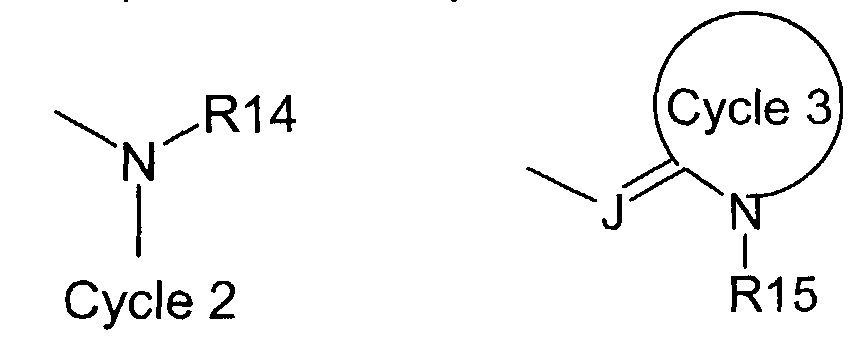
- R12 et R15 représentent indépendamment l'un de l'autre, un radical alkyle, linéaire ou ramifié, en C1-C8 éventuellement substitué ; un radical benzyle éventuellement substitué ;
- R14 représente un atome d'hydrogène, un radical alkyle en C1-C8 éventuellement substitué, de préférence par au moins un hydroxyle, un radical alcoxy, linéaire ou ramifié, en C1-C4, un radical amino, un radical amino substitué par un ou plusieurs radicaux alkyle, identiques ou non, linéaires ou ramifiés, en C1-C4, éventuellement porteurs d'au moins un groupe hydroxyle ; un radical aryle en C6 éventuellement substitué ; un radical hétéroaryle en C2-C12 éventuellement substitué ;
- J représente un atome d'azote ou un groupe C-R16 avec R16 ayant la même signification que R13 ;
- Cycle 1 étant choisi parmi les radicaux hétéroaromatiques à 5 à 12 chaínons, portant au moins une charge cationique sur un atome d'azote et comprenant éventuellement au moins un autre hétéroatome choisi parmi l'azote, l'oxygène et/ou le soufre ; lesdits radicaux étant éventuellement substitués par au moins un radical alkyle, linéaire ou ramifié, en C1-C8 substitué ou non ; au moins un radical alcoxy, linéaire ou ramifié, en C1-C8 substitué ou non ; au moins un radical amino ; au moins un radical amino substitué par un ou plusieurs groupements alkyle, identiques, ou non, linéaires ou ramifiés, en C1-C8, éventuellement porteurs d'au moins un groupement hydroxyle ; au moins un radical aromatique en C5-C6 ; au moins un groupement hydroxyle ; au moins un radical alcoxycarbonyle, linéaire ou ramifié, en C1-C8 ; au moins un nitro ; au moins un cyano ; au moins un radical alkylsulfonamido linéaire ou ramifié, en C1-C12 (alkyl-SO2-NH-) ; alkylsulfamoyle linéaire ou ramifié, en C1-C12 (alkyl-NH-SO2-) ;
- Cycle 2 étant choisi parmi les radicaux aromatiques en C6-C12 ; les radicaux hétéroaromatiques à 5 à 12 chaínons, comprenant au moins un hétéroatome choisi parmi l'azote, l'oxygène et/ou le soufre ; lesdits radicaux étant éventuellement substitués par au moins un radical alkyle, linéaire ou ramifié, en C1-C8 ; au moins un radical alcoxy, linéaire ou ramifié, en C1-C8 ; au moins un radical amino ; au moins un radical amino substitué par un ou plusieurs groupements alkyle, identiques, ou non, linéaires ou ramifiés, en C1-C8, éventuellement porteurs d'au moins un groupement hydroxyle ; au moins un radical (hétéro)aromatique comprenant de préférence 5 à 6 chaínons ; au moins un groupement hydroxyle. De préférence Cycle 2 représente un radical aromatique en C6-C30, éventuellement substitué comme indiqué ci-dessus ;
- Cycle 3 étant choisi parmi les radicaux hétéroaromatiques à 5 ou 6 chaínons comprenant au moins un hétéroatome choisi parmi l'azote, l'oxygène et/ou le soufre ; lesdits radicaux étant éventuellement substitués par au moins un radical alkyle, linéaire ou ramifié, en C1-C8 ; au moins un radical alcoxy, linéaire ou ramifié, en C1-C8 ; au moins un radical amino ; au moins un radical amino substitué par un ou plusieurs groupements alkyle, identiques, ou non, linéaires ou ramifiés, en C1-C8, éventuellement porteurs d'au moins un groupement hydroxyle ; au moins un radical aromatique en C5-C6 ; au moins un groupement hydroxyle ; au moins un radical alcoxycarbonyle linéaire ou ramifié en C1-C8 ; nitro ; cyano ; au moins un radical alkylsulfonamido linéaire ou ramifié en C1-C12 (alkyl-SO2-NH-) ; au moins un radical alkylsulfamoyle linéaire ou ramifié en C1-C12 (alkyl-NH-SO2-) ;
- Cycle 4 étant choisi parmi les radicaux aromatiques en C6-C12 ; les radicaux hétéroaromatiques à 5 à 12 chaínons, comprenant au moins un hétéroatome choisi parmi l'azote, l'oxygène et/ou le soufre ; lesdits radicaux étant éventuellement substitués par au moins un radical alkyle, linéaire ou ramifié, en C1-C8 ; au moins un radical alcoxy, linéaire ou ramifié, en C1-C8 ; au moins un radical amino ; au moins un radical amino substitué par un ou plusieurs groupements alkyle, identiques, ou non, linéaires ou ramifiés, en C1-C8, éventuellement porteurs d'au moins un groupement hydroxyle ; au moins un radical (hétéro)aromatique comprenant de préférence 5 à 6 chaínons; au moins un groupement hydroxyle ;









| Composition A | |
| Alkyl (C8/C10 50/50) polyglucoside en solution aqueuse à 60 % tamponnée | 10 g |
| Alcool benzylique | 10 g |
| Polyéthylène glycol 400 à 8 motifs d'oxyde d'éthylène | 12 g |
| Colorant de mixte l'exemple 1 | 5,7.10-4 mol |
| Ammoniaque à 20.5 % | 10 g |
| Eau déminéralisée | qsp 100 g |


| Composition selon l'invention | ||||
| Type de cheveux | L* | a* | b* | Dégradation (ΔE) |
| Colorant mixte avant shampooing | 63,81 | 7,04 | 73,39 | 3,23 |
| Colorant mixte après shampooing | 65,78 | 4,50 | 73,07 | |
| Compositions comparatives : | ||||
| Type de cheveux | L* | a* | b* | Dégradation (ΔE) |
| Mélange des colorants I et II avant shampooing | 65,45 | 1,88 | 70,41 | 19,29 |
| Mélange des colorants I et II après shampooing | 68,85 | -2,47 | 51,93 |


Claims (31)
- Composition tinctoriale comprenant, dans un milieu approprié pour la teinture des fibres kératiniques, notamment humaines, au moins un colorant mixte comprenant au moins deux chromophores ; au moins l'un des chromophores étant choisi parmi les chromophores de la famille des composés azines cycliques et/ou nitrés (hétéro)aromatiques éventuellement associé à au moins un chromophore de la famille des méthines et/ou des carbonyles ; les chromophores étant liés entre eux par l'intermédiaire d'au moins un bras de liaison stoppant la délocalisation des électrons de chacun des chromophores ; à l'exception d'une composition comprenant un colorant mixte à deux chromophores dont l'un est un composé nitré benzénique, l'autre un composé nitré benzénique ou anthraquinonique, les deux chromophores étant reliés au moyen d'un atome d'azote par l'intermédiaire d'un bras de liaison constitué par un radical alkyle éventuellement interrompu par un atome d'azote porteur d'un ou de deux radicaux choisis parmi l'hydrogène, un radical alkyle en C1-C4, un radical hydroxyalkyle en C1-C4, et des composés de formules suivantes :
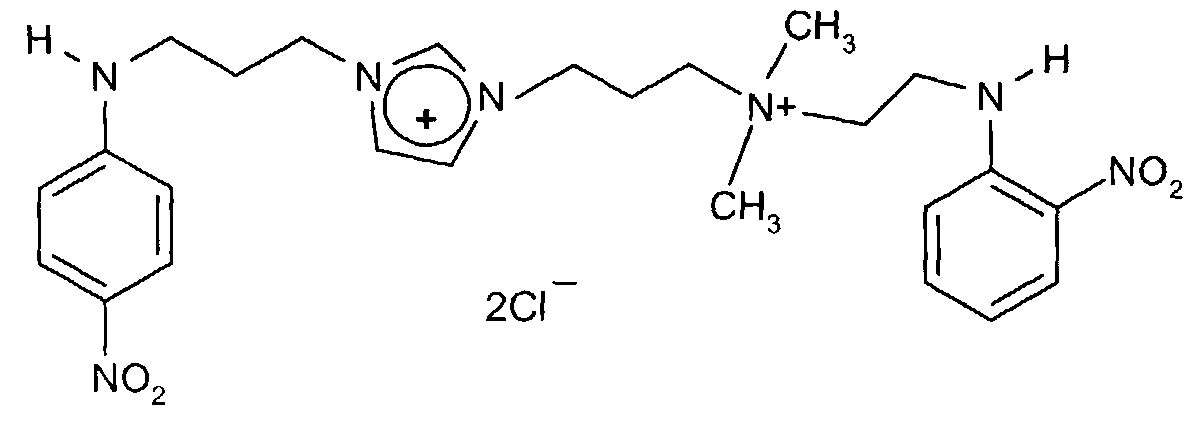

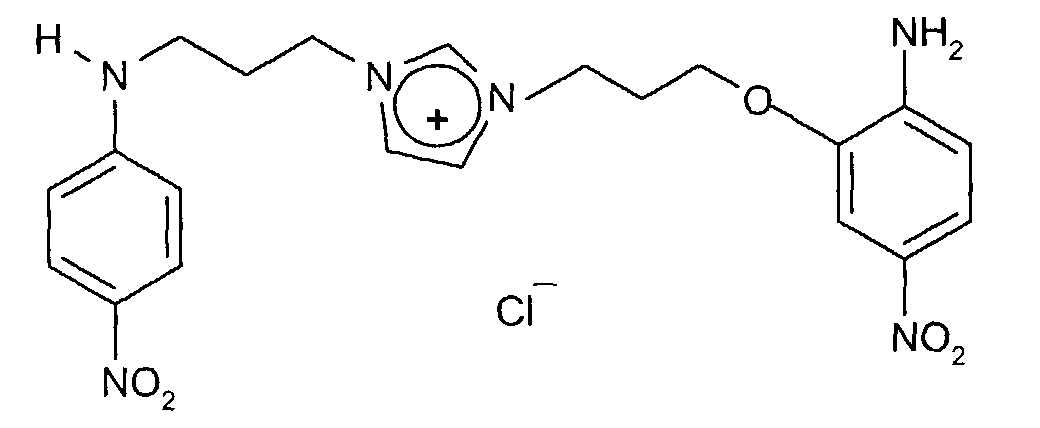
- Composition selon la revendication précédente, caractérisée en ce que le colorant mixte comprend au moins deux chromophores différents dont l'un au moins porte une ou plusieurs charges cationiques.
- Composition selon la revendication précédente, caractérisée en ce que les chromophores absorbent dans le domaine visible entre 400 et 800 nm.
- Composition selon l'une quelconque des revendications précédentes, caractérisée en ce que le colorant mixte comprend deux à quatre chromophores, de préférence deux à trois chromophores.
- Composition selon l'une quelconque des revendications précédentes, caractérisée en ce que le colorant mixte comprend deux chromophores.
- Composition selon l'une des revendications précédentes, caractérisée en ce que le ou les chromophores cationiques sont des chromophores comprenant au moins un atome d'azote quaternisé.
- Composition selon l'une quelconque des revendications précédentes, caractérisée en ce que le colorant mixte comprend au moins un chromophore de la famille des azines cycliques.
- Composition selon la revendication précédente, caractérisée en ce que le chromophore de la famille des azines cycliques est choisi parmi les azine, xanthène, thioxanthène, fluorindine, acridine, (di)oxazine, (di)thiazine, pyronine.
- Composition selon la revendication précédente, caractérisée en ce que le chromophore de la famille des azines est un radical issu de colorants formule suivante (I) ainsi que ses formes tautomères :formule dans laquelle :
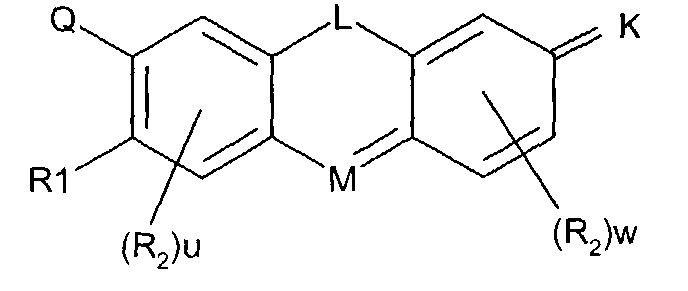 L, représente un hétéroatome de préférence choisi parmi l'oxygène, le soufre ; un groupe NH ; un groupe N-R3,M représente un hétéroatome de préférence choisi parmi l'oxygène, le soufre, l'azote ; un groupe N+-R3 ; un groupe CH ; un groupe C-R4 ;Q, K, identiques ou non, représentent un groupement hydroxyle ; un radical amino ; un radical amino substitué par un ou plusieurs radicaux alkyle, identiques ou non, linéaires ou ramifiés, en C1-C8, éventuellement porteurs d'au moins un groupement hydroxyle, un radical aryle éventuellement substitué, un radical alkyl(C1-C8)aryle éventuellement substitué ; un groupement ammonium de type N+(R5)t avec t égal à 2 pour K et à 3 pour Q ; R5, identiques ou non, représentent un atome d'hydrogène ; un radical alkyle, linéaire ou ramifié, en C1-C8, éventuellement porteur d'au moins un groupement hydroxyle ; un radical aryle éventuellement substitué, un radical alkyl(C1-C8)aryle la partie aryle étant éventuellement substituée ; un radical alkyle en C1-C8, linéaire ou ramifiée, éventuellement substituée, un radical alcoxy, linéaire ou ramifié, en C1-C8, éventuellement substitué ;à la condition que Q et K ne représentent pas à la fois un groupement ammonium de type N+(R5)t ;R1, R2, identiques ou non, représentent un atome d'hydrogène ; un radical alkyle, linéaire ou ramifié, en C1-C8 éventuellement substitué ; un radical amino ; un radical amino substitué ou non par un ou plusieurs radicaux, identiques ou non, choisis parmi les radicaux alkyle, linéaires ou ramifiés, en C1-C8 éventuellement substitués, les radicaux phényle éventuellement substitués ; un atome d'halogène de préférence le chlore, le fluor ;au cas où Q représente un radical amino substitué ou non, ou un groupement hydroxyle, R1 peut représenter un radical alkylamino ou alcoxy formant avec l'atome d'azote ou d'oxygène du radical J, un cycle à 6 chaínons, éventuellement condensé avec un radical aromatique, ledit radical aromatique étant éventuellement substitué par au moins un groupement amino ou amino substitué ou non par un ou plusieurs radicaux identiques ou non, choisis parmi les radicaux alkyle, linéaires ou ramifiés, en C1-C8 éventuellement substitués, les radicaux phényle éventuellement substitués ;R3, R4, identiques ou non, représentent un radical alkyle, linéaire ou ramifié en C1-C8 éventuellement substitué, de préférence par au moins un hydroxyle ; au moins un radical alcoxy, linéaire ou ramifié en C1-C8 ; au moins un radical amino ; au moins un radical amino substitué par un ou plusieurs radicaux alkyles, identiques ou non, linéaires ou ramifiés, en C1-C8, éventuellement porteurs d'au moins un radical hydroxyle ;R3, R4, identiques ou non, peuvent aussi représenter un radical aryle, de préférence en C6, éventuellement substitué, de préférence par au moins un radical alkyle, linéaire ou ramifié, en C1-C8 ; par au moins un groupement hydroxyle ; par au moins un radical alcoxy, linéaire ou ramifié, en C1-C8 ; par au moins un radical amino ; par au moins un radical amino substitué par un ou plusieurs radicaux alkyle, identiques ou non, linéaires ou ramifiés, en C1-C8, éventuellement porteurs d'au moins un groupement hydroxyle ; un atome d'halogène et de préférence le chlore ou le fluor ; par au moins un groupement nitro ; par au moins un groupement cyano, de préférence R3 et R4, identiques ou non, représentent un radical alkyle, linéaire en C1-C4, un radical aryle éventuellement substitué ;le coefficient u est égal à 2 ; w est égal à 3.
 - Composition selon l'une quelconque des revendications précédentes, caractérisée en ce que le chromophore de la famille des nitrés (hétéro)aromatiques est un radical issu de colorants correspondant aux formules (II) et (III) ci-dessous, ainsi que leurs formes tautomères :Formules dans lesquelles
 R6, identiques ou non, représentent un atome d'hydrogène ; un radical alkyle, linéaire ou ramifié, en C1-C8, éventuellement porteur d'au moins un groupement hydroxyle ; un radical aryle éventuellement substitué, un radical alkyl(C1-C8)aryle la partie aryle étant éventuellement substituée ; un radical alkyle en C1-C8, linéaire ou ramifiée, éventuellement substituée, un radical alcoxy, linéaire ou ramifié, en C1-C8, éventuellement substitué ;R7, identiques ou différents, représentent un atome d'hydrogène ; alkyle linéaire ou ramifié en C1-C4, éventuellement substitué ; un radical alcoxy linéaire ou ramifié en C1-C8, éventuellement substitué ; un radical aryle en C6 éventuellement substitué ; un radical amino ; un radical amino substitué par un ou plusieurs radicaux choisis parmi les radicaux alkyle, identiques ou non, linéaires ou ramifiés, en C1-C8, de préférence en C1-C4, éventuellement substitués, de préférence par au moins un groupe hydroxyle, alcoxy, linéaire ou ramifié en C1-C4, thioalkyle linéaires ou ramifiés en C1-C4, alkylsulfonamido linéaires ou ramifiés en C1-C4, parmi les radicaux aryle en C6 éventuellement substitué et parmi les radicaux hétéroaryle comprenant 5 à 6 chaínons éventuellement substitués ; un groupe hydroxyle ; un groupe nitro ; un groupe cyano.
 - Composition selon l'une quelconque des revendications précédentes, caractérisée en ce que les chromophores de type méthines, sont choisis parmi les composés comprenant au moins un enchaínement choisi parmi >C=C< et -N=C< dont les deux atomes ne sont pas simultanément engagés dans un cycle ; sachant qu'il n'est pas exclu que l'un des atomes d'azote ou de carbone des enchaínements peut être engagé dans un cycle.
- Composition selon l'une des revendications précédentes, caractérisée en ce que les chromophores de type méthine sont des radicaux issus de chromophores de la famille des méthine, azométhine, mono- et di- arylméthane, indamines, indophénols, indoanilines, carbocyanines, azacabocyanines et leurs isomères, diazacarbocyanines et leurs isomères, tétraazacarocyanines, hémicyanines, ainsi que, le cas échéant, leurs isomères.
- Composition selon l'une des revendications précédentes, caractérisée en ce que les chromophores de type méthine sont des radicaux issus de chromophores de formule suivante (IV) ainsi que ses formes tautomères :Formule (IX) dans laquelle :
 Conviennent aussi ceux issus de la formule suivante (V) :R8, R9, identiques ou non, représentent un atome d'hydrogène ; un radical aryle en C6-C30 un radical alkyl(C1-C8)aryle, la partie aryle étant éventuellement substituée par un ou plusieurs groupements, identiques ou non, choisis de préférence parmi les groupements hydroxyle, alcoxy, linéaire ou ramifié, substitué ou non, en C1-C4, amino, amino substitué par un ou plusieurs radicaux alkyles, identiques ou non, linéaires ou ramifiés, en C1-C4 éventuellement porteurs d'au moins un groupement hydroxyle, les atomes d'halogène, de préférence le chlore ; un radical hétérocyclique, choisi notamment parmi les hétérocycles thiophène, furane, pipéronyle, indole, indoline, pyridine, carbazole, déhydroquinoléïne, chromone ;R8, R9, ne peuvent en outre représenter simultanément ni un radical aromatique, ni un radical hétéroaromatique ;R10, identiques ou différents, représentent un atome d'hydrogène ; un radical alkyle, linéaire ou ramifié, en C1-C8 éventuellement substitué ; un radical aryle en C6-C30, éventuellement substitué ; un radical amino ; un radical amino substitué par ou plusieurs radicaux alkyle, linéaires ou ramifiés, en C1-C4, éventuellement porteurs d'au moins un groupement hydroxyle ; un groupement hydroxyle ; un radical alcoxy, linéaire ou ramifié, en C1-C8, éventuellement porteur d'au moins un groupement hydroxyle, alcoxy en C1-C4 ; un atome d'halogène et de préférence le chlore ;X représente un atome d'azote, un atome de carbone ;le coefficient n représente 0 lorsque X est un atome d'azote, et 1 lorsque X est un atome de carbone ;le coefficient n' est égal à 4 ;A1 représente un groupement amino ; un groupement amino substitué par un ou plusieurs radicaux alkyles en C1-C8, identiques ou non, linéaires ou ramifiés, éventuellement porteurs d'au moins un groupement hydroxyle, un groupement ammonium N+(R11)2 ; R11, identiques ou non, représentent un radical alkyle en C1-C8 éventuellement substitué ; un radical aryle en C6 éventuellement substitué, de préférence par un ou plusieurs hydroxyle, atomes d'halogène, de préférence le chlore, le fluor, groupes nitro, groupes cyano, alcoxy, linéaires ou ramifiés, en C1-C4, monohydroxy alcoxy en C1-C4, linéaires ou ramifiés, polyhydroxyalcoxy, en C2-C4, linéaires ou ramifiés, amino substitués ou non par un ou plusieurs radicaux alkyle, hydroxyalkyle, identiques ou différents, en C1-C4, linéaires ou ramifiés ;et le cas échéant leurs formes tautomères ; formule dans laquelle
 formules dans lesquelles :B, D, E, et F, identiques ou différents, représentant un atome d'azote ou un groupe C-R13,R13, identiques ou non, représentent un atome d'hydrogène, un radical alkyle en C1-C8 éventuellement substitué, de préférence par au moins un hydroxyle ; un radical alcoxy, linéaire ou ramifié, en C1-C4 ; un radical amino ; un radical amino substitué par un ou plusieurs radicaux alkyle, identiques ou non, linéaires ou ramifiés, en C1-C4, éventuellement porteurs d'au moins un groupe hydroxyle ; un radical aryle en C6 éventuellement substitué, un radical hétéroaryle comprenant de 5 à 12 chaínons, éventuellement substitué ;n" = 0 ou 1 ;G représentant un Cycle 4, ou les restes :
 à la condition que lorsque n" vaut 1 et G représente un cycle, alors B, D, E et F ne peuvent représenter simultanément un atome d'azote ; et que lorsque n" vaut 0 et G représente un cycle, alors B et D ne représentent pas simultanément un atome d'azote.R12 et R15 représentent indépendamment l'un de l'autre, un radical alkyle, linéaire ou ramifié, en C1-C8 éventuellement substitué ; un radical benzyle éventuellement substitué ;R14 représente un atome d'hydrogène, un radical alkyle en C1-C8 éventuellement substitué, de préférence par au moins un hydroxyle, un radical alcoxy, linéaire ou ramifié, en C1-C4, un radical amino, un radical amino substitué par un ou plusieurs radicaux alkyle, identiques ou non, linéaires ou ramifiés, en C1-C4, éventuellement porteurs d'au moins un groupe hydroxyle ; un radical aryle en C6 éventuellement substitué ; un radical hétéroaryle en C2-C12 éventuellement substitué ;J représente un atome d'azote ou un groupe C-R16 ; avec R16 ayant la même signification que R13 ;Cycle 1 étant choisi parmi les radicaux hétéroaromatiques à 5 à 12 chaínons, portant au moins une charge cationique sur un atome d'azote et comprenant éventuellement au moins un autre hétéroatome choisi parmi l'azote, l'oxygène et/ou le soufre ; lesdits radicaux étant éventuellement substitués par au moins un radical alkyle, linéaire ou ramifié, en C1-C8 substitué ou non ; au moins un radical alcoxy, linéaire ou ramifié, en C1-C8 substitué ou non ; au moins un radical amino ; au moins un radical amino substitué par un ou plusieurs groupements alkyle, identiques, ou non, linéaires ou ramifiés, en C1-C8, éventuellement porteurs d'au moins un groupement hydroxyle ; au moins un radical aromatique en C5-C6 ; au moins un groupement hydroxyle ; au moins un radical alcoxycarbonyle, linéaire ou ramifié, en C1-C8 ; au moins un nitro ; au moins un cyano ; au moins un radical alkylsulfonamido linéaire ou ramifié, en C1-C12 (alkyl-SO2-NH-) ; alkylsulfamoyle linéaire ou ramifié, en C1-C12 (alkyl-NH-SO2-) ;Cycle 2 étant choisi parmi les radicaux aromatiques en C6-C12 ; les radicaux hétéroaromatiques à 5 à 12 chaínons, comprenant au moins un hétéroatome choisi parmi l'azote, l'oxygène et/ou le soufre ; lesdits radicaux étant éventuellement substitués par au moins un radical alkyle, linéaire ou ramifié, en C1-C8 ; au moins un radical alcoxy, linéaire ou ramifié, en C1-C8 ; au moins un radical amino ; au moins un radical amino substitué par un ou plusieurs groupements alkyle, identiques, ou non, linéaires ou ramifiés, en C1-C8, éventuellement porteurs d'au moins un groupement hydroxyle ; au moins un radical (hétéro)aromatique comprenant de préférence 5 à 6 chaínons ; au moins un groupement hydroxyle ;Cycle 3 étant choisi parmi les radicaux hétéroaromatiques à 5 ou 6 chaínons comprenant au moins un hétéroatome choisi parmi l'azote, l'oxygène et/ou le soufre ; lesdits radicaux étant éventuellement substitués par au moins un radical alkyle, linéaire ou ramifié, en C1-C8 ; au moins un radical alcoxy, linéaire ou ramifié, en C1-C8 ; au moins un radical amino ; au moins un radical amino substitué par un ou plusieurs groupements alkyle, identiques, ou non, linéaires ou ramifiés, en C1-C8, éventuellement porteurs d'au moins un groupement hydroxyle ; au moins un radical aromatique en C5-C6 ; au moins un groupement hydroxyle ; au moins un radical alcoxycarbonyle linéaire ou ramifié en C1-C8 ; nitro ; cyano ; au moins un radical alkylsulfonamido linéaire ou ramifié en C1-C12 (alkyl-SO2-NH-) ; au moins un radical alkylsulfamoyle linéaire ou ramifié en C1-C12 (alkyl-NH-SO2-) ;Cycle 4 étant choisi parmi les radicaux aromatiques en C6-C12 ; les radicaux hétéroaromatiques à 5 à 12 chaínons, comprenant au moins un hétéroatome choisi parmi l'azote, l'oxygène et/ou le soufre ; lesdits radicaux étant éventuellement substitués par au moins un radical alkyle, linéaire ou ramifié, en C1-C8 ; au moins un radical alcoxy, linéaire ou ramifié, en C1-C8 ; au moins un radical amino ; au moins un radical amino substitué par un ou plusieurs groupements alkyle, identiques, ou non, linéaires ou ramifiés, en C1-C8, éventuellement porteurs d'au moins un groupement hydroxyle ; au moins un radical (hétéro)aromatique comprenant de préférence 5 à 6 chaínons; au moins un groupement hydroxyle ;
 - Composition selon l'une quelconque des revendications précédentes, caractérisée en ce que le colorant mixte comprend au moins un chromophore de la famille des carbonyles.
- Composition selon la revendication précédente, caractérisée en ce que le chromophore de la famille des carbonyles est un radical issu de colorants de la famille les acridone, benzoquinone, anthraquinone, naphtoquinone, benzanthrone, anthranthrone, pyranthrone, pyrazolanthrone, pyrimidinoanthrone, flavanthrone, idanthrone, flavone, (iso)violanthrone, isoindolinone, benzimidazolone, isoquinolinone, anthrapyridone, pyrazoloquinazolone, périnone, quinacridone, quinophthalone, indigoïde, thioindigo, naphtalimide, anthrapyrimidine, dicétopyrrolopyrrole, coumarine.
- Composition selon l'une quelconque des revendications 14 ou 15, caractérisée en ce que le chromophore de la famille des carbonyles est un radical issu de colorants de la formule suivante (VI) :Formule dans laquelle le cycle représente un cycle à 5 ou 6 chaínons, dont éventuellement au moins l'un d'entre eux est remplacé par un hétéroatome choisi parmi l'oxygène, l'azote, le soufre, ou par une fonction carbonyle additionnelle ; ledit cycle étant éventuellement substitué par un radical ou plusieurs radicaux choisis parmi les radicaux alkyle, linéaire ou ramifié, en C1-C8, éventuellement substitués ; par un ou plusieurs radicaux hydroxyle ; les atomes d'halogène comme de préférence le chlore ; les groupements nitro, cyano, amino, alkylamino ; ledit cycle étant éventuellement condensé avec un ou plusieurs cycles aromatiques en C6, ce ou ces cycles pouvant eux-mêmes être condensés à un ou plusieurs cycles aromatiques dont éventuellement au moins l'un des atomes de carbone est remplacé par un ou plusieurs hétéroatomes choisis parmi l'oxygène, l'azote ou le soufre.

- Composition selon l'une quelconque des revendications précédentes, caractérisée en ce que le bras de liaison est cationique ou non cationique.
- Composition selon l'une quelconque des revendications précédentes, caractérisée en ce que le bras de liaison est choisi parmi une chaíne hydrocarbonée en C1-C20, de préférence en C1-C12, linéaire ou ramifiée, de préférence une chaíne alkyle, un ou plusieurs des atomes de carbone de ladite chaíne pouvant chacun être remplacés par un hétéroatome tel que le soufre, l'azote, l'oxygène, par un hétérocycle comprenant 5 ou 6 chaínons, saturé ou non, comprenant de préférence au moins deux atomes d'azote ; ladite chaíne hydrocarbonée pouvant être insaturée ou contenir un radical arylène ; parmi un radical arylène ; parmi un radical divalent téréphtalamide ; parmi un radical divalent ou trivalent, par exemple de type triazine.
- Composition selon l'une quelconque des revendications précédentes, caractérisée en ce que la teneur en colorant mixte varie de 0,001 à 20% en poids, plus particulièrement, de 0,005 à 10% en poids, et de préférence, de 0,01 et 5% en poids, par rapport au poids total de la composition.
- Composition selon l'une quelconque des revendications précédentes, caractérisée en ce qu'elle comprend un ou plusieurs colorants directs additionnels autres que ledit colorant mixte.
- Composition selon la revendication précédente, caractérisée en ce que la teneur en chacun des colorants directs additionnels est varie de 0,001 à 10 % en poids par rapport au poids total de la composition tinctoriale.
- Composition selon l'une quelconque des revendications précédentes, caractérisée en ce qu'elle comprend au moins une base d'oxydation choisie parmi les paraphénylènediamines, les bis-phénylalkylènediamines, les para-aminophénols, les ortho-aminophénols, les bases hétérocycliques et leurs sels d'addition.
- Composition selon l'une quelconque des revendications précédentes, caractérisée en ce qu'elle comprend au moins un coupleur choisi parmi les métaphénylènediamines, les méta-aminophénols, les métadiphénols, les coupleurs naphtaléniques, les coupleurs hétérocycliques et leurs sels d'addition.
- Composition selon l'une des revendications 22 ou 23, caractérisée en ce que la teneur de chacune des bases d'oxydation est varie de 0,001 à 10 % en poids par rapport au poids total de la composition tinctoriale et la teneur de chacun des coupleurs varie de 0,001 à 10 % en poids par rapport au poids total de la composition tinctoriale.
- Composition selon l'une quelconque des revendications précédentes, caractérisée en ce que la composition comprend au moins un agent oxydant.
- Composition selon la revendication précédente, caractérisée en ce que l'agent oxydant est choisi parmi le peroxyde d'hydrogène, les peroxydes de métaux alcalins ou alcalino-terreux, le peroxyde d'urée, les bromates ou ferricyanures de métaux alcalins, les persels, les enzymes telles que les peroxydases et les oxydo-réductases à deux ou à quatre électrons, et de préférence le peroxyde d'hydrogène.
- Composition selon l'une quelconque des revendications précédentes, caractérisée en ce que le pH est compris entre 8 et 11.
- Procédé de coloration de fibres kératiniques, notamment humaines, consistant à mettre en oeuvre les étapes suivantes :a) on applique la composition selon l'une quelconque des revendications 1 à 24, sur de fibres sèches ou non, éventuellement en présence d'au moins un agent oxydant,b) on laisse poser pendant une durée suffisante pour obtenir la coloration souhaitée,c) on rince éventuellement les fibres,d) on lave les fibres et on les rince,e) on sèche ou on laisse sécher les fibres.
- Dispositif à plusieurs compartiments dans lequel au moins un premier compartiment contient une composition tinctoriale comprenant au moins un colorant mixte tel que décrit dans l'une des revendications 1 à 24, et éventuellement au moins un colorant direct additionnel différent du colorant mixte, éventuellement au moins une base d'oxydation, éventuellement au moins un coupleur, et un autre compartiment contenant un agent oxydant.
- Colorant mixte tel que décrit dans l'une quelconque des revendications 1 à 18, et ses sels d'addition, à l'exception de colorants mixtes à deux chromophores dont l'un est un composé nitré benzénique, l'autre un composé nitré benzénique ou anthraquinonique ; les deux chromophores étant reliés au moyen d'un atome d'azote par l'intermédiaire d'un bras de liaison constitué par un radical alkyle éventuellement interrompu par un atome d'azote porteur d'un ou de deux radicaux choisis parmi l'hydrogène, un radical alkyle en C1-C4, un radical hydroxyalkyle en C1-C4 et à l'exception des composés de formules suivantes :
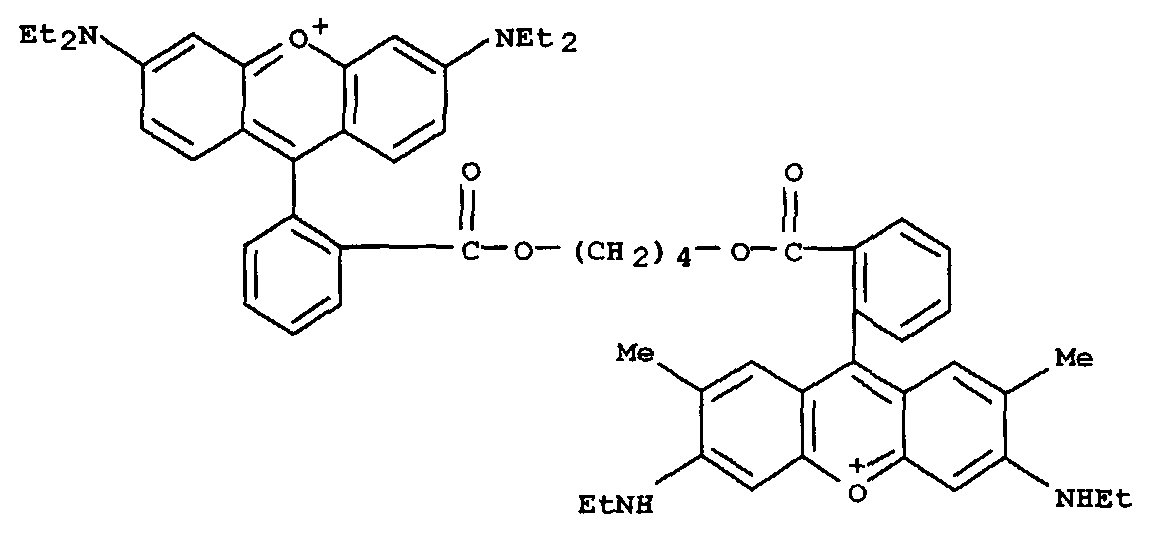


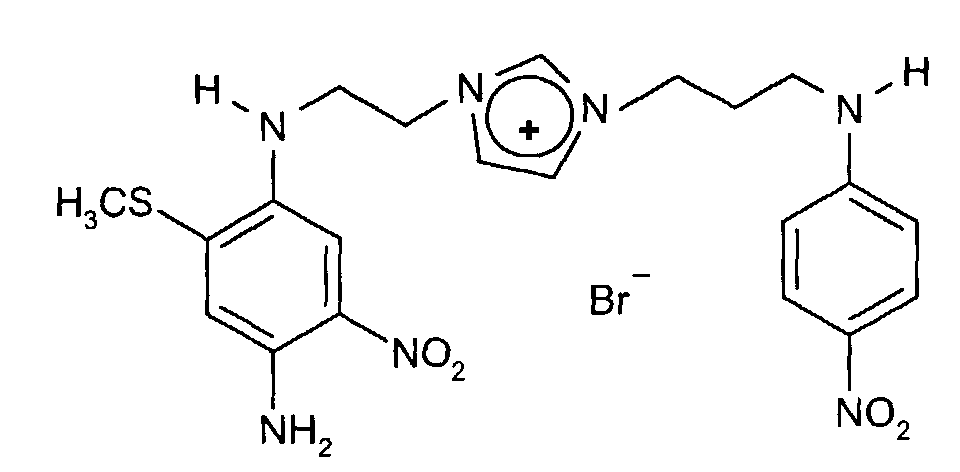
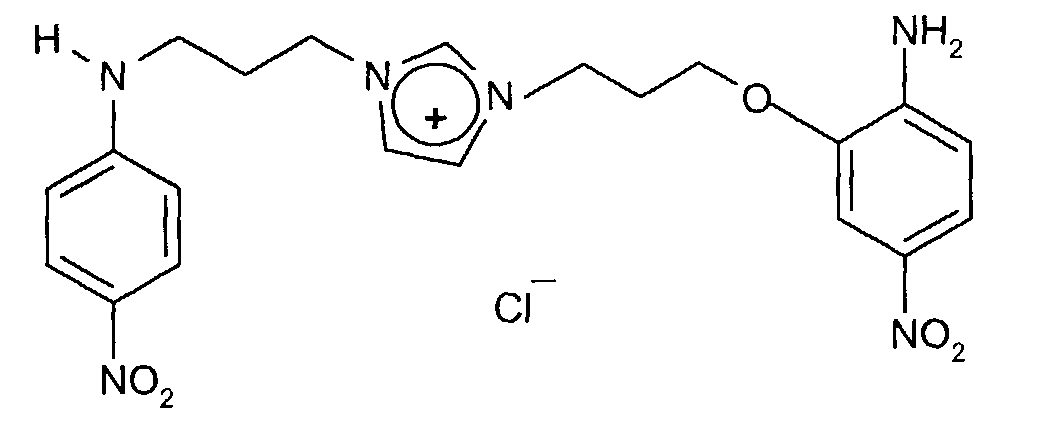
- Colorant mixte selon la revendication précédente, caractérisé en ce qu'il correspond aux formules suivantes, ainsi que ses sels d'addition :
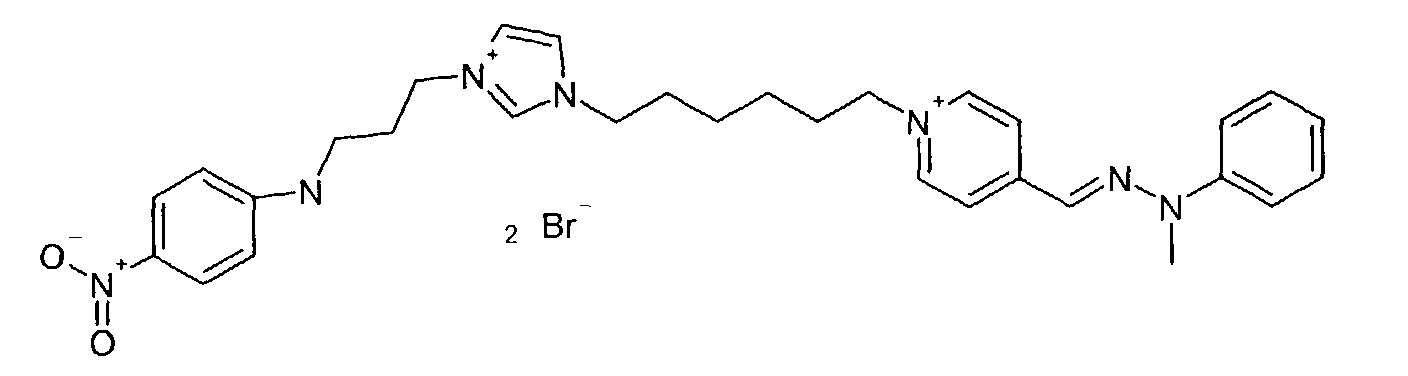

Applications Claiming Priority (4)
| Application Number | Priority Date | Filing Date | Title |
|---|---|---|---|
| FR0450382 | 2004-02-27 | ||
| FR0450382A FR2866808A1 (fr) | 2004-02-27 | 2004-02-27 | Composition comprenant un colorant mixte a base d'au moins un chromophore de type nitre(herero)aromatique ou azine cyclique, procede de coloration et colorants mixtes |
| FR0407020 | 2004-06-25 | ||
| FR0407020A FR2866803B1 (fr) | 2004-02-27 | 2004-06-25 | Composition comprenant un colorant mixte a base d'au moins un chromophore de type nitre (hetero) aromatique ou azine cyclique, procede de coloration et colorants mixtes |
Publications (2)
| Publication Number | Publication Date |
|---|---|
| EP1574206A2 true EP1574206A2 (fr) | 2005-09-14 |
| EP1574206A3 EP1574206A3 (fr) | 2005-11-02 |
Family
ID=34828648
Family Applications (1)
| Application Number | Title | Priority Date | Filing Date |
|---|---|---|---|
| EP05290442A Withdrawn EP1574206A3 (fr) | 2004-02-27 | 2005-02-25 | Composition comprenant un colorant mixte à base d'au moins un chromophore de type nitre (hétéro)aromatique ou azine cyclique |
Country Status (6)
| Country | Link |
|---|---|
| EP (1) | EP1574206A3 (fr) |
| JP (1) | JP2005263798A (fr) |
| CN (1) | CN100376227C (fr) |
| BR (1) | BRPI0500812A (fr) |
| FR (1) | FR2866803B1 (fr) |
| MX (1) | MXPA05002314A (fr) |
Cited By (3)
| Publication number | Priority date | Publication date | Assignee | Title |
|---|---|---|---|---|
| WO2007039529A2 (fr) | 2005-10-06 | 2007-04-12 | Ciba Specialty Chemicals Holding Inc. | Colorants disulfure d'oxazine |
| FR2899896A1 (fr) * | 2006-04-13 | 2007-10-19 | Oreal | Compose dichromophorique cationique comportant deux motifs de type hydrazone et a bras de liaison cationique, composition tinctoriale comprenant au moins un tel compose, procede de mise en oeuvre et utilisations |
| WO2007122340A1 (fr) * | 2006-04-13 | 2007-11-01 | L'oréal | Compose dichromophorique cationique comportant deux motifs de type hydrazone et a bras de liaison cationique, composition tinctoriale comprenant au moins un tel compose, procede de mise en œuvre et utilisations |
Family Cites Families (5)
| Publication number | Priority date | Publication date | Assignee | Title |
|---|---|---|---|---|
| NL131593C (fr) * | 1966-07-25 | |||
| DE2655177C3 (de) * | 1976-12-06 | 1979-05-17 | Max-Planck-Gesellschaft Zur Foerderung Der Wissenschaften E.V., 3400 Goettingen | Stimulierbares Medium für einen Farbstofflaser |
| DE4004614A1 (de) * | 1990-02-15 | 1991-08-22 | Basf Ag | Verfahren zur uebertragung von bichromophoren cyanogruppen enthaltenden methinfarbstoffen |
| US5214140A (en) * | 1990-02-15 | 1993-05-25 | Basf Aktiengesellschaft | Bichromophoric methine and azamethine dyes and process for transferring them |
| DE19731166A1 (de) * | 1997-07-21 | 1999-01-28 | Basf Ag | Verwendung von Reaktivfarbstoffen zum Färben von Haaren |
-
2004
- 2004-06-25 FR FR0407020A patent/FR2866803B1/fr not_active Expired - Fee Related
-
2005
- 2005-02-25 BR BRPI0500812-3A patent/BRPI0500812A/pt not_active IP Right Cessation
- 2005-02-25 EP EP05290442A patent/EP1574206A3/fr not_active Withdrawn
- 2005-02-28 MX MXPA05002314 patent/MXPA05002314A/es not_active Application Discontinuation
- 2005-02-28 CN CNB2005100524667A patent/CN100376227C/zh not_active Expired - Fee Related
- 2005-02-28 JP JP2005053167A patent/JP2005263798A/ja not_active Withdrawn
Cited By (4)
| Publication number | Priority date | Publication date | Assignee | Title |
|---|---|---|---|---|
| WO2007039529A2 (fr) | 2005-10-06 | 2007-04-12 | Ciba Specialty Chemicals Holding Inc. | Colorants disulfure d'oxazine |
| WO2007039529A3 (fr) * | 2005-10-06 | 2007-11-29 | Ciba Sc Holding Ag | Colorants disulfure d'oxazine |
| FR2899896A1 (fr) * | 2006-04-13 | 2007-10-19 | Oreal | Compose dichromophorique cationique comportant deux motifs de type hydrazone et a bras de liaison cationique, composition tinctoriale comprenant au moins un tel compose, procede de mise en oeuvre et utilisations |
| WO2007122340A1 (fr) * | 2006-04-13 | 2007-11-01 | L'oréal | Compose dichromophorique cationique comportant deux motifs de type hydrazone et a bras de liaison cationique, composition tinctoriale comprenant au moins un tel compose, procede de mise en œuvre et utilisations |
Also Published As
| Publication number | Publication date |
|---|---|
| EP1574206A3 (fr) | 2005-11-02 |
| BRPI0500812A (pt) | 2006-04-11 |
| FR2866803B1 (fr) | 2007-06-29 |
| CN100376227C (zh) | 2008-03-26 |
| FR2866803A1 (fr) | 2005-09-02 |
| CN1679490A (zh) | 2005-10-12 |
| MXPA05002314A (es) | 2005-10-18 |
| JP2005263798A (ja) | 2005-09-29 |
Similar Documents
| Publication | Publication Date | Title |
|---|---|---|
| EP0918053B1 (fr) | Nouveaux composés azoíques, utilisation pour la teinture, compositions les contenant et procédés de teinture. | |
| EP2070988B1 (fr) | Composé styryl à motif hydroxy(cyclo)alkylamino thiol/disulfure, procédé d'éclaircissement des matières kératiniques à partir de ce colorant | |
| EP1377264A1 (fr) | Composition tinctoriale pour la teinture des fibres keratiniques comprenant un colorant azoique cationique | |
| WO2002078660A1 (fr) | Composition tinctoriale pour la teinture des fibres keratiniques comprenant un colorant azoique cationique | |
| FR2822695A1 (fr) | Nouvelle composition tinctiriale pour la teinture des fibres keratiniques comprenant un colorant azoique cationique particilier | |
| WO2002078658A1 (fr) | Composition tinctoriale pour la teinture des fibres keratiniques comprenant un colorant azoïque cationique | |
| FR2822696A1 (fr) | Nouvelle composition tinctoriale pour la teinture des fibres keratiniques comprenant un colorant diazoique dicationique particulier | |
| EP2024444A2 (fr) | Composition de teinture comprenant un colorant fluorescent naphtylimide thiol/disulfure, procede d'eclaircissement des matieres keratiniques a partir de ce colorant | |
| EP1757660A1 (fr) | Colorants mixtes cationiques comprenant un chromophore anthraquinone et leur utilisation en colorant capillaire | |
| JP2008115390A (ja) | アゾ又はトリ(ヘテロ)アリールメタン型の少なくとも1つの発色団をベースとした混合染料を含有する組成物、染色方法及び混合染料 | |
| EP1663400B1 (fr) | Composition tinctoriale comprenant au moins un colorant direct a chromophores mixtes | |
| EP1648402A1 (fr) | Composition tinctoriale eclaircissante comprenant au moins un colorant direct cationique a chromophores mixtes | |
| FR2853230A1 (fr) | Composition de coloration pour matieres keratiniques humaines comprenant un colorant auto-oxydable, procede et utilisation | |
| FR2779056A1 (fr) | Composition de teinture pour fibres keratiniques avec un colorant direct cationique et un polyol ou ether de polyol | |
| EP1574206A2 (fr) | Composition comprenant un colorant mixte à base d'au moins un chromophore de type nitre (hétéro)aromatique ou azine cyclique | |
| EP1593369A1 (fr) | Composition comprenant au moins un colorant mixte à base d'au moins un chromophore de type méthine et/ou carbonyle, procédé de coloration et colorants mixtes | |
| US7303591B2 (en) | Composition comprising at least one mixed dye comprising at least two chromophores of (hetero) aromatic nitro or cyclic azine type, dyeing process, and mixed dyes | |
| FR2866808A1 (fr) | Composition comprenant un colorant mixte a base d'au moins un chromophore de type nitre(herero)aromatique ou azine cyclique, procede de coloration et colorants mixtes | |
| FR2879929A1 (fr) | Composition comprenant un colorant mixte a base d'au moins un chromophore de type tri-(hetero)aryle methane,procede de coloration et colorants mixtes | |
| FR2879928A1 (fr) | Composition comprenant au moins un colorant mixte a base d'au moins un chromophore de type carbonyle, procede de coloration et colorants mixtes | |
| FR2879927A1 (fr) | Composition comprenant un colorant mixte a base d'au moins un chromophore de type nitre (hetero) aromatique,procede de coloration et colorants mixtes. | |
| FR2866807A1 (fr) | Composition comprenant au moins un colorant mixte a base d'au moins un chromophore de type methine et/ou carbonyle, procede de coloration et colorants mixtes | |
| FR2872035A1 (fr) | Utilisation de composes polycationiques en teinture des fibres keratiniques | |
| FR2866806A1 (fr) | Composition comprenant uin colorant mixte a base d'au moins un chromophore et type azo ou tri-(hetero)aryle methane, procede de coloration et colorants mixtes | |
| EP1647550A1 (fr) | Monomères ou dimères symmétriques azoïques cationiques leur préparation, compositions les comprenant et procédé de coloration de fibres kératiniques |
Legal Events
| Date | Code | Title | Description |
|---|---|---|---|
| PUAI | Public reference made under article 153(3) epc to a published international application that has entered the european phase |
Free format text: ORIGINAL CODE: 0009012 |
|
| AK | Designated contracting states |
Kind code of ref document: A2 Designated state(s): AT BE BG CH CY CZ DE DK EE ES FI FR GB GR HU IE IS IT LI LT LU MC NL PL PT RO SE SI SK TR |
|
| AX | Request for extension of the european patent |
Extension state: AL BA HR LV MK YU |
|
| PUAL | Search report despatched |
Free format text: ORIGINAL CODE: 0009013 |
|
| AK | Designated contracting states |
Kind code of ref document: A3 Designated state(s): AT BE BG CH CY CZ DE DK EE ES FI FR GB GR HU IE IS IT LI LT LU MC NL PL PT RO SE SI SK TR |
|
| AX | Request for extension of the european patent |
Extension state: AL BA HR LV MK YU |
|
| 17P | Request for examination filed |
Effective date: 20060502 |
|
| AKX | Designation fees paid |
Designated state(s): AT BE BG CH CY CZ DE DK EE ES FI FR GB GR HU IE IS IT LI LT LU MC NL PL PT RO SE SI SK TR |
|
| 17Q | First examination report despatched |
Effective date: 20080205 |
|
| STAA | Information on the status of an ep patent application or granted ep patent |
Free format text: STATUS: THE APPLICATION IS DEEMED TO BE WITHDRAWN |
|
| 18D | Application deemed to be withdrawn |
Effective date: 20080516 |