EP1574864B1 - Procédé permettant de tester le fonctionnement des composants électroniques et électriques intégrés dans un véhicule d'un type donné et adressables par un bus de communication - Google Patents
Procédé permettant de tester le fonctionnement des composants électroniques et électriques intégrés dans un véhicule d'un type donné et adressables par un bus de communication Download PDFInfo
- Publication number
- EP1574864B1 EP1574864B1 EP20050003555 EP05003555A EP1574864B1 EP 1574864 B1 EP1574864 B1 EP 1574864B1 EP 20050003555 EP20050003555 EP 20050003555 EP 05003555 A EP05003555 A EP 05003555A EP 1574864 B1 EP1574864 B1 EP 1574864B1
- Authority
- EP
- European Patent Office
- Prior art keywords
- data
- real
- motor vehicle
- test
- vehicle
- Prior art date
- Legal status (The legal status is an assumption and is not a legal conclusion. Google has not performed a legal analysis and makes no representation as to the accuracy of the status listed.)
- Expired - Lifetime
Links
Images


Classifications
-
- G—PHYSICS
- G01—MEASURING; TESTING
- G01R—MEASURING ELECTRIC VARIABLES; MEASURING MAGNETIC VARIABLES
- G01R31/00—Arrangements for testing electric properties; Arrangements for locating electric faults; Arrangements for electrical testing characterised by what is being tested not provided for elsewhere
- G01R31/005—Testing of electric installations on transport means
- G01R31/006—Testing of electric installations on transport means on road vehicles, e.g. automobiles or trucks
- G01R31/007—Testing of electric installations on transport means on road vehicles, e.g. automobiles or trucks using microprocessors or computers
Definitions
- the invention relates to a method for testing the function of electronic and electrical components installed in a motor vehicle of a certain type, addressable via a communication bus.
- the complexity of the vehicle electrical system is increasing, as more and more functionalities, which are electronically controlled or provide signals, are provided on the vehicle side. This is particularly evident in the increasing number of separate control units that control different complexes.
- the electrical or electronic components via a central vehicle bus, z. B. CAN bus interconnected so that they can be addressed directly, but also communicate with each other and can exchange data or signals. Since such a system is somewhat susceptible to failure, it is necessary to perform various tests to verify proper operation, to see how much of the equipment integrated into the bus system is communicating with each other, taking data or putting it on the bus, etc.
- components to be installed are checked for their function at separate test stations before actual assembly. Examples include engine test beds on which the finished motor vehicle engine is tested before its actual installation in the body.
- Such a test method is z. B. off DE 198 57 462 A1 known.
- a test motor connected to a CAN bus becomes in different operating states operated and stored the data signals occurring in the communicating with a single component to be tested control units.
- These data recorded on a separate test stand serve as a database of the environment for a motor vehicle engine to be tested later on a separate engine test bench. So there is only a "island test" of individual, separate components before the actual shoring.
- DE 100 32 080 A1 describes a method and a test device for installation control of electrical components in a motor vehicle. These components are connected to a communication bus. The tester transmits a set of input signals to the electrical component under test and detects the actual output signals and compares them with desired output signals.
- test device is provided to capture measurement data of the complex overall system in the environment of the individual component to be tested during operation on a test bench, store it and later generate it again as test signals.
- the invention is therefore based on the problem to provide a method that allows a functional test of a variety of built-electronic and electrical components and their interaction under realistic test conditions.
- the test is a type-specific real data set is used
- the real data was recorded in real journeys of a motor vehicle of the same type as the test to be tested
- the real data are given to the communication bus and the response data given by the addressed components in response to the real data on the communication bus are detected, which are compared as actual data with the real data representing the target data and the function of the verifiable components is determined based on the comparison, and / or in response the fault memory data entered into the component-side memory devices are read out to the real data given on the communication bus and evaluated to determine the function of the checked components.
- the basis for the method according to the invention is the acquisition of data from any real road trips performed with a vehicle of the same type, primarily with a maximum of equipment on electrical and electronic components.
- the data is taken from the communication bus, that is, it is detected during road travel, all data communication on the bus.
- This data is arbitrary data. They can come from sensors embedded in the electronic system that provide readings and put on the bus, from ECUs that give specific information to the bus, or that give a response signal to the bus for a given signal, or any other components. These data are generated on the basis of real events during the journey.
- This data is now the basis for a corresponding communication of the actual installed equipment and components via the communication bus.
- a sensor signal contained within the real data of a sensor which also leads within the real data to a reaction by a control signal in the form of a reaction signal, leads in the vehicle to be tested in the ideal case to the same reaction of the control unit, the means that there should be an identical reaction signal of the control unit within the recorded test data. If a signal, which is given by one control unit to another within the real data, leads to a reaction signal of this control unit, ideally this reaction signal would have to be mapped identically within the recorded test data of the vehicle to be checked.
- the corresponding communication data of the bus of the vehicle to be tested are now recorded parallel to the administration of the real data.
- These reaction data which are quasi a reaction to the triggering real data, form the actual data record, which is compared with the desired data record formed by the real data record. If the vehicle to be tested is identical in terms of equipment with the vehicle on which the real data was recorded, ideally an identity would have to exist between the actual data and the target data. If the equipment is not identical and the vehicle to be tested is equipped less, resulting in a data discrepancy, as diverse control devices, because not available, can not respond.
- the method according to the invention therefore allows the function and the interaction of the built-up component based on real test scenarios.
- the test depth is therefore much greater than in the previously known separate examination of individual components in the uninstalled state.
- the real data are expediently adjusted for error data resulting from their recording as part of the real journeys, in order to avoid giving erroneous test data to the bus of the vehicle to be tested.
- the real data is expediently time-resolved, as already described, that is, it can be assigned to each real, for example, a specific delayed reaction requiring real date the corresponding reaction date, so that can be checked whether, for example, a control device addressed via a real date has actually responded to this date, ie has given the response date to the bus. That is, the real data is provided with a time stamp, which allows a corresponding mapping and assignment of the reaction data to the real data in the context of the actual target data comparison.
- the reaction data are expediently continuously recorded and also continuously compared with the real data, so that the evaluation can be ended very promptly at the end of the test cycle.
- the real data in a comparison to the speed or time duration of their real recording higher speed or shorter time are expediently given to the communication bus, whereby any reaction times of the control devices of the vehicle to be tested must be taken into account in order to ensure that an addressed control device actually could react.
- the entries of the error memories of the control units can also be used for the analysis / testing of the electrical / electronic system. For this purpose, the fault memory entries are read out within the finish line.
- a functional test can be carried out after completion of the motor vehicle, ie when it is completely assembled and all components are integrated. It would be so be provided within and / or at the end of the finish line a test station in which the motor vehicle is tested. This test may, for. B. take 5 minutes, depending on how fast the real data can be put on the bus and the actual data can be recorded and evaluated.
- the functional test can be performed several times during assembly, that is, that the motor vehicle during assembly z. B. intermittently or after installation of certain components or the like is checked.
- all real data are expediently given to the communication bus. Those real data to which, for example, corresponding control devices and the like have been installed, which can thus find their addressee arrive and are processed accordingly or treated, while real data concerning components that are not yet installed, do not bother because they find no addressee ,
- a mobile, portable data processing device which is connected to the communication bus, regardless of whether the functional test is carried out at the end or during the assembly.
- a data processing device remains in a multiple test during assembly expediently during the entire time on the vehicle and records all occurring in the context of the functional tests occurring during this reaction data ordered.
- the functional tests if the vehicle is repeatedly tested during assembly, may be performed as described either at predetermined times or upon reaching a predetermined assembly level. For this purpose, if necessary, certain components are automatically detected for their presence. It turns out that z. B. the entire dashboard was used with all its controllers and other components, this can for example give a corresponding signal on the bus, which is detected by the data processing device and thus triggers the functional test.
- the real data also contain data from or concerning components that are not installed at least at the time of the test. These data, when placed on the bus, find no addressee, so trigger no response, but are not hindering for the other bump test. This has the advantage that no different real data sets have to be held for different test times, in particular during a test on the line.
- the real data set advantageously contains real data relative to a type-specific maximum degree of build on electronic or electrical components, which is advantageous in that ideally only a single type-specific real data set must be kept in stock, since "excess data" contained therein regarding non-built-in components, etc. is not disturbing are.
- the method according to the invention In order to design the method according to the invention as flexibly as possible, it is provided to store a plurality of type-specific real data sets for different motor vehicle types in the optionally portable data processing device used for the functional test, wherein the real data record to be used is selected as a function of the vehicle to be tested. That is, there are specific sets for different types of vehicles, where the real data set to be used is selected and read at the given time. Furthermore, it can be provided that in the functional test, possibly portable data processing device several type-specific real data sets for different Equipment variants of the motor vehicle are stored, wherein the real data set to be used is selected depending on the motor vehicle to be tested. There is also an additional variant specification according to this invention embodiment.
- a maximum variant for a vehicle type, for example, three variant-specific data sets are provided, a maximum variant, a middle variant and a minimal variant.
- the corresponding record is selected.
- This embodiment of the invention takes into account the fact that the real driving conditions are sometimes also dependent on the country in which the motor vehicle is to be delivered. A motor vehicle delivered in a very hot climatic zone is exposed to other real conditions than a motor vehicle delivered to Scandinavia or to the north. If corresponding real data has been recorded on test drives at such different conditions, more specific tests can accordingly be carried out.
- the data record selection is based on an information indicating the type of motor vehicle and optionally the equipment variant and possibly the country of use regarding the production process of the motor vehicle or on the basis of an identification number given or recorded by the motor vehicle. Further information regarding the motor vehicle to be tested arises from the production process itself, after it is known at all times, which motor vehicle contains which equipment (which is inevitably required for the production process and the parts supply, etc.), and where the motor vehicle is delivered. Alternatively, it is also conceivable during the connection of the data processing device read out about this a vehicle identification number and thus to include all the information that is required for the selection of the real data record.
- the real data record to be used is stored in the data processing device to be used in a timely manner.
- This invention alternative is based on the exact knowledge of the vehicle type, the equipment variant and, where appropriate, its country-specific location. Thus, if a vehicle to be tested enters the test area (regardless of whether this occurs during assembly or at the end of the test), all vehicle-specific data is known.
- the data are transmitted via networks and wireless transmission in each case directly from a server (online) via a corresponding device into the vehicle. Caching of the data can be omitted in this case.
- the comparison of the actual data with the desired data can be done in the data processing device itself or in a separate computing device to which the actual data recorded by the data processing device and possibly also the desired data are transmitted.
- the target data may already be available from this external computing device.
- the computing device then only requires information regarding the desired data set to be used, which information can be transferred from the data processing device itself. On the other hand, it is conceivable that the computing device knows all the information about the vehicle to be tested, and on the basis of this itself can select the correct target data set.
- test report is expediently created and output on the basis of the comparison result. This can be done in writing to hold documentation, but can also be purely electronic Output to a terminal or the like, or by outputting the fault memory entries via the installed test systems.
- the method according to the invention offers a number of advantages.
- the electronic or electrical systems can be tested quickly under real conditions or on the basis of real communication data.
- Real test drives can therefore be reduced to a minimum, a test of the electronic system in the context of these test drives can be largely eliminated.
- a direct assignment of an error, a fault symptom or an error description to a triggering event is possible after the "trigger data", ie the real data is given in time-resolved manner on the bus.
- any combinability of operating states from, for example, different real road trips is possible after the separate real data can be combined to form an overall data record.
- the invention further relates to a device for testing electronic or electrical components installed in a motor vehicle, designed to carry out the described method.
- Fig. 1 shows in the form of a schematic diagram of the central process steps of the method according to the invention. How out Fig. 1 It will be apparent that real road trips are made using various finished motor vehicles of different types and vehicle equipment to accommodate a variety of real data sets that are type and equipment specific.
- two different motor vehicle types are used by way of example, namely Type I motor vehicles and Type II motor vehicles.
- two different equipment variants are used, namely a minimum equipment variant a and a maximum equipment variant b.
- the minimum equipment variant a is a certain number or are certain types of electrical or electronic components, but not all maximum built-in provided, while in the maximum equipment variant b all components are available to this type maximum buildable.
- the maximum equipment variant b all components are available to this type maximum buildable.
- there are two different types of vehicles in two different equipment options used namely the vehicle la and Ib and the vehicles IIa and IIb.
- any real road trips are performed, that is, at any time, under any environmental conditions and performing any actions, as many different situations are to be played in the context of data generation in order to make the real data set as large as possible and as versatile.
- a real record is added to each motor vehicle by receiving the entire bus communication traffic, so all on the communication bus of the motor vehicle, z. B. the CAN bus existing information or data recorded.
- the data processing device is in the example shown in a test station located at the end of the vehicle production line.
- Fig. 1 a newly assembled type I motor vehicle in an upscale trim level, which corresponds to the maximum trim level b or comes close to this.
- a vehicle identification number is detected in the test station and given to the data processing device DV.
- This identification number indicates that this is a type I vehicle in an upscale equipment variant, which is why a maximum equipment data set, namely the real data record RDIb is to be used for test purposes.
- the gift of this selection information is represented by "Ib" on the arrow a. It is also possible to use production-related data for data record selection, since it is known at any time which type of equipment is involved in any vehicle on the production line.
- the data processing device with a communication bus of the motor vehicle, z. B. the CAN bus (it can also be another vehicle bus, eg MOST bus act), after which the real data is given in time-compressed form on the communication bus.
- the data acquisition of all data transported on the communication bus with regard to the given real data, which is quasi the action data begins, which are given by the control units or other components hanging on the bus, more or less in response to the action or real data.
- the real data is any arbitrary datum that has been transported onto the bus at any time during its acquisition, its sensor signals, controller information, etc.
- the actual data recorded is equally any of the components attached to the bus generated signals, be it sensor signals or signals and data from controllers, which are generated in response to any real data and placed on the bus.
- the real data is time resolved, so that each actual date can be assigned to a specific "trigger real date". In this way, in the context of the later evaluation, a reference of a faulty or missing actual date to its triggering real date can be drawn, on which an error analysis can take place.
- the data processing device DV performs a comparison between the desired data, formed by the real data record RDIb, and the recorded actual data. All real data given or relating to components which are also present on the vehicle to be tested, and which themselves are a reaction date to a previously given "real-time triggering date", must have corresponding, quasi-identical actual values. Data within the actual data pool will be present after the "real-time trigger" is included in the real record and has been placed on the bus and must result in the same actual response date. This is recorded and evaluated as part of the target / actual comparison. Real data of components that are not present on the vehicle under test lead to no response after the component address is not found on the bus of the vehicle to be tested. For this there is inevitably no corresponding actual date, what on the part of the data processing device DV is recognized but after this the equipment of the vehicle to be tested is known.
- the result of the test is then output. If all control units and other components function correctly with reference to the real data, it can be assumed that no errors will occur during operation. Of course, not every situation and every device communication can be checked after the scope of the check depends on the data pool of the real data. Nevertheless, a relatively wide range of tests can be realized which, if the comparison leads to a positive test result, can be taken as the basis for the assumption that no difficulties will arise in the operation.
- the triggering real-time signal can be determined as far as can be determined. B. no corresponding actual response signal is present, determined and issued for closer troubleshooting information in the test report.
- the type Ib vehicle shown leaves the testing station when the test is completed. Subsequently, the next type I vehicle in equipment variant a drives into the inspection station.
- the data processing device again receives corresponding information about the real data record to be selected, in this case the real data record RDIa and checks this vehicle in a corresponding manner.
- Fig. 2 shows in the form of a schematic diagram of the communication bus 1 of a motor vehicle according to the invention, to which a number of control units SG1, SG2, SG3, ... SGn-1, SGn are provided, on which any number of sensors or actuators 2 are provided in communicate with the controller in any way and exchange data.
- the real data given to the communication bus 1 and there distributed to the corresponding control units or actuators / sensors, which in turn give the response signals on the communication bus 1, from where they have a corresponding read-out interface S, with the input Interface S can of course coincide, be read out.
- any error memory of the control units are read as well as, if possible, any given signals checked for correctness. Subsequently, the evaluation already described in the context of the actual-target comparison.
- the real data are, as already described, type and equipment-specific.
- a distinction between different types of bus or bus systems can be made if two different buses, z. B. the CAN-BUS and the MOST bus are provided.
- bus-typical signals are given to the respective bus.
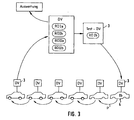
- Fig. 3 shows an alternative to the described embodiment according to Fig. 1 with a central inspection station located at the end of the production line.
- a multiple function test is performed on the line during the progressive assembly of the motor vehicle.
- a type I motor vehicle in equipment variant b is progressively manufactured.
- This is known to the data processing device DV by corresponding information.
- the data processing device DV is now a test data processing device 3 with the corresponding real data set RDIb, which is to be selected for the motor vehicle 4, occupied, the data is stored there.
- the test data processing device 3 is connected to the motor vehicle 4 at a suitable interface S with the already installed communication bus 1.
- the data processing device 3 remains during the entire assembly on the motor vehicle.
- the progressive assembly represented by the respective advancing arrows P, is at different times, eg. B. after installation of a certain number or a certain type of control devices or the like, performed a function test of the already existing components several times.
- the data processing device 3 plays each of the complete real data on the communication bus 1, takes the actual data and stores this time-related.
- a final functional test is carried out, after which the data processing device is removed again and fed to the data processing device DV, where the data are read out and subsequently evaluated. This is also done by target-actual comparison, in this case, production-related.
- test data processing device 3 It is also conceivable that all possible real data sets are already present in the test data processing device 3 and that the data record to be used is selected only after connecting the data processing device 3 to the motor vehicle bus. For this purpose, the data processing device reads z. Example, a corresponding identification number of the motor vehicle, via which information about the vehicle type and the equipment variant are given, after which the record to be used is read.
Landscapes
- Engineering & Computer Science (AREA)
- Computer Hardware Design (AREA)
- Microelectronics & Electronic Packaging (AREA)
- Chemical & Material Sciences (AREA)
- Combustion & Propulsion (AREA)
- Physics & Mathematics (AREA)
- General Physics & Mathematics (AREA)
- Testing And Monitoring For Control Systems (AREA)
Claims (22)
- Procédé pour tester le fonctionnement de composants électriques et électroniques, intégrés dans un véhicule d'un type défini, adressables par le biais d'un bus de communication,
caractérisé en ce que, pour le test est employé un jeu de données réelles, spécifique au type, dont les données réelles ont été recueillies par un prélèvement sur le bus de communication au cours de parcours routiers réels d'un véhicule du même type que celui à tester, sachant que les données réelles ont été fournies sur le bus de communication et les données de réaction, fournies sur le bus de communication par les composants adressés en tant que réaction aux données réelles, ont été collectées, lesquelles données de réaction en tant que données mesurées ont été comparées aux données réelles représentant des données théoriques et, à l'aide de la comparaison, le fonctionnement des composants vérifiables est déterminé, et/ou les données de mémoire d'erreur inscrites dans des dispositifs de mémoire au niveau des composants en tant que réaction aux données réelles fournies sur le bus de communication sont extraites et elles sont évaluées afin de déterminer le fonctionnement des composants vérifiables. - Procédé selon la revendication 1, caractérisé en ce que les données réelles sont nettoyées des données d'erreur produites lors de leur enregistrement dans le cadre des parcours réels.
- Procédé selon la revendication 1 ou 2, caractérisé en ce que, pour permettre l'affectation d'une donnée de réaction à sa donnée réelle à confronter dans le cadre de la comparaison, les données réelles sont horodatées.
- Procédé selon l'une des revendications précédentes, caractérisé en ce que les données de réaction sont collectées en continu durant la fourniture des données réelles et comparées aux données réelles.
- Procédé selon l'une des revendications précédentes, caractérisé en ce que les données réelles sont fournies sur le bus de communication avec une vitesse plus élevée ou dans un temps plus court en comparaison à la vitesse ou à la durée de leur enregistrement réel.
- Procédé selon l'une des revendications précédentes, caractérisé en ce que le test de fonctionnement est effectué après la fabrication du véhicule.
- Procédé selon l'une des revendications 1 à 6, caractérisé en ce que le test de fonctionnement est effectué plusieurs fois durant l'assemblage du véhicule.
- Procédé selon la revendication 7, caractérisé en ce que, dans le cadre de chaque test de fonctionnement, toutes les données réelles sont fournies sur le bus de communication.
- Procédé selon l'une des revendications précédentes, caractérisé en ce que pour la fourniture des données réelles et pour l'enregistrement des données de réaction est employé un appareil de traitement de données mobile, portable qui est relié au bus de communication.
- Procédé selon la revendication 9, caractérisé en ce que l'appareil de traitement de données reste dans le véhicule durant l'assemblage et enregistre de manière ordonnée toutes les données de réaction résultantes dans le cadre des tests de fonctionnement effectués durant ce temps.
- Procédé selon la revendication 10, caractérisé en ce que les tests de fonctionnement sont effectués à des moments spécifiés à l'avance ou lorsqu'une phase d'assemblage prédéfinie est atteinte.
- Procédé selon l'une des revendications précédentes, caractérisé en ce que les données réelles contiennent également des données de composants ou des composants en question qui ne sont pas intégrés au moins au moment des tests.
- Procédé selon l'une des revendications précédentes, caractérisé en ce que, dans le cadre de l'enregistrement des données de réaction, également d'éventuelles entrées dans des mémoires d'erreur de composants, en particulier d'appareils de commande, sont extraites et enregistrées.
- Procédé selon l'une des revendications précédentes, caractérisé en ce que le jeu de données réelles contient des données réelles relatives à un degré d'intégration maximal, spécifique au type, de composants électroniques et électriques.
- Procédé selon l'une des revendications précédentes, caractérisé en ce que, dans l'appareil de traitement de données employé pour le test de fonctionnement, le cas échéant portable, sont déposés plusieurs jeux de données réelles, spécifiques de type, pour différents types de véhicules, le jeu de données réelles à employer étant sélectionné en fonction du véhicule à vérifier.
- Procédé selon l'une des revendications précédentes, caractérisé en ce que, dans l'appareil de traitement de données employé pour le test de fonctionnement, le cas échéant portable, sont déposés plusieurs jeux de données réelles, spécifiques de type, pour différentes variantes d'équipement du véhicule, le jeu de données réelles à employer étant sélectionné en fonction du véhicule à vérifier.
- Procédé selon l'une des revendications précédentes, caractérisé en ce que, dans l'appareil de traitement de données employé pour le test de fonctionnement, le cas échéant portable, sont déposés plusieurs jeux de données réelles, spécifiques au pays, le jeu de données réelles à employer étant sélectionné en fonction du véhicule à vérifier.
- Procédé selon l'une des revendications 15 à 17, caractérisé en ce que la sélection du jeu de données se fait à l'aide d'une information, concernant les opérations de production du véhicule, indiquant le type de véhicule et le cas échéant la variante d'équipement et le cas échéant le pays de mise en circulation, ou à l'aide d'une information d'identification saisie ou fournie par le véhicule.
- Procédé selon l'une des revendications 1 à 14, caractérisé en ce que le jeu de données réelles à employer pour le ou les tests de fonctionnement à effectuer est enregistré peu de temps avant dans l'appareil de traitement de données à employer.
- Procédé selon l'une des revendications précédentes, caractérisé en ce que la comparaison des données mesurées aux données théoriques a lieu dans l'appareil de traitement de données même ou dans un dispositif informatique distinct auquel sont fournies les données mesurées enregistrées par l'appareil de traitement de données et, le cas échéant, les données théoriques.
- Procédé selon l'une des revendications précédentes, caractérisé en ce que, à l'aide du résultat de la comparaison, un rapport de test est créé et sorti.
- Dispositif pour tester des composants électriques ou électroniques intégrés dans un véhicule, configuré pour exécuter le procédé selon l'une des revendications 1 à 21.
Applications Claiming Priority (2)
| Application Number | Priority Date | Filing Date | Title |
|---|---|---|---|
| DE200410012143 DE102004012143B3 (de) | 2004-03-12 | 2004-03-12 | Verfahren zum Testen der Funktion von in einem Kraftfahrzeug eines bestimmten Typs verbauten, über einen Kommunikationsbus adressierbaren elektronischen und elektrischen Komponenten |
| DE102004012143 | 2004-03-12 |
Publications (2)
| Publication Number | Publication Date |
|---|---|
| EP1574864A1 EP1574864A1 (fr) | 2005-09-14 |
| EP1574864B1 true EP1574864B1 (fr) | 2008-05-07 |
Family
ID=34813680
Family Applications (1)
| Application Number | Title | Priority Date | Filing Date |
|---|---|---|---|
| EP20050003555 Expired - Lifetime EP1574864B1 (fr) | 2004-03-12 | 2005-02-18 | Procédé permettant de tester le fonctionnement des composants électroniques et électriques intégrés dans un véhicule d'un type donné et adressables par un bus de communication |
Country Status (2)
| Country | Link |
|---|---|
| EP (1) | EP1574864B1 (fr) |
| DE (2) | DE102004012143B3 (fr) |
Cited By (2)
| Publication number | Priority date | Publication date | Assignee | Title |
|---|---|---|---|---|
| CN104240334A (zh) * | 2014-09-30 | 2014-12-24 | 长城汽车股份有限公司 | 汽车脉冲信号记录仪及车辆检测设备 |
| CN104614609A (zh) * | 2015-01-27 | 2015-05-13 | 浪潮电子信息产业股份有限公司 | 一种超级电容的测试方法 |
Families Citing this family (9)
| Publication number | Priority date | Publication date | Assignee | Title |
|---|---|---|---|---|
| DE102006031242A1 (de) * | 2006-07-06 | 2008-01-10 | Robert Bosch Gmbh | Verfahren zum Durchführen eines Tests |
| DE102008008012A1 (de) * | 2008-02-07 | 2009-10-15 | It-Designers Gmbh | Vorrichtung zur Funktionsüberprüfung eines Fahrzeugs |
| DE102009037497B4 (de) * | 2009-08-13 | 2012-04-12 | Predrag Stevanovic | Diagnosevorrichtung für schlüsselloses Zugangssystem |
| DE102010030829A1 (de) | 2010-03-16 | 2011-09-22 | Fahrzeugsystemdaten Gmbh | Anordnung und Verfahren zur Fahrzeugzustandsuntersuchung |
| US8352791B2 (en) | 2010-06-04 | 2013-01-08 | GM Global Technology Operations LLC | Configurable test suite |
| DE102012200194A1 (de) | 2011-03-16 | 2012-09-20 | Fahrzeugsystemdaten Gmbh | Anordnung und Verfahren zur Baugruppenprüfung, insbesondere zur Achsdämpfungsprüfung, in Fahrzeugen |
| DK2772886T3 (en) * | 2013-02-28 | 2015-07-06 | Kapsch Trafficcom Ag | Electronic onboard-vehicle system and test method thereof |
| DE102017100075B4 (de) * | 2017-01-04 | 2018-09-27 | Iav Gmbh Ingenieurgesellschaft Auto Und Verkehr | Verfahren und Vorrichtung zum Betreiben eines Fahrzeuges während einer Entwicklungsphase |
| DE102017207014A1 (de) * | 2017-04-26 | 2018-10-31 | Audi Ag | Verfahren zur Datenerhebung |
Family Cites Families (10)
| Publication number | Priority date | Publication date | Assignee | Title |
|---|---|---|---|---|
| DE3232416A1 (de) * | 1982-09-01 | 1984-03-01 | Kienzle Apparate Gmbh, 7730 Villingen-Schwenningen | Datenerfassungssystem fuer fahrzeuge |
| US5041976A (en) * | 1989-05-18 | 1991-08-20 | Ford Motor Company | Diagnostic system using pattern recognition for electronic automotive control systems |
| DE4330312C3 (de) * | 1993-09-08 | 2000-10-05 | Daimler Chrysler Ag | Verfahren zur Überprüfung von Anordnungen vernetzter Steuergeräte in der Entwicklungsphase von Kraftfahrzeugen |
| GB9516414D0 (en) * | 1995-08-10 | 1995-10-11 | Genrad Ltd | Electronic diagnostic system |
| DE19722188A1 (de) * | 1997-05-27 | 1998-12-03 | Bayerische Motoren Werke Ag | Vorrichtung zur Funktionsüberprüfung eines elektronisch gesteuerten Regelsystems in einem Kraftfahrzeug nach einem Fertigungsvorgang |
| DE19857462A1 (de) * | 1998-12-12 | 2000-06-15 | Volkswagen Ag | Verfahren zur Prüfung von Einzelkomponenten eines Kraftfahrzeuges |
| DE19961589A1 (de) * | 1999-12-21 | 2001-07-05 | Bosch Gmbh Robert | Serviceelement in verteilten Systemen |
| DE10032080A1 (de) * | 2000-07-01 | 2002-01-10 | Volkswagen Ag | Verfahren und Prüfsteuergerät zur Einbaukontrolle von elektrischen Komponenten in einem Kraftfahrzeug |
| US6609051B2 (en) * | 2001-09-10 | 2003-08-19 | Daimlerchrysler Ag | Method and system for condition monitoring of vehicles |
| DE10236620A1 (de) * | 2002-08-09 | 2004-02-19 | Daimlerchrysler Ag | Kraftfahrzeug, Fahrprüfeinrichtung, Fahrprüfprogramm und Prüfstand |
-
2004
- 2004-03-12 DE DE200410012143 patent/DE102004012143B3/de not_active Expired - Fee Related
-
2005
- 2005-02-18 DE DE200550003937 patent/DE502005003937D1/de not_active Expired - Lifetime
- 2005-02-18 EP EP20050003555 patent/EP1574864B1/fr not_active Expired - Lifetime
Cited By (3)
| Publication number | Priority date | Publication date | Assignee | Title |
|---|---|---|---|---|
| CN104240334A (zh) * | 2014-09-30 | 2014-12-24 | 长城汽车股份有限公司 | 汽车脉冲信号记录仪及车辆检测设备 |
| CN104614609A (zh) * | 2015-01-27 | 2015-05-13 | 浪潮电子信息产业股份有限公司 | 一种超级电容的测试方法 |
| CN104614609B (zh) * | 2015-01-27 | 2017-06-27 | 浪潮电子信息产业股份有限公司 | 一种超级电容的测试方法 |
Also Published As
| Publication number | Publication date |
|---|---|
| EP1574864A1 (fr) | 2005-09-14 |
| DE502005003937D1 (de) | 2008-06-19 |
| DE102004012143B3 (de) | 2005-09-15 |
Similar Documents
| Publication | Publication Date | Title |
|---|---|---|
| DE102008015352B4 (de) | Verfahren zum Aufzeichnen von Daten und Datenaufzeichnungssystem | |
| EP1574864B1 (fr) | Procédé permettant de tester le fonctionnement des composants électroniques et électriques intégrés dans un véhicule d'un type donné et adressables par un bus de communication | |
| DE102016220670A1 (de) | Verfahren und System zum Testen von Software für autonome Fahrzeuge | |
| DE102004042002A1 (de) | Verbesserte Reparaturverifikation für elektronische Fahrzeugsysteme | |
| DE102007059524A1 (de) | Verfahren zum Erzeugen einer Betriebssoftware auf einem Steuergerät für ein Kraftfahrzeug sowie Steuergerät | |
| EP3535144A1 (fr) | Procédé pour associer des modules capteurs pour pneus à un véhicule tracté d'un attelage pour véhicule utilitaire dédié | |
| WO2010012351A1 (fr) | Procédé de programmation de données dans au moins deux modules de commande d’un véhicule automobile | |
| DE102005044236B4 (de) | Diagnosegerät | |
| DE102013002648B3 (de) | Master-Busgerät für einen Fahrzeugkommunikationsbus eines Kraftwagens | |
| DE19546815A1 (de) | Steuersystem mit Datenspeicherung | |
| DE102021111724A1 (de) | Verfahren und Computerprogramm zum Evaluieren eines Softwarestands eines Fahrerassistenzsystems | |
| EP1597117B1 (fr) | Dispositif et procede de diagnostic embarque central pour vehicules automobiles | |
| EP4003823B1 (fr) | Procédé de démarrage d'un véhicule automobile | |
| DE102013203501A1 (de) | Datenlogger, Datenerfassungsnetzwerk, Kraftfahrzeug und Verfahren | |
| DE10153447B4 (de) | Verfahren und Vorrichtung zur Programmierung eines Steuergeräts eines Fahrzeugs, insbesondere eines Kraftfahrzeugs | |
| EP2367155B1 (fr) | Agencement et procédé destinés au contrôle de l'état d'un véhicule | |
| DE102020101524A1 (de) | Elektrik/Elektronik-Architektur für ein Kraftfahrzeug mit einer elektronischen Recheneinrichtung und mit einem Schnittstellensteuergerät, sowie Verfahren | |
| EP3399425B1 (fr) | Procédé destiné à la détection d'une topologie de câblage | |
| DE102006053559B4 (de) | Inbetriebnahme eines Notbremssystems in einer Werkstatt | |
| DE102021200257A1 (de) | Verfahren zur Validierung von Softwarefunktionen in einem Fahrerassistenzsystem für Kraftfahrzeuge | |
| DE102015003211A1 (de) | Anordnung zur Diagnose eines Kraftfahrzeugs | |
| DE102009053751B4 (de) | Verfahren zum Diagnostizieren eines Fehlers an einem Kraftfahrzeug | |
| DE102004013253A1 (de) | Einrichutng zum Sammeln, Bereitstellen und/oder Speichern von insbesondere auslesbaren Stell- und/oder Betriebsgrößen | |
| DE102013216558B4 (de) | Verfahren zur Diagnose eines steuerbaren Schaltelements eines Motorsteuergeräts | |
| EP3720056B1 (fr) | Procédé et système d'analyse parallèle en temps réel lors des essais fonctionnels du matériel et du logiciel des appareils de commande |
Legal Events
| Date | Code | Title | Description |
|---|---|---|---|
| PUAI | Public reference made under article 153(3) epc to a published international application that has entered the european phase |
Free format text: ORIGINAL CODE: 0009012 |
|
| AK | Designated contracting states |
Kind code of ref document: A1 Designated state(s): AT BE BG CH CY CZ DE DK EE ES FI FR GB GR HU IE IS IT LI LT LU MC NL PL PT RO SE SI SK TR |
|
| AX | Request for extension of the european patent |
Extension state: AL BA HR LV MK YU |
|
| 17P | Request for examination filed |
Effective date: 20060314 |
|
| AKX | Designation fees paid |
Designated state(s): DE FR GB IT |
|
| GRAP | Despatch of communication of intention to grant a patent |
Free format text: ORIGINAL CODE: EPIDOSNIGR1 |
|
| GRAS | Grant fee paid |
Free format text: ORIGINAL CODE: EPIDOSNIGR3 |
|
| GRAA | (expected) grant |
Free format text: ORIGINAL CODE: 0009210 |
|
| AK | Designated contracting states |
Kind code of ref document: B1 Designated state(s): DE FR GB IT |
|
| REG | Reference to a national code |
Ref country code: GB Ref legal event code: FG4D Free format text: NOT ENGLISH |
|
| REF | Corresponds to: |
Ref document number: 502005003937 Country of ref document: DE Date of ref document: 20080619 Kind code of ref document: P |
|
| PLBE | No opposition filed within time limit |
Free format text: ORIGINAL CODE: 0009261 |
|
| STAA | Information on the status of an ep patent application or granted ep patent |
Free format text: STATUS: NO OPPOSITION FILED WITHIN TIME LIMIT |
|
| 26N | No opposition filed |
Effective date: 20090210 |
|
| REG | Reference to a national code |
Ref country code: FR Ref legal event code: PLFP Year of fee payment: 12 |
|
| PGFP | Annual fee paid to national office [announced via postgrant information from national office to epo] |
Ref country code: DE Payment date: 20160229 Year of fee payment: 12 Ref country code: IT Payment date: 20160226 Year of fee payment: 12 |
|
| PGFP | Annual fee paid to national office [announced via postgrant information from national office to epo] |
Ref country code: GB Payment date: 20160223 Year of fee payment: 12 Ref country code: FR Payment date: 20160224 Year of fee payment: 12 |
|
| REG | Reference to a national code |
Ref country code: DE Ref legal event code: R119 Ref document number: 502005003937 Country of ref document: DE |
|
| GBPC | Gb: european patent ceased through non-payment of renewal fee |
Effective date: 20170218 |
|
| REG | Reference to a national code |
Ref country code: FR Ref legal event code: ST Effective date: 20171031 |
|
| PG25 | Lapsed in a contracting state [announced via postgrant information from national office to epo] |
Ref country code: DE Free format text: LAPSE BECAUSE OF NON-PAYMENT OF DUE FEES Effective date: 20170901 Ref country code: FR Free format text: LAPSE BECAUSE OF NON-PAYMENT OF DUE FEES Effective date: 20170228 |
|
| PG25 | Lapsed in a contracting state [announced via postgrant information from national office to epo] |
Ref country code: IT Free format text: LAPSE BECAUSE OF NON-PAYMENT OF DUE FEES Effective date: 20170218 Ref country code: GB Free format text: LAPSE BECAUSE OF NON-PAYMENT OF DUE FEES Effective date: 20170218 |