EP1575113A2 - Assemblage de piles à combustible et procédé pour faire opérer un assemblage de piles a combustible - Google Patents
Assemblage de piles à combustible et procédé pour faire opérer un assemblage de piles a combustible Download PDFInfo
- Publication number
- EP1575113A2 EP1575113A2 EP05005340A EP05005340A EP1575113A2 EP 1575113 A2 EP1575113 A2 EP 1575113A2 EP 05005340 A EP05005340 A EP 05005340A EP 05005340 A EP05005340 A EP 05005340A EP 1575113 A2 EP1575113 A2 EP 1575113A2
- Authority
- EP
- European Patent Office
- Prior art keywords
- fuel cell
- gas
- flow
- pressure drop
- fields
- Prior art date
- Legal status (The legal status is an assumption and is not a legal conclusion. Google has not performed a legal analysis and makes no representation as to the accuracy of the status listed.)
- Withdrawn
Links
Images


Classifications
-
- H—ELECTRICITY
- H01—ELECTRIC ELEMENTS
- H01M—PROCESSES OR MEANS, e.g. BATTERIES, FOR THE DIRECT CONVERSION OF CHEMICAL ENERGY INTO ELECTRICAL ENERGY
- H01M8/00—Fuel cells; Manufacture thereof
- H01M8/04—Auxiliary arrangements, e.g. for control of pressure or for circulation of fluids
- H01M8/04082—Arrangements for control of reactant parameters, e.g. pressure or concentration
- H01M8/04089—Arrangements for control of reactant parameters, e.g. pressure or concentration of gaseous reactants
-
- H—ELECTRICITY
- H01—ELECTRIC ELEMENTS
- H01M—PROCESSES OR MEANS, e.g. BATTERIES, FOR THE DIRECT CONVERSION OF CHEMICAL ENERGY INTO ELECTRICAL ENERGY
- H01M8/00—Fuel cells; Manufacture thereof
- H01M8/02—Details
- H01M8/0202—Collectors; Separators, e.g. bipolar separators; Interconnectors
- H01M8/0258—Collectors; Separators, e.g. bipolar separators; Interconnectors characterised by the configuration of channels, e.g. by the flow field of the reactant or coolant
- H01M8/0263—Collectors; Separators, e.g. bipolar separators; Interconnectors characterised by the configuration of channels, e.g. by the flow field of the reactant or coolant having meandering or serpentine paths
-
- H—ELECTRICITY
- H01—ELECTRIC ELEMENTS
- H01M—PROCESSES OR MEANS, e.g. BATTERIES, FOR THE DIRECT CONVERSION OF CHEMICAL ENERGY INTO ELECTRICAL ENERGY
- H01M8/00—Fuel cells; Manufacture thereof
- H01M8/04—Auxiliary arrangements, e.g. for control of pressure or for circulation of fluids
- H01M8/04291—Arrangements for managing water in solid electrolyte fuel cell systems
-
- H—ELECTRICITY
- H01—ELECTRIC ELEMENTS
- H01M—PROCESSES OR MEANS, e.g. BATTERIES, FOR THE DIRECT CONVERSION OF CHEMICAL ENERGY INTO ELECTRICAL ENERGY
- H01M8/00—Fuel cells; Manufacture thereof
- H01M8/24—Grouping of fuel cells, e.g. stacking of fuel cells
- H01M8/241—Grouping of fuel cells, e.g. stacking of fuel cells with solid or matrix-supported electrolytes
-
- H—ELECTRICITY
- H01—ELECTRIC ELEMENTS
- H01M—PROCESSES OR MEANS, e.g. BATTERIES, FOR THE DIRECT CONVERSION OF CHEMICAL ENERGY INTO ELECTRICAL ENERGY
- H01M8/00—Fuel cells; Manufacture thereof
- H01M8/24—Grouping of fuel cells, e.g. stacking of fuel cells
- H01M8/2465—Details of groupings of fuel cells
- H01M8/2483—Details of groupings of fuel cells characterised by internal manifolds
-
- H—ELECTRICITY
- H01—ELECTRIC ELEMENTS
- H01M—PROCESSES OR MEANS, e.g. BATTERIES, FOR THE DIRECT CONVERSION OF CHEMICAL ENERGY INTO ELECTRICAL ENERGY
- H01M8/00—Fuel cells; Manufacture thereof
- H01M8/10—Fuel cells with solid electrolytes
- H01M2008/1095—Fuel cells with polymeric electrolytes
-
- H—ELECTRICITY
- H01—ELECTRIC ELEMENTS
- H01M—PROCESSES OR MEANS, e.g. BATTERIES, FOR THE DIRECT CONVERSION OF CHEMICAL ENERGY INTO ELECTRICAL ENERGY
- H01M8/00—Fuel cells; Manufacture thereof
- H01M8/04—Auxiliary arrangements, e.g. for control of pressure or for circulation of fluids
- H01M8/04082—Arrangements for control of reactant parameters, e.g. pressure or concentration
- H01M8/04089—Arrangements for control of reactant parameters, e.g. pressure or concentration of gaseous reactants
- H01M8/04119—Arrangements for control of reactant parameters, e.g. pressure or concentration of gaseous reactants with simultaneous supply or evacuation of electrolyte; Humidifying or dehumidifying
-
- Y—GENERAL TAGGING OF NEW TECHNOLOGICAL DEVELOPMENTS; GENERAL TAGGING OF CROSS-SECTIONAL TECHNOLOGIES SPANNING OVER SEVERAL SECTIONS OF THE IPC; TECHNICAL SUBJECTS COVERED BY FORMER USPC CROSS-REFERENCE ART COLLECTIONS [XRACs] AND DIGESTS
- Y02—TECHNOLOGIES OR APPLICATIONS FOR MITIGATION OR ADAPTATION AGAINST CLIMATE CHANGE
- Y02E—REDUCTION OF GREENHOUSE GAS [GHG] EMISSIONS, RELATED TO ENERGY GENERATION, TRANSMISSION OR DISTRIBUTION
- Y02E60/00—Enabling technologies; Technologies with a potential or indirect contribution to GHG emissions mitigation
- Y02E60/30—Hydrogen technology
- Y02E60/50—Fuel cells
Definitions
- the present invention relates to a fuel cell assembly according to the preamble of claim 1 and a method according to the preamble of claim 8.
- Fuel cells are characterized by a high electrical efficiency, Low pollutant emissions and low noise levels from and are in particular for driving vehicles or for mobile generation electrical energy very well suited.
- a fuel cell with a polymer electrolyte membrane (PEM) due to their relative low operating temperature range, their robustness and tolerance Pressure fluctuations favored.
- hydrogen is preferably used as the fuel gas or other fuel, such as methanol.
- the hydrogen gets on a particular platinum catalyzed anode having decomposed and to Protons oxidized, which pass through the PEM to a cathode and there with react with supplied oxygen and form water.
- a PEM is a certain amount of water or a certain moistening for the desired Ion or proton conduction required. Adequate humidification of the PEM and a discharge of the resulting water are for the function of the Fuel cell and high efficiency essential.
- DE 100 48 331 A1 and US 6,103,409 A disclose an arrangement from layered fuel cells - a so-called fuel cell stack.
- the fuel cells are parallel to an air supply and air discharge for the cathode-side supply of oxygen and parallel to one Fuel gas supply and fuel gas discharge to the anode-side supply with Fuel gas connected.
- the present invention is based on the object, a fuel cell assembly and a method of operating a fuel cell assembly specify with multiple fuel cells, so that an optimal gas supply and thus enables optimum performance of the individual fuel cells become.
- the pressure drop, the flow resistance or a corresponding value of Flow fields for each fuel cell determined individually. This is preferably done by means of a common pressure sensor in the gas discharge through single-wise, preferably pulse-like applying the flow fields with gas.
- the flow resistance or the corresponding value at the respective flow field may be the gas flow or supply pressure of the respective fuel cell suitably changed, in particular possibly increased. This can also be used to compensate for structural differences and one favorable for optimal operation of all fuel cells Make flow condition through the fuel cells.
- a common gas control device for Einzel park or groupwise control of the gas flows through the so-called flow fields the fuel cell provided.
- the gas flows, in particular the cathode-side gas streams for air or another oxidizing gas, through the flow fields can so for the fuel cell individually or in groups, ie independent of the gas flows through other fuel cells controlled and, if necessary, regulated.
- the electrical power or voltage the individual fuel cell monitors with a drop in power or voltage, an increase in the degree of humidification of the respective fuel cell displays.
- Threshold when falling below or exceeding a certain Threshold will then be the pressure drop, the flow resistance or the Corresponding value for the actual or better determination of the Moisture condition determined for the individual fuel cell (s) and / or optionally directly increases the gas flow for this fuel cell to the To reduce the degree of humidification.
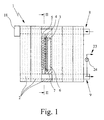
- Fig. 1 shows a schematic representation of a proposed fuel cell assembly 1 with several stacked fuel cells 2.
- One of the fuel cells 2 is shown cut for illustration. Based on this fuel cell 2, the structure of the Fuel cell 2, which are preferably constructed identical explained.
- the fuel cell 2 has an anode 3, a membrane 4 and a cathode 5 on.
- the anode 3 and the cathode 5 are preferably on opposite sides Sides of the preferably exclusively proton-conducting membrane 4 arranged.
- the anode 3 is in particular a three-phase layer, as known in fuel cells, for example graphite, a catalyst material, like a metal or an alloy of the platinum group, and one suitable proton conductive material.
- the cathode 5 can accordingly be constructed.
- Fuel gas in particular hydrogen is the anode 3 via an anode-side Flow field 6 can be fed.
- hydrogen takes place at the anode. 3 a decomposition and oxidation to protons passing through the membrane 4 too the cathode 5 are passed, where they react with oxygen to water.
- a cathode-side flow field 7 is to provide the oxygen or another oxidizing gas, preferably air of the cathode 5 supplied.
- the membrane 4 thus separates the two flow fields 6 and 7 or the Fuel gas and the oxidizing gas from each other.
- it is in the membrane 4 to a polymer electrolyte membrane (PEM) or a Membrane made of another suitable material.
- PEM polymer electrolyte membrane
- the water formed on the cathode side is more liquid and / or gaseous form.
- the gas flow through the cathode side Flow field 7 leads depending on the input-side humidity to a cathode side Drying, that is a removal of emerging water. additionally can be formed, especially in liquid form present water also be derived by a derivative, not shown, or the like.
- the degree of moistening of the membrane 4 is for its proton or ionic conductivity important and / or for the flow resistance in the flow field. 7 with authoritative. Accordingly, the performance of the fuel cell 2 is from Moisture level dependent.
- the fuel cells 2 are on the one hand with their anode-side flow fields 6 parallel to a not shown in Fig. 1 fuel gas supply and discharge and on the other hand with their cathode-side flow fields 7 in parallel to a gas supply 8 and a gas discharge 9 for the supply of air or other oxidizing gas connected.
- Fig. 1 it is indicated that the gas supply 8, a feed channel 10 and the Gas outlet 9 has a discharge channel 11, wherein the channels 10, 11th each pass through the fuel cell 2 and the flow fields 7 to this Channels 10, 11 are connected.
- Fig. 2 shows in a schematic section along line II-II of Fig. 1 the Fuel cell 2 on the cathode side.
- the channels 10 and 11 for the supply and Discharge of gas and the connected flow field 7 are schematic indicated.
- flow field 7 may - as in the illustration - to a single, for example, meandering channel, but also around a plurality of parallel channels or other flow area or act a flow area.
- flow field is accordingly preferably in a very broad or general sense understand.
- Various design solutions are the expert from the Known in the art.
- Fig. 2 are further a fuel gas supply line 12 and a fuel gas discharge 13 indicated, to which the anode side not shown in Fig. 2 Flow fields 6 of the fuel cell 2 are connected in parallel.
- all the fuel cells are 2 fluidly connected on the anode side and the cathode side in parallel.
- the fuel cell assembly 1 For modifying the cathode-side gas flows through the flow fields 7, the fuel cell assembly 1 additionally has a gas control device 14, as indicated in Fig. 2 only schematically.
- the gas control device 14 By means of the gas control device 14 are the gas streams through the flow fields 7 of the fuel cells 2 individually or in groups controllable or adjustable.
- Fig. 3 shows in a partial enlargement of Fig. 2, the gas control device 14, in the illustrated example, a control tube 15 with openings 16 in a control channel 17 has.
- the control tube 15 is by means of a in Fig. 1 and 4 indicated drive 18, preferably a stepper motor or the like, in the feed channel 17 rotatable.
- the openings 16 are designed and arranged such that, depending on the rotational position of the control tube 15 connecting channels 19 between the control channel 17 and the Strömungsfeldem 7 alone or in groups - so only for the fuel cell 2 individually or for a group of fuel cells 2 - are releasable. in the released state, as shown in Fig. 3, can then additionally off gas the interior of the control tube 15 via the connecting channel 19 in addition the flow field 7 flow, as indicated by the arrows.
- the gas control device 14 with gas, in particular Air or other oxidizing gas, supplied the gas pressure preferably slightly higher than the gas pressure of the gas supply 8 or is the pressure prevailing in the feed channel 10 gas pressure. So can depending on the rotational position of the control tube 15 gas from the interior of the control tube 15 via the of the passage opening 16 shared connection channel 19 in the associated Flow field 7 and accordingly its gas flow - ie increase the gas flow through the flow field 7 -. The same applies when the gas control device 14 and the control tube 15 at the same time several Connecting channels 19 to a group of fuel cells 2 opens.
- gas in particular Air or other oxidizing gas
- control channel 17 is preferably parallel to the feed channel 10 and passes through the stacked or arranged Fuel cells 2.
- the control tube 15 is rotatable in the representation example. Alternatively or in addition it may also be axially movable to the desired optional Release or blocking of the connection channels 19 to the individual flow fields 7 to effect.
- control tube 15 and another, not illustrated control tube or other actuator may be provided, in particular wherein the two are relatively movable or adjustable to the to achieve desired control functions.
- control tube 15 as a roller or as be designed another suitable actuator. Accordingly is the term "head tube” in the present invention preferably in one wide sense, very general so to understand as an actuator.
- the control tube 15 may also be arranged outside thereof and over corresponding connections to the fuel cell 2 may be connected.
- the Gas control device 14 and a non-illustrated provision of Control gas for actuating non-illustrated valves, pressure regulators, Throttles or the like serve to control the gas flows through the flow fields 7 accordingly - ie single or groupwise for the fuel cell 2 - to control or regulate if necessary.
- this is done then again air or the same gas as for the gas supply 8 as Control gas used.
- Fig. 4 shows a schematic representation of a plan view of the fuel cell assembly 1.
- the feed channel 10 is connected to a main pump 20 of the gas supply 8 connected. If necessary, an unillustrated pressure accumulator or the like may be interposed.
- the gas control device 14, in particular its control channel 17 or the interior the control tube 15, is preferably via an additional pump 21 to the Gas supply 8, in particular to the downstream side of the main pump 20, connected.
- the auxiliary pump 21 serves to increase the gas pressure, wherein an already small increase, for example by 50 to 200 Pa, depending on the flow conditions, enough.
- higher gas pressure of the gas control device 14 to reach the gas pressure in the feed channel 10 may alternatively or additionally to the auxiliary pump 21 or another Pressure Booster also a throttle, a valve or pressure regulator 22 or the like may be associated with the feed channel 10, as in FIG. 4 indicated.
- the gas supply 8 also includes a device, not shown for influencing and optionally fixing or adjusting the humidity of the supplied gas, such as air.
- the fuel cell assembly 1 preferably further comprises a control device 23, in particular a control of the drive 18, the main pump 20, the auxiliary pump 21, the pressure regulator or valve 22 and / or serves other facilities.
- a control device 23 in particular a control of the drive 18, the main pump 20, the auxiliary pump 21, the pressure regulator or valve 22 and / or serves other facilities.
- the control device 23 also preferably serves a detection of the individual fuel cell 2 emitted electrical power or Tension.
- control device 23 can also control the gas pressure, especially on the downstream side of the flow fields 7, capture. Especially for this purpose, a pressure sensor 24 of the gas outlet 9 and its discharge channel 11, as indicated in Fig. 1.
- the gas flow through the respective Fuel cell 2 increases to that with the increased degree of humidification concomitant increase in drag and in particular again to reduce or normalize the degree of moistening. Due to the increased gas flow thus a cathode-side "drying" or reduction of the humidification of the fuel cell 2, in particular the Membrane 4.
- the increase in the gas flow may also be required simultaneously for several fuel cells 2 - so groupwise - done.
- common gas control device 14 may However, other valves, valve devices or the like. Provided be, in particular the desired individual, group or selective Gas supply to achieve.
- the supply of gas to Feed channel 10 - for example by means of the pressure regulator or valve 22 - interrupted.
- the individual fuel cells 2 or their cathode-side flow fields 7 in succession briefly Gas supplied.
- By cyclically enabling and disabling the connection channels 19 to the flow fields 7 is in particular a pulse-like Gas supply.
- the pressure pulses are detected downstream, wherein the height of the detected pressure pulses is a measure of the pressure drop or Represents flow resistance in the respective fuel cell 2. So will open simple way the pressure drop, flow resistance or another, determined by the degree of humidification value of the individual flow fields 7, which is referred to below as "pressure measurement”.
- the pressure measurement is preferably cyclic for all fuel cells. 2
- the gas flow of a fuel cell 2 with increased pressure drop or flow resistance or increased Moisture level can be increased by means of the gas control device 14.
- a control or possibly even regulation of the gas flow takes place by the relevant fuel cell 2 depending on the result of Pressure measurement.
- the pressure measurement for the fuel cells 2 becomes periodic repeated, so that a continuous monitoring is enabled.
- the pressure measurement can be independent of the monitoring of the performance the fuel cell 2 or in addition, especially after detection a power loss of a fuel cell 2, are used.
- a common Pressure sensor 24 is provided in particular for all fuel cells 2. If necessary, also a corresponding pressure sensor in the gas supply 8 may be provided to directly or more easily the pressure drop to be able to determine.
- a flow sensor can be used to control the flow resistance or correlated values, such as the flow velocity, the mass flow or the like. To determine.
- the above statements with regard to the pressure sensor then apply accordingly. It should be noted, that the flow velocity or the mass flow on the one hand and the pressure drop or the flow resistance, on the other hand, vice versa depend on each other, in particular inversely proportional, and that this in the control or regulation of the individual fuel cell 2 accordingly must be taken into account.
- the gas control device 14 is for the individual or groupwise Determination of flow parameters not required. however
- the gas control device 14 may be for the preferred variation described above the gas flow to influence the moistening state of the individual Fuel cells 2 are used.
- the proposed determination of the flow parameters such as pressure drop, flow resistance or a corresponding thereto Value, also fuel gas side, so for the fuel gas supply 12 and fuel gas discharge line 13 and the anode-side flow fields 6 used become. This, in turn, makes it possible in an easy way to optimize, individual control or regulation of the individual fuel cells 2.
Landscapes
- Life Sciences & Earth Sciences (AREA)
- Engineering & Computer Science (AREA)
- Manufacturing & Machinery (AREA)
- Sustainable Development (AREA)
- Sustainable Energy (AREA)
- Chemical & Material Sciences (AREA)
- Chemical Kinetics & Catalysis (AREA)
- Electrochemistry (AREA)
- General Chemical & Material Sciences (AREA)
- Fuel Cell (AREA)
Applications Claiming Priority (2)
| Application Number | Priority Date | Filing Date | Title |
|---|---|---|---|
| DE102004012332A DE102004012332A1 (de) | 2004-03-11 | 2004-03-11 | Brennstoffzellenanordnung |
| DE102004012332 | 2004-03-11 |
Publications (2)
| Publication Number | Publication Date |
|---|---|
| EP1575113A2 true EP1575113A2 (fr) | 2005-09-14 |
| EP1575113A3 EP1575113A3 (fr) | 2007-07-11 |
Family
ID=34813685
Family Applications (1)
| Application Number | Title | Priority Date | Filing Date |
|---|---|---|---|
| EP05005340A Withdrawn EP1575113A3 (fr) | 2004-03-11 | 2005-03-11 | Assemblage de piles à combustible et procédé pour faire opérer un assemblage de piles a combustible |
Country Status (2)
| Country | Link |
|---|---|
| EP (1) | EP1575113A3 (fr) |
| DE (1) | DE102004012332A1 (fr) |
Cited By (2)
| Publication number | Priority date | Publication date | Assignee | Title |
|---|---|---|---|---|
| WO2007080468A1 (fr) * | 2006-01-10 | 2007-07-19 | Toyota Jidosha Kabushiki Kaisha | Assemblage de piles à combustible à détermination de stoechiométrie dans des piles individuelles |
| DE102007021909A1 (de) | 2007-05-10 | 2008-11-13 | Robert Bosch Gmbh | Brennstoffzellensystem mit Mehrfach-Betriebsmitteldosiereinheit |
Families Citing this family (4)
| Publication number | Priority date | Publication date | Assignee | Title |
|---|---|---|---|---|
| US20050277008A1 (en) * | 2004-06-15 | 2005-12-15 | Rainer Pechtoid | Equalizer channel in fuel cells |
| JP2009016155A (ja) | 2007-07-04 | 2009-01-22 | Toyota Motor Corp | 燃料電池の制御装置および燃料電池システム |
| DE102020203357A1 (de) | 2020-03-16 | 2021-09-16 | Mtu Friedrichshafen Gmbh | Verfahren zum Spülen von Brennstoffzellen, Brennstoffzellenanordnung, und Fahrzeug mit einer solchen Brennstoffzellenanordnung |
| DE102023102764A1 (de) * | 2023-02-06 | 2024-08-08 | Bayerische Motoren Werke Aktiengesellschaft | Brennstoffzellenanordnung und Verfahren zum Reinigen einer Brennstoffzellenanordnung |
Family Cites Families (6)
| Publication number | Priority date | Publication date | Assignee | Title |
|---|---|---|---|---|
| DE19747596C1 (de) * | 1997-10-28 | 1999-03-11 | Forschungszentrum Juelich Gmbh | Vorrichtung zur selektiven Spülung von Einzelzellen eines Brennstoffzellenstapels |
| US6030718A (en) * | 1997-11-20 | 2000-02-29 | Avista Corporation | Proton exchange membrane fuel cell power system |
| US6103409A (en) * | 1998-02-10 | 2000-08-15 | General Motors Corporation | Fuel cell flooding detection and correction |
| JP4576646B2 (ja) * | 1999-09-30 | 2010-11-10 | アイシン精機株式会社 | 燃料電池 |
| JP2002367641A (ja) * | 2001-06-08 | 2002-12-20 | Honda Motor Co Ltd | 燃料電池およびその運転方法 |
| US6911277B2 (en) * | 2002-05-01 | 2005-06-28 | General Motors Corporation | Device and method to expand operating range of a fuel cell stack |
-
2004
- 2004-03-11 DE DE102004012332A patent/DE102004012332A1/de not_active Withdrawn
-
2005
- 2005-03-11 EP EP05005340A patent/EP1575113A3/fr not_active Withdrawn
Cited By (3)
| Publication number | Priority date | Publication date | Assignee | Title |
|---|---|---|---|---|
| WO2007080468A1 (fr) * | 2006-01-10 | 2007-07-19 | Toyota Jidosha Kabushiki Kaisha | Assemblage de piles à combustible à détermination de stoechiométrie dans des piles individuelles |
| US8815459B2 (en) | 2006-01-10 | 2014-08-26 | Toyota Jidosha Kabushiki Kaisha | Fuel cell stack with stoichiometry determination in individual cells |
| DE102007021909A1 (de) | 2007-05-10 | 2008-11-13 | Robert Bosch Gmbh | Brennstoffzellensystem mit Mehrfach-Betriebsmitteldosiereinheit |
Also Published As
| Publication number | Publication date |
|---|---|
| DE102004012332A1 (de) | 2005-09-29 |
| EP1575113A3 (fr) | 2007-07-11 |
Similar Documents
| Publication | Publication Date | Title |
|---|---|---|
| DE69836593T2 (de) | Verfahren und vorrichtung zum betrieb einer elektrochemischen brennstoffzelle mit periodischer brennstoffunterbrechung an der anode | |
| DE10065460B4 (de) | System und Verfahren zur Steuerung des Feuchtigkeitsniveaus einer Brennstoffzelle | |
| DE102013218144B4 (de) | Brennstoffzellensystem und Verfahren zum Steuern des Brennstoffzellensystems | |
| DE102008027752A1 (de) | Verfahren für Brennstoffzellen-Inbetriebnahme mit gleichmäßiger Wasserstoffströmung | |
| EP1815549B1 (fr) | Systeme de piles a combustible pourvu d'un separateur de liquide | |
| DE102008028007A1 (de) | Umfassendes Verfahren zum Auslösen von Anodenentlüftungsvorgängen in einem Brennstoffzellensystem | |
| EP3033789B1 (fr) | Simplification du système électrique de piles à combustible par appauvrissement de l'alimentation des cathodes | |
| DE102004031162B4 (de) | Brennstoffzellensystem und Gassteuer- und Betriebsverfahren für ein Brennstoffzellensystem zur Wasser- und Gasverteilung | |
| DE102006019114B4 (de) | Brennstoffzellensystem zur verbesserten Wasserstoff- und Sauerstoffverwendung | |
| DE102012102282A1 (de) | Algorithmus für die In-situ-Quantifizierung einer PEMFC-Membranfunktionsfähigkeit über ihre Lebensdauer | |
| DE102006003394A1 (de) | Brennstoffzellensystem, das die Stabilität seines Betriebs sicherstellt | |
| DE102016111638A1 (de) | Bipolarplatte mit variabler Breite der Reaktionsgaskanäle im Eintrittsbereich des aktiven Bereichs, Brennstoffzellenstapel und Brennstoffzellensystem mit solchen Bipolarplatten sowie Fahrzeug | |
| DE112009005042T5 (de) | Brennstoffzellensystem und Verfahren zum Betreiben eines Brennstoffzellensystems | |
| AT523373B1 (de) | Sensorvorrichtung für ein Brennstoffzellensystem | |
| DE112007000575T5 (de) | Brennstoffzellensystem | |
| DE102004012332A1 (de) | Brennstoffzellenanordnung | |
| WO2008000217A1 (fr) | Système à pile à combustible | |
| DE102017215574A1 (de) | Verfahren zum Betreiben einer Brennstoffzelle und Brennstoffzellensystem | |
| EP4165703B1 (fr) | Plaque bipolaire avec obturateur insérable et empilement de cellules élémentaires | |
| DE102015222552A1 (de) | Brennstoffzellenstapel Bipolarplatten aufweisend sowie Brennstoffzellensystem | |
| DE102016119587A1 (de) | Methoden und verfahren zum ausgleich des spannungsabfalls infolge anodenverunreinigung | |
| DE102015215497B4 (de) | Brennstoffzellenstapel mit variabler Segmentierung sowie Brennstoffzellensystem und Fahrzeug mit einem solchen | |
| DE10348698B4 (de) | Vorrichtung und Verfahren zur Erzeugung von elektrischer Energie und Wasser aus CO-haltigem Wasserstoff | |
| DE102004025229A1 (de) | Brennstoffzellenanlage mit einem Kathodenstoffstrom | |
| DE102012011441A1 (de) | Membran-Elektroden-Einheit für eine Brennstoffzelle |
Legal Events
| Date | Code | Title | Description |
|---|---|---|---|
| PUAI | Public reference made under article 153(3) epc to a published international application that has entered the european phase |
Free format text: ORIGINAL CODE: 0009012 |
|
| AK | Designated contracting states |
Kind code of ref document: A2 Designated state(s): AT BE BG CH CY CZ DE DK EE ES FI FR GB GR HU IE IS IT LI LT LU MC NL PL PT RO SE SI SK TR |
|
| AX | Request for extension of the european patent |
Extension state: AL BA HR LV MK YU |
|
| PUAL | Search report despatched |
Free format text: ORIGINAL CODE: 0009013 |
|
| AK | Designated contracting states |
Kind code of ref document: A3 Designated state(s): AT BE BG CH CY CZ DE DK EE ES FI FR GB GR HU IE IS IT LI LT LU MC NL PL PT RO SE SI SK TR |
|
| AX | Request for extension of the european patent |
Extension state: AL BA HR LV MK YU |
|
| AKX | Designation fees paid | ||
| STAA | Information on the status of an ep patent application or granted ep patent |
Free format text: STATUS: THE APPLICATION IS DEEMED TO BE WITHDRAWN |
|
| 18D | Application deemed to be withdrawn |
Effective date: 20080112 |
|
| REG | Reference to a national code |
Ref country code: DE Ref legal event code: 8566 |