EP1577399A2 - Trousse diagnostique et procédé de détection d'une infection par le phytovirus dans la production de vegetaux - Google Patents
Trousse diagnostique et procédé de détection d'une infection par le phytovirus dans la production de vegetaux Download PDFInfo
- Publication number
- EP1577399A2 EP1577399A2 EP05003256A EP05003256A EP1577399A2 EP 1577399 A2 EP1577399 A2 EP 1577399A2 EP 05003256 A EP05003256 A EP 05003256A EP 05003256 A EP05003256 A EP 05003256A EP 1577399 A2 EP1577399 A2 EP 1577399A2
- Authority
- EP
- European Patent Office
- Prior art keywords
- virus
- primers
- kit according
- grapevine
- fragment
- Prior art date
- Legal status (The legal status is an assumption and is not a legal conclusion. Google has not performed a legal analysis and makes no representation as to the accuracy of the status listed.)
- Withdrawn
Links
Images
Classifications
-
- C—CHEMISTRY; METALLURGY
- C12—BIOCHEMISTRY; BEER; SPIRITS; WINE; VINEGAR; MICROBIOLOGY; ENZYMOLOGY; MUTATION OR GENETIC ENGINEERING
- C12Q—MEASURING OR TESTING PROCESSES INVOLVING ENZYMES, NUCLEIC ACIDS OR MICROORGANISMS; COMPOSITIONS OR TEST PAPERS THEREFOR; PROCESSES OF PREPARING SUCH COMPOSITIONS; CONDITION-RESPONSIVE CONTROL IN MICROBIOLOGICAL OR ENZYMOLOGICAL PROCESSES
- C12Q1/00—Measuring or testing processes involving enzymes, nucleic acids or microorganisms; Compositions therefor; Processes of preparing such compositions
- C12Q1/68—Measuring or testing processes involving enzymes, nucleic acids or microorganisms; Compositions therefor; Processes of preparing such compositions involving nucleic acids
- C12Q1/6876—Nucleic acid products used in the analysis of nucleic acids, e.g. primers or probes
- C12Q1/6888—Nucleic acid products used in the analysis of nucleic acids, e.g. primers or probes for detection or identification of organisms
- C12Q1/6895—Nucleic acid products used in the analysis of nucleic acids, e.g. primers or probes for detection or identification of organisms for plants, fungi or algae
-
- C—CHEMISTRY; METALLURGY
- C12—BIOCHEMISTRY; BEER; SPIRITS; WINE; VINEGAR; MICROBIOLOGY; ENZYMOLOGY; MUTATION OR GENETIC ENGINEERING
- C12Q—MEASURING OR TESTING PROCESSES INVOLVING ENZYMES, NUCLEIC ACIDS OR MICROORGANISMS; COMPOSITIONS OR TEST PAPERS THEREFOR; PROCESSES OF PREPARING SUCH COMPOSITIONS; CONDITION-RESPONSIVE CONTROL IN MICROBIOLOGICAL OR ENZYMOLOGICAL PROCESSES
- C12Q1/00—Measuring or testing processes involving enzymes, nucleic acids or microorganisms; Compositions therefor; Processes of preparing such compositions
- C12Q1/70—Measuring or testing processes involving enzymes, nucleic acids or microorganisms; Compositions therefor; Processes of preparing such compositions involving virus or bacteriophage
- C12Q1/701—Specific hybridization probes
Definitions
- the present invention concerns a diagnostic kit composed of PCR primers and/or cloned nucleotide sequences and/or nucleic probes for the diagnosis and identification of harmful viruses affecting the quality of plant production, in particular in nursery vegetable, flower and fruit productions, and a method for detecting plant viruses (phytoviruses) which utilizes that diagnostic kit.
- a diagnostic kit composed of PCR primers and/or cloned nucleotide sequences and/or nucleic probes for the diagnosis and identification of harmful viruses affecting the quality of plant production, in particular in nursery vegetable, flower and fruit productions, and a method for detecting plant viruses (phytoviruses) which utilizes that diagnostic kit.
- the diagnostic instruments available today consist essentially of: a) tests on biological indicators which contemplate long times and high costs; b) serological tests, which are very practical but not always reliable due to the poor immunogenicity of some viruses, and are not suitable for detecting viroids because they have no capsidic protein; c) molecular tests, based on the properties of the nucleic acid which guarantee very high sensitivity and versatility in use, characteristics which make them particularly suitable both for mass diagnosis and for fine diagnosis.
- the object of the invention is to make available a method of diagnosis and a diagnostic kit based on the genic sequences of pathogenic viral and viroidal species of vegetable, flower and fruit cultures, validated and suitable also for diagnosis for the purposes of the plant health certification required from nurserymen with relation to these pathogens, also according to the Commission Directives:
- the method of diagnosis proposed is innovative for the specific purposes mentioned above because it aims to detect several viral species belonging to the same genus, by using degenerate primers, and is therefore usable for multiple diagnosis.
- Another object of the invention is to propose the formulation of a kit for commercial use, for the diagnosis of plant viruses in nursery productions of vegetables.
- these primers are proposed for diagnostic purposes for detecting RNA of viruses and viroids in preparations of nucleic acid, obtained also from vegetal tissue, through RT-PCR.
- the amplified fragments were also cloned in suitable transcription vectors from which to generate nucleic RNA and/or DNA probes to be used for diagnosis through molecular hybridising of vegetal extracts or preparations of nucleic acid fixed on nylon membrane and chemioluminescent detection of the hybrid formed.
- the nucleotide sequence of the cloned fragments was also determined.
- probes or “nucleic probes” designates probes, riboprobes and transcripts.
- the term "diagnostic kit” designates a kit of a commercial or experimental type, intended for detecting plant viruses and/or viroids according to the present invention.
- the invention concerns a diagnostic kit for detecting one or more plant viruses and/or viroids selected among the following: Vitivirus Grapevine virus A, Grapevine virus B, Grapevine virus D, Grapevine leafroll-associated virus 4, Grapevine leafroll-associated virus 5 Grapevine fleck virus, Grapevine red globe virus, Grapevine asteroid mosaic virus, Grapevine leafroll-associated virus 7, Plum bark necrosis pitting-associated virus, Peach latent mosaic viroid, variants of Peach latent mosaic viroid responsible for calico of the peach, Plum pox virus, Citrus psorosis virus, Citrus variegation virus, Citrus tristeza virus, Olive latent virus-1, Olive latent virus-2, Olive latent ringspot virus, Olive latent yellowing associated virus, Turnip mosaic virus, Alfalfa mosaic virus, Cucumber mosaic virus, Impatiens necrotic spot virus, Tomato spotted wilt virus, Pelargonium zonate spot virus, Lettuce mosaic virus, Cucumber green mottle mosaic virus
- PCR primers The PCR primers, the cloned nucleotide sequences and the probes useable in the preparation of the invention kit are described in detail here below and claimed in the claims annexed to this description.
- the invention concerns a method for the detection and identification of plant viruses and/or viroids in nursery vegetable, flower and fruit productions, which contemplates the use of a particular type of diagnostic kit according to the invention.
- PCR primers designed on the GDD pattern of ORF1 (viral polymerase), for detecting the grapevine viruses Grapevine virus A (Acc.n.X75433), Grapevine virus B (Acc.n.X75448), Grapevine virus D (Acc.n. Y15892) (Martelli et al . 1997, Archives of Virology 142:1929-1932; Saldarelli et al ., 1998 European. Journal of Plant Pathology, 104, 945-950).
- the expected amplified fragment is 363 bp.
- the expected amplified fragment is 390 bp.
- PCR primer for the amplification of a 290 bp fragment inside the gene of HSP70 for detecting Plum bark necrosis stem pitting-associated virus (PBNSPaV) (Acc.n. AJ305307).
- the expected amplified fragment is 290 bp
- PCR primers for detecting Plum pox virus (PPV) designed on the gene codifying the helper component of PPV, strain M, (Acc.n. AJ243957).
- the expected amplified fragment is 893 bp.
- PLMVd Peach latent mosaic viroid
- the expected amplified fragment corresponds to the cDNA of the complete genome of PLMVd and it may vary between 335-338 and 349-350 bp depending on the isolates (Hernández and Flores, 1992, Proc. Natl. Acad. Sci. USA, 89: 3711-3715; Malfitano et al ., Virology, 2003, 313: 492-501).
- Primer FPLMVd-59 5'-CTTACCTCATTGCGAGGTGCTTAGCC-3' (position 127-152 of the reference sequence published by Hernández and Flores, 1992), used in the reverse transcription reaction and, in association with the primer FPLMV-60, in the PCR reaction
- Primer FPLMVd-60 5'-GTGGGACTTTTCCTTCTGGAACCAAG-3' (position 153-178 of the reference sequence) used in association with the primer FPLMV-59 in the PCR reaction.
- the primers FPLMVd-59 and FPLMVd-60 have not been described previously and they are new and original because they correspond to a relatively little variable region of PLMVd, so they are efficient on a wide spectrum of isolates.
- a 337 bp fragment for detecting PLMVd with a nucleic probe corresponds to the genomic cDNA of the variant PL1.1 obtained with RT-PCR from the isolate UBA.CA.P1 using the primers FPLMVd-59 and FPLMVd-60 described above in point 2.5 (the sequences of the primers FPLMVd-59 and 60 are underlined).
- the cDNA was cloned into pGEM-T-easy (Promega) yielding the plasmid pGPL1.1.
- the nucleic probe is obtained by transcription of the 337 bp fragment by means of the RNA polymerase of T7 after linearization of the plasmid with the restriction enzyme Spe I
- PCR primers for identifying the variants of PLMVd responsible for calico of the peach, containing insertions of 12-13 nt between positions 1 and 337 of the reference sequence: (Malfitano et al ., 2003) Primer FPLMVd-61: 5'-AAGGTGGAGGGGCTGAGAGG-3' (position 69-88 of the reference sequence), used in the reverse transcription reaction and, in association with the primer FPLMV-58, in the PCR reaction) Primer FPLMVd-58: 5' -ATCCAGGTACCGCCGTAGAAAC- 3' (position 202-223 of the reference sequence), used in association with the primer FPLMV-61 in the PCR reaction.
- the expected amplified fragment for the variants of PLMVd with insertion of 12 13 nucleotides in the loop A is about 235-237 bp, the one for the variants without insertion is about 223-224 bp.
- Separation on 5% non-denaturing polyacrylamide gel allows discrimination between the two types of variants.
- the primers FPLMVd-61 and FPLMVd-58 are new and original because if they are used in a simple PCR reaction, they can also allow the identification of variants of atypical sequences of PLMVd cloned with standard methods, avoiding the use of sequencing.
- PCR primers designed on the gene for capsidic protein for detecting Citrus psorosis virus (CPsV) (Acc.n. AF036338).
- the expected amplified fragment is 593 bp.
- cDNA for detecting CPsV (Acc.n.AF036338) with a nucleic probe.
- the 600 bp fragment corresponds to the cDNA of the gene for the capsidic protein (RNA3, nt 654-1253) of an Apulian isolate of 'Navelina' VC (IAM-UBA-ps101) obtained using the primers cp1 and cp2 described above in point 3.1
- the resulting cDNA was cloned into pGEM-T easy (Promega) yielding the plasmid pCPS600.
- the nucleic probe is obtained by transcription of the fragment by means of the RNA polymerase of T7 after linearization of the plasmid pCPS600 with Sal I or Sac I.
- PCR primers designed on the sequence of the gene for the capsidic protein for detecting Citrus variegation virus (CVV) (Acc.n. U17389).
- the expected amplified fragment is 249 bp.
- Sequence of a 249 bp fragment for detecting CVV (Accession number U17389, 1592-1840) with a nucleic probe.
- the fragment corresponds to the cDNA of the RNA3 of an isolate obtained from Gargano Lemon (UBA-CVV -301) obtained by RT-PCR.
- the resulting cDNA was cloned into pGEM-T easy (Promega) yielding the plasmid pGEM CVVCP60x/3.
- the nucleic probe is obtained by transcription of the 249 bp fragment by means of the RNA polymerase of SP6 after linearization of the plasmid pGEMCVVCP60x/3 with Nco I.
- a 1050 bp fragment for detecting OLV-1 with a nucleic probe corresponds to the cDNA of part of the gene for the capsidic protein of an isolate obtained from olive.
- the resulting cDNA was cloned into the pSPT64 vector yielding the plasmid pSPTOLV1.
- the nucleic probe is obtained by transcription of the 1050 bp fragment by means of the RNA polymerase of T7 after linearization of the plasmid pSPTOLV1 with Eco RI
- PCR primers designed on the gene for capsidic protein for detecting Olive latent ringspot virus (OLRSV) (Acc.n. AJ277435).
- ORSV Olive latent ringspot virus
- the expected amplified fragment is 477 bp.
- AMV Alfalfa mosaic virus
- Impaliens necrotic spot virus designed on the RNA S of INSV, non-structural protein, (Acc.n.X66972).
- the expected amplified fragment is 631 bp.
- CMV Cucumber mosaic virus
- Sequence of a 637 bp fragment for detecting CMV with a nucleic probe corresponds to the cDNA of part of the gene for polymerase protein obtained using the primers described above in point 5.7
- the resulting cDNA was cloned into pGEM-T (Promega) yielding the plasmid pGEMCMV-2a.
- the nucleic probe is obtained by transcription of the 637 bp fragment by means of the RNA polymerase of T7 after linearization of the plasmid with Sac I.
- BYMV Bean Yellow Mosaic Virus
- TSWV Tomato spotted wilt virus
- Sequence of a 837 bp fragment for detecting LeMV with a nucleic probe corresponds to the cDNA of the gene for capsidic protein obtained using the primers described above in point 5.15.
- the resulting cDNA was cloned into pGEM-4Z (Promega) yielding the plasmid pLeMV.
- the nucleic probe is obtained by transcription of the 837 bp fragment by means of the RNA polymerase of T7 after linearization of the plasmid with Eco RI
- PCR primers for detecting Cucumber green mottle mosaic virus designed on the gene codifying the capsidic protein of CGMMV-NS strain (Acc.n.AJ243831).
- the expected amplified fragment is 476 bp.
- Sequence of a 478 bp fragment for detecting CGMMV with a nucleic probe corresponds to the cDNA of part of the gene for capsidic protein obtained using the primers described above in point 5.16.
- the resulting cDNA was cloned into pGEM-T (Promega) yielding the plasmid pCGMMVcp.
- the nucleic probe is obtained by transcription of the 478 bp fragment by means of the RNA polymerase of SP6 after linearization of the plasmid with Sac II.
- PCR primers for detecting Artichoke Italian latent virus designed on the gene for capsidic protein (Acc.n.X87254).
- the expected amplified fragment is 760 bp.
- Sequence of a 760 bp fragment for detecting AILV with a nucleic probe corresponds to the cDNA of part of the gene for capsidic protein obtained using the primers described above in point 5.21.
- the resulting cDNA was cloned into pGEM-T (Promega) yielding the plasmid pGTAILV.cp.6 .
- the nucleic probe is obtained by transcription of the 760 bp fragment by means of the RNA polymerase of SP6 after linearization of the plasmid with Apa I.
- Sequence of a 580 bp fragment for detecting ArLV with a nucleic probe corresponds to the cDNA of part of the gene for capsidic protein obtained using the primers described above in point 5.23.
- the resulting cDNA was cloned into pGEM-4Z (Promega) yielding the plasmid pAL37-2.
- the nucleic probe is obtained by transcription of the 580 bp fragment by means of the RNA polymerase of T7 after linearization of the plasmid with Eco RI.
- the fragment corresponds to the cDNA of part of the gene for the polyprotein of the genomic RNA.
- the cDNA was cloned into pGEM-4Z (Promega) yielding the plasmid pCeMV.8
- the nucleic probe is obtained by transcription of the 650 bp fragment by means of the RNA polymerase of T7 after linearization of the plasmid with Eco RI.
- RNA preparations that were used as a "mould” for the synthesis of the cDNA fragments to be cloned were prepared according to standardised methods currently used in plant virology.
- the cDNA was synthesised by means of RT-PCR essentially as described by Minafra and Gallitelli (1995) (Methods in Molecular Biology , vol. 50: Species Diagnostics protocols: PCR and Other Nucleic Acid Methods, edited by J.P. Clapp, Humana Press Inc. Totowa, NJ) and then cloned into suitable transcription vectors according to standardised methods described by Sambrook et al ., ( 1989) (Molecular Cloning: A Laboratory Manual. New York: Cold Spring Harbor Laboratory).
- RNA preparations were used to assess the diagnostic procedures with RT-PCR (Minafra and Gallitelli, 1995) and molecular hybridising (Gallitelli and Saldarelli, 1995 Methods in Molecular Biology, vol. 50: Species Diagnostics protocols: PCR and Other Nucleic Acid Methods, edited by J.P. Clapp, Humana Press Inc. Totowa, NJ9).
- the invention concerns a diagnostic kit for use according to the invention which comprises one or more specific probes for the viruses described above.
- probes of the riboprobe type, were obtained by transcription in vitro of fragments of cDNA of the viral genome cloned into suitable transcription vectors. Transcription was carried out with the DIG RNA Labelling kit (Roche) using DIG-UTP as a marker.
- each riboprobe may be used, alone or in combination, at various concentrations, generally at the concentration of 100 ng/ml.
- the hybridising signals may be revealed with suitable detection kits, for example with the DIG luminescent detection kit (Roche, Germany), following the manufacturer's instructions. In this case, after treatment, the membranes are exposed against radiography film the first time for a minimum of one hour and then for further 16 hours.
- the riboprobes described above in points 5.2, 5.4, 5.6, 5.8, 5.10, 5.12, 5.14, 5.16, 5.18, 5.20, 5.22, 5.24, 5.25, are dried in a vacuum and kept at +4°C, in the form of a dried precipitate and included in the kit in aliquots in sufficient quantity for a multiple hybridising reaction and for as many separate hybridising reactions as are the riboprobes supplied in the kit for the hybridising of a "standard" membrane of 10 by 20 cm, useful for the analysis of about 200 samples of plant extract of 5 microlitres each.
- the kit also includes a set of membranes pre-soaked with a solution of 50 mM NaOH- 2.5 mM EDTA, in sufficient number for a multiple hybridising reaction and for as many separate hybridising reactions as are the riboprobes supplied in the kit.
- These membranes contain in the first row juice extracts from a healthy plant and, in the last row, preparations of the same plasmidic DNA (or DNA amplified from plasmid by PCR) used for the synthesis of the riboprobes, to be used as a positive control.
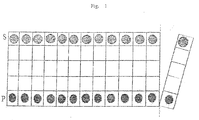
- This arrangement, represented in Figure 1, in fact allows the use of even single portions of the membrane, depending on the test requirements.
- Figure 1 represents a diagram of a nylon membrane to be inserted in the commercial kit of the invention for the diagnosis of plant viruses of vegetable plants by means of molecular hybridising.
- the membrane (Amersham Hybond N + or equivalent), which has a height of 10 cm and a width of 20 cm, is divided into I cm squares and pre-soaked with a solution of NaOH 50 mM-EDTA 2.5 mM corresponding to the rows marked S and P are applied, respectively, negative and positive controls.
- the negative control is composed of 5 microlitres of juice extracted from a healthy plant in NaOH 50 mM-EDTA 2.5 mM;
- the positive control is composed of 50 nanograms of the same plasmidic DNA used for the transcription of the riboprobe that is to be used for the diagnosis.
- Membranes may be prepared containing, in P, the same plasmidic DNA (or DNA amplified from plasmid by means of PCR) or a different plasmidic DNA (or DNA amplified from plasmid by means of PCR) in each position of row P for multiple diagnosis on the same samples.
- the arrangement of the controls on the membrane allows their even partial use such as for the portion which appears detached on the right of the drawing.
- This membrane diagram may be adopted also for diagnosis of any type of pathogens.
- RNA was purified from green leaves or from phloem of dormant cuttings kept at 4°C in plastic bags, with chromatography on silica (Foissac et al. 2000; 18th International symposium Virus and Virus-like diseases of fruit trees, July 9-15 2000, Canterbury, p. 48). Aliquots of 100-500 (0.25-0.5 in the case of CPsV) nanograms of total RNA are denatured for 3' at 100°C in the presence of random hexamers and retro-transcribed with MMLV (Invitrogen) for 1h at 42°C.
- each work sample is composed of 24 sub-samples of leaf tissue collected with a randomised systematic method (Barnett, 1986; Surveying for plant viruses: design and consideration. Pages 147-166 in: Introduction to plant disease epidemiology. Eds.
- Campbell CL & Madden LV Wiley Interscience, NY
- the trace may be composed of elastic thread suited to cover about 2 m 2 of seedlings corresponding to about 2400 plants.
- the 24 sub-samples are taken from batches of about 100,000 plants. In any case it is necessary to take at least one sample for each batch of plants, even less than 100,000 in size, where by batch is meant a group of plants of the same age, derived from the same batch of seed and grown in the same greenhouse.
- the assessment error probability was estimated with the formula of Clayton and Slack (1988;. American Potato Journal 65: 711-723), hypothesising a uniform distribution of the infection.
- the optimum ratio between plant tissue and volume of the extraction solution was determined on the basis of the mean weight of 100 work samples, taken in the nursery, which was estimated at about 1.2 g. This value was considered for the preparation of an experimental work sample, on which to determine the limit of sensitivity of the method.
- the most unfavourable condition was reproduced, in which only one of the 24 sub-samples was infected, mixing 50 mg of plant tissue, taken from a plant infected with one of the viruses being studied, with 1.15 g of plant tissue taken from healthy plants.
- aliquots of 50 mg of infected tissue are mixed, taken for each of the viruses being studied, and the sample is made up to 1.2 g with tissue taken from healthy plants.
- the work sample thus composed was ground with an ordinary roller press in the presence of 6 volumes of a solution of 50 mM NaOH, containing 2.5 mM EDTA, and the extract applied in aliquots of 5 microlitres on nylon membranes (Hybond N+, Amersham Pharmacia) pre-soaked with the same NaOH-EDTA solution.
- nylon membranes Hybond N+, Amersham Pharmacia
- the positive and negative controls were represented, respectively, by preparations of plasmidic DNA containing the fragment used for the transcription of the probe and raw extracts obtained from healthy tomato plants. After the application of the samples, the membranes were exposed to UV for 5 minutes and kept at environment temperature wrapped in Whatman 3MM paper and aluminium foil; until they were used.
- the probes of the citrus fruit viruses used in molecular hybridizing proved to be a much more sensitive and reliable diagnosis tool than serological tests, especially for CTV, with an increase of the positive samples found (up to 70%), and for CCV, for which the conventional serological test is unreliable on account of the poor immunogenic power of the virus.
- the diagnosis through molecular hybridising of the examined viral pathogens of olive makes it possible to detect 5-100 picograms of RNA per microgram of total extracted RNA.
- the RNA probes were validated on field material taken in different growth periods. It is possible, without reducing the sensitivity of the test, to mix two or more probes in the same hybridising mixture to highlight mixed infections.
- the optimum ratio between plant tissue and volume of the extraction solution was 1 to 6. With a ratio of 1 to 3, the excessive presence of plant residues on the membrane often generated non-specific signals, while a ratio of I to 9 or 1 to 12 reduced the signal intensity of some viruses. In the case of work samples of 1.2 g soaked in 15 ml of extraction mixture, it was estimated that a weight of about 400 milligrams of plant tissue corresponded to 5 microlitres of extract (stain) applied on the membrane.
- the sensitivity limit was about 17 micrograms of infected tissue per stain.
- the sensitivity limit was between 17 and 21 micrograms per stain but each riboprobe maintained its own specificity.
- double exposure against a radiography plate allowed the reduction of possible false negatives even though in 90% of the cases the signal was already clearly visible after one hour of exposure. No reductions in signal intensity were observed in membranes kept at room temperature and subjected to hybridising at a distance of more than one year from preparation.
- the method was also applied to the checking of the state of health of nursery production of seedlings of lettuce, prickly lettuce and endive, allowing the detection of TSWV and of the lettuce mosaic virus (LeMV). Consistent infections (up to 70%) of LeMV were found in lettuce seeds, carrying out molecular hybridising on seedlings in the cotyledon stage, obtained from seeds placed to germinate on sterile substratum.
Landscapes
- Chemical & Material Sciences (AREA)
- Life Sciences & Earth Sciences (AREA)
- Organic Chemistry (AREA)
- Engineering & Computer Science (AREA)
- Proteomics, Peptides & Aminoacids (AREA)
- Health & Medical Sciences (AREA)
- Zoology (AREA)
- Wood Science & Technology (AREA)
- Analytical Chemistry (AREA)
- Immunology (AREA)
- Biotechnology (AREA)
- Microbiology (AREA)
- Biophysics (AREA)
- Molecular Biology (AREA)
- Physics & Mathematics (AREA)
- Biochemistry (AREA)
- Bioinformatics & Cheminformatics (AREA)
- General Engineering & Computer Science (AREA)
- General Health & Medical Sciences (AREA)
- Genetics & Genomics (AREA)
- Mycology (AREA)
- Botany (AREA)
- Virology (AREA)
- Measuring Or Testing Involving Enzymes Or Micro-Organisms (AREA)
Applications Claiming Priority (2)
| Application Number | Priority Date | Filing Date | Title |
|---|---|---|---|
| ITMI20040258 ITMI20040258A1 (it) | 2004-02-17 | 2004-02-17 | Corredo diagnostico e metodo per il rilevamento di infezioni da fitovirus nelle produzioni vivaistiche |
| ITMI20040258 | 2004-02-17 |
Publications (2)
| Publication Number | Publication Date |
|---|---|
| EP1577399A2 true EP1577399A2 (fr) | 2005-09-21 |
| EP1577399A3 EP1577399A3 (fr) | 2006-01-04 |
Family
ID=34835586
Family Applications (1)
| Application Number | Title | Priority Date | Filing Date |
|---|---|---|---|
| EP05003256A Withdrawn EP1577399A3 (fr) | 2004-02-17 | 2005-02-16 | Trousse diagnostique et procédé de détection d'une infection par le phytovirus dans la production de végétaux |
Country Status (2)
| Country | Link |
|---|---|
| EP (1) | EP1577399A3 (fr) |
| IT (1) | ITMI20040258A1 (fr) |
Cited By (8)
| Publication number | Priority date | Publication date | Assignee | Title |
|---|---|---|---|---|
| CN102296128A (zh) * | 2011-10-08 | 2011-12-28 | 中国农业科学院柑桔研究所 | 柑桔衰退病毒的rt-lamp快速检测方法 |
| KR101301866B1 (ko) * | 2011-03-08 | 2013-08-30 | 대한민국 | 십자화과 식물체에서 병원성 박테리아 및 병원성 바이러스의 표적서열 증폭을 위한 프라이머 세트 및 이를 이용한 병원균 검출 방법 |
| EP2982763A1 (fr) * | 2014-08-07 | 2016-02-10 | Agritest S.r.l. | Synthèse et utilisation d'un polyprobe pour la détection d'infections virales dans un artichaut |
| RU2644244C2 (ru) * | 2016-06-07 | 2018-02-08 | Федеральное государственное учреждение "Федеральный исследовательский центр "Фундаментальные основы биотехнологии" Российской академии наук | Набор синтетических олигонуклеотидов для выявления вируса крапчатости винограда (Grapevine fleck virus) |
| CN108441582A (zh) * | 2018-06-11 | 2018-08-24 | 西南大学 | 柑橘鳞皮病毒的rt-lamp检测试剂盒和方法 |
| CN109487003A (zh) * | 2018-12-03 | 2019-03-19 | 潍坊科技学院 | 甜瓜坏死斑点病毒的rt-lamp检测引物对及检测方法 |
| CN109971889A (zh) * | 2019-04-16 | 2019-07-05 | 云南大学 | 玉米黄花叶病毒的rt-lamp检测试剂盒及其应用 |
| CN111424118A (zh) * | 2020-04-24 | 2020-07-17 | 云南省农业科学院生物技术与种质资源研究所 | 一种西番莲病毒病原多重复合pcr检测方法 |
Families Citing this family (1)
| Publication number | Priority date | Publication date | Assignee | Title |
|---|---|---|---|---|
| CN110747276B (zh) * | 2019-11-22 | 2020-06-30 | 山东大学齐鲁医院 | Bace2作为胶质瘤预后/诊断/治疗标志物的应用 |
Family Cites Families (1)
| Publication number | Priority date | Publication date | Assignee | Title |
|---|---|---|---|---|
| WO2001005957A2 (fr) * | 1999-07-19 | 2001-01-25 | Agritope, Inc. | Proteines virales associees a l'enroulement de la vigne |
-
2004
- 2004-02-17 IT ITMI20040258 patent/ITMI20040258A1/it unknown
-
2005
- 2005-02-16 EP EP05003256A patent/EP1577399A3/fr not_active Withdrawn
Cited By (10)
| Publication number | Priority date | Publication date | Assignee | Title |
|---|---|---|---|---|
| KR101301866B1 (ko) * | 2011-03-08 | 2013-08-30 | 대한민국 | 십자화과 식물체에서 병원성 박테리아 및 병원성 바이러스의 표적서열 증폭을 위한 프라이머 세트 및 이를 이용한 병원균 검출 방법 |
| CN102296128A (zh) * | 2011-10-08 | 2011-12-28 | 中国农业科学院柑桔研究所 | 柑桔衰退病毒的rt-lamp快速检测方法 |
| CN102296128B (zh) * | 2011-10-08 | 2013-03-20 | 中国农业科学院柑桔研究所 | 柑桔衰退病毒的rt-lamp快速检测方法 |
| EP2982763A1 (fr) * | 2014-08-07 | 2016-02-10 | Agritest S.r.l. | Synthèse et utilisation d'un polyprobe pour la détection d'infections virales dans un artichaut |
| RU2644244C2 (ru) * | 2016-06-07 | 2018-02-08 | Федеральное государственное учреждение "Федеральный исследовательский центр "Фундаментальные основы биотехнологии" Российской академии наук | Набор синтетических олигонуклеотидов для выявления вируса крапчатости винограда (Grapevine fleck virus) |
| CN108441582A (zh) * | 2018-06-11 | 2018-08-24 | 西南大学 | 柑橘鳞皮病毒的rt-lamp检测试剂盒和方法 |
| CN109487003A (zh) * | 2018-12-03 | 2019-03-19 | 潍坊科技学院 | 甜瓜坏死斑点病毒的rt-lamp检测引物对及检测方法 |
| CN109971889A (zh) * | 2019-04-16 | 2019-07-05 | 云南大学 | 玉米黄花叶病毒的rt-lamp检测试剂盒及其应用 |
| CN111424118A (zh) * | 2020-04-24 | 2020-07-17 | 云南省农业科学院生物技术与种质资源研究所 | 一种西番莲病毒病原多重复合pcr检测方法 |
| CN111424118B (zh) * | 2020-04-24 | 2022-10-25 | 云南省农业科学院生物技术与种质资源研究所 | 一种西番莲病毒病原多重复合pcr检测方法 |
Also Published As
| Publication number | Publication date |
|---|---|
| ITMI20040258A1 (it) | 2004-05-17 |
| EP1577399A3 (fr) | 2006-01-04 |
Similar Documents
| Publication | Publication Date | Title |
|---|---|---|
| Green et al. | Easy and efficient DNA extraction from woody plants for the detection of phytoplasmas by polymerase chain reaction | |
| Kokkinos et al. | Real-time PCR assays for detection and quantification of sweetpotato viruses | |
| Nie et al. | A novel usage of random primers for multiplex RT-PCR detection of virus and viroid in aphids, leaves, and tubers | |
| Li et al. | Detection of geminiviruses in sweetpotato by polymerase chain reaction | |
| Bostan et al. | An RT-PCR primer pair for the detection of Pospiviroid and its application in surveying ornamental plants for viroids | |
| CN111424118B (zh) | 一种西番莲病毒病原多重复合pcr检测方法 | |
| Büttner et al. | Forest diseases caused by viruses. | |
| Navarro et al. | SURVEYS AND CERTIFICATION: The Citrus Variety Improvement Program in Spain in the Period 1975-2001 | |
| Werner et al. | Detection of cherry leaf roll nepovirus (CLRV) in birch, beech and petunia by immuno‐capture RT‐PCR using a conserved primer pair | |
| EP1577399A2 (fr) | Trousse diagnostique et procédé de détection d'une infection par le phytovirus dans la production de vegetaux | |
| CN112195223A (zh) | 一种柑橘黄龙病快速检测方法 | |
| Magaña-Álvarez et al. | Detection of Tomato brown rugose fruit virus (ToBRFV) in solanaceous plants in Mexico | |
| Shargil et al. | Development of a fluorescent in situ hybridization (FISH) technique for visualizing CGMMV in plant tissues | |
| Ivars et al. | Development of a non-radioactive dot-blot hybridisation assay for the detection of Pelargonium flower break virus and Pelargonium line pattern virus | |
| SERÇE et al. | Apple chlorotic leaf spot virus (ACLSV) status in Turkey and sensitive detection using advanced techniques | |
| Rosa et al. | Improved efficiency for quantitative and qualitative indexing for Citrus tristeza virus and Citrus psorosis virus | |
| Kundu | A rapid and effective RNA release procedure for virus detection in woody plants by reverse transcription-polymerase chain reaction | |
| Tiwari et al. | Characterization, Epidemiology, and Management | |
| Maroon et al. | PCR-based tests for the detection of tobamoviruses and carlaviruses | |
| Achachi et al. | Detection of citrus psorosis virus using an improved one-step RT-PCR | |
| Kovalskaya et al. | Application of a modified EDTA-mediated exudation technique and guttation fluid analysis for Potato spindle tuber viroid RNA detection in tomato plants (Solanum lycopersicum) | |
| Kokane et al. | Development of reverse transcription duplex PCR (RT-d-PCR) for simultaneous detection of the citrus tristeza virus and Indian citrus ringspot virus | |
| Pant et al. | Detection of Mandarivirus and greening bacterium using electron microscopy, PCR and RT-PCR in Kinnow mandarin nurseries in Punjab | |
| Akbas et al. | Simultaneous detection of Apple mosaic virus in cultivated hazelnuts by one-tube RT-PCR | |
| Aldaghi et al. | A simple and rapid protocol of crude DNA extraction from apple trees for PCR and real-time PCR detection of ‘Candidatus Phytoplasma mali’ |
Legal Events
| Date | Code | Title | Description |
|---|---|---|---|
| PUAI | Public reference made under article 153(3) epc to a published international application that has entered the european phase |
Free format text: ORIGINAL CODE: 0009012 |
|
| AK | Designated contracting states |
Kind code of ref document: A2 Designated state(s): AT BE BG CH CY CZ DE DK EE ES FI FR GB GR HU IE IS IT LI LT LU MC NL PL PT RO SE SI SK TR |
|
| AX | Request for extension of the european patent |
Extension state: AL BA HR LV MK YU |
|
| RIC1 | Information provided on ipc code assigned before grant |
Ipc: 7C 12Q 1/68 A |
|
| PUAL | Search report despatched |
Free format text: ORIGINAL CODE: 0009013 |
|
| AK | Designated contracting states |
Kind code of ref document: A3 Designated state(s): AT BE BG CH CY CZ DE DK EE ES FI FR GB GR HU IE IS IT LI LT LU MC NL PL PT RO SE SI SK TR |
|
| AX | Request for extension of the european patent |
Extension state: AL BA HR LV MK YU |
|
| 17P | Request for examination filed |
Effective date: 20060612 |
|
| AKX | Designation fees paid |
Designated state(s): AT BE BG CH CY CZ DE DK EE ES FI FR GB GR HU IE IS IT LI LT LU MC NL PL PT RO SE SI SK TR |
|
| AXX | Extension fees paid |
Extension state: HR Payment date: 20060612 Extension state: AL Payment date: 20060612 |
|
| 17Q | First examination report despatched |
Effective date: 20080128 |
|
| STAA | Information on the status of an ep patent application or granted ep patent |
Free format text: STATUS: THE APPLICATION IS DEEMED TO BE WITHDRAWN |
|
| 18D | Application deemed to be withdrawn |
Effective date: 20080610 |