EP1577454B1 - Module d'isolation et d'étanchéité - Google Patents
Module d'isolation et d'étanchéité Download PDFInfo
- Publication number
- EP1577454B1 EP1577454B1 EP05005789A EP05005789A EP1577454B1 EP 1577454 B1 EP1577454 B1 EP 1577454B1 EP 05005789 A EP05005789 A EP 05005789A EP 05005789 A EP05005789 A EP 05005789A EP 1577454 B1 EP1577454 B1 EP 1577454B1
- Authority
- EP
- European Patent Office
- Prior art keywords
- module according
- ecr
- screen
- citp
- insulation
- Prior art date
- Legal status (The legal status is an assumption and is not a legal conclusion. Google has not performed a legal analysis and makes no representation as to the accuracy of the status listed.)
- Expired - Lifetime
Links
- 238000009413 insulation Methods 0.000 claims description 19
- XLYOFNOQVPJJNP-UHFFFAOYSA-N water Substances O XLYOFNOQVPJJNP-UHFFFAOYSA-N 0.000 claims description 14
- 238000007789 sealing Methods 0.000 claims description 12
- 239000000463 material Substances 0.000 claims description 10
- 239000000853 adhesive Substances 0.000 claims description 9
- 230000001070 adhesive effect Effects 0.000 claims description 9
- -1 polyethylene Polymers 0.000 claims description 9
- 239000011248 coating agent Substances 0.000 claims description 7
- 238000000576 coating method Methods 0.000 claims description 7
- 229920000728 polyester Polymers 0.000 claims description 7
- 239000004743 Polypropylene Substances 0.000 claims description 6
- 239000011324 bead Substances 0.000 claims description 6
- 230000006835 compression Effects 0.000 claims description 6
- 238000007906 compression Methods 0.000 claims description 6
- 229920001155 polypropylene Polymers 0.000 claims description 6
- 239000004698 Polyethylene Substances 0.000 claims description 3
- 230000035515 penetration Effects 0.000 claims description 3
- 230000035699 permeability Effects 0.000 claims description 3
- 229920000573 polyethylene Polymers 0.000 claims description 3
- 239000010408 film Substances 0.000 description 17
- 239000000835 fiber Substances 0.000 description 14
- 238000001649 capillary isotachophoresis Methods 0.000 description 9
- 239000003292 glue Substances 0.000 description 9
- 229920000742 Cotton Polymers 0.000 description 7
- 238000004026 adhesive bonding Methods 0.000 description 7
- 239000011810 insulating material Substances 0.000 description 7
- 238000002955 isolation Methods 0.000 description 5
- 238000000034 method Methods 0.000 description 5
- 239000012943 hotmelt Substances 0.000 description 4
- 239000003566 sealing material Substances 0.000 description 4
- 235000013311 vegetables Nutrition 0.000 description 4
- 241000196324 Embryophyta Species 0.000 description 3
- 240000006240 Linum usitatissimum Species 0.000 description 3
- 235000004431 Linum usitatissimum Nutrition 0.000 description 3
- 241001465754 Metazoa Species 0.000 description 3
- 238000005253 cladding Methods 0.000 description 3
- 244000025254 Cannabis sativa Species 0.000 description 2
- 235000012766 Cannabis sativa ssp. sativa var. sativa Nutrition 0.000 description 2
- 235000012765 Cannabis sativa ssp. sativa var. spontanea Nutrition 0.000 description 2
- 102000004855 Multi drug resistance-associated proteins Human genes 0.000 description 2
- 108090001099 Multi drug resistance-associated proteins Proteins 0.000 description 2
- 241001494479 Pecora Species 0.000 description 2
- 235000014676 Phragmites communis Nutrition 0.000 description 2
- 235000009120 camo Nutrition 0.000 description 2
- 230000015556 catabolic process Effects 0.000 description 2
- 235000005607 chanvre indien Nutrition 0.000 description 2
- 238000006731 degradation reaction Methods 0.000 description 2
- 238000010586 diagram Methods 0.000 description 2
- 239000011491 glass wool Substances 0.000 description 2
- 239000011487 hemp Substances 0.000 description 2
- 238000004519 manufacturing process Methods 0.000 description 2
- 239000011490 mineral wool Substances 0.000 description 2
- 230000008569 process Effects 0.000 description 2
- 230000009467 reduction Effects 0.000 description 2
- 238000009958 sewing Methods 0.000 description 2
- 229920002994 synthetic fiber Polymers 0.000 description 2
- 240000004246 Agave americana Species 0.000 description 1
- 244000198134 Agave sisalana Species 0.000 description 1
- 101100328883 Arabidopsis thaliana COL1 gene Proteins 0.000 description 1
- 101100328890 Arabidopsis thaliana COL3 gene Proteins 0.000 description 1
- 241000209134 Arundinaria Species 0.000 description 1
- 235000017166 Bambusa arundinacea Nutrition 0.000 description 1
- 235000017491 Bambusa tulda Nutrition 0.000 description 1
- 101100328886 Caenorhabditis elegans col-2 gene Proteins 0.000 description 1
- 241000283707 Capra Species 0.000 description 1
- 244000146553 Ceiba pentandra Species 0.000 description 1
- 235000003301 Ceiba pentandra Nutrition 0.000 description 1
- 244000060011 Cocos nucifera Species 0.000 description 1
- 235000013162 Cocos nucifera Nutrition 0.000 description 1
- 240000007154 Coffea arabica Species 0.000 description 1
- 244000205754 Colocasia esculenta Species 0.000 description 1
- 235000006481 Colocasia esculenta Nutrition 0.000 description 1
- 240000000491 Corchorus aestuans Species 0.000 description 1
- 235000011777 Corchorus aestuans Nutrition 0.000 description 1
- 235000010862 Corchorus capsularis Nutrition 0.000 description 1
- 244000150187 Cyperus papyrus Species 0.000 description 1
- 241000219146 Gossypium Species 0.000 description 1
- 244000273256 Phragmites communis Species 0.000 description 1
- 244000082204 Phyllostachys viridis Species 0.000 description 1
- 235000015334 Phyllostachys viridis Nutrition 0.000 description 1
- 240000008289 Quercus suber Species 0.000 description 1
- 235000016977 Quercus suber Nutrition 0.000 description 1
- 241000283984 Rodentia Species 0.000 description 1
- 230000009471 action Effects 0.000 description 1
- 238000004873 anchoring Methods 0.000 description 1
- 239000010426 asphalt Substances 0.000 description 1
- 239000011425 bamboo Substances 0.000 description 1
- 230000004888 barrier function Effects 0.000 description 1
- 239000011230 binding agent Substances 0.000 description 1
- 230000015572 biosynthetic process Effects 0.000 description 1
- 239000011489 building insulation material Substances 0.000 description 1
- 230000001413 cellular effect Effects 0.000 description 1
- 239000007799 cork Substances 0.000 description 1
- 239000013039 cover film Substances 0.000 description 1
- 230000001066 destructive effect Effects 0.000 description 1
- 230000001627 detrimental effect Effects 0.000 description 1
- 238000001035 drying Methods 0.000 description 1
- 230000002349 favourable effect Effects 0.000 description 1
- 239000002657 fibrous material Substances 0.000 description 1
- 235000004426 flaxseed Nutrition 0.000 description 1
- 239000006260 foam Substances 0.000 description 1
- 210000004209 hair Anatomy 0.000 description 1
- 238000003306 harvesting Methods 0.000 description 1
- 230000006872 improvement Effects 0.000 description 1
- 230000008595 infiltration Effects 0.000 description 1
- 238000001764 infiltration Methods 0.000 description 1
- 229910052500 inorganic mineral Inorganic materials 0.000 description 1
- 238000009434 installation Methods 0.000 description 1
- 239000012212 insulator Substances 0.000 description 1
- 238000009940 knitting Methods 0.000 description 1
- 239000002655 kraft paper Substances 0.000 description 1
- 239000000155 melt Substances 0.000 description 1
- 239000011104 metalized film Substances 0.000 description 1
- 239000011140 metalized polyester Substances 0.000 description 1
- 239000011707 mineral Substances 0.000 description 1
- 239000002557 mineral fiber Substances 0.000 description 1
- 238000002156 mixing Methods 0.000 description 1
- 239000000203 mixture Substances 0.000 description 1
- 239000004745 nonwoven fabric Substances 0.000 description 1
- 239000000123 paper Substances 0.000 description 1
- 238000004321 preservation Methods 0.000 description 1
- 230000001681 protective effect Effects 0.000 description 1
- 230000005855 radiation Effects 0.000 description 1
- 230000000630 rising effect Effects 0.000 description 1
- 238000004513 sizing Methods 0.000 description 1
- 238000003860 storage Methods 0.000 description 1
- 239000012209 synthetic fiber Substances 0.000 description 1
- 239000004753 textile Substances 0.000 description 1
- 238000003466 welding Methods 0.000 description 1
Images
Classifications
-
- E—FIXED CONSTRUCTIONS
- E04—BUILDING
- E04B—GENERAL BUILDING CONSTRUCTIONS; WALLS, e.g. PARTITIONS; ROOFS; FLOORS; CEILINGS; INSULATION OR OTHER PROTECTION OF BUILDINGS
- E04B1/00—Constructions in general; Structures which are not restricted either to walls, e.g. partitions, or floors or ceilings or roofs
- E04B1/62—Insulation or other protection; Elements or use of specified material therefor
- E04B1/74—Heat, sound or noise insulation, absorption, or reflection; Other building methods affording favourable thermal or acoustical conditions, e.g. accumulating of heat within walls
- E04B1/88—Insulating elements for both heat and sound
-
- E—FIXED CONSTRUCTIONS
- E04—BUILDING
- E04B—GENERAL BUILDING CONSTRUCTIONS; WALLS, e.g. PARTITIONS; ROOFS; FLOORS; CEILINGS; INSULATION OR OTHER PROTECTION OF BUILDINGS
- E04B1/00—Constructions in general; Structures which are not restricted either to walls, e.g. partitions, or floors or ceilings or roofs
- E04B1/62—Insulation or other protection; Elements or use of specified material therefor
- E04B1/74—Heat, sound or noise insulation, absorption, or reflection; Other building methods affording favourable thermal or acoustical conditions, e.g. accumulating of heat within walls
- E04B2001/742—Use of special materials; Materials having special structures or shape
- E04B2001/743—Animal products, e.g. wool, feathers
-
- E—FIXED CONSTRUCTIONS
- E04—BUILDING
- E04B—GENERAL BUILDING CONSTRUCTIONS; WALLS, e.g. PARTITIONS; ROOFS; FLOORS; CEILINGS; INSULATION OR OTHER PROTECTION OF BUILDINGS
- E04B1/00—Constructions in general; Structures which are not restricted either to walls, e.g. partitions, or floors or ceilings or roofs
- E04B1/62—Insulation or other protection; Elements or use of specified material therefor
- E04B1/74—Heat, sound or noise insulation, absorption, or reflection; Other building methods affording favourable thermal or acoustical conditions, e.g. accumulating of heat within walls
- E04B2001/742—Use of special materials; Materials having special structures or shape
- E04B2001/745—Vegetal products, e.g. plant stems, barks
-
- E—FIXED CONSTRUCTIONS
- E04—BUILDING
- E04B—GENERAL BUILDING CONSTRUCTIONS; WALLS, e.g. PARTITIONS; ROOFS; FLOORS; CEILINGS; INSULATION OR OTHER PROTECTION OF BUILDINGS
- E04B1/00—Constructions in general; Structures which are not restricted either to walls, e.g. partitions, or floors or ceilings or roofs
- E04B1/62—Insulation or other protection; Elements or use of specified material therefor
- E04B1/74—Heat, sound or noise insulation, absorption, or reflection; Other building methods affording favourable thermal or acoustical conditions, e.g. accumulating of heat within walls
- E04B1/76—Heat, sound or noise insulation, absorption, or reflection; Other building methods affording favourable thermal or acoustical conditions, e.g. accumulating of heat within walls specifically with respect to heat only
- E04B2001/7691—Heat reflecting layers or coatings
-
- Y—GENERAL TAGGING OF NEW TECHNOLOGICAL DEVELOPMENTS; GENERAL TAGGING OF CROSS-SECTIONAL TECHNOLOGIES SPANNING OVER SEVERAL SECTIONS OF THE IPC; TECHNICAL SUBJECTS COVERED BY FORMER USPC CROSS-REFERENCE ART COLLECTIONS [XRACs] AND DIGESTS
- Y02—TECHNOLOGIES OR APPLICATIONS FOR MITIGATION OR ADAPTATION AGAINST CLIMATE CHANGE
- Y02A—TECHNOLOGIES FOR ADAPTATION TO CLIMATE CHANGE
- Y02A30/00—Adapting or protecting infrastructure or their operation
- Y02A30/24—Structural elements or technologies for improving thermal insulation
- Y02A30/244—Structural elements or technologies for improving thermal insulation using natural or recycled building materials, e.g. straw, wool, clay or used tires
Definitions
- the present invention relates to an insulation and sealing module.
- the field of the invention is that of cladding modules for the insulation of buildings at floors, roofs, walls, walls, attics and ceilings.
- Such a coating module must generally be sealed.
- the document FR 2 809 128 A teaches a device for fixing a coating on a roof.
- This coating comprises insulation means, namely a thermal insulating panel, assembled by gluing to sealing means, namely an elastomeric bitumen.
- a panel is a rigid element so that such a coating presents great difficulties with regard to its storage and handling.
- the thick insulating materials comprise a thick and dense sheet, possibly an outer film and possibly an inner film.
- the outer cover film is made of polyester or polypropylene.
- the thick sheet constituting an insulating thickness is made of a mineral fibrous material such as glass wool or rockwool.
- the inner protective film is also made of "Kraft" paper or polypropylene. It has a role of vapor barrier. Both films also provide mechanical protection of the web.
- the thin insulating materials comprise a metallized outer film covering a sandwich structure in which are inserted metallized soft films and flexible sheets of insulating material.
- Flexible films have reflective properties used to limit heat transfer by radiation.
- the flexible plies are made of a synthetic material such as a synthetic wadding, a cellular foam, or a bubble material consisting of one or more layers of closed bags containing air or any gas.
- Thin insulators are usually welded together so that they have compression points at the weld points. At the compression points, the thickness of the insulation is substantially reduced, resulting in a significant degradation of the insulation performance.
- these insulating materials must be protected from infiltrations and water runoff by a sealing material such as a screen.
- the waterproofness of a roof is obligatorily implemented by the outside.
- the insulating material is placed before the sealing screen so that it is facing the cover. It is the same for a ventilated facade of a timber frame house for example.
- the boundary common to two juxtaposed panels tends to open over time and thermal, acoustic or water leakage tend to increase. If the row of nails or fastening clips is disposed at the edge of each panel, this creates local deformations and increases the opening on this common border. If this row is relatively far from the common border, the two panels are not maintained at this level, which is not more favorable.
- the invention proposes to provide an improvement to this situation.
- a module for coating a wall comprises isolation means assembled to sealing means; moreover, these insulating means consist of an insulation complex composed of an alternation of layers and films, this complex being devoid of points of compression.
- junction of two adjacent modules can thus be achieved using the sealing means.
- the sealing means consist of a screen composed of at least one layer of metallized nonwoven material.
- This nonwoven material may be polyethylene, polyester or polypropylene, the screen may comprise up to three layers.
- the insulation and sealing means are assembled by gluing.
- Bonding is preferentially in the form of parallel adhesive beads.
- the screen has an overhang relative to at least one edge of the isolation means.
- the adhesive beads have a shrinkage with respect to at least one edge of the insulating means, the length of this shrinkage being greater than or equal to that of the overhang.
- the MIE coating module later referred to as the module, essentially comprises isolation means and sealing means.
- the insulation means a thin insulating material in the present case, are part of the state of the art. However, it is preferable that they be devoid of compression points, which means that they are assembled by sewing or gluing.
- these isolation means consist of a thermal and sound insulation complex CITP.
- This complex is composed of 12 elements arranged in stacking.
- an A1 film, exterior, metallized reflects energy and resists tearing. It is made of metallized polyester, reinforced with a grid and coated with polyethylene.
- an N1 batt which is insulating, materializes an air gap between two metallized films. It consists of polyester with a density of between 40 and 150 g / m 2 .
- a first intermediate film F1 reflects the radiated thermal energy. It is made of metallized polypropylene.
- a second tissue ply N2 follows the first intermediate film F1.
- a second intermediate film F2 follows the second cotton wool N2.
- an NVC cotton tablecloth also placed between two intermediate films, reinforces the acoustic attenuation of the complex by its density. It consists of dense cotton, needled, heat-bonded, coated or knitted. Its weight per unit area is between 50 g / m 2 and 600 g / m 2 . By its density, it promotes the reduction of noise nuisance.Its sound reduction index Rw is between 20 and 38 dB in the case of an association with a blanket comprising terracotta elements. On the other hand, its thermal insulation coefficient is less than 0.05 W / m ° C.
- needled refers to webs of nonwoven fibers intermixed by the action of barbed needles. It refers to the process of manufacturing felt and nonwoven fabrics, consisting of passing tufts of fiber in a coarse weave, with hook needles, and thereby causing their entanglement.
- thermolated refers to the process for the production of non-woven felts and textiles, which consists of mixing a thermofusible fiber with fibers of synthetic or natural origin, before passing them to the oven in order to bond them together.
- an NVL linen vegetable tablecloth has a natural hygroregulation power, and thermal insulation properties, with a certain surface inertia. It is made of needle-punched, thermo-bonded, spunbonded or knitted linen, and having a weight per unit area of between 50 g / m 2 and 600 g / m 2 . This sheet has a hygroregulatory capacity allowing it to absorb a quantity of water vapor at least equal to its weight in the dry state without seeing its thermal conductivity increase in the same proportions, unlike mineral fibers.
- a seam is stitched at least 6 seams along the length of the width, including two side seams CO1, CO6 close to 20mm from the edge of the CITP complex, and at least 4 central seams CO2 , CO3, CO4, CO5.
- a space of 1 to 20 mm separates two consecutive stitches.
- the NVL linseed with natural hygroregulatory properties is placed on one of the two apparent faces of the CITP complex. This sheet functions as a steam exchanger. During a period of high humidity, the aquifer stores water vapor in and around its fibers and, during a dry period, the water table restores the stored water vapor.
- a tablecloth consist mainly of plant fibers such as flax, hemp, cotton, coconut, agave, sisal, coffee, bamboo, cane, kapok, reed, papyrus, cork oak, jute, this without limitation.
- a tablecloth is mainly constituted of animal fibers, such as the hair systems of sheep, goats, camelids, rodents, without limitation.
- the webs also incorporate a small percentage of unnatural fibers that serve as binder.
- At least one web can consist of a mixture incorporating animal and vegetable fibers, in part or in whole.
- the aforementioned webs of plant or animal fiber can coexist with synthetic fiber webs, such as the polyester wadding constituting the battles N1, N2, N3, N4 of the CITP complex. They can also coexist with traditional tablecloths made of glass wool or rockwool.
- the two faces of the complex are in contact with a blade of air.
- the inner air space is unventilated, unlike the outer air space.
- the product should not be compressed during installation.
- the inner face comprising the sheet of vegetable fiber, for example linen, must be protected from the risk of degradation in the habitable parts of the building, by a wall such as plasterboard or paneling according to the rules of art .
- the sealing means consist of an ECR screen which is superimposed on the CITP complex previously described.
- the assembly is made by gluing.
- the widths of the CIPT complex are driven by a treadmill on a positioning table provided with a series of at least three sizing heads. These heads slightly overhang the widths and emit a flow of glue permanently on the moving CIPT complex. The latter is thus found carrying parallel adhesive beads arranged according to the arrangement of the gluing heads.
- the ECR screen is then pressed against the glue beads COL1, COL2, COL3.
- the bonding is generally by fiberization of a hotmelt with an adhesive remaining flexible, by at least 3 strips 50 to 100 mm wide, in the lengthwise direction. The location of the glue strips is offset from that of the CPIT complex seams.
- hotmelt refers to a hot melt glue, which melts with heat.
- fiberization relates to a deposit of glue without contact by projection in spiral forms, and comes from the name of a trademark filed by the manufacturer of a gluing machine.
- This so-called hotmelt glue has a high tack-off power called "TACK”, and remains flexible over time.
- the adhesive used is called permanent tack: indeed, the bonding has a strong initial adhesion, and retains its powerful characteristic over time.
- the ECR screen is generally made in the form of a bilayer or a three-layer polypropylene. Its basis weight is 95 g / m 2 and its coefficient of permeability to water vapor less than 6000 g / m 2 / 24h.
- the ECR screen overflows the CITP complex on at least one side, preferably over a length.
- the screen is not glued to the edge of the opposite side, which turns out to be the opposite side of the adjacent width.
- the overlap portion of the second ECR screen can be glued or glued to the surfaces facing the CIPT complex and the ECR screen of the first web. It follows that the complexes of the two widths are held edge to edge.
- the operation can be repeated laterally, as well as in a rising or falling direction.
Landscapes
- Physics & Mathematics (AREA)
- Engineering & Computer Science (AREA)
- Architecture (AREA)
- Acoustics & Sound (AREA)
- Electromagnetism (AREA)
- Civil Engineering (AREA)
- Structural Engineering (AREA)
- Laminated Bodies (AREA)
- Nonwoven Fabrics (AREA)
- Building Environments (AREA)
Description
- La présente invention concerne un module d'isolation et d'étanchéité.
- Le domaine de l'invention est celui des modules de revêtement destinés à l'isolation des bâtiments au niveau des planchers, des toitures, des parois, des murs, des combles et des plafonds.
- Un tel module de revêtement doit généralement être rendu étanche. Ainsi, le document
FR 2 809 128 A - Un panneau est un élément rigide si bien qu'un tel revêtement présente de grandes difficultés pour ce qui concerne son stockage et sa manutention.
- Par ailleurs, cohabitent deux grandes familles de matériaux souples isolants pour bâtiments.
- Premièrement, les matériaux isolants épais, de plus de 10 cm d'épaisseur, comprennent une nappe épaisse et dense, éventuellement un film extérieur et éventuellement un film intérieur. Le film extérieur de couverture est réalisé en polyester ou en polypropylène. La nappe épaisse constituant une épaisseur isolante est constituée d'une matière fibreuse minérale telle que la laine de verre ou la laine de roche. Le film intérieur de protection est réalisé également en papier « Kraft » ou en polypropylène. Il a un rôle de pare-vapeur. Les deux films assurent en outre la protection mécanique de la nappe.
- Deuxièmement, les matériaux isolants minces, de moins de 10 cm d'épaisseur, comprennent un film extérieur métallisé recouvrant une structure sandwich dans laquelle s'intercalent des films souples métallisés et des nappes souples en matériau isolant. On pourra se référer notamment aux documents
WO 00/17460 FR 2 792 668 - En tout état de cause, ces matériaux isolants doivent être protégés des infiltrations et ruissellements d'eau par un matériau d'étanchéité tel qu'un écran.
- L'étanchéité d'une toiture est obligatoirement mise en oeuvre par l'extérieur. Le matériau isolant est posé avant l'écran d'étanchéité de sorte que celui-ci soit en regard de la couverture. Il en va de même pour une façade ventilée d'une maison à ossature bois par exemple.
- De tels matériaux d'étanchéité ne sont pas sans entraîner un certain nombre d'inconvénients.
- En premier lieu et comme évoqué ci-dessus, il convient de procéder à la pose successive d'un matériau d'isolation, et d'un matériau d'étanchéité. Cette double pose grève les temps de main d'oeuvre dans un secteur où elle est rare, augmente les procédures de sécurité et obère les prix et les procédures d'approvisionnement. Elle nécessite un double ancrage non destructif des deux matériaux sur un même support.
- En second lieu, la juxtaposition des panneaux ou des laizes ne peut actuellement se faire de façon satisfaisante.
- S'ils sont disposés en chevauchement, outre les pertes de matière du fait du débord d'un panneau sur le panneau adjacent, ils présentent une irrégularité de surface néfaste au matériau d'étanchéité ainsi qu'au panneau d'habillage éventuel.
- S'ils sont apposés latéralement, la frontière commune à deux panneaux juxtaposés tend à s'ouvrir au cours du temps et les fuites thermiques, acoustiques ou d'eau tendent à croître. Si la rangée de clous ou d'agrafes de fixation est disposée en bordure de chaque panneau, cela crée des déformations locales et augmente l'ouverture sur cette frontière commune. Si cette rangée est relativement éloignée de la frontière commune, les deux panneaux ne sont pas maintenus à ce niveau, ce qui n'est pas plus favorable.
- L'invention se propose d'apporter une amélioration à cette situation.
- Selon l'invention, un module de revêtement d'une paroi comprend des moyens d'isolation assemblés à des moyens d'étanchéité ; de plus, ces moyens d'isolation consistent en un complexe d'isolation composé d'une alternance de nappes et de films, ce complexe étant dépourvu de points de compression.
- La jonction de deux modules adjacents peut ainsi être réalisée à l'aide des moyens d'étanchéité.
- Avantageusement, les moyens d'étanchéité consistent en un écran composé d'au moins une couche de matériau non tissé métallisé.
- Ce matériau non tissé peut être du polyéthylène, du polyester ou du polypropylène, l'écran pouvant comporter jusqu'à trois couches.
- De plus, cet écran présente une résistance à la pénétration de l'eau supérieure à 1 000 mm et inférieure à 3000 mm.
En outre, l'écran possède au moins une des caractéristiques suivantes : - coefficient de perméabilité à la vapeur d'eau inférieur à 6 000 g/m2/24h,
- résistance à la déchirure au clou supérieure à 50 Newtons,
- réflexion de l'énergie comprise entre 50 et 75 %.
- Suivant un mode de réalisation privilégié, les moyens d'isolation et d'étanchéité sont assemblés par collage.
- Le collage se présente préférentiellement sous forme de cordons de colle parallèles.
- De plus, l'écran présente un débord par rapport à au moins un bord des moyens d'isolation.
- En outre, les cordons de colle présentent un retrait par rapport à au moins un bord des moyens d'isolation, la longueur de ce retrait étant supérieure ou égale à celle du débord.
- La présente invention apparaîtra maintenant avec plus de détails dans le cadre de la description qui suit d'un exemple de réalisation donné à titre illustratif en se référant au dessin joint, dans lequel :
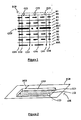
- la
figure 1 est un schéma en coupe d'un mode de réalisation du complexe d'isolation, et - la
figure 2 est un schéma en perspective d'un module de revêtement. - Les éléments présents dans les deux figures sont affectés d'une seule et même référence.
- Le module de revêtement MIE, ultérieurement désigné comme le module, comprend essentiellement des moyens d'isolation et des moyens d'étanchéité.
- Les moyens d'isolation, un matériau isolant mince dans le cas présent, font partie de l'état de l'art. Toutefois, il est préférable qu'ils soient dépourvus de points de compression, ce qui signifie qu'ils sont assemblés par couture ou par collage.
- En référence à la
figure 1 , selon un mode de réalisation préférentiel, ces moyens d'isolation consistent en un complexe d'isolation thermique et phonique CITP. Ce complexe est composé de 12 éléments disposés en empilement. - Premièrement, un film armé A1, extérieur, métallisé, réfléchit l'énergie et résiste à la déchirure. Il est constitué de polyester métallisé, armé d'une grille et enduit de polyéthylène.
- Deuxièmement, une nappe d'ouate N1, qui est isolante matérialise une lame d'air entre deux films métallisés. Elle est constituée de polyester d'une masse surfacique comprise entre 40 et 150 g/m2.
- Troisièmement, un premier film intermédiaire F1, réfléchit l'énergie thermique rayonnée. Il est constitué de polypropylène métallisé.
- Quatrièmement, une deuxième nappe d'ouate N2 suit le premier film intermédiaire F1.
- Cinquièmement, un deuxième film intermédiaire F2 suit la deuxième nappe d'ouate N2.
- Sixièmement, une nappe végétale de coton NVC, également disposée entre 2 films intermédiaires renforce l'atténuation acoustique du complexe de par sa densité. Elle est constituée de coton dense, aiguilleté, thermo-lié, nappé ou tricoté. Sa masse surfacique est comprise entre 50 g/m2 et 600 g/m2. Par sa densité, elle favorise l'affaiblissement des nuisances sonores.Son indice d'affaiblissement acoustique Rw est compris entre 20 et 38 dB dans le cas d'une association avec une couverture comprenant des éléments en terre cuite. D'autre part, son coefficient d'isolation thermique est inférieur à 0,05 W/m.°C.
- Le terme aiguilleté concerne des nappes de fibres non-tissées entremêlées par l'action d'aiguilles à barbes. Il désigne le procédé de fabrication de feutres et textiles non-tissés, consistant à faire passer des touffes de fibre dans une trame grossière, avec des aiguilles à crochet, et à provoquer ainsi leur enchevêtrement.
- Le terme thermolié désigne le procédé de fabrication de feutres et textiles non-tissés, consistant à mélanger une fibre thermofusible aux fibres d'origines synthétiques ou naturelles, avant de les passer au four afin de les lier entre elles.
- Suivent un troisième film intermédiaire F3, une troisième nappe d'ouate N3, un quatrième film intermédiaire F4, une quatrième nappe d'ouate N4 et un deuxième film armé F2.
- Finalement, une nappe végétale de lin NVL possède un pouvoir naturel d'hygrorégulation, et des propriétés d'isolation thermique, doté d'une certaine inertie en surface. Elle est constituée de lin aiguilleté, thermo-lié, nappé ou tricoté, et présentant une masse surfacique comprise entre 50 g/m2 et 600 g/m2. Cette nappe présente une capacité hygrorégulatrice lui permettant d'absorber une quantité de vapeur d'eau au moins égale à son poids à l'état sec sans voir sa conductivité thermique augmenter dans les mêmes proportions, contrairement aux fibres minérales.
- Il est possible de procéder à l'assemblage des douze couches du complexe CITP par couture ou par collage. Dans les deux cas on évite ainsi les problèmes générés par la présence de zones de compression engendrés lors d'une opération de soudure telle celle précédemment décrite. Par conséquent on évite la formation d'un pont thermique et/ou acoustique, voir hydrique, oeuvrant à l'encontre de l'invention.
- Pour assembler le complexe CITP, une couture par points est réalisée à raison d'au moins 6 coutures sur la longueur de la laize, dont deux coutures latérales CO1, CO6 rapprochées à 20mm du bord du complexe CITP, et au moins 4 coutures centrales CO2, CO3, CO4, CO5. Un espace de 1 à 20 mm sépare deux points de couture consécutifs.
- Il est également possible de coller le complexe CITP en disposant la colle de façon appropriée sur chaque interface film/nappe.
- La nappe végétale de lin NVL aux propriétés hygrorégulatrices naturelles est disposée sur une des deux faces apparentes du complexe CITP. Cette nappe fonctionne comme un échangeur de vapeur d'eau. Lors d'une période de forte humidité, la nappe emmagasine la vapeur d'eau dans et autour de ses fibres et, lors d'une période sèche, la nappe restitue la vapeur d'eau emmagasinée.
- La conductivité thermique des fibres végétales généralement notée λ varie selon plusieurs critères :
- conditions climatiques lors de la récolte,
- mode de conservation et de dessiccation,
- mode d'assemblage par thermoliage, nappage, aiguilletage, tricotage,
- pourcentage d'association à d'autres matériaux liants tels la colle, l'ouate de polyester, d'autres fibres végétales ou naturelles,
- densité du matelas de fibres,
- conditions climatiques présentes.
- Les coefficients suivants ont été observés, les plus faibles étant les plus intéressants :
- chanvre 0,039, lin 0,037, coton 0,040, mouton 0,035 à 0,045, coco 0,047 à 0,050, liège expansé 0,032 à 0,045, roseaux 0,056 W/m.°C.
- Il est en effet possible qu'une nappe soit constituée majoritairement de fibres végétales telles le lin, le chanvre, le coton, la noix de coco, l'agave, le sisal, le café, le bambou, la canne, le kapok, le roseau, le papyrus, le chêne liège, le jute, ceci non limitativement.
- Il est également possible qu'une nappe soit constituée majoritairement de fibres animales, telles les systèmes pileux des ovins, caprins, camélidés, rongeurs, non limitativement.
- Généralement, les nappes intègrent aussi un faible pourcentage de fibres non naturelles qui servent de liant.
- Il est également possible qu'au moins une nappe soit constituée d'un mélange intégrant des fibres animales et végétales, en partie ou en totalité.
- Les nappes susmentionnées en fibre végétale ou animale peuvent coexister avec des nappes en fibre synthétique, telle l'ouate de polyester constituant les nappes d'ouate N1, N2, N3, N4 du complexe CITP. Elles peuvent également coexister avec des nappes traditionnelles en laine de verre ou en laine de roche.
- Dans le cas général, il est préférable que les deux faces du complexe soient en contact avec une lame d'air. La lame d'air intérieure est non ventilée, contrairement à la lame d'air extérieure. Il convient de ne pas comprimer le produit lors de la pose.
- Toutefois, dans le cas d'une isolation sur volige ou plancher, il convient de placer le complexe directement sur le support sans ménager de lame d'air intérieure.
- La face intérieure, comportant la nappe de fibre végétale, par exemple du lin, doit être protégée des risques de dégradation dans les parties habitables du bâtiment, par une paroi telle qu'une plaque de plâtre ou de lambris conformément aux règles de l'art.
- Comme représenté également sur la
figure 2 , les moyens d'étanchéité consistent en un écran ECR qui est superposé au complexe CITP précédemment décrit. L'assemblage est réalisé par collage. - A cet effet, les laizes du complexe CIPT sont entraînées par un tapis roulant sur une table de positionnement pourvue d'une série d'au moins trois têtes d'encollage. Ces têtes surplombent légèrement les laizes et émettent un flux de colle en permanence sur le complexe CIPT en mouvement. Ce dernier se retrouve ainsi porteur de cordons de colle parallèles disposés en fonction de l'agencement des têtes d'encollage. L'écran ECR est ensuite plaqué en pression sur les cordons de colle COL1, COL2, COL3. Le collage se fait généralement par fibérisation d'un hotmelt avec une colle restant souple, par au moins 3 bandes de 50 à 100 mm de large, dans le sens de la longueur. L'emplacement des bandes de colle est décalé par rapport à celui des coutures de complexe CPIT.
- Le terme hotmelt désigne une colle thermofuslble, qui fond à la chaleur.
- Le terme fibérisation concerne une dépose de colle sans contact par projection sous formes spiralées, et provient du nom d'une marque déposée par le fabricant d'une machine à coller.
- Cette colle dite hotmelt a un fort pouvoir de collage-décollage dit « TACK », et reste souple dans le temps.
- La colle mise en oeuvre est dite à tack permanent : en effet, le collage présente une forte adhésion initiale, et conserve sa caractéristique puissante dans le temps.
- L'écran ECR est généralement réalisé sous forme d'un bicouche ou d'un tricouche en polypropylène. Sa masse surfacique est de 95 g/m2 et son coefficient de perméabilité à la vapeur d'eau inférieur à 6 000 g/m2/24h.
- De plus, l'écran ECR peut présenter les caractéristiques suivantes ;
- résistance à la pénétration de l'eau supérieure à 1 000 mm et inférieure à 3000 mm au sens de la norme ISO 811,
- coefficient de réflexion compris entre 50 et 75 %,
- résistance à la déchirure au clou supérieure à 50 Newtons au sens de la norme MOAT 27.5.4.1.
- De préférence, l'écran ECR déborde du complexe CITP sur au moins un coté, préférentiellement sur une longueur. L'écran n'est pas collé en bordure du coté opposé, qui s'avère être le coté en vis-à-vis de la laize adjacente. De ce fait il est possible, après la pose d'une première laize, de soulever latéralement son écran ECR. On peut alors disposer le débord DEB de l'écran d'une deuxième laize entre le complexe CIPT et l'écran ECR de la première laize. Ensuite, on peut procéder à un collage ou à un adhésivage de la partie débordante du deuxième écran ECR sur les surfaces en regard du complexe CIPT et de l'écran ECR de la première laize. Il s'ensuit que les complexes des deux laizes sont maintenus bord à bord.
- L'opération peut se répéter latéralement, ainsi que dans un sens montant ou descendant.
- L'exemple de réalisation de l'invention présenté ci-dessus a été choisi eu égard à son caractère concret. Il ne serait cependant pas possible de répertorier de manière exhaustive tous les modes de réalisation que recouvre cette invention. En particulier, tout moyen décrit peut être remplacé par un moyen équivalent sans sortir du cadre de la présente invention.
Claims (11)
- Module (MIE) de revêtement d'une paroi comprenant des moyens d'isolation (CITP) assemblés à des moyens d'étanchéité (ECR), caractérisé en ce que lesdits moyens d'isolation (CITP) consistent en un complexe d'isolation composé d'une alternance de nappes et de films, ce complexe étant dépourvu de points de compression.
- Module selon la revendication 1, caractérisé en ce que lesdits moyens d'étanchéité (ECR) consistent en un écran composé d'au moins une couche de matériau non tissé métallisé.
- Module selon la revendication 2, caractérisé en ce que ledit matériau non tissé est du polyéthylène.
- Module selon la revendication 2, caractérisé en ce que ledit matériau non tissé est du polyester.
- Module selon la revendication 2, caractérisé en ce que ledit matériau non tissé est du polypropylène et en ce que ledit écran (ECR) comporte au moins deux couches.
- Module selon l'une quelconque des revendications 2 à 5, caractérisé en ce que ledit écran (ECR) présente une résistance à la pénétration de l'eau supérieure à 1 000 mm et inférieure à 3000 mm.
- Module selon l'une quelconque des revendications 2 à 6, caractérisé en ce que ledit écran (ECR) possède au moins une des caractéristiques suivantes :- coefficient de perméabilité à la vapeur d'eau inférieur à 6 000 g/m2/24h,- résistance à la déchirure au clou supérieure à 50 Newtons,- réflexion de l'énergie comprise entre 50 et 75%.
- Module selon l'une quelconque des revendications précédentes, caractérisé en ce que lesdits moyens d'isolation (CITP) et d'étanchéité (ECR) sont assemblés par collage.
- Module selon la revendication 8, caractérisé en ce que ledit collage se présente sous forme de cordons de colle (CC1, CC2, CC3) parallèles.
- Module selon la revendication 9, caractérisé en ce que ledit écran (ECR) présente un débord (DEB) par rapport à au moins un bord desdits moyens d'isolation (CITP).
- Module selon la revendication 10, caractérisé en ce que lesdits cordons de colle (CC1, CC2, CC3) présentent un retrait par rapport à au moins un bord desdits moyens d'isolation (CITP), la longueur dudit retrait étant supérieure ou égale à celle dudit débord (DEB).
Applications Claiming Priority (2)
| Application Number | Priority Date | Filing Date | Title |
|---|---|---|---|
| FR0402836 | 2004-03-19 | ||
| FR0402836A FR2867795B1 (fr) | 2004-03-19 | 2004-03-19 | Module d'isolation et d'etancheite |
Publications (2)
| Publication Number | Publication Date |
|---|---|
| EP1577454A1 EP1577454A1 (fr) | 2005-09-21 |
| EP1577454B1 true EP1577454B1 (fr) | 2013-02-27 |
Family
ID=34834197
Family Applications (1)
| Application Number | Title | Priority Date | Filing Date |
|---|---|---|---|
| EP05005789A Expired - Lifetime EP1577454B1 (fr) | 2004-03-19 | 2005-03-17 | Module d'isolation et d'étanchéité |
Country Status (4)
| Country | Link |
|---|---|
| EP (1) | EP1577454B1 (fr) |
| ES (1) | ES2409331T3 (fr) |
| FR (1) | FR2867795B1 (fr) |
| PT (1) | PT1577454E (fr) |
Family Cites Families (2)
| Publication number | Priority date | Publication date | Assignee | Title |
|---|---|---|---|---|
| ATE538264T1 (de) * | 1998-09-23 | 2012-01-15 | Orion Financement | Komplexes material zur anwendung unter anderem als wärmedämmung |
| FR2792668B1 (fr) * | 1999-04-21 | 2002-01-18 | Paul Riedel | Isolant thermique et phonique global destine au batiment et capable de reduire tous les transferts d'energies et d'inconforts rencontres dans les habitations habitees, dans les locaux occupes, particulierement dans les combles |
-
2004
- 2004-03-19 FR FR0402836A patent/FR2867795B1/fr not_active Expired - Fee Related
-
2005
- 2005-03-17 ES ES05005789T patent/ES2409331T3/es not_active Expired - Lifetime
- 2005-03-17 EP EP05005789A patent/EP1577454B1/fr not_active Expired - Lifetime
- 2005-03-17 PT PT50057892T patent/PT1577454E/pt unknown
Also Published As
| Publication number | Publication date |
|---|---|
| PT1577454E (pt) | 2013-06-04 |
| FR2867795B1 (fr) | 2006-06-09 |
| ES2409331T3 (es) | 2013-06-26 |
| FR2867795A1 (fr) | 2005-09-23 |
| EP1577454A1 (fr) | 2005-09-21 |
Similar Documents
| Publication | Publication Date | Title |
|---|---|---|
| EP1565625B1 (fr) | Materiau d'isolation thermique souple comprenant au moins une nappe ajouree | |
| EP0315553B2 (fr) | Complexe textile multicouches à base de nappes fibreuses ayant des caractéristiques différentes | |
| WO2005100708A3 (fr) | Panneau insonorise de decoration interieure | |
| CA2712098C (fr) | Materiau et procede pour fournir une isolation et un drainage a un mur de fondation | |
| CA2379679A1 (fr) | Ensemble d'isolation d'un batiment en metal | |
| KR101431380B1 (ko) | 조인트 절연형 삼중 복합방수공법 | |
| FR2867795A1 (fr) | Module d'isolation et d'etancheite | |
| EP1095193B1 (fr) | Materiau complexe destine notamment a l'isolation thermique | |
| FR2792668A1 (fr) | Isolant thermique et phonique global destine au batiment et capable de reduire tous les transferts d'energies et d'inconforts rencontres dans les habitations habitees, dans les locaux occupes, particulierement dans les combles | |
| FR2867796A1 (fr) | Complexe d'isolation thermique et phonique | |
| FR2765304A1 (fr) | Complexe isolant reducteur des transferts d'energies pour l'amelioration des conforts methodes d'assemblages modes de poses et de fixations | |
| FR2988642A1 (fr) | Materiau composite isolant acoustiquement et thermiquement | |
| JP3063151B2 (ja) | 直貼り床用緩衝部材 | |
| JP6905698B2 (ja) | トンネルの防水断熱用複合シート及び防水シート、並びに複合シートの設置方法 | |
| FR2951477A1 (fr) | Ecran souple de sous-toiture et revetement de sous-toiture forme a partir de cet ecran | |
| JP2005134769A (ja) | 防音材料 | |
| EP2450494B1 (fr) | Isolant multicouche | |
| RU51702U1 (ru) | Скальный лист | |
| FR2521621A1 (fr) | Element de support de carrelage, destine a etre interpose entre ce carrelage et son support rigide et a adherer contre ceux-ci, et sol carrele comportant de tels elements | |
| FR2847651A1 (fr) | Materiau d'isolation thermique et procede de pose d'un tel materiau | |
| FR2792667A1 (fr) | Isolant thermique et phonique global destine au batiment et capable de reduire tous les transferts d'energies et d'inconforts rencontres dans les habitations habitees, dans les locaux occupes, particulierement dans les combles | |
| EP2826620A1 (fr) | Une sous couche multicouche pour l'imperméabilisation d'un toit d'un bâtiment dans lequel ledit toit comporte une couverture de toit métallique. | |
| FR2988640A1 (fr) | Materiau composite isolant acoustiquement et thermiquement | |
| KR101554900B1 (ko) | 발열체를 이용한 발열지붕 복합판넬 | |
| EP3426862B1 (fr) | Systeme étanche d'isolation acoustique sous carrelage |
Legal Events
| Date | Code | Title | Description |
|---|---|---|---|
| PUAI | Public reference made under article 153(3) epc to a published international application that has entered the european phase |
Free format text: ORIGINAL CODE: 0009012 |
|
| AK | Designated contracting states |
Kind code of ref document: A1 Designated state(s): AT BE BG CH CY CZ DE DK EE ES FI FR GB GR HU IE IS IT LI LT LU MC NL PL PT RO SE SI SK TR |
|
| AX | Request for extension of the european patent |
Extension state: AL BA HR LV MK YU |
|
| 17P | Request for examination filed |
Effective date: 20060315 |
|
| AKX | Designation fees paid |
Designated state(s): AT BE BG CH CY CZ DE DK EE ES FI FR GB GR HU IE IS IT LI LT LU MC NL PL PT RO SE SI SK TR |
|
| 17Q | First examination report despatched |
Effective date: 20061206 |
|
| GRAP | Despatch of communication of intention to grant a patent |
Free format text: ORIGINAL CODE: EPIDOSNIGR1 |
|
| GRAS | Grant fee paid |
Free format text: ORIGINAL CODE: EPIDOSNIGR3 |
|
| GRAA | (expected) grant |
Free format text: ORIGINAL CODE: 0009210 |
|
| AK | Designated contracting states |
Kind code of ref document: B1 Designated state(s): AT BE BG CH CY CZ DE DK EE ES FI FR GB GR HU IE IS IT LI LT LU MC NL PL PT RO SE SI SK TR |
|
| REG | Reference to a national code |
Ref country code: GB Ref legal event code: FG4D Free format text: NOT ENGLISH |
|
| REG | Reference to a national code |
Ref country code: CH Ref legal event code: EP |
|
| REG | Reference to a national code |
Ref country code: AT Ref legal event code: REF Ref document number: 598623 Country of ref document: AT Kind code of ref document: T Effective date: 20130315 |
|
| REG | Reference to a national code |
Ref country code: IE Ref legal event code: FG4D Free format text: LANGUAGE OF EP DOCUMENT: FRENCH |
|
| REG | Reference to a national code |
Ref country code: DE Ref legal event code: R096 Ref document number: 602005038265 Country of ref document: DE Effective date: 20130425 |
|
| REG | Reference to a national code |
Ref country code: PT Ref legal event code: SC4A Free format text: AVAILABILITY OF NATIONAL TRANSLATION Effective date: 20130524 |
|
| REG | Reference to a national code |
Ref country code: NL Ref legal event code: T3 |
|
| REG | Reference to a national code |
Ref country code: ES Ref legal event code: FG2A Ref document number: 2409331 Country of ref document: ES Kind code of ref document: T3 Effective date: 20130626 |
|
| REG | Reference to a national code |
Ref country code: LT Ref legal event code: MG4D |
|
| PG25 | Lapsed in a contracting state [announced via postgrant information from national office to epo] |
Ref country code: BG Free format text: LAPSE BECAUSE OF FAILURE TO SUBMIT A TRANSLATION OF THE DESCRIPTION OR TO PAY THE FEE WITHIN THE PRESCRIBED TIME-LIMIT Effective date: 20130527 Ref country code: IS Free format text: LAPSE BECAUSE OF FAILURE TO SUBMIT A TRANSLATION OF THE DESCRIPTION OR TO PAY THE FEE WITHIN THE PRESCRIBED TIME-LIMIT Effective date: 20130627 Ref country code: LT Free format text: LAPSE BECAUSE OF FAILURE TO SUBMIT A TRANSLATION OF THE DESCRIPTION OR TO PAY THE FEE WITHIN THE PRESCRIBED TIME-LIMIT Effective date: 20130227 Ref country code: SE Free format text: LAPSE BECAUSE OF FAILURE TO SUBMIT A TRANSLATION OF THE DESCRIPTION OR TO PAY THE FEE WITHIN THE PRESCRIBED TIME-LIMIT Effective date: 20130227 |
|
| PG25 | Lapsed in a contracting state [announced via postgrant information from national office to epo] |
Ref country code: PL Free format text: LAPSE BECAUSE OF FAILURE TO SUBMIT A TRANSLATION OF THE DESCRIPTION OR TO PAY THE FEE WITHIN THE PRESCRIBED TIME-LIMIT Effective date: 20130227 Ref country code: GR Free format text: LAPSE BECAUSE OF FAILURE TO SUBMIT A TRANSLATION OF THE DESCRIPTION OR TO PAY THE FEE WITHIN THE PRESCRIBED TIME-LIMIT Effective date: 20130528 Ref country code: FI Free format text: LAPSE BECAUSE OF FAILURE TO SUBMIT A TRANSLATION OF THE DESCRIPTION OR TO PAY THE FEE WITHIN THE PRESCRIBED TIME-LIMIT Effective date: 20130227 Ref country code: SI Free format text: LAPSE BECAUSE OF FAILURE TO SUBMIT A TRANSLATION OF THE DESCRIPTION OR TO PAY THE FEE WITHIN THE PRESCRIBED TIME-LIMIT Effective date: 20130227 |
|
| PG25 | Lapsed in a contracting state [announced via postgrant information from national office to epo] |
Ref country code: CZ Free format text: LAPSE BECAUSE OF FAILURE TO SUBMIT A TRANSLATION OF THE DESCRIPTION OR TO PAY THE FEE WITHIN THE PRESCRIBED TIME-LIMIT Effective date: 20130227 Ref country code: DK Free format text: LAPSE BECAUSE OF FAILURE TO SUBMIT A TRANSLATION OF THE DESCRIPTION OR TO PAY THE FEE WITHIN THE PRESCRIBED TIME-LIMIT Effective date: 20130227 Ref country code: SK Free format text: LAPSE BECAUSE OF FAILURE TO SUBMIT A TRANSLATION OF THE DESCRIPTION OR TO PAY THE FEE WITHIN THE PRESCRIBED TIME-LIMIT Effective date: 20130227 Ref country code: RO Free format text: LAPSE BECAUSE OF FAILURE TO SUBMIT A TRANSLATION OF THE DESCRIPTION OR TO PAY THE FEE WITHIN THE PRESCRIBED TIME-LIMIT Effective date: 20130227 Ref country code: EE Free format text: LAPSE BECAUSE OF FAILURE TO SUBMIT A TRANSLATION OF THE DESCRIPTION OR TO PAY THE FEE WITHIN THE PRESCRIBED TIME-LIMIT Effective date: 20130227 |
|
| PG25 | Lapsed in a contracting state [announced via postgrant information from national office to epo] |
Ref country code: CY Free format text: LAPSE BECAUSE OF FAILURE TO SUBMIT A TRANSLATION OF THE DESCRIPTION OR TO PAY THE FEE WITHIN THE PRESCRIBED TIME-LIMIT Effective date: 20130227 |
|
| PLBE | No opposition filed within time limit |
Free format text: ORIGINAL CODE: 0009261 |
|
| STAA | Information on the status of an ep patent application or granted ep patent |
Free format text: STATUS: NO OPPOSITION FILED WITHIN TIME LIMIT |
|
| 26N | No opposition filed |
Effective date: 20131128 |
|
| REG | Reference to a national code |
Ref country code: DE Ref legal event code: R097 Ref document number: 602005038265 Country of ref document: DE Effective date: 20131128 |
|
| PGFP | Annual fee paid to national office [announced via postgrant information from national office to epo] |
Ref country code: CH Payment date: 20140327 Year of fee payment: 10 Ref country code: NL Payment date: 20140326 Year of fee payment: 10 Ref country code: MC Payment date: 20140304 Year of fee payment: 10 Ref country code: IE Payment date: 20140327 Year of fee payment: 10 |
|
| PGFP | Annual fee paid to national office [announced via postgrant information from national office to epo] |
Ref country code: AT Payment date: 20140305 Year of fee payment: 10 |
|
| PGFP | Annual fee paid to national office [announced via postgrant information from national office to epo] |
Ref country code: GB Payment date: 20140327 Year of fee payment: 10 |
|
| PGFP | Annual fee paid to national office [announced via postgrant information from national office to epo] |
Ref country code: DE Payment date: 20140327 Year of fee payment: 10 |
|
| PG25 | Lapsed in a contracting state [announced via postgrant information from national office to epo] |
Ref country code: TR Free format text: LAPSE BECAUSE OF FAILURE TO SUBMIT A TRANSLATION OF THE DESCRIPTION OR TO PAY THE FEE WITHIN THE PRESCRIBED TIME-LIMIT Effective date: 20130227 |
|
| PG25 | Lapsed in a contracting state [announced via postgrant information from national office to epo] |
Ref country code: HU Free format text: LAPSE BECAUSE OF FAILURE TO SUBMIT A TRANSLATION OF THE DESCRIPTION OR TO PAY THE FEE WITHIN THE PRESCRIBED TIME-LIMIT; INVALID AB INITIO Effective date: 20050317 |
|
| REG | Reference to a national code |
Ref country code: DE Ref legal event code: R119 Ref document number: 602005038265 Country of ref document: DE |
|
| PG25 | Lapsed in a contracting state [announced via postgrant information from national office to epo] |
Ref country code: MC Free format text: LAPSE BECAUSE OF NON-PAYMENT OF DUE FEES Effective date: 20150331 |
|
| REG | Reference to a national code |
Ref country code: CH Ref legal event code: PL |
|
| REG | Reference to a national code |
Ref country code: AT Ref legal event code: MM01 Ref document number: 598623 Country of ref document: AT Kind code of ref document: T Effective date: 20150317 |
|
| GBPC | Gb: european patent ceased through non-payment of renewal fee |
Effective date: 20150317 |
|
| REG | Reference to a national code |
Ref country code: NL Ref legal event code: MM Effective date: 20150401 |
|
| REG | Reference to a national code |
Ref country code: IE Ref legal event code: MM4A |
|
| PG25 | Lapsed in a contracting state [announced via postgrant information from national office to epo] |
Ref country code: IE Free format text: LAPSE BECAUSE OF NON-PAYMENT OF DUE FEES Effective date: 20150317 Ref country code: GB Free format text: LAPSE BECAUSE OF NON-PAYMENT OF DUE FEES Effective date: 20150317 Ref country code: LI Free format text: LAPSE BECAUSE OF NON-PAYMENT OF DUE FEES Effective date: 20150331 Ref country code: CH Free format text: LAPSE BECAUSE OF NON-PAYMENT OF DUE FEES Effective date: 20150331 Ref country code: DE Free format text: LAPSE BECAUSE OF NON-PAYMENT OF DUE FEES Effective date: 20151001 |
|
| PG25 | Lapsed in a contracting state [announced via postgrant information from national office to epo] |
Ref country code: AT Free format text: LAPSE BECAUSE OF NON-PAYMENT OF DUE FEES Effective date: 20150317 |
|
| REG | Reference to a national code |
Ref country code: FR Ref legal event code: PLFP Year of fee payment: 12 |
|
| PGFP | Annual fee paid to national office [announced via postgrant information from national office to epo] |
Ref country code: LU Payment date: 20160331 Year of fee payment: 12 Ref country code: ES Payment date: 20160328 Year of fee payment: 12 |
|
| PGFP | Annual fee paid to national office [announced via postgrant information from national office to epo] |
Ref country code: BE Payment date: 20160328 Year of fee payment: 12 Ref country code: PT Payment date: 20160304 Year of fee payment: 12 |
|
| PGFP | Annual fee paid to national office [announced via postgrant information from national office to epo] |
Ref country code: IT Payment date: 20160323 Year of fee payment: 12 |
|
| REG | Reference to a national code |
Ref country code: FR Ref legal event code: PLFP Year of fee payment: 13 |
|
| PG25 | Lapsed in a contracting state [announced via postgrant information from national office to epo] |
Ref country code: NL Free format text: LAPSE BECAUSE OF NON-PAYMENT OF DUE FEES Effective date: 20150401 |
|
| PG25 | Lapsed in a contracting state [announced via postgrant information from national office to epo] |
Ref country code: PT Free format text: LAPSE BECAUSE OF NON-PAYMENT OF DUE FEES Effective date: 20170918 |
|
| PG25 | Lapsed in a contracting state [announced via postgrant information from national office to epo] |
Ref country code: LU Free format text: LAPSE BECAUSE OF NON-PAYMENT OF DUE FEES Effective date: 20170317 |
|
| PG25 | Lapsed in a contracting state [announced via postgrant information from national office to epo] |
Ref country code: IT Free format text: LAPSE BECAUSE OF NON-PAYMENT OF DUE FEES Effective date: 20170317 |
|
| REG | Reference to a national code |
Ref country code: BE Ref legal event code: MM Effective date: 20170331 |
|
| REG | Reference to a national code |
Ref country code: FR Ref legal event code: PLFP Year of fee payment: 14 |
|
| PG25 | Lapsed in a contracting state [announced via postgrant information from national office to epo] |
Ref country code: BE Free format text: LAPSE BECAUSE OF NON-PAYMENT OF DUE FEES Effective date: 20170331 |
|
| REG | Reference to a national code |
Ref country code: ES Ref legal event code: FD2A Effective date: 20180629 |
|
| PG25 | Lapsed in a contracting state [announced via postgrant information from national office to epo] |
Ref country code: ES Free format text: LAPSE BECAUSE OF NON-PAYMENT OF DUE FEES Effective date: 20170318 |
|
| PGFP | Annual fee paid to national office [announced via postgrant information from national office to epo] |
Ref country code: FR Payment date: 20240321 Year of fee payment: 20 |