EP1579698B1 - Verfahren und vorrichtung zur erweiterung eines audiosignals - Google Patents
Verfahren und vorrichtung zur erweiterung eines audiosignals Download PDFInfo
- Publication number
- EP1579698B1 EP1579698B1 EP03778627A EP03778627A EP1579698B1 EP 1579698 B1 EP1579698 B1 EP 1579698B1 EP 03778627 A EP03778627 A EP 03778627A EP 03778627 A EP03778627 A EP 03778627A EP 1579698 B1 EP1579698 B1 EP 1579698B1
- Authority
- EP
- European Patent Office
- Prior art keywords
- dramatic
- story
- audio signal
- media fragments
- parameters
- Prior art date
- Legal status (The legal status is an assumption and is not a legal conclusion. Google has not performed a legal analysis and makes no representation as to the accuracy of the status listed.)
- Expired - Lifetime
Links
- 230000005236 sound signal Effects 0.000 title claims abstract description 46
- 238000000034 method Methods 0.000 title claims abstract description 30
- 230000003190 augmentative effect Effects 0.000 title claims description 11
- 239000012634 fragment Substances 0.000 claims abstract description 63
- 230000036651 mood Effects 0.000 claims description 7
- 238000012545 processing Methods 0.000 claims description 3
- 238000009877 rendering Methods 0.000 claims description 2
- 238000004590 computer program Methods 0.000 description 5
- 238000010586 diagram Methods 0.000 description 5
- 230000007704 transition Effects 0.000 description 5
- 239000000284 extract Substances 0.000 description 4
- 230000000007 visual effect Effects 0.000 description 4
- 230000008859 change Effects 0.000 description 3
- GDOPTJXRTPNYNR-UHFFFAOYSA-N methyl-cyclopentane Natural products CC1CCCC1 GDOPTJXRTPNYNR-UHFFFAOYSA-N 0.000 description 3
- 239000007795 chemical reaction product Substances 0.000 description 2
- 238000012986 modification Methods 0.000 description 2
- 230000004048 modification Effects 0.000 description 2
- 239000011435 rock Substances 0.000 description 2
- 208000023514 Barrett esophagus Diseases 0.000 description 1
- 102100031102 C-C motif chemokine 4 Human genes 0.000 description 1
- 101100054773 Caenorhabditis elegans act-2 gene Proteins 0.000 description 1
- 101100000858 Caenorhabditis elegans act-3 gene Proteins 0.000 description 1
- 102100024058 Flap endonuclease GEN homolog 1 Human genes 0.000 description 1
- 101000833646 Homo sapiens Flap endonuclease GEN homolog 1 Proteins 0.000 description 1
- HEFNNWSXXWATRW-UHFFFAOYSA-N Ibuprofen Chemical compound CC(C)CC1=CC=C(C(C)C(O)=O)C=C1 HEFNNWSXXWATRW-UHFFFAOYSA-N 0.000 description 1
- 238000004378 air conditioning Methods 0.000 description 1
- 230000003416 augmentation Effects 0.000 description 1
- 239000003086 colorant Substances 0.000 description 1
- 238000013461 design Methods 0.000 description 1
- 238000001514 detection method Methods 0.000 description 1
- 238000011161 development Methods 0.000 description 1
- 230000000694 effects Effects 0.000 description 1
- 238000000605 extraction Methods 0.000 description 1
- 238000005562 fading Methods 0.000 description 1
- JEIPFZHSYJVQDO-UHFFFAOYSA-N ferric oxide Chemical compound O=[Fe]O[Fe]=O JEIPFZHSYJVQDO-UHFFFAOYSA-N 0.000 description 1
- 230000006870 function Effects 0.000 description 1
- 238000010438 heat treatment Methods 0.000 description 1
- 238000007654 immersion Methods 0.000 description 1
- 230000008676 import Effects 0.000 description 1
- 238000004519 manufacturing process Methods 0.000 description 1
- 230000007246 mechanism Effects 0.000 description 1
- 230000008569 process Effects 0.000 description 1
- 230000003595 spectral effect Effects 0.000 description 1
Images



Classifications
-
- H—ELECTRICITY
- H04—ELECTRIC COMMUNICATION TECHNIQUE
- H04N—PICTORIAL COMMUNICATION, e.g. TELEVISION
- H04N5/00—Details of television systems
- H04N5/44—Receiver circuitry for the reception of television signals according to analogue transmission standards
- H04N5/60—Receiver circuitry for the reception of television signals according to analogue transmission standards for the sound signals
-
- G—PHYSICS
- G10—MUSICAL INSTRUMENTS; ACOUSTICS
- G10L—SPEECH ANALYSIS TECHNIQUES OR SPEECH SYNTHESIS; SPEECH RECOGNITION; SPEECH OR VOICE PROCESSING TECHNIQUES; SPEECH OR AUDIO CODING OR DECODING
- G10L25/00—Speech or voice analysis techniques not restricted to a single one of groups G10L15/00 - G10L21/00
- G10L25/48—Speech or voice analysis techniques not restricted to a single one of groups G10L15/00 - G10L21/00 specially adapted for particular use
-
- G—PHYSICS
- G10—MUSICAL INSTRUMENTS; ACOUSTICS
- G10H—ELECTROPHONIC MUSICAL INSTRUMENTS; INSTRUMENTS IN WHICH THE TONES ARE GENERATED BY ELECTROMECHANICAL MEANS OR ELECTRONIC GENERATORS, OR IN WHICH THE TONES ARE SYNTHESISED FROM A DATA STORE
- G10H1/00—Details of electrophonic musical instruments
- G10H1/36—Accompaniment arrangements
-
- G—PHYSICS
- G11—INFORMATION STORAGE
- G11B—INFORMATION STORAGE BASED ON RELATIVE MOVEMENT BETWEEN RECORD CARRIER AND TRANSDUCER
- G11B27/00—Editing; Indexing; Addressing; Timing or synchronising; Monitoring; Measuring tape travel
- G11B27/02—Editing, e.g. varying the order of information signals recorded on, or reproduced from, record carriers
- G11B27/031—Electronic editing of digitised analogue information signals, e.g. audio or video signals
- G11B27/034—Electronic editing of digitised analogue information signals, e.g. audio or video signals on discs
-
- G—PHYSICS
- G11—INFORMATION STORAGE
- G11B—INFORMATION STORAGE BASED ON RELATIVE MOVEMENT BETWEEN RECORD CARRIER AND TRANSDUCER
- G11B27/00—Editing; Indexing; Addressing; Timing or synchronising; Monitoring; Measuring tape travel
- G11B27/10—Indexing; Addressing; Timing or synchronising; Measuring tape travel
- G11B27/19—Indexing; Addressing; Timing or synchronising; Measuring tape travel by using information detectable on the record carrier
- G11B27/28—Indexing; Addressing; Timing or synchronising; Measuring tape travel by using information detectable on the record carrier by using information signals recorded by the same method as the main recording
Definitions
- the present invention relates to a method and system for augmenting an audio signal in accordance with extracted features of said audio signal.
- the present invention has particular, but not exclusive, application with systems that determine and extract musical features of an audio signal such as tempo and key.
- European Patent Application EP0403118 describes audio/visual compilation in a data processing system such as a home personal computer (PC).
- the system comprises library, audio, and story authoring and editing modules which enable a user to compile an audio/visual presentation and output it.
- International Patent Application WO01/18655 discloses a method and system for music video generation on a computer which comprises an editing interface including a selection of foreground, background, import facility and special effects buttons, a timeline for creating a script of instructions for the assembly of graphic images, in synchrony with music, to thereby produce a music video project.
- the document US 5,005,459 discloses a method for musical tone visualizing involving analysing the spectral content of an audio signal and selecting an appropriate video signal source to be rendered with the musical performance.
- a possible application is the display of the picture of one or more instruments currently being played.
- extracted music features from an audio signal such as key and tempo a re associated with dramatic parameters representing a n overview of a media fragment which may contain an audio/video data file.
- a fast tempo may fit well with a media fragment having a chase scene that is high speed and furious.
- the dramatic parameters advantageously represent features of a story such as mood, pace, incidents and so on.
- the dramatic parameters are also mapped onto extracted features of the audio signal such as key and tempo.
- the media fragments are stored in a database from which they are obtained.
- the fragments may be generated at runtime in accordance with a story template which comprises a general description or narrative structure for a story, and appropriate dramatic parameters.
- a romance story template may have certain requirements such as musical keys associated with happiness (major keys) or sadness (minor keys).
- a narrative arc describing the progression of a romance story is represented in the story template.
- One example arc for a romance story may comprise the following, a chance meeting, development of a relationship, a tragedy and a happy or romanceful ending.
- a consumer may select four music tracks which are analysed to determine for example genre (or the consumer may input a preferred genre) and musical features are extracted from the tracks.
- the features are employed to determine a closely matching story template that is then employed to obtain appropriate matching media fragments. For example, media fragments having dramatic parameters indicating major keys (happy), or minor keys (sad) and which also contain romantic content may then be obtained to make up the story.
- the media fragments are then rendered to the consumer along with their music selection. Hence, a consumer undergoes a story experience in tandem with, and informed by the selected music.
- combinations of musical keys may also be employed to determine dramatic moments such as a build up and subsequent release of tension.
- the system comprises a personal computer connected to a database storing media fragments and story templates.
- the computer is provided with program code, which extracts musical features from audio signals representing a musical selection, and also with program code representing a story building module, which selects templates and obtains appropriate media fragments in dependence on determined dramatic parameters related to the extracted musical features.
- the dramatic parameters are represented in a configurable meta-language such as eXtended Mark-up Language (XML).
- XML eXtended Mark-up Language
- the computer program matches story templates and media fragments having associated dramatic parameter tags and renders the story to the consumer.
- the computer is part of a home network having output devices whereby lighting may be changed at identified dramatic moments, and further aspects of the experiential environment surrounding the consumer may be controlled to provide a compelling story telling experience in conjunction with musical selection.
- Physical Mark-up Language PML may be used to accomplish the aforementioned.
- FIG. 1 shows a schematic representation of a system 100 for augmenting an audio signal.
- the system 100 consists of a central processing unit (CPU) 102 connected to memory (ROM) 104 and memory (RAM) 106 via a general data-bus 108.
- Computer code or software 110 on a carrier 112 may be loaded into RAM 106 (or alternatively provided in ROM 104), the code causing the CPU 102 to perform instructions embodying a method or methods according to the invention.
- the CPU 102 is connected to a store 114 and to output devices 116, 118.
- a user interface (UI) 120 is provided.
- the system 1 00 may be embodied as a conventional home personal computer (PC) with the output device 116 taking the form of a computer monitor or display.
- the store 114 may be a remote database available over a network connection (LAN or WAN).
- LAN local area network
- the output devices 116, 118 may be distributed around the home and comprise for example a wall mounted flat panel display, computer controlled home lighting units, audio speakers placed around the home and so on.
- the connections between the CPU 102 and other devices 116, 118 may be wireless (for example communications via radio standards IEEE802.11, ZigBee IEE802.15.4 or Bluetooth) or wired (for example communications via wired standards Ethernet, USB), or a combination of both.
- the system 100 requires input of audio signals from which features are extracted.
- the extraction of musical features from audio signals is described in the paper "Querying large collections of music for similarity" (Matt Welsh et al, UC Berkeley Technical Report UCB/CSD-00-1096, November 1999) the contents of which are hereby incorporated.
- the paper describes how features such as an average tempo, volume, noise, and tonal transitions can be determined from analysing a n input audio signal.
- a method for determining the musical key of an audio signal is described in the United States patent US5,038,658 to Tsuruta et al , hereby incorporated and to which the reader is directed.
- audio signals are input to the CPU 102 by input device 122.
- the CPU 102 receives the audio signals and extracts musical features such as volume, tempo, and key as described in the aforementioned references.
- the audio signal is provided via an internal input device 122 of the PC such as a CD/DVD or hard disc drive.
- the audio signals may be input via a connection to a networked home entertainment system (Hi-Fi, home cinema etc).
- Figure 2 shows an example table 200 for use by computer program 110.
- the table illustrates a non-exhaustive relationship of extracted musical features 2 04 (MF) with predetermined and defined dramatic parameters 206 (DP).
- MF extracted musical features 2 04
- DP predetermined and defined dramatic parameters 206
- MAJ key Major Key
- MIN key Minor key
- Such knowledge may be used to indicate a dramatic change in a story (for example, a happy marriage scene to a sad tragic scene, with the music adding to the story experience).
- a musical feature corresponding to such a combination of non-adjacent key changes is represented by (NAK) with the dramatic parameter CLASH.
- the table also illustrates that a dramatic parameter of FAST or SLOW may be associated with an extracted TEMPO (beats per minute - b pm) result.
- F or example, a bpm of greater than 120 may be assigned a FAST dramatic parameter, whereas a song or track with a slower tempo may be assigned a SLOW dramatic parameter.
- dramatic parameters are for illustrative purposes only, with many possible dramatic parameters in the form of mark up language tags (realised in XML for example) or other attributes.
- other musical features such as type of instrument (a cello may be assigned a SAD/SLOW attribute), and a high-level genre descriptive tag may be defined.
- Many audio CD or MP3 archives have genre descriptors associated with a track or CD, e.g. rock, romantic, trance etc and these could be retrieved and assigned dramatic parameters.
- www.gracenote.com is an example music database and service provider wherein the music is categorised as rock, electronic/dance, jazz and so on.
- Electronic/dance music selected from such a service may be associated with a dramatic parameter ⁇ FUTURE> or ⁇ CYBER> which generally indicates the genre of a story which may be suitable.
- a consumer wishing to be entertained, selects three music tracks for playing, track 1 (TR1), track 2 (TR2) and track 3 (TR3) on their PC.
- the audio signals of the tracks are input by input device 122 to CPU 102, which determines and extracts musical features from the audio signals.
- the CPU 102 acting under instructions from computer program 110, correlates the determined musical features (MF) 204 with associated dramatic parameters (DP) 206 using table 200 ( Figure 2 ) and subsequently builds a table 300 as shown in Figure 3 .
- the table 300 indicates that the CPU 102 has determined that track 1 begins with a FAST tempo and has an associated dramatic parameter HAPPY (i.e. a major key). Following that TR2 clashes (NAK feature determined) and is in a minor key (with a corresponding dramatic parameter SAD). Track 3, similar to track 1 has been determined as being generally FAST (high tempo), and in a major key (HAPPY).
- HAPPY dramatic parameter
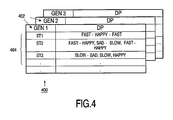
- Figure 4 shows illustrative examples of a collection of story templates constructed for use with system 100.
- the collection may be arranged as shown in the diagram according to genre (GEN 1, GEN 2, GEN 3).
- the genre may have been indicated by the consumer (via UI 120) or determined by for example reading descriptor tags of the selected music as known in the art.
- GEN1 may for example represent simple children stories, or horror, or romance or any other story classification genre deemed as suitable.
- the templates 404 may also store other information such as how many principle characters or protagonists are suitable (perhaps only 3 are needed for a short romance story involving a love triangle).
- the story templates 404 each have associated dramatic parameters related to a narrative structure. For example, many stories (particularly Hollywood films) follow a three-act structure in which Act I sets up the characters and story, Act II develops the story and in Act III the story is resolved. Often, at the end of Act I there is an inciting incident which allows the revelation of a character to develop. Hence, Applicants have realised that musical transitions, or track changes may be used (via a NAK detection, for example) to delineate phases of the story or screenplay.
- Figure 4 story template 1 (ST1) has a simple narrative structure in which dramatic parameters indicate a story arc in which for example the first act is fast, moves onto happy act II and finishes with a fast scene or scenes for act III.
- An example story which may fit such a template would be a simple children's story in which animal friends race, have a party to celebrate the winner, and subsequently race home.
- story templates may store information related to the length of time of each act (and hence of the overall story), with short stories having say acts roughly equal to one or two music tracks (6-8 minutes or soon average) whilst longer stories may have longer acts with more dramatic parameters DP to indicate scene changes within an act.
- Those experienced in the art of story writing and scripting may define other parameters and character rules appertaining to story templates.
- CPU 102 compares the DP of the story templates with those determined from the music selection ( Figure 3 ) and selects a closely matching template. For example, comparison of the DP determined in Figure 3 with ST2 of Figure 4 reveals a match and so ST2 is selected. Having selected a story template 404 the CPU 102 must then populate the template ST2 with actual story content.
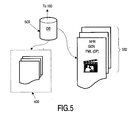
- Figure 5 shows an example store 114 in the form of a database 500 that stores a multiplicity of media fragments 502.
- a media fragment is a data entity comprising for example an encoded segment of film (sometimes referred to as a shot and wherein several shots make up a scene). Hence the media fragment has a certain associated time duration when played.
- the fragments 502 are characterised by tagged attributes relating to dramatic parameters.
- the media fragment may be stored as, by way of example an XML record comprising a description of the audio/visual content of the scene (for example genre-Action, act 1, opening car chase, 4 minutes) and dramatic parameters associated with the content of the scene.
- a description of the audio/visual content of the scene for example genre-Action, act 1, opening car chase, 4 minutes
- dramatic parameters associated with the content of the scene.
- an overall story may be developed with several different endings and openings (for example, a story may start with a car, or bicycle chase scene) each suitable for different dramatic parameters (TEMPO). This enables some foreshadowing of the story to be maintained whilst still enabling different fragments to be shown in dependence on determined dramatic parameters of the music. Similar scenes having different durations may also be created.
- the computer program instructs CPU 102 to search the database for media fragments 502, which roughly match in terms of duration, act and dramatic parameters the selected story template.
- the fragments are obtained, ordered and cached in memory 106 (or hard disk drive), and subsequently output with the music.
- the database 5 00 may also optionally store, for convenience, the story templates 400 as illustrated in Figure 5 .
- Story fragments having a children's genre tag are searched to match the determined timeline (TL) and dramatic parameters (DP).
- TL time
- DP dramatic parameters
- track 1 TR1
- FASTHAPPY DP combination
- a media fragment related to the first selected fragment
- act II having a slower pace
- a sad theme is searched for and which will last roughly the duration of track 2.
- media fragments tagged as having a fast/happy ending and related to the first fragment are selected for rendering with track 3.
- the story is output on, in this PC embodiment, the display monitor 116.
- FIG. 6 illustrates a flowchart showing the steps described above.
- an audio signal representing the music selection is input (IAS) and musical features extracted (EMF) in step 604.
- a dramatic parameter list characterising the music is generated (GEN DP) in step 606 following which in step 608 a s tory template is selected (ST) and u sed in conjunction with the dramatic parameters to obtain appropriate media fragments (OMF).
- ST s tory template
- OMF media fragments
- step 610 the story is output (O/P) together with the music selection.
- pre-canned content was retrieved for a user in dependence on a story template having a timeline which roughly matched the duration of the music selection.
- the media fragments may be computer generated at runtime by processor 102.
- a media fragment may contain computer generated content in the form of a simple cartoon for a child.
- the matching of the fragments with the timeline of the music selection is then relatively simple since processor 102 generates the actual media fragment and its content.
- the need for story templates may be obviated in such a case, with simple rules (ACT 1, ACT 2, ACT 3, DP- HAPPY, FAST, HAPPY) aiding the generation of the media fragments making up the story.
- the module represented by dashed outline 124 in Figure 1 is implemented as a home network plug-in module 124 with network links to various output devices 116, 118 which are compliant with a mark-up language and instruction set designed to deliver real world experiences.
- a mark-up language and instruction set designed to deliver real world experiences An example of such a physical mark-up language (PML) is described in Applicants copending application WO 02/092183 .
- PML comprises a means to author, communicate and render experiences to an end user so that the end user experiences a certain level of immersion within a real physical space.
- PML enabled consumer devices such as a HI-FI and lighting system can receive instructions from a host network device (the instructions may be embedded within a DVD video stream for example) that causes the lights or sound output from the devices to be modified.
- a host network device the instructions may be embedded within a DVD video stream for example
- the lights or sound output from the devices to be modified.
- a dark scene in a movie causes the lights in the consumer's home to darken appropriately.
- PML is in general a high level descriptive mark-up language which may be realised in XML with descriptors which relate to real world events ( ⁇ dim light>). Hence, PML enables devices around the home to augment an experience for a consumer in a standardised fashion.
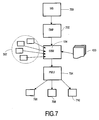
- FIG. 7 illustrates an example PML flowchart embodying aspects of the present invention.
- Audio signals are input (IAS) 700 and analysed for music features (EMF) 702.
- the features are provided to the story building module 124 which generates a dramatic parameter table and timeline as previously described.
- the module 124 selects a story template 400 in dependence on the generated table and obtains suitable media fragments 502.
- the fragments (which may be pre-canned or runtime generated) include PML descriptors as well as dramatic parameters.
- the fragments are then assembled by the module 124, and provided to a PML interpreter (PMLI) 704.
- PMLI PML interpreter
- PML commands associated with the fragments are interpreted and subsequently directed to PML enabled devices 706, 708, 710 on the home network.
- devices 706, 708 may represent a PML lighting system and a PML projector.
- the devices respond to PML commands so as to for example, project changing lighting levels and colours on a wall at certain moments in the narrative and audio experience associated with the selected music and obtained media fragments.
- Other devices 710 such as desktop fans, or air conditioning and heating systems may be controlled in dependence on the dramatic features in order to further augment the input audio signals and output story experience.
- the system may be in the form of a dedicated module 124, or a general purpose computer, operating alone or in tandem with other devices on a consumer network. Extracted musical features such as key, key changes, tempo and so on are input to the computer which then relates the features to dramatic parameters. Appropriate media fragments are then obtained and subsequently output and rendered to a user. Other output devices may be used to further enhance and augment the story.
Landscapes
- Engineering & Computer Science (AREA)
- Multimedia (AREA)
- Physics & Mathematics (AREA)
- Signal Processing (AREA)
- Acoustics & Sound (AREA)
- Audiology, Speech & Language Pathology (AREA)
- Human Computer Interaction (AREA)
- Health & Medical Sciences (AREA)
- Computational Linguistics (AREA)
- Electrophonic Musical Instruments (AREA)
- Information Retrieval, Db Structures And Fs Structures Therefor (AREA)
- Two-Way Televisions, Distribution Of Moving Picture Or The Like (AREA)
- Input Circuits Of Receivers And Coupling Of Receivers And Audio Equipment (AREA)
- Signal Processing Not Specific To The Method Of Recording And Reproducing (AREA)
- Signal Processing For Digital Recording And Reproducing (AREA)
- Auxiliary Devices For Music (AREA)
- Electrically Operated Instructional Devices (AREA)
- Stereo-Broadcasting Methods (AREA)
Claims (20)
- Verfahren zur Erweiterung eines Audiosignals, wobei dieses Verfahren Folgendes umfasst:- das Empfangen eines Audiosignals,- das Extrahieren von Merkmalen aus dem genannten Audiosignal,- das Erzeugen einer nach Zeit geordneten Tabelle dramatischer Parameter entsprechend den extrahierten Merkmalen,- das Erhalten von Mediafragmenten, die Videodaten enthalten, wenigstens teilweise, und zwar in Abhängigkeit von der Tabelle dramatischer Parameter, und- das Ausliefern der genannten Mediafragmente zusammen mit dem genannten Audiosignal.
- Verfahren nach Anspruch 1, wobei die genannten aus dem genannten Audiosignal extrahierten Merkmale Tempo, Tonart, und/oder Lautstärke enthalten.
- Verfahren nach Anspruch 1 oder 2, wobei die Erzeugung der genannten Tabelle dramatischer Parameter das Erfassen einer Liste dramatischer Parameter und assoziierter Audiomerkmale, das Vergleichen und aneinander Anpassen der extrahierten Merkmale mit den erfassten assoziierten Audiomerkmale und das Einfügen einer Eingabe mit dem mit dem Audiomerkmal assoziierten dramatischen Parameter umfasst.
- Verfahren nach Anspruch 1, 2 oder 3, wobei die genannten dramatischen Parameter Stimmung, Tempoänderungen, Geschehnisse enthalten.
- Verfahren nach einem der vorstehenden Ansprüche, wobei das genannte Erhalten der genannten Mediafragmente das Selektieren eines Fragments aus einem Speicher umfasst, wobei das genannte Fragment mit einem assoziierten dramatischen Parameter gespeichert wird, der mit der betreffenden Eingabe in die Tabelle dramatischer Parameter übereinstimmt.
- Verfahren nach einem der vorstehenden Ansprüche, wobei das genannte Erhalten der genannten Mediafragmente das Erzeugen eines Fragments umfasst.
- Verfahren nach Anspruch 5 oder 6, und das weiterhin das Empfangen von Benutzereingaben umfasst, wobei die Benutzereingabe das genannte Empfangen beeinflusst.
- Verfahren nach einem der vorstehenden Ansprüche, wobei das genannte Ausliefern das Speichern der genannten Mediafragmente und des genannten Audiosignals umfasst.
- Verfahren nach einem der vorstehenden Ansprüche, wobei das genannte Ausliefern das Rendern der genannten Mediafragmente und des genannten Audiosignals umfasst.
- Verfahren nach einem der vorstehenden Ansprüche, und das weiterhin Folgendes umfasst: vor dem Erhalten der genannten Mediafragmente das Selektieren einer Geschichtsschablone wenigstens teilweise in Abhängigkeit von der genannten Tabelle dramatischer Parameter, wobei die genannte Geschichtsschablone das genannte Erhalten von Mediafragmente beeinflusst.
- Verfahren nach Anspruch 10, wobei die genannte Geschichtsschablone dramatische Parameterdaten enthält, die sich auf eine Erzählstruktur bezieht.
- Verfahren nach Anspruch 11, wobei die Selektion von Mediafragmenten das Zusammenpassen der dramatischen Parameter der selektierten Geschichtsschablone mit denen der Mediafragmente umfasst.
- Verfahren nach Anspruch 10, 11 oder 12, wobei die Geschichtsschablone entsprechend den logischen Geschichtsstrukturregeln und der dramatischen Parameterliste erzeugt wird.
- Verfahren nach einem der vorstehenden Ansprüche, wobei die dramatischen Parameter durch physikalische Markierungssprachmerker dargestellt werden.
- Verfahren nach einem der vorstehenden Ansprüche, wobei Kombinationen extrahierter Merkmale assoziierte dramatische Parameter haben.
- System zur Erweiterung eines Audiosignals, wobei das System Folgendes umfasst: eine Eingangsanordnung zum Empfangen eines Audiosignals und Verarbeitungsmittel zum Extrahieren von Merkmalen aus dem genannten empfangenen Audiosignal, zum Erzeugen einer zeitgeordneten Tabelle dramatischer Parameter, assoziiert mit den genannten extrahierten Merkmalen, zum Erhalten von Mediafragmenten, die Videodaten enthalten, wenigstens teilweise in Abhängigkeit von der genannten erzeugten Tabelle dramatischer Parameter, und wenigstens eine Ausgangsanordnung zum Ausliefern der genannten Mediafragmente zusammen mit dem genannten Audiosignal.
- System nach Anspruch 16, das weiterhin einen Speicher zur Speicherung der genannten Mediafragmente aufweist.
- System nach Anspruch 16 oder 17, wobei die genannte wenigstens eine Ausgangsanordnung Wiedergabemittel aufweist, an denen die genannten Mediafragmente wiedergegeben werden.
- System nach einem der Ansprüche 16, 17 oder 18, wobei die genannte wenigstens eine Ausgangsanordnung für Instruktionen verantwortlich ist, die mit den genannten dramatischen Parametern assoziiert sind.
- Programmcode auf einem träger, der, wenn von einem Prozessor durchgeführt, dafür sorgt, dass der genannte Prozessor alle Schritte nach den Verfahren nach den Ansprüchen 1 bis 15 durchführt.
Applications Claiming Priority (3)
| Application Number | Priority Date | Filing Date | Title |
|---|---|---|---|
| GBGB0230097.8A GB0230097D0 (en) | 2002-12-24 | 2002-12-24 | Method and system for augmenting an audio signal |
| GB0230097 | 2002-12-24 | ||
| PCT/IB2003/005967 WO2004059986A1 (en) | 2002-12-24 | 2003-12-10 | Method and system for augmenting an audio signal |
Publications (2)
| Publication Number | Publication Date |
|---|---|
| EP1579698A1 EP1579698A1 (de) | 2005-09-28 |
| EP1579698B1 true EP1579698B1 (de) | 2008-05-14 |
Family
ID=9950380
Family Applications (1)
| Application Number | Title | Priority Date | Filing Date |
|---|---|---|---|
| EP03778627A Expired - Lifetime EP1579698B1 (de) | 2002-12-24 | 2003-12-10 | Verfahren und vorrichtung zur erweiterung eines audiosignals |
Country Status (13)
| Country | Link |
|---|---|
| US (1) | US8433575B2 (de) |
| EP (1) | EP1579698B1 (de) |
| JP (2) | JP2006512820A (de) |
| KR (1) | KR20050086942A (de) |
| CN (2) | CN100438633C (de) |
| AT (1) | ATE395789T1 (de) |
| AU (1) | AU2003285635A1 (de) |
| BR (1) | BR0317713A (de) |
| DE (1) | DE60321044D1 (de) |
| ES (1) | ES2305539T3 (de) |
| GB (2) | GB0230097D0 (de) |
| RU (1) | RU2322654C2 (de) |
| WO (1) | WO2004059986A1 (de) |
Families Citing this family (29)
| Publication number | Priority date | Publication date | Assignee | Title |
|---|---|---|---|---|
| JP3987025B2 (ja) * | 2002-12-12 | 2007-10-03 | シャープ株式会社 | マルチメディアデータ処理装置およびマルチメディアデータ処理プログラム |
| JP4513644B2 (ja) * | 2005-05-13 | 2010-07-28 | ヤマハ株式会社 | コンテンツ配信サーバ |
| KR20090029721A (ko) * | 2006-05-19 | 2009-03-23 | 에이엠비엑스 유케이 리미티드 | 주위 경험 명령 생성 |
| US8285654B2 (en) * | 2006-06-29 | 2012-10-09 | Nathan Bajrach | Method and system of providing a personalized performance |
| KR101138396B1 (ko) | 2007-09-11 | 2012-04-26 | 삼성전자주식회사 | Iptv 단말기에서 컨텐츠 재생 방법 및 장치 |
| US9251776B2 (en) | 2009-06-01 | 2016-02-02 | Zya, Inc. | System and method creating harmonizing tracks for an audio input |
| US9177540B2 (en) | 2009-06-01 | 2015-11-03 | Music Mastermind, Inc. | System and method for conforming an audio input to a musical key |
| US8779268B2 (en) | 2009-06-01 | 2014-07-15 | Music Mastermind, Inc. | System and method for producing a more harmonious musical accompaniment |
| US9257053B2 (en) * | 2009-06-01 | 2016-02-09 | Zya, Inc. | System and method for providing audio for a requested note using a render cache |
| US8785760B2 (en) | 2009-06-01 | 2014-07-22 | Music Mastermind, Inc. | System and method for applying a chain of effects to a musical composition |
| US9310959B2 (en) | 2009-06-01 | 2016-04-12 | Zya, Inc. | System and method for enhancing audio |
| CA2996784A1 (en) | 2009-06-01 | 2010-12-09 | Music Mastermind, Inc. | System and method of receiving, analyzing, and editing audio to create musical compositions |
| WO2013130841A1 (en) * | 2012-02-29 | 2013-09-06 | Wayans Damon Kyle | Editing storyboard templates for customizing of segments of a video |
| US9431002B2 (en) | 2014-03-04 | 2016-08-30 | Tribune Digital Ventures, Llc | Real time popularity based audible content aquisition |
| US9798509B2 (en) | 2014-03-04 | 2017-10-24 | Gracenote Digital Ventures, Llc | Use of an anticipated travel duration as a basis to generate a playlist |
| US9454342B2 (en) | 2014-03-04 | 2016-09-27 | Tribune Digital Ventures, Llc | Generating a playlist based on a data generation attribute |
| EP2963651A1 (de) * | 2014-07-03 | 2016-01-06 | Samsung Electronics Co., Ltd | Verfahren und vorrichtung zur wiedergabe von multimedia |
| CN105224581B (zh) * | 2014-07-03 | 2019-06-21 | 北京三星通信技术研究有限公司 | 在播放音乐时呈现图片的方法和装置 |
| EP3175418A4 (de) | 2014-07-31 | 2018-03-28 | Mindsightmedia Inc. | Verfahren, vorrichtung und artikel zur bereitstellung von medieninhalt über eine benutzerauswählbare erzählerische präsentation |
| WO2016115154A1 (en) | 2015-01-14 | 2016-07-21 | MindsightMedia, Inc. | Data mining, influencing viewer selections, and user interfaces |
| US10261964B2 (en) | 2016-01-04 | 2019-04-16 | Gracenote, Inc. | Generating and distributing playlists with music and stories having related moods |
| US10419508B1 (en) | 2016-12-21 | 2019-09-17 | Gracenote Digital Ventures, Llc | Saving media for in-automobile playout |
| US10019225B1 (en) | 2016-12-21 | 2018-07-10 | Gracenote Digital Ventures, Llc | Audio streaming based on in-automobile detection |
| US10565980B1 (en) | 2016-12-21 | 2020-02-18 | Gracenote Digital Ventures, Llc | Audio streaming of text-based articles from newsfeeds |
| US11915722B2 (en) | 2017-03-30 | 2024-02-27 | Gracenote, Inc. | Generating a video presentation to accompany audio |
| JP7121988B2 (ja) * | 2018-09-10 | 2022-08-19 | 株式会社クロスフェーダー | 動画コンテンツ生成方法および生成プログラム |
| EP4243014A4 (de) | 2021-01-25 | 2024-07-17 | Samsung Electronics Co., Ltd. | Vorrichtung und verfahren zur verarbeitung eines mehrkanal-audiosignals |
| US20220405982A1 (en) * | 2021-06-21 | 2022-12-22 | Lemon Inc. | Spectrum algorithm with trail renderer |
| CN115243087B (zh) * | 2022-07-04 | 2025-09-09 | 北京小糖科技有限责任公司 | 音视频合拍处理方法、装置、终端设备及存储介质 |
Family Cites Families (47)
| Publication number | Priority date | Publication date | Assignee | Title |
|---|---|---|---|---|
| US5005459A (en) * | 1987-08-14 | 1991-04-09 | Yamaha Corporation | Musical tone visualizing apparatus which displays an image of an animated object in accordance with a musical performance |
| US5038658A (en) * | 1988-02-29 | 1991-08-13 | Nec Home Electronics Ltd. | Method for automatically transcribing music and apparatus therefore |
| CA2015215C (en) | 1989-06-16 | 1994-01-11 | Bradley James Beitel | Computer-based, audio/visual creation and presentation system and method |
| JPH0668168A (ja) * | 1992-08-17 | 1994-03-11 | Nippon Telegr & Teleph Corp <Ntt> | 音響キーワードによる映像検索方法および装置 |
| NZ258398A (en) * | 1992-11-16 | 1997-06-24 | Multimedia Systems Corp | Optimal transmission of multimedia entertainment information |
| JP3506410B2 (ja) * | 1997-04-23 | 2004-03-15 | 日本電信電話株式会社 | 劇的映像制作支援方法および装置 |
| US5898119A (en) * | 1997-06-02 | 1999-04-27 | Mitac, Inc. | Method and apparatus for generating musical accompaniment signals, and method and device for generating a video output in a musical accompaniment apparatus |
| US6052657A (en) * | 1997-09-09 | 2000-04-18 | Dragon Systems, Inc. | Text segmentation and identification of topic using language models |
| US5913259A (en) * | 1997-09-23 | 1999-06-15 | Carnegie Mellon University | System and method for stochastic score following |
| US6504089B1 (en) * | 1997-12-24 | 2003-01-07 | Canon Kabushiki Kaisha | System for and method of searching music data, and recording medium for use therewith |
| US6067126A (en) * | 1998-01-05 | 2000-05-23 | Intel Corporation | Method and apparatus for editing a video recording with audio selections |
| US6201176B1 (en) * | 1998-05-07 | 2001-03-13 | Canon Kabushiki Kaisha | System and method for querying a music database |
| US6714909B1 (en) * | 1998-08-13 | 2004-03-30 | At&T Corp. | System and method for automated multimedia content indexing and retrieval |
| AUPP624698A0 (en) * | 1998-09-29 | 1998-10-22 | Canon Kabushiki Kaisha | Method and apparatus for multimedia editing |
| JP3434223B2 (ja) * | 1998-11-19 | 2003-08-04 | 日本電信電話株式会社 | 音楽情報検索装置,音楽情報蓄積装置,音楽情報検索方法,音楽情報蓄積方法およびそれらのプログラムを記録した記録媒体 |
| JP3252282B2 (ja) * | 1998-12-17 | 2002-02-04 | 松下電器産業株式会社 | シーンを検索する方法及びその装置 |
| JP2000221988A (ja) * | 1999-01-29 | 2000-08-11 | Sony Corp | データ処理装置、データ処理方法、プログラム提供媒体及び記録媒体 |
| US6434520B1 (en) * | 1999-04-16 | 2002-08-13 | International Business Machines Corporation | System and method for indexing and querying audio archives |
| JP2000305578A (ja) * | 1999-04-26 | 2000-11-02 | Nippon Telegr & Teleph Corp <Ntt> | 音楽データベース作成装置、作成方法およびそのプログラム記録媒体 |
| KR100853951B1 (ko) * | 1999-05-19 | 2008-08-25 | 디지맥 코포레이션 | 오디오를 처리하는 방법들 및 장치들 |
| US6321200B1 (en) * | 1999-07-02 | 2001-11-20 | Mitsubish Electric Research Laboratories, Inc | Method for extracting features from a mixture of signals |
| GB9918611D0 (en) * | 1999-08-07 | 1999-10-13 | Sibelius Software Ltd | Music database searching |
| US6355869B1 (en) * | 1999-08-19 | 2002-03-12 | Duane Mitton | Method and system for creating musical scores from musical recordings |
| JP4491700B2 (ja) * | 1999-08-26 | 2010-06-30 | ソニー株式会社 | 音響検索処理方法、音響情報検索装置、音響情報蓄積方法、音響情報蓄積装置および音響映像検索処理方法、音響映像情報検索装置、音響映像情報蓄積方法、音響映像情報蓄積装置 |
| AU7329400A (en) | 1999-09-03 | 2001-04-10 | Benson, Iritte | Method and system for music video generation |
| JP2001118689A (ja) * | 1999-10-15 | 2001-04-27 | Matsushita Electric Ind Co Ltd | 照明制御方法 |
| US7022905B1 (en) * | 1999-10-18 | 2006-04-04 | Microsoft Corporation | Classification of information and use of classifications in searching and retrieval of information |
| JP4438144B2 (ja) * | 1999-11-11 | 2010-03-24 | ソニー株式会社 | 信号分類方法及び装置、記述子生成方法及び装置、信号検索方法及び装置 |
| JP3757719B2 (ja) * | 1999-11-19 | 2006-03-22 | 松下電器産業株式会社 | 音響データ分析方法及びその装置 |
| US6678680B1 (en) * | 2000-01-06 | 2004-01-13 | Mark Woo | Music search engine |
| KR100694028B1 (ko) * | 2000-01-25 | 2007-03-12 | 삼성전자주식회사 | 멀티미디어 파일 작성용 저작장치 및 방법 |
| US6308154B1 (en) * | 2000-04-13 | 2001-10-23 | Rockwell Electronic Commerce Corp. | Method of natural language communication using a mark-up language |
| ATE539593T1 (de) * | 2000-06-21 | 2012-01-15 | Philips Solid State Lighting | Verfahren und vorrichtung zum steuern eines beleuchtungssystems in abhängigkeit einer audioeingabe |
| US7065416B2 (en) * | 2001-08-29 | 2006-06-20 | Microsoft Corporation | System and methods for providing automatic classification of media entities according to melodic movement properties |
| GB0023930D0 (en) * | 2000-09-29 | 2000-11-15 | Canon Kk | Database annotation and retrieval |
| JP2002117407A (ja) * | 2000-10-10 | 2002-04-19 | Satake Corp | 動画像検索方法及びその装置 |
| US6778226B1 (en) * | 2000-10-11 | 2004-08-17 | Koninklijke Philips Electronics N.V. | Device cabinet with dynamically controlled appearance |
| JP2002215195A (ja) * | 2000-11-06 | 2002-07-31 | Matsushita Electric Ind Co Ltd | 音楽信号処理装置 |
| DE10164686B4 (de) * | 2001-01-13 | 2007-05-31 | Native Instruments Software Synthesis Gmbh | Automatische Erkennung und Anpassung von Tempo und Phase von Musikstücken und darauf aufbauender interaktiver Musik-Abspieler |
| US8949878B2 (en) * | 2001-03-30 | 2015-02-03 | Funai Electric Co., Ltd. | System for parental control in video programs based on multimedia content information |
| US7039585B2 (en) * | 2001-04-10 | 2006-05-02 | International Business Machines Corporation | Method and system for searching recorded speech and retrieving relevant segments |
| GB0111431D0 (en) | 2001-05-11 | 2001-07-04 | Koninkl Philips Electronics Nv | A real-world representation system and language |
| JP2002341888A (ja) * | 2001-05-18 | 2002-11-29 | Pioneer Electronic Corp | ビート密度検出装置と情報再生装置 |
| US6740803B2 (en) * | 2001-11-21 | 2004-05-25 | Line 6, Inc | Computing device to allow for the selection and display of a multimedia presentation of an audio file and to allow a user to play a musical instrument in conjunction with the multimedia presentation |
| US20030107592A1 (en) * | 2001-12-11 | 2003-06-12 | Koninklijke Philips Electronics N.V. | System and method for retrieving information related to persons in video programs |
| US6967275B2 (en) * | 2002-06-25 | 2005-11-22 | Irobot Corporation | Song-matching system and method |
| JP4313563B2 (ja) * | 2002-12-04 | 2009-08-12 | パイオニア株式会社 | 楽曲検索装置及び方法 |
-
2002
- 2002-12-24 GB GBGB0230097.8A patent/GB0230097D0/en not_active Ceased
-
2003
- 2003-09-03 GB GBGB0320578.8A patent/GB0320578D0/en not_active Ceased
- 2003-12-10 AU AU2003285635A patent/AU2003285635A1/en not_active Abandoned
- 2003-12-10 ES ES03778627T patent/ES2305539T3/es not_active Expired - Lifetime
- 2003-12-10 DE DE60321044T patent/DE60321044D1/de not_active Expired - Lifetime
- 2003-12-10 CN CNB2003801074572A patent/CN100438633C/zh not_active Expired - Fee Related
- 2003-12-10 AT AT03778627T patent/ATE395789T1/de not_active IP Right Cessation
- 2003-12-10 US US10/540,315 patent/US8433575B2/en not_active Expired - Fee Related
- 2003-12-10 JP JP2004563455A patent/JP2006512820A/ja active Pending
- 2003-12-10 WO PCT/IB2003/005967 patent/WO2004059986A1/en not_active Ceased
- 2003-12-10 CN CNB2003801074093A patent/CN100559460C/zh not_active Expired - Fee Related
- 2003-12-10 RU RU2005123387/09A patent/RU2322654C2/ru not_active IP Right Cessation
- 2003-12-10 BR BR0317713-0A patent/BR0317713A/pt not_active IP Right Cessation
- 2003-12-10 EP EP03778627A patent/EP1579698B1/de not_active Expired - Lifetime
- 2003-12-10 KR KR1020057012029A patent/KR20050086942A/ko not_active Withdrawn
- 2003-12-10 JP JP2005509727A patent/JP4871592B2/ja not_active Expired - Fee Related
Also Published As
| Publication number | Publication date |
|---|---|
| DE60321044D1 (de) | 2008-06-26 |
| GB0320578D0 (en) | 2003-10-01 |
| ES2305539T3 (es) | 2008-11-01 |
| JP2006512625A (ja) | 2006-04-13 |
| RU2322654C2 (ru) | 2008-04-20 |
| CN100438633C (zh) | 2008-11-26 |
| ATE395789T1 (de) | 2008-05-15 |
| CN1732510A (zh) | 2006-02-08 |
| US20060085182A1 (en) | 2006-04-20 |
| JP4871592B2 (ja) | 2012-02-08 |
| GB0230097D0 (en) | 2003-01-29 |
| CN1732692A (zh) | 2006-02-08 |
| AU2003285635A1 (en) | 2004-07-22 |
| US8433575B2 (en) | 2013-04-30 |
| JP2006512820A (ja) | 2006-04-13 |
| KR20050086942A (ko) | 2005-08-30 |
| WO2004059986A1 (en) | 2004-07-15 |
| BR0317713A (pt) | 2005-11-22 |
| EP1579698A1 (de) | 2005-09-28 |
| RU2005123387A (ru) | 2006-03-20 |
| CN100559460C (zh) | 2009-11-11 |
Similar Documents
| Publication | Publication Date | Title |
|---|---|---|
| EP1579698B1 (de) | Verfahren und vorrichtung zur erweiterung eines audiosignals | |
| CN110603537B (zh) | 增强的内容跟踪系统和方法 | |
| KR101715971B1 (ko) | 키워드 및 스트링 입력에 기초한 애니메이트된 미디어를 어셈블링하는 방법 및 시스템 | |
| CN112530471B (zh) | 媒体内容增强系统以及组成媒体产品的方法 | |
| JP4250301B2 (ja) | 映像シーケンスを編集する方法及びシステム | |
| JP2004206711A (ja) | デジタルマルチメディア装置システムにおける音楽と画像の同期化 | |
| US20090307207A1 (en) | Creation of a multi-media presentation | |
| KR20080043129A (ko) | 음악의 무드를 이용한 사진 추천 방법 및 그 시스템 | |
| WO2007127695A2 (en) | Prefernce based automatic media summarization | |
| WO2017062961A1 (en) | Methods and systems for interactive multimedia creation | |
| US20140161423A1 (en) | Message composition of media portions in association with image content | |
| US20060100882A1 (en) | Method and system to mark an audio signal with metadata | |
| JP5025398B2 (ja) | 画像再生装置、及びプログラム | |
| JP2004297804A (ja) | マルチメディアディスクを生成する方法 | |
| CN113569064B (zh) | 多媒体列表的名称生成方法和装置 | |
| CN116723361A (zh) | 一种视频创作方法、装置、计算机设备及存储介质 | |
| US20060016321A1 (en) | Apparatus and method for controlling sounds and images | |
| SVP Group | Automatic generation of movie trailers using ontologies | |
| KR20040094250A (ko) | 노래 반주기기의 노래 검색 시스템 | |
| CN120260524A (zh) | 音频节目生成方法、音频节目生成装置、存储介质及电子设备 | |
| JP3985656B2 (ja) | 映像索引付加方法及びプログラム及びコンピュータ読み取り可能な記録媒体 | |
| CN115186128A (zh) | 评论播放方法、装置、存储介质和电子设备 | |
| CN120358393A (zh) | 一种跨平台融媒体智能创作方法、服务器、介质及产品 | |
| JP2006202301A (ja) | 記憶装置およびコンピュータ読取り可能な記録媒体 | |
| HK1146775A1 (en) | A method for incorporating a soundtrack into an edited video-with-audio recording and an audio tag |
Legal Events
| Date | Code | Title | Description |
|---|---|---|---|
| PUAI | Public reference made under article 153(3) epc to a published international application that has entered the european phase |
Free format text: ORIGINAL CODE: 0009012 |
|
| 17P | Request for examination filed |
Effective date: 20050725 |
|
| AK | Designated contracting states |
Kind code of ref document: A1 Designated state(s): AT BE BG CH CY CZ DE DK EE ES FI FR GB GR HU IE IT LI LU MC NL PT RO SE SI SK TR |
|
| AX | Request for extension of the european patent |
Extension state: AL LT LV MK |
|
| DAX | Request for extension of the european patent (deleted) | ||
| GRAP | Despatch of communication of intention to grant a patent |
Free format text: ORIGINAL CODE: EPIDOSNIGR1 |
|
| GRAS | Grant fee paid |
Free format text: ORIGINAL CODE: EPIDOSNIGR3 |
|
| GRAA | (expected) grant |
Free format text: ORIGINAL CODE: 0009210 |
|
| AK | Designated contracting states |
Kind code of ref document: B1 Designated state(s): AT BE BG CH CY CZ DE DK EE ES FI FR GB GR HU IE IT LI LU MC NL PT RO SE SI SK TR |
|
| REG | Reference to a national code |
Ref country code: GB Ref legal event code: FG4D |
|
| REG | Reference to a national code |
Ref country code: CH Ref legal event code: EP |
|
| REG | Reference to a national code |
Ref country code: IE Ref legal event code: FG4D Free format text: LANGUAGE OF EP DOCUMENT: FRENCH |
|
| REF | Corresponds to: |
Ref document number: 60321044 Country of ref document: DE Date of ref document: 20080626 Kind code of ref document: P |
|
| PG25 | Lapsed in a contracting state [announced via postgrant information from national office to epo] |
Ref country code: SI Free format text: LAPSE BECAUSE OF FAILURE TO SUBMIT A TRANSLATION OF THE DESCRIPTION OR TO PAY THE FEE WITHIN THE PRESCRIBED TIME-LIMIT Effective date: 20080514 |
|
| PG25 | Lapsed in a contracting state [announced via postgrant information from national office to epo] |
Ref country code: FI Free format text: LAPSE BECAUSE OF FAILURE TO SUBMIT A TRANSLATION OF THE DESCRIPTION OR TO PAY THE FEE WITHIN THE PRESCRIBED TIME-LIMIT Effective date: 20080514 |
|
| REG | Reference to a national code |
Ref country code: ES Ref legal event code: FG2A Ref document number: 2305539 Country of ref document: ES Kind code of ref document: T3 |
|
| NLV1 | Nl: lapsed or annulled due to failure to fulfill the requirements of art. 29p and 29m of the patents act | ||
| PG25 | Lapsed in a contracting state [announced via postgrant information from national office to epo] |
Ref country code: AT Free format text: LAPSE BECAUSE OF FAILURE TO SUBMIT A TRANSLATION OF THE DESCRIPTION OR TO PAY THE FEE WITHIN THE PRESCRIBED TIME-LIMIT Effective date: 20080514 Ref country code: NL Free format text: LAPSE BECAUSE OF FAILURE TO SUBMIT A TRANSLATION OF THE DESCRIPTION OR TO PAY THE FEE WITHIN THE PRESCRIBED TIME-LIMIT Effective date: 20080514 |
|
| REG | Reference to a national code |
Ref country code: GB Ref legal event code: 732E |
|
| PG25 | Lapsed in a contracting state [announced via postgrant information from national office to epo] |
Ref country code: DK Free format text: LAPSE BECAUSE OF FAILURE TO SUBMIT A TRANSLATION OF THE DESCRIPTION OR TO PAY THE FEE WITHIN THE PRESCRIBED TIME-LIMIT Effective date: 20080514 Ref country code: PT Free format text: LAPSE BECAUSE OF FAILURE TO SUBMIT A TRANSLATION OF THE DESCRIPTION OR TO PAY THE FEE WITHIN THE PRESCRIBED TIME-LIMIT Effective date: 20081014 Ref country code: CZ Free format text: LAPSE BECAUSE OF FAILURE TO SUBMIT A TRANSLATION OF THE DESCRIPTION OR TO PAY THE FEE WITHIN THE PRESCRIBED TIME-LIMIT Effective date: 20080514 Ref country code: SE Free format text: LAPSE BECAUSE OF FAILURE TO SUBMIT A TRANSLATION OF THE DESCRIPTION OR TO PAY THE FEE WITHIN THE PRESCRIBED TIME-LIMIT Effective date: 20080814 |
|
| PGFP | Annual fee paid to national office [announced via postgrant information from national office to epo] |
Ref country code: TR Payment date: 20081201 Year of fee payment: 6 |
|
| PG25 | Lapsed in a contracting state [announced via postgrant information from national office to epo] |
Ref country code: SK Free format text: LAPSE BECAUSE OF FAILURE TO SUBMIT A TRANSLATION OF THE DESCRIPTION OR TO PAY THE FEE WITHIN THE PRESCRIBED TIME-LIMIT Effective date: 20080514 Ref country code: RO Free format text: LAPSE BECAUSE OF FAILURE TO SUBMIT A TRANSLATION OF THE DESCRIPTION OR TO PAY THE FEE WITHIN THE PRESCRIBED TIME-LIMIT Effective date: 20080514 Ref country code: BE Free format text: LAPSE BECAUSE OF FAILURE TO SUBMIT A TRANSLATION OF THE DESCRIPTION OR TO PAY THE FEE WITHIN THE PRESCRIBED TIME-LIMIT Effective date: 20080514 |
|
| PLBE | No opposition filed within time limit |
Free format text: ORIGINAL CODE: 0009261 |
|
| STAA | Information on the status of an ep patent application or granted ep patent |
Free format text: STATUS: NO OPPOSITION FILED WITHIN TIME LIMIT |
|
| 26N | No opposition filed |
Effective date: 20090217 |
|
| PG25 | Lapsed in a contracting state [announced via postgrant information from national office to epo] |
Ref country code: BG Free format text: LAPSE BECAUSE OF FAILURE TO SUBMIT A TRANSLATION OF THE DESCRIPTION OR TO PAY THE FEE WITHIN THE PRESCRIBED TIME-LIMIT Effective date: 20080814 Ref country code: EE Free format text: LAPSE BECAUSE OF FAILURE TO SUBMIT A TRANSLATION OF THE DESCRIPTION OR TO PAY THE FEE WITHIN THE PRESCRIBED TIME-LIMIT Effective date: 20080514 |
|
| PG25 | Lapsed in a contracting state [announced via postgrant information from national office to epo] |
Ref country code: MC Free format text: LAPSE BECAUSE OF NON-PAYMENT OF DUE FEES Effective date: 20081231 |
|
| REG | Reference to a national code |
Ref country code: CH Ref legal event code: PL |
|
| PG25 | Lapsed in a contracting state [announced via postgrant information from national office to epo] |
Ref country code: IE Free format text: LAPSE BECAUSE OF NON-PAYMENT OF DUE FEES Effective date: 20081210 Ref country code: CH Free format text: LAPSE BECAUSE OF NON-PAYMENT OF DUE FEES Effective date: 20081231 Ref country code: LI Free format text: LAPSE BECAUSE OF NON-PAYMENT OF DUE FEES Effective date: 20081231 |
|
| REG | Reference to a national code |
Ref country code: FR Ref legal event code: TP |
|
| PG25 | Lapsed in a contracting state [announced via postgrant information from national office to epo] |
Ref country code: HU Free format text: LAPSE BECAUSE OF FAILURE TO SUBMIT A TRANSLATION OF THE DESCRIPTION OR TO PAY THE FEE WITHIN THE PRESCRIBED TIME-LIMIT Effective date: 20081115 Ref country code: LU Free format text: LAPSE BECAUSE OF NON-PAYMENT OF DUE FEES Effective date: 20081210 Ref country code: CY Free format text: LAPSE BECAUSE OF FAILURE TO SUBMIT A TRANSLATION OF THE DESCRIPTION OR TO PAY THE FEE WITHIN THE PRESCRIBED TIME-LIMIT Effective date: 20080514 |
|
| PG25 | Lapsed in a contracting state [announced via postgrant information from national office to epo] |
Ref country code: GR Free format text: LAPSE BECAUSE OF FAILURE TO SUBMIT A TRANSLATION OF THE DESCRIPTION OR TO PAY THE FEE WITHIN THE PRESCRIBED TIME-LIMIT Effective date: 20080815 |
|
| PG25 | Lapsed in a contracting state [announced via postgrant information from national office to epo] |
Ref country code: TR Free format text: LAPSE BECAUSE OF NON-PAYMENT OF DUE FEES Effective date: 20091210 |
|
| PGFP | Annual fee paid to national office [announced via postgrant information from national office to epo] |
Ref country code: IT Payment date: 20121220 Year of fee payment: 10 Ref country code: ES Payment date: 20121211 Year of fee payment: 10 |
|
| PGFP | Annual fee paid to national office [announced via postgrant information from national office to epo] |
Ref country code: FR Payment date: 20130107 Year of fee payment: 10 |
|
| PGFP | Annual fee paid to national office [announced via postgrant information from national office to epo] |
Ref country code: DE Payment date: 20121219 Year of fee payment: 10 |
|
| REG | Reference to a national code |
Ref country code: DE Ref legal event code: R119 Ref document number: 60321044 Country of ref document: DE |
|
| REG | Reference to a national code |
Ref country code: FR Ref legal event code: ST Effective date: 20140829 |
|
| REG | Reference to a national code |
Ref country code: DE Ref legal event code: R119 Ref document number: 60321044 Country of ref document: DE Effective date: 20140701 |
|
| PG25 | Lapsed in a contracting state [announced via postgrant information from national office to epo] |
Ref country code: DE Free format text: LAPSE BECAUSE OF NON-PAYMENT OF DUE FEES Effective date: 20140701 |
|
| PG25 | Lapsed in a contracting state [announced via postgrant information from national office to epo] |
Ref country code: FR Free format text: LAPSE BECAUSE OF NON-PAYMENT OF DUE FEES Effective date: 20131231 |
|
| REG | Reference to a national code |
Ref country code: ES Ref legal event code: FD2A Effective date: 20150709 |
|
| PG25 | Lapsed in a contracting state [announced via postgrant information from national office to epo] |
Ref country code: ES Free format text: LAPSE BECAUSE OF NON-PAYMENT OF DUE FEES Effective date: 20131211 |
|
| PG25 | Lapsed in a contracting state [announced via postgrant information from national office to epo] |
Ref country code: IT Free format text: LAPSE BECAUSE OF NON-PAYMENT OF DUE FEES Effective date: 20131231 |
|
| PG25 | Lapsed in a contracting state [announced via postgrant information from national office to epo] |
Ref country code: IT Free format text: LAPSE BECAUSE OF NON-PAYMENT OF DUE FEES Effective date: 20131210 |
|
| PGFP | Annual fee paid to national office [announced via postgrant information from national office to epo] |
Ref country code: GB Payment date: 20191210 Year of fee payment: 17 |
|
| GBPC | Gb: european patent ceased through non-payment of renewal fee |
Effective date: 20201210 |
|
| PG25 | Lapsed in a contracting state [announced via postgrant information from national office to epo] |
Ref country code: GB Free format text: LAPSE BECAUSE OF NON-PAYMENT OF DUE FEES Effective date: 20201210 |