EP1579967A2 - Verfahren und Vorrichtung zur Herstellung eines hohlen Baumstammes - Google Patents
Verfahren und Vorrichtung zur Herstellung eines hohlen Baumstammes Download PDFInfo
- Publication number
- EP1579967A2 EP1579967A2 EP05076069A EP05076069A EP1579967A2 EP 1579967 A2 EP1579967 A2 EP 1579967A2 EP 05076069 A EP05076069 A EP 05076069A EP 05076069 A EP05076069 A EP 05076069A EP 1579967 A2 EP1579967 A2 EP 1579967A2
- Authority
- EP
- European Patent Office
- Prior art keywords
- log
- logs
- hollow
- wood
- building
- Prior art date
- Legal status (The legal status is an assumption and is not a legal conclusion. Google has not performed a legal analysis and makes no representation as to the accuracy of the status listed.)
- Withdrawn
Links
- 238000000034 method Methods 0.000 title claims abstract description 8
- 239000002023 wood Substances 0.000 claims abstract description 22
- 238000004519 manufacturing process Methods 0.000 claims abstract description 13
- 238000005520 cutting process Methods 0.000 claims description 5
- 238000003754 machining Methods 0.000 claims description 4
- 239000011810 insulating material Substances 0.000 description 7
- 229910000831 Steel Inorganic materials 0.000 description 5
- 239000010959 steel Substances 0.000 description 5
- 229910000746 Structural steel Inorganic materials 0.000 description 4
- 238000005516 engineering process Methods 0.000 description 3
- 238000005253 cladding Methods 0.000 description 1
- 239000004020 conductor Substances 0.000 description 1
- 238000010276 construction Methods 0.000 description 1
- 238000005034 decoration Methods 0.000 description 1
- 238000009408 flooring Methods 0.000 description 1
- 238000009434 installation Methods 0.000 description 1
- 239000012774 insulation material Substances 0.000 description 1
- 238000005304 joining Methods 0.000 description 1
- 239000000463 material Substances 0.000 description 1
Images



Classifications
-
- B—PERFORMING OPERATIONS; TRANSPORTING
- B27—WORKING OR PRESERVING WOOD OR SIMILAR MATERIAL; NAILING OR STAPLING MACHINES IN GENERAL
- B27B—SAWS FOR WOOD OR SIMILAR MATERIAL; COMPONENTS OR ACCESSORIES THEREFOR
- B27B5/00—Sawing machines working with circular or cylindrical saw blades; Components or equipment therefor
- B27B5/12—Cylinder saws
-
- E—FIXED CONSTRUCTIONS
- E04—BUILDING
- E04B—GENERAL BUILDING CONSTRUCTIONS; WALLS, e.g. PARTITIONS; ROOFS; FLOORS; CEILINGS; INSULATION OR OTHER PROTECTION OF BUILDINGS
- E04B1/00—Constructions in general; Structures which are not restricted either to walls, e.g. partitions, or floors or ceilings or roofs
- E04B1/18—Structures comprising elongated load-supporting parts, e.g. columns, girders, skeletons
- E04B1/26—Structures comprising elongated load-supporting parts, e.g. columns, girders, skeletons the supporting parts consisting of wood
-
- E—FIXED CONSTRUCTIONS
- E04—BUILDING
- E04B—GENERAL BUILDING CONSTRUCTIONS; WALLS, e.g. PARTITIONS; ROOFS; FLOORS; CEILINGS; INSULATION OR OTHER PROTECTION OF BUILDINGS
- E04B2/00—Walls, e.g. partitions, for buildings; Wall construction with regard to insulation; Connections specially adapted to walls
- E04B2/56—Load-bearing walls of framework or pillarwork; Walls incorporating load-bearing elongated members
- E04B2/70—Load-bearing walls of framework or pillarwork; Walls incorporating load-bearing elongated members with elongated members of wood
- E04B2/701—Load-bearing walls of framework or pillarwork; Walls incorporating load-bearing elongated members with elongated members of wood with integrated supporting and obturation function
- E04B2/702—Load-bearing walls of framework or pillarwork; Walls incorporating load-bearing elongated members with elongated members of wood with integrated supporting and obturation function with longitudinal horizontal elements
-
- E—FIXED CONSTRUCTIONS
- E04—BUILDING
- E04B—GENERAL BUILDING CONSTRUCTIONS; WALLS, e.g. PARTITIONS; ROOFS; FLOORS; CEILINGS; INSULATION OR OTHER PROTECTION OF BUILDINGS
- E04B2/00—Walls, e.g. partitions, for buildings; Wall construction with regard to insulation; Connections specially adapted to walls
- E04B2/56—Load-bearing walls of framework or pillarwork; Walls incorporating load-bearing elongated members
- E04B2/70—Load-bearing walls of framework or pillarwork; Walls incorporating load-bearing elongated members with elongated members of wood
- E04B2/701—Load-bearing walls of framework or pillarwork; Walls incorporating load-bearing elongated members with elongated members of wood with integrated supporting and obturation function
- E04B2/705—Load-bearing walls of framework or pillarwork; Walls incorporating load-bearing elongated members with elongated members of wood with integrated supporting and obturation function with longitudinal horizontal elements placed between columns
-
- E—FIXED CONSTRUCTIONS
- E04—BUILDING
- E04C—STRUCTURAL ELEMENTS; BUILDING MATERIALS
- E04C3/00—Structural elongated elements designed for load-supporting
- E04C3/02—Joists; Girders, trusses, or trusslike structures, e.g. prefabricated; Lintels; Transoms; Braces
- E04C3/12—Joists; Girders, trusses, or trusslike structures, e.g. prefabricated; Lintels; Transoms; Braces of wood, e.g. with reinforcements, with tensioning members
Definitions
- the present invention relates to a log building as defined in the preamble of claim 1, comprising a separate load-bearing skeleton consisting of round logs.
- the invention also relates to a log as used in a log building and to a method and an apparatus for its manufacture.
- the building may be made from individual logs or from prefabricated elements.
- the walls of round-timber houses are built using dovetails from horizontal logs which are joined together by edge joints.
- the horizontal logs thus form the load-bearing structure of the building.
- a drawback with present-day log houses is often the setting or sag of the log wall.
- the setting typically amounts to about 10-50 mm/m during the first two years. Therefore, it is necessary to provide a space e.g. in the upper part of the door and window openings to allow for setting, which space can be filled with thermal insulation material.
- Another drawback associated with this type of log houses is the high expenses and complexity of their production.
- the new industrial round-timber technology has led to serial production of building logs for solid-wood round-timber houses, it is currently not possible to prefabricate e.g. wall elements in factory, but houses are assembled from individual logs on the building site.
- NO-patent specification 302905 presents a log framework system for a log building in which, instead of dovetails, upright logs are used at the corners. These vertical logs form a set of pillars. This set of pillars functions as a load-bearing structure of the log building. Placed at the corners of the building are upright solid-wood logs, and horizontal solid-wood logs forming the walls are joined to the upright logs via dovetail joints formed by the topmost and bottommost logs. In other words, in such a log building all load-bearing structures may consist of upright solid-wood logs and the non-load-bearing structures may consist of horizontal solid-wood logs.
- a disadvantage associated with present-day solid-wood log houses is the relatively large weight of the wall logs, which causes setting. Moreover, the degree of utilization of the wood material is poor, and laminated timbers involve the drawback of complicated manufacture and consequent high manufacturing costs.
- the object of the present invention is to eliminate the drawbacks of prior-art technology and to achieve a new type of log building in which at least the horizontal wall logs are hollow logs, which are round solid-wood logs with a cavity inside, made by removing the core of the log, thus allowing the core to be utilized for other purposes.
- Another object of the invention is to achieve a new type of round log intended for use in a log building and consisting of a hollow log having a cavity inside and machined from a solid-wood log, as well as a method and an apparatus for the production of such logs.
- the invention makes it possible to utilize a raw-wood log by machining it, e.g. by sawing, so as to produce a hollow log, and additionally by further sawing the core to produce other sawn timber products.
- raw-wood logs can be utilized to a considerably higher degree than in prior-art technology as the logs need not be milled or rounded off on a lathe.
- the process of machining the raw-wood logs to produce hollow logs and planks etc. is relatively simple.
- the entire building can be constructed from hollow-log elements cored-out in factory, which are assembled on the building site.
- FIG. 1 An upright log pillar 1 (Fig. 1) is provided at each corner. Secured to these are horizontal solid-wood wall logs. The topmost tier of logs of the house can function as a structural fixing log. The tiers below it consist of logs freely piled on top of each other. The upright log 1 is secured to a concrete pillar in the basement.
- Fig. 1 presents a skeletal view of a round-timber house with upright logs 1 at the corners and between them as well as within the house, forming a set of pillars that functions as the load-bearing structure of the building.
- the logs 1 are secured to the basement of the building and to the roof rafters 3, which are fastened to the ends of the upright logs 1.
- the set of pillars is braced by the horizontal wall components, the horizontal timbers 5 supporting the floor of the loft and by the entire roof structure.
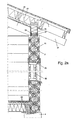
- Fig. 2a presents a cross-section of the hollow-log wall structure of the invention, where the horizontal logs 2 have been piled on top or each other.
- the logs 2 are round logs with a hollow inside, produced by machining.
- the space inside the log is filled with insulating material 21.
- Fitted in the wall is a window 22 having a frame 23 fitted against the logs 2 and provided with insulating material.
- the floor comprises joists 24 fitted on the basement 4, with insulating material and flooring boards on the joists.
- the roof comprises a roof structure 26 fitted on rafters 25 and provided with insulating material, boarding and cladding.
- Fig. 2a and 2c present a structure in which the prefabricated wall element 31 consists of hollow logs 2 with insulating material inside.
- the logs are placed one over the other and fastened together with a bolting bar 32 extending through the entire element.
- each two logs placed one over the other can be tied together using dowels 33.
- the bolting bars 52 are passed through the logs in a region where the logs have been reinforced with lengths of core timber 34 placed inside them.
- the piece of core timber 35 extends from the end of the log to a point beyond the bolting bar.
- the element is provided with an end fillet 36 extending across the entire height of the element and with edge fillets 37 for a groove to permit the element to be secured by fastening the topmost log with securing bolts while the logs below it are secured by means of a wooden tie rod 38 set in the upright log 1 (Fig. 2e).
- Fig. 2d presents a more detailed illustration of the way in which the horizontal topmost hollow wall log 2 is secured to the massive upright log 1.
- C-profile parts 42 made of steel are fastened to the tie rod chases 41 in the pillar logs 1.
- the ends of the horizontal logs 2 are provided with bolts 43 placed at the center of the log so that their head is locked in the slot of the C-profile, and the threaded other ends are screwed fast in vertical pins 44.
- the topmost tier of logs is anchored on the pillar logs 1 by means of bolts.
- the anchorage permits unobstructed setting of the logs while stiffening the pillars and the horizontal logs of the wall as a single functional wall structure.
- the profiles may be secured using holding-down plates 46 fastened with screws 45 to the side of the upright log 1.
- Fig. 3a and 3b illustrate the manner of securing the corner pillar 1 to the concrete pillar 4.
- the joint is implemented using an angle-iron bracket 51 which is secured to the concrete pillar 4 via a holding-down plate 52 placed under it and anchored in the concrete by means of anchor bars 53.
- the holding-down plate 52 is provided with a central hole.
- the angle-iron bracket 51 is provided with a corresponding hole, and the angle-iron bracket is secured to the holding-down plate 52 via a bolted joint 54.
- the angle-iron bracket is similarly fastened to the pillar log 1 with screws 55.
- the upright log is a hollow log 61 with a steel tube 62 inside it, both being provided with holes 63, 64 for the securing bolts. Insulating material 65 may be provided between the steel tube and the hollow log.
- the steel tube 62 is secured to the basement.
- the log 61 is provided with a C-profile part 66 set in the log and fastened via a screw-and-nut joint 67 as described above, and the horizontal log 2 is fastened to the upright log via a threaded part 68 and a boss 69 according to the above description.
- the structure comprises a floor supporting shelf 71 with a supporting plate 72, which are fitted e.g. in slots 73, 74 provided in the upright pillar and in the steel tube.
- FIG. 5a ⁇ 5c illustrate the production of hollow logs.
- a raw-wood log 81 is sawn as described below by means of a tubular saw via a single operation producing two hollow logs 82, 84 and a core timber 85, which can be sawn further to produce e.g. planks.
- a single raw-wood log used for the log building can yield hollow logs, floor boards as well as ceiling panels.
- the dimensions of the hollow logs may be for example: outer timber 82, diameter 260 mm, wall thickness 30 mm; inner timber 83, 182 mm, wall thickness 28 mm; and sawing allowance 9 mm.
- the core timber could have a diameter of 108, so it can be sawn further to produce planks and panels.
- Fig. 6a ⁇ 6e present a tubular saw designed for the production of hollow logs, also illustrating its operating principle.
- the tubular saw comprises two identical cutter units 101, by means of which the raw-wood log 102 is sawn from both ends.
- the cutter units have been fitted on cutter carriages 103, which are moved along rails 104 by a drive mechanism as indicated by the arrows.
- Each cutter unit comprises an electric drive 105, an exhaust pipe 106 for the sawdust and a tubular cutter 107.
- the log 102 is held immovable between the cutter units by a holding unit 108.
- the cutter is a tubular three-blade cutter, consisting of three cutting tubes 111 ⁇ 113 one inside the other.
- a cutter collar 114 provided with oppositely oriented teeth 115 and cut-outs 116 between them to generate an air flow as indicated by the arrow.
- the sawing is performed as illustrated in Fig. 6e.
- air is circulated as indicated by the arrows so that a negative pressure A prevails between the outermost cutting tubes as well as in the central tube, while a positive pressure Y prevails between them, thus causing the sawdust to be removed via the exhaust pipe 105.
Landscapes
- Engineering & Computer Science (AREA)
- Architecture (AREA)
- Civil Engineering (AREA)
- Structural Engineering (AREA)
- Life Sciences & Earth Sciences (AREA)
- Physics & Mathematics (AREA)
- Electromagnetism (AREA)
- Wood Science & Technology (AREA)
- Mechanical Engineering (AREA)
- Forests & Forestry (AREA)
- Load-Bearing And Curtain Walls (AREA)
- Packaging Of Annular Or Rod-Shaped Articles, Wearing Apparel, Cassettes, Or The Like (AREA)
- Superconductors And Manufacturing Methods Therefor (AREA)
- Indicating And Signalling Devices For Elevators (AREA)
- Maintenance And Inspection Apparatuses For Elevators (AREA)
- Alarm Systems (AREA)
- Debugging And Monitoring (AREA)
- Debarking, Splitting, And Disintegration Of Timber (AREA)
- Manufacture Of Wood Veneers (AREA)
Applications Claiming Priority (3)
| Application Number | Priority Date | Filing Date | Title |
|---|---|---|---|
| FI20001378 | 2000-06-09 | ||
| FI20001378A FI20001378A7 (fi) | 2000-06-09 | 2000-06-09 | Hirsirakennuksen runkohirsijärjestelmä |
| EP01947482A EP1292738B1 (de) | 2000-06-09 | 2001-06-11 | Blockhaus und baurundholz |
Related Parent Applications (1)
| Application Number | Title | Priority Date | Filing Date |
|---|---|---|---|
| EP01947482A Division EP1292738B1 (de) | 2000-06-09 | 2001-06-11 | Blockhaus und baurundholz |
Publications (2)
| Publication Number | Publication Date |
|---|---|
| EP1579967A2 true EP1579967A2 (de) | 2005-09-28 |
| EP1579967A3 EP1579967A3 (de) | 2005-10-12 |
Family
ID=8558527
Family Applications (2)
| Application Number | Title | Priority Date | Filing Date |
|---|---|---|---|
| EP05076069A Withdrawn EP1579967A3 (de) | 2000-06-09 | 2001-06-11 | Verfahren und Vorrichtung zur Herstellung eines hohlen Baumstammes |
| EP01947482A Expired - Lifetime EP1292738B1 (de) | 2000-06-09 | 2001-06-11 | Blockhaus und baurundholz |
Family Applications After (1)
| Application Number | Title | Priority Date | Filing Date |
|---|---|---|---|
| EP01947482A Expired - Lifetime EP1292738B1 (de) | 2000-06-09 | 2001-06-11 | Blockhaus und baurundholz |
Country Status (6)
| Country | Link |
|---|---|
| EP (2) | EP1579967A3 (de) |
| AT (1) | ATE305540T1 (de) |
| AU (1) | AU2001269153A1 (de) |
| DE (1) | DE60113681D1 (de) |
| FI (1) | FI20001378A7 (de) |
| WO (1) | WO2001094711A1 (de) |
Families Citing this family (2)
| Publication number | Priority date | Publication date | Assignee | Title |
|---|---|---|---|---|
| DE102006055976B4 (de) * | 2006-11-24 | 2012-07-19 | Werner Grosse | Verfahren zur Herstellung eines Strukturteils für Holzbauten |
| KR101289236B1 (ko) | 2011-07-07 | 2013-07-26 | 유한회사 에스와이 | 목조주택 및 목조주택의 제조방법 |
Family Cites Families (6)
| Publication number | Priority date | Publication date | Assignee | Title |
|---|---|---|---|---|
| DE375970C (de) * | 1923-05-22 | Bergbau Ind Und Bahnbau Ges | Verfahren zur Herstellung von Holzrohren aus einem Holzstamme | |
| US694452A (en) * | 1901-08-12 | 1902-03-04 | Andrew Anderson | Wood-pipe machine. |
| US2040110A (en) * | 1933-09-15 | 1936-05-12 | Nat Log Construction Co | Building and log construction |
| FR2621938B1 (fr) * | 1987-10-14 | 1990-01-26 | Grandclement Jean Claude | Pieces de bois allongees pour la construction et/ou la decoration de batiments |
| FI90370C (fi) * | 1990-11-26 | 1994-01-25 | Seppo Latvala | Menetelmä hirsiseinän valmistamiseksi |
| US5438812A (en) * | 1993-12-23 | 1995-08-08 | Regents Of The University Of Minnesota | Hollow veneered pole |
-
2000
- 2000-06-09 FI FI20001378A patent/FI20001378A7/fi unknown
-
2001
- 2001-06-11 AU AU2001269153A patent/AU2001269153A1/en not_active Abandoned
- 2001-06-11 AT AT01947482T patent/ATE305540T1/de not_active IP Right Cessation
- 2001-06-11 EP EP05076069A patent/EP1579967A3/de not_active Withdrawn
- 2001-06-11 EP EP01947482A patent/EP1292738B1/de not_active Expired - Lifetime
- 2001-06-11 WO PCT/FI2001/000551 patent/WO2001094711A1/en not_active Ceased
- 2001-06-11 DE DE60113681T patent/DE60113681D1/de not_active Expired - Lifetime
Also Published As
| Publication number | Publication date |
|---|---|
| DE60113681D1 (de) | 2005-11-03 |
| EP1579967A3 (de) | 2005-10-12 |
| EP1292738B1 (de) | 2005-09-28 |
| WO2001094711A1 (en) | 2001-12-13 |
| AU2001269153A1 (en) | 2001-12-17 |
| FI20001378A0 (fi) | 2000-06-09 |
| ATE305540T1 (de) | 2005-10-15 |
| FI20001378L (fi) | 2001-12-10 |
| FI20001378A7 (fi) | 2001-12-10 |
| EP1292738A1 (de) | 2003-03-19 |
| WO2001094711A8 (en) | 2002-02-28 |
Similar Documents
| Publication | Publication Date | Title |
|---|---|---|
| US5333426A (en) | Wood frame construction system with prefabricated components | |
| CN102216539B (zh) | 单元式建筑物系统 | |
| US5353560A (en) | Building structure and method of use | |
| CA2329083C (en) | A method for building construction | |
| US20100058687A1 (en) | Method of constructing a multi-storey building using prefabricated modular panels | |
| EP3892786A1 (de) | Linearmodul für gebäude zur herstellung von konstruktionsrahmen von fertighäusern mit wärmedämmung, bausatz für gebäude und gebäude | |
| US11840836B2 (en) | Structural wall panel system | |
| CN107740530B (zh) | 一种高温蒸压轻质加气混凝土整体外墙板及其施工方法 | |
| TW202223215A (zh) | 用於具有承重牆的多層建築物之預鑄樓地板天花板阻力錨 | |
| US20240084593A1 (en) | Structual Wall Panel System | |
| WO1999040267A1 (en) | Modular building unit | |
| EP1579967A2 (de) | Verfahren und Vorrichtung zur Herstellung eines hohlen Baumstammes | |
| CN113047516B (zh) | 一种易于组装的用于装配式建筑的预制木板材 | |
| US3466828A (en) | Modular wall construction | |
| US20190177975A1 (en) | Structural element | |
| JP2024536489A5 (de) | ||
| CA2639339A1 (en) | Method of constructing a multi-storey building using prefabricated modular panels | |
| JP2836448B2 (ja) | 木造建築物 | |
| RU2794438C1 (ru) | Способ формирования эркера деревянного строения | |
| RU2812672C1 (ru) | Строительная конструкция здания и здание, содержащее такую конструкцию | |
| RU2850032C1 (ru) | Способ возведения многоэтажного дома с использованием деревянных блоков, многоэтажный дом и стартовая планка | |
| CN214696146U (zh) | 一种木柱的钢构连接件 | |
| JP2008536030A (ja) | リングビーム構造物と木質梁工法 | |
| GB2172314A (en) | Perforated steel angle/timber composite lintel (P.S.A.) | |
| EA045524B1 (ru) | Деревянный панельный элемент, способ изготовления деревянного панельного элемента и применение деревянного панельного элемента |
Legal Events
| Date | Code | Title | Description |
|---|---|---|---|
| PUAI | Public reference made under article 153(3) epc to a published international application that has entered the european phase |
Free format text: ORIGINAL CODE: 0009012 |
|
| PUAL | Search report despatched |
Free format text: ORIGINAL CODE: 0009013 |
|
| AC | Divisional application: reference to earlier application |
Ref document number: 1292738 Country of ref document: EP Kind code of ref document: P |
|
| AK | Designated contracting states |
Kind code of ref document: A2 Designated state(s): AT BE CH CY DE DK ES FI FR GB GR IE IT LI LU MC NL PT SE TR |
|
| AK | Designated contracting states |
Kind code of ref document: A3 Designated state(s): AT BE CH CY DE DK ES FI FR GB GR IE IT LI LU MC NL PT SE TR |
|
| AKX | Designation fees paid | ||
| REG | Reference to a national code |
Ref country code: DE Ref legal event code: 8566 |
|
| STAA | Information on the status of an ep patent application or granted ep patent |
Free format text: STATUS: THE APPLICATION IS DEEMED TO BE WITHDRAWN |
|
| 18D | Application deemed to be withdrawn |
Effective date: 20060413 |