EP1580525A1 - Procédé de détection du début d'une plongée pour ordinateur de plongée - Google Patents
Procédé de détection du début d'une plongée pour ordinateur de plongée Download PDFInfo
- Publication number
- EP1580525A1 EP1580525A1 EP04101172A EP04101172A EP1580525A1 EP 1580525 A1 EP1580525 A1 EP 1580525A1 EP 04101172 A EP04101172 A EP 04101172A EP 04101172 A EP04101172 A EP 04101172A EP 1580525 A1 EP1580525 A1 EP 1580525A1
- Authority
- EP
- European Patent Office
- Prior art keywords
- value
- pressure
- variation
- frequency
- stored
- Prior art date
- Legal status (The legal status is an assumption and is not a legal conclusion. Google has not performed a legal analysis and makes no representation as to the accuracy of the status listed.)
- Granted
Links
- 238000000034 method Methods 0.000 title claims abstract description 68
- 238000001514 detection method Methods 0.000 title claims abstract description 27
- 230000009189 diving Effects 0.000 title description 21
- 238000004590 computer program Methods 0.000 claims abstract 2
- 238000012937 correction Methods 0.000 claims description 34
- 238000005259 measurement Methods 0.000 claims description 25
- XLYOFNOQVPJJNP-UHFFFAOYSA-N water Substances O XLYOFNOQVPJJNP-UHFFFAOYSA-N 0.000 claims description 18
- 238000004364 calculation method Methods 0.000 claims description 9
- FGUUSXIOTUKUDN-IBGZPJMESA-N C1(=CC=CC=C1)N1C2=C(NC([C@H](C1)NC=1OC(=NN=1)C1=CC=CC=C1)=O)C=CC=C2 Chemical compound C1(=CC=CC=C1)N1C2=C(NC([C@H](C1)NC=1OC(=NN=1)C1=CC=CC=C1)=O)C=CC=C2 FGUUSXIOTUKUDN-IBGZPJMESA-N 0.000 claims description 5
- 238000012545 processing Methods 0.000 claims description 4
- 230000009471 action Effects 0.000 claims description 3
- 238000012360 testing method Methods 0.000 description 23
- 230000008569 process Effects 0.000 description 22
- 238000010586 diagram Methods 0.000 description 11
- 230000006870 function Effects 0.000 description 8
- 230000007423 decrease Effects 0.000 description 5
- 230000006399 behavior Effects 0.000 description 4
- 238000009530 blood pressure measurement Methods 0.000 description 4
- 101100536354 Drosophila melanogaster tant gene Proteins 0.000 description 3
- 230000006837 decompression Effects 0.000 description 3
- 238000002360 preparation method Methods 0.000 description 3
- IJGRMHOSHXDMSA-UHFFFAOYSA-N Atomic nitrogen Chemical compound N#N IJGRMHOSHXDMSA-UHFFFAOYSA-N 0.000 description 2
- 230000002238 attenuated effect Effects 0.000 description 2
- 230000008859 change Effects 0.000 description 2
- 230000000694 effects Effects 0.000 description 2
- 238000009499 grossing Methods 0.000 description 2
- 230000036541 health Effects 0.000 description 2
- 238000004519 manufacturing process Methods 0.000 description 2
- 230000000737 periodic effect Effects 0.000 description 2
- 230000004913 activation Effects 0.000 description 1
- 230000002457 bidirectional effect Effects 0.000 description 1
- 238000010276 construction Methods 0.000 description 1
- 229910052757 nitrogen Inorganic materials 0.000 description 1
- 230000002123 temporal effect Effects 0.000 description 1
- 230000007704 transition Effects 0.000 description 1
- 238000005406 washing Methods 0.000 description 1
Images

Classifications
-
- G—PHYSICS
- G04—HOROLOGY
- G04G—ELECTRONIC TIME-PIECES
- G04G21/00—Input or output devices integrated in time-pieces
- G04G21/02—Detectors of external physical values, e.g. temperature
-
- B—PERFORMING OPERATIONS; TRANSPORTING
- B63—SHIPS OR OTHER WATERBORNE VESSELS; RELATED EQUIPMENT
- B63C—LAUNCHING, HAULING-OUT, OR DRY-DOCKING OF VESSELS; LIFE-SAVING IN WATER; EQUIPMENT FOR DWELLING OR WORKING UNDER WATER; MEANS FOR SALVAGING OR SEARCHING FOR UNDERWATER OBJECTS
- B63C11/00—Equipment for dwelling or working underwater; Means for searching for underwater objects
- B63C11/02—Divers' equipment
- B63C11/32—Decompression arrangements; Exercise equipment
-
- G—PHYSICS
- G01—MEASURING; TESTING
- G01C—MEASURING DISTANCES, LEVELS OR BEARINGS; SURVEYING; NAVIGATION; GYROSCOPIC INSTRUMENTS; PHOTOGRAMMETRY OR VIDEOGRAMMETRY
- G01C5/00—Measuring height; Measuring distances transverse to line of sight; Levelling between separated points; Surveyors' levels
- G01C5/06—Measuring height; Measuring distances transverse to line of sight; Levelling between separated points; Surveyors' levels by using barometric means
-
- B—PERFORMING OPERATIONS; TRANSPORTING
- B63—SHIPS OR OTHER WATERBORNE VESSELS; RELATED EQUIPMENT
- B63C—LAUNCHING, HAULING-OUT, OR DRY-DOCKING OF VESSELS; LIFE-SAVING IN WATER; EQUIPMENT FOR DWELLING OR WORKING UNDER WATER; MEANS FOR SALVAGING OR SEARCHING FOR UNDERWATER OBJECTS
- B63C11/00—Equipment for dwelling or working underwater; Means for searching for underwater objects
- B63C11/02—Divers' equipment
- B63C2011/021—Diving computers, i.e. portable computers specially adapted for divers, e.g. wrist worn, watertight electronic devices for detecting or calculating scuba diving parameters
-
- G—PHYSICS
- G01—MEASURING; TESTING
- G01C—MEASURING DISTANCES, LEVELS OR BEARINGS; SURVEYING; NAVIGATION; GYROSCOPIC INSTRUMENTS; PHOTOGRAMMETRY OR VIDEOGRAMMETRY
- G01C25/00—Manufacturing, calibrating, cleaning, or repairing instruments or devices referred to in the other groups of this subclass
Definitions
- the present invention relates to a method for detecting the beginning of a diving intended to be implemented in a portable electronic device of the type dive computer. More specifically, the method is intended to be implemented in such a device having at least a first mode of operation and a second mode of operation, called dive mode.
- This device comprises in particular a pressure sensor for measuring the value of the pressure environment as well as electronic circuits for processing the results of pressure measurements comprising a time base and at least one memory zone.
- the detection method according to the present invention is notably based on the study of the variations of the surrounding pressure as a function of time to detect the beginning of a dive resulting in a significant increase in the value of the surrounding pressure.
- the present invention also relates to a portable electronic device specially adapted for carrying out the method mentioned above.
- EP 0 689 109 issued in the name of CITIZEN WATCH CO. LTD. the 16th December 1998, describes such a type of process as well as an electronic device portable for its implementation.
- this device is provided with means specific devices arranged to detect contacting the device with water, as well as a pressure sensor, arranged to measure the value of the pressure surrounding.
- the pressure sensor is powered, in a first mode of operation, so as to measure the pressure atmospheric approximately once an hour to memorize the value thus obtained in as the value of the reference pressure.
- the specific means of detection of water which may for example be in the form of contacts ohmic devices arranged on the box of the device, are permanently powered or periodically.
- the ohmic contacts thus fulfill a function of main switch for circuits dedicated to the mode of operation relating to the practice of diving, especially for the pressure sensor. Indeed, when the presence of water is detected at the ohmic contacts, the power supply frequency of the sensor pressure is changed so that measurements of the surrounding pressure are carried out with a period of the order of one second, as part of a called the mode of preparation. These measurements make it possible to calculate value of the pressure variation between the last measured value and the last value of the stored reference pressure, the value of the variation being then compared to a predefined value constituting a mode triggering threshold diving. When the variation of the pressure crosses the triggering threshold, the dive mode is activated. If not, the sensor is still powered for a few minutes to monitor the evolution of the surrounding pressure. A Once this time has elapsed, the method of preparation is deactivated and the pressure sensor is again powered with a period of the order of the hour.
- Such a detection method makes it possible, for example, to distinguish between a situation according to which the wearer of the device wets it by washing the hands and a situation that actually corresponds to the beginning of a dive.
- the pressure measurements made by the pressure sensor allow to validate the beginning of a dive following the activation of the preparation, insofar as the device first undergoes contact with the water before seeing its surrounding pressure grow.
- this type of device has a significant disadvantage of view of its construction residing in the need to provide specific means detection of the presence of water at its box.
- the use of ohmic contacts it is indeed imperative to provide means specific to guarantee the tightness of the box of the device in the region these contacts, which may have important consequences for the cost of manufacturing the device.
- the method described above has a similar disadvantage because it is based on the implementation of specific means of detecting the presence of water.
- such devices are known in which a sensor of pressure is periodically powered to measure the value of the pressure environment, the results of these measurements being stored. These devices are arranged so that for each new measure of the surrounding pressure, the value of the variation between this last measure and the previous one is calculated and compared to a value defining a trigger threshold. Once the trigger threshold crossed, the dive mode is activated, the penultimate value of the measured pressure typically being stored as a reference pressure, i.e. is supposed to correspond to the surface pressure of the body of water in which the diving is done.
- This type of device however, has the disadvantage that the accuracy of detecting the start of a dive is entirely based on the value used for the triggering threshold.
- the device is exposed to a risk of inadvertent tripping of the diving mode. For example, if the carrying such a device descends a mountain road at a steady pace, the device is likely to equate the corresponding pressure increase with a entry into the water.
- the value chosen for the threshold is too large, the accuracy on the trigger may not be good if the wearer stays in the water near the surface for a while before the start of a dive. In such a case, it is also possible that the value of the reference pressure memorized is not correct because measured in water, at a depth less than that corresponding to the triggering threshold. Such an error may, according to his amplitude, have dangerous consequences for the health of the wearer of the particular from the point of view of data relating to a possible level of decompression on which the error would be reported.
- a first object of the present invention is to overcome the disadvantages aforementioned prior art by providing a method of detecting the beginning of a diving with greater precision, the detection being done on the basis of values measured ambient pressure, as well as a suitable portable electronic device to the implementation of such a method.
- step e it is envisaged, alternatively in step e), to compare the value absolute of the variation of the calculated pressure to a predefined quantity, stored in said memory zone, or determined on the basis of pressure values measured.
- the updating of the value of the pressure reference is not done systematically at a given frequency. It is indeed taken into account the variation of the calculated pressure for possible correct a measured value of the ambient pressure before memorizing it as than reference pressure. As a result, greater precision is obtained compared to to the devices of the prior art mentioned above, for the detection of the beginning of a diving.
- the correction of step f) consists in adding the first correction factor to the value of the stored reference pressure, the result of the addition being stored as a new value of the reference pressure.
- step e) when the size is determined on the basis of measured pressure values, step e) further comprises an action of storing the value of the variation of pressure at the second frequency, at least the last three values of the variation stored pressure are used to calculate the magnitude.
- This last corresponds, according to a preferred variant, to the result of the calculation of the average of the pressure variation on the last three values, the correction of step f) of adding the quantity to the value of the reference pressure memorized, the result of the addition being stored as a new value of the reference pressure.
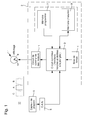
- Figure 1 schematically shows a general diagram of the electronic circuit of an example of a portable electronic device for the purpose of process of the present invention.
- the device portable electronics comes in the special form of a watch 1 electronic diving system with an analogue display comprising at least two modes of operation, a first time mode and a second dive mode.
- the method according to the present invention is not limited to its implementation. implemented on a watch but can also be implemented on any type conventional portable dive computer without departing from the scope of this invention.
- the electronic circuit of the watch 1 comprises in particular an integrated circuit 2 comprising a controller circuit 3 capable of managing the conventional time functions of the watch 1 comprising, for this purpose, a time division circuit and being connected in particular to a resonator 4 providing a time base. From this time base, temporal information produced by the controller circuit 3, in particular to perform the functions of the time mode and the features related to the dive mode.
- controller circuit 3 receives as input signals generated by a pressure sensor 5 generating analog electrical signals representative of the surrounding pressure. These signals pass through an analog-to-digital converter 6 before being supplied to the input of the controller circuit 3, in the form of a digital signal.
- the pressure sensor 5 is of conventional type and the person skilled in the art does not encounter no particular difficulty in choosing one that is suitable for the implementation of of the present invention.
- the integrated circuit 2 also comprises memory zones, in particular a first memory zone 7, preferably of the non-volatile type, containing a program allowing the controller circuit 3 to perform the calculations relating to the mode diving, on the basis of a decompression algorithm, for example.
- the choice of a non-volatile memory reprogrammable allows possibly to modify later the calculation program according to the chosen decompression algorithm.
- the integrated circuit 2 comprises preferred at least a second memory zone 8, also of the non-volatile type, in which measurements as well as results of calculations performed by the circuit controller 3 are stored. This second memory area 8 is in particular provided to store depth measurements and corresponding time measurements relating to the last dives, for illustrative purposes.
- the controller circuit 3 determines the situation and state of the diver at every moment, from the point of view of the practice of the diving. For this purpose, it is possible in particular to predict that in time mode, a measurement of pressure is performed every five minutes and that in dive mode, a measurement of pressure is performed every two seconds, for example. From all these periodic measurements and on the basis of the program stored in the first zone of 7, the controller circuit 3 determines a certain number of parameters relevant to the diver's health, that is, in particular, the residual rate of nitrogen dissolved in his body and the amount of micro-bubbles formed by example.
- the watch 1 has a analog type display, including hour hands 9 and minutes 10, controlled by bidirectional motors (not shown).
- the controller circuit 3 is programmed to produce signals adapted to destination of a control circuit 11 bi-directional motors, such way that the hands of hours 9 and 10 minutes display information the current time, in a first time mode, and information relating to the practice of diving in a second mode of diving.
- the watch further comprises a control member 12, such as a stem-crown, provided to adjust the current time or to activate functions special.
- a control member 12 such as a stem-crown
- Figures 2 to 4 present diagrams relating to three modes of performing the method of detecting the beginning of diving according to the present invention, the description of these embodiments being provided in a non-limiting manner.
- These three processes can be used to "filter" the periodic pressure measurements by the pressure sensor 5 to limit inadvertent tripping of the mode diving, as can happen with certain devices of the prior art, when for example, we descend quickly from a mountain.
- these processes are aimed to avoid that a device implementing them does not detect the beginning of a dive, because, for example, the wearer remains a moment in the water, at the level of the surface, before actually starting the dive as such.
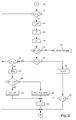
- Figure 1 shows a schematic diagram detailing the steps of the method of detecting the beginning of the dive according to a first mode of embodiment of the present invention.
- the controller circuit 3 is programmed to supply periodically the pressure sensor 5 when the watch is in the time mode, to perform measurements of the value of the surrounding pressure.
- stage A identified by the numeral 20, of diagram, a previously measured pressure value being stored as a that reference pressure Pref.
- a first counter (not shown) is intended to measure first time intervals t1, this counter having a value of t1 between 0 and T1 in stage A, T1 being a period value of measures.
- the period T1 is substantially between 0.1 and 10 seconds.
- step 21 of the diagram from stage A, the controller circuit 3 tests the value of the first counter. As long as the counter value is not equal to T1, the method is repeated in step A, preferably but not limited to once per second, the value of the counter being incremented each time.
- the pressure sensor 5 is then powered to perform a measurement of the surrounding pressure P, in 23.
- the circuit controller 3 calculates a pressure variation dP, at 24, based on the values of lastly measured pressure and reference pressure Pref previously stored.
- the controller circuit 3 compares, at 25, the value calculated for the variation of the pressure dP to a predefined value S, called the threshold of trigger, and which corresponds to a height of water preferably between 0.2 and 1.5 meters.
- the dive mode is activated, in 26.
- the controller circuit 3 performs an additional test on the value of the variation of the pressure dP, in 27. More precisely, the controller circuit determines the sign of dP, this operation being preferably performed at the same frequency as the pressure measurements 23. However, it can be envisaged as an alternative that the frequency of the test 27 is different from the measurements of the surrounding pressure without leaving the of the present invention.
- the additional test 31 consists in checking whether the value t2 of the second counter has reached the value T2, corresponding to the frequency f2 at which the value the stored reference pressure can be corrected, this second frequency f2 being lower than the frequency f1 at which the measurements of the value of the surrounding pressure P are performed.
- the frequency f2 must be low enough, ie the period T2 must be long enough for the pressure variation to be a significant value from the point of view of the correction of the value of the pressure of reference Pref.
- T2 substantially understood between 30 seconds and 10 minutes, a frequency f2 of the order of 0.001 to 0.04 Hz.
- the controller circuit 3 When the value of t2 is equal to T2, the controller circuit 3 performs a new calculation in 32 whose purpose is to evaluate the recent behavior of the value of the surrounding pressure compared to its average behavior taken over an interval more important time. For this purpose, the controller circuit 3 stores the last value of the variation of the pressure dP calculated in the memory zone 8, this last preferably having at least four locations for this purpose. So, the last value of the variation of the calculated pressure dP is stored in replacing the oldest dP value still in memory.
- the controller circuit then calculates the average value dPm of the variation of the pressure on the basis of last four values stored in memory, denoted dPi-3, dPi-2, dPi-1 and dP, simply by adding them together and dividing the result of the addition by four.
- the controller circuit 3 compares, at 33, this mean value at the last value of the variation of the pressure dP calculated.
- the value of the reference pressure Pref is updated with the last value measurement of the surrounding pressure P, at 34. Once the update is carried out, the value t2 of the second counter is reset at 30 and the procedure is repeated. stage A.
- the value t2 of the second counter is reset at 30 and the procedure is repeated. stage A.
- the general principle of operation of the process according to the present method of realization is based on the fact that the surrounding pressure increases so noticeable at the beginning of a dive. So, when the value of the pressure varies quickly to a value sufficient to exceed the trigger threshold, the mode dive is activated.
- two cases can be distinguished: know the first case of a decrease in the surrounding pressure and the second case a moderate increase in the surrounding pressure.
- the wearer is not in the water but he is gaining altitude.
- the value of the reference pressure Pref memorized is then updated with a relatively high frequency, that is to say on the order of a few seconds, so that the stored value is representative of the true value of atmospheric pressure with good precision.
- a relatively high frequency that is to say on the order of a few seconds.
- a moderate increase in the surrounding pressure can be attributed to two different causes, an entry into the water while remaining at a shallow depth, a rapid descent on the surface, as example a fast downhill mountain drive or during practice of an aerial sport.
- the method according to the present invention makes it possible to take account of this type of events because the reference pressure is updated but with a relatively low frequency compared to the frequency of measurements of the surrounding pressure.
- this increase is reflected in the value of the pressure of reference Pref memorized but being attenuated.
- the variations of the pressure surroundings are taken into account while undergoing a kind of smoothing during their treatment by the controller circuit.
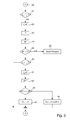
- Figure 3 is a schematic diagram detailing the steps of the method for detecting the beginning of the dive according to a second mode of embodiment of the present invention.
- the controller circuit goes to an additional test in 40.
- the additional test 40 consists of checking whether the value t2 of a second counter has reached the value T2 corresponding to the frequency f2 at which the value of the stored reference pressure can be corrected. This second frequency f2 is lower than the frequency f1 at which the measurements of the value of the surrounding pressure P are made.
- the frequency f2 is here of the same order of magnitude as in the context of first embodiment.
- T2 substantially between 30 seconds and 10 minutes, a frequency f2 of in the order of 0.001 to 0.04 Hz.
- the controller circuit 3 When the value of t2 is equal to T2, the controller circuit 3 resets the value t2 of the second counter at 41, before performing a new calculation, at 42, of which the goal is to evaluate the recent behavior of the value of the surrounding pressure compared to its average behavior taken over a longer period of time.
- This step 42 is similar to the step 32 described in connection with the first mode of production.
- the controller circuit 3 stores the last value of the variation of the dP calculated in the memory area 8, the latter comprising preferably at least four locations for this purpose. So the last value of the variation of the calculated pressure dP is stored by replacing the value of dP the older still in memory.
- the controller circuit then calculates the value average dPm of the change in pressure based on the last four values memorized, noted dPi-3, dPi-2, dPi-1 and dP, simply by adding them together and dividing the result of the addition by four.
- the controller circuit 3 compares, in 43, the absolute value of this average value to the absolute value of the last value of the variation of the calculated pressure dP.
- the value of the reference pressure Pref is updated with the last measured value of the surrounding pressure P, in 44. Once the update carried out, the process is repeated in stage A.
- the value of the reference pressure Pref is always updated at frequency f2, which may lead to a lower accuracy of the value of the reference pressure stored in relation to the actual pressure in in certain special circumstances of use.
- Figure 4 shows a schematic diagram detailing the steps of the method of detecting the beginning of diving in a third mode embodiment of the present invention.
- the method according to the present embodiment differs from the two precedents mainly by the nature of the magnitude used to correct the value the stored reference pressure, which is here a predefined quantity and no longer a quantity based on measured ambient pressure values.
- the controller circuit 3 assigns a particular value, here 6, to the value n of an additional counter, whose function will be exposed further.
- the value t2 of a second counter is then tested at 52.
- the value t2 is equal to a value T3 which corresponds to a second updating frequency f2
- it is reset at 53, while the last value of the reference pressure Pref stored is saved as the surface pressure P 0 , at 54, this being used as reference in the dive mode.
- the method of A is repeated.
- the value t 2 of the second counter is smaller than T 3, the process in A in incrementing t2.
- a value of T3 of between 30 seconds and 10 minutes will preferably be taken, ie a corresponding frequency f3 of the order of 0.001 to 0.04 Hz.
- the additional test 55 consists of checking whether the value t2 of the second counter has reached a value a * T2, a being an integer and T2 corresponding to a frequency f2 at which the value of the stored reference pressure is which can be corrected, this third frequency f2 being between frequencies f1 and f3.
- the frequency f2 must be low enough, ie the period T2 must be long enough for the pressure variation to be a significant value from the point of view of the correction of the value of the pressure of reference Pref.
- T2 substantially understood between 30 seconds and 5 minutes, a frequency f2 of the order of 0.003 to 0.04 Hz.
- the circuit controller performs another test, at 57, based on the last calculated value of the variation of the pressure dP.
- the value of dP is compared to a magnitude predefined c1 whose value corresponds to a water level of the order of 2 to 40 cm.
- the controller circuit When the value of dP is greater than c1, the controller circuit performs a correction of the value of the reference pressure Pref, at 58, by memorizing the sum of the last stored Pref value with the value of c1 as new value of the reference pressure Pref. Then the value n of the counter additional is decremented at 59 before continuing the end of the process. resuming in step 52 previously described.
- the controller circuit 3 performs a different test, at 60, based on the last calculated value of the variation of the pressure dP. The latter is then compared to a second predefined magnitude c2, called the second correction factor, whose value is between the respective values of c1 and S.
- step 61 which constitutes an additional step of correcting the value of the pressure of reference Pref.
- step 61 indeed, the sum of the last value memorized the reference pressure with c2 is stored as new value of the reference pressure Pref.
- This method provides a distinction on the sign of the last calculated value the pressure variation dP, as well as the method according to the first embodiment of implementation, the reference pressure being corrected only in cases where the value of the surrounding pressure does not decrease.
- the essential difference distinguishing the process according to the present mode of realization of the above lies in the fact that the size used to perform the correction of the value of the reference pressure Pref does not take into account the past evolution of the value of the surrounding pressure to the extent that it corresponds to a predefined constant.
- the increases in the measured pressure P are reflected in level of the value of the reference pressure Pref memorized while being mitigated.
- the correction step 58, as well as step 61, capped, with a value c1 the increase in the value of the reference pressure to memorize to smooth the increases in the surrounding pressure.
- the stored value of the pressure of reference deviates more and more from the true value of the surrounding pressure.
- the detection method according to the present invention can be implemented in any portable electronic device of the computer type of diving, whether its display is analog or digital.
- the invention is not not limited to the operating modes described, insofar as these parameters can be modified by an appropriate programming of the controller circuit.
- the man of profession will not encounter any particular difficulty in adapting the process according to the present invention to its own needs, particularly as regards the values provided as an example for correction frequencies and magnitudes.
Landscapes
- Physics & Mathematics (AREA)
- General Physics & Mathematics (AREA)
- Engineering & Computer Science (AREA)
- Radar, Positioning & Navigation (AREA)
- Remote Sensing (AREA)
- Mechanical Engineering (AREA)
- Ocean & Marine Engineering (AREA)
- Electric Clocks (AREA)
- Measuring Fluid Pressure (AREA)
- Electromechanical Clocks (AREA)
- Motor And Converter Starters (AREA)
- Photoreceptors In Electrophotography (AREA)
Abstract
Description
- la figure 1 est un diagramme schématique général du circuit électronique d'un exemple de dispositif électronique portable pour la mise en oeuvre du procédé selon la présente invention,
- la figure 2 est un diagramme exposant de manière schématique les étapes du procédé de détection du début d'une plongée selon un premier mode de réalisation de la présente invention,
- la figure 3 est un diagramme exposant de manière schématique les étapes du procédé de détection du début d'une plongée selon un second mode de réalisation de la présente invention, et
- la figure 4 est un diagramme exposant de manière schématique les étapes du procédé de détection du début d'une plongée selon un troisième mode de réalisation de la présente invention.
Claims (17)
- Procédé de détection du début d'une plongée pour dispositif électronique portable (1) présentant au moins un premier mode de fonctionnement et un second mode de fonctionnement, dit mode plongée, et comportant notamment un capteur de pression (5) pour mesurer la valeur de la pression environnante (P) ainsi que des circuits électroniques (2) de traitement des résultats desdites mesures comprenant une base de temps (4) et au moins une zone mémoire (7, 8), le procédé, mis en oeuvre dans ledit premier mode de fonctionnement, comportant les étapes consistant à:a) mesurer une valeur de la pression environnante et la mémoriser en tant que pression de référence (Pref),b) mesurer périodiquement la valeur de la pression environnante (P) à une première fréquence (f1),c) calculer périodiquement la valeur de la variation de pression (dP) entre la pression environnante mesurée (P) et la pression de référence (Pref) à ladite première fréquence (f1) et, comparer ladite valeur de variation de la pression (dP) à une valeur prédéfinie, appelée seuil de déclenchement (S) et stockée dans ladite zone mémoire (7),d) activer ledit mode plongée si ladite valeur de variation de pression (dP) est supérieure au dit seuil de déclenchement ou, dans le cas contraire, continuer à l'étape e),e) comparer, à une seconde fréquence (f2), ladite valeur de variation de la pression (dP) à une grandeur prédéfinie (c1), stockée dans ladite zone mémoire (7) ou déterminée (dPm) sur la base de valeurs de pression mesurées, ladite grandeur étant inférieure au dit seuil de déclenchement (S), ladite seconde fréquence (f2) étant inférieure ou égale à ladite première fréquence (f1),f) effectuer une correction de la valeur de la pression de référence (Pref) si la valeur de variation de la pression (dP) est supérieure à ladite grandeur ou, dans le cas contraire, mémoriser la dernière valeur de pression mesurée (P) en tant que nouvelle valeur de la pression de référence (Pref), puisg) reprendre à l'étape b).
- Procédé de détection du début d'une plongée pour dispositif électronique portable présentant au moins un premier mode de fonctionnement et un second mode de fonctionnement, dit mode plongée, et comportant notamment un capteur de pression pour mesurer la valeur de la pression environnante ainsi que des circuits électroniques de traitement des résultats desdites mesures comprenant une base de temps et au moins une zone mémoire, le procédé, mis en oeuvre dans ledit premier mode de fonctionnement, comportant les étapes consistant à:a) mesurer une valeur de la pression environnante et la mémoriser en tant que pression de référence (Pref),b) mesurer périodiquement la valeur de la pression environnante (P) à une première fréquence (f1),c) calculer périodiquement la valeur de la variation de pression (dP) entre la pression environnante mesurée (P) et la pression de référence (Pref) à ladite première fréquence (f1) et, comparer ladite valeur de variation de la pression (dP) à une valeur prédéfinie, appelée seuil de déclenchement (S) et stockée dans ladite zone mémoire (7),d) activer ledit mode plongée si ladite valeur de variation de pression (dP) est supérieure au dit seuil de déclenchement ou, dans le cas contraire, continuer à l'étape e),e) comparer périodiquement, à une seconde fréquence (f2), la valeur absolue de ladite valeur de variation de la pression (dP) à une grandeur prédéfinie, stockée dans ladite zone mémoire (7), ou déterminée sur la base de valeurs de pression mesurées, ladite grandeur étant inférieure au dit seuil de déclenchement (S),f) effectuer une correction de la valeur de la pression de référence (Pref) si la valeur de variation de la pression (dP) est supérieure à ladite grandeur ou, dans le cas contraire, mémoriser la dernière valeur de pression mesurée (P) en tant que nouvelle valeur de la pression de référence (Pref), puisg) reprendre à l'étape b).
- Procédé de détection selon la revendication 1, comprenant en outre après l'étape d) les étapes consistant à :d') déterminer périodiquement, à une troisième fréquence (f3), le signe de ladite variation de la pression (dP), ladite troisième fréquence (f3) étant comprise entre lesdites première et seconde fréquences (f1, f2),d") mémoriser la valeur de la dernière pression mesurée en tant que valeur de la pression de référence (Pref) puis reprendre à l'étape b) si ladite variation de pression (dP) est négative ou, dans le cas contraire, continuer à l'étape e).
- Procédé de détection selon la revendication 1 ou 3 dans lequel, lorsque ladite grandeur est prédéfinie, celle-ci étant appelée premier facteur de correction (c1), ladite correction de l'étape f) consiste à additionner ledit premier facteur de correction (c1) à ladite valeur de la pression de référence mémorisée, le résultat de l'addition étant mémorisée en tant que nouvelle valeur de la pression de référence (Pref).
- Procédé de détection selon la revendication 4, dans lequel, l'accomplissement des étapes e) à g) définissant un cycle, ledit premier facteur de correction (c1) est remplacé dans les étapes e) et f), dans le déroulement de un cycle sur n, par une grandeur prédéfinie supplémentaire, appelée second facteur de correction (c2) et dont la valeur est comprise entre celles dudit premier facteur de correction et dudit seuil de déclenchement, lorsqu'une correction a effectivement été apportée à la valeur de la pression de référence au cours des n-1 derniers cycles écoulés, n étant un nombre entier compris entre deux et dix.
- Procédé de détection selon la revendication 1 ou 3 dans lequel, lorsque ladite grandeur est déterminée sur la base de valeurs de pression mesurées, l'étape e) comprend en outre une action de mise en mémoire de ladite valeur de la variation de pression (dP) à ladite seconde fréquence (f2), au moins les trois dernières valeurs de la variation de pression (dPi-2, dPi-1, dP) mémorisées étant utilisées pour calculer ladite grandeur, cette dernière correspondant au résultat du calcul de la moyenne de la variation de pression (dPm) sur lesdites au moins trois dernières valeurs, ladite correction de l'étape f) consistant à additionner ladite grandeur (dPm) à ladite valeur de la pression de référence mémorisée, le résultat de l'addition étant mémorisé en tant que nouvelle valeur de la pression de référence (Pref).
- Procédé de détection selon la revendication 6, dans lequel ladite grandeur est calculée sur la base des quatre dernières valeurs de la variation de pression (dPi-3, dPi-2, dPi-1, dP) mémorisées.
- Procédé de détection selon les revendications 3 et 6 ou 3 et 7 dans lequel, lorsque le signe de la dernière variation de pression (dP) calculée est négative dans l'étape d"), les valeurs de la variation de pression mémorisées (dPi-3, dPi-2, dPi-1, dP) sont toutes remplacées par zéro avant de reprendre à l'étape b).
- Procédé de détection selon la revendication 2, dans lequel l'étape e) comprend en outre une action de mise en mémoire de ladite valeur de la variation de pression (dP) à ladite seconde fréquence (f2), au moins les trois dernières valeurs de la variation de pression (dPi-2, dPi-1, dP) mémorisées étant utilisées pour calculer ladite grandeur, cette dernière correspondant à la valeur absolue du résultat du calcul de la moyenne de la variation de pression (dPm) sur lesdites au moins trois dernières valeurs, ladite correction de l'étape f) consistant à additionner ladite valeur de la moyenne de la variation de pression (dPm) à ladite valeur de la pression de référence mémorisée, le résultat de l'addition étant mémorisé en tant que nouvelle valeur de la pression de référence (Pref).
- Procédé de détection selon la revendication 3 ou 8, dans lequel les première et troisième fréquences (f1, f3) sont égales.
- Procédé de détection selon l'une quelconque des revendications précédentes, dans lequel ladite première fréquence (f1) présente une valeur comprise sensiblement entre 0,1 et 10 Hz.
- Procédé de détection selon l'une quelconque des revendications précédentes, dans lequel ladite seconde fréquence (f2) présente une valeur comprise sensiblement entre 0,001 et 0,04 Hz.
- Procédé de détection selon l'une quelconque des revendications précédentes, dans lequel la valeur dudit seuil de déclenchement correspond à une hauteur d'eau comprise sensiblement entre 0,2 et 1,5 mètres.
- Procédé de détection selon l'une quelconque des revendications précédentes, comportant une étape supplémentaire étant mise en oeuvre à une quatrième fréquence (f4) et au cours de laquelle la valeur de la pression de référence (Pref) mémorisée est sauvegardée dans une zone mémoire supplémentaire pour être utilisée ultérieurement dans le mode plongée en tant que valeur de la pression réelle à la surface du plan d'eau dans lequel la plongée est effectuée.
- Programme d'ordinateur installé dans un circuit contrôleur pour la mise en oeuvre du procédé selon l'une quelconque des revendications précédentes.
- Circuit contrôleur pour dispositif électronique portable agencé pour la mise en oeuvre du procédé de détection selon l'une quelconque des revendications 1 à 14.
- Dispositif électronique portable comprenant un circuit contrôleur selon la revendication 16.
Priority Applications (7)
| Application Number | Priority Date | Filing Date | Title |
|---|---|---|---|
| DE602004018455T DE602004018455D1 (de) | 2004-03-22 | 2004-03-22 | Verfahren zur Detektion des Beginns eines Tauchgangs für Tauchcomputer |
| AT04101172T ATE418062T1 (de) | 2004-03-22 | 2004-03-22 | Verfahren zur detektion des beginns eines tauchgangs für tauchcomputer |
| EP04101172A EP1580525B1 (fr) | 2004-03-22 | 2004-03-22 | Procédé de détection du début d'une plongée pour ordinateur de plongée |
| US11/082,966 US7448384B2 (en) | 2004-03-22 | 2005-03-18 | Process of detection of a dive start in a dive computer |
| JP2005081302A JP4708822B2 (ja) | 2004-03-22 | 2005-03-22 | ダイブ・コンピュータ内の潜水開始の検出プロセス |
| CN2005100564823A CN1673681B (zh) | 2004-03-22 | 2005-03-22 | 在潜水计算机中检测潜水开始的过程 |
| HK06102921.4A HK1082966B (en) | 2004-03-22 | 2006-03-07 | Process of detection of a dive start in a dive computer |
Applications Claiming Priority (1)
| Application Number | Priority Date | Filing Date | Title |
|---|---|---|---|
| EP04101172A EP1580525B1 (fr) | 2004-03-22 | 2004-03-22 | Procédé de détection du début d'une plongée pour ordinateur de plongée |
Publications (2)
| Publication Number | Publication Date |
|---|---|
| EP1580525A1 true EP1580525A1 (fr) | 2005-09-28 |
| EP1580525B1 EP1580525B1 (fr) | 2008-12-17 |
Family
ID=34854705
Family Applications (1)
| Application Number | Title | Priority Date | Filing Date |
|---|---|---|---|
| EP04101172A Expired - Lifetime EP1580525B1 (fr) | 2004-03-22 | 2004-03-22 | Procédé de détection du début d'une plongée pour ordinateur de plongée |
Country Status (6)
| Country | Link |
|---|---|
| US (1) | US7448384B2 (fr) |
| EP (1) | EP1580525B1 (fr) |
| JP (1) | JP4708822B2 (fr) |
| CN (1) | CN1673681B (fr) |
| AT (1) | ATE418062T1 (fr) |
| DE (1) | DE602004018455D1 (fr) |
Families Citing this family (6)
| Publication number | Priority date | Publication date | Assignee | Title |
|---|---|---|---|---|
| ATE390617T1 (de) * | 2004-07-13 | 2008-04-15 | Eta Sa Mft Horlogere Suisse | Verfahren zur detektion des tauchbeginnes für einen tauchcomputer |
| JP2007182199A (ja) * | 2006-01-10 | 2007-07-19 | Seiko Epson Corp | ダイバーズ用情報処理装置、ダイバーズ用情報処理装置の制御方法および制御プログラム |
| AT510385B1 (de) | 2010-09-13 | 2017-04-15 | Ing Dr Arne Sieber Dipl | Berührungssensitives display und methode zur bedienung eines tauchcomputers |
| EP2793450B1 (fr) * | 2013-04-18 | 2017-03-15 | Sensirion AG | Système et procédé permettant de déterminer la précision du capteur d'un dispositif électronique portable |
| CN104554671A (zh) * | 2014-12-26 | 2015-04-29 | 深圳市德威胜潜水工程有限公司 | 潜水减压方法及其系统 |
| CN105547571A (zh) * | 2015-12-11 | 2016-05-04 | 广东小天才科技有限公司 | 一种根据压强报警的方法和系统 |
Citations (2)
| Publication number | Priority date | Publication date | Assignee | Title |
|---|---|---|---|---|
| EP0682301A2 (fr) | 1994-05-10 | 1995-11-15 | Seiko Epson Corporation | Dispositif de mesure de la profondeur de l'eau |
| EP0689109A1 (fr) | 1993-03-12 | 1995-12-27 | Citizen Watch Co. Ltd. | Appareil electronique a fonction de mesure de profondeur d'eau |
Family Cites Families (11)
| Publication number | Priority date | Publication date | Assignee | Title |
|---|---|---|---|---|
| JPH0664162B2 (ja) * | 1985-11-08 | 1994-08-22 | シチズン時計株式会社 | 水深計付電子時計 |
| JP2928809B2 (ja) * | 1990-03-15 | 1999-08-03 | カシオ計算機株式会社 | 電子式水深計 |
| WO2000059779A1 (fr) * | 1999-04-01 | 2000-10-12 | Seiko Epson Corporation | Appareil de traitement de donnees pour plongeurs et procede de commande dudit appareil |
| JP3478289B2 (ja) * | 1999-09-08 | 2003-12-15 | セイコーエプソン株式会社 | ダイバーズ用情報処理装置 |
| JP3608555B2 (ja) * | 2002-03-08 | 2005-01-12 | セイコーエプソン株式会社 | ダイバーズ用情報処理装置、情報処理方法、プログラム及び記録媒体 |
| EP1396766B1 (fr) | 2002-09-04 | 2009-12-02 | Asulab S.A. | Montre électronique de plongée à affichage analogique |
| DE60234691D1 (de) | 2002-09-04 | 2010-01-21 | Asulab Sa | Elektronische Taucheruhr mit Analoganzeige |
| US6842402B2 (en) * | 2002-09-04 | 2005-01-11 | Asulab S.A. | Electronic diving watch with analog display |
| US6791903B2 (en) * | 2002-09-04 | 2004-09-14 | Asulab S.A. | Electronic diving watch with analog display |
| EP1481890A4 (fr) * | 2002-12-11 | 2008-04-09 | Seiko Epson Corp | Dispositif de traitement d'informations pour plongeur, procede et programme de controle dudit dispositif, support d'enregistrement, equipement de plongee, procede de controle de l'equipement de plongee |
| ATE390617T1 (de) * | 2004-07-13 | 2008-04-15 | Eta Sa Mft Horlogere Suisse | Verfahren zur detektion des tauchbeginnes für einen tauchcomputer |
-
2004
- 2004-03-22 EP EP04101172A patent/EP1580525B1/fr not_active Expired - Lifetime
- 2004-03-22 DE DE602004018455T patent/DE602004018455D1/de not_active Expired - Lifetime
- 2004-03-22 AT AT04101172T patent/ATE418062T1/de not_active IP Right Cessation
-
2005
- 2005-03-18 US US11/082,966 patent/US7448384B2/en not_active Expired - Lifetime
- 2005-03-22 JP JP2005081302A patent/JP4708822B2/ja not_active Expired - Lifetime
- 2005-03-22 CN CN2005100564823A patent/CN1673681B/zh not_active Expired - Lifetime
Patent Citations (2)
| Publication number | Priority date | Publication date | Assignee | Title |
|---|---|---|---|---|
| EP0689109A1 (fr) | 1993-03-12 | 1995-12-27 | Citizen Watch Co. Ltd. | Appareil electronique a fonction de mesure de profondeur d'eau |
| EP0682301A2 (fr) | 1994-05-10 | 1995-11-15 | Seiko Epson Corporation | Dispositif de mesure de la profondeur de l'eau |
Also Published As
| Publication number | Publication date |
|---|---|
| CN1673681B (zh) | 2010-04-28 |
| EP1580525B1 (fr) | 2008-12-17 |
| US7448384B2 (en) | 2008-11-11 |
| CN1673681A (zh) | 2005-09-28 |
| JP4708822B2 (ja) | 2011-06-22 |
| ATE418062T1 (de) | 2009-01-15 |
| US20050205092A1 (en) | 2005-09-22 |
| DE602004018455D1 (de) | 2009-01-29 |
| JP2005274572A (ja) | 2005-10-06 |
| HK1082966A1 (zh) | 2006-06-23 |
Similar Documents
| Publication | Publication Date | Title |
|---|---|---|
| EP2075654B1 (fr) | Dispositif électronique portable destiné à afficher la valeur de variables à partir de mesures efffectuées par un capteur et présentant une fonction historique | |
| EP1617177B1 (fr) | Procédé de détection du début d'une plongée pour ordinateur de plongée | |
| EP1762915B1 (fr) | Montre altimètre | |
| FR2538108A1 (fr) | Thermometre medical electronique et procede de mesure de la temperature du corps | |
| EP1580525B1 (fr) | Procédé de détection du début d'une plongée pour ordinateur de plongée | |
| WO2005096106A1 (fr) | Dispositif électronique portable avec fonction variomètre à affichage analogique | |
| EP0639997A1 (fr) | Dispositif "compteur de golf" et montre combinee a un tel dispositif. | |
| EP3168695B1 (fr) | Procédé de test de la marche d'une montre à quartz | |
| EP0079305A2 (fr) | Dispositif de mesure de la pression sanguine | |
| FR2966928A1 (fr) | Procede et dispositif de surveillance d'une chaine de mesure redondee | |
| EP3332697A1 (fr) | Procédé de détection et de calcul de durée d'un saut | |
| EP3627243B1 (fr) | Procede de reglage de la frequence moyenne d'une base de temps incorporee dans une montre electronique | |
| EP2916193B1 (fr) | Base de temps comprenant un oscillateur, un circuit diviseur de fréquence et un circuit d'inhibition d'impulsions de cadencement | |
| EP1396767B1 (fr) | Montre électronique de plongée à affichage analogique | |
| EP1396766B1 (fr) | Montre électronique de plongée à affichage analogique | |
| FR2892193A1 (fr) | Dispositif et procede de correction des effets du vieillissement d'un capteur de mesure | |
| EP1426738A1 (fr) | Dispositif électronique et procédé comportant des moyens capacitifs de détection d'eau | |
| CH715474A2 (fr) | Procédé de diffusion par une montre d'un message informatif relatif à une évaluation de la qualité du sommeil d'un porteur de ladite montre. | |
| FR2884606A1 (fr) | Gyrometre a filtre optique a boucle fermee permettant de mesurer la puissance optique | |
| CH704688A2 (fr) | Procédé de certification de montre-chronographe. | |
| CH713220A2 (fr) | Procédé de détection et de calcul de durée d'un saut. | |
| EP2881809A1 (fr) | Procédé et appareil de mesure de la fréquence et de l'amplitude des oscillations d'un oscillateur mécanique de mouvement horloger | |
| WO2024261186A1 (fr) | Procédé de contrôle chronométrique d'un mouvement horloger | |
| CH720883A2 (fr) | Procédé de contrôle chronométrique d'un mouvement horloger | |
| CH698514B1 (fr) | Montre altimètre. |
Legal Events
| Date | Code | Title | Description |
|---|---|---|---|
| PUAI | Public reference made under article 153(3) epc to a published international application that has entered the european phase |
Free format text: ORIGINAL CODE: 0009012 |
|
| AK | Designated contracting states |
Kind code of ref document: A1 Designated state(s): AT BE BG CH CY CZ DE DK EE ES FI FR GB GR HU IE IT LI LU MC NL PL PT RO SE SI SK TR |
|
| AX | Request for extension of the european patent |
Extension state: AL LT LV MK |
|
| 17P | Request for examination filed |
Effective date: 20060328 |
|
| AKX | Designation fees paid |
Designated state(s): AT BE BG CH CY CZ DE DK EE ES FI FR GB GR HU IE IT LI LU MC NL PL PT RO SE SI SK TR |
|
| 17Q | First examination report despatched |
Effective date: 20070223 |
|
| GRAP | Despatch of communication of intention to grant a patent |
Free format text: ORIGINAL CODE: EPIDOSNIGR1 |
|
| RTI1 | Title (correction) |
Free format text: METHOD OF DETECTION OF THE BEGINNING OF A DIVE FOR A DIVE COMPUTER |
|
| GRAS | Grant fee paid |
Free format text: ORIGINAL CODE: EPIDOSNIGR3 |
|
| GRAA | (expected) grant |
Free format text: ORIGINAL CODE: 0009210 |
|
| AK | Designated contracting states |
Kind code of ref document: B1 Designated state(s): AT BE BG CH CY CZ DE DK EE ES FI FR GB GR HU IE IT LI LU MC NL PL PT RO SE SI SK TR |
|
| REG | Reference to a national code |
Ref country code: GB Ref legal event code: FG4D Free format text: NOT ENGLISH |
|
| REG | Reference to a national code |
Ref country code: CH Ref legal event code: EP |
|
| REG | Reference to a national code |
Ref country code: IE Ref legal event code: FG4D Free format text: LANGUAGE OF EP DOCUMENT: FRENCH |
|
| REF | Corresponds to: |
Ref document number: 602004018455 Country of ref document: DE Date of ref document: 20090129 Kind code of ref document: P |
|
| REG | Reference to a national code |
Ref country code: CH Ref legal event code: NV Representative=s name: ICB INGENIEURS CONSEILS EN BREVETS SA |
|
| PG25 | Lapsed in a contracting state [announced via postgrant information from national office to epo] |
Ref country code: NL Free format text: LAPSE BECAUSE OF FAILURE TO SUBMIT A TRANSLATION OF THE DESCRIPTION OR TO PAY THE FEE WITHIN THE PRESCRIBED TIME-LIMIT Effective date: 20081217 Ref country code: PL Free format text: LAPSE BECAUSE OF FAILURE TO SUBMIT A TRANSLATION OF THE DESCRIPTION OR TO PAY THE FEE WITHIN THE PRESCRIBED TIME-LIMIT Effective date: 20081217 Ref country code: SI Free format text: LAPSE BECAUSE OF FAILURE TO SUBMIT A TRANSLATION OF THE DESCRIPTION OR TO PAY THE FEE WITHIN THE PRESCRIBED TIME-LIMIT Effective date: 20081217 |
|
| NLV1 | Nl: lapsed or annulled due to failure to fulfill the requirements of art. 29p and 29m of the patents act | ||
| REG | Reference to a national code |
Ref country code: IE Ref legal event code: FD4D |
|
| PG25 | Lapsed in a contracting state [announced via postgrant information from national office to epo] |
Ref country code: ES Free format text: LAPSE BECAUSE OF FAILURE TO SUBMIT A TRANSLATION OF THE DESCRIPTION OR TO PAY THE FEE WITHIN THE PRESCRIBED TIME-LIMIT Effective date: 20090328 Ref country code: IE Free format text: LAPSE BECAUSE OF FAILURE TO SUBMIT A TRANSLATION OF THE DESCRIPTION OR TO PAY THE FEE WITHIN THE PRESCRIBED TIME-LIMIT Effective date: 20081217 Ref country code: EE Free format text: LAPSE BECAUSE OF FAILURE TO SUBMIT A TRANSLATION OF THE DESCRIPTION OR TO PAY THE FEE WITHIN THE PRESCRIBED TIME-LIMIT Effective date: 20081217 Ref country code: BG Free format text: LAPSE BECAUSE OF FAILURE TO SUBMIT A TRANSLATION OF THE DESCRIPTION OR TO PAY THE FEE WITHIN THE PRESCRIBED TIME-LIMIT Effective date: 20090317 Ref country code: RO Free format text: LAPSE BECAUSE OF FAILURE TO SUBMIT A TRANSLATION OF THE DESCRIPTION OR TO PAY THE FEE WITHIN THE PRESCRIBED TIME-LIMIT Effective date: 20081217 |
|
| PG25 | Lapsed in a contracting state [announced via postgrant information from national office to epo] |
Ref country code: SE Free format text: LAPSE BECAUSE OF FAILURE TO SUBMIT A TRANSLATION OF THE DESCRIPTION OR TO PAY THE FEE WITHIN THE PRESCRIBED TIME-LIMIT Effective date: 20090317 Ref country code: PT Free format text: LAPSE BECAUSE OF FAILURE TO SUBMIT A TRANSLATION OF THE DESCRIPTION OR TO PAY THE FEE WITHIN THE PRESCRIBED TIME-LIMIT Effective date: 20090518 Ref country code: CZ Free format text: LAPSE BECAUSE OF FAILURE TO SUBMIT A TRANSLATION OF THE DESCRIPTION OR TO PAY THE FEE WITHIN THE PRESCRIBED TIME-LIMIT Effective date: 20081217 Ref country code: AT Free format text: LAPSE BECAUSE OF FAILURE TO SUBMIT A TRANSLATION OF THE DESCRIPTION OR TO PAY THE FEE WITHIN THE PRESCRIBED TIME-LIMIT Effective date: 20081217 |
|
| BERE | Be: lapsed |
Owner name: ETA SA MANUFACTURE HORLOGERE SUISSE Effective date: 20090331 |
|
| PG25 | Lapsed in a contracting state [announced via postgrant information from national office to epo] |
Ref country code: SK Free format text: LAPSE BECAUSE OF FAILURE TO SUBMIT A TRANSLATION OF THE DESCRIPTION OR TO PAY THE FEE WITHIN THE PRESCRIBED TIME-LIMIT Effective date: 20081217 |
|
| PLBE | No opposition filed within time limit |
Free format text: ORIGINAL CODE: 0009261 |
|
| STAA | Information on the status of an ep patent application or granted ep patent |
Free format text: STATUS: NO OPPOSITION FILED WITHIN TIME LIMIT |
|
| PG25 | Lapsed in a contracting state [announced via postgrant information from national office to epo] |
Ref country code: MC Free format text: LAPSE BECAUSE OF NON-PAYMENT OF DUE FEES Effective date: 20090331 Ref country code: DK Free format text: LAPSE BECAUSE OF FAILURE TO SUBMIT A TRANSLATION OF THE DESCRIPTION OR TO PAY THE FEE WITHIN THE PRESCRIBED TIME-LIMIT Effective date: 20081217 |
|
| 26N | No opposition filed |
Effective date: 20090918 |
|
| PG25 | Lapsed in a contracting state [announced via postgrant information from national office to epo] |
Ref country code: BE Free format text: LAPSE BECAUSE OF NON-PAYMENT OF DUE FEES Effective date: 20090331 |
|
| PG25 | Lapsed in a contracting state [announced via postgrant information from national office to epo] |
Ref country code: GR Free format text: LAPSE BECAUSE OF FAILURE TO SUBMIT A TRANSLATION OF THE DESCRIPTION OR TO PAY THE FEE WITHIN THE PRESCRIBED TIME-LIMIT Effective date: 20090318 |
|
| PG25 | Lapsed in a contracting state [announced via postgrant information from national office to epo] |
Ref country code: LU Free format text: LAPSE BECAUSE OF NON-PAYMENT OF DUE FEES Effective date: 20090322 |
|
| PG25 | Lapsed in a contracting state [announced via postgrant information from national office to epo] |
Ref country code: HU Free format text: LAPSE BECAUSE OF FAILURE TO SUBMIT A TRANSLATION OF THE DESCRIPTION OR TO PAY THE FEE WITHIN THE PRESCRIBED TIME-LIMIT Effective date: 20090618 |
|
| PGFP | Annual fee paid to national office [announced via postgrant information from national office to epo] |
Ref country code: GB Payment date: 20110224 Year of fee payment: 8 |
|
| PG25 | Lapsed in a contracting state [announced via postgrant information from national office to epo] |
Ref country code: TR Free format text: LAPSE BECAUSE OF FAILURE TO SUBMIT A TRANSLATION OF THE DESCRIPTION OR TO PAY THE FEE WITHIN THE PRESCRIBED TIME-LIMIT Effective date: 20081217 |
|
| PG25 | Lapsed in a contracting state [announced via postgrant information from national office to epo] |
Ref country code: CY Free format text: LAPSE BECAUSE OF FAILURE TO SUBMIT A TRANSLATION OF THE DESCRIPTION OR TO PAY THE FEE WITHIN THE PRESCRIBED TIME-LIMIT Effective date: 20081217 |
|
| GBPC | Gb: european patent ceased through non-payment of renewal fee |
Effective date: 20120322 |
|
| PG25 | Lapsed in a contracting state [announced via postgrant information from national office to epo] |
Ref country code: GB Free format text: LAPSE BECAUSE OF NON-PAYMENT OF DUE FEES Effective date: 20120322 |
|
| REG | Reference to a national code |
Ref country code: FR Ref legal event code: PLFP Year of fee payment: 13 |
|
| REG | Reference to a national code |
Ref country code: FR Ref legal event code: PLFP Year of fee payment: 14 |
|
| REG | Reference to a national code |
Ref country code: FR Ref legal event code: PLFP Year of fee payment: 15 |
|
| PGFP | Annual fee paid to national office [announced via postgrant information from national office to epo] |
Ref country code: IT Payment date: 20190219 Year of fee payment: 16 Ref country code: FI Payment date: 20190221 Year of fee payment: 16 |
|
| REG | Reference to a national code |
Ref country code: FI Ref legal event code: MAE |
|
| PG25 | Lapsed in a contracting state [announced via postgrant information from national office to epo] |
Ref country code: FI Free format text: LAPSE BECAUSE OF NON-PAYMENT OF DUE FEES Effective date: 20200322 |
|
| PG25 | Lapsed in a contracting state [announced via postgrant information from national office to epo] |
Ref country code: IT Free format text: LAPSE BECAUSE OF NON-PAYMENT OF DUE FEES Effective date: 20200322 |
|
| PGFP | Annual fee paid to national office [announced via postgrant information from national office to epo] |
Ref country code: FR Payment date: 20230222 Year of fee payment: 20 |
|
| PGFP | Annual fee paid to national office [announced via postgrant information from national office to epo] |
Ref country code: DE Payment date: 20230221 Year of fee payment: 20 |
|
| PGFP | Annual fee paid to national office [announced via postgrant information from national office to epo] |
Ref country code: CH Payment date: 20230402 Year of fee payment: 20 |
|
| P01 | Opt-out of the competence of the unified patent court (upc) registered |
Effective date: 20230701 |
|
| REG | Reference to a national code |
Ref country code: DE Ref legal event code: R082 Ref document number: 602004018455 Country of ref document: DE Representative=s name: PATENTANWAELTE STURM WEILNAU FRANKE PARTNERSCH, DE |
|
| REG | Reference to a national code |
Ref country code: DE Ref legal event code: R071 Ref document number: 602004018455 Country of ref document: DE |
|
| REG | Reference to a national code |
Ref country code: CH Ref legal event code: PL |