EP1580728A1 - Appareil te méthode pour le traitement d'une sonnerie. - Google Patents
Appareil te méthode pour le traitement d'une sonnerie. Download PDFInfo
- Publication number
- EP1580728A1 EP1580728A1 EP05102181A EP05102181A EP1580728A1 EP 1580728 A1 EP1580728 A1 EP 1580728A1 EP 05102181 A EP05102181 A EP 05102181A EP 05102181 A EP05102181 A EP 05102181A EP 1580728 A1 EP1580728 A1 EP 1580728A1
- Authority
- EP
- European Patent Office
- Prior art keywords
- volume
- samples
- sound source
- weight
- notes
- Prior art date
- Legal status (The legal status is an assumption and is not a legal conclusion. Google has not performed a legal analysis and makes no representation as to the accuracy of the status listed.)
- Withdrawn
Links
- 238000000034 method Methods 0.000 title claims abstract description 33
- 238000012545 processing Methods 0.000 title claims abstract description 20
- 230000002194 synthesizing effect Effects 0.000 description 4
- 230000015572 biosynthetic process Effects 0.000 description 3
- 238000004891 communication Methods 0.000 description 3
- 238000006243 chemical reaction Methods 0.000 description 2
- 238000010276 construction Methods 0.000 description 2
- 230000007423 decrease Effects 0.000 description 2
- 238000010586 diagram Methods 0.000 description 2
- 238000012986 modification Methods 0.000 description 2
- 230000004048 modification Effects 0.000 description 2
- 238000003786 synthesis reaction Methods 0.000 description 2
- 230000001413 cellular effect Effects 0.000 description 1
- 208000027744 congestion Diseases 0.000 description 1
- 230000009189 diving Effects 0.000 description 1
- 238000005516 engineering process Methods 0.000 description 1
- 230000004044 response Effects 0.000 description 1
- 230000002459 sustained effect Effects 0.000 description 1
Images


Classifications
-
- G—PHYSICS
- G10—MUSICAL INSTRUMENTS; ACOUSTICS
- G10H—ELECTROPHONIC MUSICAL INSTRUMENTS; INSTRUMENTS IN WHICH THE TONES ARE GENERATED BY ELECTROMECHANICAL MEANS OR ELECTRONIC GENERATORS, OR IN WHICH THE TONES ARE SYNTHESISED FROM A DATA STORE
- G10H1/00—Details of electrophonic musical instruments
- G10H1/02—Means for controlling the tone frequencies, e.g. attack or decay; Means for producing special musical effects, e.g. vibratos or glissandos
- G10H1/04—Means for controlling the tone frequencies, e.g. attack or decay; Means for producing special musical effects, e.g. vibratos or glissandos by additional modulation
- G10H1/053—Means for controlling the tone frequencies, e.g. attack or decay; Means for producing special musical effects, e.g. vibratos or glissandos by additional modulation during execution only
- G10H1/057—Means for controlling the tone frequencies, e.g. attack or decay; Means for producing special musical effects, e.g. vibratos or glissandos by additional modulation during execution only by envelope-forming circuits
- G10H1/0575—Means for controlling the tone frequencies, e.g. attack or decay; Means for producing special musical effects, e.g. vibratos or glissandos by additional modulation during execution only by envelope-forming circuits using a data store from which the envelope is synthesized
-
- A—HUMAN NECESSITIES
- A63—SPORTS; GAMES; AMUSEMENTS
- A63H—TOYS, e.g. TOPS, DOLLS, HOOPS OR BUILDING BLOCKS
- A63H17/00—Toy vehicles, e.g. with self-drive; ; Cranes, winches or the like; Accessories therefor
- A63H17/26—Details; Accessories
- A63H17/262—Chassis; Wheel mountings; Wheels; Axles; Suspensions; Fitting body portions to chassis
-
- G—PHYSICS
- G10—MUSICAL INSTRUMENTS; ACOUSTICS
- G10H—ELECTROPHONIC MUSICAL INSTRUMENTS; INSTRUMENTS IN WHICH THE TONES ARE GENERATED BY ELECTROMECHANICAL MEANS OR ELECTRONIC GENERATORS, OR IN WHICH THE TONES ARE SYNTHESISED FROM A DATA STORE
- G10H7/00—Instruments in which the tones are synthesised from a data store, e.g. computer organs
- G10H7/02—Instruments in which the tones are synthesised from a data store, e.g. computer organs in which amplitudes at successive sample points of a tone waveform are stored in one or more memories
-
- G—PHYSICS
- G10—MUSICAL INSTRUMENTS; ACOUSTICS
- G10H—ELECTROPHONIC MUSICAL INSTRUMENTS; INSTRUMENTS IN WHICH THE TONES ARE GENERATED BY ELECTROMECHANICAL MEANS OR ELECTRONIC GENERATORS, OR IN WHICH THE TONES ARE SYNTHESISED FROM A DATA STORE
- G10H2230/00—General physical, ergonomic or hardware implementation of electrophonic musical tools or instruments, e.g. shape or architecture
- G10H2230/005—Device type or category
- G10H2230/021—Mobile ringtone, i.e. generation, transmission, conversion or downloading of ringing tones or other sounds for mobile telephony; Special musical data formats or protocols therefor
-
- G—PHYSICS
- G10—MUSICAL INSTRUMENTS; ACOUSTICS
- G10H—ELECTROPHONIC MUSICAL INSTRUMENTS; INSTRUMENTS IN WHICH THE TONES ARE GENERATED BY ELECTROMECHANICAL MEANS OR ELECTRONIC GENERATORS, OR IN WHICH THE TONES ARE SYNTHESISED FROM A DATA STORE
- G10H2230/00—General physical, ergonomic or hardware implementation of electrophonic musical tools or instruments, e.g. shape or architecture
- G10H2230/025—Computing or signal processing architecture features
- G10H2230/041—Processor load management, i.e. adaptation or optimization of computational load or data throughput in computationally intensive musical processes to avoid overload artifacts, e.g. by deliberately suppressing less audible or less relevant tones or decreasing their complexity
-
- G—PHYSICS
- G10—MUSICAL INSTRUMENTS; ACOUSTICS
- G10H—ELECTROPHONIC MUSICAL INSTRUMENTS; INSTRUMENTS IN WHICH THE TONES ARE GENERATED BY ELECTROMECHANICAL MEANS OR ELECTRONIC GENERATORS, OR IN WHICH THE TONES ARE SYNTHESISED FROM A DATA STORE
- G10H2240/00—Data organisation or data communication aspects, specifically adapted for electrophonic musical tools or instruments
- G10H2240/011—Files or data streams containing coded musical information, e.g. for transmission
- G10H2240/046—File format, i.e. specific or non-standard musical file format used in or adapted for electrophonic musical instruments, e.g. in wavetables
- G10H2240/056—MIDI or other note-oriented file format
-
- G—PHYSICS
- G10—MUSICAL INSTRUMENTS; ACOUSTICS
- G10H—ELECTROPHONIC MUSICAL INSTRUMENTS; INSTRUMENTS IN WHICH THE TONES ARE GENERATED BY ELECTROMECHANICAL MEANS OR ELECTRONIC GENERATORS, OR IN WHICH THE TONES ARE SYNTHESISED FROM A DATA STORE
- G10H2250/00—Aspects of algorithms or signal processing methods without intrinsic musical character, yet specifically adapted for or used in electrophonic musical processing
- G10H2250/541—Details of musical waveform synthesis, i.e. audio waveshape processing from individual wavetable samples, independently of their origin or of the sound they represent
- G10H2250/571—Waveform compression, adapted for music synthesisers, sound banks or wavetables
Definitions
- the present invention relates to an apparatus and a method for processing a bell sound, and more particularly, to an apparatus and a method for processing a bell sound capable of reducing system resources and outputting rich sound quality by controlling in advance a volume of sound sources before synthesizing a frequency.
- a wireless terminal is an apparatus for performing communication or transmitting/receiving data while moving.
- the wireless terminal there exist a cellular phone or a personal digital assistant (PDA).
- PDA personal digital assistant
- MIDI musical instrument digital interface
- the MIDI is a standard specification for hardware and data structure that provide compatibility in the input/output between musical instruments or between musical instruments and computers through digital interface. Accordingly, the devices having the MIDI can share data because compatible data are created therein.
- a MIDI file has information about intensity and tempo of a note, commands related to musical characteristics, and even a kind of an instrument as well as an actual score.
- the MIDI file does not store waveform information and so a file size thereof is relatively small and the MIDI file is easy to edit (adding and deleting an instrument).
- an artificial sound was produced using a frequency modulation (FM) method to obtain an instrument's sound. That is, the FM method has an advantage of using a small amount of memory since a separate sound source is not used in realizing the instrument's sound using the frequency modulation. However, the FM method has a disadvantage of not being able to produce a natural sound close to an original sound.
- FM frequency modulation
- the wave-table type method has an advantage of producing a natural sound closest to an original sound, and thus is now widely used.
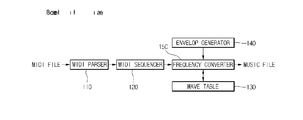
- Fig. 1 is a view schematically illustrating a construction of a MIDI player of a related art.
- the MIDI player includes: a MIDI parser 110 for extracting a plurality of notes and note play times from a MID file; a MIDI sequencer 120 for sequentially outputting the extracted note play times; a wave table 130 in which at least more than one sound sour ce sample is registered; an envelope generator 140 for generating an envelope so as to determine sizes of a volume and a pitch; and a frequency converter 150 for applying the envelope to the sound source sample registered in the wave table depending on the note play time and converting the envelope using a frequency given to the notes to output the same.
- the MIDI file can record information about music therein and include a score such as a plurality of notes, note play times, a timbre.
- the note is in formation representing a minimum unit of a sound
- a play time is a length of each note
- a scale is information about a note's height.
- seven notes e.g.: C, D, E and etc.
- the timbre represents a tone color and includes a note's unique characteristic of its own that distinguishes two notes having the same height, intensity, and length.
- the timbre is a characteristic that distinguishes a note 'C' of the piano from a note 'C' of the violin.
- the note p lay time means a play time of each of the notes included in the MIDI file and is information about the same note's length. For example, if a play time of a note 'D' is 1/8 second, a sound source that corresponds to the note 'D' is played for 1/8 second.
- Sound sources for respective instruments and for each note of the respective instruments are registered in the wave table 130.
- the note includes steps of 1 to 128.
- the envelope generator 140 is an envelope of a sound waveform for determining sizes of a volume or a pitch of sound source samples played in response to the respective notes included in the MIDI file. Therefore, the envelope has a great influence on quality while using much resources of a central processing unit (CPU).
- CPU central processing unit
- the envelope includes an envelope for a volume and an envelope for a pitch.
- the envelope for the volume is roughly classified into four steps such as an attack, a decay, a sustain, and a release.
- volume interval information Since those four steps of time information for the sound source's volume are included in volume interval information, they are used in synthesizing a sound.
- the frequency converter 150 reads a sound source sample for each note from the wave table 130 if a play time for a predetermined note is inputted, applies an envelope generated from the envelope generator 140 to the read sound source sample, and converting the envelope using a frequency given to the note to output the same.
- an oscillator can be used for the frequency converter 150.
- the frequency converter 150 converts the sound source sample of 20KHz into a sound source sample of 40KHz to output the same.
- a representative sound source sample for each note is read from the wave table 130, the read sound source sample is frequency-converted into a sound source sample that corresponds to each note. If a sound source for an arbitrary note exists on the wave table 130, the relevant sound source sample can be read and outputted from the wave table 130 from the wave table 130 without separate frequency conversion.
- the above-described process is repeatedly performed whenever the play time for each note is inputted until a MIDI play is terminated.
- the related art MIDI player sequentially performs processes of applying the envelope to the sound source sample and converting the envelope using the frequency that corresponds to each note.
- a system requires a considerable amount of operations and occupies much CPU resources.
- the MIDI file should be played and outputted in real time. Since the frequency conversion is performed for each note as described above, music might not be played in real time.
- the present invention is directed to an apparatus and a method for proces sing a bell sound that substantially obviate one or more problems due to limitations and disadvantages of the related art.
- An object of the present invention is to provide an apparatus and a method for processing a bell sound capable of reducing a system load generated by play of a bell sound.
- Another object of the present invention is to provide an apparatus and a method for processing a bell sound capable of securing rich sound quality while reducing use amount of CPU resources.
- a further another object of the present invention is to provide an apparatus and a method for processing a bell sound capable of reducing use amount of CPU resources due to frequency synthesis by controlling in advance a volume of sound sources before synthesizing a frequency.
- a still further another object of the present invention to provide an apparatus and a method for processing a bell sound capable of controlling a volume of a sound source sample using a weight for the sound sample's volume and a volume weight.
- an apparatus for processing a bell sound includes: a parser for performing a parsing so as to extract a plurality of notes, volume values, volume interval information, and note play times from an inputted MIDI file; a MIDI sequencer for sorting and outputting the parsed notes in a time order; a wave table in which a plurality of sound source samples are registered; a volume controller for controlling in advance a volume of sound source samples that correspond to the notes using the number of volume samples for each step in a volume interval of the respective notes; and a frequency converter for converting the volume-controlled sound source samples using a frequency given to each note outputted from the MIDI sequencer and outputting the same.
- a method for processing a bell sound which includes: extracting a plurality of notes, volume values, volume in terval information, and note play times from an inputted MIDI file; computing the number of volume samples for each step using the extracted volume values and the volume interval information; controlling a volume of sound source samples using the computed number of the volume samples for each step; and converting the controlled sound source samples using a frequency given to the notes.
- the present invention controls in advance the volume of the sound source samples for a bell sound to be played and then performs frequency synthesis, thereby reducing a system load due to real-time play of the bell sound.
- Fig. 1 is a block diagram of a related art MIDI player
- Fig. 2 is a block diagram of a n apparatus for processing a bell sound according to an embodiment of the present invention
- Fig. 3 is a view illustrating an envelope for a volume interval of sound source samples
- Fig. 4 is a view exemplarily illustrating that a volume of sound source samples is controlled in Fig. 2;
- Fig. 5 is a flowchart of a method for processing a bell sound according to an embodiment of the present invention.
- Fig. 2 is a schematic view illustrating a construction of an apparatus for processing a bell sound according to a preferred embodiment of the present invention.
- the apparatus for processing the bell sound includes: a MIDI parser 11 for extracting a plurality of notes, volume values, volume interval information, and note play times for the notes from a MIDI file; a MIDI sequencer 12 for sorting the note play times for the notes in a time order; a volume weight computation block 13 for computing a volume weight for each step using the extracted volume value; a sample computation block 14 for computing the number of volume samples for each step using the volume weight for each step and the volume interval information; a volume controller 15 for controlling a volume of sound source samples using the number of volume samples for each step; a frequency converter 16 for converting the controlled sound samples using a frequency given to the notes and outputting the same; and a wave table 18 in which the sound source samples are registered.
- the MIDI parser 11 parses the inputted MIDI file to extract a plurality of notes, volume values, volume interval information, and note play times for the notes.
- the MIDI file is a MIDI-based bell sound contents having score data.
- the MIDI file is stored within a terminal or downloaded from the outside through communication.
- the bell sound for the wireless terminal is mostly of a MIDI file except a basic original sound.
- the MIDI has a structure of having numerous notes and control signals for respective tracks. Accordingly, when each bell sound is played, an instrument that corresponds to each note and additional data related to the instrument are analyzed from the sound source samples, and a sound is produced and played using results thereof.
- the volume interval information includes time information for an attack, a decay, a sustain, and a release. Since the volume interval information is differently represented depending on the notes, the volume interval information may be set so that it corresponds to each note.
- an envelope for the volume is classified into four steps of an attack, a decay, a sustain, and a release. That is, a note can include an attack time during which the volume increases from zero to a maximum value for the note play time, a decay time during which the volume decreases from the maximum value to a predetermined volume, a sustain time during which the predetermined volume is sustained for a predetermined period of time, and a release time during which the volume decreases from the predetermined volume to zero and released. Since the above-described volume is so unnatural to realize an actual sound, a natural sound can be produced through a volume control. For that purpose, the envelope for the volume is controlled. In the present invention, the envelope is not controlled by the frequency converter but controlled in advance by a separate device.
- articulation data which is information representing unique characteristics of the sound source samples includes time information about the four steps of an attack, a decay, a sustain, and a release and is used in synthesizing a sound.
- the MIDI file inputted to the MIDI parser 11 is a file containing in advance information for predetermined music and stored in a storage medium or downloaded in real time.
- the MIDI file can include a plurality of notes and note play times.
- the note is information representing a sound.
- the note represents information such as 'C', 'D', and 'E'. Since the note is not an actual sound, the note should be played using actual sound sources.
- the note can be prepared in a range from 1 to 128.
- the MIDI file can be a musical piece having a beginning and end of one song.
- the musical piece can include numerous notes and time lengths of respective notes. Therefore, the MIDI file can include information about the scale and the play time that correspond to the respective note s.
- predetermined sound source samples can be registered in the wave table 18 in advance.
- the sound source samples represent the notes for the sound sources closest to an original sound.
- the sound source samples registered in the wave table 18 are so insufficient as to produce all of the notes, the sound source samples are frequen cy-converted to produce all of the notes.
- the sound source samples can be less than the notes. That is, there are limitations in making all of the 128 notes in form of the sound source samples and registering the sound samples in the wave tab le 18. Generally, only representative several sound source samples among the sound source samples for the 128 notes are registered in the wave table 18.
- the MIDI file inputted to the MIDI parser 11 can include tens of notes or all of the 128 notes depending on a score. If the MIDI file is inputted, the MIDI parser 11 parses the MIDI parser to extract a plurality of notes, volume values, volume interval information, and note play times for the notes.
- the note play time means a play time of each of the notes included in the MIDI file and is information about the same note's length.
- a play time of a note 'D' is 1/8 second
- a sound source that corresponds to the note 'D' is played for 1/8 second.
- the MIDI sequencer sorts the notes in an order of the note play time. That is, the MIDI sequencer 12 sorts the notes in a time order for the respective tracks or the respective instruments.
- the parsed volume values are inputted to the volume weight computation block 13 and the volume interval information is inputted to the sample computation block 14.
- the volume weight computation block 13 divides the inputted volume value into a plurality of steps between ze ro and one and applies a volume value for each step to the following equation 1 to compute the volume weight value.
- Wev (1-V) /log10 (1/V)
- Wev (weight of envelope) is the volume weight for each step and represents an envelope -applied time weight
- V represents the volume value for each step.
- the volume weight for each step can be computed as many as the number of the steps divided from the volume value. For example, presuming that the volume value is divided into ten steps between zero and one, the volume value can be divided into total ten steps of 0.1, 0.2, ... ,1. At this point, the dividing of the volume value into a plurality of steps should be optimized. That is, as the volume value is divided into more steps (e.g., more than ten steps), the volume is generated in a more natural manner but instead the CPU operation amount is increased as much as that. On the contrary, as the volume value is divided into the lesser steps (e.g., less than ten steps), the volume is not generated in a less natural manner. Therefore, it is preferable to divide the volume value into optimized steps with consideration of the CPU operation amount and the natural volume.
- the volume weight for each step computed by the volume weight computation block 13 is inputted to the sample computation block 14.
- the sample computation block 14 computes the number of the volume samples using the volume weight for each step inputted from the volume weight computation block 13 and the volume interval information inputted from the MIDI parser 11.
- the sample computation block 14 determines a final time for each volume interval that will be applied in the volume interval information using the volume weight for each step.
- the volume interval information contains time intervals set for the respective intervals currently determined, i.e., an attack time, a decay time, a sustain time, and a release time. At this point, the times for the respective volume intervals are newly determined by the volume weights for each step computed above, so that the final time for the respective volume intervals are determined.
- the numbers of the volume samples for each step in the respective volume interval where a final time has been determined are computed using the volume weight for each step.
- Sev is proportional to Wev and inverse-proportional to SR, Wnote, and Td.
- the Sev is obtained by diving Wev by a product SR*Wnote*Td.
- the numbers of the volume samples for each step (Sev) in the respective volume interval where the final time has been determined are computed using the equation 2. At this point, the computed number of the volume samples exists as many as the number of the steps of the volume values.
- the number of the volume samples for each step can be constructed in form of a table as provided by the following equation 3.
- Table [Nvol] ⁇ Sev1, Sev2, Sev3,..,SevNvol ⁇ where Nvol represents the number of the steps of the volume value.
- the table contains the number of the volume samples of ten in total. That is, the number of elements in the table is the same as the number of the steps of the volume.
- the volume controller 15 controls a volume of the sound source samples using the number of the volume samples represented by the table.
- a straight line having the number of the first volume samples (Sev1) and the number of the second volume samples (Sev2) for its both ends is made, a point P2 on the straight line that corresponds to a sample S12 is multiplied by a weight W1.
- a volume value between zero and one for each step is multiplied by a current volume that is to be applied to an actual sound, so that final volume values that are to be multiplied by each sample are computed in advance.
- the MIDI sequencer 12 receives a plurality of notes and note play times from the MIDI parser 11, and sequentially outputs the note play times for the notes to the frequency converter 16 after a predetermined period of time elapses.
- the frequency converter 16 converts the sound source samples whose volumes have been controlled by the volume controller 15 using a frequency given to each of the notes outputted from the MIDI sequencer 12 and outputs a music file to the outside.
- the present invention can be applied in the same way to all of the notes included in the MIDI file in connection with the playing of the bell sound on the basis of the above case.
- Fig. 5 is a flowchart of a method for processing a bell sound according to an embodiment of the present invention.
- note play information and volume information are extracted from the inputted MIDI file (S21).
- the note play information includes a plurality of notes and play times for respective notes included in the MIDI file.
- the volume information includes a volume value of each note and the volume interval information.
- the number of volume samples for each step is computed using the extracted volume information (S23).
- the volume value included in the volume information is divided into optimized steps, and then the volume weight for each step is computed. Further, the final time for each volume interval is newly determined using the volume weight for each step, and the number of volume samples for each step in the respective volume interval is computed.
- a volume control of the volume of the sound source samples that correspond to the note play information is performed using the number of volume samples for each step (S25). After that, the sound source samples whose volumes have been controlled are converted using a frequency given to the notes and outputted (S27).
- the frequency converter does not control the volume. Instead, the volumes for the sound source samples are controlled in advance so that they may be appropriate for the respective notes and the frequency converter converts and outputs only the frequency of the sound source samples whose volumes have been controlled. According to the related art, conge stion in operation amounts is generated and a CPU overload is thus caused as the frequency is converted and outputted in real time whenever loop data is repeated.
- the present invention can suppress the CPU overload and realize a MIDI play of more efficiency and high reliability.
Landscapes
- Engineering & Computer Science (AREA)
- Physics & Mathematics (AREA)
- Acoustics & Sound (AREA)
- Multimedia (AREA)
- General Engineering & Computer Science (AREA)
- Electrophonic Musical Instruments (AREA)
Applications Claiming Priority (2)
| Application Number | Priority Date | Filing Date | Title |
|---|---|---|---|
| KR1020040019381A KR100636906B1 (ko) | 2004-03-22 | 2004-03-22 | 미디 재생 장치 그 방법 |
| KR2004019381 | 2004-03-22 |
Publications (1)
| Publication Number | Publication Date |
|---|---|
| EP1580728A1 true EP1580728A1 (fr) | 2005-09-28 |
Family
ID=34858867
Family Applications (1)
| Application Number | Title | Priority Date | Filing Date |
|---|---|---|---|
| EP05102181A Withdrawn EP1580728A1 (fr) | 2004-03-22 | 2005-03-18 | Appareil te méthode pour le traitement d'une sonnerie. |
Country Status (4)
| Country | Link |
|---|---|
| US (1) | US7427709B2 (fr) |
| EP (1) | EP1580728A1 (fr) |
| KR (1) | KR100636906B1 (fr) |
| CN (1) | CN1674089A (fr) |
Families Citing this family (7)
| Publication number | Priority date | Publication date | Assignee | Title |
|---|---|---|---|---|
| US7663046B2 (en) * | 2007-03-22 | 2010-02-16 | Qualcomm Incorporated | Pipeline techniques for processing musical instrument digital interface (MIDI) files |
| US7674970B2 (en) * | 2007-05-17 | 2010-03-09 | Brian Siu-Fung Ma | Multifunctional digital music display device |
| JP2011064961A (ja) * | 2009-09-17 | 2011-03-31 | Toshiba Corp | 音声再生装置および方法 |
| KR101365592B1 (ko) * | 2013-03-26 | 2014-02-21 | (주)테일러테크놀로지 | Mgi음악 파일 생성 시스템 및 방법 |
| CN105761733A (zh) * | 2016-02-02 | 2016-07-13 | 腾讯科技(深圳)有限公司 | 生成歌词文件的方法和装置 |
| CN106548768B (zh) * | 2016-10-18 | 2018-09-04 | 广州酷狗计算机科技有限公司 | 一种音符修正的方法和装置 |
| CN108668028B (zh) * | 2018-05-29 | 2020-11-20 | 北京小米移动软件有限公司 | 消息提示方法、装置及存储介质 |
Citations (4)
| Publication number | Priority date | Publication date | Assignee | Title |
|---|---|---|---|---|
| US4336736A (en) * | 1979-01-31 | 1982-06-29 | Kabushiki Kaisha Kawai Gakki Seisakusho | Electronic musical instrument |
| EP0600639A2 (fr) * | 1992-12-03 | 1994-06-08 | International Business Machines Corporation | Dispositif et méthode pour configurer des synthétiseurs de manière dynamique |
| WO1998011531A1 (fr) * | 1996-09-13 | 1998-03-19 | Cirrus Logic, Inc. | Filtre forçant la periodicite d'une onde, destine au pretraitement d'echantillons sonores dans un synthetiseur de table d'echantillonnage |
| US6392135B1 (en) * | 1999-07-07 | 2002-05-21 | Yamaha Corporation | Musical sound modification apparatus and method |
Family Cites Families (41)
| Publication number | Priority date | Publication date | Assignee | Title |
|---|---|---|---|---|
| US5117726A (en) * | 1990-11-01 | 1992-06-02 | International Business Machines Corporation | Method and apparatus for dynamic midi synthesizer filter control |
| US5119711A (en) * | 1990-11-01 | 1992-06-09 | International Business Machines Corporation | Midi file translation |
| JP2890831B2 (ja) * | 1990-11-28 | 1999-05-17 | ヤマハ株式会社 | Midiコード作成装置 |
| JPH0594191A (ja) * | 1991-10-01 | 1993-04-16 | Roland Corp | 電気弦楽器用ピツクアツプの周波数特性補償装置 |
| US5315057A (en) * | 1991-11-25 | 1994-05-24 | Lucasarts Entertainment Company | Method and apparatus for dynamically composing music and sound effects using a computer entertainment system |
| JP3404775B2 (ja) * | 1992-10-28 | 2003-05-12 | ヤマハ株式会社 | 楽音合成装置と方法 |
| US5471006A (en) * | 1992-12-18 | 1995-11-28 | Schulmerich Carillons, Inc. | Electronic carillon system and sequencer module therefor |
| GB2296123B (en) * | 1994-12-13 | 1998-08-12 | Ibm | Midi playback system |
| WO1997015914A1 (fr) * | 1995-10-23 | 1997-05-01 | The Regents Of The University Of California | Structure de controle destinee a la synthese des sons |
| JP2962217B2 (ja) * | 1995-11-22 | 1999-10-12 | ヤマハ株式会社 | 楽音生成装置及び方法 |
| US6199163B1 (en) * | 1996-03-26 | 2001-03-06 | Nec Corporation | Hard disk password lock |
| US5837914A (en) * | 1996-08-22 | 1998-11-17 | Schulmerich Carillons, Inc. | Electronic carillon system utilizing interpolated fractional address DSP algorithm |
| SG67993A1 (en) * | 1996-08-30 | 1999-10-19 | Yamaha Corp | Sound source system based on computer software and method of generating acoustic waveform data |
| US5917917A (en) * | 1996-09-13 | 1999-06-29 | Crystal Semiconductor Corporation | Reduced-memory reverberation simulator in a sound synthesizer |
| US5744739A (en) * | 1996-09-13 | 1998-04-28 | Crystal Semiconductor | Wavetable synthesizer and operating method using a variable sampling rate approximation |
| US5824936A (en) * | 1997-01-17 | 1998-10-20 | Crystal Semiconductor Corporation | Apparatus and method for approximating an exponential decay in a sound synthesizer |
| US5811706A (en) * | 1997-05-27 | 1998-09-22 | Rockwell Semiconductor Systems, Inc. | Synthesizer system utilizing mass storage devices for real time, low latency access of musical instrument digital samples |
| DE60018626T2 (de) * | 1999-01-29 | 2006-04-13 | Yamaha Corp., Hamamatsu | Vorrichtung und Verfahren zur Eingabe von Steuerungsdateien für Musikvorträge |
| JP3741560B2 (ja) * | 1999-03-18 | 2006-02-01 | 株式会社リコー | メロディ音発生装置 |
| JP2001100760A (ja) * | 1999-09-27 | 2001-04-13 | Yamaha Corp | 波形生成方法及び装置 |
| DE19948974A1 (de) * | 1999-10-11 | 2001-04-12 | Nokia Mobile Phones Ltd | Verfahren zum Erkennen und Auswählen einer Tonfolge, insbesondere eines Musikstücks |
| US6225546B1 (en) * | 2000-04-05 | 2001-05-01 | International Business Machines Corporation | Method and apparatus for music summarization and creation of audio summaries |
| FR2808370A1 (fr) * | 2000-04-28 | 2001-11-02 | Cit Alcatel | Procede de compression d'un fichier midi |
| US7126051B2 (en) * | 2001-03-05 | 2006-10-24 | Microsoft Corporation | Audio wave data playback in an audio generation system |
| US6806412B2 (en) * | 2001-03-07 | 2004-10-19 | Microsoft Corporation | Dynamic channel allocation in a synthesizer component |
| WO2002077585A1 (fr) * | 2001-03-26 | 2002-10-03 | Sonic Network, Inc. | Systeme et procede de creation et d'arrangement musicaux |
| US20030037237A1 (en) * | 2001-04-09 | 2003-02-20 | Jean-Paul Abgrall | Systems and methods for computer device authentication |
| US6928648B2 (en) * | 2001-04-20 | 2005-08-09 | Sun Microsystems, Inc. | Method and apparatus for a mobile multimedia java framework |
| KR100393617B1 (ko) * | 2001-07-11 | 2003-08-02 | 삼성전자주식회사 | 외팔보형 거치대와, 이에 거치되는 핸드셋을 구비한 전화기 |
| US7065380B2 (en) * | 2001-07-19 | 2006-06-20 | Texas Instruments Incorporated | Software partition of MIDI synthesizer for HOST/DSP (OMAP) architecture |
| JP3649197B2 (ja) * | 2002-02-13 | 2005-05-18 | ヤマハ株式会社 | 楽音生成装置および楽音生成方法 |
| US6898729B2 (en) * | 2002-03-19 | 2005-05-24 | Nokia Corporation | Methods and apparatus for transmitting MIDI data over a lossy communications channel |
| US7863513B2 (en) * | 2002-08-22 | 2011-01-04 | Yamaha Corporation | Synchronous playback system for reproducing music in good ensemble and recorder and player for the ensemble |
| KR100453142B1 (ko) * | 2002-10-17 | 2004-10-15 | 주식회사 팬택 | 이동통신 단말기에서의 사운드 압축 방법 |
| TWI235356B (en) * | 2003-04-28 | 2005-07-01 | Mediatek Inc | Waveform adjustable system for music file |
| TWI252468B (en) * | 2004-02-13 | 2006-04-01 | Mediatek Inc | Wavetable synthesis system with memory management according to data importance and method of the same |
| US7002069B2 (en) * | 2004-03-09 | 2006-02-21 | Motorola, Inc. | Balancing MIDI instrument volume levels |
| EP1805761A4 (fr) * | 2004-10-22 | 2011-03-30 | Lg Electronics Inc | Appareil et procede permettant de reproduire un fichier midi |
| KR100678163B1 (ko) * | 2005-02-14 | 2007-02-02 | 삼성전자주식회사 | 휴대용 단말기에서 연주 기능을 수행하는 장치 및 방법 |
| KR100717491B1 (ko) * | 2005-04-18 | 2007-05-14 | 엘지전자 주식회사 | 음악 작곡 장치 및 그 운용방법 |
| US7548853B2 (en) * | 2005-06-17 | 2009-06-16 | Shmunk Dmitry V | Scalable compressed audio bit stream and codec using a hierarchical filterbank and multichannel joint coding |
-
2004
- 2004-03-22 KR KR1020040019381A patent/KR100636906B1/ko not_active Expired - Fee Related
-
2005
- 2005-03-18 EP EP05102181A patent/EP1580728A1/fr not_active Withdrawn
- 2005-03-21 US US11/085,950 patent/US7427709B2/en not_active Expired - Fee Related
- 2005-03-22 CN CNA2005100564611A patent/CN1674089A/zh active Pending
Patent Citations (4)
| Publication number | Priority date | Publication date | Assignee | Title |
|---|---|---|---|---|
| US4336736A (en) * | 1979-01-31 | 1982-06-29 | Kabushiki Kaisha Kawai Gakki Seisakusho | Electronic musical instrument |
| EP0600639A2 (fr) * | 1992-12-03 | 1994-06-08 | International Business Machines Corporation | Dispositif et méthode pour configurer des synthétiseurs de manière dynamique |
| WO1998011531A1 (fr) * | 1996-09-13 | 1998-03-19 | Cirrus Logic, Inc. | Filtre forçant la periodicite d'une onde, destine au pretraitement d'echantillons sonores dans un synthetiseur de table d'echantillonnage |
| US6392135B1 (en) * | 1999-07-07 | 2002-05-21 | Yamaha Corporation | Musical sound modification apparatus and method |
Also Published As
| Publication number | Publication date |
|---|---|
| CN1674089A (zh) | 2005-09-28 |
| KR100636906B1 (ko) | 2006-10-19 |
| US7427709B2 (en) | 2008-09-23 |
| KR20050094214A (ko) | 2005-09-27 |
| US20050204903A1 (en) | 2005-09-22 |
Similar Documents
| Publication | Publication Date | Title |
|---|---|---|
| JP2001100760A (ja) | 波形生成方法及び装置 | |
| JP3654079B2 (ja) | 波形生成方法及び装置 | |
| JP3654083B2 (ja) | 波形生成方法及び装置 | |
| EP1580728A1 (fr) | Appareil te méthode pour le traitement d'une sonnerie. | |
| JP3654080B2 (ja) | 波形生成方法及び装置 | |
| JP3654082B2 (ja) | 波形生成方法及び装置 | |
| US20050188819A1 (en) | Music synthesis system | |
| JP3654084B2 (ja) | 波形生成方法及び装置 | |
| KR100598209B1 (ko) | Midi 재생 장치 및 방법 | |
| US20060086238A1 (en) | Apparatus and method for reproducing MIDI file | |
| EP1571647A1 (fr) | Dispositif et méthode pour le traitement d'une sonnerie | |
| KR100689495B1 (ko) | Midi 재생 장치 및 방법 | |
| RU2314502C2 (ru) | Устройство и способ для обработки звука звонка | |
| KR20060067721A (ko) | 미디 합성 방법 | |
| KR100598208B1 (ko) | Midi 재생 장치 및 방법 | |
| KR100598207B1 (ko) | Midi 재생 장치 및 방법 | |
| KR20210050647A (ko) | 악기 디지털 인터페이스 재생 장치 및 방법 | |
| KR100636905B1 (ko) | 미디 재생 장치 그 방법 | |
| JP3933161B2 (ja) | 波形生成方法及び装置 | |
| JP3674527B2 (ja) | 波形生成方法及び装置 | |
| KR100547340B1 (ko) | 미디 재생 장치 그 방법 | |
| JP3933162B2 (ja) | 波形生成方法及び装置 | |
| JPH10307581A (ja) | 波形データ圧縮装置および方法 | |
| JP2006091460A (ja) | 音源用波形データの決定装置 | |
| JPH0340396B2 (fr) |
Legal Events
| Date | Code | Title | Description |
|---|---|---|---|
| PUAI | Public reference made under article 153(3) epc to a published international application that has entered the european phase |
Free format text: ORIGINAL CODE: 0009012 |
|
| AK | Designated contracting states |
Kind code of ref document: A1 Designated state(s): AT BE BG CH CY CZ DE DK EE ES FI FR GB GR HU IE IS IT LI LT LU MC NL PL PT RO SE SI SK TR |
|
| AX | Request for extension of the european patent |
Extension state: AL BA HR LV MK YU |
|
| RIN1 | Information on inventor provided before grant (corrected) |
Inventor name: LEE, JUN YUP Inventor name: LEE, JAE HYUCK Inventor name: SONG, JUNG MIN Inventor name: PARK, YONG CHUL |
|
| 17P | Request for examination filed |
Effective date: 20060206 |
|
| AKX | Designation fees paid |
Designated state(s): DE FR GB NL |
|
| GRAP | Despatch of communication of intention to grant a patent |
Free format text: ORIGINAL CODE: EPIDOSNIGR1 |
|
| STAA | Information on the status of an ep patent application or granted ep patent |
Free format text: STATUS: THE APPLICATION IS DEEMED TO BE WITHDRAWN |
|
| 18D | Application deemed to be withdrawn |
Effective date: 20081111 |