EP1580905A2 - Verfahren zur Überwachung der Verstärkung eines optischen Verstärkers und Vorrichtung dafür - Google Patents
Verfahren zur Überwachung der Verstärkung eines optischen Verstärkers und Vorrichtung dafür Download PDFInfo
- Publication number
- EP1580905A2 EP1580905A2 EP04020978A EP04020978A EP1580905A2 EP 1580905 A2 EP1580905 A2 EP 1580905A2 EP 04020978 A EP04020978 A EP 04020978A EP 04020978 A EP04020978 A EP 04020978A EP 1580905 A2 EP1580905 A2 EP 1580905A2
- Authority
- EP
- European Patent Office
- Prior art keywords
- light
- optical
- monitor light
- optical amplifier
- section
- Prior art date
- Legal status (The legal status is an assumption and is not a legal conclusion. Google has not performed a legal analysis and makes no representation as to the accuracy of the status listed.)
- Granted
Links
Images



Classifications
-
- H—ELECTRICITY
- H04—ELECTRIC COMMUNICATION TECHNIQUE
- H04B—TRANSMISSION
- H04B10/00—Transmission systems employing electromagnetic waves other than radio-waves, e.g. infrared, visible or ultraviolet light, or employing corpuscular radiation, e.g. quantum communication
- H04B10/07—Arrangements for monitoring or testing transmission systems; Arrangements for fault measurement of transmission systems
- H04B10/075—Arrangements for monitoring or testing transmission systems; Arrangements for fault measurement of transmission systems using an in-service signal
- H04B10/079—Arrangements for monitoring or testing transmission systems; Arrangements for fault measurement of transmission systems using an in-service signal using measurements of the data signal
- H04B10/0797—Monitoring line amplifier or line repeater equipment
-
- H—ELECTRICITY
- H04—ELECTRIC COMMUNICATION TECHNIQUE
- H04B—TRANSMISSION
- H04B10/00—Transmission systems employing electromagnetic waves other than radio-waves, e.g. infrared, visible or ultraviolet light, or employing corpuscular radiation, e.g. quantum communication
- H04B10/07—Arrangements for monitoring or testing transmission systems; Arrangements for fault measurement of transmission systems
- H04B10/075—Arrangements for monitoring or testing transmission systems; Arrangements for fault measurement of transmission systems using an in-service signal
- H04B10/077—Arrangements for monitoring or testing transmission systems; Arrangements for fault measurement of transmission systems using an in-service signal using a supervisory or additional signal
- H04B10/0777—Monitoring line amplifier or line repeater equipment
-
- H—ELECTRICITY
- H04—ELECTRIC COMMUNICATION TECHNIQUE
- H04B—TRANSMISSION
- H04B10/00—Transmission systems employing electromagnetic waves other than radio-waves, e.g. infrared, visible or ultraviolet light, or employing corpuscular radiation, e.g. quantum communication
- H04B10/29—Repeaters
- H04B10/291—Repeaters in which processing or amplification is carried out without conversion of the main signal from optical form
- H04B10/293—Signal power control
- H04B10/2931—Signal power control using AGC
-
- H—ELECTRICITY
- H04—ELECTRIC COMMUNICATION TECHNIQUE
- H04B—TRANSMISSION
- H04B2210/00—Indexing scheme relating to optical transmission systems
- H04B2210/07—Monitoring an optical transmission system using a supervisory signal
- H04B2210/077—Monitoring an optical transmission system using a supervisory signal using a separate fibre
Definitions
- the present invention relates to a gain monitoring method and an apparatus thereof, for monitoring accurately a signal gain in an optical amplifier used for optical communications.
- WDM wavelength division multiplexing
- an optical amplifier for compensating for a transmission loss in an optical fiber is used, to enable the long-distance transmission.
- the optical amplifier used for the WDM system for example, there is used a rare-earth element doped optical fiber amplifier, a Raman amplifier, or a semiconductor optical amplifier.
- EDFA erbium doped optical fiber amplifier
- the EDFA has become in practical use as the optical amplifier capable of amplifying a light in a C-band (conventional band) of 1530nm to 1566nm being a wavelength band in which a loss of optical fiber is low, or a light in an L-band (long wavelength band) of 1570nm to 1610nm. Further, in recent years, the introduction of semiconductor optical amplifier has been studied for the purpose of compensating for an optical loss during optical transmission for a short or middle distance in a metro-network or the like.
- a control of an optical amplification operation such as, a gain constant control (automatic gain control: AGC) for controlling a signal light gain, which is a ratio between input signal light power and output signal light power to and from the optical amplifier, to be constant, an output constant control (automatic level control: ALC) for controlling the output signal light power to be constant, or the like (refer to Japanese Unexamined Patent Publication No. 8-18136).
- a gain constant control automatic gain control: AGC
- ALC automatic level control
- a light amplified spontaneous emission (ASE) light
- ASE amplified spontaneous emission
- the generation amount of the noise light is set as a function of the input light power to the optical amplifier, to calculate the generation amount of the noise light according to a monitor result of the input light power, and a control error in the optical amplification operation is corrected based on the calculation result (refer to Japanese Unexamined Patent Publication No. 2000-232433).
- a technique in which a noise light is extracted from an output light of an optical amplifier utilizing an optical filer for noise light elimination, to monitor the power of the noise light, thereby supervising a noise figure of the optical amplifier (refer to Japanese Unexamined Patent Publication No. 6-132905).
- the generation amount of the noise light generated inside the optical amplifier is hardly to be accurately detected. Namely, in the case where the generation amount of the noise light is calculated according to the input light power to the optical amplifier, the generation amount of the noise light is indirectly obtained based on a measurement result of the input light power, and accordingly, an actually generated noise light is not directly detected. Therefore, there is a possibility of an error in the calculated generation amount of the noise light. Further, in the case where the power of the noise light is monitored utilizing the optical filter for noise light elimination, since the noise light power in a band deviated from a signal light wavelength is monitored, there is a possibility of an error due to a difference of wavelength.
- the present invention has been accomplished in view of the above problems, and it is an object of the present invention to realize a gain monitoring method and an apparatus thereof, capable of detecting a gain of a signal light regardless of a noise light generated inside an optical amplifier, and to provide an apparatus capable of controlling with high accuracy an operation of the optical amplifier using the same.
- a gain monitoring method for an optical amplifier comprises: (A) branching a part of a signal light input to the optical amplifier as an input monitor light; (B) branching a part of a light output from the optical amplifier as an output monitor light; (C) modulating the branched input monitor light; (D) multiplexing the modulated input monitor light and the branched output monitor light; (E) receiving the multiplexed monitor light to convert it into an electrical signal, and thereafter, extracting an interference component generated due to the modulated input monitor light and the branched output monitor light, which is contained in the electrical signal; and (F) detecting a gain for the signal light in the optical amplifier based on the extracted interference component.
- a gain monitoring apparatus for an optical amplifier comprises: a first optical branching section that branches a part of a signal light input to the optical amplifier as an input monitor light; a second optical branching section that branches a part of a light output from the optical amplifier as an output monitor light; a modulating section that modulates the input monitor light branched in the first optical branching section; a multiplexing section that multiplexes the input monitor light modulated in the modulating section and the output monitor light branched in the second optical branching section; an optical detecting section that receives the multiplexed light output from the multiplexing section to convert it into an electrical signal; a filter section that extracts an interference component generated due to the input monitor light modulated in the modulating section and the output monitor light branched in the second optical branching section, which is contained in the electrical signal output from the optical detecting section; and a gain detecting section that detects a gain for the signal light in the optical amplifier based on the interference component extracted in the filter section.
- the multiplexed light contains the interference component (beat component), which is changed in proportion to the gain of the optical amplifier regardless of a noise light generated in the optical amplifier, due to the interference by the input monitor light and the output monitor light. Therefore, by extracting the interference component from the electrical signal obtained by photo-electrically converting the multiplexed light, it becomes possible to detect the gain for the signal light in the optical amplifier.
- the gain monitoring method for the optical amplifier and the apparatus thereof in the present invention it is possible to accurately detect the gain for the signal light regardless of the noise light generated inside the optical amplifier. If an operation of the optical amplifier is controlled utilizing the method and apparatus, it becomes possible to realize a high accurate operation control.
- FIG. 1 is a block diagram showing one embodiment of an apparatus applied with a gain monitoring method for an optical amplifier according to the present invention.
- the present apparatus comprises: an optical branching device 11 as a first branching section that branches a part of a signal light Lin input to an optical amplifier 100, as an input monitor light; a phase shifter 12 as a phase adjusting section that adjusts a phase of the input monitor light; an intensity modulator 13 as a modulating section that modulates the input monitor light output from the phase shifter 12; a polarization controller 14 as a polarization state adjusting section that controls a polarization state of the modulated input monitor light; an optical branching device 15 as a second optical branching section that branches a part of a signal light Lout output from the optical amplifier 100, as an output monitor light; an optical multiplexer 16 as an optical multiplexing section that multiplexes the input monitor light output from the polarization controller 14 and the output monitor light output from the optical branching device 15; an optical detector 17 as an optical detecting section that detects the multiplexed light; a frequency cutoff filter (BPF) 18 as a filter section that extracts an interference component
- the optical amplifier 100 is a known optical amplifier, which outputs the input signal light Lin after amplification, and generates a noise light with an optical amplification operation thereof.
- the optical amplifier 100 there is a rare-earth element doped fiber amplifier, a Raman amplifier, a semiconductor optical amplifier or the like.
- the optical branching device 11 branches the light given to an input port thereof at a previously set proportion, and outputs one of the branched lights to the optical amplifier 100 while outputting the other branched light to the phase shifter 12 as an input monitor light M1.
- the phase shifter 12 adjusts a phase of the input monitor light M1 output from the optical branching device 11, so that phases of the input side and output side monitor lights to be multiplexed by the optical multiplexer 16, are aligned.
- the phase shifter 12 it is possible to use a known optical device having a configuration to change a phase utilizing the alteration in refractive index due to a thermal optical effect and the like.
- the configuration of the phase shifter 12 is not limited to the above example.
- phase shifter 12 is arranged on an optical path between the optical branching device 11 and the intensity modulator 13
- the arrangement of the phase shifter 12 can be changed, and accordingly, the phase shifter 12 may be arranged on an arbitrary position on the optical path between the optical branching device 11 and the optical multiplexer 16, through which the input monitor light is propagated, or on an arbitrary position on the optical path between the optical branching device 15 and the optical multiplexer 16, through which the output monitor light is propagated.
- the intensity modulator 13 modulates the intensity of the input monitor light output from the phase shifter 12 in accordance with a modulation signal having a frequency 2 ⁇ f sufficiently lower than a modulation frequency of the signal light Lin input to the optical amplifier 100.
- the modulation frequency 2 ⁇ f in this intensity modulator 13 is set to be lower than the modulation frequency of the signal light Lin by two digits or above.
- the modulation frequency of the signal light Lin is 10GHz, it is preferable to set the modulation frequency in the intensity modulator 13 at about several tens MHz to several hundreds MHz.
- an intensity modulator 13 it is possible to use the one performing the intensity modulation on the monitor light using a magnetic optical device or a Pockels cell. Note, although one example is shown in which the intensity modulation is performed on the input monitor light, the present invention is not limited to this example, and the input monitor light may be modulated by another modulation system other than the intensity modulation.
- the polarization controller 14 adjusts a polarization state of an input monitor light M2 output from the intensity modulator 13, so that polarization states of the input and output monitor lights to be multiplexed by the optical multiplexer 16 are coincident with each other.
- the polarization controller 14 is arranged on the optical path between the intensity modulator 13 and the optical multiplexer 16.
- the arrangement of the polarization controller 14 can be changed, and the polarization controller 14 may be arranged on an arbitrary position on the optical path between the optical branching device 11 and the optical multiplexer 16, through which the input monitor light is propagated, or on an arbitrary position on the optical path between the optical branching device 15 and the optical multiplexer 16, through which the output monitor light is propagated.
- the optical branching device 15 branches the light output from the optical amplifier 100 at a previously set proportion, and outputs one of the branched lights to the outside as an output signal light Lout while outputting the other branched light to the optical multiplexer 16 as an output monitor light M3.
- the optical multiplexer 16 is given with the input monitor light M2 output from the polarization controller 14 at one of input ports thereof and with the output monitor light M3 branched by the optical branching device 15 at the other input port thereof, and multiplexes the input monitor light M2 and the output monitor light M3 using a half-mirror or the like, to output a multiplexed light M4 to the optical detector 17.
- the optical detector 17 receives the multiplexed light M4 output from the optical multiplexer 16, and generates an electrical signal whose voltage level is changed according to the power of the multiplexed light M4, to output the electrical signal to the frequency cutoff filter 18.
- the frequency cutoff filter 18 is an electrical filter having a narrow passband with a frequency ⁇ f half (1/2 times) the modulation frequency 2 ⁇ f in the intensity modulator 13 as the center, which extracts the interference component (beat component) generated due to the modulated input monitor light and the output monitor light, which is contained in the electrical signal output from the optical detector 17, to output the interference component to the gain detection circuit 19.
- this frequency cutoff filter 18 it is possible to use a bandpass filter, a lock-in amplifier or the like.
- the gain detection circuit 19 obtains the signal gain in the optical amplifier 100 according to the voltage level of the electrical signal of the frequency ⁇ f passed through the frequency cutoff filter 18, to output a signal indicating the signal gain to the optical amplifier 100.
- an AGC, an ALC or the like is performed based on the output signal from the gain detection circuit 19.
- a part of the signal light Lin input to the optical amplifier 100 is branched by the optical branching device 11 as the input monitor light M1, and the input monitor light M1 is given to the intensity modulator 13 via the phase shifter 12 to be subjected to the intensity modulation at the frequency 2 ⁇ f .
- the intensity modulated input monitor light M2 is sent to the optical multiplexer 16 via the polarization controller 14.
- the signal light Lin passed through the optical branching device 11 is input to the optical amplifier 100 to be amplified up to a required level.
- the noise light is generated due to the amplification operation of the signal light, to be output together with the signal light (refer to FIG. 8).
- a part of the output light Lout from the optical amplifier 100 is branched by the optical branching device 11 to be sent to the optical multiplexer 16 as the output monitor light M3.
- the input monitor light M2 and the output monitor light M3, reached the optical multiplexer 16 are signals of the phases aligned with each other and the polarization states coincident with each other, as a result that the phase and the polarization state of the input monitor light M2 are adjusted, respectively, by the phase shifter 12 and the polarization controller 14 arranged on the monitoring optical path on an input side.
- Such input monitor light M2 and output monitor light M3 are multiplexed by the optical multiplexer 16, so that the multiplexed light M4 having the beat component of the frequency ⁇ f is output to the optical detector 17.
- the multiplexed light M4 has a waveform of steady state without the beat component.
- a time is represented by t
- an electric field of the input light to the optical amplifier is represented by Ein(k, t)
- an electric field of the output light from the optical amplifier is represented by Eout(k, t).
- an electric field Emix(k, t) of the lights multiplexed by the optical multiplexer 16 can be expressed by the following equation (1).
- Emix(k, t) ⁇ ⁇ Ein(k, t) ⁇ Cos( ⁇ f ⁇ t) + ⁇ ⁇ Eout(k, t)
- Eout(k, t) of the output light from the optical amplifier 100 can be expressed by the following equation (2), if an electric field of the ASE light is Ease(k, t) and the signal gain is G.
- Eout(k,t) G ⁇ Ein(k,t) + Ease(k,t)
- the power Pmix of the light detected by the optical detector 17 can be expressed by the following equation (4), if a symbol indicating a time average is represented by ⁇ .
- Pmix(k) ⁇ k
- Pmix(k) ⁇ k ⁇ Emix(k, t) 2 ⁇
- a first term represents the power of the input light
- a second term represents the power of the output light
- a third term represents a generation amount of the ASE light.
- the last fifth term which is a term caused by multiplexing the input light and the output light, is called an interference term.
- the electrical signal output from the optical detector 17 for example as shown in FIG. 4, voltages corresponding to the first to third terms in the equation (6) are concentrated in the vicinity of the frequency 0, the voltage corresponding to the fourth term has the component of the frequency 2 ⁇ f , and the voltage corresponding to the interference term has the component of the frequency ⁇ f .
- the voltage level of the frequency ⁇ f is changed in proportion to G . Therefore, the component of the frequency ⁇ f is extracted by the frequency cutoff filter 18 to be processed by the gain detection circuit 19, thereby enabling the gain detection of the optical amplifier 100 for only the signal light component, which does not contain the noise light.
- the signal gain detected by the gain detection circuit 19 is fed back to the optical amplifier 100, and the optical amplification operation control of AGC, ALC or the like is performed based on the signal gain, so that an extremely high accurate control can be realized without an influence of the noise light generated inside the optical amplifier 100.
- FIG. 5 is a block diagram showing a configuration of an embodiment in which the present invention is applied to an EDFA.
- the configuration shown in FIG. 5 is an example in the case where for example a known EDFA in which the optical amplification is performed in two-stages, is used for the optical amplifier 100 in the configuration shown in FIG. 1.
- a former stage optical amplification section consisting of an erbium doped fiber (EDF) 101A, a pumping light source (LD) 102A and a WDM coupler 103A
- a latter stage optical amplification section consisting of an EDF 101 B, a pumping light source 102B and a WDM coupler 103B
- EDF erbium doped fiber
- LD pumping light source
- WDM coupler 103A WDM coupler
- a latter stage optical amplification section consisting of an EDF 101 B, a pumping light source 102B and a WDM coupler 103B
- GEQ gain equalizer
- the signal light Lin passed through the optical branching device 11 is input to the former stage optical amplification section via the optical isolator 105A, and passes through the WDM coupler 103A to be sent to the EDFA 101 A.
- a pumping light Lp generated in the pumping light source 102A which is driven by an LD driving circuit 104, is supplied to the EDFA 101A via the WDM coupler 103A, so that the signal light propagated through the EDFA 101 A is amplified due to the stimulated emission function of the pumped erbium. Further, when the signal light is amplified, the ASE light is generated to become the noise light, and is output together with the signal light.
- the output light from the EDFA 101 A is input to the latter stage optical amplification section via the optical isolator 105B, the gain equalizer 106 and the optical attenuator 107, and passes through the WDM coupler 103B to be sent to the EDF 101 B.
- a pumping light Lp generated in the pumping light source 102B which is driven by the LD driving circuit 104, is supplied to the EDF 101 B via the WDM coupler 103B, so that the signal light propagated through the EDF 101 B is amplified and also the ASE light is generated.
- the light output from the EDF 101 B is sent to the optical branching device 15 via an optical isolator 105C.
- the gain equalizer 106 having a loss wavelength characteristic corresponding to gain wavelength characteristics of the former and latter optical amplification sections, is a known optical device for equalizing the power of the post-amplified signal lights having each wavelength. Further, the optical attenuator 107 is for adjusting the power of the light input to the latter optical amplification section, so that the power of the output light Lout is fixed at a required level.
- a part of the signal light Lin input to the former stage EDF 101 A is branched by the optical branching device 11 as the input monitor light, and passes through the phase shifter 12, the intensity modulator 13 and the polarization controller 14 in this order, and the input monitor light modulated at the frequency 2 ⁇ f is sent to the optical multiplexer 16. Further, a part of the output light Lout of the EDFA is branched by the optical branching device 15 as the output monitor light, to be sent to the optical multiplexer 16.
- the input monitor light and the output monitor light are multiplexed by the optical multiplexer 16, and the beat component of the frequency ⁇ f generated in the multiplexed light is extracted by the optical detector 16 and the frequency cutoff filter 18, so that a total gain of the signal light component from which the ASE lights generated in the former and latter optical amplification sections are eliminated, is detected by the gain detection circuit 19.
- the detection result of the gain detection circuit 19 is transmitted to the LD driving circuit 104, and the driving conditions of the respective pumping light sources 102A and 102B are feedback controlled, so that a gain in the EDFA becomes fixed. As a result, it becomes possible to perform the AGC of the EDFA with high accuracy.
- the EDFA to which the present invention is applied is not limited to the above example, and the present invention is effective for EDFAs of various configurations. Further, it is surely possible to apply the present invention to a known rare-earth element doped optical fiber amplifier using, as an amplification medium, an optical fiber doped with a rare-earth element other than erbium.
- FIG. 6 is a block diagram showing a configuration of an embodiment in which the present invention is applied to a Raman amplifier.
- the configuration shown in FIG. 6 is an example in the case where for example a Raman amplifier which utilizes a dispersion shifted fiber (DSF) as an amplification medium, is used as the optical amplifier 100 in the configuration shown in F1G. 1.
- a Raman amplifier which utilizes a dispersion shifted fiber (DSF) as an amplification medium
- DSF dispersion shifted fiber
- pumping lights Lp generated in pumping light sources (LD) 112A and 112B which are driven by an LD driving circuit 114, are supplied in bi-directions from opposite ends of a dispersion shifted fiber 111 via WDM couplers 113A and 113B, so that the light propagated through the dispersion shifted fiber 111 is amplified utilizing a Raman effect being a non-linear phenomenon.
- This Raman effect is a phenomenon in which a gain peak appears at a frequency lower than a frequency of the pumping light Lp by 13.2THz, and in a 1.5 ⁇ m band, the light in the wavelength band which is apart from the pumping light wavelength to the long wavelength side by about 100nm, is amplified. Further, when the signal light is Raman amplified, the noise light is generated inside the Raman amplifier, due to the induced Raman scattering caused by the pumping light, to be output together with the Raman amplified signal light.
- a part of the signal light Lin input to the dispersion shifted fiber 111 is branched by the optical branching device 11 as the input monitor light, and passes through the phase shifter 12, the intensity modulator 13 and the polarization controller 14 in this order, and the input monitor light modulated at the frequency 2 ⁇ f is sent to the optical multiplexer 16. Further, a part of the output light Lout of the Raman amplifier is branched by the optical branching device 15 as the output monitor light to be sent to the optical multiplexer 16.
- the input monitor light and the output monitor light are multiplexed by the optical multiplexer 16, and the beat component of the frequency ⁇ f generated in the multiplexed light is extracted by the optical detector 16 and the frequency cutoff filter 18, so that a Raman gain for the signal light component from which the noise light generated inside the dispersion shifted fiber 111 due to the induced Raman emission is eliminated, is detected by the gain detection circuit 19.
- the detection result of the gain detection circuit 19 is transmitted to the LD driving circuit 114, and driving conditions of the respective pumping sources 112A and 112B are feedback controlled, so that the Raman gain reaches a desired value. As a result, it becomes possible to perform the optical amplification operation in the Raman amplifier with high accuracy.
- the dispersion shifted fiber 111 is made the Raman amplification medium.
- the Raman amplification medium is not limited thereto, and it is possible to use a transmission path fiber such as a 1.3 ⁇ m zero-dispersion single mode fiber or the like, or a Raman amplification fiber having a high non-linear factor.
- the configuration example has been shown in which the pumping lights Lp are supplied in the bi-directions from the opposite ends of the dispersion shifted fiber 111.
- a forward pumping configuration or a backward pumping configuration may be applied in which the pumping light Lp is supplied in one direction from one end of the dispersion shifted fiber 111.
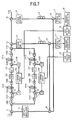
- FIG. 7 is a block diagram showing an embodiment in which the present invention is applied to an EDFA corresponding to a C-band and an L-band.
- the EDFA corresponding to the C-band and the L-band has a configuration in which an optical amplification section for C-band using the EDFA corresponding to a single band shown in FIG. 5, and an optical amplification section for L-band having a configuration similar to the above, are connected in parallel using a C/L separating coupler 108A and a C/L multiplexing coupler 108B.
- a reference numeral of each constitutional element of the optical amplification section for L-band is attached with (') corresponding to each constitutional element of the optical amplification section for C-band.
- a part of the signal light Lin given to the C/L separating coupler 1 08A is branched by the optical branching device 11 as the input monitor light, and the input monitor light is given to the intensity modulator 13 to be subjected to the intensity modulation at the frequency 2 ⁇ f , and then the modulated light is branched into two by an optical branching device 20 to be sent to the optical multiplexers 16 for C-band and the optical multiplexer 16' for L-band, respectively.
- a part of the output light multiplexed by the C/L multiplexing coupler 108B is branched by the optical branching devices 15 and 15', respectively, to generate an output monitor signal for C-band and an output monitor signal for L-band.
- the output monitor signals corresponding to the respective bands are sent to the optical multiplexers 16 and 16', via the phase shifters 12 and 12', and the polarization controllers 14 and 14', respectively, so that the output monitor signals whose phases and polarization states are approximately coincident with those of the input monitor signal, are input to the optical multiplexers 16 and 16'.
- the multiplexed lights output from the optical multiplexers 16 and 16' are detected by the optical detectors 17 and 1 T, and thereafter, the beat components of the frequency ⁇ f extracted by the frequency cutoff filters 18 and 18' are sent to the gain detection circuit 19 and 19', respectively, so that total gains of the signal light components from which the ASE lights generated in the optical amplification sections for C-band and L-band are eliminated, are detected, respectively.
- the detection results of the gain detection circuits 19 and 19' are transmitted to the LD driving circuits 104 and 104', so that the driving conditions of the pumping light sources 102A and 102B, and 102A' and 102B' are feedback controlled.
- the present invention to a rare-earth element doped optical fiber amplifier, which collectively amplifies optical signals of three or more different bands.
Landscapes
- Physics & Mathematics (AREA)
- Electromagnetism (AREA)
- Engineering & Computer Science (AREA)
- Computer Networks & Wireless Communication (AREA)
- Signal Processing (AREA)
- Lasers (AREA)
- Optical Communication System (AREA)
- Optical Modulation, Optical Deflection, Nonlinear Optics, Optical Demodulation, Optical Logic Elements (AREA)
Applications Claiming Priority (2)
| Application Number | Priority Date | Filing Date | Title |
|---|---|---|---|
| JP2004087265 | 2004-03-24 | ||
| JP2004087265A JP4198082B2 (ja) | 2004-03-24 | 2004-03-24 | 光増幅器の利得モニタ方法および装置 |
Publications (3)
| Publication Number | Publication Date |
|---|---|
| EP1580905A2 true EP1580905A2 (de) | 2005-09-28 |
| EP1580905A3 EP1580905A3 (de) | 2007-12-05 |
| EP1580905B1 EP1580905B1 (de) | 2012-10-17 |
Family
ID=34858439
Family Applications (1)
| Application Number | Title | Priority Date | Filing Date |
|---|---|---|---|
| EP04020978A Expired - Lifetime EP1580905B1 (de) | 2004-03-24 | 2004-09-03 | Verfahren zur Überwachung der Verstärkung eines optischen Verstärkers und Vorrichtung dafür |
Country Status (4)
| Country | Link |
|---|---|
| US (1) | US7308208B2 (de) |
| EP (1) | EP1580905B1 (de) |
| JP (1) | JP4198082B2 (de) |
| CN (1) | CN100338894C (de) |
Families Citing this family (12)
| Publication number | Priority date | Publication date | Assignee | Title |
|---|---|---|---|---|
| ATE370562T1 (de) * | 2004-12-22 | 2007-09-15 | Alcatel Lucent | Einrichtung und verfahren zur demodulation von dpsk signalen |
| US7643759B2 (en) * | 2005-01-12 | 2010-01-05 | Sumitomo Electric Industries, Ltd. | Signal-quality evaluation device, signal adjustment method, optical-signal evaluation system, and optical transmission system |
| JP4940861B2 (ja) * | 2006-09-28 | 2012-05-30 | 富士通株式会社 | Wdm光伝送システム |
| CN101141190B (zh) * | 2007-05-24 | 2010-12-08 | 中兴通讯股份有限公司 | Edfa瞬态特性指标测试装置和方法 |
| JP2009043849A (ja) * | 2007-08-07 | 2009-02-26 | Nippon Telegr & Teleph Corp <Ntt> | 光ファイバ増幅器 |
| JP2012022260A (ja) | 2010-07-16 | 2012-02-02 | Fujitsu Ltd | 光増幅装置及び伝送路損失測定方法 |
| US8705167B2 (en) * | 2010-08-25 | 2014-04-22 | Fujitsu Limited | System and method for compensating for polarization dependent loss |
| KR101489279B1 (ko) * | 2013-06-27 | 2015-02-04 | 주식회사 라이콤 | 자기 자동이득제어 분산형 라만증폭기의 자동이득제어방법 |
| JP6156496B2 (ja) | 2013-07-11 | 2017-07-05 | 日本電気株式会社 | 光通信装置 |
| CN106170933B (zh) * | 2014-05-14 | 2019-04-12 | 华为海洋网络有限公司 | 一种光中继器,及光纤通信系统 |
| CN107124224B (zh) * | 2017-06-22 | 2019-06-14 | 武汉光迅科技股份有限公司 | 一种自适应波段放大方法及放大器 |
| JP7739883B2 (ja) * | 2021-09-15 | 2025-09-17 | オムロン株式会社 | 光干渉測距センサ |
Family Cites Families (30)
| Publication number | Priority date | Publication date | Assignee | Title |
|---|---|---|---|---|
| JPH0810284B2 (ja) * | 1987-11-20 | 1996-01-31 | 日本電信電話株式会社 | 光導波路光軸合わせ方法および装置 |
| GB9106181D0 (en) * | 1991-03-22 | 1991-05-08 | British Telecomm | Photonic amplifier |
| JP3018709B2 (ja) * | 1992-02-04 | 2000-03-13 | 日本電気株式会社 | 光増幅器特性評価方法および光中継伝送方式 |
| US5471334A (en) * | 1992-10-21 | 1995-11-28 | Nippon Telegraph And Telephone Corporation | Method and apparatus for monitoring noise figure of optical amplifier |
| JP2772357B2 (ja) | 1992-10-21 | 1998-07-02 | 日本電信電話株式会社 | 線形中継器の雑音指数監視装置 |
| JPH0764134A (ja) * | 1993-08-23 | 1995-03-10 | Nippon Telegr & Teleph Corp <Ntt> | 光増幅器の出力制御回路 |
| JPH0818136A (ja) | 1994-06-27 | 1996-01-19 | Hitachi Ltd | 光増幅器 |
| JP2875181B2 (ja) * | 1995-03-17 | 1999-03-24 | 株式会社生体光情報研究所 | 断層撮影装置 |
| JP2687933B2 (ja) * | 1995-06-09 | 1997-12-08 | 日本電気株式会社 | 光直接増幅器 |
| JP3363003B2 (ja) * | 1995-10-03 | 2003-01-07 | 株式会社日立製作所 | 光増幅装置及び光増幅装置を用いた光伝送システム |
| DE19547603A1 (de) * | 1995-12-20 | 1997-06-26 | Sel Alcatel Ag | Optische Verstärkereinrichtung |
| CA2172873C (en) * | 1996-03-28 | 2002-03-12 | Kim Byron Roberts | Method of determining optical amplifier failures |
| SE514609C2 (sv) * | 1996-09-13 | 2001-03-19 | Ericsson Telefon Ab L M | System och förfarande för reglering av uteffekten hos en optisk förstärkare |
| JPH10126339A (ja) * | 1996-10-15 | 1998-05-15 | Toshiba Corp | 光伝送システム |
| KR19990069330A (ko) * | 1998-02-06 | 1999-09-06 | 윤종용 | 채널당 출력파워가 일정한 광증폭기 및 이를위한 방법 |
| JP3597036B2 (ja) * | 1998-02-18 | 2004-12-02 | 住友電気工業株式会社 | 光ファイバ増幅器 |
| JP3532759B2 (ja) * | 1998-03-11 | 2004-05-31 | 富士通株式会社 | Wdm通信システムにおける中継装置及び同装置の送信レベル制御方法 |
| KR100416439B1 (ko) * | 1998-11-24 | 2004-03-30 | 삼성전자주식회사 | 이득평탄도를제어하는광섬유증폭기 |
| US6163399A (en) * | 1998-12-08 | 2000-12-19 | Nortel Networks Limited | Method and apparatus for suppressing transients in optical amplifiers |
| JP3802992B2 (ja) | 1999-02-08 | 2006-08-02 | 富士通株式会社 | 波長多重光通信システム |
| US6198571B1 (en) * | 1999-03-31 | 2001-03-06 | Afc Technologies Inc. | Computerized intelligent optical amplifier for multi-channel optical networks |
| JP2000349718A (ja) * | 1999-06-08 | 2000-12-15 | Nec Corp | 光ファイバ増幅器 |
| US6631027B2 (en) * | 2000-04-13 | 2003-10-07 | Corning Incorporated | Universal controller for an optical amplifier that operates over a wide dynamic range of optical signals and optical amplifiers utilizing such controllers |
| US6922532B2 (en) * | 2000-12-07 | 2005-07-26 | Frederic Simard | Optical performance monitoring for D/WDM networks |
| US6529316B1 (en) * | 2001-05-03 | 2003-03-04 | Onetta, Inc. | Optical network equipment with optical channel monitor and dynamic spectral filter alarms |
| US6751014B2 (en) * | 2001-06-19 | 2004-06-15 | International Business Machines Corporation | Automatic gain control and dynamic equalization of erbium doped optical amplifiers in wavelength multiplexing networks |
| JP3923301B2 (ja) * | 2001-11-29 | 2007-05-30 | 富士通株式会社 | Wdm通信システムにおける光アンプ監視制御方法 |
| US7042634B2 (en) * | 2002-03-14 | 2006-05-09 | Nippon Telegraph And Telephone Corporation | Optical amplifier |
| US7061668B2 (en) * | 2002-03-21 | 2006-06-13 | Siemens Communications Inc. | Fast optical amplifier control circuit |
| JP4126994B2 (ja) * | 2002-08-30 | 2008-07-30 | 住友電気工業株式会社 | 光増幅器、光増幅器の利得制御方法、及び光増幅器の利得制御回路 |
-
2004
- 2004-03-24 JP JP2004087265A patent/JP4198082B2/ja not_active Expired - Fee Related
- 2004-08-30 US US10/928,214 patent/US7308208B2/en not_active Expired - Fee Related
- 2004-09-03 EP EP04020978A patent/EP1580905B1/de not_active Expired - Lifetime
- 2004-10-19 CN CNB2004100837690A patent/CN100338894C/zh not_active Expired - Fee Related
Non-Patent Citations (1)
| Title |
|---|
| None |
Also Published As
| Publication number | Publication date |
|---|---|
| JP4198082B2 (ja) | 2008-12-17 |
| US7308208B2 (en) | 2007-12-11 |
| JP2005277044A (ja) | 2005-10-06 |
| EP1580905B1 (de) | 2012-10-17 |
| CN1674470A (zh) | 2005-09-28 |
| EP1580905A3 (de) | 2007-12-05 |
| US20050213990A1 (en) | 2005-09-29 |
| CN100338894C (zh) | 2007-09-19 |
Similar Documents
| Publication | Publication Date | Title |
|---|---|---|
| JP3844902B2 (ja) | 波長多重用光増幅器及び光通信システム | |
| US6606188B2 (en) | Optical repeater using raman amplification, wavelength division multiplexed light transmission system, excitation light supply method and excitation light control method for raman amplification | |
| US6654561B1 (en) | Method and apparatus for measuring optical signal-to-noise ratio, and pre-emphasis method and optical communication system each utilizing the method | |
| EP1182808B1 (de) | Optischer Verstärker mit Kontrolle des Pumplichtes für Ramanverstärkung | |
| JP3363003B2 (ja) | 光増幅装置及び光増幅装置を用いた光伝送システム | |
| US6724526B1 (en) | Inter-wavelength light power deviation monitoring method and optical equalizer and optical amplifier utilizing the method | |
| US6560008B1 (en) | Controlling apparatus and controlling method for wavelength division multiplexing optical amplifier | |
| JPH11224967A (ja) | 利得等化のための方法並びに該方法の実施に使用する装置及びシステム | |
| US6373625B1 (en) | Method, apparatus, and system for optical amplification | |
| EP1580905B1 (de) | Verfahren zur Überwachung der Verstärkung eines optischen Verstärkers und Vorrichtung dafür | |
| EP1427075B1 (de) | Ramanverstärker und optisches Übertragungssystem | |
| JP2000078081A (ja) | 波長分散補償機能を備えた光増幅器及び光通信システム、並びに波長多重信号光の波長分散補償方法 | |
| US7119950B2 (en) | Amplification method and optical amplifier for wavelength division multiplexed signal light | |
| JP4549591B2 (ja) | 装置 | |
| US7075711B2 (en) | Optical communication system having dynamic gain equalization | |
| JP2001168841A (ja) | 波長多重光増幅器 | |
| JP4337545B2 (ja) | 光通信システム | |
| JP2714611B2 (ja) | 光中継器及びそれを使った光伝送路網 | |
| JP2001036174A (ja) | 光増幅装置 | |
| JP3953769B2 (ja) | 光増幅装置 | |
| EP3447861B1 (de) | Optischer verstärker | |
| EP4492590A1 (de) | Breitbandiger optischer verstärker | |
| JP3940926B2 (ja) | 波長多重光増幅装置 |
Legal Events
| Date | Code | Title | Description |
|---|---|---|---|
| PUAI | Public reference made under article 153(3) epc to a published international application that has entered the european phase |
Free format text: ORIGINAL CODE: 0009012 |
|
| AK | Designated contracting states |
Kind code of ref document: A2 Designated state(s): AT BE BG CH CY CZ DE DK EE ES FI FR GB GR HU IE IT LI LU MC NL PL PT RO SE SI SK TR |
|
| AX | Request for extension of the european patent |
Extension state: AL HR LT LV MK |
|
| PUAL | Search report despatched |
Free format text: ORIGINAL CODE: 0009013 |
|
| AK | Designated contracting states |
Kind code of ref document: A3 Designated state(s): AT BE BG CH CY CZ DE DK EE ES FI FR GB GR HU IE IT LI LU MC NL PL PT RO SE SI SK TR |
|
| AX | Request for extension of the european patent |
Extension state: AL HR LT LV MK |
|
| 17P | Request for examination filed |
Effective date: 20080227 |
|
| AKX | Designation fees paid |
Designated state(s): FR GB |
|
| REG | Reference to a national code |
Ref country code: DE Ref legal event code: 8566 |
|
| 17Q | First examination report despatched |
Effective date: 20100804 |
|
| GRAP | Despatch of communication of intention to grant a patent |
Free format text: ORIGINAL CODE: EPIDOSNIGR1 |
|
| GRAS | Grant fee paid |
Free format text: ORIGINAL CODE: EPIDOSNIGR3 |
|
| GRAA | (expected) grant |
Free format text: ORIGINAL CODE: 0009210 |
|
| RIN1 | Information on inventor provided before grant (corrected) |
Inventor name: WATANABE, MANABU, FUJITSU NETWORK TECHN. LIMITED |
|
| AK | Designated contracting states |
Kind code of ref document: B1 Designated state(s): FR GB |
|
| REG | Reference to a national code |
Ref country code: GB Ref legal event code: FG4D |
|
| PLBE | No opposition filed within time limit |
Free format text: ORIGINAL CODE: 0009261 |
|
| STAA | Information on the status of an ep patent application or granted ep patent |
Free format text: STATUS: NO OPPOSITION FILED WITHIN TIME LIMIT |
|
| 26N | No opposition filed |
Effective date: 20130718 |
|
| GBPC | Gb: european patent ceased through non-payment of renewal fee |
Effective date: 20130903 |
|
| REG | Reference to a national code |
Ref country code: FR Ref legal event code: ST Effective date: 20140530 |
|
| PG25 | Lapsed in a contracting state [announced via postgrant information from national office to epo] |
Ref country code: GB Free format text: LAPSE BECAUSE OF NON-PAYMENT OF DUE FEES Effective date: 20130903 |
|
| PG25 | Lapsed in a contracting state [announced via postgrant information from national office to epo] |
Ref country code: FR Free format text: LAPSE BECAUSE OF NON-PAYMENT OF DUE FEES Effective date: 20130930 |