EP1581018B1 - Aussageverfahren für die Aufwärtsstrecken-empfangsleistung in einem Aufwärtsstrecken-hybriddienst - Google Patents
Aussageverfahren für die Aufwärtsstrecken-empfangsleistung in einem Aufwärtsstrecken-hybriddienst Download PDFInfo
- Publication number
- EP1581018B1 EP1581018B1 EP03753225A EP03753225A EP1581018B1 EP 1581018 B1 EP1581018 B1 EP 1581018B1 EP 03753225 A EP03753225 A EP 03753225A EP 03753225 A EP03753225 A EP 03753225A EP 1581018 B1 EP1581018 B1 EP 1581018B1
- Authority
- EP
- European Patent Office
- Prior art keywords
- received power
- service
- call
- call request
- uplink
- Prior art date
- Legal status (The legal status is an assumption and is not a legal conclusion. Google has not performed a legal analysis and makes no representation as to the accuracy of the status listed.)
- Expired - Lifetime
Links
- 238000000034 method Methods 0.000 title claims abstract description 60
- 238000004364 calculation method Methods 0.000 claims abstract description 12
- 238000010295 mobile communication Methods 0.000 claims abstract description 9
- 230000000694 effects Effects 0.000 claims description 2
- 230000003993 interaction Effects 0.000 claims description 2
- 238000004422 calculation algorithm Methods 0.000 description 10
- 238000004891 communication Methods 0.000 description 10
- 238000004088 simulation Methods 0.000 description 10
- 238000005259 measurement Methods 0.000 description 4
- 238000004458 analytical method Methods 0.000 description 2
- 238000007726 management method Methods 0.000 description 2
- 238000012360 testing method Methods 0.000 description 2
- 235000003801 Castanea crenata Nutrition 0.000 description 1
- 244000209117 Castanea crenata Species 0.000 description 1
- 230000005540 biological transmission Effects 0.000 description 1
- 238000010276 construction Methods 0.000 description 1
- 230000001419 dependent effect Effects 0.000 description 1
- 238000009795 derivation Methods 0.000 description 1
- 238000010586 diagram Methods 0.000 description 1
- 238000005516 engineering process Methods 0.000 description 1
- 238000013507 mapping Methods 0.000 description 1
- 238000012545 processing Methods 0.000 description 1
- 230000035945 sensitivity Effects 0.000 description 1
Images



Classifications
-
- H—ELECTRICITY
- H04—ELECTRIC COMMUNICATION TECHNIQUE
- H04W—WIRELESS COMMUNICATION NETWORKS
- H04W52/00—Power management, e.g. Transmission Power Control [TPC] or power classes
- H04W52/04—Transmission power control [TPC]
- H04W52/18—TPC being performed according to specific parameters
- H04W52/22—TPC being performed according to specific parameters taking into account previous information or commands
- H04W52/223—TPC being performed according to specific parameters taking into account previous information or commands predicting future states of the transmission
-
- H—ELECTRICITY
- H04—ELECTRIC COMMUNICATION TECHNIQUE
- H04B—TRANSMISSION
- H04B17/00—Monitoring; Testing
- H04B17/30—Monitoring; Testing of propagation channels
- H04B17/382—Monitoring; Testing of propagation channels for resource allocation, admission control or handover
Definitions
- the present invention relates to a management method for the wireless resource of an uplink mixed service of a controlling radio network controller (CRNC) in a wide-band code division multiple access (WCDMA) mobile communication system, more particularly, to a method for fast call admission control of an uplink mixed service of a WCDMA system.
- the present invention belongs to the domain of communication technology.
- CAC call admission control
- the aim of the fast power control of the uplink in a WCDMA system consists in: the uplink transmit power of user equipment (UE) is adjusted by the downlink transmit power control (DL TPC) bit, so that the quality factor E b / N 0 of the signal received by a base station can match the quality of service (QoS) of the corresponding service.
- the mapping relationship between E b / N 0 and QoS can be obtained by an actual measurement after simulation.
- different UEs have different distances to the base station and different transmit powers, as long as the types of service are the same, the E b lN 0 s received by the base station for each UE should be maintained in nearly the same level due to the UL (Uplink) fast power control.
- the WCDMA system can support a mixed service with variable rates, but its service is commonly classified as different classes according to QoS, such as the session, flow, interaction and background in 3GPP, wherein the first and the second classes are real-time services, the third class is a service without sensitivity for time delay, and the forth class is a non-real time service. It is so cursory to configure the parameters of an algorithm only based on these four classes of services, especially for an algorithm with the characteristic of prediction such as admission control, etc; for instance, with respect to the service class of flow, there is a great difference between the E b / N 0 s required by different data rates.
- QoS such as the session, flow, interaction and background in 3GPP
- the ultimate capacity of an uplink cell of a WCDMA system is limited by the total interference level received by the cell.
- the aim of downlink admission control consists in: it is determined to admit or refuse a new user call, a new radio access bearer (RAB) and a new radio link (RL) based on the current resource condition of the system (such as under switching).
- the admission has to be controlled on the basis of interference and radio measurement. Making sure the system is stable, the QoSof the new call should be achieved as much as possible to avoid overload.
- a base station control apparatus determines the communication quality of the service area of the base station from the uplink and the downlink signal quality, and sends an access restriction signal to the base station when the determined communication quality is bad, and then the base station implements engagement processing to the new calls sent to or from other mobile radio terminals, since the patent does not predict the increment of the uplink interference power of the system on the basis of the QoS of a call request, it is not suitable for WCDMA systems.
- An admission control method for uplink real-time service requires: 1. A total interference power received by a base station, which includes the interference from other users in the cell, the interference from adjacent cells and background noise; 2. A fast and effective estimation for the interference possibly applied to the call request service; 3. Determining the interference threshold for different services in consideration of various factors.
- the total interference power received by the base station can be measured from the base station, but it is difficult to predict the increment of cell interference power caused by new services under the condition of mixed services. It needs considering the following factors to determine the interference threshold for different services: the capability of uplink User Equipment (UE) QoS, the QoS of the services connected to the system and switching margin.
- UE User Equipment
- the hardware resource condition of NodeB is also a factor considered by uplink admission control.
- European patent application EP 1071306 A1 (24 January 2001 ), "Method of predicting the received power level at a base station of a CDMA network and base station implementing the method", which is filed by ALCATEL, introduces a method of predicting a power level received by a base station assuming admission a candidate user by the base station.
- One object of the present invention is to provide a method for uplink power prediction and calling admission control for a mixed service of mobile communication systems, which is an admission control method of uplink real-time service on the basis of QoS of service, data rate and real-time interference status of system and in which the increment of interference power received by a base station after a new call access is predicted by different solutions and according to different conditions, additionally different admission thresholds for different services are adopted and the influence of base station hardware barrage is taken into consideration, so the present method can be conveniently used in a real system of 3 G RNC.
- Another object of the present invention is to provide a method for uplink power prediction and calling admission control for a mixed service of a mobile communication system, which overcomes the disadvantages of the rough prediction for the increment of interference power received by a base station and large amount of calculation in the prior art, and solves the problem of the disjunction between the prior art and practical cases.
- the uplink call admission control in a wide-band code division multiple access mobile communication system is an important part of the radio resource management module in CRNC. It is required that the uplink admission control method can estimate the increment of the interference power received by the base station after a new service access with accuracy, at the same time the method can not be too complicated and has practical solutions for detailed questions, in order to ensure the QoS of the original services in the system and the QoS of the new service, as well as to ensure the admission judgment to be completed rapidly.
- a prediction method for the uplink received power in a wide-band code division multiple access system for a mixed access service is characterized by: obtaining a current uplink received power and a service type of a call request; calculating the received power change corresponding to the current uplink received power and the service type of the call request by a discrete simple calculation and according to a pre-configuration table, wherein the pre-configuration table is obtained by scaling and pre-calculating a nonlinear power change characteristic curve; and calculating the prediction value of the uplink received power in accordance with the current uplink received power and the received power change.
- a call admission control method for an uplink mixed service of a mobile communication system which includes: obtaining the prediction value of the above-mentioned uplink received power by means of the above-mentioned prediction method; and determining whether it will admit said call service in accordance with the above-mentioned prediction value of the uplink received power.
- the key point to the uplink admission control method for the mixed service in a wide-band code division multiple access mobile communication system consists in how to pre-estimate the increment of the interference power received by the base station after a new call request being accessed rapidly and efficiently, and with theoretical analysis and lots of simulation it is found that the features of the call services and the load condition of the system as well as the hardware resource of the base station, and so on should be taken into consideration synthetically to predict the increment of the interference power of the base station, furthermore, the solution for the details such as the non-linear calculation between the non-integer variables in the admission control method will also influence the efficiency of the admission control method greatly.
- the increment of the interference power received by the base station when a mixed service being accessed is predicted by means of the system load curve for single service and on the basis of the features of the mixed service system, and in this method, the influence of the factors such as the resource restriction of base station hardware, the restriction of the interference power received by the base station and the access priority are taken into synthetical consideration firstly, and the increment of the interference power received by the base station after a new call being accessed based on the features of services and the practical situation of cell load, furthermore, the solution for the details such as the non-linear calculation between the non-integer variables is pointed out, as a result, compared with the prior art, the method of the present invention can achieve the uplink admission control in a wide-band code division multiple access mobile communication system more accurately and faster to save accessing time, increase the uplink capacity of the system, and reduce the lost call rate and the drop rate, which makes the method have a real use value.
- Each one of the above-mentioned four classes of services is divided into corresponding subclasses in accordance with different data rates.
- the present invention is on the basis of 3GPP TS-R99 series specifications.
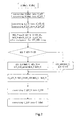
- the uplink admission control method of the present invention is as following:
- Step 1 inputting call request and related parameters (step 101 ).
- the related parameters are input in accordance with a real-time measured value.
- the following parameters are pre-configured in background based on network planning, simulation and the result of route measurement.
- the related parameters of each service subclass The service can be divided into different service subclasses on the basis of QoS and the data rate of the service, the resulted service subclasses have N kinds, and N can be adjusted based on the practical situation such as the service provided by the service provider, etc.
- the quality factor for each service subclass can be determined based on the block error ratio (BLER) corresponding to the QoS of the corresponding service class and the data rate.
- BLER block error ratio
- An allowable safety coefficient of the limit user number j D which is a discount value of a service subclass under the condition of mixed service on the basis of a theoretical limit user number of single service;
- a high priority margin of the interference power threshold r h which is the switching margin of the high priority access interference power threshold of a service subclass under the condition of mixed service, with a maximal range of 0 ⁇ 1;
- a low priority margin of the interference power threshold r n which is the margin of the low priority access interference power threshold of a service subclass under the condition of mixed service, with a maximal range of 0 ⁇ 1;
- I threshold_ltd which is interference threshold value corresponding to the limit user number under the condition of mixed service
- a high priority access threshold value l threshold_highpriority l threshold_ltd . r h ;
- a low priority access threshold value l threshold_lowpriority : l threshold_lowpriority l threshold_ltd . r n ;
- M f a forecast revision factor, a background noise power ⁇ 0 and an interference factor applied to the present cell from other cells;
- the background noise power is ⁇ 0 ;
- the interference factor applied to the present cell from other cells is i, which relates to the ratio between the load condition of the present cell and those of adjacent cells, and can be estimated by other algorithms based on the load condition of adjacent cells.
- Step 2 determining NodeB hardware barrage
- UL Capacity Credit represents the existing hardware resource credit of NodeB
- UL cost represents the hardware resource credit required by the present call.
- step 104 If the formula is true, it will enter into a next step (step 104 ); otherwise it will refuse the access request ( step 110 ).
- Step 3 determining uplink interference restriction
- Step 3 The main aim of Step 3 is to determine whether the following formula is true: I total_old + ⁇ l > I threshold
- DeltI01 is a duality function.
- the aim of the auxiliary algorithm is to improve the operation efficiency of summing (or differencing) the variables in dBm (or dB) by the system.
- the algorithm in detail is as following:
- Step 4 updating the existing UL Capacity Credit of NodeB:
- UL Capacity Credit UL Capacity Credit - UL cost; otherwise the existing UL Capacity Credit of NodeB will not be updated.
- the applicable conditions of the model consist in that: carrier frequency is in the range of 150MHz ⁇ 2000MHz, the effective height of the base station antenna h b is in the range of 30 ⁇ 200 m, the height of the mobile station antenna is in the range of 1 ⁇ 10 m, the communication distance d is in the range of 1 ⁇ 20 km, and the height of the mobile station is 1.5m.
- Table 4 mobile station number service subclass number moving speed 1 1 3km/h 2 1 3km/h 3 1 3km/h 4 1 3kmm 5 1 3km/h 6 1 3km/h 7 1 3km/h 8 1 3km/h 9 1 3km/h 10 1 3km/h 11 2 3km/h 12 2 3km/h 13 3 3km/h 14 3 3km/h 15 4 3km/h 16 4 3km/h 17 5 3km/h 18 5 3km/h 19 5 3km/h 20 7 3km/h 20 7 3km/h/h
- the service of a new call request is the service subclass of number 6, which is in the form of walking and with high priority.
- Step 1 determining for NodeB hardware barrage
- Step2 determining for uplink interference restriction
- I threshold -91.4768dBm.
- Step3 updating the existing UL capacity credit of NodeB
- the UL capacity credit is updated based on the consumption law of NodeB and the SF of No.6 service subclass.
- the whole downlink admission control flow is ended so far.
- the key point to the uplink mixed service admission control is to estimate the increment of the interference power possibly applied to a system by a new call request rapidly and accurately.
- the present method predicts the increment of the total interference power received by a base station caused by a new call request, by means of a single service load curve on the basis of the actual conditions of different subclasses and system load and the conditions such as NodeB hardware resource barrage, etc, also a solution for non-linear variable real-time operation is provided in this method.
Landscapes
- Engineering & Computer Science (AREA)
- Computer Networks & Wireless Communication (AREA)
- Signal Processing (AREA)
- Mobile Radio Communication Systems (AREA)
Claims (13)
- Vorhersageverfahren für eine Aufwärtsstreckenempfangsleistung in einem Breitband-Codemultiplexzugriffssystem mit einem Mischdienstzugriff, wobei das Vorhersageverfahren dadurch gekennzeichnet ist, dass es aufweist:Erhalten einer aktuellen Aufwärtsstreckenempfangsleistung und eines Diensttyps einer Verbindungsanforderung;Berechnen der Empfangsleistungsänderung, die der aktuellen Aufwärtsstreckenempfangsleistung und dem Diensttyp der Verbindungsanforderung entspricht, durch eine diskrete einfache Berechnung mit einer Vorkonfigurationstabelle, wobei die Vorkonfigurationstabelle durch Skalieren und Vorausberechnen einer nichtlinearen Leistungsänderungskennlinie erhalten wird; undBerechnen des vorhergesagten Werts der Aufwärtsstreckenempfangsleistung gemäß der aktuellen Aufwärtsstreckenempfangsleistung und der Empfangsleistungsänderung.
- Vorhersageverfahren für eine Aufwärtsstreckenempfangsleistung nach Anspruch 1, wobei die Beziehung zwischen der unter der Bedingung eines Einzeldienstes skalierten Aufwärtsstreckenempfangsleistung und der Empfangsleistungsänderung in der Vorkonfigurationstabelle aufgezeichnet wird;
wobei der Schritt des Berechnens des Wertes der Empfangsleistungsänderung aufweist:Skalieren der aktuellen Aufwärtsstreckenempfangsleistung;Nachschlagen der Empfangsleistungsänderung unter der Einzeldienstbedingung, die der aktuellen Aufwärtsstreckenempfangsleistung entspricht, in der Vorkonfigurationstabelle; undBerechnen der vorhergesagten Empfangsleistungsänderung gemäß dem Diensttyp der Verbindungsanforderung. - Vorhersageverfahren für eine Aufwärtsstreckenempfangsleistung nach Anspruch 2, wobei der Schritt zum Berechnen des vorhergesagten Werts einer Aufwärtsstreckenempfangsleistung aufweist:Umwandeln der aktuellen Aufwärtsstreckenempfangsleistung und der Empfangsleistungsänderung in einen Skalierungswert gemäß einem öffentlichen Nominalwert; undBerechnen des vorhergesagten Werts der Aufwärtsstreckenempfangsleistung durch eine diskrete einfache Berechnung gemäß einem vorkonfigurierte Array, wobei das vorkonfigurierte Array durch Skalieren und Vorausberechnen des Ergebnisses des Addierens von möglichen nichtlinearen Leistungen erhalten wird.
- Vorhersageverfahren für eine Aufwärtsstreckenempfangsleistung nach Anspruch 2, wobei der Schritt des Berechnens der vorhergesagten Empfangsleistungsänderung basierend auf dem Diensttyp der Verbindungsanforderung aufweist:Berechnen der vorhergesagten Empfangsleistungsänderung basierend auf der Empfangsleistungsänderung unter der Einzeldienstbedingung, die der aktuellen Aufwärtsstreckenempfangsleistung entspricht, und dem Lastschätzungsfaktor, der dem Diensttyp der Verbindungsanforderung entspricht;wobei der Lastschätzungsfaktor gemäß dem QoS-Index jedes Diensttyps und den Charakteristiken der Funkumgebung im Voraus berechnet wird.
- Vorhersageverfahren für eine Aufwärtsstreckenempfangsleistung nach Anspruch 4, wobei der QoS-Index des Diensttyps einen Sprachaktivitätsfaktor, ein Leistungs-RauschVerhältnis und eine Dienstdatenrate beinhaltet, und die Charakteristiken der Funkumgebung einen Nachbarzellinterferenzfaktor umfassen.
- Vorhersageverfahren für eine Aufwärtsstreckenempfangsleistung nach einem der Ansprüche 1 bis 5, wobei der Diensttyp ein Typ ausgegliedert aus den vier Typen von Sitzung, Fluss, Interaktion und Hintergrund ist.
- Verbindungszulassungssteuerungsverfahren für einen Aufwärtsstreckenmischdienst eines Mobilkommunikationssystems, aufweisend:Erhalten eines vorhergesagten Werts der Aufwärtsstreckenempfangsleistung durch das Vorhersageverfahren nach einem der Ansprüche 1 bis 6 (107); undBestimmen basierend auf dem vorhergesagten Wert der Aufwärtsstreckenempfangsleistung (108), ob der Verbindungsdienst zugelassen werden soll.
- Zulassungssteuerungsverfahren nach Anspruch 7, wobei das Verfahren ferner aufweist:Bestimmen vor dem Erhalten des vorhergesagten Werts der Aufwärtsstreckenempfangsleistung (102), ob der Zustand von NodeB "nicht verfügbar" ist, und Zurückweisen der Verbindungsanforderung (110), wenn die Antwort zutreffend ist.
- Zulassungssteuerungsverfahren nach Anspruch 7, wobei das Verfahren ferner aufweist:Bestimmen vor dem Erhalten des vorhergesagten Werts der Aufwärtsstreckenempfangsleistung (103), ob der aktuelle UL-Restkapazitätskredit von NodeB niedriger als der UL-Aufwand ist, der "nicht verfügbar" erforderlich ist, und Zurückweisen der Verbindungsanforderung (110), wenn die Antwort zutreffend ist; undAktualisieren des UL-Restkapazitätskredits (109), wenn die Verbindungsanforderung zugelassen wird.
- Zulassungssteuerungsverfahren nach Anspruch 7, wobei der Schritt zum Bestimmen, ob der Verbindungsdienst zugelassen werden soll, aufweist:Vergleichen des vorhergesagten Werts der Aufwärtsstreckenempfangsleistung und eines vorbestimmten Schwellwertes (108), Zulassen der Verbindungsanforderung (109), wenn der vorhergesagte Wert der Aufwärtsstreckenempfangsleistung niedriger als der vorbestimmte Schwellwert ist, und andernfalls Zurückweisen der Verbindungsanforderung (110).
- Zulassungssteuerungsverfahren nach Anspruch 10, wobei die vorbestimmten Schwellenwerte jeweils für jeden Diensttyp festgelegt werden (105, 106), und der Schritt des Bestimmens, ob der Verbindungsdienst zugelassen werden soll, aufweist:Vergleichen des vorhergesagten Werts der Aufwärtsstreckenempfangsleistung und eines vorbestimmten Schwellwertes, Zulassen der Verbindungsanforderung (109), wenn der vorhergesagte Wert der Aufwärtsstreckenempfangsleistung niedriger als der vorbestimmte Schwellwert ist, und andernfalls Zurückweisen der Verbindungsanforderung (110).
- Zulassungssteuerungsverfahren nach Anspruch 10, wobei ein vorbestimmter Schwellwert hoher Priorität und ein vorbestimmter Schwellwert niedriger Priorität für eine Aufschaltverbindung bzw. eine Zugriffsverbindung festgelegt sind (105, 106), und der Schritt zum Bestimmen, ob der Verbindungsdienst zugelassen werden soll, aufweist:Bestimmen, ob der vorhergesagte Wert der Aufwärtsstreckenempfangsleistung niedriger als der vorbestimmte Schwellwert hoher Priorität ist, wenn die Verbindungsanforderung eine Aufschaltverbindung ist; Bestimmen, ob der vorhergesagte Wert der Aufwärtsstreckenempfangsleistung niedriger als der vorbestimmte Schwellwert niedriger Priorität ist, wenn die Verbindungsanforderung eine Zugriffsverbindung ist; und Zulassen der Verbindungsanforderung (109), wenn die Antwort zutreffend ist, und andernfalls Zurückweisen der Verbindungsanforderung (110).
- Zulassungssteuerungsverfahren nach Anspruch 10, wobei die vorbestimmten Schwellwerte jeweils für jeden Diensttyp festgelegt werden, und ein vorbestimmter Schwellwert hoher Priorität und ein vorbestimmter Schwellwert niedriger Priorität jeweils für eine Aufschaltverbindung und eine Zugriffsverbindung in Bezug auf jeden Diensttyp festgelegt werden (105, 106), und der Schritt zum Bestimmen, ob der Verbindungsdienst zugelassen werden soll, aufweist:Bestimmen, ob der vorhergesagte Wert der Aufwärtsstreckenempfangsleistung niedriger als der vorbestimmte Schwellwert hoher Priorität ist, entsprechend dem Diensttyp der Verbindungsanforderung, wenn die Verbindungsanforderung eine Aufschaltverbindung ist; Bestimmen, ob der vorhergesagte Wert der Aufwärtsstreckenempfangsleistung niedriger als der vorbestimmte Schwellwert niedriger Priorität ist, entsprechend dem Diensttyp der Verbindungsanforderung, wenn die Verbindungsanforderung eine Zugriffsverbindung ist; und Zulassen der Verbindungsanforderung (109), wenn die Antwort zutreffend ist, und andernfalls Zurückweisen der Verbindungsanforderung (109).
Applications Claiming Priority (3)
| Application Number | Priority Date | Filing Date | Title |
|---|---|---|---|
| CNB02139928XA CN100463566C (zh) | 2002-12-31 | 2002-12-31 | 移动通信系统上行链路混合业务快速呼叫接纳控制方法 |
| CN2139928.X | 2002-12-31 | ||
| PCT/CN2003/000809 WO2004060000A1 (en) | 2002-12-31 | 2003-09-23 | A predication method of uplink received power in uplink hybridize service and a control method of mobile communication |
Publications (3)
| Publication Number | Publication Date |
|---|---|
| EP1581018A1 EP1581018A1 (de) | 2005-09-28 |
| EP1581018A4 EP1581018A4 (de) | 2010-10-13 |
| EP1581018B1 true EP1581018B1 (de) | 2013-04-03 |
Family
ID=32661074
Family Applications (1)
| Application Number | Title | Priority Date | Filing Date |
|---|---|---|---|
| EP03753225A Expired - Lifetime EP1581018B1 (de) | 2002-12-31 | 2003-09-23 | Aussageverfahren für die Aufwärtsstrecken-empfangsleistung in einem Aufwärtsstrecken-hybriddienst |
Country Status (6)
| Country | Link |
|---|---|
| EP (1) | EP1581018B1 (de) |
| CN (1) | CN100463566C (de) |
| AU (1) | AU2003272845A1 (de) |
| ES (1) | ES2407837T3 (de) |
| RU (1) | RU2339189C2 (de) |
| WO (1) | WO2004060000A1 (de) |
Families Citing this family (10)
| Publication number | Priority date | Publication date | Assignee | Title |
|---|---|---|---|---|
| CN100396151C (zh) * | 2004-12-07 | 2008-06-18 | 华为技术有限公司 | 一种基站上行负载控制方法 |
| FI20055469A0 (fi) * | 2005-09-02 | 2005-09-02 | Nokia Corp | Menetelmä ja järjestely radioresurssien hallintaan |
| WO2007026054A1 (en) * | 2005-09-02 | 2007-03-08 | Nokia Siemens Networks Oy | Method and arrangement for radio resource control |
| CN100551115C (zh) * | 2006-04-21 | 2009-10-14 | 华为技术有限公司 | 高速下行分组接入中许可证的控制方法 |
| KR100928678B1 (ko) * | 2006-10-02 | 2009-11-27 | 삼성전자주식회사 | 광대역 무선 접속 시스템의 연결 수락 제어 방법 및 장치 |
| CN101325800B (zh) * | 2007-06-15 | 2011-11-09 | 鼎桥通信技术有限公司 | 一种cdma系统的上行链路负载估计方法 |
| CN101516124B (zh) * | 2008-02-20 | 2011-10-26 | 中兴通讯股份有限公司 | 一种td-scdma系统的接纳控制方法及装置 |
| JP4742171B2 (ja) * | 2010-01-06 | 2011-08-10 | 株式会社エヌ・ティ・ティ・ドコモ | 移動通信方法、呼制御ノード、優先度制御ノード及び移動管理ノード |
| CN102625323B (zh) * | 2012-03-08 | 2016-03-30 | 电信科学技术研究院 | 网络规划方法与装置 |
| US10547856B2 (en) * | 2016-10-18 | 2020-01-28 | Netflix, Inc. | Constant-slope bitrate allocation for distributed encoding |
Family Cites Families (11)
| Publication number | Priority date | Publication date | Assignee | Title |
|---|---|---|---|---|
| US6137840A (en) * | 1995-03-31 | 2000-10-24 | Qualcomm Incorporated | Method and apparatus for performing fast power control in a mobile communication system |
| JP2785804B2 (ja) * | 1996-05-30 | 1998-08-13 | 日本電気株式会社 | 移動通信システム |
| JP3173565B2 (ja) | 1996-06-20 | 2001-06-04 | 日本電気株式会社 | Cdmaシステムにおけるアクセス規制装置 |
| KR100250716B1 (ko) | 1997-10-31 | 2000-04-01 | 서평원 | 코드분할 다중접속 이동통신시스템 기지국의 호제어방법 |
| KR100288375B1 (ko) * | 1998-05-25 | 2001-06-01 | 윤종용 | 역방향링크와독립적인순방향링크의전력제어방법 |
| US6917607B1 (en) * | 1999-05-31 | 2005-07-12 | Samsung Electronics Co., Ltd. | Apparatus and method for gated transmission in CDMA communication system |
| ATE201126T1 (de) * | 1999-07-23 | 2001-05-15 | Cit Alcatel | Verfahren zur voraussage der empfangenen leistung einer basisstation eines cdma-netzes und bassistation hierfür |
| TW472469B (en) * | 1999-10-07 | 2002-01-11 | Ibm | Adaptive power control in wideband CDMA cellular systems (WCDMA) and methods of operation |
| CN1114332C (zh) * | 1999-10-28 | 2003-07-09 | 华为技术有限公司 | 码分多址移动通信系统中功率控制的方法 |
| CN1133292C (zh) * | 2000-12-29 | 2003-12-31 | 深圳市中兴通讯股份有限公司 | 一种宽带码分多址系统中上行接纳控制方法 |
| CN1373572A (zh) * | 2001-03-01 | 2002-10-09 | 深圳市中兴通讯股份有限公司 | 一种宽带码分多址系统混合业务的接纳控制方法 |
-
2002
- 2002-12-31 CN CNB02139928XA patent/CN100463566C/zh not_active Expired - Fee Related
-
2003
- 2003-09-23 RU RU2005124267/09A patent/RU2339189C2/ru not_active IP Right Cessation
- 2003-09-23 EP EP03753225A patent/EP1581018B1/de not_active Expired - Lifetime
- 2003-09-23 AU AU2003272845A patent/AU2003272845A1/en not_active Abandoned
- 2003-09-23 ES ES03753225T patent/ES2407837T3/es not_active Expired - Lifetime
- 2003-09-23 WO PCT/CN2003/000809 patent/WO2004060000A1/zh not_active Ceased
Also Published As
| Publication number | Publication date |
|---|---|
| RU2005124267A (ru) | 2006-01-20 |
| RU2339189C2 (ru) | 2008-11-20 |
| CN1514561A (zh) | 2004-07-21 |
| WO2004060000A1 (en) | 2004-07-15 |
| EP1581018A1 (de) | 2005-09-28 |
| ES2407837T3 (es) | 2013-06-14 |
| EP1581018A4 (de) | 2010-10-13 |
| AU2003272845A1 (en) | 2004-07-22 |
| CN100463566C (zh) | 2009-02-18 |
Similar Documents
| Publication | Publication Date | Title |
|---|---|---|
| Ishikawa et al. | Capacity design and performance of call admission control in cellular CDMA systems | |
| US6278701B1 (en) | Capacity enhancement for multi-code CDMA with integrated services through quality of services and admission control | |
| KR100757884B1 (ko) | 무선 네트워크를 특징지우고, 조절하고, 최적화하기 위한 방법 및 장치 | |
| US6519705B1 (en) | Method and system for power control in wireless networks using interference prediction with an error margin | |
| US8184532B2 (en) | Estimation of interference variation caused by the addition or deletion of a connection | |
| US7047018B2 (en) | Data transmission method and system | |
| US8346177B2 (en) | Methods and arrangements for memory-efficient estimation of noise floor | |
| EP1581018B1 (de) | Aussageverfahren für die Aufwärtsstrecken-empfangsleistung in einem Aufwärtsstrecken-hybriddienst | |
| US7173904B1 (en) | System and method for reverse link overload control | |
| Staehle et al. | Approximating the othercell interference distribution in inhomogeneous UMTS networks | |
| Outes et al. | Multi-cell admission control for UMTS | |
| US20040203450A1 (en) | Call admission apparatus and method for guaranteeing quality of service in a mobile communication system | |
| CN100426705C (zh) | 宽带码分多址移动通信系统的下行链路呼叫接纳控制方法 | |
| Flanagan et al. | WCDMA network cost function minimization for soft handover optimization with variable user load | |
| US20050265299A1 (en) | System and method for dimensioning a cdma network | |
| EP1872485B1 (de) | Leistungsregelungsverfahren und -vorrichtung | |
| Valkealahti et al. | UMTS radio network multiparameter control | |
| Kallos et al. | Call blocking probabilities in a W-CDMA cell with fixed number of channels and finite number of traffic sources | |
| US20030099258A1 (en) | Method for controlling pilot power of a cell within a CDMA system | |
| KR100550183B1 (ko) | 자동 위치 추적 서비스를 이용한 주파수 공용 통신용 무선망설계 및 최적화방법 | |
| Drozdy et al. | Study of GSM system performance by a GSM network computer simulator | |
| Ishikawa et al. | Blocking probability calculation using traffic equivalent distributions in sir-based power controlled w-cdma cellular systems | |
| Heras-Brandin et al. | A multiservice dimensioning procedure for 3G CDMA | |
| Choi et al. | Capacity evaluation of forward link in a CDMA system supporting high data-rate service | |
| Nie et al. | Outage analysis for multi-connection multiclass services in the uplink of wideband CDMA cellular mobile networks |
Legal Events
| Date | Code | Title | Description |
|---|---|---|---|
| PUAI | Public reference made under article 153(3) epc to a published international application that has entered the european phase |
Free format text: ORIGINAL CODE: 0009012 |
|
| 17P | Request for examination filed |
Effective date: 20050709 |
|
| AK | Designated contracting states |
Kind code of ref document: A1 Designated state(s): AT BE BG CH CY CZ DE DK EE ES FI FR GB GR HU IE IT LI LU MC NL PT RO SE SI SK TR |
|
| AX | Request for extension of the european patent |
Extension state: AL LT LV MK |
|
| DAX | Request for extension of the european patent (deleted) | ||
| A4 | Supplementary search report drawn up and despatched |
Effective date: 20100914 |
|
| 17Q | First examination report despatched |
Effective date: 20110113 |
|
| REG | Reference to a national code |
Ref country code: DE Ref legal event code: R079 Ref document number: 60343670 Country of ref document: DE Free format text: PREVIOUS MAIN CLASS: H04Q0007340000 Ipc: H04W0052220000 |
|
| RIC1 | Information provided on ipc code assigned before grant |
Ipc: H04W 52/22 20090101AFI20120716BHEP |
|
| GRAP | Despatch of communication of intention to grant a patent |
Free format text: ORIGINAL CODE: EPIDOSNIGR1 |
|
| GRAS | Grant fee paid |
Free format text: ORIGINAL CODE: EPIDOSNIGR3 |
|
| GRAA | (expected) grant |
Free format text: ORIGINAL CODE: 0009210 |
|
| AK | Designated contracting states |
Kind code of ref document: B1 Designated state(s): AT BE BG CH CY CZ DE DK EE ES FI FR GB GR HU IE IT LI LU MC NL PT RO SE SI SK TR |
|
| REG | Reference to a national code |
Ref country code: GB Ref legal event code: FG4D |
|
| REG | Reference to a national code |
Ref country code: CH Ref legal event code: EP Ref country code: AT Ref legal event code: REF Ref document number: 605394 Country of ref document: AT Kind code of ref document: T Effective date: 20130415 |
|
| REG | Reference to a national code |
Ref country code: IE Ref legal event code: FG4D |
|
| REG | Reference to a national code |
Ref country code: DE Ref legal event code: R096 Ref document number: 60343670 Country of ref document: DE Effective date: 20130529 |
|
| REG | Reference to a national code |
Ref country code: ES Ref legal event code: FG2A Ref document number: 2407837 Country of ref document: ES Kind code of ref document: T3 Effective date: 20130614 |
|
| REG | Reference to a national code |
Ref country code: SE Ref legal event code: TRGR |
|
| REG | Reference to a national code |
Ref country code: RO Ref legal event code: EPE |
|
| REG | Reference to a national code |
Ref country code: SK Ref legal event code: T3 Ref document number: E 14204 Country of ref document: SK |
|
| PG25 | Lapsed in a contracting state [announced via postgrant information from national office to epo] |
Ref country code: SI Free format text: LAPSE BECAUSE OF FAILURE TO SUBMIT A TRANSLATION OF THE DESCRIPTION OR TO PAY THE FEE WITHIN THE PRESCRIBED TIME-LIMIT Effective date: 20130403 |
|
| REG | Reference to a national code |
Ref country code: NL Ref legal event code: VDEP Effective date: 20130403 |
|
| PG25 | Lapsed in a contracting state [announced via postgrant information from national office to epo] |
Ref country code: NL Free format text: LAPSE BECAUSE OF FAILURE TO SUBMIT A TRANSLATION OF THE DESCRIPTION OR TO PAY THE FEE WITHIN THE PRESCRIBED TIME-LIMIT Effective date: 20130403 Ref country code: GR Free format text: LAPSE BECAUSE OF FAILURE TO SUBMIT A TRANSLATION OF THE DESCRIPTION OR TO PAY THE FEE WITHIN THE PRESCRIBED TIME-LIMIT Effective date: 20130704 Ref country code: FI Free format text: LAPSE BECAUSE OF FAILURE TO SUBMIT A TRANSLATION OF THE DESCRIPTION OR TO PAY THE FEE WITHIN THE PRESCRIBED TIME-LIMIT Effective date: 20130403 Ref country code: PT Free format text: LAPSE BECAUSE OF FAILURE TO SUBMIT A TRANSLATION OF THE DESCRIPTION OR TO PAY THE FEE WITHIN THE PRESCRIBED TIME-LIMIT Effective date: 20130805 |
|
| PG25 | Lapsed in a contracting state [announced via postgrant information from national office to epo] |
Ref country code: CY Free format text: LAPSE BECAUSE OF FAILURE TO SUBMIT A TRANSLATION OF THE DESCRIPTION OR TO PAY THE FEE WITHIN THE PRESCRIBED TIME-LIMIT Effective date: 20130403 Ref country code: BG Free format text: LAPSE BECAUSE OF FAILURE TO SUBMIT A TRANSLATION OF THE DESCRIPTION OR TO PAY THE FEE WITHIN THE PRESCRIBED TIME-LIMIT Effective date: 20130703 |
|
| PG25 | Lapsed in a contracting state [announced via postgrant information from national office to epo] |
Ref country code: DK Free format text: LAPSE BECAUSE OF FAILURE TO SUBMIT A TRANSLATION OF THE DESCRIPTION OR TO PAY THE FEE WITHIN THE PRESCRIBED TIME-LIMIT Effective date: 20130403 Ref country code: EE Free format text: LAPSE BECAUSE OF FAILURE TO SUBMIT A TRANSLATION OF THE DESCRIPTION OR TO PAY THE FEE WITHIN THE PRESCRIBED TIME-LIMIT Effective date: 20130403 |
|
| PLBE | No opposition filed within time limit |
Free format text: ORIGINAL CODE: 0009261 |
|
| STAA | Information on the status of an ep patent application or granted ep patent |
Free format text: STATUS: NO OPPOSITION FILED WITHIN TIME LIMIT |
|
| PG25 | Lapsed in a contracting state [announced via postgrant information from national office to epo] |
Ref country code: IT Free format text: LAPSE BECAUSE OF FAILURE TO SUBMIT A TRANSLATION OF THE DESCRIPTION OR TO PAY THE FEE WITHIN THE PRESCRIBED TIME-LIMIT Effective date: 20130403 |
|
| 26N | No opposition filed |
Effective date: 20140106 |
|
| REG | Reference to a national code |
Ref country code: DE Ref legal event code: R097 Ref document number: 60343670 Country of ref document: DE Effective date: 20140106 |
|
| PG25 | Lapsed in a contracting state [announced via postgrant information from national office to epo] |
Ref country code: MC Free format text: LAPSE BECAUSE OF FAILURE TO SUBMIT A TRANSLATION OF THE DESCRIPTION OR TO PAY THE FEE WITHIN THE PRESCRIBED TIME-LIMIT Effective date: 20130403 |
|
| REG | Reference to a national code |
Ref country code: CH Ref legal event code: PL |
|
| REG | Reference to a national code |
Ref country code: IE Ref legal event code: MM4A |
|
| PG25 | Lapsed in a contracting state [announced via postgrant information from national office to epo] |
Ref country code: CH Free format text: LAPSE BECAUSE OF NON-PAYMENT OF DUE FEES Effective date: 20130930 Ref country code: LI Free format text: LAPSE BECAUSE OF NON-PAYMENT OF DUE FEES Effective date: 20130930 Ref country code: IE Free format text: LAPSE BECAUSE OF NON-PAYMENT OF DUE FEES Effective date: 20130923 |
|
| PG25 | Lapsed in a contracting state [announced via postgrant information from national office to epo] |
Ref country code: HU Free format text: LAPSE BECAUSE OF FAILURE TO SUBMIT A TRANSLATION OF THE DESCRIPTION OR TO PAY THE FEE WITHIN THE PRESCRIBED TIME-LIMIT; INVALID AB INITIO Effective date: 20030923 Ref country code: LU Free format text: LAPSE BECAUSE OF NON-PAYMENT OF DUE FEES Effective date: 20130923 |
|
| REG | Reference to a national code |
Ref country code: FR Ref legal event code: PLFP Year of fee payment: 14 |
|
| REG | Reference to a national code |
Ref country code: FR Ref legal event code: PLFP Year of fee payment: 15 |
|
| REG | Reference to a national code |
Ref country code: FR Ref legal event code: PLFP Year of fee payment: 16 |
|
| PGFP | Annual fee paid to national office [announced via postgrant information from national office to epo] |
Ref country code: RO Payment date: 20200831 Year of fee payment: 18 Ref country code: DE Payment date: 20200909 Year of fee payment: 18 Ref country code: FR Payment date: 20200812 Year of fee payment: 18 Ref country code: GB Payment date: 20200916 Year of fee payment: 18 Ref country code: SK Payment date: 20200817 Year of fee payment: 18 Ref country code: TR Payment date: 20200918 Year of fee payment: 18 Ref country code: CZ Payment date: 20200909 Year of fee payment: 18 |
|
| PGFP | Annual fee paid to national office [announced via postgrant information from national office to epo] |
Ref country code: AT Payment date: 20200825 Year of fee payment: 18 Ref country code: BE Payment date: 20200817 Year of fee payment: 18 Ref country code: SE Payment date: 20200910 Year of fee payment: 18 |
|
| PGFP | Annual fee paid to national office [announced via postgrant information from national office to epo] |
Ref country code: ES Payment date: 20201005 Year of fee payment: 18 |
|
| REG | Reference to a national code |
Ref country code: DE Ref legal event code: R119 Ref document number: 60343670 Country of ref document: DE |
|
| REG | Reference to a national code |
Ref country code: SE Ref legal event code: EUG |
|
| REG | Reference to a national code |
Ref country code: SK Ref legal event code: MM4A Ref document number: E 14204 Country of ref document: SK Effective date: 20210923 |
|
| REG | Reference to a national code |
Ref country code: AT Ref legal event code: MM01 Ref document number: 605394 Country of ref document: AT Kind code of ref document: T Effective date: 20210923 |
|
| REG | Reference to a national code |
Ref country code: BE Ref legal event code: MM Effective date: 20210930 |
|
| GBPC | Gb: european patent ceased through non-payment of renewal fee |
Effective date: 20210923 |
|
| PG25 | Lapsed in a contracting state [announced via postgrant information from national office to epo] |
Ref country code: RO Free format text: LAPSE BECAUSE OF NON-PAYMENT OF DUE FEES Effective date: 20210923 Ref country code: CZ Free format text: LAPSE BECAUSE OF NON-PAYMENT OF DUE FEES Effective date: 20210923 |
|
| PG25 | Lapsed in a contracting state [announced via postgrant information from national office to epo] |
Ref country code: SK Free format text: LAPSE BECAUSE OF NON-PAYMENT OF DUE FEES Effective date: 20210923 Ref country code: SE Free format text: LAPSE BECAUSE OF NON-PAYMENT OF DUE FEES Effective date: 20210924 Ref country code: GB Free format text: LAPSE BECAUSE OF NON-PAYMENT OF DUE FEES Effective date: 20210923 Ref country code: FR Free format text: LAPSE BECAUSE OF NON-PAYMENT OF DUE FEES Effective date: 20210930 Ref country code: DE Free format text: LAPSE BECAUSE OF NON-PAYMENT OF DUE FEES Effective date: 20220401 Ref country code: BE Free format text: LAPSE BECAUSE OF NON-PAYMENT OF DUE FEES Effective date: 20210930 |
|
| PG25 | Lapsed in a contracting state [announced via postgrant information from national office to epo] |
Ref country code: AT Free format text: LAPSE BECAUSE OF NON-PAYMENT OF DUE FEES Effective date: 20210923 |
|
| REG | Reference to a national code |
Ref country code: ES Ref legal event code: FD2A Effective date: 20221028 |
|
| PG25 | Lapsed in a contracting state [announced via postgrant information from national office to epo] |
Ref country code: ES Free format text: LAPSE BECAUSE OF NON-PAYMENT OF DUE FEES Effective date: 20210924 |