EP1583312A1 - Appareils et méthode pour contrôler l'accès à un système multimédia IP à partir d'un serveur d'applications - Google Patents
Appareils et méthode pour contrôler l'accès à un système multimédia IP à partir d'un serveur d'applications Download PDFInfo
- Publication number
- EP1583312A1 EP1583312A1 EP04290891A EP04290891A EP1583312A1 EP 1583312 A1 EP1583312 A1 EP 1583312A1 EP 04290891 A EP04290891 A EP 04290891A EP 04290891 A EP04290891 A EP 04290891A EP 1583312 A1 EP1583312 A1 EP 1583312A1
- Authority
- EP
- European Patent Office
- Prior art keywords
- access
- control
- database
- node
- application server
- Prior art date
- Legal status (The legal status is an assumption and is not a legal conclusion. Google has not performed a legal analysis and makes no representation as to the accuracy of the status listed.)
- Withdrawn
Links
- 238000000034 method Methods 0.000 title claims description 30
- 238000004891 communication Methods 0.000 claims abstract description 35
- 230000000977 initiatory effect Effects 0.000 claims description 4
- 230000004044 response Effects 0.000 claims description 2
- 238000004590 computer program Methods 0.000 claims 3
- 238000010586 diagram Methods 0.000 description 16
- 230000007246 mechanism Effects 0.000 description 9
- 230000008569 process Effects 0.000 description 4
- 238000004458 analytical method Methods 0.000 description 3
- 238000013475 authorization Methods 0.000 description 3
- 238000011161 development Methods 0.000 description 3
- 238000013507 mapping Methods 0.000 description 3
- 230000011664 signaling Effects 0.000 description 3
- 230000008901 benefit Effects 0.000 description 1
- 230000005540 biological transmission Effects 0.000 description 1
- 238000005538 encapsulation Methods 0.000 description 1
- 230000010354 integration Effects 0.000 description 1
- 230000003993 interaction Effects 0.000 description 1
- 238000005259 measurement Methods 0.000 description 1
- 238000012986 modification Methods 0.000 description 1
- 230000004048 modification Effects 0.000 description 1
- 238000010926 purge Methods 0.000 description 1
- 230000001960 triggered effect Effects 0.000 description 1
Images


Classifications
-
- H—ELECTRICITY
- H04—ELECTRIC COMMUNICATION TECHNIQUE
- H04L—TRANSMISSION OF DIGITAL INFORMATION, e.g. TELEGRAPHIC COMMUNICATION
- H04L63/00—Network architectures or network communication protocols for network security
- H04L63/02—Network architectures or network communication protocols for network security for separating internal from external traffic, e.g. firewalls
- H04L63/0209—Architectural arrangements, e.g. perimeter networks or demilitarized zones
-
- H—ELECTRICITY
- H04—ELECTRIC COMMUNICATION TECHNIQUE
- H04L—TRANSMISSION OF DIGITAL INFORMATION, e.g. TELEGRAPHIC COMMUNICATION
- H04L61/00—Network arrangements, protocols or services for addressing or naming
-
- H—ELECTRICITY
- H04—ELECTRIC COMMUNICATION TECHNIQUE
- H04L—TRANSMISSION OF DIGITAL INFORMATION, e.g. TELEGRAPHIC COMMUNICATION
- H04L61/00—Network arrangements, protocols or services for addressing or naming
- H04L61/45—Network directories; Name-to-address mapping
-
- H—ELECTRICITY
- H04—ELECTRIC COMMUNICATION TECHNIQUE
- H04L—TRANSMISSION OF DIGITAL INFORMATION, e.g. TELEGRAPHIC COMMUNICATION
- H04L63/00—Network architectures or network communication protocols for network security
- H04L63/10—Network architectures or network communication protocols for network security for controlling access to devices or network resources
- H04L63/101—Access control lists [ACL]
-
- H—ELECTRICITY
- H04—ELECTRIC COMMUNICATION TECHNIQUE
- H04W—WIRELESS COMMUNICATION NETWORKS
- H04W4/00—Services specially adapted for wireless communication networks; Facilities therefor
- H04W4/12—Messaging; Mailboxes; Announcements
-
- H—ELECTRICITY
- H04—ELECTRIC COMMUNICATION TECHNIQUE
- H04W—WIRELESS COMMUNICATION NETWORKS
- H04W8/00—Network data management
- H04W8/02—Processing of mobility data, e.g. registration information at HLR [Home Location Register] or VLR [Visitor Location Register]; Transfer of mobility data, e.g. between HLR, VLR or external networks
- H04W8/04—Registration at HLR or HSS [Home Subscriber Server]
-
- H—ELECTRICITY
- H04—ELECTRIC COMMUNICATION TECHNIQUE
- H04W—WIRELESS COMMUNICATION NETWORKS
- H04W80/00—Wireless network protocols or protocol adaptations to wireless operation
- H04W80/08—Upper layer protocols
- H04W80/10—Upper layer protocols adapted for application session management, e.g. SIP [Session Initiation Protocol]
-
- H—ELECTRICITY
- H04—ELECTRIC COMMUNICATION TECHNIQUE
- H04W—WIRELESS COMMUNICATION NETWORKS
- H04W88/00—Devices specially adapted for wireless communication networks, e.g. terminals, base stations or access point devices
- H04W88/14—Backbone network devices
Definitions
- the present invention relates to security nodes for controlling access to internet protocol multi-media systems from application servers outside the systems.
- the third generation partnership project known as 3GPP has developed and standardised an Internet Protocol Multimedia Sub-system (IMS) to provide a multi-media and call control service architecture.
- the service architecture may be supported by a real-time capable Universal Mobile Telecommunications System (UMTS) communicating data in the form of Internet Protocol (IP) packets.
- UMTS Universal Mobile Telecommunications System
- IP Internet Protocol
- IMS provides a basis for service provision and development of new services and is envisioned as a standardised convergence platform, which enables integration of real time multi-media services with non-real time services and person-to-machine communications.
- the IMS architecture includes application servers for hosting application programs for providing service logic and handling service execution to deliver services to users.
- AS application servers
- interfaces In order for application servers to deliver services to IMS subscribers, a number of interfaces have been defined between the application servers and IMS entities. Examples of these interfaces include the ISC interface and the Sh interface, which are explained in more detail in Annex 1.
- Application programs can be developed by an operator of the IMS (or a trusted third party) or application programs can be developed by a non-trusted third party.
- an application server outside the IMS In order for an application program to be provided by a non-trusted third party, an application server outside the IMS must be provided with access to the IMS. Allowing access to the IMS network by a third party service provider can enhance an IMS network, because an operator of the network can offer a broader range of services. However some restriction upon the access to the IMS should be provided in order to maintain the security of the IMS network resources. It is therefore desirable to provide secure access to the IMS network resources from an application server outside an IMS network.
- OSA Open Service Architecture
- OSA API OSA Application Programming Interface
- the concept behind the OSA API is to open the operator's network resources to third parties in a secure way.
- OSA provides only a limited access to information contained in SIP messages and codecs for media sessions are predefined and therefore restricted to a set number of codec types.
- an OSA application can offer a limitation of the functions that an OSA application can offer.
- network resources such as resources provided by an IMS network
- a security node for controlling access to an internet protocol multi-media system (IMS) from an application server outside the system.
- the internet protocol multi-media system includes a session protocol server (S-CSCF) and a subscriber database (HSS).
- the security node comprises a database access control node operable to control access to the subscriber database (HSS) from the application server, a session message control node operable to control communication of the messages to the session protocol server from the application server, and a control information database for storing control data.
- the control data specifies conditions for accessing the subscriber database (HSS) and for communicating with the session protocol server (S-CSCF).
- the database access control node is operable to control access to the subscriber database in accordance with the control data
- the session message control node is operable to control communication of messages to the session protocol server in accordance with the control data.
- OSA Open Service Architecture
- SIP Session Initiation Protocol
- codecs for use in a multi-media session are predefined and restricted to a set number of codecs types. Functions offered by the OSA are therefore limited.
- there is only a limited number of triggering possibilities for an OSA application server because triggering events are defined in the OSA specifications, which, for example, do not include triggering on the media content contained in a SIP message.
- SIP application servers can be used which can offer more functionality than an OSA application server to developers.
- a mapping between OSA functions and SIP functions have not yet been achieved for OSA to be used with IMS.
- SIP application servers are already available.
- a security node embodying the present invention allows controlled access by an external application server to an IMS network which at least in part models access which is provided to an application server operating within the IMS network.
- an application program providing a multi-media service can communicate messages with a session protocol server as if the application program were running on an operator's application server within the IMS network.
- the security node therefore adds value in that the same application program could be host on an external third party server as could be hosted on an application server located within the IMS trusted domain.
- a security node were not to be used and an external third party application server were to be allowed free access to the IMS network, the external application server would have access to all the resources of the IMS network without any control or restriction on that access.
- a third party could have access to information which may be commercially sensitive to the operator of the IMS network, and access to data which may be personal to a user.
- an unscrupulous third party could disrupt the IMS network by sending spam messages or sending messages to an extent that a substantial portion of a communications bandwidth of the IMS network may be consumed.
- the control data may include access control information defining a policy established by an operator of the network for at least one of allowing access to the subscriber database (HSS) information from the application server or for allowing communication of the messages to the session protocol server from the application server.
- HSS subscriber database
- the database access control node may control access to the subscriber database in accordance with the access control information in combination with user preference information provided within the subscriber information database.
- the security node includes a resource controller operable to provide an indication of currently available communications resources for accessing the subscriber database and communicating messages to the session protocol server.
- the database access control node is operable to control access to the subscriber database (HSS), and the session message control node is operable to control communication of the messages to the session protocol server in accordance with a currently available communications resources and the policy control information.
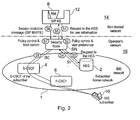
- FIG. 1 provides an illustration of an example of an IMS architecture according to an embodiment of the present invention.
- an IMS network 1 includes a subscriber database which is a Home Subscriber Server (HSS) 2, a session protocol server, which is a Serving Call State Control Function (S-CSCF) 4 and a Proxy-Call State Control Function (P-CSCF) 6, which are arranged in combination with an application program 8 to provide a multi-media service to an IMS subscriber 10.
- the service is provided by the application program 8 operating on a Session Initiation Protocol (SIP) Application Server (AS) 12, which is operating in a non-trusted network 14, outside an operator's network 16.
- SIP Session Initiation Protocol
- AS Application Server
- the SIP AS 12 requires access to the IMS network 1.
- Access to the IMS network 1 from the SIP AS is provided by a security node SN.
- the security node SN provides two interfaces to the IMS subsystem, which are the standard ISC interface to the S-CSCF and the Sh interface to the HSS.
- the operation of the security node is substantially transparent or at least unobtrusive to the operation of the third party SIP AS 12, the HSS 2 and the S-CSCF 4.
- the UMTS core network elements have not been shown in Figure 1 and not all of the IMS entities are represented in Figure 1.
- the P-CSCF 6, the S-CSCF 4 and the HSS 2 of the IMS network are shown in Figure 1, since these are required for supporting a service to the IMS subscriber 10.
- the network shown in Figure 1 also includes a security gateway (SEG) channel 18, which provides a facility for communicating between the SIP AS and the IMS system. More details of the SEG are provided in Annex 2.
- SEG security gateway
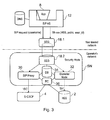
- the SIP proxy 30 is an example implementation of a session message control node, which is arranged to enforce a defined policy for allowing access to the ISC interface as determined by the access control information.
- the policy may be established by off-line agreements with the application program developer.
- the agreements may define, for example, conditions for allowing permission to an external SIP AS to access the ISC interface for SIP procedures.
- the list of permissions may include at least one of a permission to act as a user agent (UA), a permission to use SUBSCRIBE/NOTIFY methods, or a determination of a maximum number of simultaneous communications allowed between the application server and the session protocol server, which may be SIP connections.
- the DIAMETER Node 32 is an example implementation of a database access control node, which provides a facility for allowing inter-domain access to the Sh interface.
- DIAMETER is a protocol providing authentication, authorisation and accounting for accessing the subscriber database (HSS).
- HSS subscriber database
- the DIAMETER node 32 is responsible for enforcing an established operator's policy for accessing the Sh interface, including a Service Level Agreement (SLA) (see control information database).
- SLA Service Level Agreement
- the operator's policy may be established, according to off-line agreements between the operator and the service provider.
- An off-line agreement may, for example, specify permissions for a third party SIP AS for Sh interface procedures or the maximum number of simultaneous connections, which may be allowed on the Sh interface.
- the DIAMETER Node 32 is responsible for enforcing permission for external SIP Application servers only.
- the HSS 2 will still maintain a SIP AS permission list for the operator's SIP AS as part of the access control information.
- the address of the DIAMETER node 32 has to be included in the SIP AS permission list of the HSS.
- the DIAMETER node is part of the operator's domain, there is no security issue with this requirement.
- a second requirement is that the DIAMETER node should be given all Sh permissions to be able to have full access to the information contained in the HSS and to be able to perform if required any operation.
- a part of the security gateway (SEG) 18.2 formed within the security node SN provides one end of a channel for communicating securely between the IMS network 16 and the non-trusted network 14.
- the SEG 18 has been defined in the 3GPP specifications and provides a facility for inter-domain security for the IP layer and the transport layer. The SEG therefore provides a channel for any IP-based traffic between the SIP AS and the Security Node (incl. DIAMETER and SIP traffic).
- a more detailed explanation of the SEG is provided in Annex 2.
- the role of the resource controller 36 is to poll and analyse measurements of the load of the S-CSCF and the HSS in order to prevent overloading of IMS resources.
- the resource controller 36 is arrange to adapt dynamically external communications in accordance with a currently experienced load on either the S-CSCF or the HSS, in accordance with the access control information which includes an off-line agreement signed between the third party and the operator.
- the security node When receiving a request from a third party SIP AS, the security node is arranged to analyse the received request and to determine whether the request is a SIP request or a DIAMETER request. In accordance with the analysis the security node either communicates a message to the S-CSCF or access the HSS in dependence upon the determination.
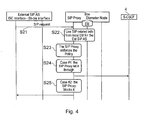
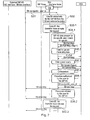
- Figures 4, 5, 6 and 7 provide examples of an access to the S-CSCF from a SIP AS and an access to the HSS information respectively for example cases.
- FIG. 4 provides a flow diagram for accessing the session protocol server (S-CSCF) via the session message control node (SIP Proxy) 30, which is summarised below:
- any incoming request addressed to the HSS is processed by the DIAMETER node.
- Three different cases can be distinguished when handling requests for the user information held in the HSS, which depend on whether user preference data is present in the control database 34.
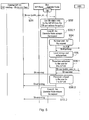
- Figure 5 provides a flow diagram illustrating access to the HSS in accordance with a DIAMETER request from a third party SIP AS, for the case where there are no user preferences at the DIAMETER node.
- Figures 6 and 7 provide flow diagrams illustrating the case where there are user preferences present at the DIAMETER node, which either do not need updating (Figure 6) or need up-dating ( Figure 7) respectively.
- the first case is when the user preferences regarding access to personal information are not available at the DIAMETER node. For instance, after a certain period of time, the user preferences can be considered obsolete and deleted from the DIAMETER node.
- the call flow for such a situation is presented in Figure 5 and is summarised as follows:
- the second case is when the DIAMETER node already holds the data related to the preferences of the user in the control information database.
- the DIAMETER Node first has to make sure the local version of the user preferences is still consistent with the data in the HSS. To achieve this, each time the DIAMETER node receives an Sh request related to a specific user, it has to check a flag in the repository data of the HSS to determine whether or not the data has been updated or not.
- Figure 6 provides a flow diagram illustrating the case where the user preferences are still consistent with those stored in the HSS
- Figure 7 illustrates the case where the user preferences are no longer consistent and have to be updated.
- the flow diagrams in Figures 6 and 7 perform the same operation as the flow diagram provided in Figure 5, except that the user preference information is not present in the Figure 5 example. Therefore, only the differences for the example cases will be explained for the flow diagrams in Figures 6 and 7. As such, the following steps differ from the steps performed in Figure 5:
- the present invention should not be considered to be limited to an IMS network but may find application in controlling access to any multi-media system from an application server.
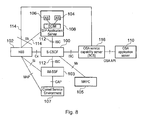
- the IP Multimedia Subsystem is a multi-media and call control service architecture, defined by 3GPP, on top of the real time capable UMTS packet domain. IMS provides a basis for service provision and development of new services. Its role is to provide services to the user. More information on the IMS can be found in [1] and [2]. IMS architecture for service provision is provided in Figure 8.
- the IMS home network is responsible for making IMS services available to the user and for controlling and managing the access to these services.
- An IMS home network can be split into four main functional entities: the Interrogating Call Session Control Function (I-CSCF), the Serving Call Session Control Function (S-CSCF), the Proxy Call Session Control Function (P-CSCF) and the Home Subscriber Server (HSS).
- I-CSCF Interrogating Call Session Control Function
- S-CSCF Serving Call Session Control Function
- P-CSCF Proxy Call Session Control Function
- HSS Home Subscriber Server
- I-SSF IP Multimedia-Service Switching Function
- MRFC Multimedia Resource Function Control
- CAMEL Customized Applications for Mobile Networks Enhanced Logic
- the Serving Call Control Function (S-CSCF)
- the Serving Call Control Function (S-CSCF) 100 is in charge of various signalling functions.
- the role of the S-CSCF 100 of particular interest is its service triggering features. Indeed, in IMS, the S-CSCF is the entity, which performs service triggering. It can provide simple services to a user or more advanced services by interacting with an application server.
- the Home Subscriber Server (HSS)
- the Home Subscriber Server (HSS) 102 is an evolution of the Home Location Register (HLR) currently used in the mobile network. It contains information such as user identities, subscribed service or profile, service specific information, mobility management information, authorisation information and functions related to the IP multimedia domain. It handles authentication and location information.
- HLR Home Location Register
- Application servers are in charge of hosting service logic and handling service execution. There are three types of Application Servers (AS) defined in IMS specifications to deliver services to the user: the SIP Application Server 108, the OSA (Open Service Architecture) Application Server 110 and the CAMEL Service environment 107.
- AS Application Servers
- the main interfaces include the ISC Interface 112 and the Sh interface 114, which are explained in more detail below.
- the interface between the HSS 102 and the SIP AS 108 or the OSA SCS 110 is called the Sh interface 114.
- the Sh interface is an intra operator interface and is based on the DIAMETER protocol.
- DIAMETER is an Authentication, Authorisation, Accounting (AAA) protocol used to exchange information related to user profile.
- the Sh interface 114 provides a facility for performing data handling procedures such as downloading data from the HSS 102 to the AS 108 and updating data in the HSS 102.
- the Sh interface 114 also handles subscription/notification procedures which enables the HSS to notify an Application Server of changes in data for which the AS previously subscribed to. More information on the Sh interface can be found in [3] and [4].
- IMS In IMS specifications, the application servers, running the services, have been de-coupled from other network equipment and communicate with IMS through a standard interface.
- the interface between the S-CSCF 100 and the service platform(s) is called the ISC interface 112.
- the ISC interface is a standardised SIP-based interface. More information on the ISC interface 112 can be found at [1]-6.2 and [2]-4.2.4.
- This ISC Interface is common to the SIP Application Server, the OSA Application Server and the CAMEL Application Server.
- I-SSF IP Multimedia- Service Switching Function
- the IM-SSF performs mediation between the S-CSCF and the CAMEL Application Protocol (CAP). Indeed, it provides the inter-working of the SIP messages to the corresponding Customized Applications for Mobile Networks Enhanced Logic (CAMEL).
- CAP CAMEL Application Protocol
- Call State models are logically located within the IM-SSF which performs the mapping process between SIP methods passed across the ISC and CAMEL mechanisms, that will be used to initiate dialogue with the CAMEL service environment.
- MRFC Multimedia Resource Function Control
- the Multimedia Resource Function (not shown in figure 8) takes care of performing all the necessary functions in order to be able to carry out multiparty calls and audio video conferences on the IP network.
- the MRF is divided from a functional point of view in two parts: the Multimedia Resource Function Control (MRFC) and the Multimedia Resource Function Processor (MRFP).
- the MRFC controls the media streams in the MRFP, interprets the information that arrives from the S-CSCF or from an application server and performs the control of the users belonging to different audio-video conferences.
- the MRFP provides the resources that must be controlled by the MRFC, mixes and processes the media streams and interacts with the MRFC in order to update the list of active users in the transmission of real time data.
- Annex 2 Secure Access Mechanisms for Third Party SIP AS
- SIP Application Servers in IMS are described in the 3GPP specifications as a way to influence and to control SIP sessions.
- a range of service capabilities offered by SIP Application Servers and the Session Initiation Protocol (SIP) provide an attractive environment for third party service providers and other network operators, including fixed line and Internet service providers to develop multi-media services.
- SIP Session Initiation Protocol
- the standardisation of the application server interface with the S-CSCF eases the opening of the IMS domain to third party SIP AS.
- security mechanisms between IMS entities and third party SIP AS should be set up. A number of security mechanisms are already available in IMS and can be used for this purpose.
- Access control and validity of the user are security functions that are achieved by authentication mechanisms, preventing a user's identity from being usurped or more generally spoofed.
- TLS Transport Layer Security Protocol
- IPSec and TLS also provide confidentiality and integrity.
- the IMS control plane traffic within the IMS core network shall be routed via a SEG when it takes place between different security domains (in particular over those interfaces that may exist between different IMS operator domains). In order to do so, IMS operators shall operate NDS/IP Za-interface between SEGs.”
- a mechanism has been defined to handle situations where the ISC interface handles communications between two different domains.
- the defined architecture to handle such situations is based on a hop-by-hop security mechanism and entities referred to as Security Gateways (SEGs).
- SEGs Security Gateways
- the role of SEGs is to manage communications with entities situated in other security domains.
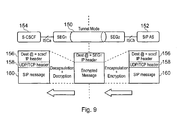
- An overview of the general procedure is provided in Figure 9.
- a SEG channel 150 is provided between a SIP Application Server 152 and an S-CSCF 154.
- a SIP message containing an Internet Protocol header 156, a UDP/TCP header 158 and a SIP message body 160 is encapsulated and encrypted for communication to the S-CSCF via the SEG channel 150. Decryption and de-encapsulation are performed to recover the SIP message at a receiving side of the channel 150.
- the HSS maintains a permission list called "AS permission list" (The permissions are applied by the HSS to a specific Application Server but are not user-specific).
- AS permission list a permission list
- the HSS checks if the considered AS has the permission to send the considered request and return an error result if the AS does not have the required permission.
Landscapes
- Engineering & Computer Science (AREA)
- Computer Networks & Wireless Communication (AREA)
- Signal Processing (AREA)
- Computer Hardware Design (AREA)
- Computer Security & Cryptography (AREA)
- Computing Systems (AREA)
- General Engineering & Computer Science (AREA)
- Telephonic Communication Services (AREA)
- Mobile Radio Communication Systems (AREA)
Priority Applications (4)
| Application Number | Priority Date | Filing Date | Title |
|---|---|---|---|
| EP04290891A EP1583312A1 (fr) | 2004-04-02 | 2004-04-02 | Appareils et méthode pour contrôler l'accès à un système multimédia IP à partir d'un serveur d'applications |
| EP05751679A EP1741269A1 (fr) | 2004-04-02 | 2005-03-25 | Appareils et procede destines a controler l'acces a un systeme multimedia ip a partir d'un serveur d'applications |
| PCT/EP2005/003311 WO2005099215A1 (fr) | 2004-04-02 | 2005-03-25 | Appareils et procede destines a controler l'acces a un systeme multimedia ip a partir d'un serveur d'applications |
| US11/547,144 US20070209061A1 (en) | 2004-04-02 | 2005-03-25 | Apparatuses and Method for Controlling Access to an ip Multimedia System from an Application Server |
Applications Claiming Priority (1)
| Application Number | Priority Date | Filing Date | Title |
|---|---|---|---|
| EP04290891A EP1583312A1 (fr) | 2004-04-02 | 2004-04-02 | Appareils et méthode pour contrôler l'accès à un système multimédia IP à partir d'un serveur d'applications |
Publications (1)
| Publication Number | Publication Date |
|---|---|
| EP1583312A1 true EP1583312A1 (fr) | 2005-10-05 |
Family
ID=34878337
Family Applications (2)
| Application Number | Title | Priority Date | Filing Date |
|---|---|---|---|
| EP04290891A Withdrawn EP1583312A1 (fr) | 2004-04-02 | 2004-04-02 | Appareils et méthode pour contrôler l'accès à un système multimédia IP à partir d'un serveur d'applications |
| EP05751679A Withdrawn EP1741269A1 (fr) | 2004-04-02 | 2005-03-25 | Appareils et procede destines a controler l'acces a un systeme multimedia ip a partir d'un serveur d'applications |
Family Applications After (1)
| Application Number | Title | Priority Date | Filing Date |
|---|---|---|---|
| EP05751679A Withdrawn EP1741269A1 (fr) | 2004-04-02 | 2005-03-25 | Appareils et procede destines a controler l'acces a un systeme multimedia ip a partir d'un serveur d'applications |
Country Status (3)
| Country | Link |
|---|---|
| US (1) | US20070209061A1 (fr) |
| EP (2) | EP1583312A1 (fr) |
| WO (1) | WO2005099215A1 (fr) |
Cited By (12)
| Publication number | Priority date | Publication date | Assignee | Title |
|---|---|---|---|---|
| WO2007056925A1 (fr) * | 2005-11-15 | 2007-05-24 | Huawei Technologies Co., Ltd. | Procede et materiel de controle de session dans un reseau ims |
| WO2007071276A1 (fr) * | 2005-12-22 | 2007-06-28 | Telecom Italia S.P.A. | Architecture ims multiconstructeur |
| WO2007082493A1 (fr) * | 2006-01-23 | 2007-07-26 | Huawei Technologies Co., Ltd. | Procédé et entité de réseau pour le traitement du contenu de message de protocole d'ouverture de session |
| WO2007112649A1 (fr) * | 2006-04-05 | 2007-10-11 | Huawei Technologies Co., Ltd. | Système, dispositif et procédé d'accès à une base de données fondés sur un protocole d'initialisation de session |
| WO2007109647A3 (fr) * | 2006-03-20 | 2008-04-17 | Airvana Inc | Services multimédia en diffusion individuelle et en diffusion sélective |
| WO2009051528A1 (fr) * | 2007-10-17 | 2009-04-23 | Telefonaktiebolaget Lm Ericsson (Publ). | Procédé et agencement pour déterminer un réglage de sécurité |
| CN1984434B (zh) * | 2005-12-12 | 2011-01-12 | 上海原动力通信科技有限公司 | 无线通信系统及其无线资源管理方法和小区切换方法 |
| CN102484641A (zh) * | 2009-06-30 | 2012-05-30 | 法国电信公司 | 用于选择网络资源的方法 |
| CN1964564B (zh) * | 2005-10-10 | 2012-07-04 | 华为技术有限公司 | 无线通信系统中用户面承载资源分配方法及无线通信系统 |
| WO2012173536A1 (fr) * | 2011-06-15 | 2012-12-20 | Telefonaktiebolaget Lm Ericsson (Publ) | Procédés et agencement pour répartir des requêtes |
| CN104426887A (zh) * | 2013-09-04 | 2015-03-18 | 华为技术有限公司 | 业务权限确定方法和装置 |
| US11729588B1 (en) | 2021-09-30 | 2023-08-15 | T-Mobile Usa, Inc. | Stateless charging and message handling |
Families Citing this family (39)
| Publication number | Priority date | Publication date | Assignee | Title |
|---|---|---|---|---|
| US9219729B2 (en) | 2004-05-19 | 2015-12-22 | Philip Drope | Multimedia network system with content importation, content exportation, and integrated content management |
| US9503528B2 (en) * | 2004-06-14 | 2016-11-22 | Alcatel-Lucent Usa Inc. | System for provisioning service data utilizing the IMS defined Sh interface's transparent data |
| JP4960341B2 (ja) * | 2005-04-01 | 2012-06-27 | テレフオンアクチーボラゲット エル エム エリクソン(パブル) | Imsベースの通信を開始するための方法 |
| JP4692813B2 (ja) * | 2005-05-13 | 2011-06-01 | Smc株式会社 | 電磁弁駆動制御装置 |
| KR100770861B1 (ko) * | 2005-05-13 | 2007-10-26 | 삼성전자주식회사 | 아이피 멀티미디어 서브시스템망에서 회선교환 서비스정보를 획득하기 위한 방법 및 장치 |
| DE102005026982A1 (de) * | 2005-06-10 | 2006-12-14 | Siemens Ag | Verfahren zur Vereinbarung eines Sicherheitsschlüssels zwischen mindestens einem ersten und einem zweiten Kommunikationsteilnehmer zur Sicherung einer Kommunikationsverbindung |
| US7783618B2 (en) | 2005-08-26 | 2010-08-24 | Hewlett-Packard Development Company, L.P. | Application server (AS) database with class of service (COS) |
| US8213411B2 (en) * | 2005-08-26 | 2012-07-03 | Hewlett-Packard Development Company, L.P. | Charging database with class of service (COS) |
| US8799490B2 (en) * | 2005-08-26 | 2014-08-05 | Hewlett-Packard Development Company, L.P. | Automated application server (AS) permissions provisioning |
| US8213408B1 (en) * | 2005-09-16 | 2012-07-03 | Genband Us Llc | Providing security in a multimedia network |
| WO2007087749A1 (fr) * | 2006-01-26 | 2007-08-09 | Huawei Technologies Co. Ltd. | Procédé et système pour la génération et l'acquisition de droits d'auteurs et centre d'octroi de droits |
| US20070289009A1 (en) * | 2006-06-12 | 2007-12-13 | Nokia Corporation | Authentication in a multiple-access environment |
| US8522017B2 (en) * | 2006-11-01 | 2013-08-27 | Cisco Technology, Inc. | Systems and methods for signal reduction in wireless communication |
| US8929360B2 (en) | 2006-12-07 | 2015-01-06 | Cisco Technology, Inc. | Systems, methods, media, and means for hiding network topology |
| WO2008076015A1 (fr) * | 2006-12-21 | 2008-06-26 | Telefonaktiebolaget Lm Ericsson (Publ) | Procédé et agencement pour gérer une requête de service dans un réseau multimédia |
| ES2488940T3 (es) * | 2007-09-13 | 2014-09-01 | Huawei Technologies Co., Ltd. | Método y dispositivo de elemento de red para adquirir la información de control de política de una sesión de acceso IP |
| CN101621772B (zh) * | 2008-07-02 | 2012-06-06 | 中国移动通信集团公司 | 一种会话控制方法及设备 |
| US9197706B2 (en) | 2008-12-16 | 2015-11-24 | Qualcomm Incorporated | Apparatus and method for bundling application services with inbuilt connectivity management |
| WO2010111561A2 (fr) | 2009-03-25 | 2010-09-30 | Tekelec | Procédés, systèmes et supports de stockage lisibles par un ordinateur permettant de fournir un serveur mandataire pour un serveur domestique d'abonnés (hss) |
| US8219683B2 (en) * | 2009-03-31 | 2012-07-10 | International Business Machines Corporation | Enabling creation of converged internet protocol multimedia subsystem services by third-party application developers using session initiation protocol support |
| CN102035792A (zh) * | 2009-09-24 | 2011-04-27 | 中兴通讯股份有限公司 | 组播资源管理的方法与装置 |
| US8743688B2 (en) * | 2009-12-11 | 2014-06-03 | At&T Intellectual Property I, L.P. | Method and apparatus for dynamically controlling internet protocol packet handling in a voice over internet protocol network |
| US10602241B2 (en) * | 2009-12-31 | 2020-03-24 | Bce Inc. | Method, system network and computer-readable media for controlling outgoing telephony calls to cause initiation of call features |
| US8750292B2 (en) * | 2010-02-25 | 2014-06-10 | Tekelec, Inc. | Systems, methods, and computer readable media for using a signaling message routing node to provide backup subscriber information management service |
| GB2482919B (en) | 2010-08-20 | 2014-05-07 | Samsung Electronics Co Ltd | Retrieval of user equipment capabilities by application server |
| US9288230B2 (en) * | 2010-12-20 | 2016-03-15 | Qualcomm Incorporated | Methods and apparatus for providing or receiving data connectivity |
| EP2656647B1 (fr) | 2010-12-23 | 2019-04-24 | Tekelec, Inc. | Procédé, système et support lisible par ordinateur pour modifier un message de signalement diameter destiné à un noeud ayant une fonction de facturation |
| EP2528295B1 (fr) * | 2011-05-24 | 2019-09-04 | Vodafone GmbH | Method and system of controlling a gateway |
| EP2763458B1 (fr) * | 2011-09-30 | 2017-06-28 | Nec Corporation | Système de communication, procédé et dispositif |
| US8695060B2 (en) | 2011-10-10 | 2014-04-08 | Openpeak Inc. | System and method for creating secure applications |
| US9100796B2 (en) | 2011-12-15 | 2015-08-04 | Tekelec, Inc. | Methods, systems, and computer readable media for seamless roaming between diameter and non-diameter networks |
| US9350818B2 (en) | 2014-09-05 | 2016-05-24 | Openpeak Inc. | Method and system for enabling data usage accounting for unreliable transport communication |
| US20160071040A1 (en) | 2014-09-05 | 2016-03-10 | Openpeak Inc. | Method and system for enabling data usage accounting through a relay |
| US9232013B1 (en) | 2014-09-05 | 2016-01-05 | Openpeak Inc. | Method and system for enabling data usage accounting |
| US8938547B1 (en) | 2014-09-05 | 2015-01-20 | Openpeak Inc. | Method and system for data usage accounting in a computing device |
| US10687206B2 (en) | 2018-01-30 | 2020-06-16 | Hewlett Packard Enterprise Development Lp | Response messages including information elements not indicated as requested |
| US10762220B2 (en) | 2018-06-11 | 2020-09-01 | Bank Of America Corporation | Access control tool |
| US11552943B2 (en) * | 2020-11-13 | 2023-01-10 | Cyberark Software Ltd. | Native remote access to target resources using secretless connections |
| CN112468466B (zh) * | 2020-11-16 | 2023-04-18 | 上海欣方智能系统有限公司 | 一种关于超大规模ims as技术的实现系统 |
Family Cites Families (11)
| Publication number | Priority date | Publication date | Assignee | Title |
|---|---|---|---|---|
| US5774668A (en) * | 1995-06-07 | 1998-06-30 | Microsoft Corporation | System for on-line service in which gateway computer uses service map which includes loading condition of servers broadcasted by application servers for load balancing |
| US6141759A (en) * | 1997-12-10 | 2000-10-31 | Bmc Software, Inc. | System and architecture for distributing, monitoring, and managing information requests on a computer network |
| US7836494B2 (en) * | 1999-12-29 | 2010-11-16 | Intel Corporation | System and method for regulating the flow of information to or from an application |
| US20020026473A1 (en) * | 2000-08-31 | 2002-02-28 | Telefonaktiebolaget Lm Ericsson (Publ) | Application-programming-interface-based method and system including triggers |
| US6947897B2 (en) * | 2001-02-13 | 2005-09-20 | Capital One Financial Corporation | System and method for managing consumer information |
| US6888828B1 (en) * | 2001-10-02 | 2005-05-03 | Nokia Corporation | System and method for providing at least one service obtained from a service network for a user in a packet switched communication network |
| AU2003212638A1 (en) * | 2002-03-13 | 2003-09-22 | Adjungo Networks Ltd. | Accessing cellular networks from non-native local networks |
| US7027577B2 (en) * | 2002-08-26 | 2006-04-11 | Telefonaktiebolaget Lm Ericsson (Publ) | Method and system for multi-party call conferencing |
| US8335860B2 (en) * | 2002-12-19 | 2012-12-18 | Nokia Corporation | Filtering application services |
| US7627894B2 (en) * | 2003-02-04 | 2009-12-01 | Nokia Corporation | Method and system for authorizing access to user information in a network |
| GB0306863D0 (en) * | 2003-03-25 | 2003-04-30 | Nokia Corp | Service provisioning in a communication system |
-
2004
- 2004-04-02 EP EP04290891A patent/EP1583312A1/fr not_active Withdrawn
-
2005
- 2005-03-25 EP EP05751679A patent/EP1741269A1/fr not_active Withdrawn
- 2005-03-25 WO PCT/EP2005/003311 patent/WO2005099215A1/fr not_active Ceased
- 2005-03-25 US US11/547,144 patent/US20070209061A1/en not_active Abandoned
Non-Patent Citations (5)
| Title |
|---|
| 3GPP SA: "TS 23.141 V6.5.0: Presence Service; Architecture and functional description (Release 6)", 3GPP TECHNICAL SPECIFICATION, March 2004 (2004-03-01), pages 1 - 36, XP002295425, Retrieved from the Internet <URL:www.3gpp.org/ftp> [retrieved on 20040909] * |
| 3GPP SA: "TS 33.203 V6.2.0: 3G Security: Access security for IP-based services", 3GPP TECHNICAL SPECIFICATION, March 2004 (2004-03-01), pages 1 - 42, XP002295500, Retrieved from the Internet <URL:www.3gpp.org/ftp> [retrieved on 20040908] * |
| HUNT R: "Internet/Intranet firewall security-policy, architecture and transaction services", COMPUTER COMMUNICATIONS, BUTTERWORTHS & CO. PUBLISHERS LTD, GB, vol. 21, no. 13, 1 September 1998 (1998-09-01), pages 1107 - 1123, XP004146571, ISSN: 0140-3664 * |
| SRISURESH P,KUTHAN J,ROSENBERG J,MOLITOR A,RAYHAN A: "Middlebox communication architecture and framework", IETF REQUEST FOR COMMENT, August 2002 (2002-08-01), pages 1 - 34, XP015009080 * |
| TSG-SA: "TS 33.210 V6.4.0: 3G Security; Network Domain Security; IP network layer security (Release 6)", 3GPP TECHNICAL SPECIFICATION, March 2004 (2004-03-01), pages 1 - 21, XP002295424, Retrieved from the Internet <URL:www.3gpp.org/ftp> [retrieved on 20040908] * |
Cited By (22)
| Publication number | Priority date | Publication date | Assignee | Title |
|---|---|---|---|---|
| CN1964564B (zh) * | 2005-10-10 | 2012-07-04 | 华为技术有限公司 | 无线通信系统中用户面承载资源分配方法及无线通信系统 |
| CN1968262B (zh) * | 2005-11-15 | 2011-04-06 | 华为技术有限公司 | 一种ims网络中的会话控制方法和装置 |
| WO2007056925A1 (fr) * | 2005-11-15 | 2007-05-24 | Huawei Technologies Co., Ltd. | Procede et materiel de controle de session dans un reseau ims |
| CN1984434B (zh) * | 2005-12-12 | 2011-01-12 | 上海原动力通信科技有限公司 | 无线通信系统及其无线资源管理方法和小区切换方法 |
| WO2007071276A1 (fr) * | 2005-12-22 | 2007-06-28 | Telecom Italia S.P.A. | Architecture ims multiconstructeur |
| US8520664B2 (en) | 2005-12-22 | 2013-08-27 | Tim Italia S.P.A. | Multi-vendor IMS architecture |
| WO2007082493A1 (fr) * | 2006-01-23 | 2007-07-26 | Huawei Technologies Co., Ltd. | Procédé et entité de réseau pour le traitement du contenu de message de protocole d'ouverture de session |
| WO2007109647A3 (fr) * | 2006-03-20 | 2008-04-17 | Airvana Inc | Services multimédia en diffusion individuelle et en diffusion sélective |
| GB2450285A (en) * | 2006-03-20 | 2008-12-17 | Airvana Inc | Unicasting and multicasting multimedia services |
| US11477617B2 (en) | 2006-03-20 | 2022-10-18 | Ericsson Evdo Inc. | Unicasting and multicasting multimedia services |
| GB2450285B (en) * | 2006-03-20 | 2011-06-22 | Airvana Inc | Unicasting and multicasting multimedia services |
| WO2007112649A1 (fr) * | 2006-04-05 | 2007-10-11 | Huawei Technologies Co., Ltd. | Système, dispositif et procédé d'accès à une base de données fondés sur un protocole d'initialisation de session |
| WO2009051528A1 (fr) * | 2007-10-17 | 2009-04-23 | Telefonaktiebolaget Lm Ericsson (Publ). | Procédé et agencement pour déterminer un réglage de sécurité |
| US8386766B2 (en) | 2007-10-17 | 2013-02-26 | Telefonaktiebolaget Lm Ericsson (Publ) | Method and arrangement for deciding a security setting |
| CN102484641A (zh) * | 2009-06-30 | 2012-05-30 | 法国电信公司 | 用于选择网络资源的方法 |
| CN102484641B (zh) * | 2009-06-30 | 2015-10-07 | 法国电信公司 | 用于选择网络资源的方法 |
| WO2012173536A1 (fr) * | 2011-06-15 | 2012-12-20 | Telefonaktiebolaget Lm Ericsson (Publ) | Procédés et agencement pour répartir des requêtes |
| CN104426887A (zh) * | 2013-09-04 | 2015-03-18 | 华为技术有限公司 | 业务权限确定方法和装置 |
| EP3029908A4 (fr) * | 2013-09-04 | 2016-07-27 | Huawei Tech Co Ltd | Procédé et dispositif de détermination de droit de maintenance |
| CN104426887B (zh) * | 2013-09-04 | 2018-06-19 | 华为技术有限公司 | 业务权限确定方法和装置 |
| US11729588B1 (en) | 2021-09-30 | 2023-08-15 | T-Mobile Usa, Inc. | Stateless charging and message handling |
| US12041521B2 (en) | 2021-09-30 | 2024-07-16 | T-Mobile Usa, Inc. | Stateless charging and message handling |
Also Published As
| Publication number | Publication date |
|---|---|
| EP1741269A1 (fr) | 2007-01-10 |
| US20070209061A1 (en) | 2007-09-06 |
| WO2005099215A1 (fr) | 2005-10-20 |
Similar Documents
| Publication | Publication Date | Title |
|---|---|---|
| US20070209061A1 (en) | Apparatuses and Method for Controlling Access to an ip Multimedia System from an Application Server | |
| CN101379757B (zh) | 在通信网络中提供电话服务以及实施策略的方法和系统 | |
| US8194642B2 (en) | System and method for providing multimedia services | |
| EP2137931B1 (fr) | Procédé et arrangement de gestion de profils dans un réseau de services multimédia | |
| KR101139072B1 (ko) | Ims 기반 통신 개시 방법 | |
| US7912460B2 (en) | Communication control system for providing service by using policy | |
| US7916850B2 (en) | IMS subscriber access control | |
| US20100293593A1 (en) | Securing contact information | |
| Márquez et al. | Interworking of IP multimedia core networks between 3GPP and WLAN | |
| US20090303943A1 (en) | Access Control in a Communication Network | |
| US11089561B2 (en) | Signal plane protection within a communications network | |
| KR101107948B1 (ko) | 통신 시스템에서의 서비스 제공 | |
| US20100226361A1 (en) | Multi-Vendor IMS Architecture | |
| US12470632B2 (en) | Technique for storing cookie information in a core network domain of a wireless communication network | |
| US20090327721A1 (en) | Method and Apparatuses for Securing Communications Between a User Terminal and a SIP Proxy Using IPSEC Security Association | |
| Grech et al. | Service control architecture in the UMTS IP multimedia core network subsystem | |
| Costa-Requena | Application of Location Information to SIP | |
| Scalisi | IMS Release 10 Tutorial | |
| De Zen | Service Personalisation and Beyond | |
| IMS | TS-3GA-23.228 (Rel11) v11. 10.0 IP Multimedia Subsystem (IMS); Stage 2 |
Legal Events
| Date | Code | Title | Description |
|---|---|---|---|
| PUAI | Public reference made under article 153(3) epc to a published international application that has entered the european phase |
Free format text: ORIGINAL CODE: 0009012 |
|
| AK | Designated contracting states |
Kind code of ref document: A1 Designated state(s): AT BE BG CH CY CZ DE DK EE ES FI FR GB GR HU IE IT LI LU MC NL PL PT RO SE SI SK TR |
|
| AX | Request for extension of the european patent |
Extension state: AL HR LT LV MK |
|
| AKX | Designation fees paid | ||
| REG | Reference to a national code |
Ref country code: DE Ref legal event code: 8566 |
|
| STAA | Information on the status of an ep patent application or granted ep patent |
Free format text: STATUS: THE APPLICATION IS DEEMED TO BE WITHDRAWN |
|
| 18D | Application deemed to be withdrawn |
Effective date: 20060406 |