EP1583445B1 - Rideau suspendu comportant des fentes externes - Google Patents
Rideau suspendu comportant des fentes externes Download PDFInfo
- Publication number
- EP1583445B1 EP1583445B1 EP02795896A EP02795896A EP1583445B1 EP 1583445 B1 EP1583445 B1 EP 1583445B1 EP 02795896 A EP02795896 A EP 02795896A EP 02795896 A EP02795896 A EP 02795896A EP 1583445 B1 EP1583445 B1 EP 1583445B1
- Authority
- EP
- European Patent Office
- Prior art keywords
- ring
- slit
- item
- edge
- rod
- Prior art date
- Legal status (The legal status is an assumption and is not a legal conclusion. Google has not performed a legal analysis and makes no representation as to the accuracy of the status listed.)
- Expired - Lifetime
Links
Images



Classifications
-
- A—HUMAN NECESSITIES
- A47—FURNITURE; DOMESTIC ARTICLES OR APPLIANCES; COFFEE MILLS; SPICE MILLS; SUCTION CLEANERS IN GENERAL
- A47K—SANITARY EQUIPMENT; ACCESSORIES THEREFOR, e.g. TOILET ACCESSORIES
- A47K3/00—Baths; Showers; Appurtenances therefor
- A47K3/28—Showers or bathing douches
- A47K3/38—Arrangements for curtains
-
- A—HUMAN NECESSITIES
- A47—FURNITURE; DOMESTIC ARTICLES OR APPLIANCES; COFFEE MILLS; SPICE MILLS; SUCTION CLEANERS IN GENERAL
- A47H—FURNISHINGS FOR WINDOWS OR DOORS
- A47H13/00—Fastening curtains on curtain rods or rails
- A47H13/02—Fastening curtains on curtain rods or rails by rings, e.g. with additional runners
-
- A—HUMAN NECESSITIES
- A47—FURNITURE; DOMESTIC ARTICLES OR APPLIANCES; COFFEE MILLS; SPICE MILLS; SUCTION CLEANERS IN GENERAL
- A47H—FURNISHINGS FOR WINDOWS OR DOORS
- A47H15/00—Runners or gliders for supporting curtains on rails or rods
- A47H15/04—Gliders
-
- A—HUMAN NECESSITIES
- A47—FURNITURE; DOMESTIC ARTICLES OR APPLIANCES; COFFEE MILLS; SPICE MILLS; SUCTION CLEANERS IN GENERAL
- A47H—FURNISHINGS FOR WINDOWS OR DOORS
- A47H7/00—Devices for putting-up and removing curtain rods
- A47H7/02—Curtain rods, capable of being lowered
Definitions
- the present invention relates to an accessory for attaching and detaching materials from a rod without requiring removal of the rod or adding additional hardware, such as hooks or the like, to the fabric.
- U.S. Patent No. 5,186,232 issued on February 16, 1993 (which is fully incorporated herein by reference), discloses and claims an accessory product for easily mounting and detaching a material from a rod without removing the rod.
- the accessory product is intended for use with hanging or otherwise suspended materials, such as window treatments (window curtains, drapes, I etc.), shower curtains, windscreens, towels, and so forth.
- suspended materials referred to herein as "hanging materials” for brevity
- hanging materials are well known in the art, and are often mounted onto rods.
- the '232 patent discloses an accessory invention, as shown in Figure 5 , which allows a curtain or so forth to be attached to a mounting rod without the need for hanging support hooks, clips, and so forth, while also avoiding the need to remove the rod from its supports.
- the accessory is useful in a large variety of applications, including shower curtains and other household and commercial products. It involves a series of reinforced openings with slits provided between alternating paired sets of holes, thereby allowing the hanging material to be attached over the rod without the need for threading or hooks. Further advances and improvements to the inventions disclosed in the '232 patent are provided herein.
- the present invention provides an item for hanging comprising a hanging material and a ring, said hanging material having an opening for receiving a rod such that said material can be suspended from said rod, said item comprising a ring provided to reinforce said opening in said hanging material, said ring having an opening such that said item is suitable for suspension from a rod; characterized in that :
- a hanging material such as a curtain (e. g. a window curtain or a shower curtain) or other product is provided with a slit therein for attachment of the hanging material to a fixed rod without removing the rod.
- the material has a fastener therein, as well, the slit extending through the fastener.
- the hanging material includes at least one external slit, i.e. a slit, at any angle, which intersects an edge of the hanging material.
- the external slit is one (at any angle) which extends through the inside circumference or inner edge of a fastener at one end and the outer edge of the hanging material at the other end.
- the invention can be used for window treatments, shower curtains, drapery, portieres, room dividers, blinds, accessory tapes, and windscreens, or other hanging items.
- the fastener which can be made of a rigid, or semi-rigid material (i. e. a material with some flexibility), is preferably integrated into the hanging material and facilitates the attachment of the material to the rod without the need to remove the rod from its supports.
- the slit is of any shape or size desired.
- An apparatus which allows a curtain or so forth to be attached to a mounting rod without the need for using additional support hooks, clips, or like, and while also avoiding the need to remove the rod from its supports.
- openings are provided each having a slit provided therein.
- the slit can be of any shape or size desired, whether straight, curved, or so forth. Likewise it can be of any width desired, whether a uniform width, or a width which changes over the length of the slit, e.g. in an hourglass shape, as with slit 390 of Figure 33 .
- each opening is reinforced with a fastener such as a ring 10.
- Ring 10 can be made of homo polypropylene, ABS, or other suitable materials. These materials are strong enough to support the various fabrics commonly used for curtains, drapes, and so forth. In addition, they also have excellent memory so that, after being flexed to fit over the rod, the ring automatically springs back to its original position.
- pairs of rings can be provided having a horizontal slit connecting each pair.
- the hanging product includes at least one external slit therein.
- external slit refers to a slit which passes through the material of the hanging product (and through a ring as well if one is provided) to ultimately exit outside the suspended material 20.
- Examples of external slits are horizontal external slit 12 and vertical external slit 17.
- Various other examples of external slits are provided herein.
- the external slit can be in any orientation and, when used in conjunction with a ring, can extend through any position on the ring, whether the " 12o'clock" position, or to 1 o'clock, 2 o'clock, 10 o'clock, 11 o'clock, or so forth.
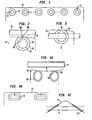
- Rings with external slits can be provided to the hanging product in addition to the horizontally slit rings ofthe'232 patent, as shown, for example, in Figure 1 .
- the hanging product can be provided with externally slit rings only.
- the ring 10 is located within the suspended material 20 and external slit 17 extends from the ring and through the suspended material 20, exiting at the suspended material 20's edge.
- a space of suspended material 20 exists between the ring 10 and the outside of the suspended material 20, and the external slit extends through that space.
- Ring 10, as with the other rings or fasteners of the present invention can be attached to the hanging product via any desired secure means.
- the rings can be attached by staking, by sealing, by sewing, by welding, or by using any of the methods of U.S. Provisional Application Serial No. 60/150,876, filed August 26, 1999 , whose contents are fully incorporated herein by reference.
- a closed ring 10 is provided.
- the term closed ring refers to the fact that the external slit is normally "closed" i.e. the two radial edges which form the slit 17 are pressed together.
- the ring has some degree of flexibility, and must be flexed for the slit to open, i.e. for the edges of the slit to move some distance apart. Flexing the ring increases the width of the gap to insert the ring over the rod.
- the slit extends through the ring until the edge of the hanging product (whether that edge of the hanging product is beyond the edge of the ring or coincides with it as shown in various embodiments below).
- an open ring 30 is provided in the material 32 for attachment of the hanging product to the rod or bar 34.
- ring 30 is an open ring which is provided with rounded edges 36.
- a space is provided between the edges of the open ring, forming a mouth or gap 38 which acts as the external slit.
- the gap is approximately 1/16" to 1/8" in diameter, although larger or smaller gaps can be used, depending on the application, rod size, and shape.
- the upper edge of ring 30 is tangent to the upper edge 39 of suspended material 32.
- rounded edges 36 and mouth 38 form an external slit design which is easier for a person to attach to rod 34.
- the example of Figure 2 is to be contrasted with the example shown in Figure 1 .
- a closed ring is provided having a radial slit therethrough.
- the ring is closed in that the slit 17 consists of a right radial edge and a left radial edge of the ring, those right and left radial edges being pressed against each other.
- Figure 2 provides an open ring structure in which a gap exists between the left radial edge 36a of the ring and the right radial edge 36b of the ring, radial edges 36a and 36b being the edges extending from the outer circumference or outer edge 26 to the inner circumference or inner edge 28 of the fastener or ring.
- the radial edges of the open ring be rounded as shown in Figure 2 .
- Open mouth 38 and rounded edges 36 facilitate the attachment of the ring to the rod from below, and further facilitate the attachment of the ring with one hand.
- Figure 3 illustrates the example of Figure 2 as attached to rod 34. In addition to providing ease of attachment, the example of Figure 2 also provides ease of detachment.
- ring 50 is elongated in shape, as shown in Figure 4a .
- the elongated shape is an oval.
- the elongated shape of the ring facilitates attachment of the ring to a square or rectangular rod.
- the example can be utilized with drapes, window treatments, blinds, and so forth.
- Ring 50 can include an open mouth 58, as in the example of Figure 2 , or, alternatively, it can have a closed mouth, such as shown in Figure 1 and, for example, Figures 22-27 .
- the ring can also have the upper edge of ring 50 tangent to upper edge 59 of the suspended material.
- the elongated ring can be any non-circular shape, including, for example, a rectangle or quadrilateral.
- a rectangle or quadrilateral One such shape is provided in Figure 4(b) .
- the external and/or internal edges of the ring need not be rounded although they are preferably so.
- the ring 50 can be elongated vertically, as shown in Figure 4 (a) , or can be elongated horizontally, as shown in Figure 4 (b) .
- Use of the horizontally elongated ring 70 of Figure 4 (b) allows the curtain 72 to spread more in a lateral direction (i. e. from left to right) along the curtain rod. The same curtain will spread out or widen more along a rod 74 using the horizontally elongated ring of Figure 4 (b) than it would using a rounded ring such as the ring 30 of Figure 2 .
- Figures 5 through 8 An illustration of a comparison of the unmodified invention of the '232 patent to the external slit inventions of the present application is shown in Figures 5 through 8.
- Figure 5 is a front view of the invention of the '232 patent, with Figure 7 being a top view thereof.
- Figure 6 is a front view of the external slit inventions herein, with Figure 7 being a top view thereof.
- the external slit devices may be used to provide certain patterns of flow of a curtain (e. g. the way it folds, hangs, etc). Depending on the desired results, they may be used in conjunction with the rings of the '232 device or by themselves. As shown in Figure 5 and in the top view of Figure 7 , using the devices of the '232 patent, the left (and right) edge of the curtain 82 will normally point outward (away from a shower or window) when placed on a rod 84.
- the curtain concave toward the viewer, i.e. the edge pointed away from the viewer as shown in Figure 8 .
- This effect is produced by the external slits, as shown in Figures 6 and 8 .
- the curtain is concave in this fashion, a more aesthetic appearance is produced for the curtain. Indeed, this is the industry standard for curtains.
- light is more effectively blocked from the window behind the curtain since the curtain cups against the wall, and likewise water is contained more effectively in the shower, as shown in Figure 8 .
- the external slit examples can also be used to facilitate the placement of multiple layers of curtains on a rod.
- a fabric curtain 100 is placed on a rod 104 with a second curtain or liner 120 placed behind it.
- a decorative fabric shower curtain for example, is often provided with a plastic liner behind it, the plastic liner protecting the fabric from the water of the shower.
- each layer of curtain can be removed independently from the rod 104 without the need to remove any other layer, as shown in Figures 9 and 10 .
- the fabric curtain must first be removed from the rod, then the old liner must be removed from the rod, then the new liner is placed on the rod, and then the fabric curtain is replaced on the rod.
- the old liner can be directly removed from the and a replacement liner easily placed onto the rod, without the need to remove the fabric curtain, even if the fabric curtain is made according to the'232 patent.
- the present inventions allow the width and the spacing of the flow of the curtain to be adjusted more readily.
- Using an approach purely like the '232 patent requires an even number of rings.
- the use of one or more external slits (in conjunction with the '232 patent design or using only external slits), on the other hand, allows an odd number of rings which is sometimes necessary due to spacing considerations between the rings (e.g. for flow of the curtain) and due to considerations governing the necessary width of the curtain or other hanging product.
- ring 130 is fully within the suspended material 132. As shown in Figure 12 , in this example ring 130 is below or touching hem 137 of suspended material 132.
- ring 140 overlaps with hem 147 of the curtain or suspended material 142.
- the top of ring 140 is also tangent to top edge 149 of the curtain.
- the cutting of a series of external slits 133 across the length of the hem 137 of the curtain can often result in a hem which will droop or hang downward.
- the ring 140 acts to reinforce the hem, suspending the hem upward and preventing drooping.
- the ring is an open ring with rounded edges, as discussed above with respect to Figure 2 .
- an open ring with rounded edges or one of the other examples
- a ring with a locking device e. g. as shown in Figures 22-27
- the present inventions are not limited to such a closed ring.
- ring 180 overlaps with the edge of the curtain 182, such that ring extends beyond hem 187.
- This example can be used, for example, to lengthen the curtain.
- the example can be used with a externally slit ring 180 as shown in Figure 16 , or with a horizontally slit ring 190, as shown in Figure 17 .
- a tab 175 can be placed at the bottom of a ring 170 (either horizontally slit as shown, or a externally slit ring). Tab 175 is used to attach the ring to a curtain 172, e. g. at the hem 177.
- the fabric material can be vinyl, cotton, polyester, polyester/cotton or any other natural or synthetic fabric, including woven or non-woven fabrics, and can be rigid, semi-rigid, paper, plastic, wood, metal, or the like.
- Two half rings may be placed together to encapsulate the fabric material therein, alternatively a single ring may be integrated into the fabric material.
- the ring-like shape is cut directly into the material, without attaching a ring or fastener as an intermediate attachment to the hanging material.
- Two such examples useful for understanding the invention are shown in Figure 14 (left and right radial edges of slit separate) and Figure 33 (left and right radial edges of slit touching), although any of the slit designs of the present application can be used.
- Other examples of preferred embodiments are shown in Figures 31- 32 .
- the hanging product 160 is preferably made of a relatively rigid or semi-rigid material such as a thick vinyl, either throughout the product, or at least in the area of the ring.
- the design can be used as part of a set of blinds or so forth.
- the external slit 153 can be a simple closed slit, if desired, as in Figure 1 . Alternatively, it can be a more rounded design such as shown in Figures 2 and 14 .
- An open slit i.e. one with a gap between the left and right radial edges
- closed slits with rounded radial edges can be provided in this example or any other examples or embodiments of the application, as shown in Figures 30-33 .
- Such closed slits with rounded radial edges are ones in which the left and right radial edges are rounded, but are also touching when the slit is not being flexed.
- Such closed slits with rounded radial edges provided in rings attached to the hanging product as shown, for example, in Figure 30 .
- a projection, extension or finger is also be provided to the ring as shown in Figures 18, 19 and 20 .
- a ring 200, 210 or 220 is provided with a projecting edge, flange, extension, or finger 206, 216 or 226.
- Extensions 206, 216 or 226 are projections off of the ring (preferably off of the ring's outer circumference), which extend beyond the ring away from the hanging product (e.g. toward the ceiling).
- the extensions are each located adjacent to and to the side of the slit 204. Preferably two extensions are provided, one on each side of the slit. In the preferred embodiment, the slit preferably exits at the top of the product (i.e.
- the extensions are likewise preferably provided on top of the product, on both sides of the ring.
- the slit in any of the embodiments of the present invention can exit at any side or edge of the product (at any location on the "clock face"), with one or two extensions being preferably provided on the side or sides of the slit, whichever side or edge of the product is chosen.
- Extension 206 or 216 of Figures 18 and 19 serve numerous functions. For example, they make it easier to open up the ring when flexing the ring.
- Extension 206 or 216 of Figures 18 and 19 are provided to overlap hems 207 and 217, respectively, supporting the hems and preventing the drooping of the hem discussed above.
- Fingers 206 and 216 also cover the slit vertical edge of the hem, preventing it from fraying.
- Finger 226, on the other hand, is provided above the hem 227, with the ring 220 overlapping the hem to support it. In this embodiment, a portion of the ring - the finger only - projects above the upper edge of the curtain, similar in some ways to Figure 16 .
- the fingers can be spread and opposed as shown in Figures 18 and 20 .
- fingers 226 can be provided as opposed "thumbs".
- inner edges 224a and 224b are at an angle to each other greater than 0 (zero) degrees but less than 180 degrees. This is in contrast to the inner edges 214a and 214b of the fingers of Figure 19 , which are parallel to each other.
- These spread fingers facilitate attachment of the rings 200 and 220 to a rod. They make it easier to slide the ring into the rod until the ring is pushed over the rod. They also make it easier to spread the ring open by hand to insert it over the rod, and to spread the ring open to remove it from the rod. They facilitate attachment whether a simple external slit through the ring is used (as shown in Figures 18 - 20 ), or alternatively in conjunction with open rings with rounded edges (as shown in Figure 2 ).
- a curved external slit 232 can be provided. Further preferably, the slit can be curved and offset, as shown, for example, in Figure 20 .
- curved slit 232 has an upper vertical component 232a, an approximately horizontal component 232b, and a radial component 232c. Radial component 232c of slit 232 exits the inner circumference of the ring at a location which is offset to the side, rather than exiting the ring at the top of the inner circumference of ring 220 (i.e. rather than exiting directly below vertical component 232a).
- fingers 224a and 224b are pulled to the left and right, respectively to open up the ring 220 and insert the ring over a rod.
- Curved slit 233 which intersects the inner circumference of the ring at an offset position rather than at the top of the ring, provides an advantage to the user in that the slit 213 will not sit directly on top of the rod while the curtain is in use. This eliminates the problem of the slit riding on the rod when the curtain is pulled open or closed. Instead, a smooth surface of the ring rides on the rod, easing movement of the curtain.
- Figure 20 can be provided to any given product.
- the curved slit can be provided with or without offset features, whether offset intersection points, or a bottom offset from the 12:00 position.
- the various features of the embodiment of Figure 20 whether a curved slit and/or an offset and/or the fingers, can also be provided directly to the hanging product (without using a ring) as shown in Figure 32 .
- the curved slit can be provided to exit the edge of the product at any exit point other than the top of the ring, with an offset between the intersection point of the curved slit with the inner circumference/edge of the product and the exit point of the product.
- the slit's endpoints are spaced from each other at their intersection points such that the two intersection points are not at the same location were they placed on a standard clock. For example, if the intersection of the curved slit with the exit point from the product were at the 12:00 position (as shown in Figure 20 ), the intersection of the curved slit at the inner edge would be at a point other than the 12:00 position (approximately 1:00 in Figure 20 ). Or, likewise, if the intersection of the curved slit with the exit point from the product were at the 2:00 position instead, the intersection of the curved slit at the inner edge would be at a point other than the 2:00 position.
- the ring 230 can be provided with a flat upper edge 235, as shown in Figure 21 .
- Upper edge 235 overlaps with hem 237.
- Upper edge 235 therefore, provides yet further support for the hem over an extended length of fabric.
- upper edge 235 provides support over a length equal to approximately the outer diameter of the ring 230 for each ring.
- This upper edge can be the entire upper edge of the ring. Or, it can be used a portion of the upper edge, e.g. in conjunction with an extension off the ring, as shown, for example in Figures 18-20 .
- Offset slit 233b is a slit which intersects the inner circle 231 in a secant-like or tangent-like fashion. Offset slit 233b is off center, such that the line it makes (if extended) would not intersect the center of inner circle 231. Or, viewing the circumference of the inner circle, the intersection point of the slit with the inner circumference or edge of the product is offset from the 12:00 position on that inner circle.
- This offset slit allows the ring to glide more smoothly along the rod since the slit does not sit directly on the rod's top.
- the intersection of the slit at the inner edge is preferably at a point offset from the 12: 00 position when the product is hanging, so that the slit does not ride on the rod as previously discussed.
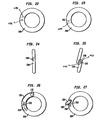
- a ring which can be selectively opened or sealed, i.e. "locked” as shown in Figures 22-25.
- Figure 22 is a front view of ring 240
- Figure 23 is a rear view of ring 240.
- the cut 243 in the top ring shown in Figure 22 is spaced from the corresponding cut 244 in the bottom ring shown in Figure 23 .
- the cut does not extend through both rings in the same position - as a result, the top and bottom rings have an overlap in the area between the cut in the top and bottom ring as shown in Figures 24 and 25 .
- a locking pin is used to secure the two rings.
- ring 240 includes a pin 246 which is located in this overlap area extends through a opening or channel 242.
- the pin 246 In the open position, shown in Figure24 , the pin 246 is separated from channel 242 forming a gap for placing the ring on a rod.
- pin 246 In the closed position, shown in Figure 24 , pin 246 inserts snugly into channel 242 to seal the ring.
- a ring 250 is provided, as shown in Figure 26 .
- Ring 250 includes an internal sliding member 254 which can be pushed or pulled using knob 256. Sliding member 254 slides into and out of internal channel 258 to close and open gap 252.
- a pivoting member 264 is provided, having a pin 265 which inserts into an opening 266. Pivoting member264 can be rotated to open or close gap 262.
- the examples of Figure 22-27 are useful for providing a very secure ring which cannot accidentally be pulled off of a rod. They also increases the smoothness of the sliding of the rings along the rod.
- Strip 306 can be used to convert an existing curtain or other hanging product 302 or can be used to provide a hanging product in which the specific types of fasteners or provided on top can be interchanged.
- Strip 306 includes attachment devices 308 which attach to the top of the hanging product 302.
- the attachment device can be reversibly detachable, e.g. via snaps, a button and hole type design, a zipper, or a hook, or can be more permanent, e. g. via sewing, welding, adhesive, or so forth. Any other attachment methods for attaching the strip to the hanging product can be used as well.
- an existing hanging product with holes 310 can easily be converted to one of the present invention by attaching the strip 306 to the hanging product using the holes 310.
- the hanging product 302 can be woven, non-woven, rigid, semi-rigid, or so forth.
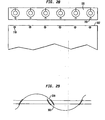
- any of the embodiments or examples described herein can be placed in sequence from right to left, as shown in Figure 29 .
- This allows a person to cover a long window, shower or so forth, by using two or more curtains when the item to be covered is longer than the width of a single curtain.
- overlaps can be used, as shown in Figure 29 .
- the edge of one curtain 320 extends beyond the edge of the other curtain 330, minimizing or eliminating the appearance of any gap between the curtains.
- the slit 344 can include a segment or slit 344a which extends through the hanging product 350, and a segment or slit 344b which extends through the ring 340. As previously discussed with respect to Figure 20 , the slit 344 need not be in a straight line. As shown in Figure 30 , slit 344a is at an angle to slit 344b, the angle being other than 180 degrees. If desired, the slits 344a and 344b can combine to form a curved slit, or can be two straight segments at any angle to each other, the latter being shown in Figure 30 .
- a hanging product in a further example useful for understanding the present invention includes an inner cut-out area 380, also shown as 151 in Figure14 .
- the hanging product includes a slit 370 which extends from the edge of the hanging product to the inner cut-out area 380.
- Slit 370 includes a left radial edge 375a and a right radial edge 375b.
- the slit is an offset slit.
- the radius of the left radial edge 375a is different than the radius of the right radial edge 375b.
- Figure 31 (a) can therefore be contrasted with Figure 33 which shows an example useful for understanding the invention in which the left and right radial edges 388a and 388b are of equal radii, and wherein the slit is not offset but central, along the radius of the circle. It is also preferred that the left radial edge and right radial edge contact each other, as shown in both Figures 31 (a) and 33 , although a gap can alternately be provided.
- a hanging product can also have a ring designed in this fashion, as shown in Figure 31 (b) .
- Ring 400 is provided as part of hanging product 401.
- Ring 400 includes a slit 412.
- Slit 412 (and likewise ring 400) has a left radial edge 402a and a right radial edge 402b, wherein left radial edge 402a and right radial edge 402b have different radii.
- the ring 400 includes an edge 404 which is flat along at least a portion of the upper edge of the ring and preferably overlaps hem 406. Extension 408 off of the ring 400 further serves to ease the opening of the ring and its attachment onto a rod, and also serves to support the hem 406.
Landscapes
- Health & Medical Sciences (AREA)
- Public Health (AREA)
- Epidemiology (AREA)
- General Health & Medical Sciences (AREA)
- Curtains And Furnishings For Windows Or Doors (AREA)
Abstract
Claims (15)
- Article destiné à être suspendu, comprenant un matériau suspendu et un anneau, ledit matériau suspendu comportant une ouverture pour recevoir une tringle, pour permettre la suspension dudit matériau sur ladite tringle, ledit article comprenant un anneau (200, 210, 220) destiné à renforcer ladite ouverture dans ledit matériau suspendu, ledit anneau comportant une ouverture, de sorte à permettre la suspension dudit article sur une tringle ; caractérisé en ce que:ledit article comprend un bord, et ledit article comprend une fente (204, 232), s'étendant à partir dudit bord à travers ledit anneau (200, 210, 220) vers ladite ouverture, ledit anneau comprenant en outre des saillies (206, 216, 226), s'étendant à l'écart dudit anneau (200, 210, 220), lesdites saillies étant adjacentes à ladite fente et situées sur le côté de celle-ci, dans un positionnement tel que lesdites saillies (206, 216, 226) peuvent être déplacées l'une à l'écart de l'autre pour faciliter l'élargissement de ladite fente (204, 232).
- Article selon la revendication 1, dans lequel lesdites saillies (206, 216, 226) comprennent un premier doigt, comprenant un premier bord interne, et un deuxième doigt comprenant un deuxième bord interne, ledit premier bord interne et ledit deuxième bord interne formant un angle entre eux.
- Article selon la revendication 2, dans lequel ledit angle est compris entre zéro degré et cent quatre-vingts degrés.
- Article selon la revendication 1, dans lequel une desdites saillies (206, 216, 226) est agencée sur le côté droit de ladite fente (204, 232) et une desdites saillies est agencée sur le côté gauche de ladite fente (204, 232).
- Article selon l'une quelconque des revendications 1 à 4, dans lequel ledit anneau (200, 210, 220) comprend au moins un bord radial, ledit bord radial étant arrondi.
- Article selon l'une quelconque des revendications 1 à 4, dans lequel ledit anneau (200, 210, 220) comporte un bord, ledit bord dudit anneau étant tangentiel par rapport audit bord dudit article.
- Article selon l'une quelconque des revendications 1 à 6, dans lequel ledit anneau (200, 210, 220) chevauche ledit bord dudit article.
- Article selon l'une quelconque des revendications 1 à 7, dans lequel ledit article comprend un bord supérieur lorsque ledit article est suspendu, ladite fente (204, 232) s'étendant à partir dudit bord supérieur à travers ledit anneau (200, 210, 220) vers ladite ouverture.
- Article selon l'une quelconque des revendications 1 à 8, dans lequel ledit anneau (200, 210, 220) comprend une circonférence interne, ladite circonférence interne comprenant une partie supérieure lorsque ledit article est suspendu, ladite fente (204, 232) coupant ladite circonférence interne dudit anneau au niveau d'un point décalé de ladite partie supérieure.
- Article selon l'une quelconque des revendications précédentes, dans lequel ladite fente (204, 232) est courbée.
- Article selon l'une quelconque des revendications précédentes, dans lequel ledit article est sélectionné dans le groupe constitué de : rideaux de douche, rideaux de fenêtre, traitements de fenêtre, persiennes, stores, rideaux, portières, cloisons et écrans antivent.
- Article selon l'une quelconque des revendications précédentes, dans lequel ladite fente (204, 232) comprend un bord radial de gauche et un bord radial de droite, au moins un desdits bords de gauche et de droite étant arrondi.
- Article selon l'une quelconque des revendications précédentes, dans lequel ladite fente (204, 232) comprend en outre un composant pratiquement horizontal lorsque ledit article est suspendu sur la tringle.
- Article selon la revendication 1, dans lequel ladite fente (204, 232) est courbée, ladite fente coupant ladite ouverture au niveau d'un point décalé de la position de douze heures sur ladite ouverture lorsque ledit article est suspendu sur la tringle.
- Article selon la revendication 1, dans lequel ladite fente (204, 232) est courbée ;
ladite ouverture comprenant en outre des doigts en saillie (206, 216, 226) pour ouvrir ladite fente (204, 232), afin de fixer ledit article sur la tringle à travers la fente, lesdits doigts en saillie comprenant un premier doigt en saillie, comprenant un premier bord interne, et un deuxième doigt en saillie comprenant un deuxième bord interne, ledit premier bord interne et ledit deuxième bord interne formant un angle entre eux, compris entre zéro degré et cent quatre-vingts degrés.
Applications Claiming Priority (12)
| Application Number | Priority Date | Filing Date | Title |
|---|---|---|---|
| US14385399P | 1999-07-15 | 1999-07-15 | |
| US15087699P | 1999-08-26 | 1999-08-26 | |
| US17108199P | 1999-12-15 | 1999-12-15 | |
| US20387300P | 2000-05-12 | 2000-05-12 | |
| US21774700P | 2000-07-12 | 2000-07-12 | |
| US09/617,402 US6494248B1 (en) | 1999-07-15 | 2000-07-17 | Suspended materials having external slits |
| US73855500A | 2000-12-15 | 2000-12-15 | |
| US73854500A | 2000-12-15 | 2000-12-15 | |
| US10/062,588 US7788733B1 (en) | 1999-12-15 | 2001-07-05 | Towel products |
| US09/916,603 US7058988B1 (en) | 1999-07-15 | 2001-07-27 | Apparatus for hanging articles of clothing |
| PCT/US2002/040248 WO2004058015A1 (fr) | 1999-07-15 | 2002-12-16 | Objets suspendus comportant des fentes externes |
| US10/320,340 US6935402B2 (en) | 1999-07-15 | 2002-12-16 | Suspended materials having external slits |
Publications (3)
| Publication Number | Publication Date |
|---|---|
| EP1583445A1 EP1583445A1 (fr) | 2005-10-12 |
| EP1583445A4 EP1583445A4 (fr) | 2006-10-04 |
| EP1583445B1 true EP1583445B1 (fr) | 2009-12-02 |
Family
ID=32996743
Family Applications (1)
| Application Number | Title | Priority Date | Filing Date |
|---|---|---|---|
| EP02795896A Expired - Lifetime EP1583445B1 (fr) | 1999-07-15 | 2002-12-16 | Rideau suspendu comportant des fentes externes |
Country Status (5)
| Country | Link |
|---|---|
| US (1) | US6935402B2 (fr) |
| EP (1) | EP1583445B1 (fr) |
| CN (1) | CN100384356C (fr) |
| AU (2) | AU2002360623A1 (fr) |
| WO (1) | WO2004058015A1 (fr) |
Families Citing this family (33)
| Publication number | Priority date | Publication date | Assignee | Title |
|---|---|---|---|---|
| US7788733B1 (en) * | 1999-12-15 | 2010-09-07 | Zahner Design Group, Ltd. | Towel products |
| US20180317689A1 (en) * | 1999-07-15 | 2018-11-08 | Zahner Design Group, Ltd. | Hanging Products |
| US7296609B2 (en) * | 1999-07-15 | 2007-11-20 | Zahner Design Group, Ltd. | Hanging products |
| USD668091S1 (en) | 2000-07-17 | 2012-10-02 | Zahner Design Group, Ltd. | Shower curtain |
| USD551950S1 (en) | 2005-11-14 | 2007-10-02 | Rick Davenport | Shower curtain ring |
| US20150173549A1 (en) * | 2006-12-13 | 2015-06-25 | David Zahner | Track and Curtain System |
| GB2458075B (en) * | 2006-12-13 | 2011-07-06 | John Dewees | Track and curtain system |
| US10085582B2 (en) * | 2006-12-13 | 2018-10-02 | Zahner Design Group, Ltd. | Track and curtain system |
| US20090260662A1 (en) * | 2008-04-16 | 2009-10-22 | Patton Lisa R | Splash curtain for conveyor warewasher |
| US20100065230A1 (en) * | 2008-09-15 | 2010-03-18 | Shirley Hibbs | Spacing cable |
| CN201286601Y (zh) * | 2008-09-17 | 2009-08-12 | 胡立功 | 帘子悬挂环及其帘子 |
| US20110010891A1 (en) * | 2009-07-15 | 2011-01-20 | John Rowley | Grommet for use in window treatments |
| CN102371037B (zh) * | 2011-10-25 | 2013-06-19 | 华润建筑有限公司 | 六向可调节挡烟垂臂悬挂装置及挡烟垂臂的安装方法 |
| USD664423S1 (en) | 2011-12-06 | 2012-07-31 | Zenith Products Corporation | Hookless shower liner fastener |
| USD664424S1 (en) | 2011-12-06 | 2012-07-31 | Zenith Products Corporation | Hookless shower liner fastener |
| US9107544B2 (en) | 2011-12-09 | 2015-08-18 | Zenith Products Corporation | Hookless shower liner fastener |
| US9532675B2 (en) * | 2012-02-28 | 2017-01-03 | Somfy Sas | Motorized carriage, screen-moving assembly comprising such a carriage, screening installation and method for operating such an installation |
| US9788692B2 (en) | 2013-04-09 | 2017-10-17 | Thomas C. Chenoweth | Dual panel shower curtain |
| US10767685B2 (en) | 2013-11-21 | 2020-09-08 | Medline Industries, Inc. | Hangable apparatus and systems and methods therefor |
| US9861222B2 (en) | 2013-11-21 | 2018-01-09 | Medline Industries, Inc. | Hangable apparatus and systems and methods therefor |
| US10729268B2 (en) | 2016-07-19 | 2020-08-04 | Town & Country Linen Corp. | Hanger ring with integral hook |
| USD823097S1 (en) * | 2017-09-18 | 2018-07-17 | M.G. Manufacturing Company, Inc. | Buckle for a shower curtain |
| US20190090697A1 (en) * | 2017-09-22 | 2019-03-28 | Liberty Hardware Mfg. Corp. | Towel ring assembly |
| USD859964S1 (en) * | 2018-04-27 | 2019-09-17 | M.G. Manufacturing Company, Inc. | Lateral slit buckle for a shower curtain |
| USD980048S1 (en) | 2018-07-25 | 2023-03-07 | Medline Industries, Lp | Hanger system |
| US10945548B2 (en) | 2018-07-25 | 2021-03-16 | Medline Industries, Inc. | Hangable apparatus and systems and methods therefor |
| US10799055B2 (en) | 2018-07-25 | 2020-10-13 | Medline Industries, Inc. | Hangable apparatus and systems and methods therefor |
| US11291325B2 (en) | 2018-07-25 | 2022-04-05 | Medline Industries, Lp | Hangable apparatus and systems and methods therefor |
| USD935803S1 (en) * | 2019-01-09 | 2021-11-16 | Ningbo Ocean Textiles Co., Ltd | Curtain set |
| CN110141099A (zh) * | 2019-05-20 | 2019-08-20 | 林鑫杭 | 一种窗帘 |
| US11229329B2 (en) * | 2020-02-26 | 2022-01-25 | Kenney Manufacturing Company | Double ring shower liner |
| USD1097792S1 (en) | 2023-02-06 | 2025-10-14 | Decolin Inc. | Shower curtain ring |
| USD1097791S1 (en) | 2023-02-06 | 2025-10-14 | Decolin Inc. | Shower curtain ring |
Family Cites Families (11)
| Publication number | Priority date | Publication date | Assignee | Title |
|---|---|---|---|---|
| US2666481A (en) * | 1952-10-03 | 1954-01-19 | Robert E White | Curtain |
| US2831538A (en) * | 1955-01-06 | 1958-04-22 | Lishman Jacob | Drapery support |
| US2897535A (en) * | 1956-12-03 | 1959-08-04 | Manufacturers Supply Co | Molded curtain hanger |
| US3388734A (en) * | 1965-04-27 | 1968-06-18 | Silvestre Sabino | Devices for hanging and gathering slidable curtains |
| US3897535A (en) * | 1973-08-29 | 1975-07-29 | United Aircraft Corp | Process for fixturing a workpiece by quenching a liquid resin |
| ES435476A1 (es) * | 1975-03-10 | 1976-12-01 | Sabicort Espana | Perfeccionamientos en los dispositivos para deslizamiento de cortinajes. |
| US4031943A (en) * | 1976-05-03 | 1977-06-28 | Sabino Silvestre | System for hanging curtains |
| US5111868A (en) * | 1991-07-02 | 1992-05-12 | Sawaya Frederick J | Replacement eyelet for flexible curtains |
| US5186232A (en) * | 1992-05-18 | 1993-02-16 | David Zahner | Accessory |
| US6494248B1 (en) * | 1999-07-15 | 2002-12-17 | Zahner Design Group, Ltd. | Suspended materials having external slits |
| US6189597B1 (en) * | 1999-10-13 | 2001-02-20 | Wen Ping Cheng | Hanger ring assembly for curtain |
-
2002
- 2002-12-16 US US10/320,340 patent/US6935402B2/en not_active Expired - Lifetime
- 2002-12-16 WO PCT/US2002/040248 patent/WO2004058015A1/fr not_active Ceased
- 2002-12-16 EP EP02795896A patent/EP1583445B1/fr not_active Expired - Lifetime
- 2002-12-16 AU AU2002360623A patent/AU2002360623A1/en not_active Abandoned
- 2002-12-16 CN CNB028296796A patent/CN100384356C/zh not_active Expired - Fee Related
-
2010
- 2010-09-22 AU AU2010224377A patent/AU2010224377A1/en not_active Abandoned
Also Published As
| Publication number | Publication date |
|---|---|
| EP1583445A1 (fr) | 2005-10-12 |
| US20040031576A1 (en) | 2004-02-19 |
| AU2002360623A1 (en) | 2004-07-22 |
| WO2004058015A9 (fr) | 2007-04-26 |
| CN100384356C (zh) | 2008-04-30 |
| US6935402B2 (en) | 2005-08-30 |
| AU2010224377A1 (en) | 2010-10-14 |
| CN1684611A (zh) | 2005-10-19 |
| WO2004058015A1 (fr) | 2004-07-15 |
| EP1583445A4 (fr) | 2006-10-04 |
Similar Documents
| Publication | Publication Date | Title |
|---|---|---|
| US10045649B2 (en) | Hanging products | |
| US6935402B2 (en) | Suspended materials having external slits | |
| US6494248B1 (en) | Suspended materials having external slits | |
| US6192965B1 (en) | Zippered shower curtain | |
| US5074348A (en) | Adjustable valence system for a window | |
| CA2186219C (fr) | Bandes magnetiques de fermeture pour tentures et doublures | |
| US20180317689A1 (en) | Hanging Products | |
| US7788733B1 (en) | Towel products | |
| WO2001086105A1 (fr) | Adaptateur permettant de suspendre des stores a enroulement et des rideaux | |
| WO1995025456A9 (fr) | Bandes magnetiques de fermeture pour tentures et doublures | |
| WO2008011461A2 (fr) | Système de rideau de fenêtre à panneaux personnalisables modulaires | |
| US20090294077A1 (en) | Easy access hanging structure for window origami panels | |
| US7058988B1 (en) | Apparatus for hanging articles of clothing | |
| CN103251297A (zh) | 轨道和幕帘系统 | |
| US2588256A (en) | Curtain construction | |
| US20100051210A1 (en) | Modular customizable panel window curtain system | |
| US20100051214A1 (en) | Modular customizable panel window curtain system | |
| US5146972A (en) | Method for draping curtains | |
| US20030116288A1 (en) | Window treatment panels | |
| US2859810A (en) | Drapery prtectors | |
| US2606280A (en) | Removable lamp shade having slide fastener securing means | |
| US20030178153A1 (en) | Removable decorative vane cover | |
| US20100224331A1 (en) | Panels of Fabric and Associated Assemblies for a Window Treatment | |
| US5765260A (en) | Drapery with removable header | |
| US1892448A (en) | Curtain and drape structure |
Legal Events
| Date | Code | Title | Description |
|---|---|---|---|
| PUAI | Public reference made under article 153(3) epc to a published international application that has entered the european phase |
Free format text: ORIGINAL CODE: 0009012 |
|
| 17P | Request for examination filed |
Effective date: 20050718 |
|
| AK | Designated contracting states |
Kind code of ref document: A1 Designated state(s): AT BE BG CH CY CZ DE DK EE ES FI FR GB GR IE IT LI LU MC NL PT SE SI SK TR |
|
| AX | Request for extension of the european patent |
Extension state: AL LT LV MK RO |
|
| DAX | Request for extension of the european patent (deleted) | ||
| A4 | Supplementary search report drawn up and despatched |
Effective date: 20060905 |
|
| RIC1 | Information provided on ipc code assigned before grant |
Ipc: A47K 3/38 20060101ALI20060830BHEP Ipc: A47H 13/02 20060101ALI20060830BHEP Ipc: A47H 15/04 20060101ALI20060830BHEP Ipc: A47H 7/02 20060101ALI20060830BHEP Ipc: A47H 1/00 20060101AFI20040720BHEP |
|
| 17Q | First examination report despatched |
Effective date: 20061220 |
|
| GRAP | Despatch of communication of intention to grant a patent |
Free format text: ORIGINAL CODE: EPIDOSNIGR1 |
|
| GRAS | Grant fee paid |
Free format text: ORIGINAL CODE: EPIDOSNIGR3 |
|
| GRAA | (expected) grant |
Free format text: ORIGINAL CODE: 0009210 |
|
| AK | Designated contracting states |
Kind code of ref document: B1 Designated state(s): AT BE BG CH CY CZ DE DK EE ES FI FR GB GR IE IT LI LU MC NL PT SE SI SK TR |
|
| REG | Reference to a national code |
Ref country code: GB Ref legal event code: FG4D |
|
| REG | Reference to a national code |
Ref country code: CH Ref legal event code: EP |
|
| REG | Reference to a national code |
Ref country code: IE Ref legal event code: FG4D |
|
| REF | Corresponds to: |
Ref document number: 60234650 Country of ref document: DE Date of ref document: 20100114 Kind code of ref document: P |
|
| REG | Reference to a national code |
Ref country code: NL Ref legal event code: VDEP Effective date: 20091202 |
|
| PG25 | Lapsed in a contracting state [announced via postgrant information from national office to epo] |
Ref country code: SE Free format text: LAPSE BECAUSE OF FAILURE TO SUBMIT A TRANSLATION OF THE DESCRIPTION OR TO PAY THE FEE WITHIN THE PRESCRIBED TIME-LIMIT Effective date: 20091202 Ref country code: FI Free format text: LAPSE BECAUSE OF FAILURE TO SUBMIT A TRANSLATION OF THE DESCRIPTION OR TO PAY THE FEE WITHIN THE PRESCRIBED TIME-LIMIT Effective date: 20091202 |
|
| PG25 | Lapsed in a contracting state [announced via postgrant information from national office to epo] |
Ref country code: CY Free format text: LAPSE BECAUSE OF FAILURE TO SUBMIT A TRANSLATION OF THE DESCRIPTION OR TO PAY THE FEE WITHIN THE PRESCRIBED TIME-LIMIT Effective date: 20091202 Ref country code: SI Free format text: LAPSE BECAUSE OF FAILURE TO SUBMIT A TRANSLATION OF THE DESCRIPTION OR TO PAY THE FEE WITHIN THE PRESCRIBED TIME-LIMIT Effective date: 20091202 |
|
| PG25 | Lapsed in a contracting state [announced via postgrant information from national office to epo] |
Ref country code: AT Free format text: LAPSE BECAUSE OF FAILURE TO SUBMIT A TRANSLATION OF THE DESCRIPTION OR TO PAY THE FEE WITHIN THE PRESCRIBED TIME-LIMIT Effective date: 20091202 |
|
| PG25 | Lapsed in a contracting state [announced via postgrant information from national office to epo] |
Ref country code: PT Free format text: LAPSE BECAUSE OF FAILURE TO SUBMIT A TRANSLATION OF THE DESCRIPTION OR TO PAY THE FEE WITHIN THE PRESCRIBED TIME-LIMIT Effective date: 20100402 Ref country code: BG Free format text: LAPSE BECAUSE OF FAILURE TO SUBMIT A TRANSLATION OF THE DESCRIPTION OR TO PAY THE FEE WITHIN THE PRESCRIBED TIME-LIMIT Effective date: 20100302 Ref country code: ES Free format text: LAPSE BECAUSE OF FAILURE TO SUBMIT A TRANSLATION OF THE DESCRIPTION OR TO PAY THE FEE WITHIN THE PRESCRIBED TIME-LIMIT Effective date: 20100313 Ref country code: MC Free format text: LAPSE BECAUSE OF NON-PAYMENT OF DUE FEES Effective date: 20100701 Ref country code: EE Free format text: LAPSE BECAUSE OF FAILURE TO SUBMIT A TRANSLATION OF THE DESCRIPTION OR TO PAY THE FEE WITHIN THE PRESCRIBED TIME-LIMIT Effective date: 20091202 Ref country code: NL Free format text: LAPSE BECAUSE OF FAILURE TO SUBMIT A TRANSLATION OF THE DESCRIPTION OR TO PAY THE FEE WITHIN THE PRESCRIBED TIME-LIMIT Effective date: 20091202 |
|
| REG | Reference to a national code |
Ref country code: CH Ref legal event code: PL |
|
| PG25 | Lapsed in a contracting state [announced via postgrant information from national office to epo] |
Ref country code: BE Free format text: LAPSE BECAUSE OF FAILURE TO SUBMIT A TRANSLATION OF THE DESCRIPTION OR TO PAY THE FEE WITHIN THE PRESCRIBED TIME-LIMIT Effective date: 20091202 Ref country code: CZ Free format text: LAPSE BECAUSE OF FAILURE TO SUBMIT A TRANSLATION OF THE DESCRIPTION OR TO PAY THE FEE WITHIN THE PRESCRIBED TIME-LIMIT Effective date: 20091202 Ref country code: SK Free format text: LAPSE BECAUSE OF FAILURE TO SUBMIT A TRANSLATION OF THE DESCRIPTION OR TO PAY THE FEE WITHIN THE PRESCRIBED TIME-LIMIT Effective date: 20091202 |
|
| PLBE | No opposition filed within time limit |
Free format text: ORIGINAL CODE: 0009261 |
|
| STAA | Information on the status of an ep patent application or granted ep patent |
Free format text: STATUS: NO OPPOSITION FILED WITHIN TIME LIMIT |
|
| PG25 | Lapsed in a contracting state [announced via postgrant information from national office to epo] |
Ref country code: GR Free format text: LAPSE BECAUSE OF FAILURE TO SUBMIT A TRANSLATION OF THE DESCRIPTION OR TO PAY THE FEE WITHIN THE PRESCRIBED TIME-LIMIT Effective date: 20100303 Ref country code: LI Free format text: LAPSE BECAUSE OF NON-PAYMENT OF DUE FEES Effective date: 20091231 Ref country code: IE Free format text: LAPSE BECAUSE OF NON-PAYMENT OF DUE FEES Effective date: 20091216 Ref country code: CH Free format text: LAPSE BECAUSE OF NON-PAYMENT OF DUE FEES Effective date: 20091231 |
|
| 26N | No opposition filed |
Effective date: 20100903 |
|
| PG25 | Lapsed in a contracting state [announced via postgrant information from national office to epo] |
Ref country code: DE Free format text: LAPSE BECAUSE OF NON-PAYMENT OF DUE FEES Effective date: 20100701 |
|
| PG25 | Lapsed in a contracting state [announced via postgrant information from national office to epo] |
Ref country code: DK Free format text: LAPSE BECAUSE OF FAILURE TO SUBMIT A TRANSLATION OF THE DESCRIPTION OR TO PAY THE FEE WITHIN THE PRESCRIBED TIME-LIMIT Effective date: 20091202 |
|
| PG25 | Lapsed in a contracting state [announced via postgrant information from national office to epo] |
Ref country code: IT Free format text: LAPSE BECAUSE OF FAILURE TO SUBMIT A TRANSLATION OF THE DESCRIPTION OR TO PAY THE FEE WITHIN THE PRESCRIBED TIME-LIMIT Effective date: 20091202 |
|
| REG | Reference to a national code |
Ref country code: FR Ref legal event code: ST Effective date: 20110228 |
|
| PG25 | Lapsed in a contracting state [announced via postgrant information from national office to epo] |
Ref country code: LU Free format text: LAPSE BECAUSE OF NON-PAYMENT OF DUE FEES Effective date: 20091216 |
|
| PG25 | Lapsed in a contracting state [announced via postgrant information from national office to epo] |
Ref country code: FR Free format text: LAPSE BECAUSE OF NON-PAYMENT OF DUE FEES Effective date: 20100202 |
|
| PG25 | Lapsed in a contracting state [announced via postgrant information from national office to epo] |
Ref country code: TR Free format text: LAPSE BECAUSE OF FAILURE TO SUBMIT A TRANSLATION OF THE DESCRIPTION OR TO PAY THE FEE WITHIN THE PRESCRIBED TIME-LIMIT Effective date: 20091202 |
|
| GBPC | Gb: european patent ceased through non-payment of renewal fee |
Effective date: 20171216 |
|
| PG25 | Lapsed in a contracting state [announced via postgrant information from national office to epo] |
Ref country code: GB Free format text: LAPSE BECAUSE OF NON-PAYMENT OF DUE FEES Effective date: 20171216 |
|
| REG | Reference to a national code |
Ref country code: GB Ref legal event code: S28 Free format text: APPLICATION FILED |
|
| REG | Reference to a national code |
Ref country code: GB Ref legal event code: S28 Free format text: RESTORATION ALLOWED Effective date: 20190325 |
|
| PGFP | Annual fee paid to national office [announced via postgrant information from national office to epo] |
Ref country code: GB Payment date: 20211222 Year of fee payment: 20 |
|
| REG | Reference to a national code |
Ref country code: GB Ref legal event code: PE20 Expiry date: 20221215 |
|
| PG25 | Lapsed in a contracting state [announced via postgrant information from national office to epo] |
Ref country code: GB Free format text: LAPSE BECAUSE OF EXPIRATION OF PROTECTION Effective date: 20221215 |