EP1584162B1 - Verfahren und vorrichtung zur bandbreitenkontrolle durch verändern der paketlänge - Google Patents
Verfahren und vorrichtung zur bandbreitenkontrolle durch verändern der paketlänge Download PDFInfo
- Publication number
- EP1584162B1 EP1584162B1 EP03751130A EP03751130A EP1584162B1 EP 1584162 B1 EP1584162 B1 EP 1584162B1 EP 03751130 A EP03751130 A EP 03751130A EP 03751130 A EP03751130 A EP 03751130A EP 1584162 B1 EP1584162 B1 EP 1584162B1
- Authority
- EP
- European Patent Office
- Prior art keywords
- size
- packets
- packet
- data
- max
- Prior art date
- Legal status (The legal status is an assumption and is not a legal conclusion. Google has not performed a legal analysis and makes no representation as to the accuracy of the status listed.)
- Expired - Lifetime
Links
Images


Classifications
-
- H—ELECTRICITY
- H04—ELECTRIC COMMUNICATION TECHNIQUE
- H04L—TRANSMISSION OF DIGITAL INFORMATION, e.g. TELEGRAPHIC COMMUNICATION
- H04L47/00—Traffic control in data switching networks
- H04L47/10—Flow control; Congestion control
-
- H—ELECTRICITY
- H04—ELECTRIC COMMUNICATION TECHNIQUE
- H04L—TRANSMISSION OF DIGITAL INFORMATION, e.g. TELEGRAPHIC COMMUNICATION
- H04L47/00—Traffic control in data switching networks
- H04L47/10—Flow control; Congestion control
- H04L47/43—Assembling or disassembling of packets, e.g. segmentation and reassembly [SAR]
Definitions
- the invention relates to a method and system for controlling the size of data packets transmitted from a sender device to one or more receiving devices, for achieving bandwidth control.
- a device In performing data transmission using various media such as cable, telephone line, satellite communication, etc., it is conventional for the data to be sent from one device to one or more receiving devices.
- the data is first fragmented, or segmented, into packets and then the packets transmitted, or broadcast.
- packet is used herein and conventionally to indicate a sequence of bytes of digital data and represents the smallest unit of transmission and reception.
- a “device” is defined as a hardware element, usually having a software component, capable of receiving and/or transmitting data packets. Examples of such devices include computers, GPRS mobile phones and network equipment.
- the term "content”, as used herein, indicates data that is segmented into a sequence of packets.
- the data contained within the content could be a file, or part of a file, part of a data stream, or any collection of data.
- the content can comprise pure data, or audio and video data streams, or of any combination.
- the content is sent in sequentially transmitted packets from a sender device to one or more receiving devices.
- the sending and receiving devices typically run software programs in conjunction with a computer, whose purpose at the sender device is to fragment the content to be sent into the packets, and at the receiver device to reassemble the packets received into the original content.
- Bandwidth is conventionally defined and used herein to mean the amount of data that can be transmitted over the media in a given time frame, for example, 10 Mbps (10 million bits per second). Essentially, this is the speed of the transmission, that is, the speed at which data of the content is sent from the sending device to the receiving devices.
- Each transmitting-receiving system has a certain bandwidth capability that is defined by various factors, such as the type of media used for the transmission and the hardware and software equipment used for transmission and reception of the data at the sending and receiving devices. For example, a broadband cable medium has a larger bandwidth capability than a telephone line.
- UDP Unicast and multicast User Datagram Protocol
- AAL ATM Adaption Layer
- data from different files that is, different content
- the packets of two different contents can be transmitted at the same time in separate streams, for example, each stream of 5 Mbps bandwidth.
- portions of the available bandwidth of a given media are sold, or leased to several different customers for use at the same time.
- Some applications require that packets are to be received in a regular and timely fashion, for example, for audio and video transmissions in which it is important that the jitter (i.e., the amount of variation in the end-to-end packet transit time) is kept as low as possible.
- jitter i.e., the amount of variation in the end-to-end packet transit time
- Increasing reliability at the receiving device implies use of a high precision control of the bandwidth at the sending device, especially for broadband applications.
- the bandwidth usage of a broadcast application is selected according to network load and speed, leased bandwidth capacity, and processing speed of the receiving device.
- the bandwidth allocated for a given transmission is hereafter referred to as the "target bandwidth" (B T ).
- B T the bandwidth allocated for a given transmission.
- the actual bandwidth used can vary relative to the selected target bandwidth.
- the bandwidth varies and can be measured at any time.
- the "instantaneous bandwidth” is the bandwidth measured in the shortest measurable time. For example, if the bandwidth usage is regularly checked once per second, the instantaneous bandwidth is computed by dividing the quantity of data transferred in that time frame (in this case 1 second) by that time interval.
- the broadcast of the content has an "average (or mean) bandwidth" B M . This is the total amount of data transmitted during a transmission divided by the transmission duration.
- B M The terms “mean bandwidth” and “average bandwidth” are used interchangeably herein.
- the wait time between packets is related to the bandwidth used during transmission of a content. For example, increasing the wait time between packets while maintaining a fixed packet size results in less data transmitted during a given time, and vice versa.
- Prior attempts to solve the various problems discussed above typically enforce a maximum bandwidth. That is, the transmission protocol is such so as to intervene when a maximum value bandwidth is exceeded, but does not intervene when the bandwidth usage is lower than the maximum.
- Other existing solutions correct existing traffic streams. That is, a protocol is used to solve congestion problems caused by senders without inbuilt traffic control. Still other existing solutions discard packets when buffer space is exceeded. Some of the solutions of this type discard packets using an algorithm, such as the "leaky bucket” algorithm (Tanenbaum, Computer Networks, 3 rd Edition, p, 380, Prentice Hall). Other solutions permit a certain amount of burstiness in the output stream using an algorithm such as the "token bucket” algorithm (Tanenbaum, p. 381).
- Prior application Serial No. 10/062,830 filed January 31, 2002 , which is assigned to the same Assignee, provides a method and apparatus by which the bandwidth can be held more closely to a desired target bandwidth B T value by properly selecting the pause (wait time t w ) between the successive packets and the packets are transmitted using the selected wait time during the transmission of the content.
- the method and system of that application determines the wait time t w between packets in accordance with a novel algorithm developed and implemented that relates the desired size P of the packets of a content to be transmitted to the desired target bandwidth B T .
- the parameters of desired target bandwidth B T and size of the packets P are provided or selected, and from these the wait time t w is computed.
- the wait, or pause, time pause t w By properly selecting and controlling the wait, or pause, time pause t w , between the transmission of the successive packets the transmission of the content at the desired target bandwidth is more closely controlled and maintained at the selected value.
- the invention of that application can be implemented in software and/or hardware.
- the precision of the bandwidth control is maximized by the use of the highest resolution clock or other timing device available at the sending devices. This provides the best compensation for wait time t w rounding errors, i.e., rounding the wait time value up or down to the nearest whole number value achievable by the system timing devices.
- a method for controlling the bandwidth of transmission of data content by an application program that transmits contiguous collections of data having a minimum block size (d min ) in cycles of successive data packets characterized by the steps of:
- a system for controlling the bandwidth of transmission of data content in cycles of successive data packets comprising:
- the present invention is directed to another method and system for controlling bandwidth to a target value B T during transmission of the packets of a content.
- the size of the packets transmitted during a "cycle" is varied.
- the term "cycle” means a given number of packets having different sizes. A number of cycles of packets is used during the transmission of a content.
- the content to be sent is divided into packets.
- the packets are regularly sent with a fixed wait time interval t w between successive packets.
- the packets are of two different sizes, a minimum P min and a maximum P max , during the transmission and possibly one of a third size between P min and P max for the last packet of the content.
- the instantaneous bandwidth B I should be as near as possible to the target bandwidth B T (in order to keep the burstiness as low as possible).
- the size of all packets was fixed to a value P (with the possible exception of the last packet).
- the packets can have two different sizes: P min or P max ) (again, with an exception for the last packet).
- the method and system of the present invention finds particular use in applications using "unreliable” protocols, such as UDP, which do not use a comeback or returning traffic, as distinguished from so-called “reliable” protocols, such as TCP, which utilize such return traffic.
- the sending device is computer controlled and transmission of the content at the sending device is controlled by a computer application program.
- the program is structured to make the necessary calculations and control the size of the packets and distribution of packets of different sizes and the transmission of such packets. This is described below.
- the computer program is written using any suitable conventional programming language.
- the input parameters for the application program are:
- the target bandwidth B T represents the bandwidth at which the content (including the protocol overhead) is to be sent. This parameter is typically specified on a per-transmission basis. As explained above, several transmissions with the same or different target bandwidth B T can be taking place at the same time over the same medium. A properly constructed system can use one computer and one application program to accomplish this, or there can be a separate computer and application program for each transmission.
- the wait time interval t w is the time interval that occurs between successive packets of the transmission.
- the use of a high-resolution timer is not required in the preferred embodiment of the invention, but it is important that the hardware and/or software implementation of the sending device is capable of reliably waiting for the desired interval with a relatively high degree of precision.
- the wait time interval is chosen according to the hardware and software (operating system, programming language) specifications. Usually, the limitations are on the software side. When programming, there typically exist functions that can be implemented to wait for a desired time. Specifications exist that describe the precision limitations of these functions, also according to the operating system used. It should also be considered that the intercorrelations between functions implemented in software development kits and operating systems are not always well predictable. The following is a procedure used in the preferred embodiment of the invention in choosing the wait time interval:
- the minimal data block size d min represents the smallest contiguous collection of data that the application program can transmit. As explained below, this value must be at least equal to the protocol overhead of a packet plus 1 byte.
- the content of a transmission to be sent is divided into packets.
- the packets are regularly sent with a fixed interval t w between successive packets.
- the packets are of two different sizes, a minimum P min and a maximum P max , during the transmission and possibly one of a third size between P min and P max for the last packet of the content. This results in the average bandwidth usage value B M being as near as possible to the target bandwidth B T for the given transmission.
- the wait time t w should be chosen according to the minimum data block size d min . If the difference between P min and P max is large, the wait time should be kept as small as possible (but according to the precision limit described above). Again, the difference between P min and P max is equal to d min .
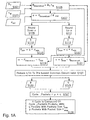
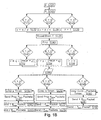
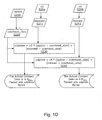
- FIG. 1A-1C show the implementation of the invention.
- the drawings 1A-1D show the following processes:
- Fig. 1A depicts the computation of packet composition by computing the different packet sizes and the number of packets for each packet size during a cycle.
- the average bandwidth B M must be equal to the target bandwidth B T (exception can be the last cycle).
- the theoretical packet size P theoretical is the theoretical size that every packet should have in order to ensure that the target bandwidth B T for a given content transmission is achieved when sending packets with a fixed wait time interval t w between successive packets.
- the packet size granularity (rounding packet size to a whole number) is not infinitesimally small, but is determined by the minimum data block size d min that makes up the packet. For example, if the minimum data block size that the application program can handle is 50 Bytes, and the P theoretical packet size value (resulting from (Eq. 1) is 976.45 Bytes, the possible packet sizes rounded down to the theoretical value is 950 Bytes and 1000 Bytes.
- the maximum target bandwidth B T for the application is selected.
- the software program will reasonably send the data at a maximum of 50 Mbps.
- the theoretical packet size P theoretical is computed using the previously selected t w .
- d min is computed for carrying the content data, but also trying not to increase the burstiness too much.
- a transmission protocol with a maximum packet size of 350000 bytes and overhead of 35 bytes is used (theoretical transmission protocol, for example).
- the cycle packet size when rounded will vary between 350000 and 700000 bytes. This can cause a relatively high burstiness, depending on the chosen wait time t w .
- the choice can be made to send protocol packets of 35000 bytes (10 times less), with cycle packet sizes of 595000 and 630000 bytes, respectively. Since the overhead size per protocol packet is very small (35 bytes), the content data is efficiently sent and the burstiness is dramatically decreased (considering the same wait time t w ).
- the packet transmissions are distributed as described in point 16 of Example 1 below.
- Network protocols typically have a fixed maximum protocol packet size. For example, for the ATM protocol this size (size of a cell) is 53 Bytes. This means that the herebefore called packets are blocks of data which must be fragmented into protocol packets depending on the maximal protocol packet size. For example, if a packet of size 200 Bytes must be sent on an ATM protocol network, it will be split into 3 protocol packets of 53 Bytes (max protocol packet size for ATM) and one protocol packet of 41 Bytes.
- the packets size would be P theoretical and therefore the bandwidth used equal to B T .
- An increase of the minimal data block size d min handled by the application program and/or of the time interval between the successive packets can cause an increase of the instantaneous bandwidth (depending on the transmission sample rate). Also, an increase of the minimal data block size handled can cause an increase of the difference of the value P max - P min , leading to an increase of the burstiness.
- Fig. 1C depicts the composition of packets according to transmission protocol packets. That is, the method and system of the invention can be applied to any transmission protocol.
- the purpose of the process is to compute how many protocol packets (e.g., UDP packets) must be put together to create a cycle packet.
- each protocol packet is of a size ppsize. This computation is done for both P max and P min . This is important because, when implementing a software application, the transmission control is implemented at transmission protocol level, i.e., the programmer can control how many packets of a given protocol are sent. In this way, the programmer can say, for example, a cycle packet of size P max is composed by a number of UDP packets.
- the number of the protocol packets is computed as described below. It should be noted that for every properly working software application, d min must be equal or smaller than ppsize. Otherwise, the application is not able to handle data blocks of size ppsize. That is, the application is not able to transmit using the chosen transmission protocol (with protocol packet size ppsize).
- the protocol packet size ppsize [Bytes] is used as an input parameter.
- the protocol packet size ppsize represents the maximum protocol packet size for those protocols, which can have a varying protocol packet size (e.g., UDP). Other transmission protocols have fixed protocol packet size (e.g., ATM). Knowing the values of P min and P max from S 115 and S117, the packet composition at network protocol level can be computed as follows:
- the address of the receiver devices to which the content is to be transmitted is contained in the same packet in which the content data is stored.
- the part of the packet which contains the address of the receiving devices and other information (not belonging to the content to be sent) is hereafter called overhead.
- a protocol packet sent on the network will therefore contain a given overhead of a value "overhead size", input in S220, and a given amount of content data.
- the amount of content data sent in a packet of size P max and P min depends on the number of protocol packets resulting from the splitting process needed by the network protocol, described above, and also on the overhead of every protocol packet.
- this process computes the data content of a given packet.
- protocol data e.g., the receiver address.
- no "useful" data of the content to be sent is contained.
- the programmer must be able to say how much content should be put in a packet. This allows knowing how much space of a packet is reserved for "useful" data and how much space is spent for header information.
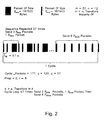
- Fig. 2 illustrates the proportional distribution of the different packets during a cycle, in order to decrease burstiness (i.e., the instantaneous bandwidth must be as near as possible to the target bandwidth).
- Fig. 2 further shows a pictorial representation of some of the results of the Example. In the example:
- UDP protocol packets header is 28 Bytes (20 bytes for IP and 8 bytes for UDP).
- the maximum size of UDP protocol packets is 65535 Bytes.
- Protocol packets composition :
- Fig. 3 is a diagram that explains the transmission of the data packets.
- a computer 10 that has a broadcast application program installed.
- the broadcast application program operates on a content 12 that is to be transmitted in data packets.
- the parameters of the transmission target bandwidth B T , p, and wait time t w are input to the computer 10, as explained above.
- the computer computes the packet sizes as described with respect to Figs. 1A-1D and operates to control the transmission 1 6 of packets 18 (black bars), shown as having varying sizes.
- the packets 1 8 are received at a computer 20 that has a receiving application program installed. This program reassembles the received packets into a file that corresponds to the content file 12 that was sent. This is conventional.
Landscapes
- Engineering & Computer Science (AREA)
- Computer Networks & Wireless Communication (AREA)
- Signal Processing (AREA)
- Data Exchanges In Wide-Area Networks (AREA)
Claims (22)
- Verfahren zum Steuern der Bandbreite der Übertragung von Dateninhalt mittels eines Anwendungsprogramms, das zusammenhängende Datenerfassungen mit einer Mindestblockgröße (dmin) in Zyklen aufeinander folgender Datenpakete überträgt, mittels der folgenden Schritte:Wählen einer Zielbandbreite (BT) für die Inhaltsübertragung und einer festgelegten Wartezeit (tw) zwischen Paketen; Berechnen einer Mindest- und einer Höchstpaketgröße auf Grundlage der Mindestdatenblockgröße (dmin) und einer theoretischen Paketgröße, wobei die theoretische Paketgröße der Zielbandbreite (BT) mal der Wartezeit (tw) entspricht; Bestimmen einer ersten Anzahl von Paketen mit der Mindestgröße und einer zweiten Anzahl von Paketen mit der Höchstgröße, die während eines Zyklus mit der festgelegten Wartezeit (tw) dazwischen übertragen werden sollen, wobei die erste und die zweite Anzahl auf Grundlage der Höchst-und der Mindestpaketgröße und der theoretischen Paketgröße berechnet werden; undÜbertragen der ersten Anzahl von Paketen mit der Mindestgröße und der zweiten Anzahl von Paketen mit der Höchstgröße mit der besagten Wartezeit (tw) zwischen aufeinander folgenden Paketen.
- Verfahren nach Anspruch 1, in dem die Pakete mit unterschiedlicher Größe Pakete mit jeweils einer Mindestgröße (Pmin) und einer Höchstgröße (Pmax) sind.
- Verfahren nach Anspruch 2, in dem außerdem mindestens ein Paket mit einer anderen Größe vorlegt, um den Inhalt eines Zyklus zu vervollständigen.
- Verfahren nach einem der vorhergehenden Ansprüche, in dem die Mindestwertpaketgröße (Pmin) dem Wert von

- Verfahren nach Anspruch 4, in dem die Höchstwertpaketgröße (Pmax) dem Wert von

- Verfahren nach Anspruch 5, das weiterhin die folgenden Schritte umfasst:Errechnen von Werten von
 Bestimmen der Beziehung von m zu n als eine Anzeige dafür, ob mehr oder weniger Pakete mit der Mindestgröße (Pmin) im Vergleich zu Paketen mit der Höchstgröße (Pmax) vorliegen.
 - Verfahren nach Anspruch 6, das weiterhin die Schritte des Berechnens des Werts von

- Verfahren nach Anspruch 7, das weiterhin den Schritt des Errechnens eines Werts r, der der Anzahl von Datenpaketen entspricht, die für einen vollständigen Zyklus übertragen werden sollen, aus dem Wert von p und q umfasst.
- Verfahren nach Anspruch 8, das weiterhin den Schritt des Berechnens der Anzahl der Zyklen, die zum Übertragen des vollständigen Inhalts der Daten erforderlich sind, aus den Werten von p, q und r umfasst.
- Verfahren nach einem der Ansprüche 2 bis 9, das weiterhin den folgenden Schritt umfasst:Übertragen des Dateninhalts gemäß einem Datenprotokoll, in dem eine Anzahl von Protokollpaketen mit einer gegebenen Größe (ppgröße) jedes Datenpaket mit einer Mindestgröße (Pmin) und einer Höchstgröße (Pmax) zusammensetzt, und Errechnen der Werte von V1
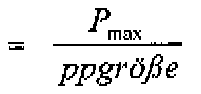

- Verfahren nach Anspruch 10, das weiterhin die folgenden Schritte umfasst:Abrunden von V1 auf einen Wert V3Aufrunden von V3 auf einen Wert V4Errechnen von Werten vonmaxrest = (Pmax - V3 * ppgröße) undminrest = (Pmin - V4 * ppgröße) undAufteilen eines Datenpakets mit der Größe Pmax in V3 Protokollpakete mit der Größe ppgröße und1 Protokollpaket mit der Größe maxrest undAufteilen eines Datenpakets mit der Größe Pmin inV4 Protokollpakete mit der Größe ppgröße und1 Protokollpaket mit der Größe minrest.
- System zum Steuern der Bandbreite der Übertragung von Dateninhalt in Zyklen aufeinander folgender Datenpakete, das Folgendes umfasst:Computermittel, das ein Anwendungsprogramm beinhaltet, das zusammenhängende Datenerfassungen mit einer Mindestblockgröße (dmin) überträgt, die die kleinste zusammenhängende Datenerfassung darstellt, die das Anwendungsprogramm übertragen kann, dazu eingerichtet, Parameter einer Zielbandbreite (Bt) für die Inhaltsübertragung und einer festgelegten Wartezeit (tw) zwischen Paketen zu empfangen, wobei das besagte Anwendungsprogramm betrieben werden kann, Folgendes durchzuführen:Berechnen einer Mindest- und einer Höchstpaketgröße auf Grundlage der Mindestdatenblockgröße und einer theoretischen Paketgröße, wobei die besagte theoretische Paketgröße der Zielbandbreite (mal der Wartezeit entspricht; undBestimmen einer ersten Anzahl von Paketen mit der Mindestgröße und einer zweiten Anzahl von Paketen mit der Höchstgröße, die während eines Zyklus mit der festgelegten Wartezeit (tw) dazwischen übertragen werden sollen, wobei die erste und die zweite Anzahl auf Grundlage der Höchst-und der Mindestpaketgröße und der theoretischen Paketgröße berechnet werden; undwobei das besagte Computermittel dazu eingerichtet ist, in Antwort auf das Anwendungsprogramm die Übertragung der ersten Anzahl von Paketen mit der Mindestgröße und der zweiten Anzahl von Paketen mit der Höchstgröße während eines Zyklus mit einer festgelegten Wartezeit (tw) dazwischen zu bestimmen und zu steuern, um eine Übertragung bei der Zielbandbreite (BT) zu erzielen.
- System nach Anspruch 12, in dem das besagte Computermittel dahingehend arbeitet, Pakete mit unterschiedlicher Größe zu bestimmen und zu übertragen, wobei die Pakete mit unterschiedlicher Größe Pakete jeweils eine Mindestgröße (Pmin) und eine Höchstgröße (Pmax) aufweisen.
- System nach Anspruch 13, in dem das besagte Computermittel dahingehend arbeitet, mindestens ein Paket mit einer anderen Größe zu bestimmen und zu übertragen, um den Inhalt eines Zyklus zu vervollständigen.
- System nach einem der Ansprüche 12, 13 oder 14, in dem der besagte Computer dahingehend arbeitet, die Mindestwertpaketgröße (Pmin) als den Wert von

- System nach Anspruch 15, in dem der besagte Computer dahingehend arbeitet, die Höchstwertpaketgröße (Pmax) als den Wert von

- System nach Anspruch 16, in dem der besagte Computer die Werte von m = Ptheoretisch - Pmin und n = Pmax - Ptheoretisch errechnet und
die Beziehung von m zu n als eine Anzeige dafür, ob mehr oder weniger Pakete mit der Mindestgröße (Pmin) im Vergleich zu Paketen mit der Höchstgröße (Pmax) vorliegen, bestimmt. - System nach Anspruch 17, in dem der besagte Computer weiterhin den Wert von

- System nach Anspruch 18, in dem der besagte Computer aus dem Wert von p und q einen Wert r errechnet, der der Anzahl von Datenpaketen entspricht, die übertragen werden sollen, um einen Zyklus zu vervollständigen.
- System nach Anspruch 19, in dem der besagte Computer weiterhin aus den Werten von p, q und r die Anzahl der Zyklen, die zum Übertragen des vollständigen Inhalts der Daten erforderlich sind, errechnet.
- System nach einem der Ansprüche 13 bis 20, in dem der besagte Computer weiterhin dahingehend arbeitet, den Dateninhalt gemäß einem Datenprotokoll zu errechnen und zu übertragen, in dem eine Anzahl von Protokollpaketen mit einer gegebenen Größe (ppgröße) jedes Datenpaket mit einer Mindestgröße (Pmin) und einer Höchstgröße (Pmax) zusammensetzt, und die Werte von V1


- System nach Anspruch 21, in dem der besagte Computer dahingehend arbeitet, Folgendes durchzuführen:Abrunden von V1 auf einen Wert V3;Aufrunden von V3 auf einen Wert V4;Errechnen von Werten vonmaxrest = (Pmax - V3 * ppgröße) undminrest = (Pmin - V4 * ppgröße) undAufteilen eines Datenpakets mit der Größe Pmax in V3 Protokollpakete mit der Größe ppgröße und1 Protokollpaket mit der Größe maxrest undAufteilen eines Datenpakets mit der Größe Pmin in V4 Protokollpakete mit der Größe ppgröße und1 Protokollpaket mit der Größe minrest.
Applications Claiming Priority (3)
| Application Number | Priority Date | Filing Date | Title |
|---|---|---|---|
| US273545 | 1999-03-22 | ||
| US10/273,545 US7428243B2 (en) | 2002-10-18 | 2002-10-18 | Method and system for varying data packet size for controlling bandwidth |
| PCT/IB2003/004581 WO2004036839A2 (en) | 2002-10-18 | 2003-10-17 | Method and system for varying data packet size for controlling bandwidth |
Publications (2)
| Publication Number | Publication Date |
|---|---|
| EP1584162A2 EP1584162A2 (de) | 2005-10-12 |
| EP1584162B1 true EP1584162B1 (de) | 2008-08-13 |
Family
ID=32092826
Family Applications (1)
| Application Number | Title | Priority Date | Filing Date |
|---|---|---|---|
| EP03751130A Expired - Lifetime EP1584162B1 (de) | 2002-10-18 | 2003-10-17 | Verfahren und vorrichtung zur bandbreitenkontrolle durch verändern der paketlänge |
Country Status (6)
| Country | Link |
|---|---|
| US (1) | US7428243B2 (de) |
| EP (1) | EP1584162B1 (de) |
| AT (1) | ATE405072T1 (de) |
| AU (1) | AU2003269349A1 (de) |
| DE (1) | DE60322961D1 (de) |
| WO (1) | WO2004036839A2 (de) |
Families Citing this family (10)
| Publication number | Priority date | Publication date | Assignee | Title |
|---|---|---|---|---|
| NO20006683D0 (no) * | 2000-12-28 | 2000-12-28 | Abb Research Ltd | Fremgangsmåte for tidssynkronisering |
| US7539756B2 (en) * | 2002-01-31 | 2009-05-26 | Darby & Mohaine, L.L.C. | Method and system of data packet transmission timing for controlling bandwidth |
| US8300524B1 (en) | 2006-01-30 | 2012-10-30 | Doug Carson & Associates, Inc. | Authenticating a data transmission by varying a rate thereof |
| US7792137B2 (en) | 2006-07-05 | 2010-09-07 | Abidanet, Llc | Self-organized and self-managed ad hoc communications network |
| KR100799587B1 (ko) * | 2006-11-17 | 2008-01-30 | 한국전자통신연구원 | 스위치에서 동적 대역 제한 방법 및 장치 |
| US8411566B2 (en) * | 2007-10-31 | 2013-04-02 | Smart Share Systems APS | Apparatus and a method for distributing bandwidth |
| CN102045305B (zh) * | 2009-10-20 | 2015-06-10 | 中兴通讯股份有限公司 | 一种多媒体资源传播的监测追踪方法和系统 |
| US9716635B2 (en) * | 2012-09-14 | 2017-07-25 | Facebook, Inc. | Content prioritization based on packet size |
| US10075877B1 (en) * | 2014-05-12 | 2018-09-11 | Google Llc | Systems and methods for using radio layer information to enhance network transfer protocols |
| US9680758B2 (en) | 2015-09-02 | 2017-06-13 | Intel Corporation | Apparatus and method to increase throughput of a transmitter |
Family Cites Families (14)
| Publication number | Priority date | Publication date | Assignee | Title |
|---|---|---|---|---|
| US4771391A (en) | 1986-07-21 | 1988-09-13 | International Business Machines Corporation | Adaptive packet length traffic control in a local area network |
| GB9516931D0 (en) | 1995-08-18 | 1995-10-18 | Newbridge Networks Corp | Method of traffic policing in broadband cell-based networks |
| US5982778A (en) | 1996-08-30 | 1999-11-09 | Advanced Micro Devices, Inc. | Arrangement for regulating packet flow rate in shared-medium, point-to-point, and switched networks |
| US6038216A (en) | 1996-11-01 | 2000-03-14 | Packeteer, Inc. | Method for explicit data rate control in a packet communication environment without data rate supervision |
| US6144637A (en) | 1996-12-20 | 2000-11-07 | Cisco Technology, Inc. | Data communications |
| US6215767B1 (en) | 1997-04-25 | 2001-04-10 | Lucent Technologies Inc. | Quality of service adjustment and traffic shaping on a multiple access network |
| US6118787A (en) | 1997-06-27 | 2000-09-12 | Advanced Micro Devices, Inc. | Apparatus and method for regulating assigned bandwidth in high speed packet switched networks |
| US6320846B1 (en) | 1997-08-05 | 2001-11-20 | Hi/Fm, Inc. | Method and apparatus for controlling network bandwidth |
| US6249530B1 (en) | 1997-12-22 | 2001-06-19 | Sun Microsystems, Inc. | Network bandwidth control |
| US6330700B1 (en) | 1999-05-18 | 2001-12-11 | Omnipoint Corporation | Out-of-band forward error correction |
| JP2001230810A (ja) | 2000-02-16 | 2001-08-24 | Fujitsu Ltd | パケット流量制御装置および方法 |
| US6940861B2 (en) | 2000-03-14 | 2005-09-06 | General Instrument Corporation | Data rate limiting |
| US7370110B2 (en) | 2000-04-18 | 2008-05-06 | Hoshiko Llc | Method and system for operating a network server to discourage inappropriate use |
| JP2002325093A (ja) * | 2001-04-26 | 2002-11-08 | Fujitsu Ltd | 帯域制御方法及び装置、並びに帯域制御システム |
-
2002
- 2002-10-18 US US10/273,545 patent/US7428243B2/en not_active Expired - Lifetime
-
2003
- 2003-10-17 EP EP03751130A patent/EP1584162B1/de not_active Expired - Lifetime
- 2003-10-17 AU AU2003269349A patent/AU2003269349A1/en not_active Abandoned
- 2003-10-17 WO PCT/IB2003/004581 patent/WO2004036839A2/en not_active Ceased
- 2003-10-17 DE DE60322961T patent/DE60322961D1/de not_active Expired - Lifetime
- 2003-10-17 AT AT03751130T patent/ATE405072T1/de not_active IP Right Cessation
Also Published As
| Publication number | Publication date |
|---|---|
| US20040076173A1 (en) | 2004-04-22 |
| ATE405072T1 (de) | 2008-08-15 |
| EP1584162A2 (de) | 2005-10-12 |
| WO2004036839A3 (en) | 2004-07-29 |
| HK1083399A1 (en) | 2006-06-30 |
| US7428243B2 (en) | 2008-09-23 |
| AU2003269349A1 (en) | 2004-05-04 |
| WO2004036839A2 (en) | 2004-04-29 |
| DE60322961D1 (de) | 2008-09-25 |
Similar Documents
| Publication | Publication Date | Title |
|---|---|---|
| EP1472838B1 (de) | Verfahren und system zur zeitsteuerung einer datenpaketübertragung zur bandbreitensteuerung | |
| US7724750B2 (en) | Expedited data transmission in packet based network | |
| US20020169880A1 (en) | Method and device for robust real-time estimation of the bottleneck bandwidth in the internet | |
| EP1187401A2 (de) | Verfahren und Vorrichtungen zur Reduzierung von Netzwerküberlastkontrolle | |
| US20050286416A1 (en) | Communication system | |
| US20010015956A1 (en) | Packet size control technique | |
| US20050053002A1 (en) | Methods and devices for maximizing the throughput of TCP/IP data along wireless links | |
| US7054317B1 (en) | Method for controlling transmission control protocol window size in asynchronous transfer mode network | |
| EP1584162B1 (de) | Verfahren und vorrichtung zur bandbreitenkontrolle durch verändern der paketlänge | |
| US7151747B2 (en) | Controlling method of priority class setup of communication packet and system of the same | |
| EP1428358B1 (de) | Datenkommunikationsmethode und -system zur übertragung von mehreren datenströmen, die verfügbare bandbreite pro datenstrom berechnend und anpassend | |
| CN112532536B (zh) | 一种文件传输方法、系统、计算机可读存储介质及设备 | |
| Fisk et al. | Dynamic adjustment of TCP window sizes | |
| US20090147676A1 (en) | Communication system, communication terminal, relay node, communication method used therein, and program thereof | |
| EP1730903B1 (de) | Beschleunigte datenübertragung in auf paketen basierenden netzwerken | |
| HK1083399B (en) | Method and system for varying data packet size for controlling bandwidth | |
| US7154850B1 (en) | Wireless data transmission using time out control | |
| US7304943B2 (en) | Apparatus and method for bandwidth control | |
| Kabir et al. | Study of Different TCP Protocols in Wireless Network | |
| AU2003209589A1 (en) | Method and system of data packet transmission timing for controlling bandwidth | |
| Benadoud et al. | Enhancing TCP over satellite links using CANIT algorithm | |
| Hasegawa et al. | Performance evaluation of HTTP/TCP on asymmetric networks | |
| Hu et al. | An accurate model for analyzing wireless TCP performance with the coexistence of Non-TCP traffic | |
| Asplund et al. | Partially Reliable Multimedia Transport |
Legal Events
| Date | Code | Title | Description |
|---|---|---|---|
| PUAI | Public reference made under article 153(3) epc to a published international application that has entered the european phase |
Free format text: ORIGINAL CODE: 0009012 |
|
| 17P | Request for examination filed |
Effective date: 20050429 |
|
| AK | Designated contracting states |
Kind code of ref document: A2 Designated state(s): AT BE BG CH CY CZ DE DK EE ES FI FR GB GR HU IE IT LI LU MC NL PT RO SE SI SK TR |
|
| AX | Request for extension of the european patent |
Extension state: AL LT LV MK |
|
| RAP1 | Party data changed (applicant data changed or rights of an application transferred) |
Owner name: THE FANTASTIC IP GMBH |
|
| DAX | Request for extension of the european patent (deleted) | ||
| REG | Reference to a national code |
Ref country code: HK Ref legal event code: DE Ref document number: 1083399 Country of ref document: HK |
|
| 17Q | First examination report despatched |
Effective date: 20051025 |
|
| GRAP | Despatch of communication of intention to grant a patent |
Free format text: ORIGINAL CODE: EPIDOSNIGR1 |
|
| GRAS | Grant fee paid |
Free format text: ORIGINAL CODE: EPIDOSNIGR3 |
|
| GRAA | (expected) grant |
Free format text: ORIGINAL CODE: 0009210 |
|
| AK | Designated contracting states |
Kind code of ref document: B1 Designated state(s): AT BE BG CH CY CZ DE DK EE ES FI FR GB GR HU IE IT LI LU MC NL PT RO SE SI SK TR |
|
| REG | Reference to a national code |
Ref country code: GB Ref legal event code: FG4D |
|
| REG | Reference to a national code |
Ref country code: CH Ref legal event code: EP |
|
| REG | Reference to a national code |
Ref country code: IE Ref legal event code: FG4D |
|
| REF | Corresponds to: |
Ref document number: 60322961 Country of ref document: DE Date of ref document: 20080925 Kind code of ref document: P |
|
| PG25 | Lapsed in a contracting state [announced via postgrant information from national office to epo] |
Ref country code: NL Free format text: LAPSE BECAUSE OF FAILURE TO SUBMIT A TRANSLATION OF THE DESCRIPTION OR TO PAY THE FEE WITHIN THE PRESCRIBED TIME-LIMIT Effective date: 20080813 Ref country code: ES Free format text: LAPSE BECAUSE OF FAILURE TO SUBMIT A TRANSLATION OF THE DESCRIPTION OR TO PAY THE FEE WITHIN THE PRESCRIBED TIME-LIMIT Effective date: 20081124 |
|
| PG25 | Lapsed in a contracting state [announced via postgrant information from national office to epo] |
Ref country code: SI Free format text: LAPSE BECAUSE OF FAILURE TO SUBMIT A TRANSLATION OF THE DESCRIPTION OR TO PAY THE FEE WITHIN THE PRESCRIBED TIME-LIMIT Effective date: 20080813 Ref country code: AT Free format text: LAPSE BECAUSE OF FAILURE TO SUBMIT A TRANSLATION OF THE DESCRIPTION OR TO PAY THE FEE WITHIN THE PRESCRIBED TIME-LIMIT Effective date: 20080813 Ref country code: FI Free format text: LAPSE BECAUSE OF FAILURE TO SUBMIT A TRANSLATION OF THE DESCRIPTION OR TO PAY THE FEE WITHIN THE PRESCRIBED TIME-LIMIT Effective date: 20080813 |
|
| PG25 | Lapsed in a contracting state [announced via postgrant information from national office to epo] |
Ref country code: BE Free format text: LAPSE BECAUSE OF FAILURE TO SUBMIT A TRANSLATION OF THE DESCRIPTION OR TO PAY THE FEE WITHIN THE PRESCRIBED TIME-LIMIT Effective date: 20080813 |
|
| REG | Reference to a national code |
Ref country code: HK Ref legal event code: GR Ref document number: 1083399 Country of ref document: HK |
|
| PG25 | Lapsed in a contracting state [announced via postgrant information from national office to epo] |
Ref country code: BG Free format text: LAPSE BECAUSE OF FAILURE TO SUBMIT A TRANSLATION OF THE DESCRIPTION OR TO PAY THE FEE WITHIN THE PRESCRIBED TIME-LIMIT Effective date: 20081113 Ref country code: DK Free format text: LAPSE BECAUSE OF FAILURE TO SUBMIT A TRANSLATION OF THE DESCRIPTION OR TO PAY THE FEE WITHIN THE PRESCRIBED TIME-LIMIT Effective date: 20080813 |
|
| PG25 | Lapsed in a contracting state [announced via postgrant information from national office to epo] |
Ref country code: MC Free format text: LAPSE BECAUSE OF NON-PAYMENT OF DUE FEES Effective date: 20081031 Ref country code: SK Free format text: LAPSE BECAUSE OF FAILURE TO SUBMIT A TRANSLATION OF THE DESCRIPTION OR TO PAY THE FEE WITHIN THE PRESCRIBED TIME-LIMIT Effective date: 20080813 Ref country code: CZ Free format text: LAPSE BECAUSE OF FAILURE TO SUBMIT A TRANSLATION OF THE DESCRIPTION OR TO PAY THE FEE WITHIN THE PRESCRIBED TIME-LIMIT Effective date: 20080813 Ref country code: RO Free format text: LAPSE BECAUSE OF FAILURE TO SUBMIT A TRANSLATION OF THE DESCRIPTION OR TO PAY THE FEE WITHIN THE PRESCRIBED TIME-LIMIT Effective date: 20080813 Ref country code: PT Free format text: LAPSE BECAUSE OF FAILURE TO SUBMIT A TRANSLATION OF THE DESCRIPTION OR TO PAY THE FEE WITHIN THE PRESCRIBED TIME-LIMIT Effective date: 20090113 |
|
| REG | Reference to a national code |
Ref country code: CH Ref legal event code: PL |
|
| PLBE | No opposition filed within time limit |
Free format text: ORIGINAL CODE: 0009261 |
|
| STAA | Information on the status of an ep patent application or granted ep patent |
Free format text: STATUS: NO OPPOSITION FILED WITHIN TIME LIMIT |
|
| 26N | No opposition filed |
Effective date: 20090514 |
|
| PG25 | Lapsed in a contracting state [announced via postgrant information from national office to epo] |
Ref country code: EE Free format text: LAPSE BECAUSE OF FAILURE TO SUBMIT A TRANSLATION OF THE DESCRIPTION OR TO PAY THE FEE WITHIN THE PRESCRIBED TIME-LIMIT Effective date: 20080813 |
|
| PG25 | Lapsed in a contracting state [announced via postgrant information from national office to epo] |
Ref country code: IT Free format text: LAPSE BECAUSE OF FAILURE TO SUBMIT A TRANSLATION OF THE DESCRIPTION OR TO PAY THE FEE WITHIN THE PRESCRIBED TIME-LIMIT Effective date: 20080813 |
|
| PG25 | Lapsed in a contracting state [announced via postgrant information from national office to epo] |
Ref country code: CH Free format text: LAPSE BECAUSE OF NON-PAYMENT OF DUE FEES Effective date: 20081031 Ref country code: LI Free format text: LAPSE BECAUSE OF NON-PAYMENT OF DUE FEES Effective date: 20081031 Ref country code: IE Free format text: LAPSE BECAUSE OF NON-PAYMENT OF DUE FEES Effective date: 20081017 |
|
| PG25 | Lapsed in a contracting state [announced via postgrant information from national office to epo] |
Ref country code: SE Free format text: LAPSE BECAUSE OF FAILURE TO SUBMIT A TRANSLATION OF THE DESCRIPTION OR TO PAY THE FEE WITHIN THE PRESCRIBED TIME-LIMIT Effective date: 20081113 |
|
| PG25 | Lapsed in a contracting state [announced via postgrant information from national office to epo] |
Ref country code: HU Free format text: LAPSE BECAUSE OF FAILURE TO SUBMIT A TRANSLATION OF THE DESCRIPTION OR TO PAY THE FEE WITHIN THE PRESCRIBED TIME-LIMIT Effective date: 20090214 Ref country code: LU Free format text: LAPSE BECAUSE OF NON-PAYMENT OF DUE FEES Effective date: 20081017 Ref country code: CY Free format text: LAPSE BECAUSE OF FAILURE TO SUBMIT A TRANSLATION OF THE DESCRIPTION OR TO PAY THE FEE WITHIN THE PRESCRIBED TIME-LIMIT Effective date: 20080813 |
|
| PG25 | Lapsed in a contracting state [announced via postgrant information from national office to epo] |
Ref country code: TR Free format text: LAPSE BECAUSE OF FAILURE TO SUBMIT A TRANSLATION OF THE DESCRIPTION OR TO PAY THE FEE WITHIN THE PRESCRIBED TIME-LIMIT Effective date: 20080813 |
|
| PG25 | Lapsed in a contracting state [announced via postgrant information from national office to epo] |
Ref country code: GR Free format text: LAPSE BECAUSE OF FAILURE TO SUBMIT A TRANSLATION OF THE DESCRIPTION OR TO PAY THE FEE WITHIN THE PRESCRIBED TIME-LIMIT Effective date: 20081114 |
|
| REG | Reference to a national code |
Ref country code: GB Ref legal event code: 732E Free format text: REGISTERED BETWEEN 20110317 AND 20110323 |
|
| REG | Reference to a national code |
Ref country code: DE Ref legal event code: R081 Ref document number: 60322961 Country of ref document: DE Owner name: DARBY & MOHAINE L.L.C., WILMINGTON, US Free format text: FORMER OWNER: THE FANTASTIC IP GMBH, ZUG, CH Effective date: 20110506 |
|
| REG | Reference to a national code |
Ref country code: FR Ref legal event code: TP |
|
| REG | Reference to a national code |
Ref country code: FR Ref legal event code: PLFP Year of fee payment: 14 |
|
| REG | Reference to a national code |
Ref country code: FR Ref legal event code: PLFP Year of fee payment: 15 |
|
| REG | Reference to a national code |
Ref country code: FR Ref legal event code: PLFP Year of fee payment: 16 |
|
| PGFP | Annual fee paid to national office [announced via postgrant information from national office to epo] |
Ref country code: FR Payment date: 20210921 Year of fee payment: 19 |
|
| PGFP | Annual fee paid to national office [announced via postgrant information from national office to epo] |
Ref country code: GB Payment date: 20210929 Year of fee payment: 19 |
|
| PGFP | Annual fee paid to national office [announced via postgrant information from national office to epo] |
Ref country code: DE Payment date: 20210916 Year of fee payment: 19 |
|
| REG | Reference to a national code |
Ref country code: DE Ref legal event code: R119 Ref document number: 60322961 Country of ref document: DE |
|
| GBPC | Gb: european patent ceased through non-payment of renewal fee |
Effective date: 20221017 |
|
| PG25 | Lapsed in a contracting state [announced via postgrant information from national office to epo] |
Ref country code: FR Free format text: LAPSE BECAUSE OF NON-PAYMENT OF DUE FEES Effective date: 20221031 Ref country code: DE Free format text: LAPSE BECAUSE OF NON-PAYMENT OF DUE FEES Effective date: 20230503 |
|
| PG25 | Lapsed in a contracting state [announced via postgrant information from national office to epo] |
Ref country code: GB Free format text: LAPSE BECAUSE OF NON-PAYMENT OF DUE FEES Effective date: 20221017 |