EP1584359A2 - Energieverwaltungssystem für Spielsteuerung - Google Patents
Energieverwaltungssystem für Spielsteuerung Download PDFInfo
- Publication number
- EP1584359A2 EP1584359A2 EP05102445A EP05102445A EP1584359A2 EP 1584359 A2 EP1584359 A2 EP 1584359A2 EP 05102445 A EP05102445 A EP 05102445A EP 05102445 A EP05102445 A EP 05102445A EP 1584359 A2 EP1584359 A2 EP 1584359A2
- Authority
- EP
- European Patent Office
- Prior art keywords
- data
- game controller
- host
- qos
- received
- Prior art date
- Legal status (The legal status is an assumption and is not a legal conclusion. Google has not performed a legal analysis and makes no representation as to the accuracy of the status listed.)
- Withdrawn
Links
Images


Classifications
-
- A—HUMAN NECESSITIES
- A63—SPORTS; GAMES; AMUSEMENTS
- A63F—CARD, BOARD, OR ROULETTE GAMES; INDOOR GAMES USING SMALL MOVING PLAYING BODIES; VIDEO GAMES; GAMES NOT OTHERWISE PROVIDED FOR
- A63F13/00—Video games, i.e. games using an electronically generated display having two or more dimensions
- A63F13/30—Interconnection arrangements between game servers and game devices; Interconnection arrangements between game devices; Interconnection arrangements between game servers
-
- A—HUMAN NECESSITIES
- A63—SPORTS; GAMES; AMUSEMENTS
- A63F—CARD, BOARD, OR ROULETTE GAMES; INDOOR GAMES USING SMALL MOVING PLAYING BODIES; VIDEO GAMES; GAMES NOT OTHERWISE PROVIDED FOR
- A63F13/00—Video games, i.e. games using an electronically generated display having two or more dimensions
- A63F13/20—Input arrangements for video game devices
- A63F13/23—Input arrangements for video game devices for interfacing with the game device, e.g. specific interfaces between game controller and console
- A63F13/235—Input arrangements for video game devices for interfacing with the game device, e.g. specific interfaces between game controller and console using a wireless connection, e.g. infrared or piconet
-
- A—HUMAN NECESSITIES
- A63—SPORTS; GAMES; AMUSEMENTS
- A63F—CARD, BOARD, OR ROULETTE GAMES; INDOOR GAMES USING SMALL MOVING PLAYING BODIES; VIDEO GAMES; GAMES NOT OTHERWISE PROVIDED FOR
- A63F13/00—Video games, i.e. games using an electronically generated display having two or more dimensions
- A63F13/40—Processing input control signals of video game devices, e.g. signals generated by the player or derived from the environment
- A63F13/42—Processing input control signals of video game devices, e.g. signals generated by the player or derived from the environment by mapping the input signals into game commands, e.g. mapping the displacement of a stylus on a touch screen to the steering angle of a virtual vehicle
- A63F13/424—Processing input control signals of video game devices, e.g. signals generated by the player or derived from the environment by mapping the input signals into game commands, e.g. mapping the displacement of a stylus on a touch screen to the steering angle of a virtual vehicle involving acoustic input signals, e.g. by using the results of pitch or rhythm extraction or voice recognition
-
- A—HUMAN NECESSITIES
- A63—SPORTS; GAMES; AMUSEMENTS
- A63F—CARD, BOARD, OR ROULETTE GAMES; INDOOR GAMES USING SMALL MOVING PLAYING BODIES; VIDEO GAMES; GAMES NOT OTHERWISE PROVIDED FOR
- A63F13/00—Video games, i.e. games using an electronically generated display having two or more dimensions
- A63F13/70—Game security or game management aspects
- A63F13/71—Game security or game management aspects using secure communication between game devices and game servers, e.g. by encrypting game data or authenticating players
-
- A—HUMAN NECESSITIES
- A63—SPORTS; GAMES; AMUSEMENTS
- A63F—CARD, BOARD, OR ROULETTE GAMES; INDOOR GAMES USING SMALL MOVING PLAYING BODIES; VIDEO GAMES; GAMES NOT OTHERWISE PROVIDED FOR
- A63F13/00—Video games, i.e. games using an electronically generated display having two or more dimensions
- A63F13/90—Constructional details or arrangements of video game devices not provided for in groups A63F13/20 or A63F13/25, e.g. housing, wiring, connections or cabinets
- A63F13/95—Storage media specially adapted for storing game information, e.g. video game cartridges
-
- A—HUMAN NECESSITIES
- A63—SPORTS; GAMES; AMUSEMENTS
- A63F—CARD, BOARD, OR ROULETTE GAMES; INDOOR GAMES USING SMALL MOVING PLAYING BODIES; VIDEO GAMES; GAMES NOT OTHERWISE PROVIDED FOR
- A63F13/00—Video games, i.e. games using an electronically generated display having two or more dimensions
- A63F13/20—Input arrangements for video game devices
- A63F13/21—Input arrangements for video game devices characterised by their sensors, purposes or types
- A63F13/215—Input arrangements for video game devices characterised by their sensors, purposes or types comprising means for detecting acoustic signals, e.g. using a microphone
-
- A—HUMAN NECESSITIES
- A63—SPORTS; GAMES; AMUSEMENTS
- A63F—CARD, BOARD, OR ROULETTE GAMES; INDOOR GAMES USING SMALL MOVING PLAYING BODIES; VIDEO GAMES; GAMES NOT OTHERWISE PROVIDED FOR
- A63F13/00—Video games, i.e. games using an electronically generated display having two or more dimensions
- A63F13/30—Interconnection arrangements between game servers and game devices; Interconnection arrangements between game devices; Interconnection arrangements between game servers
- A63F13/32—Interconnection arrangements between game servers and game devices; Interconnection arrangements between game devices; Interconnection arrangements between game servers using local area network [LAN] connections
-
- A—HUMAN NECESSITIES
- A63—SPORTS; GAMES; AMUSEMENTS
- A63F—CARD, BOARD, OR ROULETTE GAMES; INDOOR GAMES USING SMALL MOVING PLAYING BODIES; VIDEO GAMES; GAMES NOT OTHERWISE PROVIDED FOR
- A63F13/00—Video games, i.e. games using an electronically generated display having two or more dimensions
- A63F13/30—Interconnection arrangements between game servers and game devices; Interconnection arrangements between game devices; Interconnection arrangements between game servers
- A63F13/33—Interconnection arrangements between game servers and game devices; Interconnection arrangements between game devices; Interconnection arrangements between game servers using wide area network [WAN] connections
- A63F13/335—Interconnection arrangements between game servers and game devices; Interconnection arrangements between game devices; Interconnection arrangements between game servers using wide area network [WAN] connections using Internet
-
- A—HUMAN NECESSITIES
- A63—SPORTS; GAMES; AMUSEMENTS
- A63F—CARD, BOARD, OR ROULETTE GAMES; INDOOR GAMES USING SMALL MOVING PLAYING BODIES; VIDEO GAMES; GAMES NOT OTHERWISE PROVIDED FOR
- A63F2300/00—Features of games using an electronically generated display having two or more dimensions, e.g. on a television screen, showing representations related to the game
- A63F2300/10—Features of games using an electronically generated display having two or more dimensions, e.g. on a television screen, showing representations related to the game characterized by input arrangements for converting player-generated signals into game device control signals
- A63F2300/1025—Features of games using an electronically generated display having two or more dimensions, e.g. on a television screen, showing representations related to the game characterized by input arrangements for converting player-generated signals into game device control signals details of the interface with the game device, e.g. USB version detection
-
- A—HUMAN NECESSITIES
- A63—SPORTS; GAMES; AMUSEMENTS
- A63F—CARD, BOARD, OR ROULETTE GAMES; INDOOR GAMES USING SMALL MOVING PLAYING BODIES; VIDEO GAMES; GAMES NOT OTHERWISE PROVIDED FOR
- A63F2300/00—Features of games using an electronically generated display having two or more dimensions, e.g. on a television screen, showing representations related to the game
- A63F2300/10—Features of games using an electronically generated display having two or more dimensions, e.g. on a television screen, showing representations related to the game characterized by input arrangements for converting player-generated signals into game device control signals
- A63F2300/1025—Features of games using an electronically generated display having two or more dimensions, e.g. on a television screen, showing representations related to the game characterized by input arrangements for converting player-generated signals into game device control signals details of the interface with the game device, e.g. USB version detection
- A63F2300/1031—Features of games using an electronically generated display having two or more dimensions, e.g. on a television screen, showing representations related to the game characterized by input arrangements for converting player-generated signals into game device control signals details of the interface with the game device, e.g. USB version detection using a wireless connection, e.g. Bluetooth®, infrared connections
-
- A—HUMAN NECESSITIES
- A63—SPORTS; GAMES; AMUSEMENTS
- A63F—CARD, BOARD, OR ROULETTE GAMES; INDOOR GAMES USING SMALL MOVING PLAYING BODIES; VIDEO GAMES; GAMES NOT OTHERWISE PROVIDED FOR
- A63F2300/00—Features of games using an electronically generated display having two or more dimensions, e.g. on a television screen, showing representations related to the game
- A63F2300/10—Features of games using an electronically generated display having two or more dimensions, e.g. on a television screen, showing representations related to the game characterized by input arrangements for converting player-generated signals into game device control signals
- A63F2300/1081—Input via voice recognition
-
- A—HUMAN NECESSITIES
- A63—SPORTS; GAMES; AMUSEMENTS
- A63F—CARD, BOARD, OR ROULETTE GAMES; INDOOR GAMES USING SMALL MOVING PLAYING BODIES; VIDEO GAMES; GAMES NOT OTHERWISE PROVIDED FOR
- A63F2300/00—Features of games using an electronically generated display having two or more dimensions, e.g. on a television screen, showing representations related to the game
- A63F2300/20—Features of games using an electronically generated display having two or more dimensions, e.g. on a television screen, showing representations related to the game characterised by details of the game platform
- A63F2300/206—Game information storage, e.g. cartridges, CD ROM's, DVD's, smart cards
-
- A—HUMAN NECESSITIES
- A63—SPORTS; GAMES; AMUSEMENTS
- A63F—CARD, BOARD, OR ROULETTE GAMES; INDOOR GAMES USING SMALL MOVING PLAYING BODIES; VIDEO GAMES; GAMES NOT OTHERWISE PROVIDED FOR
- A63F2300/00—Features of games using an electronically generated display having two or more dimensions, e.g. on a television screen, showing representations related to the game
- A63F2300/40—Features of games using an electronically generated display having two or more dimensions, e.g. on a television screen, showing representations related to the game characterised by details of platform network
- A63F2300/401—Secure communication, e.g. using encryption or authentication
-
- A—HUMAN NECESSITIES
- A63—SPORTS; GAMES; AMUSEMENTS
- A63F—CARD, BOARD, OR ROULETTE GAMES; INDOOR GAMES USING SMALL MOVING PLAYING BODIES; VIDEO GAMES; GAMES NOT OTHERWISE PROVIDED FOR
- A63F2300/00—Features of games using an electronically generated display having two or more dimensions, e.g. on a television screen, showing representations related to the game
- A63F2300/40—Features of games using an electronically generated display having two or more dimensions, e.g. on a television screen, showing representations related to the game characterised by details of platform network
- A63F2300/404—Features of games using an electronically generated display having two or more dimensions, e.g. on a television screen, showing representations related to the game characterised by details of platform network characterized by a local network connection
-
- A—HUMAN NECESSITIES
- A63—SPORTS; GAMES; AMUSEMENTS
- A63F—CARD, BOARD, OR ROULETTE GAMES; INDOOR GAMES USING SMALL MOVING PLAYING BODIES; VIDEO GAMES; GAMES NOT OTHERWISE PROVIDED FOR
- A63F2300/00—Features of games using an electronically generated display having two or more dimensions, e.g. on a television screen, showing representations related to the game
- A63F2300/40—Features of games using an electronically generated display having two or more dimensions, e.g. on a television screen, showing representations related to the game characterised by details of platform network
- A63F2300/407—Data transfer via internet
-
- A—HUMAN NECESSITIES
- A63—SPORTS; GAMES; AMUSEMENTS
- A63F—CARD, BOARD, OR ROULETTE GAMES; INDOOR GAMES USING SMALL MOVING PLAYING BODIES; VIDEO GAMES; GAMES NOT OTHERWISE PROVIDED FOR
- A63F2300/00—Features of games using an electronically generated display having two or more dimensions, e.g. on a television screen, showing representations related to the game
- A63F2300/50—Features of games using an electronically generated display having two or more dimensions, e.g. on a television screen, showing representations related to the game characterized by details of game servers
- A63F2300/53—Features of games using an electronically generated display having two or more dimensions, e.g. on a television screen, showing representations related to the game characterized by details of game servers details of basic data processing
- A63F2300/532—Features of games using an electronically generated display having two or more dimensions, e.g. on a television screen, showing representations related to the game characterized by details of game servers details of basic data processing using secure communication, e.g. by encryption, authentication
-
- A—HUMAN NECESSITIES
- A63—SPORTS; GAMES; AMUSEMENTS
- A63F—CARD, BOARD, OR ROULETTE GAMES; INDOOR GAMES USING SMALL MOVING PLAYING BODIES; VIDEO GAMES; GAMES NOT OTHERWISE PROVIDED FOR
- A63F2300/00—Features of games using an electronically generated display having two or more dimensions, e.g. on a television screen, showing representations related to the game
- A63F2300/60—Methods for processing data by generating or executing the game program
- A63F2300/6063—Methods for processing data by generating or executing the game program for sound processing
- A63F2300/6072—Methods for processing data by generating or executing the game program for sound processing of an input signal, e.g. pitch and rhythm extraction, voice recognition
Definitions
- This invention relates to peripherals for controlling video games, and more particularly, to game controllers that wirelessly connect to host game consoles.
- Game controllers facilitate user interaction with video games.
- Game controllers come in many configurations depending upon the desired gaming environment for which the game controllers are to be used.
- Certain game controllers are designed to connect with game hosting systems and specifically to game consoles or personal computers (PCs) using wireless technologies.
- wireless game controllers are designed to operate with a host such as a game console or PC, where the game controller and host transmit and receive data to one another.
- a host such as a game console or PC
- game controllers are battery operated, and after awhile the battery or batteries are required to be charged or replaced.
- a game controller and a host manage reception and transmission power of the game controller.
- the game controller and host determine quality of service (QOS) of data being sent from and to the game controller, and the reception and transmission power of the game controller is adjusted to operate at the lowest power level with acceptable QOS based on the QOS determination.
- QOS quality of service
- the following disclosure describes power management of transmission and reception of data from a game controller.
- the game controller determines quality of service (QOS) of data received from a host game console or host, and decrements reception power until QOS degrades below an acceptable level or increments reception power until QOS is acceptable.
- the host determines QOS of data received from the game controller and provides feedback to the game controller to decrease transmission power until QOS degrades below an acceptable level or increases transmission power until QOS is acceptable.
- the determining of QOS at the host and game controller and increasing/decreasing of reception and transmission power at the game controller are continuous in order to reduce power at the game controller while maintaining continuous game play (i.e., uninterrupted communication).
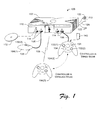
- Fig. 1 shows an exemplary console-based gaming system 100. It includes a host game console or host 102 and up to four controllers, as represented by two game controllers 104(1) and 104(2).
- host 102 may be a personal computer (PC).
- Each game controller 104 is coupled to the host 102 via a wired or wireless interface and utilizes a suitable data protocol, such as USB (Universal Serial Bus).
- One game controller 104(2) is illustrated as operating in two different modes: a wired mode and a wireless mode. In the wired mode, the game controller 104(2) is connected to the host 102 via a cable 106. The game controller 104(2) derives power from the host game console 102 through the cable 106. In the wireless mode, the game controller 104(2) is connected to the host 102 via a wireless link 108. The cable 106 may be detached from the game controller 104(2) to provide greater freedom of movement.
- the wireless link 108 may be implemented using one of various wireless technologies such as IR (infrared), and RF (radio frequency) which includes Bluetooth and WiFi (i.e., IEEE 802.11b).
- IR infrared
- RF radio frequency
- Bluetooth and WiFi i.e., IEEE 802.11b
- reception power at game controller 104(2) may be reduced or increased.
- transmission power at game controller 104(2) may be reduced or increased.
- Reception and transmission power at game controller 104(2) is particularly adjusted to reduce battery consumption at game controller 104(2). Incremental increases or decreases in reception and transmission power at game controller 104(2) are particularly provided. In other words game controller 104(2) may have multiple transmission and reception power levels to choose from. This is further discussed below. Regardless of the reception and transmission power of game controller 104(2), wireless link 108 is continuously maintained during game play.
- time division multiple access is employed to allocate a time slot as defined by TDMA, for each game controller 104 to communicate with host game console 102. Therefore only one game controller 104 communicates with host game console 102 at any given time, avoiding interference between the game controllers 104. Furthermore, all of the game controllers 104 may individually adjust reception and transmission power.
- a player i.e., user can switch between wireless operation and wired operation by connecting the cable 106 to, or disconnecting it from, the host 102.
- Cable 106 provides serial communication between host 102 and controller 104(2). While in wired mode, the game controller 104(2) is powered by the cable 102 which also provides a charging connection allowing the game controller 104(2) battery (or batteries) to be recharged. In certain embodiments non-rechargeable batteries may be used.
- the host 102 is equipped with a portable media drive 110 and an optional internal hard disk drive.
- the portable media drive 110 supports various forms of portable storage media as represented by an optical storage disc 112. Examples of suitable portable storage media include DVD, CD-ROM, game discs, game cartridges, and so forth.
- virtual slots are assigned, without prompting the user, in sequential order to reduce complexity for the user.
- the first virtual slot is assigned to the first wireless game controller 104 introduced to the host 102; the second virtual slot is assigned to the second wireless game controller 104, and so on.
- the user can choose a virtual slot via a user interface presented on the display. Actuation of a pre-designated button which may be included in control buttons 116 on the host 102 invokes a slot assignment pane from which the player can select an available virtual slot.
- Control buttons 116 are positioned on the front face of the game console 102.
- Control buttons 116 include, for example, a power button that switches power to the game console and an eject button that alternately opens and closes a tray of the portable media drive 110 to allow insertion and extraction of the storage disc 112.
- Each game controller 104 may be equipped with any of a wide variety of user interaction mechanisms. As illustrated in Fig. 1, each game controller 104 is equipped with two thumbsticks 132(1) and 132(2), a directional or D-pad 134, surface buttons 136, and two triggers 138. These mechanisms are merely representative, and other known gaming mechanisms may be substituted for or added to those shown in Fig. 1.
- a memory unit 140 may be inserted into the game controller 104 to provide additional and portable storage (as illustrated) or alternatively inserted into the host 102.
- Portable memory units such as memory unit 140 enable players to store game parameters and transport them for play on other hosts (i.e., game consoles).
- each game controller 104 is configured to accommodate two memory units 140, although more or less than two memory units may be employed in other implementations.
- the host 102 may support one or more memory units per player.
- Fig. 2 shows functional components of the host 102 in more detail.
- the host 102 has a central processing unit (CPU) 200 and a memory controller 202 that facilitates processor access to various types of memory, including a flash ROM (Read Only Memory) 204, a RAM (Random Access Memory) 206, a hard disk drive 208, and the portable media drive 110.
- the CPU 200 is equipped with a level 1 cache 210 and a level 2 cache 212 to temporarily store data and hence reduce the number of memory access cycles, thereby improving processing speed and throughput.
- CPU 200 processes received data from a game controller (i.e., game controller 104), and determines QOS based on the received data.
- CPU 200 provides feedback to the game controller (e.g., game controller 104) to either increment or decrement transmission power based on the QOS of the received data.
- One method of determining whether received data satisfies a QOS metric is through the use of checksums on the received data. In other words data may be sent as a group of bits with a particular bit or bits reserved for use as a checksum. A checksum calculation is performed on the received bits, including the checksum's bits, to determine if the data has been correctly received. If the data has been correctly received, the QOS metric is satisfied. If the data has not been correctly received, the QOS metric is not satisfied.
- QOS metrics may include actual (i.e., text) data of a received data packet; header data of a received data; and received voice data.
- Another QOS metric may include forward error correcting (FEC) code which inherently includes error checking. For example, if any of the QOS metrics indicates that data is not correctly received, CPU 200 provides feedback to the game controller to increment transmission power. If all QOS metrics are correctly received (i.e., satisfied), transmission power at the game controller may be more than adequate, and the game controller may decrement transmission power. This is further discussed below.
- FEC forward error correcting
- the CPU 200, memory controller 202, and various memory devices are interconnected via one or more buses, including serial and parallel buses, a memory bus, a peripheral bus, and a processor or local bus using any of a variety of bus architectures.
- bus architectures can include an Industry Standard Architecture (ISA) bus, a Micro Channel Architecture (MCA) bus, an Enhanced ISA (EISA) bus, a Video Electronics Standards Association (VESA) local bus, and a Peripheral Component Interconnect (PCI) bus.
- ROM 204 is configured as a flash ROM that is connected to the memory controller 202 via a PCI (Peripheral Component Interconnect) bus and a ROM bus (neither of which are shown).
- RAM 206 is configured as multiple DDR SDRAM (Double Data Rate Synchronous Dynamic RAM) modules that are independently controlled by the memory controller 202 via separate buses (not shown).
- the hard disk drive 208 and portable media drive 110 are connected to the memory controller 202 via the PCI bus and an ATA (Advance Technology Attachment) bus 216.
- a 3D graphics processing unit 220 and a video encoder 222 form a video processing pipeline for high speed and high resolution graphics processing.
- Data is carried from the graphics processing unit 220 to the video encoder 222 via a digital video bus (not shown).
- An audio processing unit 224 and an audio codec (coder/decoder) 226 form a corresponding audio processing pipeline with high fidelity and stereo processing. Audio data is carried between the audio processing unit 224 and the audio codec 226 via a communication link (not shown).
- the video and audio processing pipelines output data to an A/V (audio/video) port 228 for transmission to the television or other display.
- the video and audio processing components 220-228 are mounted on the module 214.
- USB host controller 230 is coupled to the CPU 200 and the memory controller 202 via a bus (e.g., PCI bus) and serves as host for the peripheral controllers 104(1)-104(4).
- a network interface 232 provides access to a network (e.g., LAN, Internet, etc.) and may be any of a wide variety of various wired or wireless interface components including an Ethernet card, a modem, a Bluetooth module, a cable modem, and the like.
- the host 102 has two dual controller support subassemblies 240(1) and 240(2), with each subassembly supporting up to two of the game controllers 104(1)-104(4).
- a front panel I/O subassembly 242 supports the functionality of the control buttons 116 which includes binding button 117, as well as any LEDs (light emitting diodes) or other indicators exposed on the outer surface of the host 102.
- a controller wireless interface 244 provides support for wireless communication with the game controllers 104.
- Controller wireless interface 244 may include IR and RF interfaces and is used to maintain the wireless link 108 described in Fig. 1.
- Controller wireless interface 244 allows data and data packets to be received from game controllers 104 where QOS metrics are determined as to the received data and data packets. Furthermore, through controller wireless interface 244 data and data packets are sent to the game controllers 104 which also determine QOS metrics as to the received data and data packets from host 102.
- the subassemblies 240(1), 240(2), and 242 and controller wireless interface 244 are coupled to the module 214, and particularly the USB controller 230, via one or more cable assemblies 246.
- Eight memory units 140(1)-140(8) are illustrated as being connectable to the four game controllers 104(1)-104(4) (i.e., two memory units for each game controller). Each memory unit 140 offers additional storage on which games, game parameters, and other data may be stored. When inserted into a game controller (e.g., game controller 104), the memory unit 140 can be accessed by the memory controller 202. It is noted that, in other implementations, the memory units 140 may be inserted into compatible slots in the host 102.
- a system power supply module 250 provides power to the components of the gaming system 100 and to the game controllers 104 when operating in the wired mode.
- a power on reset circuitry 252 and reset circuit 254 allow the host 102 to be reset during operation or when power is initially provided (i.e., the game console is turned on).
- a fan 256 cools the circuitry within the host 102.
- the host 102 may further implement a cryptography engine to perform common cryptographic functions, such as encryption, decryption, authentication, digital signing, hashing, and the like.
- the cryptography engine may be implemented as part of the CPU 200, or in software stored in memory (e.g., ROM 204, hard disk drive 208) that executes on the CPU 200, so that the CPU 200 is configured to perform the cryptographic functions.
- an error correcting (e.g., FEC) engine may be implemented as part of the CPU 200, or in software that executes on the CPU 200, so that CPU 200 performs error correcting on received data.
- the derived error correcting information may be one of the QOS metrics that the host 102 (i.e., CPU 200) determines as to the received data.
- Fig. 3 shows functional components of the game controller 104 in more detail.
- the game controller 104 has a central processing unit (CPU) 302 and memory, including ROM 304, RAM 306 and EEPROM 308.
- CPU central processing unit
- ROM 304 read-only memory
- RAM 306 random access memory
- EEPROM 308 is separate from, but interfaced with, the module 310.
- a battery charging circuit 354 recharges battery 350 while the game controller is connected via the cable.
- a power management module 356 generates voltages for the different components on the module 310 and dynamically manages power consumption of those components.
- a reset circuit 358 and power on reset circuitry 360 allow the game controller to be reset during operation or when power is initially provided.
- power management module 356 is instructed by CPU 200 to adjust reception and transmission power of RF module 334, radio baseband unit 336, and DMA channels unit 338.
- CPU 200 directly instructs RF module 334, radio baseband unit 336, and DMA channels unit 338 to adjust reception and transmission power.
- the game controller 104 may further implement an error correcting (e.g., FEC) engine that may be implemented as part of the CPU 302, or in software that executes on the CPU 302, so that CPU 302 performs error correcting on received data.
- FEC error correcting
- the derived error correcting information may be one of the QOS metrics that the game controller 104 (i.e., CPU 302) determines as to the received data.
- the process 400 is illustrated as a collection of blocks in a logical flow graph, which represent a sequence of operations that can be implemented in hardware, software, or a combination thereof.
- the blocks represent computer instructions that, when executed by one or more processors, perform the recited operations.
- the game controller begins receiving initial data from the host.
- the game controller sets its receiver sensitivity at an upper threshold value to receive the initial data or data packet from the host.
- data or a data packet is received by the game controller from the host.
- the data may include a distinct unit such as a data packet which may include a header data, actual data (i.e., text data), and voice data, which may be encrypted and/or employ error correcting schemes such as checksums.
- a wait may be performed to assure that all of the data or the complete data packet is received at the particular receiver sensitivity.
- a set (i.e., predetermined) wait period may be performed (e.g., wait for 100 ms) before proceeding to the next block (i.e., block 406); however, a complete data packet or sufficient data should be made available to perform a quality of service (QOS) determination by the game controller.
- QOS quality of service
- QOS analysis is performed or determined as to the data received at a particular receiver sensitivity.
- the QOS analysis may include a determination as to whether data is correctly received through error correcting or checksums.
- Particular data may relate to a particular QOS metric. If the particular data is correctly received, a QOS metric is satisfied. However, if the particular data is not correctly received, the QOS metric is not satisfied.
- QOS metrics i.e., particular data
- QOS metrics include, but are not limited to, header data, actual (e.g., text) data, and voice data.
- FEC forward error code
- FEC forward error code
- block 412 is performed which increments the reception power level of the game controller to a power level one increment higher than the current power level in order to adequately receive data (i.e., meet an acceptable QOS). Subsequent data is then received by the game controller at this reception power level (i.e., block 404 is performed).
- block 414 is performed which provides that the receiver sensitivity stays at the current level since the game controller is already operating at the upper receiver sensitivity level. Subsequent data is then received by the game controller at the upper threshold receiver sensitivity level (i.e., block 404 is performed).
- block 414 is performed which provides that receiver sensitivity reception power level stays at the current receiver sensitivity since the game controller is already operating at the lower receiver sensitivity level. Subsequent data is then received by the game controller at the lower threshold receiver sensitivity level (i.e., block 404 is performed).
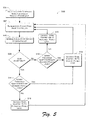
- Fig. 5 shows a process 500 for adjusting (i.e. changing) game controller transmission power.
- the process 500 is performed at a host such as host 102 as it receives data from a game controller such as game controller 104.
- Process 500 can continuously performed until transmission (i.e., communication) between the game controller and host is complete.
- the process 500 is illustrated as a collection of blocks in a logical flow graph, which represent a sequence of operations that can be implemented in hardware, software, or a combination thereof.
- the blocks represent computer instructions that, when executed by one or more processors, perform the recited operations.
- the host begins receiving initial data from the game controller.
- the game controller sets its transmission power level at an upper threshold value to transmit the initial data or data packet to the host.
- data or a data packet is received by the host from the game controller.
- the data may include a distinct unit such as a data packet which may include a header data, actual data (i.e., text data), and voice data, which may be encrypted and/or employ error correcting schemes.
- a wait may be performed to assure all of the data or the complete data packet is received at the particular reception power level.
- a set (i.e., predetermined) wait period may be performed (e.g., wait for 100 ms) before proceeding to the next block (i.e. block 506); however a complete data packet or sufficient data should be made available to perform a quality of service (QOS) analysis by the host.
- QOS quality of service
- a threshold level may be set which relates to a number of QOS metrics being met. For example, if three of four QOS metrics are satisfied (i.e., found to be good), the QOS is acceptable. In certain cases, a QOS metric such as voice data may be irrelevant since the game controller and host are not communicating voice data. Irrelevant or non-applicable QOS metrics are ignored and not factored in determining if QOS is acceptable.
- the host determines that the game controller is not operating at its upper threshold transmission power level (i.e., following the "No" branch of block 510)
- the host instructs the game controller to increment its transmission power level to a power level one increment higher than the current power level in order for the host to adequately receive data (i.e., meet an acceptable QOS). Subsequent data is then received by the host at this transmission power level (i.e., block 504 is performed).
- block 514 is performed which provides that the transmission power level stays at the current power level since the game controller is already operating at the upper threshold transmission power level. Subsequent data is then received by the host at the upper threshold transmission power level (i.e., block 504 is performed).
- block 518 is performed where the host instructs the game controller to decrement its reception power level to a power level one increment lower than the current power level, thus reducing the transmission power level and conserving game controller battery power. Subsequent data is then received by the host at this transmission power level (i.e., block 504 is performed).
- block 514 is performed which provides that transmission power level stays at the current power level since the game controller is already operating at the lower threshold transmission power level. Subsequent data is then received by the host at the lower threshold transmission power level (i.e., block 504 is performed).
Landscapes
- Engineering & Computer Science (AREA)
- Multimedia (AREA)
- Human Computer Interaction (AREA)
- Computer Networks & Wireless Communication (AREA)
- Business, Economics & Management (AREA)
- Computer Security & Cryptography (AREA)
- General Business, Economics & Management (AREA)
- Physics & Mathematics (AREA)
- Acoustics & Sound (AREA)
- Mobile Radio Communication Systems (AREA)
Applications Claiming Priority (2)
| Application Number | Priority Date | Filing Date | Title |
|---|---|---|---|
| US10/817,317 US20050227763A1 (en) | 2004-03-31 | 2004-03-31 | Game controller power management |
| US817317 | 2004-03-31 |
Publications (2)
| Publication Number | Publication Date |
|---|---|
| EP1584359A2 true EP1584359A2 (de) | 2005-10-12 |
| EP1584359A3 EP1584359A3 (de) | 2005-10-19 |
Family
ID=34912676
Family Applications (1)
| Application Number | Title | Priority Date | Filing Date |
|---|---|---|---|
| EP05102445A Withdrawn EP1584359A3 (de) | 2004-03-31 | 2005-03-29 | Energieverwaltungssystem für Spielsteuerung |
Country Status (7)
| Country | Link |
|---|---|
| US (1) | US20050227763A1 (de) |
| EP (1) | EP1584359A3 (de) |
| JP (1) | JP2005288160A (de) |
| CN (1) | CN100592310C (de) |
| AU (1) | AU2005201230B2 (de) |
| CA (1) | CA2502964A1 (de) |
| TW (1) | TW200540604A (de) |
Cited By (1)
| Publication number | Priority date | Publication date | Assignee | Title |
|---|---|---|---|---|
| EP1952862B1 (de) * | 2006-11-17 | 2017-10-25 | Nintendo Co., Ltd. | Speichermedium mit darauf gespeichertem Spielprogramm und Spielgerät |
Families Citing this family (16)
| Publication number | Priority date | Publication date | Assignee | Title |
|---|---|---|---|---|
| US20060040742A1 (en) * | 2004-08-20 | 2006-02-23 | Wright Steven A | Methods, systems, and computer program products for coordinating peer-to-peer communication sessions across a communication network by uploading a coordination module to a hosting server |
| GB2443099B (en) * | 2005-11-11 | 2008-10-08 | Realtek Semiconductor Corp | Power consumption control methods applied to communication systems |
| TWI279994B (en) * | 2005-11-11 | 2007-04-21 | Realtek Semiconductor Corp | Power consumption control methods applied to communication systems, and related devices |
| US7644294B2 (en) * | 2006-01-06 | 2010-01-05 | Advanced Micro Devices, Inc. | Dynamically self-decaying device architecture |
| DE602006004842D1 (de) * | 2006-03-25 | 2009-03-05 | Tzou May | Öffnungssystem für ein Garagentor |
| CN101192940B (zh) * | 2006-11-28 | 2011-04-20 | 中兴通讯股份有限公司 | 移动游戏服务质量保障方法 |
| US8704492B2 (en) | 2007-02-20 | 2014-04-22 | Microsoft Corporation | Automatic power switching in game peripheral |
| US20080320041A1 (en) * | 2007-06-21 | 2008-12-25 | Motorola, Inc. | Adding virtual features via real world accessories |
| US20100144431A1 (en) * | 2008-12-09 | 2010-06-10 | Lo Chen-Jung | Game system |
| FR2953613B1 (fr) * | 2009-12-07 | 2012-01-13 | Alcatel Lucent | Systeme bureautique comprenant une application de telephonie |
| US20130017887A1 (en) * | 2011-07-14 | 2013-01-17 | Wilson Keithline | Game Controller System |
| WO2013085539A1 (en) | 2011-12-09 | 2013-06-13 | Intel Corporation | Adaptive graphics subsystem power and performance management |
| US9612651B2 (en) * | 2014-10-27 | 2017-04-04 | Futurewei Technologies, Inc. | Access based resources driven low power control and management for multi-core system on a chip |
| CN205758148U (zh) * | 2016-02-02 | 2016-12-07 | 嘉兴市舒福德电动床有限公司 | 一种电动床 |
| CN111111007A (zh) * | 2019-12-31 | 2020-05-08 | 北京品驰医疗设备有限公司 | 具有信号发射和接收灵敏度调整功能的植入式医疗系统 |
| JP2022529093A (ja) * | 2020-03-20 | 2022-06-17 | 深▲せん▼市壹位堂科技有限公司 | 機能切り替え及び切り替えの動的認識のための制御機器並びに動的認識方法 |
Family Cites Families (31)
| Publication number | Priority date | Publication date | Assignee | Title |
|---|---|---|---|---|
| US5691898A (en) * | 1995-09-27 | 1997-11-25 | Immersion Human Interface Corp. | Safe and low cost computer peripherals with force feedback for consumer applications |
| US5738583A (en) * | 1996-02-02 | 1998-04-14 | Motorola, Inc. | Interactive wireless gaming system |
| US6167282A (en) * | 1998-06-18 | 2000-12-26 | Motorola, Inc. | Method and apparatus for updating site ranking factors in a wireless communication system |
| US6599194B1 (en) * | 1998-09-08 | 2003-07-29 | Darren Smith | Home video game system with hard disk drive and internet access capability |
| US6445916B1 (en) * | 1999-01-07 | 2002-09-03 | Lucent Technologies Inc. | Wireless system and method for evaluating quality of service |
| US6628956B2 (en) * | 1999-03-15 | 2003-09-30 | Telefonaktiebolaget Lm Ericsson (Publ) | Adaptive power control in a radio communications systems |
| US6468160B2 (en) * | 1999-04-08 | 2002-10-22 | Nintendo Of America, Inc. | Security system for video game system with hard disk drive and internet access capability |
| US6727816B1 (en) * | 1999-05-13 | 2004-04-27 | Honeywell International Inc. | Wireless system with variable learned-in transmit power |
| JP2000358079A (ja) * | 1999-06-15 | 2000-12-26 | Matsushita Electric Ind Co Ltd | 受信品質測定装置 |
| US6708034B1 (en) * | 1999-09-13 | 2004-03-16 | Nortel Networks Ltd. | End-to-end quality of service guarantee in a wireless environment |
| US8002617B1 (en) * | 1999-09-27 | 2011-08-23 | Nokia Corporation | Sponsored network games |
| US6238289B1 (en) * | 2000-01-10 | 2001-05-29 | Eleven Engineering Inc. | Radio frequency game controller |
| JP2003525719A (ja) * | 2000-03-06 | 2003-09-02 | イレヴン エンジニアリング インコーポレイテッド | 無線周波数遠隔ゲームコントローラ |
| US6430395B2 (en) * | 2000-04-07 | 2002-08-06 | Commil Ltd. | Wireless private branch exchange (WPBX) and communicating between mobile units and base stations |
| WO2002023315A2 (en) * | 2000-09-12 | 2002-03-21 | Aladdin Knowledge Systems, Ltd. | System for managing rights and permitting on-line playback of digital content |
| US6684062B1 (en) * | 2000-10-25 | 2004-01-27 | Eleven Engineering Incorporated | Wireless game control system |
| AU2001278682B2 (en) * | 2000-10-27 | 2006-05-04 | Sony Interactive Entertainment Inc. | Information processing system comprising a plurality of operation terminal devices and an information processing device |
| JP2002217991A (ja) * | 2001-01-24 | 2002-08-02 | Ntt Docomo Inc | 無線通信システム、無線通信方法、無線中継装置、及び無線通信システムを用いた多元接続無線アクセスシステム |
| JP3494998B2 (ja) * | 2001-01-25 | 2004-02-09 | 株式会社ソニー・コンピュータエンタテインメント | 情報通信システム、情報処理装置、通信特定情報の保存方法、通信特定情報の保存プログラムを記録したコンピュータ読み取り可能な記録媒体、通信特定情報の保存プログラム |
| US6641480B2 (en) * | 2001-01-29 | 2003-11-04 | Microsoft Corporation | Force feedback mechanism for gamepad device |
| US20020110246A1 (en) * | 2001-02-14 | 2002-08-15 | Jason Gosior | Wireless audio system |
| KR100915275B1 (ko) * | 2001-11-05 | 2009-09-03 | 가부시키가이샤 히타치세이사쿠쇼 | 무선 통신 시스템 및 그 통신 제어 방법 및 무선 통신기 |
| JP2003283413A (ja) * | 2002-03-22 | 2003-10-03 | Toshiba Corp | Cdm受信装置とそのパワーセーブ方法 |
| US20030197677A1 (en) * | 2002-04-17 | 2003-10-23 | Hulvey Robert W. | Keyboard/mouse/GPIO interface of a wireless interface device |
| JP4016260B2 (ja) * | 2002-09-03 | 2007-12-05 | ソニー株式会社 | ワイヤレスlanシステムおよびベース装置 |
| US7918734B2 (en) * | 2002-09-30 | 2011-04-05 | Time Warner Cable, A Division Of Time Warner Entertainment Company, L.P. | Gaming server providing on demand quality of service |
| EP2026472A1 (de) * | 2002-11-07 | 2009-02-18 | Adaptix, Inc. | Verfahren und Vorrichtung zur Anpassungsträgerzuteilung und Leistungssteuerung in Mehrträgerkommunikationssystemen |
| US7050798B2 (en) * | 2002-12-16 | 2006-05-23 | Microsoft Corporation | Input device with user-balanced performance and power consumption |
| US20040203383A1 (en) * | 2002-12-31 | 2004-10-14 | Kelton James Robert | System for providing data to multiple devices and method thereof |
| US7245947B2 (en) * | 2003-09-16 | 2007-07-17 | Nokia Corporation | Method and system for power-based control of an ad hoc wireless communications network |
| JP4725962B2 (ja) * | 2005-12-16 | 2011-07-13 | 株式会社ソニー・コンピュータエンタテインメント | 通信端末装置および送信電力制御方法 |
-
2004
- 2004-03-31 US US10/817,317 patent/US20050227763A1/en not_active Abandoned
-
2005
- 2005-03-22 TW TW094108851A patent/TW200540604A/zh unknown
- 2005-03-22 AU AU2005201230A patent/AU2005201230B2/en not_active Ceased
- 2005-03-28 JP JP2005091720A patent/JP2005288160A/ja active Pending
- 2005-03-29 EP EP05102445A patent/EP1584359A3/de not_active Withdrawn
- 2005-03-30 CA CA002502964A patent/CA2502964A1/en not_active Abandoned
- 2005-03-31 CN CN200510056258A patent/CN100592310C/zh not_active Expired - Fee Related
Non-Patent Citations (1)
| Title |
|---|
| None * |
Cited By (1)
| Publication number | Priority date | Publication date | Assignee | Title |
|---|---|---|---|---|
| EP1952862B1 (de) * | 2006-11-17 | 2017-10-25 | Nintendo Co., Ltd. | Speichermedium mit darauf gespeichertem Spielprogramm und Spielgerät |
Also Published As
| Publication number | Publication date |
|---|---|
| JP2005288160A (ja) | 2005-10-20 |
| US20050227763A1 (en) | 2005-10-13 |
| CN1680962A (zh) | 2005-10-12 |
| EP1584359A3 (de) | 2005-10-19 |
| CA2502964A1 (en) | 2005-09-30 |
| CN100592310C (zh) | 2010-02-24 |
| AU2005201230A1 (en) | 2005-10-20 |
| AU2005201230B2 (en) | 2010-07-01 |
| TW200540604A (en) | 2005-12-16 |
Similar Documents
| Publication | Publication Date | Title |
|---|---|---|
| US7753788B2 (en) | Game controller that converts between wireless operation and wired operation | |
| AU2005201230B2 (en) | Game controller power management | |
| EP1583321B1 (de) | Kopplung einer drahtlosen Spielsteuerungsvorrichtung mit einem Host | |
| US20050221894A1 (en) | Multi-system game controller that operates in multiple USB modes | |
| US9573056B2 (en) | Expandable control device via hardware attachment | |
| US6585596B1 (en) | Wireless game control units | |
| EP1583317A1 (de) | Drahtlose Spielsteuerungsvorrichtung mit schneller Verbindung zu einem Host | |
| TWI393402B (zh) | 用於遊戲主機周邊裝置之無線協定 | |
| KR101202114B1 (ko) | 게임 컨트롤러 전력 관리 |
Legal Events
| Date | Code | Title | Description |
|---|---|---|---|
| PUAI | Public reference made under article 153(3) epc to a published international application that has entered the european phase |
Free format text: ORIGINAL CODE: 0009012 |
|
| PUAL | Search report despatched |
Free format text: ORIGINAL CODE: 0009013 |
|
| AK | Designated contracting states |
Kind code of ref document: A2 Designated state(s): AT BE BG CH CY CZ DE DK EE ES FI FR GB GR HU IE IS IT LI LT LU MC NL PL PT RO SE SI SK TR |
|
| AX | Request for extension of the european patent |
Extension state: AL BA HR LV MK YU |
|
| AK | Designated contracting states |
Kind code of ref document: A3 Designated state(s): AT BE BG CH CY CZ DE DK EE ES FI FR GB GR HU IE IS IT LI LT LU MC NL PL PT RO SE SI SK TR |
|
| AX | Request for extension of the european patent |
Extension state: AL BA HR LV MK YU |
|
| 17P | Request for examination filed |
Effective date: 20060320 |
|
| AKX | Designation fees paid |
Designated state(s): AT BE BG CH CY CZ DE DK EE ES FI FR GB GR HU IE IS IT LI LT LU MC NL PL PT RO SE SI SK TR |
|
| 17Q | First examination report despatched |
Effective date: 20061109 |
|
| STAA | Information on the status of an ep patent application or granted ep patent |
Free format text: STATUS: THE APPLICATION IS DEEMED TO BE WITHDRAWN |
|
| 18D | Application deemed to be withdrawn |
Effective date: 20141001 |