EP1585357A1 - Optimierung von Ressourcen in einem Telekommunikationsnetzwerk. - Google Patents
Optimierung von Ressourcen in einem Telekommunikationsnetzwerk. Download PDFInfo
- Publication number
- EP1585357A1 EP1585357A1 EP05006972A EP05006972A EP1585357A1 EP 1585357 A1 EP1585357 A1 EP 1585357A1 EP 05006972 A EP05006972 A EP 05006972A EP 05006972 A EP05006972 A EP 05006972A EP 1585357 A1 EP1585357 A1 EP 1585357A1
- Authority
- EP
- European Patent Office
- Prior art keywords
- network
- area
- window
- network element
- information
- Prior art date
- Legal status (The legal status is an assumption and is not a legal conclusion. Google has not performed a legal analysis and makes no representation as to the accuracy of the status listed.)
- Withdrawn
Links
Images


Classifications
-
- H—ELECTRICITY
- H04—ELECTRIC COMMUNICATION TECHNIQUE
- H04W—WIRELESS COMMUNICATION NETWORKS
- H04W36/00—Hand-off or reselection arrangements
- H04W36/24—Reselection being triggered by specific parameters
- H04W36/30—Reselection being triggered by specific parameters by measured or perceived connection quality data
- H04W36/302—Reselection being triggered by specific parameters by measured or perceived connection quality data due to low signal strength
-
- H—ELECTRICITY
- H04—ELECTRIC COMMUNICATION TECHNIQUE
- H04W—WIRELESS COMMUNICATION NETWORKS
- H04W88/00—Devices specially adapted for wireless communication networks, e.g. terminals, base stations or access point devices
- H04W88/12—Access point controller devices
Definitions
- the present invention relates to a management of a communication network. Especially, the invention relates to the management of handovers by controlling the network parameters so that the network capacity can be optimized.
- the mobility management is a very important issue.
- the aim of the management is to optimize the network resources so that the network works property and the user of the terminal receives the services he/she wants in a proper manner.
- the handover is commonly known as an action of switching from one radio channel to another, during a connection, such as an on-going call, Switching from one radio channel to another is performed typically when a mobile station moves from the area of one cell to another.
- different types of handovers may be performed, such as soft handover, softer handover, inter-frequency handover, intra-frequency handover and inter-system handover,
- a soft handover is a procedure in which a UE maintains its connection with the UTRAN via two or more cells (Node B:s) simultaneously.
- a soft handover is a CDMA specific procedure, made possible by the fact that all base stations use the same frequency. This makes it possible that the UE can be connected to several of them at the same time, The base stations to which a UE is connected at the same time are said to belong to an active set of the UE.
- Soft handovers are managed with user equipment UE measurement reports and active set update messages sent by the network and measurement control messages sent by the network. The network always makes the final decision on all changes to the UE's active set.
- the advantage of the soft handover especially in cell borders is that the UE can collect more signal energy from several sources simultaneously and maintain the connection better than with a single link to one cell.
- the interference level is lower since the transmission power of the base stations and the UEs can be optimized with soft handover. It should be born in mind that in the soft handover the UE can simultaneously be connected to several sectors of different Node B:s.
- Another handover type is a softer handover.
- the softer handover is a special case of the soft handover.
- the UE is simultaneously connected to several sectors of a single Node B.
- the term soft handover will be used.
- the term soft handover should be considered as broadly as possible, especially so that the term comprises both the soft handover and the softer handover.
- the base stations which are involved in the soft handover, are selected with a special procedure in CDMA.
- the UE measures the signal strengths of the cells in the active set and the signal strengths of the neighbouring cells.
- the UE compares the measurement results of primary Common Pilot Channel (CPICH) of the measured cells to system threshold values.
- the system threshold values are the following: addition window, drop window and replacement window.
- the addition, drop and replacement windows form so-called window set.
- the addition window defines the value, when a new cell is added to an active set.
- the drop window defines the value, when a cell is dropped out from the active set and the replacement window defines the value, when a cell in the active set is replaced with another,
- the window sizes are fixed.
- the UE sends the measurement report to the network, if at least one of the threshold values exceeds.
- the measurement report is sent to a network element called RNC via the base stations (Node B:s), which controls the use and the reliability of the radio resources.
- the RNC also compares the measurement results to the system threshold values (i.e. to the window sizes) and does other system capacity evaluations. If the comparison shows that the active set in the UE must be updated, the RNC sends so-called Active Set update Command to the UE, Thus, the RNC makes the final decision of the active set update.
- the soft handover overhead is a common metric, which is used to quantify the soft handover activity in a network. It can be considered as a measure of the additional hardware and transmission resources required for implementation of the soft handover. So, the more often the UE is in soft handover the larger is the soft handover overhead. That is why the number of soft handovers should be minimized.
- the UE measures a Common Pilot Channel CPICH of the active set cells and the neighboring cells. Especially, the measured values are so-called Energy of a chip compared to interference Ec/No and Received Signal Code Power RSCP (the energy level at which a reception is made).
- RSCP Received Signal Code Power
- the fading pattern of interference can be considered more or less identical to the fading pattern of received signal RSCP, as they are both generated from the same source.
- the white noise component is negligible in good field (high RSSI, low pathloss, high Ec/No, high RSCP),
- the interference is mainly generated by the white noise from surrounding environment.
- the interference generated from own active set cells is negligible.
- the level of white noise is dependent on the channel bandwidth of the system and can be considered quite static.
- the Energy of a chip compared to interference Ec/No starts to follow the fading patterns of Received Signal Code Power RSCP (the energy level at which a reception is made) and fluctuates very rapidly (fast fading).
- RSCP Received Signal Code Power
- the rapid Ec/No fluctuation causes the UE to add and drop the cells on its active set uncontrollably and the soft handover gain is lost in the process. Fixing large addition and drop windows could solve this problem, but it would result in significant capacity losses at high Ec/No and RSCP levels and is thus a problem.
- An object of the present invention is thus to provide a method, a system and a network element to overcome the above-mentioned problems.
- the objects of the invention are achieved by a method, a system and a network element, which are characterized by what is stated in the independent claims. Embodiments of the invention are disclosed in the dependent claims.
- the solution according to the present invention is based on the inventive idea that the window sizes in the window set are adjusted dynamically depending on the radio condition measurement results done by the UE and analyzed by a Radio Network Controller (RNC). If needed, the RNC changes the window set values after the analysis and informs the UE about the new window set values.
- RNC Radio Network Controller
- the basic idea is that when the UE moves towards the cell borders (defined by the measurement calculations), it starts to use more appropriate window sizes to maximize the soft handover gain at the border area of cells.
- the RNC defines the window sizes, which are better for the situation to maximize the downlink and lub interface capacity.
- a special procedure is arranged in the RNC, in which a value describing the radio conditions of the network in the area is defined from the measurement result received from the UE.
- the value is derived from the measurement report values received from the user equipment UE.
- the derived value is compared to at least one predetermined threshold values. Depending on the comparison the window set values are changed if necessary.
- the UE is informed about the new window set values and the new values are used in the RNC when defining the need for active set update.
- the window set values defining the predetermined conditions to initiate an active set update, are always changed, when the RSSI value, calculated from the measurement values received in the measurement report, meets the threshold value.
- the information about the new window set values are sent to the UE.
- the new window set values are used in determining the cells, which cells must be updated in the active set.
- An active set update message is sent to the UE if needed.
- the network element calculates a value describing the radio conditions of the network in the area from the measurement report values received from the user equipment UE.
- the value is compared to a first threshold value. If the condition of the first comparison is not fulfilled, the value is compared to another threshold value, If the condition is not fulfilled, the normal handover procedure is continued. If the condition in the first or in the second comparison is fulfilled, it is checked, which window set is in use. If the appropriate window set to the situation is already in use, the normal handover procedures are continued. If the appropriate window set is not in use, the window set is changed resulting the change in the conditions for initiating the active set update procedure. As a result the information about the new window set values are sent to the UE. The new window set values are used in determining the cells, which cells must be updated in the active set. An active set update message is sent to the UE if needed.
- the system comprises at least an User Equipment UE for measuring signal strengths of cells in the area and transmitting a measurement report comprising information at least about the signal strengths of cells in the area to the network.
- an active set comprising information about the cells relating to the handover is maintained in the system according to the invention.
- the active set is updated in response to a comparison of the measured signal strengths of the cells in the area to a window set values comprising information about predetermined conditions to initiate the active set updating.
- the system further comprises a network element for determining a value describing the radio conditions of the network in the area from the measurement report values received from the user equipment UE and for comparing said value describing the radio conditions of the network in the area with a threshold value (set in the network).
- the network element in the system is arranged to change window set values comprising information about the predetermined conditions to initiate the active set updating in response to said comparison of said value describing the radio conditions of the network in the area with the threshold value.
- the network element according to the invention is arranged to optimize a handover procedure in a telecommunications network.
- the network element is arranged to determine a value describing the radio conditions of the network in the area from the measurement report values received from the user equipment UE and to compare said value describing the radio conditions of the network in the area with a threshold value (set in the network).
- the network element is arranged to change window set values comprising information about the predetermined conditions to initiate the active set updating in response to said comparison of said value describing the radio conditions of the network in the area with the threshold value.
- the advantage of the method, the system and the network element according to the invention is that the network capacity can be improved, since the soft handover overhead is, adjusted to every situation.
- the system adapts the soft handover overhead depending on the radio conditions and thus maximizes the system capacity on good field strength and maximizes the soft handover gain in weak field strength. There is no need to make any modifications to the present networks or user equipments, when implementing the invention.
- the present invention is applicable to any network, which uses the active set concept. This is especially known in CDMA systems, such as in UMTS.
- 3G WCDMA Wideband Code Division Multiple Access
- UMTS Universal Mobile Telecommunications System
- the invention is not restricted to these embodiments, but it may be applied to any mobile communication system in which the handover is based to a so called active set, which comprises the information about the active cells the user equipment UE is connected to.
- active set which comprises the information about the active cells the user equipment UE is connected to.
- Other examples of such systems are IS-41, IS-95, CDMA 2000 or other similar mobile communication systems, such as the PCS (Personal communication system) or the DCS 1800 (Digital cellular system for 1800 MHz), and systems implementing UMTS TDD (Time Division Duplex) or UMTS FDD (Frequency Division Duplex).
- FIG. 1 shows a simplified version of the mobile communications system architecture, illustrating only components that are essential to the invention, even though those skilled in the art naturally know that a general mobile communication system also comprises other functions and structures, which do not have to be described in more detail herein.
- the main parts of the UMTS are a Core Network CN, a UMTS radio access network UTRAN and a mobile station MS, which may also be referred to a user equipment UE.
- the Core Network CN is the network part in the UMTS, which takes care of the connection management, session management and mobility management among other things.
- the Core Network CN comprises network nodes (not shown) such as a Serving GPRS Support Node SGSN and a Mobile Switching Centre MSC.
- the core network CN may be connected to external networks (not shown), which may be Circuit-Switched CS networks, such as a Public Land Mobile Network PLMN, a Public Switched Telephone Network PSTN, and an Integrated Services Digital Network ISDN, or Packet-Switched PS networks, such as the Intemet and X.25.
- the core network is not illustrated here more accurately since it does not play an important role in the present invention.
- the UTRAN is a theoretical concept for the 3G radio access network comprising Radio Network Controllers RNC and base stations known as Node B.
- the RNC is arranged to at least control the radio resources.
- the interface between the RNC and Node B is called lub.
- the interface Uu provides interconnection between the RNC and the User Terminal via the Node B.
- the User Terminal may be a simplified terminal intended only for speech, or it may be a terminal for multiple services operating as a service platform and supporting the loading and execution of different service-related functions.
- the User Terminal comprises actual mobile equipment ME and an associated removable identification card USIM (Universal Subscriber Identity Module), which is also called a subscriber identity module.
- USIM Universal Subscriber Identity Module
- an User Equipment UE i.e. Mobile Station MS
- Mobile Station MS generally refers to an entity of the actual terminal and the subscriber identity module.
- the user equipment UE can be connected to several base stations (i.e, Node Bs) at the same time. This is called soft handover.
- the list comprising the active cells into which the UE is connected, is called an active set.
- the cells in the active set are selected and managed with a special procedure.
- several parameters are defined, which are used in the maintenance of the active set. These parameters comprises at least addition, drop and replacement windows, which together are called a window set in this context and which define the predetermined conditions to initiate an active set update. Also other parameters are defined, but they are not important in view of the present invention and thus are not introduced here.
- These window values determine the threshold values, when the UE sends the measurement report to the network.
- the addition window defines the value, when a new cell is added to an active set
- the drop window defines the value, when a cell is dropped out from the active set
- the replacement window defines the value, when a cell in the active set is replaced with another
- the UE measures the signal strengths of the cells in the active set as well as the neighbouring cells and compares these values to the window set values. If the comparison shows that the active set must be updated, the UE sends the measurement results to the RNC, which makes the final decision about the active set update.
- the difference between the signal-to-noise ratio of the cell in the active set having the strongest signal-to-noise ratio and the signal-to-noise ratio of the measured cells, which is not in the active set, are compared to each others and if the difference is below the addition window value, the cell is added to the active set by sending an active set update command to UE.
- the signal-to-noise ratio of the other cells in the active set are compared to the signal-to-noise ratio of the cell having the strongest signal-to-noise ratio in the active set.
- the replacement window simply defines a value, how much the signal-to-noise ratio of a neighbouring cell must be better than the signal-to-noise ratio of the weakest cell in the active set to be added to the active set by replacing the weakest cell,
- the replacement window is used only if the active set is full.
- FIG. 2 shows a first embodiment of the method according to the present invention.
- the status of the UE is that it uses a window set B, which is meant to be in use in good radio conditions and it is moving towards weaker radio conditions.
- the first step is that the UE sends a measurement report 2-1 to the RNC via the Node B.
- the measurement report comprises information about the signal strengths of the cells in the active set as well as signal strengths of the neighbouring cells to the UE in its current location, More specifically, the measurement report according to this embodiment of the invention comprises the following information: the information about the Received Signal Code Power RSCP, which refers to the energy level at which a reception is made, and the information about the Energy of a Chip compared to interference Ec/No.
- RSCP Received Signal Code Power
- the UE suggests the cells, which must be added, dropped or replaced in the active set.
- the RSSI value describes the radio conditions experienced by the UE at its current location. To a man skilled in the art it is obvious that the RSSI value is independent of the number of cells being involved in the handover.
- the value determined in the RNC can also be any other value than RSSI. as long as it describes the radio conditions of the network experienced by the UE.
- the RNC compares the RSSI value to a threshold value 2-3, which threshold value is set by the network operator and defined based on different criteria of the network optimization. If it is below the first threshold value, it is checked, whether the window set A is already in use 2-4.
- the window set A comprises information about the addition, drop and replacement windows and thus determines the predetermined conditions to initiate an active set update. If the window set A is already in use, the RNC handles the original measurement report sent by the UE according to normal soft handover procedures 2-9.
- the normal soft handover procedures comprise at least the determination of the cells, which must be added, dropped and replaced in the active set. After the determination an active set update command is sent to the UE if needed 2-10.
- the RNC makes a decision that the window set A should be used 2-5.
- the RNC sends a measurement control message to the UE with the new window set parameters 2-8.
- the RNC handles the original measurement report sent by the UE according to the normal soft handover procedures 2-9.
- the RNC uses the new values indicated in the window set A.
- the measured cell values, reported in the measurement report are compared with the new addition, drop and replacement window values (defined in the window set A) and cells, which must be added, dropped and replaced in the active set are determined.
- the RNC sends an active set update command to UE, if needed.
- the comparison in step 2-3 may also show that the RSSI value is not below the threshold value, According to this embodiment of the invention it is checked if the window set B is use 2-6. If it is in use, the RNC continues with the basic handover control procedures 2-9. If the window set B is not in use, the RNC makes the decision that the window set B should be used 2-7 and sends a measurement control message to the UE comprising the new window set parameters 2-8. After sending the measurement control message to the UE, the RNC handles the original measurement report sent by the UE according to the normal soft handover procedures 2-9. At this point, the RNC, uses the new values indicated in the window set B. Finally, the RNC sends an active set update command to UE, if needed 2-10,
- the value describing the network conditions experienced by the UE is the RSSI.
- the RSSI is appropriate because it can be calculated from the measurement information of any cell in the measurement report and the value is the same in all cells.
- the value can be any measurement value, which is defined in the measurement report or derivable from it.
- the value used in the RNC is the RSCP, which is defined individually to every cell and describes the signal strength directly. In the embodiment only the RSCP value can be transmitted in the measurement report sent by the UE, since any other values are not needed.
- the RNC can, for example, calculate an average of all RSCP values belonging to the cells, which are in the active set, to get a more accurate value of the network conditions.
- Any other method for calculating a value, which can be used in the RNC, can be used, as long as it gives information about the radio conditions in the network.
- a typical measurement report sent by the UE there are reported the RSCP value of the measured cells, or the EC/No value of the measured cells or the both.
- Figure 2 it is shown the UE and the RNC only, since these are the essential elements according to present invention.
- the signals between the UE and the RNC go via other network elements also, such as Node B:s, but these are not illustrated in the Figure 2 to make the description simpler.
- FIG. 3 shows another embodiment of the method according to the present' invention.
- the status of the UE is that it uses a window set B, which is meant to be in use in good radio conditions.
- the first step is that the UE sends a measurement report 3-1 to the RNC via the Node B.
- the measurement report comprises information about the signal strengths of the cells in the active set as well as signal strengths of the neighbouring cells to the UE in its current location. More specifically, the measurement report according to this embodiment of the invention comprises at least the following information: the information about the Received Signal Code Power RSCP, which refers to the energy level at which a reception is made, and the information about the Energy of a Chip compared to interference Ec/No.
- the UE suggests the cells, which must be added, dropped or replaced in the active set.
- the RSSI value describes the radio conditions experienced by the UE at its current location. To a man skilled in the art it is obvious that the RSSI value is independent of the number of cells being involved in the handover.
- the RNC compares the RSSI value to a first threshold value A 3-3, which threshold value is set by the network operator and defined based on different criteria of the network optimisation. If it is below the first threshold value A, it is checked, whether the window set A is already in use 3-4.
- the window set A comprises information about the addition, drop and replacement windows, If the window set A is already in use, the RNC handles the original measurement report sent by the UE according to normal soft handover procedures 3-10.
- the normal soft handover procedures comprise at least the determination of the cells, which must be added, dropped and replaced in the active set. After the determination an active set update command is sent to the UE if needed 3-11. If the window set A is not in use, the RNC makes a decision that the window set A should be used 3-5.
- the RNC sends a measurement control message to the UE with the new window set parameters 3-19. After sending the measurement control message to the UE, the RNC handles the original measurement report sent by the UE according to the normal soft handover procedures 3-10.
- the RNC uses the new values indicated in the window set A.
- the measured cell values, reported in the measurement report are compared with the new addition, drop and replacement window values (defined in the window set A) and cells, which must be added, dropped and replaced in the active set are determined.
- the RNC sends an active set update command to UE, if needed.
- the comparison in step 3-3 may also show that the RSSI value is not below the threshold A.
- the RNC makes another comparison and compares the RSSI value according to this embodiment to another threshold value B 3-6. If the RSSI value is not above the threshold value B, the RNC continues with the basic handover control procedures 3-10 as described earlier and sends an active set update command to the UE if needed 3-11. If the RSSI value is above the threshold B, it is checked if the window set B is used 3-7. If it is in use, the RNC continues with the basic handover control procedures 3-10. If the window set B is not in use, the RNC makes the decision that the window set B should be used 3-8 and sends a measurement control message to the UE comprising the new window set parameters 3-9.
- the RNC After sending the measurement control message to the UE, the RNC handles the original measurement report sent by the UE according to the normal soft handover procedures 3-10. At this point, the RNC uses the new values indicated in the window set B. Finally, the RNC sends an active set update command to UE, if needed.
- the embodiment according to Figure 3 comprises so-called hysteresis area, which is between the thresholds A and B, If the RSSI value derived from the measurement report is in the hysteresis area (i.e. between the threshold values A and B), the window set values are not changed.
- the advantage of the hysteresis is that the network operator can adjust the size of the hysteresis and thus control the network resources conveniently.
- the inventive idea of the present invention it is also possible to define more threshold values and window sets. If this is done, new comparison steps must be done in the network element, such as the RNC. This requires more computing capacity in the RNC and makes the process slower. Thus, the number of comparison steps in the RNC must be adjusted so that an extra step in the comparison is in balance with the advantage received from it.
- FIG. 4 illustrates, how the change in the RSSI value affects the window sets, when the threshold values are crossed.
- the Figure 4 refers to the method according to the invention shown in Figure 3.
- the starting point is that the UE is using the window set B, which is the situation in the good radio conditions (RSSI is high) and the soft handover overhead is small. At some point, the RSSI value fades below the threshold B.
- the RNC notices that the RSSI value is between the threshold values A and B, when calculating the RSSI value using the information from the measurement report. In this situation the RNC makes the decision not to make any changes to the window set, as shown in Figure 3.
- the RNC notices it from the RSSI calculations and the comparison.
- the window set B is changed to window set A and the UE equipment is informed about the change, as described earlier.
- the soft handover overhead is large, since the radio conditions are not good.
- the window set A is used until the RSSI value is higher than the threshold B and the window set B is taken into use again.
- the white noise component is also shown in Figure 4.
- the system according to the invention is implemented so that the network can maximize the system capacity by optimizing the soft handover overhead.
- the system comprises a network element, which is arranged to define a value describing the radio conditions in the network, such as a RSSI value, from the UE measurements.
- the value is compared to threshold values in the network. If the comparison shows that the value, like the RSSI, is below a first threshold value, the network element in the system checks, which window set is in use. If it is the proper one, the network element in the system continues with the basic handover procedures and sends an active set update command to the UE if needled. If the window set is not proper for the situation, the network element in the system selects a better window set for the situation and informs the UE of the new window set in the measurement control message.
- the network element is arranged to perform the method steps described earlier.
- the network element is arranged to maximize the system capacity by optimizing the soft handover overhead.
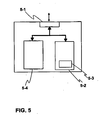
- the network element comprises input/output means 5-1 for receiving the UE measurement report via the Node B.
- the input/output means can be any kind of connection by means of which the signals can be transmitted to/from the network element.
- the network element comprises means for calculating 5-2 a value from the measurement report, which gives information about the network conditions experienced by the UE.
- the calculated value is for example the RSSI value.
- the means for calculating the value can for example be a microprocessor running an appropriate software 5-3.
- the network element is arranged also to compare the calculated value with a predetermined threshold value and in response to the comparison to make a decision, if the window set in use is appropriate for the situation. If it is not, the network element changes the window set and is arranged to inform the UE about the change.
- the network element comprises memory means 5-4 for storing the threshold values and the active set values, Furthermore, the network element is arranged to carry out all the handover procedures.
- the network element controls the handover procedure by sending different kind of control signals to other elements in the network, such as the UE, through the input/output means 5-1.
- the above-mentioned functions are advantageously implemented with a microprocessor running software for the functions.
- the software is stored into the memory means 5-4 of the network element.
- the different components are arranged to communicate with each other so that the functions according to the invention can be implemented.
- the network element is a Radio Network Controller RNC.
- the comparison algorithm can be arranged to the Node B.
- the values describing radio conditions of the network in the area are the UE specific and must be determined to each UE separately.
- the UE is moving from good radio conditions towards weaker radio conditions.
- the solution according to the inventions is naturally applicable in a situation, where the UE is moving from weak radio conditions towards better radio conditions.
Landscapes
- Engineering & Computer Science (AREA)
- Computer Networks & Wireless Communication (AREA)
- Signal Processing (AREA)
- Mobile Radio Communication Systems (AREA)
Applications Claiming Priority (2)
| Application Number | Priority Date | Filing Date | Title |
|---|---|---|---|
| FI20040509 | 2004-04-07 | ||
| FI20040509A FI20040509A7 (fi) | 2004-04-07 | 2004-04-07 | Tietoliikenneverkon resurssien optimointi |
Publications (1)
| Publication Number | Publication Date |
|---|---|
| EP1585357A1 true EP1585357A1 (de) | 2005-10-12 |
Family
ID=32104163
Family Applications (1)
| Application Number | Title | Priority Date | Filing Date |
|---|---|---|---|
| EP05006972A Withdrawn EP1585357A1 (de) | 2004-04-07 | 2005-03-31 | Optimierung von Ressourcen in einem Telekommunikationsnetzwerk. |
Country Status (3)
| Country | Link |
|---|---|
| EP (1) | EP1585357A1 (de) |
| FI (1) | FI20040509A7 (de) |
| NO (1) | NO20051643L (de) |
Cited By (1)
| Publication number | Priority date | Publication date | Assignee | Title |
|---|---|---|---|---|
| US12022311B2 (en) | 2020-09-09 | 2024-06-25 | Elisa Oyj | Evaluating effect of a change made in a communication network |
Citations (5)
| Publication number | Priority date | Publication date | Assignee | Title |
|---|---|---|---|---|
| WO1999004593A1 (en) * | 1997-07-21 | 1999-01-28 | Qualcomm Incorporated | A method of and apparatus for selecting base stations to communicate with a remote station |
| WO1999005873A1 (en) * | 1997-07-23 | 1999-02-04 | Northern Telecom Limited | Hand-off based upon relative pilot signal strength |
| US5937019A (en) * | 1996-08-07 | 1999-08-10 | Qualcomm Incorporated | Method and apparatus for reliable intersystem handoff in a CDMA system |
| WO1999043178A1 (en) * | 1998-02-17 | 1999-08-26 | Nokia Networks Oy | Measurement reporting in a telecommunication system |
| WO1999057934A1 (en) * | 1998-04-30 | 1999-11-11 | Telefonaktiebolaget Lm Ericsson (Publ) | Method and apparatus for control of soft handoff usage in radiocommunication systems |
-
2004
- 2004-04-07 FI FI20040509A patent/FI20040509A7/fi unknown
-
2005
- 2005-03-31 EP EP05006972A patent/EP1585357A1/de not_active Withdrawn
- 2005-04-04 NO NO20051643A patent/NO20051643L/no unknown
Patent Citations (5)
| Publication number | Priority date | Publication date | Assignee | Title |
|---|---|---|---|---|
| US5937019A (en) * | 1996-08-07 | 1999-08-10 | Qualcomm Incorporated | Method and apparatus for reliable intersystem handoff in a CDMA system |
| WO1999004593A1 (en) * | 1997-07-21 | 1999-01-28 | Qualcomm Incorporated | A method of and apparatus for selecting base stations to communicate with a remote station |
| WO1999005873A1 (en) * | 1997-07-23 | 1999-02-04 | Northern Telecom Limited | Hand-off based upon relative pilot signal strength |
| WO1999043178A1 (en) * | 1998-02-17 | 1999-08-26 | Nokia Networks Oy | Measurement reporting in a telecommunication system |
| WO1999057934A1 (en) * | 1998-04-30 | 1999-11-11 | Telefonaktiebolaget Lm Ericsson (Publ) | Method and apparatus for control of soft handoff usage in radiocommunication systems |
Non-Patent Citations (1)
| Title |
|---|
| XINJIE YANG ET AL: "Evaluation of soft handover algorithms for UMTS", PERSONAL, INDOOR AND MOBILE RADIO COMMUNICATIONS, 2000. PIMRC 2000. THE 11TH IEEE INTERNATIONAL SYMPOSIUM ON SEPT. 18-21, 2000, PISCATAWAY, NJ, USA,IEEE, vol. 2, 18 September 2000 (2000-09-18), pages 772 - 776, XP010520740, ISBN: 0-7803-6463-5 * |
Cited By (1)
| Publication number | Priority date | Publication date | Assignee | Title |
|---|---|---|---|---|
| US12022311B2 (en) | 2020-09-09 | 2024-06-25 | Elisa Oyj | Evaluating effect of a change made in a communication network |
Also Published As
| Publication number | Publication date |
|---|---|
| FI20040509L (fi) | 2005-10-08 |
| FI20040509A0 (fi) | 2004-04-07 |
| NO20051643L (no) | 2005-10-10 |
| FI20040509A7 (fi) | 2005-10-08 |
| NO20051643D0 (no) | 2005-04-04 |
Similar Documents
| Publication | Publication Date | Title |
|---|---|---|
| KR100754066B1 (ko) | 이동 통신 시스템에서 주파수간 측정을 실행하는가입자국, 네트워크 제어 수단 및 방법 | |
| US8385832B2 (en) | Inter-cell interference control in an uplink multi-carrier radio communications system | |
| CN100592829C (zh) | 基于事件地报告移动台测量结果 | |
| EP2269415B1 (de) | Schätzung und begrenzung von interferenzen zwischen zellen | |
| KR100729020B1 (ko) | 이동 통신 시스템에서 주파수간 측정을 트리거링하는가입자국, 네트워크 제어 수단 및 방법 | |
| EP1142408B1 (de) | Anordnung und verfahren zum schätzen von zwischenfrequenzmessungen für funknetze | |
| US6594500B2 (en) | Method and apparatus for controlling transmit power thresholds based on classification of wireless communication subscribers | |
| CN100375575C (zh) | 移动通信小区切换的测量控制方法 | |
| CN1985540B (zh) | 用于蜂窝通信中切换的方法和设备 | |
| KR20000070975A (ko) | 통신시스템에서 핸드오프를 제어하기 위한 방법 및 장치 | |
| JP2004007643A (ja) | セルラー移動通信網 | |
| CN101843142A (zh) | 触发时间处理方法和设备 | |
| JP2002271264A (ja) | セルラシステム、基地局制御装置、移動局及びそれらに用いる送信電力制御方法 | |
| US20050136929A1 (en) | Method and apparatus for supporting a soft handoff by establishing a cell set used to facilitate antenna beam mode transitions in a mobile station | |
| US8135407B2 (en) | Network evaluated hard hardover using predictions | |
| EP1954069A1 (de) | Funkzugangsnetzvorrichtung, mobilstation und handover-steuerverfahren | |
| EP1377101B1 (de) | Verfahren und Steuereinheit zur Aktualisierung einer aktiven Menge eines Teilnehmerendgeräts in einem zellularen Funksystem | |
| US20060099985A1 (en) | Apparatus and method for radio transmission in a cellular communication system | |
| KR20030021344A (ko) | 소프트 핸드오버 결정 방법 | |
| EP1585357A1 (de) | Optimierung von Ressourcen in einem Telekommunikationsnetzwerk. | |
| KR100315308B1 (ko) | 소프트 핸드오프 수행 방법 | |
| JP5928687B2 (ja) | 無線パラメータ制御システム、無線パラメータ制御装置、無線基地局、無線パラメータ制御方法及びプログラム | |
| US7146168B2 (en) | Method and system for providing a downlink connection in a cellular network | |
| Mohammed et al. | 2G/3G inter-RAT handover performance analysis | |
| CN101695185B (zh) | 移动通信系统和无线通信系统 |
Legal Events
| Date | Code | Title | Description |
|---|---|---|---|
| PUAI | Public reference made under article 153(3) epc to a published international application that has entered the european phase |
Free format text: ORIGINAL CODE: 0009012 |
|
| AK | Designated contracting states |
Kind code of ref document: A1 Designated state(s): AT BE BG CH CY CZ DE DK EE ES FI FR GB GR HU IE IS IT LI LT LU MC NL PL PT RO SE SI SK TR |
|
| AX | Request for extension of the european patent |
Extension state: AL BA HR LV MK YU |
|
| 17P | Request for examination filed |
Effective date: 20051205 |
|
| AKX | Designation fees paid |
Designated state(s): AT BE BG CH CY CZ DE DK EE ES FI FR GB GR HU IE IS IT LI LT LU MC NL PL PT RO SE SI SK TR |
|
| 17Q | First examination report despatched |
Effective date: 20060922 |
|
| STAA | Information on the status of an ep patent application or granted ep patent |
Free format text: STATUS: THE APPLICATION IS DEEMED TO BE WITHDRAWN |
|
| 18D | Application deemed to be withdrawn |
Effective date: 20070403 |