EP1587327A2 - Transcodage vidéo - Google Patents
Transcodage vidéo Download PDFInfo
- Publication number
- EP1587327A2 EP1587327A2 EP05102726A EP05102726A EP1587327A2 EP 1587327 A2 EP1587327 A2 EP 1587327A2 EP 05102726 A EP05102726 A EP 05102726A EP 05102726 A EP05102726 A EP 05102726A EP 1587327 A2 EP1587327 A2 EP 1587327A2
- Authority
- EP
- European Patent Office
- Prior art keywords
- format
- video
- compressed video
- picture
- bitrate
- Prior art date
- Legal status (The legal status is an assumption and is not a legal conclusion. Google has not performed a legal analysis and makes no representation as to the accuracy of the status listed.)
- Withdrawn
Links
- 238000000034 method Methods 0.000 claims abstract description 105
- 238000013139 quantization Methods 0.000 claims abstract description 103
- 238000007906 compression Methods 0.000 claims abstract description 86
- 230000006835 compression Effects 0.000 claims abstract description 79
- 239000013598 vector Substances 0.000 claims description 31
- 239000000872 buffer Substances 0.000 claims description 20
- 238000001914 filtration Methods 0.000 claims description 13
- 230000001105 regulatory effect Effects 0.000 claims description 2
- 230000011664 signaling Effects 0.000 claims 1
- 230000006837 decompression Effects 0.000 description 22
- 238000006243 chemical reaction Methods 0.000 description 16
- 230000008569 process Effects 0.000 description 14
- 238000005070 sampling Methods 0.000 description 12
- 238000012545 processing Methods 0.000 description 11
- 230000007246 mechanism Effects 0.000 description 9
- 238000003860 storage Methods 0.000 description 8
- 238000012360 testing method Methods 0.000 description 8
- 230000008901 benefit Effects 0.000 description 7
- 238000004891 communication Methods 0.000 description 7
- 239000000284 extract Substances 0.000 description 7
- 238000004519 manufacturing process Methods 0.000 description 6
- 230000009467 reduction Effects 0.000 description 6
- 238000013459 approach Methods 0.000 description 5
- 230000007423 decrease Effects 0.000 description 5
- 238000010586 diagram Methods 0.000 description 5
- 239000011159 matrix material Substances 0.000 description 5
- 238000009826 distribution Methods 0.000 description 4
- 230000000694 effects Effects 0.000 description 4
- 239000010410 layer Substances 0.000 description 4
- 230000005540 biological transmission Effects 0.000 description 3
- 230000006870 function Effects 0.000 description 3
- 238000013507 mapping Methods 0.000 description 3
- 230000002441 reversible effect Effects 0.000 description 3
- 238000012552 review Methods 0.000 description 3
- 238000004458 analytical method Methods 0.000 description 2
- 230000001276 controlling effect Effects 0.000 description 2
- 230000006735 deficit Effects 0.000 description 2
- 238000007726 management method Methods 0.000 description 2
- 230000000750 progressive effect Effects 0.000 description 2
- 230000006978 adaptation Effects 0.000 description 1
- 230000003044 adaptive effect Effects 0.000 description 1
- 230000002411 adverse Effects 0.000 description 1
- 230000000903 blocking effect Effects 0.000 description 1
- 230000015556 catabolic process Effects 0.000 description 1
- 230000008859 change Effects 0.000 description 1
- 230000001186 cumulative effect Effects 0.000 description 1
- 238000006731 degradation reaction Methods 0.000 description 1
- 230000003111 delayed effect Effects 0.000 description 1
- 230000001419 dependent effect Effects 0.000 description 1
- 238000001514 detection method Methods 0.000 description 1
- 238000005516 engineering process Methods 0.000 description 1
- 239000000835 fiber Substances 0.000 description 1
- 238000009499 grossing Methods 0.000 description 1
- 230000010354 integration Effects 0.000 description 1
- 230000008450 motivation Effects 0.000 description 1
- 230000003287 optical effect Effects 0.000 description 1
- 238000004321 preservation Methods 0.000 description 1
- 230000008707 rearrangement Effects 0.000 description 1
- 238000011084 recovery Methods 0.000 description 1
- 230000007727 signaling mechanism Effects 0.000 description 1
- 239000002356 single layer Substances 0.000 description 1
- 230000001360 synchronised effect Effects 0.000 description 1
Images


Classifications
-
- E—FIXED CONSTRUCTIONS
- E06—DOORS, WINDOWS, SHUTTERS, OR ROLLER BLINDS IN GENERAL; LADDERS
- E06C—LADDERS
- E06C1/00—Ladders in general
- E06C1/02—Ladders in general with rigid longitudinal member or members
- E06C1/04—Ladders for resting against objects, e.g. walls poles, trees
- E06C1/08—Ladders for resting against objects, e.g. walls poles, trees multi-part
- E06C1/10—Sections fitted end to end
-
- H—ELECTRICITY
- H04—ELECTRIC COMMUNICATION TECHNIQUE
- H04N—PICTORIAL COMMUNICATION, e.g. TELEVISION
- H04N19/00—Methods or arrangements for coding, decoding, compressing or decompressing digital video signals
- H04N19/40—Methods or arrangements for coding, decoding, compressing or decompressing digital video signals using video transcoding, i.e. partial or full decoding of a coded input stream followed by re-encoding of the decoded output stream
-
- E—FIXED CONSTRUCTIONS
- E06—DOORS, WINDOWS, SHUTTERS, OR ROLLER BLINDS IN GENERAL; LADDERS
- E06C—LADDERS
- E06C7/00—Component parts, supporting parts, or accessories
- E06C7/08—Special construction of longitudinal members, or rungs or other treads
-
- E—FIXED CONSTRUCTIONS
- E06—DOORS, WINDOWS, SHUTTERS, OR ROLLER BLINDS IN GENERAL; LADDERS
- E06C—LADDERS
- E06C7/00—Component parts, supporting parts, or accessories
- E06C7/50—Joints or other connecting parts
- E06C7/505—Anchors being adapted to fix a ladder to a vertical structure, e.g. ladder hooks
-
- H—ELECTRICITY
- H04—ELECTRIC COMMUNICATION TECHNIQUE
- H04N—PICTORIAL COMMUNICATION, e.g. TELEVISION
- H04N19/00—Methods or arrangements for coding, decoding, compressing or decompressing digital video signals
- H04N19/10—Methods or arrangements for coding, decoding, compressing or decompressing digital video signals using adaptive coding
- H04N19/102—Methods or arrangements for coding, decoding, compressing or decompressing digital video signals using adaptive coding characterised by the element, parameter or selection affected or controlled by the adaptive coding
- H04N19/103—Selection of coding mode or of prediction mode
-
- H—ELECTRICITY
- H04—ELECTRIC COMMUNICATION TECHNIQUE
- H04N—PICTORIAL COMMUNICATION, e.g. TELEVISION
- H04N19/00—Methods or arrangements for coding, decoding, compressing or decompressing digital video signals
- H04N19/10—Methods or arrangements for coding, decoding, compressing or decompressing digital video signals using adaptive coding
- H04N19/102—Methods or arrangements for coding, decoding, compressing or decompressing digital video signals using adaptive coding characterised by the element, parameter or selection affected or controlled by the adaptive coding
- H04N19/12—Selection from among a plurality of transforms or standards, e.g. selection between discrete cosine transform [DCT] and sub-band transform or selection between H.263 and H.264
- H04N19/122—Selection of transform size, e.g. 8x8 or 2x4x8 DCT; Selection of sub-band transforms of varying structure or type
-
- H—ELECTRICITY
- H04—ELECTRIC COMMUNICATION TECHNIQUE
- H04N—PICTORIAL COMMUNICATION, e.g. TELEVISION
- H04N19/00—Methods or arrangements for coding, decoding, compressing or decompressing digital video signals
- H04N19/10—Methods or arrangements for coding, decoding, compressing or decompressing digital video signals using adaptive coding
- H04N19/102—Methods or arrangements for coding, decoding, compressing or decompressing digital video signals using adaptive coding characterised by the element, parameter or selection affected or controlled by the adaptive coding
- H04N19/124—Quantisation
- H04N19/126—Details of normalisation or weighting functions, e.g. normalisation matrices or variable uniform quantisers
-
- H—ELECTRICITY
- H04—ELECTRIC COMMUNICATION TECHNIQUE
- H04N—PICTORIAL COMMUNICATION, e.g. TELEVISION
- H04N19/00—Methods or arrangements for coding, decoding, compressing or decompressing digital video signals
- H04N19/10—Methods or arrangements for coding, decoding, compressing or decompressing digital video signals using adaptive coding
- H04N19/134—Methods or arrangements for coding, decoding, compressing or decompressing digital video signals using adaptive coding characterised by the element, parameter or criterion affecting or controlling the adaptive coding
- H04N19/136—Incoming video signal characteristics or properties
- H04N19/14—Coding unit complexity, e.g. amount of activity or edge presence estimation
-
- H—ELECTRICITY
- H04—ELECTRIC COMMUNICATION TECHNIQUE
- H04N—PICTORIAL COMMUNICATION, e.g. TELEVISION
- H04N19/00—Methods or arrangements for coding, decoding, compressing or decompressing digital video signals
- H04N19/10—Methods or arrangements for coding, decoding, compressing or decompressing digital video signals using adaptive coding
- H04N19/134—Methods or arrangements for coding, decoding, compressing or decompressing digital video signals using adaptive coding characterised by the element, parameter or criterion affecting or controlling the adaptive coding
- H04N19/146—Data rate or code amount at the encoder output
- H04N19/15—Data rate or code amount at the encoder output by monitoring actual compressed data size at the memory before deciding storage at the transmission buffer
-
- H—ELECTRICITY
- H04—ELECTRIC COMMUNICATION TECHNIQUE
- H04N—PICTORIAL COMMUNICATION, e.g. TELEVISION
- H04N19/00—Methods or arrangements for coding, decoding, compressing or decompressing digital video signals
- H04N19/10—Methods or arrangements for coding, decoding, compressing or decompressing digital video signals using adaptive coding
- H04N19/134—Methods or arrangements for coding, decoding, compressing or decompressing digital video signals using adaptive coding characterised by the element, parameter or criterion affecting or controlling the adaptive coding
- H04N19/146—Data rate or code amount at the encoder output
- H04N19/152—Data rate or code amount at the encoder output by measuring the fullness of the transmission buffer
-
- H—ELECTRICITY
- H04—ELECTRIC COMMUNICATION TECHNIQUE
- H04N—PICTORIAL COMMUNICATION, e.g. TELEVISION
- H04N19/00—Methods or arrangements for coding, decoding, compressing or decompressing digital video signals
- H04N19/10—Methods or arrangements for coding, decoding, compressing or decompressing digital video signals using adaptive coding
- H04N19/134—Methods or arrangements for coding, decoding, compressing or decompressing digital video signals using adaptive coding characterised by the element, parameter or criterion affecting or controlling the adaptive coding
- H04N19/157—Assigned coding mode, i.e. the coding mode being predefined or preselected to be further used for selection of another element or parameter
-
- H—ELECTRICITY
- H04—ELECTRIC COMMUNICATION TECHNIQUE
- H04N—PICTORIAL COMMUNICATION, e.g. TELEVISION
- H04N19/00—Methods or arrangements for coding, decoding, compressing or decompressing digital video signals
- H04N19/10—Methods or arrangements for coding, decoding, compressing or decompressing digital video signals using adaptive coding
- H04N19/169—Methods or arrangements for coding, decoding, compressing or decompressing digital video signals using adaptive coding characterised by the coding unit, i.e. the structural portion or semantic portion of the video signal being the object or the subject of the adaptive coding
- H04N19/17—Methods or arrangements for coding, decoding, compressing or decompressing digital video signals using adaptive coding characterised by the coding unit, i.e. the structural portion or semantic portion of the video signal being the object or the subject of the adaptive coding the unit being an image region, e.g. an object
- H04N19/172—Methods or arrangements for coding, decoding, compressing or decompressing digital video signals using adaptive coding characterised by the coding unit, i.e. the structural portion or semantic portion of the video signal being the object or the subject of the adaptive coding the unit being an image region, e.g. an object the region being a picture, frame or field
-
- H—ELECTRICITY
- H04—ELECTRIC COMMUNICATION TECHNIQUE
- H04N—PICTORIAL COMMUNICATION, e.g. TELEVISION
- H04N19/00—Methods or arrangements for coding, decoding, compressing or decompressing digital video signals
- H04N19/10—Methods or arrangements for coding, decoding, compressing or decompressing digital video signals using adaptive coding
- H04N19/169—Methods or arrangements for coding, decoding, compressing or decompressing digital video signals using adaptive coding characterised by the coding unit, i.e. the structural portion or semantic portion of the video signal being the object or the subject of the adaptive coding
- H04N19/17—Methods or arrangements for coding, decoding, compressing or decompressing digital video signals using adaptive coding characterised by the coding unit, i.e. the structural portion or semantic portion of the video signal being the object or the subject of the adaptive coding the unit being an image region, e.g. an object
- H04N19/176—Methods or arrangements for coding, decoding, compressing or decompressing digital video signals using adaptive coding characterised by the coding unit, i.e. the structural portion or semantic portion of the video signal being the object or the subject of the adaptive coding the unit being an image region, e.g. an object the region being a block, e.g. a macroblock
-
- H—ELECTRICITY
- H04—ELECTRIC COMMUNICATION TECHNIQUE
- H04N—PICTORIAL COMMUNICATION, e.g. TELEVISION
- H04N19/00—Methods or arrangements for coding, decoding, compressing or decompressing digital video signals
- H04N19/10—Methods or arrangements for coding, decoding, compressing or decompressing digital video signals using adaptive coding
- H04N19/169—Methods or arrangements for coding, decoding, compressing or decompressing digital video signals using adaptive coding characterised by the coding unit, i.e. the structural portion or semantic portion of the video signal being the object or the subject of the adaptive coding
- H04N19/186—Methods or arrangements for coding, decoding, compressing or decompressing digital video signals using adaptive coding characterised by the coding unit, i.e. the structural portion or semantic portion of the video signal being the object or the subject of the adaptive coding the unit being a colour or a chrominance component
-
- H—ELECTRICITY
- H04—ELECTRIC COMMUNICATION TECHNIQUE
- H04N—PICTORIAL COMMUNICATION, e.g. TELEVISION
- H04N19/00—Methods or arrangements for coding, decoding, compressing or decompressing digital video signals
- H04N19/50—Methods or arrangements for coding, decoding, compressing or decompressing digital video signals using predictive coding
- H04N19/503—Methods or arrangements for coding, decoding, compressing or decompressing digital video signals using predictive coding involving temporal prediction
- H04N19/51—Motion estimation or motion compensation
- H04N19/527—Global motion vector estimation
-
- H—ELECTRICITY
- H04—ELECTRIC COMMUNICATION TECHNIQUE
- H04N—PICTORIAL COMMUNICATION, e.g. TELEVISION
- H04N19/00—Methods or arrangements for coding, decoding, compressing or decompressing digital video signals
- H04N19/50—Methods or arrangements for coding, decoding, compressing or decompressing digital video signals using predictive coding
- H04N19/503—Methods or arrangements for coding, decoding, compressing or decompressing digital video signals using predictive coding involving temporal prediction
- H04N19/51—Motion estimation or motion compensation
- H04N19/56—Motion estimation with initialisation of the vector search, e.g. estimating a good candidate to initiate a search
Definitions
- a computer processes video information as a series of numbers representing the information.
- a single number typically represents an intensity value for one picture element ["pixel"] of a picture.
- Several factors affect the quality of the video information, including sample depth, resolution, and frame rate.
- Sample depth indicates the range of numbers used to represent a sample. When more values are possible for the sample, quality is higher because the number can capture more subtle variations in intensity. Video with higher resolution tends to look crisper than other video, and video with higher frame rate tends to look smoother than other video. For all of these factors, the tradeoff for high quality is the cost of storing and transmitting the information, as Table 1 shows. Bitrates for different quality levels of raw video Bits Per Pixel Resolution Frame Rate Bitrate 8 (value 0-255) 160x120 pixels 7.5 1.2 Mbit/s 24 (value 0-16,777,215) 240x176 pixels 15 15.2 Mbit/s 24 (value 0-16,777,215) 352 ⁇ 288 pixels 30 73Mbit/s
- High resolution formats such as those used for HDTV use even more bitrate for raw video.
- compression also called coding or encoding
- Compression decreases the cost of storing and transmitting information by converting it into a lower bitrate form.
- Decompression also called decoding reconstructs a version of the original information from the compressed form.
- Two categories of compression are lossless and lossy.
- Lossless compression reduces the bitrate of information by removing redundancy. For example, a series of ten red pixels is represented as a code for "red" and the number ten in compression, and the series is perfectly reconstructed in decompression. Lossless compression reduces bitrate at no cost to quality, but can only reduce bitrate up to a certain point. Decreases in bitrate are limited by the complexity of the information. Entropy coding is another term for lossless compression.
- transcoding converts compressed information of one bitrate, quality, or format to compressed information of another bitrate, quality, or format.
- Different transcoders use different techniques.
- a homogeneous transcoder uses the same format for both decompression and compression during transcoding, for example, converting high bitrate MPEG-2 compressed video to lower bitrate MPEG-2 compressed video.
- a heterogeneous transcoder uses different formats for decompression and compression, for example, converting MPEG-2 compressed video to H.261 compressed video.
- heterogeneous transcoders see, for example, the article by Shanableh et al., entitled "Transcoding of Video into Different Encoding Formats.”
- transcoders fully decompress compressed information and then fully recompress the information. Naive transcoding simply cascades the decompression and re-compression stages. Other transcoders only partially decompress the compressed information, re-compressing the information that was decompressed and passing other, still compressed elements through as part of the transcoding.
- SMPTE Society of Motion Picture and Television Engineers
- Partial decompression transcoders typically reuse compressed information to reduce the complexity of the transcoding process, avoiding resource-intensive operations such as motion estimation and coding mode decisions in the second compression.
- video can be re-sampled, re-quantized, or otherwise processed. While this is sometimes necessary to reduce bitrate or ensure format compatibility, such processing may introduce transcoding loss beyond the loss necessarily associated with the second compression. For example, suppose 73 Mbit/s video is compressed to 4 Mbit/s MPEG-2 video, then transcoded to 2.8 Mbit/s H.261 video. Transcoding losses can make the quality of the transcoded H.261 video worse than the quality of the 73 Mbit/s video if it was directly compressed to 2.8 Mbit/s H.261 video.
- references mentioned above focus primarily on homogeneous transcoding solutions, which ignores the need for heterogeneous transcoding solutions.
- the references discuss reuse of compressed information in transcoding, they typically emphasize reuse for the sake of reducing transcoding complexity.
- a few references describe reuse in terms of reducing quality losses, but do not show how to efficiently reuse information while also exploiting the compression efficiencies of the second compression stage in transcoding.
- a video transcoder transcodes video from a source format to a target format in a way that both substantially preserves quality and substantially reduces bitrate.
- the various strategies can be used in combination or independently.
- a tool transcodes video from a source format to a target format at the same bitrate or a lower bitrate.
- the tool decompresses compressed video in the source format and obtains type values for multiple units of the compressed video.
- the type values may be picture type values, macroblock coding type values, and/or other information.
- the tool makes some coding decisions based at least in part on the obtained type values, so as to help the tool match quality between the compressed video in the target and source formats.
- the tool independently makes other coding decisions to make use of the compression efficiencies of the target format to reduce bitrate.
- a tool decompresses compressed video in one format and obtains quantization levels for the compressed video.
- the tool quantizes the video to a degree comparable to the obtained quantization levels to reduce differences in quality between the compressed video in the two formats.
- compression efficiencies of the second format substantially reduce bitrate.
- a tool decompresses compressed video in a first format and re-compresses the video.
- the tool uses a second format encoder with one-pass variable bitrate encoding, but regulates compression parameters to produce the second format compressed video at a constant or relatively constant bitrate.
- Described embodiments are directed to techniques and tools for high-fidelity transcoding.
- a video transcoder performs high-fidelity conversion of video from a first lossy compression format to a second lossy compression format. This allows interoperability between the two formats with reduced transcoding losses and substantial preservation of quality.
- the compression efficiencies of the second format result in output bitrates substantially lower than the input bitrates.
- Various techniques and tools described herein use information from or about the source format compressed video when determining how to use bits efficiently for re-compression.
- This information may be obtained or derived during decoding of the source format compressed video, or from another source.
- Rules in the transcoder define how to use target format syntax elements and make coding decisions based on the source format information.
- the quality of the transcoded pictures substantially matches the quality of the source format compressed pictures.
- the numbers of bits used to compress pictures in the target format roughly track the numbers of bits used to compress the same pictures in the source format, after adjusting for any overall difference in bitrate.
- a transcoder uses information such as source format syntax elements as hints (implemented as transcoding rules) during re-encoding. This allows certain corresponding syntax elements and coding decisions to be maintained across the two compression formats. By not compressing a picture far below its previous quality level, the transcoder decreases the risk of introducing new artifacts (e.g., due to quantization that is too coarse). The transcoder also avoids allocating bits to encode noise or preserve quality below visible thresholds. In areas where the original encoder saved bits with lossy compression, the quality of the transcoding is lowered, since transcoding at higher quality would do little to improve fidelity to the original content, and may instead introduce quantization noise or amplify the quantization noise introduced by the first encoding. Thus, the transcoded video follows the quality and bitrate patterns of the incoming video within a tolerance.
- a transcoder coerces a target format encoder to use picture types (e.g., I, P, or B) from the source format compressed video for corresponding pictures compressed in the target format. This can help the transcoder match quality in the compressed video between the source and target formats, and can also help preserve fast forward, fast reverse, and other access functionality.
- a transcoder uses inter/intra macroblock coding types from the source format compressed video when compressing in the target format.
- a transcoder uses field/frame coding decision information from the source format compressed video. These techniques can also help the transcoder match quality in the compressed video between the source and target formats.
- the transcoder gives the target format encoder the freedom to exploit additional compression opportunities to reduce overall bitrate.
- a transcoder maps the quantization levels of source format compressed video to the target format compressed video. For example, the transcoder maps macroblock layer quantization levels to corresponding macroblocks of the target format compressed video.
- the transcoder can map MPEG-2 quantization levels to WMV9 macroblocks using the differential quantizer signaling mechanism of WMV9.
- a transcoder applies external, proportional rate control over the one-pass variable bitrate mode of a video encoder, so as to produce output at a constant or relatively constant bitrate. This allows the transcoder to operate in a constant bitrate mode or variable bitrate mode.
- a video transcoder performs high-fidelity conversion of MPEG-2 coded video to WMV9 coded video while reducing bitrate by 20-30% for typical sequences.
- the transcoder preserves picture and macroblock types and carefully maps quantization levels to curtail transcoding loss.
- the transcoding is particularly useful to producers and broadcasters of high-quality video, where MPEG-2 has been the dominant format.
- Other applications relate to transcoding between a format used for one type of consumer device (e.g., MPEG-2 on PC) and another type of consumer device (e.g., WMV9 on laptop).
- a transcoder performs conversion other than MPEG-2 to WMV9.
- the transcoder converts between MPEG-2 and H.264, MPEG-2 and VC-9, or another pair of video formats.
- the transcoder converts information other than video.
- a processing tool other than a video transcoder may implement one or more of the techniques.
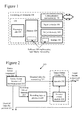
- Figure 1 illustrates a generalized example of a suitable computing environment (100) in which described embodiments may be implemented.
- the computing environment (100) is not intended to suggest any limitation as to scope of use or functionality, as the techniques and tools may be implemented in diverse general-purpose or special-purpose computing environments.
- the computing environment (100) includes at least one processing unit (110) and memory (120).
- the processing unit (110) executes computer-executable instructions and may be a real or a virtual processor. In a multi-processing system, multiple processing units execute computer-executable instructions to increase processing power.
- the memory (120) may be volatile memory (e.g., registers, cache, RAM), non-volatile memory (e.g., ROM, EEPROM, flash memory, etc.), or some combination of the two.
- the memory (120) stores software (180) implementing high-fidelity transcoding.
- a computing environment may have additional features.
- the computing environment (100) includes storage (140), one or more input devices (150), one or more output devices (160), and one or more communication connections (170).
- An interconnection mechanism such as a bus, controller, or network interconnects the components of the computing environment (100).
- operating system software provides an operating environment for other software executing in the computing environment (100), and coordinates activities of the components of the computing environment (100).
- the storage (140) may be removable or non-removable, and includes magnetic disks, magnetic tapes or cassettes, CD-ROMs, CD-RWs, DVDs, or any other medium which can be used to store information and which can be accessed within the computing environment (100).
- the storage (140) stores instructions for the software (180).
- the input device(s) (150) may be a touch input device such as a keyboard, mouse, pen, or trackball, a voice input device, a scanning device, or another device that provides input to the computing environment (100).
- the input device(s) (150) may be a sound card, video card, TV tuner card, or similar device that accepts audio or video input in analog or digital form, or a CD-ROM or CD-RW that reads audio or video samples into the computing environment (100).
- the output device(s) (160) may be a display, printer, speaker, CD-writer, or another device that provides output from the computing environment (100).
- the communication connection(s) (170) enable communication over a communication medium to another computing entity.
- the communication medium conveys information such as computer-executable instructions, audio or video input or output, or other data in a modulated data signal.
- a modulated data signal is a signal that has one or more of its characteristics set or changed in such a manner as to encode information in the signal.
- communication media include wired or wireless techniques implemented with an electrical, optical, RF, infrared, acoustic, or other carrier.
- Computer-readable media are any available media that can be accessed within a computing environment.
- Computer-readable media include memory (120), storage (140), communication media, and combinations of any of the above.
- program modules include routines, programs, libraries, objects, classes, components, data structures, etc. that perform particular tasks or implement particular abstract data types.
- the functionality of the program modules may be combined or split between program modules as desired in various embodiments.
- Computer-executable instructions for program modules may be executed within a local or distributed computing environment.
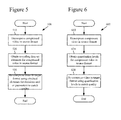
- FIG. 2 shows a generalized video transcoder (200) in which described embodiments may be implemented.
- the transcoder (200) of Figure 2 may be implemented as a DirectX Media Object ["DMO"] (300), as shown in Figure 3.
- the DMO in turn may be incorporated into the system filter graph (400) of Figure 4.
- This architecture simplifies integration of the transcoder, provides the flexibility to use any of various source format decoders, and simplifies the addition of extra functionality.
- the transcoder (200) has various modules, including the source format decoder and bitstream parser (210), the re-coding data set processor (220), and the target format encoder (230).
- the relationships shown between modules within the transcoder (200) indicate general flows of information in the transcoder (200); other relationships are not shown for the sake of simplicity.
- the transcoder (200) receives video (205) compressed in a source format, decodes it, re-encodes it, and produces video (235) compressed in a target format.
- the source format is MPEG-2 and the target format is WMV9, but other format pairs are also possible.
- MPEG-2 see the MPEG-2 standard (also released as the H.262 standard), the disclosure of which is hereby incorporated by reference.
- WMV9 see U. S. Provisional Patent Application Serial No. 60/488,710, filed July 18, 2003, the disclosure of which is hereby incorporated by reference.
- the transcoder (200) processes video pictures, which may be video frames, video fields, or combinations of frames and fields.
- Decompression and compression in the transcoder (200) are block-based and use color format such as a 4:2:0, in which case each macroblock ["MB"] includes 4 8x8 luminance blocks (at times treated as one 16x16 MB) and two 8x8 chrominance blocks.
- the compression and decompression are object-based, use a different MB or block format, or otherwise perform operations on sets of pixels of different sizes or configuration.
- the source format decoder and bitstream parser (210) receives the compressed video (205) in the source format.
- the decoder (210) decodes the video (205), producing decoded video (215) for transcoding.
- the same or different decoded video may be used as video (213) for preview by the end user.
- the components of the decoder (210) vary by compression format and implementation, but typically include an entropy decoder, inverse quantizer, inverse frequency transformer, and motion compensator.
- the decoder (210) fully decompresses the video (205) to produce the video (215) for transcoding.
- the bitstream parser (210) which may be integrated with the decoder (210) or separate, extracts a set of data elements (217) to be used in re-coding the video.
- these elements include picture type, MB intra/inter coding mode, and frame/field decision information.
- the set of data elements (217) includes other and/or additional elements.
- the re-coding data set processor (220) processes and packages the extracted elements for use in controlling re-compression.
- the target format encoder (230) re-encodes the video (215) according to the target format.
- the target format encoder (230) itself includes an encoder module (232) that performs the actual compression and an encoder control module (234) for controlling quality and/or rate of the compression.
- the encoder control module (234) translates elements from the source format video into control signals for the encoder module (232) and equivalent parameters for the target format compressed video.
- the encoder module (232) produces compressed video (235) in the target format, which may be routed to a target format decoder module for previewing purposes or another module for other feedback purposes.
- the components of the encoder module (232) vary by compression format and implementation, but typically include an image preprocessor (for sample rate conversions, filtering, etc.), a motion estimator/compensator, frequency transformer, quantizer, and entropy encoder, as well as necessary decoding components.
- Video transcoders may use a variation or supplemented version of the generalized transcoder (200).
- modules of the transcoder can be added, omitted, split into multiple modules, combined with other modules, and/or replaced with like modules.
- transcoders with different modules and/or other configurations of modules perform one or more of the described techniques.
- FIG 3 shows the internal architecture of the DMO (300).
- the video modules of the DMO (300) have two input pins and one output pin.
- the input pins are for uncompressed video (302) and source format (e.g., MPEG-2) compressed video (304), and the output pin is for target format (e.g., WMV9) compressed video (342).
- source format e.g., MPEG-2
- target format e.g., WMV9 compressed video
- the target format video encoder (310) receives uncompressed video (302) and sends a notification (312) to the source format parameter parser (320) when a picture is ready for compression. In return, the encoder (310) receives information used in making coding decisions.
- the notification/return protocol may be implemented as callback functions between components or with some other mechanism. Information is extracted a few pictures at a time as the coding progresses, synchronously with the video encoding. Alternatively, the transcoder uses different timing.
- the parser (320) receives corresponding source format compressed video (304) and extracts syntax elements from it to obtain information about a video picture in the source video.
- the parser (320) extracts any or all of the embedded syntax elements and derived elements from the compressed video (304). For example, the parser (320) extracts a subset of the SMPTE MPEG-2 re-coding data set. Alternatively, the parser (320) extracts other and/or additional elements. From the syntax elements, the parser (320) makes coding decisions and parameterizes the syntax elements and coding decisions for delivery as return parameters (322) to the encoder (310). Using the return parameters (322), the encoder (310) produces target format compressed video.
- a target format e.g., WMA9 audio encoder (330) receives uncompressed audio (328) and produces target format compressed audio.
- a queue and buffer management module (340) receives the compressed video and compressed audio from the encoders (310, 330) and produces the target format compressed video (342) and target format compressed audio (344) as synchronized output.
- the queue and buffer management module (340) may include one or more buffers for rate control purposes, and may provide feedback to the encoders (310, 330) to regulate quality and/or rate.
- Figure 4 shows a filter graph implementation (400) that incorporates the DMO (300) for the transcoder as a filter.
- the system accomplishes transcoding of audio and video, multiplexing of the compressed audio and video, and creation of a valid output format (e.g., ASF) file as the final output.
- a valid output format e.g., ASF
- Transcoding starts with a multiplexed source format (e.g., MPEG-2) file as input.
- the source format source filter (410) represents the source format video stream as played out from a network stream, file, etc.
- the source format stream splitter (420) splits the source format stream into compressed audio and compressed video substreams, and passes these to the TEE (430) over a single pin.
- the TEE (430) passes the information it receives on its input pin to each of its output pins. (The filter that receives the information will use some and ignore the rest.)
- the source format video decoder (440) decodes the compressed video sub-stream and produces uncompressed video.
- the source format (e.g., AES) audio decoder (450) decodes the compressed audio sub-stream and produces uncompressed audio.
- the transcoder filter (300) receives the uncompressed video and uncompressed audio as well as the raw output from the TEE (430), which includes the source format compressed video sub-stream.
- the components of the transcoder filter (300) operate as described above, producing target format (e.g., WMV9) compressed video and target format (e.g., WMA9) compressed audio.
- the writer/multiplexer (490) combines this compressed information along with header information into an output format file, which is stored and/or transmitted.
- filter graph (400) may represent a software-only implementation of the transcoder, other implementations use combinations of hardware, firmware, and software for transcoding, with the expected benefit of faster transcoding.
- a video transcoder preserves picture types, MB coding types, frame/field coding decision information, and/or other information during transcoding from a source format to a target format.
- the transcoder uses the information for coding decisions and/or setting equivalent parameters in the target format compression. This helps the transcoder match the quality of the source format compressed video.
- the transcoder gives the target format encoder the freedom to make various other coding decisions for the video, so as to exploit compression efficiencies and reduce overall bitrate.
- Figure 5 shows a technique (500) for obtaining and using re-coding data set elements for source format compressed video during transcoding.
- a source format decoder decompresses (510) the source format compressed video, producing uncompressed video. For example, the decompression is full decompression.
- the transcoder obtains (520) re-coding data set elements for the source format compressed video.
- the transcoder parses the source format compressed video before, during, or after decoding (e.g., from a buffered copy).
- the re-coding data set elements are separately signaled or otherwise provided.
- the elements are source format syntax elements or elements derived from source format syntax elements, for example, picture type values, intra/inter MB coding type values, and field/frame information.
- the transcoder obtains other and/or additional elements.
- the encoder computes new motion vectors for motion compensation with loop filtering, intensity compensation, more motion vectors, and/or increased motion vector precision, so as to improve motion compensated prediction and thereby reduce bitrate for prediction residuals.
- Motion vector information from the source format compressed video may be used in some motion estimation decisions (e.g., to speed up estimation by providing start points) and ignored in other motion estimation decisions (e.g., to find the exact motion vectors in view of loop filtering, intensity compensation, etc.).
- the transcoder may complete the decompression (510) before beginning the re-compression (530). More commonly, the transcoder performs the stages of the technique (500) concurrently for a picture, group of pictures, or other duration of video.
- a video transcoder maps quantization levels for compressed video in a source format to the compressed video in a target format when transcoding. This mapping establishes the equivalence of the quantizer step size in the source and destination compressed video formats, and helps the transcoder preserve quality and reduce transcoding losses.
- the transcoder obtains (620) quantization levels for the source format compressed video.
- the transcoder parses the source format compressed video before, during, or after decoding. Alternatively, the levels are separately signaled or otherwise provided.
- the quantization levels are, for example, per-MB quantization step size values for uniform quantization. Alternatively, the transcoder obtains other and/or additional kinds of quantization levels.
- a target format encoder re-compresses (630) the uncompressed video, producing target format compressed video.
- the encoder uses the obtained quantization levels when making quantization decisions. For example, the encoder sets a quantization value for a picture based upon the average of the per-MB quantization step size values for MBs of the corresponding picture in the source format compressed video. Or, the encoder sets a quantization value for a MB based upon a per-MB quantization step size value for a corresponding MB in the source format compressed video. This helps the encoder match the quality of the source format compressed video when compressing in the target format. The encoder can make various other decisions so as to reduce bitrate without penalizing quality, as described in the previous section.
- the transcoder may complete the decompression (610) before beginning the re-compression (630). More commonly, the transcoder performs the stages of the technique (600) concurrently for a picture, group of pictures, or other duration of video.
- a video transcoder uses rate control when transcoding.
- the rate control allows the transcoder to control bitrate to satisfy constant bitrate constraints for Internet streaming or other applications, while staying close to the quality of the source format compressed video.
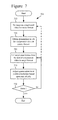
- Figure 7 shows a technique (700) for rate control in transcoding.
- a source format decoder decompresses (710) source format compressed video, producing uncompressed video. For example, the decompression is full decompression.
- the transcoder obtains (720) quantization levels for the source format compressed video, as described in the previous section.
- the transcoder sets (730) a target quantization level for a unit of compressed video in the target format. For example, the encoder assigns a quantization level for a picture or MB, as described in the previous section.
- the transcoder adjusts (740) the target quantization level (within thresholds) based upon one or more rate criteria.
- the thresholds prevent the transcoder from deviating too far up or down from the corresponding quantization level(s) of the source format compressed video, which helps keep the quality of the compressed video close between the target and source formats.
- the rate criteria are based upon buffer fullness levels, deviation between the number of bits allocated for the unit and the number of bits actually used encoding the unit, and/or other factors.
- the number of bits allocated for the unit may be based on desired bitrate, picture type and/or picture coding complexity, or it may be based on bits used by the same unit in the source compressed format (scaled appropriately).
- the encoder can adjust quantization to account to local variations in complexity. Overall, the transcoder coarsens quantization to reduce bitrate towards a goal or makes quantization finer to increase bitrate towards a goal. The transcoder may also attempt to control fluctuations in quality levels while achieving the goal bitrate.
- the transcoder determines (750) whether transcoding is done and, if not, continues by setting (730) the target quantization level for the next unit.
- the transcoder may complete the decompression (710) before beginning the setting (730) and adjusting (740) for rate control. More commonly, the transcoder performs the stages of the technique (700) concurrently for a picture, group of pictures, or other duration of video.
- a transcoder translates MPEG-2 video to WMV9 video.
- the transcoder considers MPEG-2 syntax and semantic elements and uses a set of rules that allows syntax elements and coding decisions to be maintained between MPEG-2 compression and WMV9 compression. Specifically, the transcoder uses a subset of the MPEG-2 re-coding data set (as described in SMPTE 327M-2000), which is derived from the MPEG-2 video in the decoding sub-system. The transcoder uses the MPEG-2 re-coding data as a starting point in the encoding sub-system, making coding decisions for WMV9 encoding from it and carrying forward certain items to the WMV9 bitstream. Thus, the transcoder preserves or modifies various MPEG-2 coding parameters according to specific needs of the WMV9 encoder and transcoding scenario.
- the transcoder addresses the following problem. Given a set of video pictures that have been encoded by MPEG-2, how should the transcoder allocate bits and quality (quantization) when re-encoding the same pictures with WMV9? In the transcoding, the transcoder strives to avoid (or at least significantly reduce) transcoding losses while substantially preserving quality. The transcoder does not expend too many bits to preserve quality that is below perceptibility/visibility thresholds. At the same time, the transcoder exploits the additional compression efficiencies of WMV9 to produce output at bitrates lower than the bitrates of the MPEG-2 compressed input.
- the transcoder operates in a single pass, decompressing the MPEG-2 compressed video, collecting re-coding data set elements, and re-compressing the video concurrently in one pass through the video sequence.
- the single-pass transcoding can be used in various streaming scenarios, with MPEG-2 input and WMV9 output in real time or close to real time.
- the transcoder could decompress the entire sequence and store sequence-wide statistics, then start the transcoding.
- Such multi-pass transcoding may improve quality but requires substantially more computational time, making it hard to implement in a product.
- a content pull model is becoming more common, in which content is delivered after consumers decide what content to watch and when to watch it. Two technologies have facilitated this change. The first is video on demand ["VOD”], and the second is the personal video recorder ["PVR"].
- VOD and PVR benefit from MPEG-2 to WMV9 transcoding due to savings in bandwidth and storage.
- VOD and PVR are implemented on a large scale, and the cumulative effect of bandwidth savings can result in large costs savings.
- VOD operators have stretched MPEG-2 compression to the limit for acceptable quality video, so transcoding to another format should avoid any further quality degradation.
- the transcoder converts MPEG-2 VOD content to WMV9 format, it reduces bitrate while preserving the quality of the video.
- Video servers routinely ingest and play out video that is stored internally in MPEG-2 format. Assets that are edited are either re-ingested in MPEG-2 or transcoded to MPEG-2 in order to fit into the production chain.
- the compression efficiencies of WMV9 reduce network bandwidth and storage requirements within a broadcast facility.
- the transcoder converts studio-ingested content to WMV9 format at bitrate below the original, while preserving quality.
- This re-formatted content may be stored with a smaller footprint and transmitted to a playout server with reduced network bandwidth.
- a broadcast facility may use the WMV9 content for playout to air, air-backup, or disaster recovery from a remote site. In the last case, the cost savings from reduced bitrate are even greater as the video is likely transported over a wide area network.
- Proxy creation for content review is currently a popular use of WMV9. While MPEG-2 works for contribution and distribution of video within a broadcast facility, it is not inherently a streaming format and scales poorly when applied to lower resolutions and bitrates. A lower rate proxy is needed to review archived content and ingested content that is to play to air.
- the transcoder creates lower bitrate and lower resolution WMV9 files that are still at the original frame rate. Time codes from the original video are preserved in the proxy low bitrate video.
- the transcoder may be used in conjunction with a content player that allows the user to preview the proxy, make cuts and other edits, and create decision lists for edits.
- Broadcasters routinely use backhaul delivery to send content to their affiliates for local airing.
- Content syndicators use backhaul delivery via leased fiber or satellite channels to transmit video to their clients.
- MPEG-2 is a common intermediary delivery format for these and other intra-facility transfers, with appropriate conditional access decoders. In backhaul applications, even small bitrate gains can result in large cost savings.
- the intermediate format is transparent, which provides a strong impetus for the adoption of WMV9 as a more efficient delivery format.
- Both MPEG-2 and WMV9 use three basic picture coding types: intra ["I”], unidirectional predicted ["P”], and bi-directionally predicted ["B”].
- WMV9 usually has better compression efficiency, reducing bitrate for the same quality. Accordingly, the goal of transcoding is not to preserve bit allocation per se between the input video stream and the transcoded video stream.
- the differences in encoding tools between MPEG-2 and WMV9 obviate the need for such rigorous tracking.
- per-picture and relative bit allocations from the MPEG-2 compressed video may be helpful as a general guide for the WMV9 encoder, as substantially over-allocating bits will not improve picture quality. In fact, use of picture type information to guide coding decisions can significantly improve transcoding efficiency.
- Each MPEG-2 picture type has bitrate and quality implications, as there are significant differences in fidelity of the coded picture to the original picture as a function of picture type.
- An I picture represents a full refresh, which ends propagation of errors in motion compensation, reconstruction, etc. Propagation of transcoding errors is also terminated with a new I picture.
- I pictures usually consume more bits than other pictures. Thus, inserting an I picture adversely affects bitrate, but tends to improve perceptual quality by lowering propagation errors.
- the transcoder matches I picture types between the source format compressed video and target format compressed video in several situations. To improve resiliency against propagation of transcoding errors, transmission errors, or other errors, the transcoder uses I pictures in the target format compressed video. Or, when GOP pattern matching is used (see below), the transcoder matches I picture types.
- the WMV9 encoder may adjust the exact location of an I picture by a few pictures forward or backward to exploit coding efficiencies specific to the sequence.
- a P picture uses forward prediction (from a previous reference picture), while a B picture may use forward and/or backward prediction.
- a P picture consumes more bits than a B picture.
- a P picture may be used as a reference picture for motion compensation.
- a B picture is not referenced by any other picture, so errors within a B picture are localized.
- the transcoder When bitrate for the target format compressed video is allowed to match the bitrate for the source format compressed video, the transcoder preserves picture coding types for the highest quality transcoding. For transcoding with bitrate reduction, however, such picture type matching may prevent necessary bitrate reduction.
- the transcoder therefore selectively substitutes P pictures for I pictures in the WMV9 compressed video or reduces the frequency of I pictures. Further bitrate reduction is attained by replacing P pictures with B pictures.
- the transcoder maps B pictures to B pictures in all transcoding scenarios.
- a group of pictures ["GOP"] is an arrangement of pictures according to a picture type pattern.
- a MPEG-2 GOP may consist of an I picture followed by a number ofP pictures as anchors, with B pictures between the anchors, for example, I, B, B, P, B, B, P, B, B, P, B, B, B, B.
- MPEG-2 video streams often use GOP size of 12 frames for film content and 15 frames for television content.
- Different GOP patterns provide varying levels of support for random access, fast forward, fast reverse, or other access functionality.
- WMV9 video usually has less frequent I pictures, with the default setting inserting an I picture every 10 seconds.
- the transcoder may match GOP patterns (in particular, I picture positions) between the input video and transcoded video in various situations.
- GOP patterns in particular, I picture positions
- the transcoder matches GOP patterns.
- matching GOP patterns tends to cause matching bitrate, which tends to cause matching quality.
- MPEG-2 allows encoding an entire sequence as frames or as fields. Use of the latter is fairly rare, as field coding modes permitted for frames make up for loss of efficiency when compressing fast moving content. Overall, frame coding outperforms field coding more frequently.
- the transcoder When transcoding field coded pictures, the transcoder lets the internal decision mechanism of the WMV9 encoder determine the field/frame coding type of each MB The transcoder does not automatically enforce field coding. Alternatively, the transcoder matches field/frame coding type decisions at the MB layer or other layer for all picture types. For example, the transcoder forces the WMV9 encoder to use interlaced field pictures when the MPEG-2 compressed video uses field pictures. Matching frame/field picture types in this way is expected to improve transcoding efficiency like other examples of type matching in transcoding.
- MBs in P pictures and B pictures may be intra coded (without using prediction from reference(s)) or inter coded (using prediction from reference(s)).
- intra coding is used when motion compensation fails or gives poor results (e.g., large prediction residuals).
- Motion compensation may fail when a MB includes newly exposed content (such as a new object or newly revealed background) for which there is no good match in the reference picture.
- the transcoder preserves intra/inter coding type decisions and selectively re-applies the decisions at the MB layer for non-I pictures in the WMV9 video.
- One motivation for matching intra coding types at the MB level is that it ensures high quality (at the cost of higher bitrate) for the MB under consideration.
- Both MPEG-2 and WMV9 use uniform quantization of transform coefficients. Coefficients are represented similarly in terms of bit precision, the number of allowed quantizer step sizes, and the range of allowed quantizer step sizes. This facilitates the use of quantization as the driving mechanism for matching quality between MPEG-2 video and WMV9 video.
- the transcoder guides WMV9 encoding such that neither too few nor too many bits are used. Using a suitable number of bits to compress each picture helps preserve quality and reduce transcoding losses.
- an MPEG-2 parser extracts the quantizer scale for each MB of a given picture in the MPEG-2 video.
- the transcoder For picture level quantization of a picture in the WMV9 video, the transcoder averages the MPEG-2 quantization scales of the non-skipped MBs in the picture of the MPEG-2 video.
- the transcoder uses the average value for the picture level quantizer scale for the WMV9 picture (using the picture level quantizer scale for the MBs within the picture).
- the transcoder may adjust the picture level quantizer scale to satisfy the current rate constraints. In any case, the transcoder maintains quantization levels to be within a tolerance of corresponding quantization levels in the MPEG-2 video.
- Picture level quantizer level control does not provide fine grain quality/rate control.
- the transcoder matches quantization at the MB level.
- WMV9 allows setting of the quantizer scale at the MB level (sometimes called the DQUANT feature).
- the WMV9 encoder may adjust quantization levels for individual MBs.
- the transcoder causes the WMV9 encoder to use quantization according to the quantizer values for the respective corresponding MBs of the MPEG-2 video. If the transcoder uses rate control, the transcoder may adjust the per MB quantizer levels to satisfy the current rate constraints. Again, in any case, the transcoder maintains quantization levels to be within a tolerance of corresponding quantization levels in the MPEG-2 video..
- WMV9 MB skipping decisions are not adjusted.
- a MB is not forced to be coded in the WMV9 video just because the corresponding MB was coded in the MPEG-2 video.
- the transcoder produces output WMV9 video at a variable bitrate that is below the bitrate of the MPEG-2 input. In other scenarios, the transcoder produces WMV9 output at a fixed or relatively fixed bitrate that is at or below the bitrate of the MPEG-2 input. To achieve this, the transcoder uses rate control on top of the default variable bitrate mode of the WMV9 encoder to help maintain a fixed output bitrate despite varying picture type and scene complexity.
- the transcoder may use a three-step process for rate control: (1) target bit allocation, (2) coarse control over quantization based upon virtual buffer criteria, and (3) fine adaptive quantization to adjust quantization values to local variations.
- the target bit allocation can vary by picture type and picture complexity. For example, I pictures are allocated more bits than P pictures of the same quality, which are allocated more bits than B pictures of the same quality.
- the extracted picture type values may be used to allocate bits to different pictures.
- Complex pictures are allocated more bits than simple pictures of the same quality, where complexity is estimated from analysis of content or encoding results.
- the transcoder uses feedback from the WMV9 encoder to adjust quantization levels as a function of excess or deficit bits. Specifically, the transcoder scales quantization step size in proportion to the fullness of a rate buffer. This forces the output to conform to the desired rate, while avoiding buffer overflows and underflows. When the output bitrate target is reasonable, the transcoder can still achieve seamless transcoding.
- the transcoder may also apply psychovisual criteria. As long as constant bitrate constraints for a picture, group of pictures, or other duration of content are satisfied, the transcoder gives the WMV9 encoder the flexibility to allocate bits efficiently within the duration to satisfy quality constraints.
- Figure 8 shows a first proportional rate control mechanism (800), which uses weighting according to deviation from target bit allocation.
- Final bit allocations are expressed in terms of weighted quantizer step size(s) (862) for pictures or MBs to be encoded.
- the deviation between allocated bits and actual bits used to encode pictures is used to scale the target quantizer step sizes (844), where the target quantizer step sizes (844) are derived from the source format compressed video.
- bit allocation 802.
- a simple approach is to allocate bits to each unit based upon the bitrate (bits/sec) divided by frame rate (frames/second).
- Bit allocation for each unit may also be based on the corresponding number of bits used in the source format, scaled by the ratio of target to source bitrates.
- the mechanism starts as above but modifies allocation based on the picture type in the target format, while still conforming to the constant bitrate criteria.
- the bits actually used (882) to encode a picture are subtracted from the bits allocated (802) for the picture. This yields a deviation between the bits allocated and the bits used.
- deviations from several past pictures are used to affect the quantizer scaling.
- the deviations are delayed in delay buffers (820, 830) and weighted by threshold scale factors (822, 832).
- the threshold scale factors are . 5 to give equal weight to the deviations for each of the previous two pictures. Or, more weight is given to the more recent of the two previous pictures (e.g., 7 vs. .3).
- the weighted deviations are combined and routed to the threshold evaluator (840).
- the threshold evaluator (840) receives an adjusted deviation and computes a quantization scale factor (842) to apply to the target quantization step size(s) (844). Though Figure 8 shows the quantization scale factor (842) as a multiplier, the factor (842) may also be expressed in terms of an amount to be added to or subtracted from the target quantization step size(s) (844). The threshold evaluator (840) may limit the magnitude of the scaling to prevent large changes in picture quality from one picture to another.
- Figure 9 shows pseudocode (900) for part of a second proportional rate control mechanism, which uses weighting according to buffer fullness levels.
- the target bit allocation g_nAvgBPF is assumed to be constant, equal to the target bitrate divided by frames per second.
- the term pIncomingParameter represents the total bits consumed by encoding the last picture. These terms adjust g_nCurrentBufferLevel, which is a buffer level of a virtual buffer that is depleted at a constant rate and filled at a varying rate.
- the buffer level is limited to the range of 0 to g_nMaxBufSize, which depends on the application. In one case, g_nMaxBufSize is initialized to five seconds of video at the target bitrate.
- a buffer fullness nBufferFraction is computed by dividing g_nCurrentBufferLevel by g_nMaxBufSize. The buffer fullness determines the amount of scaling in terms of ADJUST_SCALE, which is an experimentally derived value. For example, if ADJUST_SCALE is 20, the quantization scaling factor q_nQPAdjust varies in the range of -10 and 10. If the buffer is half full, nBufferFraction is .5 and q_nQPAdjust is 0.
- transcoding rules To accrue gains in transcoding, transcoding rules consider various details of the systems context in which the transcoder is used. Some of these details affect picture quality. Others affect the speed and efficiency of implementation.
- the transcoder may simply select and use one color sampling mode to avoid the complexity of dealing with different color sampling processes on a continuing basis. Or, the transcoder may switch color sampling modes on a frame-by-frame or other basis.
- the transcoder avoids color space conversions such as those between luminance/chrominance color space and red/green/blue color space.
- MPEG-2 and WMV9 video both operate in luminance/chrominance space, so color conversion is unnecessary.
- Televisions display NTSC video at approximately 60 fields per second. In contrast, film content is displayed at 24 video frames per second. Telecine conversion processes convert video from television rate to film rate, and inverse telecine processes convert from film to television. Film is often converted to television rate using a 3:2 pulldown pattern, according to which three fields are pulled from the first film frame (e.g., by repeating a field), two fields are pulled from the next film frame, and so on.
- the transcoder handles 24 frames per second film content as follows.
- the transcoder derives the 3:2 pulldown pattern from the MPEG-2 video as the two flags "top field first" and "repeat first field.” One or both of these flags are preserved for each coded frame of video (in the elementary stream or at the ASF level). As a result, breaks in the pattern due to editing or other reasons are preserved.
- the transcoder re-compresses the frames with the various transcoding rules.
- the content is played out at approximately 60 fields per second using the preserved inverse telecine information. This solution works for pure film content.
- the transcoder treats the film content as television content to simplify processing.
- Loop filtering improves picture quality by smoothing the effects of quantization related blocking artifacts. This makes reference pictures work better for subsequent motion estimation and compensation.
- Use of loop filtering in WMV9 mitigates compression artifacts from the previous compression cycle, and without loop filtering such artifacts can reduce the effectiveness of subsequent compression.
- the transcoder allows loop filtering in the WMV9 encoder.
- MPEG-2 provides an explicit quantization matrix in the sequence header of the bitstream, to be used for certain picture types.
- the default quantization matrix in MPEG-2 is non-flat for I pictures and flat for other types of pictures.
- WMV9 uses a flat quantization matrix across all picture types, but offers two variations for the width of the dead zone around 0 for the flat quantization. (Non-flat quantization may still be implemented as an encoder-only process in WMV9.)
- the WMV9 encoder does not exceed the quantization scale of the corresponding MPEG-2 encoded MB, adjusting for the quantization matrix as appropriate).
- the quantizer scale used by the WMV9 encoder may reasonably exceed that of the corresponding MPEG-2 MB, since WMV9 supports more complex prediction modes and more precise motion vectors.
- the transcoder may select between the different dead-zone widths based on desired quality settings to fine tune the quantization.
- MPEG-2 generally provides for one motion vector per MB.
- one motion vector is generated for each field of the MB WMV9 allows up to four motion vectors per MB, which allows finer grain motion compensation to adapt to localized changes, at the cost of additional bits to signal the motion vectors.
- the transcoder allows four motion vectors per MB in the WMV9 encoder.
- MPEG-2 uses standard DCT.
- WMV9 allows DCT in some modes, but other modes use a fast, integer-based transform that speeds up processing compared to using MPEG-2 style DCT.
- the overall performance of the fast, integer-based transform is similar to standard DCT - the fast, integer-based transform does not per se improve quality compared to the DCT.
- Intensity compensation allows re-mapping of pixels in reference pictures to scale and/or shift pixel values. This can help conserve bits in fade-in and fade-out sequences.
- MPEG-2 does not use intensity compensation
- the transcoder allows intensity compensation in the WMV9 encoder
- the WMV9 encoder may use variable-size transforms, which is a significant departure from MPEG-2.
- Block size of the transform is a parameter that trades off local adaptivity versus coding overhead. When adaptation to local changes is desirable, a smaller transform size is preferable. Appropriate selection of transform size can reduce ringing and other artifacts due to coarse quantization of high frequency transform coefficients for blocks that would otherwise include content boundaries.
- Motion vector information signaled in the MPEG-2 bitstream may be used as a starting point for motion estimation in the WMV9 encoder during transcoding, potentially speeding up the motion estimation process in the WMV9 encoder.
- the WMV9 encoder may also reduce the size of the motion estimation search area.
- a transcoder achieves high-fidelity conversion from MPEG-2 to WMV9.
- High-fidelity conversion is extremely important to producers and broadcasters of high-quality video, who will not tolerate lower fidelity representation of previously encoded content.
- a PSNR of 45 dB is considered high for transcoding, and the MPEG-2 to WMV9 transcoder frequently exceeds that mark.
- a first set of tests compared picture sizes for MPEG-2 video versus WMV9 video transcoded using a naive transcoder. For many pictures of the WMV9 video, the number of bits used was either much higher or much lower than the number of bits used for the corresponding MPEG-2 picture.
- a second set of tests compared picture sizes for MPEG-2 video versus WMV9 video transcoded using the improved transcoder. With it, the number of bits used per WMV9 picture was consistently below the number of bits used per MPEG-2 picture, and the peaks and valleys of the overall usage patterns roughly match between the two video sequences.
- the improved transcoding was consistently better by 5 dB on average for luminance (1 dB on average for chrominance). This difference corresponds to a bitrate gain of between 10% and 20%, meaning one must use 10% to 20% more bits in naive transcoding to attain quality comparable to the improved transcoding. Viewer testing confirmed these results, with viewers consistently identifying the improved transcoding results as being superior in quality to the naive transcoding results for the same bitrate.
Landscapes
- Engineering & Computer Science (AREA)
- Multimedia (AREA)
- Signal Processing (AREA)
- Mechanical Engineering (AREA)
- Physics & Mathematics (AREA)
- Discrete Mathematics (AREA)
- General Physics & Mathematics (AREA)
- Compression Or Coding Systems Of Tv Signals (AREA)
- Compression, Expansion, Code Conversion, And Decoders (AREA)
Applications Claiming Priority (2)
| Application Number | Priority Date | Filing Date | Title |
|---|---|---|---|
| US10/826,974 US20050232497A1 (en) | 2004-04-15 | 2004-04-15 | High-fidelity transcoding |
| US826974 | 2004-04-15 |
Publications (1)
| Publication Number | Publication Date |
|---|---|
| EP1587327A2 true EP1587327A2 (fr) | 2005-10-19 |
Family
ID=34939172
Family Applications (1)
| Application Number | Title | Priority Date | Filing Date |
|---|---|---|---|
| EP05102726A Withdrawn EP1587327A2 (fr) | 2004-04-15 | 2005-04-07 | Transcodage vidéo |
Country Status (10)
| Country | Link |
|---|---|
| US (1) | US20050232497A1 (fr) |
| EP (1) | EP1587327A2 (fr) |
| JP (1) | JP2005323353A (fr) |
| KR (1) | KR20060045719A (fr) |
| CN (1) | CN1684518A (fr) |
| AU (1) | AU2005201439A1 (fr) |
| BR (1) | BRPI0501305A (fr) |
| CA (1) | CA2504185A1 (fr) |
| MX (1) | MXPA05004071A (fr) |
| RU (1) | RU2005110996A (fr) |
Cited By (6)
| Publication number | Priority date | Publication date | Assignee | Title |
|---|---|---|---|---|
| FR2908259A1 (fr) * | 2007-02-16 | 2008-05-09 | Thomson Licensing Sas | Procede de reduction de debit d'un premier flux de donnees video codees en un deuxieme flux |
| WO2010036995A1 (fr) * | 2008-09-29 | 2010-04-01 | Dolby Laboratories Licensing Corporation | Obtention de nouveaux vecteurs de mouvement à partir de vecteurs de mouvement existants |
| EP2693754A1 (fr) * | 2012-08-02 | 2014-02-05 | Intel Corporation | Codage de données vidéo |
| US8761244B2 (en) | 2009-11-04 | 2014-06-24 | Tencent Technology (Shenzhen) Company Limited | Method and system for media file compression |
| EP2800388A4 (fr) * | 2012-01-19 | 2014-11-19 | Huawei Tech Co Ltd | Procédé et appareil de conversion de vidéos |
| CN111199743A (zh) * | 2020-02-28 | 2020-05-26 | Oppo广东移动通信有限公司 | 音频编码格式确定方法、装置、存储介质及电子设备 |
Families Citing this family (82)
| Publication number | Priority date | Publication date | Assignee | Title |
|---|---|---|---|---|
| JP3753726B1 (ja) * | 2004-10-13 | 2006-03-08 | シャープ株式会社 | 動画像再符号化装置、動画像編集装置、プログラム、及び記録媒体 |
| WO2006061838A2 (fr) * | 2004-12-08 | 2006-06-15 | Imagine Communications Ltd. | Multiplexage statistique distribue de multimedia |
| JP2006203682A (ja) * | 2005-01-21 | 2006-08-03 | Nec Corp | 動画像圧縮符号化ビットストリームシンタックス変換装置及び動画像通信システム |
| WO2007010779A1 (fr) * | 2005-07-15 | 2007-01-25 | Matsushita Electric Industrial Co., Ltd. | Émetteur de paquets |
| US20070033144A1 (en) * | 2005-08-03 | 2007-02-08 | Microsoft Corporation | Binding components |
| US8208540B2 (en) * | 2005-08-05 | 2012-06-26 | Lsi Corporation | Video bitstream transcoding method and apparatus |
| US7912127B2 (en) * | 2005-08-05 | 2011-03-22 | Lsi Corporation | H.264 to VC-1 and VC-1 to H.264 transcoding |
| US8045618B2 (en) * | 2005-08-05 | 2011-10-25 | Lsi Corporation | Method and apparatus for MPEG-2 to VC-1 video transcoding |
| US8155194B2 (en) * | 2005-08-05 | 2012-04-10 | Lsi Corporation | Method and apparatus for MPEG-2 to H.264 video transcoding |
| US7881384B2 (en) * | 2005-08-05 | 2011-02-01 | Lsi Corporation | Method and apparatus for H.264 to MPEG-2 video transcoding |
| US7903739B2 (en) * | 2005-08-05 | 2011-03-08 | Lsi Corporation | Method and apparatus for VC-1 to MPEG-2 video transcoding |
| US8447121B2 (en) | 2005-09-14 | 2013-05-21 | Microsoft Corporation | Efficient integrated digital video transcoding |
| KR20070108433A (ko) * | 2006-01-09 | 2007-11-12 | 한국전자통신연구원 | 청크 디스크립터를 이용한 svc 파일포맷에서의 비디오데이터 공유방법 |
| US7830800B1 (en) | 2006-01-12 | 2010-11-09 | Zenverge, Inc. | Architecture for combining media processing with networking |
| US8102916B1 (en) * | 2006-01-12 | 2012-01-24 | Zenverge, Inc. | Dynamically changing media compression format in compressed domain |
| WO2007111006A1 (fr) * | 2006-03-27 | 2007-10-04 | Nec Corporation | Systeme, procede et programme de stockage d'image mobile |
| US8862759B2 (en) * | 2006-04-05 | 2014-10-14 | Agiledelta, Inc. | Multiplexing binary encoding to facilitate compression |
| US7659897B1 (en) * | 2006-06-30 | 2010-02-09 | Nvidia Corporation | System, method, and computer program product for video benchmarking |
| CN101119483B (zh) * | 2006-07-31 | 2011-11-02 | 联想(北京)有限公司 | 一种基于源质量的视频流传输速率调整方法 |
| JP5112787B2 (ja) * | 2006-09-01 | 2013-01-09 | 株式会社リコー | 情報処理装置、プログラム更新方法及びプログラム |
| US8194744B2 (en) * | 2006-09-20 | 2012-06-05 | Lsi Corporation | Method and/or apparatus for implementing reduced bandwidth high performance VC1 intensity compensation |
| US20080101473A1 (en) * | 2006-10-26 | 2008-05-01 | Matsushita Electric Industrial Co., Ltd. | Transcoding apparatus and transcoding method |
| US8311114B1 (en) | 2006-12-06 | 2012-11-13 | Zenverge, Inc. | Streamlined transcoder architecture |
| JP4847890B2 (ja) * | 2007-02-16 | 2011-12-28 | パナソニック株式会社 | 符号化方式変換装置 |
| US20080316995A1 (en) * | 2007-06-20 | 2008-12-25 | Motorola, Inc. | Broadcast channel signal and apparatus for managing the transmission and receipt of broadcast channel information |
| US8098732B2 (en) * | 2007-10-10 | 2012-01-17 | Sony Corporation | System for and method of transcoding video sequences from a first format to a second format |
| US8233727B2 (en) * | 2007-10-19 | 2012-07-31 | Research In Motion Limited | Arbitrary ratio image resizing in the DCT domain |
| US8457958B2 (en) * | 2007-11-09 | 2013-06-04 | Microsoft Corporation | Audio transcoder using encoder-generated side information to transcode to target bit-rate |
| US8265168B1 (en) | 2008-02-01 | 2012-09-11 | Zenverge, Inc. | Providing trick mode for video stream transmitted over network |
| WO2009097284A1 (fr) * | 2008-02-01 | 2009-08-06 | Zenverge, Inc. | Compression intermédiaire d'images de référence pour transcodage |
| CN101621685B (zh) * | 2008-07-04 | 2011-06-15 | 株式会社日立制作所 | 编码装置和编码方法 |
| WO2010048524A1 (fr) * | 2008-10-24 | 2010-04-29 | Transvideo, Inc. | Procédé et appareil adaptés pour modifier le débit de flux de données vidéo compressés |
| US20100104022A1 (en) * | 2008-10-24 | 2010-04-29 | Chanchal Chatterjee | Method and apparatus for video processing using macroblock mode refinement |
| US20100104015A1 (en) * | 2008-10-24 | 2010-04-29 | Chanchal Chatterjee | Method and apparatus for transrating compressed digital video |
| WO2010063883A1 (fr) * | 2008-12-03 | 2010-06-10 | Nokia Corporation | Commutation entre modes de codage de coefficients dct |
| US20100166060A1 (en) * | 2008-12-31 | 2010-07-01 | Texas Instruments Incorporated | Video transcoder rate control |
| US8311115B2 (en) | 2009-01-29 | 2012-11-13 | Microsoft Corporation | Video encoding using previously calculated motion information |
| US8396114B2 (en) | 2009-01-29 | 2013-03-12 | Microsoft Corporation | Multiple bit rate video encoding using variable bit rate and dynamic resolution for adaptive video streaming |
| US8855213B2 (en) * | 2009-03-26 | 2014-10-07 | Apple Inc. | Restore filter for restoring preprocessed video image |
| KR101045191B1 (ko) * | 2009-06-09 | 2011-06-30 | (주)제너시스템즈 | 개선된 영상 트랜스코더 및 트랜스코딩 방법 |
| US8270473B2 (en) | 2009-06-12 | 2012-09-18 | Microsoft Corporation | Motion based dynamic resolution multiple bit rate video encoding |
| US20110046761A1 (en) * | 2009-08-19 | 2011-02-24 | Paul Frederick Titchener | Recorded Media Enhancement Method |
| US8879623B2 (en) * | 2009-09-02 | 2014-11-04 | Sony Computer Entertainment Inc. | Picture-level rate control for video encoding a scene-change I picture |
| US8897370B1 (en) * | 2009-11-30 | 2014-11-25 | Google Inc. | Bitrate video transcoding based on video coding complexity estimation |
| KR101529992B1 (ko) | 2010-04-05 | 2015-06-18 | 삼성전자주식회사 | 픽셀 그룹별 픽셀값 보상을 위한 비디오 부호화 방법과 그 장치, 및 픽셀 그룹별 픽셀값 보상을 위한 비디오 복호화 방법과 그 장치 |
| US8705616B2 (en) | 2010-06-11 | 2014-04-22 | Microsoft Corporation | Parallel multiple bitrate video encoding to reduce latency and dependences between groups of pictures |
| US8825886B2 (en) * | 2010-07-28 | 2014-09-02 | Hong Kong Applied Science and Technology Research Institute Company Limited | System and method for evaluating network transport effects on delivery of media content |
| US8533166B1 (en) * | 2010-08-20 | 2013-09-10 | Brevity Ventures LLC | Methods and systems for encoding/decoding files and transmission thereof |
| US9094685B2 (en) | 2010-09-21 | 2015-07-28 | Dialogic Corporation | Efficient coding complexity estimation for video transcoding systems |
| CN102014284B (zh) * | 2010-12-10 | 2014-09-10 | 中兴通讯股份有限公司 | 转码业务中获取视频码流的参数集值的方法、系统及装置 |
| US8902973B2 (en) * | 2011-04-05 | 2014-12-02 | Dialogic Corporation | Perceptual processing techniques for video transcoding |
| PH12014500016A1 (en) * | 2011-06-28 | 2014-05-19 | Samsung Electronics Co Ltd | Video encoding method using offset adjustments according to pixel classification and apparatus therefor, video decoding method and apparatus therefor |
| US9369723B2 (en) | 2011-07-14 | 2016-06-14 | Comcast Cable Communications, Llc | Preserving image quality in temporally compressed video streams |
| KR101928910B1 (ko) | 2011-08-30 | 2018-12-14 | 쏘닉 아이피, 아이엔씨. | 복수의 최대 비트레이트 레벨들을 사용하여 인코딩된 비디오를 인코딩하고 스트리밍하기 위한 시스템들 및 방법들 |
| US9591318B2 (en) | 2011-09-16 | 2017-03-07 | Microsoft Technology Licensing, Llc | Multi-layer encoding and decoding |
| US8885702B2 (en) * | 2011-10-17 | 2014-11-11 | Google Inc. | Rate-distortion-complexity optimization of video encoding guided by video description length |
| US8934538B2 (en) * | 2011-10-17 | 2015-01-13 | Google Inc. | Rate-distortion-complexity optimization of video encoding |
| JP5760950B2 (ja) * | 2011-10-28 | 2015-08-12 | 富士通株式会社 | 動画像再符号化装置、動画像再符号化方法及び動画像再符号化用コンピュータプログラム |
| US9432704B2 (en) * | 2011-11-06 | 2016-08-30 | Akamai Technologies Inc. | Segmented parallel encoding with frame-aware, variable-size chunking |
| ES2823478T3 (es) * | 2011-12-13 | 2021-05-07 | Jvc Kenwood Corp | Dispositivo de codificación de vídeo, procedimiento de codificación de vídeo, programa de codificación de vídeo, dispositivo de decodificación de vídeo, procedimiento de decodificación de vídeo, y programa de decodificación de vídeo |
| US11089343B2 (en) | 2012-01-11 | 2021-08-10 | Microsoft Technology Licensing, Llc | Capability advertisement, configuration and control for video coding and decoding |
| US10021409B2 (en) * | 2012-05-09 | 2018-07-10 | Integrated Device Technology, Inc. | Apparatuses and methods for estimating bitstream bit counts |
| US9532080B2 (en) | 2012-05-31 | 2016-12-27 | Sonic Ip, Inc. | Systems and methods for the reuse of encoding information in encoding alternative streams of video data |
| US9591355B2 (en) * | 2012-10-19 | 2017-03-07 | Broadcom Corporation | Decoding video streams using decoders supporting a different encoding profile |
| US9357210B2 (en) | 2013-02-28 | 2016-05-31 | Sonic Ip, Inc. | Systems and methods of encoding multiple video streams for adaptive bitrate streaming |
| US9906785B2 (en) * | 2013-03-15 | 2018-02-27 | Sonic Ip, Inc. | Systems, methods, and media for transcoding video data according to encoding parameters indicated by received metadata |
| KR20180010343A (ko) * | 2013-05-24 | 2018-01-30 | 쏘닉 아이피, 아이엔씨. | 적응적 비트레이트 스트리밍을 위해 적응적 양자화를 갖고 다수의 비디오 스트림들을 인코딩하는 시스템들 및 방법들 |
| WO2015025237A2 (fr) * | 2013-07-26 | 2015-02-26 | Riversilica Technologies Pvt Ltd | Procédé et système permettant de transcoder une vidéo numérique |
| US9137285B2 (en) * | 2013-10-21 | 2015-09-15 | Broadcom Corporation | Adaptive audio video (AV) stream processing |
| US9485456B2 (en) | 2013-12-30 | 2016-11-01 | Akamai Technologies, Inc. | Frame-rate conversion in a distributed computing system |
| FR3016764B1 (fr) * | 2014-01-17 | 2016-02-26 | Sagemcom Broadband Sas | Procede et dispositif de transcodage de donnees video de h.264 vers h.265 |
| CN105187835B (zh) | 2014-05-30 | 2019-02-15 | 阿里巴巴集团控股有限公司 | 基于内容的自适应视频转码方法及装置 |
| US20160041993A1 (en) * | 2014-08-05 | 2016-02-11 | Time Warner Cable Enterprises Llc | Apparatus and methods for lightweight transcoding |
| JP6341078B2 (ja) * | 2014-12-09 | 2018-06-13 | 富士通株式会社 | サーバ装置、プログラム及び情報処理方法 |
| US10148989B2 (en) | 2016-06-15 | 2018-12-04 | Divx, Llc | Systems and methods for encoding video content |
| US10776659B2 (en) * | 2016-08-26 | 2020-09-15 | Goodrich Corporation | Systems and methods for compressing data |
| AU2018230328B2 (en) | 2017-03-10 | 2021-05-06 | Hfi Innovation Inc. | Method and apparatus of implicit intra coding tool settings with intra directional prediction modes for video coding |
| US10771789B2 (en) | 2017-05-19 | 2020-09-08 | Google Llc | Complexity adaptive rate control |
| US10958948B2 (en) | 2017-08-29 | 2021-03-23 | Charter Communications Operating, Llc | Apparatus and methods for latency reduction in digital content switching operations |
| US10652296B2 (en) * | 2017-10-06 | 2020-05-12 | Arris Enterprises Llc | Method and apparatus to efficiently smooth adaptive content playback in HTTP live streaming |
| CN114390290B (zh) * | 2022-01-26 | 2025-03-28 | 湖南快乐阳光互动娱乐传媒有限公司 | 一种视频处理方法、装置、设备及存储介质 |
| US12272384B1 (en) * | 2024-08-15 | 2025-04-08 | Pheon, Inc. | Synchronization of lip movement images to audio voice signal |
Family Cites Families (58)
| Publication number | Priority date | Publication date | Assignee | Title |
|---|---|---|---|---|
| FR2389277A1 (fr) * | 1977-04-29 | 1978-11-24 | Ibm France | Procede de quantification a allocation dynamique du taux de bits disponible, et dispositif de mise en oeuvre dudit procede |
| FR2412987A1 (fr) * | 1977-12-23 | 1979-07-20 | Ibm France | Procede de compression de donnees relatives au signal vocal et dispositif mettant en oeuvre ledit procede |
| DE3171990D1 (en) * | 1981-04-30 | 1985-10-03 | Ibm | Speech coding methods and apparatus for carrying out the method |
| JPH0556275A (ja) * | 1990-08-30 | 1993-03-05 | Sharp Corp | 画像符号化装置及び画像復号装置 |
| DE4211945C1 (fr) * | 1992-04-09 | 1993-05-19 | Institut Fuer Rundfunktechnik Gmbh, 8000 Muenchen, De | |
| JP3508146B2 (ja) * | 1992-09-11 | 2004-03-22 | ソニー株式会社 | ディジタル信号符号化復号化装置、ディジタル信号符号化装置及びディジタル信号復号化装置 |
| JP3185413B2 (ja) * | 1992-11-25 | 2001-07-09 | ソニー株式会社 | 直交変換演算並びに逆直交変換演算方法及びその装置、ディジタル信号符号化及び/又は復号化装置 |
| US5463424A (en) * | 1993-08-03 | 1995-10-31 | Dolby Laboratories Licensing Corporation | Multi-channel transmitter/receiver system providing matrix-decoding compatible signals |
| NL9301358A (nl) * | 1993-08-04 | 1995-03-01 | Nederland Ptt | Transcodeerinrichting. |
| US5537440A (en) * | 1994-01-07 | 1996-07-16 | Motorola, Inc. | Efficient transcoding device and method |
| US5515107A (en) * | 1994-03-30 | 1996-05-07 | Sigma Designs, Incorporated | Method of encoding a stream of motion picture data |
| US5541852A (en) * | 1994-04-14 | 1996-07-30 | Motorola, Inc. | Device, method and system for variable bit-rate packet video communications |
| US5617142A (en) * | 1994-11-08 | 1997-04-01 | General Instrument Corporation Of Delaware | Method and apparatus for changing the compression level of a compressed digital signal |
| US5623424A (en) * | 1995-05-08 | 1997-04-22 | Kabushiki Kaisha Toshiba | Rate-controlled digital video editing method and system which controls bit allocation of a video encoder by varying quantization levels |
| US5995670A (en) * | 1995-10-05 | 1999-11-30 | Microsoft Corporation | Simplified chain encoding |
| US5835495A (en) * | 1995-10-11 | 1998-11-10 | Microsoft Corporation | System and method for scaleable streamed audio transmission over a network |
| US6957350B1 (en) * | 1996-01-30 | 2005-10-18 | Dolby Laboratories Licensing Corporation | Encrypted and watermarked temporal and resolution layering in advanced television |
| US5996022A (en) * | 1996-06-03 | 1999-11-30 | Webtv Networks, Inc. | Transcoding data in a proxy computer prior to transmitting the audio data to a client |
| SE515535C2 (sv) * | 1996-10-25 | 2001-08-27 | Ericsson Telefon Ab L M | En transkoder |
| JPH11275592A (ja) * | 1998-01-22 | 1999-10-08 | Victor Co Of Japan Ltd | 動画像符号列変換装置及びその方法 |
| US6466623B1 (en) * | 1998-03-27 | 2002-10-15 | Industrial Technology Research Institute | Method and apparatus for motion estimation for high performance transcoding |
| US6434197B1 (en) * | 1999-01-07 | 2002-08-13 | General Instrument Corporation | Multi-functional transcoder for compressed bit streams |
| US6259741B1 (en) * | 1999-02-18 | 2001-07-10 | General Instrument Corporation | Method of architecture for converting MPEG-2 4:2:2-profile bitstreams into main-profile bitstreams |
| US6463414B1 (en) * | 1999-04-12 | 2002-10-08 | Conexant Systems, Inc. | Conference bridge processing of speech in a packet network environment |
| US6370502B1 (en) * | 1999-05-27 | 2002-04-09 | America Online, Inc. | Method and system for reduction of quantization-induced block-discontinuities and general purpose audio codec |
| US6426977B1 (en) * | 1999-06-04 | 2002-07-30 | Atlantic Aerospace Electronics Corporation | System and method for applying and removing Gaussian covering functions |
| US7315815B1 (en) * | 1999-09-22 | 2008-01-01 | Microsoft Corporation | LPC-harmonic vocoder with superframe structure |
| US6300973B1 (en) * | 2000-01-13 | 2001-10-09 | Meir Feder | Method and system for multimedia communication control |
| JP4432188B2 (ja) * | 2000-02-22 | 2010-03-17 | ソニー株式会社 | 符号化フォーマット変換装置、符号化フォーマット変換システム及び方法 |
| US6522693B1 (en) * | 2000-02-23 | 2003-02-18 | International Business Machines Corporation | System and method for reencoding segments of buffer constrained video streams |
| US6404814B1 (en) * | 2000-04-28 | 2002-06-11 | Hewlett-Packard Company | Transcoding method and transcoder for transcoding a predictively-coded object-based picture signal to a predictively-coded block-based picture signal |
| US6650705B1 (en) * | 2000-05-26 | 2003-11-18 | Mitsubishi Electric Research Laboratories Inc. | Method for encoding and transcoding multiple video objects with variable temporal resolution |
| US6647061B1 (en) * | 2000-06-09 | 2003-11-11 | General Instrument Corporation | Video size conversion and transcoding from MPEG-2 to MPEG-4 |
| US6934334B2 (en) * | 2000-10-02 | 2005-08-23 | Kabushiki Kaisha Toshiba | Method of transcoding encoded video data and apparatus which transcodes encoded video data |
| US7039116B1 (en) * | 2000-11-07 | 2006-05-02 | Cisco Technology, Inc. | Methods and apparatus for embedding and format conversion of compressed video data |
| US7058127B2 (en) * | 2000-12-27 | 2006-06-06 | International Business Machines Corporation | Method and system for video transcoding |
| JP3800965B2 (ja) * | 2001-02-06 | 2006-07-26 | 日本ビクター株式会社 | データレート変換装置 |
| US20030028386A1 (en) * | 2001-04-02 | 2003-02-06 | Zinser Richard L. | Compressed domain universal transcoder |
| US6925501B2 (en) * | 2001-04-17 | 2005-08-02 | General Instrument Corporation | Multi-rate transcoder for digital streams |
| JP4038996B2 (ja) * | 2001-04-27 | 2008-01-30 | 松下電器産業株式会社 | 信号処理装置および信号処理方法 |
| US6757648B2 (en) * | 2001-06-28 | 2004-06-29 | Microsoft Corporation | Techniques for quantization of spectral data in transcoding |
| JP4574090B2 (ja) * | 2001-09-21 | 2010-11-04 | 三菱電機株式会社 | 動画データ変換装置および動画データ変換プログラム |
| US7027982B2 (en) * | 2001-12-14 | 2006-04-11 | Microsoft Corporation | Quality and rate control strategy for digital audio |
| JP4193406B2 (ja) * | 2002-04-16 | 2008-12-10 | 三菱電機株式会社 | 映像データ変換装置および映像データ変換方法 |
| US20030206597A1 (en) * | 2002-04-19 | 2003-11-06 | Droplet Technology, Inc. | System, method and computer program product for image and video transcoding |
| JP4275358B2 (ja) * | 2002-06-11 | 2009-06-10 | 株式会社日立製作所 | 画像情報変換装置およびビットストリーム変換機ならびに画像情報変換送信方法 |
| US6944224B2 (en) * | 2002-08-14 | 2005-09-13 | Intervideo, Inc. | Systems and methods for selecting a macroblock mode in a video encoder |
| US20040136457A1 (en) * | 2002-10-23 | 2004-07-15 | John Funnell | Method and system for supercompression of compressed digital video |
| US6961377B2 (en) * | 2002-10-28 | 2005-11-01 | Scopus Network Technologies Ltd. | Transcoder system for compressed digital video bitstreams |
| US7318027B2 (en) * | 2003-02-06 | 2008-01-08 | Dolby Laboratories Licensing Corporation | Conversion of synthesized spectral components for encoding and low-complexity transcoding |
| US7142601B2 (en) * | 2003-04-14 | 2006-11-28 | Mitsubishi Electric Research Laboratories, Inc. | Transcoding compressed videos to reducing resolution videos |
| JP2004032796A (ja) * | 2003-07-22 | 2004-01-29 | Toshiba Corp | 情報伝送システム |
| US7295612B2 (en) * | 2003-09-09 | 2007-11-13 | Apple Inc. | Determining the number of unidirectional and bidirectional motion compensated frames to be encoded for a video sequence and detecting scene cuts in the video sequence |
| US7460990B2 (en) * | 2004-01-23 | 2008-12-02 | Microsoft Corporation | Efficient coding of digital media spectral data using wide-sense perceptual similarity |
| US7440626B2 (en) * | 2004-12-02 | 2008-10-21 | Mitsubishi Electric Research Laboratories, Inc. | Image transcoding |
| US20060245491A1 (en) * | 2005-04-28 | 2006-11-02 | Mehrban Jam | Method and circuit for transcoding transform data |
| US8447121B2 (en) * | 2005-09-14 | 2013-05-21 | Microsoft Corporation | Efficient integrated digital video transcoding |
| US8265157B2 (en) * | 2007-02-07 | 2012-09-11 | Lsi Corporation | Motion vector refinement for MPEG-2 to H.264 video transcoding |
-
2004
- 2004-04-15 US US10/826,974 patent/US20050232497A1/en not_active Abandoned
-
2005
- 2005-04-05 AU AU2005201439A patent/AU2005201439A1/en not_active Abandoned
- 2005-04-07 EP EP05102726A patent/EP1587327A2/fr not_active Withdrawn
- 2005-04-12 BR BR0501305-4A patent/BRPI0501305A/pt not_active IP Right Cessation
- 2005-04-14 CA CA002504185A patent/CA2504185A1/fr not_active Abandoned
- 2005-04-14 KR KR1020050031134A patent/KR20060045719A/ko not_active Withdrawn
- 2005-04-14 RU RU2005110996/09A patent/RU2005110996A/ru not_active Application Discontinuation
- 2005-04-15 MX MXPA05004071A patent/MXPA05004071A/es not_active Application Discontinuation
- 2005-04-15 CN CNA2005100666418A patent/CN1684518A/zh active Pending
- 2005-04-15 JP JP2005118048A patent/JP2005323353A/ja active Pending
Cited By (10)
| Publication number | Priority date | Publication date | Assignee | Title |
|---|---|---|---|---|
| FR2908259A1 (fr) * | 2007-02-16 | 2008-05-09 | Thomson Licensing Sas | Procede de reduction de debit d'un premier flux de donnees video codees en un deuxieme flux |
| WO2010036995A1 (fr) * | 2008-09-29 | 2010-04-01 | Dolby Laboratories Licensing Corporation | Obtention de nouveaux vecteurs de mouvement à partir de vecteurs de mouvement existants |
| US8761244B2 (en) | 2009-11-04 | 2014-06-24 | Tencent Technology (Shenzhen) Company Limited | Method and system for media file compression |
| US8989259B2 (en) | 2009-11-04 | 2015-03-24 | Tencent Technology (Shenzhen) Company Limited | Method and system for media file compression |
| US9014261B2 (en) | 2009-11-04 | 2015-04-21 | Tencent Technology (Shenzhen) Company Limited | Method and system for media file compression |
| EP2800388A4 (fr) * | 2012-01-19 | 2014-11-19 | Huawei Tech Co Ltd | Procédé et appareil de conversion de vidéos |
| US9872021B2 (en) | 2012-01-19 | 2018-01-16 | Huawei Technologies Co., Ltd. | Video conversion method and apparatus |
| EP2693754A1 (fr) * | 2012-08-02 | 2014-02-05 | Intel Corporation | Codage de données vidéo |
| CN111199743A (zh) * | 2020-02-28 | 2020-05-26 | Oppo广东移动通信有限公司 | 音频编码格式确定方法、装置、存储介质及电子设备 |
| CN111199743B (zh) * | 2020-02-28 | 2023-08-18 | Oppo广东移动通信有限公司 | 音频编码格式确定方法、装置、存储介质及电子设备 |
Also Published As
| Publication number | Publication date |
|---|---|
| MXPA05004071A (es) | 2005-10-19 |
| BRPI0501305A (pt) | 2005-12-06 |
| US20050232497A1 (en) | 2005-10-20 |
| CA2504185A1 (fr) | 2005-10-15 |
| AU2005201439A1 (en) | 2005-10-27 |
| KR20060045719A (ko) | 2006-05-17 |
| RU2005110996A (ru) | 2006-10-20 |
| CN1684518A (zh) | 2005-10-19 |
| JP2005323353A (ja) | 2005-11-17 |
Similar Documents
| Publication | Publication Date | Title |
|---|---|---|
| EP1587327A2 (fr) | Transcodage vidéo | |
| US8300688B2 (en) | Method for video transcoding with adaptive frame rate control | |
| KR100934290B1 (ko) | 엠피이지-2 4:2:2-프로파일 비트스트림을 메인-프로파일비트스트림으로 컨버팅 하기 위한 방법 및 아키텍처 | |
| US6441754B1 (en) | Apparatus and methods for transcoder-based adaptive quantization | |
| Tudor et al. | Real-time transcoding of MPEG-2 video bit streams | |
| US6343098B1 (en) | Efficient rate control for multi-resolution video encoding | |
| US7391807B2 (en) | Video transcoding of scalable multi-layer videos to single layer video | |
| KR100323489B1 (ko) | 비디오데이타를가지는비트스트림의트랜스코딩방법및장치 | |
| US8170097B2 (en) | Extension to the AVC standard to support the encoding and storage of high resolution digital still pictures in series with video | |
| EP1145558B1 (fr) | Systeme de mise en forme de sequences d'images comprimees | |
| US8311095B2 (en) | Method and apparatus for transcoding between hybrid video codec bitstreams | |
| US7978920B2 (en) | Method and system for processing an image, method and apparatus for decoding, method and apparatus for encoding, and program with fade period detector | |
| US20020118755A1 (en) | Video coding architecture and methods for using same | |
| US20070132784A1 (en) | Circuit and method for modifying a region of an encoded image | |
| US20090141809A1 (en) | Extension to the AVC standard to support the encoding and storage of high resolution digital still pictures in parallel with video | |
| US20060227868A1 (en) | System and method of reduced-temporal-resolution update for video coding and quality control | |
| US6961377B2 (en) | Transcoder system for compressed digital video bitstreams | |
| WO2003007619A1 (fr) | Procede et dispositif pour generer un signal video code echelonnable a partir d'un signal video code non echelonnable | |
| US9357213B2 (en) | High-density quality-adaptive multi-rate transcoder systems and methods | |
| JP2012135029A (ja) | 復号装置および方法、プログラム、並びに記録媒体 | |
| Kalva | Issues in H. 264/MPEG-2 video transcoding | |
| US6498816B1 (en) | Circuit and method for formatting each of a series of encoded video images into respective regions | |
| US20050135486A1 (en) | Transcoding method, medium, and apparatus | |
| CN1364384A (zh) | 图像数据压缩 | |
| Youn et al. | Video transcoding for multiple clients |
Legal Events
| Date | Code | Title | Description |
|---|---|---|---|
| PUAI | Public reference made under article 153(3) epc to a published international application that has entered the european phase |
Free format text: ORIGINAL CODE: 0009012 |
|
| AK | Designated contracting states |
Kind code of ref document: A2 Designated state(s): AT BE BG CH CY CZ DE DK EE ES FI FR GB GR HU IE IS IT LI LT LU MC NL PL PT RO SE SI SK TR |
|
| AX | Request for extension of the european patent |
Extension state: AL BA HR LV MK YU |
|
| STAA | Information on the status of an ep patent application or granted ep patent |
Free format text: STATUS: THE APPLICATION IS DEEMED TO BE WITHDRAWN |
|
| 18D | Application deemed to be withdrawn |
Effective date: 20101103 |