EP1587765B1 - Verfahren zur abnahmeprüfung von glas - Google Patents
Verfahren zur abnahmeprüfung von glas Download PDFInfo
- Publication number
- EP1587765B1 EP1587765B1 EP03813788A EP03813788A EP1587765B1 EP 1587765 B1 EP1587765 B1 EP 1587765B1 EP 03813788 A EP03813788 A EP 03813788A EP 03813788 A EP03813788 A EP 03813788A EP 1587765 B1 EP1587765 B1 EP 1587765B1
- Authority
- EP
- European Patent Office
- Prior art keywords
- pressure
- capsule
- stage
- peak
- profile
- Prior art date
- Legal status (The legal status is an assumption and is not a legal conclusion. Google has not performed a legal analysis and makes no representation as to the accuracy of the status listed.)
- Expired - Lifetime
Links
- 238000012360 testing method Methods 0.000 title claims description 36
- 238000000034 method Methods 0.000 title claims description 30
- 239000011521 glass Substances 0.000 title claims description 21
- 239000002775 capsule Substances 0.000 claims description 73
- 239000003814 drug Substances 0.000 claims description 22
- 229940079593 drug Drugs 0.000 claims description 22
- 238000010304 firing Methods 0.000 claims description 12
- 239000007788 liquid Substances 0.000 claims description 10
- 230000007423 decrease Effects 0.000 claims description 3
- 238000002347 injection Methods 0.000 claims description 3
- 239000007924 injection Substances 0.000 claims description 3
- XLYOFNOQVPJJNP-UHFFFAOYSA-N water Substances O XLYOFNOQVPJJNP-UHFFFAOYSA-N 0.000 claims description 3
- 230000002706 hydrostatic effect Effects 0.000 claims description 2
- 238000007789 sealing Methods 0.000 claims description 2
- 239000000126 substance Substances 0.000 claims description 2
- 238000010998 test method Methods 0.000 claims description 2
- 230000003247 decreasing effect Effects 0.000 claims 1
- 238000004519 manufacturing process Methods 0.000 description 5
- 239000000463 material Substances 0.000 description 5
- 239000005388 borosilicate glass Substances 0.000 description 3
- 238000011179 visual inspection Methods 0.000 description 3
- 239000000919 ceramic Substances 0.000 description 2
- 238000011109 contamination Methods 0.000 description 2
- 238000001914 filtration Methods 0.000 description 2
- 239000004033 plastic Substances 0.000 description 2
- 229920003023 plastic Polymers 0.000 description 2
- 238000003860 storage Methods 0.000 description 2
- 230000002411 adverse Effects 0.000 description 1
- QVGXLLKOCUKJST-UHFFFAOYSA-N atomic oxygen Chemical compound [O] QVGXLLKOCUKJST-UHFFFAOYSA-N 0.000 description 1
- 238000010586 diagram Methods 0.000 description 1
- 238000009826 distribution Methods 0.000 description 1
- 239000007789 gas Substances 0.000 description 1
- 238000005342 ion exchange Methods 0.000 description 1
- 230000007774 longterm Effects 0.000 description 1
- 229910052760 oxygen Inorganic materials 0.000 description 1
- 239000001301 oxygen Substances 0.000 description 1
- 239000002245 particle Substances 0.000 description 1
- 239000004417 polycarbonate Substances 0.000 description 1
- 229920000515 polycarbonate Polymers 0.000 description 1
- 238000004088 simulation Methods 0.000 description 1
- 239000011232 storage material Substances 0.000 description 1
- 238000005728 strengthening Methods 0.000 description 1
- 239000012780 transparent material Substances 0.000 description 1
Images
Classifications
-
- G—PHYSICS
- G01—MEASURING; TESTING
- G01N—INVESTIGATING OR ANALYSING MATERIALS BY DETERMINING THEIR CHEMICAL OR PHYSICAL PROPERTIES
- G01N3/00—Investigating strength properties of solid materials by application of mechanical stress
- G01N3/08—Investigating strength properties of solid materials by application of mechanical stress by applying steady tensile or compressive forces
- G01N3/10—Investigating strength properties of solid materials by application of mechanical stress by applying steady tensile or compressive forces generated by pneumatic or hydraulic pressure
- G01N3/12—Pressure testing
Definitions
- Needle-free injectors are used as an alternative to needle-type hypodermic injectors for delivering liquid drugs and other substances through the skin and into the underlying tissues.
- the drug is dispensed from a drug capsule having a piston which is driven with sufficient force that the drug is expelled at sufficiently high pressure to pierce the skin.
- the drug capsule will comprise a hollow cylindrical chamber narrowing to a discharge orifice at one end, and a piston slidingly and sealingly located at the other.
- the piston is caused to move towards the orifice to dispense the drug by a ram, powered by a variety of means such as a spring, pressurised gas or pyrotechnic charge.
- the orifice diameter can vary from about 0.08 mm to about 0.7 mm, according to the application.
- the more successful and controllable injectors employ a two-phase injection pressure profile; the first is a short but very high-pressure pulse to puncture the skin and the second is at a lower pressure to dispense the drug through the hole thus formed.
- the first pressure pulse will be of around 100 microsecond duration, and have a peak pressure of 300 - 500 bar, and the second will last for around 200 milliseconds with a pressure of around 100 bar.
- the duration of the second phase will vary according to the volume to be delivered.
- the drug capsule is transparent, so that the contents may be checked for accuracy and contamination.
- This requirement has placed a severe limitation on the types of materials that may be used, because the transparent material must be strong enough to withstand the extremely high pressures, and must not adversely affect the drug.
- such materials are generally unsuitable for storing the drug, because they absorb water from the drug, or are permeable to oxygen, or react in some way with the drug. Therefore, drug capsules made from plastics are required to be filled immediately before use, a rather inconvenient procedure, with a risk of inaccurate filling and contamination, and requiring training of the operators.
- the "Intraject” manufactured by Weston Medical Limited is a pre-filled single-use disposable needle-free injector, having one of the very few glass capsules suitable for long-term drug storage.
- This is a borosilicate drug capsule of up to 1 ml capacity, made to exceedingly close manufacturing specifications, and further improved by ion exchange strengthening.
- the breakage rate for these capsules is exceptionally low, but it is desirable to reduce this still further.
- JP 4256829 A discloses a method for pressure testing a ceramic combustor, in which the stress profile of the combustor comprises two stages; a first stage in which the stress is increased substantially linearly up to a peak pressure and a second stage in which the stress is removed substantially instantaneously.
- the present invention provides a testing method which enables glass needle-free injector drug capsules, to have reduced rates of glass breakage by subjecting the containers to a two-stage proof test.
- This test can be fully automated.
- the capsules which survive the proof test have increased probability of surviving the high pressures that the capsule will be subject to during firing.
- the capsules which fail the proof test are the capsules that would be likely to have failed during firing. Hence, overall the resultant number of capsules which break during firing will be reduced.
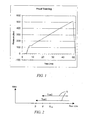
- the two-stages of the proof test may consist of first ramping the pressure up to a peak pressure over a time of approximately 40 - 250ms, for example 50ms, and then as quickly as possible reducing the pressure to zero (i.e. atmospheric pressure), ensuring that the dwell time at the peak pressure is kept to a minimum.
- the reduction of the pressure to zero may take 0-10ms, and preferably less than 2ms.
- the capsule is preferably filled with a liquid during the proof test to provide both hydrostatic loading and an accurate simulation of the conditions the capsule will be subject to during firing of the device.
- the pressure may be applied hydraulically.
- Borosilicate glasses are not inherently weak. It is the flaws in the glass, generally introduced during manufacturing, which create localised areas of weakness, which, above a stress threshold, lead to rapid crack growth and catastrophic failure. A range of flaws are introduced into the batch, such that some capsules, with the smallest flaw sizes, are strong, whilst others, with the largest flaw sizes, are weak. The consequence of this to needle free injection devices is that a certain percentage of capsules will catastrophically fail during firing.
- Glass capsules produced by the Weston manufacturing route have a device failure rate which should be reduced to a minimum.
- visual inspection techniques are currently used; however, the process is costly.
- the aim of this invention is to improve on the as-manufactured and visually inspected device failure rate to meet failure rates acceptable to commercial customers in a cost effective manner.
- the pressure profile has a first stage in which the pressure increases from a starting pressure to a peak pressure at a first average rate of pressure increase, and a second stage in which the pressure decreases from the peak pressure to the starting pressure at a second, greater, average rate of pressure decrease.
- the duration of the first stage is around 50ms with a substantially line pressure increase to a peak pressure of 540 Bar
- the second stage has a duration of around 2ms. The two stages follow each other with no time period during which the peak pressure is maintained.
- the proof test works by the following mechanism. Considering first the loading cycle, if, at the precise instant the peak pressure is reached, the statistics of crack growth in a batch of capsules is considered, then all capsules in the batch with any cracks above a particular flaw size, S, will have failed catastrophically. If the pressure is then instantaneously reduced to zero, then to a good approximation, the crack distributions in each capsule will be frozen-in - only the cracks which are moving at a significant speed at the peak pressure will continue to grow. Hence, if there are only a small number of capsules which contain flaws which grow above S after the pressure is reduced to zero, the proof test acts as a near perfect filter, filtering out virtually all capsules with flaw sizes above S.
- the peak pressure of the proof test is determined by the thickness and geometry of the glass being proof tested. Additionally, a factor is introduced to uplift the peak pressure to compensate for the small amount of crack growth which inevitably occurs during the second stage of the test.
- the peak pressure of the proof test is in the range 300-900 Bar, and more preferably 300-700 Bar, for example approximately 540 bar.
- Figure 2 shows this approach.
- the arrows A indicate the range of containers which will fail the respective test based on the maximum flaw size present.
- the total number of capsules with flaw sizes above S scrit will be a small number of a small number and hence the total number of capsules in the batch with flaw size above S scrit will reduce. Further successive proof tests will also theoretically further reduce the number of capsules in the batch with flaw sizes above S crit .
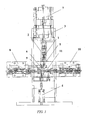
- Figure 3 presents an engineering diagram of the Weston Medical proof tester. Operation of the proof tester follows four discrete stages: Setting; Filling; Loading; and Unloading.
- the glass capsule ( 1 ) is positioned into a test pot ( 2 ) which is subsequently loaded into position above the 'stinger' ( 5 ) - a sealed movable pipe that connects the high-pressure block ( 6 ) to the capsule test pot ( 2 ).
- the pot is clamped by a pneumatic actuator ( 3 ) and then the 'stringer' ( 5 ) is inserted into place by another pneumatic actuator ( 4 ).
- the high-pressure seals are then in place to prevent leaks from the 'stinger'.
- a low-pressure system fills the volume of the high-pressure unit ( 6 ) with a liquid, usually water, and then the capsule ( 1 ) is filled with the same liquid through the 'stinger' ( 5 ).
- the capsule ( 1 ) is then sealed by a valve at one end in the high-pressure unit and at the other end, at the top of the capsule, by a seal lowered by a third pneumatic actuator ( 7 ).
- the volume is also sealed by a ceramic ball held in place upon a seal ( 11 ) by a hydraulic valve ( 10) .
- the volume of liquid in the capsule is ready to be pressurised.
- a high speed hydraulic valve ( 8 ) drives a high quality piston through the high pressure seal ( 9 ) to increase the pressure in the capsule.
- a high-speed processor uses the feedback from a high-speed piezoelectric pressure sensor, a high-speed processor controls the rate of increase in pressure as required.
- the system unloads the pressure in the capsule by actuating the other high-speed hydraulic valve ( 10 ) which then releases the ball-seal ( 11 ). With the ball free to move there is a near-instantaneous drop in pressure.
- An alternative to this approach is to use a mechanical servo driven drive to load a liquid containing capsule via a sealing piston.
- the unloading cycle of the proof test is completed by a large pneumatic cylinder that, similar to the hydraulic system, is pressurized during the loading phase, and allows rapid release of the air during the unloading phase.
- the method has been demonstrated to be slightly slower than the hydraulic method disclosed above, but is almost equally effective.
Landscapes
- General Health & Medical Sciences (AREA)
- Health & Medical Sciences (AREA)
- Life Sciences & Earth Sciences (AREA)
- Chemical & Material Sciences (AREA)
- Analytical Chemistry (AREA)
- Biochemistry (AREA)
- Physics & Mathematics (AREA)
- General Physics & Mathematics (AREA)
- Immunology (AREA)
- Pathology (AREA)
- Medical Preparation Storing Or Oral Administration Devices (AREA)
- Investigating Strength Of Materials By Application Of Mechanical Stress (AREA)
- Infusion, Injection, And Reservoir Apparatuses (AREA)
Claims (18)
- Verfahren zur Abnahmeprüfung der Festigkeit einer glasnadelfreien Injektionskapsel zum Liefern von flüssigen Arzneimitteln und anderen Substanzen durch die Haut und in das untenliegende Gewebe eines Patienten, wobei während der Injektion die Haut während eines sehr hohen Druckpulses, dem Abgabedruck, punktiert wird, wobei das Abnahmeprüfverfahren das Unterdrucksetzen der glasnadelfreien Injektionskapsel umfasst, wobei die Kapsel die Priwifung nicht besteht, falls sie bricht und wodurch, wenn die Kapsel die Abnahmeprüfung besteht, eine verstärkte Wahrscheinlichkeit des Überstehens des Abgabedruckes aufweist,
wobei die glasnadelfreie Injektionskapsel einem Druckprofil ausgesetzt wird, wobei das Druckprofil zwei Stufen aufweist, eine erste Stufe, bei der die glasnadelfreie Injektionskapsel einem Druckprofil ausgesetzt wird, das ein Ansteigen des Druckes von einem Startdruck zu einem Spitzendruck bei einer ersten mittleren Rate des Druckanstieges umfasst, wobei der Spitzendruck größer als der Abgabedruck ist, und eine zweite Stufe, bei der der Druck von dem Spitzendruck zum Startdruck bei einer zweiten, größeren mittleren Rate der Druckverminderung abnimmt, wobei die zweite Stufe der ersten Stufe mit keiner Zeltspanne folgt, während der Spitzendruck aufrecht erhalten wird, wobei die zweite Stufe des Druckprofils die Verminderung des Spitzendrucks im Wesentlichen sofort zu dem Startdruck umfasst. - Vorfahren nach Anspruch 1, wobei der Startdruck Atmosphärendruck ist.
- Herfahren nach Anspruch 1, wobei die erste Stufe des Druckprofils das Ansteigenlassen des Drucks im Wesentlichen linear auf den Spitzendruck umfasst.
- Verwahren nach einem der vorstehenden Ansprüche, wobei das Unterdrucksetzten der Kapsel das Füllen der Kapsel mit einer Flüssigkeit und das Unterdrucksetzen der Flüssigkeit umfasst.
- Verfahren nach Anspruch 4, wobei der Druck durch Abdichten der Kapsel und Anlegen des Drucks hydrostatisch unter Verwindung der Flüssigkeit erfolgt.
- Verwahren nach Anspruch 4 oder 5, wobei Wasser zum hydrostatischen Analegen des Druckes verwendet wird.
- Verfahren nach Anspruch 5 oder 6, wobei die Kapseldichtung unter Verwendung eines O-Rings abgewendet wird, der unter hydrostatischem Druck abdichtet.
- Vorfahren nach Anspruch 7, wobei der Druck in der zweiten Stufe durch Öffnen eines hydraulischen Ventiles angelassen wird.
- Vorfahren nach Anspruch 8, wobei der Druck unter Verwerdung eines mechanischen Servoantriebs angelegt wird und der Druck in der zweiten Stufe durch einen Pneumatikzylinder angelassen wird.
- Vorfahren nach einem der vorstehenden Ansprüche, wobei die Kapsel einer Anzahl von Prüfungen unterzogen wird.
- Verwahren nach einem der vorstehenden Ansprüche, wobei die erste Stufe des Druckprofils eine Dauer von 30-250ms aufweist.
- Verwahren nach einem der vorstehenden Ansprüche, wobei die erste Stufe des Druckprofils eine Dauer von 40-70ms aufweist.
- Verfahren nach einem der vorstehenden Anspruche, wobei die zweite Stufe des Druckprofils eine Dauer von 0-10ms aufweiset.
- Vorfahren nach Anspruch 13, wobei die zweite Stufe des Druckprofils eine Dauer von 0-2ms aufweiset.
- Verfahren nach einem der vorstehenden Ansprüche, wobei der Spitzendruck im Bereich von 300-900 bar liegt.
- Vorfahren nach Anspruch 15, wobei der Spitzendruck im Bereich von 300-700 bar liegt.
- Verfahren nach einem der vorstehenden Ansprüche, wobei der Druck, dem die Kapsel ausgesetzt wird, unter Rückkopplung von einem Drucksensor gesteuert wird.
- Vorfahren zum Prüfen einer Charge von glasnadelfreien Injektionskapseln mit dem Aufsetzen jeder Kapsel der Charge eines Verfahrens nach einem der vorstehenden Ansprüche.
Applications Claiming Priority (3)
| Application Number | Priority Date | Filing Date | Title |
|---|---|---|---|
| GB0229447A GB2396430A (en) | 2002-12-18 | 2002-12-18 | A method of proof testing glass containers |
| GB0229447 | 2002-12-18 | ||
| PCT/US2003/040587 WO2004056717A1 (en) | 2002-12-18 | 2003-12-18 | A method of proof testing glass |
Publications (3)
| Publication Number | Publication Date |
|---|---|
| EP1587765A1 EP1587765A1 (de) | 2005-10-26 |
| EP1587765A4 EP1587765A4 (de) | 2009-03-25 |
| EP1587765B1 true EP1587765B1 (de) | 2013-02-20 |
Family
ID=9949888
Family Applications (1)
| Application Number | Title | Priority Date | Filing Date |
|---|---|---|---|
| EP03813788A Expired - Lifetime EP1587765B1 (de) | 2002-12-18 | 2003-12-18 | Verfahren zur abnahmeprüfung von glas |
Country Status (6)
| Country | Link |
|---|---|
| EP (1) | EP1587765B1 (de) |
| JP (1) | JP2006518835A (de) |
| AU (1) | AU2003301124A1 (de) |
| CA (1) | CA2528666C (de) |
| GB (1) | GB2396430A (de) |
| WO (1) | WO2004056717A1 (de) |
Families Citing this family (2)
| Publication number | Priority date | Publication date | Assignee | Title |
|---|---|---|---|---|
| JP6954521B2 (ja) * | 2015-12-28 | 2021-10-27 | 株式会社ダイセル | 射出装置 |
| CN107328586A (zh) * | 2017-07-20 | 2017-11-07 | 苏州辉益电气科技有限公司 | 一种汽车玻璃天窗的抗压检测仪 |
Citations (1)
| Publication number | Priority date | Publication date | Assignee | Title |
|---|---|---|---|---|
| JPH04256829A (ja) * | 1991-02-08 | 1992-09-11 | Toshiba Corp | セラミックス製燃焼器部品の保証試験装置 |
Family Cites Families (9)
| Publication number | Priority date | Publication date | Assignee | Title |
|---|---|---|---|---|
| GB301422A (en) * | 1927-11-29 | 1929-08-01 | Byron Scott Dague | Methods and apparatus for testing hollow articles |
| US2314310A (en) * | 1940-08-16 | 1943-03-16 | Owens Illinois Glass Co | Bottle testing apparatus |
| US3251218A (en) * | 1963-02-04 | 1966-05-17 | Paul F Russell | Apparatus for pressure testing the porosity and strength of cartons and containers |
| US3230760A (en) * | 1964-06-12 | 1966-01-25 | Dow Chemical Co | Non-destructive testing of pressure vessels |
| US3771649A (en) * | 1972-07-17 | 1973-11-13 | L Strauss | Hydraulic pressure bottle testing method and machine |
| JPS5249994B2 (de) * | 1972-12-29 | 1977-12-21 | ||
| US3894424A (en) * | 1974-04-16 | 1975-07-15 | Coca Cola Co | On line pressure testing system |
| US3955402A (en) * | 1975-09-22 | 1976-05-11 | The Coca-Cola Co. | Pass level tester for glass bottles |
| US4916936A (en) * | 1988-07-25 | 1990-04-17 | The Kendall Company | Device for testing packages |
-
2002
- 2002-12-18 GB GB0229447A patent/GB2396430A/en not_active Withdrawn
-
2003
- 2003-12-18 EP EP03813788A patent/EP1587765B1/de not_active Expired - Lifetime
- 2003-12-18 CA CA2528666A patent/CA2528666C/en not_active Expired - Fee Related
- 2003-12-18 WO PCT/US2003/040587 patent/WO2004056717A1/en not_active Ceased
- 2003-12-18 JP JP2004562308A patent/JP2006518835A/ja active Pending
- 2003-12-18 AU AU2003301124A patent/AU2003301124A1/en not_active Abandoned
Patent Citations (1)
| Publication number | Priority date | Publication date | Assignee | Title |
|---|---|---|---|---|
| JPH04256829A (ja) * | 1991-02-08 | 1992-09-11 | Toshiba Corp | セラミックス製燃焼器部品の保証試験装置 |
Also Published As
| Publication number | Publication date |
|---|---|
| EP1587765A1 (de) | 2005-10-26 |
| GB2396430A (en) | 2004-06-23 |
| WO2004056717A1 (en) | 2004-07-08 |
| CA2528666C (en) | 2013-06-11 |
| GB0229447D0 (en) | 2003-01-22 |
| EP1587765A4 (de) | 2009-03-25 |
| JP2006518835A (ja) | 2006-08-17 |
| CA2528666A1 (en) | 2004-07-08 |
| AU2003301124A1 (en) | 2004-07-14 |
Similar Documents
| Publication | Publication Date | Title |
|---|---|---|
| US7320346B2 (en) | Method of proof testing glass | |
| EP1446177B1 (de) | Medikamentenkapsel eines nadellosen injektors und methode zur dessen befüllung | |
| NO330380B1 (no) | Nal-los sproyte for injisering av en vaeske som inneholdes i en forhandsfylt ampulle | |
| EP0459335B1 (de) | Verwendung eines Verfahrens und einer Anordnung zur Leckageprüfung | |
| EP1587765B1 (de) | Verfahren zur abnahmeprüfung von glas | |
| US20070175538A1 (en) | System and method for filling containers with liquid under varying pressure conditions | |
| DE19918721A1 (de) | Verfahren und Vorrichtung zum Befüllen von nadelfreien Injektoren | |
| EP2435113A2 (de) | Zur lagerung von injektionslösungen geeignete zylinder-kolben-einheit für einen nadelfreien injektor und verfahren zum blasenfreien automatischen oder manellen befüllen der zylinder-kolben-einheit, auch bei atmosphärendruck | |
| US11148923B2 (en) | Device and method for filling a container with a filling product | |
| KR20110048091A (ko) | 내압성 실험장치 및 그 장치를 이용한 내압성 실험방법 | |
| WO2002060516A1 (en) | Method and apparatus for filling needleless injector capsules | |
| EP2395340A1 (de) | Verfahren und Vorrichtung zum Testen von Patronen für ein flüssiges Medikament | |
| DE19533736C2 (de) | Verfahren und Vorrichtung zur hydraulischen Prüfung von Katheterballons | |
| EP1924803A2 (de) | Verfahren und vorrichtung zum testen einer gaskapsel | |
| KR101118071B1 (ko) | 구멍이 형성된 용기의 구멍 검사 시스템 | |
| JPH08210941A (ja) | 医薬用プラスチック成形品の成形不良を検査する方法 | |
| CA2267483C (en) | Gas capsule | |
| EP2607297A1 (de) | Verfahren und Vorrichtung zum Befüllen von Behältern | |
| KR102695533B1 (ko) | 진공채혈관 제조 장치 및 이를 이용한 진공채혈관 제조 방법 | |
| JP3992697B2 (ja) | 孔付容器の孔検査システム | |
| MXPA97003591A (en) | Adequate glass medical container for use in injectors without ag | |
| AU2002228169A1 (en) | Method and apparatus for filling needleless injector capsules |
Legal Events
| Date | Code | Title | Description |
|---|---|---|---|
| PUAI | Public reference made under article 153(3) epc to a published international application that has entered the european phase |
Free format text: ORIGINAL CODE: 0009012 |
|
| 17P | Request for examination filed |
Effective date: 20050708 |
|
| AK | Designated contracting states |
Kind code of ref document: A1 Designated state(s): AT BE BG CH CY CZ DE DK EE ES FI FR GB GR HU IE IT LI LU MC NL PT RO SE SI SK TR |
|
| AX | Request for extension of the european patent |
Extension state: AL LT LV MK |
|
| DAX | Request for extension of the european patent (deleted) | ||
| RBV | Designated contracting states (corrected) |
Designated state(s): DE FR GB |
|
| RIN1 | Information on inventor provided before grant (corrected) |
Inventor name: BRIDGES, PAUL Inventor name: KING, TOBY Inventor name: SHERGOLD, OLIVERC/O ZOGENIX, INC. |
|
| RAP1 | Party data changed (applicant data changed or rights of an application transferred) |
Owner name: ZOGENIX, INC. |
|
| A4 | Supplementary search report drawn up and despatched |
Effective date: 20090223 |
|
| RIC1 | Information provided on ipc code assigned before grant |
Ipc: G01N 3/12 20060101ALI20090217BHEP Ipc: C03C 1/00 20060101AFI20040715BHEP |
|
| 17Q | First examination report despatched |
Effective date: 20090615 |
|
| REG | Reference to a national code |
Ref country code: DE Ref legal event code: R079 Ref document number: 60343333 Country of ref document: DE Free format text: PREVIOUS MAIN CLASS: C03C0001000000 Ipc: G01N0003120000 |
|
| RIC1 | Information provided on ipc code assigned before grant |
Ipc: G01M 3/32 20060101ALI20120402BHEP Ipc: G01N 3/12 20060101AFI20120402BHEP |
|
| GRAP | Despatch of communication of intention to grant a patent |
Free format text: ORIGINAL CODE: EPIDOSNIGR1 |
|
| GRAS | Grant fee paid |
Free format text: ORIGINAL CODE: EPIDOSNIGR3 |
|
| GRAA | (expected) grant |
Free format text: ORIGINAL CODE: 0009210 |
|
| AK | Designated contracting states |
Kind code of ref document: B1 Designated state(s): DE FR GB |
|
| REG | Reference to a national code |
Ref country code: GB Ref legal event code: FG4D |
|
| REG | Reference to a national code |
Ref country code: DE Ref legal event code: R096 Ref document number: 60343333 Country of ref document: DE Effective date: 20130418 |
|
| PLBE | No opposition filed within time limit |
Free format text: ORIGINAL CODE: 0009261 |
|
| STAA | Information on the status of an ep patent application or granted ep patent |
Free format text: STATUS: NO OPPOSITION FILED WITHIN TIME LIMIT |
|
| 26N | No opposition filed |
Effective date: 20131121 |
|
| REG | Reference to a national code |
Ref country code: DE Ref legal event code: R097 Ref document number: 60343333 Country of ref document: DE Effective date: 20131121 |
|
| REG | Reference to a national code |
Ref country code: FR Ref legal event code: PLFP Year of fee payment: 13 |
|
| REG | Reference to a national code |
Ref country code: FR Ref legal event code: PLFP Year of fee payment: 14 |
|
| PGFP | Annual fee paid to national office [announced via postgrant information from national office to epo] |
Ref country code: DE Payment date: 20161213 Year of fee payment: 14 Ref country code: GB Payment date: 20161222 Year of fee payment: 14 |
|
| PGFP | Annual fee paid to national office [announced via postgrant information from national office to epo] |
Ref country code: FR Payment date: 20161222 Year of fee payment: 14 |
|
| REG | Reference to a national code |
Ref country code: DE Ref legal event code: R119 Ref document number: 60343333 Country of ref document: DE |
|
| GBPC | Gb: european patent ceased through non-payment of renewal fee |
Effective date: 20171218 |
|
| REG | Reference to a national code |
Ref country code: FR Ref legal event code: ST Effective date: 20180831 |
|
| PG25 | Lapsed in a contracting state [announced via postgrant information from national office to epo] |
Ref country code: DE Free format text: LAPSE BECAUSE OF NON-PAYMENT OF DUE FEES Effective date: 20180703 Ref country code: FR Free format text: LAPSE BECAUSE OF NON-PAYMENT OF DUE FEES Effective date: 20180102 |
|
| PG25 | Lapsed in a contracting state [announced via postgrant information from national office to epo] |
Ref country code: GB Free format text: LAPSE BECAUSE OF NON-PAYMENT OF DUE FEES Effective date: 20171218 |