EP1587984B1 - Papiermacherformiergewebe - Google Patents
Papiermacherformiergewebe Download PDFInfo
- Publication number
- EP1587984B1 EP1587984B1 EP03768933A EP03768933A EP1587984B1 EP 1587984 B1 EP1587984 B1 EP 1587984B1 EP 03768933 A EP03768933 A EP 03768933A EP 03768933 A EP03768933 A EP 03768933A EP 1587984 B1 EP1587984 B1 EP 1587984B1
- Authority
- EP
- European Patent Office
- Prior art keywords
- machine direction
- yarns
- direction yarns
- yarn
- knuckles
- Prior art date
- Legal status (The legal status is an assumption and is not a legal conclusion. Google has not performed a legal analysis and makes no representation as to the accuracy of the status listed.)
- Expired - Lifetime
Links
- 239000004744 fabric Substances 0.000 title claims abstract description 130
- 238000000034 method Methods 0.000 claims description 22
- 239000000835 fiber Substances 0.000 claims description 16
- 238000004519 manufacturing process Methods 0.000 claims 1
- 239000010410 layer Substances 0.000 description 63
- 238000009941 weaving Methods 0.000 description 6
- 239000002759 woven fabric Substances 0.000 description 3
- 239000004677 Nylon Substances 0.000 description 2
- 239000012736 aqueous medium Substances 0.000 description 2
- 230000015572 biosynthetic process Effects 0.000 description 2
- 239000000463 material Substances 0.000 description 2
- 229920001778 nylon Polymers 0.000 description 2
- 229920000728 polyester Polymers 0.000 description 2
- 239000002356 single layer Substances 0.000 description 2
- 238000003853 Pinholing Methods 0.000 description 1
- 239000004743 Polypropylene Substances 0.000 description 1
- 238000005299 abrasion Methods 0.000 description 1
- 230000002411 adverse Effects 0.000 description 1
- 239000004760 aramid Substances 0.000 description 1
- 229920003235 aromatic polyamide Polymers 0.000 description 1
- 238000010000 carbonizing Methods 0.000 description 1
- 235000019504 cigarettes Nutrition 0.000 description 1
- 238000002788 crimping Methods 0.000 description 1
- 238000001035 drying Methods 0.000 description 1
- 230000000694 effects Effects 0.000 description 1
- 230000005484 gravity Effects 0.000 description 1
- 238000004806 packaging method and process Methods 0.000 description 1
- -1 polypropylene Polymers 0.000 description 1
- 229920001155 polypropylene Polymers 0.000 description 1
- 238000009958 sewing Methods 0.000 description 1
- 239000002002 slurry Substances 0.000 description 1
- 239000000725 suspension Substances 0.000 description 1
- 229920002994 synthetic fiber Polymers 0.000 description 1
- 210000001364 upper extremity Anatomy 0.000 description 1
- XLYOFNOQVPJJNP-UHFFFAOYSA-N water Substances O XLYOFNOQVPJJNP-UHFFFAOYSA-N 0.000 description 1
Images





Classifications
-
- D—TEXTILES; PAPER
- D21—PAPER-MAKING; PRODUCTION OF CELLULOSE
- D21F—PAPER-MAKING MACHINES; METHODS OF PRODUCING PAPER THEREON
- D21F1/00—Wet end of machines for making continuous webs of paper
- D21F1/0027—Screen-cloths
- D21F1/0036—Multi-layer screen-cloths
- D21F1/0045—Triple layer fabrics
-
- Y—GENERAL TAGGING OF NEW TECHNOLOGICAL DEVELOPMENTS; GENERAL TAGGING OF CROSS-SECTIONAL TECHNOLOGIES SPANNING OVER SEVERAL SECTIONS OF THE IPC; TECHNICAL SUBJECTS COVERED BY FORMER USPC CROSS-REFERENCE ART COLLECTIONS [XRACs] AND DIGESTS
- Y10—TECHNICAL SUBJECTS COVERED BY FORMER USPC
- Y10S—TECHNICAL SUBJECTS COVERED BY FORMER USPC CROSS-REFERENCE ART COLLECTIONS [XRACs] AND DIGESTS
- Y10S162/00—Paper making and fiber liberation
- Y10S162/903—Paper forming member, e.g. fourdrinier, sheet forming member
-
- Y—GENERAL TAGGING OF NEW TECHNOLOGICAL DEVELOPMENTS; GENERAL TAGGING OF CROSS-SECTIONAL TECHNOLOGIES SPANNING OVER SEVERAL SECTIONS OF THE IPC; TECHNICAL SUBJECTS COVERED BY FORMER USPC CROSS-REFERENCE ART COLLECTIONS [XRACs] AND DIGESTS
- Y10—TECHNICAL SUBJECTS COVERED BY FORMER USPC
- Y10T—TECHNICAL SUBJECTS COVERED BY FORMER US CLASSIFICATION
- Y10T442/00—Fabric [woven, knitted, or nonwoven textile or cloth, etc.]
- Y10T442/30—Woven fabric [i.e., woven strand or strip material]
- Y10T442/3179—Woven fabric is characterized by a particular or differential weave other than fabric in which the strand denier or warp/weft pick count is specified
-
- Y—GENERAL TAGGING OF NEW TECHNOLOGICAL DEVELOPMENTS; GENERAL TAGGING OF CROSS-SECTIONAL TECHNOLOGIES SPANNING OVER SEVERAL SECTIONS OF THE IPC; TECHNICAL SUBJECTS COVERED BY FORMER USPC CROSS-REFERENCE ART COLLECTIONS [XRACs] AND DIGESTS
- Y10—TECHNICAL SUBJECTS COVERED BY FORMER USPC
- Y10T—TECHNICAL SUBJECTS COVERED BY FORMER US CLASSIFICATION
- Y10T442/00—Fabric [woven, knitted, or nonwoven textile or cloth, etc.]
- Y10T442/30—Woven fabric [i.e., woven strand or strip material]
- Y10T442/3179—Woven fabric is characterized by a particular or differential weave other than fabric in which the strand denier or warp/weft pick count is specified
- Y10T442/3195—Three-dimensional weave [e.g., x-y-z planes, multi-planar warps and/or wefts, etc.]
Definitions
- This invention relates generally to woven fabrics, and relates more specifically to woven fabrics for papermakers.
- a water slurry, or suspension, of cellulosic fibers (known as the paper "stock") is fed onto the top of the upper run of an endless belt of woven wire and/or synthetic material that travels between two or more rollers.
- the belt often referred to as a "forming fabric" provides a papermaking surface on the upper surface of its upper run which operates as a filter to separate the cellulosic fibers of the paper stock from the aqueous medium, thereby forming a wet paper web.
- the aqueous medium drains through mesh openings of the forming fabric, known as drainage holes, by gravity alone or with assistance from one or more suction boxes located on the lower surface ( i.e. , the "machine side") of the upper run of the fabric.
- the paper web After leaving the forming section, the paper web is transferred to a press section of the paper machine, in which it is passed through the nips of one or more pairs of pressure rollers covered with another fabric, typically referred to as a "press felt.” Pressure from the rollers removes additional moisture from the web; the moisture removal is often enhanced by the presence of a "batt" layer on the press felt.
- the paper is then conveyed to a dryer section for further moisture removal. After drying, the paper is ready for secondary processing and packaging.
- papermaker's fabrics are manufactured as endless belts by one of two basic weaving techniques.
- fabrics are flat woven by a flat weaving process, with their ends being joined to form an endless belt by any one of a number of well-known joining methods, such as dismantling and reweaving the ends together (commonly known as splicing), or sewing a pin-seamable flap on each end or a special foldback, then reweaving these into pin-seamable loops.
- splicing commonly known as splicing
- sewing a pin-seamable flap on each end or a special foldback then reweaving these into pin-seamable loops.
- the warp yarns extend in the machine direction and the filling yarns extend in the cross machine direction.
- fabrics are woven directly in the form of a continuous belt with an endless weaving process.
- the warp yarns extend in the cross machine direction and the filling yarns extend in the machine direction.
- machine direction MD
- CMD cross machine direction
- Both weaving methods described hereinabove are well known in the art, and the term “endless belt” as used herein refers to belts made by either method.
- Wire marking is particularly problematic in the formation of fine paper grades, as it can affect a host of paper properties, such as sheet mark, porosity, "see through” and pin holing. Wire marking is typically the result of individual cellulosic fibers being oriented within the paper web such that their ends reside within gaps between the individual threads or yarns of the forming fabric. This problem is generally addressed by providing a permeable fabric structure with a coplanar surface that allows paper fibers to bridge adjacent yarns of the fabric rather than penetrate the gaps between yarns.
- coplanar means that the upper extremities of the yarns defining the paper-forming surface are at substantially the same elevation, such that at that level there is presented a substantially “planar” surface. Accordingly, fine paper grades intended for use in quality printing, carbonizing, cigarettes, electrical condensers, and like grades of fine paper have typically heretofore been formed on very finely woven or fine wire mesh forming fabrics.
- such finely woven fabrics include at least some relatively small diameter machine direction or cross machine direction yarns.
- such yarns tend to be delicate, leading to a short surface life for the fabric.
- the use of smaller yarns can also adversely effect the mechanical stability of the fabric (especially in terms of skew resistance, narrowing propensity and stiffness), which may negatively impact both the service life and the performance of the fabric.
- multi-layer forming fabrics have been developed with fine-mesh yarns on the paper forming surface to facilitate paper formation and coarser-mesh yarns on the machine contact side to provide strength and durability.
- fabrics have been constructed which employ one set of machine direction yarns which interweave with two sets of cross machine direction yarns to form a fabric having a fine paper forming surface and a more durable machine side surface. These fabrics form part of a class of fabrics which are generally referred to as "double layer" fabrics.
- fabrics have been constructed which include two sets of machine direction yarns and two sets of cross machine direction yarns that form a fine mesh paper side fabric layer and a separate, coarser machine side fabric layer.
- double and triple layer fabrics include additional sets of yarn as compared to single layer fabrics, these fabrics typically have a higher "caliper” (i.e., they are thicker than) comparable single layer fabrics.
- An illustrative double layer fabric is shown in U.S. Patent No. 4,423,755 to Thompson, and illustrative triple layer fabrics are shown in U.S. Patent No. 4,501,303 to Osterberg, U.S. Patent No. 5,152,326 to Vohringer, U.S. Patent Nos. 5,437,315 and 5,967,195 to Ward, and U.S. Patent No. 6,244,306 to Troughton.
- the coarser CMD yarns used in the bottom layer of the fabric typically have long "floats" (segments that span multiple adjacent MD yarns in the weave pattern) that contact the papermaking machine and, accordingly, are subjected to a large degree of wear.
- this is desirable, as it can protect the bottom machine direction yarns (which are forced to absorb and withstand much of the tension present in the fabric during operation); such a configuration does suggest that the cross-machine direction yarns that contact the paper machine should be wear-resistant.
- the bottom CMD yarns should not be of a size or woven in a configuration that negatively impacts papermaking. As such, a weave pattern that can improve the wear resistance of the CMD yarns while still providing acceptable papermaking properties is desirable.
- a triple layer fabric includes a set of top machine direction yarns, a set of top cross machine direction yarns interwoven with the top machine direction yarns to form a top fabric layer, a set of bottom machine direction yarns, and a set of bottom cross machine direction yarns interwoven with the bottom machine direction yarns to form a bottom fabric layer stitched to the top fabric layer.
- the bottom machine direction yarns and the bottom cross machine direction yarns are interwoven in a series of repeat units in which the bottom machine direction yarns pass below multiple nonadjacent bottom cross machine direction yarns to form bottom machine direction knuckles, and in which pairs of bottom machine direction yarns separated from one another by one bottom machine direction yarn form bottom machine direction knuckle pairs under a common bottom cross machine direction yarn.
- Each bottom machine direction knuckle pair forms a diagonal with two imaginary diagonal lines nonadjacent bottom machine direction knuckle pair such that each bottom machine direction knuckle pair in the diagonal is offset by two cross machine direction yarns and one bottom machine direction yarn.
- the top and bottom fabric layers may be stitched together, for example, by conventional stitching yarns, stitching yarn pairs, pseudo-stitching yarns, and/or a self-stitching configuration.
- the bottom machine direction knuckles of a pair tend to bow toward one another, effectively lengthening floats present on either side of these knuckles.
- the increased length offers more bottom CMD yarn contact area to serve as a wear surface.
- the presence of these two bottom MD knuckles in close proximity can exert significant force on the common bottom CMD yarn, thereby causing it to crimp substantially.
- larger (and, in turn, more wear-resistant) bottom CMD yarns can be employed.
- the papermaker's fabric discussed above includes pairs of first and second stitching yarns positioned between pairs of top CMD yarns.
- the first and second stitching yarns of each pair are interwoven with the top and bottom MD yarns such that, as a fiber support portion of the first stitching yarn is interweaving with the top MD yarns, a binding portion of the second stitching yam is positioned below the top MD yarns, and such that as a fiber support portion of the second stitching yam is interweaving with the top MD yarns, a binding portion of the first stitching yarn is positioned below the top MD yarns.
- the first and second stitching yarns cross each other as they pass below a transitional top MD yarn, and each of the binding portions of the first and second stitching yarns passes below at least one of the bottom MD yarns. Further, the presence of the diagonal formed by the bottom MD knuckles can provide a fabric that produces reduced marking of the paper sheet.
- embodiments of the papermaker's fabrics described above may be used to make paper.
- a paper stock may be applied to a papermaker's fabric as described above, and moisture may be removed from the paper stock to produce paper.
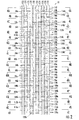
- Figure 1 is a top view of a twenty harness triple layer forming fabric according to embodiments of the present invention.
- Figure 2 is a top section view of the bottom layer the fabric of Figure 1 with the top layer removed.
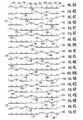
- Figures 3A-3J are section views of the MD yarns of the fabric of Figure 1 taken along lines 3A-3A through 3J-3J thereof.
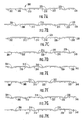
- Figures 4A-4T are section views of the CMD yarns of the fabric of Figure 1 taken along lines 4A-4A through 4T-4T.
- Figures 5A-5L are cross-sectional views of the MD yarns of a bottom layer of a twenty-four harness triple layer fabric according to embodiments of the present invention.
- Figures 6A-6X are cross-sectional views of the CMD yarns of the bottom layer of the twenty-four harness triple layer fabric of Figures 5A-5L .
- Figure 7A-7H are cross-sectional views of the MD yarns of a bottom layer of a sixteen harness triple layer fabric according to embodiments of the present invention.
- Figures 8A-8P are cross-sectional views of the CMD yarns of the bottom layer of the sixteen harness triple layer fabric of Figures 7A-7H .
- a twenty harness triple layer forming fabric 20 is illustrated in Figures 1 - 4, in which a single repeat unit of the fabric 20 is shown.
- the repeat unit of the fabric 20 includes a top layer 21 and a bottom layer 81.
- the top layer 21 includes ten top MD yarns 22, 24, 26, 28, 30, 32, 34, 36, 38 and 40 and twenty top CMD yarns 42, 46, 50, 54, 58, 62, 66, 70, 74, 78, 82, 86, 90, 94, 98,102,106,110,114, and 118. These are interwoven such that each top CMD yam passes over and beneath top MD yarns in an alternating fashion, with each top MD yarn passing either over or under the top CMD yarns.
- top CMD yam 42 passes under top MD yarn 22, over top MD yarn 24, under top MD yarn 26, over top MD yam 28 and so on until it passes over top MD yarn 40.
- top CMD yarn 46 passes under top MD yarn 22, over top MD yarn 24, under top MD yarn 26, over top MD yarn 28 and so on until it passes over top MD yarn 40.
- the repeat unit of the fabric 20 also includes the bottom layer 81.
- the repeat unit includes ten bottom MD yarns 122, 124, 126, 128, 130, 132, 134, 136, 138, and 140, which are interwoven with twenty bottom CMD yarns 142, 144, 146, 148, 150, 152, 154, 156, 158, 160, 162, 164, 166, 168, 170,172,174,176,178, and 180.
- Each of the bottom MD and CMD yarns is positioned substantially directly below a corresponding top MD or CMD yarn.
- the interweaving pattern of the bottom layer 81 is described in greater detail below.
- the top layer 21 and the bottom layer 81 also include portions of twenty stitching yam pairs, designated herein as pairs 44a, 44b, 48a, 48b, 52a, 52b, 56a, 56b, 60a, 60b, 64a, 64b, 68a, 68b, 72a, 72b, 76a, 76b, 80a, 80b, 84a, 84b, 88a, 88b, 92a, 92b, 96a, 96b, 100a, 100b, 104a, 104b, 108a, 108b, 112a, 112b, 116a, 116b, 120a and 120b.
- the stitching yarns interweave with the top MD yarns and bottom MD yarns to bind the top and bottom fabric layers together.
- the stitching yarns form an integral part of the top layer 21 and interweave with the top MD yarns in an "over/under” pattern.
- Each top MD yarn that passes over the top CMD yarns also passes beneath portions of the stitching yarns, and similarly each top MD yarn that passes beneath the top CMD yarns also passes over portions of the stitching yarns to form the "over/under” pattern.
- top MD yarn 22 passes over the CMD yarn 42, under stitching yarn 44b, over top CMD yarn 46, under stitching yarn 48a and so forth until it passes under stitching yam 120b.
- Top MD yam 24 passes underneath top CMD yarn 42, over stitching yam 44b, under top CMD yarn 46, and so forth until it passes above the crossing point of stitching yarns 120a and 120b.
- the stitching yarns are positioned in pairs between adjacent top and bottom CMD yarns; there is no bottom CMD yarn below each stitching yarn pair so that space is present for the stitching yarn to stitch.
- stitching yarns 44a and 44b are positioned between top CMD yarns 42 and 46.
- the top CMD yarns are positioned substantially directly above the bottom CMD yarns, such that space exists between adjacent bottom CMD yarns for the stitching yarns to stitch. That is, there is no bottom CMD yarn positioned substantially directly below the stitching yam pairs, thereby providing a space in which the stitching yarns can stitch below a bottom CMD yarn.
- the fabric 20 may have differing numbers of top and bottom CMD yarns in a repeat unit; for example, there may be 1.5, two, three or five times as many top CMD yarns as bottom CMD yarns.
- bottom CMD yarns may be present below the stitching yarn pairs; in such embodiments, it is preferred that the stitching yarns of a pair stitch on opposite sides of the underlining bottom CMD yarn.
- the bottom MD yarns are interwoven with the bottom CMD yarns in a pattern in which each bottom MD yarn passes under a bottom CMD yarn, over the next three adjacent bottom CMD yarns, below the next bottom CMD yam, over the next six adjacent bottom CMD yarns, below the next bottom CMD yam, over the next three adjacent bottom CMD yarns, below the next bottom CMD yam, and over the next four bottom CMD yarns.
- bottom MD yarn 122 passes under bottom CMD yarn 142, above bottom CMD yarns 144, 146, and 148, below bottom CMD yarn 150, above bottom CMD yarns 152, 154, 156, 158, 160, and 162, below bottom CMD yarn 164, above bottom CMD yarns 166, 168 and 170, below bottom CMD yarn 172, and above bottom CMD yarns 174, 176, 178 and 180.
- the other bottom MD yarns follow a similar "under 1/over 3/under 1/over 6/under 1/over 3/under 1/over 4" weave pattern, but each is offset in its weaving sequence from its nearest bottom MD yarn neighbors by two bottom CMD yarns.
- bottom MD yarn 124 (which is adjacent bottom CMD yarn 122 ) passes below bottom CMD yarn 178, above bottom CMD yarns 180,142,144, below bottom CMD yam 146, above bottom CMD yarns 148, 150, 152, 154, 156, and 158, below bottom CMD yarn 160, above bottom CMD yarn 162, 164, and 166, below bottom CMD yam 168, above bottom CMD yarns 170,172,174, and 176.
- bottom MD "knuckle” formed by bottom MD yarn 122 as it passes below bottom CMD yam 150 is offset from the corresponding bottom "knuckle” formed by adjacent bottom MD yam 124 as it passes below bottom CMD yarn 146 by two bottom CMD yarns.
- each of the bottom MD yarns forms four knuckles in the repeat pattern. Two pairs of the knuckles are offset from one another by four bottom CMD yarns, one pair of knuckles is offset by seven bottom CMD yarns, and another pair of knuckles is offset by five bottom CMD yarns.
- bottom MD yarn 122 in Figure 3A form four bottom MD knuckles at bottom CMD yarns 142, 150, 164, and 172, which are offset by from one another by four, seven, four, and five bottom CMD yarns, respectively.
- each of the bottom MD knuckles formed on the bottom surface of the bottom layer 81 by the bottom MD yarns is separated from another bottom MD yarn knuckle formed under the same bottom CMD yarn by one bottom MD yarn.
- bottom MD yarns 122 and 126 form a pair of knuckles at bottom CMD yarn 142.
- Bottom MD yarns 122 and 126 are separated by bottom MD yarn 124.
- the bottom MD yarn knuckles tend to bow toward one another, resulting in an effective lengthening of the long bottom CMD yarn float (in this instance, seven bottom MD yarns long) between bottom MD yarn knuckle pairs. This effective increase in float length can improve wear of the fabric.
- Embodiments of this configuration are described in detail in U.S. Patent No. 6,244,306 to Troughton , the disclosure of which is hereby incorporated by reference in its entirety.
- Each of the bottom MD knuckle pairs forms two imaginary diagonal lines with a nonadjacent bottom MD knuckle pair such that each bottom MD knuckle pair in the diagonal is offset by two CMD yarns and one bottom MD yam.
- bottom CMD yarn 144 forms a bottom MD knuckle pair 144k and 144k' at bottom MD yarns 132 and 136.
- the next consecutive bottom MD knuckle pair in the diagonal is formed by bottom CMD yarn 148, which forms a bottom MD knuckle pair 148k and 148k' at bottom MD yarns 130 and 134.
- bottom CMD yarn 152 which forms a bottom MD knuckle pair 152k and 152k' at MD yarns 128 and 132
- bottom MD knuckle pair formed at bottom CMD yarn 156 which forms a bottom MD knuckle pair 156k and 156k' at MD yarns 126 and 130, and so forth.
- bottom CMD yarns separating the bottom MD knuckle pairs in the diagonal lines described above form similar imaginary diagonal lines of bottom MD knuckle pairs.
- bottom CMD yam 154 forms bottom MD knuckle pair 154k and 154k' at bottom MD yarns 136 and 140.
- the next bottom MD knuckle pair 158k and 158k' in the diagonal is formed by bottom CMD yarn 158 at bottom MD yarns 134 and 18, and so forth.
- the alternating diagonal pattern described above may improve marking properties of the fabric.
- the bottom CMD yarns may be grouped in adjacent pairs such that the first half of the repeat pattern in the first bottom CMD yarn in a pair follows the same pattern as the second half of the second bottom CMD yarn in the pair.
- bottom CMD yarn 142 passes above bottom MD yam 122, beneath bottom MD yam 124, above bottom MD yarn 126, and beneath bottom MD yarns 128,130,132,134, 136,138, and 140.
- Adjacent bottom CMD yam 144 passes above bottom MD yam 132, beneath bottom MD yarn 134, above bottom MD yarn 136, and beneath bottom MD yarns 138, 140, 122, 124, 126,128, and 130.
- each of the stitching yarns of the repeat unit can be subdivided into two portions: a fiber support portion which interweaves with the top MD yarns, and a binding portion which interweaves with a bottom MD yarn. These are separated at "transitional" top MD yarns, below which one stitching yam of a pair crosses the other stitching yam of the pair.
- the stitching yarns of each pair are interwoven relative to one another such that the fiber support portion of one yarn of the pair is positioned above the binding portion of the other yarn of the pair.
- the fiber support portion of the stitching yam of each pair designated with an "a" interweaves in an alternating fashion with five top MD yarns (alternately passing over three top MD yarns and under two top MD yarns), and the other stitching yarn of the pair (those designated with a "b") passes over two top MD yarns while passing below a top MD yarn positioned between those two MD yarns.
- each stitching yarn passes over top MD yarns that the top CMD yarns pass beneath, and passes below top MD yarns that each top CMD yarn passes over.
- the stitching yarns and top CMD form a plain weave pattern with the top MD yarns on the papermaking (i.e., top surface)( see Figure 1 ).
- each stitching yam passes below one bottom MD yarn in the repeat unit such that an "over 4/under 1" pattern is established by the pair of stitching yarns on the bottom surface of the fabric 20 (see Figure 2 ).
- This configuration is discussed in greater detail in U.S. Patent No. 5,967,195 to Ward , the disclosure of which is hereby incorporated herein by reference in its entirety.
- a stitching yarn passes below a bottom MD yarn, it does so between two bottom CMD yarns that are forming bottom CMD long floats. In this position, the CMD yarns can protect the stitching yarns from contact with the paper machine and from the resultant wear.
- Pairs of stitching yarns that are positioned adjacent to and on opposite sides of a top or bottom CMD yarn are interwoven with the top or bottom MD yarns such that there is an offset of two MD yarns between such stitching yam pairs.
- stitching yam 44a passes above top MD yarns 30, 34 and 38 and below bottom MD yarn 124.
- Stitching yarn 48a passes above top MD yarns 34, 38 and 22 (with top MD yarn 22 being a continuation of the pattern on the opposite side) and below bottom MD yarn 128.
- stitching yarn 44a is offset from stitching yarn 48a by two top and bottom MD yarns. This same two MD yam offset is followed for the interweaving of the other stitching yarns.
- the fabric can have at least some "reversed picks" in the stitching yam configuration. Although it is preferred that all of the stitching yam pairs follow this pattern, i.e., that 50% of the stitching yarn pairs be "reversed", some benefit can be obtained by reversing only a smaller percentage (for example 25, 33 or 40%) of the stitching yam pairs.
- Fabrics having non-reversed pick stitching yarns may also be used.
- other stitching yarn configurations may be used, including "pseudo-stitching" yarns.
- a pseudo-stitching yarn configuration only one of the stitching yarns in a stitching yam pair forms a knuckle with the bottom MD yarns in the repeat unit.
- a "self-stitched" fabric can be used.
- An example of a self-stitched fabric can be found in U.S. Patent No. RE35,777 to Givin , the disclosure of which is hereby incorporated by reference in its entirety.
- a self-stitched fabric is a fabric that includes a set of top MD yarns, a set of bottom MD yarns, a set of top CMD yarns, and a set of bottom CMD yarns.
- the top MD yarns interweave with the top CMD yarns to form a top fabric layer
- the set of bottom MD yarns interweave with the bottom CMD yarns to form a bottom fabric layer.
- the top MD or top CMD yarns can stitch the top and bottom fabric layers together. That is, an MD yarn from the top layer periodically interweaves with a bottom CMD yarn, and/or a CMD yam from the top layer periodically interweaves with a bottom MD yarn, thus forming an effective stitching point.
- top CMD or top MD yarns that interweave with the bottom layer to form a stitching point do not form an integrated part of the bottom fabric layer and are used in addition to the knuckles that form the pattern of the bottom layer shown in Figure 2 . Additional stitching yarns may not be necessary.
- the fabrics of the present invention may also employ other top layer weave patterns; for example, twills, satins, broken twills, and the like may also be employed.
- Each of the bottom CMD yarns may be positioned substantially directly below a corresponding top CMD yarn. When stitching yarn pairs are used, there is typically no bottom CMD yarn positioned substantially directly below the stitching yarn pairs, thereby providing a space in which the stitching yarns can stitch below a bottom CMD yam.
- the fabric may have differing numbers of top and bottom CMD yarns in a repeat unit; for example, there may be 1.5, two or three times as many top CMD yarns as bottom CMD yarns, or there may be a CMD yarn below each stitching yarn pair.
- the stitching yarns may comprise an integral portion of the top surface weave or may not.
- the stitching yarns can be stitched in the cross machine direction or in the machine direction of the fabric. Further, stitching yarns that are not arranged as stitching yarn pairs may also be employed in the fabrics of the present invention; examples of such stitching yarns are illustrated in U.S. Patent No. 5,238,536 to Danby .
- FIGS 1-4 employs ten top MD yarns and ten bottom MD yarns (i.e. , they are "twenty harness fabrics")
- FIGs 5A-J and 6A-X illustrate the bottom layer 200 of an alternative embodiment of a twenty-four harness triple layer fabric (not shown in its entirety).
- the bottom layer 200 can be stitched to a top layer similar to the top layer 21 described with respect to fabric 20 in Figures 1-4 .
- the bottom layer 200 includes twenty-four bottom CMD yarns 202, 204, 206, 208, 210, 212, 214, 216, 218, 220, 222, 224, 226, 228, 230, 232, 234, 236, 238, 240, 242, 244, 246, and 248 interwoven with twelve bottom MD yarns 250, 252, 254, 256, 258, 260, 262, 264, 266, 268, 270, and 272. As they interweave, each bottom MD yam follows an "under 1/over 3/under 1/ over 8/under 1/over 3/under 1/ over 6" weave pattern relative to the bottom CMD yarns, with adjacent bottom MD yarns being offset from one another by two bottom CMD yarns.
- Each bottom MD yam forms four bottom MD knuckles.
- the four bottom MD knuckles are offset from one another by nine, seven or, in two cases, four bottom CMD yarns.
- bottom MD yarn 250 forms knuckles at bottom CMD yarns 202, 210, 228, and 236, which are offset from one another by four, nine, four, and seven bottom CMD yarns, respectively.
- bottom MD knuckle pairs are formed under a common bottom CMD yarn such that each knuckle in the pair is separated by one bottom MD yarn.
- Each of the bottom MD knuckle pairs form imaginary diagonal lines with a nonadjacent bottom MD knuckle pair such that each bottom MD knuckle pair in the diagonal lines is offset by two CMD yarns and one bottom MD yarn.
- bottom CMD yarn 208 ( Figure 6D ) forms a bottom MD knuckle pair at bottom MD yarns 260 ( Figure 4F ) and 264 ( Figure 4H ).
- the next consecutive bottom MD knuckle pair in the diagonal lines is formed by bottom CMD yarn 212, which forms a bottom MD knuckle pair at bottom MD yarns 258 and 262.
- the bottom MD knuckle pair formed at CMD yarn 212 is offset from the bottom MD knuckle pair formed at bottom CMD yarn 208 by two bottom CMD yarns and one bottom MD yam.
- the next consecutive bottom MD knuckle pair in the diagonal lines is formed at bottom CMD yarn 216, which forms a bottom MD knuckle pair at MD yarns 256 and 260.
- bottom CMD yarns separating the bottom MD knuckle pairs in the diagonal described above form similar diagonal lines of bottom MD knuckle pairs.
- bottom CMD yarn 210 forms bottom MD knuckle pair at bottom MD yarns 270 and 250.
- the next bottom MD knuckle pair in the diagonal lines is formed by bottom CMD yam 214 at bottom MD yarns 272 and 268, and so forth.
- Figures 7A-H and 8A-P illustrate the MD yarns of a bottom layer 300 of a sixteen harness triple layer fabric (not shown in its entirety), which includes sixteen bottom CMD yarns 302, 304, 306, 308, 310, 312, 314, 316, 318, 320, 322, 324, 326, 328, 330, and 332 interwoven with eight bottom MD yarns 334, 336, 338, 340, 342, 344, 346, and 348.
- each bottom MD yarn follows an "under 1/over 3/under 1/over 4/under 1/over 3/under 1/ over 2" pattern, with adjacent bottom MD yarns being offset from one another by two bottom CMD yarns.
- Each bottom MD yam forms four bottom MD knuckles in the repeat pattern.
- the four bottom MD knuckles are offset from one another by five, four, or three bottom CMD yarns.
- bottom MD yam 334 forms knuckles at bottom CMD yarns 302, 310, 320 and 328, which are offset from one another by four (in two cases), five, four, and three bottom CMD yarns, respectively.
- Bottom MD knuckle pairs separated by one bottom MD yarn are formed under a common bottom CMD yam.
- Each of the bottom MD knuckle pairs forms two imaginary diagonal lines with a nonadjacent bottom MD knuckle pair such that each bottom MD knuckle pair in the diagonal lines is offset by two CMD yarn one bottom MD yarn.
- bottom CMD yarn 312 ( Figure 8F ) forms a bottom MD knuckle pair at bottom MD yarns 338 ( Figure 7C ) and 342 ( Figure 7E ).
- bottom CMD yarn 316 which forms a bottom MD knuckle pair at bottom MD yarns 336 and 340.
- the bottom CMD yarns separating the bottom MD knuckle pairs in the diagonal lines described above form similar diagonal lines of bottom MD knuckle pairs.
- bottom CMD yam 314 forms bottom MD knuckle pair at bottom MD yarns 344 and 348.
- the next bottom MD knuckle pair in the diagonal lines is formed by bottom CMD yam 318 at bottom MD yarns 342 and 346.
- the form of the yarns utilized in the fabrics of the present invention can vary, depending upon the desired properties of the final papermaker's fabric.
- the yarns may be multifilament yarns, monofilament yarns, twisted multifilament or monofilament yarns, spun yarns, or any combination thereof.
- the materials comprising yarns employed in the fabric of the present invention may be those commonly used in papermaker's fabric.
- the yarns may be formed of polypropylene, polyester, aramid, nylon, or the like. The skilled artisan should select a yam material according to the particular application of the final fabric. In particular, round monofilament yarns formed of polyester or nylon are preferred.
- top MD yarns have a diameter of between about 0.13 mm and 0.17 mm
- top CMD yarns have a diameter of between about 0.13 mm and 0.20 mm
- stitching yarns have a diameter of between about 0.11 mm and 0.15 mm
- bottom MD yarns have a diameter of between about 0.17 mm and 0.25 mm
- bottom CMD yarns have a diameter of between about 0.20 mm and 0.35 mm.
- the ratio of diameter of bottom CMD yarn to bottom MD yam can be from about 1.0 to about 2.5.
Landscapes
- Paper (AREA)
- Sanitary Thin Papers (AREA)
- Storage Of Web-Like Or Filamentary Materials (AREA)
- Pharmaceuticals Containing Other Organic And Inorganic Compounds (AREA)
- Polysaccharides And Polysaccharide Derivatives (AREA)
- Disintegrating Or Milling (AREA)
Claims (35)
- Dreilagiges Papiersieb (20), das Folgendes umfasst:einen Satz oberer Maschinenrichtungsgarne (22 - 40);einen Satz oberer Quermaschinenrichtungsgarne (42 - 118), die mit den oberen Maschinenrichtungsgarnen (22 - 40) verwebt sind, um eine obere Gewebelage (21) zu bilden;einen Satz unterer Maschinenrichtungsgarne (122 - 140);einen Satz unterer Quermaschinenrichtungsgarne (142 - 180), die mit den unteren Maschinenrichtungsgarnen (122 - 140) verwebt sind, um eine untere Gewebelage (81) zu bilden, die an die obere Gewebelage (21) angeheftet ist;dadurch gekennzeichnet, dass die unteren Maschinenrichtungsgarne (142 - 180) und die unteren Quermaschinenrichtungsgarne (142 - 180) in einer Reihe von Rapporteinheiten verwebt sind, in denen die unteren Maschinenrichtungsgarne (122 - 140) unter mehreren nicht aneinander angrenzenden unteren Quermaschinenrichtungsgarnen (142 - 180) verlaufen, um untere Maschinenrichtungserhebungen zu bilden, und in denen Paare von unteren Maschinenrichtungsgarnen (132, 136), die durch ein unteres Maschinenrichtungsgarn (134) voneinander getrennt sind, untere Maschinenrichtungserhebungspaare (144k, 144k') unter einem gemeinsamen unteren Quermaschinenrichtungsgarn (144) bilden; und
wobei jedes untere Maschinenrichtungserhebungspaar (144k, 144k') zwei imaginäre Diagonallinien mit einem nicht angrenzenden unteren Maschinenrichtungserhebungspaar (148k, 148k') bildet, und zwar so, dass jedes untere Maschinenrichtungserhebungspaar in den Diagonallinien um zwei untere Quermaschinenrichtungsgarne (146, 148) und ein unteres Maschinenrichtungsgarn (130) versetzt ist. - Dreilagiges Gewebe nach Anspruch 1, darüber hinaus einen Satz Heftgarne (44a - 120b) umfassend, die mit der oberen und unteren Gewebelage (21, 81) verwebt sind.
- Dreilagiges Gewebe nach Anspruch 1 oder 2, wobei jedes untere Maschinenrichtungsgarn (122- 140) vier untere Maschinenrichtungserhebungen bildet.
- Dreilagiges Gewebe nach Anspruch 2 oder 3, wobei die oberen Maschinenrichtungsgarne (22 - 40), die oberen Quermaschinenrichtungsgarne (42 - 118) und die Heftgarne (44a - 120b) verwebt sind, um eine Grundbindungspapiersiebfläche zu bilden.
- Dreilagiges Gewebe nach einem der Ansprüche 1 bis 4, wobei die Rapporteinheit gleiche Anzahlen von Quermaschinenrichtungsgarnen (42 - 118) und unteren Quermaschinenrichtungsgarnen (142 - 180) umfasst.
- Dreilagiges Gewebe nach einem der Ansprüche 2 bis 5, wobei die Rapporteinheit Heftgarne umfasst, die in Paaren zwischen aneinander angrenzenden oberen Quermaschinenrichtungsgarnen angeordnet sind.
- Dreilagiges Gewebe nach einem der Ansprüche 2 bis 6, wobei die Rapporteinheit gleiche Anzahlen von oberen Quermaschinenrichtungsgarnen (42 - 118) und Heftgarnpaaren (44a - 120b) umfasst.
- Dreilagiges Gewebe nach einem der Ansprüche 1 bis 7, wobei die unteren Maschinenrichtungserhebungen (144k) an jedem unteren Maschinenrichtungsgarn (132) zwei Erhebungspaare (152k') bilden, die um vier untere Quermaschinenrichtungsgarne (146, 148, 150, 152) versetzt sind.
- Dreilagiges Gewebe nach Anspruch 8, wobei der Satz unterer Maschinenrichtungsgarne (122 - 140) in der Rapporteinheit zehn untere Maschinenrichtungsgarne umfasst, und wobei die unteren Maschinenrichtungserhebungen an jedem unteren Maschinenrichtungsgarn ein Erhebungspaar, das um sieben untere Quermaschinenrichtungsgarne versetzt ist, und ein Erhebungspaar, das um fünf untere Quermaschinenrichtungsgarne versetzt ist, bilden.
- Dreilagiges Gewebe nach Anspruch 8 oder 9, wobei der Satz unterer Maschinenrichtungsgarne in der Rapporteinheit zwölf untere Maschinenrichtungsgarne (250 - 272) umfasst, und wobei die unteren Maschinenrichtungserhebungen an jedem unteren Maschinenrichtungsgarn ein Erhebungspaar, das um neun Quermaschinenrichtungsgarne, und ein Paar unterer Maschinenrichtungserhebungen bilden, die um sieben Quermaschinenrichtungsgarne versetzt sind.
- Dreilagiges Gewebe nach einem der Ansprüche 8 bis 10, wobei der Satz unterer Maschinenrichtungsgarne in der Rapporteinheit acht untere Maschinenrichtungsgarne (334 - 348) umfasst, und wobei die unteren Maschinenrichtungserhebungen jedes der unteren Maschinenrichtungsgarne ein Erhebungspaar, das um fünf Quermaschinenrichtungsgarne versetzt ist, und ein Erhebungspaar, das um drei Quermaschinenrichtungsgarne versetzt ist, bilden.
- Dreilagiges Gewebe nach einem der Ansprüche 1 bis 11, wobei die unteren Maschinenrichtungsgarne einen ersten Durchmesser haben, und die unteren Quermaschinenrichtungsgarne einen zweiten Durchmesser haben, und wobei das Verhältnis zwischen dem ersten und zweiten Durchmesser zwischen ca. 1,0 und 2,5 beträgt.
- Dreilagiges Papiersiebgewebe nach einem der Ansprüche 1 bis 12, wobei Paare von ersten und zweiten Heftgarnen (44a - 120b) zwischen Paaren von oberen Quermaschinenrichtungsgarnen (42 - 118) angeordnet sind, wobei die ersten und zweiten Heftgarne jedes Paars mit den oberen und unteren Maschinenrichtungsgarnen so verwebt sind, dass, wenn ein Faserauflageabschnitt des ersten Heftgarns mit den oberen Maschinenrichtungsgarnen verwebt wird, ein Bindungsabschnitt des zweiten Heftgarns unter den oberen Maschinenrichtungsgarnen angeordnet ist, und so, dass, wenn ein Faserauflageabschnitt des zweiten Heftgarns mit den oberen Maschinenrichtungsgarnen verwebt wird, ein Bindungsabschnitt des ersten Heftgarns unter den oberen Maschinenrichtungsgarnen angeordnet ist, und so, dass die ersten und zweiten Heftgarne einander kreuzen, wenn sie unter einem oberen Maschinenrichtungsübergangsgarn verlaufen, und so, dass jeder der Bindungsabschnitte der ersten und zweiten Heftgarne unter mindestens einem der unteren Maschinenrichtungsgarne verläuft.
- Dreilagiges Gewebe nach Anspruch 13, wobei zwischen 25 und 50 Prozent aneinander angrenzender Paare erster und zweiter Heftgarne als umgekehrte Einschläge verwebt sind.
- Dreilagiges Gewebe nach Anspruch 13 oder 14, wobei jedes untere Maschinenrichtungsgarn (122 - 140) vier untere Maschinenrichtungserhebungen bildet.
- Dreilagiges Gewebe nach einem der Ansprüche 13 bis 15, wobei die oberen Maschinenrichtungsgarne (22 - 40), die oberen Quermaschinenrichtungsgarne (42 - 118) und die Heftgarne (44a - 120b) verwebt sind, um eine Grundbindungspapiersiebfläche zu bilden.
- Dreilagiges Gewebe nach einem der Ansprüche 13 bis 16, wobei die Rapporteinheit gleiche Anzahlen von oberen Quermaschinenrichtungsgarnen (42 - 118) und unteren Quermaschinenrichtungsgarnen (142 - 180) umfasst.
- Dreilagiges Gewebe nach einem der Ansprüche 13 bis 17, wobei die Rapporteinheit gleiche Anzahlen von oberen Quermaschinenrichtungsgarnen (42 - 118) und Heftgarnpaaren (44a - 120b) umfasst.
- Dreilagiges Gewebe nach einem der Ansprüche 13 bis 18, wobei die unteren Maschinenrichtungserhebungen (144k, 144k') an jedem unteren Maschinenrichtungsgarn (132) zwei Erhebungspaare (152k') bilden, die um vier untere Quermaschinenrichtungsgarne (146, 148, 150, 152) versetzt sind.
- Dreilagiges Gewebe nach Anspruch 19, wobei der Satz unterer Maschinenrichtungsgarne in der Rapporteinheit zehn untere Maschinenrichtungsgarne (122 - 140) umfasst, und wobei die unteren Maschinenrichtungserhebungen an jedem unteren Maschinenrichtungsgarn ein Erhebungspaar, das um sieben untere Quermaschinenrichtungsgarne versetzt ist, und ein Erhebungspaar, das um fünf untere Quermaschinenrichtungsgarne versetzt ist, bilden.
- Dreilagiges Gewebe nach Anspruch 19 oder 20, wobei der Satz unterer Maschinenrichtungsgarne in der Rapporteinheit zwölf untere Maschinenrichtungsgarne (250 - 272) umfasst, und wobei die unteren Maschinenrichtungserhebungen an jedem unteren Maschinenrichtungsgarn ein Erhebungspaar, das um neun Quermaschinenrichtungsgarne, und ein Paar unterer Maschinenrichtungserhebungen, die um sieben Quermaschinenrichtungsgarne versetzt sind, bilden.
- Dreilagiges Gewebe nach einem der Ansprüche 19 bis 21, wobei der Satz unterer Maschinenrichtungsgarne in der Rapporteinheit acht untere Maschinenrichtungsgarne (334 - 348) umfasst, und wobei die unteren Maschinenrichtungserhebungen jedes der unteren Maschinenrichtungsgarne ein Erhebungspaar, das um fünf Quermaschinenrichtungsgarne versetzt ist, und ein Erhebungspaar, das um drei Quermaschinenrichtungsgarne versetzt ist, bilden.
- Dreilagiges Gewebe nach einem der Ansprüche 13 bis 22, wobei die unteren Maschinenrichtungsgarne einen ersten Durchmesser haben, und die unteren Quermaschinenrichtungsgarne einen zweiten Durchmesser haben, und wobei das Verhältnis zwischen dem ersten und zweiten Durchmesser zwischen ca. 1,0 und 2,5 beträgt.
- Verfahren zur Herstellung von Papier, wobei das Verfahren die folgenden Schritte umfasst:(a) Bereitstellen eines Papiersiebs nach einem der Ansprüche 1 bis 23;(b) Auftragen von Papierrohstoff auf das Papiersieb; und(c) Entfernen von Feuchtigkeit aus dem Papierrohstoff.
- Verfahren nach Anspruch 24, wobei der Satz Heftgarne (44a - 120b) darüber hinaus Paare von ersten und zweiten Heftgarnen umfasst, die zwischen Paaren von oberen Quermaschinenrichtungsgarnen angeordnet sind, wobei die ersten und zweiten Heftgarne jedes Paars mit den oberen und unteren Maschinenrichtungsgarnen so verwebt sind, dass, wenn ein Faserauflageabschnitt des ersten Heftgarns mit den oberen Maschinenrichtungsgarnen verwebt wird, ein Bindungsabschnitt des zweiten Heftgarns unter den oberen Maschinenrichtungsgarnen angeordnet ist, und so, dass, wenn ein Faserauflageabschnitt des zweiten Heftgarns mit den oberen Maschinenrichtungsgarnen verwebt wird, ein Bindungsabschnitt des ersten Heftgarns unter den oberen Maschinenrichtungsgarnen angeordnet ist, und so, dass die ersten und zweiten Heftgarne einander kreuzen, wenn sie unter einem oberen Maschinenrichtungsübergangsgarn verlaufen, und so, dass jeder der Bindungsabschnitte der ersten und zweiten Heftgarne unter mindestens einem der unteren Maschinenrichtungsgarne verläuft.
- Verfahren nach Anspruch 25, wobei zwischen 25 und 50 Prozent aneinander angrenzender Paare erster und zweiter Heftgarne als umgekehrte Einschläge verwebt sind.
- Verfahren nach einem der Ansprüche 24 bis 26, wobei jedes untere Maschinenrichtungsgarn (122- 140) vier untere Maschinenrichtungserhebungen bildet.
- Verfahren nach einem der Ansprüche 24 bis 27, wobei die oberen Maschinenrichtungsgarne (22 - 40), die oberen Quermaschinenrichtungsgarne (42 - 118) und die Heftgarne (44a - 120b) verwebt sind, um eine Grundbindungspapiersiebfläche zu bilden.
- Verfahren nach einem der Ansprüche 24 bis 28, wobei die Rapporteinheit gleiche Anzahlen von Quermaschinenrichtungsgarnen (42 - 118) und unteren Quermaschinenrichtungsgarnen (142 - 180) umfasst.
- Verfahren nach einem der Ansprüche 24 bis 29, wobei die Rapporteinheit gleiche Anzahlen von oberen Quermaschinenrichtungsgarnen (42 - 118) und Heftgarnpaaren (44a - 120b) umfasst.
- Verfahren nach einem der Ansprüche 24 bis 30, wobei die unteren Maschinenrichtungserhebungen an jedem unteren Maschinenrichtungsgarn (132) zwei Erhebungspaare (152k') bilden, die um vier untere Quermaschinenrichtungsgarne (146, 148, 150, 152) versetzt sind.
- Verfahren nach Anspruch 31, wobei der Satz unterer Maschinenrichtungsgarne in der Rapporteinheit zehn untere Maschinenrichtungsgarne (122- 140) umfasst, und wobei die unteren Maschinenrichtungserhebungen an jedem unteren Maschinenrichtungsgarn ein Erhebungspaar, das um sieben untere Quermaschinenrichtungsgarne versetzt ist, und ein Erhebungspaar, das um fünf untere Quermaschinenrichtungsgarne versetzt ist, bilden.
- Verfahren nach Anspruch 31 oder 32, wobei der Satz unterer Maschinenrichtungsgarne in der Rapporteinheit zwölf untere Maschinenrichtungsgarne (250 - 272) umfasst, und wobei die unteren Maschinenrichtungserhebungen an jedem unteren Maschinenrichtungsgarn ein Erhebungspaar, das um neun Quermaschinenrichtungsgarne, und ein Paar unterer Maschinenrichtungserhebungen, die um sieben Quermaschinenrichtungsgarne versetzt sind, bilden.
- Verfahren nach Anspruch 31 oder 33, wobei der Satz unterer Maschinenrichtungsgarne in der Rapporteinheit acht untere Maschinenrichtungsgarne (334 - 348) umfasst, und wobei die unteren Maschinenrichtungserhebungen jedes der unteren Maschinenrichtungsgarne ein Erhebungspaar, das um fünf Quermaschinenrichtungsgarne versetzt ist, und ein Erhebungspaar, das um drei Quermaschinenrichtungsgarne versetzt ist, bilden.
- Verfahren nach einem der Ansprüche 24 bis 34, wobei die unteren Maschinenrichtungsgarne einen ersten Durchmesser haben, und die unteren Quermaschinenrichtungsgarne einen zweiten Durchmesser haben, und wobei das Verhältnis zwischen dem ersten und zweiten Durchmesser zwischen ca. 1,0 und 2,5 beträgt.
Applications Claiming Priority (3)
| Application Number | Priority Date | Filing Date | Title |
|---|---|---|---|
| US354928 | 1999-07-15 | ||
| US10/354,928 US6837277B2 (en) | 2003-01-30 | 2003-01-30 | Papermaker's forming fabric |
| PCT/US2003/036249 WO2004070111A1 (en) | 2003-01-30 | 2003-11-10 | Papermaker's forming fabric |
Publications (2)
| Publication Number | Publication Date |
|---|---|
| EP1587984A1 EP1587984A1 (de) | 2005-10-26 |
| EP1587984B1 true EP1587984B1 (de) | 2008-02-27 |
Family
ID=32770444
Family Applications (1)
| Application Number | Title | Priority Date | Filing Date |
|---|---|---|---|
| EP03768933A Expired - Lifetime EP1587984B1 (de) | 2003-01-30 | 2003-11-10 | Papiermacherformiergewebe |
Country Status (8)
| Country | Link |
|---|---|
| US (1) | US6837277B2 (de) |
| EP (1) | EP1587984B1 (de) |
| AT (1) | ATE387537T1 (de) |
| AU (1) | AU2003291529A1 (de) |
| CA (1) | CA2483822C (de) |
| DE (1) | DE60319436T2 (de) |
| MX (1) | MXPA04011399A (de) |
| WO (1) | WO2004070111A1 (de) |
Families Citing this family (24)
| Publication number | Priority date | Publication date | Assignee | Title |
|---|---|---|---|---|
| US20060231154A1 (en) * | 2003-03-03 | 2006-10-19 | Hay Stewart L | Composite forming fabric |
| US6896009B2 (en) * | 2003-03-19 | 2005-05-24 | Weavexx Corporation | Machine direction yarn stitched triple layer papermaker's forming fabrics |
| DE602004020987D1 (de) * | 2003-06-10 | 2009-06-18 | Voith Patent Gmbh | Papiermaschinenbespannungen mit gepaarten, wechselseitig eingebundenen multisegmentgarnen |
| GB0317248D0 (en) * | 2003-07-24 | 2003-08-27 | Voith Fabrics Gmbh & Co Kg | Fabric |
| US7243687B2 (en) * | 2004-06-07 | 2007-07-17 | Weavexx Corporation | Papermaker's forming fabric with twice as many bottom MD yarns as top MD yarns |
| JP4563260B2 (ja) * | 2005-06-14 | 2010-10-13 | 日本フイルコン株式会社 | 工業用二層織物 |
| US7484538B2 (en) * | 2005-09-22 | 2009-02-03 | Weavexx Corporation | Papermaker's triple layer forming fabric with non-uniform top CMD floats |
| US7219701B2 (en) * | 2005-09-27 | 2007-05-22 | Weavexx Corporation | Papermaker's forming fabric with machine direction stitching yarns that form machine side knuckles |
| US7275566B2 (en) * | 2006-02-27 | 2007-10-02 | Weavexx Corporation | Warped stitched papermaker's forming fabric with fewer effective top MD yarns than bottom MD yarns |
| US7580229B2 (en) | 2006-04-27 | 2009-08-25 | Hitachi Global Storage Technologies Netherlands B.V. | Current-perpendicular-to-the-plane (CPP) magnetoresistive sensor with antiparallel-free layer structure and low current-induced noise |
| US7487805B2 (en) * | 2007-01-31 | 2009-02-10 | Weavexx Corporation | Papermaker's forming fabric with cross-direction yarn stitching and ratio of top machined direction yarns to bottom machine direction yarns of less than 1 |
| US20080196784A1 (en) * | 2007-02-15 | 2008-08-21 | Scott Quigley | Wear side weave pattern of a composite forming fabric |
| US7624766B2 (en) * | 2007-03-16 | 2009-12-01 | Weavexx Corporation | Warped stitched papermaker's forming fabric |
| WO2009018274A1 (en) * | 2007-07-30 | 2009-02-05 | Astenjohnson, Inc. | Warp-tied forming fabric with selective warp pair ordering |
| US20090183795A1 (en) | 2008-01-23 | 2009-07-23 | Kevin John Ward | Multi-Layer Papermaker's Forming Fabric With Long Machine Side MD Floats |
| US7766053B2 (en) * | 2008-10-31 | 2010-08-03 | Weavexx Corporation | Multi-layer papermaker's forming fabric with alternating paired and single top CMD yarns |
| KR101365274B1 (ko) * | 2009-10-02 | 2014-02-19 | 바데이 인코포레이티드 | 다층 직조 직물 및 이의 제조 방법 |
| US8251103B2 (en) | 2009-11-04 | 2012-08-28 | Weavexx Corporation | Papermaker's forming fabric with engineered drainage channels |
| USD670916S1 (en) * | 2011-12-23 | 2012-11-20 | Yao I Fabric Co., Ltd. | Mesh-chair cloth |
| US10329714B2 (en) | 2016-10-28 | 2019-06-25 | Astenjohnson, Inc. | Guiding resistant forming fabric with balanced twill machine side layer |
| FR3070402B1 (fr) * | 2017-08-30 | 2020-08-28 | Safran Aircraft Engines | Texture fibreuse tissee pour la formation d'une preforme de carter |
| WO2019156917A1 (en) * | 2018-02-12 | 2019-08-15 | Huyck Licensco Inc. | Multi-layer papermaker's forming fabric with auxiliary bottom md yarns |
| IT202000000637A1 (it) * | 2020-01-15 | 2021-07-15 | Feltri Marone S P A | Tessuto triplo di fabbricazione della carta |
| USD1027460S1 (en) * | 2020-09-26 | 2024-05-21 | Casper Sleep Inc. | Woven textile |
Family Cites Families (118)
| Publication number | Priority date | Publication date | Assignee | Title |
|---|---|---|---|---|
| DE454092C (de) | 1927-12-29 | H G Waldhelm Filztuchfabrik | Gewebter Entwaesserungsfilz bei Papiermaschinen | |
| US2172430A (en) | 1937-10-14 | 1939-09-12 | Lawrence Duck Company | Single ply drier felt with asbestos facing |
| US2554034A (en) | 1948-08-18 | 1951-05-22 | Orr Felt & Blanket Company | Papermaker's felt |
| US3094149A (en) | 1960-11-14 | 1963-06-18 | Orr Felt & Blanket Company | Paper makers felt |
| US3325909A (en) | 1966-01-27 | 1967-06-20 | Huyck Corp | Fabric for pumping fluids |
| US4093512A (en) | 1975-04-23 | 1978-06-06 | Huyck Corporation | Papermakers belts having ultra-high modulus load bearing yarns |
| US4289173A (en) | 1975-10-30 | 1981-09-15 | Scapa-Porritt Limited | Papermakers fabrics |
| US4529013A (en) | 1975-10-30 | 1985-07-16 | Scapa-Porritt Limited | Papermakers fabrics |
| GB1572905A (en) | 1976-08-10 | 1980-08-06 | Scapa Porritt Ltd | Papermakers fabrics |
| DE2736796C3 (de) | 1977-08-16 | 1981-08-27 | Hermann Wangner Gmbh & Co Kg, 7410 Reutlingen | Papiermaschinensieb und Verfahren zu dessen Herstellung |
| US4290209A (en) | 1978-05-17 | 1981-09-22 | Jwi Ltd. | Dryer fabric |
| SE420852B (sv) | 1978-06-12 | 1981-11-02 | Nordiskafilt Ab | Formeringsvira |
| USRE33195E (en) | 1978-08-04 | 1990-04-10 | Asten Group, Inc. | Fabrics for papermaking machines |
| US4244543A (en) | 1979-01-08 | 1981-01-13 | Exxon Research & Engineering Co. | Support roller or rocker for hot expanding pipe lines |
| US4453573A (en) | 1980-02-11 | 1984-06-12 | Huyck Corporation | Papermakers forming fabric |
| DE3036409C2 (de) | 1980-09-26 | 1983-01-20 | Hermann Wangner Gmbh & Co Kg, 7410 Reutlingen | Doppellagiges Sieb für den Siebteil einer Papiermaschine |
| US4394673A (en) | 1980-09-29 | 1983-07-19 | International Business Machines Corporation | Rare earth silicide Schottky barriers |
| US4438788A (en) | 1980-09-30 | 1984-03-27 | Scapa Inc. | Papermakers belt formed from warp yarns of non-circular cross section |
| SE430425C (sv) | 1981-06-23 | 1986-09-19 | Nordiskafilt Ab | Formeringsvira for pappers-, cellulosa- eller liknande maskiner |
| US4633596A (en) | 1981-09-01 | 1987-01-06 | Albany International Corp. | Paper machine clothing |
| DE3146385C2 (de) | 1981-11-23 | 1985-10-31 | Hermann Wangner Gmbh & Co Kg, 7410 Reutlingen | Doppellagiges Gewebe als Bespannung für Papiermaschinen |
| SE441016B (sv) | 1982-04-26 | 1985-09-02 | Nordiskafilt Ab | Formeringsvira for pappers-, cellulosa- eller liknande maskiner |
| US4414263A (en) | 1982-07-09 | 1983-11-08 | Atlanta Felt Company, Inc. | Press felt |
| DE3301810C2 (de) | 1983-01-20 | 1986-01-09 | Hermann Wangner Gmbh & Co Kg, 7410 Reutlingen | Verbund-Gewebe als Bespannung für den Blattbildungsteil einer Papiermaschine |
| SE435739B (sv) | 1983-02-23 | 1984-10-15 | Nordiskafilt Ab | Formeringsvira av dubbelvevnadstyp |
| DE3307144A1 (de) | 1983-03-01 | 1984-09-13 | Hermann Wangner Gmbh & Co Kg, 7410 Reutlingen | Papiermaschinenbespannung in einer gewebebindung, die keine in laengsrichtung verlaufenden symmetrieachse aufweist |
| DE3329740C2 (de) | 1983-08-17 | 1986-07-03 | Hermann Wangner Gmbh & Co Kg, 7410 Reutlingen | Zwei- oder mehrlagiges Gewebe als Bespannung für den Blattbildungsteil einer Papiermaschine |
| DE3329739C1 (de) | 1983-08-17 | 1985-01-10 | Hermann Wangner Gmbh & Co Kg, 7410 Reutlingen | Mehrlagige Bespannung fuer Papiermaschinen |
| FR2560242B1 (fr) | 1984-02-29 | 1986-07-04 | Asten Fabriques Feutres Papete | Toile destinee en particulier aux machines a papier, et son procede de preparation |
| FI844125L (fi) | 1984-03-26 | 1985-09-27 | Huyck Corp | Pappersmaskintyg som bestaor av slitstarka traodar. |
| GB2157328A (en) | 1984-04-12 | 1985-10-23 | Jwi Ltd | Improved multilayer forming fabric |
| US4755420A (en) | 1984-05-01 | 1988-07-05 | Jwi Ltd. | Dryer fabric having warp strands made of melt-extrudable polyphenylene sulphide |
| ATE43376T1 (de) | 1984-06-14 | 1989-06-15 | Oberdorfer Fa F | Papiermaschinen-sieb. |
| US4731281A (en) | 1984-10-29 | 1988-03-15 | Huyck Corporation | Papermakers fabric with encapsulated monofilament yarns |
| DE3445367C1 (de) | 1984-12-12 | 1986-08-14 | F. Oberdorfer, 7920 Heidenheim | Verbundgewebe als Papiermaschinensieb |
| US4642261A (en) | 1984-12-21 | 1987-02-10 | Unaform Inc. | Papermakers fabric having a tight bottom weft geometry |
| US4636426A (en) | 1985-01-04 | 1987-01-13 | Huyck Corporation | Papermaker's fabric with yarns having multiple parallel monofilament strands |
| FR2597123B1 (fr) | 1986-04-10 | 1988-12-02 | Thuasne & Cie | Tissu elastique de contention |
| DE3615304A1 (de) | 1986-05-06 | 1987-11-12 | Wangner Gmbh Co Kg Hermann | Bespannung fuer den blattbildungsteil einer papiermaschine |
| EP0224276B1 (de) | 1986-05-06 | 1990-03-28 | Hermann Wangner GmbH & Co. KG | Bespannung für den Blattbildungsteil einer Papiermaschine |
| US4709732A (en) | 1986-05-13 | 1987-12-01 | Huyck Corporation | Fourteen harness dual layer weave |
| US4676278A (en) | 1986-10-10 | 1987-06-30 | Albany International Corp. | Forming fabric |
| DE3634649A1 (de) | 1986-10-10 | 1988-04-14 | Wangner Gmbh Co Kg Hermann | Bespannung fuer den blattbildungsteil einer papiermaschine mit zusaetzlichen, flottierenden querfaeden groesserer rapportlaenge |
| DE3635000A1 (de) | 1986-10-14 | 1988-04-21 | Oberdorfer Fa F | Doppellagiges papiermaschinensieb mit grob strukturierter laufseite und fein strukturierter papierseite |
| DE3635632A1 (de) | 1986-10-20 | 1988-04-21 | Wangner Gmbh Co Kg Hermann | Bespannung fuer den blattbildungsteil einer papiermaschine |
| US4759975A (en) | 1986-11-06 | 1988-07-26 | Asten Group, Inc. | Papermaker's wet press felt having multi-layered base fabric |
| CA1277209C (en) | 1986-11-28 | 1990-12-04 | Dale B. Johnson | Composite forming fabric |
| US4705601A (en) | 1987-02-05 | 1987-11-10 | B.I. Industries, Inc. | Multi-ply paper forming fabric with ovate warp yarns in lowermost ply |
| FI78329B (fi) | 1987-02-10 | 1989-03-31 | Tamfelt Oy Ab | Pappersmaskinduk. |
| DE3705345A1 (de) | 1987-02-19 | 1988-09-01 | Oberdorfer Fa F | Verbundgewebe als bespannung fuer den blattbildungsteil einer papiermaschine |
| GB8706552D0 (en) | 1987-03-19 | 1987-04-23 | Scapa Porrtitt Ltd | Papermachine &c clothing |
| SE460125B (sv) | 1987-03-24 | 1989-09-11 | Nordiskafilt Ab | Flerlagrat avvattningsband foer formering av pappersark |
| DE3713510A1 (de) | 1987-04-22 | 1988-11-10 | Oberdorfer Fa F | Papiermaschinensieb aus einem doppellagigen gewebe |
| DE3801051A1 (de) | 1988-01-15 | 1989-07-27 | Wangner Gmbh Co Kg Hermann | Doppellagige bespannung fuer den blattbildungsbereich einer papiermaschine |
| US4989647A (en) | 1988-04-08 | 1991-02-05 | Huyck Corporaiton | Dual warp forming fabric with a diagonal knuckle pattern |
| CA1320410C (en) | 1988-06-27 | 1993-07-20 | Takuo Tate | Papermakers' double layer type fabrics |
| JP2558153B2 (ja) | 1988-08-30 | 1996-11-27 | 日本フイルコン株式会社 | ワイヤマークを改善した単織製紙用織物 |
| JP2558155B2 (ja) | 1988-08-31 | 1996-11-27 | 日本フイルコン株式会社 | 製紙面に補助緯糸の水平面を形成した製紙用一重織物 |
| US4909284A (en) | 1988-09-23 | 1990-03-20 | Albany International Corp. | Double layered papermaker's fabric |
| US5052448A (en) | 1989-02-10 | 1991-10-01 | Huyck Corporation | Self stitching multilayer papermaking fabric |
| DE3909534A1 (de) | 1989-03-22 | 1990-09-27 | Oberdorfer Fa F | Formiersieb fuer die nasspartie einer papiermaschine |
| JP2799729B2 (ja) | 1989-04-18 | 1998-09-21 | 日本フイルコン株式会社 | 無端状織物及び無端状製紙用織物 |
| US4942077A (en) | 1989-05-23 | 1990-07-17 | Kimberly-Clark Corporation | Tissue webs having a regular pattern of densified areas |
| US4967805A (en) | 1989-05-23 | 1990-11-06 | B.I. Industries, Inc. | Multi-ply forming fabric providing varying widths of machine direction drainage channels |
| DE3923938A1 (de) | 1989-07-19 | 1991-01-31 | Oberdorfer Fa F | Formiergewebe fuer die nasspartie einer papiermaschine |
| US4987929A (en) | 1989-08-25 | 1991-01-29 | Huyck Corporation | Forming fabric with interposing cross machine direction yarns |
| DE3938159A1 (de) | 1989-11-16 | 1991-05-23 | Oberdorfer Fa F | Verbundgewebe fuer papiermaschinensiebe |
| JP2558169B2 (ja) | 1990-03-27 | 1996-11-27 | 日本フイルコン株式会社 | 製紙面に補助緯糸の水平面を形成した製紙用一重織物 |
| US5025839A (en) | 1990-03-29 | 1991-06-25 | Asten Group, Inc. | Two-ply papermakers forming fabric with zig-zagging MD yarns |
| AT393521B (de) | 1990-05-08 | 1991-11-11 | Hutter & Schrantz Ag | Gewebe aus kunststoff-monofilamenten fuer den einsatz als entwaesserungssieb einer papiermaschine |
| US5199467A (en) | 1990-06-06 | 1993-04-06 | Asten Group, Inc. | Papermakers fabric with stacked machine direction yarns |
| FI85605C (fi) | 1990-06-15 | 1994-06-28 | Tamfelt Oy Ab | Tvaoskiktad pappersmaskinsduk |
| US5067526A (en) | 1990-08-06 | 1991-11-26 | Niagara Lockport Industries, Inc. | 14 harness dual layer papermaking fabric |
| US5116478A (en) | 1990-11-05 | 1992-05-26 | Nippon Filcon Co., Ltd. | Extendable and heat shrinkable polyester mono-filament for endless fabric |
| US5101866A (en) | 1991-01-15 | 1992-04-07 | Niagara Lockport Industries Inc. | Double layer papermakers fabric having extra support yarns |
| US5238536A (en) | 1991-06-26 | 1993-08-24 | Huyck Licensco, Inc. | Multilayer forming fabric |
| JP3165839B2 (ja) | 1991-11-21 | 2001-05-14 | ウエーベック コーポレーション | 多層フェルト布 |
| SE469432B (sv) | 1991-11-22 | 1993-07-05 | Nordiskafilt Ab | Vaevd beklaednad foer pappersmaskiner och liknande |
| US5219004A (en) | 1992-02-06 | 1993-06-15 | Lindsay Wire, Inc. | Multi-ply papermaking fabric with binder warps |
| US5228482A (en) | 1992-07-06 | 1993-07-20 | Wangner Systems Corporation | Papermaking fabric with diagonally arranged pockets |
| DE4302031C1 (de) | 1993-01-26 | 1993-12-16 | Heimbach Gmbh Thomas Josef | Trockensieb sowie Verfahren zu dessen Herstellung |
| JP3076703B2 (ja) | 1993-09-06 | 2000-08-14 | 日本フイルコン株式会社 | 製紙用経糸一重緯糸二重織物 |
| US5421374A (en) | 1993-10-08 | 1995-06-06 | Asten Group, Inc. | Two-ply forming fabric with three or more times as many CMD yarns in the top ply than in the bottom ply |
| US5421375A (en) | 1994-02-28 | 1995-06-06 | Wangner Systems Corporation | Eight harness double layer forming fabric with uniform drainage |
| JP3444373B2 (ja) | 1994-03-18 | 2003-09-08 | 日本フイルコン株式会社 | 製紙面側織物に補助緯糸を配置した経糸2重緯糸2重製紙用織物 |
| US5429686A (en) | 1994-04-12 | 1995-07-04 | Lindsay Wire, Inc. | Apparatus for making soft tissue products |
| US5454405A (en) | 1994-06-02 | 1995-10-03 | Albany International Corp. | Triple layer papermaking fabric including top and bottom weft yarns interwoven with a warp yarn system |
| US5542455A (en) | 1994-08-01 | 1996-08-06 | Wangner Systems Corp. | Papermaking fabric having diagonal rows of pockets separated by diagonal rows of strips having a co-planar surface |
| US5456293A (en) | 1994-08-01 | 1995-10-10 | Wangner Systems Corporation | Woven papermaking fabric with diagonally arranged pockets and troughs |
| US5983953A (en) | 1994-09-16 | 1999-11-16 | Weavexx Corporation | Paper forming progess |
| US5518042A (en) | 1994-09-16 | 1996-05-21 | Huyck Licensco, Inc. | Papermaker's forming fabric with additional cross machine direction locator and fiber supporting yarns |
| US5709250A (en) | 1994-09-16 | 1998-01-20 | Weavexx Corporation | Papermakers' forming fabric having additional fiber support yarns |
| JP3517008B2 (ja) | 1994-12-02 | 2004-04-05 | 日本フイルコン株式会社 | 製紙用一重織物 |
| US5482567A (en) | 1994-12-06 | 1996-01-09 | Huyck Licensco, Inc. | Multilayer forming fabric |
| US5520225A (en) | 1995-01-23 | 1996-05-28 | Wangner Systems Corp. | Pocket arrangement in the support surface of a woven papermaking fabric |
| US5746257A (en) | 1995-07-06 | 1998-05-05 | Asten, Inc. | Corrugator belt seam |
| JP3510013B2 (ja) | 1995-07-25 | 2004-03-22 | 日本フイルコン株式会社 | 経糸一重緯糸三重構造の製紙用織物 |
| US5555917A (en) | 1995-08-11 | 1996-09-17 | Wangner Systems Corporation | Sixteen harness multi-layer forming fabric |
| US5641001A (en) | 1995-08-16 | 1997-06-24 | Huyck Licensco, Inc. | Papermaker's fabric with additional cross machine direction yarns positioned in saddles |
| JP3474039B2 (ja) | 1995-09-22 | 2003-12-08 | 日本フイルコン株式会社 | 製紙用二層織物 |
| US5651394A (en) | 1996-02-02 | 1997-07-29 | Huyck Licensco, Inc. | Papermakers fabric having cabled monofilament oval-shaped yarns |
| GB9604602D0 (en) | 1996-03-04 | 1996-05-01 | Jwi Ltd | Composite papermaking fabric with paired weft binder yarns |
| CN2277848Y (zh) | 1996-06-18 | 1998-04-08 | 刘青林 | 双向摆动自动点焊钳组 |
| US5937914A (en) | 1997-02-20 | 1999-08-17 | Weavexx Corporation | Papermaker's fabric with auxiliary yarns |
| US5857498A (en) | 1997-06-04 | 1999-01-12 | Weavexx Corporation | Papermaker's double layer forming fabric |
| US5967195A (en) * | 1997-08-01 | 1999-10-19 | Weavexx Corporation | Multi-layer forming fabric with stitching yarn pairs integrated into papermaking surface |
| US5881764A (en) | 1997-08-01 | 1999-03-16 | Weavexx Corporation | Multi-layer forming fabric with stitching yarn pairs integrated into papermaking surface |
| SE511107C2 (sv) * | 1997-12-15 | 1999-08-09 | Albany Int Corp | Vävd vira |
| US6158478A (en) * | 1998-04-14 | 2000-12-12 | Astenjohnson, Inc. | Wear resistant design for high temperature papermachine applications |
| WO2000004225A1 (en) * | 1998-07-16 | 2000-01-27 | Asten, Inc. | Soft-faced dryer fabric |
| US6148869A (en) | 1998-12-17 | 2000-11-21 | Wangner Systems Corporation | Dual layer papermaking fabric formed in a balanced weave |
| US6123116A (en) * | 1999-10-21 | 2000-09-26 | Weavexx Corporation | Low caliper mechanically stable multi-layer papermaker's fabrics with paired machine side cross machine direction yarns |
| US6179013B1 (en) * | 1999-10-21 | 2001-01-30 | Weavexx Corporation | Low caliper multi-layer forming fabrics with machine side cross machine direction yarns having a flattened cross section |
| US6585006B1 (en) * | 2000-02-10 | 2003-07-01 | Weavexx Corporation | Papermaker's forming fabric with companion yarns |
| US6244306B1 (en) * | 2000-05-26 | 2001-06-12 | Weavexx Corporation | Papermaker's forming fabric |
| US6253796B1 (en) | 2000-07-28 | 2001-07-03 | Weavexx Corporation | Papermaker's forming fabric |
| US6379506B1 (en) * | 2000-10-05 | 2002-04-30 | Weavexx Corporation | Auto-joinable triple layer papermaker's forming fabric |
| US6745797B2 (en) * | 2001-06-21 | 2004-06-08 | Weavexx Corporation | Papermaker's forming fabric |
-
2003
- 2003-01-30 US US10/354,928 patent/US6837277B2/en not_active Expired - Lifetime
- 2003-11-10 AU AU2003291529A patent/AU2003291529A1/en not_active Abandoned
- 2003-11-10 EP EP03768933A patent/EP1587984B1/de not_active Expired - Lifetime
- 2003-11-10 DE DE2003619436 patent/DE60319436T2/de not_active Expired - Lifetime
- 2003-11-10 CA CA002483822A patent/CA2483822C/en not_active Expired - Lifetime
- 2003-11-10 WO PCT/US2003/036249 patent/WO2004070111A1/en not_active Ceased
- 2003-11-10 MX MXPA04011399A patent/MXPA04011399A/es active IP Right Grant
- 2003-11-10 AT AT03768933T patent/ATE387537T1/de active
Also Published As
| Publication number | Publication date |
|---|---|
| EP1587984A1 (de) | 2005-10-26 |
| ATE387537T1 (de) | 2008-03-15 |
| MXPA04011399A (es) | 2005-02-14 |
| US6837277B2 (en) | 2005-01-04 |
| DE60319436D1 (de) | 2008-04-10 |
| DE60319436T2 (de) | 2009-02-26 |
| AU2003291529A1 (en) | 2004-08-30 |
| CA2483822A1 (en) | 2004-08-19 |
| US20040149343A1 (en) | 2004-08-05 |
| WO2004070111A1 (en) | 2004-08-19 |
| CA2483822C (en) | 2008-06-03 |
Similar Documents
| Publication | Publication Date | Title |
|---|---|---|
| US6244306B1 (en) | Papermaker's forming fabric | |
| CA2483822C (en) | Papermaker's forming fabric | |
| EP1000197B1 (de) | Mehrschichtiges formiergebwebe mit im papierseite integrierten nähfadenpaaren | |
| US7243687B2 (en) | Papermaker's forming fabric with twice as many bottom MD yarns as top MD yarns | |
| US7441566B2 (en) | Machine direction yarn stitched triple layer papermaker's forming fabrics | |
| AU2007201400B2 (en) | Papermaker's forming fabric with cross-direction yarn stitching and ratio of top machined direction yarns to bottom machine direction yarns of 2:3 | |
| US6112774A (en) | Double layer papermaker's forming fabric with reduced twinning. | |
| US7624766B2 (en) | Warped stitched papermaker's forming fabric | |
| US20100147410A1 (en) | Multi-Layer Papermaker's Forming Fabric with Long Machine Side MD Floats | |
| US7484538B2 (en) | Papermaker's triple layer forming fabric with non-uniform top CMD floats | |
| US6860969B2 (en) | Papermaker's forming fabric | |
| US7487805B2 (en) | Papermaker's forming fabric with cross-direction yarn stitching and ratio of top machined direction yarns to bottom machine direction yarns of less than 1 |
Legal Events
| Date | Code | Title | Description |
|---|---|---|---|
| PUAI | Public reference made under article 153(3) epc to a published international application that has entered the european phase |
Free format text: ORIGINAL CODE: 0009012 |
|
| 17P | Request for examination filed |
Effective date: 20041021 |
|
| AK | Designated contracting states |
Kind code of ref document: A1 Designated state(s): AT BE BG CH CY CZ DE DK EE ES FI FR GB GR HU IE IT LI LU MC NL PT RO SE SI SK TR |
|
| AX | Request for extension of the european patent |
Extension state: AL LT LV MK |
|
| DAX | Request for extension of the european patent (deleted) | ||
| GRAP | Despatch of communication of intention to grant a patent |
Free format text: ORIGINAL CODE: EPIDOSNIGR1 |
|
| GRAS | Grant fee paid |
Free format text: ORIGINAL CODE: EPIDOSNIGR3 |
|
| GRAA | (expected) grant |
Free format text: ORIGINAL CODE: 0009210 |
|
| AK | Designated contracting states |
Kind code of ref document: B1 Designated state(s): AT BE BG CH CY CZ DE DK EE ES FI FR GB GR HU IE IT LI LU MC NL PT RO SE SI SK TR |
|
| REG | Reference to a national code |
Ref country code: GB Ref legal event code: FG4D |
|
| REG | Reference to a national code |
Ref country code: CH Ref legal event code: EP |
|
| REG | Reference to a national code |
Ref country code: IE Ref legal event code: FG4D |
|
| REF | Corresponds to: |
Ref document number: 60319436 Country of ref document: DE Date of ref document: 20080410 Kind code of ref document: P |
|
| REG | Reference to a national code |
Ref country code: SE Ref legal event code: TRGR |
|
| PG25 | Lapsed in a contracting state [announced via postgrant information from national office to epo] |
Ref country code: ES Free format text: LAPSE BECAUSE OF FAILURE TO SUBMIT A TRANSLATION OF THE DESCRIPTION OR TO PAY THE FEE WITHIN THE PRESCRIBED TIME-LIMIT Effective date: 20080607 |
|
| NLV1 | Nl: lapsed or annulled due to failure to fulfill the requirements of art. 29p and 29m of the patents act | ||
| PG25 | Lapsed in a contracting state [announced via postgrant information from national office to epo] |
Ref country code: BE Free format text: LAPSE BECAUSE OF FAILURE TO SUBMIT A TRANSLATION OF THE DESCRIPTION OR TO PAY THE FEE WITHIN THE PRESCRIBED TIME-LIMIT Effective date: 20080227 Ref country code: SI Free format text: LAPSE BECAUSE OF FAILURE TO SUBMIT A TRANSLATION OF THE DESCRIPTION OR TO PAY THE FEE WITHIN THE PRESCRIBED TIME-LIMIT Effective date: 20080227 |
|
| PG25 | Lapsed in a contracting state [announced via postgrant information from national office to epo] |
Ref country code: CZ Free format text: LAPSE BECAUSE OF FAILURE TO SUBMIT A TRANSLATION OF THE DESCRIPTION OR TO PAY THE FEE WITHIN THE PRESCRIBED TIME-LIMIT Effective date: 20080227 Ref country code: SK Free format text: LAPSE BECAUSE OF FAILURE TO SUBMIT A TRANSLATION OF THE DESCRIPTION OR TO PAY THE FEE WITHIN THE PRESCRIBED TIME-LIMIT Effective date: 20080227 Ref country code: PT Free format text: LAPSE BECAUSE OF FAILURE TO SUBMIT A TRANSLATION OF THE DESCRIPTION OR TO PAY THE FEE WITHIN THE PRESCRIBED TIME-LIMIT Effective date: 20080721 Ref country code: DK Free format text: LAPSE BECAUSE OF FAILURE TO SUBMIT A TRANSLATION OF THE DESCRIPTION OR TO PAY THE FEE WITHIN THE PRESCRIBED TIME-LIMIT Effective date: 20080227 Ref country code: NL Free format text: LAPSE BECAUSE OF FAILURE TO SUBMIT A TRANSLATION OF THE DESCRIPTION OR TO PAY THE FEE WITHIN THE PRESCRIBED TIME-LIMIT Effective date: 20080227 |
|
| ET | Fr: translation filed | ||
| PG25 | Lapsed in a contracting state [announced via postgrant information from national office to epo] |
Ref country code: RO Free format text: LAPSE BECAUSE OF FAILURE TO SUBMIT A TRANSLATION OF THE DESCRIPTION OR TO PAY THE FEE WITHIN THE PRESCRIBED TIME-LIMIT Effective date: 20080227 |
|
| REG | Reference to a national code |
Ref country code: FR Ref legal event code: CA |
|
| PLBE | No opposition filed within time limit |
Free format text: ORIGINAL CODE: 0009261 |
|
| STAA | Information on the status of an ep patent application or granted ep patent |
Free format text: STATUS: NO OPPOSITION FILED WITHIN TIME LIMIT |
|
| 26N | No opposition filed |
Effective date: 20081128 |
|
| PG25 | Lapsed in a contracting state [announced via postgrant information from national office to epo] |
Ref country code: BG Free format text: LAPSE BECAUSE OF FAILURE TO SUBMIT A TRANSLATION OF THE DESCRIPTION OR TO PAY THE FEE WITHIN THE PRESCRIBED TIME-LIMIT Effective date: 20080527 Ref country code: EE Free format text: LAPSE BECAUSE OF FAILURE TO SUBMIT A TRANSLATION OF THE DESCRIPTION OR TO PAY THE FEE WITHIN THE PRESCRIBED TIME-LIMIT Effective date: 20080227 |
|
| PG25 | Lapsed in a contracting state [announced via postgrant information from national office to epo] |
Ref country code: MC Free format text: LAPSE BECAUSE OF NON-PAYMENT OF DUE FEES Effective date: 20081130 |
|
| REG | Reference to a national code |
Ref country code: CH Ref legal event code: PL |
|
| PG25 | Lapsed in a contracting state [announced via postgrant information from national office to epo] |
Ref country code: CY Free format text: LAPSE BECAUSE OF FAILURE TO SUBMIT A TRANSLATION OF THE DESCRIPTION OR TO PAY THE FEE WITHIN THE PRESCRIBED TIME-LIMIT Effective date: 20080227 |
|
| PG25 | Lapsed in a contracting state [announced via postgrant information from national office to epo] |
Ref country code: LI Free format text: LAPSE BECAUSE OF NON-PAYMENT OF DUE FEES Effective date: 20081130 Ref country code: IE Free format text: LAPSE BECAUSE OF NON-PAYMENT OF DUE FEES Effective date: 20081110 Ref country code: CH Free format text: LAPSE BECAUSE OF NON-PAYMENT OF DUE FEES Effective date: 20081130 |
|
| PG25 | Lapsed in a contracting state [announced via postgrant information from national office to epo] |
Ref country code: LU Free format text: LAPSE BECAUSE OF NON-PAYMENT OF DUE FEES Effective date: 20081110 Ref country code: HU Free format text: LAPSE BECAUSE OF FAILURE TO SUBMIT A TRANSLATION OF THE DESCRIPTION OR TO PAY THE FEE WITHIN THE PRESCRIBED TIME-LIMIT Effective date: 20080828 |
|
| PG25 | Lapsed in a contracting state [announced via postgrant information from national office to epo] |
Ref country code: TR Free format text: LAPSE BECAUSE OF FAILURE TO SUBMIT A TRANSLATION OF THE DESCRIPTION OR TO PAY THE FEE WITHIN THE PRESCRIBED TIME-LIMIT Effective date: 20080227 |
|
| PG25 | Lapsed in a contracting state [announced via postgrant information from national office to epo] |
Ref country code: GR Free format text: LAPSE BECAUSE OF FAILURE TO SUBMIT A TRANSLATION OF THE DESCRIPTION OR TO PAY THE FEE WITHIN THE PRESCRIBED TIME-LIMIT Effective date: 20080528 |
|
| REG | Reference to a national code |
Ref country code: FR Ref legal event code: CJ Effective date: 20111024 Ref country code: FR Ref legal event code: CA Effective date: 20111024 Ref country code: FR Ref legal event code: CD Owner name: WEAVEXX , LLC, US Effective date: 20111024 |
|
| REG | Reference to a national code |
Ref country code: DE Ref legal event code: R082 Ref document number: 60319436 Country of ref document: DE Representative=s name: MEISSNER, BOLTE & PARTNER GBR, DE |
|
| REG | Reference to a national code |
Ref country code: DE Ref legal event code: R082 Ref document number: 60319436 Country of ref document: DE Representative=s name: MEISSNER, BOLTE & PARTNER GBR, DE Effective date: 20120120 Ref country code: DE Ref legal event code: R081 Ref document number: 60319436 Country of ref document: DE Owner name: WEAVEXX, LLC, RALEIGH, US Free format text: FORMER OWNER: WEAVEXX CORP., YOUNGSVILLE, N.C., US Effective date: 20120120 Ref country code: DE Ref legal event code: R082 Ref document number: 60319436 Country of ref document: DE Representative=s name: MEISSNER BOLTE PATENTANWAELTE RECHTSANWAELTE P, DE Effective date: 20120120 |
|
| REG | Reference to a national code |
Ref country code: AT Ref legal event code: PC Ref document number: 387537 Country of ref document: AT Kind code of ref document: T Owner name: WEAVEXX, LLC, US Effective date: 20120402 |
|
| REG | Reference to a national code |
Ref country code: FR Ref legal event code: PLFP Year of fee payment: 13 |
|
| REG | Reference to a national code |
Ref country code: FR Ref legal event code: PLFP Year of fee payment: 14 |
|
| REG | Reference to a national code |
Ref country code: FR Ref legal event code: PLFP Year of fee payment: 15 |
|
| PGFP | Annual fee paid to national office [announced via postgrant information from national office to epo] |
Ref country code: SE Payment date: 20221127 Year of fee payment: 20 Ref country code: IT Payment date: 20221123 Year of fee payment: 20 Ref country code: GB Payment date: 20221128 Year of fee payment: 20 Ref country code: FR Payment date: 20221123 Year of fee payment: 20 Ref country code: FI Payment date: 20221125 Year of fee payment: 20 Ref country code: DE Payment date: 20221125 Year of fee payment: 20 Ref country code: AT Payment date: 20221019 Year of fee payment: 20 |
|
| REG | Reference to a national code |
Ref country code: DE Ref legal event code: R071 Ref document number: 60319436 Country of ref document: DE |
|
| REG | Reference to a national code |
Ref country code: GB Ref legal event code: PE20 Expiry date: 20231109 |
|
| REG | Reference to a national code |
Ref country code: AT Ref legal event code: MK07 Ref document number: 387537 Country of ref document: AT Kind code of ref document: T Effective date: 20231110 |
|
| REG | Reference to a national code |
Ref country code: SE Ref legal event code: EUG |
|
| PG25 | Lapsed in a contracting state [announced via postgrant information from national office to epo] |
Ref country code: GB Free format text: LAPSE BECAUSE OF EXPIRATION OF PROTECTION Effective date: 20231109 |
|
| PG25 | Lapsed in a contracting state [announced via postgrant information from national office to epo] |
Ref country code: GB Free format text: LAPSE BECAUSE OF EXPIRATION OF PROTECTION Effective date: 20231109 |