EP1588901B1 - Procédé de changement d'au moins une fonction réglable d'un véhicule automobile - Google Patents
Procédé de changement d'au moins une fonction réglable d'un véhicule automobile Download PDFInfo
- Publication number
- EP1588901B1 EP1588901B1 EP20050007355 EP05007355A EP1588901B1 EP 1588901 B1 EP1588901 B1 EP 1588901B1 EP 20050007355 EP20050007355 EP 20050007355 EP 05007355 A EP05007355 A EP 05007355A EP 1588901 B1 EP1588901 B1 EP 1588901B1
- Authority
- EP
- European Patent Office
- Prior art keywords
- driver
- function
- change
- feature
- motor vehicle
- Prior art date
- Legal status (The legal status is an assumption and is not a legal conclusion. Google has not performed a legal analysis and makes no representation as to the accuracy of the status listed.)
- Expired - Lifetime
Links
Images

Classifications
-
- B—PERFORMING OPERATIONS; TRANSPORTING
- B60—VEHICLES IN GENERAL
- B60R—VEHICLES, VEHICLE FITTINGS, OR VEHICLE PARTS, NOT OTHERWISE PROVIDED FOR
- B60R16/00—Electric or fluid circuits specially adapted for vehicles and not otherwise provided for; Arrangement of elements of electric or fluid circuits specially adapted for vehicles and not otherwise provided for
- B60R16/02—Electric or fluid circuits specially adapted for vehicles and not otherwise provided for; Arrangement of elements of electric or fluid circuits specially adapted for vehicles and not otherwise provided for electric constitutive elements
- B60R16/023—Electric or fluid circuits specially adapted for vehicles and not otherwise provided for; Arrangement of elements of electric or fluid circuits specially adapted for vehicles and not otherwise provided for electric constitutive elements for transmission of signals between vehicle parts or subsystems
- B60R16/0231—Circuits relating to the driving or the functioning of the vehicle
Definitions
- the invention relates to a method for changing at least one adjustable function of a motor vehicle.
- Modern motor vehicles offer a variety of functions that have different effects on the vehicle or its operation in their kind.
- functions are adjustable, which have no influence on the driving at all, such as functions for adjusting the driver or passenger seat or the air conditioning, etc.
- functions that have a considerable influence on vehicle operation.
- driver assistance systems such as a lane change assistance system, a lane departure warning system, an adaptive cruise control system and the like, ie all systems that serve to detect driving or operating situations or the direct influence of the driving itself ,
- the vehicle manufacturer now in particular makes conservative adjustments to such "critical" functions as to influence the driving operation or the driving performance or the danger information in order to provide a high degree of safety, so that the driver does not get into situations that are set too high by system intrusion thresholds or the like who, in view of the driving skills, would have needed a system intervention, a warning, etc. beforehand.
- the individual performance of its customers is not known, which is why he is forced, not least for product liability reasons, to choose the most conservative, restrictive and thus safe basic attitude.
- the automatic maintenance of a distance of the motor vehicle to a driving ahead Vehicle is used, each commissioning, the unproblematic follow-up time of 1.8 seconds, which corresponds to one half the speedometer corresponding distance to the vehicle ahead, selected.
- US-A-5 513 107 shows the features of the preamble of claim 1.
- the invention is based on the problem of specifying a method that allows the driver individually more options for changing the function of previously "rigid" defined functions while securing the vehicle manufacturer to the effect that the change in function of the driver deliberately made taking into account possible consequences of any kind was to offer.
- a method for changing at least one adjustable function of a motor vehicle provides that when the changes are made depending on the selected function to be changed a function-specific visual and / or audible warning information is issued by the driver by recording at least one biometric or another person-specific distinctive feature must be actively confirmed by means of a detection device, after which the recorded feature is compared with a comparison function associated with the function, and depending on the comparison result, if necessary, a retentive storage of the feature takes place and the desired change is made or not.
- the invention allows a change in certain selected functions, which are critical in nature and have direct or indirect effects on the driving operation and the potential dangers, but actively involves the driver in the change cycle in such a way that he must confirm the desired change in a binding manner before it can be done at all.
- the driver when the driver has announced his function change request by appropriate command input, first checks whether it is a special function to be treated or function change that requires a corresponding active participation of the driver for legal protection. If so, the driver will receive visual or audible warning information prior to making the change, indicating that he is carrying out a significant, more serious system intervention.
- This optical warning can be output to it, for example, on a display, the acoustic warning via a corresponding loudspeaker system.
- the warning prompts the driver to actively confirm his desire to change, for which he must initiate the inclusion of a biometric or personal characteristic that uniquely identifies the driver's person.
- appropriate recording means are provided, which actively operate the driver or with whom he must interact actively.
- this recorded feature is compared with a comparison feature that was taken earlier and assigned to the specific function. If both features match, the recorded confirmation feature is retentively stored, at least until a new change in the function, such as a reset to a default setting was made, and performed the desired change in function. If, in the course of the comparison, the recorded characteristic or the comparison feature does not match, the change is not accepted.
- a biometric feature for example, a fingerprint, the iris, the face shape or a voice response can be recorded, to which of course corresponding recording devices such as a fingerprint sensor, an iris and face scanner or a voice response recording device are provided.
- the fingerprint, the iris and the face are distinctive biometric features, which are processed through appropriate form analysis in the context of the comparison.
- the language response is sufficiently individual and unique analyzable, in the case of a comparison, the voice response is compared with a correspondingêtssymmetricantwortfile and can also be optionally stored.
- the voice response may be, for example, a defined wording such as the name or a specific codeword that the driver needs to speak.
- the inclusion of the feature only once at the beginning of the adjustment process is necessary, offers in particular the face scan, which does not require immediate action of the driver (he must finger when fingerprint recording, for example, put on the sensor, etc.) and also while driving frequently be carried out, an opportunity for continuous personal verification.
- it is expedient, above all with regard to the fingerprint, iris and face sensor to position the latter in such a way that they can only be actuated by the driver or only detect them and an actuation by the front passenger is precluded, so that it is prevented in that the passenger lets the individualized function settings be made for him, even though he does not drive himself.
- an advantageous development of the invention that at a suitable sensor means recorded operating situation, which indicates that the driver leaves the motor vehicle despite the engine running, the change made is canceled and the function is reset to a default setting.
- An operating situation triggering the reset can be determined, for example, in the case of a detected standstill of the vehicle and simultaneous opening of the driver's door. Additionally or alternatively, the detection of the weight load of the driver's seat is possible, with a longer lasting relief of the driver's seat from the weight of the driver, the operating situation is detected.
- the driver also enters his name for the associated storage, which name after a change made to the respective function or the function package in a display for optically visible individualization of the function setting is shown.
- the display is thus continuously indicated, based on which person the changes in function have been created, so that confusion excluded and the current user is immediately recognizable that his desired setting was also made.
- the invention further relates to a motor vehicle, which naturally has appropriate control devices and functional elements for performing the functions, etc. and of course also has a corresponding input and detection and playback option for the function requests as well as the features and warnings, the Motor vehicle is designed for carrying out the method.
- Fig. 1 shows an inventive motor vehicle 1 in the form of a schematic diagram comprising a plurality of control units 2, which control any system-specific functions, among which are those that can be critical for the driving sometimes or whose change brings a risk potential.
- the control units 2 can be selectively addressed via a common bus 3 for making any functional changes, for which purpose a central control unit 4 is provided which takes action when a change in function requiring active confirmation is to be carried out.
- the input means 5 may be a central input means, which is designed in the manner of a joystick in the form of a rotary knob, and via which a corresponding function or a function package can be selected in a menu guide shown on a monitor 6.
- Other input means such as switches, buttons, a touch screen, etc. are conceivable.
- the selected function or the selected function package ie a group of defined functions that have been individually configured by the driver, for example, to the package is output from the monitor 4, where, for example, the package is stored on the monitor 6 after appropriate selection.
- a corresponding information is output to the monitor 6, which indicates to the driver on the one hand that the desired change due to a more serious system intervention has significant effects on the performance of the vehicle, so therefore can be dangerous, on the other hand, he is asked to actively confirm his desire to change.
- a biometric feature or another person-specific distinctive feature is included, for which purpose a corresponding detection means 7, for example a fingerprint sensor or an iris scanner or a face scanner or a voice recording device, is provided.
- the driver actively inputs the feature, eg places a finger on the fingerprint sensor or actuates the iris or face scan recording button, the recorded feature is given to the control device 4 in which a comparison feature is assigned to the desired function or the function package is, read and compared with the recorded feature. Depending on how the comparison fails, the desired change is made or not, or it is at least temporarily not set, as will be discussed below.
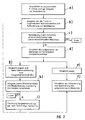
- Fig. 2 shows in more detail the sequence.
- the driver first selects the function to be changed or the desired function of the change underlying the change as already described or input the change depending on the type of function, for example an alteration of the system intervention threshold of the adaptive cruise control system for example, to 0.5 seconds (such engagement would allow for a closer approach until the system intervenes with a distance control).
- the controller 4 Upon the selection is now checked by the controller 4, if the selected function is "critical" nature and requires an active confirmation for release or setting, or whether the selected function package contains such or it is attributed such a status. If this is the case, as shown in step b), one of the function or the function package associated warning information is output to the monitor 6, which indicates the dangers or problems associated with the desired change.
- a request is issued which prompts the driver to actively give an acknowledgment signal.
- step c) the driver who has expressed the change request now gives the corresponding confirmation signal by recording a biometric or person-specific distinctive feature, for example the fingerprint or an iris or face scan, which is recorded via the corresponding detection means 7.
- a biometric or person-specific distinctive feature for example the fingerprint or an iris or face scan
- the driver is for example given a specific time interval of e.g. 30 seconds available. If the feature is not recorded within this time, the function setting will never occur, the setting process will be aborted (end).
- step d) the control device 4 makes a comparison between the recorded feature and a comparison feature previously stored at any time, ie also a previously recorded fingerprint or iris scan, etc.
- a comparison feature previously stored at any time, ie also a previously recorded fingerprint or iris scan, etc.
- step f) If the comparison is positive, ie if the fingerprints match, for example, as shown in step e), then in step f) the desired change of the function or the setting of the changed function is performed, at the same time the recorded feature in the control device 4 in order to be able to read it out later, if necessary, for purposes of verification that the driver has actually actively given the confirmation.
- step h a second warning information is issued, which indicates the driver, and offers him the possibility of assigning the comparison feature. It may be the case that the driver desires such a change for the first time, whereby naturally no comparison feature can be assigned here. If the driver so wishes, he can confirm this, for example by pressing a button or by re-recording the fingerprint, etc., after which the comparison feature is assigned, as shown in step i). The driver "authorizes" in this case so for the first time by assignment of the comparison feature. If he does not wish to do so and if he does not enter a command within the specified period of time, the process is terminated (end).
- step f) the change in step f) and the storage of the feature can be made immediately, as shown by the solid line to step f).
- step b) it is possible, as shown by the dashed line to step b) to issue the first warning again to alert the driver directly to the effects associated with the change and stop to confirm the change request by the feature recording, after which Steps c) - f) are processed.
- the controller 4 receives a corresponding signal, which results in all changes made previously being reset and the vehicle as a whole being reset to a default state.
- steps c) - f) expire, or - should his comparison feature not also be deposited with the changed functions (several persons may have deposited their individual comparison feature for a function or a function package) - the steps c), d) and g) - i).
Landscapes
- Engineering & Computer Science (AREA)
- Automation & Control Theory (AREA)
- Mechanical Engineering (AREA)
- Auxiliary Drives, Propulsion Controls, And Safety Devices (AREA)
- Lock And Its Accessories (AREA)
Claims (10)
- Procédé de changement d'au moins une fonction réglable d'un véhicule automobile,
caractérisé en ce que,
lors de l'accomplissement du changement selon la fonction choisie à modifier, une information d'avertissement optique et / ou acoustique spécifique à la fonction est émise, qui doit être confirmée de manière active par le conducteur par l'enregistrement d'au moins une caractéristique biométrique ou d'une autre caractéristique indubitable propre à l'individu à l'aide d'un système de saisie, après quoi la caractéristique enregistrée est comparée avec une caractéristique de comparaison affectée à la fonction, et en fonction du résultat de la comparaison, le cas échéant, une mémorisation rémanente de la caractéristique est effectuée et la modification souhaitée est réalisée ou non. - Procédé selon la revendication 1
caractérisé en ce que,
en tant que caractéristique biométrique, on enregistre une empreinte digitale, l'iris, la forme du visage ou une réponse vocale. - Procédé selon la revendication 1 ou 2,
caractérisé en ce que,
plusieurs fonctions définies en usine ou par le conducteur en tant qu'un paquet de fonctions - auxquelles une caractéristique de comparaison se référant au paquet est affectée et parmi lesquelles au moins une nécessite la confirmation active du conducteur - peuvent être modifiées de manière commune. - Procédé selon l'une des revendications précédentes,
caractérisé en ce que,
en cas de besoin, le conducteur peut affecter automatiquement la caractéristique de comparaison. - Procédé selon l'une des revendications précédentes,
caractérisé en ce que,
lors d'une modification non réalisée suite au résultat de la comparaison, une seconde information est émise, qui informe le conducteur du défaut de la caractéristique de comparaison, à la suite de quoi le conducteur peut obtenir de manière active l'affectation, après éventuellement un nouvel enregistrement de la caractéristique, la modification s'ensuivant alors. - Procédé selon l'une des revendications précédentes,
caractérisé en ce que,
lors de l'arrêt du moteur du véhicule automobile, la modification réalisée est annulée et la fonction est réinitialisée sur le réglage de base. - Procédé selon l'une des revendications précédentes,
caractérisé en ce que,
en cas d'une situation de service détectée par l'intermédiaire de moyens de détection appropriés, qui laisse conclure à un abandon du véhicule automobile par le conducteur, malgré le fait que le moteur tourne toujours, la modification réalisée est annulée et la fonction est réinitialisée à un réglage de base. - Procédé selon la revendication 7
caractérisé en ce que,
il est reconnu une situation de service déclenchant la remise à zéro lors d'un arrêt détecté du véhicule automobile et d'une ouverture simultanée de la porte du conducteur ou lors d'une décharge du siège du véhicule du poids du conducteur. - Procédé selon l'une des revendications précédentes,
caractérisé en ce que,
en même temps que l'affectation de la caractéristique de comparaison à une fonction modifiée personnalisée au conducteur ou un paquet de fonctions, le conducteur entre également son nom pour l'archivage associé, lequel nom est affiché, après une modification réalisée de la fonction respective, sur un écran de visualisation pour une individualisation visible optiquement du réglage de la fonction. - Véhicule automobile, réalisé pour la remise en oeuvre du procédé conformément à l'une des revendications 1 à 9.
Applications Claiming Priority (2)
| Application Number | Priority Date | Filing Date | Title |
|---|---|---|---|
| DE102004019829 | 2004-04-23 | ||
| DE200410019829 DE102004019829B3 (de) | 2004-04-23 | 2004-04-23 | Verfahren zum Verändern wenigstens einer einstellbaren Funktion eines Kraftfahrzeugs |
Publications (2)
| Publication Number | Publication Date |
|---|---|
| EP1588901A1 EP1588901A1 (fr) | 2005-10-26 |
| EP1588901B1 true EP1588901B1 (fr) | 2007-01-24 |
Family
ID=34801987
Family Applications (1)
| Application Number | Title | Priority Date | Filing Date |
|---|---|---|---|
| EP20050007355 Expired - Lifetime EP1588901B1 (fr) | 2004-04-23 | 2005-04-05 | Procédé de changement d'au moins une fonction réglable d'un véhicule automobile |
Country Status (2)
| Country | Link |
|---|---|
| EP (1) | EP1588901B1 (fr) |
| DE (2) | DE102004019829B3 (fr) |
Families Citing this family (4)
| Publication number | Priority date | Publication date | Assignee | Title |
|---|---|---|---|---|
| DE102008009427B4 (de) | 2008-02-15 | 2021-07-29 | Continental Automotive Gmbh | Verfahren zum Schutz eines Infotainmentsystems eines Fahrzeugs vor unberechtigtem Zugriff |
| DE102016206311B4 (de) | 2016-04-14 | 2019-12-05 | Volkswagen Aktiengesellschaft | Verfahren für ein Fahrzeug |
| DE102017202257B4 (de) | 2017-02-13 | 2021-08-05 | Ford Global Technologies, Llc | Anzeigevorrichtung für ein Kraftfahrzeug, Kraftfahrzeug und Verfahren zur individuellen Einstellung eines Displays |
| DE102023125708A1 (de) | 2023-09-22 | 2025-03-27 | Dr. Ing. H.C. F. Porsche Aktiengesellschaft | Verfahren zum fahrerwechselbasierten Reagieren auf eine Einstellung einer Funktion eines Fahrzeugs |
Family Cites Families (10)
| Publication number | Priority date | Publication date | Assignee | Title |
|---|---|---|---|---|
| JPH03135853A (ja) * | 1989-10-20 | 1991-06-10 | Hitachi Ltd | 自動車用制御装置および自動車制御方法 |
| US5513107A (en) * | 1992-12-17 | 1996-04-30 | Ford Motor Company | Methods and apparatus for controlling operating subsystems of a motor vehicle |
| DE19640694A1 (de) * | 1996-10-02 | 1998-04-09 | Bosch Gmbh Robert | Verfahren und Vorrichtung zur Steuerung der Fahrgeschwindigkeit eines Fahrzeugs |
| DE19728226A1 (de) * | 1997-07-02 | 1999-01-07 | Zahnradfabrik Friedrichshafen | Benutzerspezifisches Fahrzeug |
| DE19860112A1 (de) * | 1998-12-23 | 2000-07-27 | Mannesmann Vdo Ag | Verfahren zur Anpassung von Parametern einer Steuereinheit eines Fahrzeuges |
| US6370471B1 (en) * | 1999-04-09 | 2002-04-09 | Robert Bosch Gmbh | Automatic following guidance system for motor vehicles |
| DE10021068A1 (de) * | 2000-04-28 | 2001-10-31 | Bosch Gmbh Robert | Vorrichtung und Verfahren zur benutzerspezifischen Einstellung eines Gerätes, insbesondere eines Kraftfahrzeuges |
| DE10066078B4 (de) * | 2000-08-26 | 2005-01-20 | Audi Ag | Personalisierungsvorrichtung und Personalisierungsverfahren zur benutzerabhängigen Einstellung von Parameterwerten |
| DE10046832B4 (de) * | 2000-09-20 | 2011-02-03 | Daimler Ag | Vorrichtung und Verfahren zur Erfassung von Fahrdaten eines Kraftfahzeuges mit einem elektronisch ansteuerbaren Antriebsstrang |
| DE10059792B4 (de) * | 2000-12-01 | 2013-02-21 | Volkswagen Ag | Verstelleinrichtung für eine Abstandsregelung |
-
2004
- 2004-04-23 DE DE200410019829 patent/DE102004019829B3/de not_active Expired - Fee Related
-
2005
- 2005-04-05 DE DE200550000341 patent/DE502005000341D1/de not_active Expired - Lifetime
- 2005-04-05 EP EP20050007355 patent/EP1588901B1/fr not_active Expired - Lifetime
Also Published As
| Publication number | Publication date |
|---|---|
| DE102004019829B3 (de) | 2005-08-18 |
| EP1588901A1 (fr) | 2005-10-26 |
| DE502005000341D1 (de) | 2007-03-15 |
Similar Documents
| Publication | Publication Date | Title |
|---|---|---|
| EP3428030B1 (fr) | Procédé de réglage d'au moins un paramètre de fonctionnement d'un véhicule automobile, système de réglage d'au moins un paramètre de fonctionnement d'un véhicule automobile et véhicule automobile | |
| DE102010022433A1 (de) | Verfahren zur Steuerung des Betriebs eines vollautomatischen, zur unabhängigen Fahrzeugführung ausgebildeten Fahrerassistenzsystems eines Kraftfahrzeugs und Kraftzeug | |
| WO2017097509A1 (fr) | Procédé de fonctionnement d'un véhicule | |
| WO2014040930A1 (fr) | Procédé et dispositif de commande d'un composant d'automobile au moyen de gestes | |
| DE19529571A1 (de) | Bediengerät | |
| EP3494021B1 (fr) | Procédé d'adaptation d'une interface homme-machine dans un véhicule à moteur, et véhicule à moteur | |
| EP4017752B1 (fr) | Procédé de fourniture d'une navigation d'utilisateur individuelle pour au moins un élément fonctionnel d'un véhicule automobile pour un utilisateur dans le véhicule automobile, et système de navigation d'utilisateur électronique | |
| DE102012105285A1 (de) | Verfahren und ein System zum Assistieren eines Fahrers eines Kraftfahrzeugs | |
| WO2021023468A1 (fr) | Dispositif et procédé de commande d'un siège passager dans un véhicule | |
| DE102020109366A1 (de) | Verfahren zur individuellen Anpassung eines Fahrzeugs, System zur individuellen Anpassung eines Fahrzeugs, Komponente für ein Fahrzeug, Mensch-Maschine-Interface und Auswertungseinrichtung | |
| EP3983254A1 (fr) | Dispositif de réglage pour l'activation ou la désactivation d'au moins un système d'aide à la conduite et/ou d'au moins un mode de conduite pour une conduite autonome | |
| DE102006052481A1 (de) | Verfahren und Vorrichtung zum Betreiben eines Fahrzeugs mit mindestens einem Fahrassistenzsystem | |
| EP4031397A1 (fr) | Procédé pour un affichage commandé par la situation d'un élément d'actionnement | |
| DE102013015204B4 (de) | Verfahren und System zum Betreiben wenigstens einer Anzeigeeinrichtung eines Kraftwagens sowie Kraftwagen mit einem System zum Betreiben wenigstens einer Anzeigeeinrichtung | |
| DE102020211549A1 (de) | Automatisches Auswählen einer aus einer Mehrzahl von Parkassistenzfunktionen bei einem Kraftfahrzeug | |
| EP4366998A1 (fr) | Procédé de détermination d'un temps d'arrêt pour un véhicule à moteur automatisé | |
| DE10308415B3 (de) | Verfahren zur Steuerung einer Sitzeinstellung | |
| EP1588901B1 (fr) | Procédé de changement d'au moins une fonction réglable d'un véhicule automobile | |
| DE102017103391A1 (de) | Verfahren zur Verbesserung der Benutzerfreundlichkeit eines Fahrzeugs | |
| WO2021023728A1 (fr) | Procédé permettant de fournir une fonction d'une unité fonctionnelle d'un véhicule automobile, système d'assistance et véhicule automobile | |
| DE102015204365A1 (de) | Vorrichtung und Verfahren zum autonomen oder teilautonomen Steuern eines Fahrzeugs | |
| DE102017117094A1 (de) | Individualisierbare Darstellung einer Umgebung eines Kraftfahrzeugs durch eine Fahrerassistenzvorrichtung | |
| DE102018123155A1 (de) | Verfahren für eine Benutzer-Fahrzeug-Schnittstelle und Benutzer-Fahrzeug-Schnittstelle | |
| DE102021121660A1 (de) | Verfahren zum Feststellen einer Fahrtüchtigkeit eines Fahrers eines Kraftfahrzeugs | |
| DE102020201520A1 (de) | Vorrichtung und Verfahren zur haptischen Interaktion eines Fahrzeuginsassen mit einem Fahrzeug |
Legal Events
| Date | Code | Title | Description |
|---|---|---|---|
| PUAI | Public reference made under article 153(3) epc to a published international application that has entered the european phase |
Free format text: ORIGINAL CODE: 0009012 |
|
| AK | Designated contracting states |
Kind code of ref document: A1 Designated state(s): AT BE BG CH CY CZ DE DK EE ES FI FR GB GR HU IE IS IT LI LT LU MC NL PL PT RO SE SI SK TR |
|
| AX | Request for extension of the european patent |
Extension state: AL BA HR LV MK YU |
|
| 17P | Request for examination filed |
Effective date: 20060426 |
|
| AKX | Designation fees paid |
Designated state(s): DE FR GB IT |
|
| GRAP | Despatch of communication of intention to grant a patent |
Free format text: ORIGINAL CODE: EPIDOSNIGR1 |
|
| GRAS | Grant fee paid |
Free format text: ORIGINAL CODE: EPIDOSNIGR3 |
|
| GRAA | (expected) grant |
Free format text: ORIGINAL CODE: 0009210 |
|
| AK | Designated contracting states |
Kind code of ref document: B1 Designated state(s): DE FR GB IT |
|
| REG | Reference to a national code |
Ref country code: GB Ref legal event code: FG4D Free format text: NOT ENGLISH |
|
| REF | Corresponds to: |
Ref document number: 502005000341 Country of ref document: DE Date of ref document: 20070315 Kind code of ref document: P |
|
| ET | Fr: translation filed | ||
| GBT | Gb: translation of ep patent filed (gb section 77(6)(a)/1977) |
Effective date: 20070426 |
|
| PLBE | No opposition filed within time limit |
Free format text: ORIGINAL CODE: 0009261 |
|
| STAA | Information on the status of an ep patent application or granted ep patent |
Free format text: STATUS: NO OPPOSITION FILED WITHIN TIME LIMIT |
|
| 26N | No opposition filed |
Effective date: 20071025 |
|
| REG | Reference to a national code |
Ref country code: FR Ref legal event code: PLFP Year of fee payment: 12 |
|
| REG | Reference to a national code |
Ref country code: FR Ref legal event code: PLFP Year of fee payment: 13 |
|
| REG | Reference to a national code |
Ref country code: FR Ref legal event code: PLFP Year of fee payment: 14 |
|
| PGFP | Annual fee paid to national office [announced via postgrant information from national office to epo] |
Ref country code: IT Payment date: 20220429 Year of fee payment: 18 Ref country code: GB Payment date: 20220425 Year of fee payment: 18 Ref country code: FR Payment date: 20220425 Year of fee payment: 18 Ref country code: DE Payment date: 20220430 Year of fee payment: 18 |
|
| P01 | Opt-out of the competence of the unified patent court (upc) registered |
Effective date: 20230529 |
|
| REG | Reference to a national code |
Ref country code: DE Ref legal event code: R119 Ref document number: 502005000341 Country of ref document: DE |
|
| GBPC | Gb: european patent ceased through non-payment of renewal fee |
Effective date: 20230405 |
|
| PG25 | Lapsed in a contracting state [announced via postgrant information from national office to epo] |
Ref country code: GB Free format text: LAPSE BECAUSE OF NON-PAYMENT OF DUE FEES Effective date: 20230405 |
|
| PG25 | Lapsed in a contracting state [announced via postgrant information from national office to epo] |
Ref country code: GB Free format text: LAPSE BECAUSE OF NON-PAYMENT OF DUE FEES Effective date: 20230405 Ref country code: FR Free format text: LAPSE BECAUSE OF NON-PAYMENT OF DUE FEES Effective date: 20230430 Ref country code: DE Free format text: LAPSE BECAUSE OF NON-PAYMENT OF DUE FEES Effective date: 20231103 |
|
| PG25 | Lapsed in a contracting state [announced via postgrant information from national office to epo] |
Ref country code: IT Free format text: LAPSE BECAUSE OF NON-PAYMENT OF DUE FEES Effective date: 20230405 |