EP1592273A2 - Verfahren und Vorrichtung zum Erstellen eines Signalstärkenmodells für einen zugangpunkt in einer willkürlchen Position - Google Patents
Verfahren und Vorrichtung zum Erstellen eines Signalstärkenmodells für einen zugangpunkt in einer willkürlchen Position Download PDFInfo
- Publication number
- EP1592273A2 EP1592273A2 EP05251223A EP05251223A EP1592273A2 EP 1592273 A2 EP1592273 A2 EP 1592273A2 EP 05251223 A EP05251223 A EP 05251223A EP 05251223 A EP05251223 A EP 05251223A EP 1592273 A2 EP1592273 A2 EP 1592273A2
- Authority
- EP
- European Patent Office
- Prior art keywords
- signal strength
- access point
- arbitrary location
- model
- sampling points
- Prior art date
- Legal status (The legal status is an assumption and is not a legal conclusion. Google has not performed a legal analysis and makes no representation as to the accuracy of the status listed.)
- Withdrawn
Links
Images


Classifications
-
- H—ELECTRICITY
- H04—ELECTRIC COMMUNICATION TECHNIQUE
- H04W—WIRELESS COMMUNICATION NETWORKS
- H04W16/00—Network planning, e.g. coverage or traffic planning tools; Network deployment, e.g. resource partitioning or cells structures
- H04W16/18—Network planning tools
-
- H—ELECTRICITY
- H04—ELECTRIC COMMUNICATION TECHNIQUE
- H04W—WIRELESS COMMUNICATION NETWORKS
- H04W16/00—Network planning, e.g. coverage or traffic planning tools; Network deployment, e.g. resource partitioning or cells structures
- H04W16/18—Network planning tools
- H04W16/20—Network planning tools for indoor coverage or short range network deployment
-
- H—ELECTRICITY
- H04—ELECTRIC COMMUNICATION TECHNIQUE
- H04W—WIRELESS COMMUNICATION NETWORKS
- H04W24/00—Supervisory, monitoring or testing arrangements
- H04W24/02—Arrangements for optimising operational condition
Definitions
- the present invention relates generally to techniques for determining the placement of wireless access points (APs) in a wireless network, and more particularly, to methods and apparatus for estimating the signal strength coverage for a wireless access point.
- APs wireless access points
- Wireless networks such as wireless local area networks (WLANs) based on the IEEE 802.11 standard, have been widely deployed in many enterprises, primary to provide wireless data access from portable devices, such as laptop computers and personal digital assistants (PDAs), to the wired infrastructure of the enterprise.
- PDAs personal digital assistants
- an infrastructure-mode wireless LAN is to be deployed in a specific area, e.g., an enterprise facility, it is necessary to appropriately place wireless access points to which terminals associate. Since the coverage range of a single access point is limited, typical installations in enterprises consist of multiple access points. Since bad signal reception leads to unacceptable network behavior, such as insufficient overall throughput, adequate signal coverage throughout the area must be ensured.
- a number of techniques have been proposed or suggested for determining the placement of access points for a wireless network.
- An important aspect of such techniques is determining the expected signal strength coverage of an access point if it were to be placed at a specified location at the site.
- such tools estimate signal strength coverage given an expected location for an access point based on an analytical radio propagation model.
- the model takes into account radio signal propagation, augmented with information about the number of walls and other obstructions in the signal path, as well as the material and other characteristics of the obstructions. This typically requires a detailed floor plan of the building with information about signal reflectors and obstructors in the floor plan.
- a technique is disclosed for constructing a signal strength model for an existing access point, based on actual signal strength measurements of this access point at several sampling points. The signal strength model can then be used to predict the estimated signal strength from the access point at any point of the site.
- a method and apparatus are provided for obtaining a signal strength model for an access point at an arbitrary location, q, at a site.
- Signal strength measurements are obtained for each of n sampling points; the signal strength received at the arbitrary location, q, is computed from each of said sampling points (for example, using reciprocity principles); signal strength estimates corresponding to the signal received at the sampling points from the arbitrary location are computed; and a signal strength model is determined for an access point positioned at the arbitrary location, q.
- the signal strength model can be determined, for example, by smoothing the obtained signal strength measurements into a set (for example, using a generalized additive model (GAM)); dividing the site into a grid of squares of known size; and interpolating the set across two dimensions (for example, using an Akima spline interpolation) to form a scalar array to estimate the received signal strength at the center of each grid square.
- the scalar array comprises the signal strength model for an access point positioned at the arbitrary location, q.
- a signal strength model is obtained for an access point at an arbitrary location, q, at a site by (i) obtaining signal strength measurements for each of n sampling points; for each sampling point, (ii) generating a model for the signal strength received at the sampling point when the access point is placed at an arbitrary location, q; (iii) computing a signal strength received at the n sampling points when the access point is placed at the arbitrary location, q; and (iv) determining the signal strength model for the access point positioned at the arbitrary location, q.
- the present invention provides a new non-parametric modeling technique for constructing a signal strength model for an access point at a random location within a site, without placing a real access point at the desired location and obtaining measurements.
- the present invention obtains sample measurements from several fixed access points in a novel way to compute a signal coverage model for an access point at a random location.
- the disclosed signal strength model automatically takes into account the signal strength propagation characteristics of the site and also allows for an efficient deployment methodology.
- FIG. 1 illustrates a conventional wireless network environment 100 in which the present invention can be employed.
- the wireless network environment 100 comprises a wireless device 101 and access points 102-1 through 102-L.
- Wireless device 101 uses the access points 102 to exchange blocks of data, or packets, with other devices, such as servers that are external to the wireless network 100.
- the wireless device 101 is associated with one of the access points 102 for the purpose of communicating with another device.
- FIG. 2 is a schematic diagram illustrating a floor plan of an exemplary site 200.
- the signal strength is measured of the access point at each of the n sample locations 210-1 through 210-8 (n is 8 in the exemplary embodiment shown in FIG. 2).
- the received signal strength is evaluated by either using a sniffer to record signal strength on received packets (e.g., beacons) from the access point 250, or making the access point 250 transmit a packet by specifically probing the access point 250.
- the sampling points are uniformly distributed throughout the site 200.
- the obtained signal strength measurements are then optionally smoothed using a technique based on generalized additive models, for example, as described in T. Hastie and R. Tibshirani, "Generalized Additive Models,” Chapman and Hall (1990).
- the smoothed signal strength values are then interpolated, e.g., using Akima splines, as described, for example, in H. Akima, "Algorithm 761: Scattered-Data Surface Fitting that has the Accuracy of Cubic Polynomial," ACM Transactions on Mathematical Software, Vol. 22, No. 3, 362-71 (Sept., 1996); H.
- Akima "Algorithm 760: Rectangular-Grid-Data Surface Fitting that has the Accuracy of Bicubic Polynomial,” ACM Transactions on Mathematical Software, Vol. 22, No. 3, 357-61 (Sept. 1996); H. Akima, "A New Method of Interpolation and Smooth Curve Fitting Based on Local Procedures,” Journal of the ACM, Vol. 17, No. 4, 589-602 (Oct. 1970).
- Akima spline interpolation does a bivariate interpolation and is a local, triangle-based technique with many desirable properties including local containment of discontinuities.
- A denote the area of interest and let S represent the set of all possible signal strength values.
- Q ⁇ ( 1 , p 1 ),..., (s n ,, p n ,) ⁇ , where s i is the signal strength measured at point p i , 1 ⁇ i ⁇ n.
- the interpolation-based method yields a function (model), E Q q : A ⁇ S , that maps each point in the area of interest to a signal strength value obtained via smoothing and interpolation from the input measurements Q .
- E x / q denotes the model where q denotes the location of the access point and q and X taken together in context describe the measurement set used as input.
- E P / q denotes the model.
- the model can then be used to predict the estimated signal strength from the access point at any point on the floor of the site, in accordance with the present invention.
- the above technique provides a signal strength model for an access point if actual samples of signal strength for the access point are available. Since the sample signal strength measurements at points p 1 ,..., p n were for signal strengths from an access point at a specific location 250, they can only be used to compute a model for an access point at this location.
- the present invention provides a technique for generating a model without having actual measurements for an access point.
- the present invention generates a model for an access point at a random location without placing a real access point at the desired location and taking measurements.
- a signal strength model is generated by placing access points (transceivers) at specific locations and collecting signal strength samples of these access points. These samples are then used to build signal strength models for each of these access points using the method outlined above for estimating the signal strength for an access point at a known location. Then, the models for these access points are used collectively to build a model for a hypothetical access point at another potential location.
- FIG. 3 is a schematic diagram illustrating a floor plan of an exemplary site 300. As shown in FIG. 3, the signal strength is measured by placing access points at specific locations 310-1 through 310-8 ( n is 8 in the exemplary embodiment shown in FIG. 3). The present invention provides a technique for estimating the signal strength model for a possible location 350 of an access point.
- n x n matrix M of signal strengths is obtained, where M(i, j ) specifies the signal strength measured at location p i from the access point at location p j .
- the previous section described a method for building a signal propagation model E P / Pj for the access point at location p j by using the column M ( ⁇ , j ) of matrix M .
- This model provides an estimated signal strength E P / Pj (r) at point r . Since the model is built using actual sampling of signal strengths, it takes into account the building characteristics of the site automatically.
- the above technique can be modified such that it does not use the reciprocity principle.
- models are first built by using the rows M( j, ⁇ ) of matrix M (instead of the columns). Intuitively, these models capture the effect of moving an access point while fixing the location where signal strength is measured. These models can then be used collectively as before to build a model for a hypothetical access point at a location, as would be apparent to a person of ordinary skill in the art based on the present disclosure.
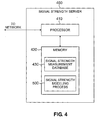
- FIG. 4 is a schematic block diagram of an exemplary signal strength server 400 incorporating features of the present invention.
- the signal strength server 400 may be any computing device, such as a personal computer, work station or server.
- the exemplary signal strength server 400 includes a processor 410 and a memory 420, in addition to other conventional elements (not shown).
- the processor 410 operates in conjunction with the memory 420 to execute one or more software programs. Such programs may be stored in memory 420 or another storage device accessible to the signal strength server 400 and executed by the processor 410 in a conventional manner.
- the memory 420 may store a signal strength measurement database 430 that comprises, e.g., the n x n matrix M of measured signal strengths for the n sampling points p 1 ,..., p n .
- the memory 420 may store a signal strength modeling process 500, discussed below in conjunction with FIG. 5.
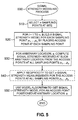
- the signal strength modeling process 500 processes the signal strength measurements obtained at n sampling points and synthesizes the input that would have been collected at an arbitrary point q to build a signal strength model for the arbitrary point q.
- FIG. 5 is a flow chart describing an exemplary implementation of the signal strength modeling process 500.
- the signal strength modeling process 500 initially selects n sampling points p 1 ,..., p n at the site during step 510. Thereafter, for each of the n sampling points p 1 ,..., p n , a signal strength model is built during step 520 by placing an access point at each sampling point p 1 ,..., p n .
- the signal strength received at such arbitrary location is computed from the access points at all sampling points p 1 ,..., p n during step 530. Reciprocity principles are optionally applied during step 540 to get n signal strength measurements corresponding to the access points at all sampling points p 1 ,..., p n . Finally, the model algorithm described above for fixed locations is applied during step 550 to get a signal strength model for an access point positioned at the arbitrary location, q .
- a signal strength model can be generated during step 550 for an access point positioned at the arbitrary location, q , as follows, using the signal strength measurements that were synthesized during step 540:
- the present invention can be deployed, for example, using battery operated devices with small form factor that can wirelessly transmit and receive packets and measure received signal strength for applicable wireless technologies.
- Such devices are referred to as Wireless Auxiliary Receive/Transmit Stations (WARTS).
- WARTS Wireless Auxiliary Receive/Transmit Stations
- the WARTS devices can send a stream of packets, receive packets from other wireless devices, and in particular, from other WARTS devices, and record signal strength for received packets.
- sniffer/signal strength measurement devices can be used, such as those described in S. Ganu et al., "Infrastructure-Based Location Estimation in WLAN Networks," Proc. of IEEE Conference on Wireless Communications and Networking Conference 2004, Atlanta, GA (2004).
- the WARTS devices can be affixed to appropriate locations at a site and powered up by the administrator.
- the WARTS devices could employ an appropriate protocol (e.g., using standard ad-hoc networking principles) to collect all necessary data automatically, in particular the matrix M described above. The collected data can then be used off-line. It is also possible to extend the technique to estimate characteristics other than basic signal strength as presented above. For example, the following estimations are possible: (i) measurements for several different access point transmit powers, (ii) observed data rate, and (iii) measurements for different wireless technologies, e.g., 802.11 a/b/g.
- the methods and apparatus discussed herein may be distributed as an article of manufacture that itself comprises a computer readable medium having computer readable code means embodied thereon.
- the computer readable program code means is operable, in conjunction with a computer system, to carry out all or some of the steps to perform the methods or create the apparatuses discussed herein.
- the computer readable medium may be a recordable medium (e.g., floppy disks, hard drives, compact disks, or memory cards) or may be a transmission medium (e.g., a network comprising fiber-optics, the world-wide web, cables, or a wireless channel using time-division multiple access, code-division multiple access, or other radiofrequency channel). Any medium known or developed that can store information suitable for use with a computer system may be used.
- the computer-readable code means is any mechanism for allowing a computer to read instructions and data, such as magnetic variations on a magnetic media or height variations on the surface of a compact disk.
- the computer systems and servers described herein each contain a memory that will configure associated processors to implement the methods, steps, and functions disclosed herein.
- the memories could be distributed or local and the processors could be distributed or singular.
- the memories could be implemented as an electrical, magnetic or optical memory, or any combination of these or other types of storage devices.
- the term "memory" should be construed broadly enough to encompass any information able to be read from or written to an address in the addressable space accessed by an associated processor. With this definition, information on a network is still within a memory because the associated processor can retrieve the information from the network.
Landscapes
- Engineering & Computer Science (AREA)
- Computer Networks & Wireless Communication (AREA)
- Signal Processing (AREA)
- Mobile Radio Communication Systems (AREA)
- Position Fixing By Use Of Radio Waves (AREA)
Applications Claiming Priority (2)
| Application Number | Priority Date | Filing Date | Title |
|---|---|---|---|
| US834291 | 2004-04-28 | ||
| US10/834,291 US7583961B2 (en) | 2004-04-28 | 2004-04-28 | Method and apparatus for generating a signal strength model for an access point at an arbitrary location |
Publications (2)
| Publication Number | Publication Date |
|---|---|
| EP1592273A2 true EP1592273A2 (de) | 2005-11-02 |
| EP1592273A3 EP1592273A3 (de) | 2008-09-03 |
Family
ID=34940532
Family Applications (1)
| Application Number | Title | Priority Date | Filing Date |
|---|---|---|---|
| EP05251223A Withdrawn EP1592273A3 (de) | 2004-04-28 | 2005-03-01 | Verfahren und Vorrichtung zum Erstellen eines Signalstärkenmodells für einen zugangpunkt in einer willkürlchen Position |
Country Status (6)
| Country | Link |
|---|---|
| US (1) | US7583961B2 (de) |
| EP (1) | EP1592273A3 (de) |
| JP (1) | JP2005318603A (de) |
| KR (1) | KR20060047566A (de) |
| CN (1) | CN1691624A (de) |
| CA (1) | CA2497928C (de) |
Cited By (3)
| Publication number | Priority date | Publication date | Assignee | Title |
|---|---|---|---|---|
| WO2008044031A1 (en) * | 2006-10-13 | 2008-04-17 | Barmate Limited | Service request system |
| EP3634029A1 (de) * | 2018-10-01 | 2020-04-08 | Deutsche Telekom AG | Verfahren und kommunikationseinheit zur visualisierung eines abdeckungsbereichs eines drahtlosen kommunikationsnetzes |
| EP3993289A1 (de) * | 2020-10-28 | 2022-05-04 | HERE Global B.V. | Verfahren und vorrichtung zur beschleunigung der schätzung eines funkmodells eines zugangspunkts |
Families Citing this family (21)
| Publication number | Priority date | Publication date | Assignee | Title |
|---|---|---|---|---|
| KR100848322B1 (ko) | 2006-12-08 | 2008-07-24 | 한국전자통신연구원 | 실내 무선 측위 장치 및 방법 |
| US7904092B2 (en) * | 2007-01-04 | 2011-03-08 | Cisco Technology, Inc. | Locally adjusted radio frequency coverage maps in wireless networks |
| JP5027293B2 (ja) * | 2007-04-04 | 2012-09-19 | テレフオンアクチーボラゲット エル エム エリクソン(パブル) | 電気通信における無線ネットワーク計画、シミュレーションおよび解析を改善するための方法および装置 |
| US8185121B2 (en) * | 2007-08-31 | 2012-05-22 | Symbol Technologies, Inc. | Optimization of displayed RF coverage |
| KR100942051B1 (ko) * | 2007-10-30 | 2010-02-11 | 한국전자통신연구원 | 실내 위치결정방법 및 장치 |
| WO2009097447A1 (en) * | 2008-01-29 | 2009-08-06 | Rf Code, Inc. | Asset tracking system for electronic equipment |
| KR100946774B1 (ko) * | 2008-02-18 | 2010-03-11 | 영남대학교 산학협력단 | 무선랜 기반 측위를 위한 신호 세기 예측 방법 |
| US20090310544A1 (en) * | 2008-06-12 | 2009-12-17 | Praval Jain | Method and system for increasing throughput in a hierarchical wireless network |
| US7940715B2 (en) * | 2009-03-03 | 2011-05-10 | Src, Inc. | Entropic based activity passive detection and monitoring system |
| US8164444B2 (en) * | 2009-04-29 | 2012-04-24 | Healthsense, Inc. | Position detection |
| WO2011037939A1 (en) * | 2009-09-22 | 2011-03-31 | Jesse Caulfield | Method, system, and computer-readable medium for improved prediction of spectrum occupancy and estimation of radio signal field strength |
| CN103648105B (zh) * | 2009-10-27 | 2017-02-01 | 华为技术有限公司 | 一种无线局域网接入点部署方案的获得方法及系统 |
| CN102056180B (zh) * | 2009-10-27 | 2013-12-18 | 华为技术有限公司 | 一种无线局域网接入点部署方案的获得方法及系统 |
| KR101035226B1 (ko) | 2009-12-24 | 2011-05-18 | 경북대학교 산학협력단 | 무선신호 간섭 회피방법 및 그에 따른 무선 네트워크 시스템 |
| US8295846B2 (en) * | 2010-03-02 | 2012-10-23 | Sony Corporation | GPS-based CE device wireless access point mapping |
| US9888360B2 (en) | 2012-11-01 | 2018-02-06 | Qualcomm Incorporated | Methods to optimize and streamline AP placement on floor plan |
| US9184761B2 (en) * | 2013-03-01 | 2015-11-10 | Texas Instruments Incorporated | Asynchronous to synchronous sampling using Akima algorithm |
| EP3935581A4 (de) | 2019-03-04 | 2022-11-30 | Iocurrents, Inc. | Datenkompression und -kommunikation mit maschinenlernung |
| US11916630B2 (en) * | 2021-05-11 | 2024-02-27 | Here Global B.V. | Method and apparatus for accelerating estimation of a radio model of a beamforming access point |
| US12425871B2 (en) * | 2022-06-15 | 2025-09-23 | Caterpillar Inc. | Methods and systems for access point placement optimization in low-signal worksite environments |
| CN116975589B (zh) * | 2022-07-07 | 2025-10-31 | 中国移动通信集团设计院有限公司 | 网络场强预测的特征生成方法、装置、设备及存储介质 |
Family Cites Families (6)
| Publication number | Priority date | Publication date | Assignee | Title |
|---|---|---|---|---|
| US776058A (en) * | 1904-02-26 | 1904-11-29 | Charles F Heinze | Rotary engine. |
| US5987328A (en) * | 1997-04-24 | 1999-11-16 | Ephremides; Anthony | Method and device for placement of transmitters in wireless networks |
| US6119009A (en) | 1997-09-18 | 2000-09-12 | Lucent Technologies, Inc. | Method and apparatus for modeling the propagation of wireless signals in buildings |
| US6680924B2 (en) | 2000-12-14 | 2004-01-20 | Carnegie Mellon University | Method for estimating signal strengths |
| GB0105910D0 (en) | 2001-03-09 | 2001-04-25 | Cellular Design Services Ltd | Measurement-based prediction method for radiation path loss |
| JP2005525003A (ja) * | 2001-09-05 | 2005-08-18 | ニューベリイ ネットワークス,インコーポレーテッド | 無線ネットワークにおける位置検出および場所追跡 |
-
2004
- 2004-04-28 US US10/834,291 patent/US7583961B2/en not_active Expired - Lifetime
-
2005
- 2005-02-22 CA CA2497928A patent/CA2497928C/en not_active Expired - Fee Related
- 2005-03-01 EP EP05251223A patent/EP1592273A3/de not_active Withdrawn
- 2005-04-04 CN CNA2005100629870A patent/CN1691624A/zh active Pending
- 2005-04-27 JP JP2005128794A patent/JP2005318603A/ja not_active Abandoned
- 2005-04-28 KR KR1020050035398A patent/KR20060047566A/ko not_active Ceased
Cited By (4)
| Publication number | Priority date | Publication date | Assignee | Title |
|---|---|---|---|---|
| WO2008044031A1 (en) * | 2006-10-13 | 2008-04-17 | Barmate Limited | Service request system |
| EP3634029A1 (de) * | 2018-10-01 | 2020-04-08 | Deutsche Telekom AG | Verfahren und kommunikationseinheit zur visualisierung eines abdeckungsbereichs eines drahtlosen kommunikationsnetzes |
| EP3993289A1 (de) * | 2020-10-28 | 2022-05-04 | HERE Global B.V. | Verfahren und vorrichtung zur beschleunigung der schätzung eines funkmodells eines zugangspunkts |
| US11546779B2 (en) | 2020-10-28 | 2023-01-03 | Here Global B.V. | Method and apparatus for accelerating estimation of a radio model of an access point |
Also Published As
| Publication number | Publication date |
|---|---|
| CA2497928C (en) | 2010-04-06 |
| US20050245252A1 (en) | 2005-11-03 |
| KR20060047566A (ko) | 2006-05-18 |
| EP1592273A3 (de) | 2008-09-03 |
| JP2005318603A (ja) | 2005-11-10 |
| CN1691624A (zh) | 2005-11-02 |
| US7583961B2 (en) | 2009-09-01 |
| CA2497928A1 (en) | 2005-10-28 |
Similar Documents
| Publication | Publication Date | Title |
|---|---|---|
| US7583961B2 (en) | Method and apparatus for generating a signal strength model for an access point at an arbitrary location | |
| US8520647B2 (en) | Wireless client position estimating system and method | |
| US8270994B2 (en) | Applications of signal quality observations | |
| US7403784B2 (en) | Method and apparatus for positioning a set of terminals in an indoor wireless environment | |
| CA2638754C (en) | Position detection and location tracking in a wireless network | |
| US10375668B2 (en) | Time distance of arrival based mobile device location detection with disturbance scrutiny | |
| CN100591149C (zh) | 用于辅助无线节点定位的方法、装置和系统 | |
| US7196662B2 (en) | Probabilistic model for a positioning technique | |
| US7286835B1 (en) | Enhanced wireless node location using differential signal strength metric | |
| JP4934441B2 (ja) | 無線ノード位置推定方法、システム、及びその処理装置 | |
| EP1754385B1 (de) | Drahtloser knotenortungsmechanismus mit definition der suchregion zur optimierung der ortungsberechnung | |
| JP4207081B2 (ja) | 電波伝搬特性推定システム及びその方法並びにプログラム | |
| US20090196267A1 (en) | Systems and methods for providing location based services (lbs) utilizing wlan and/or gps signals for seamless indoor and outdoor tracking | |
| EP2488887A1 (de) | Klassifizierung von orten in kategorien nach ausbreitungseigenschaften | |
| TW201329486A (zh) | 定位方法 | |
| US20080080429A1 (en) | Minimum variance location estimation in wireless networks | |
| CN112462325B (zh) | 一种空间内定位方法、装置和存储介质 | |
| JP4162654B2 (ja) | 信号特性観測値の使用 | |
| CN115580825B (zh) | 一种基于WiFi定位获取室内位置的方法 | |
| US20220376803A1 (en) | Electromagnetic Propagation Modeling Calibration through Crowd-Sourced and Secondary Measurements | |
| CN100466852C (zh) | 用于无线网络的定位应用 | |
| O’Dell et al. | Lost in space or positioning in sensor networks | |
| Tohoiev | Determining the location of patients in remote rehabilitation by means of a wireless network | |
| Kappes et al. | Estimating signal strength coverage for a wireless access point | |
| KR20100016807A (ko) | 도로 측정 데이터를 이용한 건물 내부 전파환경 예측 방법 |
Legal Events
| Date | Code | Title | Description |
|---|---|---|---|
| PUAI | Public reference made under article 153(3) epc to a published international application that has entered the european phase |
Free format text: ORIGINAL CODE: 0009012 |
|
| AK | Designated contracting states |
Kind code of ref document: A2 Designated state(s): AT BE BG CH CY CZ DE DK EE ES FI FR GB GR HU IE IS IT LI LT LU MC NL PL PT RO SE SI SK TR |
|
| AX | Request for extension of the european patent |
Extension state: AL BA HR LV MK YU |
|
| PUAL | Search report despatched |
Free format text: ORIGINAL CODE: 0009013 |
|
| AK | Designated contracting states |
Kind code of ref document: A3 Designated state(s): AT BE BG CH CY CZ DE DK EE ES FI FR GB GR HU IE IS IT LI LT LU MC NL PL PT RO SE SI SK TR |
|
| AX | Request for extension of the european patent |
Extension state: AL BA HR LV MK YU |
|
| RAP1 | Party data changed (applicant data changed or rights of an application transferred) |
Owner name: AVAYA INC. |
|
| 17P | Request for examination filed |
Effective date: 20090303 |
|
| AKX | Designation fees paid |
Designated state(s): DE GB |
|
| STAA | Information on the status of an ep patent application or granted ep patent |
Free format text: STATUS: THE APPLICATION IS DEEMED TO BE WITHDRAWN |
|
| 18D | Application deemed to be withdrawn |
Effective date: 20101001 |