EP1594122A1 - Spreizspektrumwasserzeichen - Google Patents
Spreizspektrumwasserzeichen Download PDFInfo
- Publication number
- EP1594122A1 EP1594122A1 EP04090177A EP04090177A EP1594122A1 EP 1594122 A1 EP1594122 A1 EP 1594122A1 EP 04090177 A EP04090177 A EP 04090177A EP 04090177 A EP04090177 A EP 04090177A EP 1594122 A1 EP1594122 A1 EP 1594122A1
- Authority
- EP
- European Patent Office
- Prior art keywords
- signal
- watermark
- audio
- psycho
- watermark signal
- Prior art date
- Legal status (The legal status is an assumption and is not a legal conclusion. Google has not performed a legal analysis and makes no representation as to the accuracy of the status listed.)
- Withdrawn
Links
- 238000001228 spectrum Methods 0.000 title claims abstract description 25
- 238000007493 shaping process Methods 0.000 claims abstract description 60
- 230000005236 sound signal Effects 0.000 claims abstract description 44
- 230000002087 whitening effect Effects 0.000 claims abstract description 14
- 230000000873 masking effect Effects 0.000 claims description 21
- 230000003595 spectral effect Effects 0.000 claims description 20
- 238000000034 method Methods 0.000 claims description 16
- 238000011144 upstream manufacturing Methods 0.000 claims description 2
- 230000003247 decreasing effect Effects 0.000 abstract description 3
- 238000005516 engineering process Methods 0.000 abstract description 3
- 230000002596 correlated effect Effects 0.000 abstract 1
- 230000006870 function Effects 0.000 description 15
- 238000012545 processing Methods 0.000 description 5
- 230000005540 biological transmission Effects 0.000 description 2
- 230000001419 dependent effect Effects 0.000 description 2
- 238000003780 insertion Methods 0.000 description 2
- 230000037431 insertion Effects 0.000 description 2
- 238000012360 testing method Methods 0.000 description 2
- 238000004891 communication Methods 0.000 description 1
- 238000001514 detection method Methods 0.000 description 1
- 230000000694 effects Effects 0.000 description 1
- 238000002372 labelling Methods 0.000 description 1
- 238000012986 modification Methods 0.000 description 1
- 230000004048 modification Effects 0.000 description 1
- 238000012544 monitoring process Methods 0.000 description 1
- 238000011084 recovery Methods 0.000 description 1
- 238000005070 sampling Methods 0.000 description 1
Images

Classifications
-
- G—PHYSICS
- G11—INFORMATION STORAGE
- G11B—INFORMATION STORAGE BASED ON RELATIVE MOVEMENT BETWEEN RECORD CARRIER AND TRANSDUCER
- G11B20/00—Signal processing not specific to the method of recording or reproducing; Circuits therefor
- G11B20/00086—Circuits for prevention of unauthorised reproduction or copying, e.g. piracy
-
- G—PHYSICS
- G11—INFORMATION STORAGE
- G11B—INFORMATION STORAGE BASED ON RELATIVE MOVEMENT BETWEEN RECORD CARRIER AND TRANSDUCER
- G11B20/00—Signal processing not specific to the method of recording or reproducing; Circuits therefor
- G11B20/00086—Circuits for prevention of unauthorised reproduction or copying, e.g. piracy
- G11B20/00884—Circuits for prevention of unauthorised reproduction or copying, e.g. piracy involving a watermark, i.e. a barely perceptible transformation of the original data which can nevertheless be recognised by an algorithm
- G11B20/00891—Circuits for prevention of unauthorised reproduction or copying, e.g. piracy involving a watermark, i.e. a barely perceptible transformation of the original data which can nevertheless be recognised by an algorithm embedded in audio data
-
- G—PHYSICS
- G11—INFORMATION STORAGE
- G11B—INFORMATION STORAGE BASED ON RELATIVE MOVEMENT BETWEEN RECORD CARRIER AND TRANSDUCER
- G11B20/00—Signal processing not specific to the method of recording or reproducing; Circuits therefor
- G11B20/00086—Circuits for prevention of unauthorised reproduction or copying, e.g. piracy
- G11B20/00884—Circuits for prevention of unauthorised reproduction or copying, e.g. piracy involving a watermark, i.e. a barely perceptible transformation of the original data which can nevertheless be recognised by an algorithm
- G11B20/00913—Circuits for prevention of unauthorised reproduction or copying, e.g. piracy involving a watermark, i.e. a barely perceptible transformation of the original data which can nevertheless be recognised by an algorithm based on a spread spectrum technique
-
- G—PHYSICS
- G10—MUSICAL INSTRUMENTS; ACOUSTICS
- G10L—SPEECH ANALYSIS TECHNIQUES OR SPEECH SYNTHESIS; SPEECH RECOGNITION; SPEECH OR VOICE PROCESSING TECHNIQUES; SPEECH OR AUDIO CODING OR DECODING
- G10L19/00—Speech or audio signals analysis-synthesis techniques for redundancy reduction, e.g. in vocoders; Coding or decoding of speech or audio signals, using source filter models or psychoacoustic analysis
- G10L19/018—Audio watermarking, i.e. embedding inaudible data in the audio signal
Definitions
- the invention relates to a method and an apparatus for transmitting together with an audio or video signal watermark data using a spread spectrum, and for regaining watermark data embedded in a spread spectrum.
- Watermarking means imperceptible insertion of information into multimedia data, e.g. audio data and/or video data, i.e. watermark signals that are embedded in an audio signal should not be audible.
- additional information data such as a number or a text
- Watermarking can be used for e.g. copyright protection, labelling (e.g. URL of a site or a site's logo), monitoring, tamper proofing, or conditional access.
- Applying 'spread spectrum' in an (RF) communications system means that a small baseband signal bandwidth is intentionally spread over a larger bandwidth by injecting or adding a higher-frequency signal, or spreading function.
- Spread spectrum technology and the related inserted or added information signal can be used for implementing watermarking of e.g. digital audio signals.
- This spectrum carries the information of one watermark data symbol.
- PN pseudo-noise
- the spreading function or the PN sequence and the resulting signal have energy in a very broad frequency range. The wideness of this frequency band can be adjusted within the complete audio spectrum range from 0Hz to one half of the sampling frequency.
- This watermark signal must be large enough to be recoverable even in the presence of noise or 'attacks' between watermark encoder and watermark decoder, and it must be small enough to be inaudible or invisible.
- One solution in connection with audio signals is to shape the watermark signal according to psycho-acoustical laws, i.e. to reduce it in magnitude so that it has a level that is below the masking threshold, whereafter the shaped watermark signal is added to the original signal.
- a known processing for retrieving at receiver or decoder side the embedded watermark signal data from the spread spectrum is convolving or correlating the received or replayed spectrum with a spreading function or PN sequence that is - only for convolving - time-inverse with respect to the original spreading function or sequence, which kind of processing is also called 'applying a matched filter'.
- BPSK modulation was used for applying the spread spectrum function
- the output of this process is a peak at the middle of the sequence of correlation overlap-add values, whereby the sign of such peak represents the value of the desired watermark signal information bit.
- QPSK was used two peaks will be present in the sequence of correlation values, whereby each peak represents one bit value. Because in most cases the original signal is not available at receiver side the shaping in the spectral domain is to be reversed in order to increase the detectability of the embedded watermark signal, e.g. by a applying reversed psycho-acoustic processing.
- a problem to be solved by the invention is to reduce the audibility of the embedded watermark signals but to keep the reliability of the detection of the embedded watermark signals.
- This problem is solved by the method disclosed in claim 1.
- An apparatus that utilises this method is disclosed in claim 2.
- a signal generated in accordance with this method is disclosed in claim 3.
- the watermark signal is not only shaped according to psycho-acoustic principles, but is additionally, or effectively, shaped based on the efficiency of the watermarking. If for each spectral line the phase of a watermark signal value embedded in a given audio signal value with respect to the phase of that audio signal value is not 90 or 270 degrees, or not approximately 90/270 degrees, it is shifted to 90 or 270 degrees or to approximately 90/270 degrees, respectively, whereby the magnitude of the watermark signal value is shortened but the phase is kept unchanged between the audio signal value without embedded watermark signal value and the audio signal value with the embedded watermark signal value.
- the encoder-side initial shaping and the additional shaping are based on the original audio signal values.
- the resulting shaped signal value is nevertheless nearly the same as with known technology, and therefore the inverse or reverse psycho-acoustical shaping at receiver or decoder side leads to nearly the same reconstructed watermark signal.
- the original audio signal is not available and therefore reverse shaping differs a little from the one in the encoder because the encoder shapes based on the original audio signal whereas the decoder shapes based on the audio signal with embedded watermarking signal. But this difference is negligible because the magnitude of the watermark signal is negligible.
- the reverse psycho-acoustic shaping at decoder side can be replaced by whitening the spectrum before applying the decoder PN sequence on the watermark signal.
- Whitening' means multiplying or magnifying the magnitude of each received spectral value of an audio frame such that all audio signal magnitudes (in which the watermark signal is embedded) get the same value in a frame.
- the audibility of the watermark signal that is embedded in the useful signal is decreased without affecting its detectability at receiver side.
- the inventive method is suited for transmitting together with an audio or video signal watermark data using a spread spectrum, said method including the steps:
- the inventive apparatus is suited for transmitting together with an audio or video signal watermark data using a spread spectrum, wherein said apparatus includes:
- inventive audio or video signal including embedded watermark data is generated including the steps:
- the inventive method is suited for regaining watermark data bits embedded in a spread spectrum in an audio or video signal, whereby the original watermark data bits were used at encoder side to modulate an encoder spreading function signal for providing a watermark signal, and wherein the masking level of said audio or video signal was determined and a corresponding psycho-acoustic shaping of said watermark signal was performed, and wherein said psycho-acoustically shaped watermark signal was additionally shaped in order to reduce on average the magnitude of said watermark signal, whereby the phase of the values of said audio or video signal into which said psycho-acoustically and additionally shaped watermark signal was embedded was kept unchanged by said additional shaping, and wherein said psycho-acoustically and additionally shaped watermark signal was embedded in said audio or video signal and said audio or video signal carrying said embedded watermark signal was transmitted or transferred, said method including the steps:
- the inventive apparatus is suited for regaining watermark data bits embedded in a spread spectrum in an audio or video signal, whereby the original watermark data bits were used at encoder side to modulate an encoder spreading function signal for providing a watermark signal, and wherein the masking level of said audio or video signal was determined and a corresponding psycho-acoustic shaping of said watermark signal was performed, and wherein said psycho-acoustically shaped watermark signal was additionally shaped in order to reduce on average the magnitude of said watermark signal, whereby the phase of the values of said audio or video signal into which said psycho-acoustically and additionally shaped watermark signal was embedded was kept unchanged by said additional shaping, and wherein said psycho-acoustically and additionally shaped watermark signal was embedded in said audio or video signal and said audio or video signal carrying said embedded watermark signal was transmitted or transferred, said apparatus including:
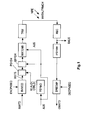
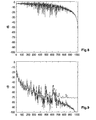
- an original audio input signal AUS like that depicted in Fig. 6 is encoded, or processed such that the masking level threshold information or the energy level information for an encoding is retrieved, using a psycho-acoustic model calculator PSYMC.
- the resulting masking level threshold (shown in Fig. 7) information or energy level related information MLAUD for the audio data or its frequency spectrum coefficients (resulting e.g. from an FFT or an MDCT) of a current audio signal input frame is fed together with related control data or coding parameters CTRLD to a psycho-acoustic shaping stage PSYSH.
- the vertical axis shows amplitudes in 'dB' and the horizontal axis shows 1024 spectral lines of the audio, masking and watermarking signals resulting from e.g. a 1024-points FFT, which FFT provides a magnitude and a phase value for each spectral point.
- Input watermark data IWATD enter a bit value modulation stage BVMOD in which a current bit value of the IWATD data is used to correspondingly modulate a current encoder pseudo-noise (PN) sequence section ENCPNSEQ.
- PN current encoder pseudo-noise
- the unshaped, or original, watermark input signal IWATD of a current audio signal frame is depicted in Fig. 8.
- the encoder pseudo-noise sequence section ENCPNSEQ is left unchanged whereas, if the current bit value is '0' or '-1', the encoder pseudo-noise sequence section ENCPNSEQ is inverted.
- Sequence ENCPNSEQ consists of e.g.
- the pseudo-noise sequence section ENCPNSEQ can have a length corresponding to that of the audio signal frames.
- the pieces of watermark signals WATS resulting from stage BVMOD are fed to a psycho-acoustic shaping stage PSYSH in which they are shaped in amplitude according to the current psycho-acoustic properties of the audio signal AUS. This can be performed, in the frequency domain, by shaping the current watermark signal WATS according to (i.e. its amplitudes envelope is made conforming to) the corresponding frame section masking level threshold or energy level shape or curve in masking level threshold information MLAUD.
- Fig. 9 shows the masking level threshold of Fig.
- the psycho-acoustically shaped watermark signals coming from stage PSYSH are further shaped in an effective-shaping stage EFFSH and are thereafter combined with, or added to, corresponding frame sections of audio data AUS in a watermark embedding stage WATEMB.
- the effective-shaping stage EFFSH performs an additional shaping that advantageously reduces the level or magnitudes of the watermark signal information without loss of detectability at decoder side of the embedded watermark signals, as will be explained in connection with figures 2 to 5.
- Stage EFFSH is controlled by the audio input signal AUS, too.
- the 'effective shaping' checks for each magnitude/phase pair of the psycho-acoustically shaped FFT output whether or not the phase between the audio signal spectral value and the related watermark signal value is already 90 or 270 degrees or nearly 90 or 270 degrees.
- the 'effective shaping' takes place in that to the current watermark value pair a phase of (nearly) 90 or 270 degrees with respect to the phase of the current audio signal value pair is assigned and thereby the magnitude of the current watermark value pair is decreased correspondingly.
- Tests with different audio and watermark signals have shown that the magnitudes of the watermark value pairs can be shortened by about 30% on average.
- the shapings are carried out in the frequency domain, and can additionally be carried out in the time domain. Adding of the shaped watermark signal to the original audio signal is preferably performed in time domain.
- the output signal of stage WATEMB passes through transmitter stage TRM, which includes a channel encoder or modulator and e.g. a D/A converter, and transmission channel WATAUTRMCH to a watermark signal decoder or receiver.
- TRM transmitter stage
- a channel encoder or modulator e.g. a D/A converter
- transmission channel WATAUTRMCH to a watermark signal decoder or receiver.
- a noise or reverberation or echo signal NRE can be added.
- the distorted transmitted signal enters a receiver stage REC wherein a channel decoding or demodulation and e.g. a synchronisation is performed. Its output signal passes via an inverse psycho-acoustic shaping or whitening stage IPSYWH to a data recovery matched filter (or time-inverse convolution) stage DRECMF.
- inverse psycho-acoustic shaping the masking level threshold, or energy level, information MLAUD and/or the related control data or coding parameters CTRLD can be transmitted, too, and evaluated at decoder side, or are not transmitted but calculated in the decoder.
- Stage DRECMF convolves, or filters, the watermark signals of a current incoming audio frame with a corresponding decoder pseudo-noise sequence section DRECPNSEQ that is pre-known by, or stored in, the decoder and that is a time-inverse version of the related encoder pseudo-noise sequence section ENCPNSEQ, wherein each correctly transmitted watermark bit appears e.g. as a peak in the middle of the convolution results.
- stage DRECMF correlates the watermark signals of a current incoming audio frame with a decoder pseudo-noise sequence section DRECPNSEQ that is pre-known by, or stored in, the decoder and that corresponds to the related encoder pseudo-noise sequence section ENCPNSEQ, wherein each correctly transmitted watermark bit appears e.g. as a peak in the middle of the correlation results.
- Stage DRECMF provides the reconstructed watermark signal decoder output watermark data OWATD which correspond to the input watermark data IWATD.
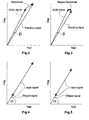
- Fig. 2 depicts addition of a watermark signal to an audio signal at encoder side for one spectral line in the real/imaginary plain. Note that the true magnitude of the 'watermark signal' is depicted in the drawing in a severely exaggerated fashion.
- the real magnitude of the watermark signal as resulting from the psycho-acoustic shaping in stage PSYSH has a level that is about 20 to 70dB lower than that of the audio signal, cf. Fig. 7 and Fig. 9.
- the 'resulting signal' is received as 'input signal'.
- whitening will be explained below
- reverse psycho-acoustic shaping it is normalised to an appropriate magnitude. In this example it is reduced in magnitude to the depicted signal 'shaped signal'.
- this reverse shaping or whitening is dependent practically on the audio signal magnitude only, i.e. the magnitude of the 'input signal' after whitening or inverse psycho-acoustic shaping, and it is independent from the watermark signal magnitude.
- the additionally or effectively shaped 'watermark signal' vector has a phase of about 90 or 270 degrees with respect to the related vector of the 'audio signal', which results at decoder side in a spectral line having the same phase ⁇ but a different magnitude of the 'input signal'.
- the embedded watermark signal is less audible due to its smaller magnitude, but that advantageously its detectability in the decoder (which is only related to the phase ⁇ if the watermark signal has a small magnitude) has not changed.
- 'Shaping' at encoder side represents a multiplication of the watermark signal WATS by the masking level of the audio signal
- 'reverse shaping' at decoder side represents a division by the masking level of the received audio signal in which the watermark signal is embedded.
- IPSYWH carries out a spectrum whitening instead.
- 'Whitening' means multiplying or magnifying the magnitude of each received spectral value of an audio frame such that all audio signal magnitudes (in which the watermark signal is embedded) get the same value in a frame. Thereby the audio signal itself is seriously distorted, but the resulting effect is that the magnitudes of the watermark signal spectral values get a value that basically corresponds to their original magnitude level according to Fig. 8.
- the received non-whitened (i.e. non-manipulated) audio signal RAUS is used for the other decoder audio signal processing purposes. Tests have shown that applying whitening instead of reverse psycho-acoustic shaping achieves results that are as good or nearly as good as when applying reverse psycho-acoustic shaping at decoder side.
- the invention can also be used when watermarking digital video signals.
Landscapes
- Engineering & Computer Science (AREA)
- Computer Security & Cryptography (AREA)
- Signal Processing (AREA)
- Multimedia (AREA)
- Editing Of Facsimile Originals (AREA)
Priority Applications (1)
| Application Number | Priority Date | Filing Date | Title |
|---|---|---|---|
| EP04090177A EP1594122A1 (de) | 2004-05-06 | 2004-05-06 | Spreizspektrumwasserzeichen |
Applications Claiming Priority (1)
| Application Number | Priority Date | Filing Date | Title |
|---|---|---|---|
| EP04090177A EP1594122A1 (de) | 2004-05-06 | 2004-05-06 | Spreizspektrumwasserzeichen |
Publications (1)
| Publication Number | Publication Date |
|---|---|
| EP1594122A1 true EP1594122A1 (de) | 2005-11-09 |
Family
ID=34928802
Family Applications (1)
| Application Number | Title | Priority Date | Filing Date |
|---|---|---|---|
| EP04090177A Withdrawn EP1594122A1 (de) | 2004-05-06 | 2004-05-06 | Spreizspektrumwasserzeichen |
Country Status (1)
| Country | Link |
|---|---|
| EP (1) | EP1594122A1 (de) |
Cited By (5)
| Publication number | Priority date | Publication date | Assignee | Title |
|---|---|---|---|---|
| EP1887565A1 (de) * | 2006-07-11 | 2008-02-13 | France Telecom | Verfahren und Vorrichtung zur Erfassung eines Decoders in einem Audiosignal |
| EP1936950A1 (de) * | 2006-12-22 | 2008-06-25 | France Télécom | Erkennungsverfahren und -system einer Nachricht in einem markierten digitalen Signal |
| WO2009037133A1 (fr) * | 2007-09-21 | 2009-03-26 | Thales | Procede fournissant les moyens de reconnaitre l'origine et/ou le contenu d'un signal rf |
| EP2787503A1 (de) | 2013-04-05 | 2014-10-08 | Movym S.r.l. | Verfahren und System zur Audiosignal-Wasserzeichenmarkierung |
| CN108417199A (zh) * | 2013-01-18 | 2018-08-17 | 株式会社东芝 | 音频水印信息检测装置及音频水印信息检测方法 |
Citations (1)
| Publication number | Priority date | Publication date | Assignee | Title |
|---|---|---|---|---|
| EP0828372A2 (de) * | 1996-09-04 | 1998-03-11 | Nec Corporation | Spreizspektrumwasserzeichen für integrierte Signalisierung |
-
2004
- 2004-05-06 EP EP04090177A patent/EP1594122A1/de not_active Withdrawn
Patent Citations (1)
| Publication number | Priority date | Publication date | Assignee | Title |
|---|---|---|---|---|
| EP0828372A2 (de) * | 1996-09-04 | 1998-03-11 | Nec Corporation | Spreizspektrumwasserzeichen für integrierte Signalisierung |
Cited By (12)
| Publication number | Priority date | Publication date | Assignee | Title |
|---|---|---|---|---|
| EP1887565A1 (de) * | 2006-07-11 | 2008-02-13 | France Telecom | Verfahren und Vorrichtung zur Erfassung eines Decoders in einem Audiosignal |
| EP1936950A1 (de) * | 2006-12-22 | 2008-06-25 | France Télécom | Erkennungsverfahren und -system einer Nachricht in einem markierten digitalen Signal |
| FR2910766A1 (fr) * | 2006-12-22 | 2008-06-27 | France Telecom | Procede et systeme de detection d'un message dans un signal numerique tatoue |
| WO2009037133A1 (fr) * | 2007-09-21 | 2009-03-26 | Thales | Procede fournissant les moyens de reconnaitre l'origine et/ou le contenu d'un signal rf |
| FR2921528A1 (fr) * | 2007-09-21 | 2009-03-27 | Thales Sa | Procede fournissant les moyens de reconnaitre l'origine et/ou le contenu d'un signal rf |
| US8391490B2 (en) | 2007-09-21 | 2013-03-05 | Thales | Method providing the means for recognizing the origin and/or content of an RF signal |
| CN101803274B (zh) * | 2007-09-21 | 2013-10-16 | 泰勒斯公司 | 提供用于识别射频信号来源和/或内容的装置的方法 |
| AU2008300695B2 (en) * | 2007-09-21 | 2013-10-24 | Thales | Method providing the means for recognizing the origin and/or content of an RF signal |
| KR101419575B1 (ko) * | 2007-09-21 | 2014-07-14 | 탈레스 | Rf 신호의 발신원 및/또는 내용을 인식하는 수단을 제공하는 방법 |
| CN108417199A (zh) * | 2013-01-18 | 2018-08-17 | 株式会社东芝 | 音频水印信息检测装置及音频水印信息检测方法 |
| CN108417199B (zh) * | 2013-01-18 | 2022-11-22 | 株式会社东芝 | 音频水印信息检测装置及音频水印信息检测方法 |
| EP2787503A1 (de) | 2013-04-05 | 2014-10-08 | Movym S.r.l. | Verfahren und System zur Audiosignal-Wasserzeichenmarkierung |
Similar Documents
| Publication | Publication Date | Title |
|---|---|---|
| US7760790B2 (en) | Method and apparatus for transmitting watermark data bits using a spread spectrum, and for regaining watermark data bits embedded in a spread spectrum | |
| Garcia | Digital Watermaking of Audio Signals Using a Psychoacoustic Auditory Model and Spread Spectrum Theory | |
| US8306811B2 (en) | Embedding data in audio and detecting embedded data in audio | |
| Swanson et al. | Current state of the art, challenges and future directions for audio watermarking | |
| CN101271690B (zh) | 保护音频数据的音频扩频水印处理方法 | |
| Gopalan et al. | Audio steganography for covert data transmission by imperceptible tone insertion | |
| EP1542227A1 (de) | Verfahren und Vorrichtung zur Übertragung von Wasserzeichen-Datenbits mit Spreizspektrum und zur Wiedergewinnung von Datenbits integriert in einem Spreizspektrum | |
| AU2011304463B2 (en) | Watermark generator, watermark decoder, method for providing a watermarked signal based on discrete valued data and method for providing discrete valued data in dependence on a watermarked signal | |
| US20050105726A1 (en) | Method and device for embedding watermark information and method and device for extracting embedded watermark information | |
| CA2231239A1 (en) | Method and apparatus for transporting auxiliary data in audio signals | |
| Yun et al. | Acoustic data transmission based on modulated complex lapped transform | |
| RU2505868C2 (ru) | Способ встраивания цифровой информации в аудиосигнал | |
| Khalil et al. | Audio watermarking with high embedding capacity based on multiple access techniques | |
| CN109584890A (zh) | 音频水印嵌入、提取、电视节目互动方法及装置 | |
| EP1886305B1 (de) | Verfahren und vorrichtung zur kennzeichnung eines audio- oder videosignals mit wasserzeichendaten mittels eines spreizspektrums | |
| CA2527011C (en) | Audio encoding/decoding apparatus having watermark insertion/abstraction function and method using the same | |
| EP1594122A1 (de) | Spreizspektrumwasserzeichen | |
| Matsuoka et al. | Acoustic OFDM: Embedding high bit-rate data in audio | |
| Gopalan | A unified audio and image steganography by spectrum modification | |
| Zhang et al. | Robust and transparent audio watermarking based on improved spread spectrum and psychoacoustic masking | |
| Qi et al. | An active audio steganography attacking method using discrete spring transform | |
| Zhang et al. | Efficient audio data hiding via parallel combinatory spread spectrum | |
| Muntean et al. | Audio digital watermarking based on hybrid spread spectrum | |
| Liang et al. | Robust blind extracting audio watermarking based on quadrature phase shift keying and improved spread spectrum | |
| Singh et al. | Audio watermarking using spectral modifications |
Legal Events
| Date | Code | Title | Description |
|---|---|---|---|
| PUAI | Public reference made under article 153(3) epc to a published international application that has entered the european phase |
Free format text: ORIGINAL CODE: 0009012 |
|
| AK | Designated contracting states |
Kind code of ref document: A1 Designated state(s): AT BE BG CH CY CZ DE DK EE ES FI FR GB GR HU IE IT LI LU MC NL PL PT RO SE SI SK TR |
|
| AX | Request for extension of the european patent |
Extension state: AL HR LT LV MK |
|
| AKX | Designation fees paid | ||
| STAA | Information on the status of an ep patent application or granted ep patent |
Free format text: STATUS: THE APPLICATION IS DEEMED TO BE WITHDRAWN |
|
| 18D | Application deemed to be withdrawn |
Effective date: 20060510 |
|
| REG | Reference to a national code |
Ref country code: DE Ref legal event code: 8566 |