EP1594320A1 - Verfahren und System für dynamische Selektion der Transformationsgröße in einem Videodekodierer - Google Patents
Verfahren und System für dynamische Selektion der Transformationsgröße in einem Videodekodierer Download PDFInfo
- Publication number
- EP1594320A1 EP1594320A1 EP05009165A EP05009165A EP1594320A1 EP 1594320 A1 EP1594320 A1 EP 1594320A1 EP 05009165 A EP05009165 A EP 05009165A EP 05009165 A EP05009165 A EP 05009165A EP 1594320 A1 EP1594320 A1 EP 1594320A1
- Authority
- EP
- European Patent Office
- Prior art keywords
- transform size
- inverse transform
- macroblock
- syntax element
- video
- Prior art date
- Legal status (The legal status is an assumption and is not a legal conclusion. Google has not performed a legal analysis and makes no representation as to the accuracy of the status listed.)
- Withdrawn
Links
- 238000000034 method Methods 0.000 title claims abstract description 36
- 238000012545 processing Methods 0.000 claims abstract description 26
- 230000001131 transforming effect Effects 0.000 claims description 12
- 238000010586 diagram Methods 0.000 description 17
- 230000006835 compression Effects 0.000 description 14
- 238000007906 compression Methods 0.000 description 14
- 239000013598 vector Substances 0.000 description 12
- 238000005192 partition Methods 0.000 description 9
- 241000023320 Luma <angiosperm> Species 0.000 description 6
- 230000008901 benefit Effects 0.000 description 6
- OSWPMRLSEDHDFF-UHFFFAOYSA-N methyl salicylate Chemical compound COC(=O)C1=CC=CC=C1O OSWPMRLSEDHDFF-UHFFFAOYSA-N 0.000 description 6
- 238000012546 transfer Methods 0.000 description 6
- 230000007704 transition Effects 0.000 description 6
- 238000013459 approach Methods 0.000 description 5
- 230000000903 blocking effect Effects 0.000 description 4
- 230000006870 function Effects 0.000 description 4
- 230000008569 process Effects 0.000 description 4
- 230000009466 transformation Effects 0.000 description 4
- 238000004590 computer program Methods 0.000 description 3
- 238000013139 quantization Methods 0.000 description 3
- 230000000694 effects Effects 0.000 description 2
- 238000005516 engineering process Methods 0.000 description 2
- 239000000463 material Substances 0.000 description 2
- 230000002123 temporal effect Effects 0.000 description 2
- 230000002457 bidirectional effect Effects 0.000 description 1
- 230000008859 change Effects 0.000 description 1
- 238000006243 chemical reaction Methods 0.000 description 1
- 238000004891 communication Methods 0.000 description 1
- 238000005056 compaction Methods 0.000 description 1
- 230000006837 decompression Effects 0.000 description 1
- 238000011161 development Methods 0.000 description 1
- 238000006073 displacement reaction Methods 0.000 description 1
- 238000001914 filtration Methods 0.000 description 1
- 238000010348 incorporation Methods 0.000 description 1
- 230000010365 information processing Effects 0.000 description 1
- 238000004519 manufacturing process Methods 0.000 description 1
- 238000013507 mapping Methods 0.000 description 1
- 238000012986 modification Methods 0.000 description 1
- 230000004048 modification Effects 0.000 description 1
- 230000008520 organization Effects 0.000 description 1
- 238000011160 research Methods 0.000 description 1
- 230000000007 visual effect Effects 0.000 description 1
Images



Classifications
-
- H—ELECTRICITY
- H04—ELECTRIC COMMUNICATION TECHNIQUE
- H04N—PICTORIAL COMMUNICATION, e.g. TELEVISION
- H04N19/00—Methods or arrangements for coding, decoding, compressing or decompressing digital video signals
- H04N19/44—Decoders specially adapted therefor, e.g. video decoders which are asymmetric with respect to the encoder
-
- H—ELECTRICITY
- H04—ELECTRIC COMMUNICATION TECHNIQUE
- H04N—PICTORIAL COMMUNICATION, e.g. TELEVISION
- H04N19/00—Methods or arrangements for coding, decoding, compressing or decompressing digital video signals
- H04N19/10—Methods or arrangements for coding, decoding, compressing or decompressing digital video signals using adaptive coding
- H04N19/102—Methods or arrangements for coding, decoding, compressing or decompressing digital video signals using adaptive coding characterised by the element, parameter or selection affected or controlled by the adaptive coding
- H04N19/12—Selection from among a plurality of transforms or standards, e.g. selection between discrete cosine transform [DCT] and sub-band transform or selection between H.263 and H.264
- H04N19/122—Selection of transform size, e.g. 8x8 or 2x4x8 DCT; Selection of sub-band transforms of varying structure or type
-
- H—ELECTRICITY
- H04—ELECTRIC COMMUNICATION TECHNIQUE
- H04N—PICTORIAL COMMUNICATION, e.g. TELEVISION
- H04N19/00—Methods or arrangements for coding, decoding, compressing or decompressing digital video signals
- H04N19/70—Methods or arrangements for coding, decoding, compressing or decompressing digital video signals characterised by syntax aspects related to video coding, e.g. related to compression standards
Definitions
- Certain embodiments of the invention relate to the processing of video signals. More specifically, certain embodiments of the invention relate to a method and system for dynamic selection of transform size in a video decoder based on signal content.
- the H.264 coding standard provides flexibility by defining a baseline profile, a main profile, and an extended profile in order to serve a variety of applications.
- the main profile for example, is intended to support digital television broadcasting and next-generation digital versatile disk (DVD) applications.
- the baseline profile for example, is intended to support mobile applications that may have limited processing capabilities.
- the extended profile for example, is intended to support streaming video and may comprise features that provide error resilience and that facilitate switching between bitstreams.
- Enhancements to the H.264 coding standard have resulted from a new set of coding tools known as the fidelity range extensions (FRExt).
- FRExt fidelity range extensions
- the FRExt extensions are intended to support high image resolutions needed in applications such as studio video editing, post-production processing, standard definition (SD) and high-definition (HD) television, and enhanced DVD video.
- SD standard definition
- HD high-definition
- the FRExt extensions also define a high profile, which may be utilized to provide higher coding efficiency without adding significant implementation complexity.
- the high profile may be adapted by applications such as those supported by the Blu-ray Disk Association, the digital video broadcast (DVB) standards, the HD-DVD specification of the DVD Forum, and/or the new broadcast TV specification of the US advanced television systems committee (ATSC).
- DVD digital video broadcast
- HD-DVD high-DVD specification of the DVD Forum
- ATSC US advanced television systems committee
- coding or compression of image and/or video signals may be accomplished by first transforming the signal, or an error that may result from predicting the signal, from a spatial domain representation to a spatial frequency domain representation.
- image and/or video signal compression may be achieved by means of a two dimensional (2D) Discrete Cosine Transform (DCT).
- DCT Discrete Cosine Transform
- Another transformation approach may be to adaptively change the basis functions in a 2D transform based on signal content. In this latter approach, for example, the 2D transform may be based on wavelets.
- a quantization step may be utilized to zero-out any coefficients with relatively low values.
- the transformation and quantization steps may reduce redundancies in the signal's spatial content by compacting the signal's energy to as few basis functions as possible. By increasing the size of the transform, a corresponding increase in signal energy compaction may be achieved thereby improving the performance of the entire compression system.
- a system and/or method for dynamic selection of transform size in a video decoder based on signal content substantially as shown in and/or described in connection with at least one of the figures, as set forth more completely in the claims.
- a method for video signal processing comprising:
- FIG. 1 is a block diagram illustrating an exemplary encoder and decoder system, in connection with an embodiment of the invention.
- FIG. 2 is a block diagram of an exemplary H.264-based encoder, in connection with an embodiment of the invention.
- FIG. 3A is a block diagram of a portion of an exemplary H.264-based encoder with fixed transform size, in connection with an embodiment of the invention.
- FIG. 3B is a block diagram of a portion of an exemplary H.264-based encoder where the transform size selection is tied to the best prediction block size, in connection with an embodiment of the invention.
- FIG. 3C is a block diagram of a portion of an exemplary H.264-based encoder where the transform size selection is based on image content and the best prediction block size, in accordance with an embodiment of the invention.
- FIG. 4 is a block diagram of an exemplary an H.264-based decoder, in accordance with an embodiment of the invention.
- FIG. 5 is a flow diagram illustrating exemplary steps for inverse transform block size selection in an H.264-based video decoder based on a transform size syntax element, in accordance with an embodiment of the invention.
- Certain embodiments of the invention may be found in a method and system for dynamic selection of transform size based on signal content.
- a set of simplified transform selection rules and guidelines in the encoding and decoding processes of image and video signals, it may be possible to achieve the low bit-rate objective of ISO MPEG4 Part 10 and ITU-T H.264 while minimizing the effects of compression artifacts in signals with regions of sharp or abrupt transitions.
- These selection rules and guidelines may achieve this objective by combining the benefits of reduced residual correlation through better signal prediction selection with the benefits of large transform sizes in areas without high detail and/or sharp transitions.
- FIG. 1 is a block diagram illustrating an exemplary encoder and decoder system, in connection with an embodiment of the invention.
- a video encoder 102 and a video decoder 104.
- the video encoder 102 may comprise suitable logic, circuitry, and/or code that may be adapted to encode or compress video information from a video source and generate an encoded video bit stream that comprises the encoded or compressed video information.
- the generated encoded video bit stream may also comprise side information regarding the encoding or compression operations in the video encoder 102.
- the generated encoded video bit stream may be transferred to the video decoder 104.
- the video encoder 102 may be adapted to support, for example, the ISO MPEG4 Part 10 and the ITU-T H.264 standard specifications.
- the video encoder 102 may be adapted to support, for example, fidelity range extensions (FRExt) and a high profile mode of operation associated with the H.264 standard specification.
- FRExt fidelity range extensions
- the video decoder 104 may comprise suitable logic, circuitry, and/or code that may be adapted to decode or decompress the encoded video bit stream generated by the video encoder 102 and generate a video signal that may be transferred to other processing devices, to storage devices, and/or to display devices.
- the video decoder 104 may be adapted to support, for example, the ISO MPEG4 Part 10 and the ITU-T H.264 standard specifications.
- the video decoder 104 may be adapted to support, for example, fidelity range extensions (FRExt) and a high profile mode of operation associated with the H.264 standard specification.
- FRExt fidelity range extensions
- the current picture may be processed in units of a macroblock, where a macroblock corresponds to, for example, 16x16 pixels in the original image.
- a macroblock may be encoded in intra-coded mode, for "I" pictures, or in inter-coded mode, for predictive or "P" pictures and bidirectional or "B” pictures.
- the intra-coded or "I” pictures may only use the information within the picture to perform video compression.
- the "I” pictures may utilize spatial prediction to reduce redundancy.
- Each GOP may generally start with a self-contained "I” picture as the reference or anchor frame from which the other pictures in the group may be generated for display.
- the GOP frequency, and correspondingly the frequency of "I” pictures, may be driven by specific application spaces.
- the predicted or "P” pictures may use a motion estimation scheme to generate picture elements that may be predicted from the most recent anchor frame or "I” picture. Compressing the difference between predicted samples and the source value results in better coding efficiency than that which may be achieved by transmitting the encoded version of the source picture information.
- the compressed difference picture is decoded and subsequently added to a predicted picture for display.
- Motion estimation may refer to a process by which an encoder estimates the amount of motion for a collection of picture samples in a picture "P", via displacing another set of picture samples within another picture. Both sets of picture samples may have the same coordinates within their corresponding pictures and the displacing may be performed within a larger group of picture samples labeled a motion window. Minimizing the difference between the two sets of picture samples motivates motion estimation. A displaced set of picture samples corresponding to a minimum difference may be considered the best prediction and may be distinguished by a set of motion vectors. Once all the motion vectors are available, the whole picture may be predicted and subtracted from the samples of the "P" picture. The resulting difference signal may then be encoded by the video encoder 102.
- Motion compensation may refer to a process by which a decoder recalls a set of motion vectors and displaces the corresponding set of picture samples. Output samples may be decoded or reconstructed by adding the displaced samples to a decoded difference picture. Because it may be desirable to produce a drift-free output stream, both the encoder and the decoder need access to the same decoded pictures in order to utilize the decoded pictures as basis for estimation of other pictures. For this purpose, the encoder may comprise a copy of the decoder architecture to enable the duplication of reconstructed pictures. As a result, the final motion estimation and final displacement may be done on reconstructed pictures.
- both the "I" pictures and the "P” pictures may be used to predict pixels, they may be referred to as “reference” pictures.
- the bidirectional-predicted pictures or "B" pictures may use multiple pictures that occur in a future location in the video sequence and/or in a past location in the video sequence to predict the image samples.
- motion estimation may be used for pixel prediction in "B” pictures and the difference between the original source and the predicted picture may be compressed by the video encoder 102.
- one or more "B" pictures may be motion compensated and may be added to the decoded version of the compressed difference signal for display.
- slices or portions of a picture or image may comprise macroblocks that are intra-coded or inter-coded.
- an "I" slice comprises intra-coded macroblocks
- a "P” slice comprises predicted inter-coder macroblocks
- a "B” slice comprises bi-directionally predicted inter-coded macroblocks.
- Inter-coded macroblocks in "P” slices may only use one vector to predict a block of pixels.
- Inter-coded macroblocks in "B” slices may use one or two vectors to predict a block of pixels.
- FIG. 2 is a block diagram of an exemplary H.264-based encoder, in connection with an embodiment of the invention.
- a video encoder 102 may be adapted to support, for example, fidelity range extensions (FRExt) and a high profile mode of operation associated with the H.264 standard specification.
- FRExt fidelity range extensions
- the video encoder 102 may comprise a current frame (Fn) source 202, a first digital adder 204, a forward transform (T) 206, a forward quantizer (Q) 208, an entropy encoder 212, a reference frames (Fn-1*) source 224, a motion estimator 226, a motion compensator 228, an intra-coding selector 230, and an intra-coding predictor 232, a reverse quantizer (Q -1 ) 214, a reverse transform (T -1 ) 216, a second digital adder 218, a digital filter 220, and a current reconstructed frame (Fn*) source 222.
- Fn current frame
- T forward transform
- Q forward quantizer
- the current frame source 202 may provide a current frame or picture in a GOP for encoding.
- the current picture may be processed in units of a macroblock, where a macroblock corresponds to, for example, 16x16 pixels in the original image.
- Each macroblock may be encoded in intra-coded mode, for "I" pictures, or in inter-coded mode, for "P" and "B" pictures. In either mode, a prediction macroblock P may be formed on a reconstructed frame or picture.
- the intra-coding selector 230 may select between sample images from a current picture Fn and from pictures which have been previously encoded, decoded, and reconstructed as shown by the unfiltered reconstructed output uFn* of the second digital adder 218.
- the intra-coding predictor 232 may generate the predicted macroblock P based on the unfiltered reconstructed output uFn* and the selection made by the intra-coding selector 230.
- the predicted macroblock P may be generated based on the current picture and motion-compensated prediction from one or more reference frames in the reference frame source 224.
- the motion compensated prediction may be provided by the motion estimator 226 and the motion compensator 228.
- the motion compensated prediction may be based on at least one previous encoded and reconstructed picture in time and/or at least one subsequent encoded and reconstructed picture in time from the current picture being encoded.
- the predicted macroblock P may be subtracted from the current macroblock by the first digital adder 204 to generate a difference macroblock Dn.
- the difference macroblock may be transformed by the forward transform 206 and quantized by the forward quantizer 208.
- the output of the forward quantizer 208 may be entropy encoded by the entropy encoder 212 before being passed to the encoded video bit stream.
- the encoded video bit stream comprises the entropy-encoded video contents and any side information necessary to decode the macroblock.
- the results from the forward quantizer 208 may be re-scaled and inverse transformed by the reverse quantizer 214 and the inverse transform 216 to generate a reconstructed difference macroblock Dn*.
- the prediction macroblock P may be added to the reconstructed difference macroblock Dn* by the second digital adder 218 to generate the unfiltered reconstructed output uFn*.
- the filter 220 may be applied to uFn* to reduce the effects of blocking distortion and a reconstructed reference frame or picture may be generated Fn*.
- FIG. 3A is a block diagram of a portion of an exemplary H.264-based encoder with fixed transform size, in connection with an embodiment of the invention.
- the encoder 300 may be adapted to support, for example, fidelity range extensions (FRExt) and a high profile mode of operation associated with the H.264 standard specification.
- the video encoder 300 may comprise a prediction engine 302, a best prediction block size selector 304, a 4x4 transformer 306, a quantizer 308, and an entropy encoder 310.
- the prediction engine 302 may comprise a plurality of prediction size blocks 312 to 324.
- These prediction block sizes may be, for example, a 4x4 prediction block 312, a 4x8 prediction block 314, an 8x4 prediction block 316, an 8x8 prediction block 318, a 16x8 prediction block 320, an 8x16 prediction block 122, and/or a 16x16 prediction block 324.
- the prediction engine 302 may comprise suitable logic, circuitry, and/or code that may be adapted to perform intra-prediction and inter-prediction of macroblocks.
- the prediction engine 302 may intra-predict or inter-predict portions or subblocks of a macroblock.
- a prediction block P may be formed based on spatial prediction modes.
- a block or prediction block may refer to a 16x16 macroblock or to an MxN macroblock subblock, where M ⁇ 16 and N ⁇ 16.
- the prediction block P may be subtracted from the current block to generate an error signal prior to encoding.
- the block contents may be luminance (luma) samples and/or may be chrominance (chroma) samples.
- the spatial prediction mode chosen for a block may be one that minimizes the residual between the prediction block P and the current block.
- the choice of intra prediction mode may be part of the side information that is signaled to the decoder.
- Prediction based on motion compensation may be performed on a macroblock by dividing the macroblock into partitions and sub-partitions according to supported block sizes.
- a prediction block P may be formed based on previously encoded and reconstructed blocks.
- a separate motion vector may be required for each partition and sub-partition of the predicted macroblock.
- Each motion vector and the structure of the partition and sub-partitions may be encoded and transmitted to a decoder for video reconstruction. For example, when large partitions or sub-partitions are chosen, a small number of bits may be necessary to signal to a decoder the motion vector and the partition size.
- the best prediction block size selector 304 may comprise suitable logic, circuitry, and/or code that may be adapted to determine the best prediction block sizes to be used in predicting a macroblock.
- the best prediction block size selector 304 may be adapted to determine a set of best prediction block sizes for a macroblock based on which prediction block sizes minimize the residual between the prediction block P and the current block.
- Information regarding the set of best prediction block sizes may be encoded and transferred to a decoder for video reconstruction.
- the 4x4 transformer 306 may comprise suitable logic, circuitry, and/or code that may be adapted to perform a forward transform on a predicted representation of a current macroblock that utilizes a 4x4 transform size.
- the 4x4 transformer 306 may be applied to both inter-predicted and intra-predicted images.
- the coefficients of the transform in the 4x4 transformer 306 may be selected to reduce redundancies in the signal's spatial content by compacting the signal's energy to as few basis functions as possible.
- the transform coefficients may be programmable and there may be a different set of coefficients for intra-predicted images and for inter-predicted images.
- the quantizer 308 may comprise suitable logic, circuitry, and/or code that may be adapted to quantize or scale the transformed predicted image produced by the 4x4 transformer 306.
- the scaling coefficients of the quantizer 208 may be programmable and there may be a different set of coefficients for intra-predicted images and for inter-predicted images.
- the entropy encoder 210 may comprise suitable logic, circuitry, and/or code that may be adapted to encode the output of the quantizer 208 to generate an encoded video bit stream that may be transferred to at least one video decoder.
- the entropy encoder 310 may also encode additional side information that may be utilized by a decoder to reconstruct an image for display.
- the video encoder 300 shown in FIG. 3A is limited to a 4x4 transform size in the 4x4 transformer 106.
- This size transform may reduce the artifacts that are generally associated with larger transforms but it may require that a large content of side information be transferred to a decoder to reconstruct the image.
- FIG. 3B is a block diagram of a portion of an exemplary H.264-based encoder where transform block size selection is tied to the best prediction block size, in connection with an embodiment of the invention.
- the video encoder 330 differs from the video encoder 300 in FIG. 3A in that an NxM transformer 332 may replace the 4x4 transformer 304.
- the NxM transformer 332 may comprise suitable logic, circuitry, and/or code that may be adapted to forward transform a predicted macroblock with an NxM transform size.
- the NxM transform size may be selected to be of the same size as the best prediction block size of the predicted block being transformed.
- the NxM transformer 132 may utilize an 8x8 transform size. This approach may allow the use of larger transforms to improve compression efficiency but may result in the selection of large transform sizes for images with abrupt transitions. As with the 4x4 transformer 306 in FIG. 3A, the NxM transformer 332 may utilize different transform coefficients for inter-predicted and intra-predicted macroblocks.
- FIG. 3C is a block diagram of a portion of an exemplary H.264-based encoder where transform block size selection is based on image content and the best prediction block size, in accordance with an embodiment of the invention.
- the video encoder 340 may differ from the video encoder 330 in FIG. 3B in that a transform size controller 342 may be added to the system.
- the transform size controller 342 may comprise suitable logic, circuitry, and/or code that may be adapted to determine an NxM transform size to be utilized by the NxM transformer 332 for transforming a inter-predicted and intra-predicted macroblocks.
- the NxM transformer 332 may determine the NxM transform size based on a set of rules and/or guidelines that allow for the video encoder 340 to achieve the efficiency objectives of H.264.
- the transform size controller 342 may transfer information related to the transform size selection to the entropy encoder 308 for encoding.
- the transform size controller 342 may generate, for example, a transform size syntax element that may comprise information regarding the transform size that may be utilized for reconstruction of the macroblock.
- the encoded information may then be transferred to decoders to decode and reconstruct the picture.
- the decoders may then make use of these guidelines and rules utilized by the video encoder 340 to inverse transform the predicted macroblocks with a reduced amount of side information.
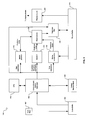
- FIG. 4 is a block diagram of an exemplary an H.264-based decoder, in accordance with an embodiment of the invention.
- the video decoder 104 in FIG. 1 may comprise a code input 402, a code buffer 404, a symbol interpreter 408, a context memory block 406, a CPU 410, a spatial predictor 412, an inverse scanner, quantizer, and transformer (ISQDCT) 414, a motion compensator 416, a reconstructor 420, a deblocker filter 424, a picture buffer 418, and a display engine 422.
- the code buffer 402 may comprise suitable circuitry, logic and/or code that may be adapted to receive and buffer a compressed video stream from the code input 402 prior to interpreting it by the symbol interpreter 408.
- the compressed video stream may be encoded in a binary format using CABAC or CAVLC, for example.
- the code buffer 404 may be adapted to transfer portions of different lengths of the compressed video stream as may be required by the symbol interpreter 408.
- the code buffer 404 may comprise a portion of a memory system, such as a dynamic random access memory (DRAM).
- DRAM dynamic random access memory
- the symbol interpreter 408 may comprise suitable circuitry, logic and/or code that may be adapted to interpret the compressed video stream to obtain quantized frequency coefficients information and additional side information necessary for decoding of the compressed video stream.
- the symbol interpreter 408 may be adapted to obtain the transform size syntax element generated by a video encoder and transmitted as part of the side information.
- the symbol interpreter 408 may also be adapted to interpret either CABAC or CAVLC encoded video stream, for example.
- the symbol interpreter 408 may comprise a CAVLC decoder and a CABAC decoder. Quantized frequency coefficients determined by the symbol interpreter 408 may be communicated to the ISQDCT 414, and the side information may be communicated to the motion compensator 416 and the spatial predictor 412.
- the symbol interpreter 408 may also be adapted to provide the ISQDCT 414 with information regarding the forward transformation of the encoded macroblocks in the compressed video stream. In this regard, the symbol interpreter 408 may transfer to the ISQDCT 414 the decoded transform size syntax element. Depending on the prediction mode for each macroblock associated with an interpreted set of quantized frequency coefficients, the symbol interpreter 408 may provide side information either to a spatial predictor 412, if spatial prediction was used during encoding, or to a motion compensator 416, if temporal prediction was used during encoding. The side information may comprise prediction mode information and/or motion vector information, for example.
- the symbol interpreter 408 may also provide side information to the deblocker filter 424.
- the side information may comprise prediction mode information, motion vector information, quantization parameter information, and/or boundary pixel values to determine the strength of the deblocking filter across, for example, 4x4 or 8x8 edge boundaries.
- a CPU 410 may be coupled to the symbol interpreter 408 to coordinate the interpreting process for each macroblock within the encoded video bit stream.
- the symbol interpreter 408 may be coupled to a context memory block 406.
- the context memory block 406 may be adapted to store a plurality of contexts that may be utilized for interpreting the CABAC and/or CAVLC-encoded bit stream.
- the context memory 406 may be another portion of the same memory system as the code buffer 404, or a portion of a different memory system, for example.
- the ISQDCT 414 may comprise suitable circuitry, logic and/or code that may be adapted to generate a prediction error from a set of quantized frequency coefficients received from the symbol interpreter 408.
- the ISQDCT 414 may be adapted to transform the quantized frequency coefficients back to spatial domain using an inverse transform of a size that may be determined by the transform size syntax element.
- the inverse transform size may be determined from the set or rules and guidelines used by the encoder to forward transform the macroblocks.
- the spatial predictor 412 and the motion compensator 416 may comprise suitable circuitry, logic and/or code that may be adapted to generate prediction pixels utilizing side information received from the symbol interpreter 408.
- the spatial predictor 412 may generate prediction pixels for spatially predicted macroblocks
- the motion compensator 416 may generate prediction pixels for temporally predicted macroblocks.
- the prediction pixels generated by the motion compensator 416 may comprise prediction pixels associated with motion compensation vectors in previously reconstructed pictures.
- the motion compensator 416 may retrieve the prediction pixels from previously reconstructed pictures stored in the picture buffer 418.
- the picture buffer 418 may store previously reconstructed pictures that may correspond to pictures that occurred before and/or after the current picture being processed.
- the reconstructor 420 may comprise suitable circuitry, logic and/or code that may be adapted to receive the prediction error from the ISQDCT 414, as well as the prediction pixels from either the motion compensator 416 or the spatial predictor 412 based on whether the prediction mode was a temporal or spatial prediction, respectively.
- the reconstructor 420 may then generate a reconstructed output stream where reconstructed macroblocks in the reconstructed output stream make up a reconstructed picture.
- the reconstructed output stream may be generated based on the prediction error and the side information received from either the spatial predictor 412 or the motion compensator 416.
- the reconstructed output stream may then be transferred to the deblocker filter 424 for spatial filtering.
- the spatial predictor 412 When the spatial predictor 412 is utilized for generating prediction pixels, reconstructed macroblocks may be communicated back from the reconstructor 420 to the spatial predictor 412. In this way, the spatial predictor 412 may utilize pixel information along a left, a corner or a top border with a neighboring macroblock to obtain pixel estimation within a current macroblock.
- the deblocker filter 424 may comprise suitable circuitry, logic and/or code that may be adapted to spatially filter the reconstructed output stream received from the reconstructor 420 to reduce blocking artifacts. These blocking artifacts may be associated with missing pixel information along one or more borders between neighboring macroblocks and/or with spatial low frequency offsets between macroblocks.
- the picture buffer 418 may be adapted to store one or more filtered reconstructed pictures in the filtered reconstructed output stream received from the deblocker filter 424.
- the picture buffer 418 may also be adapted to transfer filtered reconstructed pictures to the motion compensator 416.
- the picture buffer 418 may transfer a previously filtered reconstructed picture back to the deblocker filter 424 so that a current macroblock within a current picture may be spatially filtered to remove or reduce blocking artifacts.
- the picture buffer 418 may also transfer one or more filtered reconstructed pictures to the display engine 424.
- the display engine 424 may comprise suitable logic, circuitry, and/or code that may be adapted to output the filtered reconstructed output stream to a video display, for example.
- the transform size syntax element generated by the video encoder 340, for example, and received by the video decoder 104 in FIG. 4 during a high profile mode of operation may be based on the observation that at standard definition (SD) resolution and above, the use of block sizes smaller than 8x8 is limited, and therefore new coding tools, a luma 8x8 transform and a luma 8x8 intra prediction mode may be utilized.
- a transform mode, Transform8 may be utilized to indicate that an 8x8 transform may be in use or enabled for block sizes 8x8 and above.
- the mode may be enabled by the transform size syntax element, transform_8x8_mode_flag, in the Picture Parameter Set RBSP.
- additional syntax elements may be utilized.
- the syntax element all_8x8 equal to logic 1 may be used to indicate that all four 8x8 subpartitions are using 8x8 block size. In this case, the 8x8 transform size is used. Otherwise, when all_8x8 is equal to logic 0, block sizes smaller than 8x8 may be in use and so the existing 4x4 transform size is used.
- the syntax element intra_pred_size may be used to indicate whether the macroblock type is Intra_4x4, that is, the syntax element intra_pred_size is equal to logic 0, or Intra_8x8.
- the syntax elements prev_intra8x8_pred_mode_flag and rem_intra8x8_pred_mode may be used to determine the specific 8x8 intra mode used.
- Luma Transform Size Intra_4x4 na na 4x4 Intra_8x8 na na 8x8 Intra_16x16 na na 4x4 P_16x16 0 na 4x4 1 na 8x8 P_8x16 0 na 4x4 1 na 8x8 P_16x8 0 na 4x4 1 na 8x8 P_16x8 0 na 4x4 1 na 8x8 P_8x8 0 na 4x4 1 1 8x8 B_ Direct 0 na 4x4 1 na 8x8 B_16x16 0 na 4x4
- Table 1 indicates an exemplary mapping of macroblock type to luma transform size that results from the addition of the new syntax elements to the encoding and decoding operations in H.264 standard specifications.
- Table 1 comprises intra-coded macroblock types intra_4X4, Intra_8x8, and intra_16x16, inter-coded macroblock types P_16x16, P_8x16, P_16x8, P_8x8, B_16x16, B_8x16, B_16x8, B_8x8, and B_direct, where B_direct corresponds to a macroblock in a "B" slice that is in direct mode.
- FIG. 5 is a flow diagram illustrating exemplary steps for inverse transform block size selection in an H.264-based video decoder based on a transform size syntax element, in accordance with an embodiment of the invention.
- the video decoder 104 in FIG. 1 may determine whether the current decoded macroblock is an intra-coded macroblock. When the macroblock is intra-coded, the video encoder 104 may proceed to step 506 to determine the transform size. In step 506, the high profile mode and the 8x8 transform in the video decoder 104 may be enabled.
- the decoding of a macroblock type to I_4x4 may be changed semantically to mean I_NxN.
- the transform_size_8x8_flag syntax element may indicate whether NxN corresponds to a 4x4 transform size or to an 8x8 transform size.
- the transform_size_8x8_flag syntax element indicates an 8x8 transform size, then an 8x8 spatial prediction and an 8x8 transform are used. Otherwise, an 4x4 spatial prediction and a 4x4 transform are used.
- the approached described for intra-coded macroblocks allows the support of an 8x8 spatial prediction mode without the need to cause many VLC tables or CABAC context tables.
- the flow diagram 500 may proceed to step 514.
- step 508 the video decoder 104 may determine whether the macroblock is a direct mode inter-coded macroblock. When the macroblock is a not a direct mode macroblock, the video decoder 104 may proceed to step 510.
- the transform size could be either a 4x4 transform size or an 8x8 transform and that the transform size may be indicated using the transform_size_8x8_flag syntax element, that is, the transform_size_8x8_flag syntax element may indicate whether the 4x4 transform size or the 8x8 transform size is to be used.
- the video decoder 104 determines whether any of the 8x8 blocks were subdivided.
- the blocks were to, for example, 4x4, 4x8, or 8x4, then only the 4x4 transform size may be used and the transform_size_8x8_flag syntax element may not need to be in the encoded video bit stream.
- the transform_size_8x8_flag syntax element is in the encoded video bit stream to indicate whether the 4x4 transform size or the 8x8 transform size is to be used.
- the flow diagram 500 may proceed to step 514.
- step 512 when the macroblock is a direct mode macroblock, the video decoder 104 may proceed to step 512.
- the whole macroblock may be direct mode, B_Direct_16x16, or an individual 8x8 block can be direct mode, B_Direct_8x8.
- the macroblock or the block may inherit the block size of the collocated macroblock or the collocated block in a particular reference picture. The collocated block size may not be known during stream parsing.
- the video decoder 104 may use the 4x4 transform size when an inherited 8x8 block size may be further subdivided.
- the inherited block may generally be 8x8 or larger, which may be indicated by a direct_8x8_inference flag syntax element being set to logic 1 for SD and higher resolution, and the transform_size_8x8_flag syntax element is in the encoded video bit stream and may be utilized to determine whether the 4x4 transform size or the 8x8 transform size is to be used.
- the flow diagram 500 may proceed to step 514.
- step 514 the video decoder 104 in FIG. 1 may inverse transform the received macroblock based on the selected inverse transform size in either steps 506, 510, or 512. After completing step 514, the video decoder 104 may proceed to end step 516.
- the present invention may be realized in hardware, software, or a combination of hardware and software.
- the present invention may be realized in a centralized fashion in at least one computer system, or in a distributed fashion where different elements are spread across several interconnected computer systems. Any kind of computer system or other apparatus adapted for carrying out the methods described herein is suited.
- a typical combination of hardware and software may be a general-purpose computer system with a computer program that, when being loaded and executed, controls the computer system such that it carries out the methods described herein.
- the present invention may also be embedded in a computer program product, which comprises all the features enabling the implementation of the methods described herein, and which when loaded in a computer system is able to carry out these methods.
- Computer program in the present context means any expression, in any language, code or notation, of a set of instructions intended to cause a system having an information processing capability to perform a particular function either directly or after either or both of the following: a) conversion to another language, code or notation; b) reproduction in a different material form.
Landscapes
- Engineering & Computer Science (AREA)
- Multimedia (AREA)
- Signal Processing (AREA)
- Physics & Mathematics (AREA)
- Discrete Mathematics (AREA)
- General Physics & Mathematics (AREA)
- Compression Or Coding Systems Of Tv Signals (AREA)
Applications Claiming Priority (4)
| Application Number | Priority Date | Filing Date | Title |
|---|---|---|---|
| US107138 | 1987-10-09 | ||
| US56892604P | 2004-05-07 | 2004-05-07 | |
| US568926P | 2004-05-07 | ||
| US11/107,138 US7894530B2 (en) | 2004-05-07 | 2005-04-15 | Method and system for dynamic selection of transform size in a video decoder based on signal content |
Publications (1)
| Publication Number | Publication Date |
|---|---|
| EP1594320A1 true EP1594320A1 (de) | 2005-11-09 |
Family
ID=34935785
Family Applications (1)
| Application Number | Title | Priority Date | Filing Date |
|---|---|---|---|
| EP05009165A Withdrawn EP1594320A1 (de) | 2004-05-07 | 2005-04-26 | Verfahren und System für dynamische Selektion der Transformationsgröße in einem Videodekodierer |
Country Status (3)
| Country | Link |
|---|---|
| US (1) | US7894530B2 (de) |
| EP (1) | EP1594320A1 (de) |
| TW (1) | TWI268714B (de) |
Cited By (3)
| Publication number | Priority date | Publication date | Assignee | Title |
|---|---|---|---|---|
| EP2105026A4 (de) * | 2007-01-18 | 2015-05-20 | Samsung Electronics Co Ltd | Verfahren und vorrichtung zur kodierung und dekodierung auf grundlage von intraprädiktion |
| US11153569B2 (en) | 2018-09-07 | 2021-10-19 | Panasonic Intellectual Property Corporation Of America | System and method for video coding |
| US12621460B2 (en) | 2024-10-08 | 2026-05-05 | Panasonic Intellectual Property Corporation Of America | System and method for video coding |
Families Citing this family (36)
| Publication number | Priority date | Publication date | Assignee | Title |
|---|---|---|---|---|
| US7590059B2 (en) * | 2004-05-21 | 2009-09-15 | Broadcom Corp. | Multistandard video decoder |
| US8422555B2 (en) * | 2006-07-11 | 2013-04-16 | Nokia Corporation | Scalable video coding |
| US9094686B2 (en) * | 2006-09-06 | 2015-07-28 | Broadcom Corporation | Systems and methods for faster throughput for compressed video data decoding |
| EP2160837B1 (de) * | 2007-06-29 | 2024-07-24 | Orange | Auswahl von an den decodierer verteilten decodierungsfunktionen |
| US8456380B2 (en) * | 2008-05-15 | 2013-06-04 | International Business Machines Corporation | Processing computer graphics generated by a remote computer for streaming to a client computer |
| US8503527B2 (en) | 2008-10-03 | 2013-08-06 | Qualcomm Incorporated | Video coding with large macroblocks |
| KR20100095992A (ko) * | 2009-02-23 | 2010-09-01 | 한국과학기술원 | 비디오 부호화에서의 분할 블록 부호화 방법, 비디오 복호화에서의 분할 블록 복호화 방법 및 이를 구현하는 기록매체 |
| TWI451764B (zh) | 2009-04-02 | 2014-09-01 | Novatek Microelectronics Corp | 畫框內預測模式的選擇裝置及方法 |
| GB2469679B (en) * | 2009-04-23 | 2012-05-02 | Imagination Tech Ltd | Object tracking using momentum and acceleration vectors in a motion estimation system |
| US9391635B2 (en) * | 2009-05-15 | 2016-07-12 | Texas Instruments Incorporated | Block scanner and run-level encoder from AC to DC values |
| JP5927117B2 (ja) * | 2009-07-23 | 2016-05-25 | トムソン ライセンシングThomson Licensing | ビデオ符号化及び復号化のための適応的変換選択のための方法及び装置 |
| US9819952B2 (en) * | 2009-10-05 | 2017-11-14 | Thomson Licensing Dtv | Methods and apparatus for embedded quantization parameter adjustment in video encoding and decoding |
| JP5556996B2 (ja) * | 2010-01-06 | 2014-07-23 | ソニー株式会社 | 画像処理装置および方法 |
| US8995527B2 (en) * | 2010-02-19 | 2015-03-31 | Qualcomm Incorporated | Block type signalling in video coding |
| KR20150013776A (ko) * | 2010-04-09 | 2015-02-05 | 미쓰비시덴키 가부시키가이샤 | 동화상 부호화 장치 및 동화상 복호 장치 |
| US9106933B1 (en) | 2010-05-18 | 2015-08-11 | Google Inc. | Apparatus and method for encoding video using different second-stage transform |
| US9215470B2 (en) * | 2010-07-09 | 2015-12-15 | Qualcomm Incorporated | Signaling selected directional transform for video coding |
| GB2486692B (en) * | 2010-12-22 | 2014-04-16 | Canon Kk | Method for encoding a video sequence and associated encoding device |
| US10992958B2 (en) | 2010-12-29 | 2021-04-27 | Qualcomm Incorporated | Video coding using mapped transforms and scanning modes |
| CN104811711B (zh) * | 2011-01-06 | 2019-02-15 | 三星电子株式会社 | 视频的编码方法和装置及视频的解码方法和装置 |
| US9210442B2 (en) | 2011-01-12 | 2015-12-08 | Google Technology Holdings LLC | Efficient transform unit representation |
| KR101840579B1 (ko) * | 2011-01-13 | 2018-03-20 | 닛본 덴끼 가부시끼가이샤 | 영상 복호 장치, 영상 복호 방법 및 프로그램 |
| US9380319B2 (en) | 2011-02-04 | 2016-06-28 | Google Technology Holdings LLC | Implicit transform unit representation |
| KR20130050149A (ko) * | 2011-11-07 | 2013-05-15 | 오수미 | 인터 모드에서의 예측 블록 생성 방법 |
| US9219915B1 (en) | 2013-01-17 | 2015-12-22 | Google Inc. | Selection of transform size in video coding |
| US9544597B1 (en) | 2013-02-11 | 2017-01-10 | Google Inc. | Hybrid transform in video encoding and decoding |
| US9967559B1 (en) | 2013-02-11 | 2018-05-08 | Google Llc | Motion vector dependent spatial transformation in video coding |
| US9674530B1 (en) | 2013-04-30 | 2017-06-06 | Google Inc. | Hybrid transforms in video coding |
| US20140376611A1 (en) * | 2013-06-21 | 2014-12-25 | Qualcomm Incorporated | Adaptive color transforms for video coding |
| US9602826B2 (en) | 2014-06-27 | 2017-03-21 | Massachusetts Institute Of Technology | Managing transforms for compressing and decompressing visual data |
| US20160029022A1 (en) * | 2014-07-25 | 2016-01-28 | Mediatek Inc. | Video processing apparatus with adaptive coding unit splitting/merging and related video processing method |
| US9565451B1 (en) | 2014-10-31 | 2017-02-07 | Google Inc. | Prediction dependent transform coding |
| US9769499B2 (en) | 2015-08-11 | 2017-09-19 | Google Inc. | Super-transform video coding |
| US10277905B2 (en) | 2015-09-14 | 2019-04-30 | Google Llc | Transform selection for non-baseband signal coding |
| US9807423B1 (en) | 2015-11-24 | 2017-10-31 | Google Inc. | Hybrid transform scheme for video coding |
| US11122297B2 (en) | 2019-05-03 | 2021-09-14 | Google Llc | Using border-aligned block functions for image compression |
Citations (1)
| Publication number | Priority date | Publication date | Assignee | Title |
|---|---|---|---|---|
| EP1408695A2 (de) * | 2002-10-08 | 2004-04-14 | NTT DoCoMo, Inc. | Verfahren zur Bildkodierung und -dekodierung |
Family Cites Families (16)
| Publication number | Priority date | Publication date | Assignee | Title |
|---|---|---|---|---|
| US5054103A (en) * | 1987-09-24 | 1991-10-01 | Matsushita Electric Works, Ltd. | Picture encoding system |
| USRE37858E1 (en) * | 1991-04-12 | 2002-09-24 | Mitsubishi Denki Kabushiki Kaisha | Motion compensation predicting encoding method and apparatus |
| DE69334235D1 (de) * | 1992-01-29 | 2008-09-18 | Mitsubishi Electric Corp | Kodiergerät mit hoher Wirksamkeit und Vorrichtung zum Aufzeichnen/Wiedergeben von Videoinformation |
| KR100283343B1 (ko) * | 1992-06-25 | 2001-03-02 | 이데이 노부유끼 | 화상신호 부호화방법 및 복호화방법과 화상신호 부호화장치 및 복호화장치 |
| JP3115199B2 (ja) * | 1994-12-16 | 2000-12-04 | 松下電器産業株式会社 | 画像圧縮符号化装置 |
| JP3169783B2 (ja) * | 1995-02-15 | 2001-05-28 | 日本電気株式会社 | 動画像の符号化・復号システム |
| US6002801A (en) * | 1995-04-18 | 1999-12-14 | Advanced Micro Devices, Inc. | Method and apparatus for improved video decompression by selection of IDCT method based on image characteristics |
| EP0850540B1 (de) * | 1996-07-11 | 2004-11-10 | Koninklijke Philips Electronics N.V. | Übertragung und empfang codierter videobilder |
| AUPO951497A0 (en) * | 1997-09-29 | 1997-10-23 | Canon Information Systems Research Australia Pty Ltd | A method for data compression |
| US6160848A (en) * | 1998-01-22 | 2000-12-12 | International Business Machines Corp. | Conditional replenishment device for a video encoder |
| US6347157B2 (en) * | 1998-07-24 | 2002-02-12 | Picsurf, Inc. | System and method for encoding a video sequence using spatial and temporal transforms |
| US6370197B1 (en) * | 1999-07-23 | 2002-04-09 | Memorylink Corporation | Video compression scheme using wavelets |
| FI116819B (fi) * | 2000-01-21 | 2006-02-28 | Nokia Corp | Menetelmä kuvien lähettämiseksi ja kuvakooderi |
| US7203373B2 (en) * | 2001-10-30 | 2007-04-10 | Texas Instruments Incorporated | Image and video coding with redundant run-length-level-last codewords removed |
| CN101448162B (zh) * | 2001-12-17 | 2013-01-02 | 微软公司 | 处理视频图像的方法 |
| US7277587B2 (en) * | 2002-04-26 | 2007-10-02 | Sharp Laboratories Of America, Inc. | System and method for lossless video coding |
-
2005
- 2005-04-15 US US11/107,138 patent/US7894530B2/en active Active
- 2005-04-26 EP EP05009165A patent/EP1594320A1/de not_active Withdrawn
- 2005-05-06 TW TW094114677A patent/TWI268714B/zh not_active IP Right Cessation
Patent Citations (1)
| Publication number | Priority date | Publication date | Assignee | Title |
|---|---|---|---|---|
| EP1408695A2 (de) * | 2002-10-08 | 2004-04-14 | NTT DoCoMo, Inc. | Verfahren zur Bildkodierung und -dekodierung |
Non-Patent Citations (4)
| Title |
|---|
| "TEXT OF COMMITTEE DRAFT OF JOINT VIDEO SPECIFICATION (ITU-T REC. H-264 ISO/IEC 14496-10 AVC) MPEG02/N4810", ISO/IEC JTC1/SC29/WG11 MPEG02/N4810, FAIRFAX,, US, May 2002 (2002-05-01), pages I - X,1, XP001074690 * |
| PATTAYA, THAILAND, M. WIEN & J.-R. OHM: "Simplified Adaptive Block Transforms", ITU - TELECOMMUNICATIONS STANDARDIZATION SECTOR - STUDY GROUP 16 QUESTION 6 - VIDEO CODING EXPERTS GROUP (VCEG), 4 December 2001 (2001-12-04), Pattaya, Thailand, pages 1 - 5, XP002339410 * |
| SULLIVAN G J, TOPIWALA P N, LUTHRA A: "The H.264/AVC advanced video coding standard: overview and introduction to the fidelity range extensions", PROCEEDINGS OF SPIE, APPLICATIONS OF DIGITAL IMAGE PROCESSING XXVII, vol. 5558, November 2004 (2004-11-01), pages 454 - 474, XP002340590 * |
| WIEN M: "VARIABLE BLOCK-SIZE TRANSFORMS FOR H.264/AVC", IEEE TRANSACTIONS ON CIRCUITS AND SYSTEMS FOR VIDEO TECHNOLOGY, IEEE INC. NEW YORK, US, vol. 13, no. 7, July 2003 (2003-07-01), pages 604 - 613, XP001051189, ISSN: 1051-8215 * |
Cited By (5)
| Publication number | Priority date | Publication date | Assignee | Title |
|---|---|---|---|---|
| EP2105026A4 (de) * | 2007-01-18 | 2015-05-20 | Samsung Electronics Co Ltd | Verfahren und vorrichtung zur kodierung und dekodierung auf grundlage von intraprädiktion |
| US11153569B2 (en) | 2018-09-07 | 2021-10-19 | Panasonic Intellectual Property Corporation Of America | System and method for video coding |
| US11812027B2 (en) | 2018-09-07 | 2023-11-07 | Panasonic Intellectual Property Corporation Of America | System and method for video coding |
| US12149701B2 (en) | 2018-09-07 | 2024-11-19 | Panasonic Intellectual Property Corporation Of America | System and method for video coding |
| US12621460B2 (en) | 2024-10-08 | 2026-05-05 | Panasonic Intellectual Property Corporation Of America | System and method for video coding |
Also Published As
| Publication number | Publication date |
|---|---|
| TW200607357A (en) | 2006-02-16 |
| US7894530B2 (en) | 2011-02-22 |
| TWI268714B (en) | 2006-12-11 |
| US20050249290A1 (en) | 2005-11-10 |
Similar Documents
| Publication | Publication Date | Title |
|---|---|---|
| US10397572B2 (en) | Method and system for generating a transform size syntax element for video decoding | |
| US7894530B2 (en) | Method and system for dynamic selection of transform size in a video decoder based on signal content | |
| CN105379284B (zh) | 动态图像编码装置及其动作方法 | |
| CN107454401B (zh) | 图像处理装置和图像处理方法 | |
| JP2013524669A (ja) | 高効率な動画像符号化のためのスーパーブロック | |
| CN100401780C (zh) | 在视频解码器中动态选择变换尺寸的方法和系统 | |
| Bansal et al. | VP8 Encoder—Cost effective implementation | |
| Nakajima | Video Coding and HEVC | |
| HK1240732B (zh) | 图像处理装置和图像处理方法 | |
| HK1240729B (zh) | 图像处理装置和图像处理方法 | |
| HK1240731B (zh) | 图像处理装置和图像处理方法 | |
| HK1238055B (zh) | 图像处理装置和图像处理方法 | |
| HK1240731A1 (en) | Image processing device and image processing method | |
| HK1238055A1 (en) | Image processing device and image processing method | |
| HK1240729A1 (en) | Image processing device and image processing method |
Legal Events
| Date | Code | Title | Description |
|---|---|---|---|
| PUAI | Public reference made under article 153(3) epc to a published international application that has entered the european phase |
Free format text: ORIGINAL CODE: 0009012 |
|
| AK | Designated contracting states |
Kind code of ref document: A1 Designated state(s): AT BE BG CH CY CZ DE DK EE ES FI FR GB GR HU IE IS IT LI LT LU MC NL PL PT RO SE SI SK TR |
|
| AX | Request for extension of the european patent |
Extension state: AL BA HR LV MK YU |
|
| 17P | Request for examination filed |
Effective date: 20060509 |
|
| AKX | Designation fees paid |
Designated state(s): DE FR GB |
|
| RAP1 | Party data changed (applicant data changed or rights of an application transferred) |
Owner name: BROADCOM CORPORATION |
|
| RIN1 | Information on inventor provided before grant (corrected) |
Inventor name: CHIN, DOUGLAS, C/O BROADCOM CORPORATION Inventor name: GORDON, STEPHEN,C/O BROADCOM CORPORATION |
|
| 17Q | First examination report despatched |
Effective date: 20071030 |
|
| STAA | Information on the status of an ep patent application or granted ep patent |
Free format text: STATUS: THE APPLICATION IS DEEMED TO BE WITHDRAWN |
|
| 18D | Application deemed to be withdrawn |
Effective date: 20141101 |