EP1595846A2 - Méthode de synthèse de métalloaluminosilicate cristallisé par synthèse directe - Google Patents
Méthode de synthèse de métalloaluminosilicate cristallisé par synthèse directe Download PDFInfo
- Publication number
- EP1595846A2 EP1595846A2 EP05290883A EP05290883A EP1595846A2 EP 1595846 A2 EP1595846 A2 EP 1595846A2 EP 05290883 A EP05290883 A EP 05290883A EP 05290883 A EP05290883 A EP 05290883A EP 1595846 A2 EP1595846 A2 EP 1595846A2
- Authority
- EP
- European Patent Office
- Prior art keywords
- solid
- metal
- preparation
- metalloaluminosilicate
- source
- Prior art date
- Legal status (The legal status is an assumption and is not a legal conclusion. Google has not performed a legal analysis and makes no representation as to the accuracy of the status listed.)
- Withdrawn
Links
Images

Classifications
-
- C—CHEMISTRY; METALLURGY
- C01—INORGANIC CHEMISTRY
- C01B—NON-METALLIC ELEMENTS; COMPOUNDS THEREOF; METALLOIDS OR COMPOUNDS THEREOF NOT COVERED BY SUBCLASS C01C
- C01B39/00—Compounds having molecular sieve and base-exchange properties, e.g. crystalline zeolites; Their preparation; After-treatment, e.g. ion-exchange or dealumination
- C01B39/02—Crystalline aluminosilicate zeolites; Isomorphous compounds thereof; Direct preparation thereof; Preparation thereof starting from a reaction mixture containing a crystalline zeolite of another type, or from preformed reactants; After-treatment thereof
- C01B39/06—Preparation of isomorphous zeolites characterised by measures to replace the aluminium or silicon atoms in the lattice framework by atoms of other elements, i.e. by direct or secondary synthesis
-
- C—CHEMISTRY; METALLURGY
- C01—INORGANIC CHEMISTRY
- C01B—NON-METALLIC ELEMENTS; COMPOUNDS THEREOF; METALLOIDS OR COMPOUNDS THEREOF NOT COVERED BY SUBCLASS C01C
- C01B33/00—Silicon; Compounds thereof
- C01B33/20—Silicates
- C01B33/36—Silicates having base-exchange properties but not having molecular sieve properties
- C01B33/38—Layered base-exchange silicates, e.g. clays, micas or alkali metal silicates of kenyaite or magadiite type
-
- C—CHEMISTRY; METALLURGY
- C01—INORGANIC CHEMISTRY
- C01B—NON-METALLIC ELEMENTS; COMPOUNDS THEREOF; METALLOIDS OR COMPOUNDS THEREOF NOT COVERED BY SUBCLASS C01C
- C01B37/00—Compounds having molecular sieve properties but not having base-exchange properties
- C01B37/005—Silicates, i.e. so-called metallosilicalites or metallozeosilites
-
- C—CHEMISTRY; METALLURGY
- C01—INORGANIC CHEMISTRY
- C01B—NON-METALLIC ELEMENTS; COMPOUNDS THEREOF; METALLOIDS OR COMPOUNDS THEREOF NOT COVERED BY SUBCLASS C01C
- C01B39/00—Compounds having molecular sieve and base-exchange properties, e.g. crystalline zeolites; Their preparation; After-treatment, e.g. ion-exchange or dealumination
- C01B39/02—Crystalline aluminosilicate zeolites; Isomorphous compounds thereof; Direct preparation thereof; Preparation thereof starting from a reaction mixture containing a crystalline zeolite of another type, or from preformed reactants; After-treatment thereof
- C01B39/06—Preparation of isomorphous zeolites characterised by measures to replace the aluminium or silicon atoms in the lattice framework by atoms of other elements, i.e. by direct or secondary synthesis
- C01B39/065—Galloaluminosilicates; Group IVB- metalloaluminosilicates; Ferroaluminosilicates
Definitions
- the invention relates to a method of preparation by direct synthesis of crystallized metalloaluminosilicate using at least one source of aluminum and, as a source of silicon and as a source of at least one other metal M, at least one silicic material lamellar containing metals in the framework.
- Another object of the invention relates to the new solids obtained, in particular solids of given zeolitic structure containing particular metals in the zeolitic framework.
- Zeolites are crystalline solids whose particular structure has a very fine and very regular porosity. These solids are known for a long time (mid 18th century). Until around 1950, the many known natural zeolites are mostly considered as mineralogical curiosities. From this date, the first successes are recorded in the field of synthesis. It is then the starting point of a real craze for these minerals and the numerous research works will lead to important successes in synthesis of new zeolites. At present, there are some 40 natural zeolites and between 150 and 200 synthetic zeolites, of which less than a dozen are currently in industrial application.
- zeolites The set of structural types of all these zeolites is listed in "Atlas of zeolite framework types", 5 th revised Edition, (2001), Ch.Baerlocher, WMMeier, DHOlson.
- the term zeolite refers, according to the atlas, to a network of atoms with tetrahedral coordination MO 4 .
- the MO 4 tetrahedra are interconnected by their oxygen vertex so that two of them share only one oxygen and that all the oxygen atoms of the framework belong to two tetrahedra. In zeolites, this results in a very aerated structure traversed by very fine and very regular channels whose opening is between 0.3 and 1.0 nm.
- the most known zeolites are those which crystallize in the (Si, Al) (aluminosilicate) network, the purely silicic zeolites, the zeolites which crystallize in the (Si, Ge) (silicogermanate) network, the zeolites which crystallize in the network ( Si, B) (borosilicate).
- titanosilicates such as Ti-beta (Blasco, T.
- Aluminophosphates are solids which have been extensively studied and which allow the incorporation of different metals such as Co, Fe, Mg, Mn Zn (for example obtained Co-AlPO-FAU).
- the hydrothermal synthesis of zeolites involves a mixture of compounds containing the metals of the zeolite (Si, Ge, Al ....), alkali metal cations, water and often organic molecules that play. the structuring role.
- the metals of the zeolite Si, Ge, Al ....
- alkali metal cations water and often organic molecules that play. the structuring role.
- silicon source incorporated in the preparation step of the mixture may be silicate, silica gel, colloidal silica and / or silicic acid.
- Zones et al use magadiite, solid silicic lamellar, as a source of silica for the synthesis of zeolites. These authors demonstrate the synthesis of zeolites such as ZSM-5, ZSM-48, ZSM-12, ZSM-39 and SSZ-15. Similarly, in GB2125390, the authors use as a source of silicon the synthetic silica magadiite or the natural magadiite for the synthesis of zeolites ZSM-5 and MOR. Zones et al demonstrate that synthetic magadiite is particularly interesting in terms of cost for the synthesis of zeolites.
- the Applicant focused her efforts on solving the problem problem of introducing any metal in a simple and inexpensive way into the framework of the zeolite, for any range of Si / Al and Si / metals ratios.
- the subject of this invention is a direct synthesis method using a source of aluminum and a metallosilicic lamellar solid as a source of silicon and as source of at least one other metal M for the crystalline metalloaluminosilicate synthesis.
- This method allows the incorporation of any metal into the zeolitic framework with short crystallization times and Si / Al and Si / variable metal ratios.
- the invention also relates to new solids prepared in particular by this method.
- the invention also relates to novel zeolite solids having particular metals in the framework.
- the invention relates to a method of preparation by direct synthesis of crystallized metalloaluminosilicate using at least one source of aluminum and, as a source of silicon and as a source of at least one other metal M, at least one silicic material lamellar containing metals in the framework.
- This method comprises the preparation of a mixture containing at least one solid lamellar as a source of silicon and as a source of at least one other metal M, less a source of aluminum, water, possibly at least one organic compound in organic structuring agent, possibly at least one zeolite seed and optionally at least one source of alkaline cation. Then, the crystallization steps, nucleation and crystal growth lead to the crystallized final solid.
- the metal M is preferably chosen from the group formed by boron, chromium and gallium. indium, nickel, zirconium, cobalt, titanium, copper, niobium, magnesium, zinc, manganese, germanium. In a very preferred manner, the metal M is chosen from boron, gallium, indium, nickel, cobalt, copper, niobium, magnesium, zinc, manganese, germanium.
- the invention also relates to new solids prepared in particular by this method.
- the invention also relates to novel zeolite solids having particular metals in the framework.
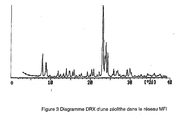
- X-ray diffraction is a technique used to characterize the solids according to the invention.
- the X-ray analysis is performed on powder with a diffractometer operating in reflection and equipped with a rear monochromator using copper radiation (wavelength 1.5406 ⁇ ).
- the estimation of the measurement error ⁇ (d hkl ) on d hkl is calculated by the Bragg relation as a function of the absolute error ⁇ (2 ⁇ ) assigned to the measurement of 2 ⁇ .
- An absolute error ⁇ (2 ⁇ ) equal to + -0.2 ° is commonly accepted.
- Each crystallized solid has an X-ray diffraction pattern of its own.
- lamellar silicates used for the invention mention may be made of Magadiite, natrosilite, Kenyaite, makatite, nekoite, kanemite, okenite, dehayelite, macdonalite and rhodesite, octosilicate.
- Magadiite and Kenyaite will be used.
- Magadiite will be used.
- lamellar silicate solids often exist in the natural state with a composition of the type A x Si y O z , nH 2 O, A may be, for example, a sodium or potassium element.
- Such lamellar solids are, for example, Na 2 Si 14 O 29 ⁇ 9H 2 O for Magadiite and Na 2 Si 20 O 41 ⁇ 10H 2 O for Kenyaite.
- Such natural solids have the same composition as synthetic solids. These solids often have a three-dimensional structure, with Van der Walls interactions between the layers and a low surface area.
- the lamellar silicic solids of the invention can be synthesized according to any method known to those skilled in the art.
- the method of preparation generally consists of a mixing step, during which a mixture comprising an alkali metal, a source of SiO 2 silica, water, optionally an organic structuring agent and a crystallization step are prepared. maintains this mixture under conditions allowing the formation of a crystalline solid.
- the preferred alkali metal is sodium.
- a lamellar silicic solid synthesized in the presence of an organic structuring agent Preferably, in the context of the invention, use will be made of a lamellar silicic solid synthesized in the presence of an organic structuring agent.
- the organic structuring agents used for the synthesis of lamellar silicic solids may be chosen from the following non-exhaustive list comprising benzyltriethylammonium chloride, benzyltrimethylammonium chloride, dibenzyldimethylammonium chloride, N, N'-dimethylpiperazine, triethylamine, or other quaternary compounds or heterocycle amines, an alkylamine, a trialkylamine, a tetraalkylammonium compound and a trimethylhexamethylenediamine diamine, said alkyl having 1 to 12 carbon atoms.
- the organic structurant comprises at least one alcohol group and at least one amine group separated by a hydrocarbon chain.
- the organic template comprises a single alcohol group and a single amine group.
- the alcohol group is a terminal group of the organic template.
- the amine group is preferably a terminal group of the organic template.
- the two alcohol and amine groups are terminal groups of the organic template.
- the organic template has from 1 to 20 carbon atoms.
- the hydrocarbon chain separating the two amine and alcohol groups may comprise a linear, cyclic or aromatic alkyl group, preferably cyclic or aromatic.
- the organic template is selected from the group consisting of tyramine, 4-aminophenol, trans-4-aminocyclohexanol and 2- (4-aminophenyl) ethanol.
- the method for synthesizing the lamellar silicic material comprises a step of mixture, in which a mixture comprising an alkali metal is prepared, a source of silica, water and organic structuring.
- the alkali metal A incorporated in the preparation step of the mixture may be lithium, potassium, sodium and / or calcium.
- the alkali metal is sodium.
- the source of silica incorporated in the preparation step of the mixture may be silicate, silica gel, colloidal silica and / or silicic acid.
- step i) of mixing at least one non-silicic metal, including metal M.
- the metal M is selected from the group formed by boron, chromium, gallium, indium, nickel, zirconium, cobalt, titanium, copper, niobium, magnesium, zinc, manganese, germanium. Even more preferably, the metal M is selected from boron, gallium, indium, nickel, cobalt, copper, niobium, magnesium, zinc, manganese, germanium.
- Aluminum may also be incorporated as Al 2 O 3 , Al (NO 3 ) 3 , for example.
- the metal M can be incorporated in the mixture in an oxidized form XOn, or in any other form, such as, for example, Co (CH 3 COO) 2 , Ti (EtO) 4 , Ni (CH 3 COO) 2 , Zn (CH 3 COO) 2 , Cu (CH 3 COO) 2 , Cr (CH 3 COO) 2 , Zr (OH) 4 , Na 2 B 4 O 7 , Mg (CH 3 COO) 2 , Mn (CH 3 COO) 2 , Nb 2 O 5 , GeO 2 .
- the method for synthesizing the lamellar silicic material comprises a step of crystallisation during which this mixture is maintained under conditions allowing the formation of a crystalline solid.
- the crystallization stage is generally of the hydrothermal type. This step can be carried out according to any method known to those skilled in the art, preferably in an autoclave.
- the reaction mixture can be vigorously stirred or not during the duration of the step of crystallization.
- the mixture obtained is heated during step i) at a crystallization temperature of between 100 and 200 ° C., preferably between 135 and 175 ° C, during a crystallization period of between 1 and 20 days, preferably between 3 and 10 days.
- the crystallized solid is generally separated from the mixture by any known method those skilled in the art such as filtration.
- the solid is then washed with water, preferably deionized water.
- the drying step v) is generally carried out at a temperature between 50 and 150 ° C for a period of 12 to 30 hours.
- the drying is carried out at atmospheric pressure preferably but can be performed under pressure.
- the solids used for the preparation method of the invention are as synthesized (often in alkaline form) or have undergone modification treatments.
- treatments of modification mention may be made of the cationic exchange which makes it possible to put the solid in form acid.
- solid delamination treatment or bridging means any treatment that significantly reduces the interaction forces between the sheets so as to break the cohesion between the sheets, to separate the sheets from each other and disperse the sheets.
- the treatment of delamination can be preferably a mechanical treatment (strong agitation) or the use ultrasound or any other method known to those skilled in the art within the definition previous. Bridging involves introducing pillars into interlamellar spaces; he allows to create a mesoporosity and increase the specific surface.
- the lamellar silicate solids used for the invention contain metals in the framework, of which at least one metal M, preferably chosen from boron, chromium, gallium, indium, nickel, zirconium, cobalt, titanium, copper, niobium, magnesium, zinc, manganese, germanium and even more preferably selected from boron, gallium, indium, nickel, cobalt, copper, niobium, magnesium , zinc, manganese, germanium.
- the lamellar silicate solids may contain aluminum in the framework, in addition to the other metal M.
- the lamellar silicate solids preferably contain only one metal M, and possibly aluminum, in the framework.
- the introduction of metal into the framework of the lamellar solid can be carried out in any manner known to those skilled in the art, either by direct synthesis or by post-synthesis substitution.
- the metal is introduced into the framework to the synthesis of the lamellar solid.
- the metal source M used may be in an oxidized form MOn, or in any other form, such as, for example, Co (CH 3 COO) 2 , Ti (EtO) 4 , Ni (CH 3 COO) 2 , Zn ( CH 3 COO) 2 , Cu (CH 3 COO) 2 , Cr (CH 3 COO) 2 , Zr (OH) 4 , Na 2 B 4 O 7 , Mg (CH 3 COO) 2 , Mn (CH 3 COO) 2 , Nb 2 O 5 , GeO 2 .
- the source of aluminum is preferably sodium aluminate, or an aluminum salt, for example chloride, nitrate, hydroxide or sulphate, an aluminum alkoxide or alumina itself, preferably in hydrated or hydratable form, as for example, colloidal alumina, pseudoboehmite, gamma-alumina or alpha or beta trihydrate. It is also possible to use mixtures of the sources mentioned above.
- seeds may be advantageous to add seeds to the reaction mixture in order to reduce the time necessary for the formation of the nuclei and / or the total duration of crystallization. he can also be advantageous to use germs to promote the formation of the solid crystallized at the expense of impurities.
- Such seeds include crystalline solids, in particular crystals of the crystallized solid to be synthesized.
- the crystalline germs are generally added in a proportion of between 0.01 and 10% of the weight of the silicon source used in the reaction mixture.
- the alkaline cation is selected from the group consisting of lithium, potassium, sodium, calcium. Sodium is preferred.
- Zeolites crystallize from a gel possibly containing a structurant organic.
- the organic structurant is a compound that contributes to the formation of a network zeolite given during the crystallization process and given synthesis conditions.
- zeolite EU-1 and ZSM-50 are synthesized respectively with the organic structure hexamethonium (HM) and dibenzyldimethylammonium (DBDMA).
- HM hexamethonium
- DBDMA dibenzyldimethylammonium
- the zeolite Y, and more generally the zeolites of structural type FAU, are synthesized in a hydrothermal medium without the presence of organic structuring agent and in the presence of seeds.
- the MOR zeolite is also synthesized without structuring.
- Beta zeolite can be synthesized using tetraethylammonium hydroxide.
- the zeolite ZSM-5 can be synthesized without structuring but is synthesized preferentially with tetrapropylammonium bromide (TPA) (industrial synthesis).
- TPA tetrapropylammonium bromide
- the ZSM-22 zeolite can be synthesized with a diamino-octane structurant.
- the zeolite synthesis conditions are widely known to those skilled in the art.
- the gel is advantageously placed under hydrothermal conditions under a reaction pressure autogenous, possibly by adding gas, for example nitrogen, to a temperature between 120 ° C and 200 ° C.
- the time required to obtain the crystallization varies usually between 1 hour and several months depending on the composition of the reagents in the gel, the stirring and the reaction temperature.
- the reaction is carried out generally with stirring or without agitation, preferably in the presence stirring.
- the solid phase obtained is separated from the mixture by any method known to those skilled in the art such as filtration.
- the solid phase is washed with water, preferably deionized.
- the solid phase is then ready for subsequent steps such drying, dehydration and calcination and / or ion exchange. For these steps, all the conventional methods known to those skilled in the art can be employed.
- the solid is filtered and washed; it is then said in its "synthetic crude” form and is ready for subsequent steps such as drying, dehydration and calcination and / or ion exchange.
- steps all conventional methods known to those skilled in the art can be employed.
- the calcination step is advantageously carried out by one or more heating steps at temperatures ranging from 100 to 1000 ° C. for periods ranging from a few hours to several days.
- the calcination is carried out in two consecutive heating stages, the first being carried out at a temperature between 100 and 300 ° C and the second being carried out at a temperature between 400 ° C and 700 ° C, the temperature being kept five to ten hours at each stage.
- the calcined forms of the solids no longer contain any organic compound, or in a quantity less than the "raw form of synthesis", insofar as the organic substance is eliminated for the most part, generally by a heat treatment of burning the organic substance in presence of air.
- the ammonium form (NH4 +) is important because it can easily be converted to hydrogen form by calcination.
- Modification treatments can also be applied to the solid thus calcined.
- We modifying treatment means all treatments such as vapotirements or acid attacks known to those skilled in the art.
- all zeolites containing metals other than aluminum in the framework can be synthesized.
- metals other than aluminum mention may be made without being exhaustive of metals such as boron, chromium, gallium, indium, nickel, zirconium, cobalt, titanium, copper, niobium, magnesium, zinc, manganese, germanium.
- the metal contained in the framework of the zeolite is selected from boron, gallium, indium, nickel, cobalt, copper, niobium, magnesium, zinc, manganese, germanium.
- the solid obtained is a zeolite of FAU type, more preferably a zeolite Y.
- the metal M contained in zeolite Y thus obtained is titanium.
- the Si / Ti ratio is generally between 10 and 1000, preferably between 15 and 80 or between 400 and 700.
- the zeolite Y thus obtained comprises nickel.
- the Si / Ni ratio is generally between 10 and 1000, preferably between 15 and 80 or between 400 and 700.
- a preferred zeolite is an FAU type zeolite, more preferably a Y zeolite.
- the Y zeolite obtained preferably comprises a metal selected from Co, Ni, Cu, Mn in the framework.
- the metal M contained in zeolite Y thus obtained is titanium alone.
- the Si / Ti ratio is generally between 10 and 1000, preferably between 15 and 80 or between 400 and 700.
- the zeolite Y thus obtained comprises nickel.
- the Si / Ni ratio is generally between 10 and 1000, preferably between 15 and 80 or between 400 and 700.
- To this solution are added 2.57 g Magadiite (with Co, Cu, Ni or Ti) or Kenite (with Ni, Ti, Co or Cu).
- the mixture is stirred.
- To this mixture, the FAU seeds are added.
- the mixture is then heated for 24 hours at 100oC if the silicon source is Magadiite and for 48 hours at 100oC if the silicon source is Kenyaite.
- the product obtained after crystallization is centrifuged, washed with deionized water and dried overnight. at 100 ° C.
- 0.088 g of NaCl and 0.214 g of KCl are diluted in a solution of 15.4 g of tetraethylammonium hydroxide and 8.58 g of water.
- a solution comprising 0.275 g of sodium aluminate, 0.056 g of NaOH and 2.92 g of water is added to the mixture.
- the mixture is stirred for 30 minutes.
- the resulting gel is transferred to the teflon liner of an autoclave and heated to 140 ° C.
- the autoclave is continuously stirred, the longitudinal axis of the autoclave rotating with a speed of about 60 rpm in a plane perpendicular to the axis of rotation for 15 days.
- the product obtained after crystallization is centrifuged and the recovered solid is washed with distilled water and the solid is dried overnight at 100 ° C.
- the solids obtained according to the preparation of the invention have a DRX spectrum identical to that reported in FIG. 2, similar to that of a zeolite Beta.
Landscapes
- Chemical & Material Sciences (AREA)
- Organic Chemistry (AREA)
- Life Sciences & Earth Sciences (AREA)
- General Life Sciences & Earth Sciences (AREA)
- Geology (AREA)
- Inorganic Chemistry (AREA)
- Engineering & Computer Science (AREA)
- Chemical Kinetics & Catalysis (AREA)
- Materials Engineering (AREA)
- Silicates, Zeolites, And Molecular Sieves (AREA)
Abstract
Description
On connaít à l'heure actuelle une quarantaine de zéolithes naturelles et entre 150 et 200 zéolithes synthétiques, dont moins d'une dizaine connaissent pour l'instant une application industrielle.
L'ensemble des types structuraux de toutes ces zéolithes est répertorié dans "Atlas of zeolite framework types", 5th revised Edition, (2001), Ch.Baerlocher, W.M.Meier, D.H.Olson.
Le terme zéolithe se réfère selon l'atlas à un réseau d'atomes à coordinence tétraédrique MO4. Les tétraèdres MO4 sont reliés entre eux par leur sommet oxygène de telle sorte que deux d'entre eux ne partagent qu'un seul oxygène et que tous les atomes d'oxygène de la charpente appartiennent à deux tétraèdres. Dans les zéolithes, il en résulte une structure très aérée parcourue par des canaux très fins et très réguliers dont l'ouverture est comprise entre 0,3 et 1,0 nm.
Il est toutefois possible dans certains cas, pour des métaux particuliers, d'obtenir d'autres zéolithes métallosilicates par un mode de synthèse directe; on peut citer les titanosilicates comme Ti-Beta (Blasco, T.et al, Chem. Commun., 2367-2368 (1996)), la Zn-Beta (Takewaki et al, Topics in Catalysis, 9, 35-42 (1999), la Chabazite AI-Co-P (Feng P.Y, Nature 388 735-741(1997)), la Beta Ga-Si (Reddy K.SN et al J.Incl.Phenom.Mol.Recogn.Chem). Toutefois, les méthodes de préparation utilisées ne permettent pas l'incorporation de tous les métaux directement à la synthèse. Par exemple, les métaux tels que le Cobalt peuvent précipiter au pH de synthèse des zéolithes.
L'introduction de métal peut également être obtenue par substitution isomorphique post synthèse (EP 0,146,384). L'introduction n'est pas toujours possible et dépend de la nature des métaux. Les aluminophosphates sont des solides qui ont été largement étudiés et qui permettent l'incorporation de différents métaux tels que Co, Fe, Mg, Mn Zn (obtention par exemple de Co-AlPO -FAU).
Pour les zéolithes silicoaluminiques, les sources de silicium et d'aluminium ont été largement étudiées dans la littérature. Par exemple, la source de silicium incorporée dans l'étape de préparation du mélange peut être du silicate, du silica gel, de la silice colloïdale et/ou de l'acide silicique.
L'invention porte également sur des nouveaux solides zéolithiques comportant des métaux particuliers dans la charpente.
L'invention porte également sur des nouveaux solides zéolithiques comportant des métaux particuliers dans la charpente.
On distinguera les méthodes de synthèses largement décrites dans la littérature ne faisant pas appel à l'utilisation de structurant organique et les méthodes de synthèse utilisant un structurant organique.
De manière préférée, le structurant organique comporte au moins un groupement alcool et au moins un groupement amine séparés par une chaíne hydrocarbonée. Avantageusement, le structurant organique comporte un seul groupement alcool et un seul groupement amine.
De préférence, le structurant organique comporte de 1 à 20 atomes de carbone.
La chaíne hydrocarbonée séparant les deux groupements amine et alcool peut comporter un groupement alkyl linéaire, cyclique ou aromatique, de préférence cyclique ou aromatique.
De préférence, le structurant organique est choisi dans le groupe formé par la tyramine, le 4-aminophénol, le trans-4-aminocyclohexanol et le 2-(4-amino-phényl)-éthanol.
- x étant généralement compris entre 0,1 et 1, de préférence entre 0,1 et 0,6
- y étant supérieur à 10
- z étant compris entre 0,05 et 3, de préférence entre 0,2 et 1
Les solides silicates lamellaires peuvent contenir de l'aluminium dans la charpente, en plus du ou des autres métaux M. De préférence les solides silicates lamellaires ne contiennent qu'un seul métal M, et éventuellement de l'aluminium, dans la charpente.
La source de métal M utilisée peut être sous une forme oxydée MOn, ou sous toute autre forme, telle que, par exemple, Co(CH3COO)2, Ti(EtO)4, Ni(CH3COO)2, Zn(CH3COO)2, Cu(CH3COO)2, Cr(CH3COO)2, Zr(OH)4, Na2B4O7, Mg(CH3COO)2, Mn(CH3COO)2, Nb2O5, GeO2.
Le sodium est préféré.
L'utilisation d'un structurant particulier ainsi que les procédés de synthèse des zéolithes sont connue de l'homme du métier. La revue "Verified syntheses of zeolitic materials" , IZA Publication, H.Robson, Ed, donnent des procédés de synthèse de nombreuses zéolithes vérifiés et publiés dans la littérature.
La zéolithe Y, et plus généralement les zéolithes de type structural FAU, sont synthétisées en milieu hydrothermal sans la présence de structurant organique et en présence de germes. La zéolithe MOR est également synthétisée sans structurant. La zéolithe Béta peut être synthétisée en utilisant l'hydroxyde de tetraethylammonium. La zéolithe ZSM-5 peut être synthétisée sans structurant mais est synthétisée préférentiellement avec le bromure de tetrapropylammonium (TPA) (synthèse industrielle).
La zéolithe ZSM-22 peut être synthétisée avec un structurant de type diamino-octane.
L'étape de calcination s'effectue avantageusement par une ou plusieurs étapes de chauffage à des températures allant de 100 à 1000°C pour des durées allant de quelques heures à plusieurs jours. De manière préférée, la calcination s'effectue en deux étapes de chauffage consécutives, la première étant réalisée à une température comprise entre 100 et 300°C et la deuxième étant réalisée à une température comprise entre 400°C et 700°C, la température étant maintenue cinq à dix heures à chaque étape.
Parmi les formes de zéolithes obtenues par échange d'ions, la forme ammonium (NH4+) est importante, car elle peut être facilement convertie sous la forme hydrogène par calcination.
Selon un autre mode très préféré, la zéolithe Y ainsi obtenue comprend du nickel. Le rapport Si/Ni est généralement compris entre 10 et 1000, de préférence compris entre 15 et 80 ou entre 400 et 700.
- structure FAU cristallisant dans le réseau (Si, Al, M); avec M= Co, Ni, Cu, Ti Mn
- structure Bêta cristallisant dans le réseau (Si, Al, M); avec M= Co, Cu, Ni, Mn
- structure MFI cristallisant dans le réseau (Si, Al, M); avec M= Co, Ni, Zr,
Cu, Mn, de préférence avec M = Co, Ni, Cu, Mn - structure MOR cristallisant dans le réseau (Si, Al, M); avec M= Co, Ni, Zr, Cu, Mn, de préférence avec M = Co, Ni, Cu, Mn
- structure EUO cristallisant dans le réseau (Si, Al, M); avec M= Co, Ni, Cr , Zr, Ti, Mn
- structure NES cristallisant dans le réseau (Si, Al, M); avec M= Co, Ni, Cr , Zr, Ti, Mn.
- structure TON cristallisant dans le réseau (Si, Al, M); avec M= Co, Ni, Cr , Zr, Ti, Mn.
Dans un mode de réalisation, la zéolithe Y obtenue comprend de préférence un métal choisi parmi Co, Ni, Cu, Mn dans la charpente.
Selon un autre mode très préféré, le métal M contenu dans la zéolithe Y ainsi obtenue est le titane seul. Le rapport Si/Ti est généralement compris entre 10 et 1000, de préférence compris entre 15 et 80 ou entre 400 et 700.
Selon encore un autre mode très préféré, la zéolithe Y ainsi obtenue comprend du nickel. Le rapport Si/Ni est généralement compris entre 10 et 1000, de préférence compris entre 15 et 80 ou entre 400 et 700.
SiO2/AlO2O3 = 5
Na2O / SiO2 = 0.43
H2O / SiO2 = 18
Ce gel est mis en contact avec des germes de zéolithe FAU tel que le gel final ait donc la composition suivante :
SiO2/ Al2O3= 10
Na2O / SiO2= 0.42
H2O / SiO2 = 18
avec
- La source de Na est de la soude NaOH (Scharlau),
- La source d' AI est de l'aluminate de sodium 32.8% Na2O, 54% Al2O3, 13.2% H2O (Carlo Erba),
- H2O déionisée
- La source de Si est soit de la Magadiite avec du cobalt, du cuivre, du Nickel ou Titane dans la charpente ou bien de la Kenyaite avec du nickel, du titane, du cobalt ou du cuivre dans la charpente.
| source de Si, nature du métal, rapport Si/M sur le matériau lamellaire | Si/Al sur le solide obtenu | Si / Metal sur le solide obtenu |
| Magadiite avec Co Si/Co=50 | 4.4 | 28.5 |
| Magadiite avec Co Si/Co=30 | 4.9 | 30.0 |
| Magadiite avec Ni Si/Ni=50 | 3.9 | 36.4 |
| Magadiite avec Ni Si/Ni=650 | 5.6 | 501.0 |
| Magadiite avec Cu Si/Cu=50 | 4.1 | 114.0 |
| Magadiite avec Ti Si/Ti=100 | 4.0 | 16.0 |
| Magadiite avec Ti Si/Ti=1000 | 4.0 | 520.0 |
| Kenyaite avec Co Si/Co=30 | 4.1 | 20.0 |
| Kenyaite avec Ti Si/Ti=100 | 4.1 | 32.0 |
| Kenyaite avec Cu Si/Cu=30 | 4.2 | 18.0 |
| Kenyaite avec Ni Si/Ni=50 | 4.1 | 41.0 |
| Kenyaite avec Ni Si/Ni=650 | 4.0 | 480.0 |
SiO2 / Al2O3 = 50
TEAOH / SiO2 = 0.5
NaOH / SiO2 = 0.02
H2O / SiO2 = 15
(Na+K) / SiO2=0.12
K/(Na+K)=0.33
- La source de Si est une Magadiite avec Co ou Mn dans la charpente,
- L'hydroxyde de tetraethylammonium (TEAOH) à 35% de Aldrich est le structurant organique,
- La source de sodium Na est de la soude NaOH (Scharlau) et NaCl 99% (Prolabo)
- La source d' Al est de l'aluminate de sodium 32.8% Na2O, 54% Al2O3. 13.2% H2O (Carlo Erba),
- La source de K est KCl 99.5% (Scharlau).
- L'eau est de l'H2O déionisée
4.402 g de Magadiite contenant un métal M (Co, Mn) sont ajoutés sous agitation (vitesse d'agitation = 350 tour/minute). Après 30 minutes, une solution comprenant 0.275 g d'aluminate de sodium, 0.056 g de NaOH et 2.92 g d'eau est ajoutée au mélange. Le mélange est agité pendant 30 minutes.
Le gel obtenu est transféré dans la chemise en téflon d'un autoclave et chauffé à 140º C . L'autoclave est continuellement agité, l'axe longitudinal de l'autoclave tournant avec une vitesse d'environ 60 tours/minute dans un plan perpendiculaire à l'axe de rotation durant 15 jours. Le produit obtenu après cristallisation est centrifugé et le solide récupéré est lavé à l'eau distillée et le solide est séché une nuit à 100°C.
Les solides obtenus selon la préparation de l'invention possèdent un spectre DRX identique à celui reporté figure2, semblable à celui d'une zéolithe Bêta.
| source de Si, nature du métal, rapport Si/M sur le matériau lamellaire | Si/AI sur le solide obtenu | Si / Métal sur le solide obtenu |
| Magadiite avec Co Si/Co=30 | 13.6 | 15.2 |
| Magadiite avec Co Si/Co=40 | 13.6 | 23.4 |
| Magadiite avec Co Si/Co = 50 | 11.3 | 41.2 |
| Magadiite avec Mn Si/Mn = 50 | 10.7 | 52.7 |
SiO2 / Al2O3=100 NaOH / SiO2 = 0.15 H2O / SiO2 = 34.5 .....TPA / SiO2 = 0.31
avec
- La source d' Al2O3 est Al2 (SO4)3, 18 H2O (Merck)
- La source de SiO2 est la Magadiite avec des métaux dans la charpente (Co, Ni, Cu, Mn)
- Le structurant organique est le bromure de tetrapropylammonium (TPA - Br) 99% (Aldrich)
- La source de Na est de la soude NaOH (Scharlau)
- L'eau est de l'H2O déionisée.
| source de Si, nature du métal, rapport Si/M sur le matériau lamellaire | Si/Al sur le solide obtenu | Si / Métal sur le solide obtenu |
| Magadiite avec Ni Si/Ni=50 | 28.0 | 41.1 |
| Magadiite avec Co Si/Co=50 | 17.0 | 30 |
| Magadiite avec Mn Si/Mn = 50 | 10 | 124 |
| Magadiite avec Cu Si/Cu = 50 | 41.8 | 80.6 |
Claims (25)
- Méthode de préparation par synthèse directe de métalloaluminosilicate cristallisé utilisant au moins une source d'aluminium et, comme source de silicium et comme source d'au moins un autre métal M choisi dans le groupe formé par le bore, le chrome, le gallium, l'indium, le nickel, le zirconium, le cobalt, le titane, le cuivre, le niobium, le magnésium, le zinc, le manganèse, le germanium, au moins un matériau silicique lamellaire contenant des métaux dans la charpente.
- Méthode de préparation selon la revendication 1 comprenant une étape de mélange d'au moins un solide lamellaire comme source de silicium et comme source d'un autre métal M, avec au moins une source d'aluminium, et de l'eau, une étape de cristallisation, une étape de nucléation et une étape de croissance des cristaux.
- Méthode de préparation selon la revendication 2 dans laquelle le mélange comprend au moins un composé organique en tant que structurant organique.
- Méthode de préparation selon l'une des revendications 2 à 3 dans laquelle le mélange comprend au moins un germe de zéolithe.
- Méthode de préparation selon l'une des revendications 2 à 4 dans laquelle le mélange comprend au moins une source de cation alcalin.
- Méthode de préparation selon l'une des revendications précédentes dans laquelle le métal M est choisi dans le groupe formé par le bore, le gallium, l'indium, le nickel, le cobalt, le cuivre, le niobium, le magnésium, le zinc, le manganèse, le germanium.
- Méthode de préparation selon l'une des revendications précédentes dans laquelle le matériau silicique lamellaire est la Magadiite ou la Kenyaite.
- Méthode de préparation selon la revendication 7 dans laquelle le matériau silicique lamellaire est la Magadiite.
- Méthode de préparation selon l'une des revendications précédentes dans laquelle le matériau silicique lamellaire est synthétisé en présence d'un structurant organique.
- Méthode de préparation selon la revendication 9 dans laquelle le structurant organique comporte au moins un groupement alcool et au moins un groupement amine séparés par une chaíne hydrocarbonée.
- Méthode de préparation selon la revendication 10 dans laquelle le structurant organique comporte un seul groupement alcool et un seul groupement amine.
- Méthode de préparation selon la revendication 11 dans laquelle le groupement alcool est un groupement terminal du structurant organique et/ou le groupement amine est un groupement terminal du structurant organique.
- Méthode de préparation selon l'une des revendications 9 à 12 dans laquelle le structurant organique comporte de 1 à 20 atomes de carbone.
- Méthode de préparation selon l'une des revendications précédente dans laquelle le matériau silicique lamellaire est échangé cationiquement, ponté ou délaminé.
- Solide métalloaluminosilicate cristallisé susceptible d'être obtenu par la méthode selon l'une des revendications 1 à 14.
- Solide métalloaluminosilicate selon la revendication 15 contenant dans la charpente au moins un métal M choisi dans le groupe formé par le bore, le chrome, le gallium, l'indium, le nickel, le zirconium, le cobalt, le titane, le cuivre, le niobium, le magnésium, le zinc, le manganèse, le germanium.
- Solide métalloaluminosilicate selon la revendication 16 contenant dans la charpente au moins un métal M choisi dans le groupe formé par le bore, le gallium, l'indium, le nickel, le cobalt, le cuivre, le niobium, le magnésium, le zinc, le manganèse, le germanium.
- Solide métalloaluminosilicate selon la revendication 16 ou 17 dont la structure est de type FAU.
- Solide métalloaluminosilicate comprenant des métaux dans la charpente zéolithique choisi dans le groupe formé par les zéolithes de structure FAU cristallisant dans le réseau (Si, Al, M) où M désigne un métal choisi parmi Co, Ni, Cu, Ti, Mn.
- Solide métalloaluminosilicate comprenant des métaux dans la charpente zéolithique choisi dans le groupe formé par les zéolithes de structure bêta cristallisant dans le réseau (Si, Al, M) où M désigne un métal choisi parmi Co, Cu, Ni, Mn.
- Solide métalloaluminosilicate comprenant des métaux dans la charpente zéolithique choisi dans le groupe formé par les zéolithes de structure MFI ou MOR cristallisant dans le réseau (Si, Al, M) où M désigne un métal choisi parmi Co, Ni, Cu, Zr, Mn.
- Solide métalloaluminosilicate comprenant des métaux dans la charpente zéolithique choisi dans le groupe formé par les zéolithes de structure EUO, NES ou TON cristallisant dans le réseau (Si, Al, M) où M désigne un métal choisi parmi Co, Ni, Cr, Zr, Ti, Mn.
- Solide métalloaluminosilicate selon la revendication 18 ou 19 qui est une zéolithe Y.
- Solide métalloaluminosilicate selon la revendication 23 qui contient du Ni avec un rapport Si/Ni compris entre 10 et 1000.
- Solide métalloaluminosilicate selon la revendication 23 qui contient comme seul métal M du Ti avec un rapport Si/Ti compris entre 10 et 1000.
Applications Claiming Priority (2)
| Application Number | Priority Date | Filing Date | Title |
|---|---|---|---|
| FR0405021A FR2869894B1 (fr) | 2004-05-10 | 2004-05-10 | Methode de synthese de metalloaluminosilicate cristallise par synthese directe |
| FR0405021 | 2004-05-10 |
Publications (2)
| Publication Number | Publication Date |
|---|---|
| EP1595846A2 true EP1595846A2 (fr) | 2005-11-16 |
| EP1595846A3 EP1595846A3 (fr) | 2007-05-23 |
Family
ID=34942180
Family Applications (1)
| Application Number | Title | Priority Date | Filing Date |
|---|---|---|---|
| EP05290883A Withdrawn EP1595846A3 (fr) | 2004-05-10 | 2005-04-26 | Méthode de synthèse de métalloaluminosilicate cristallisé par synthèse directe |
Country Status (6)
| Country | Link |
|---|---|
| US (1) | US20050271582A1 (fr) |
| EP (1) | EP1595846A3 (fr) |
| JP (1) | JP2005320238A (fr) |
| CN (1) | CN1733605A (fr) |
| FR (1) | FR2869894B1 (fr) |
| ZA (1) | ZA200503309B (fr) |
Families Citing this family (32)
| Publication number | Priority date | Publication date | Assignee | Title |
|---|---|---|---|---|
| FR2867200B1 (fr) * | 2004-03-05 | 2006-05-26 | Inst Francais Du Petrole | Solide cristallise uvl-1 et procede d'hydroconversion / hydrocraquage de charges hydrocarbonees |
| JP2007031172A (ja) * | 2005-07-22 | 2007-02-08 | Inst Fr Petrole | アミノアルコール型有機構造化剤からラメラ固体を合成する方法 |
| ITMI20061231A1 (it) * | 2006-06-26 | 2007-12-27 | Eni Spa | Proxcesso e materiali zeolitici per la separazione di gas |
| FR2909905B1 (fr) * | 2006-12-15 | 2009-02-06 | Inst Francais Du Petrole | Procede de preparation de magdiite ou kenyaite a partir d'un structurant orgnanique comp0rtant deux fonctions alcools terminales. |
| EP2160355B1 (fr) * | 2007-04-04 | 2011-08-31 | Basf Se | Procédé de préparation d'un silicate contenant des hétéroatomes |
| CN101279857B (zh) * | 2007-04-06 | 2011-11-09 | 清华大学 | 介孔材料的制备方法 |
| WO2008153759A2 (fr) | 2007-05-24 | 2008-12-18 | Saudi Basic Industries Corporation | Catalyseur de conversion d'hydrocarbures et procédé de production et d'utilisation correspondant - dépôt bimétallique |
| US8969232B2 (en) * | 2007-05-24 | 2015-03-03 | Saudi Basic Industries Corporation | Catalyst for conversion of hydrocarbons, process of making and process of using thereof—incorporation 2 |
| US9221723B2 (en) * | 2007-05-24 | 2015-12-29 | Saudi Basic Industries Corporation | Catalyst for conversion of hydrocarbons, process of making and process of using thereof—incorporation-1 |
| US8993468B2 (en) | 2007-05-24 | 2015-03-31 | Saudi Basic Industries Corporation | Catalyst for conversion of hydrocarbons, process of making and process of using thereof—Ge zeolites |
| US8541331B2 (en) * | 2007-08-13 | 2013-09-24 | Pq Corporation | Iron-containing aluminosilicate zeolites and methods of making and using same |
| FR2920423B1 (fr) * | 2007-09-04 | 2009-11-13 | Inst Francais Du Petrole | Preparation d'un materiau composite poreux a base de zeolithe eu-1 et sa mise en oeuvre en isomerisation des aromatiques en c8. |
| JP5219021B2 (ja) * | 2007-09-14 | 2013-06-26 | 独立行政法人産業技術総合研究所 | 結晶性ミクロ多孔体の製造方法 |
| CN101514022B (zh) * | 2008-02-20 | 2011-08-17 | 中国石油化工股份有限公司 | Zsm-5/zsm-23/mcm-22三相共生分子筛及其合成方法 |
| CN101514024B (zh) * | 2008-02-20 | 2011-04-27 | 中国石油化工股份有限公司 | β沸石/Magadiite/丝光沸石共生材料及其合成方法 |
| ES2465004T3 (es) | 2008-05-21 | 2014-06-04 | Basf Se | Procedimiento de síntesis directa de zeolitas que contienen Cu que tienen una estructura de CHA |
| CN101613110B (zh) * | 2008-12-16 | 2012-01-11 | 海南美大制药有限公司 | 一种硅酸镁铝化合物及其合成方法 |
| JP5656211B2 (ja) * | 2009-08-31 | 2015-01-21 | 独立行政法人国立高等専門学校機構 | コバルト骨格置換アルミノシリケート型ゼオライトの製造方法 |
| FR2970259B1 (fr) | 2011-01-07 | 2014-07-18 | IFP Energies Nouvelles | Procede d'hydrocraquage utilisant un catalyseur zeolithique contenant deux fonctions hydrogenantes distinctes. |
| CN103204505B (zh) * | 2012-01-13 | 2015-03-18 | 中国石油化工股份有限公司 | 一种制备含铝层状水羟硅钠石的方法 |
| US10005072B2 (en) | 2012-07-23 | 2018-06-26 | W. R. Grace & Co.-Conn | High matrix surface area catalytic cracking catalyst stabilized with magnesium and silica |
| US9993810B2 (en) | 2012-07-23 | 2018-06-12 | W. R. Grace & Co.-Conn | Silica sol bound catalytic cracking catalyst stabilized with magnesium |
| IN2015DN02842A (fr) * | 2012-12-12 | 2015-09-11 | Haldor Topsoe As | |
| US10207255B2 (en) | 2013-11-22 | 2019-02-19 | Saudi Basic Industries Corporation | Catalyst with improved activity/selectivity for light naphtha aromatization |
| EP3519354A1 (fr) | 2016-09-30 | 2019-08-07 | Johnson Matthey Public Limited Company | Nouvelle synthèse de zéolite avec une source de fluorure |
| CN106554029A (zh) * | 2016-11-14 | 2017-04-05 | 南开大学 | 封装金属铬配合物的复合fau型分子筛及其合成方法 |
| ZA201901486B (en) * | 2018-03-14 | 2020-12-23 | Evonik Degussa Gmbh | Process for preparing a structurally selective ologomerization catalyst of prolonged stability by precipitation |
| US10350585B1 (en) * | 2018-08-14 | 2019-07-16 | Saudi Arabian Oil Company | Methods for synthesizing hierarchical zeolites for catalytic cracking |
| CN111514848A (zh) * | 2020-04-29 | 2020-08-11 | 贵州大学 | 一种氨基修饰的铝麦羟硅钠石选择性吸附材料的制备与应用 |
| JP2023156098A (ja) * | 2022-04-12 | 2023-10-24 | 東ソー株式会社 | Fau型ゼオライトの製造方法 |
| CN119637896A (zh) * | 2023-09-18 | 2025-03-18 | 中国石油天然气股份有限公司 | 一种强酸性fau型分子筛及其制备方法 |
| CN119683643B (zh) * | 2025-02-24 | 2025-06-24 | 山东理工大学 | 一种钛丝光沸石分子筛制备方法及制备装置 |
Family Cites Families (23)
| Publication number | Priority date | Publication date | Assignee | Title |
|---|---|---|---|---|
| US3510422A (en) * | 1967-09-11 | 1970-05-05 | Texaco Inc | Composite silicate-zeolite catalyst |
| GB2125390B (en) * | 1982-08-16 | 1985-12-24 | Ici Plc | Preparation of zeolites |
| US4560542A (en) * | 1984-12-06 | 1985-12-24 | Exxon Research And Engineering Co. | Method for the preparation of zeolites using a low water low alkali metal content gel |
| US4859648A (en) * | 1984-12-28 | 1989-08-22 | Mobil Oil Corporation | Layered metal chalcogenides containing interspathic polymeric chalcogenides |
| US4689207A (en) * | 1985-03-06 | 1987-08-25 | Chevron Research Company | Process for the preparation of crystalline microporous organosilicates using magadiite as a silica source |
| US4676958A (en) * | 1985-03-06 | 1987-06-30 | Chevron Research Company | Preparation of crystalline zeolites using magadiite |
| US4626421A (en) * | 1985-06-28 | 1986-12-02 | Chevron Research Company | Preparation of magadiite |
| US4980333A (en) * | 1986-06-27 | 1990-12-25 | Mobil Oil Corporation | Perovskite-related layered oxides containing interspathic polymeric oxide |
| JPH07115871B2 (ja) * | 1986-12-12 | 1995-12-13 | 水澤化学工業株式会社 | 水素型ゼオライトの製造方法 |
| US5186918A (en) * | 1987-12-15 | 1993-02-16 | Uop | Substitution of Cr in place of Al in the framework of molecular sieve via treatment with fluoride salts |
| US5187132A (en) * | 1991-05-14 | 1993-02-16 | Chevron Research And Technology Company | Preparation of borosilicate zeolites |
| US5283043A (en) * | 1992-04-16 | 1994-02-01 | Mobil Oil Corp. | Direct crystallization of organic-swelled layered silicates and preparation of layered silicates containing interlayer polymeric chalcogenides therefrom |
| AU678983B2 (en) * | 1992-07-24 | 1997-06-19 | Exxon Chemical Patents Inc. | Catalysts and their use in oxidation of satured hydrocarbons |
| AU678597B2 (en) * | 1993-07-23 | 1997-06-05 | Exxon Chemical Patents Inc. | Process for the manufacture of a zeolite |
| AUPN538295A0 (en) * | 1995-09-13 | 1995-10-05 | Australian National University, The | Magnesiosilicate cation exchange compounds |
| US5688975A (en) * | 1996-04-10 | 1997-11-18 | Uop | Rare earth stabilized Cr/Ti substituted molecular sieves |
| AU3232997A (en) * | 1996-06-07 | 1998-01-05 | Chevron U.S.A. Inc. | Zeolite me-utd-1 |
| JPH1087315A (ja) * | 1996-09-09 | 1998-04-07 | Toyota Central Res & Dev Lab Inc | 層状珪酸及びその製造方法,層状珪酸塩 |
| JP3379353B2 (ja) * | 1996-09-09 | 2003-02-24 | 株式会社豊田中央研究所 | メソポア材料及びその製造方法 |
| US7041274B2 (en) * | 1999-10-22 | 2006-05-09 | Intevep, S.A. | Aluminosilicate compositions, preparation and use |
| US6346224B1 (en) * | 1999-10-22 | 2002-02-12 | Intevep, S.A. | Metaloalluminosilicate composition, preparation and use |
| FR2808520B1 (fr) * | 2000-05-05 | 2002-08-02 | Inst Francais Du Petrole | Procede de preparation d'une zeolithe de type structural euo , la zeolithe obtenue et son utilisation en tant que catalyseur d'isomerisation des c8 aromatiques |
| WO2004020335A1 (fr) * | 2002-08-28 | 2004-03-11 | Albemarle Netherlands B.V. | Processus de preparation de zeolites de type pensatile dopes au moyen d'un reactif dope |
-
2004
- 2004-05-10 FR FR0405021A patent/FR2869894B1/fr not_active Expired - Fee Related
-
2005
- 2005-04-25 ZA ZA200503309A patent/ZA200503309B/en unknown
- 2005-04-26 EP EP05290883A patent/EP1595846A3/fr not_active Withdrawn
- 2005-05-09 CN CN200510078824.1A patent/CN1733605A/zh active Pending
- 2005-05-10 US US11/125,339 patent/US20050271582A1/en not_active Abandoned
- 2005-05-10 JP JP2005137135A patent/JP2005320238A/ja active Pending
Also Published As
| Publication number | Publication date |
|---|---|
| FR2869894A1 (fr) | 2005-11-11 |
| CN1733605A (zh) | 2006-02-15 |
| JP2005320238A (ja) | 2005-11-17 |
| US20050271582A1 (en) | 2005-12-08 |
| ZA200503309B (en) | 2006-07-26 |
| FR2869894B1 (fr) | 2007-02-23 |
| EP1595846A3 (fr) | 2007-05-23 |
Similar Documents
| Publication | Publication Date | Title |
|---|---|---|
| EP1595846A2 (fr) | Méthode de synthèse de métalloaluminosilicate cristallisé par synthèse directe | |
| EP0364352B1 (fr) | Procédé de synthèse de zéolithes appartenant à la famille structurale de la faujasite, produits obtenus et leur application en adsorption et catalyse | |
| EP0946416A1 (fr) | Zeolithe im-5, son procede de preparation et ses applications catalytiques | |
| EP0419334B1 (fr) | Zéolite de type bêta et son procédé de préparation | |
| EP3378830B1 (fr) | Procede de synthese de la zeolithe izm-2 en presence d'un structurant dibromure de 1,6-bis(methylpiperidinium)hexane | |
| EP0172068A1 (fr) | Nouveau procédé de synthèse de zéolites du type aluminosilicate, produits obtenus par ce procédé et utilisation de ces produits | |
| FR3064261A1 (fr) | Procede de synthese de la zeolithe izm-2 en presence d'un structurant dihydroxyde de 1,6-bis(methylpiperidinium)hexane | |
| EP3801893A1 (fr) | Procede de synthese d'une zeolithe de type structural afx de tres haute purete en presence d'un structurant organique azote | |
| WO2019224087A1 (fr) | Procede de preparation d'une zeolithe de type structural afx par synthese en presence d'un structurant organique azote | |
| EP0419307B1 (fr) | Zéolite de la famille de la mazzite, son procédé de synthèse et son utilisation comme catalyseur | |
| EP0443004B1 (fr) | Synthese de zeolithes aluminosilicate a structure faujasite | |
| EP0436713B1 (fr) | Synthese de zeolites gallosilicate a structure faujasite | |
| FR3101342A1 (fr) | Procede de preparation d’une zeolithe izm-2 en presence d’un melange de structurants organiques azotes sous forme hydroxyde et bromure et d’un chlorure de metal alcalin | |
| EP1510501A1 (fr) | Solide cristallisé IM-11 de type structural LTA et son procédé de preparation. | |
| EP3801892A1 (fr) | Procede de preparation d'une zeolithe de type structural afx de haute purete avec un structurant organique azote | |
| WO2023066715A1 (fr) | Procédé de préparation de zéolithe fau en présence d'un structurant hydroxyde de tétraéthylammonium teaoh | |
| EP0224531B1 (fr) | Zeolites du type borosilicate contenant du fluor | |
| EP0437989B1 (fr) | Zéolithe de type lévyne et son procédé de préparation | |
| EP1559681B1 (fr) | Méthode de synthèse de solides lamellaires à partir d'un structurant organique de type amino-alcool | |
| EP0427579B1 (fr) | Zéolithe de type mordénite et son procédé de préparation | |
| EP0530103B1 (fr) | Procédé de synthèse de zéolites à charpente aluminosilicique appartenant à la famille structurale de la faujasite, produits obtenus et leur application en adsorption et catalyse | |
| FR3090616A1 (fr) | Procédé de préparation d'une zéolithe de type structural LTL | |
| EP1591420A2 (fr) | Solide cristallisé ITQ-31 et son procédé de préparation | |
| EP0530104A1 (fr) | Procédé de synthèse de zéolites à charpente aluminosilicique appartenant à la famille structurale de la faujasite, produits obtenus et leur application en adsorption et catalyse |
Legal Events
| Date | Code | Title | Description |
|---|---|---|---|
| PUAI | Public reference made under article 153(3) epc to a published international application that has entered the european phase |
Free format text: ORIGINAL CODE: 0009012 |
|
| AK | Designated contracting states |
Kind code of ref document: A2 Designated state(s): AT BE BG CH CY CZ DE DK EE ES FI FR GB GR HU IE IS IT LI LT LU MC NL PL PT RO SE SI SK TR |
|
| AX | Request for extension of the european patent |
Extension state: AL BA HR LV MK YU |
|
| PUAL | Search report despatched |
Free format text: ORIGINAL CODE: 0009013 |
|
| AK | Designated contracting states |
Kind code of ref document: A3 Designated state(s): AT BE BG CH CY CZ DE DK EE ES FI FR GB GR HU IE IS IT LI LT LU MC NL PL PT RO SE SI SK TR |
|
| AX | Request for extension of the european patent |
Extension state: AL BA HR LV MK YU |
|
| 17P | Request for examination filed |
Effective date: 20071123 |
|
| AKX | Designation fees paid |
Designated state(s): AT BE BG CH CY CZ DE DK EE ES FI FR GB GR HU IE IS IT LI LT LU MC NL PL PT RO SE SI SK TR |
|
| 17Q | First examination report despatched |
Effective date: 20091030 |
|
| STAA | Information on the status of an ep patent application or granted ep patent |
Free format text: STATUS: THE APPLICATION IS DEEMED TO BE WITHDRAWN |
|
| 18D | Application deemed to be withdrawn |
Effective date: 20111101 |