EP1596335A2 - Charakterisierung der Bewegung von Objekten in einem Video - Google Patents
Charakterisierung der Bewegung von Objekten in einem Video Download PDFInfo
- Publication number
- EP1596335A2 EP1596335A2 EP05103773A EP05103773A EP1596335A2 EP 1596335 A2 EP1596335 A2 EP 1596335A2 EP 05103773 A EP05103773 A EP 05103773A EP 05103773 A EP05103773 A EP 05103773A EP 1596335 A2 EP1596335 A2 EP 1596335A2
- Authority
- EP
- European Patent Office
- Prior art keywords
- image
- video
- wavelet
- background
- estimated
- Prior art date
- Legal status (The legal status is an assumption and is not a legal conclusion. Google has not performed a legal analysis and makes no representation as to the accuracy of the status listed.)
- Withdrawn
Links
Images

Classifications
-
- G—PHYSICS
- G06—COMPUTING OR CALCULATING; COUNTING
- G06V—IMAGE OR VIDEO RECOGNITION OR UNDERSTANDING
- G06V20/00—Scenes; Scene-specific elements
- G06V20/50—Context or environment of the image
- G06V20/52—Surveillance or monitoring of activities, e.g. for recognising suspicious objects
- G06V20/54—Surveillance or monitoring of activities, e.g. for recognising suspicious objects of traffic, e.g. cars on the road, trains or boats
-
- G—PHYSICS
- G06—COMPUTING OR CALCULATING; COUNTING
- G06T—IMAGE DATA PROCESSING OR GENERATION, IN GENERAL
- G06T7/00—Image analysis
- G06T7/20—Analysis of motion
- G06T7/254—Analysis of motion involving subtraction of images
-
- G—PHYSICS
- G06—COMPUTING OR CALCULATING; COUNTING
- G06T—IMAGE DATA PROCESSING OR GENERATION, IN GENERAL
- G06T7/00—Image analysis
- G06T7/20—Analysis of motion
- G06T7/262—Analysis of motion using transform domain methods, e.g. Fourier domain methods
-
- G—PHYSICS
- G06—COMPUTING OR CALCULATING; COUNTING
- G06V—IMAGE OR VIDEO RECOGNITION OR UNDERSTANDING
- G06V20/00—Scenes; Scene-specific elements
- G06V20/50—Context or environment of the image
- G06V20/52—Surveillance or monitoring of activities, e.g. for recognising suspicious objects
-
- G—PHYSICS
- G06—COMPUTING OR CALCULATING; COUNTING
- G06V—IMAGE OR VIDEO RECOGNITION OR UNDERSTANDING
- G06V40/00—Recognition of biometric, human-related or animal-related patterns in image or video data
- G06V40/20—Movements or behaviour, e.g. gesture recognition
Definitions
- the present invention relates to techniques for charactering the motion of moving objects in digital video.
- the method and system classify if an object is in transition or it stops in the viewing range of the camera. It also detects left or stopped objects.
- the method and system can operate on actual or compressed data, compressed either using a block based compression scheme or a wavelet transformation based data compression technique.
- Plasberg describes an apparatus and a method for the detection of an object moving in the monitored region of a camera, wherein measured values are compared with reference values and an object detection reaction is triggered when the measured value deviates in a pre-determined manner from the reference value. This method is based on comparing the actual pixel values of images forming the video. Plasberg neither tries to detect left objects nor makes an attempt to use compressed images or video stream. In many real-time applications, it is not possible to use uncompressed video due to available processor power limitations.
- Yoneyama et al describes a system for detecting a moving object in a moving picture, which can detect moving objects in block based compression schemes without completely decoding the compressed moving picture data.
- Yoneyama's method works only in block based coding schemes, which divide images into small blocks and compress the image and video block by block. The method is based on the so-called motion vectors characterizing the motions of blocks forming each image.
- Yoneyama's approach restricts the accuracy of motion calculation to the pre-defined blocks and makes no attempt to reduce the amount of processing required by ignoring the non-moving background parts. Therefore it is a different approach than our approach which characterizes the moving objects.
- the scheme makes no attempt to estimate a background image from video to characterize the motion of moving objects.
- Taniguchi et al describe a moving object detection apparatus including a movable input section to input a plurality of images in a time series, in which a background area and a moving object are included.
- a calculation section divides each input image by unit of predetermined area, and calculates the moving vector between two images in a time series and a corresponding confidence value of the moving vector by unit of the predetermined area.
- a background area detection section detects a group of the predetermined areas, each of which moves almost equally as the background area from the input image according to the moving vector and the confidence value by unit of the predetermined area.
- a moving area detection section detects the area other than the background area as the moving area from the input image according to the moving vector of the background area. This method is also based on comparing the actual pixel values of images forming the video and there is neither an attempt to detect left objects in video nor use compressed images nor compressed video stream for background estimation.
- the present invention addresses such a need.
- a method and system for characterizing the motion of moving objects in digital video is disclosed.
- a typical video scene contains foreground and background objects. Foreground objects temporarily stay in the video. However, a stopped object or a left object becomes a part of the background scene and remains in the viewing range of the camera. It is determined if an object is in transition or it stops within the viewing range of the camera by examining the background scene estimated from the video. Left objects are also detected.
- Other methods characterize moving objects by examining the motion vectors of moving objects in video. The approach in accordance with the present invention is different from other approaches in the sense that it is determined if an object is transitory or remains in video by estimating the background scene.
- a method and system in accordance with the present invention determines left or stopped objects from a digital video.
- a plurality of images are inputted to the system in time series.
- a method and system determines the left objects by comparing the background image estimated from the current image of the video with the background estimated from previous images of the video. A difference between the current and previous background images indicates a left object.
- Other objects, which do not modify the background scene are determined a transitory objects.
- the matter and system is implemented in compressed data domain. In other words, the method and system determines left objects from digital video in compressed form. Background scene of a video can be estimated using the compressed video data as well.
- the present invention provides several methods and apparatus for characterizing the motion of moving objects in video represented in ordinary form or encoded using a data compression algorithm without performing data decompression.
- the present invention relates to techniques for charactering the motion of moving objects in digital video.
- the following description is presented to enable one of ordinary skill in the art to make and use the invention and is provided in the context of a patent application and its requirements.
- Various modifications to the preferred embodiment and the generic principles and features described herein will be readily apparent to those skilled in the art.
- the present invention is not intended to be limited to the embodiment shown but is to be accorded the widest scope consistent with the principles and features described herein.
- the present invention relates to techniques for characterizing the motion of moving objects in digital video.
- the video can be either compressed or uncompressed form.
- the invention can provide solution to many interesting problems including detection of stopped or stalled cars in highway surveillance videos, and detection of left parcels and luggage in train stations and airports.
- a typical video scene contains foreground and background objects. Foreground objects temporarily stay in the video. However, a stopped object or a left object becomes a part of the background scene and remains in the viewing range of the camera.
- Other methods characterize moving objects by examining the motion vectors of moving objects in video. Our approach is different from other approaches in the sense that we determine if an object is a transitory object or remains in video by estimating the background scene.
- moving regions and objects can be detected by comparing the current image with the background image, which can be estimated from past images of the video including the current image. If there is a significant temporal difference between the current image frame and the background image then this means that there is motion in the video. If there is no motion then the current image and the background image ideally should be equal to each other.
- Stationary pixels in the video are the pixels of the background scene because the background can be defined as temporally stationary part of the video. If the scene is observed for some time then pixels forming the entire background scene can be estimated because moving regions and objects occupy only some parts of the scene in a typical image of a video.
- a simple approach to estimate the background is to average the observed image frames of the video. Since moving objects and regions occupy only a part of the image they conceal a part of the background scene and their effect is cancelled over time by averaging.
- a pixel I n (x,y) is assumed to be moving if
- > T n (x,y) where T n (x,y) is a threshold recursively updated for each pixel as follows T n+1 (x,y) a T n (x,y) + (1-a) ( c
- , if I n (x,y) is not moving T n+1 (x,y) T n (x,y), if I n (x,y) is moving where c is a number greater than 1 and the update parameter a is a positive number close to 1.
- Initial threshold values can be experimentally determined. As it can be seen from the above equation higher the parameter c higher the threshold or lower the sensitivity of detection scheme.
- the regions different from the background are the moving regions.
- Estimated background image is subtracted from the current image of the video to detect the moving regions in the video.
- > T n (x,y) Inequality 1 are determined. These pixels are the pixels of moving objects.
- the background images Bn+1 and Bn-m are compared where the duration parameter m is a positive integer used to determine the change in background.
- the duration parameter m is determined by the user to classify if an object is moving or stopped. If there are pixels whose corresponding values significantly differ from each other in Bn+1 and Bn-m then this means that background has changed. Pixels satisfying the inequality I B n+1 (x,y) - B n-m (x,y)
- > Th Inequality 2 belong to left or stopped objects during the time corresponding to difference of frame indexes n - (n-m) m.
- the threshold value Th is a positive number.
- the union of the neighbouring pixels on the image I n is obtained to determine the left object(s) in the video.
- the number of left or stopped objects is equal to the number of disjoint regions obtained as a result of the union operation. If a pixel I n (x,y) satisfies the Inequality 1 but the corresponding background pixel B n+1 (x,y) does not satisfy the Inequality 2 this means that this pixel does not belong to a stopped or a left object. It is the pixel of a moving object in transition at time n.
- the union of the neighbouring pixels satisfying Inequality 1 on the image I n is determines the moving object(s) in the video. Similarly, the number of moving objects is equal to the number of disjoint regions obtained as a result of the union operation.
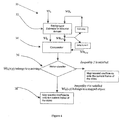
- FIGURE 1 is a block diagram 10 illustrating the present invention for characterizing the motion of moving objects in a video consisting of a sequence of images.
- the block diagrams and flow diagrams illustrated herein are preferably implemented using software on any suitable general-purpose computer or the like, having microprocessor, memory, and appropriate peripherals, where the software is implemented with program instructions stored on a computer readable medium (memory device, CDROM or DVDROM, magnetic disk, etc).
- the block diagrams and methods can alternatively be implemented using hardware (logic gates, etc) or a combination of hardware and software.
- the current image frame I n and estimated background image B n are input to a background estimating system 12 which determines the next estimate B n+1 as described above.
- the comparator 14 may simply take the difference of I n and B n and the difference of B n+1 - B n-m to determine if there is a change in pixel values. Pixels satisfying Inequalities 1 and 2 are determined.
- the motion classifier 16 determines if a pixel belongs to a moving object or a left object.
- the corresponding pixel I n (x,y) belongs to stopped or a left object. If a pixel I n (x,y) satisfies the Inequality 1 but the corresponding background pixel B n+1 (x,y) does not satisfy the Inequality 2 this means that this pixel does not belong to a stopped or a left object. It is the pixel of a moving object in transition at time n.
- the wavelet transform of the background scene can be estimated from the wavelet coefficients of past image frames, which do not change in time, whereas foreground objects and their wavelet coefficients change in time.
- Such wavelet coefficients belong to the background because the background of the scene is temporally stationary.
- Non-stationary wavelet coefficients over time correspond to the foreground of the scene and they contain motion information. If the viewing range of the camera is observed for some time then the wavelet transform of the entire background can be estimated because moving regions and objects occupy only some parts of the scene in a typical image of a video and they disappear over time.
- Wavelet transforms have substantial advantages over conventional Fourier transforms for analyzing nonlinear and non-stationary time series because wavelet transform contains both time and frequency information whereas Fourier Transform contains only frequency information of the original signal. These transforms are used in a variety of applications, some of which include data smoothing, data compression, and image reconstruction, among many others.
- US patents 5,321,776, and 5,495,292 are examples of image and video coding methods using wavelet transform.
- the so-called JPEG2000 image compression standard (ISO/IEC 15444-1:2000) is also based on wavelet transform.
- a video consisting of a plurality of images can be encoded using JPEG2000 standard by compressing each image of the video using JPEG2000 standard.
- Wavelet transforms such as the Discrete Wavelet Transform (DWT) can process a signal to provide discrete coefficients, and many of these coefficients can be discarded to greatly reduce the amount of information needed to describe the signal.
- the DWT can be used to reduce the size of an image without losing much of the resolution. For example, for a given image, the DWT of each row can be computed, and all the values in the DWT that are less then a certain threshold can be discarded. Only those DWT coefficients that are above the threshold are saved for each row.
- each row can be padded with as many zeros as the number of discarded coefficients, and the inverse Discrete Wavelet Transform (IDWT) can be used to reconstruct each row of the original image.
- IDWT inverse Discrete Wavelet Transform
- the image can be analyzed at different scales corresponding to various frequency bands, and the original image reconstructed by using only the coefficients that are of a particular band.
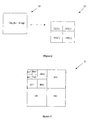
- FIGURE 2 illustrates the transformation of an original image 20 of the video into a one-level sub-sampled image 22.
- Wavelet transforms can decompose an original image into sub-images in various scales each sub-image representing a frequency subset of the original image.
- Wavelet transforms use a bank of filters processing the image pixels to decompose the original image into high- and low-frequency components. This operation can be successively applied to decompose the original image into a low-frequency, various medium-band frequency, and highfrequency components. After each stage of filtering data can be sub-sampled without losing any information because of the special nature of the wavelet filters.
- One level of two-dimensional dyadic wavelet transform creates four sub-sampled separate quarters, each containing different sets of information about the image. It is conventional to name the top left quarter Low-Low (LL) - containing low frequency horizontal and low frequency vertical information; the top right quarter High-Horizontal (HH) - containing high frequency horizontal information; the bottom left quarter High-Vertical (HV) - containing high frequency vertical information; and the bottom right quarter High-Diagonal (HD) - containing high frequency diagonal information.
- the level of transform is denoted by a number suffix following the two-letter code. For example, LL(1) refers to the first level of transform and denotes the top left corner of the sub-sampled image 22 by a factor of two in both horizontal and vertical dimensions.
- FIGURE 3 illustrates further transforms that have been performed on the LL quarter of the sub-sampled image 22 to create additional sub-sampled images.
- the second transform performed on the LL(1) quarter produces four second level quarters within the LL(1) quarter which are similar to the first level quarters, where the second level quarters are labelled as LL(2) (not shown), HH(2), HD(2), and HV(2).
- a third transform performed on the LL(2) quarter produces four third level quarters labelled as LL(3), HH(3), HD(3), and HV(3). Additional transforms can be performed to create sub-sampled images at lower levels.
- a hierarchy of sub-sampled images from wavelet transforms is also known as a "wavelet transform tree.”
- the DWT of the image I may be defined to contain LL(1) and LL(2) as well.
- the so-called sub-band images LL(3), HH(3), HD(3), and HV(3) uniquely define the sub-band image LL(2), and LL(2), HH(2), HD(2), and HV(2) uniquely define the so-called low-low image LL(1).
- wavelet transform based image encoders In wavelet transform based image encoders many of the small valued wavelet coefficients are discarded to reduce the amount of data to be stored. When the original image is to be reconstructed the discarded coefficients are replaced with zeros.
- a video is composed of a series of still images (frames) that are displayed to the user one at a time at a specified rate. Video sequences can take up a lot of memory or storage space when stored, and therefore can be compressed so that they can be stored in smaller spaces.
- each image frame of the video can be compressed using a wavelet coder.
- some portions of image frames or entire frames can be discarded especially when an image frame is positioned between two other frames in which most of the features of these frames remain unchanged.
- the present invention compares the WT of the current image with the wavelet transforms of the near future and past image frames to detect motion and moving regions in the current image without performing an inverse wavelet transform operation.
- Moving regions and objects can be detected by comparing the wavelet transforms of the current image with the wavelet transform of the background scene which can be estimated from the wavelet transforms of the current frame and past image frames. If there is a significant difference between the two wavelet transforms then this means that there is motion in the video. If there is no motion then the wavelet transforms of the current image and the background image ideally should be equal to each other.
- the wavelet transform of the background scene can be estimated from the wavelet coefficients of past image frames, which do not change in time, whereas foreground objects and their wavelet coefficients change in time.
- Such wavelet coefficients belong to the background because the background of the scene is temporally stationary.
- Non-stationary wavelet coefficients over time correspond to the foreground of the scene and they contain motion information. If the viewing range of the camera is observed for some time then the wavelet transform of the entire background can be estimated because moving regions and objects occupy only some parts of the scene in a typical image of a video and they disappear over time.
- the wavelet transform of the background scene can be estimated from the wavelet coefficients, which do not change in time.
- Stationary wavelet coefficients are the wavelet coefficients of background scene because background can be defined as temporally stationary part of the video. If the scene is observed for some time then the wavelet transform of the entire background scene can be estimated because moving regions and objects occupy only some parts of the scene in a typical image of a video.
- a simple approach to estimate the wavelet transform of the background is to average the observed wavelet transforms of the image frames. Since moving objects and regions occupy only a part of the image they can conceal a part of the background scene and their effect in the wavelet domain is cancelled over time by averaging.
- any one of the space domain approaches for background estimation can be implemented in wavelet domain.
- Initial wavelet transform of the background can be assumed to be the wavelet transform of the first image of the video.
- a wavelet coefficient WI n (x,y) is assumed to be moving if
- >T n (x,y) where T n (x,y) is a threshold recursively updated for each wavelet coefficient as follows T n+1 (x,y) a T n (x,y) + (1-a) ( b
- , if WI n (x,y) is not moving T n+1 (x,y) T n (x,y), if WI n (x,y) is moving where b is a number greater than 1 and the update parameter a is a positive number close to 1.
- Initial threshold values can be experimentally determined. As it can be seen from the above equation higher the parameter b higher the threshold or lower the sensitivity of detection scheme.
- Estimated DWT of the background is subtracted from the DWT of the current image of the video to detect the moving wavelet coefficients and consequently moving objects as it is assumed that the regions different from the background are the moving regions.
- > T n (x,y) Inequality 3 are determined.
- the wavelet transforms WB n+1 and WB n-m of background images B n+1 and B n-m are compared to determine the change in background.
- the duration parameter m is determined by the user to classify if an object is moving or stopped as discussed before. If there are wavelet coefficients whose values significantly differ from each other in WB n+1 and WB n-m then this means that background has changed. Wavelet coefficients satisfying the inequality
- > T h Inequality 4 belong to left or stopped objects during the time corresponding to difference of frame indexes n - (n-m) m.
- the threshold value T h is a positive number which may be different from the threshold value used in Inequality 2. It can also recursively determined as the threshold used in Inequality 3.
- the union of the corresponding regions on the original image is obtained to locate the moving and stopped object(s) in the video.
- the number of moving regions or stopped objects is equal to the number of disjoint regions obtained as a result of the union operation.
- the number of the moving and stopped or left object(s) is estimated from the union of the image regions producing the wavelet coefficients satisfying Inequality 3 and Inequality 4 , respectively.
- FIGURE 4 is a block diagram 30 illustrating the present invention for characterizing the motion of moving regions in wavelet compressed video.
- FIGURE 4 is similar to the FIGURE 1 except that the operations are carried out in the wavelet domain.
- WI n and WB n be the wavelet transforms of the current image frame In and estimated background image frame B n , respectively.
- the wavelet transform of the current image WI n and the estimated wavelet transform of the background scene WB n are input to the background estimator in wavelet domain 32.
- the system 32 implements the above equations to estimate WB n+1 .
- the comparator 34 may simply take the difference of WI n and WB n and the difference of WB n+1 - WB n-m to determine if there is a change in wavelet coefficient values.
- Coefficients satisfying Inequalities 3 and 4 are determined.
- the motion classifier 36 determines if a pixel belongs to a moving object or a left object. If the Inequality 4 is satisfied then the corresponding wavelet coefficient WI n (x,y) belongs to stopped or a left object. If a wavelet coefficient WI n (x,y) satisfies the Inequality 3 but the corresponding background coefficient WB n+1 (x,y) does not satisfy the Inequality 4 this means that this coefficient does not belong to a stopped or a left object. It is the coefficient of a moving object in transition at time n. Once all the wavelet coefficients satisfying the above inequality are determined, locations of corresponding regions on the original image are determined 38.
- transform of the background can be estimated as in the case of wavelet transform either by time-averaging of the transforms of images forming the video or by recursive estimation as described above or by other means reported in the literature.
- Inequalities 1 and 2 can be realized in the transform domain to characterize the nature of the motion in video.
- the present invention is applicable to the video encoded using internationally-standardized coding schemes such as MPEG-1, MPEG-2, MPEG-4 and H261 which are all based on DCT and motion compensated prediction of image frames.
- the invention can be equally applied to video coded by other linear transforms including the Hadamard transform, Karhunen-Loeve Transform, and vector quantization, etc.
- images are divided into blocks and transforms of the blocks are computed.
- background estimation can be carried out block by block.
- a coarse estimate of an image frame can be obtained from the DC value of each block in DCT and Fourier Transform. Therefore a coarse estimate of the background can be also estimated from the DC coefficients of blocks forming the image. For example, if DCT is computed in 8 pixel by 8 pixel blocks then an image whose height and width are 1/8-th of the original image can be estimated from the DC coefficients. Consequently, a coarse background image whose height and width are 1/8-th of the actual background image can be estimated from the DC coefficients as well.
- Inequalities 1 and 2 can be realized according to the new image size and the motion of moving objects can be characterized.
- a background image can be also estimated from blocks, which do not move or equivalently from blocks whose motion vectors are below a threshold. If the camera capturing the video moves then the motion of the camera must be compensated to determine the blocks, which do not move.
- Widely used transforms, DCT and Discrete Fourier Transform are linear transforms, and coefficients obtained after transformation operation can be real or complex number depending on the nature of the transform. Differencing and addition operations described above for background estimation can be implemented using transform domain coefficients inside blocks in the compressed data domain. In vector quantisation, coefficients of the vector quatized blocks are real and they are pixels or pixel-like quantities. Differencing and addition operations described above for background estimation can be implemented using the coefficients of the vector quantized blocks.
Landscapes
- Engineering & Computer Science (AREA)
- Physics & Mathematics (AREA)
- General Physics & Mathematics (AREA)
- Multimedia (AREA)
- Theoretical Computer Science (AREA)
- Computer Vision & Pattern Recognition (AREA)
- Health & Medical Sciences (AREA)
- General Health & Medical Sciences (AREA)
- Psychiatry (AREA)
- Social Psychology (AREA)
- Human Computer Interaction (AREA)
- Mathematical Physics (AREA)
- Compression Or Coding Systems Of Tv Signals (AREA)
- Image Analysis (AREA)
Applications Claiming Priority (2)
| Application Number | Priority Date | Filing Date | Title |
|---|---|---|---|
| US840817 | 2001-04-24 | ||
| US10/840,817 US20040223652A1 (en) | 2003-05-07 | 2004-05-07 | Characterization of motion of moving objects in video |
Publications (2)
| Publication Number | Publication Date |
|---|---|
| EP1596335A2 true EP1596335A2 (de) | 2005-11-16 |
| EP1596335A3 EP1596335A3 (de) | 2006-05-17 |
Family
ID=34939714
Family Applications (1)
| Application Number | Title | Priority Date | Filing Date |
|---|---|---|---|
| EP05103773A Withdrawn EP1596335A3 (de) | 2004-05-07 | 2005-05-05 | Charakterisierung der Bewegung von Objekten in einem Video |
Country Status (2)
| Country | Link |
|---|---|
| US (1) | US20040223652A1 (de) |
| EP (1) | EP1596335A3 (de) |
Cited By (1)
| Publication number | Priority date | Publication date | Assignee | Title |
|---|---|---|---|---|
| US8073261B2 (en) | 2006-12-20 | 2011-12-06 | Axis Ab | Camera tampering detection |
Families Citing this family (13)
| Publication number | Priority date | Publication date | Assignee | Title |
|---|---|---|---|---|
| JP5088507B2 (ja) * | 2006-12-27 | 2012-12-05 | 日本電気株式会社 | 同一性判定装置、同一性判定方法および同一性判定用プログラム |
| US20080167072A1 (en) * | 2007-01-04 | 2008-07-10 | Viktors Berstis | System and method for providing telephone service access via a gateway telephone |
| US9214030B2 (en) * | 2007-05-07 | 2015-12-15 | Thomson Licensing | Method and apparatus for processing video sequences |
| FR2932036B1 (fr) * | 2008-06-03 | 2011-01-07 | Thales Sa | Procede et systeme permettant de proteger un flux video compresse contre les erreurs survenant lors d'une transmission |
| CN101447078B (zh) * | 2008-12-10 | 2011-06-15 | 东软集团股份有限公司 | 一种障碍物分割方法及装置 |
| JP2013033317A (ja) * | 2011-08-01 | 2013-02-14 | Sony Corp | 画像処理装置、画像処理方法、及び、プログラム |
| CN103810461B (zh) * | 2012-11-09 | 2017-02-22 | 浙江大华技术股份有限公司 | 一种干扰目标的检测方法和设备 |
| US9275284B2 (en) * | 2014-04-30 | 2016-03-01 | Sony Corporation | Method and apparatus for extraction of static scene photo from sequence of images |
| US9213898B2 (en) * | 2014-04-30 | 2015-12-15 | Sony Corporation | Object detection and extraction from image sequences |
| CN104200197A (zh) * | 2014-08-18 | 2014-12-10 | 北京邮电大学 | 三维人体行为识别方法及装置 |
| US9712828B2 (en) | 2015-05-27 | 2017-07-18 | Indian Statistical Institute | Foreground motion detection in compressed video data |
| CN105354791B (zh) * | 2015-08-21 | 2019-01-11 | 华南农业大学 | 一种改进的自适应混合高斯前景检测方法 |
| US20240202872A1 (en) * | 2022-12-16 | 2024-06-20 | Here Global B.V. | Method, apparatus, and computer program product for image compression |
Family Cites Families (6)
| Publication number | Priority date | Publication date | Assignee | Title |
|---|---|---|---|---|
| JP3288474B2 (ja) * | 1993-03-31 | 2002-06-04 | 富士通株式会社 | 画像処理装置 |
| KR0178231B1 (ko) * | 1995-08-10 | 1999-05-01 | 배순훈 | 계층적인 움직임 추정 기법을 이용하는 움직임 벡터 검출 방법 및 장치 |
| JP3363039B2 (ja) * | 1996-08-29 | 2003-01-07 | ケイディーディーアイ株式会社 | 動画像内の移動物体検出装置 |
| JPH1091795A (ja) * | 1996-09-12 | 1998-04-10 | Toshiba Corp | 移動物体検出装置及び移動物体検出方法 |
| US20040086152A1 (en) * | 2002-10-30 | 2004-05-06 | Ramakrishna Kakarala | Event detection for video surveillance systems using transform coefficients of compressed images |
| US6999600B2 (en) * | 2003-01-30 | 2006-02-14 | Objectvideo, Inc. | Video scene background maintenance using change detection and classification |
-
2004
- 2004-05-07 US US10/840,817 patent/US20040223652A1/en not_active Abandoned
-
2005
- 2005-05-05 EP EP05103773A patent/EP1596335A3/de not_active Withdrawn
Non-Patent Citations (4)
| Title |
|---|
| GOK M Y ET AL: "Moving object detection in video by detecting non-Gaussian regions in subbands and active contours" PROCEEDINGS 2003 INTERNATIONAL CONFERENCE ON IMAGE PROCESSING. ICIP-2003. BARCELONA, SPAIN, SEPT. 14 - 17, 2003, INTERNATIONAL CONFERENCE ON IMAGE PROCESSING, NEW YORK, NY : IEEE, US, vol. VOL. 2 OF 3, 14 September 2003 (2003-09-14), pages 965-968, XP010669848 ISBN: 0-7803-7750-8 * |
| KOJIMA A ET AL: "Motion detection using 3D-FFT spectrum" STATISTICAL SIGNAL AND ARRAY PROCESSING. MINNEAPOLIS, APR. 27 - 30, 1993, PROCEEDINGS OF THE INTERNATIONAL CONFERENCE ON ACOUSTICS, SPEECH, AND SIGNAL PROCESSING (ICASSP), NEW YORK, IEEE, US, vol. VOL. 4, 27 April 1993 (1993-04-27), pages 213-216, XP010110973 ISBN: 0-7803-0946-4 * |
| OZER I B ET AL: "Real-time posture and activity recognition" MOTION AND VIDEO COMPUTING, 2002. PROCEEDINGS. WORKSHOP ON 5-6 DEC. 2002, PISCATAWAY, NJ, USA,IEEE, 5 December 2002 (2002-12-05), pages 133-138, XP010628792 ISBN: 0-7695-1860-5 * |
| TOREYIN B U ET AL: "Moving region detection in wavelet compressed video" SIGNAL PROCESSING AND COMMUNICATIONS APPLICATIONS CONFERENCE, 2004. PROCEEDINGS OF THE IEEE 12TH KUSADASI, TURKIYE APRIL 28-30, 2004, PISCATAWAY, NJ, USA,IEEE, 28 April 2004 (2004-04-28), pages 676-679, XP010732531 ISBN: 0-7803-8318-4 * |
Cited By (1)
| Publication number | Priority date | Publication date | Assignee | Title |
|---|---|---|---|---|
| US8073261B2 (en) | 2006-12-20 | 2011-12-06 | Axis Ab | Camera tampering detection |
Also Published As
| Publication number | Publication date |
|---|---|
| US20040223652A1 (en) | 2004-11-11 |
| EP1596335A3 (de) | 2006-05-17 |
Similar Documents
| Publication | Publication Date | Title |
|---|---|---|
| Park et al. | A postprocessing method for reducing quantization effects in low bit-rate moving picture coding | |
| EP1138152B1 (de) | Verfahren und vorrichtung zur durchführung einer hierarchischen bewegungsschätzung unter verwendung einer nicht-linearen pyramide | |
| KR100578682B1 (ko) | 가변 블록 크기를 이용한 계층적 움직임 추정 장치 및방법 | |
| EP1639829B1 (de) | Schätzverfahren für optische strömungen | |
| US20100303150A1 (en) | System and method for cartoon compression | |
| US20130279598A1 (en) | Method and Apparatus For Video Compression of Stationary Scenes | |
| Balster | Video compression and Rate control methods Based on the wavelet Transform | |
| US20040223652A1 (en) | Characterization of motion of moving objects in video | |
| Abbasi Aghamaleki et al. | Malicious inter-frame video tampering detection in MPEG videos using time and spatial domain analysis of quantization effects | |
| Aziz et al. | Motion estimation and motion compensated video compression using DCT and DWT | |
| Bagci et al. | Moving object detection using adaptive subband decomposition and fractional lower-order statistics in video sequences | |
| CN101036387B (zh) | 检测mpeg视频流中的运动的方法和装置 | |
| EP0979011A1 (de) | Szenenänderungsdetektion in einem Bewegungsschätzer eines Bildkodierers | |
| US20160350934A1 (en) | Foreground motion detection in compressed video data | |
| Cui et al. | Mesh-based motion estimation and compensation in the wavelet domain using a redundant transform | |
| US20060109902A1 (en) | Compressed domain temporal segmentation of video sequences | |
| US20050078873A1 (en) | Movement detection and estimation in wavelet compressed video | |
| Stanković et al. | Video frames reconstruction based on time-frequency analysis and Hermite projection method | |
| CN1159275A (zh) | 检测遮挡的方法和装置 | |
| Zhang et al. | Image sequence coding using multiple-level segmentation and affine motion estimation | |
| Kwon et al. | Motion compensated subband coding of video acquired from a moving platform | |
| JP2001346208A (ja) | 画像信号復号化装置および方法 | |
| Töreyin | Moving object detection and tracking in wavelet compressed video | |
| Penedo et al. | Digital image inpainting by estimating wavelet coefficient decays from regularity property and Besov spaces | |
| Biris et al. | High resolution surveillance video compression using JPEG2000 compression of random variables |
Legal Events
| Date | Code | Title | Description |
|---|---|---|---|
| PUAI | Public reference made under article 153(3) epc to a published international application that has entered the european phase |
Free format text: ORIGINAL CODE: 0009012 |
|
| 17P | Request for examination filed |
Effective date: 20050505 |
|
| AK | Designated contracting states |
Kind code of ref document: A2 Designated state(s): AT BE BG CH CY CZ DE DK EE ES FI FR GB GR HU IE IS IT LI LT LU MC NL PL PT RO SE SI SK TR |
|
| AX | Request for extension of the european patent |
Extension state: AL BA HR LV MK YU |
|
| PUAL | Search report despatched |
Free format text: ORIGINAL CODE: 0009013 |
|
| AK | Designated contracting states |
Kind code of ref document: A3 Designated state(s): AT BE BG CH CY CZ DE DK EE ES FI FR GB GR HU IE IS IT LI LT LU MC NL PL PT RO SE SI SK TR |
|
| AX | Request for extension of the european patent |
Extension state: AL BA HR LV MK YU |
|
| 17Q | First examination report despatched |
Effective date: 20061215 |
|
| AKX | Designation fees paid |
Designated state(s): DE FR GB |
|
| GRAP | Despatch of communication of intention to grant a patent |
Free format text: ORIGINAL CODE: EPIDOSNIGR1 |
|
| GRAS | Grant fee paid |
Free format text: ORIGINAL CODE: EPIDOSNIGR3 |
|
| STAA | Information on the status of an ep patent application or granted ep patent |
Free format text: STATUS: THE APPLICATION IS DEEMED TO BE WITHDRAWN |
|
| 18D | Application deemed to be withdrawn |
Effective date: 20081202 |