EP1597971A1 - Production de produits alimentaires - Google Patents
Production de produits alimentaires Download PDFInfo
- Publication number
- EP1597971A1 EP1597971A1 EP05253096A EP05253096A EP1597971A1 EP 1597971 A1 EP1597971 A1 EP 1597971A1 EP 05253096 A EP05253096 A EP 05253096A EP 05253096 A EP05253096 A EP 05253096A EP 1597971 A1 EP1597971 A1 EP 1597971A1
- Authority
- EP
- European Patent Office
- Prior art keywords
- moulds
- lid
- lids
- food products
- mould
- Prior art date
- Legal status (The legal status is an assumption and is not a legal conclusion. Google has not performed a legal analysis and makes no representation as to the accuracy of the status listed.)
- Withdrawn
Links
- 235000013305 food Nutrition 0.000 title claims abstract description 79
- 238000004519 manufacturing process Methods 0.000 title claims abstract description 18
- 238000000034 method Methods 0.000 claims abstract description 33
- XLYOFNOQVPJJNP-UHFFFAOYSA-N water Substances O XLYOFNOQVPJJNP-UHFFFAOYSA-N 0.000 claims abstract description 19
- 238000000151 deposition Methods 0.000 claims abstract description 6
- 235000012459 muffins Nutrition 0.000 claims description 16
- 238000010411 cooking Methods 0.000 claims description 14
- 239000011248 coating agent Substances 0.000 claims description 11
- 238000000576 coating method Methods 0.000 claims description 11
- 230000000717 retained effect Effects 0.000 claims description 7
- 239000000463 material Substances 0.000 claims description 3
- 235000015895 biscuits Nutrition 0.000 claims description 2
- 235000014510 cooky Nutrition 0.000 claims description 2
- 244000299461 Theobroma cacao Species 0.000 description 18
- 235000019219 chocolate Nutrition 0.000 description 17
- 238000001816 cooling Methods 0.000 description 12
- 238000007598 dipping method Methods 0.000 description 7
- 239000004615 ingredient Substances 0.000 description 7
- 239000012141 concentrate Substances 0.000 description 4
- 238000004806 packaging method and process Methods 0.000 description 4
- 238000005303 weighing Methods 0.000 description 4
- 235000013312 flour Nutrition 0.000 description 3
- 239000003906 humectant Substances 0.000 description 3
- 230000014759 maintenance of location Effects 0.000 description 3
- 235000015112 vegetable and seed oil Nutrition 0.000 description 3
- 239000008158 vegetable oil Substances 0.000 description 3
- 239000003795 chemical substances by application Substances 0.000 description 2
- 235000021544 chips of chocolate Nutrition 0.000 description 2
- 235000014651 chocolate spreads Nutrition 0.000 description 2
- 238000010586 diagram Methods 0.000 description 2
- 229920002379 silicone rubber Polymers 0.000 description 2
- 239000004945 silicone rubber Substances 0.000 description 2
- XUIMIQQOPSSXEZ-UHFFFAOYSA-N Silicon Chemical compound [Si] XUIMIQQOPSSXEZ-UHFFFAOYSA-N 0.000 description 1
- 229910000831 Steel Inorganic materials 0.000 description 1
- 239000004809 Teflon Substances 0.000 description 1
- 229920006362 Teflon® Polymers 0.000 description 1
- 235000009470 Theobroma cacao Nutrition 0.000 description 1
- 230000004888 barrier function Effects 0.000 description 1
- 230000015572 biosynthetic process Effects 0.000 description 1
- 235000013339 cereals Nutrition 0.000 description 1
- 238000004140 cleaning Methods 0.000 description 1
- 150000001875 compounds Chemical class 0.000 description 1
- 235000009508 confectionery Nutrition 0.000 description 1
- 239000006071 cream Substances 0.000 description 1
- 230000008021 deposition Effects 0.000 description 1
- 235000013399 edible fruits Nutrition 0.000 description 1
- 238000005516 engineering process Methods 0.000 description 1
- 239000002184 metal Substances 0.000 description 1
- 239000000843 powder Substances 0.000 description 1
- 230000002787 reinforcement Effects 0.000 description 1
- 230000003014 reinforcing effect Effects 0.000 description 1
- 238000005096 rolling process Methods 0.000 description 1
- 238000007790 scraping Methods 0.000 description 1
- 229910052710 silicon Inorganic materials 0.000 description 1
- 239000010703 silicon Substances 0.000 description 1
- 230000003068 static effect Effects 0.000 description 1
- 239000010959 steel Substances 0.000 description 1
Images


Classifications
-
- A—HUMAN NECESSITIES
- A21—BAKING; EDIBLE DOUGHS
- A21B—BAKERS' OVENS; MACHINES OR EQUIPMENT FOR BAKING
- A21B3/00—Parts or accessories of ovens
- A21B3/13—Baking-tins; Baking forms
- A21B3/139—Baking-tins; Baking forms with apertures to vent steam
-
- A—HUMAN NECESSITIES
- A21—BAKING; EDIBLE DOUGHS
- A21B—BAKERS' OVENS; MACHINES OR EQUIPMENT FOR BAKING
- A21B3/00—Parts or accessories of ovens
- A21B3/13—Baking-tins; Baking forms
- A21B3/132—Assemblies of several baking-tins or forms
-
- A—HUMAN NECESSITIES
- A21—BAKING; EDIBLE DOUGHS
- A21B—BAKERS' OVENS; MACHINES OR EQUIPMENT FOR BAKING
- A21B3/00—Parts or accessories of ovens
- A21B3/13—Baking-tins; Baking forms
- A21B3/138—Baking-tins; Baking forms flexible forms, e.g. made from silicone
Definitions
- the invention relates to the production of food products, and especially to the production of food products by cooking portions of a batter or dough in an oven to form, for example, cakes, including muffins.
- the present invention provides a process for the production of food products which comprises depositing portions of a batter or dough in each mould of an array of hollow moulds, covering the moulds with an array of lids, there being a lid for each mould, and each mould and its associated lid forming an enclosure which provides a covered region above the batter or dough into which it can expand while allowing the escape of water vapour from the said covered region, and then cooking the said portions in an oven.
- the invention also provides apparatus for the production of food products which comprises an array of hollow moulds, means for depositing a portion of batter or dough into each of the moulds, an array of lids, one for each mould, which can be arranged to cover the moulds to provide an array of enclosures each of which provides a covered region above the batter or dough into which it can expand and from which water vapour can escape, and an oven for cooking the said food products.
- the process and apparatus of the invention are especially advantageous in the manufacture of cakes, which expression is used in this specification to include muffins, and more especially the manufacture of cakes of relatively small volume.
- the process and apparatus of the invention it has been found possible to produce such cakes having a more uniform top surface, a more regular overall configuration and a more uniform size than in conventional production.
- the invention also enables the production of cakes having a higher moisture content with a lighter, softer-eating, texture than would normally be associated with a baked product of the same size produced in a conventional manner.
- vents required in any particular case will depend on the product to be manufactured, but, in practice, a suitable arrangement of the vent or vents in each lid to achieve the desired configuration and texture of the product can readily be determined by simple trials. Where a single vent in each lid suffices, then advantageously the vent is arranged centrally in the lid. Where it is found desirable to provide more than one vent in each lid, then, preferably, the vents are arranged symmetrically in the lid.
- each mould and its associated lid should be chosen in accordance with the requirements of size and shape of the finished product.
- each mould and its associated lid are so arranged that the enclosure they define is of substantially spherical, substantially ellipsoidal, or substantially cuboidal configuration.
- Each of the said enclosures is advantageously of up to 25cm 3 , preferably, up to 22.5cm 3 , and more preferably, up to 20cm 3 in volume, and advantageously of at least 5cm 3 in volume.
- each of the moulds and its associated lid may be of the same dimensions and configuration as each other.
- the array of moulds is arranged as a tray and preferably the array of lids is also arranged as a tray.
- Each tray of lids can then be placed on a corresponding tray of moulds, in use, to form the array of enclosures in a set of trays.
- the food products After the food products have been cooked, it may be required to carry out secondary processing such as applying a coating to the food product, for example, a coating of chocolate carried out by dipping, rolling or enrobing.
- secondary processing it may be convenient to retain the food products in one of the trays while removing the other so that the exposed surface of the food products can be, for example, coated in chocolate or other topping.
- the moulds and/or the lids may be so configured as to achieve that, by, for example providing the inner surface of the moulds and/or the lids with retaining means such as recessed and/or projecting portions, for example, annular ridges projecting inwardly.
- the overall shape of the mould and/or its lid may be so configured as to be able to retain the food product in one of them on removal of the other.
- the mould may be arranged to define a greater part of the sphere than its associated lid and be able to retain the food product even on inversion.
- the trays of moulds and/or lids may be made of steel, preferably provided with suitable coating such as Teflon on the surfaces that contact the food products.
- the trays of moulds and/or lids may be made from a flexible material, for example, a high temperature resistant silicone rubber. Such flexible trays are preferably provided with reinforcement to prevent distortion at high temperatures.
- the moulds and lids may have non-stick finish or the process may include coating the moulds and lids with a release agent before the portions of batter or dough are deposited.
- suction means may be provided to act on the food products.
- release can be ensured by flexing the trays and/or using pushers, robots or spikes. If it is not required to hold the food products in the moulds for secondary processing as referred to above, then the moulds may be so arranged that inversion of the moulds on its own is sufficient to ensure removal.
- the batter or dough from which the food products are made may contain inclusions such as chocolate chips or fruit pieces added before deposition in the moulds.
- Each portion of the batter or dough may have a filling inserted into it before cooking.
- the filling may be fat-based, for example, a cream, or water-based, for example, a jam.
- the filling is advantageously inserted as the portion of batter or dough is deposited in the mould. That can be carried out either using three depositers, the first for batter or dough, the second for the filling, and the third for batter or dough to cover the filling, arranged adjacent to one another in series, or by using a so-called "co-depositer” as used in the confectionery industry, which can deposit a portion of the batter or dough with the filling at the same time.
- the food products are cooked in the oven for a period within the range of from 5 to 10min, preferably at a temperature within the range of from 160 to 240°C.
- Cooking is advantageously carried out by passing the food products through a tunnel oven.
- the food products are then allowed to cool by passing through a cooling tunnel, before secondary processing, if any, removal from the moulds and lids, and packaging.
- the lids and moulds may then be returned for cleaning and/or reuse.
- the final moisture content of the food products is advantageously within the range of from 12 to 22% by weight of water based on the total weight of the product, and preferably within the range of from 14 to 20% by weight of water based on the total weight of the product (excluding any coating, inclusions or filling).
- the process and apparatus of the invention can also be used to manufacture other individual products in addition to cakes, by which is generally meant a product usually made from a cereal-based batter that is mechanically or chemically aerated and cooked in an oven, the cake having a final moisture content of at least 10% by weight based on the weight of the cake.
- Other such products that can be made in accordance with the invention include cookies or biscuits, which may be made from a short dough, and are generally cooked until they have a moisture content of less than 5% by weight, typically 2-3% by weight, based on the weight of the cooked product. If the food products are made from dough instead of batter, then the dough is advantageously deposited into the moulds by sprinkling on the dough, and scraping away any excess.
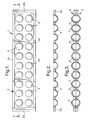
- an array of moulds is formed as a tray 2 made from a flexible material, for example, HT60EONT/1 grade silicone rubber compound obtained from Silicon Technology.
- the tray 2 is formed with end portions 2a and 2b, respectively, and side portions 2c and 2d, respectively, around a central portion 2e.
- each of the moulds 3 is equally spaced from its adjacent moulds in the same row and from an adjacent mould in the adjacent row.
- a reinforcing bar extends down the middle of the tray 2 between the two rows of the moulds 3, and prevents distortion of the tray at high temperatures.
- the tray may be of an overall length of 490mm and width of 108mm.
- Each of the moulds 3 may be of a maximum depth of 19.5mm and of a maximum diameter of 31mm, and spaced from each other at 45mm centres.
- a vent 7 in the form of an aperture positioned centrally in the top of each of the lids 5 allows water vapour to escape from the enclosures, in use.
- a series of the trays 2 are secured to a conveyor belt 8 driven by rollers 9a, 9b and 9c, respectively, so that each tray in turn passes under a co-depositer 10.
- the co-depositer 10 is arranged to deposit a portion of batter with a portion of filling within the batter into each mould 3.
- a further conveyor belt 11 driven by rollers 12a, 12b and 12c carries a series of the trays 4 of the domed lids 5 and is arranged to place a tray 4 of lids over a tray 2 of moulds 3 after the tray 2 leaves the co-depositer 10, the tray 4 of lids and the tray 2 of moulds forming an array of substantially ellipsoidal enclosures 6 as shown in Fig. 3.
- the sets of trays 2 and 4 are then passed through a tunnel oven 13 and cooling tunnel 14.
- the trays 4 of lids are then removed by the conveyor 11 and returned for re-use by the conveyor.
- the trays 2 are flexed as they travel over the roller 9b, and a reciprocating mechanism 15 is provided to push each of the moulds outwardly to ensure removal of the food products.
- a conveyor 16 is provided to transport the food products, after removal from the trays 2, to a packaging station (not shown).
- the trays 2 remain on the conveyor 8 and are returned through a wash station 17 for re-use.
- Fig. 5 shows the same apparatus as Fig. 4 (the same reference numerals being used for the same parts where appropriate) except that an initial greasing station 18 is provided to coat the trays 2 with a release agent before they pass under the co-depositer 10, and also secondary processing apparatus is provided between the cooling tunnel 14 and the reciprocating release mechanism 15.
- the secondary processing apparatus consists of an inversion station 19 where the trays 2 of the moulds 3 are inverted through 180°, a chocolate dipping station 20 where the exposed surfaces of the inverted food products are coated in chocolate, and a further inversion station 21, where the trays are once again inverted through 180° , and their exposed, chocolate-coated surfaces are uppermost.
- the trays 2 then pass through a further cooling tunnel 22 to allow the chocolate to set, and the food products are finally removed from the trays using the reciprocating mechanism 15 and conveyed to the packaging station via the conveyor 16.
- portions of batter with a filling are deposited in the moulds 3 as the trays 2 pass under the co-depositer 10.
- the moulds 3 of the tray 2 are then covered with the domed lids 5 of the tray 4 and the food products are cooked as they pass through the tunnel oven 13.
- the batter rises up in each of the enclosures 6 during cooking and water vapour is emitted into the region of the enclosure above the batter and through the vents 7 in the lids 5.
- the trays 4 of the lids 5 are removed and either the food products are removed from the moulds 3 for packaging or they are retained in the moulds for secondary processing during which the trays 2 are inverted, the exposed surfaces of the food products coated in chocolate, and the trays inverted again.
- the food products are removed from the moulds 3 and packaged.
- the moulds 3 of the trays 2 may be replaced with moulds 23 as shown in Fig. 6A.
- Each mould 23 is provided with annular ridges 24 projecting inwardly.
- Its corresponding lid 25 is provided with a central vent 26 as shown in Fig. 6B.
- the moulds 23 can be flexed by the reciprocating mechanism 15, which pushes the moulds outwardly and ensures removal.
- each mould 27 and its associated lid 28 having a central vent 28a together define a substantially spherical enclosure, but each of the moulds 27 defines a greater part of the sphere than its associated lid, which tends to assist retention of the food product in the mould after removal of the lid and on inversion of the mould.
- the apparatus of Fig. 5 may be modified so that instead of the trays 4 of the lids 5 being removed from the food products before secondary processing and the food products remaining in the moulds 3, the food products are arranged to remain in the lids and the moulds are removed before secondary processing.
- the moulds and lids may be as shown in Fig. 8 or Fig. 9.
- each mould 29 and its associated lid 30 with vent 31 together define a substantially spherical enclosure, but each of the lids 30 defines a greater part of the sphere than its associated mould 29, which tends to assist retention of the food product in the lid after removal of the mould for secondary processing.
- Fig. 8 each mould 29 and its associated lid 30 with vent 31 together define a substantially spherical enclosure, but each of the lids 30 defines a greater part of the sphere than its associated mould 29, which tends to assist retention of the food product in the lid after removal of the mould for secondary processing.
- each lid 32 is provided with a multiplicity of vents 33, including a central vent and additional vents symmetrically arranged around the central vent, through at least some of which the food product may rise to a small extent on cooking.
- the lid 32 thereby grips the food product, and mould 34 can be removed while the lid retains the food product in position ready for secondary processing.
- a batter was made from the following ingredients, the percentages being by weight and based on the total weight of the ingredients: % by weight Water 22 Humectants 10 Vegetable oil 16 Flour 14 Sugar 17 Cocoa Powder 3 Muffin Concentrate 18
- the Muffin Concentrate was a commercially available premix obtainable from, for example, Macphies of Glenbervie Limited.
- the batter was made from the above ingredients in a Hobart A200 mixer set on a high speed for 3 - 5 minutes.
- portions of batter weighing 5.5g each together with a portion of chocolate cream filling weighing 1.5g were deposited by the co-depositer 10 in the moulds 3 of the trays 2.
- the tunnel oven 13 Before each tray 2 of the moulds 3 reached the tunnel oven 13 it was covered with a tray 4 of domed lids 5 so that each portions of the batter and the filling was contained in one of the enclosures 6.
- Each set of the trays 2 and 4 was conveyed through a zoned tunnel oven 13 set with a maximum temperature of 220°C. The total cooking time was 7 minutes.
- each set of the trays 2 and 4 was passed through the cooling tunnel 14 which was of sufficient length to reduce the food product temperature to within the range of from 20 to 30°C.
- each of the trays 4 was removed from the trays 2, leaving the food products in the trays 2.
- Each tray 2 was then inverted, passed through the chocolate dipping station 20 where the exposed surfaces of the food products were coated in chocolate, and then inverted again so that the food products had their chocolate-coated surface uppermost.
- the trays 2 were then sent through the cooling tunnel 22 to allow the chocolate to set, before the food products were released from the moulds 3.
- a batter was made from the following ingredients, the percentages being by weight and based on the total weight of the ingredients: % by weight Water 22 Humectants 10 Vegetable oil 16 Flour 16 Sugar 18 Muffin Concentrate 18
- the batter was made in the same manner as the batter of Example 1. Using the apparatus of Fig. 4, portions of the batter weighing 5.5g each together with a portion of jam filling weighing 1.5g were deposited by the co-depositer 10 in the moulds 3 of the trays 2. Before each tray 2 of the moulds 3 reached the tunnel oven 13 it was covered with a tray 4 of domed lids 5 so that each portions of the batter and the filling was contained in one of the enclosures 6. Each set of the trays 2 and 4 was conveyed through the tunnel oven 13 set at a maximum temperature of 220°C. The total cooking time was 7 minutes.
- each set of the trays 2 and 4 was passed through the cooling tunnel 14 which was of sufficient length to reduce the food product temperature to within the range of from 20 to 30°C. After cooling, the food products were released from the lids 5 and the moulds 3. The resulting moist sponge cakes with a jam filling were of consistently uniform shape with a light texture.
- a batter was made from the following ingredients, the percentages being by weight and based on the total weight of the ingredients: % by weight Water 14 Humectants 9 Vegetable oil 18 Flour 15 Sugar 16 Muffin Concentrate 16 Chocolate Chips 12
- Example2 The same method was employed as in Example2 with portions of batter of 7g deposited in the moulds, but without a filling.
- the resulting chocolate chip muffins were found to be moist and of uniform shape.
Landscapes
- Life Sciences & Earth Sciences (AREA)
- Engineering & Computer Science (AREA)
- Food Science & Technology (AREA)
- General Preparation And Processing Of Foods (AREA)
- Bakery Products And Manufacturing Methods Therefor (AREA)
Applications Claiming Priority (2)
| Application Number | Priority Date | Filing Date | Title |
|---|---|---|---|
| GB0411407A GB0411407D0 (en) | 2004-05-21 | 2004-05-21 | Improvements in and relating to the production of food products |
| GB0411407 | 2004-05-21 |
Publications (1)
| Publication Number | Publication Date |
|---|---|
| EP1597971A1 true EP1597971A1 (fr) | 2005-11-23 |
Family
ID=32607760
Family Applications (1)
| Application Number | Title | Priority Date | Filing Date |
|---|---|---|---|
| EP05253096A Withdrawn EP1597971A1 (fr) | 2004-05-21 | 2005-05-19 | Production de produits alimentaires |
Country Status (2)
| Country | Link |
|---|---|
| EP (1) | EP1597971A1 (fr) |
| GB (2) | GB0411407D0 (fr) |
Cited By (4)
| Publication number | Priority date | Publication date | Assignee | Title |
|---|---|---|---|---|
| FR2914837A1 (fr) * | 2007-04-16 | 2008-10-17 | Charles Viancin Group | Enceinte e cuisson souple. |
| WO2011120997A1 (fr) * | 2010-03-31 | 2011-10-06 | Jean-Paul Magro | Système de moule de cuisson en plastique et dispositif de fabrication d'une préparation de type pain à l'aide du système de moule |
| WO2016016834A1 (fr) * | 2014-07-31 | 2016-02-04 | Soremartec S.A. | Procédé de production d'une gaufrette, et produit de confiserie comprenant ladite gaufrette |
| FR3064889A1 (fr) * | 2017-04-11 | 2018-10-12 | Emmanuelle Condet | Moule a gateau avec couvercle et indication |
Families Citing this family (1)
| Publication number | Priority date | Publication date | Assignee | Title |
|---|---|---|---|---|
| AT512472B1 (de) * | 2012-02-06 | 2015-11-15 | Hobel Michael Mag | Verfahren und vorrichtung zum herstellen von backwaren |
Citations (2)
| Publication number | Priority date | Publication date | Assignee | Title |
|---|---|---|---|---|
| US2221052A (en) * | 1939-01-06 | 1940-11-12 | Herman E Kratzer | Bakepan |
| US2601099A (en) * | 1949-06-09 | 1952-06-17 | Lockwood Mfg Company | Cover for bake pan units |
Family Cites Families (6)
| Publication number | Priority date | Publication date | Assignee | Title |
|---|---|---|---|---|
| GB226793A (en) * | 1923-12-28 | 1925-07-23 | Eugene Delay | Machine for the manufacture of waffles |
| US4208441A (en) * | 1978-03-01 | 1980-06-17 | The Pillsbury Company | Process for cooking dough products |
| US4590078A (en) * | 1983-06-09 | 1986-05-20 | Umina Anthony P | Process and apparatus for preparing canned baked products |
| DE3602206A1 (de) * | 1986-01-25 | 1987-07-30 | Steinhoff Gmbh Maschinenfabrik | Backautomat |
| US5016528A (en) * | 1990-06-20 | 1991-05-21 | Chen Tsai An | Baking apparatus |
| AT414203B (de) * | 2000-12-22 | 2006-10-15 | Haas Franz Waffelmasch | Backofen zur herstellung von gebackenen formkörpern |
-
2004
- 2004-05-21 GB GB0411407A patent/GB0411407D0/en not_active Ceased
-
2005
- 2005-05-19 EP EP05253096A patent/EP1597971A1/fr not_active Withdrawn
- 2005-05-19 GB GB0510266A patent/GB2414157B/en not_active Expired - Fee Related
Patent Citations (2)
| Publication number | Priority date | Publication date | Assignee | Title |
|---|---|---|---|---|
| US2221052A (en) * | 1939-01-06 | 1940-11-12 | Herman E Kratzer | Bakepan |
| US2601099A (en) * | 1949-06-09 | 1952-06-17 | Lockwood Mfg Company | Cover for bake pan units |
Cited By (9)
| Publication number | Priority date | Publication date | Assignee | Title |
|---|---|---|---|---|
| FR2914837A1 (fr) * | 2007-04-16 | 2008-10-17 | Charles Viancin Group | Enceinte e cuisson souple. |
| WO2011120997A1 (fr) * | 2010-03-31 | 2011-10-06 | Jean-Paul Magro | Système de moule de cuisson en plastique et dispositif de fabrication d'une préparation de type pain à l'aide du système de moule |
| FR2958119A1 (fr) * | 2010-03-31 | 2011-10-07 | Jean-Paul Magro | Systeme de moule de cuisson en plastique et machine de fabrication d'une preparation panetiere a partir du systeme de moule |
| WO2016016834A1 (fr) * | 2014-07-31 | 2016-02-04 | Soremartec S.A. | Procédé de production d'une gaufrette, et produit de confiserie comprenant ladite gaufrette |
| FR3064889A1 (fr) * | 2017-04-11 | 2018-10-12 | Emmanuelle Condet | Moule a gateau avec couvercle et indication |
| FR3064887A1 (fr) * | 2017-04-11 | 2018-10-12 | Pixcake | Moule a gateau avec couvercle |
| FR3064888A1 (fr) * | 2017-04-11 | 2018-10-12 | Emmanuelle Condet | Moule a gateau avec couvercle et bord de manutention |
| WO2018189483A1 (fr) * | 2017-04-11 | 2018-10-18 | Condet Emmanuelle | Moule à gâteau avec couvercle |
| CN110678077A (zh) * | 2017-04-11 | 2020-01-10 | 皮克斯蛋糕公司 | 具有盖子的蛋糕模具 |
Also Published As
| Publication number | Publication date |
|---|---|
| GB0411407D0 (en) | 2004-06-23 |
| GB0510266D0 (en) | 2005-06-29 |
| GB2414157B (en) | 2007-09-26 |
| GB2414157A (en) | 2005-11-23 |
Similar Documents
| Publication | Publication Date | Title |
|---|---|---|
| EP1209979B1 (fr) | Procede de fabrication d'un produit alimentaire cuit en forme de coupelle | |
| RU2656415C2 (ru) | Способ и устройство для изготовления вафельных формованных изделий, выпеченных под давлением | |
| DE2650175C3 (de) | Herstellung von Nahrungsmitteln mit einer inneren Füllung aus Dessert o.dgl. und einer äußeren Schicht aus gebackenem Mehlteig | |
| US4144356A (en) | Friedcake and stick member combination and process for making same | |
| US6783782B1 (en) | Grooved freezer-to-oven pizza crust | |
| US4986992A (en) | Partially baked croissant and pastry and method of manufacture | |
| US5281433A (en) | Process for preparing a pre-cooked, microwaveable frozen baked food product | |
| EP2281461B1 (fr) | Biscuits ayant une meilleure stabilité | |
| US20250143343A1 (en) | Modular production line and process for using it | |
| EP0776162B1 (fr) | Recipient pour tranches | |
| CN100459865C (zh) | 制作甜或咸饼的深冻半成品的方法及所得到的半成品 | |
| EP1597971A1 (fr) | Production de produits alimentaires | |
| US5503860A (en) | Process of forming dough on a corrugated paperboard preform | |
| AU741510B2 (en) | Method and apparatus for preparing food products for further processing | |
| US20180177203A1 (en) | Scooped out bagel product, apparatus and method of making scooped out bagel | |
| US20080134906A1 (en) | Flexible baking structure for dough products, system, and method of preparing a dough product | |
| GB2284738A (en) | Food products | |
| BE1030051B1 (nl) | Werkwijze voor het vormen van dessertgebak | |
| ITTO940741A1 (it) | Procedimento ed utensile per l'esecuzione, tramite indurimento di una pasta fluida, di un guscio commestibile con una cavita' da riempire | |
| BE1031203A1 (nl) | Werkwijze voor het produceren van mello cakes | |
| GB1014366A (en) | Improvements in and relating to the production of meat pies or like comestible products | |
| WO2015111043A1 (fr) | Appareil et procédé permettant de préparer un gâteau décoré | |
| Manley | Deposited soft dough and sponge drop biscuits | |
| NL8006651A (nl) | Werkwijze voor het bereiden van een bakkerijprodukt. | |
| GB2176987A (en) | Ready-baked pie bases |
Legal Events
| Date | Code | Title | Description |
|---|---|---|---|
| PUAI | Public reference made under article 153(3) epc to a published international application that has entered the european phase |
Free format text: ORIGINAL CODE: 0009012 |
|
| AK | Designated contracting states |
Kind code of ref document: A1 Designated state(s): AT BE BG CH CY CZ DE DK EE ES FI FR GB GR HU IE IS IT LI LT LU MC NL PL PT RO SE SI SK TR |
|
| AX | Request for extension of the european patent |
Extension state: AL BA HR LV MK YU |
|
| 17P | Request for examination filed |
Effective date: 20060511 |
|
| AKX | Designation fees paid |
Designated state(s): AT BE BG CH CY CZ DE DK EE ES FI FR GB GR HU IE IS IT LI LT LU MC NL PL PT RO SE SI SK TR |
|
| STAA | Information on the status of an ep patent application or granted ep patent |
Free format text: STATUS: THE APPLICATION HAS BEEN WITHDRAWN |
|
| 18W | Application withdrawn |
Effective date: 20090330 |