EP1600601A2 - Vorrichtung und Verfahren zur Beurteilung eines Bohrlochs - Google Patents
Vorrichtung und Verfahren zur Beurteilung eines Bohrlochs Download PDFInfo
- Publication number
- EP1600601A2 EP1600601A2 EP05253228A EP05253228A EP1600601A2 EP 1600601 A2 EP1600601 A2 EP 1600601A2 EP 05253228 A EP05253228 A EP 05253228A EP 05253228 A EP05253228 A EP 05253228A EP 1600601 A2 EP1600601 A2 EP 1600601A2
- Authority
- EP
- European Patent Office
- Prior art keywords
- rod
- string
- sensor
- profile
- well
- Prior art date
- Legal status (The legal status is an assumption and is not a legal conclusion. Google has not performed a legal analysis and makes no representation as to the accuracy of the status listed.)
- Granted
Links
Images






Classifications
-
- E—FIXED CONSTRUCTIONS
- E21—EARTH OR ROCK DRILLING; MINING
- E21B—EARTH OR ROCK DRILLING; OBTAINING OIL, GAS, WATER, SOLUBLE OR MELTABLE MATERIALS OR A SLURRY OF MINERALS FROM WELLS
- E21B47/00—Survey of boreholes or wells
- E21B47/02—Determining slope or direction
- E21B47/022—Determining slope or direction of the borehole, e.g. using geomagnetism
-
- E—FIXED CONSTRUCTIONS
- E21—EARTH OR ROCK DRILLING; MINING
- E21B—EARTH OR ROCK DRILLING; OBTAINING OIL, GAS, WATER, SOLUBLE OR MELTABLE MATERIALS OR A SLURRY OF MINERALS FROM WELLS
- E21B47/00—Survey of boreholes or wells
- E21B47/006—Detection of corrosion or deposition of substances
-
- E—FIXED CONSTRUCTIONS
- E21—EARTH OR ROCK DRILLING; MINING
- E21B—EARTH OR ROCK DRILLING; OBTAINING OIL, GAS, WATER, SOLUBLE OR MELTABLE MATERIALS OR A SLURRY OF MINERALS FROM WELLS
- E21B47/00—Survey of boreholes or wells
- E21B47/008—Monitoring of down-hole pump systems, e.g. for the detection of "pumped-off" conditions
-
- E—FIXED CONSTRUCTIONS
- E21—EARTH OR ROCK DRILLING; MINING
- E21B—EARTH OR ROCK DRILLING; OBTAINING OIL, GAS, WATER, SOLUBLE OR MELTABLE MATERIALS OR A SLURRY OF MINERALS FROM WELLS
- E21B47/00—Survey of boreholes or wells
- E21B47/008—Monitoring of down-hole pump systems, e.g. for the detection of "pumped-off" conditions
- E21B47/009—Monitoring of walking-beam pump systems
-
- E—FIXED CONSTRUCTIONS
- E21—EARTH OR ROCK DRILLING; MINING
- E21B—EARTH OR ROCK DRILLING; OBTAINING OIL, GAS, WATER, SOLUBLE OR MELTABLE MATERIALS OR A SLURRY OF MINERALS FROM WELLS
- E21B47/00—Survey of boreholes or wells
- E21B47/08—Measuring diameters or related dimensions at the borehole
- E21B47/085—Measuring diameters or related dimensions at the borehole using radiant means, e.g. acoustic, radioactive or electromagnetic
Definitions
- the present invention relates to equipment and techniques to evaluate wellbore conditions. More particularly, the invention relates to improved techniques to evaluate wear and corrosion in a wellbore having a downhole pump driven by a sucker rod powered at the surface.
- Oil and gas wells are typically drilled with a rotary drill bit, and the resulting borehole is cased with steel casing cemented in the borehole to support pressure from the surrounding formation. Hydrocarbons may then be produced through smaller diameter production tubing suspended within the casing.
- pumping systems are commonly used to lift fluid from the producing zone in the well to the surface of the earth. This is often the case with mature producing fields where production has declined and operating margins are thin.
- Rod strings include both "reciprocating" types, which are axially stroked, and “rotating” types, which rotate to power progressing cavity type pumps. The latter type is increasingly used, particularly in wells producing heavy, sand-laden oil or producing fluids with high water/oil ratios.
- the rod string can consist of a group of connected, essentially rigid, steel or fibreglass sucker rod sections or “joints” in lengths of 7.6 to 9.1 m (25 or 30 feet). Joints are sequentially connected or disconnected as the string is inserted or removed from the borehole, respectively.
- COROD continuous sucker rod
- Produced fluid is often corrosive, attacking the sucker rod surface and causing pitting that may lead to loss of cross-sectional area or fatigue cracking and subsequent rod failure.
- Produced fluid can also act like an abrasive slurry that can lead to mechanical failure of the rod and tubing.
- the rod and tubing also wear against each other. Such wear may be exacerbated where the well or borehole is deviated from true vertical.
- Induced wear is therefore a function of many variables, including well deviation from true vertical; angle or "dogleg” severity; downhole pump operating parameters; dynamic compression, tensile and sidewall loads; harmonics within the producing sucker rod string; produced solids; produced fluid lubricity; and water to oil ratio. Additionally, in certain conditions, such as in geologically active areas or in areas of hydrocarbon production from diatomite formations, wellbores may shift over time, causing additional deviation from vertical.
- any such surveys performed during the original drilling of the well largely comprised periodic surveys of wellbore direction and inclination performed only at one or two key intervals during the well-drilling operation. Consequently, a continuous profile of the wellbore deviation, giving rise to tubing and rod wear, is not generally known.
- performing a dedicated, continuous directional survey of existing wellbores, such as those contemplated in the above patents is generally cost-prohibitive. There is a need for a cost-effective directional survey that can be integrated into well work-over operations of existing producing wellbores to obtain an accurate, nearly continuous deviation profile and allow mitigation of rod and tubing wear.
- the most basic wear analysis techniques include simply observing the wear patterns contained within the individual lengths of oil well production tubing, to empirically inspect tubing for wall thickness loss due to mechanical wear and corrosion of sucker rods and tubing. Caliper surveys are available to measure the inside diameter of production tubing but cannot examine the condition of the outside condition of the tubing.
- More sophisticated inspection techniques employ magnetic sensor technologies to assess the condition of production tubing.
- Magnetic testing devices have been known for many years, as disclosed in U.S. Patent 2,555,853 to Irwin and more specifically for oilfield tubulars and sucker rods in U.S. Patent 2,855,564 to Irwin for a Magnetic Testing Apparatus and Method. Applying this technology to the inspection of oilfield tubulars, U.S. Patents 4,492,115, 4,636,727 and 4,715,442 to Kahil et al. disclose tubing trip tools and methods for determining the extent of defects in continuous production tubing strings during removal from the well.
- the tools and methods include magnetic flux leakage sensor coils and Hall-effect devices for detecting defects such as average wall thickness, corrosion, pitting, and wear.
- One or more of the Kahil tools further include a velocity and position detector, for correlating the location of individual defects to their locations along the tubing string. A profile of the position of the defects in the continuous string can also be established.
- U.S. Patent 4,843,317 to Dew discloses a method and apparatus for measuring casing wall thickness using an axial main coil for generating a flux field enveloping the casing wall.
- U.S. Patent 6,316,937 to Edens discloses a combination of magnetic Hall effect sensors and digital signal processing to evaluate defects and wear.
- U.S. Patent 5,914,596 to Weinbaum discloses a magnetic flux leakage and sensor system to inspect for defects and measure the wall thickness and diameter of continuous coiled tubing. All of these systems induce magnetic flux within the tubing. Surface defects result in magnetic flux leakage. Sensors measure the leakage and are thereby used to locate and quantify the surface defect.
- a system for evaluating a coiled sucker rod string, or "COROD", as it is pulled from a well is disclosed in U.S. Patent 6,580,268 B2 to Wolodko. Defects within the COROD may be correlated with their position.
- the system generates "real time" calculated dimensional display of the COROD and cross sectional area as a function of position.
- Wireless technology can be used, such as to convey signals from a processor unit as many as 200 feet to a laptop server.
- sucker rod and production tubing inspection techniques discussed have a certain level of sophistication, such as the use of wireless technology and digital signal processing. Ironically, however, the analyses derived from the resulting data are relatively limited and shortsighted. The data obtained is not optimally used to correct or mitigate wear. For example, the end result of conventional sucker rod inspection and reclamation is the rather simplistic determination of whether to re-classify and reuse or dispose of each rod.
- the present invention seeks to provide an improved system is provided for evaluating and mitigating one or more of wear and corrosion on rod strings and tubular strings.
- a wellbore evaluation system and method are provided for evaluating one or more of wear and corrosion to certain critical components of a well system.
- the preferred well system includes a production tubing string positionable in a well and a sucker rod string movable within the production tubing string.
- two or more sensors are selected from the group consisting of a deviation sensor movable within the well to determine a deviation profile; a rod sensor for sensing and measuring wear, corrosion pitting, cross-sectional area and diameter of the sucker rod string as it is removed from the well to determine a rod profile; and a tubing sensor for sensing and measuring wear, cross-sectional area, corrosion pitting, and/or holes or splits in the production tubing string as it is removed from the well to determine a tubing profile.
- a computer system which may broadly include a central server-computer, a data acquisition computer system, and circuitry connected to the individual two or more sensors, may be in communication with the two or more sensors for computing and comparing two or more of the respective deviation profile, rod profile, and tubing profile as a function of depth in the well.
- the computer compares all three of the deviation profile, rod profile and tubing profile.
- the computer determines and outputs a wear mitigation solution from one or more of the group, consisting of repositioning or installing rod guides with respect to specific depth zones of the sucker rod string, lining the production tubing string with a polymer lining at specific depths, rotating the production tubing string, rotating the sucker rod string, changing pump size, stroke or speed, changing the diameter of a section of the sucker rod string, and replacing one or more segments of the production tubing string or sucker rod string.
- a wear mitigation solution from one or more of the group, consisting of repositioning or installing rod guides with respect to specific depth zones of the sucker rod string, lining the production tubing string with a polymer lining at specific depths, rotating the production tubing string, rotating the sucker rod string, changing pump size, stroke or speed, changing the diameter of a section of the sucker rod string, and replacing one or more segments of the production tubing string or sucker rod string.
- the computer outputs a visual representation of the comparison of two or more of the deviation profile, rod profile, and tubing profile.
- the visual representation comprises a graphical display of two or more of the deviation profile, rod profile and tubing profile.
- the visual representation comprises a three dimensional plot of the deviation profile.
- the computer compares two or more of the deviation profile, rod profile and tubing profile with two or more of prior deviation, rod wear and tubing wear data.
- the computer compares one or more of the deviation profile, rod profile and tubing profile from the well system with data from another well.
- the system may further comprise a marking device for marking segments of one or both of the production tubing string and the sucker rod string when pulled from the well, a tracking device responsive to the markings on the segments as they are inserted into the well, and a computer in communication with the tracking device for tracking the relative position of each of the segments of the respective production tubing string and sucker rod string.
- the markings comprise bar code marking
- the tracking device comprises a bar code reader for reading the bar code markings.
- the system may further comprise a wireless interface for interfacing the computer with the two or more sensors.
- the computer is at a location spaced from the well and communicates with the well location using internet protocol by wireless, satellite or wired means.
- the deviation sensor comprises three pairs of an accelerometer and a gyroscope, each pair being positioned orthogonally to each other.
- the rod sensor comprises one or more of a magnetic flux sensor coil, Hall-effect device an LVDT and a laser micrometer.
- the tubing sensor comprises one or more of a magnetic flux sensor coil and Hall-effect device.
- the system may further comprise a plurality of differently sized sensor inserts for accommodating a plurality of diameters of the sucker rod string and production tubing, each sensor insert including the rod sensor or tubing sensor.
- the system may also comprise a sensor barrel for selectively receiving each of the differently sized sensor inserts.
- the rod sensor senses and measures one or more of wear to a coupling that joins segments of the sucker rod string, diameter of the coupling, wear to a rod guide, diameter of a rod guide, rod diameter, rod cross-sectional area, and pitting.
- the deviation sensor senses and measures one or more of wellbore dogleg severity, inclination angle, change in inclination angle along the well, and azimuth.
- a method for evaluating wear to components of a well system including a production tubing string positionable in a well and a sucker rod string movable within the production tubing string, the method comprising selecting two or more sensors from the group consisting of a deviation sensor movable within the well to determine a deviation profile, a rod sensor for sensing wear to the sucker rod string as it is removed from the well to determine a rod profile, and a tubing sensor for sensing wear to the production tubing string as it is removed from the well to determine a tubing profile, positioning two or more sensors at the wellhead and computing and comparing two or more of the respective deviation profile, rod profile, and tubing profile.
- the method may further comprise computing and comparing all three of the deviation sensor, rod sensor and tubing sensor.
- the method may additionally comprise determining a wear mitigation solution from one or more of the group consisting of repositioning or installing rod guides with respect to specific depth zones of the sucker rod string, lining the production tubing string with a polymer lining at specific depths, rotating the production tubing string, rotating the sucker rod string, changing pump size, stroke or speed, changing the diameter of a section of the sucker rod string, and replacing one or more segments of the production tubing string or sucker rod string.
- Preferably comparing two or more of the deviation profile, rod profile and tubing profile comprises outputting a visual representation of the correlation of two or more of the deviation profile, rod profile and tubing profile.
- Conveniently outputting the visual representation comprises graphically displaying two or more of the deviation profile, rod profile and tubing profile.
- Preferably outputting the visual representation comprises plotting a three dimensional plot of the deviation.
- the method may further comprise comparing two or more of the deviation profile, rod profile and tubing profile with two or more of prior deviation, rod wear and tubing wear data.
- the method further comprises comparing one or more of the deviation profile, rod profile and tubing profile from the well system with data from another well.
- the method may additionally comprise marking segments of one or both of the production tubing string and the sucker rod string with a unique identification when pulled from the well, reading the markings on the segments as they are inserted into the well, and tracking the relative position of each of the segments of the respective production tubing string and sucker rod string.
- marking segments comprises marking the segments with bar code
- reading the marked segments comprises reading the bar code with a bar code reader.
- the method may further comprise wirelessly transmitting from the two or more sensors or from the computer at the well to a location spaced from the well.
- the method may also comprise providing a plurality of differently sized sensor inserts for accommodating a plurality of diameters of the sucker rod string and production tubing, each sensor insert including the rod sensor or tubing sensor; and selecting one of the differently sized sensor inserts to accommodate a respective one of the plurality of diameters of the sucker rod string.
- the rod sensor senses the presence of a coupling that joins segments of the sucker rod string and measures one or more of wear to the coupling, diameter of the coupling, wear to a rod guide, diameter of a rod guide, rod diameter, rod cross-sectional area, and pitting.
- tubing sensor senses and measures one or more of tubing wear, wall thickness, cross-sectional area and pitting.
- the deviation sensor senses and measures one or more of wellbore dogleg severity, inclination angle, change in inclination angle along the well, and azimuth.
- the deviation profile is obtained by locating a deviation sensor at a lower end of the production tubing string, and generating the deviation profile while the production tubing string is retrieved to the surface.
- the deviation sensor is passed through the tubing string to land in the lower end of the production tubing string, and the speed of travel of the deviation sensor through the production tubing string is retarded by one or more wire brushes, scraper cups and parachute centralisers.
- a rod wear evaluation system for evaluating wear to a segmented sucker rod string movable within a production tubing string, the segmented sucker rod string including a plurality of sucker rod segments coupled together with couplings, the rod wear evaluation system comprising a rod sensor for sensing wear to the sucker rod string as it is removed from the well to determine a rod profile, the rod sensor including one or more of a magnetic flux sensor coil, Hall-effect device, LVDT and a laser micrometer, each of the magnetic flux sensor and laser micrometer radially spaced from the couplings to remotely sense the wear to the sucker rod string, and a computer in communication with the rod sensor for computing the rod profile.
- the system may further comprise a plurality of differently sized sensor inserts for accommodating a plurality of diameters of the segmented sucker rod string, each sensor insert including the rod sensor.
- the system may additionally comprise a sensor barrel for selectively receiving each of the differently sized sensor inserts.
- the rod sensor senses the presence of the couplings, and measures one or more of wear to the couplings, diameter of the couplings, wear to a rod guide, diameter of a rod guide, rod diameter, rod cross-sectional area, and pitting.
- a wellbore evaluation system and method are provided for evaluating one or more of wear and corrosion to certain critical components of a well system.
- the well system includes a production tubing string positionable in a well and a sucker rod string movable within the production tubing string.
- two or more sensors are selected from the group consisting of a deviation sensor movable within the well to determine a deviation profile; a rod sensor for sensing and measuring wear, corrosion pitting, cross-sectional area and diameter of the sucker rod string as it is removed from the well to determine a rod profile; and a tubing sensor for sensing and measuring wear, cross-sectional area, corrosion pitting, and/or holes or splits in the production tubing string as it is removed from the well to determine a tubing profile.
- a computer system which may broadly include a central server-computer, a data acquisition computer system, and circuitry connected to the individual two or more sensors, is in communication with the two or more sensors for computing and comparing two or more of the respective deviation profile, rod profile, and tubing profile as a function of depth in the well.
- the computer preferably compares all three of the deviation profile, rod profile, and tubing profile.
- the computer outputs a wear mitigation solution, which may include installing or repositioning rod guides with respect to specific depth zones of the sucker rod string, lining the production tubing string with a polymer lining at specific depths, employing a tubing rotator to rotate the production tubing string, employing a sucker rod rotator to rotate the sucker rod string, changing pump size, stroke or speed, changing the diameter of a section of the sucker rod string, or replacing one or more segments of the production tubing string or sucker rod string.
- a wear mitigation solution may include installing or repositioning rod guides with respect to specific depth zones of the sucker rod string, lining the production tubing string with a polymer lining at specific depths, employing a tubing rotator to rotate the production tubing string, employing a sucker rod rotator to rotate the sucker rod string, changing pump size, stroke or speed, changing the diameter of a section of the sucker rod string, or replacing one or more segments of the production tubing string or sucker rod string.
- the computer may output a visual representation of the comparison of two or more of the deviation profile, rod profile, and tubing profile.
- the visual representation may include a graphical display of two or more of the deviation profile, rod profile, and tubing profile.
- the visual representation may also include a three dimensional plot of the deviation profile, accompanied by other rod wear and tubing wear data.
- the computer compares two or more of the deviation profile, rod profile, and tubing profile with two or more previously performed profiles.
- the computer may also compare one or more of the deviation profile, rod profile, and tubing profile from the well system with profiles from another well, such as in a field of wells.
- a marking method is included for marking segments of one or both of the production tubing string and the sucker rod string when pulled from the well.
- a tracking device is responsive to the markings on the segments as they are inserted into the well, and a computer is in communication with the tracking device for tracking the relative position of each of the segments of the respective production tubing string and sucker rod string.
- the markings will comprise bar code markings
- the tracking device will comprise a bar code reader for reading the bar code markings.
- the deviation sensor preferably comprises three pairs, each of an accelerometer and a gyroscope.
- the rod sensor preferably comprises one or more of a magnetic flux sensor, Hall-effect sensor, an LVDT, and a laser micrometer.
- the tubing sensor comprises one or more of a magnetic flux sensor and a Hall-effect sensor.
- Some embodiments include a plurality of differently sized sensor inserts for accommodating a plurality of diameters of the sucker rod string and production tubing.
- Each sensor insert may include the rod sensor and tubing sensor.
- a sensor barrel selectively receives each of the differently sized sensor inserts.
- the rod sensor typically senses and measures a coupling that joins segments of the sucker rod string, diameter of the coupling, and then measures one or more of wear to a rod guide, rod diameter, rod cross-sectional area, and pitting.
- the tubing sensor typically senses and measures one or more of tubing wear cross-sectional area, wall thickness, and pitting.
- the deviation sensor typically senses and measures one or more of wellbore dogleg severity, inclination angle, change in inclination angle and azimuth.
- the wear evaluation system is tailored to specifically evaluate one or more of wear and corrosion to segmented rod strings as they are pulled from the well by a workover rig.
- Segmented rod strings include multiple segments coupled with larger diameter couplings. Magnetic sensing devices and/or laser micrometers are radially spaced from the rod string, such that they do not interfere with the larger diameter couplings.
- a preferred embodiment of a wear evaluation system is indicated generally at 10 in Figure 1.
- An embodiment of sensor package 12 including a rod sensor and tubing sensor is detailed further in Figure 2.
- the sensor package 12 may be positioned on a rig floor.
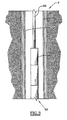
- a deviation sensor 28 is detailed further in Figure 3, as it is dropped to the bottom of well 7 in the production tubing string 20 by gravity or lowered on wireline 32 through tubing string 20.
- the system 10 evaluates wear, corrosion pitting, cross-sectional area and certain diameters of components of a well system that includes a segmented production tubing string 20 positionable in well 7 and a segmented sucker rod string 18 movable within the production tubing string 20.
- Segmented sucker rod string 18 has multiple segments coupled together with larger diameter couplings 19, although a sucker rod string may alternatively be a continuous rod or "COROD".
- Sucker rod strings may include both reciprocating type rods, which reciprocate axially in a well, or rotating type rods, which rotate to power a progressive cavity pump.
- System 10 may be a portable and/or truck-mounted field unit.
- Sensor package 12 and deviation sensor 28 both communicate with data acquisition computer system 14, and thereby with server computer system 16 to compute and compare information such as (i) the wellbore deviation; (ii) the condition of the tubing 20 in terms of holes, splits, corrosion pitting, rod wear, cross sectional area and other wall-thickness reducing flaws; (iii) the condition of the sucker rod 18 in terms of pitting, wear, cross-sectional area and diameter; (iv) the condition of the couplings 19 in terms of diameter and wear; and (v) the condition of rod guide 35 in terms of diameter and wear.
- These criteria are computed as a function of depth within the wellbore in the form of profiles, such as a deviation profile, a rod profile, and a tubing profile, and the existence and severity of the criteria are correlated by comparing the profiles.
- sensor package 12 includes an outer barrel 22, which acts as an enclosure for internal assemblies such as magnetic coil 24 fixed to the outer barrel 22.
- a sensor insert 26 is removably inserted into barrel 22.
- Sensor insert 26 typically includes one or more of magnetic flux leakage sensor coils or Hall-effect sensors, linear variable differential transformers (LVDT), and laser micrometers.
- the sensor insert 26 may be positioned centrally about either the sucker rod 18 or production tubing 20, and may be selected from a group of differently sized inserts for accommodating a variety of rod or tubing diameters.
- the sensor package 12 may house both the rod sensor and the tubing sensor.
- the rod sensor may obtain data such as wear to the coupling 19 that joins segments of the sucker rod string 18, minimum measured diameter of the coupling 19, wear to a rod guide 35, rod diameter, rod cross-sectional area, and rod pitting.
- the tubing sensor may obtain data such as tubing wear, wall thickness, cross-sectional area and pitting.
- the deviation sensor 28 may obtain data such as wellbore dogleg severity, inclination angle, change in inclination angle along the well, and azimuth.
- the rod profile is typically obtained first, the deviation profile second, and the tubing profile third.
- the deviation profile is obtained simultaneously with the tubing profile as the tubing is pulled from the well.
- the sucker rod 18 under inspection is pulled from the well by a work-over rig (not shown).
- the characteristics of the rod 18 are sensed and measured to determine the rod profile.
- Data acquisition computer system 14 receives signals from the sensor package 12 and transmits them to the server computer 16.
- Data acquisition computer system 14 may compute the profiles prior to transmitting to server computer 16, where after the server computer 16 may act as a server.
- the transmittal between data acquisition computer system 14 and server computer 16 may be by wire, or alternatively by one of a variety of wireless communication technologies known in the art, as conceptually represented by antennas 13 and 15.
- a gyroscope & accelerometer-based deviation sensor tool 28 is dropped to the bottom of the well 7 inside the tubing 20.
- the deviation sensor 28 may be lowered to the bottom of the well 7 on wireline 32.
- the deviation tool 28 measures and records inclination, rate of change of inclination and azimuth of the wellbore as the tool 28 is retrieved in the tubing by the work-over rig, or retrieved independently by wireline 32.
- the tool memory is downloaded into the data acquisition computer system 14 to compute and further process the deviation profile, comparing it with the rod profile and/or tubing profile. This information is also transmitted to server computer 16 for further processing as to the optimum wellbore wear mitigation solution .
- the production tubing string 20 is pulled from the well by the work-over rig and inspected similarly to the sucker rod string 18. As the rig pulls the tubing 20, the characteristics of the tubing 20 are sensed to determine the tubing profile. As with the rod string 18, the data acquisition computer system 14 receives signals from the sensor package 12, computes the tubing profile and transmits the information to the server computer 16. At least a portion of this computation may again be carried out by the data acquisition computer system 14.
- the server computer 16 may then act as a server.
- This server-computer 16 stores all the raw data, then applies the received information with a software program to calculate a mathematical model of wear to the well system.
- the model applies correlative techniques and other algorithms to determine a comprehensive wellbore condition profile.
- the server-computer 16 may then determine an optimal solution for the mitigation of wear within the well 7.
- the solution may be stored in the computer, acting as a central server, and then optionally transmitted back to the field unit, such as to data acquisition computer system 14, and made available for access over the internet to the appropriate personnel.
- the server computer 16 may thus be located several hundred feet, or several thousand miles away, enabled by internet and wireless technologies, such as satellite internet access.
- the server-computer 16 may store wear data for a multitude of wells, providing the convenience of one central processing location, and the ability to correlate not only the rod, tubing, and deviation data from one well, but to correlate like data from the multitude of other wells in common areas, such as to establish or identify patterns or trends common to more than one well within a producing property lease or field.
- all the data assembled in the rod profile, tubing profile, and deviation profile may be communicated and analyzed by means of a graphical database, in countless formats.
- the individual profiles may simply be displayed individually in a two-dimensional display. Such a display would only minimally show a correlation between the data, in that all three profiles may be viewed independently, without interrelating them.
- the data from the three profiles is preferably correlated, in that data from one profile is related to data from another profile.
- a three-dimensional display 50 may be viewed on a screen 51, comprising a plot 53 of the wellbore's physical path or deviation profile, where a vertical axis 52 represents depth of the well, and two horizontal axes 54, 56 define a plane parallel with the earth's surface above at the well site.
- Critical areas of the wellbore plot 53 may be graphically identified or labelled with the rod data and/or tubing data.
- the plot 58 of Figure 5 shows another plot example, wherein one wellbore deviation profile 57 is displayed and labelled with tubing data, and another wellbore deviation profile 59, identical to profile 57, is labelled with rod wear data.
- Many other types of display are possible, wherein data from two or more of the rod profile, tubing profile, and deviation profile is plotted, compared and interrelated.
- conditions of multiple wellbores within a common producing field, lease, or area may be correlated and imaged, such as by using colour-based common data isogram mapping, which may be applied to a visual display such as shown in Figure 11.
- the database also allows for comparison to other databases having historical operational failure data for the multiple wellbores.
- the entire volume of information relevant to the failure history, root cause of the failure, tubing profile, deviation profile and rod profile may be stored, analysed, correlated and graphically presented.
- This entire database can be investigated by any authorised user with internet protocol access, as well as displayed at the field.
- This feature allows for a rapid, graphic display of relevant wellbore conditions both in specific wellbores and multiple wellbores within the producing area lease or field.
- the optimum wellbore wear mitigation solution is generated and readily displayed and analysed at any location, as well as in the mobile field unit containing data acquisition computer system 14. An operator may thus rapidly implement the wellbore wear mitigation solution before the well is put back into production.
- FIG. 2 details one embodiment of sensor package 12.
- a generic cylindrical member 21 represents either the rod string 18 or tubing string 20 being examined.
- Many elements of the wear evaluation system 10 are generally known.
- magnetic flux leakage sensor coils and Hall effect sensors are known in the art to detect and measure changes in magnetic flux density caused by corrosion pitting, wall thickness change, cross-sectional area change and fatigue cracks on production tubing, sucker rods and on COROD sucker rods.
- Magnetic sensors are also known for detecting area and changes in area of COROD, and diameter or change in diameter of rod and tubing.
- LVDTs are also generally known in the art for determining diameter and thickness of specimens.
- Magnetic coil 24 is radial spaced from tubing 20 or rod 18, to magnetically energise the tubing 20 or rod 18 without touching them.
- Magnetic sensor shoes 34 are radially movable with respect to tubing 20 or rod 18 via floating, bi-directional sensor shoe mount assembly 36.
- the floating shoe mount assembly 36 allows freedom of movement as the irregular surface of the tubing 20, rod 18 or coupling 19 pass through it.
- the sensor shoes 34 may contain magnetic flux sensor shoes or Hall-effect devices to sense flux leaking from the rod 18 or tubing 20, generating signals in response.
- Signal wire 37 passes signals from the shoes 34 to the data acquisition computer system 14 or elsewhere in the sensor package 12.
- LVDT 44 Above the magnetic coil 24 in Figure 2 is LVDT 44.
- Another contact shoe 40 floats along the rod 18 or tubing 20, moving radially in response to the diameter of the rod 18, coupling 19 or rod guide 35.
- the signals are output via signal wire 43 to the data acquisition computer system 14 or elsewhere within the sensor package 12.
- a laser micrometer and receiver pair 46 for measuring the diameter or change in diameter of sucker rods, sucker rod couplings, and sucker rod guides.
- Power and signal wire 49 powers the laser micrometer and receiver pair 46 and passes signals to the data acquisition computer system 14 or elsewhere within the sensor package 12.
- sensor insert 26 is shown to house both the LVDT 44 and laser micrometer 46.
- the sensor insert 26 may be changed out to accommodate various diameters of rod and tubing.
- the insert 26 shown may be suitable for 15.9 mm, 19.1 mm, 22.2mm or 25.4 mm (5/8", 3 /4", 7/8", or 1") rods, and a larger insert may be inserted into barrel 22 for rods greater than 25.4 mm (1 ") or for tubing.
- the magnetic coil 24 in this embodiment is not included within the sensor insert 26.
- the sensor package 12 of Figure 2 is conceptual and not to scale, for the purpose of illustrating its features. If constructed with the proportions shown, the couplings 19 for coupling sucker rods 18 may interfere with floating shoes 34 and 40. When passing coupled rod string 18 through the sensor package 12, it may therefore be necessary to move the shoes 34, 40 outwardly, to prevent this interference. Accordingly, suspension system 38, consisting of pneumatic bladder or cylinder elements or alternatively, springs, is used to allow this outward radial movement. Magnetic sensor coil and Hall-effect device shoes 34 may be radially spaced to remotely detect wear to the rod string 18 and couplings 19, such as from 6.4 mm (0.25") from the rod or tubing surface, to prevent interference with the couplings 19.
- the laser micrometer 46 is capable of remotely sensing the rod, use of the laser micrometer 46 may obviate the need for the LVDT 44.
- a major advantage of using laser micrometer 46 over prior art diameter measurement systems is this ability measure the considerable variance in diameter of rod string 18, coupling 19 or guide 35 without touching them.
- the deviation sensor 28 in Figure 3 may comprise as many as three or more pairs of an inclinometer and a gyroscope, both known in the art.
- the inclinometer is a lower cost, accelerometer-based device that generally provides only inclination angle data.
- the gyroscope may additionally provide azimuth data, which could detect, for example, a corkscrew deviation that may be undetectable solely with the inclinometer.
- Conventional gyroscopes are typically a far more expensive devices. Although the additional information provided by a gyroscope is useful, lower cost gyroscope technologies are currently sought.
- the deviation sensor tool 28 may contain three sets of paired micro electrical-mechanical systems (MEMS) Coriolis-effect angular rate gyroscope and accelerometer devices known in the art of inertial navigation and shock measurement. Such devices are not known to have been employed in surveying existing, producing oil and gas wellbores for obtaining a deviation profile.
- MEMS micro electrical-mechanical systems
- Each pair of MEMS gyroscope and accelerometer devices, respectively, is triaxially positioned orthogonally to each other in the planes X, Y and Z.
- the deviation sensor is thus able to record the inclination and the azimuth of an existing, producing wellbore.
- the present invention uses less robust, lower operating temperature-capable mass produced Carioles-effect MEMS devices rather than expensive alternative technology Coriolis-effect gyroscopic devices so as to bring the cost below that of a MWD directional survey or multi-shot wireline survey performed during the drilling of a wellbore.
- an entire wellbore evaluation according to the present invention including computation of rod profile, tubing profile, and deviation profile, may be obtained for less than the cost of a conventional gyroscopic survey. This highlights an important advantage of the invention that, by comparison to current techniques, an exceedingly more comprehensive wellbore analysis for wear, corrosion and deviation can be performed at an affordable price.
- the sensors detailed in the figures are exemplary only, for conceptually illustrating the components that may be included with the wear evaluation system 10.
- the structure of the sensors is less important than the selection and use of the sensors and the integration and correlation of the data from the sensors.
- the prior art has generally sensed wear of the individual components, such as rod string segments trucked to a remote rod reclamation facility; COROD strings as pulled from the well; tubing strings as pulled from the well; and limited wellbore deviation information obtained during the original drilling of the well
- the present invention correlates this information to obtain more comprehensive information than otherwise available upon separate analysis of the individual components, and performs this operation while all the components of the system remain at the well site.
- data from two or more sensors are selected from the group consisting of a deviation sensor movable within the well, either by the tubing as it is retrieved from the well or by wireline, to determine a deviation profile; a rod sensor for sensing wear, diameter, cross-sectional area and pitting of the sucker rod string, including couplings and guides, as it is removed from the well to determine a rod profile; and a tubing sensor for sensing wear, corrosion pitting and cross-sectional area of the production tubing string as it is removed from the well to determine a tubing profile.
- a deviation sensor movable within the well, either by the tubing as it is retrieved from the well or by wireline, to determine a deviation profile
- a rod sensor for sensing wear, diameter, cross-sectional area and pitting of the sucker rod string, including couplings and guides, as it is removed from the well to determine a rod profile
- a tubing sensor for sensing wear, corrosion pitting and cross-sectional area of the production tubing string as it is removed
- server-computer 16 and/or data acquisition computer system 14 and/or logic circuits that may be contained within any of the individual sensors each may perform some subpart of this computation and comparison.
- Integration and analysis of the rod, tubing and deviation profiles further allows for the computation of a wear mitigation solution to correct at least some aspect of performance of the well system.
- the wear mitigation solution can sometimes be derived by an operator upon viewing and analysing data, such as displayed in graphical form in the display 50 of Figure 4.
- Such prior art requires an expensive deviation survey and does not include integration of tubing or rod conditions.
- the data acquisition computer system 14 and server computer 16 employed in the present invention provide a fast and comprehensive computation of the wear mitigation solution.
- the wear mitigation solution may include strategically positioning rod guides 35 shown in Fig. 1 with respect to depth in the sucker rod string 18. In simple cases, an operator may simply move the rod guides 35 to locations where excessive wear in the tubing profile is observed. However, the observed tubing profile may be a result of wear induced in a well in which the tubing was previously employed and thus unrelated to wear patterns in this wellbore.
- the server computer 16 provides a more comprehensive solution, indicating for example a large number of wear locations for repositioning rod guides 35, based on correlations with other data such as the deviation profile.
- the wear mitigation solution may include lining the production tubing string 20 with a polymer lining 33, indicated conceptually between dashed break lines in Fig. 3.
- the solution may include using a powered tubing rotator to rotate the production tubing string 20, such as to better distribute wear within the circumference of the tubing string 20.
- a rod rotator may likewise be used to rotate the sucker rod string 18.
- the solution may further include changing pump size, stroke or speed; changing the diameter of a section of the sucker rod string 18; or replacing one or more segments of the production tubing string 20 or sucker rod string 18.
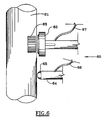
- the wear evaluation system 10 may further include a tracking system 60 detailed conceptually in Figure 6.
- a marking device 62 may mark rod or tubing 21 with a bar code 63.
- the bar code 63 could be marked on an adhesive label as the surface of cylindrical member 21 is often rough, dirty, or otherwise incapable of directly receiving the bar code 63.
- a tracking device 64 includes optical sensor 65 for subsequently reading the bar code 63.
- the marking device 62 is preferably positioned above well 7 and marks individual segments of the production tubing string 20 and the sucker rod string 18 as they are pulled from the well 7. The tracking device 64 then reads the markings on the segments as they are reinserted into the well 7.
- a computer which may be included within data acquisition computer system 14, is in communication with the tracking device 64 either wirelessly, or via wires 66, 67, for tracking the relative position of each of the segments of the respective production tubing string 20 and sucker rod string 18.
- the tracking system 60 thus allows the wear evaluation system 10, and specifically the server computer 16, to keep track of where individual segments are positioned within the tubing string 20 and sucker rod string 18. Because the segment positioning information gets stored in the server computer 16, it is of little consequence that the bar codes 63 may become illegible upon reinsertion into the well 7.
- the tracking system 60 is useful when repositioning the individual joints of tubing, or rods and especially for future analysis of the elements of the same wellbore. For example, tubing joints having the greatest wear may be repositioned at the top of the string, and it is useful to keep track of this repositioning. Upon subsequent re-evaluation of the wellbore components at a later date, rod and tubing conditions may be compared and thus incremental wear and corrosion determined. Position information may be displayed along with other wear data. For instance, each tubing segment and rod segment may be represented respectively by one of dots 45 and 55 in Figure 5. The dots 45 and 55 may be colour coded, such as to represent their degree of wear. For example, tubing segments with 0-15% wall reduction (i.e.
- a minimum of 85% thickness remaining may be represented by and displayed with a yellow dot, and placed at the lower end of the string; tubing segments with 16-30% wall reduction get a blue dot; segments with 31-50% wall thickness get a green dot; and segments with more than 50% thickness reduction get a red dot.
- a multiplicity of other coding and display schemes are conceivable.
- a rod wear evaluation system 10 comprises a rod sensor included with sensor package 12 for sensing wear to the sucker rod string 18 as it is removed from the well 7 to determine a rod profile.
- the rod sensor 12 may comprise a magnetic flux sensor, including magnetic coil 24 and magnetic sensor shoes 34.
- the rod sensor 12 may also comprise a laser micrometer, including laser micrometer and receiver pair 46.
- LVDT 44 is not included.
- the magnetic flux leakage sensor coil and Hall-effect device, 34 and laser micrometer 46 are radially spaced from the rod string 18 and couplings 19 to remotely sense the diameter, wear, cross-sectional area and pitting of the sucker rod string 18.
- the data acquisition computer system 14 is in communication with the rod sensor 12 for computing the rod profile.
- a plurality of differently sized sensor inserts 26 may be included for accommodating a plurality of diameters of the segmented sucker rod string 18, each sensor insert 16 including the rod sensor.
- Sensor barrel 22 optionally receives sensor insert 26. This embodiment senses and measures one or more of the presence of the couplings 19, wear to the couplings 19, diameter of the couplings 19, diameter of rod guide 35, rod diameter, rod cross-sectional area, and pitting.
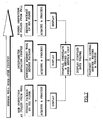
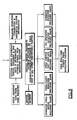
- Figures 7-10 are flow diagrams illustrating examples of preferred operation of the wear evaluation system.
- Figure 7 shows that rod, tubing, and deviation data are first acquired with their respective sensors, during normal well work-over operations.
- the data is optionally displayed, compiled, correlated, and/or recorded in the field, such as with data acquisition computer system 14. Again, some of these steps may not be performed until data reaches server computer 16, to which the data is transmitted.
- the server computer 16 may record the data, further process the data, generate the optimal wellbore wear mitigation solution and act as a server as discussed previously.
- Figure 8 illustrates that prior archived data from the same well, along with wellbore operating parameters and historical failure information, may be fed into the computer/server 26, which correlates the data and computes a wear mitigation solution.
- the server computer 16 then transmits the information back to the field, such as to data acquisition computer system 14, and to an archive database.
- the data may be made available to, displayed and interrogated by any authorised user of a computer with internet protocol access such as an operator field office, a third party engineer, a field server unit, another optional location to be specified, and an operator engineer, all at any location worldwide with authorisation and internet access.
- This transmittal of raw data from the various sensors, through data acquisition computer system 14, to server computer 16, back to the data acquisition computer system 14 and any other location worldwide, via internet protocol results in an internet published application of a real-time or nearly real-time wellbore wear mitigation solution.
- Figure 9 illustrates how the wear evaluation system 10 may more broadly integrate raw and processed data to more comprehensively apply a wear mitigation solution.
- sources may feed the computer/server 26, such as the server database archive and simultaneous data from additional wellbores in the field and their corresponding wear evaluation sensors and systems. This culminates in an ongoing wellbore image mapping database, which may feed the field service unit, the operator engineer, other engineers, and the operator field office.
- the net result is a thorough analysis of the entire producing lease or field, including single wellbores in the lease or field, which may be simultaneously analysed by multiple persons so as to provide a collaborative environment and thereafter continually analysed and refined during the life of the lease and beyond. It is a benefit of the preferred embodiments of the present invention that additional wellbores within the same lease may be evaluated by the system and also imaged within the isogram mapping capability of the system using internet protocol published application.
- Figure 10 is a diagram of a suitable system connected between a mobile field unit and a command location.
- the deviation is retrieved with the normal workover process conducted to remove the tubing string from the well.
- the tool may be located in a landing nipple or seating sub at the lower end of the tubing string.
- the dropping speed of the tool may be retarded by utilising one or more wire brushes that contact the inside surface of the tubing, or using scraper cups which also contact the inside surface of the tubing, or using parachute centralisers.
- the tool may be retrieved from the bottom of the wellbore as the tubing is pulled to the surface by the workover rig.
- Tubing string lengths generally comprise two 30' sections between a breakout of the string. This results in a deviation or inclination tool standing stationary for a short period while the threaded connections are broken out.
- the tool may measure deviation of the wellbore both while in motion and while static.
- Figure 11 conceptually illustrates a 3-dimensional image of a producing area lease or field, including the surface location, depth, deviation, as to both inclination and azimuth, rod condition and tubing condition.
- Figure 11 also shows a conceptual representation of a single wellbore image that has been "zoomed” into in order to analyse the specific deviation profile, rod profile and tubing profile at a specific depth.
- Other wellbores in the area with similar conditions may be correlated by colour isograms mapping.
Landscapes
- Physics & Mathematics (AREA)
- Geology (AREA)
- Mining & Mineral Resources (AREA)
- Engineering & Computer Science (AREA)
- Life Sciences & Earth Sciences (AREA)
- General Life Sciences & Earth Sciences (AREA)
- Geophysics (AREA)
- Fluid Mechanics (AREA)
- Environmental & Geological Engineering (AREA)
- Geochemistry & Mineralogy (AREA)
- Electromagnetism (AREA)
- Length Measuring Devices With Unspecified Measuring Means (AREA)
- Length Measuring Devices By Optical Means (AREA)
- Data Exchanges In Wide-Area Networks (AREA)
- Geophysics And Detection Of Objects (AREA)
Applications Claiming Priority (2)
| Application Number | Priority Date | Filing Date | Title |
|---|---|---|---|
| US853592 | 1986-04-18 | ||
| US10/853,592 US7107154B2 (en) | 2004-05-25 | 2004-05-25 | Wellbore evaluation system and method |
Publications (3)
| Publication Number | Publication Date |
|---|---|
| EP1600601A2 true EP1600601A2 (de) | 2005-11-30 |
| EP1600601A3 EP1600601A3 (de) | 2006-03-01 |
| EP1600601B1 EP1600601B1 (de) | 2008-11-05 |
Family
ID=34941457
Family Applications (1)
| Application Number | Title | Priority Date | Filing Date |
|---|---|---|---|
| EP05253228A Expired - Lifetime EP1600601B1 (de) | 2004-05-25 | 2005-05-25 | Vorrichtung und Verfahren zur Beurteilung eines Bohrlochs |
Country Status (7)
| Country | Link |
|---|---|
| US (1) | US7107154B2 (de) |
| EP (1) | EP1600601B1 (de) |
| AT (1) | ATE413513T1 (de) |
| CA (1) | CA2508182C (de) |
| DE (1) | DE602005010783D1 (de) |
| RU (1) | RU2005115919A (de) |
| SG (1) | SG117599A1 (de) |
Cited By (5)
| Publication number | Priority date | Publication date | Assignee | Title |
|---|---|---|---|---|
| EP1854958A1 (de) * | 2006-05-09 | 2007-11-14 | Robbins & Myers Energy Systems, L.P. | Bohrlochbeurteilungssystem und -verfahren |
| EP1857632A1 (de) * | 2006-05-09 | 2007-11-21 | Robbins & Myers Energy Systems, L.P. | Verfahren und Vorrichtung zur Korrektur von Magnetflusssensorsignalen |
| WO2010114916A1 (en) * | 2009-04-01 | 2010-10-07 | Fedd Wireless, Llc | Wireless monitoring of pump jack sucker rod loading and position |
| GB2475074A (en) * | 2009-11-04 | 2011-05-11 | Oxford Monitoring Solutions Ltd | Downhole pump incorporating an inclinometer |
| GB2514077A (en) * | 2013-01-09 | 2014-11-19 | Dv8 Technology Ltd | Wireline gyro surveying |
Families Citing this family (62)
| Publication number | Priority date | Publication date | Assignee | Title |
|---|---|---|---|---|
| US20070261768A1 (en) * | 2006-05-10 | 2007-11-15 | Reynolds Harris A Jr | Method for designing corrosion resistant alloy tubular strings |
| US7519508B2 (en) * | 2005-09-13 | 2009-04-14 | Key Energy Services, Inc. | Method and system for setting and analyzing tubing target pressures for tongs |
| JP2007192803A (ja) * | 2005-12-19 | 2007-08-02 | Ishikawajima Harima Heavy Ind Co Ltd | 腐食評価装置及び腐食評価方法 |
| BRPI0709703A2 (pt) * | 2006-03-27 | 2011-07-26 | Key Energy Services Inc | mÉtodo e sistema para avaliaÇço e exibiÇço de dados de profundidade |
| BRPI0708919A2 (pt) | 2006-03-27 | 2011-06-14 | Key Energy Services Inc | mÉtodo e sistema para interpretar dados de tubulaÇço |
| RU2008142389A (ru) * | 2006-03-27 | 2010-05-10 | Ки Энерджи Сервисиз, Инк. (Us) | Способ и система сканирования колонны труб |
| CA2583059C (en) * | 2006-03-28 | 2015-08-11 | Key Energy Services, Inc. | Method and system for calibrating a tube scanner |
| MX2007003531A (es) * | 2006-03-28 | 2008-11-18 | Key Energy Services Inc | Metodo y sistema para desplegar los datos de exploracion para tuberias de pozos de petroleo, basados en la velocidad de exploracion. |
| US7484571B2 (en) * | 2006-06-30 | 2009-02-03 | Baker Hughes Incorporated | Downhole abrading tools having excessive wear indicator |
| US7464771B2 (en) * | 2006-06-30 | 2008-12-16 | Baker Hughes Incorporated | Downhole abrading tool having taggants for indicating excessive wear |
| US7404457B2 (en) * | 2006-06-30 | 2008-07-29 | Baker Huges Incorporated | Downhole abrading tools having fusible material and methods of detecting tool wear |
| US7424910B2 (en) * | 2006-06-30 | 2008-09-16 | Baker Hughes Incorporated | Downhole abrading tools having a hydrostatic chamber and uses therefor |
| US20080106260A1 (en) * | 2006-11-02 | 2008-05-08 | Rogers John P | Magnetic flux leakage system and method |
| US8316936B2 (en) * | 2007-04-02 | 2012-11-27 | Halliburton Energy Services Inc. | Use of micro-electro-mechanical systems (MEMS) in well treatments |
| US9822631B2 (en) | 2007-04-02 | 2017-11-21 | Halliburton Energy Services, Inc. | Monitoring downhole parameters using MEMS |
| US9879519B2 (en) | 2007-04-02 | 2018-01-30 | Halliburton Energy Services, Inc. | Methods and apparatus for evaluating downhole conditions through fluid sensing |
| US8302686B2 (en) * | 2007-04-02 | 2012-11-06 | Halliburton Energy Services Inc. | Use of micro-electro-mechanical systems (MEMS) in well treatments |
| US8162050B2 (en) * | 2007-04-02 | 2012-04-24 | Halliburton Energy Services Inc. | Use of micro-electro-mechanical systems (MEMS) in well treatments |
| US8297352B2 (en) * | 2007-04-02 | 2012-10-30 | Halliburton Energy Services, Inc. | Use of micro-electro-mechanical systems (MEMS) in well treatments |
| US8297353B2 (en) * | 2007-04-02 | 2012-10-30 | Halliburton Energy Services, Inc. | Use of micro-electro-mechanical systems (MEMS) in well treatments |
| US10358914B2 (en) | 2007-04-02 | 2019-07-23 | Halliburton Energy Services, Inc. | Methods and systems for detecting RFID tags in a borehole environment |
| US9494032B2 (en) | 2007-04-02 | 2016-11-15 | Halliburton Energy Services, Inc. | Methods and apparatus for evaluating downhole conditions with RFID MEMS sensors |
| US7712527B2 (en) * | 2007-04-02 | 2010-05-11 | Halliburton Energy Services, Inc. | Use of micro-electro-mechanical systems (MEMS) in well treatments |
| US9732584B2 (en) | 2007-04-02 | 2017-08-15 | Halliburton Energy Services, Inc. | Use of micro-electro-mechanical systems (MEMS) in well treatments |
| US8291975B2 (en) * | 2007-04-02 | 2012-10-23 | Halliburton Energy Services Inc. | Use of micro-electro-mechanical systems (MEMS) in well treatments |
| US8342242B2 (en) * | 2007-04-02 | 2013-01-01 | Halliburton Energy Services, Inc. | Use of micro-electro-mechanical systems MEMS in well treatments |
| US9194207B2 (en) | 2007-04-02 | 2015-11-24 | Halliburton Energy Services, Inc. | Surface wellbore operating equipment utilizing MEMS sensors |
| US9200500B2 (en) | 2007-04-02 | 2015-12-01 | Halliburton Energy Services, Inc. | Use of sensors coated with elastomer for subterranean operations |
| US8237443B2 (en) * | 2007-11-16 | 2012-08-07 | Baker Hughes Incorporated | Position sensor for a downhole completion device |
| US8204697B2 (en) * | 2008-04-24 | 2012-06-19 | Baker Hughes Incorporated | System and method for health assessment of downhole tools |
| US20100025109A1 (en) * | 2008-07-30 | 2010-02-04 | Baker Hughes Incorporated | Apparatus and Method for Generating Formation Textural Feature Images |
| US20100042327A1 (en) * | 2008-08-13 | 2010-02-18 | Baker Hughes Incorporated | Bottom hole assembly configuration management |
| US20100038135A1 (en) * | 2008-08-14 | 2010-02-18 | Baker Hughes Incorporated | System and method for evaluation of structure-born sound |
| US9268773B2 (en) * | 2010-12-06 | 2016-02-23 | Baker Hughes Incorporated | System and methods for integrating and using information relating to a complex process |
| US8816689B2 (en) * | 2011-05-17 | 2014-08-26 | Saudi Arabian Oil Company | Apparatus and method for multi-component wellbore electric field Measurements using capacitive sensors |
| US9284791B2 (en) * | 2011-12-20 | 2016-03-15 | Frank's International, Llc | Apparatus and method to clean a tubular member |
| US9784056B2 (en) | 2011-12-20 | 2017-10-10 | Frank's International, Llc | Wear sensor for a pipe guide |
| US9169697B2 (en) | 2012-03-27 | 2015-10-27 | Baker Hughes Incorporated | Identification emitters for determining mill life of a downhole tool and methods of using same |
| US9534475B2 (en) * | 2013-05-27 | 2017-01-03 | Landmark Graphics Corporation | GUI-facilitated centralizing methods and systems |
| WO2015065477A1 (en) * | 2013-11-01 | 2015-05-07 | Halliburton Energy Services, Inc. | High performance wire marking for downhole cables |
| US9784099B2 (en) | 2013-12-18 | 2017-10-10 | Baker Hughes Incorporated | Probabilistic determination of health prognostics for selection and management of tools in a downhole environment |
| WO2016039723A1 (en) * | 2014-09-08 | 2016-03-17 | Landmark Graphics Corporation | Adjusting survey points post-casing for improved wear estimation |
| CN104458895A (zh) * | 2014-12-08 | 2015-03-25 | 清华大学 | 管道三维漏磁成像检测方法及系统 |
| CA2971712C (en) * | 2015-03-06 | 2020-07-14 | Halliburton Energy Services, Inc. | Optimizing sensor selection and operation for well monitoring and control |
| US10107932B2 (en) | 2015-07-09 | 2018-10-23 | Saudi Arabian Oil Company | Statistical methods for assessing downhole casing integrity and predicting casing leaks |
| US10767470B2 (en) | 2015-08-20 | 2020-09-08 | Halliburton Energy Services, Inc. | Inspection of wellbore conduits using a distributed sensor system |
| CN106246163B (zh) * | 2016-08-31 | 2017-07-14 | 中国科学院地质与地球物理研究所 | 近钻头动态井斜测量方法及装置 |
| US10781974B2 (en) | 2016-12-29 | 2020-09-22 | Paul A. COHEN | Corrosion sensor for storage tank |
| JP6813105B2 (ja) * | 2017-11-22 | 2021-01-13 | 株式会社島津製作所 | 磁性体の検査装置および磁性体の検査方法 |
| US11002075B1 (en) | 2018-07-31 | 2021-05-11 | J.H. Fletcher & Co. | Mine drilling system and related method |
| NL2021434B1 (en) * | 2018-08-07 | 2020-02-17 | Tenaris Connections Bv | Corrosion testing device |
| US11066919B2 (en) * | 2019-07-17 | 2021-07-20 | Optimum Innovation & Logistics, LLC | Method and apparatus for measuring wear on sucker rod guides |
| US11402351B1 (en) | 2019-08-20 | 2022-08-02 | Scan Systems Corp. | Apparatus, systems, and methods for discriminate high-speed inspection of tubulars |
| US11307173B1 (en) | 2019-08-20 | 2022-04-19 | Scan Systems Corp. | Apparatus, systems, and methods for inspection of tubular goods |
| US12031945B1 (en) | 2019-08-20 | 2024-07-09 | Scan Systems Corp. | Apparatus, systems, and methods for inspecting tubulars of different sizes |
| US11402352B1 (en) | 2019-08-20 | 2022-08-02 | Scan Systems Corp. | Apparatus, systems, and methods for inspecting tubulars employing flexible inspection shoes |
| US11286773B2 (en) * | 2020-03-11 | 2022-03-29 | Neubrex Co., Ltd. | Using fiber-optic distributed sensing to optimize well spacing and completion designs for unconventional reservoirs |
| CA3175094A1 (en) | 2020-03-13 | 2021-09-16 | Geonomic Technologies Inc. | Method and apparatus for measuring a wellbore |
| US11686177B2 (en) | 2021-10-08 | 2023-06-27 | Saudi Arabian Oil Company | Subsurface safety valve system and method |
| CN115163039B (zh) * | 2022-06-09 | 2024-08-27 | 东北大学 | 一种深部软岩钻孔变形开裂一体化非接触监测装置及方法 |
| US12546208B2 (en) | 2022-11-18 | 2026-02-10 | Walter Phillips | Apparatus for affixing a rotation sensor to a rod lift system |
| US12247948B1 (en) | 2023-03-20 | 2025-03-11 | Scan Systems, Corp. | Height adjustable inspection shoes, apparatus and methods for inspecting tubulars |
Family Cites Families (26)
| Publication number | Priority date | Publication date | Assignee | Title |
|---|---|---|---|---|
| US2555853A (en) | 1945-04-16 | 1951-06-05 | Emmett M Irwin | Magnetic testing apparatus and method |
| US2855564A (en) | 1955-10-14 | 1958-10-07 | Emmett M Irwin | Magnetic testing apparatus and method |
| US3753296A (en) | 1970-12-04 | 1973-08-21 | Applied Tech Ass | Well mapping apparatus and method |
| US3958049A (en) | 1971-11-04 | 1976-05-18 | Rodco, Inc. | Method of inspecting and treating sucker rod |
| US4987684A (en) | 1982-09-08 | 1991-01-29 | The United States Of America As Represented By The United States Department Of Energy | Wellbore inertial directional surveying system |
| US4715442A (en) | 1984-04-11 | 1987-12-29 | Pa Incorporated | Apparatus for servicing tubular strings in subterranean wells |
| US4492115A (en) | 1984-04-11 | 1985-01-08 | Pa Incorporated | Method and apparatus for measuring defects in ferromagnetic tubing |
| US4636727A (en) | 1984-04-11 | 1987-01-13 | Pa Incorporated | Method and apparatus for detecting the location of defects in tubular sections moving past a well head |
| US4843317A (en) | 1988-10-18 | 1989-06-27 | Conoco Inc. | Method and apparatus for measuring casing wall thickness using a flux generating coil with radial sensing coils and flux leakage sensing coils |
| US5115863A (en) | 1991-04-05 | 1992-05-26 | Olinger Edward L | Low turbulence rod guide |
| US5339896A (en) | 1993-05-06 | 1994-08-23 | J. M. Huber Corp. | Field installable rod guide and method |
| CA2145908C (en) | 1993-05-26 | 1998-09-29 | Dan E. O'hair | Rod guide with enhanced erodable volume |
| US5487426A (en) | 1994-09-23 | 1996-01-30 | Enterra Patco Oilfield Products Inc. | Rod guide with removable vanes |
| US5511619A (en) | 1994-12-07 | 1996-04-30 | Jackson; William E. | Polymer liners in rod pumping wells |
| US5821414A (en) | 1997-02-07 | 1998-10-13 | Noy; Koen | Survey apparatus and methods for directional wellbore wireline surveying |
| US5914596A (en) | 1997-10-14 | 1999-06-22 | Weinbaum; Hillel | Coiled tubing inspection system |
| US6152223A (en) | 1998-09-14 | 2000-11-28 | Norris Sucker Rods | Rod guide |
| FR2789438B1 (fr) * | 1999-02-05 | 2001-05-04 | Smf Internat | Element profile pour un equipement de forage rotatif et tige de forage comportant au moins un troncon profile |
| CA2265223C (en) * | 1999-03-11 | 2004-05-18 | Linden H. Bland | Wellbore annulus packer apparatus and method |
| US6453239B1 (en) | 1999-06-08 | 2002-09-17 | Schlumberger Technology Corporation | Method and apparatus for borehole surveying |
| US6308787B1 (en) * | 1999-09-24 | 2001-10-30 | Vermeer Manufacturing Company | Real-time control system and method for controlling an underground boring machine |
| US6316937B1 (en) | 1999-10-13 | 2001-11-13 | Oilfield Equipment Marketing, Inc. | Method and apparatus for detecting and measuring axially extending defects in ferrous tube |
| US6405808B1 (en) * | 2000-03-30 | 2002-06-18 | Schlumberger Technology Corporation | Method for increasing the efficiency of drilling a wellbore, improving the accuracy of its borehole trajectory and reducing the corresponding computed ellise of uncertainty |
| US6483302B1 (en) * | 2000-07-07 | 2002-11-19 | R.D. Tech Inc. | Method and apparatus for magnetic inspection of ferrous conduit for wear |
| US6580268B2 (en) | 2001-08-28 | 2003-06-17 | Weatherford/Lamb, Inc. | Sucker rod dimension measurement and flaw detection system |
| US6704656B1 (en) * | 2002-10-18 | 2004-03-09 | Schlumberger Technology Corporation | Method, apparatus and computer program product to allow automatic product composition |
-
2004
- 2004-05-25 US US10/853,592 patent/US7107154B2/en not_active Expired - Lifetime
-
2005
- 2005-05-24 CA CA2508182A patent/CA2508182C/en not_active Expired - Fee Related
- 2005-05-25 SG SG200503281A patent/SG117599A1/en unknown
- 2005-05-25 AT AT05253228T patent/ATE413513T1/de not_active IP Right Cessation
- 2005-05-25 EP EP05253228A patent/EP1600601B1/de not_active Expired - Lifetime
- 2005-05-25 RU RU2005115919/03A patent/RU2005115919A/ru not_active Application Discontinuation
- 2005-05-25 DE DE602005010783T patent/DE602005010783D1/de not_active Expired - Fee Related
Cited By (5)
| Publication number | Priority date | Publication date | Assignee | Title |
|---|---|---|---|---|
| EP1854958A1 (de) * | 2006-05-09 | 2007-11-14 | Robbins & Myers Energy Systems, L.P. | Bohrlochbeurteilungssystem und -verfahren |
| EP1857632A1 (de) * | 2006-05-09 | 2007-11-21 | Robbins & Myers Energy Systems, L.P. | Verfahren und Vorrichtung zur Korrektur von Magnetflusssensorsignalen |
| WO2010114916A1 (en) * | 2009-04-01 | 2010-10-07 | Fedd Wireless, Llc | Wireless monitoring of pump jack sucker rod loading and position |
| GB2475074A (en) * | 2009-11-04 | 2011-05-11 | Oxford Monitoring Solutions Ltd | Downhole pump incorporating an inclinometer |
| GB2514077A (en) * | 2013-01-09 | 2014-11-19 | Dv8 Technology Ltd | Wireline gyro surveying |
Also Published As
| Publication number | Publication date |
|---|---|
| US20050267686A1 (en) | 2005-12-01 |
| CA2508182C (en) | 2011-02-08 |
| CA2508182A1 (en) | 2005-11-25 |
| DE602005010783D1 (de) | 2008-12-18 |
| RU2005115919A (ru) | 2006-11-20 |
| US7107154B2 (en) | 2006-09-12 |
| ATE413513T1 (de) | 2008-11-15 |
| EP1600601A3 (de) | 2006-03-01 |
| SG117599A1 (en) | 2005-12-29 |
| EP1600601B1 (de) | 2008-11-05 |
Similar Documents
| Publication | Publication Date | Title |
|---|---|---|
| EP1600601B1 (de) | Vorrichtung und Verfahren zur Beurteilung eines Bohrlochs | |
| US7346455B2 (en) | Wellbore evaluation system and method | |
| US6580268B2 (en) | Sucker rod dimension measurement and flaw detection system | |
| AU2017424961B2 (en) | Methods and systems for wellbore integrity management | |
| US20260028887A1 (en) | Block velocity determination system and methods | |
| US5202680A (en) | System for drill string tallying, tracking and service factor measurement | |
| AU2011203712B2 (en) | Pressure release encoding system for communicating downhole information through a wellbore to a surface location | |
| EP3346265A1 (de) | Rohrinspektionswerkzeug mit verwendung von gemeinsam untergebrachten sensoren | |
| EP3947909B1 (de) | System und verfahren zur bewertung des statischen elastizitätsmoduls einer unterirdischen formation | |
| BR112013023690B1 (pt) | Metodo e aparelho para estimar um perfil de resistencia de rocha de uma formaqao | |
| US8824241B2 (en) | Method for a pressure release encoding system for communicating downhole information through a wellbore to a surface location | |
| AU2011353550A1 (en) | Method for a pressure release encoding system for communicating downhole information through a wellbore to a surface location | |
| Fonseca et al. | A Novel Approach to Borehole Quality Measurement in Unconventional Drilling | |
| CN115210446A (zh) | 使用分布式装置的油田数据处理 | |
| WO2013032445A1 (en) | Methods and systems for evaluating environmental impact of drilling operations | |
| CN116635607A (zh) | 用于确定钻管的深度和速度以及钻管在井中的时长的方法 | |
| CN121844121A (zh) | 用于根据电阻率反演对地球模型进行增强显示的方法 |
Legal Events
| Date | Code | Title | Description |
|---|---|---|---|
| PUAI | Public reference made under article 153(3) epc to a published international application that has entered the european phase |
Free format text: ORIGINAL CODE: 0009012 |
|
| AK | Designated contracting states |
Kind code of ref document: A2 Designated state(s): AT BE BG CH CY CZ DE DK EE ES FI FR GB GR HU IE IS IT LI LT LU MC NL PL PT RO SE SI SK TR |
|
| AX | Request for extension of the european patent |
Extension state: AL BA HR LV MK YU |
|
| PUAL | Search report despatched |
Free format text: ORIGINAL CODE: 0009013 |
|
| AK | Designated contracting states |
Kind code of ref document: A3 Designated state(s): AT BE BG CH CY CZ DE DK EE ES FI FR GB GR HU IE IS IT LI LT LU MC NL PL PT RO SE SI SK TR |
|
| AX | Request for extension of the european patent |
Extension state: AL BA HR LV MK YU |
|
| 17P | Request for examination filed |
Effective date: 20060831 |
|
| AKX | Designation fees paid |
Designated state(s): AT BE BG CH CY CZ DE DK EE ES FI FR GB GR HU IE IS IT LI LT LU MC NL PL PT RO SE SI SK TR |
|
| 17Q | First examination report despatched |
Effective date: 20061012 |
|
| GRAP | Despatch of communication of intention to grant a patent |
Free format text: ORIGINAL CODE: EPIDOSNIGR1 |
|
| GRAS | Grant fee paid |
Free format text: ORIGINAL CODE: EPIDOSNIGR3 |
|
| GRAA | (expected) grant |
Free format text: ORIGINAL CODE: 0009210 |
|
| AK | Designated contracting states |
Kind code of ref document: B1 Designated state(s): AT BE BG CH CY CZ DE DK EE ES FI FR GB GR HU IE IS IT LI LT LU MC NL PL PT RO SE SI SK TR |
|
| REG | Reference to a national code |
Ref country code: GB Ref legal event code: FG4D |
|
| REG | Reference to a national code |
Ref country code: CH Ref legal event code: EP |
|
| REG | Reference to a national code |
Ref country code: IE Ref legal event code: FG4D |
|
| REF | Corresponds to: |
Ref document number: 602005010783 Country of ref document: DE Date of ref document: 20081218 Kind code of ref document: P |
|
| NLV1 | Nl: lapsed or annulled due to failure to fulfill the requirements of art. 29p and 29m of the patents act | ||
| LTIE | Lt: invalidation of european patent or patent extension |
Effective date: 20081105 |
|
| PG25 | Lapsed in a contracting state [announced via postgrant information from national office to epo] |
Ref country code: ES Free format text: LAPSE BECAUSE OF FAILURE TO SUBMIT A TRANSLATION OF THE DESCRIPTION OR TO PAY THE FEE WITHIN THE PRESCRIBED TIME-LIMIT Effective date: 20090216 Ref country code: AT Free format text: LAPSE BECAUSE OF FAILURE TO SUBMIT A TRANSLATION OF THE DESCRIPTION OR TO PAY THE FEE WITHIN THE PRESCRIBED TIME-LIMIT Effective date: 20081105 Ref country code: LT Free format text: LAPSE BECAUSE OF FAILURE TO SUBMIT A TRANSLATION OF THE DESCRIPTION OR TO PAY THE FEE WITHIN THE PRESCRIBED TIME-LIMIT Effective date: 20081105 |
|
| PG25 | Lapsed in a contracting state [announced via postgrant information from national office to epo] |
Ref country code: SI Free format text: LAPSE BECAUSE OF FAILURE TO SUBMIT A TRANSLATION OF THE DESCRIPTION OR TO PAY THE FEE WITHIN THE PRESCRIBED TIME-LIMIT Effective date: 20081105 Ref country code: IS Free format text: LAPSE BECAUSE OF FAILURE TO SUBMIT A TRANSLATION OF THE DESCRIPTION OR TO PAY THE FEE WITHIN THE PRESCRIBED TIME-LIMIT Effective date: 20090305 Ref country code: PL Free format text: LAPSE BECAUSE OF FAILURE TO SUBMIT A TRANSLATION OF THE DESCRIPTION OR TO PAY THE FEE WITHIN THE PRESCRIBED TIME-LIMIT Effective date: 20081105 Ref country code: NL Free format text: LAPSE BECAUSE OF FAILURE TO SUBMIT A TRANSLATION OF THE DESCRIPTION OR TO PAY THE FEE WITHIN THE PRESCRIBED TIME-LIMIT Effective date: 20081105 Ref country code: FI Free format text: LAPSE BECAUSE OF FAILURE TO SUBMIT A TRANSLATION OF THE DESCRIPTION OR TO PAY THE FEE WITHIN THE PRESCRIBED TIME-LIMIT Effective date: 20081105 |
|
| PG25 | Lapsed in a contracting state [announced via postgrant information from national office to epo] |
Ref country code: BE Free format text: LAPSE BECAUSE OF FAILURE TO SUBMIT A TRANSLATION OF THE DESCRIPTION OR TO PAY THE FEE WITHIN THE PRESCRIBED TIME-LIMIT Effective date: 20081105 Ref country code: BG Free format text: LAPSE BECAUSE OF FAILURE TO SUBMIT A TRANSLATION OF THE DESCRIPTION OR TO PAY THE FEE WITHIN THE PRESCRIBED TIME-LIMIT Effective date: 20090205 Ref country code: DK Free format text: LAPSE BECAUSE OF FAILURE TO SUBMIT A TRANSLATION OF THE DESCRIPTION OR TO PAY THE FEE WITHIN THE PRESCRIBED TIME-LIMIT Effective date: 20081105 Ref country code: EE Free format text: LAPSE BECAUSE OF FAILURE TO SUBMIT A TRANSLATION OF THE DESCRIPTION OR TO PAY THE FEE WITHIN THE PRESCRIBED TIME-LIMIT Effective date: 20081105 Ref country code: RO Free format text: LAPSE BECAUSE OF FAILURE TO SUBMIT A TRANSLATION OF THE DESCRIPTION OR TO PAY THE FEE WITHIN THE PRESCRIBED TIME-LIMIT Effective date: 20081105 |
|
| PG25 | Lapsed in a contracting state [announced via postgrant information from national office to epo] |
Ref country code: PT Free format text: LAPSE BECAUSE OF FAILURE TO SUBMIT A TRANSLATION OF THE DESCRIPTION OR TO PAY THE FEE WITHIN THE PRESCRIBED TIME-LIMIT Effective date: 20090406 Ref country code: CZ Free format text: LAPSE BECAUSE OF FAILURE TO SUBMIT A TRANSLATION OF THE DESCRIPTION OR TO PAY THE FEE WITHIN THE PRESCRIBED TIME-LIMIT Effective date: 20081105 Ref country code: SE Free format text: LAPSE BECAUSE OF FAILURE TO SUBMIT A TRANSLATION OF THE DESCRIPTION OR TO PAY THE FEE WITHIN THE PRESCRIBED TIME-LIMIT Effective date: 20090205 |
|
| PGFP | Annual fee paid to national office [announced via postgrant information from national office to epo] |
Ref country code: DE Payment date: 20090528 Year of fee payment: 5 Ref country code: FR Payment date: 20090518 Year of fee payment: 5 |
|
| PLBE | No opposition filed within time limit |
Free format text: ORIGINAL CODE: 0009261 |
|
| STAA | Information on the status of an ep patent application or granted ep patent |
Free format text: STATUS: NO OPPOSITION FILED WITHIN TIME LIMIT |
|
| PG25 | Lapsed in a contracting state [announced via postgrant information from national office to epo] |
Ref country code: SK Free format text: LAPSE BECAUSE OF FAILURE TO SUBMIT A TRANSLATION OF THE DESCRIPTION OR TO PAY THE FEE WITHIN THE PRESCRIBED TIME-LIMIT Effective date: 20081105 |
|
| 26N | No opposition filed |
Effective date: 20090806 |
|
| PGFP | Annual fee paid to national office [announced via postgrant information from national office to epo] |
Ref country code: GB Payment date: 20090528 Year of fee payment: 5 |
|
| PG25 | Lapsed in a contracting state [announced via postgrant information from national office to epo] |
Ref country code: MC Free format text: LAPSE BECAUSE OF NON-PAYMENT OF DUE FEES Effective date: 20090531 |
|
| REG | Reference to a national code |
Ref country code: CH Ref legal event code: PL |
|
| PG25 | Lapsed in a contracting state [announced via postgrant information from national office to epo] |
Ref country code: CH Free format text: LAPSE BECAUSE OF NON-PAYMENT OF DUE FEES Effective date: 20090531 Ref country code: LI Free format text: LAPSE BECAUSE OF NON-PAYMENT OF DUE FEES Effective date: 20090531 |
|
| REG | Reference to a national code |
Ref country code: IE Ref legal event code: MM4A |
|
| PG25 | Lapsed in a contracting state [announced via postgrant information from national office to epo] |
Ref country code: IE Free format text: LAPSE BECAUSE OF NON-PAYMENT OF DUE FEES Effective date: 20090525 |
|
| PG25 | Lapsed in a contracting state [announced via postgrant information from national office to epo] |
Ref country code: GR Free format text: LAPSE BECAUSE OF FAILURE TO SUBMIT A TRANSLATION OF THE DESCRIPTION OR TO PAY THE FEE WITHIN THE PRESCRIBED TIME-LIMIT Effective date: 20090206 |
|
| GBPC | Gb: european patent ceased through non-payment of renewal fee |
Effective date: 20100525 |
|
| REG | Reference to a national code |
Ref country code: FR Ref legal event code: ST Effective date: 20110131 |
|
| PG25 | Lapsed in a contracting state [announced via postgrant information from national office to epo] |
Ref country code: IT Free format text: LAPSE BECAUSE OF FAILURE TO SUBMIT A TRANSLATION OF THE DESCRIPTION OR TO PAY THE FEE WITHIN THE PRESCRIBED TIME-LIMIT Effective date: 20081105 |
|
| PG25 | Lapsed in a contracting state [announced via postgrant information from national office to epo] |
Ref country code: LU Free format text: LAPSE BECAUSE OF NON-PAYMENT OF DUE FEES Effective date: 20090525 Ref country code: DE Free format text: LAPSE BECAUSE OF NON-PAYMENT OF DUE FEES Effective date: 20101201 |
|
| PG25 | Lapsed in a contracting state [announced via postgrant information from national office to epo] |
Ref country code: FR Free format text: LAPSE BECAUSE OF NON-PAYMENT OF DUE FEES Effective date: 20100531 |
|
| PG25 | Lapsed in a contracting state [announced via postgrant information from national office to epo] |
Ref country code: HU Free format text: LAPSE BECAUSE OF FAILURE TO SUBMIT A TRANSLATION OF THE DESCRIPTION OR TO PAY THE FEE WITHIN THE PRESCRIBED TIME-LIMIT Effective date: 20090506 |
|
| PG25 | Lapsed in a contracting state [announced via postgrant information from national office to epo] |
Ref country code: GB Free format text: LAPSE BECAUSE OF NON-PAYMENT OF DUE FEES Effective date: 20100525 |
|
| PG25 | Lapsed in a contracting state [announced via postgrant information from national office to epo] |
Ref country code: TR Free format text: LAPSE BECAUSE OF FAILURE TO SUBMIT A TRANSLATION OF THE DESCRIPTION OR TO PAY THE FEE WITHIN THE PRESCRIBED TIME-LIMIT Effective date: 20081105 |
|
| PG25 | Lapsed in a contracting state [announced via postgrant information from national office to epo] |
Ref country code: CY Free format text: LAPSE BECAUSE OF FAILURE TO SUBMIT A TRANSLATION OF THE DESCRIPTION OR TO PAY THE FEE WITHIN THE PRESCRIBED TIME-LIMIT Effective date: 20081105 |