EP1600792A2 - Dispositif et procédé d'estimation de la vitesse - Google Patents
Dispositif et procédé d'estimation de la vitesse Download PDFInfo
- Publication number
- EP1600792A2 EP1600792A2 EP05011629A EP05011629A EP1600792A2 EP 1600792 A2 EP1600792 A2 EP 1600792A2 EP 05011629 A EP05011629 A EP 05011629A EP 05011629 A EP05011629 A EP 05011629A EP 1600792 A2 EP1600792 A2 EP 1600792A2
- Authority
- EP
- European Patent Office
- Prior art keywords
- doppler frequency
- maximum doppler
- signal
- band
- pilot signal
- Prior art date
- Legal status (The legal status is an assumption and is not a legal conclusion. Google has not performed a legal analysis and makes no representation as to the accuracy of the status listed.)
- Withdrawn
Links
Images


Classifications
-
- G—PHYSICS
- G01—MEASURING; TESTING
- G01S—RADIO DIRECTION-FINDING; RADIO NAVIGATION; DETERMINING DISTANCE OR VELOCITY BY USE OF RADIO WAVES; LOCATING OR PRESENCE-DETECTING BY USE OF THE REFLECTION OR RERADIATION OF RADIO WAVES; ANALOGOUS ARRANGEMENTS USING OTHER WAVES
- G01S11/00—Systems for determining distance or velocity not using reflection or reradiation
- G01S11/02—Systems for determining distance or velocity not using reflection or reradiation using radio waves
- G01S11/10—Systems for determining distance or velocity not using reflection or reradiation using radio waves using Doppler effect
-
- H—ELECTRICITY
- H04—ELECTRIC COMMUNICATION TECHNIQUE
- H04W—WIRELESS COMMUNICATION NETWORKS
- H04W64/00—Locating users or terminals or network equipment for network management purposes, e.g. mobility management
- H04W64/006—Locating users or terminals or network equipment for network management purposes, e.g. mobility management with additional information processing, e.g. for direction or speed determination
Definitions
- the present invention relates to a mobile communication system, and more particularly to a technique for estimating a velocity of a moving object in a mobile communication system.
- the velocity of a mobile terminal is an essential element of channel information for allocation of system resources, and specifically, is utilized to determine coefficients such as a channel tracking length, a size of an interleaver, etc., in a receiving scheme utilizing an adaptive type algorithm.
- velocity information of a moving object is important information for power control and hand-off control in a cellular communication system.
- received signals experience a fading phenomenon and a Doppler frequency shift phenomenon.
- instantaneous signal power received by an antenna of a receiver corresponds to the sum of signals received through a multitude of paths generated by scattering and reflecting signals transmitted from a transmitter to the receiver.
- a received signal can be divided into a slow fading signal component and a fast fading signal component.
- the slow fading component is affected by the topography between the transmitter and the receiver, and received power varies depending upon the measuring place.
- the fast fading component is also called Rayleigh fading and is affected by scattering and reflection of signals due to the presence of obstacles on a transmission path, such as buildings, trees, automobiles, etc. Therefore, the power of a signal received by the mobile terminal instantaneously changes under the influence of the slow fading and fast fading.
- a mobile terminal receives received signals experience a Doppler frequency shift phenomenon.
- the Doppler frequency shift phenomenon produces a frequency error in a received signal in proportion to a velocity of the mobile terminal relative to a base station (transmitter).
- the velocity of a mobile terminal can be estimated by detecting a maximum Doppler frequency of a signal received from a base station.
- a signal to noise ratio (SNR) is used to compensate estimated distortion occurring in a fading channel.
- SNR signal to noise ratio
- the conventional maximum Doppler frequency estimation technique based on the COV exhibits stronger characteristics than those of the conventional maximum Doppler frequency estimation technique based on the ACF. Nevertheless, the conventional maximum Doppler frequency estimation technique based on the COV suffers from defects in that distortion also occurs to a great extent in a fading channel including noise, and it is necessary to precisely determine an SNR to compensate the distortion.
- a ratio of values of auto-correlation functions of signals having a time difference is used.
- a drawback is caused in that a range of maximum Doppler frequency that can be estimated is reduced to a half, and because auto-correlation functions are basically used, performance characteristics are feeble in the Rician fading circumstances in which direct waves exist.
- the present invention has been designed to solve the above and other problems occurring in the prior art
- An aspect of the present invention is to provide a velocity estimation apparatus and method for a mobile communication system, which reliably estimates a maximum Doppler frequency in Rayleigh fading circumstances and Rician fading circumstances.
- a velocity estimation apparatus for a communication system including a transmitter for transmitting signals through wireless channels and a receiver for receiving the signals and restoring data.
- the apparatus includes: a pilot signal detector for detecting a pilot signal from a received signal; a maximum Doppler frequency estimator for estimating a maximum Doppler frequency using the pilot signal detected by the pilot signal detector; and an adaptive type band-limit filter located at an input end of the maximum Doppler frequency estimator and established with a limit band in conformity with a previous output value of the maximum Doppler frequency estimator.
- a velocity estimation apparatus for a mobile communication system including at least one base station for providing mobile stations within a service area with wireless access services.
- the apparatus includes: an RF processing unit for down-converting a received wireless signal into a baseband signal; a sampling unit for sampling a predetermined section of the baseband signal output from the RF processing unit and outputting a digital signal; a pilot signal detection unit for detecting a pilot signal from the digital signal output from the sampling unit; an adaptive type band-limit unit for passing only the pilot signal among signals output from the pilot signal detection unit; a maximum Doppler frequency estimation unit for estimating a maximum Doppler frequency using the pilot signal filtered by the adaptive type band-limit unit; and a velocity information generating unit for converting a maximum Doppler frequency value estimated by the maximum Doppler frequency estimation unit into velocity information.
- a velocity estimation method for a communication system including a transmitter for transmitting signals through wireless channels and a receiver for receiving the signals and restoring data.
- the method includes the steps of: detecting a pilot signal from a received signal; conducting a band-limit filtering task for the pilot signal; estimating a maximum Doppler frequency using the band-limit filtered pilot signal; and generating velocity information using the estimated maximum Doppler frequency.
- a velocity estimation method for a mobile communication system including at least one base station for providing mobile stations within a service area with wireless access services.
- the method includes the steps of: down-converting a received wireless signal into a baseband signal; sampling a predetermined section of the baseband signal and outputting a digital signal; detecting a pilot signal from the digital signal; conducting a band-limit filtering task for the pilot signal; estimating a maximum Doppler frequency using the band-limit filtered pilot signal; and converting the estimated maximum Doppler frequency into velocity information.
- Equations (1) through (4) the aforementioned maximum Doppler frequency estimation techniques based on the ZCR, LCR, ACF, and COV can be expressed as in Equations (1) through (4), respectively.
- Z R 2 f m L
- Var [ a 2 ( i )] J 0 2 (2 ⁇ f m T S )
- Z R and L R are values of the zero crossing rate (ZCR) and level crossing rate (LCR) of a received signal, and f m is a maximum Doppler frequency.
- Equation 2 ⁇ is a ratio between a reference level R for counting the number of level crossing generations and an average receipt level Rrms.
- T s is a period of a pilot signal.
- Equation 3 ⁇ k is a value of the self-correlation function (ACF) between received signals, which are separated by a k th sampling time.
- ACF self-correlation function
- Equation 4 a ( i ) is a size of an i th received signal, and Cov [] and Var [ ] are values of covariance and self-variance.
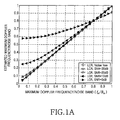
- FIGs. 1A and 1B are graphs illustrating maximum Doppler frequency distortion by additional noise when using the maximum Doppler frequency estimation techniques based on the ZCR, LCR, ACF, and COV.
- FIGs. 1A and 1 B it is to be readily understood that, in all of the maximum Doppler frequency estimation techniques based on the ZCR, LCR, ACF, and COV, estimated maximum Doppler frequencies are seriously distorted in circumstances having low signal to noise ratios, when compared to actual maximum Doppler frequencies.
- Equations (1) through (4) By reconstructing Equations (1) through (4) in consideration of influence by additional noise, Equations (5) through (8) are obtained.
- Z R ⁇ +1 ⁇ +2 B m 2 /3 f m 2 2 f m L
- R ⁇ +1 ⁇ +2 B m 2 /3 f m 2 2 ⁇ f m ⁇ e - ⁇ 2 Cov [ a 2 ( i ) a 2 ( i +1)]
- Var [ a 2 ( i )] ⁇ ⁇ +1 2 J 0 (2 ⁇ f m T S )+ sin c ( B m T S ) ⁇ 2
- Equations (5) through (8) ⁇ is a signal to noise ratio (SNR) and B m is a bandwidth of additional noise. Accordingly, in order to precisely estimate a maximum Doppler frequency in channel circumstances including noise, information for the signal to noise ratio ⁇ is required.
- an adaptive band-limiting task is implemented by limiting the bandwidth B m of additional noise to 3 2 times the maximum Doppler frequency f m , being a bandwidth of a pilot signal passing through a fading channel, thereby preventing distortion that otherwise occurs in the conventional maximum Doppler frequency estimation techniques based on the ZCR, LCR, ACF, and COV.
- FIG. 2 is a block diagram illustrating a velocity estimation apparatus in accordance with an embodiment of the present invention.
- the velocity estimation apparatus includes an RF processing unit 201 for filtering a signal of a specific band among signals received by an antenna (not shown) and down-converting the filtered signal into a baseband signal, a sampling unit 203 for sampling a predetermined section of the baseband signal output from the RF processing unit 201 and outputting a digital signal, a data signal processing unit 205for restoring the digital signal output from the sampling unit 203 into transmission data, a pilot signal detection unit 207 for detecting a pilot signal from the digital signal output from the sampling unit 203, an adaptive type band-limit filter 209 for passing only the pilot signal among signals output by the pilot signal detection unit 207, a maximum Doppler frequency estimation unit 211 for estimating a maximum Doppler frequency using the pilot signal passing through the adaptive type band-limit filter 209, and a velocity information generating unit 213 for converting an estimated value of maximum Doppler frequency output by
- a pass band of the adaptive type band-limit filter 209 is determined by a previous estimation value of maximum Doppler frequency estimated by the maximum Doppler frequency estimation unit 211, and an output of the maximum Doppler frequency estimation unit 211 is provided to the adaptive type band-limit filter 209 through a separate feedback line 212.
- the maximum Doppler frequency estimation unit 211 estimates a maximum Doppler frequency using the aforementioned technique based on the ZCR, LCR, ACF, or COV.
- the estimated maximum Doppler frequency is proportional to a velocity of a moving object, it is possible to obtain the velocity information in a simple manner.
- the pilot signal detected by the pilot signal detection unit 207 is input to the maximum Doppler frequency estimation unit 211 through the adaptive type band-limit filter 209, which is established with the pass band in consideration of the previous estimation value of maximum Doppler frequency estimated by the maximum Doppler frequency estimation unit 211.
- the maximum Doppler frequency estimation unit 211 estimates a maximum Doppler frequency based on the ZCR, LCR, ACF, or COV of a received signal and outputs an estimated value of maximum Doppler frequency.
- the adaptive band-limiting task is implemented by limiting the bandwidth B m of additional noise to 3 2 times the maximum Doppler frequency f m , which is a bandwidth of a pilot signal passing through a fading channel, thereby preventing the distortion that otherwise occurs in the conventional maximum Doppler frequency estimation techniques based on the ZCR, LCR, ACF, and COV.
- An immediately previously estimated value of maximum Doppler frequency is used as an estimated value of maximum Doppler frequency for adaptive type band-limiting. Because a maximum Doppler frequency changes only in conformity with a change in velocity of a moving object, the maximum Doppler frequency changes very slowly. Therefore, by using the previously estimated value of maximum Doppler frequency, the likelihood of an error to be produced can be decreased.
- FIGs. 3A and 3B are graphs illustrating power spectrums of the received pilot signal before and after passing through the adaptive type band-limit filter according to the present invention.
- the pilot signal having passed through the adaptive type band-limit filter 209 is band-limited only at a noise band, and therefore, distortion does not occur in the pilot signal.
- the ZCR and LCR of the received signal can be expressed by Equations (1) and (2), and the ACF and COV of the received signal can be expressed as shown in Equations (9) and (10), respectively.
- Equations (9) and (10) are obtained using an approximate expressions, J 0 ( x ) ⁇ 1- x 2 /4 and sin c ( x ) ⁇ 1-(2 ⁇ x ) 2 /6.
- Equations (1), (2), (9), and (10) because a characteristic of a signal having passed through the adaptive type band-limit filter corresponds to a received signal having no additional noise, even when using the maximum Doppler frequency estimation techniques based on the ZCR, LCR, ACF, and COV, distortion does not occur.
- f m is a maximum Doppler frequency
- f and m ( n ) is an n th estimated maximum Doppler frequency
- ⁇ ( n ) is a ratios of an n th estimated error.
- Equation (12) a relationship between ⁇ ( n ) and ⁇ ( n -1) can be expressed as shown in Equation (12).
- ⁇ (n) ⁇ + ⁇ 2 ( n -1) ⁇ +1
- ⁇ (0) becomes a variable for indicating an error of an initial maximum Doppler frequency estimation value, and has a range of 0 ⁇ ⁇ (0) ⁇ ⁇ .
- Equation (12) 1+ ⁇ 2 (0)-1 ( ⁇ +1) n
- FIGs. 4A through 4D are graphs illustrating results of experiments for comparing performances of the present maximum Doppler frequency estimation technique and the conventional maximum Doppler frequency estimation techniques based on the ZCR, LCR, ACF, and COV.
- a carrier frequency of 2GHz which is used in the WCDMA communication system
- a pilot symbol transmission rate of 1.5 Kbaud which corresponds to a slot transmission rate of the 3GPP standard
- the signal to noise ratio was set to 10dB to consider the influence by noise
- pilot symbols received for 500msec were used to estimate a single maximum Doppler frequency
- an estimated maximum Doppler frequency was updated by a learning rate of 0.3.
- the velocity estimation apparatus and method according to the present invention because the fact that a previously estimated maximum Doppler frequency is used to newly estimate a maximum Doppler frequency, outside information such as an SNR in the conventional art is not needed. As a result, the complexity in constructing the apparatus and implementing the method can be significantly reduced.
- the techniques based on the ZCR, LCR, ACF, and COV, which are used in the conventional maximum Doppler frequency estimation can be utilized in an efficient manner.
Landscapes
- Engineering & Computer Science (AREA)
- Physics & Mathematics (AREA)
- General Physics & Mathematics (AREA)
- Radar, Positioning & Navigation (AREA)
- Remote Sensing (AREA)
- Computer Networks & Wireless Communication (AREA)
- Signal Processing (AREA)
- Cable Transmission Systems, Equalization Of Radio And Reduction Of Echo (AREA)
- Mobile Radio Communication Systems (AREA)
- Monitoring And Testing Of Transmission In General (AREA)
Applications Claiming Priority (2)
| Application Number | Priority Date | Filing Date | Title |
|---|---|---|---|
| KR2004038662 | 2004-05-29 | ||
| KR1020040038662A KR20050113468A (ko) | 2004-05-29 | 2004-05-29 | 속도 추정 장치 및 방법 |
Publications (2)
| Publication Number | Publication Date |
|---|---|
| EP1600792A2 true EP1600792A2 (fr) | 2005-11-30 |
| EP1600792A3 EP1600792A3 (fr) | 2006-12-06 |
Family
ID=34978861
Family Applications (1)
| Application Number | Title | Priority Date | Filing Date |
|---|---|---|---|
| EP05011629A Withdrawn EP1600792A3 (fr) | 2004-05-29 | 2005-05-30 | Dispositif et procédé d'estimation de la vitesse |
Country Status (4)
| Country | Link |
|---|---|
| US (1) | US20050267370A1 (fr) |
| EP (1) | EP1600792A3 (fr) |
| KR (1) | KR20050113468A (fr) |
| CN (1) | CN1702477A (fr) |
Cited By (1)
| Publication number | Priority date | Publication date | Assignee | Title |
|---|---|---|---|---|
| DE112010004329B4 (de) * | 2009-11-09 | 2016-07-07 | Mitsubishi Electric Corporation | Empfangsvorrichtungen und Verfahren |
Families Citing this family (13)
| Publication number | Priority date | Publication date | Assignee | Title |
|---|---|---|---|---|
| KR100842622B1 (ko) | 2004-06-04 | 2008-06-30 | 삼성전자주식회사 | 통신 시스템에서 속도 추정 장치 및 방법 |
| GB0525126D0 (en) * | 2005-12-09 | 2006-01-18 | Uni I Oslo | Improvements in data communications |
| US9239376B2 (en) * | 2010-10-08 | 2016-01-19 | Telecommunication Systems, Inc. | Doppler aided inertial navigation |
| US9097783B2 (en) | 2006-04-28 | 2015-08-04 | Telecommunication Systems, Inc. | System and method for positioning using hybrid spectral compression and cross correlation signal processing |
| WO2009038509A1 (fr) * | 2007-09-20 | 2009-03-26 | Telefonaktiebolaget Lm Ericsson (Publ) | Sélection de schéma mimo basée sur la vitesse d'un terminal utilisateur |
| KR101027650B1 (ko) * | 2010-02-16 | 2011-04-12 | 충북대학교 산학협력단 | 코드북을 이용한 빔포밍 시스템에서 최대 도플러 주파수 추정방법 |
| US9900185B2 (en) * | 2012-09-13 | 2018-02-20 | Nvidia Corporation | Doppler spread and SNR estimation for a wireless communications receiver |
| RU2015122137A (ru) * | 2012-11-10 | 2017-01-10 | Кинг Абдалла Юниверсити Оф Сайенс Энд Текнолоджи | Улучшенная схема оценки канала |
| CN106707268A (zh) * | 2015-11-13 | 2017-05-24 | 中兴通讯股份有限公司 | 一种无线通信系统中用户终端速度估计的方法和装置 |
| JP6239670B2 (ja) * | 2016-03-24 | 2017-11-29 | ソフトバンク株式会社 | ドップラースペクトルを用いた端末の移動速度推定方法 |
| JP6239671B2 (ja) * | 2016-03-24 | 2017-11-29 | ソフトバンク株式会社 | ドップラースペクトルを用いた端末速度推定方法 |
| CN108549086B (zh) * | 2018-03-20 | 2022-04-12 | 天津大学 | 激光多普勒信号滤波带自适应选择及测试方法 |
| KR102628655B1 (ko) * | 2018-06-29 | 2024-01-24 | 삼성전자주식회사 | 레이더 구동 장치 및 방법 |
Family Cites Families (1)
| Publication number | Priority date | Publication date | Assignee | Title |
|---|---|---|---|---|
| US7116957B2 (en) * | 2001-10-22 | 2006-10-03 | Qualcomm Incorporated | Velocity responsive filtering for pilot signal reception |
-
2004
- 2004-05-29 KR KR1020040038662A patent/KR20050113468A/ko not_active Ceased
-
2005
- 2005-05-30 CN CN200510079258.6A patent/CN1702477A/zh active Pending
- 2005-05-30 EP EP05011629A patent/EP1600792A3/fr not_active Withdrawn
- 2005-05-31 US US11/141,178 patent/US20050267370A1/en not_active Abandoned
Cited By (1)
| Publication number | Priority date | Publication date | Assignee | Title |
|---|---|---|---|---|
| DE112010004329B4 (de) * | 2009-11-09 | 2016-07-07 | Mitsubishi Electric Corporation | Empfangsvorrichtungen und Verfahren |
Also Published As
| Publication number | Publication date |
|---|---|
| CN1702477A (zh) | 2005-11-30 |
| KR20050113468A (ko) | 2005-12-02 |
| US20050267370A1 (en) | 2005-12-01 |
| EP1600792A3 (fr) | 2006-12-06 |
Similar Documents
| Publication | Publication Date | Title |
|---|---|---|
| Chuang | The effects of time delay spread on portable radio communications channels with digital modulation | |
| US7218934B2 (en) | Mobile station speed estimation | |
| EP2011241B1 (fr) | Suppression d'interférence de canal adjacent | |
| US20050267370A1 (en) | Velocity estimation apparatus and method | |
| US20030133496A1 (en) | Orthogonal chirp modulation in multipath environments | |
| CN101026381A (zh) | 用于消除无线通信系统中的信道干扰的方法和设备 | |
| US7573964B2 (en) | Channel estimator with extended channel bandwidth | |
| CN101252764A (zh) | 无线终端速度估计的方法及装置 | |
| US5799242A (en) | Communication control unit for mobile communication systems and the like, including a channel quality detection unit, a quality decision unit and a control unit | |
| US7570666B2 (en) | Method and apparatus for guard interval detection in multi-carrier receiver | |
| US20030236072A1 (en) | Method and apparatus for estimating a channel based on channel statistics | |
| EP1603360A1 (fr) | Dispositif d' estimation de vitesse dans des environnements de communication mobile | |
| US8194807B2 (en) | Method to discriminate a real echo peak from an aliased echo peak | |
| US6563892B1 (en) | Method and system for detection of binary information in the presence of slowly varying disturbances | |
| US8743910B2 (en) | Method and apparatus for selecting a channel filter for a communication system | |
| US6690713B1 (en) | Tracking loop for a code division multiple access (CDMA) system | |
| CN118523797A (zh) | 一种散射通信中的数据帧探测及增益调整联合装置 | |
| US7489734B2 (en) | Equalization in radio receiver | |
| WO2007003715A1 (fr) | Procede de detection de vitesse dans un systeme de communication, recepteur, element de reseau et processeur | |
| US8442165B2 (en) | Method and apparatus for estimating Doppler frequency in a mobile terminal | |
| CN100373801C (zh) | 一种多普勒极限频率的估算方法 | |
| US8842791B2 (en) | Synchronization of a receiver to a desired signal | |
| JP2001285237A (ja) | Ofdm信号送受信装置 | |
| Petrovic et al. | Reduction of multipath effects for FSK with frequency-discriminator detection | |
| Chu et al. | Robust packet detector based automatic gain control algorithm for OFDM-based ultra-wideband systems |
Legal Events
| Date | Code | Title | Description |
|---|---|---|---|
| PUAI | Public reference made under article 153(3) epc to a published international application that has entered the european phase |
Free format text: ORIGINAL CODE: 0009012 |
|
| 17P | Request for examination filed |
Effective date: 20050530 |
|
| AK | Designated contracting states |
Kind code of ref document: A2 Designated state(s): AT BE BG CH CY CZ DE DK EE ES FI FR GB GR HU IE IS IT LI LT LU MC NL PL PT RO SE SI SK TR |
|
| AX | Request for extension of the european patent |
Extension state: AL BA HR LV MK YU |
|
| PUAL | Search report despatched |
Free format text: ORIGINAL CODE: 0009013 |
|
| AK | Designated contracting states |
Kind code of ref document: A3 Designated state(s): AT BE BG CH CY CZ DE DK EE ES FI FR GB GR HU IE IS IT LI LT LU MC NL PL PT RO SE SI SK TR |
|
| AX | Request for extension of the european patent |
Extension state: AL BA HR LV MK YU |
|
| 17Q | First examination report despatched |
Effective date: 20070119 |
|
| AKX | Designation fees paid |
Designated state(s): DE FI FR GB IT SE |
|
| STAA | Information on the status of an ep patent application or granted ep patent |
Free format text: STATUS: THE APPLICATION IS DEEMED TO BE WITHDRAWN |
|
| 18D | Application deemed to be withdrawn |
Effective date: 20090825 |