EP1600964A2 - Protection contre la copie des disques optiques - Google Patents
Protection contre la copie des disques optiques Download PDFInfo
- Publication number
- EP1600964A2 EP1600964A2 EP05253063A EP05253063A EP1600964A2 EP 1600964 A2 EP1600964 A2 EP 1600964A2 EP 05253063 A EP05253063 A EP 05253063A EP 05253063 A EP05253063 A EP 05253063A EP 1600964 A2 EP1600964 A2 EP 1600964A2
- Authority
- EP
- European Patent Office
- Prior art keywords
- sequence
- code words
- dsv
- subversive
- code
- Prior art date
- Legal status (The legal status is an assumption and is not a legal conclusion. Google has not performed a legal analysis and makes no representation as to the accuracy of the status listed.)
- Withdrawn
Links
- 230000003287 optical effect Effects 0.000 title claims abstract description 28
- 238000000034 method Methods 0.000 claims description 44
- 230000007704 transition Effects 0.000 claims description 16
- 238000010348 incorporation Methods 0.000 claims description 8
- 238000006243 chemical reaction Methods 0.000 description 8
- 238000006467 substitution reaction Methods 0.000 description 3
- 230000001939 inductive effect Effects 0.000 description 1
- 238000003780 insertion Methods 0.000 description 1
- 230000037431 insertion Effects 0.000 description 1
Images



Classifications
-
- G—PHYSICS
- G11—INFORMATION STORAGE
- G11B—INFORMATION STORAGE BASED ON RELATIVE MOVEMENT BETWEEN RECORD CARRIER AND TRANSDUCER
- G11B20/00—Signal processing not specific to the method of recording or reproducing; Circuits therefor
- G11B20/00086—Circuits for prevention of unauthorised reproduction or copying, e.g. piracy
- G11B20/00572—Circuits for prevention of unauthorised reproduction or copying, e.g. piracy involving measures which change the format of the recording medium
- G11B20/00579—Circuits for prevention of unauthorised reproduction or copying, e.g. piracy involving measures which change the format of the recording medium said format change concerning the data encoding, e.g., modulation schemes violating run-length constraints, causing excessive DC content, or involving uncommon codewords or sync patterns
-
- G—PHYSICS
- G11—INFORMATION STORAGE
- G11B—INFORMATION STORAGE BASED ON RELATIVE MOVEMENT BETWEEN RECORD CARRIER AND TRANSDUCER
- G11B20/00—Signal processing not specific to the method of recording or reproducing; Circuits therefor
- G11B20/10—Digital recording or reproducing
-
- G—PHYSICS
- G11—INFORMATION STORAGE
- G11B—INFORMATION STORAGE BASED ON RELATIVE MOVEMENT BETWEEN RECORD CARRIER AND TRANSDUCER
- G11B20/00—Signal processing not specific to the method of recording or reproducing; Circuits therefor
- G11B20/00086—Circuits for prevention of unauthorised reproduction or copying, e.g. piracy
-
- G—PHYSICS
- G11—INFORMATION STORAGE
- G11B—INFORMATION STORAGE BASED ON RELATIVE MOVEMENT BETWEEN RECORD CARRIER AND TRANSDUCER
- G11B20/00—Signal processing not specific to the method of recording or reproducing; Circuits therefor
- G11B20/10—Digital recording or reproducing
- G11B20/14—Digital recording or reproducing using self-clocking codes
- G11B20/1403—Digital recording or reproducing using self-clocking codes characterised by the use of two levels
- G11B20/1423—Code representation depending on subsequent bits, e.g. delay modulation, double density code, Miller code
- G11B20/1426—Code representation depending on subsequent bits, e.g. delay modulation, double density code, Miller code conversion to or from block codes or representations thereof
-
- G—PHYSICS
- G11—INFORMATION STORAGE
- G11B—INFORMATION STORAGE BASED ON RELATIVE MOVEMENT BETWEEN RECORD CARRIER AND TRANSDUCER
- G11B20/00—Signal processing not specific to the method of recording or reproducing; Circuits therefor
- G11B20/10—Digital recording or reproducing
- G11B20/14—Digital recording or reproducing using self-clocking codes
- G11B20/1403—Digital recording or reproducing using self-clocking codes characterised by the use of two levels
- G11B20/1423—Code representation depending on subsequent bits, e.g. delay modulation, double density code, Miller code
- G11B20/1426—Code representation depending on subsequent bits, e.g. delay modulation, double density code, Miller code conversion to or from block codes or representations thereof
- G11B2020/1457—Code representation depending on subsequent bits, e.g. delay modulation, double density code, Miller code conversion to or from block codes or representations thereof wherein DC control is performed by calculating a digital sum value [DSV]
-
- G—PHYSICS
- G11—INFORMATION STORAGE
- G11B—INFORMATION STORAGE BASED ON RELATIVE MOVEMENT BETWEEN RECORD CARRIER AND TRANSDUCER
- G11B20/00—Signal processing not specific to the method of recording or reproducing; Circuits therefor
- G11B20/10—Digital recording or reproducing
- G11B20/14—Digital recording or reproducing using self-clocking codes
- G11B20/1403—Digital recording or reproducing using self-clocking codes characterised by the use of two levels
- G11B20/1423—Code representation depending on subsequent bits, e.g. delay modulation, double density code, Miller code
- G11B20/1426—Code representation depending on subsequent bits, e.g. delay modulation, double density code, Miller code conversion to or from block codes or representations thereof
- G11B2020/1465—8 to 16 modulation, e.g. the EFM+ code used on DVDs
Definitions
- the present invention relates to a method of copy protecting an optical disc and to a copy protected optical disc.
- the application relates to a method for encoding user data and a method for selecting data symbols for incorporation within user data.
- Optical discs such as the various formats of compact discs (CDs) and of digital versatile discs (DVDs) are increasingly used for carrying information for many different applications.
- the information encoded onto the optical disc is generally very valuable and, accordingly, they are increasingly copied by counterfeiters.
- recordable CDs and CD writers for writing the information content from one disc to such recordable discs are readily available to the domestic consumer. Recordable DVDs and DVD writers have become as readily available. This means that new and effective methods for copy protecting optical discs are required.
- the present invention seeks to provide a method of copy protecting an optical disc by impressing subversive data with poor DSV characteristics thereon.
- a method of copy protecting an optical disc on which user data is encoded utilising a multimodal code, and the method comprising incorporating selected data symbols within the user data to be encoded onto the disc to ensure that at least one subversive sequence of code words having a large absolute value of DSV is encoded onto the disc.
- the or each subversive sequence of code words has a large absolute value of DSV.
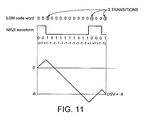
- sequences of data symbols forcing subversive sequences of code words that have an even number of transitions are provided.
- subversive sequences of data symbols that when encoded in a certain state S will force an encoder to output S as the next state for that sequence are provided.
- each code word in the or each subversive sequence is the only code word, without alternative, for the corresponding selected data symbol incorporated in the user data.
- some of the code words in the or each subversive sequence are one of two or more alternatives for the corresponding selected data symbol incorporated in the user data, but each of the two alternatives is equivalent.
- some of the code words in the or each subversive sequence are one of two or more alternatives for the corresponding selected data symbol incorporated in the user data, but all alternatives except one are ruled out by RLL rules.
- the subversive sequences of code words may be used to provide an authenticating signature.
- the subversive sequences of code words may be used to give unbalanced dc content to selected areas of encoded data on the disc.
- the or each subversive sequence of code words has a DSV with a rapid rate of change.
- a copy protected optical disc on which user data is encoded utilising a multimodal code, wherein at least one subversive sequence of code words having a large absolute value of DSV is encoded onto the disc, the or each subversive sequence of code words having been obtained from selected data symbols incorporated within the user data.
- the or each subversive sequence of code words has a large absolute value of DSV.
- the or each subversive sequence of code words has even transitions.
- subversive sequences of data symbols that when encoded in a certain state S will force an encoder to output S as the next state for that sequence are provided.
- each code word in the or each subversive sequence is the only code word, without alternative, for the corresponding selected data symbol incorporated in the in user data.
- some of the code words in the or each subversive sequence are one of two or more alternatives for the corresponding selected data symbol incorporated in the user data, but each of the alternatives is equivalent.
- some of the code words in the or each subversive sequence are one of two or more alternatives for the corresponding selected data symbol incorporated in the user data, but all the alternatives except one are ruled out by RLL rules.
- the or each subversive sequence of code words may be used to provide an authenticating signature.
- the or each subversive sequence of code words is used to give unbalanced dc content to selected areas of encoded data on the disc.
- the or each subversive sequence of code words has a DSV with a rapid rate of change.
- the present invention also extends to a method for encoding user data, utilising a multimodal code, the method comprising incorporating selected data symbols into the user data, the data symbols having been selected to force the encoder to produce at least one subversive sequence of code words having a large absolute DSV value.
- the or each subversive sequence of code words has a large absolute value of DSV.
- the or each subversive sequence of code words has even transitions.
- subversive sequences of data symbols that when encoded in a certain state S will force an encoder to output S as the next state for that sequence are provided.
- each code word in the or each subversive sequence is the only code word, without alternative, for the corresponding selected data symbol incorporated in the user data.
- some of the code words in the or each subversive sequence are one of two or more alternatives for the corresponding selected data symbol incorporated in the user data, but each of the two alternatives is equivalent.
- some of the code words in the or each subversive sequence are one of two or more alternatives for the corresponding selected data symbol incorporated in the user data, but all the alternatives except one are ruled out by RLL rules.
- each selected data symbol has been identified as a data symbol which has a code word with a large absolute value of DSV where either there is no alternative code word or all possible alternatives have large absolute values of DSV.
- the selected data symbols are identified by looking at the sequence of code words for an input sequence of data symbols, and establishing: if the sequence of code words has even transitions; if the sequence of code words has the next state the same as the initial state; if there are no alternative sequences of code words or all alternative sequences of code words are equivalent, or one of two or more alternative sequences violates the RLL rules; and if the sequence of code words has a large absolute value of DSV; and the data symbols are selected for incorporation within the user data where all the conditions are met.
- the present invention also extends to a method of selecting data symbols for incorporation within user data to be encoded using a multimodal code, the selected data symbols being selected so that they are capable of forcing an encoder to produce at least one subversive sequence of code words, the method comprising looking at a possible code word for a data symbol and selecting that data symbol if its code word has a large absolute value of DSV and there are no alternative code words, or all alternative code words are equivalent, or one of two alternative sequences violates the RLL rules.
- a method of selecting data symbols for incorporation within user data to be encoded using a multimodal code comprising looking at the sequence of code words for a sequence of two or more data symbols, and selecting that sequence of two or more data symbols if the sequence of code words has a large absolute value of DSV and there is not an alternative sequence of code words, or all alternative sequences are equivalent, or one of two alternative sequences violates the RLL rules.
- the method further comprises selecting the sequence of data symbols where the sequence of code words has even transitions.
- the method may further comprise selecting the sequence of data symbols where the sequence of code words has its next state the same as its initial state.
- Multimodal codes are Run Length Limitation (RLL) codes based on a state machine where the optimum symbol choice depends not only on the encoder state and the data to be encoded but also on some non-local characteristics such as the DSV.
- RLL Run Length Limitation
- EFM Eight-to-Sixteen Modulation
- RLL code based on a state machine
- code is an RLL(k,d) code if k and d are the minimum and maximum number respectively of consecutive zeroes allowed in an encoded sequence.
- the code word C(i) is said to be in state S(i).
- the state of a code word C can be essentially defined by its RLL characteristics. More precisely, it can be defined according to the class of code words that C can follow without violating the RLL rule. For example, consider the class of code words with no trailing zeroes. The state S 1 can then be defined as the state in which all the code words with at least k leading zeroes are. Given this definition for state S 1 , a code word with no trailing zeroes can be followed by any code word in state S 1 . Hence, state S 1 can be set as the next state for all the code words with no trailing zeroes.
- state S 2 is the state in which all the code words with no leading zeroes are, so that state S 2 can be set as the next state for all the code words with d trailing zeroes.
- Figure 3 shows some examples for ESM, which is an RLL(2,10)-code.
- State 1 is defined to be the class where all the code words have at least two leading zeroes. Therefore the next state for the code word 0010000000001001 is set to be State 1.
- State 4 is defined to be the class where all the code words have at most one leading zero. Since in ESM there are no code words having more than 9 trailing zeroes, any ESM code word with more than 2 trailing zeroes can be followed by a code word in State 4 and hence can have the next state set to State 4.
- a multimodal code provides options in the way an input data symbol 40 can be encoded, as shown in Figure 4 where two alternatives 42 and 44 are provided. For each input sequence of data symbols, there is typically a number of different possible output sequences of code words. An encoder will select one output sequence among all the possible choices according to some non-local characteristics of the encoded sequence, such as DSV.
- Figure 5 shows that an input sequence of data symbols ⁇ D(i-1), D(i) ⁇ has two possible output sequences; the sequence ⁇ C(i-1), C(i) ⁇ corresponding to path A 50 and the sequence ⁇ C(i-1), C'(i) ⁇ corresponding to path B 52.
- an encoder can choose between two alternative outputs for the input sequence ⁇ D(i-1), D(i) ⁇ . If the encoder is designed to minimize the absolute value for the DSV (
- the ESM is a 4-state multimodal code that converts 8-bit input data symbols into 16-channel bit code words. This conversion is performed according to two look-up conversion tables, the Main Table and the Substitution Table. For each state and for each input data symbol, the Main Table contains the list of the corresponding ESM code words.
- the Substitution Table contains alternative encoding for the data symbols included in the range 0, ..., 87. Hence, given a data symbol D(i) in the range 0, ..., 87 and a state S(i), there exists two alternative outputs C(i), S(i+1) and C'(i), S'(i+1), one from the Main Table, the other from the Substitution Table.
- data symbols 88, ..., 255 that are to be encoded either in State 1 or in State 4 there can be also alternative outputs: data symbols 88, ..., 255 to be encoded in State 1 can also be encoded in State 4, provided that the RLL rules are satisfied and, similarly, data symbols 88, ..., 255 to be encoded in State 4 might as well be encoded in State 1. No alternative encoding exists for data symbols in the range 88, ..., 255 to be encoded either in State 2 or in State 3. The available outputs for the data symbols are shown in Figure 6.
- a sequence of code words is a subversive sequence if it is capable of inducing uncorrectable read errors when read from an optical disc.
- a sequence of input data symbols is a subversive sequence if the encoder will be forced to output a subversive sequence of code words when presented with that input sequence of data symbols.
- SDSV subversive DSV
- SDSV sequences of input data symbols are extremely valuable for copy protection techniques based on subversive data, because they allow the creation of unreadable data on the disc by working exclusively at the user data 2 level rather than at the physical sector 4 level and hence prior to writing the user data on DLT tapes.
- the data levels when applying user data to an optical disc, for example, a DVD, are shown in Figure 8.
- the insertion of SDSV sequences of data symbols in the user data 2 will force a given encoder for the EFM Plus Modulation to output physical sectors 4 containing SDSV sequences of code words.
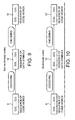
- FIG. 9 shows the non-multimodal codes case: a sequence of code words 8 is decoded into a sequence of data symbols 10; the sequence of data symbols is then encoded to give the output sequence of code words 12 which is equal to the sequence of code words 8.
- Figure 10 shows a similar process but in the case of multimodal codes: in this case the output encoded sequence of code words 12' is not necessarily equal to the sequence of code words 12.
- the sequence of data symbols 10 decoded from that SDSV sequence of code words will also have alternative non-SDSV encoded sequences of code words that the conversion algorithm will prefer to the SDSV one.
- an intelligent encoder will output a non-SDSV sequence of code words 12' rather than the SDSV sequence 8.
- a method capable of determining forced subversive sequences that is, sequences of data symbols capable of forcing an encoder to output subversive sequences of code words.
- SDSV patterns for ESM Modulation that is, sequences ⁇ D 0 , ... , D r ⁇ of data symbols (plus an initial state) such that the corresponding encoded sequence ⁇ C 0 , ..., C r ⁇ of code words has "large”
- a sequence ⁇ D 0 , ... , D r ⁇ of data symbols with initial state S 0 is a SDSV pattern if when repeated, say, t times will force a given encoder to output the sequence of code words whose
- the method is described with particular reference to ESM. However, the method outlined can be used with multimodal RLL codes other than ESM.
- the method will provide a list of patterns of data symbols forcing large
- a sequence ⁇ D 0 , ... , D r ⁇ of data symbols with a given initial state S 0 is a SDSV pattern if the corresponding encoded sequence ⁇ C 0 , ..., C r ⁇ of code words satisfies the following conditions:
- m 0 be the maximum
- M depends on how strong the required SDSV sequences must be.
- C 0 be a code word such that
- m 0 - 2i.
- the pattern (D -2 , D -1 , D 0 ) can be repeated "effectively" (from a
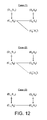
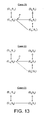
- per symbol ⁇ A 0 , A 1 ⁇ S 0 +8 4 ⁇ B 0 , B 1 ⁇ R 0 -8 4 ⁇ C 0 , C 1 , C 2 ⁇ S 0 +12 4 ⁇ D 0 , D 1 , D 2 ⁇ R 0 -12 4 ... ... ... ... ...
Landscapes
- Engineering & Computer Science (AREA)
- Signal Processing (AREA)
- Computer Security & Cryptography (AREA)
- Signal Processing For Digital Recording And Reproducing (AREA)
- Optical Recording Or Reproduction (AREA)
Applications Claiming Priority (2)
| Application Number | Priority Date | Filing Date | Title |
|---|---|---|---|
| GB0411163A GB2414337B (en) | 2004-05-19 | 2004-05-19 | The copy protection of optical discs |
| GB0411163 | 2004-05-19 |
Publications (2)
| Publication Number | Publication Date |
|---|---|
| EP1600964A2 true EP1600964A2 (fr) | 2005-11-30 |
| EP1600964A3 EP1600964A3 (fr) | 2009-11-04 |
Family
ID=32607579
Family Applications (1)
| Application Number | Title | Priority Date | Filing Date |
|---|---|---|---|
| EP05253063A Withdrawn EP1600964A3 (fr) | 2004-05-19 | 2005-05-18 | Protection contre la copie des disques optiques |
Country Status (9)
| Country | Link |
|---|---|
| US (1) | US7788504B2 (fr) |
| EP (1) | EP1600964A3 (fr) |
| JP (1) | JP4964429B2 (fr) |
| KR (1) | KR100687381B1 (fr) |
| CN (1) | CN1700334A (fr) |
| AU (1) | AU2005201723B2 (fr) |
| CA (1) | CA2505505C (fr) |
| GB (1) | GB2414337B (fr) |
| NZ (1) | NZ539686A (fr) |
Cited By (2)
| Publication number | Priority date | Publication date | Assignee | Title |
|---|---|---|---|---|
| EP2031592A1 (fr) * | 2007-08-30 | 2009-03-04 | DTR Limited | Procédé et système pour DVD enregistrables |
| US7928865B2 (en) | 2006-06-12 | 2011-04-19 | Thomson Licensing | Method and apparatus for embedding second code into optical disc data by data modulation rule variation |
Families Citing this family (2)
| Publication number | Priority date | Publication date | Assignee | Title |
|---|---|---|---|---|
| GB0301700D0 (en) * | 2003-01-24 | 2003-02-26 | Macrovision Corp | The copy protection of optical discs |
| KR101781416B1 (ko) * | 2010-06-22 | 2017-09-25 | 아브 이니티오 테크놀로지 엘엘시 | 관련 데이터세트의 처리 |
Family Cites Families (45)
| Publication number | Priority date | Publication date | Assignee | Title |
|---|---|---|---|---|
| NL8303859A (nl) | 1983-11-10 | 1985-06-03 | Philips Nv | Selektief scramblen bij compact disc. |
| JP2974678B2 (ja) * | 1988-06-23 | 1999-11-10 | ソニー株式会社 | データ誤り検出方式 |
| BR9506787A (pt) * | 1994-02-15 | 1997-09-16 | Philips Electronics Nv | Processos de converter uma série de palavras de informação de m-bit em um sinal modulado e de produzir um suporte de gravação dispositivos codificador decodificador gravador e de leitura sinal e suporte de gravação |
| US5659613A (en) | 1994-06-29 | 1997-08-19 | Macrovision Corporation | Method and apparatus for copy protection for various recording media using a video finger print |
| US5832088A (en) | 1994-08-08 | 1998-11-03 | Sony Corporation | Method and apparatus for preventing data copying from a disk using data lengths too large for a pirate medium |
| CA2165532C (fr) | 1995-01-23 | 2005-10-04 | Michael L. Mitchell | Systeme pour coder une copie maitresse de verre pour la detection de contrefacons de cd-rom |
| JP3457093B2 (ja) * | 1995-04-14 | 2003-10-14 | 松下電器産業株式会社 | 記録媒体並びにデジタル変復調方法およびその装置 |
| KR0165441B1 (ko) | 1995-09-18 | 1999-03-20 | 김광호 | 디지털 데이터 채널 부호화 및 복호화방법과 그 장치 |
| US5699434A (en) | 1995-12-12 | 1997-12-16 | Hewlett-Packard Company | Method of inhibiting copying of digital data |
| US6028936A (en) | 1996-01-16 | 2000-02-22 | Disney Enterprises, Inc. | Method and apparatus for authenticating recorded media |
| SE514352C2 (sv) | 1996-07-05 | 2001-02-12 | Ifunga Test Equipment Bv | Sätt att förse en optisk databärare med identitetsinformation |
| DE19628005B4 (de) | 1996-07-11 | 2004-04-29 | Sonopress Produktionsgesellschaft für Ton- und Informationsträger mbH | System und Verfahren zur Bereitstellung von Daten für einen Laser-Beam-Recorder |
| JPH10106146A (ja) | 1996-09-25 | 1998-04-24 | Victor Co Of Japan Ltd | ディスクの記録再生方法及び再生装置 |
| US5787068A (en) | 1996-11-07 | 1998-07-28 | Imation Corp. | Method and arrangement for preventing unauthorized duplication of optical discs using barriers |
| EP0854482B1 (fr) | 1997-01-16 | 2004-03-31 | SGS-THOMSON MICROELECTRONICS S.r.l. | Système et méthode de décodage des signaux modulés à EFM ou EFM-plus dans une unité de lecture de disques optiques (CD et DVD) |
| CN1516155A (zh) | 1997-05-30 | 2004-07-28 | ���ŷ� | 防止记录介质被复制的方法、防复制记录介质以及检测存取控制信息的装置 |
| WO1998057413A1 (fr) | 1997-06-12 | 1998-12-17 | Auckland Uniservices Limited | Transmission de signal sans fil dans des systemes de transfert de puissance par induction |
| US6016111A (en) * | 1997-07-31 | 2000-01-18 | Samsung Electronics Co., Ltd. | Digital data coding/decoding method and apparatus |
| EP0918326B1 (fr) * | 1997-10-21 | 2001-09-19 | Hewlett-Packard Company, A Delaware Corporation | Méthode pour inhiber la copie de données numériques |
| US6317397B1 (en) * | 1997-11-17 | 2001-11-13 | Matsushita Electric Industrial Co., Ltd. | Data recording medium, data recording apparatus, data reproducing apparatus and method |
| KR100403270B1 (ko) | 1997-12-29 | 2004-03-20 | 삼성전자주식회사 | 디지털기록매체의저작권을보호하는방법및장치,그리고,그디지털기록매체 |
| US6076165A (en) | 1998-01-16 | 2000-06-13 | Sony Corporation | Method for authenticating digital recording devices |
| EP0984346A1 (fr) | 1998-09-02 | 2000-03-08 | Hitachi Europe Limited | Méthode et dispositif de protection contre la copie |
| US6665240B1 (en) | 1998-10-07 | 2003-12-16 | Sony Corporation | Apparatus and method for manufacturing optical disks, apparatus and method for recording data on optical disks, apparatus and method for reproducing data from optical disks, and optical disk |
| EP1011103A1 (fr) | 1998-12-08 | 2000-06-21 | Metatec International B.V. | Protection contre la copie de CD-ROM |
| US6966002B1 (en) | 1999-04-30 | 2005-11-15 | Trymedia Systems, Inc. | Methods and apparatus for secure distribution of software |
| GB9912312D0 (en) | 1999-05-26 | 1999-07-28 | Dilla Limited C | The copy protection of digital audio compact discs |
| GB0003531D0 (en) | 2000-02-15 | 2000-04-05 | Dilla Limited C | The copy protection of digital audio compact discs |
| RU2280906C2 (ru) * | 2000-07-28 | 2006-07-27 | Макровижн Юроп Лимитед | Защита от копирования для оптических дисков |
| JP2002175662A (ja) | 2000-12-06 | 2002-06-21 | Toshiba Emi Ltd | 光ディスク |
| GB0304015D0 (en) * | 2003-02-21 | 2003-03-26 | Macrovision Europ Ltd | Copy protection for applications |
| JP3916055B2 (ja) * | 2002-03-28 | 2007-05-16 | 日本ビクター株式会社 | 変調方法、変調装置、記録媒体、復調方法および復調装置 |
| JP3971635B2 (ja) | 2002-04-08 | 2007-09-05 | 株式会社ソニー・ディスクアンドデジタルソリューションズ | データ記録媒体、データ記録方法および装置 |
| DE60236405D1 (de) | 2002-04-17 | 2010-07-01 | Sony Dadc Austria Ag | Kopierschutzsystem für optische Platten |
| JP3863059B2 (ja) | 2002-05-02 | 2006-12-27 | ソニー株式会社 | デジタルデータの記録媒体、記録方法、記録装置、再生方法、再生装置、送信方法および送信装置 |
| JP2003323761A (ja) | 2002-05-02 | 2003-11-14 | Sony Corp | デジタルデータの記録媒体、記録方法、記録装置、再生方法、再生装置、送信方法および送信装置 |
| JP4143330B2 (ja) | 2002-05-14 | 2008-09-03 | ソニー株式会社 | データ記録媒体、データ記録方法及び装置 |
| JP2003346431A (ja) * | 2002-05-29 | 2003-12-05 | Sony Corp | データ記録媒体、データ記録方法および装置 |
| TW594700B (en) * | 2002-06-07 | 2004-06-21 | Mediatek Inc | Method for performing DSV protection on EFM/EFM+ encoding system and its device |
| JP3671940B2 (ja) * | 2002-07-05 | 2005-07-13 | ソニー株式会社 | データ記録媒体、データ記録方法および装置 |
| US7212483B2 (en) * | 2002-09-25 | 2007-05-01 | Victor Company Of Japan, Limited | Modulation device, modulation method and recording medium |
| GB0301700D0 (en) | 2003-01-24 | 2003-02-26 | Macrovision Corp | The copy protection of optical discs |
| JP2004296049A (ja) * | 2003-02-10 | 2004-10-21 | Sony Corp | データ記録方法および装置、データ記録媒体並びにデータ再生方法および装置 |
| GB0304016D0 (en) | 2003-02-21 | 2003-03-26 | Macrovision Europ Ltd | The transmission of information |
| US20050015616A1 (en) * | 2003-07-16 | 2005-01-20 | Hogan Josh N. | Copy protected mastering system |
-
2004
- 2004-05-19 GB GB0411163A patent/GB2414337B/en not_active Expired - Fee Related
-
2005
- 2005-04-26 AU AU2005201723A patent/AU2005201723B2/en not_active Ceased
- 2005-04-27 CA CA2505505A patent/CA2505505C/fr not_active Expired - Fee Related
- 2005-04-28 NZ NZ539686A patent/NZ539686A/en not_active IP Right Cessation
- 2005-05-18 KR KR1020050041502A patent/KR100687381B1/ko not_active Expired - Fee Related
- 2005-05-18 EP EP05253063A patent/EP1600964A3/fr not_active Withdrawn
- 2005-05-18 JP JP2005146089A patent/JP4964429B2/ja not_active Expired - Fee Related
- 2005-05-19 US US11/132,896 patent/US7788504B2/en active Active
- 2005-05-19 CN CNA2005100739777A patent/CN1700334A/zh active Pending
Non-Patent Citations (1)
| Title |
|---|
| None |
Cited By (2)
| Publication number | Priority date | Publication date | Assignee | Title |
|---|---|---|---|---|
| US7928865B2 (en) | 2006-06-12 | 2011-04-19 | Thomson Licensing | Method and apparatus for embedding second code into optical disc data by data modulation rule variation |
| EP2031592A1 (fr) * | 2007-08-30 | 2009-03-04 | DTR Limited | Procédé et système pour DVD enregistrables |
Also Published As
| Publication number | Publication date |
|---|---|
| CN1700334A (zh) | 2005-11-23 |
| GB2414337B (en) | 2008-10-29 |
| US7788504B2 (en) | 2010-08-31 |
| JP2005332567A (ja) | 2005-12-02 |
| GB2414337A (en) | 2005-11-23 |
| KR20060047992A (ko) | 2006-05-18 |
| US20050270190A1 (en) | 2005-12-08 |
| GB0411163D0 (en) | 2004-06-23 |
| AU2005201723A1 (en) | 2005-12-08 |
| KR100687381B1 (ko) | 2007-02-26 |
| CA2505505C (fr) | 2010-11-09 |
| JP4964429B2 (ja) | 2012-06-27 |
| AU2005201723B2 (en) | 2007-08-02 |
| CA2505505A1 (fr) | 2005-11-19 |
| NZ539686A (en) | 2006-10-27 |
| EP1600964A3 (fr) | 2009-11-04 |
Similar Documents
| Publication | Publication Date | Title |
|---|---|---|
| US7464411B2 (en) | Copy protection for optical discs | |
| US8260115B2 (en) | Method and product for copy protection of optical discs using unbalanced DC content | |
| AU2001275709A1 (en) | Copy protection for optical discs | |
| JP5011116B2 (ja) | 変調の制約及び誤り制御を用いて情報の符号化及び復号化を実行する方法及びシステム | |
| US6604219B1 (en) | DC control of a multilevel signal | |
| EP1600964A2 (fr) | Protection contre la copie des disques optiques | |
| JP3717024B2 (ja) | 復調装置および方法 | |
| US20040169595A1 (en) | Method for encoding a stream of bits of a binary source signal into a stream of bits of a binary channel signal | |
| US20090195421A1 (en) | Method and apparatus for controlling digital sum value and recording medium for executing the method | |
| US20060136729A1 (en) | Copy protection for optical discs | |
| JP3953007B2 (ja) | 情報記録処理装置、情報再生処理装置、情報記録媒体、および方法、並びにコンピュータ・プログラム | |
| JP4207073B2 (ja) | 変調装置および方法、記録媒体、並びに復調装置および方法 | |
| JP4140485B2 (ja) | 情報記録処理装置、情報再生処理装置、情報記録媒体、および方法、並びにコンピュータ・プログラム | |
| JP4983032B2 (ja) | 復調テーブル、復調装置および方法、プログラム、並びに記録媒体 | |
| JP3941764B2 (ja) | 情報記録処理装置、情報再生処理装置、情報記録媒体、および方法、並びにコンピュータ・プログラム | |
| KR20030087748A (ko) | Rll(3,7) 부호화 방법 및 그 장치 |
Legal Events
| Date | Code | Title | Description |
|---|---|---|---|
| PUAI | Public reference made under article 153(3) epc to a published international application that has entered the european phase |
Free format text: ORIGINAL CODE: 0009012 |
|
| 17P | Request for examination filed |
Effective date: 20050607 |
|
| AK | Designated contracting states |
Kind code of ref document: A2 Designated state(s): AT BE BG CH CY CZ DE DK EE ES FI FR GB GR HU IE IS IT LI LT LU MC NL PL PT RO SE SI SK TR |
|
| AX | Request for extension of the european patent |
Extension state: AL BA HR LV MK YU |
|
| 111Z | Information provided on other rights and legal means of execution |
Free format text: AT BE BG CH CY CZ DE DK EE ES FI FR GB GR HU IE IS IT LT LU MC NL PL PT RO SE SI SK TR Effective date: 20090226 |
|
| RIC1 | Information provided on ipc code assigned before grant |
Ipc: H03M 5/14 20060101ALI20090709BHEP Ipc: G11B 20/14 20060101ALI20090709BHEP Ipc: G11B 20/00 20060101AFI20050808BHEP |
|
| PUAL | Search report despatched |
Free format text: ORIGINAL CODE: 0009013 |
|
| AK | Designated contracting states |
Kind code of ref document: A3 Designated state(s): AT BE BG CH CY CZ DE DK EE ES FI FR GB GR HU IE IS IT LI LT LU MC NL PL PT RO SE SI SK TR |
|
| AX | Request for extension of the european patent |
Extension state: AL BA HR LV MK YU |
|
| AKX | Designation fees paid |
Designated state(s): AT BE BG CH CY CZ DE DK EE ES FI FR GB GR HU IE IS IT LI LT LU MC NL PL PT RO SE SI SK TR |
|
| RAP1 | Party data changed (applicant data changed or rights of an application transferred) |
Owner name: ROVI EUROPE LIMITED |
|
| 17Q | First examination report despatched |
Effective date: 20120608 |
|
| STAA | Information on the status of an ep patent application or granted ep patent |
Free format text: STATUS: THE APPLICATION IS DEEMED TO BE WITHDRAWN |
|
| 18D | Application deemed to be withdrawn |
Effective date: 20130423 |
|
| D11X | Information provided on other rights and legal means of execution (deleted) |