EP1604694A1 - Dispositif composé ayant de propriétes ostéoinductrices et ostéoconductrices - Google Patents
Dispositif composé ayant de propriétes ostéoinductrices et ostéoconductrices Download PDFInfo
- Publication number
- EP1604694A1 EP1604694A1 EP04013669A EP04013669A EP1604694A1 EP 1604694 A1 EP1604694 A1 EP 1604694A1 EP 04013669 A EP04013669 A EP 04013669A EP 04013669 A EP04013669 A EP 04013669A EP 1604694 A1 EP1604694 A1 EP 1604694A1
- Authority
- EP
- European Patent Office
- Prior art keywords
- carrier
- bmp
- active agent
- polymer
- gdf
- Prior art date
- Legal status (The legal status is an assumption and is not a legal conclusion. Google has not performed a legal analysis and makes no representation as to the accuracy of the status listed.)
- Withdrawn
Links
- 230000002138 osteoinductive effect Effects 0.000 title claims abstract description 42
- 230000000278 osteoconductive effect Effects 0.000 title claims abstract description 14
- 239000002131 composite material Substances 0.000 title description 21
- 238000000034 method Methods 0.000 claims abstract description 85
- 239000013543 active substance Substances 0.000 claims abstract description 79
- 229920000642 polymer Polymers 0.000 claims abstract description 75
- 210000000988 bone and bone Anatomy 0.000 claims abstract description 72
- QORWJWZARLRLPR-UHFFFAOYSA-H tricalcium bis(phosphate) Chemical compound [Ca+2].[Ca+2].[Ca+2].[O-]P([O-])([O-])=O.[O-]P([O-])([O-])=O QORWJWZARLRLPR-UHFFFAOYSA-H 0.000 claims abstract description 68
- 108090000623 proteins and genes Proteins 0.000 claims abstract description 66
- 102000004169 proteins and genes Human genes 0.000 claims abstract description 66
- 108090000765 processed proteins & peptides Proteins 0.000 claims abstract description 41
- 239000000919 ceramic Substances 0.000 claims abstract description 36
- 239000001506 calcium phosphate Substances 0.000 claims abstract description 35
- 235000011010 calcium phosphates Nutrition 0.000 claims abstract description 35
- 238000004519 manufacturing process Methods 0.000 claims abstract description 27
- 229910000389 calcium phosphate Inorganic materials 0.000 claims abstract description 24
- 238000001727 in vivo Methods 0.000 claims abstract description 23
- 230000007547 defect Effects 0.000 claims abstract description 20
- 239000008194 pharmaceutical composition Substances 0.000 claims abstract description 18
- 230000003416 augmentation Effects 0.000 claims abstract description 16
- 238000002360 preparation method Methods 0.000 claims abstract description 13
- 230000017423 tissue regeneration Effects 0.000 claims abstract description 5
- 230000000472 traumatic effect Effects 0.000 claims abstract description 5
- 201000010099 disease Diseases 0.000 claims abstract description 4
- 208000037265 diseases, disorders, signs and symptoms Diseases 0.000 claims abstract description 4
- 230000003412 degenerative effect Effects 0.000 claims abstract description 3
- 230000023753 dehiscence Effects 0.000 claims abstract description 3
- 235000018102 proteins Nutrition 0.000 claims description 65
- -1 poly(α-hydroxy acids) Polymers 0.000 claims description 54
- 239000000243 solution Substances 0.000 claims description 49
- IAZDPXIOMUYVGZ-UHFFFAOYSA-N Dimethylsulphoxide Chemical compound CS(C)=O IAZDPXIOMUYVGZ-UHFFFAOYSA-N 0.000 claims description 46
- 238000000576 coating method Methods 0.000 claims description 42
- 239000011248 coating agent Substances 0.000 claims description 38
- QTBSBXVTEAMEQO-UHFFFAOYSA-N Acetic acid Chemical compound CC(O)=O QTBSBXVTEAMEQO-UHFFFAOYSA-N 0.000 claims description 37
- 239000002904 solvent Substances 0.000 claims description 33
- 102100035379 Growth/differentiation factor 5 Human genes 0.000 claims description 26
- 102000004196 processed proteins & peptides Human genes 0.000 claims description 26
- 108010090254 Growth Differentiation Factor 5 Proteins 0.000 claims description 24
- RDOXTESZEPMUJZ-UHFFFAOYSA-N anisole Chemical compound COC1=CC=CC=C1 RDOXTESZEPMUJZ-UHFFFAOYSA-N 0.000 claims description 24
- 239000008187 granular material Substances 0.000 claims description 24
- 238000001035 drying Methods 0.000 claims description 23
- 239000000872 buffer Substances 0.000 claims description 20
- LFQSCWFLJHTTHZ-UHFFFAOYSA-N Ethanol Chemical compound CCO LFQSCWFLJHTTHZ-UHFFFAOYSA-N 0.000 claims description 19
- 229920001184 polypeptide Polymers 0.000 claims description 19
- 102000043168 TGF-beta family Human genes 0.000 claims description 14
- 108091085018 TGF-beta family Proteins 0.000 claims description 14
- 229920001606 poly(lactic acid-co-glycolic acid) Polymers 0.000 claims description 14
- 239000007943 implant Substances 0.000 claims description 13
- 239000000463 material Substances 0.000 claims description 13
- 102100024506 Bone morphogenetic protein 2 Human genes 0.000 claims description 12
- XEKOWRVHYACXOJ-UHFFFAOYSA-N Ethyl acetate Chemical compound CCOC(C)=O XEKOWRVHYACXOJ-UHFFFAOYSA-N 0.000 claims description 12
- CSCPPACGZOOCGX-UHFFFAOYSA-N Acetone Chemical compound CC(C)=O CSCPPACGZOOCGX-UHFFFAOYSA-N 0.000 claims description 11
- 102100022544 Bone morphogenetic protein 7 Human genes 0.000 claims description 11
- UZKWTJUDCOPSNM-UHFFFAOYSA-N methoxybenzene Substances CCCCOC=C UZKWTJUDCOPSNM-UHFFFAOYSA-N 0.000 claims description 11
- 101000899361 Homo sapiens Bone morphogenetic protein 7 Proteins 0.000 claims description 8
- AMQJEAYHLZJPGS-UHFFFAOYSA-N N-Pentanol Chemical compound CCCCCO AMQJEAYHLZJPGS-UHFFFAOYSA-N 0.000 claims description 8
- 102000003982 Parathyroid hormone Human genes 0.000 claims description 8
- 108090000445 Parathyroid hormone Proteins 0.000 claims description 8
- 239000003102 growth factor Substances 0.000 claims description 8
- 239000000199 parathyroid hormone Substances 0.000 claims description 8
- 101000762366 Homo sapiens Bone morphogenetic protein 2 Proteins 0.000 claims description 7
- 208000015181 infectious disease Diseases 0.000 claims description 7
- 231100000614 poison Toxicity 0.000 claims description 7
- 239000003440 toxic substance Substances 0.000 claims description 7
- ZWEHNKRNPOVVGH-UHFFFAOYSA-N 2-Butanone Chemical compound CCC(C)=O ZWEHNKRNPOVVGH-UHFFFAOYSA-N 0.000 claims description 6
- DKPFZGUDAPQIHT-UHFFFAOYSA-N Butyl acetate Natural products CCCCOC(C)=O DKPFZGUDAPQIHT-UHFFFAOYSA-N 0.000 claims description 6
- KFZMGEQAYNKOFK-UHFFFAOYSA-N Isopropanol Chemical compound CC(C)O KFZMGEQAYNKOFK-UHFFFAOYSA-N 0.000 claims description 6
- 229920002732 Polyanhydride Polymers 0.000 claims description 6
- 239000007864 aqueous solution Substances 0.000 claims description 6
- OGBMKVWORPGQRR-UMXFMPSGSA-N teriparatide Chemical compound C([C@H](NC(=O)[C@H](CCSC)NC(=O)[C@H](CC(C)C)NC(=O)[C@H](CCC(N)=O)NC(=O)[C@@H](NC(=O)[C@H](CCC(O)=O)NC(=O)[C@H](CO)NC(=O)[C@@H](NC(=O)[C@@H](N)CO)C(C)C)[C@@H](C)CC)C(=O)N[C@@H](CC(N)=O)C(=O)N[C@@H](CC(C)C)C(=O)NCC(=O)N[C@@H](CCCCN)C(=O)N[C@@H](CC=1N=CNC=1)C(=O)N[C@@H](CC(C)C)C(=O)N[C@@H](CC(N)=O)C(=O)N[C@@H](CO)C(=O)N[C@@H](CCSC)C(=O)N[C@@H](CCC(O)=O)C(=O)N[C@@H](CCCNC(N)=N)C(=O)N[C@@H](C(C)C)C(=O)N[C@@H](CCC(O)=O)C(=O)N[C@@H](CC=1C2=CC=CC=C2NC=1)C(=O)N[C@@H](CC(C)C)C(=O)N[C@@H](CCCNC(N)=N)C(=O)N[C@@H](CCCCN)C(=O)N[C@@H](CCCCN)C(=O)N[C@@H](CC(C)C)C(=O)N[C@@H](CCC(N)=O)C(=O)N[C@@H](CC(O)=O)C(=O)N[C@@H](C(C)C)C(=O)N[C@@H](CC=1N=CNC=1)C(=O)N[C@@H](CC(N)=O)C(=O)N[C@@H](CC=1C=CC=CC=1)C(O)=O)C1=CNC=N1 OGBMKVWORPGQRR-UMXFMPSGSA-N 0.000 claims description 6
- 102100035368 Growth/differentiation factor 6 Human genes 0.000 claims description 5
- 229920000954 Polyglycolide Polymers 0.000 claims description 5
- 239000004743 Polypropylene Substances 0.000 claims description 5
- 150000001875 compounds Chemical class 0.000 claims description 5
- 230000002458 infectious effect Effects 0.000 claims description 5
- 229960001319 parathyroid hormone Drugs 0.000 claims description 5
- 229920001155 polypropylene Polymers 0.000 claims description 5
- 238000001356 surgical procedure Methods 0.000 claims description 5
- 102100040898 Growth/differentiation factor 11 Human genes 0.000 claims description 4
- 101710194452 Growth/differentiation factor 11 Proteins 0.000 claims description 4
- 102100040892 Growth/differentiation factor 2 Human genes 0.000 claims description 4
- LRHPLDYGYMQRHN-UHFFFAOYSA-N N-Butanol Chemical compound CCCCO LRHPLDYGYMQRHN-UHFFFAOYSA-N 0.000 claims description 4
- OFBQJSOFQDEBGM-UHFFFAOYSA-N Pentane Chemical compound CCCCC OFBQJSOFQDEBGM-UHFFFAOYSA-N 0.000 claims description 4
- 239000004696 Poly ether ether ketone Substances 0.000 claims description 4
- 229920001244 Poly(D,L-lactide) Polymers 0.000 claims description 4
- 239000004952 Polyamide Substances 0.000 claims description 4
- 239000004698 Polyethylene Substances 0.000 claims description 4
- XBDQKXXYIPTUBI-UHFFFAOYSA-M Propionate Chemical compound CCC([O-])=O XBDQKXXYIPTUBI-UHFFFAOYSA-M 0.000 claims description 4
- DKGAVHZHDRPRBM-UHFFFAOYSA-N Tert-Butanol Chemical compound CC(C)(C)O DKGAVHZHDRPRBM-UHFFFAOYSA-N 0.000 claims description 4
- WYURNTSHIVDZCO-UHFFFAOYSA-N Tetrahydrofuran Chemical compound C1CCOC1 WYURNTSHIVDZCO-UHFFFAOYSA-N 0.000 claims description 4
- RWGFKTVRMDUZSP-UHFFFAOYSA-N cumene Chemical compound CC(C)C1=CC=CC=C1 RWGFKTVRMDUZSP-UHFFFAOYSA-N 0.000 claims description 4
- 238000000605 extraction Methods 0.000 claims description 4
- 238000011049 filling Methods 0.000 claims description 4
- PHTQWCKDNZKARW-UHFFFAOYSA-N isoamylol Chemical compound CC(C)CCO PHTQWCKDNZKARW-UHFFFAOYSA-N 0.000 claims description 4
- BDAGIHXWWSANSR-UHFFFAOYSA-N methanoic acid Natural products OC=O BDAGIHXWWSANSR-UHFFFAOYSA-N 0.000 claims description 4
- 229920003229 poly(methyl methacrylate) Polymers 0.000 claims description 4
- 229920002492 poly(sulfone) Polymers 0.000 claims description 4
- 229920002647 polyamide Polymers 0.000 claims description 4
- 229920001610 polycaprolactone Polymers 0.000 claims description 4
- 229920002530 polyetherether ketone Polymers 0.000 claims description 4
- 229920000573 polyethylene Polymers 0.000 claims description 4
- 239000004926 polymethyl methacrylate Substances 0.000 claims description 4
- 229920001343 polytetrafluoroethylene Polymers 0.000 claims description 4
- 108010090250 Growth Differentiation Factor 6 Proteins 0.000 claims description 3
- 101710204282 Growth/differentiation factor 5 Proteins 0.000 claims description 3
- 102100035363 Growth/differentiation factor 7 Human genes 0.000 claims description 3
- 101710204283 Growth/differentiation factor 7 Proteins 0.000 claims description 3
- 239000002202 Polyethylene glycol Substances 0.000 claims description 3
- 229920001710 Polyorthoester Polymers 0.000 claims description 3
- 229910052586 apatite Inorganic materials 0.000 claims description 3
- 229940088679 drug related substance Drugs 0.000 claims description 3
- VSIIXMUUUJUKCM-UHFFFAOYSA-D pentacalcium;fluoride;triphosphate Chemical compound [F-].[Ca+2].[Ca+2].[Ca+2].[Ca+2].[Ca+2].[O-]P([O-])([O-])=O.[O-]P([O-])([O-])=O.[O-]P([O-])([O-])=O VSIIXMUUUJUKCM-UHFFFAOYSA-D 0.000 claims description 3
- 229920001223 polyethylene glycol Polymers 0.000 claims description 3
- AVQQQNCBBIEMEU-UHFFFAOYSA-N 1,1,3,3-tetramethylurea Chemical compound CN(C)C(=O)N(C)C AVQQQNCBBIEMEU-UHFFFAOYSA-N 0.000 claims description 2
- OSWFIVFLDKOXQC-UHFFFAOYSA-N 4-(3-methoxyphenyl)aniline Chemical compound COC1=CC=CC(C=2C=CC(N)=CC=2)=C1 OSWFIVFLDKOXQC-UHFFFAOYSA-N 0.000 claims description 2
- JJTUDXZGHPGLLC-IMJSIDKUSA-N 4511-42-6 Chemical compound C[C@@H]1OC(=O)[C@H](C)OC1=O JJTUDXZGHPGLLC-IMJSIDKUSA-N 0.000 claims description 2
- 108010049951 Bone Morphogenetic Protein 3 Proteins 0.000 claims description 2
- 108010049955 Bone Morphogenetic Protein 4 Proteins 0.000 claims description 2
- 108010049976 Bone Morphogenetic Protein 5 Proteins 0.000 claims description 2
- 108010049974 Bone Morphogenetic Protein 6 Proteins 0.000 claims description 2
- 102100028728 Bone morphogenetic protein 1 Human genes 0.000 claims description 2
- 108090000654 Bone morphogenetic protein 1 Proteins 0.000 claims description 2
- 102100028726 Bone morphogenetic protein 10 Human genes 0.000 claims description 2
- 101710118482 Bone morphogenetic protein 10 Proteins 0.000 claims description 2
- 102000003928 Bone morphogenetic protein 15 Human genes 0.000 claims description 2
- 108090000349 Bone morphogenetic protein 15 Proteins 0.000 claims description 2
- 102100024504 Bone morphogenetic protein 3 Human genes 0.000 claims description 2
- 102100024505 Bone morphogenetic protein 4 Human genes 0.000 claims description 2
- 102100022526 Bone morphogenetic protein 5 Human genes 0.000 claims description 2
- 102100022525 Bone morphogenetic protein 6 Human genes 0.000 claims description 2
- 102100022545 Bone morphogenetic protein 8B Human genes 0.000 claims description 2
- 102000004127 Cytokines Human genes 0.000 claims description 2
- 108090000695 Cytokines Proteins 0.000 claims description 2
- 102100040897 Embryonic growth/differentiation factor 1 Human genes 0.000 claims description 2
- 108010090296 Growth Differentiation Factor 1 Proteins 0.000 claims description 2
- 108010041881 Growth Differentiation Factor 10 Proteins 0.000 claims description 2
- 108010090290 Growth Differentiation Factor 2 Proteins 0.000 claims description 2
- 108010090293 Growth Differentiation Factor 3 Proteins 0.000 claims description 2
- 102000004858 Growth differentiation factor-9 Human genes 0.000 claims description 2
- 108090001086 Growth differentiation factor-9 Proteins 0.000 claims description 2
- 102100040895 Growth/differentiation factor 10 Human genes 0.000 claims description 2
- 101710204270 Growth/differentiation factor 2 Proteins 0.000 claims description 2
- 102100035364 Growth/differentiation factor 3 Human genes 0.000 claims description 2
- 101710204281 Growth/differentiation factor 6 Proteins 0.000 claims description 2
- 102100039939 Growth/differentiation factor 8 Human genes 0.000 claims description 2
- 101000899368 Homo sapiens Bone morphogenetic protein 8B Proteins 0.000 claims description 2
- NTIZESTWPVYFNL-UHFFFAOYSA-N Methyl isobutyl ketone Chemical compound CC(C)CC(C)=O NTIZESTWPVYFNL-UHFFFAOYSA-N 0.000 claims description 2
- UIHCLUNTQKBZGK-UHFFFAOYSA-N Methyl isobutyl ketone Natural products CCC(C)C(C)=O UIHCLUNTQKBZGK-UHFFFAOYSA-N 0.000 claims description 2
- BZLVMXJERCGZMT-UHFFFAOYSA-N Methyl tert-butyl ether Chemical compound COC(C)(C)C BZLVMXJERCGZMT-UHFFFAOYSA-N 0.000 claims description 2
- 108010056852 Myostatin Proteins 0.000 claims description 2
- 206010028980 Neoplasm Diseases 0.000 claims description 2
- KXKVLQRXCPHEJC-UHFFFAOYSA-N acetic acid trimethyl ester Natural products COC(C)=O KXKVLQRXCPHEJC-UHFFFAOYSA-N 0.000 claims description 2
- 239000003242 anti bacterial agent Substances 0.000 claims description 2
- 229940088710 antibiotic agent Drugs 0.000 claims description 2
- 239000004568 cement Substances 0.000 claims description 2
- 208000031513 cyst Diseases 0.000 claims description 2
- 235000019253 formic acid Nutrition 0.000 claims description 2
- WBJINCZRORDGAQ-UHFFFAOYSA-N formic acid ethyl ester Natural products CCOC=O WBJINCZRORDGAQ-UHFFFAOYSA-N 0.000 claims description 2
- 229940088597 hormone Drugs 0.000 claims description 2
- 239000005556 hormone Substances 0.000 claims description 2
- GJRQTCIYDGXPES-UHFFFAOYSA-N iso-butyl acetate Natural products CC(C)COC(C)=O GJRQTCIYDGXPES-UHFFFAOYSA-N 0.000 claims description 2
- FGKJLKRYENPLQH-UHFFFAOYSA-M isocaproate Chemical compound CC(C)CCC([O-])=O FGKJLKRYENPLQH-UHFFFAOYSA-M 0.000 claims description 2
- JMMWKPVZQRWMSS-UHFFFAOYSA-N isopropanol acetate Natural products CC(C)OC(C)=O JMMWKPVZQRWMSS-UHFFFAOYSA-N 0.000 claims description 2
- 229940011051 isopropyl acetate Drugs 0.000 claims description 2
- OQAGVSWESNCJJT-UHFFFAOYSA-N isovaleric acid methyl ester Natural products COC(=O)CC(C)C OQAGVSWESNCJJT-UHFFFAOYSA-N 0.000 claims description 2
- 230000003211 malignant effect Effects 0.000 claims description 2
- 229940043265 methyl isobutyl ketone Drugs 0.000 claims description 2
- YKYONYBAUNKHLG-UHFFFAOYSA-N n-Propyl acetate Natural products CCCOC(C)=O YKYONYBAUNKHLG-UHFFFAOYSA-N 0.000 claims description 2
- 229920001308 poly(aminoacid) Polymers 0.000 claims description 2
- 229920000117 poly(dioxanone) Polymers 0.000 claims description 2
- 229920002463 poly(p-dioxanone) polymer Polymers 0.000 claims description 2
- 229920001296 polysiloxane Polymers 0.000 claims description 2
- 229920002635 polyurethane Polymers 0.000 claims description 2
- 239000004814 polyurethane Substances 0.000 claims description 2
- 239000004800 polyvinyl chloride Substances 0.000 claims description 2
- 229940090181 propyl acetate Drugs 0.000 claims description 2
- 125000003259 prostaglandin group Chemical group 0.000 claims description 2
- 230000000717 retained effect Effects 0.000 claims description 2
- NQPDZGIKBAWPEJ-UHFFFAOYSA-N valeric acid Chemical compound CCCCC(O)=O NQPDZGIKBAWPEJ-UHFFFAOYSA-N 0.000 claims description 2
- 229920000139 polyethylene terephthalate Polymers 0.000 claims 2
- 239000005020 polyethylene terephthalate Substances 0.000 claims 2
- FUZZWVXGSFPDMH-UHFFFAOYSA-N hexanoic acid Chemical compound CCCCCC(O)=O FUZZWVXGSFPDMH-UHFFFAOYSA-N 0.000 claims 1
- GWYFCOCPABKNJV-UHFFFAOYSA-N isovaleric acid Chemical compound CC(C)CC(O)=O GWYFCOCPABKNJV-UHFFFAOYSA-N 0.000 claims 1
- 239000002745 poly(ortho ester) Substances 0.000 claims 1
- 230000015556 catabolic process Effects 0.000 abstract description 18
- 238000006731 degradation reaction Methods 0.000 abstract description 18
- 229920002988 biodegradable polymer Polymers 0.000 abstract description 5
- 239000004621 biodegradable polymer Substances 0.000 abstract description 5
- 229940079593 drug Drugs 0.000 abstract description 4
- 239000003814 drug Substances 0.000 abstract description 4
- 239000003960 organic solvent Substances 0.000 description 36
- 150000001413 amino acids Chemical group 0.000 description 21
- WEVYAHXRMPXWCK-UHFFFAOYSA-N Acetonitrile Chemical compound CC#N WEVYAHXRMPXWCK-UHFFFAOYSA-N 0.000 description 18
- 108010007726 Bone Morphogenetic Proteins Proteins 0.000 description 16
- 102000007350 Bone Morphogenetic Proteins Human genes 0.000 description 14
- 229960000583 acetic acid Drugs 0.000 description 14
- 229940112869 bone morphogenetic protein Drugs 0.000 description 14
- 238000002513 implantation Methods 0.000 description 14
- 210000001519 tissue Anatomy 0.000 description 13
- 210000004027 cell Anatomy 0.000 description 12
- 230000000694 effects Effects 0.000 description 12
- 238000007669 thermal treatment Methods 0.000 description 12
- 235000001014 amino acid Nutrition 0.000 description 11
- 238000004108 freeze drying Methods 0.000 description 11
- 239000002253 acid Substances 0.000 description 10
- 238000000137 annealing Methods 0.000 description 10
- 239000011159 matrix material Substances 0.000 description 10
- YMWUJEATGCHHMB-UHFFFAOYSA-N Dichloromethane Chemical compound ClCCl YMWUJEATGCHHMB-UHFFFAOYSA-N 0.000 description 9
- 238000004007 reversed phase HPLC Methods 0.000 description 9
- 241000894007 species Species 0.000 description 9
- HEDRZPFGACZZDS-UHFFFAOYSA-N Chloroform Chemical compound ClC(Cl)Cl HEDRZPFGACZZDS-UHFFFAOYSA-N 0.000 description 8
- 102000004887 Transforming Growth Factor beta Human genes 0.000 description 8
- 108090001012 Transforming Growth Factor beta Proteins 0.000 description 8
- 238000009826 distribution Methods 0.000 description 8
- 239000012362 glacial acetic acid Substances 0.000 description 8
- 229920000747 poly(lactic acid) Polymers 0.000 description 8
- 230000008569 process Effects 0.000 description 8
- 239000000126 substance Substances 0.000 description 8
- ZRKFYGHZFMAOKI-QMGMOQQFSA-N tgfbeta Chemical compound C([C@H](NC(=O)[C@H](C(C)C)NC(=O)CNC(=O)[C@H](CCC(O)=O)NC(=O)[C@H](CCCNC(N)=N)NC(=O)[C@H](CC(N)=O)NC(=O)[C@H](CC(C)C)NC(=O)[C@H]([C@@H](C)O)NC(=O)[C@H](CCC(O)=O)NC(=O)[C@H]([C@@H](C)O)NC(=O)[C@H](CC(C)C)NC(=O)CNC(=O)[C@H](C)NC(=O)[C@H](CO)NC(=O)[C@H](CCC(N)=O)NC(=O)[C@@H](NC(=O)[C@H](C)NC(=O)[C@H](C)NC(=O)[C@@H](NC(=O)[C@H](CC(C)C)NC(=O)[C@@H](N)CCSC)C(C)C)[C@@H](C)CC)C(=O)N[C@@H]([C@@H](C)O)C(=O)N[C@@H](C(C)C)C(=O)N[C@@H](CC=1C=CC=CC=1)C(=O)N[C@@H](C)C(=O)N1[C@@H](CCC1)C(=O)N[C@@H]([C@@H](C)O)C(=O)N[C@@H](CC(N)=O)C(=O)N[C@@H](CCC(O)=O)C(=O)N[C@@H](C)C(=O)N[C@@H](CC=1C=CC=CC=1)C(=O)N[C@@H](CCCNC(N)=N)C(=O)N[C@@H](C)C(=O)N[C@@H](CC(C)C)C(=O)N1[C@@H](CCC1)C(=O)N1[C@@H](CCC1)C(=O)N[C@@H](CCCNC(N)=N)C(=O)N[C@@H](CCC(O)=O)C(=O)N[C@@H](CCCNC(N)=N)C(=O)N[C@@H](CO)C(=O)N[C@@H](CCCNC(N)=N)C(=O)N[C@@H](CC(C)C)C(=O)N[C@@H](CC(C)C)C(O)=O)C1=CC=C(O)C=C1 ZRKFYGHZFMAOKI-QMGMOQQFSA-N 0.000 description 8
- 102000008186 Collagen Human genes 0.000 description 7
- 108010035532 Collagen Proteins 0.000 description 7
- 230000015572 biosynthetic process Effects 0.000 description 7
- 239000000969 carrier Substances 0.000 description 7
- 239000007931 coated granule Substances 0.000 description 7
- 229920001436 collagen Polymers 0.000 description 7
- 230000004069 differentiation Effects 0.000 description 7
- 238000001556 precipitation Methods 0.000 description 7
- 238000011002 quantification Methods 0.000 description 7
- 150000001720 carbohydrates Chemical class 0.000 description 6
- 239000012876 carrier material Substances 0.000 description 6
- 239000012634 fragment Substances 0.000 description 6
- 210000004409 osteocyte Anatomy 0.000 description 6
- 230000004819 osteoinduction Effects 0.000 description 6
- 239000011148 porous material Substances 0.000 description 6
- 239000002243 precursor Substances 0.000 description 6
- 239000000047 product Substances 0.000 description 6
- 108010049931 Bone Morphogenetic Protein 2 Proteins 0.000 description 5
- 230000004071 biological effect Effects 0.000 description 5
- 230000008468 bone growth Effects 0.000 description 5
- 210000001612 chondrocyte Anatomy 0.000 description 5
- 238000004090 dissolution Methods 0.000 description 5
- 238000010828 elution Methods 0.000 description 5
- 239000000203 mixture Substances 0.000 description 5
- 230000011164 ossification Effects 0.000 description 5
- 210000000963 osteoblast Anatomy 0.000 description 5
- 229920005862 polyol Polymers 0.000 description 5
- 150000003077 polyols Chemical class 0.000 description 5
- 230000002829 reductive effect Effects 0.000 description 5
- 238000012430 stability testing Methods 0.000 description 5
- 231100000331 toxic Toxicity 0.000 description 5
- 230000002588 toxic effect Effects 0.000 description 5
- 108010049870 Bone Morphogenetic Protein 7 Proteins 0.000 description 4
- 241000906034 Orthops Species 0.000 description 4
- 238000011161 development Methods 0.000 description 4
- 230000018109 developmental process Effects 0.000 description 4
- 229910052588 hydroxylapatite Inorganic materials 0.000 description 4
- 230000001965 increasing effect Effects 0.000 description 4
- 230000004048 modification Effects 0.000 description 4
- 238000012986 modification Methods 0.000 description 4
- 230000002188 osteogenic effect Effects 0.000 description 4
- XYJRXVWERLGGKC-UHFFFAOYSA-D pentacalcium;hydroxide;triphosphate Chemical compound [OH-].[Ca+2].[Ca+2].[Ca+2].[Ca+2].[Ca+2].[O-]P([O-])([O-])=O.[O-]P([O-])([O-])=O.[O-]P([O-])([O-])=O XYJRXVWERLGGKC-UHFFFAOYSA-D 0.000 description 4
- 238000013268 sustained release Methods 0.000 description 4
- 239000012730 sustained-release form Substances 0.000 description 4
- HEMHJVSKTPXQMS-UHFFFAOYSA-M Sodium hydroxide Chemical compound [OH-].[Na+] HEMHJVSKTPXQMS-UHFFFAOYSA-M 0.000 description 3
- 239000000316 bone substitute Substances 0.000 description 3
- 238000007385 chemical modification Methods 0.000 description 3
- 230000006378 damage Effects 0.000 description 3
- 238000012377 drug delivery Methods 0.000 description 3
- 229920000159 gelatin Polymers 0.000 description 3
- 235000019322 gelatine Nutrition 0.000 description 3
- 239000011521 glass Substances 0.000 description 3
- 230000003301 hydrolyzing effect Effects 0.000 description 3
- 230000006698 induction Effects 0.000 description 3
- 239000004005 microsphere Substances 0.000 description 3
- 239000000546 pharmaceutical excipient Substances 0.000 description 3
- 229920000728 polyester Polymers 0.000 description 3
- 230000008439 repair process Effects 0.000 description 3
- 229940126586 small molecule drug Drugs 0.000 description 3
- 238000002791 soaking Methods 0.000 description 3
- 230000006641 stabilisation Effects 0.000 description 3
- 238000011105 stabilization Methods 0.000 description 3
- 239000006228 supernatant Substances 0.000 description 3
- XLYOFNOQVPJJNP-UHFFFAOYSA-N water Substances O XLYOFNOQVPJJNP-UHFFFAOYSA-N 0.000 description 3
- 241000283690 Bos taurus Species 0.000 description 2
- VTYYLEPIZMXCLO-UHFFFAOYSA-L Calcium carbonate Chemical group [Ca+2].[O-]C([O-])=O VTYYLEPIZMXCLO-UHFFFAOYSA-L 0.000 description 2
- BHPQYMZQTOCNFJ-UHFFFAOYSA-N Calcium cation Chemical compound [Ca+2] BHPQYMZQTOCNFJ-UHFFFAOYSA-N 0.000 description 2
- 238000005618 Fries rearrangement reaction Methods 0.000 description 2
- 239000001828 Gelatine Substances 0.000 description 2
- 206010061218 Inflammation Diseases 0.000 description 2
- 241001465754 Metazoa Species 0.000 description 2
- NBIIXXVUZAFLBC-UHFFFAOYSA-N Phosphoric acid Chemical compound OP(O)(O)=O NBIIXXVUZAFLBC-UHFFFAOYSA-N 0.000 description 2
- 108010076504 Protein Sorting Signals Proteins 0.000 description 2
- 229930006000 Sucrose Natural products 0.000 description 2
- XSQUKJJJFZCRTK-UHFFFAOYSA-N Urea Chemical compound NC(N)=O XSQUKJJJFZCRTK-UHFFFAOYSA-N 0.000 description 2
- 238000010521 absorption reaction Methods 0.000 description 2
- 150000007513 acids Chemical class 0.000 description 2
- 230000002776 aggregation Effects 0.000 description 2
- 238000004220 aggregation Methods 0.000 description 2
- 238000004458 analytical method Methods 0.000 description 2
- 238000003556 assay Methods 0.000 description 2
- 229910001424 calcium ion Inorganic materials 0.000 description 2
- 239000004068 calcium phosphate ceramic Substances 0.000 description 2
- 230000022159 cartilage development Effects 0.000 description 2
- 238000006243 chemical reaction Methods 0.000 description 2
- 238000003776 cleavage reaction Methods 0.000 description 2
- 238000013270 controlled release Methods 0.000 description 2
- 231100000433 cytotoxic Toxicity 0.000 description 2
- 230000001472 cytotoxic effect Effects 0.000 description 2
- 230000003247 decreasing effect Effects 0.000 description 2
- 238000009792 diffusion process Methods 0.000 description 2
- 208000037765 diseases and disorders Diseases 0.000 description 2
- 239000006185 dispersion Substances 0.000 description 2
- 230000008030 elimination Effects 0.000 description 2
- 238000003379 elimination reaction Methods 0.000 description 2
- 239000000839 emulsion Substances 0.000 description 2
- 238000005516 engineering process Methods 0.000 description 2
- 238000001704 evaporation Methods 0.000 description 2
- 230000008020 evaporation Effects 0.000 description 2
- 239000000284 extract Substances 0.000 description 2
- 239000011536 extraction buffer Substances 0.000 description 2
- 230000009477 glass transition Effects 0.000 description 2
- 150000004676 glycans Chemical class 0.000 description 2
- 230000012010 growth Effects 0.000 description 2
- 238000010438 heat treatment Methods 0.000 description 2
- 239000012535 impurity Substances 0.000 description 2
- 230000004054 inflammatory process Effects 0.000 description 2
- 239000004615 ingredient Substances 0.000 description 2
- 150000002500 ions Chemical class 0.000 description 2
- ZXEKIIBDNHEJCQ-UHFFFAOYSA-N isobutanol Chemical compound CC(C)CO ZXEKIIBDNHEJCQ-UHFFFAOYSA-N 0.000 description 2
- 210000002901 mesenchymal stem cell Anatomy 0.000 description 2
- 230000000921 morphogenic effect Effects 0.000 description 2
- 231100000252 nontoxic Toxicity 0.000 description 2
- 230000003000 nontoxic effect Effects 0.000 description 2
- 150000002894 organic compounds Chemical class 0.000 description 2
- 229920000620 organic polymer Polymers 0.000 description 2
- 230000000399 orthopedic effect Effects 0.000 description 2
- 230000003647 oxidation Effects 0.000 description 2
- 238000007254 oxidation reaction Methods 0.000 description 2
- 239000002245 particle Substances 0.000 description 2
- 229920001282 polysaccharide Polymers 0.000 description 2
- 239000005017 polysaccharide Substances 0.000 description 2
- 230000017854 proteolysis Effects 0.000 description 2
- 239000013557 residual solvent Substances 0.000 description 2
- 230000007017 scission Effects 0.000 description 2
- 238000012216 screening Methods 0.000 description 2
- 239000000758 substrate Substances 0.000 description 2
- KDYFGRWQOYBRFD-UHFFFAOYSA-N succinic acid Chemical compound OC(=O)CCC(O)=O KDYFGRWQOYBRFD-UHFFFAOYSA-N 0.000 description 2
- 239000005720 sucrose Substances 0.000 description 2
- 230000002459 sustained effect Effects 0.000 description 2
- 230000009466 transformation Effects 0.000 description 2
- 235000019731 tricalcium phosphate Nutrition 0.000 description 2
- 238000005406 washing Methods 0.000 description 2
- HDTRYLNUVZCQOY-UHFFFAOYSA-N α-D-glucopyranosyl-α-D-glucopyranoside Natural products OC1C(O)C(O)C(CO)OC1OC1C(O)C(O)C(O)C(CO)O1 HDTRYLNUVZCQOY-UHFFFAOYSA-N 0.000 description 1
- XBBVURRQGJPTHH-UHFFFAOYSA-N 2-hydroxyacetic acid;2-hydroxypropanoic acid Chemical compound OCC(O)=O.CC(O)C(O)=O XBBVURRQGJPTHH-UHFFFAOYSA-N 0.000 description 1
- 241000894006 Bacteria Species 0.000 description 1
- 206010065687 Bone loss Diseases 0.000 description 1
- BVKZGUZCCUSVTD-UHFFFAOYSA-L Carbonate Chemical compound [O-]C([O-])=O BVKZGUZCCUSVTD-UHFFFAOYSA-L 0.000 description 1
- 241000195493 Cryptophyta Species 0.000 description 1
- FBPFZTCFMRRESA-KVTDHHQDSA-N D-Mannitol Chemical compound OC[C@@H](O)[C@@H](O)[C@H](O)[C@H](O)CO FBPFZTCFMRRESA-KVTDHHQDSA-N 0.000 description 1
- KCXVZYZYPLLWCC-UHFFFAOYSA-N EDTA Chemical compound OC(=O)CN(CC(O)=O)CCN(CC(O)=O)CC(O)=O KCXVZYZYPLLWCC-UHFFFAOYSA-N 0.000 description 1
- 108010010803 Gelatin Proteins 0.000 description 1
- 101001059454 Homo sapiens Serine/threonine-protein kinase MARK2 Proteins 0.000 description 1
- 108010058683 Immobilized Proteins Proteins 0.000 description 1
- 108090000723 Insulin-Like Growth Factor I Proteins 0.000 description 1
- 102000004218 Insulin-Like Growth Factor I Human genes 0.000 description 1
- FYYHWMGAXLPEAU-UHFFFAOYSA-N Magnesium Chemical compound [Mg] FYYHWMGAXLPEAU-UHFFFAOYSA-N 0.000 description 1
- 229930195725 Mannitol Natural products 0.000 description 1
- 108091007643 Phosphate carriers Proteins 0.000 description 1
- 102100028904 Serine/threonine-protein kinase MARK2 Human genes 0.000 description 1
- CZMRCDWAGMRECN-UGDNZRGBSA-N Sucrose Chemical compound O[C@H]1[C@H](O)[C@@H](CO)O[C@@]1(CO)O[C@@H]1[C@H](O)[C@@H](O)[C@H](O)[C@@H](CO)O1 CZMRCDWAGMRECN-UGDNZRGBSA-N 0.000 description 1
- HDTRYLNUVZCQOY-WSWWMNSNSA-N Trehalose Natural products O[C@@H]1[C@@H](O)[C@@H](O)[C@@H](CO)O[C@@H]1O[C@@H]1[C@H](O)[C@@H](O)[C@@H](O)[C@@H](CO)O1 HDTRYLNUVZCQOY-WSWWMNSNSA-N 0.000 description 1
- 230000002159 abnormal effect Effects 0.000 description 1
- 238000009825 accumulation Methods 0.000 description 1
- 239000008186 active pharmaceutical agent Substances 0.000 description 1
- 239000000654 additive Substances 0.000 description 1
- 238000013019 agitation Methods 0.000 description 1
- 150000001298 alcohols Chemical class 0.000 description 1
- 150000001447 alkali salts Chemical class 0.000 description 1
- 229940061720 alpha hydroxy acid Drugs 0.000 description 1
- 150000001280 alpha hydroxy acids Chemical class 0.000 description 1
- HDTRYLNUVZCQOY-LIZSDCNHSA-N alpha,alpha-trehalose Chemical compound O[C@@H]1[C@@H](O)[C@H](O)[C@@H](CO)O[C@@H]1O[C@@H]1[C@H](O)[C@@H](O)[C@H](O)[C@@H](CO)O1 HDTRYLNUVZCQOY-LIZSDCNHSA-N 0.000 description 1
- 229910000147 aluminium phosphate Inorganic materials 0.000 description 1
- 238000013459 approach Methods 0.000 description 1
- 239000003125 aqueous solvent Substances 0.000 description 1
- 239000012298 atmosphere Substances 0.000 description 1
- 230000004888 barrier function Effects 0.000 description 1
- 230000000975 bioactive effect Effects 0.000 description 1
- 238000004166 bioassay Methods 0.000 description 1
- 239000012620 biological material Substances 0.000 description 1
- 230000031018 biological processes and functions Effects 0.000 description 1
- 230000002051 biphasic effect Effects 0.000 description 1
- 238000009835 boiling Methods 0.000 description 1
- 210000002805 bone matrix Anatomy 0.000 description 1
- 230000010478 bone regeneration Effects 0.000 description 1
- 239000007853 buffer solution Substances 0.000 description 1
- 230000003139 buffering effect Effects 0.000 description 1
- 229940043232 butyl acetate Drugs 0.000 description 1
- 239000006227 byproduct Substances 0.000 description 1
- 229910000019 calcium carbonate Inorganic materials 0.000 description 1
- 239000004202 carbamide Substances 0.000 description 1
- 230000001413 cellular effect Effects 0.000 description 1
- 238000005119 centrifugation Methods 0.000 description 1
- 238000012512 characterization method Methods 0.000 description 1
- 239000007795 chemical reaction product Substances 0.000 description 1
- 239000000515 collagen sponge Substances 0.000 description 1
- 239000000356 contaminant Substances 0.000 description 1
- 230000001276 controlling effect Effects 0.000 description 1
- 239000013078 crystal Substances 0.000 description 1
- 231100000135 cytotoxicity Toxicity 0.000 description 1
- 230000003013 cytotoxicity Effects 0.000 description 1
- 239000007857 degradation product Substances 0.000 description 1
- 230000036425 denaturation Effects 0.000 description 1
- 238000004925 denaturation Methods 0.000 description 1
- 230000001419 dependent effect Effects 0.000 description 1
- 230000008021 deposition Effects 0.000 description 1
- 238000013461 design Methods 0.000 description 1
- 239000003599 detergent Substances 0.000 description 1
- 239000000539 dimer Substances 0.000 description 1
- 238000006471 dimerization reaction Methods 0.000 description 1
- 150000002016 disaccharides Chemical class 0.000 description 1
- 238000010494 dissociation reaction Methods 0.000 description 1
- 230000005593 dissociations Effects 0.000 description 1
- 230000002349 favourable effect Effects 0.000 description 1
- 239000000945 filler Substances 0.000 description 1
- 238000001914 filtration Methods 0.000 description 1
- 239000008273 gelatin Substances 0.000 description 1
- 235000011852 gelatine desserts Nutrition 0.000 description 1
- 230000035876 healing Effects 0.000 description 1
- 230000036541 health Effects 0.000 description 1
- FUZZWVXGSFPDMH-UHFFFAOYSA-M hexanoate Chemical compound CCCCCC([O-])=O FUZZWVXGSFPDMH-UHFFFAOYSA-M 0.000 description 1
- 238000004128 high performance liquid chromatography Methods 0.000 description 1
- 239000000710 homodimer Substances 0.000 description 1
- 125000004435 hydrogen atom Chemical group [H]* 0.000 description 1
- 150000001261 hydroxy acids Chemical group 0.000 description 1
- 230000009851 immunogenic response Effects 0.000 description 1
- 238000000338 in vitro Methods 0.000 description 1
- 238000011534 incubation Methods 0.000 description 1
- 230000001939 inductive effect Effects 0.000 description 1
- 239000011261 inert gas Substances 0.000 description 1
- 230000008595 infiltration Effects 0.000 description 1
- 238000001764 infiltration Methods 0.000 description 1
- 230000028709 inflammatory response Effects 0.000 description 1
- 230000004941 influx Effects 0.000 description 1
- 150000002484 inorganic compounds Chemical class 0.000 description 1
- 229910010272 inorganic material Inorganic materials 0.000 description 1
- 229910003480 inorganic solid Inorganic materials 0.000 description 1
- 230000010354 integration Effects 0.000 description 1
- GWYFCOCPABKNJV-UHFFFAOYSA-M isovalerate Chemical compound CC(C)CC([O-])=O GWYFCOCPABKNJV-UHFFFAOYSA-M 0.000 description 1
- 239000007788 liquid Substances 0.000 description 1
- 239000011777 magnesium Substances 0.000 description 1
- 229910052749 magnesium Inorganic materials 0.000 description 1
- ZLNQQNXFFQJAID-UHFFFAOYSA-L magnesium carbonate Chemical compound [Mg+2].[O-]C([O-])=O ZLNQQNXFFQJAID-UHFFFAOYSA-L 0.000 description 1
- 239000001095 magnesium carbonate Substances 0.000 description 1
- 229910000021 magnesium carbonate Inorganic materials 0.000 description 1
- VTHJTEIRLNZDEV-UHFFFAOYSA-L magnesium dihydroxide Chemical compound [OH-].[OH-].[Mg+2] VTHJTEIRLNZDEV-UHFFFAOYSA-L 0.000 description 1
- 239000000347 magnesium hydroxide Substances 0.000 description 1
- 229910001862 magnesium hydroxide Inorganic materials 0.000 description 1
- 239000000395 magnesium oxide Substances 0.000 description 1
- CPLXHLVBOLITMK-UHFFFAOYSA-N magnesium oxide Inorganic materials [Mg]=O CPLXHLVBOLITMK-UHFFFAOYSA-N 0.000 description 1
- AXZKOIWUVFPNLO-UHFFFAOYSA-N magnesium;oxygen(2-) Chemical compound [O-2].[Mg+2] AXZKOIWUVFPNLO-UHFFFAOYSA-N 0.000 description 1
- 238000012423 maintenance Methods 0.000 description 1
- 239000000594 mannitol Substances 0.000 description 1
- 235000010355 mannitol Nutrition 0.000 description 1
- 229940126601 medicinal product Drugs 0.000 description 1
- 230000008018 melting Effects 0.000 description 1
- 238000002844 melting Methods 0.000 description 1
- 239000002207 metabolite Substances 0.000 description 1
- 230000005012 migration Effects 0.000 description 1
- 238000013508 migration Methods 0.000 description 1
- 239000000178 monomer Substances 0.000 description 1
- 230000000877 morphologic effect Effects 0.000 description 1
- 230000035772 mutation Effects 0.000 description 1
- 239000006259 organic additive Substances 0.000 description 1
- 230000001582 osteoblastic effect Effects 0.000 description 1
- 230000020477 pH reduction Effects 0.000 description 1
- 230000037361 pathway Effects 0.000 description 1
- 230000000737 periodic effect Effects 0.000 description 1
- NBIIXXVUZAFLBC-UHFFFAOYSA-K phosphate Chemical compound [O-]P([O-])([O-])=O NBIIXXVUZAFLBC-UHFFFAOYSA-K 0.000 description 1
- 239000004014 plasticizer Substances 0.000 description 1
- 238000012667 polymer degradation Methods 0.000 description 1
- 239000002244 precipitate Substances 0.000 description 1
- 230000001376 precipitating effect Effects 0.000 description 1
- 238000012545 processing Methods 0.000 description 1
- AOHJOMMDDJHIJH-UHFFFAOYSA-N propylenediamine Chemical compound CC(N)CN AOHJOMMDDJHIJH-UHFFFAOYSA-N 0.000 description 1
- 230000001681 protective effect Effects 0.000 description 1
- 108010023714 recombinant human bone morphogenetic protein-2 Proteins 0.000 description 1
- 230000009467 reduction Effects 0.000 description 1
- 230000008929 regeneration Effects 0.000 description 1
- 238000011069 regeneration method Methods 0.000 description 1
- 230000001105 regulatory effect Effects 0.000 description 1
- 230000004044 response Effects 0.000 description 1
- 230000002441 reversible effect Effects 0.000 description 1
- 238000012552 review Methods 0.000 description 1
- 230000028327 secretion Effects 0.000 description 1
- 230000011664 signaling Effects 0.000 description 1
- 238000003998 size exclusion chromatography high performance liquid chromatography Methods 0.000 description 1
- 231100001055 skeletal defect Toxicity 0.000 description 1
- 230000012488 skeletal system development Effects 0.000 description 1
- 239000007787 solid Substances 0.000 description 1
- 239000003381 stabilizer Substances 0.000 description 1
- 238000010561 standard procedure Methods 0.000 description 1
- 210000001562 sternum Anatomy 0.000 description 1
- 150000003431 steroids Chemical class 0.000 description 1
- 239000011550 stock solution Substances 0.000 description 1
- 239000001384 succinic acid Substances 0.000 description 1
- 125000000185 sucrose group Chemical group 0.000 description 1
- 238000003786 synthesis reaction Methods 0.000 description 1
- 230000009885 systemic effect Effects 0.000 description 1
- 238000012360 testing method Methods 0.000 description 1
- 230000001225 therapeutic effect Effects 0.000 description 1
- 238000002560 therapeutic procedure Methods 0.000 description 1
- 231100000419 toxicity Toxicity 0.000 description 1
- 230000001988 toxicity Effects 0.000 description 1
- 229910000391 tricalcium phosphate Inorganic materials 0.000 description 1
- 238000000825 ultraviolet detection Methods 0.000 description 1
- 238000001291 vacuum drying Methods 0.000 description 1
- 230000002792 vascular Effects 0.000 description 1
Images





Classifications
-
- A—HUMAN NECESSITIES
- A61—MEDICAL OR VETERINARY SCIENCE; HYGIENE
- A61L—METHODS OR APPARATUS FOR STERILISING MATERIALS OR OBJECTS IN GENERAL; DISINFECTION, STERILISATION OR DEODORISATION OF AIR; CHEMICAL ASPECTS OF BANDAGES, DRESSINGS, ABSORBENT PADS OR SURGICAL ARTICLES; MATERIALS FOR BANDAGES, DRESSINGS, ABSORBENT PADS OR SURGICAL ARTICLES
- A61L27/00—Materials for grafts or prostheses or for coating grafts or prostheses
- A61L27/50—Materials characterised by their function or physical properties, e.g. injectable or lubricating compositions, shape-memory materials, surface modified materials
- A61L27/56—Porous materials, e.g. foams or sponges
-
- A—HUMAN NECESSITIES
- A61—MEDICAL OR VETERINARY SCIENCE; HYGIENE
- A61L—METHODS OR APPARATUS FOR STERILISING MATERIALS OR OBJECTS IN GENERAL; DISINFECTION, STERILISATION OR DEODORISATION OF AIR; CHEMICAL ASPECTS OF BANDAGES, DRESSINGS, ABSORBENT PADS OR SURGICAL ARTICLES; MATERIALS FOR BANDAGES, DRESSINGS, ABSORBENT PADS OR SURGICAL ARTICLES
- A61L27/00—Materials for grafts or prostheses or for coating grafts or prostheses
- A61L27/02—Inorganic materials
- A61L27/12—Phosphorus-containing materials, e.g. apatite
-
- A—HUMAN NECESSITIES
- A61—MEDICAL OR VETERINARY SCIENCE; HYGIENE
- A61L—METHODS OR APPARATUS FOR STERILISING MATERIALS OR OBJECTS IN GENERAL; DISINFECTION, STERILISATION OR DEODORISATION OF AIR; CHEMICAL ASPECTS OF BANDAGES, DRESSINGS, ABSORBENT PADS OR SURGICAL ARTICLES; MATERIALS FOR BANDAGES, DRESSINGS, ABSORBENT PADS OR SURGICAL ARTICLES
- A61L27/00—Materials for grafts or prostheses or for coating grafts or prostheses
- A61L27/28—Materials for coating prostheses
- A61L27/34—Macromolecular materials
-
- A—HUMAN NECESSITIES
- A61—MEDICAL OR VETERINARY SCIENCE; HYGIENE
- A61L—METHODS OR APPARATUS FOR STERILISING MATERIALS OR OBJECTS IN GENERAL; DISINFECTION, STERILISATION OR DEODORISATION OF AIR; CHEMICAL ASPECTS OF BANDAGES, DRESSINGS, ABSORBENT PADS OR SURGICAL ARTICLES; MATERIALS FOR BANDAGES, DRESSINGS, ABSORBENT PADS OR SURGICAL ARTICLES
- A61L27/00—Materials for grafts or prostheses or for coating grafts or prostheses
- A61L27/50—Materials characterised by their function or physical properties, e.g. injectable or lubricating compositions, shape-memory materials, surface modified materials
- A61L27/54—Biologically active materials, e.g. therapeutic substances
-
- A—HUMAN NECESSITIES
- A61—MEDICAL OR VETERINARY SCIENCE; HYGIENE
- A61L—METHODS OR APPARATUS FOR STERILISING MATERIALS OR OBJECTS IN GENERAL; DISINFECTION, STERILISATION OR DEODORISATION OF AIR; CHEMICAL ASPECTS OF BANDAGES, DRESSINGS, ABSORBENT PADS OR SURGICAL ARTICLES; MATERIALS FOR BANDAGES, DRESSINGS, ABSORBENT PADS OR SURGICAL ARTICLES
- A61L2300/00—Biologically active materials used in bandages, wound dressings, absorbent pads or medical devices
- A61L2300/20—Biologically active materials used in bandages, wound dressings, absorbent pads or medical devices containing or releasing organic materials
- A61L2300/25—Peptides having up to 20 amino acids in a defined sequence
-
- A—HUMAN NECESSITIES
- A61—MEDICAL OR VETERINARY SCIENCE; HYGIENE
- A61L—METHODS OR APPARATUS FOR STERILISING MATERIALS OR OBJECTS IN GENERAL; DISINFECTION, STERILISATION OR DEODORISATION OF AIR; CHEMICAL ASPECTS OF BANDAGES, DRESSINGS, ABSORBENT PADS OR SURGICAL ARTICLES; MATERIALS FOR BANDAGES, DRESSINGS, ABSORBENT PADS OR SURGICAL ARTICLES
- A61L2300/00—Biologically active materials used in bandages, wound dressings, absorbent pads or medical devices
- A61L2300/20—Biologically active materials used in bandages, wound dressings, absorbent pads or medical devices containing or releasing organic materials
- A61L2300/252—Polypeptides, proteins, e.g. glycoproteins, lipoproteins, cytokines
-
- A—HUMAN NECESSITIES
- A61—MEDICAL OR VETERINARY SCIENCE; HYGIENE
- A61L—METHODS OR APPARATUS FOR STERILISING MATERIALS OR OBJECTS IN GENERAL; DISINFECTION, STERILISATION OR DEODORISATION OF AIR; CHEMICAL ASPECTS OF BANDAGES, DRESSINGS, ABSORBENT PADS OR SURGICAL ARTICLES; MATERIALS FOR BANDAGES, DRESSINGS, ABSORBENT PADS OR SURGICAL ARTICLES
- A61L2300/00—Biologically active materials used in bandages, wound dressings, absorbent pads or medical devices
- A61L2300/40—Biologically active materials used in bandages, wound dressings, absorbent pads or medical devices characterised by a specific therapeutic activity or mode of action
- A61L2300/412—Tissue-regenerating or healing or proliferative agents
- A61L2300/414—Growth factors
-
- A—HUMAN NECESSITIES
- A61—MEDICAL OR VETERINARY SCIENCE; HYGIENE
- A61L—METHODS OR APPARATUS FOR STERILISING MATERIALS OR OBJECTS IN GENERAL; DISINFECTION, STERILISATION OR DEODORISATION OF AIR; CHEMICAL ASPECTS OF BANDAGES, DRESSINGS, ABSORBENT PADS OR SURGICAL ARTICLES; MATERIALS FOR BANDAGES, DRESSINGS, ABSORBENT PADS OR SURGICAL ARTICLES
- A61L2300/00—Biologically active materials used in bandages, wound dressings, absorbent pads or medical devices
- A61L2300/40—Biologically active materials used in bandages, wound dressings, absorbent pads or medical devices characterised by a specific therapeutic activity or mode of action
- A61L2300/43—Hormones, e.g. dexamethasone
-
- A—HUMAN NECESSITIES
- A61—MEDICAL OR VETERINARY SCIENCE; HYGIENE
- A61L—METHODS OR APPARATUS FOR STERILISING MATERIALS OR OBJECTS IN GENERAL; DISINFECTION, STERILISATION OR DEODORISATION OF AIR; CHEMICAL ASPECTS OF BANDAGES, DRESSINGS, ABSORBENT PADS OR SURGICAL ARTICLES; MATERIALS FOR BANDAGES, DRESSINGS, ABSORBENT PADS OR SURGICAL ARTICLES
- A61L2300/00—Biologically active materials used in bandages, wound dressings, absorbent pads or medical devices
- A61L2300/60—Biologically active materials used in bandages, wound dressings, absorbent pads or medical devices characterised by a special physical form
- A61L2300/606—Coatings
Definitions
- the present invention relates to a device having osteoinductive and osteoconductive properties in vivo comprising a ceramic carrier, preferably containing calcium phosphate, and an active agent, preferably an osteoinductive protein / peptide or a drug, and a polymer, wherein the active agent is homogeneously coated on carrier and within the polymer, which is preferably a biodegradable polymer.
- the present invention relates to a method for the production of a device having osteoinductive and osteoconductive properties in vivo .
- the invention encompasses a pharmaceutical composition comprising the device of the invention or a device which is obtainable by the method of the invention and relates to the use of said device for the preparation of a pharmaceutical composition for tissue regeneration, especially bone augmentation or treatment of bone defects, for treating degenerative and traumatic disc disease and for treatment of bone dehiscence.
- the invention relates to a kit comprising the device of the invention or a device, which is obtainable by the method of the invention.
- Beta-TCP beta-tricalcium phosphate
- alpha-TCP alpha-tricalcium phosphate
- HA hydroxyapatite
- beta-TCP for example, is suitable both as granulate and in pieces (blocks) for the treatment of bone defects.
- the bone replacements materials containing calcium phosphate are usually used when the regeneration of the bone is not possible any more or is possible with difficulties only.
- bone replacement materials are used when the formation of additional bone is a prerequisite for a subsequent setting of an implant.
- the calcium phosphates exhibit an osteoconductive effect, i.e. they represent an inert structure facilitating the migration of cells from the neighbouring bone. The presence of bones or different mesenchymal cells, however, is a precondition for the new formation of bones.
- the effect of calcium phosphates can be significantly increased by adding bone chips.
- the bones are not only osteoconductive, but also osteoinductive, i.e. they cause the transformation of undifferentiated mesenchymal stem cells into osteoblasts and chondrocytes.
- osteoinductive i.e. they cause the transformation of undifferentiated mesenchymal stem cells into osteoblasts and chondrocytes.
- autogenic bone chips are preferred to the allogenic or xenogenic preparations.
- the production of autogenic bones however, always involves a second surgical procedure, which, in many cases, is not accepted by the patient.
- bioresorbable polymers Another important biomaterial class which plays a predominant role in the field of bone tissue engineering are bioresorbable polymers (Vert, 1989). Especially the compound class of poly(hydroxy acids) has interesting application prospects due to their intrinsic biodegradability. These materials of which poly(glycolic acid) (PGA) and poly(lactic acid) (PLA) are the most prominent undergo hydrolytic chain cleavage (degradation) in a moist environment. Sustained degradation finally leads to the corresponding hydroxy acid units. Most of these hydrolytic end products occur as metabolites of many bacteria and cell phenotypes.
- PGA poly(glycolic acid)
- PLA poly(lactic acid)
- polyesters presumably play the most important role in connection with the fixation, augmentation and replacement of bone.
- Devices like screws, plates, anchors or pins serve for positioning and fixation of bone fragments after bone loss or damage.
- the major feature of these absorbable polymers in application is the lacking necessity for a removal operation.
- Another important point is in favor of polymeric fixation devices: the mechanical integration of the implant in the bone tissue.
- the common strategy is to design an implant which temporarily fulfills the function to allow a healing process and to retain strength during the early stages at the implantation site after operation. Afterwards the loss of strength and modulus of the implant should be in harmony with the increasing strength of the injured tissue (Torfflelä, 1995). Proceeding degradation creates space for restoring processes to fill the gap with ingrown of vital host tissue. Presently, no filling material is available that fits this requirements satisfactorily to form new homogeneous bone in large defects (Rueger 1996).
- osteoinductive effect an alternative to the use of autogenic bones is the use of specific bone growth and differentiation factors such as GDF-5 or different bone morphogenetic proteins (BMPs).
- BMPs bone morphogenetic proteins
- the osteoinductive effect can only be exerted by these protein factors if they are used in an immobilized form.
- calcium phosphates, collagen, mineralised collagen (collagen-containing calcium phosphate) and bioresorbable polymers are described as carriers (hydroxy apatite and beta-TCP (Hotz, 1994), hydroxylic apatite from algae extracts (Gao, 1996), bone extracts (Gombotz, 1996), collagen (Friess, 1999) and poly( ⁇ -hydroxy acids) (Hollinger, 1996).
- WO 03/043673 it has been found by the present inventors that improved and reliable osteoinductive and osteoconductive properties in vivo after implantation into a subject, preferably a human, is achieved in a device, wherein a homogenous distribution of the composite carrier, such as ⁇ -TCP or other calcium phosphates, with biologically active, non-aggregated osteoinductive protein can be realized.
- the composite carrier such as ⁇ -TCP or other calcium phosphates
- Such aggregation causes micro-precipitation, which is the reason for an inhomogenous distribution resulting in at least significantly decreased osteoinductive properties as described for other devices in the prior art, e.g., in WO98/21972.
- the device of the present invention which is free of toxic impurities or infectious contaminants.
- protecting proteins such as e.g. gelatine
- solubility mediator is totally unnecessary for the device of WO 03/043673.
- such devices are not suitable for applications requiring a retarded release of the active agent.
- Whang et al (2000) disclose an emulsion freeze-drying process starting with a PLA solution in methylene chloride for the fabrication of a biodegradable scaffold capable of incorporating and delivering bioactive macromelecules for bone regeneration.
- Schmidmaier et al (2000) disclose the use of a chloroform solution of PLA together with the osteoinductive factors IGF-I and TGF-1 in the coating of implants.
- WO02/070029 discloses a porous ⁇ -TCP matrix which is optionally admixed with PLGA microspheres encapsulated with OP-1 (osteogenic protein 1, a bone morphogenic protein) to form a heterogeneous material.
- OP-1 osteoogenic protein 1, a bone morphogenic protein
- the ⁇ -TCP matrix in WO02/070029 exhibits single separate voids instead of interconnected pores.
- the pores of this matrix are not capable to be equipped with a homogeneous coating of the polymer and/or active agent component.
- the microspheres are produced by Alkmeres, Inc and exhibit a 20 to 500 ⁇ m diameter permitting microaggregation of the encapsulated active agent.
- an object underlying the present invention is the provision of a device suitable for implantation into a subject in the need of bone augmentation, which device allows a retarded release of an attached active agent and preferably further optimized local activity of an active agent.
- Another object underlying the present invention is the provision of a device suitable for implantation into a subject in the need of bone augmentation allowing retarded release of an attached active agent and avoiding the problems associated with a local pH decrease induced by polymer degradation.
- Another object underlying the present invention is the provision of a device suitable for implantation into a subject in the need of bone augmentation allowing retarded release of an attached active agent and avoiding toxic side effects and / or inflammatory responses.
- Another object underlying the present invention is the provision of a device suitable for implantation into a subject in the need of bone augmentation allowing retarded release of an attached active agent and allowing lower doses of the active agent compared to conventional devices.
- Another object underlying the present invention is the provision of a device suitable for implantation into a subject in the need of bone allowing retarded release of an attached active agent and showing the same mechanical properties as a polymer free device, preferably with the mechanical properties of a free flowing granule.
- the present inventors were able to provide a device solving these objects and corresponding methods for the production of said device.
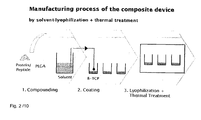
- the present invention provides a method for the production of a device comprising the steps of:
- method A is suitable for an active agent soluble in and compatible with an organic polymer solutions.
- a method for the production of a device comprising the steps of:
- method B is suitable also for an active agent insoluble in or incompatible with an organic polymer solution.
- the present invention further relates to a device produced by one of said methods, which device has osteoinductive and osteoconductive properties in vivo, comprises a carrier, wherein an active agent, preferably an osteoinductive protein, is coated onto the carrier together with a polymer, preferably a biodegradable polymer.
- an active agent preferably an osteoinductive protein
- the term "device” as used in accordance to the present invention refers to an entity, which comprises at least three components as set forth below.
- the device is a drug delivery system with porous scaffold. This device is preferably suitable for surgical defect filling and tissue regeneration. In another embodiment the device is a drug delivery system for the controlled release of active substances after implantation.
- an inorganic matrix the so-called "carrier”.
- said inorganic matrix consists of ceramics.
- said carrier is a calcium phosphate.
- said inorganic matrix is a calcium phosphate, which is beta tricalcium phosphate, alpha tricalcium phosphate, apatite or a calcium phosphate containing cement.
- said carrier is selected from the group consisting of calcium carbonate, magnesium carbonate, magnesium oxide or magnesium hydroxide.
- Said ceramics may have a particularly high surface due to the small particles size or the presence of macro- and micropores.
- said macropores have a diameter of 100 to 400 ⁇ m.
- said micropores have a diameter of less than 10 ⁇ m.
- the pores are interconnected to allow the influx of coating substances in the device preparation as well as in-growth of bone and tissue cells in the application in vivo.
- carrier encompasses three-dimensional matrices, such as the above-mentioned ceramics and ceramic/polymer composites.
- the carrier preferably, has an enlarged surface due to the small particles size or the formation of macro- and micropores during the manufacturing process.
- the carrier comprised by the device of the invention may be brought into a suitable form for administration of the device in vivo, such as solid composite materials in form of blocks, cubes, discs or granules.
- the composite carrier may be coated onto a metallic surface.
- the carrier containing calcium phosphate is in a granular form, more preferably in the form of free flowing granules.
- Granular products as moldable systems are well established for surgical defect filling especially in orthopedic indications (Draenert et al.). Therefore it is important to meet this preferred application form.
- calcium phosphate encompasses compositions comprising calcium ions (Ca 2+ ), phosphate ions (PO 3 3- ), optionally, further ions like hydroxyl ions (OH - ), carbonate (CO 3 2- ) or magnesium (Mg 2+ ) or other ions which are suitable for the carrier of the present invention.
- the calcium phosphates as used in accordance with the present invention are crystals having a three dimensional structure suitable for the device of the present invention as set forth above. Said calcium phosphates are particularly well suited as carriers for the device of the present invention. Their in vivo properties have been described in Hotz, 1994, Gao, 1996, and in WO98/21972. A list of preferred and well-known calcium phosphates is given above.
- the second component of the device of the present invention is a polymer.
- said polymer is a "biocompatible", a “biodegradable” or a “bioresorbable” polymer.
- biocompatible means the ability of a material to perform with an appropriate host response in a specific application (Wintermantel E. et al., 2002).
- Biodegradable polymers specifies polymers, which break down due to macromolecular degradation with dispersion in vivo but for which no proof exists for the elimination from the body.
- bioresorbable polymer specifies polymeric materials, which underwent degradation and further resorption in vivo; i.e. polymers, which are eliminated through natural pathways either because of simple filtration of degradation by-products or after their metabolization. Bioresorption is thus a concept which reflects total elimination of the initial foreign material.
- said bioresorbable polymer is a polymer that undergoes a chain cleavage due to macromolecular degradation in an aqueous environment.
- said polymer is selected from the group consisting of polyethylene (PE), polypropylene (PP), polyethylenerephthalate (PET), polyglactine, polyamide (PA), polymethylmethacrylate (PMMA), polyhydroxymethylmethacrylate (PHEMA), polyvinylchloride (PVC), polyvinylalcohole (PVA), polytetrafluorethylene (PTFE), polyetheretherketone (PEEK), polysulfon (PSU), polyvinylpyrolidone, polyurethane or polysiloxane.
- PE polyethylene
- PP polypropylene
- PET polyethylenerephthalate
- PET polyglactine
- PA polyamide
- PMMA polymethylmethacrylate
- PHEMA polyhydroxymethylmethacrylate
- PVC polyvinylchloride
- PVA polyvinylalcohole
- PTFE polytetrafluorethylene
- PEEK polyetheretherketone
- PSU polysulfon
- said polymer is selected from the group consisting of poly( ⁇ -hydroxy acids), poly (ortho esters), poly(anhydrides), poly(aminoacids), polyglycolid (PGA), polylactid (PLLA), poly(D,L-lactide) (PDLLA), poly(D,L-lactide co-glycolide) PLGA), poly(3-hydroxybutyricacid) (P(3-HB)), poly(3-hydroxy valeric acid) (P(3-HV)), poly(p-dioxanone) (PDS), poly( ⁇ -caprolactone) (PCL), polyanhydride (PA).
- polymers are biocompatible and bioresorbable.
- the third component of the device of the present invention is an "active agent".
- active agent comprises a polypeptide or a small molecule drug which is immobilized on and/or in the carrier.
- said polypeptide or drug is homogeneously distributed on the calcium phosphate containing carrier and / or within the polymer.
- osteoconductive refers to substrates that provide a favourable scaffolding for vascular ingress, cellular infiltration and attachment, cartilage formation, and calcified tissue deposition. Osteoconductive materials may support osseous generation via the scaffolding effect (Kenley, R.A., 1993).
- osteoinductive refers to the capability of the transformation of mesenchymal stem cells into osteoblasts and chondrocytes.
- a prerequisite for osteoinduction is a signal which is distributed by the device into the surrounding tissues where the aforementioned osteoblast precursors become activated.
- Osteoinduction as used herein encompasses the differentiation of mesenchymal cells into the bone precursor cells, the osteblasts.
- osteoinduction also comprises the differentiation of said osteoblasts into osteocytes, the mature cells of the bone.
- mesenchymal cells into chondrocytes are also encompassed by osteoinduction.
- the chondroblasts and the chondrocytes residing in the perichondrium of the bone can also differentiate into osteocytes.
- osteoinduction requires differentiation of undifferentiated or less-differentiated cells into osteocytes which are capable of forming the bone.
- a prerequisite for osteoinduction is a signal which is distributed by the device into the surrounding tissues where the aforementioned osteocyte precursors usually reside.
- the osteoinductive proteins or peptides used in accordance with the present invention are sustained released from the device after implantation and are distributed efficiently in the surrounding tissues.
- the proteins and peptides encompassed by the present invention have osteoinductive properties in vivo.
- TGF- ⁇ Transforming Growth Factor- ⁇
- Individual members of said TGF- ⁇ superfamily which have particular well osteoinductive properties are listed infra.
- the osteoinductive proteins or peptides of the device of the present invention after having been released from the carrier serving as a osteoinductive signal for the osteocyte precursors of the tissue surrounding the side of implantation of the device.
- osteoogenic describes the synthesis of new bone by osteoblasts.
- preexisting bone in the surrounding of the side of implantation of the device grows into the device using the structure of the device as a matrix onto which the osteocytes can adhere.
- osteoinductive polypeptide refers to polypeptides, such as the members of the Transforming Growth Factor- ⁇ (TGF- ⁇ ) superfamily, which have osteoinductive properties.
- TGF- ⁇ Transforming Growth Factor- ⁇
- said osteoinductive protein is a member of the TGF- ⁇ family.
- the TGF- ⁇ family of growth and differentiation factors has been shown to be involved in numerous biological processes comprising bone formation. All members of said family are secreted polypeptides comprising a characteristic domain structure. On the very N-terminus, the TGF- ⁇ family members comprise a signal peptide or secretion leader. This sequence is followed at the C-terminus by the prodomain and by the sequence of the mature polypeptide. The sequence of the mature polypeptide comprises seven conserved cysteins, six of which are required for the formation of intramolecular disulfide bonds whereas one is required for dimerization of two polypeptides.
- the biologically active TGF- ⁇ family member is a dimer, preferably composed of two mature polypeptides.
- the TGF- ⁇ family members are usually secreted as proteins comprising in addition to the mature sequence the prodomain.
- the prodomains are extracellularly cleaved off and are not part of the signalling molecule. It has been reported, however, that the prodomain(s) may be required for extracellular stabilization of the mature polypeptides.
- TGF- ⁇ family member or the proteins of said family referred to below encompass all biologically active variants of the said proteins or members and all variants as well as their inactive precursors.
- proteins comprising merely the mature sequence as well as proteins comprising the mature protein and the prodomain or the mature protein, the prodomain and the leader sequence are within the scope of the invention as well as biologically active fragments thereof. Whether a fragment of a TGF- ⁇ member has the biological activity can be easily determined by biological assays described, e.g.
- the biological activity according to the invention can be determined by in vivo models as described in the accompanied Examples.
- variants of the TGF- ⁇ members which have an amino acid sequences being at least 75%, at least 80%, at least 90%, at least 95%, at least 96%, at least 97%, at least 98% or at least 99% identical to the amino acid sequences of the members of the TGF- ⁇ family.
- said member of the TGF- ⁇ family is a member of the BMP subfamily.
- the members of the Bone Morphogenetic Protein (BMP) subfamily have been shown to be involved, inter alia, in the induction and re-modeling of bone tissue.
- BMPs were originally isolated from bone matrix. These proteins are characterized by their ability to induce new bone formation at ectopic sites.
- Various in vivo studies demonstrated the promotion of osteogenesis and chondrogenesis of precursor cells by BMPs and raise the possibility that each BMP molecule has distinct role during the skeletal development. More details about the molecular and biological properties of the BMPs are described in: Wozney JM, Rosen V (1998): Bone morphogenetic protein and bone morphogenetic protein gene family in bone formation and repair.
- the osteoinductive polypeptide of the present invention is preferably selected from the group consisting of BMP-1, BMP2, BMP-3, BMP-4, BMP-5, BMP-6, BMP7, BMP-8, BMP-9, BMP-10, BMP-11, BMP-12, BMP-13, BMP-14, BMP-15 and BMP-16.
- said member of the BMP family is BMP2 or BMP7.
- the amino acid sequence for the preproform of BMP2 is deposited under Swiss-Prot Accession number P12643 and is shown below.
- Amino acids 1 to 23 correspond to the signal sequence
- amino acids 24 to 282 correspond to the propeptide
- amino acids 283 to 396 correspond to the mature protein.
- the amino acid sequence for the preproform of BMP7 is deposited under Swiss-Prot Accession number P18075 or shown in SEQ ID No: 2.
- Amino acids 1 to 29 correspond to the leader sequence
- amino acids 30 to 292 correspond to the proform
- amino acids 293 to 431 correspond to the mature protein.
- BMP-2 or BMP7 refers to the preproform, to the proform or to the mature BMP-2 or BMP-7 peptide, respectively.
- fragments of said proteins having essentially the same biological activity, preferably osteoinductive properties. More sequence information for BMP2 and BMP7 is provided below.
- the osteoinductive polypeptide of the present invention is selected from another TGF- ⁇ family, i.e. the GDF family.
- GDF-5 also known as cartilage-derived morphogenetic protein 1 (CDMP-1) is a member of subgroup of the BMP family, which also includes other related proteins, preferably, GDF-6 and GDF-7.
- CDMP-1 cartilage-derived morphogenetic protein 1
- the mature form of the protein is a 27 kDa homodimer.
- Various in vivo and in vitro studies demonstrate the role of GDP-5 during the formation of different morphological features in the mammalian skeleton.
- GDF-5 are responsible for skeletal abnormalities including decrease of the length of long bones of limbs, abnormal joint development in the limb and sternum (Storm & Kingsley (1999), Development Biology, 209, 11-27).
- the amino acid sequence between mouse and human is highly conserved.
- the osteoinductive polypeptide of the present invention is selected from the group consisting of GDF-1, GDF-2, GDF-3, GDF-4, GDF-5, GDF-6, GDF-7, GDF-8, GDF-9, GDF-10 and GDF-11.
- said member of the GDF subfamily is GDF-5.
- the amino acid sequence for the preproform of GDF-5 is deposited under Swiss-Prot Accession number P 43026 or shown in SEQ ID No: 3.
- Amino acids 1 to 27 correspond to the leader sequence
- amino acids 28 to 381 correspond to the proform
- amino acids 382 to 501 correspond to the mature protein.
- GDF-5 refers to the preproform, to the proform or to the mature GDF-5 peptide.
- said fragment comprises amino acids 383 to 501 of the sequence shown in SEQ ID No: 3.
- said active agent is selected from hormones, cytokines, growth factors, antibiotics and other natural and/or synthesized drug substances like steroids, prostaglandines etc.
- said active agent is parathyroid hormone (PTH) and/or PTH 1-34 peptide.
- the device of the present invention may optionally, comprise additional excipients.
- excipients serve the stabilization of the protein or peptide, e.g., saccharides, amino acids, polyols, detergents or maintenance of the pH, e.g., buffer substances.
- the device of the present invention is free of toxic substances.
- toxic substances are already avoided in the production process, as their production requires additional expenditure due to required removal steps during the production process and necessary expensive means for highly sensitive chemical analysis.
- toxic substances encompasses those toxic organic solvents and additives which are used by the methods described in the art, which are classified by the ICH as class 2 solvents (ICH Topic Q 3 C Impurities: Residual Solvents) e.g. methylene chloride. Said substances may cause systemic or local toxic effects, inflammation and / or other reactions after implantation of devices containing said substances. Said prior art devices are therapeutically less acceptable due to said undesirable side effects, which cannot be avoided by the conventionally coating methods described in the art. Moreover, the international guidance for the development of therapeutic proteins require that in the manufacturing process harmful and toxic substances should be avoided (for details see: International Conference on Harmonization (ICH), Topic Q3C; www.emea.eu.int/).
- the device of the present invention or a device which is obtainable by the method of the present invention is, advantageously, free of said class 1 classified toxic substances.
- the present invention contains only solvents classified as class 3 by the ICH Topic Q 3C and, therefore, therapeutically well acceptable and fulfills the requirements of the regulatory authorities.
- said device is free of infectious material.
- infectious material comprised by the device may cause severe infections in a subject into which the device has been transplanted.
- Potentially infectious gelatin derived from bovine or procine bones is, however, used as a protecting protein in many state of the art methods (Lind, 1996).
- Solutions sufficient for the two methods A and B of the present invention (used in step (a) of method A and step (e) of method B, respectively) to produce the device of the present invention have a melting point > -40 °C and a boiling point ⁇ 200 °C. They are inactive towards the active agent.
- this solution contains a solvent selected from anisole, tetramethylurea, acetic acid, dimethylsulfoxide and tert-butanol (2-methyl-2-propanole trimethylcarbinole-butyl alcohol), acetone, 1-butanole, 2-butanole, butyl acetate, tert-butylmethyl ether, cumene, ethanole, ethyl acetate, dieethylether, ethylformate, formic acid, isobutyl acetate, isopropylacetate, methyl acetate, 3-methyl-1-butanol, methylethyl ketone, methylisobutylketone, 2-methyl-1-propanol, pentane, 1-pentanol, 2-propanol, propylacetate, and tetrahydrofurane.
- acetic acid dimethylsulfoxide and anisole.
- homogenous distributed and homogeneously coateded mean that identical amounts of the active agent are present in each and every area of said composite carrier. This area preferably includes the pores of a porous matrix. Homogenous distribution is a prerequisite for efficient release and activity of the active agent into the tissue surrounding the site of implantation. Moreover, it is to be understood that the active agent is not aggregated and partially or entirely inactivated due to precipitation or micro-precipitation, rather attachment of biologically active, non-aggregated proteins is to be achieved by homogenous coating. Said homogenous distribution can be achieved by the two above methods of the present invention.
- the homogenous coating of the carrier with said active agent and the simultaneous and / or additional homogeneous coating with the bioresorbable polymer do achieve an onion-like layer structure which acts in two manners as a protective film and as diffusion barrier to slow down the dissolution of the protein or peptide to achieve a sustained release.
- the described methods A and B allow the homogenous distribution and immobilization of the osteoinductive active agent into and / or on the carrier and the sustained release of the active agent due to the polymeric component.
- the efficacy of the coating process is, furthermore, supported by the carrier due to capillary forces resulting from the presence of numerous, preferably interconnected macro- and micropores which due to their size are capable of soaking the solutions into the pores.
- the active agent is - according to the methods A and B of the present invention - applied by attachment to the carriers from the soluble state to achieve a homogeneous coating.
- the findings underlying the present invention demonstrate that the aggregation of the proteins can be avoided in a tri-component-system by the use of suitable solvents and / or additives as described herein.
- An important precondition is the knowledge of the solubility of the osteoinductive active agent dependent on the nature of the solvent, i.e. aqueous and / or organic solvent, pH value, ionic strength and surfaces present.
- aqueous solution specifies any solution comprising water.
- the slowing down of the pH increase caused by the contact of the coating solution with the calcium phosphates in the carrier reacting in an alkaline manner plays an important role during the coating, preferably in method B.
- the methods A and B of the present invention distribute the active agent homogeneously across the inner surface of the carrier material and allow binding to the surface before a precipitation of the said protein takes place.
- the methods A and B of the present invention allow the use of non toxic organic solvents (see below), such as dimethyl sulfoxide, anisol or glacial acid. These solvents are routinely used in the methods described in the art. Normally they damage the protein during contacting and/or especially during drying but such damage is surprisingly avoided by using the special drying technique of the present invention, because the active agent is adsorbed/or attached onto the inorganic solid carrier.
- non toxic organic solvents see below
- said active agent coating buffer has a buffer concentration of preferably less than 100 mmol/l, more preferably less than 50 mmol/l and even more preferably less than 20 mmol/l to achieve a sufficient solubility of the active agent during the adsorbtion process and to avoid any modification of a ceramic carrier.
- said buffer has a buffer concentration of 10 mmol/l to achieve a sufficient solubility of the active agent during the adsorbtion process and to avoid any modification of the monophasic calcium phosphate ceramic beta TCP.
- the pH of the solution shifts in a controlled manner during the coating and drying process from pH 3 to pH 7, more preferably from 3 to 6 and most preferably from 4 to 5,5. This pH shift causes a defined reduction of the solubility of the bone growth factor to result in a homogenous, defined attachment on the TCP.
- the solutions comprise non toxic organic solvents.
- the first aspect for method A is to find a common suitable organic solvent for both, the active agent and the polymer, without inducing modifications at the active agent.
- a second aspect is the ability of the solvent(s) in step (a) method A and / or step (e) of method B for the drying process, which is preferably a freeze-drying process.
- the preferred solvents are anisole, dimethylsulfoxide (DMSO) and glacial acetic acid.
- DMSO dimethylsulfoxide
- these solvents in both method A and in method B are used in volumina to achieve a compleate soaking of the polymer solution and to avoid any remaining solution.
- said buffer contains a weak acid.
- weak acid refers to organic or inorganic compounds containing at least one ionogenically bound hydrogen atom. Weak acids are well known in the art and are described in standard text books, such as Römpp, "dictionary of chemistry”. Preferably, said weak acids which have low dissociation degrees and are described by pK values between 3 and 7, preferably between 4 and 6. Most preferably, said weak acid is acetic acid or succinic acid.
- said buffer containing solution further comprises at least one saccharides in an aqueous solution, more preferably in an aqueous solution without any further solvent apart from water.
- said buffer containing solution comprises an polyol and/or alcohol.
- Suitable alcohols or polyols are well known in the art and are described in standard text books, such as Römpp, dictionary of chemistry. More preferably, said alcohol is ethanol and said polyol is mannitol.
- the concentration of the polyol and or alcohol is between 0 - and 10 % (w/v).
- saccharides encompasses mono-, di- and polysaccharides.
- the structure and composition of mono-, di-, and polysaccharides are well known in the art and are described in standard text books, such as Römpp, "dictionary of chemistry”.
- said saccharide is a disaccharide.
- said dissaccharide is sucrose or trehalose.
- active agents in particular surprisingly proteins
- this aspect of the invention opens a new possibility to produce polymer based drug delivery systems for proteins without denaturation and / or modification of polypeptides in singular or multiphase organic systems, preferably for active agents incompatible with organic solvents.
- ceramic carrier preferably used in present invention opens the possibility to quantitatively remove organic solvents (see below).
- Suitable for one of the two methods of the present invention as active agents are all proteins, polypeptides and small molecule drugs.
- active agents with low or no affinity for inorganic carrier matrices can be immobilized in the polymer - calcium phosphate composite material.
- the binding of said active agent to the carrier is reversible.
- said dissolution of said active agent is allowed once the device has been brought into a suitable in vivo surrounding, such as a bone cavity.
- said dissolution of the immobilized compounds is a sustained release allowing diffusion of the active agent into the tissue which surrounds the device.
- the device is suitable to serve as an in vivo source for e.g. osteoinductive proteins, peptides or small molecule drugs, which are slowly released and which can be thereby efficiently distributed into the surrounding tissues or have an effect in the immobilized form.
- drying encompasses measures for removing liquids, such as excess buffer solution, or organic solvents which are still present after coating of the carrier with the osteoinductive protein or polymer solution. Preferably, drying is achieved by convection at under inert gas atmosphere, by vacuum- or freeze-drying. It is important for the composite ceramic of the present invention that after drying the ceramic matrix is substantially free of organic solvent to allow for a softening of the polymeric component in a thermal treatment step, such as steps (e) of method A and step (g) of method B. Substantially free of organic solvent means a content preferably below ⁇ 1 % residual solvent, more preferably ⁇ 0,05 %, even more preferably ⁇ 0,025 % and most preferably ⁇ 0,01 %.
- buffer which assists in keeping the active agent dissolved in aqueous solutions for a time sufficient to allow "homogenous coating” refers to a component allowing the active agent to be effectively dissolved in the solution and / or homogeneously coated in a carrier system tending to cause pH induced precipitation.
- This buffer is preferably capable of avoiding and or balancing the increase of pH caused by contacting the solution with the calcium phosphate carrier so that the protein does not immediately precipitate, e.g., due to a pH increase.
- Said buffer can be determined by the person skilled in the art considering the solubility of the osteoinductive protein (which depends on the pH and the ionic strength) and the influence of the carrier on said parameters after contacting the carrier with said buffer containing solution.
- a suitable buffer is needed for the homogeneous distribution of the active agent onto the surface of the carrier, e.g. calcium phosphate, said buffer comprising preferably a weak acid, an alcohol and a saccharide.
- the solvent for the dissolution of the preferably bioresorbable polymer in which the protein or peptide is not soluble described by the method B of the present invention comprises a suitable organic solvent for the homogeneous distribution of the polymer onto the surface of the protein or peptide coated carrier e.g. dimethyl sulfoxide, anisol or glacial acid.
- thermal treatment refers to a heating step which is applied after the solvent has been removed by drying to condense the polymeric phase by a definite collapse of the freeze dried structure and thus providing a dense and homogenous polymeric shell covering the ceramic surface of the granules.
- the purpose of this procedure is to modulate the release kinetics for the active substance and to achieve free flowing granules.
- the temperature should be equal or higher than the glass transition temperature of the corresponding polymer system.
- the glass transition temperature of the polymer can be decreased by the use of plasticizers, e.g. polyethylene glycol.
- the thermal treatment applies a temperature between the final drying temperature of ⁇ 20°C, preferably ⁇ 25°C, and most preferably ⁇ 30 °C and the maximum temperature, limited by the active agent of ⁇ 60 °C, preferably ⁇ 55, and most preferably ⁇ 50 °C.
- the time range for the thermal treatment in a preferred embodiment is as follows: Heating from 20 °C up to 60 °C in 30 minutes following by an isothermic period of 50 minutes at this temperature. Afterwards the samples are cooled down to 20 °C for 1 hour. The integrity of the active agent was determined after extraction the polymeric shell as demonstrated in example 4.
- the invention encompasses a pharmaceutical composition comprising the device of the invention or a device, which is obtainable by the method of the invention.
- the product of the present invention can be formulated as a pharmaceutical composition or a medical device.
- the composition of said product may comprise additional compounds like stabilizers, buffer substances and other excipients.
- the amount of the product of the present invention applied to the patient will be determined by the attending physician and other clinical factors; preferably in accordance with any of the above described methods. As it is well known in the medical arts, the amount applied to a patient depends upon many factors, including the patient's size, body surface area, age, sex, time and route of administration, general health conditions, and other drugs being administered concurrently. Progress can be monitored by periodic assessment.
- the present invention it is possible to treat various bone defects including large cavities in a new manner.
- large cavities could not or only under use of autogenous bone material be efficiently treated.
- treatment of bone defects which requires extensive bone augmentation or repair has now become possible without a second surgery for gaining autologous bone material.
- the invention also encompasses the use of the device of the invention or a device which is obtainable by the method of the invention for the preparation of a pharmaceutical composition for bone augmentation.
- bone augmentation refers to the induced formation of bone, which is indicated in order to treat bone defects, cavities in bones, or to treat diseases and disorders accompanied with loss of bone tissue or to prepare the subsequent setting of an implant.
- the diseases and disorders described in the following are well known in the art and are described in detail in standard medical text books such as Pschyrembel or Stedman.
- said bone augmentation follows traumatic, malignant or artificial defects.
- Another embodiment of the present invention relates to the use of the device of the invention or the preparation of a pharmaceutical composition for treating bone defects.
- said bone defects are long bone defects or bone defects following apicoectomy, extirpation of cysts or tumors, tooth extraction, or surgical removal of retained teeth.
- the invention also relates to the use of the device of the invention for filing of cavities and support guided tissue regeneration in periodontology.
- Another embodiment of the present invention relates to the use of the device of the invention for the preparation of a pharmaceutical composition for sinus floor elevation, augmentation of the atrophied maxillary and mandibulary ridge and stabilization of immediate implants.
- a method for treating one or more of the diseases referred to in accordance with the uses of the present invention comprises at least the step of administering the device of the invention in a pharmaceutically acceptable form to a subject.
- said subject is a human.
- the invention relates to a kit comprising the device of the invention.
- kits of the invention can be packaged individually in vials or other appropriate means depending on the respective ingredient or in combination in suitable containers or multicontainer units.
- Manufacture of the kit follows preferably standard procedures which are known to the person skilled in the art.
- Polymer and carrier together form the ceramic/polymer composite carrier material of the present invention, which binds an osteoinductive active agent to result in the device of the present invention, in order to allow the sustained release of said active agent in vivo.
- the composite carrier is based on a calcium phosphate and a polymer, preferably a biodegradable polymer.
- the calcium phosphate shows excellent local buffering capacity and the permeable composite structure avoids even local pH decrease when the polymer is degraded in vivo. Cytotoxic side effects due to degradation of the polymer are, hence, reduced or avoided.
- the ceramic carrier is chief ingredient of the ceramic carrier/polymer composite carrier material of the present invention, which preferably contains less than 20% of the polymer, most preferably less than 20% of PLGA.
- the ceramic/polymer composite carrier material of the present invention shows improved mechanical stability compared to conventional systems using polymeric granules for retarded release.
- the resulting free flowing granules have mechanical properties, which are the same when compared with the untreated polymer free granules.
- These untreated granules represent the well established system to withstand tissue pressure in various therapies e.g. in orthopedic indications.
- the ceramic/polymer composite carrier material of the present invention shows improved mechanical stability compared to conventional systems using polymeric granules for retarded release.
- the composite matrix allows for improved osteoconductive properties compared to prior art systems due to the porous system, in particular free of interconnected pores.
- the ceramic/polymer composite carrier material of the present invention is suitable to replace conventional encapsualting polymeric granules important for retarded release. Due to the homogeneous coating of the system (ceramic carrier plus polymer coating), the amount of polymer can be significantly reduced compared with totally polymer based scaffolds, which reduced amount of polymer leads to a reduced risk of cytotoxicity. A further aspect of the invention is the increased mechanical stability of the composite material compared with totally polymer based scaffolds.
- Step 1 Coating of beta-TCP with rhGDF-5: 500 mg ⁇ -TCP (0.5 - 1.0 mm granule size) are placed in a dry form in a 6R-glass. The stock solution of rhGDF-5 (4 mg/ml in 10 mM HCl) is diluted to 1 g/ml (with the corresponding coating buffer). 425 ⁇ l of the rhGDF-5 solution obtained in that manner are pipetted on the beta-TCP and adsorbed. The damp granulate is incubated for 1 hour at 25°C and then lyophilised. Step 2: In the subsequent step 425 ⁇ l of the following organic solvents were incubated with the coated granules from step 1 for 30 min at room temperature. After drying a sample was taken. The remaining samples were tempered at 60 °C for 1 h. From each sample the rhGDF-5 was extracted according Example 4 to quantify the modified species by RP-HPLC.
- Example 1 Manufacturing of MD05 500 retard (with a protein).
- ⁇ -TCP in a 6R glass vial, take 475 ⁇ l of the coating solution (0.525 mg/ ml rhGDF-5 in 10.0 mM acetic acid, 2.5 mM HCl, 10.0 % saccharide). Dry by freeze-drying.
- Second coating by adding 425 ⁇ l of PLGA (Resomer RG 502 H) dissolved in DMSO, containing 150 mg PLGA/ ml DMSO. Again drying by freeze-drying , including a terminal treatment step by 60 °C over 1 hour.
- Example 2 Manufacturing of MD05 500 retard (with a peptide).
- MD05 retard (containing a protein; rhGDF-5). Weight 150 mg of MD05 retard into a 50 ml tube, ad 48 ml alpha-MEM-medium including 10 % of FCS and shake continuously at 4 °C and 37 °C for defined time, (final concentration of the release-assay is ⁇ 1.6 ⁇ g rhGDF-5/ ml medium).
- the defined time in this example is ⁇ 30 days can be adapted to the respective active agent.
- an aliquot of 100 ⁇ l was taken (the taken volume will not be replaced), centrifuged for 5 minutes at 13 000 rpm, the supernatant is frozen at -70 °C. The quantification of the selected aliquots will be done by Elisa-assay.
- MD05 retard (containing a peptide, Parathormon, PTH 1-34) 0.2 g of product is taken in 1 ml PBS (final concentration of PTH is 0.015 ⁇ g/ml)incubated at 4°C and 37 °C under continuously shaking. At defined time, the incubation medium was replaced with fresh PBS. The supernatant was centrifuged at 13000 rpm for about 5 minutes, an aliquot from 250 ⁇ l was analyzed by HPLC.
- Coated Calcium phosphate with rhGDF-5 or rhBMP-2 (656 mg) was extracted in a 1 ml polypropylene reaction cup after resuspending in 1 ml extraction buffer (80mM EDTA, 8mM 1,2 Diaminopropan pH 6.7 in 20 % Ethanol) and the addition of 480 mg urea under gentle agitation for 1 h at 4 °C. After centrifugation (13 200 rpm g, 2 min) the supernatant was analyzed by RP-HPLC.
- the amount of chemical modifications i.e. oxidation of bone growth factor in solutions containing extracted protein was determined by RP-HPLC.
- the sample is applied to a Vydak C8-18 column (2 x 250 mm) which has been equilibrated with 0.15 % TFA, 20 % acetonitrile. After washing of the column, the elution is performed with a mixture of 0.1 % TFA, 20 % acetonitrile, and a stepwise gradient of 20 % - 84 % acetonitrile (flow: 0.3 ml/min). The elution is observed by measuring the absorption at 215 nm. The quantification is calculated by the ratio of the peak area of modified species to the total peak area.
- the amount of chemical modifications, i.e. oxidation of bone growth factor in solutions containing extracted protein was determined by RP-HPLC.
- the sample is applied to a Vydak C8-18 column (4.6 x 250 mm) which has been equilibrated with 0.15 % TFA, 13.5 % acetonitrile. After washing of the column, the elution is performed with a mixture of 0.1 % TFA, 13.5 % acetonitrile and a stepwise gradient of 13.5 % - 84 % acetonitrile (flow: 0.5 ml/min). The elution is observed by measuring the absorption at 215 nm. The quantification is calculated by the ratio of the peak area of modified species to the total peak area.
- the amount of soluble aggregates in samples containing extracted protein was determined by size exclusion HPLC.
- the column (TSK 3000) was equilibrated with 50 mmol/l phosphoric acid, 50 mmol/l acetic acid/NaOH, pH 3.0. The elution is observed by UV-detection at 220 nm. The quantification is calculated by the ratio of the aggregate peak area to the total peak area.
- Example 7 Stability testing of rhGDF-5 coated ⁇ -TCP granules in various organic solvents
- the amount of solvent induced protein degradation was determined by incubating 500 mg of rhGDF-5 coated granules with 425 ⁇ l of the solvent for 30 min. Afterwards the solvent were removed by evaporation under vacuum and analyzed by RP-HPLC described in example 4 and 5.
- Example 8 Stability testing of rhGDF-5 coated ⁇ -TCP granules after drying from various organic solvents and annealing
- the amount of solvent induced protein degradation during the annealing was determined by incubating 550 mg of rhGDF-5 coated granules with 425 ⁇ l of the solvent for 30 min. The solvent were removed by evaporation under vacuum and afterwards the vials were heated up at a temperature of 60 °C for 1 hour in an oven and analyzed by RP-HPLC described in example 4 and 5.
- Example 9 Stability testing of pure rhGDF-5 after drying from various organic solvents and annealing
- Example 10 Stability testing of rhGDF-5 coated ⁇ -TCP granules after drying from various organic solvents and annealing with optimized lyophilization conditions
- Example 11 Stability testing of rhGDF-5 coated ⁇ -TCP granules with PLGA shell after drying from various organic solvents and annealing with optimized conditions.
Landscapes
- Health & Medical Sciences (AREA)
- Chemical & Material Sciences (AREA)
- Life Sciences & Earth Sciences (AREA)
- Medicinal Chemistry (AREA)
- Animal Behavior & Ethology (AREA)
- Veterinary Medicine (AREA)
- Epidemiology (AREA)
- Oral & Maxillofacial Surgery (AREA)
- Dermatology (AREA)
- General Health & Medical Sciences (AREA)
- Public Health (AREA)
- Transplantation (AREA)
- Engineering & Computer Science (AREA)
- Biomedical Technology (AREA)
- Molecular Biology (AREA)
- Inorganic Chemistry (AREA)
- Dispersion Chemistry (AREA)
- Materials For Medical Uses (AREA)
Priority Applications (4)
| Application Number | Priority Date | Filing Date | Title |
|---|---|---|---|
| EP04013669A EP1604694A1 (fr) | 2004-06-09 | 2004-06-09 | Dispositif composé ayant de propriétes ostéoinductrices et ostéoconductrices |
| US11/628,993 US20100112028A1 (en) | 2004-06-09 | 2005-06-09 | Composite material for use as protein carrier |
| EP05748227A EP1753396A2 (fr) | 2004-06-09 | 2005-06-09 | Material composite pour deliverer des proteines. |
| PCT/EP2005/006206 WO2005120454A2 (fr) | 2004-06-09 | 2005-06-09 | Materiau composite utilise comme support de proteines |
Applications Claiming Priority (1)
| Application Number | Priority Date | Filing Date | Title |
|---|---|---|---|
| EP04013669A EP1604694A1 (fr) | 2004-06-09 | 2004-06-09 | Dispositif composé ayant de propriétes ostéoinductrices et ostéoconductrices |
Publications (1)
| Publication Number | Publication Date |
|---|---|
| EP1604694A1 true EP1604694A1 (fr) | 2005-12-14 |
Family
ID=34925320
Family Applications (1)
| Application Number | Title | Priority Date | Filing Date |
|---|---|---|---|
| EP04013669A Withdrawn EP1604694A1 (fr) | 2004-06-09 | 2004-06-09 | Dispositif composé ayant de propriétes ostéoinductrices et ostéoconductrices |
Country Status (1)
| Country | Link |
|---|---|
| EP (1) | EP1604694A1 (fr) |
Cited By (1)
| Publication number | Priority date | Publication date | Assignee | Title |
|---|---|---|---|---|
| EP2091569A4 (fr) * | 2006-10-31 | 2011-09-14 | Univ Rochester | Administration ciblee d'agents therapeutiques au moyen de matrices lyophilisees |
Citations (8)
| Publication number | Priority date | Publication date | Assignee | Title |
|---|---|---|---|---|
| WO1997031661A1 (fr) * | 1996-02-29 | 1997-09-04 | Lindholm T Sam | Dispositif osteogenique et son procede de preparation |
| US5711957A (en) * | 1993-05-13 | 1998-01-27 | Inoteb | Use of a porous calcium carbonate based material as support of a growth factor in the preparation of a bioabsorbable implant |
| DE19647853A1 (de) * | 1996-11-19 | 1998-05-20 | Bioph Biotech Entw Pharm Gmbh | Verbindungen mit verbesserter knorpel- und/oder knocheninduzierender Aktivität |
| WO2001082989A1 (fr) * | 2000-05-04 | 2001-11-08 | Phillips Plastics Corporation | Perles en ceramique en paquets pour reparation osseuse |
| US6461385B1 (en) * | 1997-12-18 | 2002-10-08 | Comfort Biomedical Inc. | Method and apparatus for augmenting osteointegration of prosthetic implant devices |
| EP1247537A1 (fr) * | 2001-04-04 | 2002-10-09 | Isotis B.V. | Revêtement pour appareils médicaux |
| US20030065400A1 (en) * | 2001-04-12 | 2003-04-03 | Beam Heather Ann | Method and apparatus for engineered regenrative biostructures such as hydroxyapatite substrates for bone healing applications |
| WO2003043673A1 (fr) * | 2001-11-19 | 2003-05-30 | Scil Technology Gmbh | Dispositif dote de proprietes osteoinductives et osteoconductrices |
-
2004
- 2004-06-09 EP EP04013669A patent/EP1604694A1/fr not_active Withdrawn
Patent Citations (8)
| Publication number | Priority date | Publication date | Assignee | Title |
|---|---|---|---|---|
| US5711957A (en) * | 1993-05-13 | 1998-01-27 | Inoteb | Use of a porous calcium carbonate based material as support of a growth factor in the preparation of a bioabsorbable implant |
| WO1997031661A1 (fr) * | 1996-02-29 | 1997-09-04 | Lindholm T Sam | Dispositif osteogenique et son procede de preparation |
| DE19647853A1 (de) * | 1996-11-19 | 1998-05-20 | Bioph Biotech Entw Pharm Gmbh | Verbindungen mit verbesserter knorpel- und/oder knocheninduzierender Aktivität |
| US6461385B1 (en) * | 1997-12-18 | 2002-10-08 | Comfort Biomedical Inc. | Method and apparatus for augmenting osteointegration of prosthetic implant devices |
| WO2001082989A1 (fr) * | 2000-05-04 | 2001-11-08 | Phillips Plastics Corporation | Perles en ceramique en paquets pour reparation osseuse |
| EP1247537A1 (fr) * | 2001-04-04 | 2002-10-09 | Isotis B.V. | Revêtement pour appareils médicaux |
| US20030065400A1 (en) * | 2001-04-12 | 2003-04-03 | Beam Heather Ann | Method and apparatus for engineered regenrative biostructures such as hydroxyapatite substrates for bone healing applications |
| WO2003043673A1 (fr) * | 2001-11-19 | 2003-05-30 | Scil Technology Gmbh | Dispositif dote de proprietes osteoinductives et osteoconductrices |
Cited By (2)
| Publication number | Priority date | Publication date | Assignee | Title |
|---|---|---|---|---|
| EP2091569A4 (fr) * | 2006-10-31 | 2011-09-14 | Univ Rochester | Administration ciblee d'agents therapeutiques au moyen de matrices lyophilisees |
| US8632797B2 (en) | 2006-10-31 | 2014-01-21 | University Of Rochester | Targeted delivery of therapeutic agents with lyophilized matrices |
Similar Documents
| Publication | Publication Date | Title |
|---|---|---|
| EP1604693A1 (fr) | Support formé in situ, son procédé de préparation et son utilisation | |
| JP5068269B2 (ja) | 骨再生のための成形可能な生体材料 | |
| US20150080303A1 (en) | Device having osteoinductive and osteoconductive properties | |
| US9724389B2 (en) | System and method for multiphasic release of growth factors | |
| CA2868992C (fr) | Systeme et procede de liberation multiphasique de facteurs de croissance | |
| US20100112028A1 (en) | Composite material for use as protein carrier | |
| EP1604649A1 (fr) | Material composite pour deliverer des proteines. | |
| EP1604694A1 (fr) | Dispositif composé ayant de propriétes ostéoinductrices et ostéoconductrices | |
| EP2033598A1 (fr) | Administration à base de phosphate de calcium de croissance et de différentiation de facteurs pour l'os fragilisé |
Legal Events
| Date | Code | Title | Description |
|---|---|---|---|
| PUAI | Public reference made under article 153(3) epc to a published international application that has entered the european phase |
Free format text: ORIGINAL CODE: 0009012 |
|
| AK | Designated contracting states |
Kind code of ref document: A1 Designated state(s): AT BE BG CH CY CZ DE DK EE ES FI FR GB GR HU IE IT LI LU MC NL PL PT RO SE SI SK TR |
|
| AX | Request for extension of the european patent |
Extension state: AL HR LT LV MK |
|
| AKX | Designation fees paid | ||
| STAA | Information on the status of an ep patent application or granted ep patent |
Free format text: STATUS: THE APPLICATION IS DEEMED TO BE WITHDRAWN |
|
| 18D | Application deemed to be withdrawn |
Effective date: 20060615 |
|
| REG | Reference to a national code |
Ref country code: DE Ref legal event code: 8566 |