EP1604993A1 - Inhibiteurs - Google Patents
Inhibiteurs Download PDFInfo
- Publication number
- EP1604993A1 EP1604993A1 EP04714951A EP04714951A EP1604993A1 EP 1604993 A1 EP1604993 A1 EP 1604993A1 EP 04714951 A EP04714951 A EP 04714951A EP 04714951 A EP04714951 A EP 04714951A EP 1604993 A1 EP1604993 A1 EP 1604993A1
- Authority
- EP
- European Patent Office
- Prior art keywords
- unsubstituted
- carbon atoms
- atom
- atoms substituted
- carbon number
- Prior art date
- Legal status (The legal status is an assumption and is not a legal conclusion. Google has not performed a legal analysis and makes no representation as to the accuracy of the status listed.)
- Withdrawn
Links
- 0 *C1=NC2N*=CC=C2C=C1 Chemical compound *C1=NC2N*=CC=C2C=C1 0.000 description 1
- MVIBQDYLHFUWMR-UHFFFAOYSA-N CC(N(C)Cc1ccc(C=CC(N2)=O)c2n1)=O Chemical compound CC(N(C)Cc1ccc(C=CC(N2)=O)c2n1)=O MVIBQDYLHFUWMR-UHFFFAOYSA-N 0.000 description 1
- UDLULDMQGRIBFF-UHFFFAOYSA-N CC(NC1Nc2nc(C)ccc2C=C1)=O Chemical compound CC(NC1Nc2nc(C)ccc2C=C1)=O UDLULDMQGRIBFF-UHFFFAOYSA-N 0.000 description 1
Images







Classifications
-
- C—CHEMISTRY; METALLURGY
- C07—ORGANIC CHEMISTRY
- C07D—HETEROCYCLIC COMPOUNDS
- C07D471/00—Heterocyclic compounds containing nitrogen atoms as the only ring hetero atoms in the condensed system, at least one ring being a six-membered ring with one nitrogen atom, not provided for by groups C07D451/00 - C07D463/00
- C07D471/02—Heterocyclic compounds containing nitrogen atoms as the only ring hetero atoms in the condensed system, at least one ring being a six-membered ring with one nitrogen atom, not provided for by groups C07D451/00 - C07D463/00 in which the condensed system contains two hetero rings
- C07D471/04—Ortho-condensed systems
-
- A—HUMAN NECESSITIES
- A61—MEDICAL OR VETERINARY SCIENCE; HYGIENE
- A61P—SPECIFIC THERAPEUTIC ACTIVITY OF CHEMICAL COMPOUNDS OR MEDICINAL PREPARATIONS
- A61P31/00—Antiinfectives, i.e. antibiotics, antiseptics, chemotherapeutics
- A61P31/12—Antivirals
- A61P31/14—Antivirals for RNA viruses
- A61P31/18—Antivirals for RNA viruses for HIV
-
- A—HUMAN NECESSITIES
- A61—MEDICAL OR VETERINARY SCIENCE; HYGIENE
- A61P—SPECIFIC THERAPEUTIC ACTIVITY OF CHEMICAL COMPOUNDS OR MEDICINAL PREPARATIONS
- A61P43/00—Drugs for specific purposes, not provided for in groups A61P1/00-A61P41/00
Definitions
- the present invention relates to an inhibitor for inhibiting binding of RRE to Rev protein.
- HIV-1 is a type of retrovirus, and when HIV-1 infects a normal cell, the HIV-1 introduces its mRNA into the normal cell. From the mRNA, a reverse transcriptase forms virus cDNA, which binds to a chromosome gene in a nucleus of the cell. Gene transcription for proliferation of the cell is accompanied with transcription of RNA with a gene of the virus.
- RNA is spliced so that a mature mRNA is discharged out of a nucleus.
- the HIV-1 RNA must not be spliced. What is important in this mechanism is an interaction between RRE (Rev responsible Element) of the HIV-1 mRNA and Rev protein.
- Fig. 1 illustrates a base sequence of RRE.
- Fig. 2 illustrates a structure of Rev protein.
- Fig. 3 schematically illustrates how HIV-1 duplicates as a result of the binding of RRE to Rev protein.
- Inhibition of the binding (interaction) of RRE to Rev protein causes the splicing of the HIV-1 mRNA.
- the splicing shortens the HIV-1 mRNA, so that the virus cannot proliferate. Therefore, a substance that inhibits the binding of RRE to Rev protein is considered as having an effect of suppressing development of AIDS.
- neomycine B which is a natural antibiotic.
- the neomycine B is represented by the following structural formula 1 ⁇ . The neomycine B firmly binds to RRE, so that RRE cannot bind to Rev protein.
- Non-patent Document 1 Luedtke et al. Journal of American Chemical Society, 122, 980 (2000)
- Non-patent Document 2 Wilson et al. Biochemistry 40, 1150 (2001)
- the substance disclosed in Non-patent Document 1 is represented by the following structural formula 2 ⁇
- the substance disclosed in Non-patent Document 2 is represented by the following structural formula 3 ⁇ .
- each of the substances capable of serving as the conventional inhibitors does not have a structure designed to specifically bind to a Rev protein binding site of RRE. Therefore, nonspecific binding of the substance is strong and the substance does not have a sufficient inhibitory activity.
- an object of the present invention to provide an inhibitor which has a sufficient inhibitory activity and firmly binds to a Rev protein binding site of RRE.
- naphthyridine dimer which includes two naphthyridines each having a hydrogen-binding moiety complementary to a guanine, selectively binds to a guanine-guanine mismatch (hereinafter referred to as "GG mismatch”) base pair of double-stranded DNA.
- GG mismatch guanine-guanine mismatch
- the inventors have also found that a naphthyridine-azaquinolone hybrid, which is obtained by replacing one of the two naphthyridines of naphthyridine dimer with an azaquinolone having a hydrogen-binding moiety complementary to an adenine, selectively binds to a guanine-adenine mismatch (hereinafter referred to as "GA mismatch”) base pair.
- GA mismatch guanine-adenine mismatch
- the inventors focused attention on the fact that an internal loop of RRE has a GG mismatch base pair and a GA mismatch base pair.
- the inventors have invented a novel inhibitor which inhibits binding of RRE to Rev protein by specifically binding to a Rev protein binding site of RRE.
- an inhibitor according to the present invention is an inhibitor for inhibiting binding of RRE to Rev protein, the inhibitor containing a naphthyridine derivative represented by general formula (A): where R and R 1 are mutually independently a hydrogen atom, an alkyl group of a carbon number of 1 to 15, which is unsubstituted or has one or more carbon atoms substituted respectively by an oxygen atom or a nitrogen atom, an alkoxy group of a carbon number of 1 to 15, which is unsubstituted or has one or more carbon atoms respectively substituted by an oxygen atom or a nitrogen atom, or a mono- or di-alkylamino group of a carbon number of 1 to 15, which is unsubstituted or has one or more carbon atoms substituted respectively by an oxygen atom or a nitrogen atom;
- X is an arbitrary bivalent group; and Y is a substituent represented by general formula (B) or a substituent represented by general formula (C):
- the naphthyridine derivative contains not only a single naphthyridine moiety but also at least either a naphthyridine moiety represented by general formula (B) or an azaquinolone moiety represented by general formula (C) so as to specifically bind to a GG mismatch base pair in an internal loop of RRE. According to this arrangement, it is possible to provide an inhibitor which can inhibit binding of RRE to Rev protein by binding to RRE.
- the inhibitor according to the present invention is an inhibitor for inhibiting binding of RRE to Rev protein and contains naphthyridine dimer represented by general formula (1): where R and R 1 are mutually independently a hydrogen atom, an alkyl group of a carbon number of 1 to 15, which is unsubstituted or has one or more carbon atoms substituted respectively by an oxygen atom or a nitrogen atom, an alkoxy group of a carbon number of 1 to 15, which is unsubstituted or has one or more carbon atoms substituted respectively by an oxygen atom or a nitrogen atom, or a mono- or di-alkylamino group of a carbon number of 1 to 15, which is unsubstituted or has one or more carbon atoms substituted respectively by an oxygen atom or a nitrogen atom, and R 2 is an alkylene group of a carbon number of 1 to 20, which is unsbstituted or has one or more carbon atoms respectively substituted by an oxygen atom, a sulfur atom, a nitrogen atom,
- the inhibitor according to the present invention is arranged so as to contain a naphthyridine-azaquinolone hybrid represented by general formula (2): where R 3 is a hydrogen atom, an alkyl group of a carbon number of 1 to 15, which is unsubstituted or has one or more carbon atoms substituted respectively by an oxygen atom or a nitrogen atom, an alkoxy group of a carbon number of 1 to 15, which is unsubstituted or has one or more carbon atoms substituted respectively by an oxygen atom or a nitrogen atom, or a mono- or di-alkylamino group of a carbon number of 1 to 15, which is unsubstituted or has one or more carbon atoms substituted respectively by an oxygen atom or a nitrogen atom, and R 4 is an alkylene group of a carbon number of 1 to 20, which is unsbstituted or has one or more carbon atoms respectively substituted by an oxygen atom, a sulfur atom, a nitrogen atom, or a carbonyl group
- the inhibitor contains naphthyridine dimer so as to specifically bind to a GG mismatch base pair in an internal loop of RRE. Further, the inhibitor contains the naphthyridine-azaquinolone hybrid so as to specifically bind to a GA mismatch base pair in an internal loop of RRE. According to this arrangement, it is possible to provide an inhibitor which can inhibit the binding of RRE to Rev protein by binding to RRE.
- the inhibitor according to the present invention is arranged so as to contain a trinaphthyridine-azaquinolone hybrid represented by general formula (3): where R 5 ,R 6 , and R 7 are mutually independently a hydrogen atom, an alkyl group of a carbon number of 1 to 15, which is unsubstituted or has one or more carbon atoms substituted respectively by an oxygen atom or a nitrogen atom, an alkoxy group of a carbon number of 1 to 15, which is unsubstituted or has one or more carbon atoms substituted respectively by an oxygen atom or a nitrogen atom, or a mono- or di-alkylamino group of a carbon number of 1 to 15, which is unsubstituted or has one or more carbon atoms substituted respectively by an oxygen atom or a nitrogen atom.
- R 5 ,R 6 , and R 7 are mutually independently a hydrogen atom, an alkyl group of a carbon number of 1 to 15, which is unsubstituted or has one
- the trinaphthyridine-azaquinolone hybrid contains two trinaphthyridines and one azaquinolone. Therefore, an inhibitor containing the trinaphthyridine-azaquinolone hybrid specifically binds simultaneously to a GG mismatch base pair and a GA mismatch base pair in an internal loop of RRE. According to this arrangement, it is possible to provide an inhibitor which can more effectively inhibit binding of RRE to Rev protein by binding to RRE.
- the inhibitor according to the present invention which contains the trinaphthyridine-azaquinolone hybrid can be obtained for example by binding a naphthyridine dimer to an azaquinolone hybrid by using a linker.
- the inhibitor according to the present invention may be arranged so as to contain a trinaphthyridine-azaquinolone hybrid derivative which is obtained by appropriately adjusting a structure of the linker and is represented by general formula (4): where R 8 , R 9 , and R 10 are mutually independently a hydrogen atom, an alkyl group of a carbon number of 1 to 15, which is unsubstituted or has one or more carbon atoms substituted respectively by an oxygen atom or a nitrogen atom, an alkoxy group of a carbon number of 1 to 15, which is unsubstituted or has one or more carbon atoms substituted respectively by an oxygen atom or a nitrogen atom, or a mono- or di-alkylamino group of a carbon number of 1 to 15, which is
- the inhibitor according to the present invention which contains the trinaphthyridine-azaquinolone hybrid derivative can be obtained through a step of synthesizing as an intermediate an aldehyde by allowing naphthyridine dimer or a naphthyridine-azaquinolone hybrid to react with a di-aldehyde represented by general formula (D): OHC-R A -CHO where R A is an alkylene group of a carbon number of 1 to 13, which is unsubstituted or has one or more carbon atoms substituted respectively by an oxygen atom or a nitrogen atom.
- the alkylene group indicated by R A is an alkylene group having 1 to 3 carbon atoms.
- the aldehyde thus obtained is a naphthyridine-dimer-containing aldehyde represented by general formula (5): where R 13 , and R 14 are mutually independently a hydrogen atom, an alkyl group of a carbon number of 1 to 15, which is unsubstituted or has one or more carbon atoms substituted respectively by an oxygen atom or a nitrogen atom, an alkoxy group of a carbon number of 1 to 15, which is unsubstituted or has one or more carbon atoms substituted respectively by an oxygen atom or a nitrogen atom, or a mono- or di-alkylamino group of a carbon number of 1 to 15, which is unsubstituted or has one or more carbon atoms substituted respectively by an oxygen atom or a nitrogen atom; R 15 and R 16 are mutually independently an alkylene group of a carbon number of 1 to 18, which is unsubstituted or has one or more carbon atoms substituted respectively by an oxygen atom, a sulfur atom
- the aldehyde thus obtained is a naphthyridine-azaquinolone-hybrid-containing aldehyde represented by general formula (6): where R 18 is a hydrogen atom, an alkyl group of a carbon number of 1 to 15, which is unsubstituted or has one or more carbon atoms substituted respectively by an oxygen atom or a nitrogen atom, an alkoxy group of a carbon number of 1 to 15, which is unsubstituted or has one or more carbon atoms substituted respectively by an oxygen atom or a nitrogen atom, or a mono- or di-alkylamino group of a carbon number of 1 to 15, which is unsubstituted or has one or more carbon atoms substituted respectively by an oxygen atom or a nitrogen atom; R 19 and R 20 are mutually independently an alkylene group of a carbon number of 1 to 18, which is unsubstituted or has one or more carbon atoms substituted respectively by an oxygen atom, a sulfur atom
- the present invention provides a substrate including a composite which contains at least one compound selected from the compound group consisting of naphthyridine dimer, the naphthyridine-azaquinolone hybrid, and the trinaphthyridine-azaquinolone hybrid or a derivative thereof.
- Such a substrate can be used to arrange an instrument such as a chip, a cuvette, or a plate which has a function of detecting RRE in a culture medium or a blood fluid.
- a biosensor according to the present invention includes a naphthyridine derivative according to the present invention immobilized on a carrier such as a chip, a cuvette, or a plate.
- the biosensor it is possible to detect RRE contained in a culture medium or a blood fluid, so that infection of HIV-1 and other conditions can be detected.
- An inhibitor according to the present invention is arranged so as to contain naphthyridine dimer represented by the foregoing general formula (1).
- Naphthyridine dimer according to the present embodiment is not particularly limited. Therefore, naphthyridine dimer may be synthesized by various conventional methods. For example, naphthyridine dimer represented by general formula (1) can be obtained by bonding two molecules of 1,8-naphthyridine derivative(s) with a linker.
- the 1,8-naphthyridine derivative(s) may be obtained as follows. For example, 2-amino-1,8-naphthyridine or 2-amino-7-methyl-1,8-naphthyridine is allowed to react with a reactive derivative of N-protection-4-amino butyric acid, e.g., an acid chloride so as to acylate the amino group at the second position. Thereafter, the amino group is deprotected by removing the protecting group. In this way, the 1,8-naphthyridine derivative is obtained.
- a reactive derivative of N-protection-4-amino butyric acid e.g., an acid chloride
- the inhibitor according to the present embodiment may be arranged so as to contain a naphthyridine-azaquinolone hybrid which is represented by the foregoing general formula (2) and is such a compound that one naphthyridine of naphthyridine dimer represented by general formula (1) is replaced with azaquinolone.
- the naphthyridine-azaquinolone hybrid according to the present embodiment is not particularly limited. Therefore, the naphthyridine-azaquinolone hybrid may be synthesized by various conventional methods.
- the inhibitor according to the present embodiment may contain a trinaphthyridine-azaquinolone hybrid represented by the foregoing general formula (3).
- the trinaphthyridine-azaquinolone hybrid may be obtained by bonding naphthyridine dimer to the naphthyridine-azaquinolone hybrid by using a linker.
- the linker is not particularly limited but may be appropriately adopted according to need.
- the inhibitor according to the present embodiment may contain a trinaphthyridine-azaquinolone hybrid derivative represented by the foregoing formula (4), by appropriately adjusting a structure of the linker.
- the trinaphthyridine-azaquinolone hybrid can be obtained as follows.
- the trinaphthyridine-azaquinolone hybrid is allowed to react with naphthyridine dimer and a dialdehyde such as a glutaric aldehyde, thereby to synthesize, as an intermediate, a naphthyridine-dimer-containing aldehyde represented by the foregoing general formula (5).
- Naphthyridine dimer-containing aldehyde is allowed to react with the naphthyridine-azaquinolone hybrid, thereby to obtain trinaphthyridine-azaquinolone.
- the trinaphthyridine-azaquinolone hybrid can be obtained as follows.
- the naphthyridine-azaquinolone hybrid is allowed to react with a dialdehyde such as a glutaric aldehyde, thereby to synthesize, as an intermediate, a naphthyridine-azaquinolone-hybrid-containing aldehyde represented by the foregoing general formula (6).
- the naphthyridine-azaquinolone-hybrid-containing aldehyde is allowed to react with naphthyridine dimer, thereby to obtain the trinaphthyridine-azaquinolone hybrid.
- the inhibitor according to the present embodiment contains naphthyridine dimer and/or the naphthyridine-azaquinolone hybrid. Therefore, the inhibitor has a property to be specifically bonded to a GG mismatch base pair in an internal loop of RRE and/or a GA mismatch base pair in the internal loop of RRE.
- Fig. 5 shows how naphthyridine dimer serving as the inhibitor according to the present embodiment is bonded to the GG mismatch base pair in the internal loop of RRE.
- Fig. 6 shows how the naphthyridine-azaquinolone hybrid serving as the inhibitor according to the present embodiment is bonded to the GA mismatch base pair in the internal loop of RRE.
- the inhibitor according to the present embodiment comprises naphthyridine dimer
- the inhibitor be used in such a range that the inhibitor is of a molarity of 1.2 ⁇ M to 12 ⁇ M with respect to binding of 100 nM of RRE to 100 nM of Rev protein.
- the inhibitor comprises the naphthyridine-azaquinolone hybrid
- the inhibitor be used in such a range that the inhibitor is of a morality of 2 ⁇ M to 20 ⁇ M M with respect to binding of 100 nM of RRE to 100 nM of Rev protein.
- the inhibitor comprises the trinaphthyridine-azaquinolone hybrid or a derivative of the trinaphthyridine-azaquinolone hybrid
- the inhibitor be used in such a range that the inhibitor is of a morality of 200 nM to 2 ⁇ M with respect to binding of 100 nM of RRE to 100 nM of Rev protein.
- the inhibitor according to the present embodiment specifically binds to RRE and can thereby inhibit genome RNA from being transported in a cytoplasm. Therefore, the inhibitor according to the present embodiment can be used as an anti-HIV-1 drug for inhibiting replication of the virus.
- a substrate may be made from a composite which comprises at least one selected from the compound group consisting of naphthyridine dimer, the naphthyridine-azaquinolone hybrid, and the trinaphthyridine-azaquinolone hybrid and a derivatives thereof according to the present embodiment.
- Use of such a substrate can give, to an instrument such as a chip, a cuvette, or a plate, a function of detecting RRE in a culture medium or a blood fluid.
- a trinaphthyridine-azaquinolone hybrid was synthesized as follows.
- the reaction mixture was distributed by a water-chloroform solution, and the organic layer was dehydrated and then concentrated.
- the crude product was purified by using silica gel column chromatography, thereby to obtain trinaphthyridine azaquinolone (10.0 mg).
- Trinaphthyridine azaquinolone thus obtained was analyzed by NMR. Results were as follows.
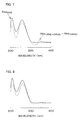
- Fig. 7 shows a UV absorption spectrum of a mixture of naphthyridine dimer and RRE.
- the solid line indicates the UV absorption spectrum of RRE alone
- the dotted line indicates a UV absorption spectrum when the absorption of naphthyridine dimer free is subtracted from the absorption of the mixture of naphthyridine dimer and RRE.
- Fig. 8 shows a UV absorption spectrum of a mixture of the naphthyridine-azaquinolone hybrid and RRE.
- the solid line indicates the UV absorption spectrum of RRE alone
- the dotted line indicates a UV absorption spectrum when the absorption of the naphthyridine-azaquinolone hybrid free is subtracted from the absorption of the mixture of the naphthyridine-azaquinolone hybrid and RRE.
- Fig. 9 shows a UV absorption spectrum of a mixture the first quinoline-containing compound and RRE.
- the solid line indicates the UV absorption spectrum of RRE alone
- the dotted line indicates a UV absorption spectrum when the absorption of the first quinoline-containing compound free is subtracted from the absorption of the mixture of the first quinoline-containing compound and RRE.
- the first quinoline-containing compound is obtained by replacing one naphthyridine of naphthyridine dimer with a quinoline incapable of hydrogen-binding to a guanine.
- Fig. 10 shows a UV absorption spectrum of a mixture of a second quinoline-containing compound and RRE.
- the solid line indicates the UV absorption spectrum of RRE alone
- the dotted line indicates a UV absorption spectrum when the absorption of the second quinoline-containing compound free is subtracted from the absorption of the mixture of the second quinoline-containing compound and RRE.
- the second quinoline-containing compound is obtained by replacing one naphthyridine of naphthyridine dimer with a quinoline incapable of hydrogen-binding to a guanine.
- comparison was made within a range of 300 nm to 400 nm where no absorption of RRE occurs.
- Figs. 7 to 10 shows that there was significant changes in the UV absorption spectra when naphthyridine dimer capable of recognizing a GG mismatch and the naphthyridine-azaquinolone hybrid capable of recognizing a GA mismatch were used and, however, that there were no remarkable changes when the first and second quinoline-containing compounds were used, each of which contains quinoline in replacement of one naphthyridine ring.
- the quinoline is incapable of form hydrogen bond with guanine.
- Naphthyridine is represented by structural formula (9).
- Azaquinolone is represented by structural formula (10).
- Quinolone is represented by structural formula (11). Comparing absorption of naphthyridine, azaquinolone, or quinolone alone and a mixture of naphthyridine, azaquinolone, or quinolone with RRE, there were almost no changes in a range of 300 nm to 400 nm.
- Figs. 11-13 respectively illustrate the UV absorption spectra of naphthyridine, azaquinolone, or quinolone alone and the mixture thereof with RRE.
- the solid line indicates a CD spectrum of RRE alone
- the dotted line indicates a CD spectrum of a mixture of naphthyridine dimer and RRE
- the dashed line indicates a CD spectrum of a mixture of the naphthyridine-azaquinolone hybrid and RRE.
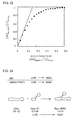
- RRE-neg has no internal loop found in RRE, the internal loop including a GG mismatch and a GA mismatch.
- RRE-neg has a base sequence shown in Fig. 16.
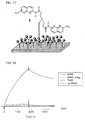
- a binding strength of each of RRE, RRE-neg, TAR, and single-stranded RNA (ss RNA) with respect to naphthyridine dimer immobilized on an SPR sensor chip was analyzed.
- TAR is known as an HIV-RNA target.
- the result of the analysis is shown in Fig. 18.
- the solid line indicates the binding strength of RRE
- the dotted line the binding strength of RRE-neg
- the dashed line the binding strength of TAR
- the double-dashed line the binding strength of ssRNA.
- a base sequence of TAR is shown in Fig. 19, and a base sequence of ssRNA is shown in Fig. 20.
- Figs. 21 and 22 show UV absorption spectra of naphthyridine dimer in the presence of RRE of various concentrations.
- Fig. 22 shows a proportion of naphthyridine dimer binding to RRE to the whole naphthyridine dimer added to RRE, the proportion being calculated from an absorption intensity at 332 nm of Fig. 21.
- a greater molecular weight results in a greater polarization degree, i.e., a greater anisotropy.
- a complex of (a) a Rev peptide (hereinafter abbreviated as "Rev-Fl") fluorescent labeled with fluorescein and (b) RRE, the molecular weight increases, and the anisotropy increases accordingly.
- the Rev-Fl has a structure shown in Fig. 24.
- Fig. 26 shows, in a descending order of anisotropic values, a dissociation curve of the case where the neomycine B was added to RRE, a dissociation curve of the case where the naphthyridine-azaquinolone hybrid was added to RRE, and a dissociation curve of the case where naphthyridine dimer was added to RRE.
- the horizontal axis indicates the concentration of each of the inhibitors.
- Fig. 26 shows that the decreases of the anisotropy were observed at lower concentrations in the use of naphthyridine dimer or naphthyridine-azaquinolone hybrid than in the use of neomycine B. This showed that naphthyridine dimer and the naphthyridine-azaquinolone hybrid have higher potency of inhibiting Rev-RRE complex formation than neomycine B.
- neomycine had an IC 50 value of 4 ⁇ M for inhibiting complex formation
- naphthyridine dimer had an IC 50 value of 1.2 ⁇ M for inhibiting complex formation
- the naphthyridine-azaquinolone hybrid had an IC 50 value of 2 ⁇ M for inhibiting complex formation.
- An IC 50 value of the trinaphthyridine-azaquinolone hybrid used as an inhibitor was obtained by using the fluorescence polarization method.
- the IC 50 value of the trinaphthyridine-azaquinolone hybrid was 0.2 ⁇ M. Further, in Fig.
- the solid line indicates how a CD spectrum of RRE alone was changed
- the dotted line indicates how a CD spectrum of RRE was changed when naphthyridine dimer was added to RRE
- the dashed line indicates how a CD spectrum of RRE was changed when the trinaphthyridine-azaquinolone hybrid was added to RRE
- Naphthyridine dimer, the naphthyridine-azaquinolone hybrid, the neomycine B, and the trinaphthyridine-azaquinolone hybrid were used as inhibitors, and anisotropies of each of the inhibitors was measured. The results of the measurement are shown in Fig. 28. (Fig.
- an inhibitor according to the present invention is an inhibitor for inhibiting binding of RRE to Rev protein.
- the inhibitor is arranged so as to contain naphthyridine dimer represented by general formula (1).
- the inhibitor according to the present invention is arranged so as to contain the naphthyridine-azaquinolone hybrid represented by general formula (2).
- the inhibitor according to the present invention is arranged so as to contain the trinaphthyridine-azaquinolone hybrid represented by general formula (3).
- the inhibitor according to the present invention is arranged so as to contain the trinaphthyridine-azaquinolone hybrid derivative represented by general formula (4).
- An inhibitor of the present invention can be used as an anti-AIDS medicine which suppresses development of AIDS.
- a naphthyridine derivative of the present invention can be used as a component of the foregoing inhibitor.
- a naphthyridine-dimer-containing aldehyde and a naphthyridine-azaquinolone-hybrid-containing aldehyde of the present invention can be used as intermediates during production of a trinaphthyridine-azaquinolone hybrid and a derivative thereof.
- a substrate and a sensor chip of the present invention can be used to arrange an instrument, such as a chip, a cuvette, or a plate, which has a function of detecting RRE contained in a culture medium or in a blood fluid.
Landscapes
- Organic Chemistry (AREA)
- Chemical & Material Sciences (AREA)
- Health & Medical Sciences (AREA)
- Life Sciences & Earth Sciences (AREA)
- General Chemical & Material Sciences (AREA)
- Public Health (AREA)
- Medicinal Chemistry (AREA)
- Nuclear Medicine, Radiotherapy & Molecular Imaging (AREA)
- Chemical Kinetics & Catalysis (AREA)
- Pharmacology & Pharmacy (AREA)
- Virology (AREA)
- Animal Behavior & Ethology (AREA)
- General Health & Medical Sciences (AREA)
- Veterinary Medicine (AREA)
- Engineering & Computer Science (AREA)
- AIDS & HIV (AREA)
- Tropical Medicine & Parasitology (AREA)
- Molecular Biology (AREA)
- Bioinformatics & Cheminformatics (AREA)
- Communicable Diseases (AREA)
- Oncology (AREA)
- Nitrogen Condensed Heterocyclic Rings (AREA)
- Pharmaceuticals Containing Other Organic And Inorganic Compounds (AREA)
Applications Claiming Priority (3)
| Application Number | Priority Date | Filing Date | Title |
|---|---|---|---|
| JP2003054725 | 2003-02-28 | ||
| JP2003054725 | 2003-02-28 | ||
| PCT/JP2004/002314 WO2004076463A1 (fr) | 2003-02-28 | 2004-02-26 | Inhibiteurs |
Publications (2)
| Publication Number | Publication Date |
|---|---|
| EP1604993A1 true EP1604993A1 (fr) | 2005-12-14 |
| EP1604993A4 EP1604993A4 (fr) | 2008-05-21 |
Family
ID=32923470
Family Applications (1)
| Application Number | Title | Priority Date | Filing Date |
|---|---|---|---|
| EP04714951A Withdrawn EP1604993A4 (fr) | 2003-02-28 | 2004-02-26 | Inhibiteurs |
Country Status (5)
| Country | Link |
|---|---|
| US (1) | US20070037841A1 (fr) |
| EP (1) | EP1604993A4 (fr) |
| JP (1) | JP4575879B2 (fr) |
| CN (1) | CN100453547C (fr) |
| WO (1) | WO2004076463A1 (fr) |
Cited By (1)
| Publication number | Priority date | Publication date | Assignee | Title |
|---|---|---|---|---|
| WO2015061573A1 (fr) * | 2013-10-23 | 2015-04-30 | The United States Of America, As Represented By The Secretary, Department Of Health & Human Services | Composés qui se lient à l'élément de réponse rev du virus de l'immunodéficience humaine |
Families Citing this family (2)
| Publication number | Priority date | Publication date | Assignee | Title |
|---|---|---|---|---|
| JP4701378B2 (ja) * | 2004-10-07 | 2011-06-15 | 国立大学法人京都大学 | ミスマッチ塩基対検出分子およびミスマッチ塩基対検出方法、並びにその利用 |
| WO2008106594A2 (fr) * | 2007-02-28 | 2008-09-04 | The Arizona Board Of Regents, On Behalf Of The University Of Arizona | Inhibiteurs de la nucléophosmine (npm) et procédés d'induction de l'apoptose |
Family Cites Families (4)
| Publication number | Priority date | Publication date | Assignee | Title |
|---|---|---|---|---|
| US4016274A (en) * | 1973-05-15 | 1977-04-05 | Rhone-Poulenc S.A. | Naphthyridine derivatives |
| JP3705975B2 (ja) * | 1999-11-26 | 2005-10-12 | 独立行政法人科学技術振興機構 | ミスマッチ認識分子 |
| JP3725405B2 (ja) * | 2000-07-17 | 2005-12-14 | 独立行政法人科学技術振興機構 | テロメアなどに結合し得る分子、それを用いた方法 |
| JP4011937B2 (ja) * | 2002-03-07 | 2007-11-21 | 独立行政法人科学技術振興機構 | ミスマッチ検出分子 |
-
2004
- 2004-02-26 JP JP2005502933A patent/JP4575879B2/ja not_active Expired - Fee Related
- 2004-02-26 US US10/547,234 patent/US20070037841A1/en not_active Abandoned
- 2004-02-26 CN CNB2004800053323A patent/CN100453547C/zh not_active Expired - Fee Related
- 2004-02-26 EP EP04714951A patent/EP1604993A4/fr not_active Withdrawn
- 2004-02-26 WO PCT/JP2004/002314 patent/WO2004076463A1/fr not_active Ceased
Cited By (3)
| Publication number | Priority date | Publication date | Assignee | Title |
|---|---|---|---|---|
| WO2015061573A1 (fr) * | 2013-10-23 | 2015-04-30 | The United States Of America, As Represented By The Secretary, Department Of Health & Human Services | Composés qui se lient à l'élément de réponse rev du virus de l'immunodéficience humaine |
| US10464970B2 (en) | 2013-10-23 | 2019-11-05 | The United States Of America As Represented By The Secretary, Department Of Health And Human Services | Compounds that bind to human immunodeficiency virus rev response element |
| US11692010B2 (en) | 2013-10-23 | 2023-07-04 | The United States Of America, As Represented By The Secretary, Department Of Health And Human Services | Compounds that bind to human immunodeficiency virus rev response element |
Also Published As
| Publication number | Publication date |
|---|---|
| JP4575879B2 (ja) | 2010-11-04 |
| CN1753900A (zh) | 2006-03-29 |
| US20070037841A1 (en) | 2007-02-15 |
| JPWO2004076463A1 (ja) | 2006-06-01 |
| CN100453547C (zh) | 2009-01-21 |
| WO2004076463A1 (fr) | 2004-09-10 |
| EP1604993A4 (fr) | 2008-05-21 |
Similar Documents
| Publication | Publication Date | Title |
|---|---|---|
| US6720188B2 (en) | Methods and kits for the detection of arginine compounds | |
| US6916925B1 (en) | Dye labeled imidazoquinoline compounds | |
| Biot et al. | Novel metallocenic compounds as antimalarial agents. Study of the position of ferrocene in chloroquine | |
| US10745393B2 (en) | Small molecular probes, processes and use thereof | |
| CN105758984B (zh) | 衍生化hplc‑dad法测定药物中小分子卤代羧酸的方法 | |
| JP7523166B2 (ja) | コロナウイルス3clプロテアーゼを標的とするvhlリガンドに基づくprotac、およびその調製方法と応用 | |
| AU2002314227B2 (en) | Labelling reagents, method for synthesis of said reagents and methods for detecting biological molecules | |
| US20120171665A1 (en) | Fluorescent markers and use thereof for labeling specific protein targets | |
| CN101225070A (zh) | 用于抗肿瘤的药物 | |
| Ribeiro et al. | Squaric acid/4-aminoquinoline conjugates: Novel potent antiplasmodial agents | |
| EP1604993A1 (fr) | Inhibiteurs | |
| CN101641598B (zh) | 确定聚谷氨酸-紫杉烷结合物中结合的紫杉烷的量的方法 | |
| US20050176647A1 (en) | Novel hairpin polyamide | |
| CN111138387B (zh) | 一种氰基呋喃酮类衍生物荧光探针及其制备方法和应用 | |
| Wall et al. | Evaluation of N-(phenylmethyl)-4-[5-(phenylmethyl)-4, 5, 6, 7-tetrahydro-1H-imidazo [4, 5-c] pyridin-4-yl] benzamide inhibitors of Mycobacterium tuberculosis growth | |
| CN114044768B (zh) | 吡咯类bet降解剂及其应用 | |
| Mosher et al. | 2-Deaminoactinomycin D, synthesis and interaction with deoxyribonucleic acid | |
| EP2899531A2 (fr) | Procédé de détection d'un analyte chiral | |
| CN108017652B (zh) | 四氢喹喔啉衍生物及在检测C-kit G-四链体DNA和抑制胃肠道间质瘤中的应用 | |
| Cavicchioni et al. | Biological activity of for-Met-Leu-Phe-OMe analogs: relevant substitutions specifically trigger killing mechanisms in human neutrophils | |
| CN119954832B (zh) | 一种kras小分子荧光探针及其制备方法和应用 | |
| US20250155452A1 (en) | NLRP3 Variants & Library Screen for NLRP3 Inhibitors with the Same | |
| CA1312604C (fr) | Derives de tetra-hydro-2,3,6,7,1h,5h,11h-(1)benzopyrano (6,7,8,ij)quinolizinone-11 utilisables comme marqueurs de composes organiques en vue de la detection de ces composes par chimiluminescence ou fluorescence | |
| Attaby et al. | Chemistry and Biological Activities of 6-pyridin-3-yl-1H-pyrazolo [3, 4-b] pyridin-3-amines (I) | |
| Genady | Synthesis and characterization of novel color chemosensors based on azo dyes for possible application in opioid pharmacology |
Legal Events
| Date | Code | Title | Description |
|---|---|---|---|
| PUAI | Public reference made under article 153(3) epc to a published international application that has entered the european phase |
Free format text: ORIGINAL CODE: 0009012 |
|
| 17P | Request for examination filed |
Effective date: 20050921 |
|
| AK | Designated contracting states |
Kind code of ref document: A1 Designated state(s): AT BE BG CH CY CZ DE DK EE ES FI FR GB GR HU IE IT LI LU MC NL PT RO SE SI SK TR |
|
| AX | Request for extension of the european patent |
Extension state: AL LT LV MK |
|
| RIN1 | Information on inventor provided before grant (corrected) |
Inventor name: KOBORI, AKIO Inventor name: GOTO, YUKI Inventor name: HAGIWARA, SHINYA Inventor name: SAITO, ISAO Inventor name: HORIE, SOUTA Inventor name: NAKATANI, KAZUHIKO |
|
| DAX | Request for extension of the european patent (deleted) | ||
| RBV | Designated contracting states (corrected) |
Designated state(s): CH DE FR GB LI SE |
|
| A4 | Supplementary search report drawn up and despatched |
Effective date: 20080422 |
|
| RIC1 | Information provided on ipc code assigned before grant |
Ipc: G01N 33/53 20060101ALI20080416BHEP Ipc: G01N 33/566 20060101ALI20080416BHEP Ipc: A61P 43/00 20060101ALI20080416BHEP Ipc: A61P 31/18 20060101ALI20080416BHEP Ipc: A61K 31/4375 20060101ALI20080416BHEP Ipc: C07D 519/00 20060101ALI20080416BHEP Ipc: C07D 471/04 20060101AFI20080416BHEP |
|
| 17Q | First examination report despatched |
Effective date: 20091009 |
|
| STAA | Information on the status of an ep patent application or granted ep patent |
Free format text: STATUS: THE APPLICATION IS DEEMED TO BE WITHDRAWN |
|
| 18D | Application deemed to be withdrawn |
Effective date: 20110621 |