EP1605623A2 - Procédé et dispositif de communication avec transmission multiple - Google Patents
Procédé et dispositif de communication avec transmission multiple Download PDFInfo
- Publication number
- EP1605623A2 EP1605623A2 EP04029179A EP04029179A EP1605623A2 EP 1605623 A2 EP1605623 A2 EP 1605623A2 EP 04029179 A EP04029179 A EP 04029179A EP 04029179 A EP04029179 A EP 04029179A EP 1605623 A2 EP1605623 A2 EP 1605623A2
- Authority
- EP
- European Patent Office
- Prior art keywords
- peer
- data block
- transmitting
- transmitter
- receiving
- Prior art date
- Legal status (The legal status is an assumption and is not a legal conclusion. Google has not performed a legal analysis and makes no representation as to the accuracy of the status listed.)
- Withdrawn
Links
- 238000000034 method Methods 0.000 title claims description 37
- 238000004891 communication Methods 0.000 title claims description 29
- 230000005540 biological transmission Effects 0.000 title claims description 25
- 230000004044 response Effects 0.000 claims description 23
- 238000010586 diagram Methods 0.000 description 12
- 238000012545 processing Methods 0.000 description 6
- 230000001934 delay Effects 0.000 description 2
- 230000002035 prolonged effect Effects 0.000 description 2
- 238000013139 quantization Methods 0.000 description 2
- 238000012937 correction Methods 0.000 description 1
- 125000004122 cyclic group Chemical group 0.000 description 1
- 230000001419 dependent effect Effects 0.000 description 1
- 238000011161 development Methods 0.000 description 1
- 230000018109 developmental process Effects 0.000 description 1
- 230000000694 effects Effects 0.000 description 1
- 230000011664 signaling Effects 0.000 description 1
Images



Classifications
-
- H—ELECTRICITY
- H04—ELECTRIC COMMUNICATION TECHNIQUE
- H04L—TRANSMISSION OF DIGITAL INFORMATION, e.g. TELEGRAPHIC COMMUNICATION
- H04L1/00—Arrangements for detecting or preventing errors in the information received
- H04L1/12—Arrangements for detecting or preventing errors in the information received by using return channel
- H04L1/16—Arrangements for detecting or preventing errors in the information received by using return channel in which the return channel carries supervisory signals, e.g. repetition request signals
- H04L1/18—Automatic repetition systems, e.g. Van Duuren systems
- H04L1/1829—Arrangements specially adapted for the receiver end
- H04L1/1858—Transmission or retransmission of more than one copy of acknowledgement message
-
- H—ELECTRICITY
- H04—ELECTRIC COMMUNICATION TECHNIQUE
- H04L—TRANSMISSION OF DIGITAL INFORMATION, e.g. TELEGRAPHIC COMMUNICATION
- H04L1/00—Arrangements for detecting or preventing errors in the information received
- H04L1/12—Arrangements for detecting or preventing errors in the information received by using return channel
- H04L1/16—Arrangements for detecting or preventing errors in the information received by using return channel in which the return channel carries supervisory signals, e.g. repetition request signals
- H04L1/18—Automatic repetition systems, e.g. Van Duuren systems
- H04L1/1812—Hybrid protocols; Hybrid automatic repeat request [HARQ]
-
- H—ELECTRICITY
- H04—ELECTRIC COMMUNICATION TECHNIQUE
- H04L—TRANSMISSION OF DIGITAL INFORMATION, e.g. TELEGRAPHIC COMMUNICATION
- H04L1/00—Arrangements for detecting or preventing errors in the information received
- H04L1/12—Arrangements for detecting or preventing errors in the information received by using return channel
- H04L1/16—Arrangements for detecting or preventing errors in the information received by using return channel in which the return channel carries supervisory signals, e.g. repetition request signals
- H04L1/18—Automatic repetition systems, e.g. Van Duuren systems
- H04L1/1829—Arrangements specially adapted for the receiver end
- H04L1/1835—Buffer management
- H04L1/1845—Combining techniques, e.g. code combining
-
- H—ELECTRICITY
- H04—ELECTRIC COMMUNICATION TECHNIQUE
- H04L—TRANSMISSION OF DIGITAL INFORMATION, e.g. TELEGRAPHIC COMMUNICATION
- H04L1/00—Arrangements for detecting or preventing errors in the information received
- H04L1/12—Arrangements for detecting or preventing errors in the information received by using return channel
- H04L1/16—Arrangements for detecting or preventing errors in the information received by using return channel in which the return channel carries supervisory signals, e.g. repetition request signals
- H04L1/18—Automatic repetition systems, e.g. Van Duuren systems
- H04L1/1867—Arrangements specially adapted for the transmitter end
- H04L1/189—Transmission or retransmission of more than one copy of a message
-
- H—ELECTRICITY
- H04—ELECTRIC COMMUNICATION TECHNIQUE
- H04L—TRANSMISSION OF DIGITAL INFORMATION, e.g. TELEGRAPHIC COMMUNICATION
- H04L1/00—Arrangements for detecting or preventing errors in the information received
- H04L1/12—Arrangements for detecting or preventing errors in the information received by using return channel
- H04L1/16—Arrangements for detecting or preventing errors in the information received by using return channel in which the return channel carries supervisory signals, e.g. repetition request signals
- H04L1/18—Automatic repetition systems, e.g. Van Duuren systems
- H04L1/1803—Stop-and-wait protocols
Definitions
- the present invention relates to communicating data between transmitting and receiving peers according to the pre-characterizing clauses of claims 1, 13, and 19.
- Modern electronic communications systems are widely implemented in devices such as the ubiquitous mobile radio telephone (cell phone). To meet the demands of ongoing improvements in such devices, increased data rates are required for improving transmission of voice and data (e.g. digital pictures). However, with increased data rates comes increased susceptibility to noise. As such, improvements in error correction and compensation in electronic communications systems are readily embraced by the communications industry.
- the indication of receiving status of the data block could be either of the following: (1) a positive or negative acknowledgement reported by the receiver, or (2) a corresponding response of the data block from the receiver when the receiver has received the data block successfully.
- the state-of-the-art system suffers from several disadvantages. For example, in a noisy communication environment, it is possible for several bits of a transmitted data block to become corrupted. Moreover, a retransmission and a positive or negative acknowledgement may also become corrupted. Thus, in a noisy communication environment, time spent waiting to receive an acknowledgement can be substantially prolonged. Such extended transmission times result in poor performance of communications systems.
- the present invention aims at providing a method of communicating data between transmitting and receiving peers that allows the receiver to quickly combine erroneous received instances of the block when required.
- the claimed method includes successively transmitting a first predetermined number of more than one identical instances of a data block with a first peer, receiving at least two of the first predetermined number of identical instances of the data block at a second peer, and combining more than one corrupted received data blocks to form a complete instance of the data block at the second peer.
- Successively transmitting a predetermined number of more than one identical instances of a data block without waiting for indication of a negative acknowledgement or time out allows a data block combining capable receiver to quickly combine several erroneous copies of the transmitted data block to form a complete and correct instance of the transmitted data block.
- transmitting a predetermined number of more than one identical instances of a data block anticipates transmission errors and preempts delay-causing receiver acknowledgement signals, thereby increasing an over all data transmission rate.
- whether to retransmit the previously transmitted data block or to transmit the next data block is decided by an indication of the receiving status of the previously transmitted data block.
- the indication of receiving status of the previous data block could be either of the following: (1) a positive or negative acknowledgement reported by the receiver, or (2) a corresponding response of the previous data block from the receiver when the receiver has received the previous data block successfully.
- One example of the first kind of indication of receiving status of the previous data block is the stop-and-wait (SAW) hybrid automatic-repeat-request (HARQ) mechanism used in high-speed downlink packet access (HSDPA) systems, such as that specified in the 3GPP TS 25.321 V5.6.0 (2003-9) Medium Access Control (MAC) protocol specification.
- SAW stop-and-wait
- HARQ hybrid automatic-repeat-request
- HSDPA high-speed downlink packet access
- MAC Medium Access Control
- the receiver When the data block is retransmitted by the transmitter and received by the receiver, the receiver combines the newly received data block with the data saved in the soft buffer with proper weighting factors and again checks the CRC. If the CRC shows the combined data block is still corrupted, the procedure is repeated. If the CRC shows the combined data block is correct, the data block is delivered to an upper layer and a positive acknowledgement (ACK) is reported back to the transmitter. When the transmitter receives the ACK status report, it proceeds to transmit the next data block.
- ACK positive acknowledgement
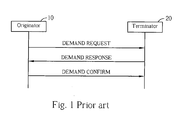
- Fig.1 illustrates a typical demand request procedure according to the prior art.
- An originator 10 sends an DEMAND REQUEST message to a terminator 20. If this message is received successfully by the terminator 20 and if the terminator 20 successfully verifies the content of the message, the terminator 20 responds with an DEMAND RESPONSE message to the originator 10.
- the originator 10 receives the DEMAND RESPONSE message, it checks the content of the message. Upon verifying the content, the originator 10 sends its second message, an DEMAND CONFIRM message.
- the demand request procedure ends.
- Fig.2 illustrates what happens in the typical demand request procedure when the DEMAND REQUEST message is rejected. If the terminator 20 determines that the content of the DEMAND REQUEST message is unsatisfactory, it returns an DEMAND REJECT message to the originator 10. Upon receiving the DEMAND REJECT message, the demand request procedure ends. The originator 10 may decide to retransmit the DEMAND REQUEST message again later to restart the demand request procedure.
- a time-out mechanism can be activated, and the message can be automatically retransmitted when an expected response (such as either the DEMAND RESPONSE message of Fig.1, DEMAND REJECT message of Fig. 2 expected by the originator 10, or the DEMAND CONFIRM message expected by the terminator 20) is not received before a predetermined time expires.
- an expected response such as either the DEMAND RESPONSE message of Fig.1, DEMAND REJECT message of Fig. 2 expected by the originator 10, or the DEMAND CONFIRM message expected by the terminator 20
- the state-of-the-art system described above suffers from several disadvantages.
- a noisy communication environment it is possible for several bits of a transmitted (or retransmitted) data block to become corrupted.
- the CRC mechanism can usually detect this situation, it cannot automatically correct corrupted bits.
- the SAW HARQ mechanism utilizes time diversity efficiently so that the number of retransmissions can be reduced dramatically.
- the delays of the data block transmission and the status report cause the procedure to take longer than necessary.
- Fig.1 Take Fig.1 as an example.
- the terminator 20 cannot know that the originator 10 is waiting for a response, and so nothing is returned. After a time out without receiving any expected responding message, the originator 10 retransmits the DEMAND REQUEST message. In a noisy environment, this retransmission may also become corrupted. Thus, in a noisy communication environment, the duration of the demand request procedure can be substantially prolonged.
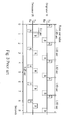
- Fig.3 illustrates a timing diagram of retransmitting the DEMAND REQUEST, called data block A hereafter, and the DEMAND RESPONSE, called data block B hereafter, according to the prior art.
- the dashed boundaries of blocks on the Tx row in Fig.3 indicate that they are not actually transmitted but are supposed to be transmitted.
- the dashed boundaries of blocks on the Rx row in Fig.3 indicate that they are not actually received correctly but are supposed to be received with CRC error.
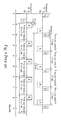
- Fig.4 illustrates the timing diagram of retransmitting data block B.
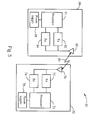
- the system 50 includes two peers 60, 70, which are communications devices such as mobile telephones, base stations or the like. Peers 60 and 70 could be both mobile telephones.
- the peer 60 includes a processor 61 connected to both a transmitter 62 and a receiver 64.
- the transmitter 62 and receiver 64 are connected to an antenna 66.
- a power supply such as a battery or power outlet line
- the antenna 66 can be shared by the transmitter 62 and receiver 64 as shown, or alternatively, two separate antennas can be provided.
- the processor 61 controls all operations of the peer 60, such as forwarding data to be transmitted to the transmitter 62 and processing data received at the receiver 64.
- the receiver 64 is capable of combining more than one corrupted received data block to form a complete instance of the data block.
- the peer 70 includes a processor 71, a transmitter 72, a receiver 74, an antenna 76, and a power supply 78.
- the peers 60, 70 communicate over a channel 80 such as a dedicated EM band (radio, microwave, etc) or a communication link over mobile network.
- the processors 61, 71 control the transmitters 62, 72 to successively transmit a predetermined number of identical instances of each data block to be sent.
- the processor 61 controls the transmitter 62 to send the data block several times without waiting for indication of a negative acknowledgement or time out.
- suitable delays between successive transmissions range from substantially no delay to roughly the expected duration for acknowledgement.
- the receiver 74 is capable of merging several corrupted blocks to properly reconstruct the sent data block. Since the main purpose in sending the same data block successively is to counter the effects of a noisy transmission environment, the predetermined number can be selected according to expected noise levels.
- the processor 61 of the peer 60 determines a data block to be sent to the peer 70.
- a data block can be of a group of user data such as segments of digital pictures or a group of signaling messages such as demand request message or demand response message to be communicated from the peer 60 to the peer 70.
- the processor 61 controls the transmitter 62 to successively transmit the data block a number of times. In other words, rather than remaining idle while waiting for an expected response or a status report from the peer 70, the peer 60 retransmits the data block one or more times.
- the receiver 74 of the peer 70 receives some quantity of the transmitted copies of the data block with varying degrees of accuracy.
- the receiver 74 would receive all instances of the data block correctly. While in a noisy environment, the receiver 74 may only receive erroneous (e.g. indicated by CRC) instances of the data block. During reception of instances of the data block, the receiver 74 reconstructs the original data block via a proper data combining mechanism until the CRC indicates that there is no data corruption in the combined data block. If the receiver 74 receives a correct instance of the data block, no data combination is needed and the receiver 74 simply neglects the other copies of the data block. Naturally, the peer 70 can transmit to the peer 60 in the same manner.
- CRC erroneous
- the communications system 50 is shown operating to transmit a data block 90.
- the processor 61 of the peer 60 forwards a number of (e.g. five) instances of the data block 90 to the transmitter 62, which then transmits all five instances over the path 80 via the antenna 66.
- the antenna 76 and receiver 74 of the peer 70 receive this transmission as illustrated by the data blocks 90a-90e.
- the data blocks 90a-90e have varying erroneous bits 92, such that the receiver 74 must combine at least two of the data blocks 90a-90e to reconstruct the original data block 90 successfully. In actual application, one of the data blocks 90a-90e may be entirely correctly received, with such combination by the receiver 74 being unnecessary.
- the receiver 74 performs any required block combination, it forwards the correct data block 90 to the processor 71. Only if the receiver 74 could not combine the data blocks 90a-90e to form the complete data block 90 would the receiver 74 indicate to the processor 71 that the data block 90 was not received correctly. As a result, the present invention method can ensure that the data block 90 is quickly and correctly transmitted.
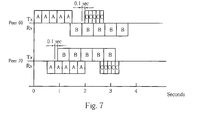
- Fig. 7 illustrating an example of the above method.
- the transmission times for data blocks A, B, and C are respectively 0.3 seconds, 0.45 seconds, and 0.15 seconds.
- the one-way transmission delay is 0.5 seconds.
- Both the processing times for data blocks A and B are 0.1 second.
- the peer 60 sends five copies of data block A, and the peer 70 receives the first copy of the data block A successfully. After the processing time of 0.1 second for data block A, the peer 70 responds with five copies of data block B. The peer 60 receives the first copy of data block B successfully. Then, after the processing time of 0.1 second for data block B, the peer 60 sends five copies of data block C.
- the communications system 50 operates in an ideal communications environment, and as such, the advantage of the present invention method is not apparent. Regardless, one can see that there are no penalties induced by the present invention method under the circumstances that the channel resources are reserved for peers 60 and 70.
- peer 70 may choose to stop transmission of the fifth instance of data block B if the first receiving instance of data block C is error free.
- a peer can interrupt the predetermined number of transmission instances of a data block while an expected response is correctly received.
- the expected response could be a positive acknowledgment of the data block or any possible responding message of the data block.
- the timing diagram of the present invention is illustrated in Fig.8.
- the present invention successively transmits a given data block several times without waiting for indication of a negative acknowledgement or time out. This allows a data block combining capable receiver to quickly combine several erroneous copies of the transmitted data block to form a complete and correct instance of the transmitted data block. That is, the present invention method anticipates transmission errors and preempts delay-causing receiver acknowledgement signals. As a result, the present invention utilizes the resources of a dedicated channel to maximum extent.
Landscapes
- Engineering & Computer Science (AREA)
- Computer Networks & Wireless Communication (AREA)
- Signal Processing (AREA)
- Detection And Prevention Of Errors In Transmission (AREA)
- Mobile Radio Communication Systems (AREA)
Applications Claiming Priority (2)
| Application Number | Priority Date | Filing Date | Title |
|---|---|---|---|
| US10/710,019 US20050276224A1 (en) | 2004-06-13 | 2004-06-13 | Multiple transmission communications method and device |
| US710019 | 2004-06-13 |
Publications (2)
| Publication Number | Publication Date |
|---|---|
| EP1605623A2 true EP1605623A2 (fr) | 2005-12-14 |
| EP1605623A3 EP1605623A3 (fr) | 2006-12-06 |
Family
ID=34980332
Family Applications (1)
| Application Number | Title | Priority Date | Filing Date |
|---|---|---|---|
| EP04029179A Withdrawn EP1605623A3 (fr) | 2004-06-13 | 2004-12-09 | Procédé et dispositif de communication avec transmission multiple |
Country Status (4)
| Country | Link |
|---|---|
| US (1) | US20050276224A1 (fr) |
| EP (1) | EP1605623A3 (fr) |
| CN (1) | CN1707995A (fr) |
| TW (1) | TWI294229B (fr) |
Cited By (2)
| Publication number | Priority date | Publication date | Assignee | Title |
|---|---|---|---|---|
| EP2490340A4 (fr) * | 2009-10-16 | 2016-01-27 | Quadrac Co Ltd | Système de communication sans fil, appareil émetteur, appareil récepteur, procédé de réception, et procédé d'émission |
| WO2017222582A1 (fr) * | 2016-06-20 | 2017-12-28 | Intel IP Corporation | Appareils pour combiner et décoder des blocs codés |
Families Citing this family (6)
| Publication number | Priority date | Publication date | Assignee | Title |
|---|---|---|---|---|
| US20080101246A1 (en) * | 2006-10-31 | 2008-05-01 | Innovative Sonic Limited | Method and apparatus for packet reception and transmission in a wireless communications system |
| TWI418180B (zh) * | 2009-06-24 | 2013-12-01 | 4Ipnet Inc | 無線寬頻傳輸裝置以及適用於此裝置之流量控制方法 |
| WO2011089549A2 (fr) * | 2010-01-20 | 2011-07-28 | Marvell World Trade Ltd | Techniques de compression à utilisateurs multiples |
| US20120011200A1 (en) * | 2010-07-06 | 2012-01-12 | Roxbeam Media Network Corporation | Method and apparatus for data storage in a peer-to-peer network |
| GB2491876A (en) * | 2011-06-15 | 2012-12-19 | Xsilon Ltd | Bit loading in a time and frequency/code divisional multiplexing method |
| US10784989B2 (en) * | 2018-03-14 | 2020-09-22 | Cypress Semiconductor Corporation | Bit error correction for wireless retransmission communications systems |
Citations (1)
| Publication number | Priority date | Publication date | Assignee | Title |
|---|---|---|---|---|
| WO2001080475A1 (fr) * | 2000-04-14 | 2001-10-25 | Qualcomm Incorporated | Procede et appareil de commande d'emission adaptative utilises dans un systeme de communications a debit binaire eleve |
Family Cites Families (11)
| Publication number | Priority date | Publication date | Assignee | Title |
|---|---|---|---|---|
| US5550848A (en) * | 1994-05-13 | 1996-08-27 | Lucent Technologies Inc. | Signaling protocol for a noisy communications channel |
| US5768527A (en) * | 1996-04-23 | 1998-06-16 | Motorola, Inc. | Device, system and method of real-time multimedia streaming |
| US5832000A (en) * | 1997-03-17 | 1998-11-03 | Motorola, Inc. | Method and apparatus for communicating error-tolerant messages |
| US6411799B1 (en) * | 1997-12-04 | 2002-06-25 | Qualcomm Incorporated | Method and apparatus for providing ternary power control in a communication system |
| US6275488B1 (en) * | 1999-11-17 | 2001-08-14 | Motorola, Inc. | Variable rate spread spectrum communication method and apparatus |
| US20030011474A1 (en) * | 2001-07-13 | 2003-01-16 | Ng Sing King | Circuit and method for electronic security seal |
| US6856604B2 (en) * | 2001-12-19 | 2005-02-15 | Qualcomm Incorporated | Efficient multi-cast broadcasting for packet data systems |
| BR0309219A (pt) * | 2002-04-15 | 2005-02-09 | Nokia Corp | Aparelho e método para facilitar a realização da radiofusão dos dados de acordo com o serviço de multimìdia hierárquico |
| US6990317B2 (en) * | 2002-05-28 | 2006-01-24 | Wireless Innovation | Interference resistant wireless sensor and control system |
| US7024162B2 (en) * | 2003-03-27 | 2006-04-04 | Motorola, Inc. | Communication system with call quality indication and method of operation therein |
| US8036710B2 (en) * | 2004-05-07 | 2011-10-11 | Qualcomm, Incorporated | Power-efficient multi-antenna wireless device |
-
2004
- 2004-06-13 US US10/710,019 patent/US20050276224A1/en not_active Abandoned
- 2004-12-09 EP EP04029179A patent/EP1605623A3/fr not_active Withdrawn
- 2004-12-10 TW TW093138347A patent/TWI294229B/zh not_active IP Right Cessation
- 2004-12-24 CN CNA2004100114475A patent/CN1707995A/zh active Pending
Patent Citations (1)
| Publication number | Priority date | Publication date | Assignee | Title |
|---|---|---|---|---|
| WO2001080475A1 (fr) * | 2000-04-14 | 2001-10-25 | Qualcomm Incorporated | Procede et appareil de commande d'emission adaptative utilises dans un systeme de communications a debit binaire eleve |
Cited By (2)
| Publication number | Priority date | Publication date | Assignee | Title |
|---|---|---|---|---|
| EP2490340A4 (fr) * | 2009-10-16 | 2016-01-27 | Quadrac Co Ltd | Système de communication sans fil, appareil émetteur, appareil récepteur, procédé de réception, et procédé d'émission |
| WO2017222582A1 (fr) * | 2016-06-20 | 2017-12-28 | Intel IP Corporation | Appareils pour combiner et décoder des blocs codés |
Also Published As
| Publication number | Publication date |
|---|---|
| TW200541263A (en) | 2005-12-16 |
| CN1707995A (zh) | 2005-12-14 |
| EP1605623A3 (fr) | 2006-12-06 |
| TWI294229B (en) | 2008-03-01 |
| US20050276224A1 (en) | 2005-12-15 |
Similar Documents
| Publication | Publication Date | Title |
|---|---|---|
| AU2005237368B2 (en) | Packet data transmitting method and mobile communication system using the same | |
| CA2563733C (fr) | Procede et systeme pour assurer des retransmissions autonomes dans un systeme de communication sans fil | |
| RU2477004C2 (ru) | Проверка правильности обнаружения подтверждения приема по схеме н-аrq посредством комбинирования данных и повторного декодирования | |
| US8286047B2 (en) | Soft buffer memory configuration in a communication system | |
| US9363621B2 (en) | System and method adopting a reliable stop-and-wait hybrid automatic repeat request protocol | |
| EP2249505A1 (fr) | Gestion de la retransmission de paquets en couche physique dans un système AMRC large bande à transfert sans rupture de charge | |
| US20030174662A1 (en) | Control information signaling method and network element | |
| EP1852996A2 (fr) | Procédés et dispositifs de détection d'erreurs et de retransmission pour des systèmes de communication | |
| US6662330B1 (en) | Joint range reject automatic repeat request protocol | |
| CN101296165B (zh) | 发送控制信令的方法和装置 | |
| US10530538B2 (en) | Hybrid automatic repeat request method and system | |
| CN113259050A (zh) | 一种数据传输方法、装置和系统 | |
| WO2009157859A2 (fr) | Commande d’erreur dans des systèmes sans fil à porteuses multiples | |
| WO2007000696A1 (fr) | Procede et appareil pour h-arq dans un systeme de radiocommunications | |
| EP1605623A2 (fr) | Procédé et dispositif de communication avec transmission multiple | |
| CN108476099A (zh) | 采用重新传送方案的方法和装置 | |
| CN110224788B (zh) | 一种数据传输的方法及装置 | |
| WO2010107374A1 (fr) | Procédés et agencements dans un système de télécommunication sans fil | |
| CN111727576B (zh) | 上行传输方法、装置、接入网设备、终端和存储介质 | |
| EP1479179A2 (fr) | Re-transmission de paquets en couche physique dans un systeme amrc large bande a transfert sans rupture de charge | |
| KR20110065396A (ko) | 통신 방법 |
Legal Events
| Date | Code | Title | Description |
|---|---|---|---|
| PUAI | Public reference made under article 153(3) epc to a published international application that has entered the european phase |
Free format text: ORIGINAL CODE: 0009012 |
|
| 17P | Request for examination filed |
Effective date: 20041209 |
|
| AK | Designated contracting states |
Kind code of ref document: A2 Designated state(s): AT BE BG CH CY CZ DE DK EE ES FI FR GB GR HU IE IS IT LI LT LU MC NL PL PT RO SE SI SK TR |
|
| AX | Request for extension of the european patent |
Extension state: AL BA HR LV MK YU |
|
| PUAL | Search report despatched |
Free format text: ORIGINAL CODE: 0009013 |
|
| AK | Designated contracting states |
Kind code of ref document: A3 Designated state(s): AT BE BG CH CY CZ DE DK EE ES FI FR GB GR HU IE IS IT LI LT LU MC NL PL PT RO SE SI SK TR |
|
| AX | Request for extension of the european patent |
Extension state: AL BA HR LV MK YU |
|
| RIC1 | Information provided on ipc code assigned before grant |
Ipc: H04L 1/18 20060101ALI20061030BHEP Ipc: H04L 1/08 20060101AFI20051004BHEP |
|
| AKX | Designation fees paid |
Designated state(s): AT BE BG CH CY CZ DE DK EE ES FI FR GB GR HU IE IS IT LI LT LU MC NL PL PT RO SE SI SK TR |
|
| 17Q | First examination report despatched |
Effective date: 20070911 |
|
| STAA | Information on the status of an ep patent application or granted ep patent |
Free format text: STATUS: THE APPLICATION IS DEEMED TO BE WITHDRAWN |
|
| 18D | Application deemed to be withdrawn |
Effective date: 20110427 |