EP1606923B1 - Systeme mains libres sans fil a signalisation silencieuse - Google Patents
Systeme mains libres sans fil a signalisation silencieuse Download PDFInfo
- Publication number
- EP1606923B1 EP1606923B1 EP04700151A EP04700151A EP1606923B1 EP 1606923 B1 EP1606923 B1 EP 1606923B1 EP 04700151 A EP04700151 A EP 04700151A EP 04700151 A EP04700151 A EP 04700151A EP 1606923 B1 EP1606923 B1 EP 1606923B1
- Authority
- EP
- European Patent Office
- Prior art keywords
- hands
- free
- silent
- short
- communication terminal
- Prior art date
- Legal status (The legal status is an assumption and is not a legal conclusion. Google has not performed a legal analysis and makes no representation as to the accuracy of the status listed.)
- Expired - Lifetime
Links
Images




Classifications
-
- H—ELECTRICITY
- H04—ELECTRIC COMMUNICATION TECHNIQUE
- H04M—TELEPHONIC COMMUNICATION
- H04M1/00—Substation equipment, e.g. for use by subscribers
- H04M1/60—Substation equipment, e.g. for use by subscribers including speech amplifiers
- H04M1/6033—Substation equipment, e.g. for use by subscribers including speech amplifiers for providing handsfree use or a loudspeaker mode in telephone sets
- H04M1/6041—Portable telephones adapted for handsfree use
- H04M1/6058—Portable telephones adapted for handsfree use involving the use of a headset accessory device connected to the portable telephone
- H04M1/6066—Portable telephones adapted for handsfree use involving the use of a headset accessory device connected to the portable telephone including a wireless connection
-
- H—ELECTRICITY
- H04—ELECTRIC COMMUNICATION TECHNIQUE
- H04M—TELEPHONIC COMMUNICATION
- H04M19/00—Current supply arrangements for telephone systems
- H04M19/02—Current supply arrangements for telephone systems providing ringing current or supervisory tones, e.g. dialling tone or busy tone
- H04M19/04—Current supply arrangements for telephone systems providing ringing current or supervisory tones, e.g. dialling tone or busy tone the ringing-current being generated at the substations
- H04M19/047—Vibrating means for incoming calls
-
- H—ELECTRICITY
- H04—ELECTRIC COMMUNICATION TECHNIQUE
- H04M—TELEPHONIC COMMUNICATION
- H04M2250/00—Details of telephonic subscriber devices
- H04M2250/02—Details of telephonic subscriber devices including a Bluetooth® interface
Definitions
- Such a silent alert function involves the use of a "non-audible" alerting device built into the terminal. This device typically alerts the user to an incoming call, or possibly other events, with vibrations produced by a mechanism such as a piezoelectric vibrator or a motor with an offset mass.
- a mechanism such as a piezoelectric vibrator or a motor with an offset mass.
- WO 03/055183 A1 describes a wireless headset communication system.
- the wireless headset comprises a communication section for wireless transmission and reception of data conforming to a Bluetooth standard.
- the wireless headset comprises a loudspeaker with a vibrating function.
- the loudspeaker having a vibrating function allows the headset to call the user by vibration or by incoming sound.
- the hands-free apparatus is alerted either by a silent alerting action such as by vibration or by a ring tone.
- EP 1 005 241 A1 describes a communication procedure between a mobile and a headset.
- Bluetooth is a standard for short-range wireless connections between various types of microprocessor based devices. Bluetooth supports connectivity between computers and peripherals, computers and wireless terminals, and wireless terminals and peripherals, without the use of linking cables.
- the Bluetooth standard consists of a core specification and supporting documents, including various device profiles that specify signaling required for specific types of devices. The latest core specification is "Specification of the Bluetooth System; Core, version 1.1,” and the latest profiles are contained in “Specification of the Bluetooth System; Profiles, version 1.1,” both published February 2, 2001 by the Bluetooth special interest group (SIG), Inc., and which are incorporated herein by reference.
- the Bluetooth SIG is a consortium of companies such as Ericsson, IBM, Intel, Microsoft, Motorola, and others which promulgates Bluetooth standards.
- Hands-free headsets have been among the first devices to make use of Bluetooth technology.
- Such hands-free headsets implement a hands-free Bluetooth profile.
- Bluetooth connectivity for such headsets means that a headset does not need to be connected via wires to a mobile terminal or other Bluetooth-enabled device. Instead, a user of the headset must simply be within about thirty feet of the terminal device.
- the Bluetooth standards refer to the terminal device as an "audio gateway". When a terminal in this case wants to alert a user to an incoming call or other event, it plays a ring tone through the ear-piece of the headset.
- the user may not be aware of the event, since the terminal could be some distance away and possibly enclosed in a briefcase or switched into a silent alert mode of operation.
- the present invention provides silent alerting capability for a Bluetooth hands-free device or any hands-free device that relies on a short-range, wireless connection to communicate with a terminal.
- the silent alerting... action can be provided by any non-audible signaling mechanism, for example a vibrator or a light. Any of various detailed signaling scenarios could provide this functionality, either with or without modification of existing short-range wireless signaling mechanisms, including the Bluetooth hands-free profile.
- a hands-free device establishes a short-range wireless connection with a communication terminal.
- a silent alerting action is produced in response to an alert message, as opposed to or in addition to an in-band ring tone or other alerting action.
- the alert message received by the hands-free device over the short-range wireless connection may specifically designate that the alerting action be silent.
- This type of alert message may, in some embodiments, result from a user specifically activating a silent mode of operation (hereinafter referred to as “silent alert mode”), either at the communication terminal or at the hands-free device. In this case, subsequent alerts are communicated to the user by means of a non-audible signaling mechanism or mechanisms.
- silent alert mode a silent mode of operation
- the hands-free device sends a silent mode activation message back to the communication terminal over the short-range wireless connection instructing the terminal that subsequent alerts should be silent (e.g. the phone should not "ring” upon receiving a call).
- the hands-free device may or may not mute any in-band ring tone.
- the short-range wireless connection is a Bluetooth connection and all messaging exchanged follows a Bluetooth hands-free profile.
- the terminal In an embodiment where the terminal sends a specific silent alert message to the hands-free, as opposed to sending a normal alerting message that is simply implemented by the HF silently, the terminal must have determined that a user has selected silent alert mode. If a user inputs this information at the terminal, the terminal makes this determination because the user has selected silent alert mode via a normal input device for the terminal. In some embodiments, however, the user can select silent alert mode on the hands-free device, and this selection can be communicated to the terminal via the short-range wireless connection.
- the hands-free apparatus which implements the invention includes a radio frequency (RF) block for the short-range wireless connection, a non-audible signaling mechanism such as a vibrator or light, and normal audio input-output (I/O) devices used for picking up and reproducing voice and other sounds.
- Baseband logic within the hands-free device in some embodiments controls the hands-free device to receive messages and produce the silent alerting action by applying appropriate voltages to the non-audible signaling mechanism.
- Software or microcode, or hard-coded semiconductor devices either of which may make up a portion of the baseband logic, enable the method of the invention to operate within the hands-free device.
- a communication terminal which implements silent alert messages includes: a normal wireless terminal function, herein referred to as the audio gateway (AG) system; a short-range wireless RF block; and short-range baseband logic to control communications over a short-range wireless connection.
- a communication terminal also includes a processing platform operatively connected to the AG system, the short-range baseband logic, RF blocks, and other logic within the communication terminal.
- Software or microcode within the communication terminal controls the terminal to respond to incoming calls or other events, establish an appropriate short-range wireless connection with the hands-free device, and receive and interpret silent mode activation messages if used.
- a combination of the above hardware with appropriate internal microcode, software, or hared coded semiconductor logic forms a means to carry out the invention.
- the present invention will now be described with reference to specific example embodiments. It must be understood that these embodiments are examples only and are not meant to limit the scope of the invention.
- the embodiments described are based on the Bluetooth standards previously discussed.
- the invention could be implemented with hands-free devices and terminals following any short-range wireless communication protocol.
- the embodiments described are disclosed in terms of a mobile or wireless terminal and a hands-free device.
- a hands-free device could be used with many different types of terminals, including a wired or land-line telephone terminal, a computer system, a PDA, a laptop computer, or any type of "pervasive computing device" through or with which a user may desire to communicate using voice or other audible means.
- alert non-audible alert
- terms such as “silent alert,” “non-audible alert” and the like are intended to encompass any alerting mechanism that is primarily intended to alert a user silently relative to a normal ring, notwithstanding that alerting devices, such as a vibrator, may make an incidental sound that can sometimes be heard.
- the Bluetooth standards refer to a terminal as an "audio gateway”, sometimes using the acronym “AG”, because a terminal serves as a gateway onto the wide-area or public network.
- the Bluetooth standards also refer to a headset as a "hands-free” device, often using the acronym “HF”.
- HF Hands-free
- this terminology is used in the specific detailed examples described below, it is not meant to suggest that the invention is limited to a Bluetooth implementation.
- the specific type of non-audible signaling mechanism used in these examples is a vibrator; however other types are envisioned: for example a blinking light.
- FIG. 1 is an external view of hardware implementing some embodiments of the invention.
- communication terminal 102 serves as an AG device.
- HF device 104 communicates with AG 102 via short-range wireless messages 106.
- HF 104 includes an ear-piece 108 which contains baseband and RF components for the HF device.
- Boom 110 connects microphone element 112 to ear-piece 108. Connecting wires for the microphone element are embedded within boom 110.
- ear-piece 108 includes a vibrator 114. This vibrator is connected to baseband logic within ear-piece 108 and serves as a non-audible signaling mechanism in embodiments represented by the hardware of FIG. 1 .
- non-audible signaling mechanism activation of a non-audible signaling mechanism is determined by receipt of a specific silent alert message from AG 102.
- silent alert mode could be activated when a user removes the headset from his ear. This removal would be detected through a circuit connected to baseband logic within ear-piece 108. Such a circuit might be activated optically, or through some sort of micro switch. Additionally, the vibrator or non-audible alerting mechanism could simply be activated for all alerts.
- the non-audible alerting mechanism in this case vibrator 114, would allow the user to be aware of an incoming call or other situation which required an alert (e.g. low battery, Email, short message, etc.).
- FIG. 2 represents an external view of hardware involved in other embodiments of the invention.
- terminal or AG 202 is in communication with HF device 204. Again, communication is via messages 206 sent over a short-range wireless connection, such as Bluetooth.
- HF device 204 includes an earpiece 208, a microphone element 210, and an electronics package 212, all interconnected by a cable 214.
- Electronics package 212 contains baseband and radio frequency (RF) components necessary to communicate with AG 202. This electronics package is embodied as a lapel clip or pin. Non-audible alerting mechanism 216 is included in the electronics package.
- RF radio frequency
- non-audible alerting mechanism is a vibrator
- its vibrations will readily be felt since the electronics package 212 is typically worn on the body whenever the headset is in use, even if the earpiece is temporarily removed.
- switch 218 is present in the electronics package 212, and enables a user to select a silent alert mode, audible ring tone in the headset only, or both. This switch is connected to baseband logic within the electronics package.
- selecting silent alert mode causes a silent mode activation message to be sent to the AG 202 over the short-range wireless connection. In this case, subsequent alert messages sent from AG 202 to HF 204 take the form of a silent alert message.
- selecting silent alert mode at switch 218 simply causes HF 204 to respond with a silent alerting action to a normal alert message received from AG 202.
- HF 204 may or may not mute any inband ring tone that would normally be played through ear-piece 208.
- switch 218 serves as a silent alert mode input mechanism for HF 204.
- the lapel pin of the previous example could be replaced by one of a number of other physical embodiments, such as a watch, bracelet, or necklace.
- the cable, connecting the electronics package embodied as a lapel pin in the previous example to the microphone and earpiece could itself be replaced by yet another short-range wireless link.
- the silent alert mechanism and the audio functions of the hands-free device might therefore be physically distinct.
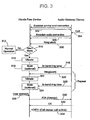
- FIG. 3 is a messaging diagram that illustrates how some embodiments of the invention exchange messages between a hands-free device and an audio gateway device. Internal processing within the HF is also illustrated. Pre-existing messages referred to in FIG. 3 and subsequent messaging diagrams are those defined in the Bluetooth hands-free profile. These specific message types are shown as an example only.
- a service level connection is established between the HF and the AG. This connection is established upon either a user action or an internal event, and either the HF or the AG may initiate the connection set up procedure.
- an audio connection is set up at step 306. The purpose of this audio connection is to pass an inband ring tone to the headset.
- This audio connection is optional, even in the current Bluetooth hands-free profile. It is not needed if an inband ring tone is not to be used, for example if the HF generates its own ring tone. In some embodiments of the invention, it is also not needed, as illustrated in the additional messaging diagrams included herein. If an audio connection is set up at step 306, either the HF or the AG may initiate it. An audio connection is always associated with an existing service level connection. Thus, as a precondition to the audio connection, the service level connection must exist.
- a ring (alert) message is sent from the AG to the HF at step 308.
- the HF determines whether silent alert mode has been selected at step 310. If not, the HF alerts the user in the prior art fashion through processes initiated at 312. If silent alert mode is selected, or if silent mode alerting is simply always present in the device, then a silent alerting action is executed at step 314. In this embodiment, a silent alerting action is performed by activating a vibrator. Since the embodiments of FIG. 3 assume that a preexisting Bluetooth hands-free profile with in-band ring tone is being used, an inband ring tone is sent from the audio gateway device to the HF at step 316.
- the HF can optionally mute this tone at step 318. If the user does not answer immediately, another ring (alert) message is sent from the AG to the HF at step 320. Again, the vibrator is activated at step 322. If the inband ring tone is muted, the muting action is again activated at step 324 when the inband ring tone is sent over the audio connection at step 326. These last four steps will be repeated as necessary. Any optional pattern or pulsing of the vibrating element can be implemented in these embodiments by the baseband logic applying appropriate on/off signaling to the vibrator. Similar patterns of pulsing can be applied to other non-audible signaling mechanisms.
- a user answers at 328.
- This answer initiates an "attention" command, or "AT” command, from the HF device to the AG device.
- the message contains an "ATA” message, or answer message, as shown at 330.
- the AG device issues a standard “ok” response at 332.
- the AG device then issues the command "+CIEV", which in the Bluetooth HF profile is an unsolicited call status indication message.
- This message can specify specific parameters about the call status.
- message 334 specifies that the call status is active.
- FIG. 4 is another messaging diagram illustrating some of the internal processing of the HF device.
- the scenario of FIG. 4 again assumes that a standard Bluetooth hands-free profile is being used.
- no in-band ring tone is sent by the AG device, as it is known that the particular model headset generates its own ring tone.
- a service level connection is set up at step 402.
- a call is received at step 404.
- a ring (alert) message is sent from the AG device to the HF device at step 406.
- the HF device determines at step 408 whether silent alert mode is in effect. If not, normal operation, including generation of a ring tone in the ear-piece, is initiated at 410.
- a silent alerting action in this case a vibration
- the ring tone may also be generated.
- Silent alert mode selection and the optional ring tone generation are input by the user through controls on the HF device. If the user does not respond to the alert, the ring (alert) message is again sent at step 414 and the vibration is again generated at step 416. These steps repeat as necessary until the user responds.
- the rest of the scenario is similar to that shown in FIG. 3 .
- An "ok" response message is sent from the AG device to the HF device at 432.
- the unsolicited call status indication message 434 is sent from the AG device to the HF device.
- the audio connection is not established until 436, at which time the user may begin a conversation with the caller.
- Step 436 establishment of the audio connection, may not take place if the alert is for some other reason besides an incoming call. For example, an alert might indicate a received Email, short message, or some change in the status of either the HF device or the AG device, such as a low battery situation.
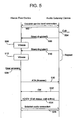
- FIG. 5 both illustrate scenarios for embodiments where the Bluetooth hands-free profile has been modified to include messages particularly related to a silent mode of operation for hands-free devices.
- Bluetooth is not essential to this invention; any short-range wireless communications link may be used.
- FIG. 5 a service level connection is again established at 502. A call is received at 505.
- a silent alert message is sent from the AG device to the HF device at step 506.
- This message is similar to the normal ring message previously discussed, however this message explicitly specifies a silent ring.
- the AG device is programmed and designed to send this new message according to these embodiments of the invention.
- the HF device is programmed and designed to understand this new message according to these embodiments of the invention.
- the HF device In response to this message, the HF device produces a silent alerting action at 508.
- the action is a vibration. If a user does not answer, the silent ring (alert) message is repeated at 510 and the silent alerting action is repeated at 512. These two steps repeat as necessary.
- an ATA (answer) message 530 is sent from the HF device to the AG device.
- An "ok" response message is transferred in the other direction at step 532.
- an unsolicited call status indication message is sent from the AG device to the HF device at step 534.
- the audio connection is established at step 536.
- FIG. 6 illustrates an example embodiment where user input selection of silent alert mode is carried out at the hands-free device.
- a service level connection is again established at 602.
- a user activates silent alert mode by using a silent alert mode input mechanism, such as a switch, on the HF device.
- the user takes this action at step 604.
- This input causes the HF to send the AG a message.
- the message illustrated in this embodiment is a standard event reporting message, "AT+CMER". This message is currently defined in the Bluetooth hands-free profile.
- message 606 in FIG. 6 is an "AT+CMER:(mode: silent)" message sent from the HF device to the AG device.
- the AG device responds with an "ok" message at step 608.
- a call is received at step 610 and the AG device responds by forwarding a silent alert message to the HF device at 612.
- the silent alerting action is initiated at the HF device at step 614. If the user does not answer a silent alert message 616 is again sent to the HF device. Again, a silent alerting action, in this case a vibration, is generated at 618, and these steps are repeated until the user answers.
- an "ATA (answer)" message 630 is again sent from the HF device to the AG device and an "ok” response 632 results.
- An unsolicited call status indication message 634 is again sent from the AG device to the HF device as before. Then an audio connection is established at step 636 as before.
- FIG. 7 is a hardware block diagram of a hands-free device that can implement embodiments of the present invention. Due to the compactness of hands-free devices of this type, much of the function of such a device is often contained within a single semiconductor chip that implements the baseband logic 700 of the device. In fact, all of the electronics and/or logic of the hands-free device, including RF elements, can be integrated in a single component.
- baseband logic includes a central processing unit (CPU) core 702. This processing core controls the operation of the device. Typically this core will include a microprocessor and supporting logic to implement a protocol stack for the short-range wireless interface and link control functions.
- An internal bus 704 links the CPU core to various other elements within the baseband logic.
- Control interface 710 receives input from any buttons or controls 712 that may be included in the hands-free device. These buttons or controls typically correspond to any silent alert mode input mechanism that may be present. Control interface 710 will also send voltage signals to a non-audible signaling mechanism, in this case vibrator 714. It should be noted that the non-audible signaling mechanism could also be of another type, for example a flashing light. Also, the type of vibrator used would be a design choice. Examples of vibrators include piezoelectric devices and a small electric motor with an offset mass.
- RF interface 716 and pulse coded modulation (PCM) block 718 in this example each provide interfaces to devices which may be external to baseband logic 700.
- RF interface 716 provides connectivity to RF block 718 which provides the radio frequency transmit and receive function for the short-range wireless connection through antenna 720, which may be an internal antenna.
- PCM interface 718 provides connectivity to codec 722.
- the codec encodes audio received through microphone 724 and decodes audio to be played through speaker 726.
- speaker 726 and microphone 724 may be located remotely from the actual codec and other hardware within the hands-free device. For example, with a boom headset the microphone is located at the end of a boom and connected by wires to the codec.
- both the microphone and speaker are located remotely and connected by wires to the codec. It should be emphasized that the hardware block diagram illustrated in FIG. 7 is an example only. Numerous configurations of logic exist to implement such devices, including Bluetooth devices.
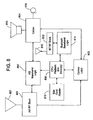
- FIG. 8 is a block diagram of a mobile terminal that implements embodiments of the invention.
- FIG. 8 illustrates a mobile terminal with Bluetooth capability.
- the present invention could be implemented with any short-range wireless technology and is not necessarily limited to implementations of the Bluetooth standard. This illustration is for example purposes only, and even with Bluetooth terminals of substantially different configurations the invention will work as previously described.
- a Bluetooth hands-free device could be used with other audio gateway devices besides mobile terminals, including, for example, personal computers, wired terminals, work stations, or any other type of device that can be used to send and receive audio messaging.
- the terminal of FIG. 8 includes traditional mobile terminal elements which work together to implement communications functions with a public, wide-area, wireless network.
- an audio gateway (AG) system includes an AG RF block 801, an AG baseband logic block 802, a control logic block 803, and a local audio codec 804 for interface with microphone and speaker elements.
- AG RF block 801 receive and transmit information for a public network is converted from and to appropriate radio frequencies, and filtering using baseband or intermediate frequency circuitry is applied, as is understood in the art.
- the terminal's long-range antenna system 807 is connected to AG RF block 801.
- basic signal processing occurs, including, for example, synchronization, channel coding, decoding, and burst formatting, as is understood in the art.
- Codec 804 handles voice and analog-to-digital and digital-to-analog processing to receive input through microphone 805 and produce output through speaker 806.
- Functions of the aforementioned AG transceiving blocks are directed and controlled by one or more microprocessors or digital signal processors and associated memory containing appropriate microcode shown as central processing unit (CPU) platform 808 for illustrative purposes.
- CPU central processing unit
- the terminal of this example accepts a subscriber identity module (SIM) card at a SIM card reader interface 810.
- Control logic 803 controls human interface components such as a keypad and a liquid crystal display (LCD), which are not shown for clarity.
- the aforementioned elements form the AG system of the mobile terminal.
- the mobile terminal of FIG. 8 includes a Bluetooth antenna element 810, (possibly internal) and a Bluetooth RF block, 812. These elements are essentially the same as those found in the hands-free device.
- the terminal also includes Bluetooth baseband logic 814.
- the Bluetooth baseband logic is functionally connected to the CPU platform of the mobile terminal.
- the Bluetooth baseband logic is essentially the same as that shown in FIG. 7 for the hands-free device, with the exception of the control interface. In place of the control interface would be an interface as necessary to connect to the CPU platform and possibly other elements within the mobile terminal. These might include one or more of a universal serial bus (USB) interface, a universal asynchronous receiver transmitter (UART), and clock and data read/write lines.
- USB universal serial bus
- UART universal asynchronous receiver transmitter
- Bluetooth antenna 810, Bluetooth RF block 812, and Bluetooth baseband logic block 814 may each be physically combined with corresponding sections of the AG assembly, and need not be physically distinct.
- a single antenna structure capable of radiating at multiple frequencies and thus operating simultaneously as AG antenna 807 and Bluetooth antenna 810 is possible.
- the functionality of the Bluetooth baseband logic block 814 may be incorporated into a device embodying the AG baseband logic 802 and may thus be physically indistinguishable. Accordingly, references to any of these functions or functional elements herein are meant to refer to the function either as incorporated into distinct components or as combined with other functions in any components in a terminal.
- While the mobile terminal described above is similar to a traditional "cellular" telephone, as used herein the terms mobile terminal, wireless terminal, or audio gateway device and similar terms may refer to: a cellular telephone either with or without a multi-line display; a personal communication system (PCS) terminal that may combine a cellular radio telephone with data processing, facsimile and data communications capabilities; a personal data assistant (PDA) that can include a radio telephone, pager, internet access, web browser, organizer; or a pervasive computing device.
- an audio gateway terminal that implements features of the invention could be a conventional personal computer, whether a desktop or laptop, or any other appliance or electronic device that might exchange voice information with a wired or wireless network.
- the terminal could be a terminal without a network connection, in which a hands-free device could simply be used for speech recognition and playback.
- a wireless hands-free device operating on a short-range wireless connection with a terminal could be used for dictation and playback, entertainment, or other applications.
Landscapes
- Engineering & Computer Science (AREA)
- Computer Networks & Wireless Communication (AREA)
- Signal Processing (AREA)
- Telephone Function (AREA)
- Mobile Radio Communication Systems (AREA)
- Telephone Set Structure (AREA)
Claims (17)
- Appareil mains libres, (104 ; 204) pour un terminal de communication (102 ; 202), ledit appareil comprenant :(a) un moyen (702, 706, 716, 718, 720) pour établir une connexion sans fil de courte portée entre l'appareil mains libres (104 ; 204) et ledit terminal de communication (102 ; 202), permettant à l'appareil mains libres (104 ; 204) et audit terminal de communication (102 ; 202) d'être conscients l'un de l'autre ;(b) un moyen (702, 706, 716, 718, 720) pour recevoir un message d'alerte sur ladite connexion sans fil de courte portée ;
caractérisé par :(c) un moyen (702, 706, 710, 714) pour produire au niveau de l'appareil mains libres (104 ; 204) une action d'alerte silencieuse quand un message d'alerte de sonnerie normale est reçu (308, 406) par ledit appareil mains libres (104 ; 204) et lorsque ledit appareil mains libres (104 ; 204) est dans un mode d'alerte silencieuse sélectionné par l'utilisateur (310 ; 408), le mode d'alerte silencieuse étant sélectionné au niveau de l'appareil mains libres, et quand
un message d'alerte silencieuse spécifique, qui spécifie une sonnerie silencieuse, est reçu (506) par ledit appareil mains libres (104 ; 204). - Appareil selon la revendication 1, comprenant en outre un moyen (702, 706, 710, 712) pour détecter la sélection par l'utilisateur du mode d'alerte silencieuse au niveau de l'appareil mains libres (104 ; 204).
- Appareil selon la revendication 2, comprenant en outre un moyen (702, 706, 716, 718, 720) pour envoyer un message d'activation de mode silencieux au terminal de communication (102 ; 202) sur la connexion sans fil de courte portée.
- Appareil selon la revendication 2, comprenant en outre un moyen (702, 706) pour assourdir une tonalité de sonnerie en bande de base au niveau de l'appareil mains libres (104 ; 204).
- Appareil selon la revendication 1, dans lequel ledit moyen (702, 706, 716, 718, 720) pour produire une action d'alerte silencieuse comprend un mécanisme de signalisation non audible (714).
- Appareil selon la revendication 1, dans lequel l'appareil comprend en outre des dispositifs d'entrée / sortie audio (718, 722, 724, 726).
- Appareil selon les revendications 5, 6, dans lequel l'appareil comprend en outre une logique (702, 706, 710) reliée de manière opérationnelle au mécanisme de signalisation non audible (714) et aux dispositifs d'entrée / sortie audio (718, 722, 724, 726), la logique (702 ; 706 ; 710) pouvant être mise en oeuvre pour commander l'appareil mains libres (104 ; 204) pour établir la connexion sans fil de courte portée pour permettre à l'appareil mains libres (104 ; 204) et au terminal de communication (102 ; 202) d'être conscients l'un de l'autre, recevoir un message d'alerte par l'intermédiaire de la connexion sans fil de courte portée et pour produire une action d'alerte silencieuse au niveau du mécanisme de signalisation non audible (714) en réponse au message d'alerte reçu.
- Appareil selon la revendication 7, comprenant en outre un mécanisme d'entrée de mode d'alerte silencieuse (712) relié à la logique (702, 706, 710), le mécanisme d'entrée de mode d'alerte silencieuse (712) pouvant être mis en oeuvre pour permettre à un utilisateur d'activer ledit mode de fonctionnement silencieux.
- Appareil selon la revendication 5, dans lequel le mécanisme de signalisation non audible (714) comprend un vibrateur.
- Appareil selon la revendication 5, dans lequel le mécanisme de signalisation non audible (714) comprend une lumière.
- Appareil mains libres selon la revendication 7, dans lequel la connexion sans fil de courte portée est une connexion Bluetooth et les messages d'alerte sont basés sur un profil Bluetooth mains libres.
- Terminal de communication (102 ; 202) comprenant :(a) un système de passerelle audio (801, 802, 807) ;(b) un bloc fréquence radio de courte portée (812) ;(c) une logique en bande de base de courte portée (814) ; et(d) une plate-forme de traitement (808) reliée de manière opérationnelle au système de passerelle audio (801, 802, 807), à la logique en bande de base de courte portée (814) et au bloc fréquence radio de courte portée (812), la plate-forme de traitement (808) pouvant être mise en oeuvre pour commander le terminal de communication (102 ; 202) pour établir une connexion sans fil de courte portée avec un appareil mains libres (104 ; 204) pour permettre au terminal de communication (102 ; 202) et à l'appareil mains libres (104 ; 204) d'être conscients l'un de l'autre et pour envoyer un message d'alerte à l'appareil mains libres (104 ; 204) par l'intermédiaire du bloc fréquence radio de courte portée (812),
caractérisé en ce que :(e) la plate-forme de traitement (808) peut en outre être mise en oeuvre pour commander ledit terminal de communication (102 ; 202) pour recevoir (606) un message d'activation de mode silencieux en provenance dudit appareil mains libres (104 ; 204) sur ledit bloc fréquence radio de courte portée (812) lorsque l'utilisateur active un mode d'alerte silencieux au niveau de l'appareil mains libres et pour envoyer (612) un message d'alerte silencieux spécifique qui spécifie une sonnerie silencieuse audit appareil mains libres (104 ; 204) en réponse à un appel entrant (610). - Terminal de communication selon la revendication 12, dans lequel la connexion sans fil de courte portée est une connexion Bluetooth et le message d'alerte silencieuse et le message d'activation de mode silencieux sont basés sur un profil Bluetooth mains libres.
- Procédé de signalisation à un utilisateur d'un appareil mains libres (104 ; 204) pour un terminal de communication (102 ; 202), le procédé comprenant :établir (302, 402, 502, 602) une connexion sans fil de courte portée entre ledit appareil mains libres (104 ; 204) et ledit terminal de communication (102 ; 202) permettant à l'appareil mains libres (104 ; 204) et au terminal de communication (102 ; 202) d'être conscients l'un de l'autre ;recevoir au niveau de l'appareil mains libres (104 ; 204) un message d'alerte sur ladite connexion bilatérale, sans fil, de courte portée ; etcaractérisé par
la production au niveau de l'appareil mains libres (104 ; 204) d'une action d'alerte silencieuse quand un message d'alerte de sonnerie normale est reçu (308, 406) par ledit appareil mains libres (104 ; 204) et lorsque ledit appareil mains libres (104 ; 204) est dans un mode d'alerte silencieuse (310, 408) sélectionné par l'utilisateur, le mode d'alerte silencieuse étant sélectionné au niveau de l'appareil mains libres, et
quand un message d'alerte silencieuse spécifique, qui spécifie une sonnerie silencieuse, est reçu (506) par ledit appareil mains libres (104 ; 204). - Procédé selon la revendication 14, comprenant en outre la détection (310 ; 408) d'une sélection par l'utilisateur d'un mode d'alerte silencieuse au niveau de l'appareil mains libres (104 ; 204).
- Procédé selon la revendication 15, comprenant en outre l'envoi (606) d'un message d'activation de mode silencieux au terminal de communication (102 ; 202) sur la connexion sans fil de courte portée.
- Procédé selon la revendication 16, comprenant en outre l'assourdissement (318) d'une tonalité de sonnerie en bande de base au niveau de l'appareil mains libres (104 ; 204).
Applications Claiming Priority (3)
| Application Number | Priority Date | Filing Date | Title |
|---|---|---|---|
| US249195 | 2003-03-21 | ||
| US10/249,195 US7953454B2 (en) | 2003-03-21 | 2003-03-21 | Wireless hands-free system with silent user signaling |
| PCT/IB2004/000037 WO2004084529A1 (fr) | 2003-03-21 | 2004-01-05 | Systeme mains libres sans fil a signalisation silencieuse |
Publications (2)
| Publication Number | Publication Date |
|---|---|
| EP1606923A1 EP1606923A1 (fr) | 2005-12-21 |
| EP1606923B1 true EP1606923B1 (fr) | 2009-07-29 |
Family
ID=32987019
Family Applications (1)
| Application Number | Title | Priority Date | Filing Date |
|---|---|---|---|
| EP04700151A Expired - Lifetime EP1606923B1 (fr) | 2003-03-21 | 2004-01-05 | Systeme mains libres sans fil a signalisation silencieuse |
Country Status (6)
| Country | Link |
|---|---|
| US (1) | US7953454B2 (fr) |
| EP (1) | EP1606923B1 (fr) |
| JP (1) | JP4531042B2 (fr) |
| CN (1) | CN1820488B (fr) |
| DE (1) | DE602004022263D1 (fr) |
| WO (1) | WO2004084529A1 (fr) |
Families Citing this family (65)
| Publication number | Priority date | Publication date | Assignee | Title |
|---|---|---|---|---|
| US7027842B2 (en) * | 2002-09-24 | 2006-04-11 | Bellsouth Intellectual Property Corporation | Apparatus and method for providing hands-free operation of a device |
| US7899500B2 (en) * | 2002-09-24 | 2011-03-01 | At&T Intellectual Property I, L. P. | Apparatus and method for providing hands-free operation of a device |
| US7096048B2 (en) * | 2003-04-01 | 2006-08-22 | Sanders Donald T | Portable communications device |
| KR100501189B1 (ko) | 2003-05-15 | 2005-07-18 | 삼성전기주식회사 | 블루투스 헤드셋 및 그 착신 알림 방법 |
| US20040259585A1 (en) * | 2003-06-04 | 2004-12-23 | Avi Yitzchak | Wireless device having dual bus archeticure for interfacing with cellular signals and short-range radio signals |
| US7130664B1 (en) | 2003-06-12 | 2006-10-31 | Williams Daniel P | User-based signal indicator for telecommunications device and method of remotely notifying a user of an incoming communications signal incorporating the same |
| US20040266489A1 (en) * | 2003-06-27 | 2004-12-30 | Nokia Corporation | Remote control of a mobile telephone, having a plurality of different operating characteristics |
| TWM248174U (en) * | 2003-09-30 | 2004-10-21 | Cellink Company Ltd | Audio frequency transmission device |
| US20050070261A1 (en) * | 2003-09-30 | 2005-03-31 | Belmont Brian V. | Method, apparatus and system for managing cell phone calls |
| US7557433B2 (en) | 2004-10-25 | 2009-07-07 | Mccain Joseph H | Microelectronic device with integrated energy source |
| JP4319573B2 (ja) * | 2004-04-07 | 2009-08-26 | 株式会社東芝 | 移動通信端末装置 |
| US6954659B2 (en) * | 2003-11-24 | 2005-10-11 | World Mobile Technologies, Inc. | Fashion accessory with wireless signal alerting device |
| TWI280770B (en) * | 2004-07-09 | 2007-05-01 | Inventec Appliances Corp | System against illegal use of mobile phone |
| DE102005038118B4 (de) * | 2004-08-23 | 2013-02-21 | Denso Corporation | Freisprecheinrichtung und Mobiltelefon-Handapparat |
| US20060068706A1 (en) * | 2004-09-30 | 2006-03-30 | Global Targe Enterprise Inc. | Connector attached bluetooth wireless earphone |
| US8290192B2 (en) | 2005-02-03 | 2012-10-16 | Nokia Corporation | Gaming headset vibrator |
| TW200640153A (en) | 2005-05-02 | 2006-11-16 | Primax Electronics Ltd | Reconfigurable peripheral devices for wireless apparatus |
| DE102005024164B4 (de) * | 2005-05-23 | 2007-04-05 | Bury Sp.Z.O.O | Freisprecheinrichtung für ein Mobiltelefon |
| EP1891848B1 (fr) | 2005-06-13 | 2015-07-22 | Intelligent Mechatronic Systems Inc. | Systeme de communication d'immersion pour un vehicule |
| JP2007143119A (ja) * | 2005-10-18 | 2007-06-07 | Denso Corp | 車載ハンズフリー装置 |
| DE102006010492A1 (de) * | 2006-03-02 | 2007-09-06 | Frank Herold | Funktelefon |
| DE102006010493A1 (de) * | 2006-03-02 | 2007-09-13 | Frank Herold | Funktelefon |
| US20070205875A1 (en) * | 2006-03-03 | 2007-09-06 | De Haan Ido G | Auxiliary device with projection display information alert |
| US9976865B2 (en) | 2006-07-28 | 2018-05-22 | Ridetones, Inc. | Vehicle communication system with navigation |
| US8731146B2 (en) | 2007-01-04 | 2014-05-20 | At&T Intellectual Property I, L.P. | Call re-directed based on voice command |
| US7805171B2 (en) * | 2007-03-06 | 2010-09-28 | Motorola Mobility, Inc. | Earmounted electronic device and method |
| US7991356B2 (en) * | 2007-03-23 | 2011-08-02 | Sigmatel, Inc. | Wireless handset and wireless headset with wireless transceiver |
| EP2136541A4 (fr) | 2007-03-23 | 2010-03-17 | Lopez Felipe Eugenio Pulido | Dispositif électronique à moyens d'alerte multiples fournissant des avertissements silencieux à l'utilisateur lorsqu'il reçoit des signaux rf provenant d'un ou de plusieurs émetteurs à distance et son procédé de fonctionnement |
| US20090072955A1 (en) * | 2007-09-17 | 2009-03-19 | Patrick Kearney Cary | Wearable coin-sized sensory devices, and related systems and methods, providing immediate wireless notification of activities on separate electronic devices |
| US20090248820A1 (en) * | 2008-03-25 | 2009-10-01 | Basir Otman A | Interactive unified access and control of mobile devices |
| US8712334B2 (en) * | 2008-05-20 | 2014-04-29 | Micron Technology, Inc. | RFID device using single antenna for multiple resonant frequency ranges |
| US9652023B2 (en) * | 2008-07-24 | 2017-05-16 | Intelligent Mechatronic Systems Inc. | Power management system |
| JP4220575B1 (ja) * | 2008-09-12 | 2009-02-04 | 株式会社東芝 | 情報処理装置 |
| US9857501B2 (en) * | 2009-02-13 | 2018-01-02 | Centurylink Intellectual Property Llc | System and method for a wireless phone enabled with weather alerts |
| US8254993B2 (en) * | 2009-03-06 | 2012-08-28 | Apple Inc. | Remote messaging for mobile communication device and accessory |
| US8170262B1 (en) * | 2009-04-15 | 2012-05-01 | Frank Kung Fu Liu | Wireless air tube headset |
| US8159402B2 (en) * | 2009-05-19 | 2012-04-17 | Motorola Mobility, Inc. | Hands free cellular communication device having a deployable antenna |
| WO2010135837A1 (fr) | 2009-05-28 | 2010-12-02 | Intelligent Mechatronic Systems Inc | Système de communication avec gestion d'informations personnelles et surveillance de véhicule à distance et caractéristiques de commande |
| WO2010148518A1 (fr) * | 2009-06-27 | 2010-12-29 | Intelligent Mechatronic Systems | Interface radio internet pour véhicule |
| US20110021147A1 (en) * | 2009-07-21 | 2011-01-27 | Tout Walid R | System and method for determining connectivity status of short range wireless devices |
| US8351895B2 (en) * | 2009-09-04 | 2013-01-08 | Zomm, Llc | Wireless security device and method to place emergency calls |
| KR101664430B1 (ko) | 2009-11-13 | 2016-10-10 | 삼성전자주식회사 | 리모트 ui 서비스 제공 방법 및 장치 |
| US9978272B2 (en) * | 2009-11-25 | 2018-05-22 | Ridetones, Inc | Vehicle to vehicle chatting and communication system |
| CN102111696A (zh) * | 2010-12-24 | 2011-06-29 | 陕西科技大学 | 降低蓝牙耳机功耗的方法 |
| US8749349B2 (en) * | 2011-03-11 | 2014-06-10 | Nokia Corporation | Method apparatus and computer program |
| CN102594412A (zh) * | 2011-12-30 | 2012-07-18 | 深圳市车音网科技有限公司 | 蓝牙终端及其控制方法 |
| US9247525B2 (en) * | 2012-03-16 | 2016-01-26 | Qualcomm Incorporated | Systems and methods for providing notifications |
| EP2680550B1 (fr) * | 2012-06-29 | 2018-10-03 | GN Audio A/S | Dispositifs de communication mains libres pour communication sans fil et câblé |
| US9140599B1 (en) * | 2012-11-02 | 2015-09-22 | Amazon Technologies, Inc. | Systems and methods for communicating between devices using vibrations |
| KR20140070882A (ko) * | 2012-11-28 | 2014-06-11 | 한국전자통신연구원 | 인스턴트 메시지 송수신 방법 및 그 장치 |
| US9413790B2 (en) * | 2012-12-03 | 2016-08-09 | Vxi Corporation | Computer telephony headset with presence indicator |
| CN105164992A (zh) * | 2013-03-15 | 2015-12-16 | 简易事务有限责任公司 | 振动提醒设备 |
| CN103200482B (zh) * | 2013-04-09 | 2016-06-29 | 北京兴科迪科技有限公司 | 太阳能充电式蓝牙耳机及装有该蓝牙耳机的车辆 |
| US20160004502A1 (en) * | 2013-07-16 | 2016-01-07 | Cloudcar, Inc. | System and method for correcting speech input |
| ITTO20130974A1 (it) * | 2013-11-29 | 2015-05-30 | Magneti Marelli Spa | Sistema per sottoporre a test l'interazione wireless fra un sistema di riproduzione di segnali audio e un telefono mobile, relativo procedimento e prodotto informatico |
| CN104796177A (zh) * | 2014-01-22 | 2015-07-22 | 光宝电子(广州)有限公司 | 蓝牙收发器、线控耳机模块及移动装置模块 |
| US9338761B2 (en) | 2014-02-26 | 2016-05-10 | Empire Technology Development Llc | Presence-based device mode modification |
| KR102288726B1 (ko) * | 2014-06-09 | 2021-08-12 | 삼성전자주식회사 | 웨어러블 전자 장치, 메인 전자 장치, 시스템 및 그 제어 방법 |
| CN104581479B (zh) * | 2014-12-17 | 2017-12-19 | 青岛歌尔声学科技有限公司 | 一种可拆卸式无线耳机系统 |
| CN105138319B (zh) * | 2015-07-30 | 2018-12-18 | 小米科技有限责任公司 | 事件提醒方法及装置 |
| US9913111B2 (en) * | 2015-12-29 | 2018-03-06 | At&T Mobility Ii Llc | Device pairing for textual communications |
| CN107105358A (zh) * | 2017-06-02 | 2017-08-29 | 歌尔科技有限公司 | 一种蓝牙耳机和蓝牙耳机控制方法 |
| CN113194396B (zh) * | 2021-04-23 | 2023-01-24 | 歌尔股份有限公司 | 助听器及其控制方法和计算机可读存储介质 |
| US11622188B1 (en) * | 2022-06-09 | 2023-04-04 | Joel Perrin | Headphone indicator |
| CN116614799B (zh) * | 2023-06-25 | 2026-02-03 | 思澈科技(重庆)有限公司 | 一种蓝牙hf设备来电音频的控制系统及方法 |
Family Cites Families (26)
| Publication number | Priority date | Publication date | Assignee | Title |
|---|---|---|---|---|
| US5359647A (en) * | 1993-05-28 | 1994-10-25 | Plantronics, Inc. | Headset in-use indicator |
| JP3500490B2 (ja) * | 1997-04-14 | 2004-02-23 | 松下電器産業株式会社 | 多機能イヤホンマイク |
| JPH10327089A (ja) | 1997-05-23 | 1998-12-08 | Matsushita Electric Ind Co Ltd | 携帯電話装置 |
| FR2779598B1 (fr) | 1998-06-05 | 2000-09-01 | Alain Aisenberg | Kit mains libres autonome pour telephones mobiles |
| JP2000013485A (ja) * | 1998-06-18 | 2000-01-14 | Napolex Co | 携帯電話機用のイヤホンマイク |
| DE19845608A1 (de) * | 1998-10-05 | 2000-04-06 | Ceotronics Ag | Hör-Sprechsystem |
| FR2786650B1 (fr) | 1998-11-26 | 2000-12-29 | Cit Alcatel | Procede de communication entre un telephone mobile et un accessoire |
| US6560468B1 (en) * | 1999-05-10 | 2003-05-06 | Peter V. Boesen | Cellular telephone, personal digital assistant, and pager unit with capability of short range radio frequency transmissions |
| JP2000349868A (ja) * | 1999-06-02 | 2000-12-15 | Kimura Denshi Kogyo:Kk | イヤホーンマイクセット通話装置 |
| US20020067825A1 (en) * | 1999-09-23 | 2002-06-06 | Robert Baranowski | Integrated headphones for audio programming and wireless communications with a biased microphone boom and method of implementing same |
| US6374126B1 (en) * | 1999-11-10 | 2002-04-16 | Ericsson Inc. | Hands-free headset with stowable stereo earpiece |
| CN2422781Y (zh) | 2000-05-10 | 2001-03-07 | 杨清辉 | 双效型行动电话无线麦克风 |
| JP4329232B2 (ja) * | 2000-06-08 | 2009-09-09 | ソニー株式会社 | モニタシステム |
| US6363139B1 (en) * | 2000-06-16 | 2002-03-26 | Motorola, Inc. | Omnidirectional ultrasonic communication system |
| US6714233B2 (en) * | 2000-06-21 | 2004-03-30 | Seiko Epson Corporation | Mobile video telephone system |
| KR100334683B1 (ko) * | 2000-09-08 | 2002-05-04 | 윤종용 | 휴대용 이동 전화기에서 이어 잭을 사용한 착신 경보장치 |
| JP3599097B2 (ja) * | 2000-10-10 | 2004-12-08 | 日本電気株式会社 | 周辺装置による携帯通信装置の呼出方法、それを用いた携帯通信装置および周辺装置 |
| JP2002152324A (ja) * | 2000-11-13 | 2002-05-24 | Kenwood Corp | 移動体電話機及びそれに用いる音声入出力装置 |
| JP2002208996A (ja) * | 2001-01-11 | 2002-07-26 | Sony Corp | 携帯機器、携帯型オーディオ信号処理装置及び携帯通信端末装置 |
| JP2003018251A (ja) | 2001-07-03 | 2003-01-17 | Matsushita Electric Ind Co Ltd | ワイヤレスヘッドセットシステム |
| US20030022690A1 (en) * | 2001-07-27 | 2003-01-30 | Siemens Information And Communication Networks, Inc. | Concealed wireless telephone |
| US6970724B2 (en) * | 2001-08-10 | 2005-11-29 | Hewlett-Packard Development Company, L.P. | Apparatus and method for automatically disabling cell phone ringing |
| JP4728537B2 (ja) * | 2001-09-14 | 2011-07-20 | 株式会社ホンダアクセス | ブルートゥース通信システム |
| US7088234B2 (en) * | 2001-11-27 | 2006-08-08 | Matsushita Electric Industrial Co., Ltd. | Wearing information notifying unit |
| JP2003188985A (ja) | 2001-12-20 | 2003-07-04 | Matsushita Electric Ind Co Ltd | ワイヤレスヘッドセット、これを用いたヘルメット、インターネット電話システム、車両用ハンズフリーシステム、通信システム、クレジット処理システムおよびキャッシュサービスシステム |
| US20040204168A1 (en) * | 2003-03-17 | 2004-10-14 | Nokia Corporation | Headset with integrated radio and piconet circuitry |
-
2003
- 2003-03-21 US US10/249,195 patent/US7953454B2/en not_active Expired - Fee Related
-
2004
- 2004-01-05 EP EP04700151A patent/EP1606923B1/fr not_active Expired - Lifetime
- 2004-01-05 JP JP2006506253A patent/JP4531042B2/ja not_active Expired - Fee Related
- 2004-01-05 WO PCT/IB2004/000037 patent/WO2004084529A1/fr not_active Ceased
- 2004-01-05 DE DE602004022263T patent/DE602004022263D1/de not_active Expired - Lifetime
- 2004-01-05 CN CN2004800023277A patent/CN1820488B/zh not_active Expired - Fee Related
Also Published As
| Publication number | Publication date |
|---|---|
| CN1820488B (zh) | 2011-07-13 |
| EP1606923A1 (fr) | 2005-12-21 |
| JP2006522522A (ja) | 2006-09-28 |
| CN1820488A (zh) | 2006-08-16 |
| WO2004084529A1 (fr) | 2004-09-30 |
| US20040185915A1 (en) | 2004-09-23 |
| US7953454B2 (en) | 2011-05-31 |
| DE602004022263D1 (de) | 2009-09-10 |
| JP4531042B2 (ja) | 2010-08-25 |
Similar Documents
| Publication | Publication Date | Title |
|---|---|---|
| US7953454B2 (en) | Wireless hands-free system with silent user signaling | |
| JP2006519562A (ja) | 車載型の私用及び会議用電話のための無線通信システム、及びその方法 | |
| KR20020013808A (ko) | 휴대용 무선 통신 장치 | |
| KR100359872B1 (ko) | 음성인식 기능을 갖는 무선 핸즈프리의 제어방법 | |
| JP2002209011A (ja) | 携帯端末 | |
| US20030083111A1 (en) | Compact mobile phone device with hook | |
| CA2162804C (fr) | Dispositif de communication multi-information portatif | |
| JP2003188948A (ja) | 携帯端末装置 | |
| KR100393603B1 (ko) | 무선 헤드셋의 재다이얼 번호 안내 방법 | |
| KR100370767B1 (ko) | 비통화모드에서의 음성신호 전송장치 및 방법 | |
| JP2003339078A (ja) | 携帯通信装置 | |
| KR100439224B1 (ko) | 휴대전화기 매너모드의 발신자번호 확인장치와 그 운용방법 | |
| JP3842674B2 (ja) | 電子機器及び携帯電話接続切替方法 | |
| KR200244227Y1 (ko) | 무선 헤드셋을 이용한 근거리 무선통화시스템 | |
| KR20030010175A (ko) | 수신 전 발신자 번호(숫자)·이름(문자) 음성 알림장치 및알림방법 | |
| JP3372896B2 (ja) | 通信端末装置と交換機 | |
| US20020061732A1 (en) | Oscillation prevention circuit | |
| JP2004120126A (ja) | Bluetooth音声通信装置 | |
| KR20030097448A (ko) | 휴대폰의 통화연결 확인 장치 및 방법 | |
| KR20050078686A (ko) | 무선통신 단말기에서의 통화중 호 착신 알림 방법 | |
| KR20010056432A (ko) | 무선 이어폰이 적용된 이동통신 단말기 시스템 | |
| JP2002094632A (ja) | 携帯電話用コード | |
| JP2006174222A (ja) | コードレス電話装置およびコードレス電話制御方法 | |
| JP2001025063A (ja) | 携帯電話装置及び着信通報抑制方法 | |
| KR20040039761A (ko) | 블루투스를 이용한 통화 장치 |
Legal Events
| Date | Code | Title | Description |
|---|---|---|---|
| PUAI | Public reference made under article 153(3) epc to a published international application that has entered the european phase |
Free format text: ORIGINAL CODE: 0009012 |
|
| 17P | Request for examination filed |
Effective date: 20050623 |
|
| AK | Designated contracting states |
Kind code of ref document: A1 Designated state(s): AT BE BG CH CY CZ DE DK EE ES FI FR GB GR HU IE IT LI LU MC NL PT RO SE SI SK TR |
|
| AX | Request for extension of the european patent |
Extension state: AL LT LV MK |
|
| DAX | Request for extension of the european patent (deleted) | ||
| RBV | Designated contracting states (corrected) |
Designated state(s): DE FR GB |
|
| GRAP | Despatch of communication of intention to grant a patent |
Free format text: ORIGINAL CODE: EPIDOSNIGR1 |
|
| GRAS | Grant fee paid |
Free format text: ORIGINAL CODE: EPIDOSNIGR3 |
|
| GRAA | (expected) grant |
Free format text: ORIGINAL CODE: 0009210 |
|
| AK | Designated contracting states |
Kind code of ref document: B1 Designated state(s): DE FR GB |
|
| REG | Reference to a national code |
Ref country code: GB Ref legal event code: FG4D |
|
| REF | Corresponds to: |
Ref document number: 602004022263 Country of ref document: DE Date of ref document: 20090910 Kind code of ref document: P |
|
| PLBE | No opposition filed within time limit |
Free format text: ORIGINAL CODE: 0009261 |
|
| STAA | Information on the status of an ep patent application or granted ep patent |
Free format text: STATUS: NO OPPOSITION FILED WITHIN TIME LIMIT |
|
| 26N | No opposition filed |
Effective date: 20100503 |
|
| REG | Reference to a national code |
Ref country code: FR Ref legal event code: PLFP Year of fee payment: 13 |
|
| REG | Reference to a national code |
Ref country code: FR Ref legal event code: PLFP Year of fee payment: 14 |
|
| REG | Reference to a national code |
Ref country code: FR Ref legal event code: PLFP Year of fee payment: 15 |
|
| PGFP | Annual fee paid to national office [announced via postgrant information from national office to epo] |
Ref country code: GB Payment date: 20201218 Year of fee payment: 18 Ref country code: FR Payment date: 20201217 Year of fee payment: 18 |
|
| PGFP | Annual fee paid to national office [announced via postgrant information from national office to epo] |
Ref country code: DE Payment date: 20201217 Year of fee payment: 18 |
|
| REG | Reference to a national code |
Ref country code: DE Ref legal event code: R119 Ref document number: 602004022263 Country of ref document: DE |
|
| GBPC | Gb: european patent ceased through non-payment of renewal fee |
Effective date: 20220105 |
|
| PG25 | Lapsed in a contracting state [announced via postgrant information from national office to epo] |
Ref country code: GB Free format text: LAPSE BECAUSE OF NON-PAYMENT OF DUE FEES Effective date: 20220105 Ref country code: DE Free format text: LAPSE BECAUSE OF NON-PAYMENT OF DUE FEES Effective date: 20220802 |
|
| PG25 | Lapsed in a contracting state [announced via postgrant information from national office to epo] |
Ref country code: FR Free format text: LAPSE BECAUSE OF NON-PAYMENT OF DUE FEES Effective date: 20220131 |