EP1607254B1 - Vorrichtung zur Luftzuführung in einen Innenraum eines Fahrzeuges - Google Patents
Vorrichtung zur Luftzuführung in einen Innenraum eines Fahrzeuges Download PDFInfo
- Publication number
- EP1607254B1 EP1607254B1 EP05011651A EP05011651A EP1607254B1 EP 1607254 B1 EP1607254 B1 EP 1607254B1 EP 05011651 A EP05011651 A EP 05011651A EP 05011651 A EP05011651 A EP 05011651A EP 1607254 B1 EP1607254 B1 EP 1607254B1
- Authority
- EP
- European Patent Office
- Prior art keywords
- flow
- air
- duct
- flow duct
- additional blower
- Prior art date
- Legal status (The legal status is an assumption and is not a legal conclusion. Google has not performed a legal analysis and makes no representation as to the accuracy of the status listed.)
- Expired - Lifetime
Links
Images


Classifications
-
- B—PERFORMING OPERATIONS; TRANSPORTING
- B60—VEHICLES IN GENERAL
- B60H—ARRANGEMENTS OF HEATING, COOLING, VENTILATING OR OTHER AIR-TREATING DEVICES SPECIALLY ADAPTED FOR PASSENGER OR GOODS SPACES OF VEHICLES
- B60H1/00—Heating, cooling or ventilating devices
- B60H1/00007—Combined heating, ventilating, or cooling devices
- B60H1/00207—Combined heating, ventilating, or cooling devices characterised by the position of the HVAC devices with respect to the passenger compartment
-
- B—PERFORMING OPERATIONS; TRANSPORTING
- B60—VEHICLES IN GENERAL
- B60H—ARRANGEMENTS OF HEATING, COOLING, VENTILATING OR OTHER AIR-TREATING DEVICES SPECIALLY ADAPTED FOR PASSENGER OR GOODS SPACES OF VEHICLES
- B60H1/00—Heating, cooling or ventilating devices
- B60H1/00007—Combined heating, ventilating, or cooling devices
- B60H1/00021—Air flow details of HVAC devices
-
- B—PERFORMING OPERATIONS; TRANSPORTING
- B60—VEHICLES IN GENERAL
- B60H—ARRANGEMENTS OF HEATING, COOLING, VENTILATING OR OTHER AIR-TREATING DEVICES SPECIALLY ADAPTED FOR PASSENGER OR GOODS SPACES OF VEHICLES
- B60H1/00—Heating, cooling or ventilating devices
- B60H1/00007—Combined heating, ventilating, or cooling devices
- B60H1/00021—Air flow details of HVAC devices
- B60H2001/00078—Assembling, manufacturing or layout details
- B60H2001/00099—Assembling, manufacturing or layout details comprising additional ventilating means
-
- B—PERFORMING OPERATIONS; TRANSPORTING
- B60—VEHICLES IN GENERAL
- B60H—ARRANGEMENTS OF HEATING, COOLING, VENTILATING OR OTHER AIR-TREATING DEVICES SPECIALLY ADAPTED FOR PASSENGER OR GOODS SPACES OF VEHICLES
- B60H1/00—Heating, cooling or ventilating devices
- B60H1/00007—Combined heating, ventilating, or cooling devices
- B60H1/00021—Air flow details of HVAC devices
- B60H2001/00185—Distribution of conditionned air
- B60H2001/002—Distribution of conditionned air to front and rear part of passenger compartment
Definitions
- the invention relates to a device for supplying air to an interior of a vehicle, in particular in the rear region of the vehicle, with a fan for generating an air flow and with at least one flow channel.
- vehicles e.g. Land, water or air vehicles, in particular their interiors, heated or air-conditioned by an appropriately conditioned by means of air conditioning air is directed into the interior.
- flow outlets or outflow points are provided, for example, at a plurality of locations deemed suitable, which are connected via a flow channel to a heating and / or air conditioning.
- a heating and / or air conditioning system is arranged in the front area of a vehicle, which primarily supplies the front seat passengers with conditioned air.
- the supplied air is directed through additional flow channels in the rear area and only exits there. In this way, the thermal comfort is affected, in particular unpleasant drafts are reduced by increased flow rates within the interior, for example, when the passengers have different wishes regarding the air conditioning.
- a heating and / or air conditioning is known, which is arranged in the front region of the interior heating and / or Air conditioning unit, branch off from which air distribution ducts to air outlet openings, wherein the rear space leads to an air distribution duct with at least one air outlet opening for venting.
- the air outlet opening can be shut off via a control flap, wherein the control elements are arranged in the rear compartment.
- a second air duct leads to the rear compartment.
- the air ducts can each lead to heated or cooled air and both open in front of the air outlet opening into a mixing chamber.
- An air conditioning system with an air conditioner in which at least one fan, at least one evaporator and at least one heating heat exchanger are arranged and from which air ducts lead to air outlets, which are assigned to different zones of a motor vehicle.
- at least one fan, at least one evaporator and at least one heating heat exchanger are arranged and from which air ducts lead to air outlets, which are assigned to different zones of a motor vehicle.
- separate air channels for cold air and separate air ducts for warm air are provided, each leading from the air conditioner to a control module for each zone.
- Air volume and air temperature can be set independently for each zone.
- Additional comfort may also be provided by a climate box where food or other goods can be cooled, warmed or kept warm.
- a climate box where food or other goods can be cooled, warmed or kept warm.
- Such is for example off DE 198 11 185 C1 known.
- the invention is therefore based on the object to provide an improved device for supplying air into an interior of a vehicle, which in particular allows improved thermal comfort in the vehicle and requires less space.
- a particularly suitable method for supplying air to an interior of a vehicle is to be specified.
- the object is achieved with respect to the device for air supply by the features of claim 1.
- the invention is based on the consideration that for a both a small space having device for air supply into an interior of a vehicle, in particular in the rear area as well as a better thermal comfort in the rear area causing device for air supply this leading to one in a flow channel Airflow should be individually controllable.
- Airflow should be individually controllable.
- a flow inlet side arranged main blower of an air conditioner for generating a to be air-conditioned air flow in the flow channel on the flow output side an additional blower is provided.
- the additional fan is arranged in the region of a flow outlet, which opens out on the flow outlet side at the flow channel into the interior.
- the energy consumption and the maximum capacity of the main blower are particularly easy to set to each other.
- the flow channel is divided into at least two sub-channels as a multi-chamber channel formed with a plurality of chamber channels.
- the subdivision into at least two subchannels can take place by means of a flexible, elastic, foldable and / or displaceable dividing wall TW.
- each additional blower or at least one additional Gebläselaufrad is connected to each sub-channel or chamber channel.Through a separate air flow without mixing the air flows of the individual channels and the flow output side targeted adjustment of the respective flow rate and flow rate is possible.
- the auxiliary fan is a mixing element upstream and / or downstream.
- the mixing element between the auxiliary fan and the flow outlet is arranged.
- the arranged between the auxiliary fan and the flow outlet mixing element can be done a finely metered mixing of cold and warm air flow, the sub-channels or multi-chamber channels open into a common flow outlet.
- the air conditioning in the foot area can be improved. In this case, an operation of the additional blower or the increased from the rear seats from the comfort, since the rear passengers are no longer dependent on the operations of the front passengers.
- the auxiliary blower is switched on and / or adjustable as needed, wherein the auxiliary blower in particular by a person sitting in the rear area person or is adjustable.
- the auxiliary fan is central, z. B. from the cockpit or a control unit of the air conditioning, or adjustable.
- the auxiliary fan allows an energy-saving and depending on the flow outlet individual adjustment of the air supply in the vehicle interior.
- At least one flow control element is arranged in the flow channel.
- the flow control element between a first, the flow channel for a hot air flow completely opening position and a second, the flow channel for a cold air flow completely opening position is arranged to be movable.
- the flow control element is advantageously movable into an intermediate position for a guidance of cold air flow and hot air flow, which is separate in the flow channel, in particular in subchannels or chamber channels.
- a Klimabox is arranged on the flow output side of the flow channel.
- a climate box which can be connected to a flow channel or to a chamber channel for warm air as well as to a flow channel or connected to a chamber channel for cold air, allows comfortable cooling, heating or keeping warm regardless of the current setting of the air conditioning or heating.
- the temperature within the climate box can be automatically kept as constant as possible, even if the temperatures of the supplied hot and cold air change.
- the advantages achieved by the invention are in particular that the thermal comfort, in particular for occupants in the rear area is improved.
- the device has a particularly small space, since the main blower compared to conventional main blowers is dimensioned much smaller. Also, a multi-zone air conditioning in the vehicle interior is possible. In addition, it is particularly easy to cool a cooler without additional cooling source or used as a warming box by the refrigerator is warmed up.
- At least one or more flow channels running in the vehicle are thermally insulated.
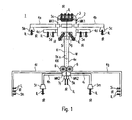
- FIG. 1 a device 1 for air supply into an interior IR of a vehicle, in particular for a modular 4-zone air conditioning is shown.
- the device 1 comprises an air conditioner 2 with a fan 3 (also called a main fan) arranged on the inlet side for supplying fresh air or circulated air, which is conditioned by means of the air conditioner 2.
- a fan 3 also called a main fan
- flow channels 4a to 4i are connected to distribute the conditioned air IL and their supply at different locations in the interior.
- the air conditioner 2 is located as usual in the front region of the vehicle not shown and serves to generate both hot air W and cold air K.
- the flow channels 4 have a number of flow outlets 5a to 5m, which open into the interior IR of the vehicle.
- the flow channels 4a to 4d are designed to be single-channeled for ventilating and heating the front region of the vehicle. That is, for the front area, the mixing of the hot air W and the cold air K to the conditioned air IL, which is supplied to the interior I, within the air conditioner 2, in particular in a first mixing chamber MK1.
- the first mixing chamber MK1 may be formed in one piece or in several parts.
- the conditioned air IL after mixing in the first mixing chamber MK1 is passed through the flow channels 4a to 4d and passes through the associated flow outlets 5a to 5g in the front region, for example through the defrosting flow outlet 5a for defrosting operation, through the flow outlets 5d. 5e in the front foot space, through the flow outlets 5f, 5g in the êttaummitte and through the flow outlets 5b, 5c on the vehicle side in the interior IR.
- these can also be multichannel, i. be designed for a separate guidance of cold air K and warm air W.
- the conditioned air IL is then generated directly in the area of the flow outlets 5a to 5g by mixing the cold air K and the warm air W.
- the flow channel 4e For ventilation and heating of the rear area, ie the rear seat area in the interior IR, the flow channel 4e leads from the air conditioner 2 to the flow outlets 5h to 5m.
- the flow channel 4e is designed to provide a separate guidance of warm air W and cold air K Mokanalig.
- the flow channel 4e is subdivided into a plurality of separate subchannels TK or as a multi-chamber channel, which comprises a plurality of chamber channels KK.
- the flow channel 4e runs in the rear region of the vehicle and has an additional blower 6 on the flow output side.
- the flow channel 4e - single-channel or multi-channel - this includes a common auxiliary fan 6 or channel-related per channel TK or KK a single auxiliary fan or at least one additional Gebläselaufrad.
- the flow output side per channel TK or KK has an additional blower 6 or an auxiliary blower 6 with two blower wheels.
- the auxiliary blower 6 is designed as a booster fan.
- the auxiliary fan 6, for example, as a mixing element for mixing the hot air W and the cold air K, a second mixing chamber MK2 downstream, which in turn channel-related and thus may be formed in two parts or as a common mixing chamber MK2 for both channels TK or KK.
- the flow channels 4f to 4i are connected, which open into the flow outlets 5h to 5m.
- the rear footwell is supplied via the flow outlet 5l or 5m via the flow outlet 5h and 5i, the lateral air supply takes place in the interior IR from the B-pillar of the vehicle.
- a flow outlet 5j or 5k which is arranged on the outlet side in the region of the second mixing chamber MK2, the conditioned air IL is guided centrally into the rear interior IR and thus into the rear area.
- the auxiliary blower (s) 6 in this example are regulated by an unillustrated automatic climate control operated by persons sitting in the rear, i. can be turned on or set.
- the operation can also central, z. B. by the driver or an occupant in the front area, made from behind when children sit or nobody sits there.
- a manual adjustment of the additional blower 6 and / or the second mixing chamber MK2 is possible.
- FIGS. 2A to 2C is a between the air conditioner 2 and designed as a two-chamber channel flow channel 4 e arranged flow control element 7 in three different positions S1 to S3 shown.
- the flow control element 7 is, for example, a mixing flap or pivoting flap pivotable about a rotation axis D.
- the flow channel 4e is subdivided into the two channels TK or KK.
- the lower - cold air K is guided by the air conditioner.
- From a heating element 8 of the air conditioner 2 flows into the other of the two channels TK or KK - for example, the upper - of the flow channel 4e hot air W.
- a multi-zone air conditioning can now be adjusted by a control of the air conditioner 2, the flow control element 7 and the auxiliary fan 6 and the heating element.
- a rapid cooling is desired
- the flow control element 7, as in FIG. 2B shown moved to the position S2, in particular pivoted so that the flow control element 7 shuts off the supply of hot air W from the air conditioner 2 in the flow channel 4e and at the same time only cold air K flows into the flow channel 4e and thus into both sub-channels TK and chamber channels KK.
- a fast heating is desired in winter.
- the flow control element 7 can be switched to a third position S3, so that the supply of cold air K is shut off from the air conditioner 2 and at the same time only warm air W flows into the flow channel 4e and its all channels TK and KK. In this way, a maximum amount of air flow per unit time is achieved.
- the flow channel 4e is provided with separate sub-channels TK or with chamber channels KK. Trained as a multi-chamber channel flow channel 4e can be performed with a flexible, elastic, foldable and / or sliding partition TW and is in the FIGS. 3A to 3C each shown in longitudinal section and in cross section.
- the hot air W and cold air K conducted in the respective chamber channel KK have the same dimensions as the two chamber channels KK. If the pressure of the hot air W is increased because, for example, an increased demand exists and is predetermined, the hot air flow is increased on the inlet side and the partition wall TW, as in FIG. 3A shown, bulges, so that the volume of the hot air duct increases and more warm air W can be transported. Analog results in increase in pressure of the cold air K as in FIG. 3A an enlarged volume for the relevant cold air duct.
- FIG. 4A shows essentially the device 1 according to FIG. 1 ,
- a Klimabox 9 is connected to the second mixing chamber MK 2 after the additional blower 6 via a further flow channel 4j branching off from the flow channel 4e and designed as a two-chamber channel.
- a further flow channel 4j branching off from the flow channel 4e and designed as a two-chamber channel.
- an additional, not shown, flow output side in the region of the flow input for the Klimabox 9 Be arranged mixing element, which causes a preset temperature by appropriately mixing the guided in the respective channels TK and KK warm air W and cold air K, so that the Klimabox 9 is cooled or heated as desired, so that they as a cool box or as a holding box can be used.
- the air supply will be blocked. This could be the case, for example, if in the winter a maximum heating of the interior IR is required and to the cold air duct warm air W leads to the Klimabox 9 but is set to a cooler temperature.
- the temperature of the Klimabox 9 can alternatively be set to cooling, heating or blocking the temperature, whereby the respective corresponding channel TK or KK of the flow channel 4j opened and shut off the other or both are shut off, which with a simple , mechanical three-way valve is accessible.
- FIG. 4B shows the Klimabox 9 in the middle of the back seat. For temperature control of the Klimabox 9 this is connected via the two-chamber channels formed as flow channels 4e and 4j to the air conditioner 2.
Landscapes
- Physics & Mathematics (AREA)
- Thermal Sciences (AREA)
- Engineering & Computer Science (AREA)
- Mechanical Engineering (AREA)
- Air-Conditioning For Vehicles (AREA)
Description
- Die Erfindung betrifft eine Vorrichtung zur Luftzuführung in einen Innenraum eines Fahrzeugs, insbesondere in den Fondbereich des Fahrzeugs, mit einem Gebläse zur Erzeugung eines Luftstroms und mit mindestens einem Strömungskanal.
- Üblicherweise werden Fahrzeuge, z.B. Land-, Wasser- oder Luftfahrzeuge, insbesondere deren Innenräume, beheizt oder klimatisiert, indem eine mittels einer Klimaanlage entsprechend konditionierte Luft in den Innenraum geleitet wird. Hierzu sind beispielsweise an mehreren, als geeignet erachteten Stellen Strömungsauslässe oder Ausströmpunkte vorgesehen, die über einen Strömungskanal mit einer Heizungs- und/oder Klimaanlage verbunden sind. Im Allgemeinen ist eine solche Heizungs- und/oder Klimaanlage im Frontbereich eines Fahrzeuges angeordnet, wodurch primär die vorne sitzenden Passagiere mit konditionierter Luft versorgt werden. Für Personen, die im hinteren Bereich des Innenraumes sitzen, ist es besonders komfortabel, wenn die zugeführte Luft durch zusätzliche Strömungskanäle auch in den hinteren Bereich geleitet wird und erst dort austritt. Auf diese Weise wird der thermische Komfort beeinflusst, insbesondere werden unangenehme Zugerscheinungen durch erhöhte Strömungsgeschwindigkeiten innerhalb des Innenraumes verringert, beispielsweise dann, wenn die Passagiere unterschiedliche Wünsche hinsichtlich der Klimatisierung haben.
- Aus der
DE 39 40 361 A1 ist dazu eine Heizungs- und/oder Klimaanlage bekannt, die ein im Frontbereich des Innenraumes angeordnetes Heiz-und/oder Klimagerät aufweist, von dem aus Luftverteilungskanäle zu Luftaustrittsöffnungen abzweigen, wobei zum Fondraum ein Luftverteilungskanal mit zumindest einer Luftaustrittsöffnung zum Belüften führt. Die Luftaustrittsöffnung ist dabei über eine Steuerklappe absperrbar, wobei deren Bedienungselemente im Fondraum angeordnet sind. Darüber hinaus führt ein zweiter Luftleitkanal zum Fondraum. Die Luftleitkanäle können jeweils aufgeheizte oder gekühlte Luft führen und münden beide vor der Luftaustrittsöffnung in einen Mischraum. - In
DE 102 41 460 A1 wird ebenfalls eine Klimaanlage mit einem Klimagerät beschrieben, in dem mindestens ein Gebläse, mindestens ein Verdampfer und mindestens ein Heizungswärmetauscher angeordnet sind und von dem aus Luftkanäle zu Luftaustritten führen, die verschiedenen Zonen eines Kraftfahrzeugs zugeordnet sind. Dabei sind getrennte Luftkanäle für kalte Luft und getrennte Luftkanäle für warme Luft vorgesehen, die vom Klimagerät jeweils zu einem Regelungsmodul für jede Zone führen. Die Luftmenge und die Lufttemperatur können für jede Zone unabhängig voneinander eingestellt werden. - Weiterhin ist es bekannt, ein zweites Klimagerät mit separaten Strömungskanälen im Fondbereich anzuordnen, mittels dessen der hintere Innenraum mit konditionierter Luft versorgt werden kann. Dies bedeutet jedoch einen deutlich höheren Kostenaufwand gegenüber einem einzelnen Klimagerät. Bei allen bekannten Klimaanlagen beziehungsweise Heizungsanlagen ist problematisch, dass sie durch die erforderliche Leistung viel Bauraum benötigen und zudem ein hohes Gewicht des Fahrzeugs aufweisen.
- Zusätzlichen Komfort kann ferner eine Klimabox bieten, in der Lebensmittel oder andere Güter gekühlt, erwärmt oder warm gehalten werden können. Eine solche ist beispielsweise aus
DE 198 11 185 C1 bekannt. - Aus der
US 4,665,971 ist eine Klimaanlage für ein Fahrzeug mit einem Teil der die vorderen Sitzplätze versorgt und einem Teil der die hinteren Sitzplätze versorgt bekannt. Dabei weist das System ein Hauptgebläse auf, sowie ein weiteres Gebläse, angeordnet in einer Rücksitzgebläseeinheit. - Ferner zeigt die
EP 1 323 555 A1 eine Klimatisierungsvorrichtung mit einer ersten Luftzirkulationsvorrichtung für einen vorderen Bereich und einer zweiten Luftzirkulationsvorrichtung für einen hinteren Bereich eines Fahrzeugs. - Der Erfindung liegt daher die Aufgabe zugrunde, eine verbesserte Vorrichtung zur Luftzuführung in einen Innenraum eines Fahrzeugs anzugeben, welche insbesondere einen verbesserten thermischen Komfort im Fahrzeug ermöglicht und weniger Bauraum benötigt. Darüber hinaus ist ein besonders geeignetes Verfahren zur Luftzuführung in einen Innenraum eines Fahrzeugs anzugeben.
- Erfindungsgemäß wird die Aufgabe hinsichtlich der Vorrichtung zur Luftzuführung durch die Merkmale des Anspruchs 1 gelöst.
- Vorteilhafte Weiterbildungen der Erfindung sind Gegenstand der Unteransprüche.
- Die Erfindung geht dabei von der Überlegung aus, dass für eine sowohl einen geringen Bauraum aufweisende Vorrichtung zur Luftzuführung in einen Innenraum eines Fahrzeugs, insbesondere in den Fondbereich als auch einen besseren thermischen Komfort im Fondbereich bewirkende Vorrichtung zur Luftzuführung diese hinsichtlich eines in einem Strömungskanal zu führenden Luftstroms individuell steuerbar sein sollte. Hierzu ist vorgesehen, dass zusätzlich zu einem strömungseingangsseitig angeordneten Hauptgebläse eines Klimageräts zur Erzeugung eines zu klimatisierenden Luftstroms im Strömungskanal strömungsausgangsseitig ein Zusatzgebläse vorgesehen ist.
- Ein zusätzlich zum Gebläse (= Hauptgebläse) strömungsausgangsseitig angeordnetes Zusatzgebläse verringert die am Hauptgebläse zur Verfügung zu stellende Förderleistung, wodurch das Hauptgebläse kleiner dimensioniert ausgebildet ist. Dies wiederum führt zu einem geringen Gewicht und zu einem besonders kleinen Bauraum.
- Vorzugsweise ist das Zusatzgebläse im Bereich eines Strömungsauslasses angeordnet, der strömungsausgangsseitig am Strömungskanal in den Innenraum mündet. Hierdurch sind der Energieverbrauch sowie die maximale Förderleistung des Hauptgebläses besonders einfach aufeinander einstellbar.
- Der Strömungskanal ist in mindestens zwei Teilkanäle unterteilt als ein Mehrkammerkanal mit mehreren Kammerkanälen ausgebildet . Die Unterteilung in zumindest zwei Teilkanäle kann mittels einer flexiblen, elastischen, faltbaren und/oder verschiebbaren Trennwand TW erfolgen. Getrennte Strömungskanäle beziehungsweise Kammerkanäle eines Mehrkammerkanals, in welchen jeweils warme und/oder kalte Luft geführt wird, ermöglichen eine individuelle Einstellung einer gewünschten Lufttemperatur an betreffenden Strömungsauslässen.
- Je nach Art und Ausbildung der Vorrichtung zur Luftzuführung kann bzw. können dabei im Strömungskanal ein oder mehrere Zusatzgebläse angeordnet sein. Jeweils ein Zusatzgebläse oder zumindest ein zusätzliches Gebläselaufrad ist an jeden Teilkanal oder Kammerkanal angeschlossen.Wodurch eine getrennte Luftführung ohne Durchmischung der Luftströme der einzelnen Kanäle sowie strömungsausgangsseitig eine gezielte Einstellung der jeweiligen Strömungsmenge und Strömungsstärke möglich ist.
- Zweckmäßigerweise ist dem Zusatzgebläse ein Mischelement vor- und/oder nachgeschaltet. Beispielsweise ist das Mischelement zwischen dem Zusatzgebläse und dem Strömungsauslass angeordnet. Mittels des zwischen dem Zusatzgebläse und dem Strömungsauslass angeordneten Mischelements kann ein fein dosierbares Mischen von kaltem und warmem Luftstrom erfolgen, wobei die Teilkanäle oder Mehrkammerkanäle in einen gemeinsamen Strömungsauslass münden. Besonders für Passagiere, die im Fond sitzen, kann mit einer derartigen, individuell temperierbaren Luftzuführung ein komfortables Klima geschaffen werden. Insbesondere kann die Klimatisierung im Fußbereich verbessert werden. Dabei erhöht eine Bedienung des oder der Zusatzgebläse von den hinteren Sitzplätzen aus den Komfort, da die hinteren Passagiere nicht mehr auf die Bedienungshandlungen der vorderen Passagiere angewiesen sind. Hierzu ist das Zusatzgebläse nach Bedarf einschaltbar und/oder einstellbar ausgebildet, wobei das Zusatzgebläse insbesondere von einer im Fondbereich sitzenden Person zu- bzw. einstellbar ist. Alternativ oder zusätzlich ist das Zusatzgebläse zentral, z. B. vom Cockpit oder einer Bedieneinheit der Klimaanlage, zu- bzw. einstellbar. Somit ermöglicht das Zusatzgebläse eine energiesparende und je nach Strömungsauslass individuelle Einstellung der Luftzuführung in den Fahrzeuginnenraum.
- Zweckmäßigerweise ist im Strömungskanal mindestens ein Strömungssteuerelement angeordnet. Vorzugsweise ist das Strömungssteuerelement zwischen einer ersten, den Strömungskanal für einen Warmluftstrom vollständig öffnenden Stellung und einer zweiten, den Strömungskanal für einen Kaltluftstrom vollständig öffnenden Stellung bewegbar angeordnet. Bei einer Unterteilung des Strömungskanals in Teilkanäle oder Kammerkanäle ist das Strömungssteuerelement vorteilhafterweise in eine Zwischenstellung für eine im Strömungskanal, insbesondere in Teilkanäle oder Kammerkanäle getrennte Führung von Kaltluftstrom und Warmluftstrom bewegbar. Durch eine derartige individuelle Einstellung von Kaltluftstrom und/oder Warmluftstrom im Strömungskanal ist es ermöglicht, dass beispielsweise bei Benutzen mehrerer Teilkanäle oder Kammerkanäle nur für Kaltluft oder Warmluft ein maximaler Kaltluftstrom bzw. Warmluftstrom, insbesondere in den Fondbereich geführt wird. Dadurch kann die Dauer bis zum Erreichen einer vorgegebenen Innenraumtemperatur für den Fondbereich deutlich verkürzt werden. Nachdem die vorgegebene Innenraumtemperatur erreicht ist, kann beispielsweise die Strömungssteuereinrichtung wieder so eingestellt werden, dass die Warmluft nur in den Warmluftkanal (= Teilkanal) und die Kaltluft nur in den Kaltluftkanal (= Teilkanal) strömt.
- Vorteilhafterweise ist strömungsausgangsseitig am Strömungskanal eine Klimabox angeordnet. Eine Klimabox, die sowohl an einen Strömungskanal oder an einen Kammerkanal für warme Luft als auch an einen Strömungskanal oder an einen Kammerkanal für kalte Luft angeschlossen ist, ermöglicht das komfortable Kühlen, Erwärmen oder Warmhalten unabhängig von der aktuellen Einstellung der Klimaanlage oder Heizung.
- Durch ein eigenes Mischelement kann die Temperatur innerhalb der Klimabox automatisch möglichst konstant gehalten werden, auch wenn sich die Temperaturen der zugeführten Warm- und Kaltluft ändern. Dabei ist auch die Überwachung der Lufttemperaturen möglich, um bei Über- oder Unterschreitung von unteren und oberen Grenztemperaturen die Luftzuführung vollständig zu sperren. Dies kann insbesondere dann erfolgen, wenn in Warm- und Kaltluftkanal zur Beschleunigung der Luftzuführung Luft derselben Temperatur geführt wird.
- Die mit der Erfindung erzielten Vorteile bestehen insbesondere darin, dass der thermische Komfort, insbesondere für Insassen im Fondbereich verbessert ist. Zudem weist die Vorrichtung einen besonders kleinen Bauraum auf, da das Hauptgebläse gegenüber herkömmlichen Hauptgebläsen wesentlich kleiner dimensioniert ist. Auch ist eine Mehrzonen-Klimatisierung im Fahrzeuginnenraum ermöglicht. Darüber hinaus kann besonders einfach eine Kühlbox ohne zusätzliche Kältequelle gekühlt oder auch als Warmhaltebox verwendet werden, indem die Kühlbox gewärmt wird.
- Vorteilhafterweise sind zumindest ein oder mehrere im Fahrzeug verlaufende Strömungskanäle, insbesondere die zur Warmhalte- oder Kühlbox führenden Strömungskanäle, thermisch isoliert.
- Die Erfindung wird im Folgenden anhand von Ausführungsbeispielen näher erläutert. Darin zeigen:
- Figur 1
- schematisch eine Vorrichtung zur Luftzuführung in einen Innenraum eines Fahrzeugs, insbesondere für eine modulare 4-Zonen-Klimatisierung des Innenraums,
- Figuren 2A bis 2C
- schematisch Teilkanäle eines Strömungskanals für Warm/Kaltluft für eine Luftzuführung in den hinteren Fahrzeuginnenraum,
- Figuren 3A bis 3C
- schematisch einen als Mehrkammerkanal ausgebildeten Strömungskanal mit einer flexiblen Trennwand, und
- Figuren 4A, 4B
- schematisch das Prinzip einer an einen Strömungskanal angeschlossenen Kühlbox.
- Einander entsprechende Teile sind in allen Figuren mit den gleichen Bezugszeichen versehen.
- In
Figur 1 ist eine Vorrichtung 1 zur Luftzuführung in einen Innenraum IR eines Fahrzeugs, insbesondere für eine modulare 4-Zonen-Klimatisierung dargestellt. Die Vorrichtung 1 umfasst ein Klimagerät 2 mit einem strömungseingangsseitig angeordneten Gebläse 3 (auch Hauptgebläse genannt) zum Zuführen von Frischluft oder Umluft, welche mittels des Klimageräts 2 klimatisiert wird. An das Klimagerät 2 sind zur Verteilung der klimatisierten Luft IL und deren Zuführung an verschiedenen Stellen in den Innenraum IR Strömungskanäle 4a bis 4i angeschlossen. Das Klimagerät 2 befindet sich wie üblich im Frontbereich des nicht abgebildeten Fahrzeuges und dient der Erzeugung sowohl von Warmluft W als auch von Kaltluft K. Die Strömungskanäle 4 weisen eine Anzahl von Strömungsauslässen 5a bis 5m auf, die in den Innenraum IR des Fahrzeugs münden. - In einer möglichen Ausführungsform sind die Strömungskanäle 4a bis 4d für die Belüftung und Beheizung des Frontbereichs des Fahrzeugs einkanalig ausgebildet. D.h. für den Frontbereich erfolgt das Mischen der Warmluft W und der Kaltluft K zur klimatisierten Luft IL, die dem Innenraum I zugeführt wird, innerhalb des Klimageräts 2, insbesondere in einer ersten Mischkammer MK1. Dabei kann die erste Mischkammer MK1 einteilig oder mehrteilig ausgebildet sein. Die klimatisierte Luft IL wird nach Mischung in der ersten Mischkammer MK1 durch die Strömungskanäle 4a bis 4d geführt und tritt durch die zugehörigen Strömungsauslässe 5a bis 5g im Frontbereich, beispielsweise durch den Strömungsauslass 5a für den Betrieb "Defrost" zur Scheibenenteisung, durch die Strömungsauslässe 5d, 5e in den Frontfußraum, durch die Strömungsauslässe 5f, 5g in die Innentaummitte und durch die Strömungsauslässe 5b, 5c an der Fahrzeugseite in den Innenraum IR aus.
- Alternativ zu den einkanalig ausgebildeten Strömungskanälen 4a bis 4d für den Frontbereich können diese auch mehrkanalig, d.h. für eine getrennte Führung von Kaltluft K und Warmluft W ausgebildet sein. In diesem Ausführungsbeispiel wird dann die klimatisierte Luft IL unmittelbar im Bereich der Strömungsauslässe 5a bis 5g durch Mischen der Kaltluft K und der Warmluft W erzeugt.
- Zur Belüftung und Beheizung des Fondbereichs, d.h. des hinteren Sitzbereichs im Innenraum IR, führt der Strömungskanal 4e von dem Klimagerät 2 zu den Strömungsauslässen 5h bis 5m. Um eine möglichst hinreichend gute Klimatisierung auch im hinteren Bereich des Innenraums IR zu erzielen, ist der Strömungskanal 4e zur separaten Führung von Warmluft W und Kaltluft K mehrkanalig ausgeführt. Beispielsweise ist der Strömungskanal 4e unterteilt in mehrere separate Teilkanäle TK oder als ein Mehrkammerkanal ausgebildet, der mehrere Kammerkanäle KK umfasst. Der Strömungskanal 4e läuft in den hinteren Bereich des Fahrzeugs und weist dort strömungsausgangsseitig ein Zusatzgebläse 6 auf. Je nach Art und Ausführung des Strömungskanals 4e - einkanalig oder mehrkanalig - umfasst dieser ein gemeinsames Zusatzgebläse 6 bzw. kanalbezogen je Kanal TK oder KK ein einzelnes Zusatzgebläse oder zumindest ein zusätzliches Gebläselaufrad. In der
Figur 1 ist ein zweikanaliger Strömungskanal 4e dargestellt, der strömungsausgangsseitig je Kanal TK oder KK ein Zusatzgebläse 6 oder ein Zusatzgebläse 6 mit zwei Gebläselaufrädern aufweist. - Das Zusatzgebläse 6 ist als ein Boostergebläse ausgeführt. Dem Zusatzgebläse 6 ist beispielsweise als Mischelement zur Mischung der Warmluft W und der Kaltluft K eine zweite Mischkammer MK2 nachgeschaltet, die wiederum kanalbezogen und somit zweiteilig oder als eine gemeinsame Mischkammer MK2 für beide Kanäle TK oder KK ausgebildet sein kann. An die zweite Mischkammer MK2 sind die Strömungskanäle 4f bis 4i angeschlossen, die in die Strömungsauslässe 5h bis 5m münden. Über den Strömungsauslass 5l bzw. 5m wird der Fondfußraum versorgt, über den Strömungsauslass 5h bzw. 5i erfolgt die seitliche Luftzuführung in den Innenraum IR von der B-Säule des Fahrzeugs aus. Zudem wird durch einen Strömungsauslass 5j bzw. 5k, der strömungsausgangsseitig im Bereich der zweiten Mischkammer MK2 angeordnet ist, die klimatisierte Luft IL mittig in den hinteren Innenraum IR und somit in den Fondbereich geführt.
- Das oder die Zusatzgebläse 6 werden in diesem Beispiel ebenso wie die zweite Mischkammer MK2 durch eine nicht abgebildete Klimaautomatik geregelt, die von im Fond sitzenden Personen bedient, d.h. eingeschaltet oder eingestellt, werden kann. Wahlweise kann die Bedienung auch zentral, z. B. von dem Fahrer oder einem Insassen im Frontbereich, aus erfolgen, wenn hinten Kinder sitzen oder dort gar niemand sitzt. Auch eine manuelle Einstellung des oder der Zusatzgebläse 6 und/oder der zweiten Mischkammer MK2 ist möglich.
- In den
Figuren 2A bis 2C ist ein zwischen dem Klimagerät 2 und dem als Zweikammerkanal ausgebildeten Strömungskanal 4e angeordnetes Strömungssteuerelement 7 in drei verschiedenen Stellungen S1 bis S3 dargestellt. InFigur 2A ist das Strömungssteuerelement 7 in die Stellung S1 (= Mittelstellung) gebracht. Bei dem Strömungssteuerelement 7 handelt es sich beispielsweise um eine um eine Drehachse D schwenkbare Mischklappe oder Schwenkklappe. Durch die Anordnung des Strömungssteuerelement 7 in Mittelstellung ist der Strömungskanal 4e in die beiden Kanäle TK bzw. KK unterteilt. In den einen Teilkanal TK bzw. Kammerkanal KK - beispielsweise dem unteren - wird von dem Klimagerät 2 Kaltluft K hineingeführt. Von einem Heizelement 8 des Klimageräts 2 strömt in den anderen der beiden Kanäle TK bzw. KK - beispielsweise dem oberen - des Strömungskanals 4e Warmluft W. - Im Betrieb der Vorrichtung 1 können nun durch eine Steuerung des Klimageräts 2, des Strömungssteuerelements 7 sowie der Zusatzgebläse 6 und des Heizelements 8 verschiedene Klimatisierungsstufen, insbesondere eine Mehrzonenklimatisierung eingestellt werden. Ist der Fahrzeuginnenraum beispielsweise im Hochsommer stark aufgeheizt, ist eine schnelle Abkühlung gewünscht Dazu wird das Strömungssteuerelement 7, wie in
Figur 2B dargestellt, in die Stellung S2 bewegt, insbesondere geschwenkt, so dass das Strömungssteuerelement 7 die Zufuhr der Warmluft W von dem Klimagerät 2 in den Strömungskanal 4e absperrt und gleichzeitig ausschließlich Kaltluft K in den Strömungskanal 4e und somit in beide Teilkanäle TK bzw. Kammerkanäle KK strömt. Analog wird beispielsweise im Winter ein schnelles Aufheizen gewünscht. Zu diesem Zweck kann das Strömungssteuerelement 7 in eine dritte Stellung S3 umgestellt werden, so dass die Zufuhr von Kaltluft K aus dem Klimagerät 2 abgesperrt ist und gleichzeitig ausschließlich Warmluft W in den Strömungskanal 4e und dessen sämtliche Kanäle TK bzw. KK strömt. Auf diese Weise wird ein maximaler Luftmengenstrom pro Zeiteinheit erreicht. - Je nach Ausführungsform ist der Strömungskanal 4e mit getrennten Teilkanälen TK oder mit Kammerkanälen KK versehen. Der als Mehrkammerkanal ausgebildete Strömungskanal 4e kann dabei mit einer flexiblen, elastischen, faltbaren und/oder verschiebbaren Trennwand TW ausgeführt sein und ist in den
Figuren 3A bis 3C jeweils im Längsschnitt und im Querschnitt dargestellt. - In dem in
Figur 3C gezeigten Fall sind bei gleichem Druck der in dem jeweiligen Kammerkanal KK geführten Warmluft W und Kaltluft K die Abmessungen der beiden Kammerkanäle KK gleich groß. Wird der Druck der Warmluft W erhöht, weil beispielsweise ein erhöhter Bedarf besteht und vorgegeben ist, so wird der Warmluftstrom strömungseingangsseitig vergrößert und die Trennwand TW, wie inFigur 3A dargestellt, beult aus, so dass sich das Volumen des Warmluftkanals vergrößert und mehr Warmluft W transportiert werden kann. Analog ergibt sich bei Druckerhöhung der Kaltluft K wie inFigur 3A ein vergrößertes Volumen für den betreffenden Kaltluftkanal. -
Figur 4A zeigt im wesentlichen die Vorrichtung 1 gemäßFigur 1 . Zusätzlich ist eine Klimabox 9 über einen weiteren, von dem Strömungskanal 4e abzweigenden und als Zweikammerkanal ausgebildeten Strömungskanal 4j mit der zweiten Mischkammer MK 2 nach dem Zusatzgebläse 6 angeschlossen. In dem Strömungskanal 4j kann strömungsausgangsseitig im Bereich des Strömungseingangs für die Klimabox 9 ein zusätzliches, nicht dargestelltes Mischelement angeordnet sein, das eine voreingestellte Temperatur durch entsprechendes Mischen der in den betreffenden Kanälen TK bzw. KK geführten Warmluft W und Kaltluft K bewirkt, so dass die Klimabox 9 wie gewünscht gekühlt bzw. gewärmt wird, so dass sie als Kühlbox bzw. als Warmhaltebox verwendet werden kann. - Ist ein Mischen zur voreingestellten Temperatur nicht möglich, wird die Luftzuführung gesperrt. Dies könnte beispielsweise der Fall sein, wenn im Winter eine maximale Beheizung des Innenraums IR erforderlich ist und dazu auch der Kaltluftkanal Warmluft W führt, die Klimabox 9 aber auf eine kühlere Temperatur eingestellt ist. In einer besonders einfachen Ausführungsform kann die Temperierung der Klimabox 9 alternativ auf Kühlen, Erwärmen oder Sperren der Temperierung eingestellt werden, wodurch der jeweils entsprechende Kanal TK bzw. KK des Strömungskanals 4j geöffnet und der jeweils andere abgesperrt beziehungsweise beide abgesperrt werden, was mit einem einfachen, mechanischen Dreiwegeventil erreichbar ist.
Figur 4B zeigt die Klimabox 9 in der Mitte der Rückbank. Zur Temperierung der Klimabox 9 ist diese über die als Zweikammerkanäle ausgebildeten Strömungskanäle 4e und 4j an das Klimagerät 2 angeschlossen. -
- 1
- Vorrichtung zur Luftzuführung
- 2
- Klimagerät
- 3
- Gebläse (= Hauptgebläse)
- 4a bis 4j
- Strömungskanäle
- 5a bis 5m
- Strömungsauslässe
- 6
- Zusatzgebläse
- 7
- Strömungssteuerelement, z. B. Mischklappe
- 8
- Heizkörper
- 9
- Klimabox
- D
- Drehachse
- IL
- klimatisierte Luft für den Innenraum eines Fahrzeugs
- IR
- Innenraum eines Fahrzeugs
- K
- Kaltluft
- KK
- Kammerkanal
- MK1
- erste Mischkammer
- MK2
- zweite Mischkammer
- TK
- Teilkanal
- TW
- Trennwand eines Strömungskanals
- W
- Warmluft
Claims (18)
- Vorrichtung (1) zur Luftzuführung in einen Innenraum (IR) eines Fahrzeugs, mit einem strömungseingangsseitig angeordneten Gebläse (3) zur Erzeugung eines klimatisierten Luftstroms (IL) und mit mindestens einem Strömungskanal (4a bis 4j), in welchem strömungsausgangsseitig mindestens ein Zusatzgebläse (6) angeordnet ist, dadurch gekennzeichnet, dass der Strömungskanal (4e, 4j) in mindestens zwei Teilkanäle (TK) unterteilt ist, wobei je Teilkanal (TK) strömungsausgangsseitig ein zugehöriges Zusatzgebläse (6) oder zumindest ein zusätzliches Gebläselaufrad angeordnet ist.
- Vorrichtung nach dem Oberbegriff des Anspruchs 1, dadurch gekennzeichnet, dass der Strömungskanal (4e, 4j) als ein Mehrkammerkanal ausgebildet ist und je Kammerkanal (KK) strömungsausgangsseitig ein zugehöriges Zusatzgebläse (6) oder zumindest ein zusätzliches Gebläselaufrad angeordnet ist.
- Vorrichtung nach Anspruch 1, wobei der Strömungskanal (4a bis 4j) in mindestens einen in den Innenraum (IR) führenden Strömungsauslass (5a bis 5m) mündet und das Zusatzgebläse (6) im Bereich des Strömungsauslasses (5j) angeordnet ist.
- Vorrichtung nach einem der Ansprüche 1 oder 3, wobei der Strömungskanal (4e, 4j) durch eine elastische, formbare, faltbare und/oder verschiebbare Trennwand (TW) in zumindest zwei Teilkanäle (TK) unterteilt ist.
- Vorrichtung nach einem der Ansprüche 1 bis 4, wobei dem Zusatzgebläse (6) ein Mischelement, insbesondere eine Mischkammer (MK2) nachgeschaltet ist.
- Vorrichtung nach Anspruch 5, wobei das Mischelement zwischen dem Zusatzgebläse (6) und dem Strömungsauslass (5j) angeordnet ist.
- Vorrichtung nach einem der Ansprüche 1 bis 6, wobei das Zusatzgebläse (6) nach Bedarf einschaltbar und/oder einstellbar ist.
- Vorrichtung nach einem der Ansprüche 2 bis 7, wobei der Strömungsauslass (5h bis 5m) in den Fondbereich, insbesondere den hinteren Sitzbereich des Innenraums (IR) mündet.
- Vorrichtung nach einem der Ansprüche 1 bis 8, wobei das Zusatzgebläse (6) zentral oder dezentral, insbesondere vom hinteren Sitzbereich bedienbar ist.
- Vorrichtung nach einem der Ansprüche 1 bis 9, wobei im Strömungskanal (4e, 4j) mindestens ein Strömungssteuerelement (7) angeordnet ist.
- Vorrichtung nach Anspruch 10, wobei das Strömungssteuerelement (7) zwischen einer ersten, den Strömungskanal (4e, 4j) für einen Warmluftstrom vollständig öffnenden Stellung (S3) und einer zweiten, den Strömungskanal (4e, 4j) für einen Kaltluftstrom vollständig öffnenden Stellung (S2) bewegbar angeordnet ist.
- Vorrichtung nach Anspruch 10 oder 11, wobei das Strömungssteuerelement (7) in einer Zwischenstellung (S1) für eine im Strömungskanal (4e, 4j) getrennte Führung von Kaltluftstrom und Warmluftstrom bewegbar ist.
- Vorrichtung nach einem der Ansprüche 1 bis 12, wobei strömungsausgangsseitig am Strömungskanal (4e) eine Klimabox (9) angeordnet ist.
- Vorrichtung nach Anspruch 13, wobei ein vom Strömungskanal (4e) abgezweigter Strömungskanal (4j) zur Klimatisierung der Klimabox (9) vorgesehen ist.
- Vorrichtung nach Anspruch 14, wobei das Zusatzgebläse (6) im Strömungskanal (4e) vor dem abgezweigten Strömungskanal (4j) angeordnet ist.
- Vorrichtung nach einem der Ansprüche 13 bis 15, wobei strömungsausgangsseitig im Strömungskanal (4e), insbesondere im Bereich des abgezweigten Strömungskanals (4j) für die Klimabox (9) ein zugehöriges Mischelement, insbesondere eine Mischkammer (MK2) angeordnet ist.
- Vorrichtung nach einem der Ansprüche 13 bis 16, wobei die Klimabox (9) als Kühl- und/oder Warmhaltebox ausgebildet ist.
- Vorrichtung nach einem der Ansprüche 1 bis 17, wobei zumindest ein Strömungskanal (4a bis 4j) thermisch isoliert ausgebildet ist.
Applications Claiming Priority (2)
| Application Number | Priority Date | Filing Date | Title |
|---|---|---|---|
| DE102004028784 | 2004-06-16 | ||
| DE102004028784A DE102004028784A1 (de) | 2004-06-16 | 2004-06-16 | Vorrichtung zur Luftzuführung in einen Innenraum eines Fahrzeuges |
Publications (3)
| Publication Number | Publication Date |
|---|---|
| EP1607254A2 EP1607254A2 (de) | 2005-12-21 |
| EP1607254A3 EP1607254A3 (de) | 2006-06-28 |
| EP1607254B1 true EP1607254B1 (de) | 2009-08-12 |
Family
ID=34937065
Family Applications (1)
| Application Number | Title | Priority Date | Filing Date |
|---|---|---|---|
| EP05011651A Expired - Lifetime EP1607254B1 (de) | 2004-06-16 | 2005-05-31 | Vorrichtung zur Luftzuführung in einen Innenraum eines Fahrzeuges |
Country Status (4)
| Country | Link |
|---|---|
| US (1) | US20060000592A1 (de) |
| EP (1) | EP1607254B1 (de) |
| AT (1) | ATE439267T1 (de) |
| DE (2) | DE102004028784A1 (de) |
Families Citing this family (22)
| Publication number | Priority date | Publication date | Assignee | Title |
|---|---|---|---|---|
| US7743614B2 (en) | 2005-04-08 | 2010-06-29 | Bsst Llc | Thermoelectric-based heating and cooling system |
| DE102005031912A1 (de) * | 2005-07-07 | 2007-01-11 | Siemens Ag | Luftkanalsystem für Fahrzeuge, insbesondere für Schienenfahrzeuge des Personenverkehrs |
| EP2015948B1 (de) * | 2006-04-28 | 2016-08-10 | MAHLE Behr GmbH & Co. KG | Kraftfahrzeug-klimaanlage |
| DE102006020377A1 (de) * | 2006-04-28 | 2007-10-31 | Behr Gmbh & Co. Kg | Kraftfahrzeug-Klimaanlagenanordnung |
| US9310112B2 (en) | 2007-05-25 | 2016-04-12 | Gentherm Incorporated | System and method for distributed thermoelectric heating and cooling |
| DE102007035220A1 (de) | 2007-07-25 | 2009-01-29 | Behr Gmbh & Co. Kg | Heiz- oder Klimaanlage, insbesondere für den Einsatz in einem Kraftfahrzeug |
| GB2461287A (en) | 2008-06-26 | 2009-12-30 | Land Rover Uk Ltd | A balanced flow air conditioning system |
| JP5324973B2 (ja) * | 2009-03-25 | 2013-10-23 | 三菱重工業株式会社 | 軌道系車両の空調装置 |
| WO2010135363A2 (en) | 2009-05-18 | 2010-11-25 | Bsst Llc | Temperature control system with thermoelectric device |
| DE102010060468A1 (de) * | 2010-11-10 | 2012-05-10 | Dr. Ing. H.C. F. Porsche Aktiengesellschaft | Neue Klimagerätegeneration |
| TWI638587B (zh) * | 2011-10-05 | 2018-10-11 | 美商應用材料股份有限公司 | 對稱電漿處理腔室 |
| DE102012107241A1 (de) * | 2012-08-07 | 2014-02-13 | Halla Visteon Climate Control Corporation 95 | Luftbehandlungs- und Luftleitanordnung für die Klimatisierung von Kraftfahrzeugen |
| US20140060795A1 (en) * | 2012-09-06 | 2014-03-06 | Jeffrey N. Yu | Concealed dynamic ventilation system |
| US9168810B2 (en) * | 2012-10-09 | 2015-10-27 | Delphi Technologies, Inc. | Heating and cooling system for occupants of the rear portion of a vehicle |
| US9682608B2 (en) * | 2013-01-30 | 2017-06-20 | Hanon Systems | Supplemental heating and cooling sources for a heating, ventilation and air conditioning system |
| DE102014209091B4 (de) * | 2013-05-14 | 2022-08-25 | Volkswagen Aktiengesellschaft | Klimatisierungsvorrichtung für ein Kraftfahrzeug |
| JP6751716B2 (ja) | 2014-12-19 | 2020-09-09 | ジェンサーム インコーポレイテッドGentherm Incorporated | 車両領域の熱調節システムならびに方法 |
| DE102016203733B4 (de) * | 2015-03-09 | 2025-11-06 | Hanon Systems | Klimaanlagensystem für Motorfahrzeuge |
| US10532628B2 (en) * | 2015-05-05 | 2020-01-14 | Mahle International Gmbh | HVAC module having a reconfigurable bi-level duct system |
| US10625566B2 (en) | 2015-10-14 | 2020-04-21 | Gentherm Incorporated | Systems and methods for controlling thermal conditioning of vehicle regions |
| US20170267065A1 (en) * | 2016-03-16 | 2017-09-21 | Hyundai Motor Company | Air conditioning system for vehicle |
| US9937830B1 (en) * | 2016-10-10 | 2018-04-10 | V Bishop Benjamin Curry | Child passenger safety seat emergency cooling and notification system |
Family Cites Families (17)
| Publication number | Priority date | Publication date | Assignee | Title |
|---|---|---|---|---|
| US3207439A (en) * | 1963-07-11 | 1965-09-21 | Gen Motors Corp | Automotive air mix heater control arrangement |
| US3278121A (en) * | 1963-09-26 | 1966-10-11 | Porsche Kg | Vehicle heating system |
| JPS589778Y2 (ja) * | 1979-05-18 | 1983-02-22 | 株式会社ボッシュオートモーティブ システム | 空気清浄器付自動車用空調装置 |
| JPS5631812A (en) * | 1979-08-20 | 1981-03-31 | Diesel Kiki Co Ltd | Automobile air conditioner |
| DE3406249A1 (de) * | 1984-02-21 | 1985-08-22 | Webasto-Werk W. Baier GmbH & Co, 8035 Gauting | Klimaanlage fuer kraftfahrzeuge, insbesondere omnibusse |
| US4478048A (en) * | 1984-03-05 | 1984-10-23 | General Electric Company | Air sensing control system for air conditioners |
| JPS60259517A (ja) * | 1984-06-04 | 1985-12-21 | Diesel Kiki Co Ltd | 自動車用空気調和装置 |
| DE3940361A1 (de) | 1989-12-06 | 1991-06-13 | Bayerische Motoren Werke Ag | Heizungs- und/oder klimaanlage fuer kraftfahrzeuginnenraeume |
| FR2725404B1 (fr) * | 1994-10-06 | 1996-11-15 | Peugeot | Circuit de repartition d'air, notamment pour la climatisation d'un vehicule automobile |
| DE29611394U1 (de) * | 1996-07-01 | 1996-08-14 | Volkswagen Ag, 38440 Wolfsburg | Strömungskanal für ein Luftführungssystem |
| FR2775221B1 (fr) * | 1998-02-20 | 2000-05-26 | Renault | Dispositif d'aeration, de chauffage et de climatisation d'un habitacle d'un vehicule automobile |
| DE19811185C1 (de) | 1998-03-14 | 1999-07-01 | Daimler Chrysler Ag | Klimabox für Fahrzeuge |
| DE10026380B4 (de) * | 2000-05-27 | 2011-12-15 | Volkswagen Ag | Einrichtung zur Klimatisierung eines Kraftfahrzeug-Innenraums |
| EP1323555A1 (de) * | 2001-12-27 | 2003-07-02 | Renault s.a.s. | Anlage und Verfahren zur Klimatisierung des Innenraums von Kraftfahrzeugen |
| DE10224763A1 (de) * | 2002-06-04 | 2003-12-24 | Delphi Tech Inc | Verfahren zur Bereitstellung von temperierter Luft und für dieses verwendbare Vorrichtung |
| DE10241460A1 (de) * | 2002-09-06 | 2004-03-18 | Robert Bosch Gmbh | Klimaanlage |
| DE10251760A1 (de) * | 2002-11-05 | 2004-05-19 | Behr Gmbh & Co. | Vorrichtung und Verfahren zur Luftverteilung in einem Fahrzeug |
-
2004
- 2004-06-16 DE DE102004028784A patent/DE102004028784A1/de not_active Withdrawn
-
2005
- 2005-05-31 AT AT05011651T patent/ATE439267T1/de not_active IP Right Cessation
- 2005-05-31 EP EP05011651A patent/EP1607254B1/de not_active Expired - Lifetime
- 2005-05-31 DE DE502005007876T patent/DE502005007876D1/de not_active Expired - Lifetime
- 2005-06-15 US US11/152,792 patent/US20060000592A1/en not_active Abandoned
Also Published As
| Publication number | Publication date |
|---|---|
| DE102004028784A1 (de) | 2006-01-05 |
| EP1607254A2 (de) | 2005-12-21 |
| EP1607254A3 (de) | 2006-06-28 |
| ATE439267T1 (de) | 2009-08-15 |
| US20060000592A1 (en) | 2006-01-05 |
| DE502005007876D1 (de) | 2009-09-24 |
Similar Documents
| Publication | Publication Date | Title |
|---|---|---|
| EP1607254B1 (de) | Vorrichtung zur Luftzuführung in einen Innenraum eines Fahrzeuges | |
| EP1088696B1 (de) | Vorrichtung zum Klimatisieren in Kraftfahrzeugen | |
| DE10014203A1 (de) | Klimasteuerung für ein Fahrzeug | |
| DE102008034167A1 (de) | Klimaanlage für Fahrzeuge | |
| DE69115647T2 (de) | Vorrichtung zur Heizung und Belüftung des Fahrgastraums eines Kraftfahrzeugs | |
| DE102004033402B4 (de) | Modulsystem zum Aufbau einer 1-Zonen-bis 4-Zonen-Klimaanlage für Fahrzeuge | |
| DE10052136A1 (de) | Heiz-Klimaanlage | |
| EP2036749B1 (de) | Klima- und Belüftungsanlage für ein Kraftfahrzeug | |
| DE3940361A1 (de) | Heizungs- und/oder klimaanlage fuer kraftfahrzeuginnenraeume | |
| DE102021209994A1 (de) | Klimaanlage eines Kraftfahrzeugs | |
| DE102014109925A1 (de) | Mehrzonen-Klimatisierungseinrichtung | |
| EP3953212B1 (de) | Klimatisierungsanordnung für ein fahrzeug und fahrzeug | |
| EP1223059A2 (de) | Verfahren und Anordnung zur Mischluftregelung in einer Heizungs- oder Klimaanlage eines Kraftfahrzeuges | |
| DE19639321C1 (de) | Klimaanlage für Fahrzeuginnenräume | |
| EP1237742B1 (de) | Heiz- und/oder klimaanlage für ein fahrzeug mit teilluftführungskanal | |
| DE19835286B4 (de) | Heizungs- oder Klimaanlage eines Fahrzeuges | |
| EP1915265B1 (de) | Vorrichtung zum klimatisieren in kraftfahrzeugen | |
| DE10253854B3 (de) | Heiz- oder Kühlanlage zur Klimatisierung eines Kraftfahrzeuginnenraums | |
| DE19943762A1 (de) | Zonen-Klimagerät | |
| EP1327541B1 (de) | Klimatisierungsanlage eines Fahrzeugs | |
| DE10055670A1 (de) | Klima- und Belüftungsanlage für ein Kraftfahrzeug | |
| DE19934187A1 (de) | Heizungs-Lüftungs-Vorrichtung für ein Fahrzeug, mit individueller Steuerung entsprechend Zonen des Fahrzeuginnenraumes | |
| DE10055669A1 (de) | Klima- und Belüftungsanlage für ein Kraftfahrzeug | |
| EP1344663B1 (de) | Mehrkanalige Heizungs- und/oder Klimaanlage für ein Kraftfahrzeug | |
| EP1555147B1 (de) | Klimatisierungsvorrichtung für ein Kraftfahrzeug |
Legal Events
| Date | Code | Title | Description |
|---|---|---|---|
| PUAI | Public reference made under article 153(3) epc to a published international application that has entered the european phase |
Free format text: ORIGINAL CODE: 0009012 |
|
| AK | Designated contracting states |
Kind code of ref document: A2 Designated state(s): AT BE BG CH CY CZ DE DK EE ES FI FR GB GR HU IE IS IT LI LT LU MC NL PL PT RO SE SI SK TR |
|
| AX | Request for extension of the european patent |
Extension state: AL BA HR LV MK YU |
|
| PUAL | Search report despatched |
Free format text: ORIGINAL CODE: 0009013 |
|
| AK | Designated contracting states |
Kind code of ref document: A3 Designated state(s): AT BE BG CH CY CZ DE DK EE ES FI FR GB GR HU IE IS IT LI LT LU MC NL PL PT RO SE SI SK TR |
|
| AX | Request for extension of the european patent |
Extension state: AL BA HR LV MK YU |
|
| 17P | Request for examination filed |
Effective date: 20061228 |
|
| AKX | Designation fees paid |
Designated state(s): AT BE BG CH CY CZ DE DK EE ES FI FR GB GR HU IE IS IT LI LT LU MC NL PL PT RO SE SI SK TR |
|
| 17Q | First examination report despatched |
Effective date: 20071023 |
|
| GRAP | Despatch of communication of intention to grant a patent |
Free format text: ORIGINAL CODE: EPIDOSNIGR1 |
|
| GRAS | Grant fee paid |
Free format text: ORIGINAL CODE: EPIDOSNIGR3 |
|
| GRAA | (expected) grant |
Free format text: ORIGINAL CODE: 0009210 |
|
| AK | Designated contracting states |
Kind code of ref document: B1 Designated state(s): AT BE BG CH CY CZ DE DK EE ES FI FR GB GR HU IE IS IT LI LT LU MC NL PL PT RO SE SI SK TR |
|
| REG | Reference to a national code |
Ref country code: GB Ref legal event code: FG4D Free format text: NOT ENGLISH |
|
| REG | Reference to a national code |
Ref country code: CH Ref legal event code: EP |
|
| REG | Reference to a national code |
Ref country code: IE Ref legal event code: FG4D |
|
| REF | Corresponds to: |
Ref document number: 502005007876 Country of ref document: DE Date of ref document: 20090924 Kind code of ref document: P |
|
| LTIE | Lt: invalidation of european patent or patent extension |
Effective date: 20090812 |
|
| PG25 | Lapsed in a contracting state [announced via postgrant information from national office to epo] |
Ref country code: LT Free format text: LAPSE BECAUSE OF FAILURE TO SUBMIT A TRANSLATION OF THE DESCRIPTION OR TO PAY THE FEE WITHIN THE PRESCRIBED TIME-LIMIT Effective date: 20090812 Ref country code: FI Free format text: LAPSE BECAUSE OF FAILURE TO SUBMIT A TRANSLATION OF THE DESCRIPTION OR TO PAY THE FEE WITHIN THE PRESCRIBED TIME-LIMIT Effective date: 20090812 Ref country code: SE Free format text: LAPSE BECAUSE OF FAILURE TO SUBMIT A TRANSLATION OF THE DESCRIPTION OR TO PAY THE FEE WITHIN THE PRESCRIBED TIME-LIMIT Effective date: 20090812 Ref country code: ES Free format text: LAPSE BECAUSE OF FAILURE TO SUBMIT A TRANSLATION OF THE DESCRIPTION OR TO PAY THE FEE WITHIN THE PRESCRIBED TIME-LIMIT Effective date: 20091123 Ref country code: IS Free format text: LAPSE BECAUSE OF FAILURE TO SUBMIT A TRANSLATION OF THE DESCRIPTION OR TO PAY THE FEE WITHIN THE PRESCRIBED TIME-LIMIT Effective date: 20091212 |
|
| NLV1 | Nl: lapsed or annulled due to failure to fulfill the requirements of art. 29p and 29m of the patents act | ||
| PG25 | Lapsed in a contracting state [announced via postgrant information from national office to epo] |
Ref country code: NL Free format text: LAPSE BECAUSE OF FAILURE TO SUBMIT A TRANSLATION OF THE DESCRIPTION OR TO PAY THE FEE WITHIN THE PRESCRIBED TIME-LIMIT Effective date: 20090812 Ref country code: PL Free format text: LAPSE BECAUSE OF FAILURE TO SUBMIT A TRANSLATION OF THE DESCRIPTION OR TO PAY THE FEE WITHIN THE PRESCRIBED TIME-LIMIT Effective date: 20090812 Ref country code: SI Free format text: LAPSE BECAUSE OF FAILURE TO SUBMIT A TRANSLATION OF THE DESCRIPTION OR TO PAY THE FEE WITHIN THE PRESCRIBED TIME-LIMIT Effective date: 20090812 |
|
| REG | Reference to a national code |
Ref country code: IE Ref legal event code: FD4D |
|
| PG25 | Lapsed in a contracting state [announced via postgrant information from national office to epo] |
Ref country code: PT Free format text: LAPSE BECAUSE OF FAILURE TO SUBMIT A TRANSLATION OF THE DESCRIPTION OR TO PAY THE FEE WITHIN THE PRESCRIBED TIME-LIMIT Effective date: 20091212 Ref country code: BG Free format text: LAPSE BECAUSE OF FAILURE TO SUBMIT A TRANSLATION OF THE DESCRIPTION OR TO PAY THE FEE WITHIN THE PRESCRIBED TIME-LIMIT Effective date: 20091112 |
|
| PG25 | Lapsed in a contracting state [announced via postgrant information from national office to epo] |
Ref country code: RO Free format text: LAPSE BECAUSE OF FAILURE TO SUBMIT A TRANSLATION OF THE DESCRIPTION OR TO PAY THE FEE WITHIN THE PRESCRIBED TIME-LIMIT Effective date: 20090812 Ref country code: IE Free format text: LAPSE BECAUSE OF FAILURE TO SUBMIT A TRANSLATION OF THE DESCRIPTION OR TO PAY THE FEE WITHIN THE PRESCRIBED TIME-LIMIT Effective date: 20090812 Ref country code: EE Free format text: LAPSE BECAUSE OF FAILURE TO SUBMIT A TRANSLATION OF THE DESCRIPTION OR TO PAY THE FEE WITHIN THE PRESCRIBED TIME-LIMIT Effective date: 20090812 Ref country code: CZ Free format text: LAPSE BECAUSE OF FAILURE TO SUBMIT A TRANSLATION OF THE DESCRIPTION OR TO PAY THE FEE WITHIN THE PRESCRIBED TIME-LIMIT Effective date: 20090812 Ref country code: DK Free format text: LAPSE BECAUSE OF FAILURE TO SUBMIT A TRANSLATION OF THE DESCRIPTION OR TO PAY THE FEE WITHIN THE PRESCRIBED TIME-LIMIT Effective date: 20090812 |
|
| PG25 | Lapsed in a contracting state [announced via postgrant information from national office to epo] |
Ref country code: SK Free format text: LAPSE BECAUSE OF FAILURE TO SUBMIT A TRANSLATION OF THE DESCRIPTION OR TO PAY THE FEE WITHIN THE PRESCRIBED TIME-LIMIT Effective date: 20090812 |
|
| PLBE | No opposition filed within time limit |
Free format text: ORIGINAL CODE: 0009261 |
|
| STAA | Information on the status of an ep patent application or granted ep patent |
Free format text: STATUS: NO OPPOSITION FILED WITHIN TIME LIMIT |
|
| 26N | No opposition filed |
Effective date: 20100517 |
|
| PG25 | Lapsed in a contracting state [announced via postgrant information from national office to epo] |
Ref country code: GR Free format text: LAPSE BECAUSE OF FAILURE TO SUBMIT A TRANSLATION OF THE DESCRIPTION OR TO PAY THE FEE WITHIN THE PRESCRIBED TIME-LIMIT Effective date: 20091113 |
|
| BERE | Be: lapsed |
Owner name: BEHR G.M.B.H. & CO. KG Effective date: 20100531 |
|
| PG25 | Lapsed in a contracting state [announced via postgrant information from national office to epo] |
Ref country code: MC Free format text: LAPSE BECAUSE OF NON-PAYMENT OF DUE FEES Effective date: 20100531 |
|
| REG | Reference to a national code |
Ref country code: CH Ref legal event code: PL |
|
| GBPC | Gb: european patent ceased through non-payment of renewal fee |
Effective date: 20100531 |
|
| PG25 | Lapsed in a contracting state [announced via postgrant information from national office to epo] |
Ref country code: LI Free format text: LAPSE BECAUSE OF NON-PAYMENT OF DUE FEES Effective date: 20100531 Ref country code: CH Free format text: LAPSE BECAUSE OF NON-PAYMENT OF DUE FEES Effective date: 20100531 |
|
| PG25 | Lapsed in a contracting state [announced via postgrant information from national office to epo] |
Ref country code: BE Free format text: LAPSE BECAUSE OF NON-PAYMENT OF DUE FEES Effective date: 20100531 Ref country code: IT Free format text: LAPSE BECAUSE OF FAILURE TO SUBMIT A TRANSLATION OF THE DESCRIPTION OR TO PAY THE FEE WITHIN THE PRESCRIBED TIME-LIMIT Effective date: 20090812 |
|
| PG25 | Lapsed in a contracting state [announced via postgrant information from national office to epo] |
Ref country code: GB Free format text: LAPSE BECAUSE OF NON-PAYMENT OF DUE FEES Effective date: 20100531 |
|
| PG25 | Lapsed in a contracting state [announced via postgrant information from national office to epo] |
Ref country code: AT Free format text: LAPSE BECAUSE OF NON-PAYMENT OF DUE FEES Effective date: 20100531 |
|
| PG25 | Lapsed in a contracting state [announced via postgrant information from national office to epo] |
Ref country code: CY Free format text: LAPSE BECAUSE OF FAILURE TO SUBMIT A TRANSLATION OF THE DESCRIPTION OR TO PAY THE FEE WITHIN THE PRESCRIBED TIME-LIMIT Effective date: 20090812 |
|
| PG25 | Lapsed in a contracting state [announced via postgrant information from national office to epo] |
Ref country code: HU Free format text: LAPSE BECAUSE OF FAILURE TO SUBMIT A TRANSLATION OF THE DESCRIPTION OR TO PAY THE FEE WITHIN THE PRESCRIBED TIME-LIMIT Effective date: 20100213 Ref country code: LU Free format text: LAPSE BECAUSE OF NON-PAYMENT OF DUE FEES Effective date: 20100531 |
|
| PG25 | Lapsed in a contracting state [announced via postgrant information from national office to epo] |
Ref country code: TR Free format text: LAPSE BECAUSE OF FAILURE TO SUBMIT A TRANSLATION OF THE DESCRIPTION OR TO PAY THE FEE WITHIN THE PRESCRIBED TIME-LIMIT Effective date: 20090812 |
|
| REG | Reference to a national code |
Ref country code: DE Ref legal event code: R082 Ref document number: 502005007876 Country of ref document: DE Representative=s name: GRAUEL, ANDREAS, DIPL.-PHYS. DR. RER. NAT., DE |
|
| REG | Reference to a national code |
Ref country code: DE Ref legal event code: R081 Ref document number: 502005007876 Country of ref document: DE Owner name: MAHLE INTERNATIONAL GMBH, DE Free format text: FORMER OWNER: BEHR GMBH & CO. KG, 70469 STUTTGART, DE Effective date: 20150223 Ref country code: DE Ref legal event code: R082 Ref document number: 502005007876 Country of ref document: DE Representative=s name: GRAUEL, ANDREAS, DIPL.-PHYS. DR. RER. NAT., DE Effective date: 20150223 |
|
| REG | Reference to a national code |
Ref country code: FR Ref legal event code: PLFP Year of fee payment: 12 |
|
| REG | Reference to a national code |
Ref country code: FR Ref legal event code: PLFP Year of fee payment: 13 |
|
| REG | Reference to a national code |
Ref country code: FR Ref legal event code: PLFP Year of fee payment: 14 |
|
| PGFP | Annual fee paid to national office [announced via postgrant information from national office to epo] |
Ref country code: FR Payment date: 20190524 Year of fee payment: 15 |
|
| PGFP | Annual fee paid to national office [announced via postgrant information from national office to epo] |
Ref country code: DE Payment date: 20200721 Year of fee payment: 16 |
|
| PG25 | Lapsed in a contracting state [announced via postgrant information from national office to epo] |
Ref country code: FR Free format text: LAPSE BECAUSE OF NON-PAYMENT OF DUE FEES Effective date: 20200531 |
|
| REG | Reference to a national code |
Ref country code: DE Ref legal event code: R119 Ref document number: 502005007876 Country of ref document: DE |
|
| PG25 | Lapsed in a contracting state [announced via postgrant information from national office to epo] |
Ref country code: DE Free format text: LAPSE BECAUSE OF NON-PAYMENT OF DUE FEES Effective date: 20211201 |